
Released: 21 October 2005
Director: Andrzej Bartkowiak
Distributor: Universal Pictures
Budget: $60 to 70 million
Stars: Karl Urban, Dwayne “The Rock” Johnson, Rosamund Pike, Raz Adoti, Richard Brake, and Dexter Fletcher
The Plot:
In the year 2046, the Union Aerospace Corporation (UAC) sends a squad of marines – led by Sergeant Asher Mahonin/Sarge (The Rock) – to answer a distress call at their Mars facility, where an alien chromosome has transformed the inhabitants into bloodthirsty demons.
The Background:
The influence of Doom (id Software, 1993) cannot be understated. It popularised first-person shooters (FPS) with its online “Deathmatches”, controversial violence, and addictive acclaim. Followed by bigger, faster sequel within less than a year, Doom remained relevant through its many ports and some obscure ancillary media before the long-awaited release of Doom 3 (ibid, 2004), which reinvigorated the franchise with its claustrophobic atmosphere and bloody gameplay. Development of a live-action adaptation can be traced back to the mid-nineties, when Universal Pictures and Columbia TriStar vied for the rights, though real-world tragedies kept the film from being produced. After production stalled at Warner Bros., producers Lorenzo di Bonaventura and John Wells returned to Universal and a script, heavily influenced by Doom 3, finally emerged, courtesy of screenwriter David Callaham, though many aspects were cut due to time and budgetary reasons. With director Andrzej Bartkowiak onboard, The Rock was offered the lead role after Arnold Schwarzenegger and Vin Diesel declined, only to gravitate towards the darker role of Sarge, and he and the other actors underwent two weeks of rigorous military training for the movie. The demonic creatures were created by Stan Winston Studios using a combination of practical effects and animatronics and CGI. Visual effects guru Jon Farhat also directed an extended first-person sequence, which was painstakingly edited to appear as one continuous shot and divided critics with its execution. Failing to make even $60 million at the box office, Doom was critically panned. Yet, while The Rock disowned the movie and Rosamund Pike expressed embarrassment at her unfamiliarity with the source material, Doom co-creator John Carmack enjoyed the film. Though few had anything good to say about Doom, the success of the 2016 reboot saw Universal produce a direct-to-DVD restart, one that did little to improve the franchise’s silver screen prospects.
The Review:
Unlike the videogame source material it’s based on, Doom follows not one half-crazed, nigh-superhuman space marine but a whole squad of trigger happy, overconfident soldiers seemingly influenced by Aliens (Cameron, 1986) but who occasionally come across as bland and one-dimensional as the troopers seen in Jason X (Isaac, 2001). The film opens with the Rapid Response Tactical Squad (RRTS) anticipating a well-deserved shore leave, only to be frustrated when their tight-ass commanding officer, simply known as “Sarge”, cancels their leave and orders them to gear up for a “game”. The UAC research facility Olduvai, based on Mars around the site of an ancient, fossilised remains, sends a distress call following a mysterious attack, a call Sarge is only too happy to answer. Stern and by the book, he absorbs his orders without question but also interprets them to suit his needs. While “extreme prejudice” is authorised, he’s fully prepared and committed to “search and destroy” despite first being ordered to contain and protect the UAC scientists and research data based in Olduvai. Still, at the start, Sarge is tough but fair; he’s sympathetic to his men being denied a break but demands nothing but professionalism from his soldiers. Therefore, he reprimands Gregory Schofield/Duke (Adoti) when he voices his frustrations the loudest and Duke responds by immediately reaffirming his loyalty to the corps, like a good soldier. Sarge is also proud to welcome Mark Dantalian/The Kid (Al Weaver) into the RRTS for his first mission. Though excited to finally be getting some action that isn’t cleaning floors, the Kid quickly becomes anxious and hesitates at facing the unknown, earning him not just ribbing from the likes of the lewd Dean Portman (Brake) but a dressing down from Sarge. However, while Sarge orders all his men to fall in line, he initially recommends that his point man, John Grimm/Reaper (Urban) take the leave and stay behind since he has history (both past and present) with Mars and the Olduvai facility, though Reaper naturally chooses to come along and “face his demons”.
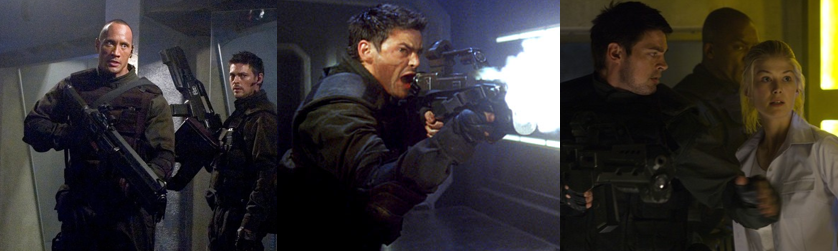
Specifically, these are events related to Reaper’s past. Ten years previously, he and his sister, Doctor Samantha Grimm (Pike), worked and learned alongside their parents on the dig site, only for them to witness their parents dying in a freak cave-in. Since then, Reaper has stayed away from Mars and grown apart from his sister, who followed in their father’s footsteps to become a genetic researcher. Sarge is sympathetic to this awkward situation in the first act or so and, though Reaper maintains his professionalism, it’s clear there are unresolved issues between him and Sam. For one thing, she doesn’t exactly approve of his dangerous and violent lifestyle; for another, he feels guilty at his estranged relationship with his non-identical twin sister. Sam has orders to download Doctor Todd Carmack’s (Russell) research data which, as far as she’s aware, isn’t anything troublesome or unethical. Instead, she believes they’ve been researching the mysterious humanoid remains found in the dig site, remains that speak to a Martian race that eliminated all diseases and gained superhuman strength through an additional fourth chromosome. As the bodies start piling up and monstrous demonic creatures start attacking the RRTS, Sam discovers Dr. Carmack was actually using C-24 in human experiments, creating the abominations that run riot throughout Olduvai. While Reaper shares her horror at these revelations, Sarge remains focused on their orders; he chews Reaper out for suggesting they destroy UAC property and refuses to believe that the infected masses can be cured of their condition. Indeed, the more the demons attack and the more men Sarge loses, the more the commander loses his grip on reality. At first, he’s seemingly willing to listen to reason and even has the civilians evacuated from the quarantine zone to Earth via the disturbing teleportation system (known as the Ark), but soon he’s ordering a mass purging to contain what he sees as an uncontrollable and violent outbreak. Sam’s the first to see the change in him, though Sarge’s own men and, soon, Reaper question his methods and orders. His obsession with killing all the scientists leads to him being dragged away by the demons, a fate he vehemently rejects, and being infected by C-24, which is naturally drawn towards the vile and wicked.
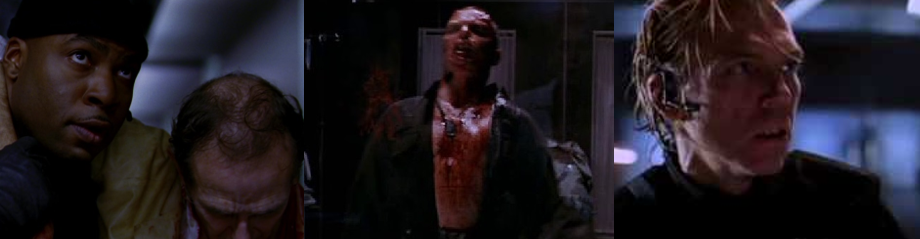
The RRTS are a colourful bunch at times. Each one has their own gamer tag handler ID and a couple even have unique weapons; Roark Gannon/Destroyer (Deobia Oparei), Duke’s surrogate family, carries a massive chaingun, for example. This tells you everything you need to know about Destroyer; he’s the big muscle who seldom speaks and gets up close and personal with his foes. Duke is far more outspoken and much more likely to crack wise; he’s immediately smitten by Sam and puts the moves on her even as she’s dissecting a demonic corpse. Excited by her passion, he even braves a nanowall, a piece of technology which he greatly fears, and is distraught when Destroyer is found beaten to death by a Hell Knight (Brian Steele). Eric Fantom/Goat (Ben Daniels) is even more uptight than Sarge, rightly expressing disgust with Portman’s filthy mouth and imagination. He’s also devoutly religious, ritualistically scarring himself whenever he takes the Lord’s name in vain. This means he’s the first to identify the mutated creatures as demons, and his faith also drives him to bash his brains in after he’s infected and begins to transform into a demon. Katsuhiko Kumanosuke Takahashi/Mac (Yao Chin) doesn’t get much to do or say; he’s left in charge of Marcus Pinzerowski/Pinky (Fletcher) and then gets his head lopped off before he can do much of anything. Luckily, the repulsive Portman is on hand to carry the load; a vile, self-styled ladies’ man, Portman disgusts his team with his antics (even Sarge rolls his eyes at his demeanour). However, he’s also the first to outright question Sarge’s orders; despite them facing a clearly unprecedented situation, Sarge stubbornly refuses to call in reinforcements and the two almost come to blows. Portman then takes it upon himself to defy orders and call for help, though his abrasive personality keeps Pinky from alerting the team when he’s attacked and killed. Finally, there’s the Kid, who’s so shaken up by the bloody situation that he begs Portman to slip him some pills. Inexperienced and hesitant, the Kid struggles with his abandonment issues as much as he struggles with Sarge’s orders, eventually standing up to his commander and being summarily executed for daring to defy him.
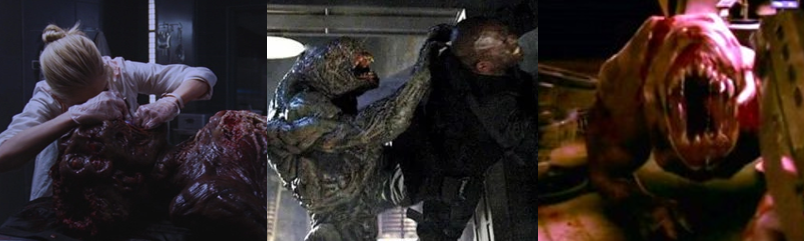
Sam’s research reveals that C-24 (and, by extension, the demons) triggers specific changes in different people based on their genetic makeup. For some, it grants accelerated healing and superhuman strength; for others, it turns them into unholy, monstrous creatures somewhat similar to the demons from the videogames. This means there’s no portal to Hell and no true demonic invasion; Goat coins the creatures demons based on his religious beliefs and Grimm dubs Olduvai “Hell” simply because bad things always happen there. Still, Olduvai is haunted by ravenous, mindless zombies; many of the scientists, including Dr. Carmack, are found this way, with limbs missing or greedily feasting on their victims. Others undergo a more extreme metamorphosis, become analogous to Imps (Doug Jones) and Hell Knights. This is about where Doom ends with its monsters; there are no Cacodemons, Lost Souls, or Cyberdemons here. However, Pinky is apprehended by an Imp and summarily infected. Apparently, his treatment of Portman was enough to trigger a disturbing transformation into a handicapped, bullish demon that catches Reaper off-guard and gnaws on his leg. The overreliance on zombies is disappointing (we’re even denied armed zombies), doubly so because the Imps and Hell Knights are brought to life through some great practical effects. Thanks to some great use of lighting (parts of the film are fittingly as dark as Doom 3), there’s a constant sense of dread in Olduvai’s tight, claustrophobic corridors. When the monsters do appear, it’s in low lighting and quick cuts, with them manhandling even the brutish Destroyer, tearing off limbs, and splattering arterial blood across the walls. Since the RRTS are unprepared for such a threat, their numbers are whittled down across the first two acts. However, when Sam takes a chance and injects C-24 into Reaper to save his life from an errant ricochet, he easily puts down zombies, Imps, and Hell Knights alike in a sequence most akin to the videogames (specifically Doom 3) but which also seems oddly out of place and literal for a videogame adaptation.
The Nitty-Gritty:
The primary human element in Doom is the troubled relationship between Sam and Reaper. Though she sent birthday cards over the years, it appears they haven’t spoken since their parents died and their paths and personalities couldn’t be more different. Sam revels in scientific exploration, excited at the prospect of learning more about Mars’ long-dead natives and potentially curing diseases, while Reaper is the consummate soldier, following orders without question until he sees the heinous experiments performed by Dr. Carmack. This even drives him to turn on Sarge, a man he’s seen to have a very amicable relationship based on mutual respect. Indeed, it’s Reaper who chides Portman’s insubordination, making it all the more significant when he first raises his weapon against Sarge after the demented soldier kills the Kid in cold blood. The C-24 thing is a bit odd, and not very Doom. It’s much more like Resident Evil (Capcom/Various, 1996 to present), as is the overuse of zombies; ironically, the inclusion of more vaguely recognisable demon-like creatures actually makes Doom a more accurate Resident Evil adaptation than Pul W.S. Anderson’s dismal efforts. It’s odd that the film takes this scientific angle on the source material, especially considering the rest of the film borrows so heavily from Doom 3. Like, it’s still set on Mars, still has the teleporter, still uses the recognisable weapons (even if “Big Fuckin’ Gun” is just a nickname here), and mirrors the dark, claustrophobic horror of Doom 3. Hell, there’s even blood writing on the walls, a 3D map system, and the screens all look very similar to those in Doom 3. So, you have a lot of visuals and the basic plot lifted from the game, but draw the line at literally having demons invade from Hell? Maybe it was a censorship thing, but then Doom has a lot of curses and bloody action, so it’s just weird to get so close to the source material and pull away from what really made the games so unique.
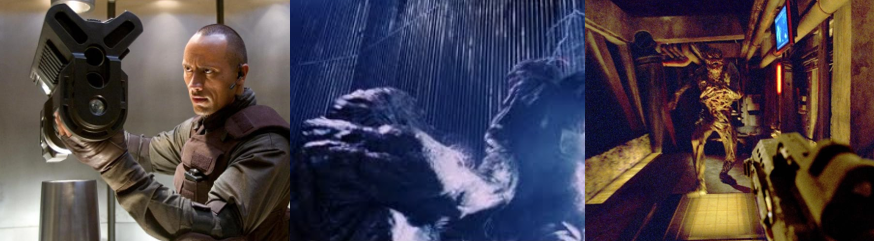
On the plus side, as I mentioned, the demons do look great. You never really get a good look at them but, like Alien, this only adds to the allure and horror. By its very nature, the film’s more Aliens than Alien, placing heavily armed Marines and gunfights at the forefront, but the foreboding atmosphere and mounting dread occasionally recalls Alien. The Imps and Hell Knights are grotesque, monstrous abominations; they don’t throw fireballs and plasma blasts, but one is wielding a chainsaw at one point and they’re not afraid to tear limbs and head off. In this version of the story, the demons attack everything in sight but only infect those whose DNA marks them as wicked or “evil”. The RRTS are perfect targets in this regard as even the most virtuous of them are marked by their violent lives and high body counts. Even being a spiritual man doesn’t spare Goat, so naturally Reaper is hesitant to get shot up with C-24 lest he be transformed into a monster. Instead, it turns him into a super soldier and essentially gives him the Berserk, Quad Damage, and Invincibility power-ups from the games as he embarks on an action-packed search for Sam, blasting anything that gets in his way, parkouring around the tight corridors and shaking off any damage. This entire sequence is shot in a first-person perspective, a dramatic shift from the rest of the film, and it’s certainly a choice. I enjoy it as an action sequence; it’s definitely unique and helps the scene stand out, but I wonder if it’s maybe too literal an adaptation of the videogames. Like, an earlier scene established the RRTS all have “kill cams”, a system barely utilised unless it’s to suggest the team’s in danger. This FPS sequence could’ve been reworked to an over-the-shoulder perspective that switched to the kill cam whenever Reaper took a shot. Or maybe we could’ve seen Pinky watching the team killing zombies from the kill cam’s perspective just to prepare us for this shift. It reminds me of the shifting comic panels used in Hulk (Lee, 2003), a stylistic visual choice that’s memorable, for sure, but lands a little hollow considering it just makes me wish I was playing the game instead of watching Reaper.
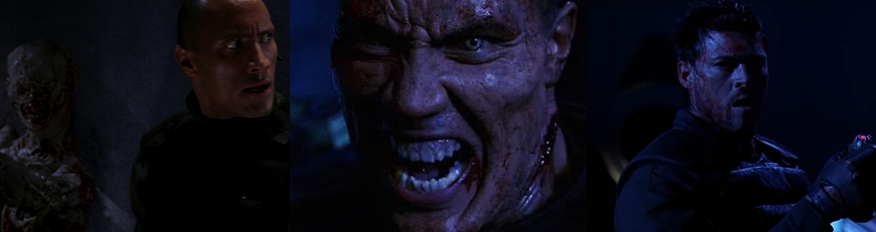
So, yeah, Sam has a look at the demonic corpses and realises they’re the Olduvai staff, infected by the creatures and transformed based on their DNA. She surmises (correctly, it pans out) that some will be empowered by C-24, but her and Reaper’s pleas fall on deaf ears and Sarge orders Duke and the Kid to execute everyone to contain the outbreak. Sarge is dragged off during an attack that also leaves Reaper bleeding out from a bullet, but he’s saved and becomes superhuman thanks to Sam’s intervention. However, by the time they catch up to Sarge, his morals and mind warped by the C-24’s influence, he’s killed all the survivors; he even murders the Kid, chastising his remaining men for their insubordination and firmly setting Reaper against him. However, Sarge has armed himself with the BFG, a massive cannon that fires an acidic plasma burst, leading to an explosive shoot out between the two that sees them exhaust their rounds and resort to settling things mano-a-mano. Yes, the Doom adaptation doesn’t end with Reaper facing off against a Cyberdemon or the Spider Mastermind, but in a fist fight with the Rock. Luckily, Reaper is super strong at this point and the fight is pretty brutal, with some tight, fun choreography (Sarge pulls out some ridiculous, physics-defying throws and slams) but it’s still a bit disappointing. Sarge doesn’t even mutate all that much from the C-24; he just grows some fangs and gets funky eyes and roars a bit, adding to the disappointment. I mean, at least give him a demon arm with claws, maybe screw up half his face, have him sprout spikes…just, something other than being the Rock looking annoyed. Thanks to them both having accelerated healing, the fight’s stakes are further lowered as they can’t really hurt each other. In the end, Reaper sacrifices his hand, impaling it on a length of metal Sarge wraps around his fist, to toss his demonic commander through the Ark. Naturally, Reaper immediately heals from this wound and finishes off Sarge by tossing a simple grenade through the portal; he doesn’t even blast Sarge in the face with the BFG or anything remotely cool. Reaper than gathers up Sam and takes the elevator back up to the surface, apparently relieved at having literally slayed his demons, and the film doesn’t even have the balls or the courtesy to end on a cliff-hanger to show the Earth’s been overrun by demons (or killed Reaper’s rabbit).

The Summary:
I’ve always had a soft spot for Doom. I first watched it when I’d only really played the first game and I enjoyed it for what it was, impressed by the practical effects, the dark atmosphere, and the obvious influence of Aliens. The Rock is pretty good here, playing against type and giving us a surprisingly nuanced character. You’d naturally expect him to be the main protagonist and, though he’s harsh, he’s a fair commander for the most part. But then he slips further into madness, before being infected and becoming a spiteful, vindictive antagonist. As I remember, Doom was the first time I became aware of Karl Urban and he’s great here. He plays the tortured, morally conflicted Reaper really well, being the likeable but tough soldier who steps up against injustice even if it means defying his commander. The rest of the RRTS are decent supporting players; some are more one-dimensional than others and just there to make up the body count, making me wonder if a smaller team wouldn’t have been better. It’s not like there weren’t civilians and scientists to be slaughtered by demons, after all. Speaking of, the demons look great; they’re shot just right so you never really get a good look at them and they’re absolutely brutal when they appear. Sadly, they’re just not in it enough and the film spends too much time building up to all Hell breaking loose. Consequently, Doom flounders in the middle, losing what momentum and intrigue it has. It tries to claw it back with the FPS sequence, but I wouldn’t blame you if you didn’t enjoy this as it is tonally odd with the rest of the film and, again, too literal an adaptation. Film is a completely different medium from videogames; no one pays to watch a movie to sit there and wish they were playing the game. It’s more miss than hit, as unique as it is, but the final fight between Reaper and Sarge is the most disappointing thing about Doom. Well, that and not committing to the Hell angle of the source material. Thus, Doom is a decent enough sci-fi action/horror with some fun moments but fails to live up to its potential and merely stands as a basic distillation of the videogames mixed with some liberal borrowing from other, better movies of the same ilk.
My Rating:
Pretty Good
Did you enjoy Doom? Do you think it did the source material justice or were you put off by the more science-based angle? Were you surprised that the Rock turned out to be the bad guy? What did you think to the FPS sequence? Were you impressed by the practical demons or annoyed by the dark lighting? Would you like to see Hollywood take another crack at adapting Doom? Whatever you think about Doom, or videogame adaptations, share your opinion in the comments and go check out my other Doom content.

 Dr. K's Waiting Room
5 thoughts on “Movie Night: Doom”