
With the release of Sonic the Hedgehog 3 (SEGA Technical Institute, 1994), gamers were introduced to Knuckles the Echidna. This mischievous, dreadlocked antagonist was created by Takashi Yuda and his debut was made all the more impressive by virtue of the fact that Sonic 3 was too big to fit on one cartridge. This meant that Knuckles was the first of Sonic’s supporting characters to co-star in a main series videogame when Sonic & Knuckles (ibid) was released on this very day in 1994.

Episode Title: “Friend or Foe?”
Air Date: 28 February 1999
Episode Title: “Flying Fortress”
Air Date: 31 March 1999
Episode Title: “No Hedgehog is an Island”
Air Date: 7 April 1999
Episode Title: “New Echidna in Town”
Air Date: 13 April 1999
Directors: Marc Boreal, François Hemmen, and Daniel Sarriet
US Network: BKN Kids II – UK Network: Channel 4
Stars: Jaleel White, Brian Drummond, Garry Chalk, Maurice LaMarche, and Peter Wilds
The Background:
After Sonic the Hedgehog blasted onto the videogame scene with Sonic the Hedgehog (Sonic Team, 1991), SEGA’s aggressive marketing campaign paid off dividends. Sonic’s popularity exploded after the release of Sonic the Hedgehog 2 (SEGA Technical Institute, 1992) and, suddenly, Sonic was everywhere, including two concurrent cartoons courtesy of DIC. While Adventure of Sonic the Hedgehog (1993; 1996) is generally criticised for its slapstick comedy, its darker counterpart, Sonic the Hedgehog (widely known as “SatAM”) is regarded as one of the defining cartoons of the nineties for its darker tone and mature themes. Although the cartoon inspired the original Archie Sonic comics, fans were left confused and disappointed when SatAM ended on an unresolved cliff-hanger. When the time came for SEGA to promote their up-coming Dreamcast, a new Sonic cartoon was commissioned, one that oddly took many visual inspirations from SatAM but told an entirely original story, one that owned more to Alvin and the Chipmunks (1983 to 1990) than its fan-favourite predecessor. Although Jaleel White returned to voice Sonic and his new siblings and writer Ben Hurst had some influence on the show, Sonic Underground became notorious for its musical interludes and struggled to find an audience thanks to the episodes being aired out of order. While the concept had even less to do with the source material than its predecessor (Sonic’s sidekick, Miles “Tails” Prower is nowhere to be found) and is widely regarded as one of the worst Sonic adaptations, Sonic Underground featured the debut of Knuckles the Echidna in Western animation and there was a sadly cancelled attempt to publish an epilogue to the much-maligned cartoon in 2013.
The Plot:
Whilst searching Planet Mobius for their mother, siblings, rebels, and rock stars Sonic, Manic, and Sonia (all voiced by White) cross paths with the distrustful and hot-headed Knuckles (Drummond). However, when the dastardly Doctor Robotnik (Chalk) manipulates Knuckles into providing him with a legendary Chaos Emerald, these four conflicting personalities must set aside their differences to oppose the doctor’s latest evil scheme.
The Review:
I watched all of Sonic’s cartoons when I was a kid. I distinctly remember watching Adventures of Sonic the Hedgehog every weekend, usually recording episodes for prosperity, and enjoying Sonic’s slapstick antics so much that I was shocked and confused when the entire tone and cast of the show suddenly changed. Sonic was no longer ridiculing Dr. Robotnik (Long John Baldry) and his minions and was instead the point man in an outnumbered resistance movement against a far darker, semi-cybernetic dictator much like in Sonic the Comic (1993 to 2002). I adapted to the new format and found myself enjoying Sonic’s dark escapades, only to be left further confused when SatAM ended on a massive cliff-hanger that teased a larger role for Dr. Robotnik’s long-suffering nephew, Snively (Charlie Adler) and a mysterious, red-eyed figure who I hoped would be Metal Sonic or even Knuckles! Sadly, we never got to see this ending resolved, even in the comics, and I was forced to adapt once again to an all-new Sonic cartoon, one that looked very similar to SatAM but was widely different and made the bold and frankly bizarre choice to lumber Sonic with two siblings. Why Tails and Amy Rose weren’t used in these roles I’ll never know but I was still a Sonic fan so I tried to give it a go, but to be fair I was about fourteen in 1999 so I was starting to veer away from cartoons like this.

Although “Flying Fortress”, “No Hedgehog is an Island”, and “New Echidna in Town” make up a three-episode story arc revolving around Knuckles and the Chaos Emerald, they were broadcast out of order and the character actually made his first appearance in the standalone story “Friend or Foe?” Following the surprisingly catchy opening theme song (one of the few highlights of the cartoon), the episode finds Sonic, Sonia, and Manic travelling to the “dreaded” Floating Island in search of their long-lost mother, Queen Aleena Hedgehog (Gail Webster, and running afoul of boobytraps laid across the island by its mysterious echidna guardian. As ever, Dr. Robotnik is lumbered with two bungling minions: sleazy-but-cunning wolf Sleet (LaMarche) and the block-headed Dingo (Wilds), who transforms into different forms at the touch of Sleet’s remote controller. The two are ordered to the Floating Island to poison Knuckles’ mind against the hedgehogs, distracting him so they can steal the Chaos Emerald and send the island (and their enemies) plummeting to the ground. Thanks to a hilariously bad holographic fake, Knuckles is easily tricked and takes off to confront the three hedgehogs right as they learn from one of the island’s “sacred pools” that their mother was (and possibly still is) there. Despite Sonia’s best attempts to keep the peace, a sluggish and awkward scuffle breaks out between Knuckles and Sonic, which ends with the Sonia and Manic exploring the island’s underground caverns (in a close approximation of the Hidden Palace Zone) and learning of Knuckles’ deception. Although Sonic talks sense into Knuckles, they’re too late to stop Sleet and Dingo from stealing the Chaos Emerald and endangering the island. Luckily, Dingo is distracted by his lust for Sonia and the baddies are forced to flee without the emerald while the three fend off a contingent of SWATbots. In the aftermath, the siblings make amends with Knuckles, who reveals that he knows Queen Aleena and that she left a message indicating that he would become a pivotal ally in their crusade.

A few episodes later, the siblings are relaxing at the beach when they’re attacked by Dr. Robotnik’s spherical “Fortress of Altitude” (almost a downgraded version of the Death Egg or the Egg Carrier), a flying fortress capable of bombarding his foes and shrugging off the laser blasts from their magic weapons thanks not only to being comprised of “Mobibindum” but also being powered by a Chaos Emerald, which atomises everything it touches. After fending off Dr. Robotnik’s SWATbots and evading the flying fortress, the siblings seek out Knuckles’ help. Initially reluctant to leave the Floating Island, Knuckles is convinced by their awful song (“No One is and Island”), though his resolve falters when the astral spirt of his great-grandfather, Athair (LaMarche), warns that this will result in a greater calamity. After easily fooling Dr. Robotnik with a decoy, Knuckles and the others slip aboard the flying fortress, avoid the ship’s defences, and burrow their way to the Chaos Emerald thanks to Knuckles’ super strength. However, after being callously dismissed by Dr. Robotnik, Sleet and Dingo claim the Chaos Emerald for themselves to both stand on their own and to try and prove their worth to their master. This causes the fortress to fall from the sky and into the sea below. Crippled by hydrophobia and unable to swim, Sonic relies on his family and friend to help get him to safety, but Sleet is stunned when usually thick-headed Dingo swipes the gem for himself! However, Dingo accidentally drops the Chaos Emerald, shattering it and unleashing a wave of unbridled Chaos Energy across the land that causes storms, earthquakes, and threatens the entire planet.
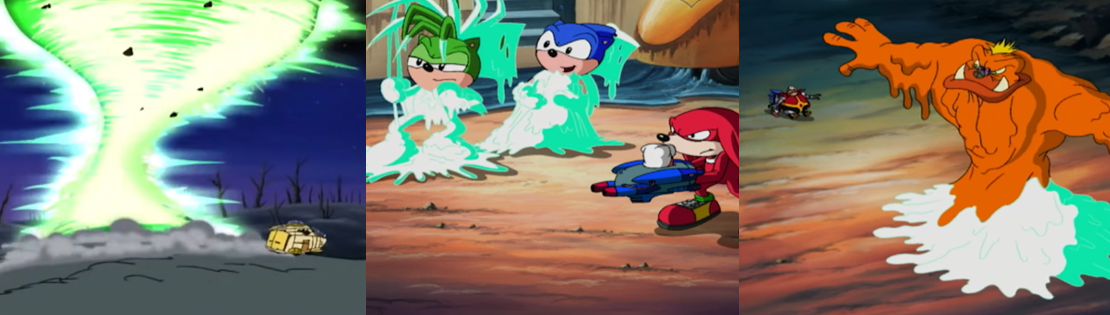
After his despair is lifted by another of the band’s terrible songs (“Learn to Overcome”), Knuckles leads them to his great-grandfather, who gifts them a special canister to house the shattered pieces and reveals that the only way to save the world is to ally with Dr. Robotnik. Naturally, Sonic and his siblings are aghast at this, but Knuckles is reluctant to defy his elder, especially with the fate of the world at stake. With the planet literally shaking apart from the rising Chaos Energy, the siblings race to find Knuckles and find another way to solve their problem, only to find that he’s been coerced into capturing them on Dr. Robotnik’s orders in exchange for the tyrant’s help in saving the world. Regretfully, Knuckles betrays his friends, only to be immediately double-crossed when Dr. Robotnik reneges on his promise not to roboticize the hedgehogs. Angered by this, a remorseful Knuckles fights back and frees his friends from their sticky bonds and joins them in searching for the Chaos Emerald, but they’re too late to keep Sleet from finding it and containing it in Dingo. This results in Dingo absorbing a full dose of Chaos Energy and transforming into a mindless, clay-like beast that threatens friend and foe alike. In what could arguably be described as a very loose adaptation of Sonic Adventure (Sonic Team, 1998), Dingo goes on a rampage that not only causes a series of volcanic eruptions but also destroys Manic’s magic drum set before heading to nearby Robotropolis, forcing Sonic to manipulate Dr. Robotnik’s ego to help subdue the beast. Toppled by the band’s music (“The Mobius Stomp”) and Dr. Robotnik’s special glue, Dingo spits out the Chaos Emerald, reverting to normal and saving the world and earning him his master’s ire. Knuckles then delivers the reassembled Chaos Emerald to Athair. Although the old echidna charges him with safeguarding the gem on the Floating Island, but the band promises that Knuckles will always have a place with them whether near or far.
The Summary:
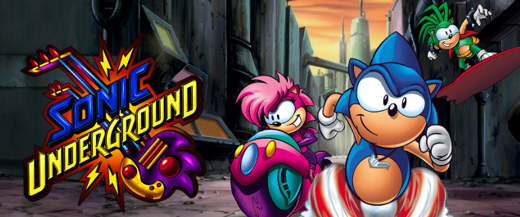
Although the show has little in common with SatAM, Sonic Underground’s Sonic remains the same boastful, reckless speedster. In place of Princess Sally Acorn (Kath Soucie), Sonia acts as the voice of reason and intelligence in the trio, chastising Sonic’s irresponsible nature and emphasising diplomacy over impulsiveness wherever possible. Manic is characterised as a laid-back surfer dude who’s not as reckless as Sonic but still isn’t as attentive as Sonia. However, while Sonia might be the smartest of the bunch, she’s from an entirely different world to both. Sonic was raised to be a Freedom Fighter by his beloved Uncle Chuck (LaMarche) and has been fighting Dr. Robotnik for as long as he can remember, Manic is a streetwise thief, and Sonia comes from a life of privilege and luxury. All three were united by a common enemy when Dr. Robotnik roboticized the only family they ever knew and wield magic medallions that transform into music instruments that act as weapons, but Sonic Underground continuously emphasised their strength as a unit more than any previous Sonic cartoon. While Sonic possesses incredible speed, he’s impulsive and also crippled by hydrophobia. Sonia might have some fancy martial arts moves but she’s often too easily trusting of wealthy folk, who are often in Dr. Robotnik’s pocket. And Manic generally gets himself into trouble since he can’t help but half-inch when the temptation arises.
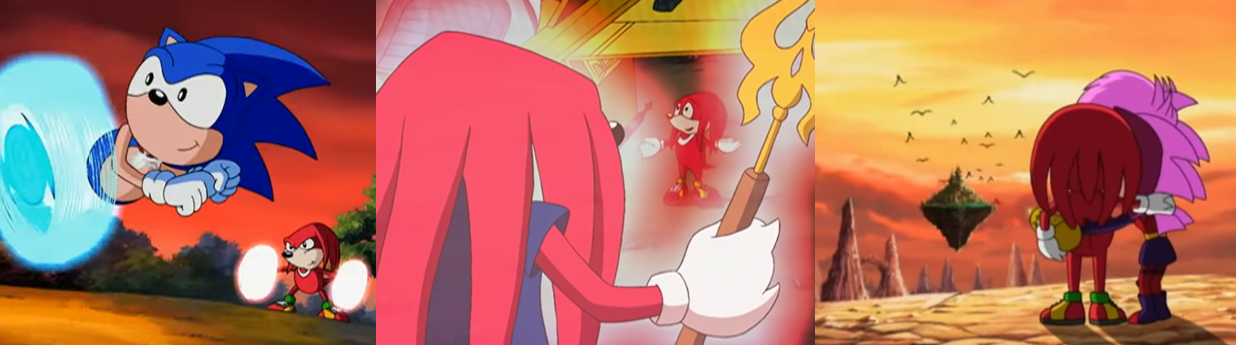
Of the three Sonic cartoons that aired in the nineties, Sonic Underground is somehow the most bizarre. Its tone is all over the place, lacking the ominous menace of SatAM but also veering more towards comedy like Adventures. Despite still being lighting fast and capable of bending physics, Sonic is surprisingly weak here. Perhaps because of the need desire emphasise themes of teamwork and friendship, Sonic is not only hampered by recklessness but shows fear when confronted by large groups of SWATbots, sluggishly fumbles through his initial fight with Knuckles, and succumbs to an uncharacteristic panic when left floundering in the ocean. Although the Floating Island is common knowledge in Sonic Underground and easily accessible, it’s far more accurate compared to the small mass seen in SatAM. It’s large, with a variety of different environments and wildlife on its soil, and Knuckles is later seen using a radar and communications system, and anti-aircraft cannons to fend off intruders. Knuckles’ reputation proceeds him to the point where even Sleet is aware of how tough he is and his skill at laying traps, and he makes an immediate impression by capturing the two dolts and roasting them over a spit for the local wildlife! However, as fleet-footed and super strong as he is, and despite showcasing a distrustful and snarky attitude, Knuckles is easily duped by Slate and Dingo and, like every character here, suffers from atrociously bad animation, appearing pudgy and disproportionate every time he moves. Knuckles’ go-to move is to spin his arms like a buzzsaw to rapidly burrow through surfaces. Just doing this is enough to knock Sonic on his ass and impress Manic, and Knuckles proves durable enough to withstand Sonic’s patented “Triple Spin Attack” and wily enough to use his knowledge of the island against his foe. Knuckles takes his role of guarding the Floating Island very seriously, to the point where he’s isolated himself from the rest of the world, but he’s equal loyal to his newfound friends and defies his instincts, and the will of his great-grandfather to aid them even though he’s extremely uncomfortable with leaving his island unguarded.
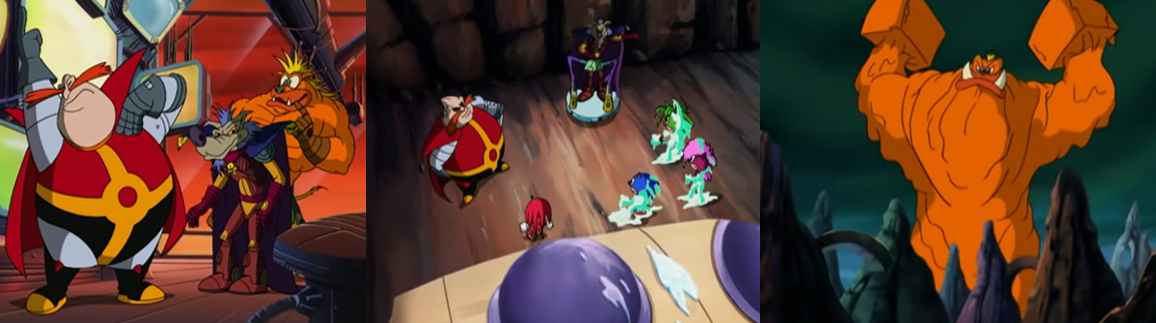
There are some benefits to this for Knuckles; namely, that he spends more time socialising with his friends and bonding with Sonia, with whom he develops a mutual attraction. However, there are major drawbacks, too. Most notably, Knuckles is naïve and easily fooled; not only does he fall for Sleet and Dingo’s lies about the hedgehogs, he trusts his great-grandfather’s word so blindly that he willingly allies with Dr. Robotnik despite knowing full well of the semi-cybernetic dictator’s malicious nature. While he looks just like SatAM’s Dr. Robotnik (save for sporting two robotic arms) and even resides in a similar citadel in the heart of Robotropolis, this Dr. Robotnik lacks the gravelly, mechanical voice, employs wildly different SWATbots, and often spares the aristocracy the indignation of roboticization in return for hefty bribes. Although Dr. Robotnik appears to be at his most dangerous when he launches his Fortress of Altitude, the airship is as disproportionate and inconsistent as everything else on the show. The Mobibindum apparently makes it super heavy and tough, yet both Sonic and Knuckles smash through its structure without issue and a simple drop in the ocean is enough to trash the fortress and leave it literally blowing up in the dictator’s face. Even when Mobius is being torn apart around him, Dr. Robotnik finds a way to turn things in his favour. He’s willing to see the world destroyed if it means being rid of Sonic and strong-arms Knuckles into doing his bidding so that he can have the final victory of his hated enemies. Honestly, there are only a few episodes of Sonic Underground that are worth watching and these four are a handful of them. The animation and voice acting is atrocious (it’s insane that Jaleel White voices all three siblings), with Knuckles sadly getting the worst of both, but it was nice to finally see him in a Western Sonic cartoon. It’s not enough to salvage the series but it certainly makes these episodes more enjoyable. If only it had been an actual continuation of SatAM, it could’ve been even better.
My Rating:
Could Be Better
Were you a fan of Sonic Underground? What did you think of the four Knuckles-centric episodes? Were you disappointed that we never got a continuation of SatAM? Which of Sonic’s siblings was your favourite and what did you think to the use of rock music in the show? Are you celebrating Knuckles’ big day today? Whatever you think about Sonic Underground, and especially Knuckles, leave a comment down below or let me know by commenting on my social media.

 Dr. K's Waiting Room
3 thoughts on “Screen Time & Knuckles: Sonic Underground & Knuckles”