

Released: 23 August 2024
Director: Rupert Sanders
Distributor: Lionsgate
Budget: $50 million
Stars: Bill Skarsgård, FKA Twigs, Danny Huston, Laura Birn, and Sami Bouajila
The Plot:
When troubled youth Eric (Skarsgård) and his girlfriend, Shelly (Twigs), are brutally murdered on the orders of demonic crime lord Vincent Roeg (Huston), a supernatural crow resurrects Eric to take his revenge.
The Background:
Created by James O’Barr in 1989, The Crow was an underground success that reflected O’Barr’s anger and pain after a tragic loss to. Since dark comic book narratives were all the rage in Hollywood at the time, the comic soon transitioned into a critically and commercially successful film adaptation, one that achieved cult status and infamy after the accidentally on-set death of star Brandon Lee. Determined to capitalise on The Crow’s (Proyas, 1994) success, series producers Edward R. Pressman and Jeff Most signed off on a slew of sequels and even a short-lived television show that was notably better received than the three cinematic and direct-to-video follow-ups. Following the universally panned fourth movie, the franchise entered Development Hell for nearly twenty years as various writers, directors, and actors were attached to a potential reboot. Stephen Norrington was in talks to direct at one point, stars Bradley Cooper and Jason Momoa were tapped for the lead role, production was stalled by financial issues, and series creator James O’Barr stated repeatedly that the new film would be a “re-adaptation” of the source material rather than an outright remake just as Alex Proyas slammed its production. Finally, in 2020, the project was revived and gained traction; Bill Skarsgård won the lead, impressing director Rupert Sanders with his conditioning and enthusiasm, and harmless firearms were mandatory onset to avoid a repeat of Brandon Lee’s tragedy. Upon release, The Crow was met with largely negative reviews that reflected the reactions to the film’s trailers. The chemistry and performances of the leads was questioned, the pacing was slandered, and even more positive spins decried it as derivative of the original and ultimately unable to escape the shadow of its predecessor. Given the franchise’s persistence, it should be no surprise that the ending was reportedly tweaked (against Skarsgård’s objections) to leave the door open for a sequel, though the film’s dismal $24 million box office makes the prospect unlikely.
The Review:
I’ve been a fan of the Crow concept since I was a kid and we first taped the original movie off the television. From there, I discovered the original graphic novel (which, honestly, took me a little while to properly appreciate) and I delved into the movie sequels hoping to at least see more of the same. Unfortunately, it seems The Crow was lightning in a bottle and none of the follow-ups came close to matching the movie’s aura and appeal, which is weird to me as the concept is pretty simple and I maintain there’s a lot of material in the comic (and its follow-ups) that could make for a good film. Like, why not do it hyper-stylised and hyper-violent, like the Sin City movies (Rodriguez and Miller, 2005;2014)? Or take inspiration from The Crow: Dead Time (O’Barr, et al, 1996) or The Crow: Flesh and Blood (Vance, et al, 1996), maybe put a twist on the story and have Shelly be the one resurrected? I was cautiously optimistic for this long-gestating remake, hopeful that it would go for grim and gritty and try to get back to the roots of the concept, but immediately lost faith once I saw the first trailers and went into it hoping that it would at least be full of enjoyable, bloody action. My first wish (that it does something different with the concept) was kind of granted in that a huge portion of the film focuses on Eric (not Draven) and Shelly (no last name) and their budding attraction to each other. Unlike in the original, we spend a significant amount of time hanging with the two, seeing them flirt and play and fuck and apparently fall in love, and the entire time I was thinking to myself…I just don’t care. It’s so weird. Like, I felt more of an emotional connection to Shelly Webster (Sofia Shinas) in the original film and she only appeared in flashbacks or as an apparition. Her and Eric’s (Brandon Lee) love and relationship was conveyed through fragmented memories, both happy and agonisingly violent, and through Eric’s pained, righteous anger. Yet, here, we see the two coming together and finally finding some peace together and I just couldn’t buy into it was it seemed so shallow and hollow.
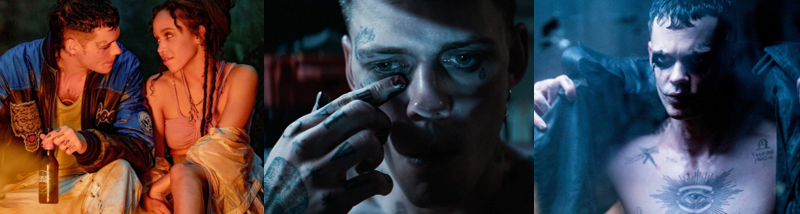
It doesn’t really help that we really don’t learn much about them. The film opens with a dream sequence from Eric’s childhood where he was apparently traumatised by the death of his beloved horse and it’s implied that his alcoholic or addict mother (Unknown) was abusive, then jumps to him in rehab, covered in ludicrous tattoos, and moping about, barely speaking and being further abused by his fellow inmates and the strangely aggressive guards. We’re told he turned to drink and drugs but never learn what he went through in the interim or what drove him to cut his wrists, and instead are presented with this sullen, damaged young man who’s essentially sleepwalking through life. In contrast, we do eventually learn a bit more about Shelly, but it still feels like pieces are missing from her puzzle. She begins the film freaked out because her friend, Zadie (Isabella Wei), is killed for recording some mysterious video of them and their friends at some party, then randomly gets arrested for possession and is locked up with Eric, whom she becomes attracted to because the script says so. when her mother, Sophia (Josette Simon), shows up with the mysterious Marian (Birn), Shelly has a partial panic attack and Eric encourages the two to flee. After escaping with ridiculous ease, the two then hole up in Shelly’s apartment and her pursuers never think to check there while the two shack up, befriend a bunch of unnamed fellow lowlifes, and revel in their freedom, despite apparently having no jobs or income (beyond, I guess, drug dealing?) eventually, Shelly opens up about being her past as a piano prodigy and Eric later learns that she was targeted by the enigmatic Vincent Roeg, who preys upon innocent souls and corrupts them with a demonic whisper. Since Shelly had video evidence of Roeg’s supernatural abilities, he eventually has his men storm the couple’s digs and suffocate them to death with plastic bags, condemning Shelly’s soul to eternal damnation since she was manipulated into stabbing a girl to death by Roeg’s influence. While Eric returns from the grave, Shelly also pops up here and there as a phantom, in Eric’s memories, or as he uncovers more of her past and she’s honestly a more fleshed out character than he is, and she’s cute and serviceable enough, but I struggled to believe the strength of their love since I didn’t see a lot of chemistry between the two.
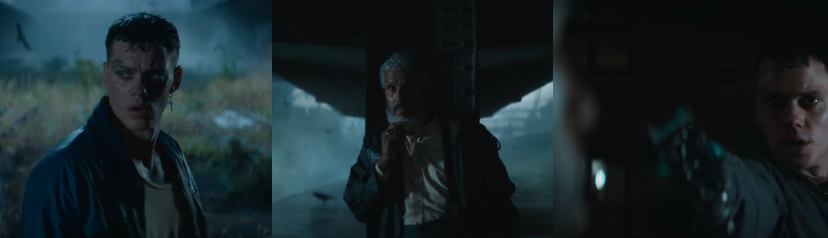
Upon being killed, Eric immediately awakens in a mysterious, desolate landscape dominated by crows (what I would describe as purgatory). There, he meets a shadowy figure the credits call Kronos (Bouajila) who basically acts as an exposition dump for what’s happened, delivering the famous “People once believed…” line from the original film and describing Eric’s situation and abilities. It’s honestly a little insulting, especially as we didn’t need such ham-fisted exposition in the original film; probably due to Brandon’s untimely death, all of his supernatural powers were conveyed using a simple “show, don’t tell” method but here, Kronos lays it all out to the stunned Eric, who returns to the living world a short time later not by bursting from his grave but by waking up on the apartment floor. Confused and disoriented, he attacks and kills corrupt cop Detective Milch (Dukagjin Podrimaj) when he comes to search for Shelly’s phone and discovers that he can heal from any wound, though isn’t spared the agony of bullet wounds and broken bones. Guided by a supernatural crow, Eric wanders about the streets, largely in disbelief about what’s happened, desperately trying to put names to the faces of his murderers; although he ends up as clueless as we are until the credits, he does stumble upon one of Roeg’s men, only for him to commit suicide rather than talk. Even Sofia is largely tight-lipped about providing him with information, though “luckily” Roeg is aware of the crow’s nature and sends his goons out to find Eric so he can steal his powers, meaning Eric gets to take out some baddies and the guys that wronged him, but he’s hardly as proactive as his predecessors.
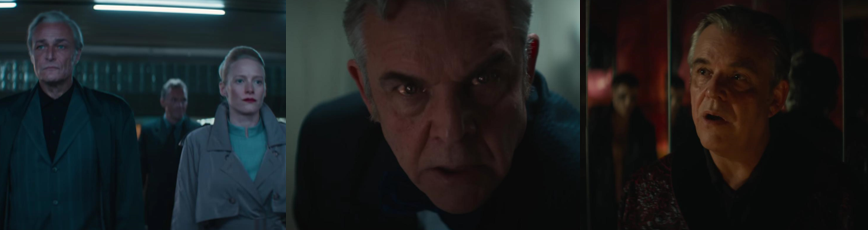
Although he lacks any formal fighting training and is unfamiliar with guns, Eric attempts to outfit himself and largely holds his own in a fight by relying on his supernatural healing. He simply ploughs ahead, absorbing damage and enduring the pain of resetting broken bones or healing from wounds. This time around, he remains virtually indestructible as long as his love for Shelly remains pure. While I would’ve expected this to factor into the finale, rendering him mortal as in previous iterations, this becomes a throwaway moment in the second act, when his belief in Shelly falters after watching her video and he dies a second time, forcing him to barter his soul for hers to return once again, finally donning a version of the iconic face paint and committing himself to his mission. This turns him from a melancholy, reluctant avenger to a stoic, enraged crusader as he systematically slaughters a bunch of goons with a sword, cutting his way through a wave of nine-to-fivers to reach Marian, who finally points him in Roeg’s direction. It’s hard to watch The Crow without comparing it to The Crow, but one area where it really fumbles the ball is in the bad guys. Instead of an eclectic bunch of over the top, memorable, despicable glorified street punks, we have a handful of unnamed goons who get so little screen time that I found myself forgetting which ones were responsible for Eric and Shelly’s death. The only one who stands out is Marian and, again, I have no idea who she is or what her motivations are. Roeg’s power is said to manipulate, corrupt, and control, so I assume they all follow him out of a desire for power or because he has leverage over time, but we learn nothing about any of them. They’re just people for Eric to kill, and while he may gain some catharsis and satisfaction from their deaths, I was briefly entertained by the blood splatter and then immediately forgot them. The exception, of course, is Roeg, played with quiet menace by the ever-reliable Danny Huston. He’s said to be centuries old, to have made a deal with the Devil, and corrupts innocents to keep himself out of Hell but…we never learn how this deal came about or anything about him except his predication for young piano players. He desires Eric’s powers, of course, and seems to covet power in general over everything else, but he’s such a vacuous and forgettable character compared to Michael Wincott’s Top Dollar and none of his underlings were as memorable as the latter’s gang of sadists.
The Nitty-Gritty:
As is to be expected, a central theme of The Crow is love. Eric and Shelly are both damaged and lonely individuals, one seemingly tortured by an abusive childhood and the other forced into horrendous acts against her will. Shelly apparently sees a reflection of herself in Eric, or perhaps feels whole with his damaged parts literally and figuratively filling the void in her soul, and they’re portrayed as carefree youngsters who live outside the system. Yet, while they may make for passionate lovers, I never felt like their love was anything more than the fiery lust of the young and attractive. Draven and Webster were a proper couple, set to be married, when they were killed, having built a life together filled with passion, fashion, and music. Eric and Shelly get drunk and high and doss about with their mates. Considering the threat Shelly knows Roeg represents, it seems weird to me that they didn’t go on the run and stayed not only in town but in her apartment; almost as weird as Roeg not sending his men there right away. Eric is especially disappointing; even if he’d had a different name so as not to be associated with Brandon Lee’s character, he’s such a sulky little emo try-hard, with his “edgy” tattoos and lethargic attitude, that I found it hard to care about him. He has none of Draven’s charisma or concern for others; he’s purely motivated by his emotions, slaughtering anyone in his way and struggling to understand what’s going on. He’s a very ineffectual avenger, something Kronos chastises him for, until the finale, where he finally accepts the responsibility placed on him and comes close to giving a decent interpretation of the character. Similarly, the soundtrack is noticeably lacking; sure, I’m an old man who isn’t into the weird tunes featured in this movie, but the lack of emo-infused, gothic rock and traditional heavy metal really works against the aural identity of the film as much as the bland setting keeps it from standing out visually.
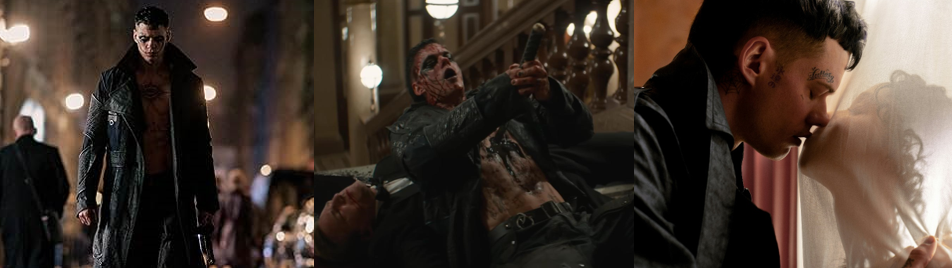
So, okay, maybe The Crow makes up for all this with action and gore. Well…no. yes, there is a lot of blood splatter and some creative, gory kills (certainly more than in the original film) but they’re not seen until the final act. Eric and Shelly are killed in a terrifying, but toothless manner compared to their counterparts and many of Eric’s later kills boil down to headshots and quick swipes of his sword. The opera slaughter (easily the best sequence in the film) is thus a highlight, with Eric cutting through waves of henchmen, slicing off arms, cutting through jaws, and absorbing every shot like a juggernaut, revelling in his bloodlust. His earlier freeway fight was okay, but lacked the focus and physicality of this scene, though naturally none of the antagonists offer a physical challenge to him given his supernatural abilities. There was a brief moment where this seemed to be a point of contention: Marian mentions how Eric, covering in the blood of his victims, has “the same look” as Roeg and Roeg explicitly states that Eric’s lust for revenge has cost him his humanity. Then it’s just swept under the rug and forgotten. Similarly, it seems Roeg is set to follow in Judah Earl’s (Richard Brooks) footsteps and steal Eric’s power using a combination of his demonic voice and Eric’s “black blood”, but that doesn’t happen either. Instead, Eric transports them to the crow’s realm and beats the old man to a pulp until he’s spirited away by demons. As per his deal, Shelly is returned to him and to life, with time apparently rewinding slightly to see her resuscitated soon after being suffocated. Eric remains dead, but seemingly chooses to wander purgatory, halfway between life and death, sure that their souls will reunite someday. Honestly it’s a bit of a confusing ending; almost as confusing as Roeg’s powers and background. Personally, I’ve always disliked that the Crow franchise has included other supernatural elements as they’ve progressed; to me, the avatar should be the only supernatural thing, set against earthly beings who must find other ways to combat him. But then again I also think The Crow is worthy of being more than just a plodding, generic, confuddled mess of a film. A sentiment Hollywood seems not to share.
The Summary:
I wanted to bee excited for The Crow. I genuinely believe a new version or adaptation of the story or concept could work, especially if it took a hyper-stylised or gritty, gothic aesthetic. Instead, The Crow is as generic as I feared and, I suspect, spent way too much time overthinking the concept. We didn’t need everything explained to us by Kronos and, arguably, we gained very little from following Eric and Shelly up to and past their deaths. I didn’t feel an emotional connection to them and, trust me, I wanted to. I kept waiting, begging, for the film to kick into gear and get started only for it to keep dragging its feet, giving us mopey emo-dude looking clueless when the obvious happens around him or is explained to him. For me, he should’ve taken on the familiar guise after his second resurrection and been all-in from there. I also wonder if the film would’ve been fitted from being told out of sequence, with the relationship aspects scaled down and reduced to nightmares and flashbacks. Also, the villains just missed the mark completely. There’s only so much Danny Huston can do with such limited screen time and development, and none of his underlings were as remotely memorable as those seen before. Even the brutal action sequences and copious blood can’t save The Crow, which is so far away from the spirit of the original that I wouldn’t call this a remake or a reboot, more a re-imagining. It’s a real shame as we’ve endured so many terrible Crow sequels and the concept deserves so much better, but do yourself a favour and just watch the original again because this tripe is as dull as dishwater and, worst of all, completely and immediately forgettable.
My Rating:
Terrible
Did you enjoy The Crow? Do you think the film added some interesting new wrinkles to the formula or did you find it generic and tasteless? What did you think to Bill Skarsgård’s performance and Eric’s characterisation? Did you like the addition focus on his relationship with Shelly? What did you think to Roeg and his largely forgettable henchmen? Which of The Crow’s sequels was your favourite, if any, and would you like the see the character return again? Whatever you think about The Crow, join the discussion below and go check out my other Crow reviews.

 Dr. K's Waiting Room
3 thoughts on “Movie Night: The Crow (2024)”