

Released: 21 December 2018
Originally Released: 30 June 1982
Developer: Nintendo R&D2
Also Available For: Arcade, Atari, BBC Micro, Coleco Adam, ColecoVision, Family Computer Disk System (Famicom), Intellivision, GameCube (via Animal Crossing (Nintendo EAD, 2001)), Nintendo 3DS (Virtual Console), Nintendo Entertainment System (NES), Nintendo Wii, Nintendo Wii U (Virtual Console)
A Brief Background:
In early 1980, Nintendo were in a spot of bother; their plans to expand into North America with Radar Scope (Nintendo R&D2/Ikegami Tsushinki, 1980) had failed, so then-president Hiroshi Yamauchi tasked young designer Shigeru Miyamoto to create a new arcade cabinet to turn things around. After plans to adapt popular comic strip character Popeye fell apart, Miyamoto took inspiration from Beauty and the Beast (Barbot de Villeneuve, 1740) and King Kong (Cooper and Schoedsack, 1933) to create Donkey Kong (Nintendo R&D1/Ikegami Tsushinki, 1981), a financial and critical success that introduced players to “Jumpman”, who would go on to become Nintendo’s mascot, Super Mario. During Donkey Kong’s development, many of the team’s concepts had to be cut due to time and hardware constraints. As they worked to develop these further, and given Donkey Kong’s success, the team developed a follow-up title that was initially planned to star the cantankerous ape himself before a smaller, more manageable substitute was created. Although Donkey Kong Jr. is now one of Nintendo’s more obscure characters, having largely been supplanted in the 16-bit era, Donkey Kong Jr. was very successful in its native Japan. Reviews praised the colourful presentation and gameplay loop and the game became very popular in the competitive play arena.
The Review:
Donkey Kong Jr. is, essentially, more of the same game as its predecessor. Like Donkey Kong, players can pick from four game modes: two single-player options and two two-player options, with “Game B” being the more difficult of the two as it includes more onscreen enemies. Regardless of which mode you pick, Donkey Kong Jr. utilises the same simplistic control scheme as before, with A being the only button you need to press to jump over enemies, to vines, and across platforms. Donkey Kong Jr. has the rare distinction of being perhaps the only Mario-adjacent videogame where the portly plumber is an antagonist. Players now control the titular Donkey Kong Jr., a stout baby ape who slowly clambers up vines, quickly slides down them, and whose only method of attacking the many critters Mario sends out to obstruct him is to touch various fruits high up on vines; these will then fall, destroying any enemies beneath them. While Donkey Kong Jr. is a far more complex-looking sprite, with a humorous and over the top death animation and being slightly more animated overall, he’s no less clunky and actually less useful than Mario was in the last game as his hit box is bigger and he doesn’t get a hammer power-up. There is a spring on one screen, but it’s just as likely to send you plummeting to your death as it is to the next platform, so you’ll need to carefully time your jumps to avoid enemies and snag some points. But don’t take too long; like in Donkey Kong, the longer you take, the lower your bonus score will be upon completing a screen, which in turn impacts your high score. While you don’t seem to earn extra lives by accumulating points and there’s no high score table to display your best score, it is displayed at the top of the screen and is the only goal available to work towards so you may be somewhat protective of this.
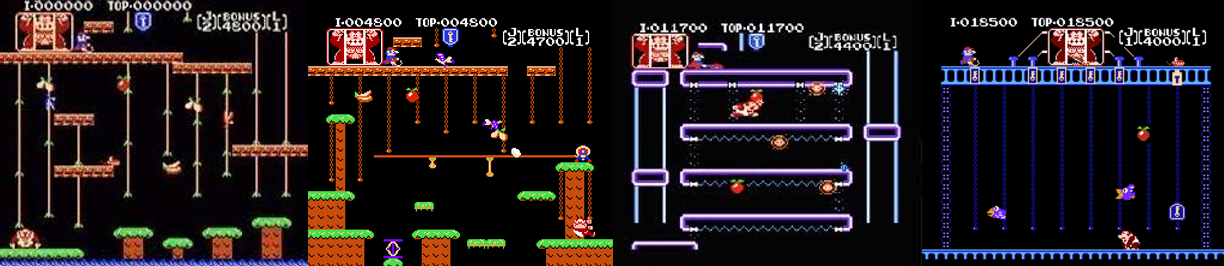
Donkey Kong Jr. is comprised of four screens that repeat in a nigh-never-ending loop until you finally die, with the enemies increasing in number and aggression the more you play. In three screens, your goal is to reach the top, acquire a key, and scare off Mario, and this culminates in a final showdown where you need to take down the devious plumber and rescue your kidnapped father. In the first screen, you simply navigate between vines being careful not to fall in the static water below or even drop a short distance as both will instantly kill you. In the second screen, you’ll bounce on the spring to smaller moving platforms and use a pulley to cross a gap and, in the third screen, you’ll hop over electrical hazards that erratically move back and forth across the platforms. Finally, you’ll climb up six chains, pushing six keys up to a bridge and avoiding bees and little alligators. Once you’ve pushed all six up to the top, the bridge is destroyed, Mario is defeated, and Donkey Kong is rescued and it all begins again until you either lose all your lives or quit from boredom. Although the game lacks the iconic music of its predecessor, each screen has some fun little jingles and sound effects but nothing especially innovative. Donkey Kong and his son are the most colourful and visually interesting sprites, with Mario only impressing due to him wielding a whip this time around, and the enemies are simply snapping alligators, egg-dropping birds, and electrical bolts. Naturally, this version allows you to create save states and rewind the game if you make a mistake, effectively destroying any difficulty curve it might’ve had and reducing the average playtime to around ten minutes.

The Summary:
Donkey Kong Jr. reeks of cheap, money-grabbing desperation. Donkey Kong was an innovative and popular arcade release and it’s obvious that Nintendo simply wanted to capitalise on that with a “new title”, but there’s very little new about this game. Sure, moving to vines is different and having to time fruit-grabbing to defeat enemies adds a little more strategy and I quite liked the final showdown with the keys on the chains, but the gameplay experience is largely the same and lacks a lot of the nostalgia and charm of its predecessor as the setting is so weird. Even now, it’s bizarre seeing Mario as a whip-cracking antagonist. Donkey Kong Jr. has a lot of visual appeal, but I wonder if this game might’ve been better if Junior actively chased Mario across the stages? Or if a two-player mode saw one player as Junior and the other as Mario trying to intercept him? I feel like Nintendo could’ve bundled these two games together into one experience at the time, creating an eight-screen loop where you first track down and capture Donkey Kong and then switch to Junior to rescue him, but, as is, I can’t see myself choosing to play Donkey Kong Jr. over its more popular and nostalgic predecessor.
My Rating:
Could Be Better
Did you ever own Donkey Kong Jr. for the NES back in the day, or play the arcade version out in the wild? How do you think it compares to Donkey Kong? What did you think to Junior and seeing Mario as an antagonist? How far did you get in the game before you failed or quit? Which Donkey Kong videogame is your favourite and why? How are you celebrating Donkey Kong’s anniversary this year? Whatever your thoughts on Donkey Kong, feel free to leave a comment below or on my social media, and check out my other Donkey Kong (and Mario) content on the site.

 Dr. K's Waiting Room
5 thoughts on “Mini Game Corner: Donkey Kong Jr. (Nintendo Switch)”