
January sees the celebration of two notable dates in science-fiction history, with January 2 christened “National Science Fiction Day” to coincide with the birth date of the world renowned sci-fi writer Isaac Asimov, and HAL 9000, the sophisticated artificial intelligence of Arthur C. Clarke’s seminal 2001: A Space Odyssey (1968), being created on 12 January. This year, however, I’ve been spending every Thursday of January celebrating sci-fi’s toughest lawman, Judge Joseph Dredd!


Released: 16 June 1995
Developer: Probe Software
Also Available For: Game Boy, Game Gear, PC/MS-DOS, and Super Nintendo Entertainment System (SNES)
A Brief Background:
Still published to this day, British science-fiction comic book 2000 AD first appeared in February 1977 and, in March of that same year, introduced readers to the uncompromising lawman of the future, Judge Joseph Dredd. Created of John Wagner, Carlos Ezquerra, and Pat Mills, Dredd became one of the most popular and iconic British comic book characters of all time. Accordingly, the character has expanded beyond the comic book panels and into the realms of videogames on more than on occasion; his first videogame outing was a largely repetitive platform shooter, a concept expanded upon by its bigger, more graphically impressive Amiga follow-up. Dredd’s relationship with videogames is largely considered to be hit and miss but, when the time finally came for the character to make the jump to the silver screen, an adaptation was put into development. While the movie would become a notorious box office bomb, developers Probe Software sought to be as faithful to the production as possible by digitising the film sets to be featured as locations in the game, however their efforts resulted in mixed-to-negative reviews across the board. While some reviews praised the gameplay and fidelity to the source material, others criticised the difficulty and lack of variety, and the game failed to make a lasting impression regardless of which system it was played.
First Impressions:
Judge Dredd is a 2D, sidescrolling run-and-gun that, for the most part, emulates the plot and visual aesthetic of the bombastic movie. Players assume the role of Judge Dredd (whose sprite more resembles his comic book counterpart than Sylvester Stallone’s look from the film) and play through twelve stages taking out street punks, mutants, and even Dredd’s fellow Judges just like in the movie. Players are given three lives to start with and can collect more by picking up extra life icons, and each stage has a primary a secondary objective, both of which are relayed to the player using sprite art modelled from scenes of the film and traditional text. Primary objectives range from destroying ammo supplies, locating Dredd’s mentor, Judge Fargo, reaching the council in the Hall of Justice, and defeating specific enemies. Secondary objectives appear to be option, but you must complete the primary objective in order to exit the current stage, something which can prove problematic given how maze-like and strangely designed many of the game’s stages are.
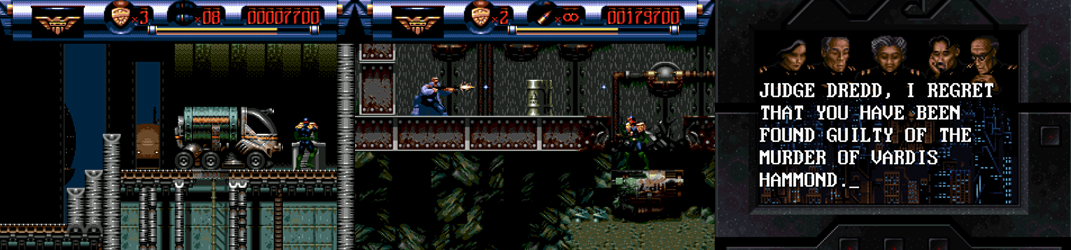
Judge Dredd is armed with his trust Lawgiver; tapping or holding the A button will see Dredd fire a variety of shots, from unlimited regular bullets to heat-seekers, grenades, and missiles, and you can even hold down the button to fire uninterrupted. Dredd can also sprint by tapping the directional pad (D-pad), and shoot while running, jumping, and crouching, and in all directions (including diagonally!) Although some objectives tell you not to shoot certain enemies, you’re free to be as trigger happy as you like; however, you’ll score more points if you use Dredd’s melee skills (A up close or X if you have a six-button controller) to disarm and arrest perps when “GUILTY” appears over their head. Dredd can jump with B and even fly about for a few seconds if you find an Anti-Grav Belt; you’ll be doing a fair amount of platforming but Dredd can’t jump very high so you’ll often need to make use of ladders, monkey along overhead lines, or even a running jump to reach new areas. Dredd can also crawl about, push some objects, and access terminals to see his current mission progression and health and ammo stats or lock doors in certain stages. Dredd controls quite well but is a bit clunky; pressing up will scroll the screen, which can be disorientating, and there’s a few too many frames of animation at times, meaning there is often a delay between button presses. Dredd is quite sturdy but can replenish his health with small and large hearts, pick up additional ammo, or even grab a temporary forcefield and invincibility to help even the odds.
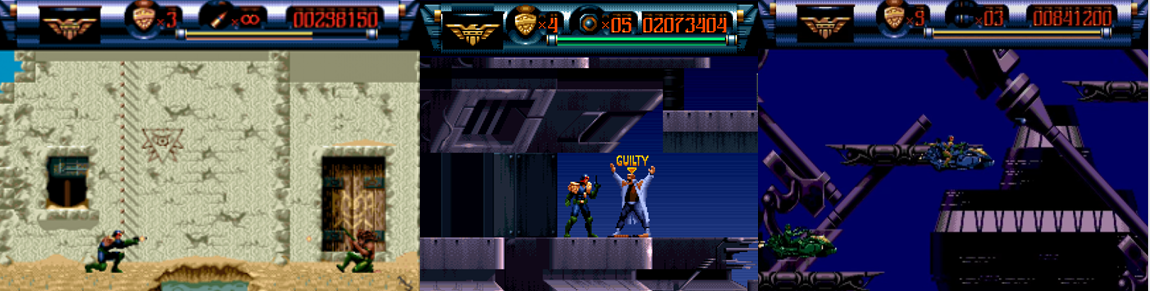
After completing each stage, you’re given a score tally and a password to help you skip ahead; while there don’t appear to be any useful passwords for this version of the game, such as infinite health or ammo, it is a handy feature to pick up where you left off or try out different missions. In my case, this is almost mandatory; it took quit a bit of trial and error to complete even the first stage as you can get stuck in an area with no way back. While Dredd will nip up on the spot after being killed, it’s quite easy to get stuck as ladders and hazards aren’t always immediately visible, and while you can duck and shoot most enemies, you’ll be majorly outclassed by the wild mutants in the Cursed Earth and the Atomic, Bacterial, and Chemical Warriors (A.B.C. Warriors) you’re tasked with destroying later on. The game certainly looks good; sprites are a bit small but Dredd has some fun idle animations, such as twirling his gun and cleaning his badge (there’s even a little squeak-squeak sound effect), and there’s some splashes of blood when you off enemies. The environments are visually very faithful to the movie, including trucks, futuristic skyscrapers, and the Statue of Liberty as in the film, but can be cluttered and a little too large for their own good. Gameplay is somewhat broken up by one stage that has you flying through the skies on your Lawmaster while fending off pursuing Judges (Herman Fergusson/Fergee fires at the rear while Dredd fires ahead) and by the fact that some enemies will be possessed by the four Dark Judges; you’ll know when they are as they’ll have an aura about them and a spirit will fly out that you can catch for bonus points if you have some Boing ammo.
My Progression:
Judge Dredd is a surprisingly tough game; at first, it reminded me of classic run-and-guns like Turrican (Factor 5, et al, 1990) or Duke Nukem (Apogee Software, 1991), especially with the placement of the heads-up display and dystopian, sci-fi setting. Seconds into the first stage, I hit a literal wall and had to think for a minute as the ladder I needed was so difficult to see and things only got more confusing from there; vents randomly damage you, trash falls from above, and you can’t even step in a small puddle of water in the Cursed Earth without taking damage. Just destroying the ammo crates in the first stage is a chore as they can only be destroyed by your explosive weapons and you need to explore the stage in a specific way so you don’t miss any and get stuck. Rather than running past terminals in Aspen, you need to access them to initiate the lockdown procedure, and enemies can take a few shots before they go down even before the clunky A.B.C. Warriors enter the picture. It appears that most stages end with a boss battle, too; the first is a guy who looked a lot like DC Comic’s James Harper/Guardian and who constantly blocks your shots with his shield while firing at you with a machine gun, tossing Molotov Cocktails, launching an almost unavoidable energy wave, or bashing your head in when you get close. You can use nearby barrels for cover but he absorbs shots like a sponge and the timing required to jump and duck under his shots meant that I couldn’t actually beat him!
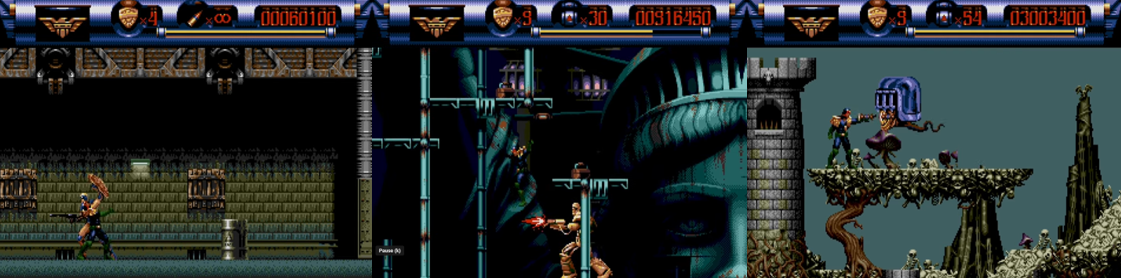
Using a password, I jumped to stage two and fared much better n the Aspen Penal Colony. There’s some neat effects on the waters of the sewer area and I was actually able to beat the stage the boss, a brute with a big club who rides an elevator that he tries to crush you with, tosses grenades and Molotov cocktails, and smacks you silly up close. It was a slog, but I did beat him, but I couldn’t get past the Cursed Earth for the life of me. Here, the mutated inhabitants live in the ruins of society and Judge Hunters patrol the wooden walkways, but the leaps of faith and confusing level layout got the better of me. I skipped ahead to the Hall of Justice and that wasn’t a problem, nor was the chase on the Lawmaster, but the A.B.C. Warriors stomping about on the construction site around the Statue of Liberty were enough to have me calling it quits. They’re immune to your regular shot, so you’ll need a healthy supply of missiles or other explosives, but their missiles and the stage’s bottomless pits were the last straw for me. it was a bit of a shame as the game’s layout and objectives actually got easier the deeper I got and, from what I can see, there’s a bit of a post-game that looks right up my alley. After dealing with Dredd’s psycho clone brother, Rico, players head to Deadworld, an alternative dimension where all life was deemed a crime, to do battle with Dredd’s reaper-like spectral counterpart, Judge Death! I could’ve used passwords to jump ahead to this point but I decided that enough was enough, but I am impressed that a videogame adaptation from this time actually expanded on the film; the game does a decent job of following the movie’s narrative but infuses it with more elements from the source material, including my favourite Dredd antagonists, the Dark Judges, which is pretty rare for a game of this era in my experience.

I wasn’t really sure what to expect from Judge Dredd; videogame adaptations of movies tended to be more hit than miss back in the 16-bit games, at least in my experience, but sadly there were some issues here that kept me from really enjoying the experience. Visually, the game is both impressive, bland, and confusing all at the same time; the horizon and backgrounds aren’t always very detailed but the foregrounds are almost too detailed, making things a bit cluttered and messy at times. Dredd looks great and plays okay, but I find it amusing that the developers included the ability to arrest people when Dredd is far more likely to just sentence criminals to death for even more infractions. Since the game doesn’t really penalise you if you kill everyone, I recommend taking a traditional run-and-gun approach, especially as you’ll be distracted by vague objectives and the maze-like areas. Overall, it was a mediocre experience, one that I struggled to get through thanks to the difficulty spike and clunky presentation. It’s a shame as I feel the concept could have legs if it was more like Contra (Konami, 1986) or Metal Slug (Nazca Corporation, 1996) and leaned more into arcade-style action rather than tedious exploration. Still, maybe I’m being too harsh? Maybe you actually enjoyed the gameplay on offer here? Perhaps you prefer one of the movie’s other ports or a different Judge Dredd game entirely? Either way, I’d love to hear about it so leave a comment below or on my social media and be sure to check out my other Judge Dredd content.

 Dr. K's Waiting Room
One thought on “Mini Game Corner [Sci-Fanuary]: Judge Dredd (Mega Drive)”