
January sees the celebration of two notable dates in science-fiction history, with January 2 christened “National Science Fiction Day” to coincide with the birth date of the world renowned sci-fi writer Isaac Asimov, and HAL 9000, the sophisticated artificial intelligence of Arthur C. Clarke’s seminal 2001: A Space Odyssey (1968), being created on 12 January.


Released: 14 November 2018
Originally Released: 6 August 1986
Developer: Nintendo
Original Developer: Nintendo R&D1 Intelligent Systems
Also Available For: GameBoy Advance, GameCube, Nintendo Entertainment System (NES), Nintendo Wii, Nintendo Wii U
The Background:
It’s probably fair to say that, compared to Nintendo’s other heavy-hitters like Super Mario and The Legend of Zelda (Various, 1986 to present), the Metroid franchise (Various, 1986 to present) is maybe one of the company’s more under-rated properties. I actually have had very little experience with the series outside of the Super Smash Bros. series (Various, 1999 to 2018) and brief experiences with Metroid II: Return of Samus (Nintendo R&D1, 1991) and Super Metroid (Nintendo R&D1 Intelligent Systems, 1994), though this is mainly due to growing up as a SEGA guy. Metroid came about after Nintendo had seen success with their early titles for their industry-saving console, the NES. Producer Gunpei Yokoi and directors Satoru Okada and Masao Yamamoto collaborated on the title, which was heavily influenced by Alien (Scott, 1979). The developers sought to create an action-orientated game in which power-ups would be not only permanent, but necessary to completion, and with a strong emphasis on non-linear exploration. Metroid ended up being so successful in this regard that it, and Castlevania (Konami, 1986), spawned an entire videogame subgenre dubbed “Metroidvania”. Metroid was well-received upon release; reviews praised its challenging gameplay and it has since been recognised as one of the greatest games ever made. Metroid would spawn a number of sequels and spin-offs, and was ported to many subsequent Nintendo consoles either as an unlockable bonus or as a full-blown remake. Considering how popular and influential the series, and this first game, have become over the years, it’s no surprise that Metroid was included in the Nintendo Switch Online service soon after it launched, which also allowed me the chance to play it for the first time.
The Plot:
Bounty hunter Samus Aran journeys to the planet Zebes to retrieve the parasitic Metroid organisms from the malicious Space Pirates, who plan to replicate the Metroids by exposing them to beta rays and then use them as biological weapons in their mad plot for galactic conquest.
Gameplay:
Metroid is a 2D, sidescrolling, action/platformer with a strong emphasis on run-and-gun action, horizontal and vertical jumps, backtracking, and exploration. Players take on the role of Samus Aran, an armoured bounty hunter with a blaster for an arm, and must explore the planet Zebes, which is comprised of five relatively distinct areas all joined together in a huge game map. Samus begins the game able to shoot directly ahead or above and to jump, and you’ll quickly find that ground-based enemies are beyond your ability to destroy in the early going as Samus can’t shoot downwards or defeat enemies by jumping on them. You’ll also, literally, run face-first into a wall if you give into your gamer’s instinct and head to the right; instead, you should go left from the starting area, where you’ll find your first Chozo Statue and your first power-up, the Morph Ball, which lets you curl up into a ball by pressing down and thus slip into small tunnels and areas. From there, the sheer scope of your mission quickly becomes very daunting; not only do enemies respawn when you leave the immediate area (not the immediate screen, as you can scroll to the left and then go back to the right and your enemies will be back) but you’re missing the most crucial aspect a game like this needs: an onscreen map. I have absolutely no idea how gamers managed to play Metroid without this simple convenience, and have heard that they either drew their own maps or consulted magazines at the time just to get an idea of where the hell you’re meant to go. Since you acquire different upgrades along the way that help you access new areas, and a lot of the areas look very similar save for some different colours and flourishes, you’ll need a good memory and a lot of experimentation to figure out where you’re going and what you’re doing.
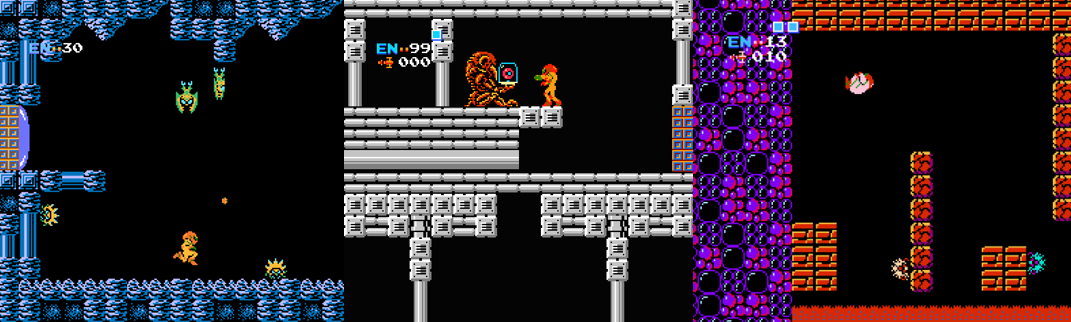
Thankfully, you can at least hold down B or X for a rapid fire function and hold A to jump a little higher, and Samus is relatively durable; her health is measured in numerical units, and her default weapon has unlimited ammo, but you will have to deal with some difficult jumps (made all the more frustrating by some horrendous enemy placement and movements) and knockback damage that can send you dropping into lava or spikes, where your health will whittle away to nothing in no time at all. Metroid gives you just one chance to finish the game; if (well, when, really) you die, the game is over and you’re given a ludicrously long password to continue but, thankfully, the Nintendo Switch version allows for both save states and a rewind function if (again…when) you make a mistake. Health and ammo is dropped by enemies and there are numerous points where you can simply stand there, blasting at constantly respawning enemies to farm health or missiles, but take care as enemies can pounce from behind and more spawn in the moment you pick up your item. Your primary goal in Metroid is to find and defeat two bosses to create a bridge that leads to the final area, Tourian, to confront Mother Brain but, to reach these bosses, you’ll need to find new upgrades to open doors or reach new areas with a higher jump, temporary platforms, or dropping down through destructible blocks. Although areas start out pretty simple, it’s not long before you need to blast at stone blocks to create pathways and platforms (though you need to be careful as the blocks will damage you if you’re standing there when they spawn back in), hopping over tiny rocky platforms floating over lava, and dodging past tougher enemies. Luckily, there are no instant death hazards here, but you can easily get trapped in a dangerous position where enemies and hazards drain your health, or you’re left with such little health that you’ll die soon after anyway. All of this means that Metroid is a pretty touch experience, even with the quality of life features offered by the Nintendo Switch; it doesn’t take much for a simple mistake to lead to disaster, enemies can take quite a few hits before being dispatched, and it’s ridiculously easy to get turned around and completely lost. Luckily, there’s no time limit to worry about, and the game is much more enjoyable with a detailed map to help you out.
Graphics and Sound:
Given that it’s an 8-bit title, Metroid is quite the pixelated adventure; Samus, especially, stands out against all of the game’s dark backgrounds thanks to her orange armour but, as you might expect, doesn’t really have many frames of imagination. She ambles along at a decent pace, even able to shoot and run at the same time, but you’ll notice that the game suffers from severe slowdown when too many enemies or items are onscreen at the same time. Each area of Zebes is accompanied by a funky little tune, with the now-recognisable Metroid theme being the catchiest of them, but you won’t encounter any context or story-related text until the final moments of the game, meaning you’ll need the instruction manual to have any idea of what the hell’s going on.

Planet Zebes is split into five areas: Brinstar, Kraid’s Lair, Norfair, Ridley’s Lair, and Tourian, with each one connected by stone or mechanical tunnels and lifts that you can descend and ascend. Each area has a different colour scheme to help differentiate them a little (blue, green, grey, purple, etc) but they’re also very similar and feature nearly identical tunnels and screens in each area, meaning that it’s very easy to lose track of where you are. Some areas feature cloud platforms, stone columns, lava, bubble or monstrous platforms and ceilings, while others are long vertical shafts you need to make your way up. These long shafts can be safer spaces where you can restock on your supplies, but you’ll also need to make use of your Bomb to blow up blocks and descend downwards to give your Morph Ball a little boost to enter into seemingly impassable walls. While lava pits are best avoided, some are actually fake and lead to new areas; other times, you’ll need to navigate through tubes, avoiding or blowing up enemies and hoping you don’t end up being boiled alive. Little touches like moss, different types of stones or foreground elements, and minor visuals help to make some screens a little more distinct but it’s very easy to get confused as some screens are literally identical but at different points on the map and you’ll no doubt be driven made by the constant beeping when your health is low.
Enemies and Bosses:
Planet Zebes is host to all manner of alien baddies who will hop, swoop, and fly right at you without a second’s hesitation. While some of the smaller, weaker enemies can be destroyed in one shot, others take multiple shots and even the simplest of enemies can cause a major problem as they respawn constantly from all angles and it’s easy to get hit by one (and knocked into lava…) Spiked Zoomers are the easiest and most frequent enemy, though you’ll probably be farming pick-ups from Zebs quite often as well. Skree drop from the ceiling and will explode if you don’t destroy them quickly, Wavers, Rios, Multivolas, and Sidehoppers bounce around the screen erratically, Dragons spit fireballs at you in an arc from lava, and Rippers travel back and forth and make for useful temporary platforms oney you acquire the Ice Beam. In Tourian, you’ll encounter the titular Metroids, bug-like parasites that float around and home in on you to suck your energy away and which can only be destroyed with your limited supply of missiles.

Considering the size of its map, Metroid only features three bosses; I assume you can theoretically tackle Kraid and Ridley in whatever order you like (assuming you take the right paths using a guide) but I fought Ridley first. This stubby little purple dragon hops up and down in the middle of the arena shooting projectiles at you. These also form a kind of protective shield that will block your shots, but can be destroyed with your weapons. Ridley doesn’t really need to do much else as he can absorb a huge amount of punishment before finally exploding, and the same can also be said about Kraid. Kraid is a little more formidable; he meanders back and forth across a platform surrounded by acid and constantly fires missiles and throws bladed projectiles at you, all of which you must dodge and shoot through in order to land the necessary multiple hits on the bulbous monster. There’s also a fake version of Kraid hiding in his lair, which will respawn upon defeat, and only by destroying the real Kraid can you complete the bridge and enter the game’s toughest and most unfair area by far. Mother Brain is a stationary brain inside a glass jar but is protected by an intricate and unrelenting arsenal of wall-mounted lasers, bubble-like projectiles, and barriers which you must blast through with your missiles. As if that isn’t bad enough, you’re given precarious platforms to stand on to shoot at her and must battle over a lava pit, constantly dodging and being pummelled by projectiles as you desperately try to fire your missiles at her through the narrowest of openings. Once she’s defeated, you’re then given about 999 in-game seconds to navigate up one final shaft and get to safety before the whole place explodes, making for a heart-poundingly tense and massively frustrating finale to an already challenging game.
Power-Ups and Bonuses:
Samus will find a wide variety of useful, permanent power-ups to gradually make her journey a little easier. It’s well worth taking the time to explore (or use a map…) to seek these out as you can increase her health by finding Energy Tanks (which will add another block of 99 health units to your total) and increase her maximum supply of missiles up to 255 with Missile Tanks. Since you need missiles to open doors and deal the maximum amount of damage to enemies, and will find yourself absolutely crucified in Tourian without these, these are both well worth seeking out. As mentioned, you’ll need the Morph Ball to progress past the first few screens, and soon acquire the Bomb to use in this form to destroy ground-based enemies or propel Samus into tunnels. The Long Beam will extend the range of Samus’s default weapon, which can also be upgraded to the Ice Beam (which, naturally, freezes enemies and turns them into temporary platforms but be warned as a subsequent shot will unfreeze them) and, eventually, the Wave Beam (which increases the firing range of your main attack). Samus can also find the High Jump Boots to extend her vertical jump, the Screw Attack to damage enemies with a spinning jump attack, and the Varia Suit to reduce the amount of damage she takes from enemies and hazards.
Additional Features:
As mentioned, the Nintendo Switch version allows for up to three save states and includes a rewind feature, both of which are incredibly useful for when you land in a sticky situation or want to take a break. If you fancy jumping ahead, you can also play an “SP” version of the game that bestows you with all the available equipment and upgrades and drops you right outside of the battle with Ridley. Unlike many videogames of its era, Metroid doesn’t feature a high score system but it does include multiple endings; the faster you finish the game, the more of Samus’s true form will be revealed in the ending. Additionally, after finishing the game, you’ll automatically start over in a new game with all of your power-ups (though without the additional Energy and Missile Tanks you acquired) or even garbed in a skin-tight outfit rather than armour.

The Summary:
I may not have ever properly played a Metroid game before, but I was fully aware of the franchise and its emphasis on backtracking and exploration. Consequently, I was a little intimidated to play through Metroid, especially as my limited experience with the series had left me struggling to find my way around. Although it is a real problem that Metroid doesn’t feature any kind of map (which is weird, as The Legend of Zelda (Nintendo R&D4, 1986) released earlier that same year and featured a rudimentary map system), it’s nothing you can’t solve with a quick Google search, meaning your only remaining hurdle is the challenge offered by the gameplay. While the controls are tight enough, Samus is a bit slippery and floaty at times, and her inability to fire in all directions makes things problematic, but nowhere near as annoying as the respawning, erratic enemies and tricky platforming sections. The various upgrades definitely help with this, and once you have a bit more health and a more powerful main attack and have gotten used to the repeating rooms and enemies, the game becomes a lot of fun. It’s definitely rough around the edges, though; when playing retro games on modern consoles, I always try to imagine how gamers coped back in the day and, in the case of Metroid, I can only assume they got through it with a great deal of patience and trial and error. Still, this was a decent experience and I’m glad that I finally played through it; it’s maybe a little too challenging and confusing at times for just a casual playthrough, though, so I’m interested to see if I find the later releases more appealing with their improved graphics and controls.
My Rating:
Pretty Good
Have you ever played Metroid? If so, what did you think to it and how do you think it holds up today, both against its subsequent titles and other games from that era? Did you struggle to navigate the inter-connected game map? Which of the bosses and upgrades was your favorite? Have you ever finished the game without using modern enhancements, and what’s the best ending you’ve achieved? Which Metroid game is your favourite? Whatever your thoughts, feel free to leave a comment below or leave a reply on my social media, and be sure to check out my other Metroid reviews.

 Dr. K's Waiting Room
7 thoughts on “Game Corner [Sci-Fanuary]: Metroid (Nintendo Switch)”