
The Day of the Dead (or Dia de los Muertos) is a traditional Latin American holiday on which, every November 1st, the lives of deceased loved ones are celebrated with food, drink, parties, and a great deal of masquerade involving the calacas and calaveras (skeletons and skulls). For me, this seems like the perfect excuse to look back on the long-running and ever-changing zombie genre that was largely popularised by director George A. Romero, which I devoted a great deal of my PhD thesis towards and which has often been used as a parallel to various aspects of society and culture.

Released: 1 October 1968
Director: George A. Romero
Distributor: Continental Distributing
Budget: $114,000 to 125,000
Stars: Duane Jones, Judith O’Dea, Karl Hardman, Marilyn Eastman, and Kyra Schon
The Plot:
When the recently deceased suddenly return to life, traumatised Barbra (O’Dea) takes shelter in a farmhouse alongside pragmatic Ben (Jones) and antagonistic Harry Cooper (Hardman). With tensions rising and the walking dead closing in, the group struggles to survive, co-exist, and make sense of this strange phenomenon.
The Background:
Ever since the 1930s, zombies have appeared in movies in one form or another, either as mindless slaves, voracious cannibals, or in their most famous form: the shambling undead. After growing bored with directing television commercials, George A. Romero and his friends, John Russo and Russell Steiner, decided to capitalise on growing trends for more bizarre content and produce a horror movie. Initially conceived of as a horror comedy about adolescent aliens, it was Russo who decided the creatures being flesh-eating reanimated corpses, which Romero infused with heavy inspiration from the macabre revolutionary themes of I Am Legend (Matheson, 1954) and its first screen adaptation, The Last Man on Earth (Salkow and Ragona, 1964). Although the role of Ben was written as a Caucasian, Duane Jones impressed Romero in his audition and the script was revised based on his input; his casting and portrayal inspired numerous racial readings and made the film surprisingly progressive for the time. The low-budget impacted the options available to the filmmakers; chocolate syrup, entrails from butcher shops, and simple make-up effects brought the gore and ghouls to gruesome life and, while simplistic by today’s standards, proved shocking and outrageous at the time. Despite the controversy it caused, Night of the Living Dead was a massive hit with its box office gross of over $30 million; although critics dismissed it at the time, Night of the Living Dead has since been regarded as a horror classic, one of the best of its era, and it was preserved in the National Film Registry in 1999. The film was not only followed by subsequent sequels (both official and unofficial) and (thanks to an agreement between Romero and Russo) a similarly-named adjacent series) that expanded and refined the zombie concept, but heavily influenced the portrayal of zombies for decades. Remade in 1990 to recoup some profit after legal issues saw the original become public domain, Night of the Living Dead is also the most remade film in history.
The Review:
When I decided to spend a year of my PhD discussing the original Resident Evil movies (Various, 2002 to 2016), I found myself deeply entrenched in the rich and lengthy lore of zombie cinema, tracking their origins as voodoo slaves in White Zombie (Halperin, 1932), their vampire-like depiction in I Am Legend and the first of its many adaptations, The Last Man on Earth, and, of course, charting the history of Romero’s genre-defining depiction of the living dead. I found that zombies are one of the most enduring horror creatures not just in cinema, but in mainstream media; they’ve been as persistent as they appear in movies, changing from shambling ghouls to rage-filled savages, and continue to be popular inclusions in horror media thanks to how versatile they are. Honestly, though, this kind of research and in-depth exposure to zombie cinema kind of ruined my appreciation for zombie movies; many are low-budget, derivative affairs or simply repeat the same lessons established by Romero decades ago, meaning it can be hard to find quality zombie movies. Although well renowned as the grandfather of this sub-genre of horror, Romero’s first effort in bringing zombies to un-life is fraught with issues, ranging from the obvious low budget and stilted performances to inconsistences in the portrayal and behaviour of the titular living dead as these aspects wouldn’t be refined until the far more visually and philosophically interesting (but, blasphemously, still quite tedious, in my opinion) sequel. I also feel compelled to specify here that I’m looking at the black and white original rather than the many different re-releases or the bastardised colour version, simply to give my thoughts on Romero’s original vision as depicted so controversially decades ago.
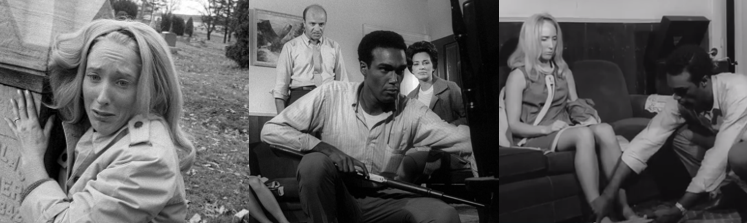
We open with Barbra and her brother, Johnny (Russell Streiner), reaching the end of a regular 200-mile round trip to place a wreath on their father’s grave at the behest of their mother. Johnny, exasperated at regularly having to waste his days commemorating a man he barely even remembers, just wants to get back home and stop throwing away good money for sentiment. While Barbra is happy to make the trip and thinks fondly of her father, Johnny has no time for lingering and amuses himself by teasing Barbra since she’s still scared by cemeteries. Indeed, Barbra’s previous resolve in chastising Johnny’s attitude falters when he starts bullying her, but they’re both horrified when a strange, shambling man (Bill Hinzman) suddenly attacks them. Although Johnny bravely (if awkwardly) tries to fight the man off, he ends up bashed into a gravestone, leaving Barbra fleeing in terror. After…somehow…crashing her car, Barbra is forced to take refuge in a nearby farmhouse; though she arms herself with a knife, she’s unable to call for help due to mysterious interference on the line but, luckily, Ben shows up and immediately takes charge. If you’re hoping for a strong, capable female lead then you’re out of luck, Barbra is so crippled by fear that’s practically catatonic, sleepwalking through the rest of the film and completely giving into despair while Ben is forthright and bravely tackles the ghouls with a tyre iron. Although he’s just as scared as her, his thoughts are on practical matters such as food, lights, and arming himself with a rifle; Barbra’s distressed state aggravates him, but he keeps his cool and puts her to work helping to secure the house against further attacks to await rescue. Eloquent, intelligent, and charismatic, Ben hides his fear and confusion behind productive tasks and narrating his observations and the horrors he’s seen aloud, something he’s forced to do since Barbra too shocked to be much conversation. When Barbra descends into hysteria, so desperate to save Johnny that she almost runs out into further danger, Ben’s forced to physically subdue her to keep her calm, allowing him to finish fortifying the house and glean insight into the crisis from a radio broadcast.
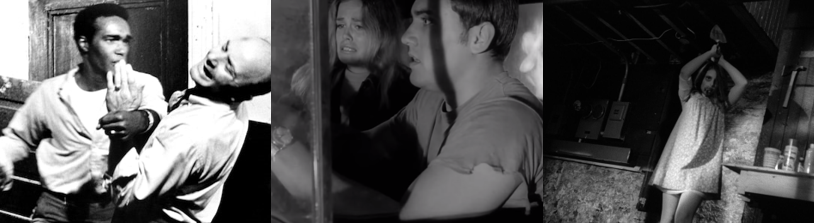
Considering it takes Ben some time (presumably a couple of hours) to finish fortifying the house, it comes as a surprise to both them and the audience when other survivors emerge from the cellar. Naturally, Ben is incensed to learn that Harry, his wife and daughter, Helen (Eastman) and Karen (Schon), and lovers Tom (Keith Wayne) and Judy (Judith Ridley), chose to hide rather than investigate the screaming and commotion. Ben’s natural instinct is to help people, no matter the danger, whereas Harry reasoned it wasn’t worth risking their lives and their safety helping others. Having witnessed the strength and tenacity of the ghouls, Harry is adamant that they’re all safer in the cellar, regardless of the fortifications, and both make valid arguments since the cellar allows them to better fend off attacks, but the house gives them a fighting chance and more escape routes. Tom does his best to play peacekeeper, but Harry stubbornly refuses to listen to reason, primarily due to fear, his shame at feeling said fear, and a deep-seated need to protect his family. Although the ghouls briefly breaking through the windows seems to prove Harry’s point, he’s aggrieved when Ben refuses to share any of the upstairs food or resources; it seems Harry wants it both ways, but Ben firmly draws a line and delivers a stern ultimatum: “You can be the boss down there. I’m boss up here”, enraging the overprotective and stubborn father. Taking his chances upstairs, Tom has the anxious and caring Judy join them while Harry barricades himself and his family downstairs out of a pig-headed fixation on being “right”. Weary of his bullish ways, Helen echoes Ben’s remarks about Harry’s shortsightedness, which cuts them and their sick daughter off from information and potential rescue. Like Tom, she emphasises co-operation and compromise, allowing them to trade places with Judy to learn more about the crisis, though he continues to rile Ben up with his antagonistic and cynical attitude. Helen is encouraged by news of rescue centres nearby and Ben devises a plan to hold off the ghouls with flaming torches so they can refuel his truck and get medical help for Karen, but the plan goes horribly awry, resulting in Tom and Judy’s fiery deaths, and Ben unloads his rage onto Harry when he refuses to let him back into the house, leading to the two tussling for the rifle.
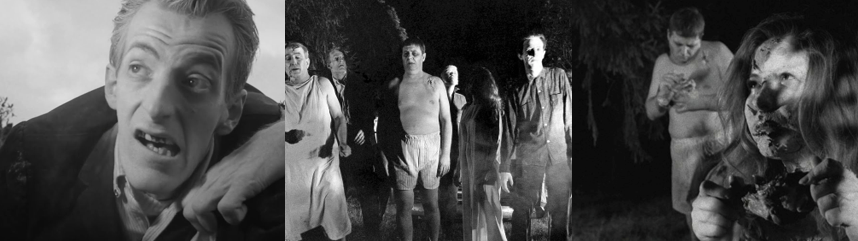
In their first appearance, Romero’s living dead are noticeably different to what we’d see in his sequels and subsequent zombie media. The first thing to note, of course, is that the living dead are never referred to as “zombies”; this term would be as fastidiously avoided and mocked as Romero’s opinions on running zombie variants, meaning the living dead have more in common with Matheson’s interpretation of vampires than the brain-devouring zombie of mainstream imagination. Consequently, the living dead are referred to as anything but zombies; described as “ghouls”, “things”, “them”, and “assassins”, the living dead are also noticeably less gruesome than in later movies, potentially because the zombie outbreak is so recent and the undead so freshly turned. Similarly, Romero avoids explaining the sudden return of the living dead; a news report speculates radiation from an exploding space probe, but divine will is also implied (Johnny mocks Barbra’s prayer and admits to no longer attending church, and is the first to die). The zombie outbreak is treated as a sudden and confusing attack, almost like an epidemic; at first, characters ignore or mock the signs but they’re soon relying on radio broadcasts for scant information and how to combat the voracious ghouls. Night of the Living Dead establishes the basic rules of the undead: for whatever reason, the recently-deceased return in a near-mindless state, driven only by the need to consume human flesh. Rather than infecting people, their bites simply expedite the deaths of their victims; because of radiation from the Venus prove, anyone who dies will then reanimate with a taste for murder and cannibalism. Though slow and shambling and driven back by fire, the ghouls are incredibly persistent and dangerous in large groups; they can only be permanently put down with a blow to the head, destroying their brain, or removing the head entirely, and people are encouraged to forgo proper funeral procedures and immolate the corpses as soon as possible. Unlike most iterations of zombies, however, the ghouls are decidedly less monstrous here; many are more like entranced slaves or crazed maniacs, meaning they can use tools or rocks where brute strength fails and young Karen even uses a trowel to stab her mother to death rather than going for the jugular as you might expect.
The Nitty-Gritty:
There’s a certain classic charm to revisiting the old black and white horrors of yesteryear; everything has a distinctly old-timey and almost gothic atmosphere, which is only extenuated by the greyscale visuals. Yes, it does make some of the night-time action difficult to make out and it’s not for everyone, but I always appreciate this era of cinema as it evokes feelings of nostalgia and appreciation for these filmmakers, who did the best they could on a limited budget and with the technology of the time and, in many cases, pioneered filmmaking effects that we still see in cinema to this day. Even in this first tentative outing for the living dead, Romero positions the ghouls as social commentary; their mindless, savage, almost primal nature explicitly reflects the dichotomy between the survivors, particularly Ben and Harry, who constantly butt heads. There’s a startling message related to this through the simple depiction of the ghouls co-existing and even working together, despite being incapable of communication, to problem solve and better devour their prey; in contrast, the survivors are equally unable to communicate due to fear, tension, and ego and absolutely incapable of working together for these same reasons. It’s these emotional responses that see other survivors uniting against their monstrous foes as a paranoid, trigger-happy mob that’s as inhuman as the ghouls they target, creating a thematic parallel that begs the question who the real monsters are, us or “them”? Naturally, you can read into this even further thanks to Ben being a Black man; though the most level-headed and practical, he’s met with suspicion (even from Barbra, initially) and hostility, which opens itself up to racial prejudice due to his skin colour and Harry’s overly aggressive demeanour, and the ghouls are also framed as being this unknowable threat not unlike foreign invader that “normal” folk struggle to understand and fight back against with extreme prejudice.
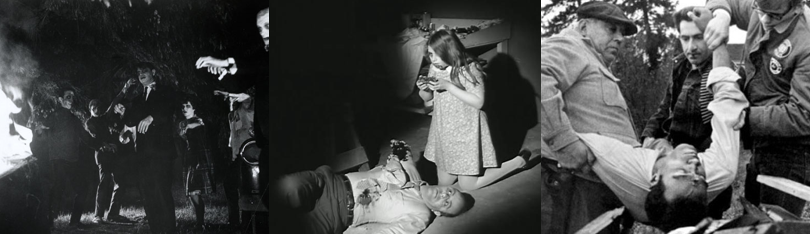
Although Johnny’s death is disappointingly lame and bloodless, the suddenness and brutality of is where the true horror lies; still, Night of the Living Dead contains a fair amount of gore, including a partially mangled (presumably eaten) corpse in the farmhouse, some rudimentary decomposition effects, a surprising amount of flaming bodes, and sickening scenes of ghouls feasting on Tom and Judy’s entrails and chargrilled flesh. Still, Night of the Living Dead focuses more on tension and both internal and external threats. Although Harry covers their exit with Molotov cocktails, he takes advantage of the situation to claim dominion over the entire house. Unsurprisingly, given they’ve been measuring dicks the entire time, Ben fights him for control of the only gun, resulting in Harry being fatally shot due to his hubris. Having succumbed to her injuries, Karen reanimates and feasts on her father’s body before stabbing her mother to death. As she and the other ghouls close in, Barbra finally snaps out of her stupor, only to be dragged into the writhing masses by Johnny, and this irony is quickly followed by Ben, the sole survivor, being forced to take refuge in the cellar when his barricades fail. After putting down the reanimated Harry (which seems as much out of spite as it for survival) and Helen, Ben waits it out and survives the night; since the ghouls go down pretty easily when you have the right weapons, the danger seems to be mostly contained by the authorities and gun-toting locals, who pick the living dead off with ease. When they come to dispatch the ghouls near the farmhouse, Ben emerges from the cellar, attracted to the gunfire, but his caution proves his undoing; since he’s skulking around in the darkness, he’s mistaken for a ghoul and promptly executed on the spot. As the credits play, his body (and those of all the characters, ghouls and human alike) is dispassionately dumped onto a bonfire and burned in one of the bleakest endings in all of horror cinema.
The Summary:
There’s a reason Night of the Living Dead is considered a horror classic and the forefather of zombie media. A low-budget affair that made the most of its resources, the film is a bleak mediation on humanity; simple ideas such as co-operating, coming together in a crisis, and working together to overcome an aggressive foe are present and resonate even to this day, where we’re more likely to turn against each other than set aside our differences. Although not as explicit as in his later movies, the ghouls are clearly utilised as an allegory for these matters, and various others; the fear and inevitability of death, the danger of the unknown, the savage nature of man are all valid readings of Night of the Living Dead. It’s also incredibly progressive in terms of Black representation; Ben is a keen, intelligent, and proactive survivor haunted by what he’s seen but determined to help others and make a fighting stand until rescue comes. While he can be as abrasive as Harry, his stubborn demeanour comes from a place of logic and reason and he’s constantly trying to increase their chances of survival, only to be met with pig-headed resistance. Harry might be an asshole, but you can see where he’s coming from; he’s scared and wants to protect his family, even if it means sacrificing others. Sadly, Helen (and women in general) don’t fare quite as well; portrayed as meek and generally useless, women just kind of get in the way or are oppressed and bossed about rather than contributing anything meaningful, though this does allow discussions about gender equality and machismo. Night of the Living Dead also established many of the “rules” for zombie cinema; although its ghouls aren’t as monstrous as later zombies and are more like entranced slaves, there’s a mystery and a danger to them when they gather in large numbers against vulnerable victims. However, it’s true that the film hasn’t aged very well; the performances and some themes are questionable, and there have been better zombie movies made since (by Romero himself, no less) that both overshadow this one and expose its flaws, though it remains recommended viewing for any fans of the genre, for sure,
My Rating:
Pretty Good
Do you consider Night of the Living Dead a classic of the genre? Were you surprised to see a Black man take such a proactive role? What did you think to the tension and rivalry between Ben and Harry? How did you interpret the ghouls and what did you think to their characterisation here? What do you think caused the zombie outbreak and how do you think you would react in such a scenario? What is your favourite zombie film and what do you think of the genre in general? How are you celebrating the Day of the Dead today? Whatever your thoughts on Night of the Living Dead, and zombie films in general, feel free to leave a comment below or leave your thoughts on my social media, and check out my other zombie content across the site.

 Dr. K's Waiting Room
2 thoughts on “Movie Night [Day of the Dead]: Night of the Living Dead (1968)”