

Released: 2 August 2023
Director: Jeff Rowe
Distributor: Paramount Pictures
Budget: $70 to 80 million
Stars: Nicolas Cantu, Micah Abbey, Shamon Brown Jr., Brady Noon, Ice Cube, Ayo Edebiri, and Jackie Chan
The Plot:
After years of being sheltered from the human world, four mutated turtle brothers embark on a quest to be accepted as normal teenagers by the people of New York City through acts of heroism. With the aid of their new friend April O’Neil (Edebiri), they target a mysterious crime syndicate, but trouble arises when an army of mutants is unleashed upon them!
The Background:
Created by Kevin Eastman and Peter Laird as a violent pastiche of comic book tropes, the Teenage Mutant Ninja Turtles (TMNT) achieved mainstream success with their toys and cartoons. After this translated into cinematic success, the TMNT became semi-regular staples on the silver screen; however, their box office potential began to wane over time, with their under-rated second and fourth outings receiving mixed reviews, their third being universally panned, and Michael Bay’s monstrous reimaginings being equally lambasted. Yet, the TMNT continued to flourish in various popular animated ventures and rights holders Nickelodeon were eager to bring the characters back to the big screen, so they partnered with Seth Rogan and Jeff Rowe to craft a new incarnation of the popular franchise. A life-long TMNT fan, Rogan aimed to emphasise the “teenage” aspect of the TMNT, which resulted in actual teenagers voicing the characters for the first time. Rogan was impressed by the cast’s camaraderie and much of the voice acting took place in group sessions to allow for more natural interactions between the characters, who were brought to life by over 120 animators at Mikros Animation and Cinesite. Inspired by the kinetic, comic book visuals of Spider-Man: Into the Spider-Verse (Persichetti, Ramsey, and Rothman, 2018), director Rowe wanted the animation to resemble concept art and imperfect comic book sketches to tie into the teenage focus. The TMNT were redesigned to be less bulky, have teenage frames and apparel, and the film’s many mutant characters were given exaggerated designs to reflect their individual personalities. Upon release, Teenage Mutant Ninja Turtles: Mutant Mayhem was met with widespread critical acclaim: critics praised the performances as much as the visuals and found it to be a reinvigorating revival of the long-popular franchise. Grossing over $180 million at the box office, Teenage Mutant Ninja Turtles: Mutant Mayhem was accompanied by a tie-in videogame, a spin-off animated series, and a sequel was also greenlit soon after.
The Review:
As is always the case when it comes to TMNT adaptations, Mutant Mayhem alters the TMNT’s origin story and the backstory of the mysterious ooze that transforms them, but in a way that touches upon many different iterations of the TMNT. The film begins with Doctor Baxter Stockman (Giancarlo Esposito) being hunted by mercenaries hired by his former employer, Cynthia Utrom (Maya Rudolph) of the Techno Cosmic Research Institute (TCRI), after he went rogue and stole the mutagenic ooze he was developing for them after forming a disturbingly familial bond with his animal test subjects, specifically the young mutant housefly who takes the name Superfly (Cube). Having felt ostracised and alone his whole life, Stockman planned to create a family of his own using the ooze but was left dead when TCRI attacked, which left Superfly to rescue his “siblings” and a stray cannister of ooze to fall into the sewers and mutate both Master Splinter (Chan) and the TMNT. Like in Michael Bay’s TMNT films, Splinter is once again just a normal street rat who comes to care for the infant turtles and decides the best way to protect them is to train them in ninjutsu, this time using YouTube videos and kung-fu movies rather than being a mutated ninja master or having learned from a ninja. Personally, I continue to find this a disappointing inclusion; it calls into question why the five are as skilled as they are when they’re simply mimicking what they see onscreen and I feel like it’s a bit weird to leave out Splinter’s legitimate martial arts background considering how bonkers the concept is in general and how hard this film otherwise runs with the surreal nature of the source material, to the point where the city is seemingly overrun with bombastic mutants.
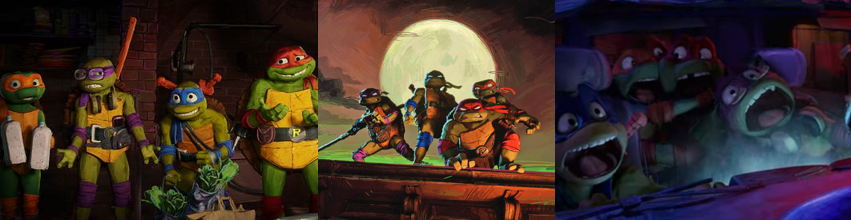
The TMNT are also very different to how I’ve seen them before; while they look very familiar and sport different body sizes relating to their capabilities (Raphael (Noon) is the biggest, Michelangelo (Brown Jr.) is the smallest and has braces, for example) and largely conform to the roles you’d expect (Leonardo (Cantu) leads and Donatello (Abbey) does machines, in the sense that he’s always got his headphones on), they’re characterised as teenagers, which is surprisingly rare in the history of the franchise, which often portrays them more as accomplished and responsible fighters who make the most of their downtime, with Mikey generally shouldering much of the comic relief. Here, they’re all very immature and easily distracted, especially by the outside world; they’re also largely untested outside of training and their own wild imaginations and develop confidence in their ninja abilities as the film goes on. Unlike in nearly every TMNT iteration before, there’s little in the way of internal conflict between them; Leo’s brothers mock and judge him for his strict adherence to Splinter’s mandate that they stay out of sight, but he’s easily swayed into straying off mission to see movies or enjoy the perks of the surface world, and his traditional rivalry with Raph is re-framed simply as an extension of the four ragging on each other for their flaws. The TMNT are lively, jovial, and squabble like bickering teenagers a lot of the time, making them as animated and kinetic as the film’s visually stunning art style; they are united in their love for their father and desire to please him but also in their longing to be normal teenagers and be accepted by humans, which they believe they can achieve if they perform heroic deeds to show that they’re not monsters. Overall, I found that the TMNT worked as a group, but individually had few chances to stand out: Raph is said to be full of rage but we rarely delve into this beyond a few instances where he delights in fighting, Donnie is more concerned with the apparent uselessness of his bo staff than he is with technical wizardry, Mikey is actually a little less goofy here since all the TMNT adopt many of his characteristics, meaning it’s Leo who edges out his brothers somewhat. He’s conflicted between his desire to live up to Splinter’s expectations and his yearning to join his brothers in revelling in the human world and this is only escalated when he instantly develops a crush on April. Yet, the film does a fun job of showing the TMNT grow and become more capable as a fighting unit as the film goes on, and this is reflected in Leo’s growing confidence as a leader even if his brothers give him a hard time over it.

As ever, the TMNT are sheltered and mentored by Splinter, now an overprotective father figure who has developed a severe hatred and mistrust of humans and the surface world. Having been shunned and ostracised his whole life, Splinter had never experienced love or affection until he stumbled across the mutated turtles and he’s desperate to hold onto that since, as he says, his boys are all he has. Since he knew how much the TMNT wanted to be a part of the outside world, Splinter took the baby TMNT up there only to be attacked and nearly killed by panicked New Yorkers. Thus, he resolved to keep them safe in the sewers and train them in ninjutsu to avoid being spotted when out for groceries, and Splinter’s characterisation is framed to mirror both Stockman’s relationship with his fledgling mutants and Superfly’s aggressive desire to create a world where he and his siblings won’t have to worry about being hounded by xenophobic humans. Although a bit overbearing and strict at times, Splinter truly loves his boys and wants what’s best for them and tries to appease their curiosity in his own way, but he’s powerless to stop them getting caught up in trying to prove themselves to humanity with the help of their human friend, April. A budding teenage reporter, April relates to the TMNT since she’s also been labelled and targeted after a comical blunder saw her vomit on-camera, so she’s desperate to turn her popularity around with a big story. Although she accepts them, she admits that others probably wouldn’t but is driven to document and aid their efforts in tracking down and apprehending Superfly since she wants to be popular and accepted, motivations that she later comes to realise are as selfish as the TMNT’s, yet they both resolve to do the right thing anyway since that’s what’s morally correct, regardless of whether people love or hate them for it.
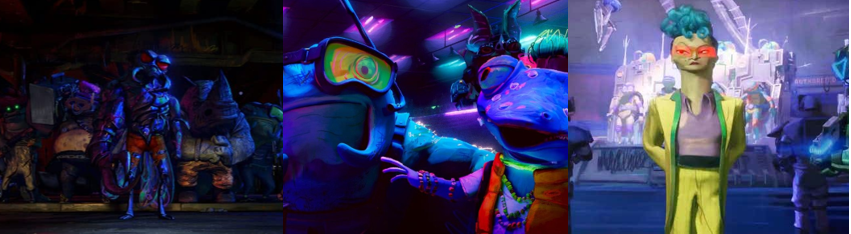
New York City is in the grip of a crime wave; news outlets are alive with reports of the mysterious Superfly orchestrating a series of robberies, but no one’s ever seen his face, not even the underlings the TMNT pummel for information. The TMNT are thus stunned and massively in over their heads when they find that Superfly is a monstrous mutated housefly and commands a crew of wacky and sadly underutilised mutants. Initially hyperactive Mondo Gecko (Paul Rudd) and Wingnut (Natasia Demetriou), wannabe singer Ray Fillet (Post Malone), meat-heads Bebop (Seth Rogan) and Rocksteady (John Cena), Aussie bruiser Leatherhead (Rose Byrne), slobbering cockroach Scumbug, and the forgettable Genghis Frog (Hannibal Buress) are painfully loyal to Superfly’s plan, to the point where they willing chase down the TMNT when they steal a vital component to his machine that he plans to use to mutate every animal on Earth. At first, Superfly and his crew embrace the TMNT as “cousins” and the TMNT even bond with some of his mutants, with Mikey and Mondo especially getting very close, but the TMNT cannot subscribe to Superfly’s plot to enslave, devour, and eradicate humanity, earning the mutated fly’s ire. Like Splinter, Superfly tried to rejoin society with his crew, only to be met with violence and bigotry, but he’s taken Stockman and Splinter’s distrust of society to a genocidal level and is determined to create a utopia for mutants by making them the dominant species on the planet. He sees this as the only way to protect his siblings from the likes of TCRI, who continuously hound the mutants in a bid to recover and replicate Stockman’s research by “milking” the mutants so they can create an army of genetically altered anthropomorphic soldiers. Superfly and Splinter’s paranoia about this comes to pass when the TMNT are briefly captured while trying to foil Superfly’s plot, but primarily exists to setup a later conflict in a future film and to forge a trust between Splinter and April that sees them uniting alongside Superfly’s easily turned crew to oppose the streetwise gangster in the finale when his plan sees him transformed into a kaiju-sized menace.
The Nitty-Gritty:
I’ve always been a big TMNT fan. I had the toys, watched the cartoons, played the videogames, and loved the original live-action movies (well…the first two, at least). When it comes to translating the TMNT to the cinema screen, I’ve come to regard animation as the best option; I loved Jim Henson’s super impressive practical suits and animatronic heads and would really like to see what modern technology could do with these traditional effects today, but animation allows for a near-infinite number of possibilities for the TMNT. Because of this, I’ve always held TMNT (Munroe, 2007) in high regard even if the plot was a little middling at times and the TMNT weren’t very visually distinct as it did such a good job of bringing them to life thanks to being entirely animated. I’m also a big fan of the frenetic visuals of the Spider-Verse films so I was intrigued when Mutant Mayhem was first announced, and even more so when I saw the big names attached to the project and teenagers being cast in the title roles for the first time. The TMNT have been reinvented numerous times over the years so it’s nothing new to me to see them and their supporting cast looking or acting different, and the film definitely does a really good job of paying homage to many aspects of the TMNT’s history, from the original Mirage comics to the ever-popular 1987 cartoon to the timeless 1990 live-action movie. This is best evident in the TMNT’s appearance; they mix aspects of the cartoons and toys into their designs (including the letters on their belts) and imagine themselves as stoic, silent ninjas much like in the original comics, yet their personalities are wildly different from both, allowing the film to present a new take on a long-running franchise.
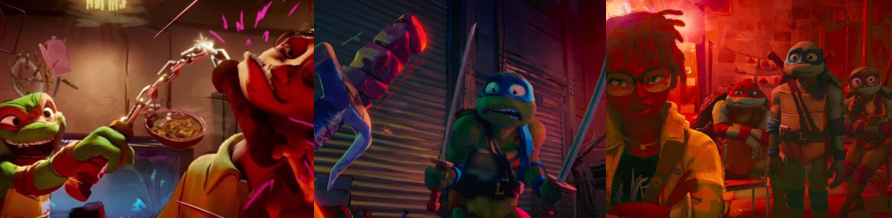
As ever, a primary theme of Mutant Mayhem is of family; Splinter and Superfly are motivated to protect their kin out of genuine concern for their welfare and prepare them to fight against inevitable xenophobia, and the TMNT and Superfly’s crew are both tight-knit groups, thought obviously the TMNT get more focus. Indeed, I do feel like Superfly’s crew could’ve been scaled down to just four mutants to give them more personality and better reflect the thematic parallels between Splinter and the TMNT as most of the crew don’t get to do much (Ray Fillet just sings his name over and over, I could barely understand Bebop and Rocksteady (who strangely turn good!), and Genghis Frog and Leatherhead may as well not be there). On the plus side, they do add to the film’s impressive visuals; the influence from the Spider-Verse films is strong here but Mutant Mayhem has a visual style all its own with this kinetic and eye-popping sketchbook-like aesthetic. Mutant Mayhem resembles a comic book come to life, or a new form of Claymation, and it really helps to give this new version of the TMNT a memorable and engaging appearance; when the TMNT fight, it’s with a fast-paced, frenetic action that gets more refined and methodical as their prowess and confidence improves, and every frame is a burst of colour, action, and creative lighting. The fights are subtly brutal at times, too; the TMNT and Splinter use weapons primarily defensively, but there were a couple of frames where it seemed like Leo, Raph, and Splinter had killed some of their attackers, which I appreciate as much as the film’s darker undertones regarding xenophobia and Superfly’s plans for humanity. Superfly himself cuts a monstrous figure at the best of times and his crew are suitably disturbing to behold, though sadly the film doesn’t give much depth to their personalities. While you could argue there’s more to his crew than meets the eye as they reveal that they only agreed to his plan as they saw no other option and readily accept a less destructive alternative, I’d say it comes across as quite rushed and the film could’ve spent more time showing the TMNT having a positive influence on Superfly’s crew if there were less mutants crammed into the brisk runtime, despite how amazing they look in this striking animation.

So, yes, the TMNT reject Superfly’s plan and try to foil his plot but end up captured by Cynthia and TCRI; thanks to April, the four are rescued by Splinter and they gain more allies when they offer Superfly and his crew a place amongst them in the sewers. Unable to let go of his destructive need to avenge his “father’s” death, Superfly angrily lashes out at his siblings and activates his machine, only for the mutant’s combined might to force it (and him) into the river. Strangely, rather than this resulting in an army of mutated undersea creatures, this transforms Superfly into a gigantic concoction of marine life and fly; already a nigh-unstoppable force before he became a Godzilla wannabe, Superfly becomes a threat to the entire city when he adds more mutated animals to his form and rampages through the streets in a lumbering, ecstatic assault against humanity. This exposes the mutants to the world and sees them all branded as monsters but, luckily, April is literally able to swallow her fears and convince New York that the TMNT and their allies are there to help, resulting in civilians offering Splinter aid when he’s injured by Superfly. Since the only way to stop Superfly is to drop one of TCRI’s anti-mutant solutions into his raging blowhole, the mutants all work together with each other and the helpful civilians to get past Superfly’s vast bulk, stomping feet, and endless supply of vehicular projectiles to end his threat. In the aftermath, the TMNT are celebrated as heroes and accepted into society just as they dreamed; their newfound allies find a home with them in the sewer, Splinter forms a bizarre relationship with Scumbug and fully supports his boys enrolling in high school, where they’re popular fixtures amongst their peers and help restore April’s reputation. While things end well for the mutants, they’re unaware that Cynthia is monitoring them from afar and so determined to discover the secrets of their mutation that she’s willing to employ the services of an ominous mercenary in bladed armour. It’s also worth pointing out that Cynthia’s last name is Utrom, which is the race that Krang is from; her appearance and voice even mirrors that of Krang and his robot body, strongly suggesting we’ll be seeing a reimagining of the Krang/Oroku Saki/Shredder alliance, though I do wonder if the Shredder can have the same impact on the TMNT given the revisions to their origin presented in this film.

The Summary:
Teenage Mutant Ninja Turtles: Mutant Mayhem is a fun, action-packed, visually stunning reimagining of the popular franchise that I think young kids will really enjoy. There’s enough references to the cartoons, toys, and other iterations of the TMNT to appeal to older viewers and hit that nostalgic sweet spot, but much of the presentation, dialogue, and humour is geared towards appealing to a new demographic. Luckily, this is one of the best versions of the TMNT put to screen; I really enjoyed how youthful they sounded, how energetic and enthusiastic they were, and their interactions with each other. I liked that they didn’t fall out and that the film avoided the usual clichés like Raph and Leo clashing over his leadership, but I did feel like their individual personalities weren’t as fleshed out as normal; they adopt so many of Mikey’s characteristics that he loses some of his individuality, Donnie doesn’t get much to do beyond realising the potential of his bo staff, and I would’ve liked to see Raph’s impulsive rage emphasised more. On the plus side, the voice work is amazing, especially with the titular brothers; they bicker and banter and interact like real teenage siblings, though at times they talk over each other a little too much and some of their jokes may become dated quite quickly. The rest of the voice cast is also pretty good; I liked Splinter being reimagined as a paranoid, overprotective father, which was juxtaposed with Superfly so well that it almost made up for robbing him of his usual legitimacy as a master martial artist. Again, though, I do think there were too many mutants on Superfly’s team; they were all very one-dimensional and seem to have been included to sell new toys and appeal to that nostalgia factor I mentioned earlier, which is a shame as there was potential for more thematic parallels between Superfly and, say, Mondo, Leatherhead, Wingnut, and Ray Fillet as dark mirrors to Splinter, Mikey, Raph, Donnie, and Leo, respectively. Luckily, the visuals, frenetic action, and overall presentation makes for a very enjoyable package; there’s a lot of colour, jokes, and engaging animation to make this one of the most entertaining TMNT films in recent memory, but I do think it was a little rushed and overstuffed at times so hopefully the next film keeps things more focused.
My Rating:
Great Stuff
What did you think to Teenage Mutant Ninja Turtles: Mutant Mayhem? Did you like the animation style or do you prefer more traditional animation? What did you think to the TMNT, their personalities and interactions, and do you agree that they needed more time to shine? Do you think there were too many mutants in the film? What did you think to the thematic parallels between Splinter and Superfly? Did you like the changes made to the lore and how do you think this will impact the Shredder’s inevitable inclusion? What’s your favourite TMNT movie or adaptation? Whatever your thoughts, please leave a comment below and check out my many other TMNT reviews across the site!

 Dr. K's Waiting Room
2 thoughts on “Movie Night: Teenage Mutant Ninja Turtles: Mutant Mayhem”