Wrestling Recap: Kane vs. Undertaker (WrestleMania XIV)

The Date: 29 March 1998
The Venue:  FleetCenter; Boston, Massachusetts
The Commentary: Jim “J.R.” Ross and Jerry “The King” Lawler
The Referee: Jack Doan
The Stakes: Semi-main event, personal rivalry between siblings

The Build-Up:
In the entire history of the World Wrestling Federation (WWF), and perhaps all of wrestling, there is, arguably, no greater and more tumultuous story than the history between Kane and the Undertaker. The Deadman had embarked on a reign of terror ever since his debut at the 1990 Survivor Series event, seemingly under the control or influence of a mysterious urn wielded by his revolting manager, Paul Bearer. However, the Undertaker’s relationship with Bearer soured after Bearer turned his back on the Deadman in favour of Mankind. In retribution, the Undertaker used his supernatural powers to blast Bearer in the face with a fireball at In Your House 14: Revenge of the ‘Taker but was tormented by Bearer’s subsequent claims that the Undertaker’s younger brother, Kane, had actually survived the fire that claimed the lives of their parents and was looking for revenge. These claims turned out to be all-too-true when, right as the Undertaker was about to defeat his long-time rival in the first-ever Hell in a Cell match on October 5th, 1997 (the day after my twelfth birthday, which sadly clashes with Global James Bond Day) at Badd Blood: In Your House, the lights went out, ominous organ music played, and a gigantic man garbed in red and black stormed the ring, literally tearing the cell’s door off, ignited the ring posts, and planted the stunned Undertaker with his own finishing manoeuvre, the Tombstone Piledriver as Kane made his shocking debut. Mute, superhumanly strong, and seemingly impervious to pain, Kane immediately embarked on a path of destruction in a bid to goad his brother into a match; the Undertaker, however, constantly refused to fight his brother but was finally pushed too far after Kane and Bearer attacked him at the 1998 Royal Rumble event. The two placed him inside a casket and setting it ablaze, seemingly killing the Undertaker, but the Deadman made another of his trademark dramatic returns and, now, was begrudgingly ready to face his brother, one-on-one, at WrestleMania XIV.

The Match:
As you might expect, given the dramatic and destructive conflict between the Undertaker and Kane and the convoluted backstory between the two, the match is preceded by another of the WWF’s fantastic video packages highlighting Bearer’s claims that “Kane is alive!” and Kane’s breath-taking debut at Badd Blood .The emphasis of the hype package is primarily on Bearer’s obsession with using Kane to extract revenge against the Undertaker and the Deadman’s refusal to fight his own flesh and blood; one thing that’s actually very interesting about this feud, even here in its early days, is that both men are kind of portrayed as tweeners. Neither man is really a face or a heel as ‘Taker is clearly being targeted, so the fans are reluctant to boo him even though he inadvertently killed his parents, and Kane was just too bad-ass, too alluring, and too impressive for people to truly boo him. Instead, it seems tensions were palpable for their inevitable conflict and everyone totally bought into the ridiculous story, suspending disbelief to simply enjoy the supernatural elements of their story and watch two massive guys go at each other after weeks and weeks of build-up. Nowhere is this unusual face/dichotomy more evident than during Kane’s entrance, where he famously stalked to the ring surrounded by flames and red lighting and delivered a Tombstone to Pete Rose, who had spent a couple of minutes insulting the crowd, their city, state, and baseball team. This, seemingly, signalled that Kane was actually a babyface despite everything that he had done leading up to this match, but then he switches right back into being more of a heel in his assault of the Undertaker. Like I say, Kane and the Undertaker was basically beyond the usual clichés of “good” and “evil”; they simply were and did whatever they wanted, whenever they wanted to, to whomever they felt like and people cheered regardless because it was always entertaining to see what these two big, beefy, semi-supernatural men would get up to next.

Kane’s power and strength impressed, especially in the early going.

Of course, the Undertaker made a suitable dramatic and ominous entrance; flanked by several torch-carrying druids, the Deadman slowly stalked to the ring following a bolt of lightning and garbed in a gothic, almost vampire-like caped outfit and sporting a temporary black teardrop tattoo on his face. Kane, however, showed no signs of intimidation (or any emotion at all, considering his face was entirely obscured by his iconic mask, but you can feel his boiling, brewing anger thanks to Jacobs’ fantastic body language and subtle gestures) leading to an iconic face-to-face stare down between the two before the Undertaker broke the tension with a big right hand and a furious assault in the ring corner. However, a common theme throughout the match, especially in the early going, is Kane’s indomitable power and ability to answer, and counter, the Undertaker’s offense at every turn; he manhandles the Undertaker on numerous occasions, overpowering him, reversing his attempts to whip Kane into the ropes and the corners, and quickly takes control of the early stages of the match by brutalising the Undertaker with his superior physical power. Kane even showed off his impressive agility by springboarding off the ring ropes to knock the Undertaker to the outside at one point, though the Undertaker was no slouch in this department either as he uncharacteristically hopped up onto Kane’s shoulders form an awkward-looking Facebuster-type move and, later, dove right over the top rope and crashing through the Spanish announce table in what looked like one hell of a crash landing!
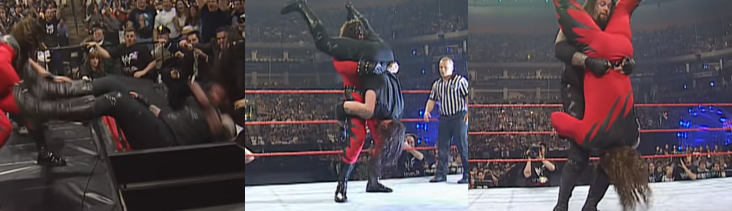
After a nasty dive through the announce table, the Undertaker and Kane traded Tombstones!

All throughout the match, Paul Bearer is a constant presence; standing at ringside, he continuously shouts encouragement and directions to Kane and taunts to the Undertaker. As the fight inevitably tumbled to the ringside area, Bearer distracted the referee so that Kane could bring the steel steps crashing down across the Undertaker’s spine. This, and similar assaults, allowed the Undertaker to truly take control of the match as he slowly, methodically, beat the Undertaker into submission, with Bearer getting a few shots in on the Deadman at every opportunity. Kane, however, allowed hubris and his emotion and obsession with hurting the Undertaker potentially keep him from winning the match as he pulled the Undertaker up from a potential three count following a Chokeslam. Kane, however, presses his advantage after ‘Taker crashes through the announce table and was prepared to finish his brother off with his patented Diving Clothesline but was enraged when the Deadman kicked out of the pin and the two ended up trading punches before Kane overpowered the Undertaker and reversed his Tombstone attempt into a Tombstone of his own! ‘Taker, however, kicked out to a surprisingly mild reaction from the crowd (the silence that followed suggests a degree of shock at this event since Tombstone kickouts weren’t as overplayed and highly anticipated as they would become in later years). Undertaker got his second wind following this and, with Kane finally showing signs of fatigue, was able to plant his brother with a Chokeslam and then returned the favour with a Tombstone…only for Kane to kick out!

It took three Tombstones to put Kane away and ‘Taker didn’t look like a winner after the match!

Despite being on the defensive for the majority of the match, J.R. constantly points out that the Deadman is making every effort to cover up from Kane’s punches and suggests that he may be playing a long game and banking on Kane tiring himself out with his furious and relentless assault. While this means that he has to endure what J.R. claims is the most brutal and physically dominating attack than he has ever experienced, this turns out to be the case and the result is a fantastic showcase for Glenn Jacobs’ popular masked character as Kane looks like an instant superstar thanks to all of the offense he gets in and the dominating position he is in throughout the entirety of the match. Nowhere is Kane’s tenacity emphasised more than in the closing minutes of the match; having kicked out of the first Tombstone, Kane continued to sit up, to get to his feet, and to stalk his brother and, despite eating another Tombstone, simply would not stay down until ‘Taker hit a third and final Tombstone to finally put his brother away. However, Kane and Paul Bearer ended up standing tall as Bearer put the boots to ‘Taker after the bell rang and Kane delivered a massive Tombstone Piledriver to his brother onto a steel chair to emphatically send the message that the Undertaker may have won the battle…but the war was far from over!

The Aftermath:
The feud between the Undertaker and Kane was far from over following this match; the two would clash again the very next month at Unforgiven: In Your House in the first-ever Inferno Match, which Kane, again, would lose. The two would eventually go their separate ways and even formed a tentative alliance that saw the Undertaker help Kane to defeat Stone Cold Steve Austin for the WWF Championship at the 1998 King of the Ring event and become embroiled in Vince McMahon’s ongoing feud with Austin over the championship throughout the summer. The two continually crossed paths as both reluctant allies and bitter rivals throughout 1998, with Kane slowly turning babyface and Undertaker turning heel in the process thanks to numerous twists and turns in their storied relationship. Such drama would follow both men throughout their subsequent careers as they continually switched allegiances and alternated between being one of the most dominant duos in the entire industry and being two of the bitterest rivals but, no matter what form their appearance or relationship took, you could always be assured of an absolute spectacle whenever Kane and the Undertaker share the ring together.

My Rating:

Rating: 4 out of 5.

Great Stuff

What did you think to the contest between Kane and the Undertaker at WrestleMania XIV? How would you rate it compared to their other bouts and which of their feuds, matches, and moments is your favourite? Were you a fan of Kane’s when he debuted and were you hyped for his first match against his brother? Which of the two were you rooting for, given the tumultuous nature of the storyline? How are you celebrating Kane’s debut this year, what are some of your favourite matches and moments from Kane’s long and complex career, and what dream match would you have liked to see him involved in? Whatever your thoughts, drop a comment below and let me know what you think about Kane.

Movie Night: Color Out of Space

Released: 7 September 2019
Director: Richard Stanley
Distributor: RLJE Films
Budget: $6 to 12 million
Stars: Nicolas Cage, Joely Richardson, Madeleine Arthur, Brendan Meyer, Julian Hilliard, and Elliot Knight

The Plot:
Nathan Gardner (Cage) and his family have moved out to his late father’s farm following his wife Theresa’s (Richardson) mastectomy. Their simple life of raising alpacas is interrupted when a strange alien meteorite lands in their garden and a strange, unquantifiable and seemingly intelligent and malevolent living colour begins to infect and infest the local wildlife, the animals, and the Gardner family in increasingly strange and horrific ways.

The Background:
Being a big fan of horror, fantasy, and Stephen King’s, it’s perhaps almost inevitable that, at some point in my admittedly-limited scope of reading, I would have heard of the works of H. P. Lovecraft. Born in 1890, Howard Phillips Lovecraft is perhaps one of horror/fantasy fiction’s most surreal and complex writers; known for conjuring nightmarish imagery and madness-inducing concepts and creatures, Lovecraft created an interconnected set of works that delved into the deepest, darkest fears of the human psyche and posited the idea that humanity is a mere speak in the grand scheme of the cosmos. In 1927, Lovecraft penned “The Colour Out of Space”, a story which he hoped would buck the trend for traditional, humanoid depictions of alien life forms. Interestingly, despite the immense mainstream success of his more notable stories, like “The Call of Cthulhu” (Lovecraft, 1926), Lovecraft considered “The Colour Out of Space” to be his favourite work and the story saw a number of adaptations over the years before director Richard Stanley began putting together this modern-day adaptation. Though planned as the first in a trilogy of films based on Lovecraft’s works, the film’s limited release and near-minuscule box office may scarper those plans despite it receiving generally positive reviews.

The Review:
If there’s one thing that might put the general audience off of viewing Color Out of Space (beyond the Americanised title), it’s the inclusion of Nicolas Cage in the lead role. Far from the blockbuster action hero he was in the nineties, Cage has somewhat reinvented himself in recent years, taking on more experimental and outlandish roles in productions with a fraction of the budget and release he is known for. Indeed, his reputation in Hollywood has become almost farcical as he brings a manic, unpredictable energy to each role he plays so you’re never really quite sure of what to expect when he shows up in a film.

Cage makes for a surprisingly relatable, ordinary man affected by an extraordinary event.

It’s fitting, then, that Cage is cast in a film based on a Lovecraftian tale; Lovecraft was notorious for conjuring up unspeakable entities that would turn the minds of us insignificant humans to a fine paste so it’s actually surprisingly remarkable foresight on the filmmakers’ part to cast the infamously kooky Cage in the lead role of Nathan Gardener. At the beginning of the film, Gardener is your typical everyman; a doting and devoted husband and father, he’s just trying to eek out a living on his father’s old farm and to return his family to some sort of normalcy after his wife’s battle with cancer. Cage brings a quiet, subdued energy to this portion of the role; you can tell he still deeply loves and cares for his wife and kids and is struggling to keep things together after all they’ve been through but he is. Nevertheless, a relatable and vulnerable character whom you buy as just a regular Dad trying to do what’s best.

Cage can always be relied upon to bring the crazy to any film he is cast in.

Things immediately take a turn into the bizarre and the surreal when the mysterious meteorite crashes into their garden; though Nathan isn’t the first to truly feel the effects of the alien Colour, he is the first to react to it, smelling a pungent stench that no others can before slowly being transformed and twisted by the influence of the titular Colour. Before long, he’s spouting all kinds of weird nonsense, exploding into unpredictable and even violent outbursts, and clearly becoming possessed by this unquantifiable alien influence to the point where he almost becomes a kind of avatar for the Colour and the closest thing the film has to a tangible antagonist.

Theresa is horrifically influenced by the presence of the Colour.

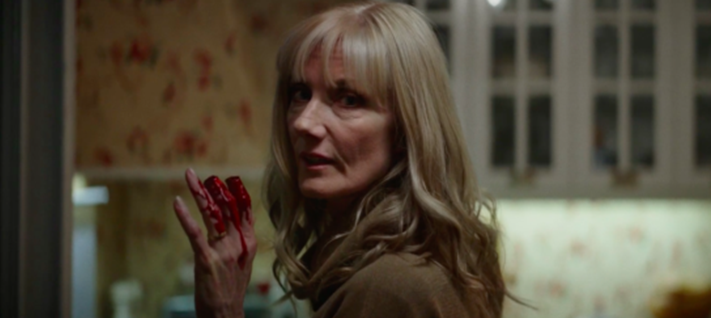
Of course, it’s not just the Nic Cage show; Joely Richardson plays his wife, Theresa, a relatively normal, everyday woman who is just trying to get back on track with her work, family, and sense of self confidence after her battle with cancer. She is, unfortunately, the first of the family to really feel the influence of the Colour, slipping into a zombie-like stupor and accidentally slicing off two of her fingers. As the Colour’s influence grows, her conversations and interactions with Nathan and the kids become increasingly disjointed and erratic but, through it all, her primary concern is for the welfare of her children (which, as I’ll discuss in a bit, turns out to be her downfall).

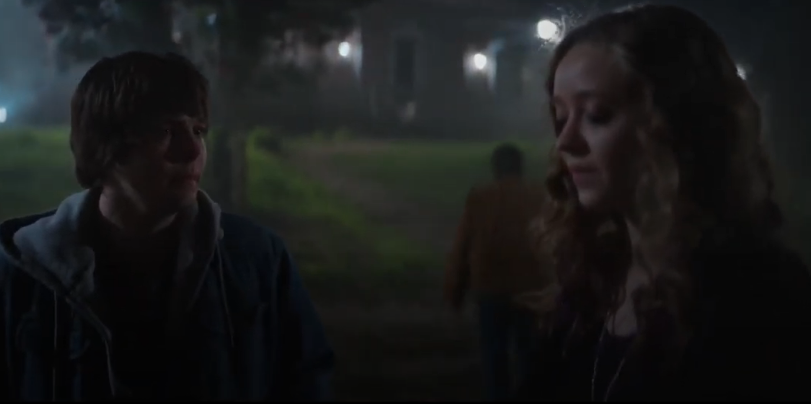
I really enjoyed, and believed, the chemistry between Benny and Lavinia.

As for the Gardener’s kids, Color Out of Space features some pretty decent casting; Lavinia (Arthur) is the couple’s only daughter, a Wiccan who is just on the cusp of growing old and rebellious enough to resent her family but is still devoted enough to truly care for her younger brother, Jack (Hilliard) and have a pretty believable friendly rivalry with her older brother, Benny (Meyer). Benny is depicted as a bit of an absent-minded stoner and the young muscle of the family as he’s constantly being roped into helping his father with the farm’s course and his outrageous alpacas but, despite annoyance and apathy being etched onto his face, he never once complains or throws a tantrum over this; as with all of the Gardener’s, family unity remains at the heart of these characters, however rocky that ground might have become before the film begins. And then there’s Jack, a cute and naïve sort of kid who has a natural curiosity and a fitting child-like whimsy about him. While his older siblings comment on the Colour’s influence but don’t truly succumb to it (with the eventual exception of Lavinia), Jack is the first one to really acknowledge the Colour’s alien presence, seemingly hearing and seeing it and attempting to communicate with it. Sadly, his affection for the Colour (which he views as a kind of imaginary friend) leads him to nothing but a heartbreakingly gruesome fate thanks the Colour’s apparent malevolence (or, perhaps, naivety).

The Nitty-Gritty:
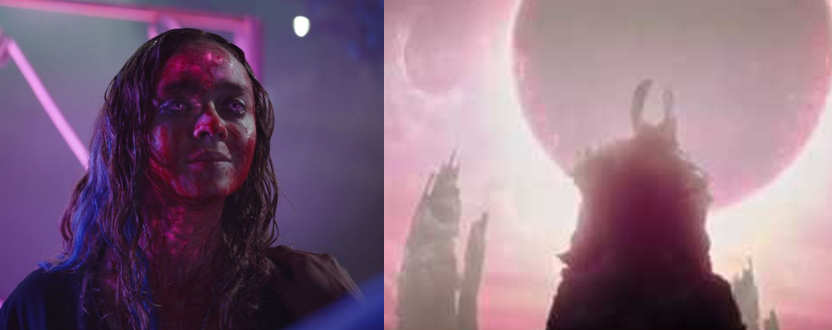
One of the things that often proves so difficult for filmmakers when it comes to adapting the works of Lovecraft is just how obscure and indescribable his many horrific creations are; perhaps, of all of Lovecraft’s monsters, the Colour is the most “unfilmable” since the written word is far better at positing a living, alien Colour that is beyond human comprehension. Film is, obviously, an inherently visual medium so a colour must be shown onscreen and I feel that the filmmaker’s realised the Colour in perhaps the best way they possibly could. Rather than a traditional alien beast, the Colour is just that; a twisted, distorted sentient spectrum of light that is at once beautiful and horrific, blinding and awe-inspiring, resembling a flash of pure light one moment and then a vortex of extraterrestrial intent the next. For the most part, the Colour is realised in an unsettling hue of purple, magenta, and pink surrounded by a clear distortion of physical reality; when it emerges from the Gardener’s well, it almost resembles a tentacled monstrosity but it is wisely never really given a true, quantifiable physical form.

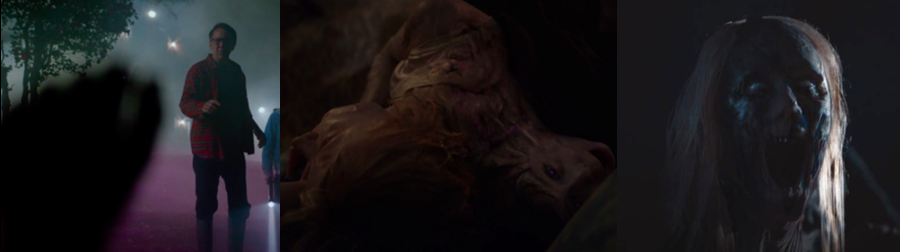
Theresa and Jack suffer a horrific fate due to the Colour’s touch…

Instead, the Colour acts through the things it influences, whether that is water, plants, or animals. It affects and distorts time and space, making moments drag out or flash past in an instant, causing characters to experience aggressive mood swings and events to seemingly happen at random and with no explanation. At first, the Colour’s influence is subtle, induced trance-like states, sending the Gardener’s animals into a frenzy, and making Lavinia sick when she drinks the tainted water but, all too soon, its influence begins to take on a more malicious note. When the Colour directly interacts with other creatures, it distorts and mutates them in gruesome ways; the Gardener’s alpacas end up fused together into a squealing, nightmarish beast like something from the imagination of David Cronenberg or John Carpenter. Described as “just a colour…but it burns”, it’s as tough the Colour were attempting to figure out the life forms it has found itself living with and, since it is unable to recognise them, transforms them and the surrounding area into forms it is more accustomed to. This is directly speculated upon by another of the Colour’s victims, Ezra (Tommy Chong), who is left a hollowed out dusk that decays into fragments of sizzling colour when he is discovered.

Lavinia offers a glimpse of the nightmare hellscape the Colour calls home…

Yet it is Theresa and Jack who arguably suffer the most due to the Colour’s influence; in trying to shield Jack from the Colour, Theresa and her young son become enveloped by its light and the result is a mutilated, agonisingly disgusting amalgamation of the two that, thankfully, is masterfully never lingered on for more than a few seconds at a time. While Nathan affords his beloved alpacas a mercifully swift death, the Colour’s influence drives him mad with distraction, allowing the Jack/Theresa creature to mutate into a ghastly spider-like….thing that attacks Lavinia in a monstrous fury before finally being put out of its misery. In the end, after the Colour has claimed her entire family, Lavinia falls back on her Wiccan ways, drawing solace from her copy of the Necronomicon and attempting to cast a series of spells and prayers to shield herself and her family, this leads to her self-mutilating herself in a vain attempt to ward off the Colour but she too becomes possessed by its influence, affording us a glimpse of the nightmarishly indescribable world that the Colour originated from before it blasts its way back to the space between waking worlds, taking the Gardener’s, their farm, and most of the surrounding area with it and leaving behind a sole survivor, Ward Phillips (Knight), a visiting Hydrologist who tries to help the family and ends up traumatised by the horrific events he bares witness to.

The Summary:
I’ve read my way through my fair share of Lovecraft’s tales and, of them, “The Colour Out of Space” was indeed one of the stronger stories. Though Lovecraft’s writing can be, at times, impenetrable and obtuse, “The Colour Out of Space” told a relatively simple tale of a normal, everyday family coming onto contact with a force of nature far beyond that of human comprehension and I have to say that Color Out of Space does a commendable job of not only bringing Lovecraft’s story to life but also expanding upon it with influence form his other works. With stellar, believable performances from top to bottom and some truly incredible special effects work (both on the Colour itself and the monstrosities it creates), Color Out of Space is quite the psychological thrill-ride with plenty of gory and gruesome moments to satiate more impatient audience members. It’s one of those films that truly leaves you questioning what is beyond our world, offering little in the way of explanations for the events that unfold, and dropping normal, everyday, relatable characters into an extraordinary and terrifying situation that has a suitably bleak and thought-provoking conclusion.

My Rating:

Rating: 4 out of 5.

Great Stuff

What did you think to Color Out of Space? Did you appreciate the film’s subtle, nuance, mounting dread and atmosphere or was it, perhaps, too surreal and slow for you? Have you read the original short story, or any Lovecraft for that matter? What did you think to how the film realised the Colour and do you think it could have been done better or differently? Which Lovecraft story is your favourite and why? What other Lovecraft works would you like to see get a big-screen adaptation? Whatever your thoughts, feel free to leave a comment below.

Movie Night: First Blood

Released: 22 October 1982
Director: Ted Kotcheff
Distributor: Orion Pictures
Budget: $15 million
Stars: Sylvester Stallone, Brian Dennehy, Jack Starrett, Bill McKinney, and Richard Crenna

The Plot:
After returning to the United States from the Vietnam War, former United States Army Special Forces soldier John J. Rambo (Stallone) faces not adulation, admiration, or a hero’s welcome but, rather, persecution and abuse at the hands of small-town sheriff William Teasle (Dennehy). Driven into the woods and suffering from post-traumatic stress and nightmarish memories of his time as a prisoner of war, Rambo wages a one-man war against his tormentors using only his unparalleled survival skills and finely-tune guerrilla tactics.

The Background:
First Blood is an adaptation of a novel by the same name, which was written by David Morrell and published in 1972. Influenced by Rogue Male (Household, 1939) and horrific stories of the Vietnam War told by his students, Morrell’s book was well-received upon release but the subsequent movie adaptation languished in development hell for ten years. Production began in earnest when Sylvester Stallone signed on to the project; Stallone, who was a proven box office commodity after the success of the first three Rocky films (Various, 1976 to 1982) also wrote around seven different versions of the film’s script but, while an ending was filmed that reflected the bleak conclusion of the novel and Rambo’s death, it was ultimately cut at the agreement of Stallone and Kotcheff. Interestingly, upon release, First Blood was met with mixed reviews, although the actors’ performances were highly praised (with Stallone’s being notably well-received). Regardless, First Blood more than made up for this with its frankly staggering $125.2 million box office and contemporary reviews not only regard the film much more favourably but First Blood is widely regarded as one of the best films of 1982 and one of the most enduring and influential movies of its genre.

The Review:
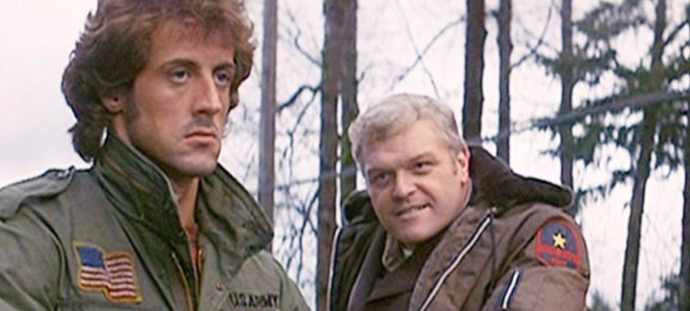
When we’re first introduced to Rambo, he’s little more than a vagrant wandering across the country in a bid to reunite with an old war buddy. Literally carrying his entire life over his shoulder, he’s a simple man just trying to reconnect with a world that has largely passed him by. Sadly, however, his attempts are largely in vain; his friend, Delmar Barry, has died after exposure to Agent Orange and it’s clear that Rambo is basically a stranger in his own country.

Teasle immediately takes a dislike to Rambo based on his rugged appearance alone.

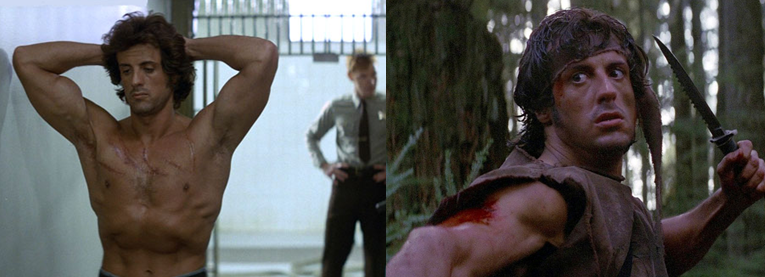
However, this is made undeniably explicit when Rambo crosses paths with Sheriff Teasle, who immediately pegs him as a troublemaking drifter on sight alone. Teasle’s judgement of Rambo boils down to little more than his own personal bias and animosity, no matter how hard he tries to justify himself. I’m sure the ironically-named town of Hope is a nice, quiet little town and that Teasle is proud of the tight ship he runs but his persecution of Rambo is completely unfounded and unnecessarily aggressive. Of course, things only escalate after Rambo is arrested on paper thin charges of vagrancy and carrying a concealed weapon; while being processed, Rambo runs afoul of Teasle’s equally-despicable Deputy Sergeant Arthur Galt (Starrett) and suffers nightmarish flashbacks to his time as a prisoner of war. And, honestly, who can blame him after the disgraceful treatment he receives at Galt’s hands; Galt wallops Rambo with his nightstick, orders him to be hosed down and holds him in an unorthodox choke with that same nightstick but he goes too far when he attempts to have Rambo shaved with a straight razor.

Rambo carries both the physical and mental scars of his time as a P.O.W.

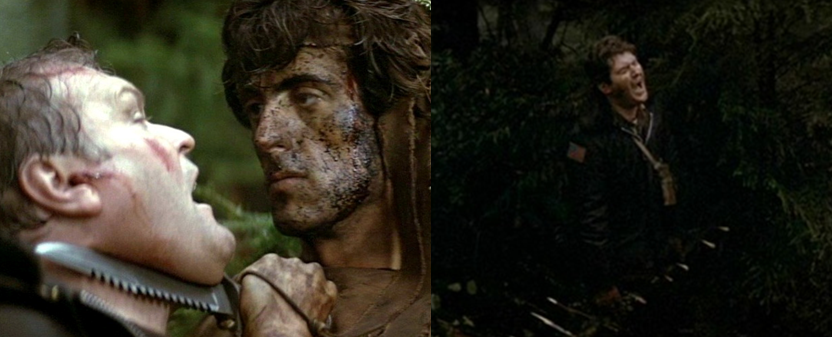
Triggered into a maniacal rage, Rambo easily takes out Teasle’s men with his bare hands and flees into the nearby woods. Earlier, Galt had described Rambo as a wild animal and his initial outburst and escape through town certainly support that; Rambo is an animalistic force of brute strength and unbridled rage, all brought on by flashbacks to his torture. Covered in scars and clearly still haunted by his experiences in Vietnam, Rambo is a force to be reckoned with and the police department vastly underestimate his capabilities. This comes to a head in their ensuing attempts to hunt him down; Teasle spares no expense in tracking Rambo down, pursuing him deep into the woods (and destroying his patrol car in the process), bringing in the dogs, calling in the helicopter for air support, and even drafting in the National Guard for support (who come packing a rocket launcher, no less!) It’s a monumental effort just to capture one man who, so far, is guilty of very little other than walking into town and being forced to relive the worst experiences of his life. Teasle’s obsession completely blinds him to Rambo’s obvious threat even after he is told of Rambo’s unmatched capabilities by Colonel Sam Trautman (Crenna) and directly leads to the accidental death of Galt after he takes this obsession to another level and ends up falling to his death as a result.

Rambo incapacitates his oppressors and pursuers through strictly non-lethal means.

This is, of course, a significant element of First Blood that separates it from the subsequent sequels. Rambo isn’t some ruthless killing machine here; instead, he’s a tortured, desperate man pushed to the edge by ignorant and abusive bigots but, despite his unbridled rage and brute savagery, Rambo doesn’t directly kill anyone in his debut film. Indeed, Rambo goes to great lengths to ensure that his pursuers are incapacitated non-lethally, setting elaborate traps and falling back on his extensive and peerless survival training. The result is actually far more impressive as it emphasises Rambo’s skill, ability, and restraint and he’s clearly deeply affected by Galt’s death. He just wanted to be left alone and would have harmlessly passed through town without incident but, when backed against the wall, easily disables Teasle’s men, and gives him every opportunity to “let it go” but is just pushed further and further until he has no other option than to wage a one-man war against the entire town…all with non-lethal force.

The Nitty-Gritty:
First Blood is a deeply moving and bleak representation of the animosity and persecution many Vietnam veterans, and other war heroes, faced back then (and, I’m sure, even now); Rambo did absolutely nothing wrong but was set off by Teasle’s victimisation and Galt’s antagonism. Indeed, the only one of Teasle’s men to actually speak out against their treatment and vendetta against Rambo is the young deputy Mitch Rogers (David Caruso), the one voice of reason in Teasle’s department who begrudgingly follows his orders despite realising the very real threat Rambo poses.

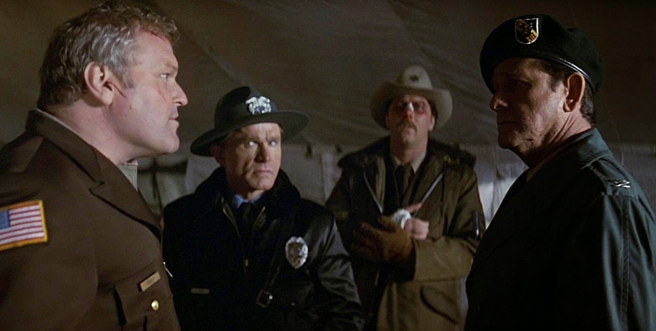
Teasle is unimpressed with Trautman’s warnings of Rambo’s incredible skills.

Of course, Rambo’s history and true danger are related to an unimpressed Teasle by Trautman; Trautman, who takes full responsibility for Rambo’s training, regards Rambo as the literal best of the best, a man trained to survive in the wild with very little resources and who actually thrives under such circumstances. He urges, practically pleads with, Teasle to simply let Rambo slip away, fully confidant that he’ll surrender willingly if allowed to pass on (which is seen to be true when Rambo tries, and fails, to surrender following Galt’s death) but Teasle adamantly refuses to believe that one man can outwit his entire show of force even after everything he’s already seen. Sadly, Trautman’s attempts to quell Rambo’s anger also fall on deaf ears as, by the time he is able to contact him, Rambo has fully committed himself to the fight against Teasle and is basically reliving the war out in the woods.

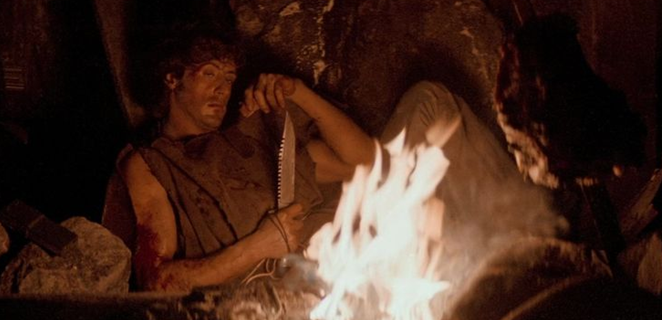
Rambo’s unique survival skills make him a formidable warrior out in the wilds.

Teasle’s obsessive vendetta against Rambo is only fuelled after Gart’s death and he absolutely refuses to be dissuaded from his crusade no matter how many horror stories Trautman tells him. While Teasle’s humanity is practically non-existent, he does exhibit a bit more than just bigotry and hatred after it appears that Rambo has died; feeling cheated out of his victory, he nonetheless attempts to apologise for his abrasive actions to Trautman. However, it turns out that Trautman’s warnings were all based on irrefutable fact and we clearly see how adaptable and skilled Rambo is; he quickly retrieves his knife, acquires a police radio and other weapons from Teasle’s men, and is able to fashion all kinds of traps using just the woods alone never mind when he commandeers and army supply truck and rolls into town for the explosive finale.

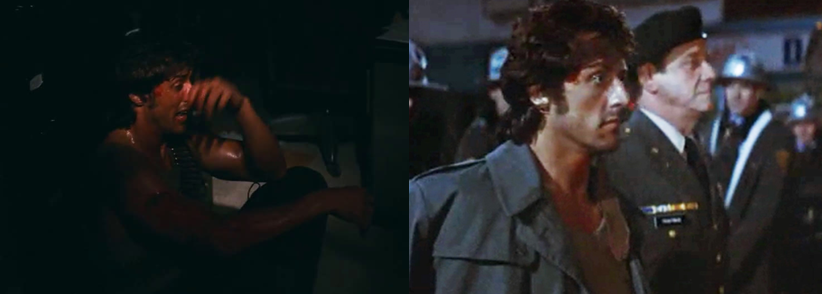
In the end, Rambo breaks down in tears at the torture and abuse he has suffered and surrenders.

In the end, Rambo’s downfall comes not from Teasle or the hundreds of guns pointing his way but from his own traumatic experiences; while his time in Vietnam affords him unprecedented survival skills and allows him to live off the land and overcome superior forces with little more than his wits, it also scarred him both literally and figuratively. Everything he experiences in Hope is a reminder of his time in the war: the straight razor reminds him of his torture, he’s basically reliving his time in the jungles of Vietnam out in the woods, and he is basically attacking an enemy encampment when he storms the town in the end. With Teasle at his mercy, Rambo finally breaks down in despair at the loss of his entire team and the horrors he witnessed in Vietnam; the only one who understands him is Trautman, who validates Rambo’s heart-breaking monologue about the trauma and disrespect he has experienced both in and outside of the Untied States and the film concludes with Teasle injured, but alive, and Rambo surrendering himself to his old mentor and overwhelmed by the atrocities he has had to commit and suffer through.

The Summary:
First Blood is an intense and moving experience; essentially a glorified manhunt for the majority of its runtime, it tells the story of a highly trained and skilled soldier pushed to the edge by abusive and cruel cops and forced to both relive, and live with, the horrors and atrocities he faced in combat. Hounded at every turn and judged for his appearance as much as his status as a former soldier, Rambo receives only persecution and abuse rather than admiration or respect and, in the end, his tormentors pay for their mistreatment not with their lives but with their pride. Despite the insurmountable odds against him, Rambo succeeds through sheer grit and determination and is the original one-man army and yet, despite all of this, all he wanted was a little respect and to be left alone. Indeed, so tormented by his experiences is Rambo, and so tired of conflict and killing, that he refuses to kill any of his tormentors even when he has every chance (and right) to do so, making First Blood a haunting action/thriller. A thinking man’s action film, First Blood is a stark reminder of the horrors of war and the foul treatment they received back in the day, as though it was their fault that they were forced to fight and kill for their country; it’s very different to the bombastic and over the top, action-packed sequels that followed it and so might not be for everyone but it remains a sobering and impact film in its own right.

My Rating:

Rating: 4 out of 5.

Great Stuff

Are you a fan of First Blood? Did you watch it back when it was first released and, if so, how did you find it in the context of the time? How do you feel it holds up today, especially compared to the sequels, and were you disappointed that the sequels veered more towards action and death than introspective commentary on the horrors of war? What did you think to Rambo’s survival skills and Teasle’s baseless persecution and obsession with him? Do you think the film should have ended in the same way as the book and with the cut scene of Rambo dying? Which of the Rambo films is your favourite? Whatever you think, comment below and let me know and check out my review of the sequel.