Movie Night: Olympus Has Fallen

Released: 18 March 2013
Director: Antoine Fuqua
Distributor: Millennium Films
Budget: $70 million
Stars: Gerard Butler, Aaron Eckhart, Rick Yune, Angela Bassett, Dylan McDermott, and Morgan Freeman

The Plot:
When a North Korean terrorist group led by Kang Yeonsak (Yune) storms the White House and takes President Benjamin Asher (Eckhart) and his cabinet hostage, their only hope is one man, Mike Banning (Butler), a former Secret Service agent forced to wage a one man rescue mission on the nation’s capital building.

The Background:
Ever since the commercial success of Die Hard (McTiernan, 1988), a number of knock-offs have permeated cinema that are, essentially, “Die Hard…but on a…”. We’ve seen Die Hard on a boat, on a train, in a plane, in a hockey stadium, in a skyscraper, and all kinds of variants but, in 2013, we got two movies that followed the basic theme of “Die Hard…but in the White House!” The more financially successful of these two movies was, of course, Olympus Has Fallen, which began life as a spec script and became the first in a whole franchise of action movies that really keeps the spirit of Die Hard alive in a time when such movies are rarely seen in cinema.

The Review:
Unlike many films featuring the President, Olympus Has Fallen opens with Asher not in some dull press conference but in a boxing ring with Mike; the entire opening sequence is a pretty effective, if overly dramatic and elaborate, way of showing the close relationship Mike has with the President and his family, especially Asher’s son, Connor (Finley Jacobsen). Mike is on friendly terms with Asher, calling him “Ben” when in private but being all business and a consummate professional when it comes to his safety. Meticulous and detail-orientated, Mike has even (conveniently for the film’s plot) taught Connor the value of always being aware of his surroundings and exits. Of course, no good action movie protagonist is any good without some significant trauma or drama and Mike’s is a doozie: while escorting the Asher’s to a fundraiser, they had a blowout and, though Mike was able to save the President, he couldn’t save his wife, Margaret (Ashley Judd).

Thankfully, Mike and Leah’s relationship has not been strained to breaking point by his guilt.

When we pick up with Mike eighteen months later, he’s a shell of his former self; now working at the Treasury Department, he’s doing the best he can to carry on and provide for his wife, Leah (Radha Mitchell), but is clearly affected by the guilt and consequences of his actions since he’s easily distracted by political news. Thankfully, the two have a very close and adorable relationship: they’re not at odds with each other or arguing, Mike’s not a drunk or abusive, and Leah is both sympathetic and supportive of him and just wants them to adjust to and accept the new normal. She doesn’t really get much to do beyond being Mike’s rock but we do get to see her doing good work at the hospital, staying busy and being supportive even in the face of the insurmountable odds stacked against Mike. Mike, however, is frustrated with his position; he maintains contact with his former director, Lynne Jacobs (Bassett), and wants back in but, while she reassures him that no one, not even Asher, blames Mike for what happened, she urges him to take some time to grieve and reflect on the accident and emphasises that Asher hasn’t given himself that time and is thus unable to see Mike every day without being reminded about what happened.

North Korean terrorists launch a devastating attack on the White House.

Although it’s obvious that things are very different not just for Mike but for Asher and Connor as well, everyone has been able to carry on as though it’s business as usual because of their commitments and, as a result, the President and his staff invite South Korean Prime Minister Lee Tae-Woo (Keong Sim) to the White House to discuss the threat of invasion from North Korean forces. However, shortly after Tao-Woo’s arrival, the White House comes under attack from the Koreans for United Freedom (KUF), a North Korean terrorist group led by Kang Yeonsak, who infiltrates the White House (which is given the completely subtle codename of “Olympus”, hence the title of the film) as one of Tao-Woo’s aides. This delivers quite an impactful sequence in which a gunship rains fire upon Washington, D.C. and the White House itself. Despite the White House’s impressive (and, frankly, unprecedented) array of weaponry (including anti-aircraft guns and hundreds of armed forces), the attack is nothing short of a massacre and the White House is captured with gratuitous use of violence and the destruction of iconic American landmarks.
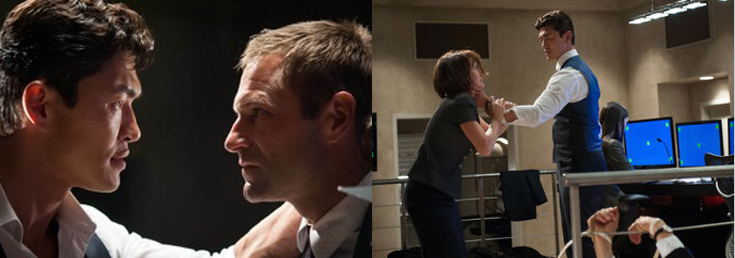
Kang is a ruthless, sadistic villain willing to killing hundreds to prove his point.

Despite being held hostage, with no idea of the whereabouts or safety of his son, Asher remains defiant in the face of Kang’s threat, ordering the remnants of the government and military not to negotiate. Kang, however, is a cold, ruthless, and remorseless individual who takes the White House with an aggressive and efficient operation, setting up heavy weapons and numerous armed men throughout the White House to fortify his position. He is also more than happy to threaten, torture, and kill Asher’s aides for security codes to America’s “Cerberus” weapon, mercilessly beating Secretary of Defense Ruth McMillan (Melissa Leo) to within an inch of her life and outright executing Tae-Woo. To spare lives, Asher permits his aides to divulge their codes since he remains steadfast that he will never reveal his own code, which only drives Kang to further extreme methods.

Forbes’ betrayal aids Kang’s cause and positions him as Mike’s dark opposite.

Kang and his cohorts are reprehensible, merciless terrorists who gun down countless members of the White House security team in an unprecedented ground assault, completely taking everyone by surprise, and of which Mike ends up being, again, the sole survivor inside the now ravaged White House. Of course, it turns out that they were aided in their efforts by Dave Forbes (McDermott), a former Secret Service agent and trusted friend of Mike’s who sells out his country after losing his way. Forbes is positioned as Mike’s dark reflection, a corruption of the ideals he fights so hard to uphold, and their inevitable showdown is framed in a way to present Mike as fighting someone as trained as capable as he. Of course, Mike is able to overcome this challenge with grit and determination and, having delivered a clean, effective, mortal blow, offers Forbes the chance at redemption before he dies.

The Nitty-Gritty:
An interesting technique Olympus Has Fallen employs is not just the usual onscreen information like locations and times and such but also little titles for key characters in the Presidential office so we know who they are and what their position is. I’m not entirely sure I really need this context (it’s enough for me to see them conversing with the President to know that they’re important) but it’s certainly unique. Of course, not being an American, having no interest in politics, and not really being that patriotic, many of these aspects are wasted on me. However, the action in Olympus Has Fallen is suitably loud and over the top and the initial assault against the White House is scary in its potential, if a little undermined by the slightly dodgy CGI (most notably seen in the film’s various blood effects). For me, none of this detracts from the sequence or the action, though, since such scenes are full of frenetic cuts, fast-paced action, and numerous explosions and brutal kills that all sell the sudden violence of the campaign more than anything else.
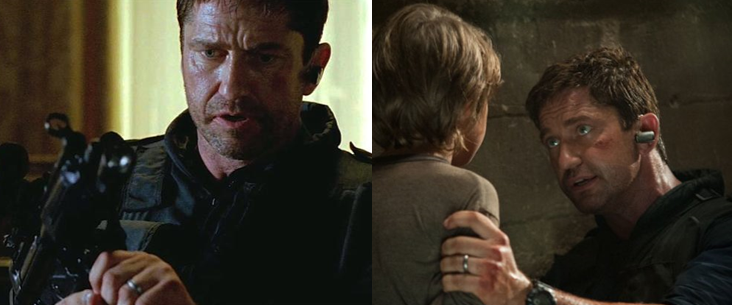
Mike’s training and knowledge of the White House makes him a force to be reckoned with.

Once Mike enters the White House as the last man standing, the film truly reveals its Die Hard roots as Mike becomes a John McClane (Bruce Willis) figure: a lone man with few resources fighting impossible odds. Mike, however, as a former Army Ranger and Secret Service Agent, is arguably a lot better trained and equipped than McClane yet, as efficient and capable as he is, he’s still just one man and positioned as a vulnerable, desperate character. Mike’s adaptability comes not just from wise cracks (and he is extremely snarky when he needs to be) and desperate innovation but from his knowledge of the White House and governmental protocols, which he uses to his advantage to arm himself, find and rescue Connor, and launch a pre-meditated counterattack using the hidden passageways to avoid and take out Kang’s men one at a time. Of course, it’s not all action and excitement in Olympus Has Fallen; much of the film’s side plot revolves around the remaining governmental body, headed up by Speaker of the House Allan Trumbull (Freeman) who, along with military aides and other advisors, desperately try to hold the country together, debate Kang’s demands, and try to find a way to resolve the situation. Interestingly, I found that the film kind of suggests Trumbull as a red herring, someone perhaps in league with Kang in order to usurp Asher as the President, but..c’mon, it’s Morgan Freeman so of course he’s the cool-headed commander-in-chief who helps co-ordinate Mike’s efforts within the White House.

Despite Kang’s impressive physical skills, Mike is able to end him with brutal efficiency.

Thankfully, there’s only a momentary debate about Mike’s credentials and capabilities so, unlike McClane, he’s not entirely alone in the White House and has a degree of support, if nothing else. However, his warnings to as General Edward Clegg, (Robert Forster) regarding their attempts to retake the White House of course fall on deaf ears because those not stuck in the middle of the shitstorm always have to make uninformed and impulsive decisions so our “Everyman” hero can shine even brighter and have another chance to perform a daring attempt to save lives. Despite his earlier obvious feelings of guilt and uselessness, Mike reacts without thinking as soon as he spots the incoming attack on the White House, goes out of his way to try and save lives, and immediately slips right back into his scrupulous training to become a one man army. Mike is an efficient, hard-hitting combatant; there’s no prolonged fight scenes here, just quick, hard, well-timed strikes. He’s also, it turns out, an equally ruthless and dangerous individual; when questioning Kang’s men, he doesn’t hesitate to murder one with one quick, vicious stab and torture information out of the other. Whereas McClane struggled with most of the terrorists he was placed up against, Mike only really finds himself facing a challenge when fighting Forbes and in the final showdown with Kang. Still, despite Forbes’ deception and taking him by surprise, Mike is quickly able to adapt and put him down. By the time he reaches Kang, Mike is fatigued and wounded and thus on the backfoot at first, especially in the face of Kang’s superior martial arts ability. However, Mike represents America’s much-touted ideals of peace, freedom, and democracy and this only bolsters his indomitable will, allowing him to make good on his promise to “stick his knife through [Kang’s] brain” and win the day for America.

The Summary:
Olympus Has Fallen is an extremely intense and engaging action film; it walks a fine, blurry line between being massively over the top and being just a little too serious for its own good, never quite falling on one side or the other. This results in a decent amount of tension and excitement; Mike is an extremely capable, well-trained, and meticulous individual and yet, thanks to Butler’s rugged charisma and down-to-earth appeal, is still a vulnerable, flawed, and relatable character. He’s fighting an uphill battle and striking with a blunt efficiency but is still human, getting more and more fatigued and battered up as the film goes on. Kang, meanwhile, is a ruthless and nigh-emotionless sadist, the kind of villain who truly believes that the ends justify such vicious means, and Yune brings a quiet, despicable magnetism to the role that is fully paid off in his violent end. Strong supporting performances by the always-fantastic Morgan Freedom and Aaron Eckhart help bolster the film’s appeal and legitimacy and, despite some dodgy CGI in the opening moments, the film stays very true to the gritty, desperate spirit of films like Die Hard and is, in my opinion, a worthy successor to that series.

My Rating:

Rating: 4 out of 5.

Great Stuff

What did you think to Olympus Has Fallen? Did you find Mike Banning, and Gerard Butler, a compelling action hero? How did you find the execution of the film’s premise and the performances within? Did you find it an enjoyable romp or were you, perhaps, unimpressed with the film’s weaker aspects and arguably derivative nature? How do you think it compares to Die Hard and similar films and which of Die Hard’s many knock-offs is your favourite? Whatever you think about Olympus Has Fallen, leave a message below and come back next Sunday for my review of the sequel!


Game Corner: Burnout Paradise: Remastered (Xbox One)

Released: 16 March 2014
Originally Released: 22 January 2008
Developer: Criterion Games
Also Available For: PC, PlayStation 3, Xbox 360 (Original Version); Nintendo Switch, PC, PlayStation 4 (Remaster)

The Background:
The Burnout franchise is a series of racing games developed by Criterion Games that began with the appropriately-titled Burnout (ibid, 2001) and is best known for its fast-paced, arcade style racing and its innovative crash mechanics and physics. Now, traditionally, I’m not really one for racing games; it’s not really my thing and I tend to stay away from anything that isn’t a mascot racer. In 2011, though, you may remember that millions of PlayStation Network accounts were compromised; as a means of compensation, players were offered a number of free games, one of which was Burnout Paradise, a title I ended up enjoying so much that I bought a physical copy some time later.

Unlike is predecessors, Burnout Paradise was more of an open world racing game.

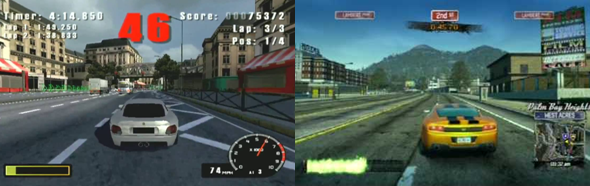
Unlike the other games in the Burnout series, Burnout Paradise is an open world game designed around exploration, online play, and racing without predefined tracks. Though the developers had to work hard to justify these new elements with the game’s sceptical publisher, Electronic Arts, Burnout Paradise was met with a generally positive response from critics and was supported by lots of downloadable content (DLC) that included additional cars, gameplay modes, and a whole new island to explore. The vast majority of this content was included in the Remastered version of the game, which also included support for higher-resolution monitors and ran at sixty frames a second. Considering how much fun I had with the original version of the game, I was delighted when a friend of mine gifted me the Remastered version so I could get back to racing through the streets, taking down cars with reckless abandon, and bopping along to the game’s awesome soundtrack.

The Plot:
Welcome to Paradise City, a large, urban environment where racing is the aim of the game. With guidance from DJ Atomika, you are shown the basics of how to race in Paradise City with the ultimate aim to upgrade your driving licence and earn a whole collection of top quality motors.

Gameplay:
Burnout Paradise: Remastered is an open world racing game in which you drive around the fictional Paradise City taking part in a series of races and other challenges to upgrade your driving license, unlock some cool cars, and be the most respected driver in the entire city. There isn’t really a “story” to speak of or a character to play as; all of the cars are empty, the streets are completely devoid of pedestrians, and while the motorbikes do have a rider, they disappear if you get into one of the game’s signature wreck sequences. As a result, the vehicles take centre stage and the only character the game really has is DK Atomika, a radio DJ who acts as your guide and talks you through the basics of the game’s controls, objectives, and offers advice as you’re driving around.

Build up your Boost meter to blast ahead in a burst of nitrous!

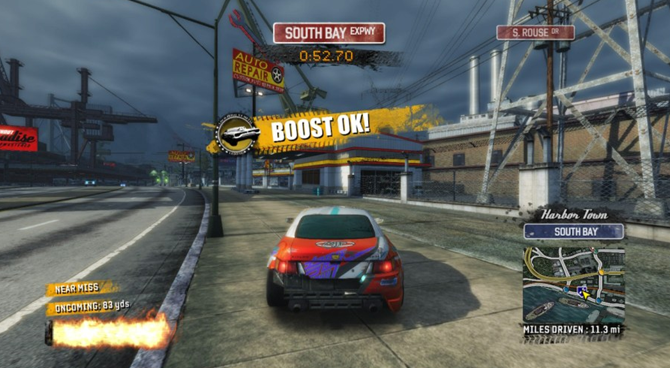
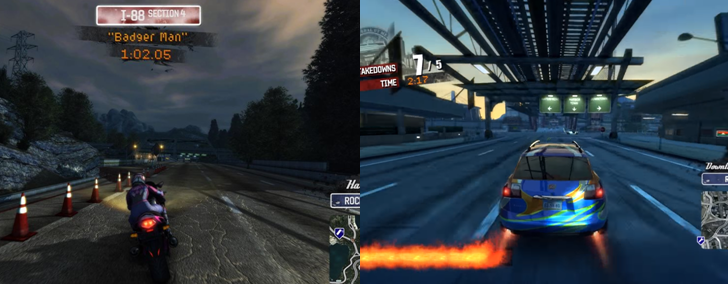
There are a variety of vehicles on offer in Burnout Paradise: Remastered, each with their own unique statistics and abilities, though all control largely similar: you press and hold in the Right Trigger to accelerate, use the Left Trigger to brake and reverse, glance behind you with the Left Bumper and switch camera positions with the Y button, and press X to use your emergency brake (or “E brake”) to perform drifts and power slides and such. As you drive, you’ll also build up a Boost meter in the bottom left of the screen; once it’s full, you can initiate a nitrous boost with the X button to blast ahead and dramatically increase your speed and odds in races. The type of car you have determines how long your Boost meter is and how effective it is; while “Speed” orientated cars have the smallest meter that drains once you press and hold A, heavier vehicles allowing for a three-tiered Boost meter, and “Stunt” orientated cars build their meter by performing special tricks and jumps.

Take part in a number of events, my favourite of which involve smashing up other cars!

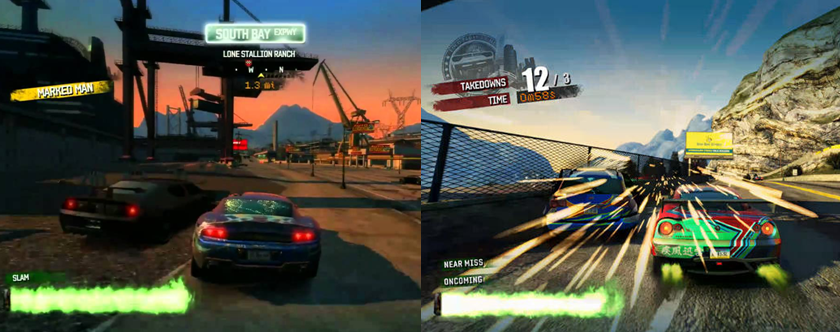
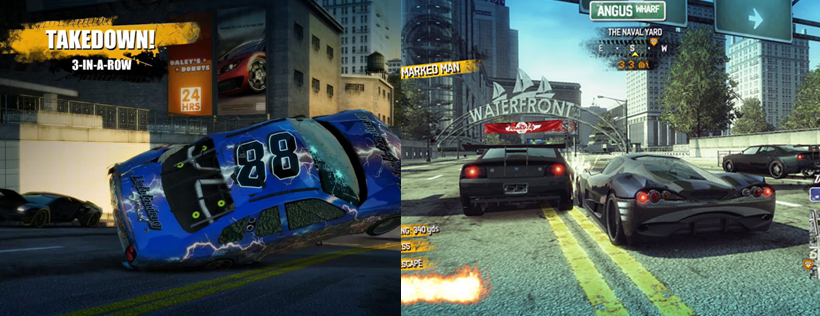
Choosing the right type of vehicle is the key to completing all of the game’s various racing challenges (known as “Events”); you may have to sacrifice speed for strength to survive “Marked Man” challenges but heavier cars won’t serve you too well in the longer races. In Burnout Paradise: Remastered, you can pull up and stop at multiple sets of traffic lights throughout the city and initiate an Event by pressing LT and RT together and there are multiple types of Events on offer. Each vehicle has their own unique Burning Route, a timed event that awards you an alternative version of the vehicle you use (with Burning and Midnight Rides substituting for the bikes); Marked Man has you race to a specific point on the map while a number of cars try to take you down; a Race is simply that: you start at one point and race to another, generally against more opponents and across a longer, more difficult distance as the game progresses; Road Rage has you perform a set number of takedowns within a time limit; and Stunt Run has you performing power slides, jumps, and a variety of other tricks to build up a required amount of points.

Use the mini map and landmarks to help navigate the city as fast as possible.

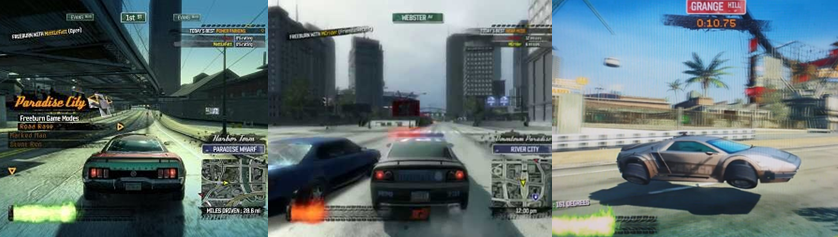
There are a couple of other Events on offer as well, such as Road Rules, Time Road Rules, and Showtime Road Rules, which see you setting speed and damage runs within a time limit for the benefit of the online leaderboards. You can use the directional pad (D-pad) to restart an Event if you mess up or are about to lose and the D-pad also accesses a separate menu for online functionality. Navigating Paradise City is pretty simple thanks to the mini map in the bottom right of the screen, which clearly shows the main road through the city and the many twisting, turning side roads and country lanes; it also highlights your opponents and nearby points of interest, like the Auto Repair shops that repair your car when it has taken damage and the Junk Yards where you can switch vehicles. If you need a better view, you can access a larger, more detailed map from the pause screen and filter it to show these landmarks, and others, which are added to your map as you pass by them while driving. Sadly, though, there’s no way to set a route to follow and no fast travel features but there are plenty of recognisable landmarks (such as the airfield, the football stadium, and the country club) and, as you’re racing towards a destination, street signs appear at the top of the screen and blink left or right so you always know when to turn…just be prepared to apply a little E-brake for tight corners.

Smash your car up to your heart’s content but don’t be surprised if it affects your racing performance.

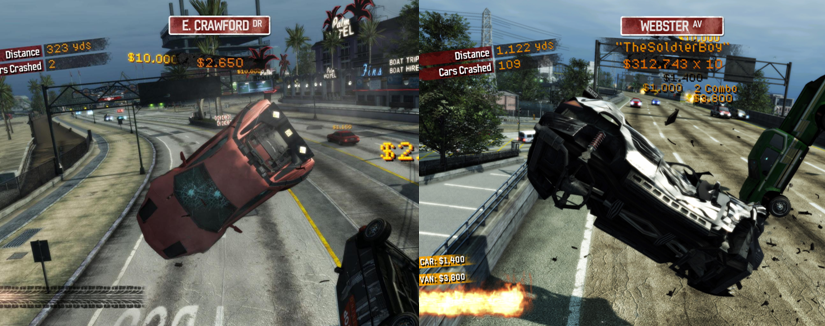
Of course, the biggest selling point of the game, and the franchise, are the elaborate crashes; as you’re driving along at high speeds, you’ll have to dodge other vehicles and obstacles such as walls and bollards. If you clip or crash head-first into these, you’ll be treated to a stunning visual of your vehicle crumpling like paper or flipping over and over. If the crash is only minor, you might get lucky enough to simply drive away from it but, if it’s more serious, your car will get wrecked and you’ll need to visit an Auto Repair to fix it up. There is no game over, though, so you don’t need to worry about the game ending because of damage but if you get too smashed up you won’t last long in Events so it’s best to either repair the damage or switch to a tougher vehicle.

Graphics and Sound:
As a racing title, the main thing Burnout Paradise: Remastered needs to worry about is performing consistently well at high speeds and rendering its large, multifaceted city. Thankfully, the game excels at both as I experienced no slowdown at all even when racing against multiple opponents and the city flies past at breakneck speed, never glitching or suffering from pop up or loads times, which are effectively masked by the city’s vast size and various areas. The only times I found the game slowed down was when you were in the Junk Yard, especially when you visit after unlocking a number of new vehicles, as each one has to load in and there’s no way to skip past these sequences.

Each vehicle has its own strengths, weakness, and capabilities that affect your driving experience.

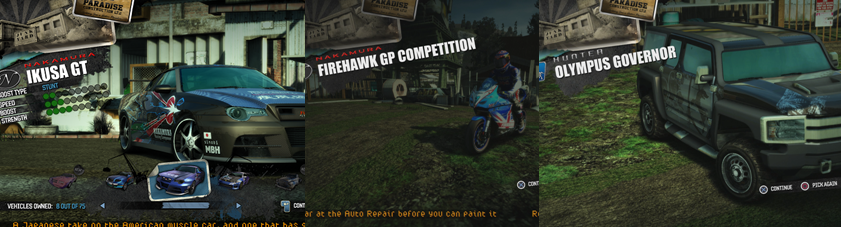
Burnout Paradise: Remastered features a wide variety of cars, bikes, and other vehicles, all of which are based heavily on real-world vehicles but changed for legal purposes. You’ll get to drive sports cars, muscle cars, racing cars, jeeps, coupes, and even massively impractical piston engines on wheels. There are also a selection of motorcycles on offer, cop cars and other emergency vehicles, vehicles based on iconic cars from television shows and movies, and even miniature toy cars. I’m no really a “car guy” but I was impressed by the game’s wide selection and the detail on offer; each vehicle controls a little differently and even crashes a little differently so you can mix and match and experiment to see what’s best for you in any given situation. It’s not easy to do this, though, since you have to travel to a Junk Yard to switch cars, which can take a while if you’re stuck in the mountains, but the majority of the cars can also be customised with paint jobs in the Junk Yard are by driving through a Paint Shop.

The game performs really well; it’s super fast and smooth and has lots of detail packed in.

Paradise City itself is the game’s most impressive feature; it’s a massive city, with lots to do and see, and it’s just fun to simply drive around aimlessly listening to some tunes and looking for things to smash through. Numerous tracks will play from the in-game radio; these can be skipped using RB and customised from the main menu and include classic music, original tracks from the previous Burnout games, and some kick-ass tunes from the likes of Sense Fail, Alice in Chains, Twisted Sister, and, of course, the game’s title track: “Paradise City” by Guns N’ Roses. The game also features a day/night cycle that you can customise the length of from the pause menu, which is a neat feature, and there are numerous landmarks to see all over the place. You’ll also stumble across fun little side areas to mess around in, such as a number of parking lots for big jumps, a quarry pit, and a railroad track and the game’s size and scope is further expanded with a visit across the bridge to Big Surf Island, where a host of additional challenges await.

Enemies and Bosses:
As it’s a racing game, there’s no real “enemies” in the traditional sense; one of the main things you’ll need to worry about as you race around the city are the many hazards that can wreck your car, from small stuff like walls and bollards to major things like oncoming traffic or rocky cliffs. When racing in Events, your main enemy will, of course, be the other racers; these start off pretty simple, with one or two cars putting up a little bit of competition, but as your license upgrades you’ll find the opponents start taking multiple different routes to the end goal and are much tougher to beat. One thing that is helpful, though, is that you can take the other drivers down to give yourself an edge in a race; they’ll return to the fray but it can be enough to buy you some time to pull ahead.

Be sure to take down other drivers and pick a tough vehicle to keep from being wrecked.

You’ll face far more aggressive opposition in Marked Man and Road Rage Events; in the former, black cars will try to ram you off the road and wreck your car and, in the latter, you’ll be doing this to a certain number of vehicles. Again, at first, this isn’t so hard; you can race up behind and alongside the cars to shove them into oncoming traffic, walls, and other opponents to build up a multiplier bonus which is always fun but, as the game progresses, the opponents get faster and much more aggressive so it’s worth switching to a car with more strength and durability than a flimsy sports car.

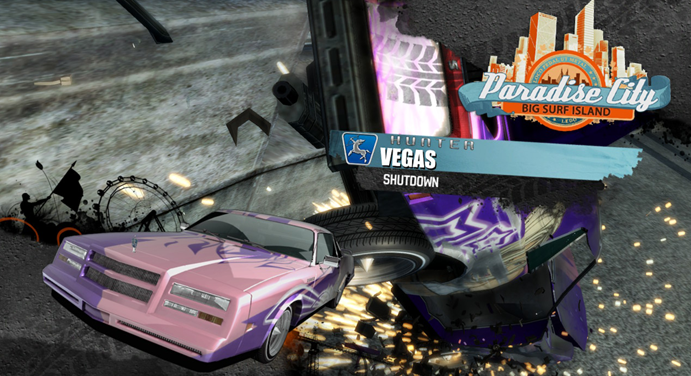
Shut down cars racing around the city to add them to your collection.

Similarly, there are no “bosses” as such but, as you win Events and upgrade your licence, new vehicles will appear throughout Paradise City. When these race past you, you have to chase after them and take them down in order to add that vehicle to your Junk Yard. Again, chasing down cars and smashing them up makes for some of the most entertaining aspects of the game but it’s a bit random when they’ll appear and fly past you and, as the map doesn’t highlight them, you’ll have to keep your eyes open when there’s a few out in the wild.

Power-Ups and Bonuses:
There’s only really one power-up available to you in the game and that’s the aforementioned Boost function. The Boost meter is built up by performing takedowns, stunts, and racing along, and really is the most valuable tool in your arsenal as it allows you to quickly catch up to cars to take them down or blast past them to the finish line. The downside, though, comes when you drive a vehicle that blows through its Boost meter in one go and the boost you receive can make certain cars careen out of control and into incredible crashes.

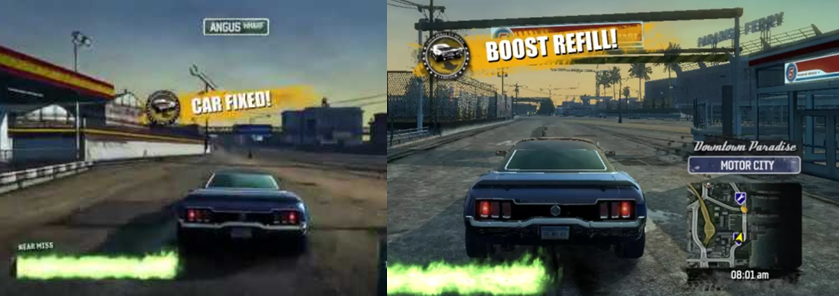
Repair your car or refill your Boost mid-race to gain a significant advantage.

Otherwise, your power-ups are tied towards the type of vehicle you use; faster cars with a decent Boost meter are good for most of the game’s Events but can cause you to be easily smashed up. As a result, it’s best to keep an eye out for the Auto Repair Shops to repair any damage and refill your boost at other drive-throughs, both of which are super handy mid-race to give you an edge.

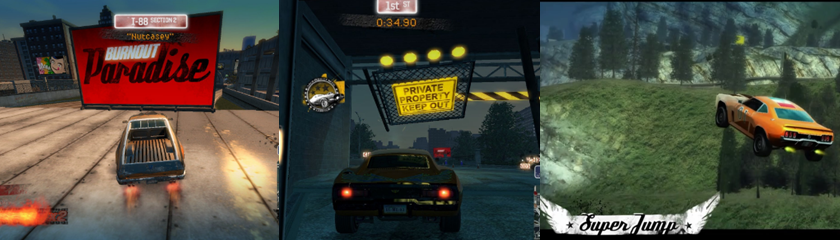
Smash through billboards and gates and tackle Super Jumps to earn Achievements.

As you explore Paradise City, you’ll find numerous gates and giant billboards to crash through; if you spot these, make sure you crash into them at every opportunity as you’ll learn a handy shortcut and take one step towards earning the game’s numerous Achievements. In addition, scattered throughout the city are a number of jumps and Super Jumps, many of which will have you crashing through one of the 120 billboards and are guaranteed to be found atop the parking lots. You’ll want to reverse up a bit, though, and get a good run up and time your boost to really fly through the Super Jumps and make sure you stick the landing or you might fail the jump.

Additional Features:
As mentioned above, the game features a number of Achievements; fifty-six, in fact. From what I can tell from my memory of the PlayStation 3 version’s Trophies, these are actually a little different than those seen in the original game and include such things as upgrading your licence, landing a certain number of Super Jumps, getting a takedown multiplier, winning Events, and so forth. You can easily burn through a whole bunch in just an hour or so of play but you’ll need to hunt high and low to find all the billboards and gates to smash through.

Take on a variety of online modes or drive the famous Delorean in hover mode!

Thanks to being the most complete version of the game, Burnout Paradise: Remastered includes all of the DLC from the original game; this means you can jump in a variety of police cars (each of which comes with a siren you can toggle on and off) to race around in. These cop cars are also used in the game’s online mode as a “Capture the Flag” style game where four players, as the cops, must chase four others as the robbers. You can also challenge online players to ranked and unranked races, Freeburn Challenges, and variations of the usual in-game Events, as well as have your best times and scores uploaded to the online leaderboards. Toy versions of certain cars are also freely available as are the “Legendary Cars”, which offer vehicles based on the Knight Industries Three Thousand (K.I.T.T.), ECTO-1, and the DeLorean time machine, amongst others. I found myself drawn towards these simply for their speed and iconography and the fact that you can put the DeLorean into hover mode!

Hop on over to Big Surf Island to take on a whole new bunch of challenges.

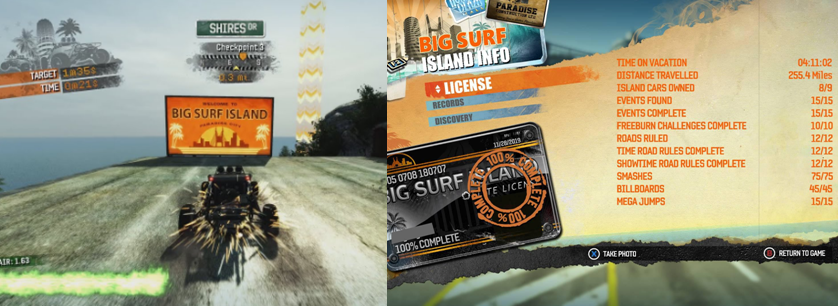
Finally, there’s Big Surf Island, a massive extra area to explore that is accessed via a bridge. Big Surf Island is smaller than Paradise City but pretty big in its own right and is home to a whole new load of billboards, gates, and jumps (here called “Mega Jumps”) as well as new cars (most of which you’ll have access to from the start) and Events that see you having to race to specific checkpoints across the island. One thing to keep in mind about Big Surf Island, though, is that nothing you do there contributes to upgrading your driving licence; instead, the points go towards building up your “Big Surf Island License”, which is levelled up to 100% by completing everything the island has to offer.

The Summary:
Now, I’m not really a fan of cars or racing, much less racing games; all of my car knowledge comes from Top Gear (specifically from 2002 to 2015) and my experience with racing games is limited to a few arcade titles and kart/mascot racers. Yet, I really enjoyed Burnout Paradise and, as such, found this Remastered version just as enjoyable, if not more so thanks to the inclusion of all of the DLC right off the bat so you have everything the game has to offer available to you. If you enjoy racing, the game has you covered. Stunts and such? It’s not for me but it’s in there. Maybe you’re more like me and you prefer the high speed crashes and taking down other cars by shoving them into the path of an oncoming bus without mercy. If so, this is the game for you. Simple to play, with loads to do and see, and fun to just drive around aimlessly, Burnout Paradise: Remastered is a great game to just throw on for an hour or so and unwind after a stressful day, taking part in some super fast races, ridiculous crashes, and listening to some great tunes while you do it.

My Rating:

Rating: 5 out of 5.

Fantastic

Are you a fan of Burnout Paradise and the Burnout franchise? If so, which game is your favourite and what is it about the games that you like? Did you pick up this Remastered version of the game; if so, how do you think it compares to the original? What is your favourite racing game franchise? Whatever your thoughts, drop a comment below and let me know.

Game Corner: Call of Duty: Modern Warfare Trilogy (Xbox 360)

CODMWTLogo

Released: 2016
Originally Released: 2007; 2009; 2011
Developer: Infinity Ward/Sledgehammer Games
Also Available For: Nintendo Wii, PC, PlayStation 3, PlayStation 4, Xbox One

The Background:
This may shock and surprise and annoy a lot of people but…I do not care for the Call of Duty franchise (Various, 2003 to present). Activision’s long-running first-person shooter (FPS) series has seen many releases, spin-offs, and other related media over the years and has, collectively, sold over 250 million copies. Yet…it’s not really for me. As a general rule, I’m not much of a fan of FPS games and my love for them died out around about the same time as the release of Perfect Dark (Rare, 2000). This is simply a personal bias for me; I sometimes struggle with the maze-like nature of FPS games, the restrictive view (I can never seem to see anything and don’t like being attacked from behind), and how many FPS games make the controls needlessly complicated and convoluted. However, when I bought my Xbox 360, it came with a few Call of Duty titles, most prominently the Modern Warfare Trilogy. Therefore, January is going to be “CoD Month” and I’ll be spending the next few Wednesdays going through the Call of Duty games I played to see if my bias against the series was justified and to obtain a bunch of sweet, sweet, Achievements.

The Plot:
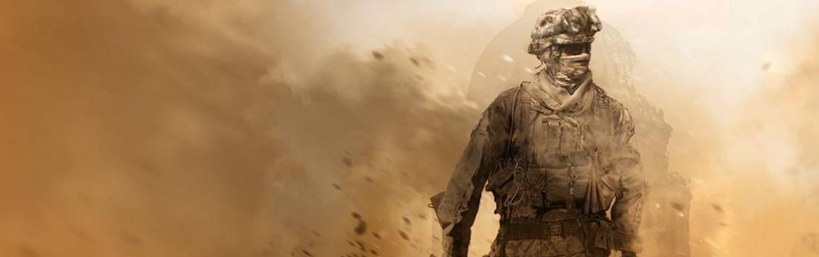
In a change for Call of Duty’s traditional World War Two settings, the Modern Warfare trilogy takes place between 2011 and 2016 and is initially centred around a civil war in Russia which eventually (through a series of complex betrayals and double-turns) escalates into a full-on world war between the United States and Russia.

Gameplay:
The Modern Warfare titles are first-person shooters that primarily place players in the role of either British Special Air Service (S.A.S.) Captain (originally Segerent) John “Soap” MacTavish and Captain John Price. While these two are the primary characters of the trilogy, you’ll also take on other roles (such as Sergeant Gary “Roach” Sanderson and Private First Class Joseph Allen in Modern Warfare 2 and Staff Sergeant Derek “Frost” Westbrook and ex-Spetsnaz operative Yuri in Modern Warfare 3). No matter who you’re playing as, the controls and heads-up display (HUD) are exactly the same and very little changes between each title in terms of your abilities and controls.

CODMWTStance
The stance you adopt affects your visibility and aiming.

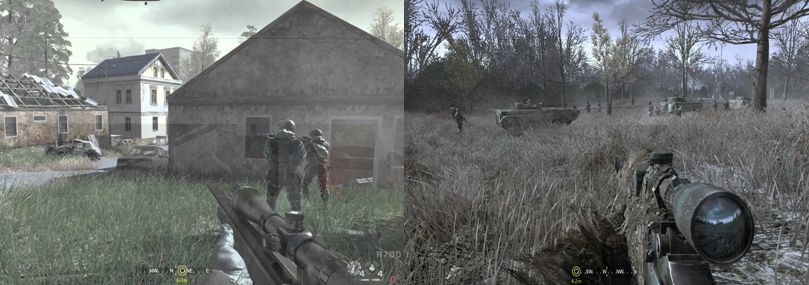
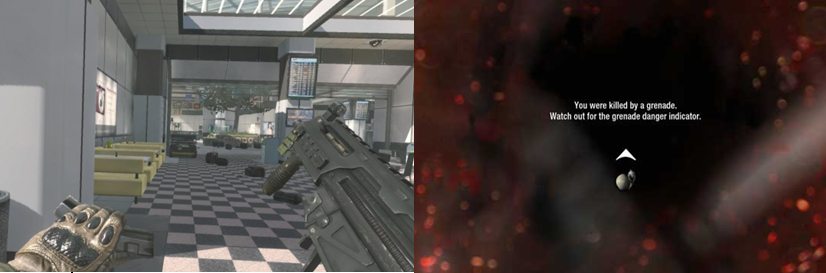
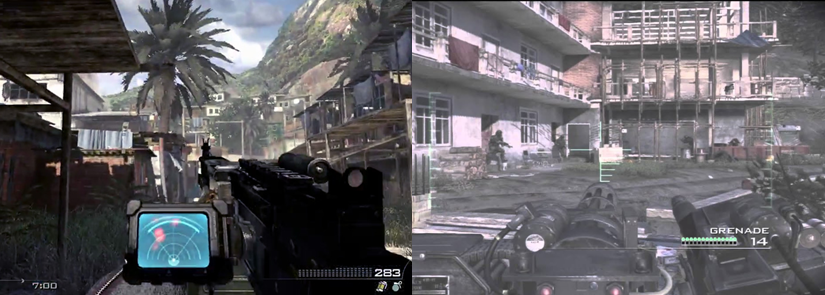
By pressing B, players can assume one of three stances: standing, crouching, and “prone” (where they lie down on the floor), each of which affects your speed, aim, and level of stealth. Standing up makes you an open target, for example, but going prone can render you almost completely undetectable. You can jump with the A button but there’s very little call for this; you don’t have to do that much jumping and this is mainly used in specific areas to vault over low walls and other areas of cover. Holding in the left analogue stick will see you break into a run (you can’t do this indefinitely, though, and there’s no stamina meter to let you know how long you have between sprints so you’ll just have to guess) while pressing in the right analogue stick allows you to melee attack enemies. You can also reload with X, toss grenades or flashbangs with either the Left and Right Buttons, respectively, switch between your weapons with the Y button (you can only hold two at a time but you can hold X to pick up new weapons as-and-when you come across them), and aim and shoot your primary weapon with the Left and Right Triggers. Shooting comes in two forms: down the sights and from the hip and, by tapping the Left Trigger, you’ll automatically snap on to the nearest enemy in a form of auto-aiming.

CODMWTReload
Be sure to watch out for incoming grenades when reloading.

Generally speaking, the game encourages you to switch weapons rather than reloading as this is faster but, in my experience, this results in you having two weapons that are low on ammo and need reloading rather than just one and considering how long and complex the reloading animations can be (I swear there’s one rifle that takes a good twenty seconds to reload) so either tactic has its pros and cons. One thing that is helpful is the ability to grab and throw enemy grenades back at them; you’ll need to be quick, though, as grenades have a horrible and annoying tendency to simply explode and kill you in one hit if you’re not fast enough. As in a lot of FPS games, you can recover your health by avoiding damage for a few seconds; while you can do this by taking cover, you need to be careful as the Modern Warfare games utilise a bullet penetration system where certain bullets and munitions are capable of penetrating certain surfaces (dry wall, concrete, etc) plus vehicles have a habit of catching fire and exploding when you’re too close to them. Luckily, each game is peppered with checkpoints so you can return to the fight quite quickly after being randomly shot in the middle of whatever you were doing.

CODMWTVehicles
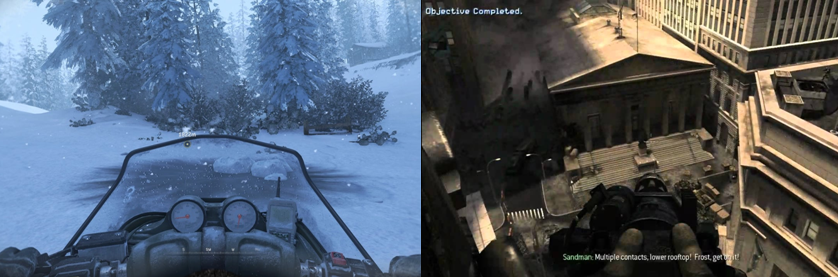
It’s not all ground-based shooting; you’ll also get into some nifty military vehicles.

A mini map sits in the HUD to help show enemy placements and works in conjunction with a small compass that directs you towards your next objective; this system is refined and far more intuitive and user-friendly in the second and third games but you’ll never really have to worry about getting lost despite how grey and brown and uniform a lot of the game’s locations are as each title is very linear in its layout and objectives. Gameplay is further broken up throughout the trilogy by allowing you to pilot and drive a variety of military vehicles; you’ll be driving trucks, tanks, boats, snow-skis, and helicopters. When high in the sky, you’ll switch between different thermal visions and have access to machine guns, bombs, and other explosive rounds to provide air support but, in a lot of cases, these are mainly prolonged gameplay sections that abruptly end in a disorientating in-game cutscene for your character. And make no mistake, the Modern Warfare games love to pull this trick on you. If you’re running through a warzone, you can guarantee that you’ll be falling through a crumbling floor or floored by a sense-jarring explosion, and if you’re driving or flying you’re most likely going to get derailed by a sudden explosion.

CODMWTMissions
You’ll also be asked to take part in some questionable missions.

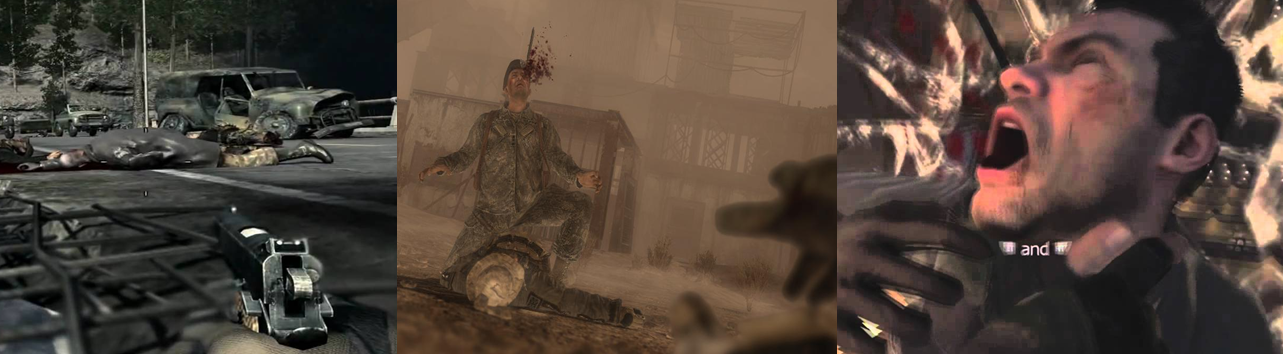
Gameplay is further broken up by tasking you with some specific missions: in Call of Duty 4: Modern Warfare, for example, you’ll have to man a Barrett M82 sniper rifle and take into account wind resistance (indicated by a fluttering flag) and the “Coriolis effect” in order to get a good shot on your target. In Modern Warfare 2, you can choose to take part in a highly controversial mission that sees you going undercover and taking part in a mass shooting at a Russian airport and Modern Warfare 3 sees you manning both a mortar cannon and a small remote control tank to clear out opposing forces. Each game also features stealth missions, generally when working with Captain Price, that see you having to sneak past guards to take them out silently with your melee attacks or sniper rifles. Sometimes, you’ll also be planting explosives or sabotaging controls panels and such and, though tense and annoying at times, these can be some of the best sections in the game as you’re not inundated with enemies you can hardly see. You’ll also have to take part in a handful of quick-time events (QTEs), generally at the conclusion of each game that sees you grievously hurt or otherwise incapacitated and forced to struggle through the sluggish controls and skewed vision to take a shot at an enemy or rapidly tap a button at the right time to win.

Graphics and Sound:
Generally speaking, the three Modern Warfare titles still all hold up pretty well despite the fact that a lot of their loading times are hidden behind doors and gates you cannot open or pass without someone else breaking them open for you. Locations are varied and take place across the globe, placing you in desolate, uninspiring environments such as the desert but also crumbling cities under a massive assault, on the steps of the White House while it’s under siege, and in the frozen Siberian wastes. You’ll also navigate through claustrophobic submarines, the streets and underground of London, and even a diamond mine. The trilogy does a great job of recreating iconic landmarks, making seeing the White House in flames or the Eiffel Tower collapsing quite a powerful spectacle, but a lot of their environments are still very bland and generic. Luckily for me, the trilogy is very linear but it can still be difficult to spot enemies when they seem to blend into their surroundings and I found myself firing on my own team mates more often than I’d like to admit as a result.

CODMWTGraphics
Weapons and locations are all rendered with a high attention to detail.

The game’s various weapons and vehicles are all extremely realistic and detailed as well, almost to a fault because, as mentioned, reloading some weapons can take a significant amount of time which, while realistic, can be annoying when you’re under heavy fire. Unlike some FPS games, the character models don’t suffer either and actually look quite decent rather than appearing as little more than action figures; it helps that the majority of the game’s story is told using the in-game engine and voiceovers rather than using full-on CGI cutscenes so there’s a lot less of the weird juxtaposition between in-game graphics and pre-rendered graphics. Each game is punctuated by fittingly rousing military music but, for the most part, I found the trilogy’s soundtracks quite underwhelming and mostly supplanted by the in-game sounds of the dead, dying, and maimed. The trilogy features some strong vocal performances (helped by actors such as Troy Baker, Keith David, Lance Henriksen, William Fichtner, Idris Elba, and Timothy Olyphant) but it’s difficult for me to really praise it all that much as it’s absolutely swamped with military slang and expressions that, again, I’m sure are extremely realistic and accurate but end up grating after a while.

Enemies and Bosses:
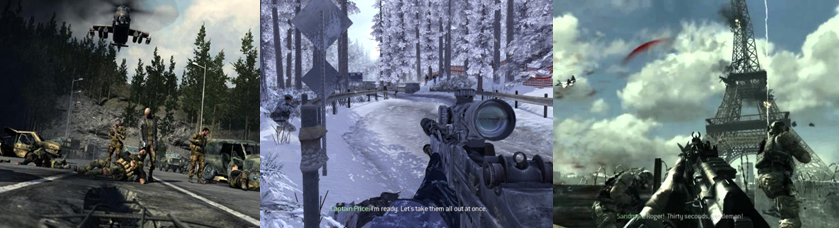
Primarily, you’ll be blowing holes through innumerable Russian soldiers and various terrorist forces who, while amounting to little more than cannon fodder to your superior weaponry and skills, can still kill you in an instant thanks to their commendable artificial intelligence. Enemies will dash behind cover, shoot over walls, move to flank you, and won’t hesitate to one-shot you with a melee attack of their own or a well-thrown grenade. When entering new areas, it’s best to take cover and scope out the area, picking enemies off from a distance as you’ll also come up against snipers and enemies who are packing rocket launchers. These, like a lot of the enemies you’ll encounter, like to take positions high above you and, while they mostly go down after one or two shots, have a nasty tendency to take pot shots at you while downed, recover and riddle you with bullets from behind, or even explode in your face if you’re not careful.

CODMWTBosses
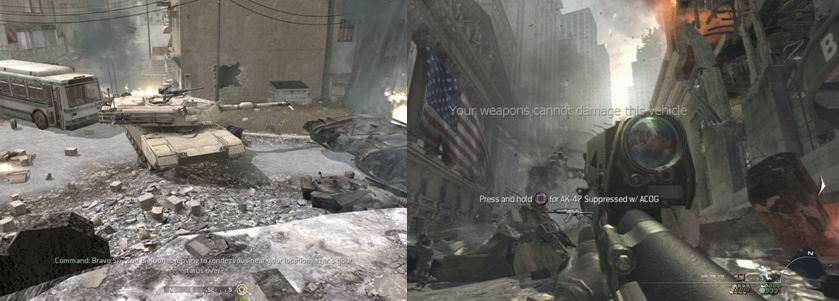
Tanks and helicopters will test your abilities.

You won’t really come up against boss battles in the traditional sense but you will have to contend with more formidable enemy weaponry, such as tanks and Mi-24 Hind helicopters. Usually, you’re equipped with a rocket launcher or similar weapon to take these down but, other times, you’ll engage them in a similar vehicle of your own and be tasked with clearing the area for your ground-based team mates.

CODMWTFinalBosses
Each game ends in a glorified quick-time event.

At the end of each game, you’ll end up in a confrontation with the game’s principal antagonist; in Call of Duty 4, it’s Victor Zakhaev, in Modern Warfare 2, it’s renegade turncoat Lieutenant General Shepherd, and in Modern Warfare 3 it’s Vladimir Makarov. No matter how good your skills are at moving, evading, and shooting, these final battles amount to little more than an interactive cutscene as your character is incapacitated and you simply limp towards a gun to make the kill shot or hit the right buttons at the right time to put them down once and for all.

Power-Ups and Bonuses:
Given that the Modern Warfare trilogy is going more for realism over anything else, there’s not really much on offer here besides a bevy of weaponry and military-grade hardware to aid in your mission (such as night vision goggles). You’ll get access to a variety of handguns, shotguns, rifles, heavy weapons like rocket launchers and the like and even riot shields but you can only ever carry two weapons at any one time.

CODMWTResources
You have plenty of modern toys and weapons at your disposal.

While ammo is quite plentiful, it might be wise to switch to another weapon when one becomes available (personally, I quite like a good sniper rifle as it helps to thin out enemies from a safe distance) and some of them are more useful than others; the M200 Intervention rifle comes equipped with a heartbeat sensor, for example, which looks and functions exactly like the motion sensor from Aliens (Cameron, 1987) and is very helpful for detecting nearby enemies, while the FGM-148 Javelin is perfect for taking out tanks and choppers (if a little unwieldy due to its size) and you can even duel wield some weapons.

Additional Features:
Each game comes with a bunch of Achievements for you to earn; many of these are story based, which is helpful, but others will require you to beat the game on higher difficulty settings or perform certain tasks in certain missions. Some even carry over from game to game, such as the “Purple Heart” Achievement, stealthily offing enemies, finding all the Intel hidden through the missions, or killing multiple enemies with one bullet or explosion, while others are slightly more specific to each game. Either way, they’re a great excuse to replay prior missions and increase your Gamer Score but a lot of them are also tied to the trilogy’s multiplayer element. As with any FPS title worth its salt, the Call of Duty series is well-renowned for its multiplayer component. Unfortunately, my Xbox Gold isn’t active right now so I couldn’t really get the most out of this initially but, luckily, Modern Warfare 2 and 3 feature a “Spec Ops” multiplier mode that allows for split-screen, couch co-op and a variety of solo options that see you surviving against waves of increasingly-difficult enemies or performing certain missions across a variety of the game’s maps. As you play these modes, you earn in-game currency to buy better weapons and upgrades, earn points to upgrade your ranking, and also unlock new maps, modes, and missions.

CODMWTBanner

The Summary:
I went into the Call of Duty: Modern Warfare Trilogy with low expectations; I simply wanted to blast through and earn as many Achievements as I could and then put the game away forever and, largely, I succeeded in that goal. While I found some elements of each game enjoyable (the stealth and vehicle-based missions, for examples), I mostly found myself complete underwhelmed with each game’s mechanics, plot, and presentation. Don’t get me wrong; I see the appeal, especially for those who enjoy FPS games (and, specifically, military FPS titles) but, for me, none of the titles are really that innovative or do much to stand out from the many similar FPS titles out there. The games get bigger and more involved as they progress, adding more vehicles and more open locations, but add very little beyond a few bells and whistles. In the end, I find myself wondering why the series is held in such regard when it looks and plays almost exactly like any other FPS title but at least the Achievements were easy enough to get.

My Rating:

Rating: 2 out of 5.

Could Be Better

What did you think of the Call of Duty: Modern Warfare trilogy? Which of the three is your favourite and where do they stand in your ranking of the Call of Duty titles? Do you think I have committed the ultimate sacrilege by besmirching the good name of the Call of Duty franchise or do you agree that the series is somewhat over-rated and stagnated? Whatever you think, feel free to leave a comment below and check back in next Wednesday for another Call of Duty review.

Movie Night: The Matrix

MatrixLogo

Released: March 1999
Director: The Wachowski Brothers
Distributor: Warner Brothers
Budget: $63 million
Stars: Keanu Reeves, Laurence Fishburne, Carrie-Anne Moss, Hugo Weaving, and Joe Pantoliano

The Plot:
Thomas A. Anderson (Reeves) is a nobody; by day, he sits in a cubicle and works a monotonous job as a software developer but, in his spare time, he has crafted a reputation under his hacker alias “Neo”. When he is targeted by Agent Smith (Weaving), Neo is brought to the enigmatic Morpheus (Fishburne) and offered both a startling truth and a destiny he could never have suspected.

The Background:
After managing to sell their script for Assassins (Donner, 1995) and the success of Bound (The Wachowski Brothers, 1996), Andy and Larry Wachowski (as they were known then) were able to sell Warner Brothers on another of their scripts: The Matrix. Featuring an impressive mixture of martial arts, philosophy, and science-fiction not often seen in major Hollywood releases and heavily influenced by manga and anime, particularly Ghost in the Shell (Oshii, 1995), The Matrix made an instant and lasting impression not just on the science-fiction and action genres but on cinema as a whole. The film both popularised the concept of “bullet time” and wire-assisted kung fu (or “wire-fu”) in movies and cemented Keanu Reeves as an action star. Suddenly, parodies were everywhere and movie heroes were all sporting long dark coats, shades, and flipping all over the place and it was all largely thanks to The Matrix. When I was a kid, The Matrix was a big, big deal. My friends and I watched the film constantly, eating up the action sequences and the cool aesthetic and soundtrack. Produced on a paltry budget of $63 million, The Matrix was a massive commercial and critical hit, making over nearly $500 million worldwide. So great was The Matrix’s success that is spawned not only two sequels but a whole slew of multimedia merchandise, including comic books and videogames. While the sequels may not have garnered quite the same critical reaction as the quasi-cult hit original, The Matrix’s important at the time (and today) cannot be understated and the later release of a fourth film proved that The Matrix still has an enduring legacy in cinema. Considering today is “National Science Fiction Day”, this seems the perfect opportunity to look back at this classic piece of cyberpunk cinema.

The Review:
The Matrix has a pretty simple concept, one that has been done before and since in cinema, but complicates it with musings on fate, destiny, and the sense of identity and reality. At its core, the plot is incredibly simple, though: the world as we know it is merely a computer-generated construct, a form of virtual reality in which we have been enslaved by a race of machines in a post-apocalyptic world. Amidst this, though, we have themes regarding providence, choice, and some of the most impression action and fight sequences put to cinema.

MatrixNeo
Apathetic to his everyday life, Anderson has far more prominence as “Neo”.

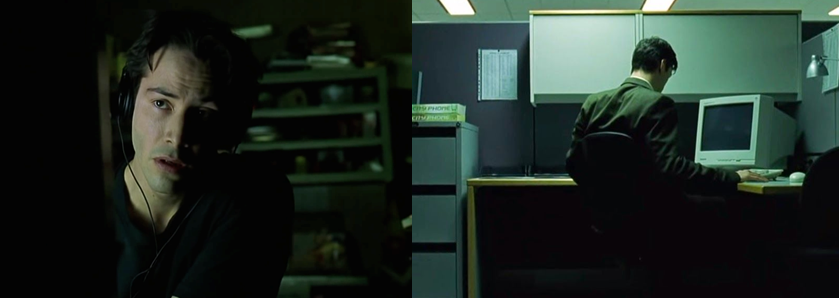
Our window into The Matrix is Thomas A. Anderson (or “Neo”, as he is known throughout the hacking community), a bored program developer who has lived most of his life with a feeling that there’s something not quite right with the world. Thanks to his illicit activities, he is acutely aware of the legendary Morpheus, a charismatic and prophet-like figure in Neo’s circles, and “the Matrix”, an undefined concept that is enough to rouse Neo’s curiosity. Keanu Reeves makes for a perfect audience surrogate; you instantly buy into the idea of him as an isolated, distracted hacker who is unfulfilled in his mundane life and eager for change but not quite confident enough to really buck the system more than showing up late for work or being generally apathetic. Once he meets Trinity (Moss), though, and is set on the path towards Morpheus and answers concerning the Matrix, Neo’s outlook begins to change; he was too afraid of plummeting to his death when trying to escape Smith and his cohorts but, once captured, is defiant enough to give them the finger and, after being reminded of the poor choices he’s made in life that have kept him stagnant, resolves to follow Trinity and her teammates towards an uncertain future.

MatrixSmith
Agent Smith is a chilling, complex villain.

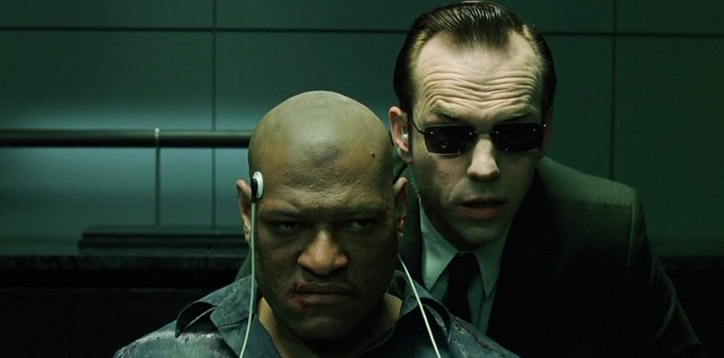
Opposing Neo is the aforementioned Agent Smith; in this movie, he’s just one of a number of men in black who target our heroes and are meant to be indistinguishable from each other. As the de facto leader, and the most charismatic of the three, Smith’s personality is revealed over time and in layers; he goes from a monotonous, fittingly robotic agent of the system to being wracked with personal animosity for Neo and being overcome by his own pride and hubris. Weaving is excellent in the role, exuding both menace and charm with the subtlest of movements and the merest of words and seeing him break out of his shell and reveal just how layered Smith is beneath his cold exterior is both captivating and terrifying at the same time. We also have Cypher (Pantoliano), the more outspoken and neurotic of the crew who takes an instant dislike to Neo thanks to his largely jaded attitude. Cypher is, if his name and Pantoliano’s scenery-chewing acting didn’t make it clear, the ultimate betrayer of the crew as he has grown disillusioned with Morpheus’s teachings and the reality of the real world and therefore deceives his crewmates, killing three of them and leaving Morpheus in the hands of Smith and the other agents. Cypher’s motivations are entirely believable, however, as the real world isn’t all it’s cracked up to be but it’s still extremely cathartic to see that smug smile blown off his face after his heel turn.

MatrixTrinity
Trinity is a capable, if underwhelming, character.

Luckily, Neo is not alone in his journey; Trinity is his main link to Morpheus’s world and serves as his eventual love interest. Yet, while Carrie-Anne Moss is acceptable in the role and more than capable at holding her own in her fight scenes, I never really bought into the attraction between the two characters. People like to rag on Keanu for being “wooden” but I’ve always enjoyed his work and found him very charismatic and that’s no different in The Matrix, where’s he’s able to showcase a variety of emotions and character quirks. Trinity, however, is a very guarded and reserved character through and through; some of this is due in part to the way those awakened to the truth of the Matrix tend to be more emotionless and reserved, especially inside the Matrix, but it’s also because of her reluctance to admit her feelings to Neo out of the fear that he isn’t who she thinks he is and the fear that he is what she thinks, as it means a dramatic change for the world if true.

MatrixMorpheus
Morpheus is easily my favourite character (…after Neo, of course).

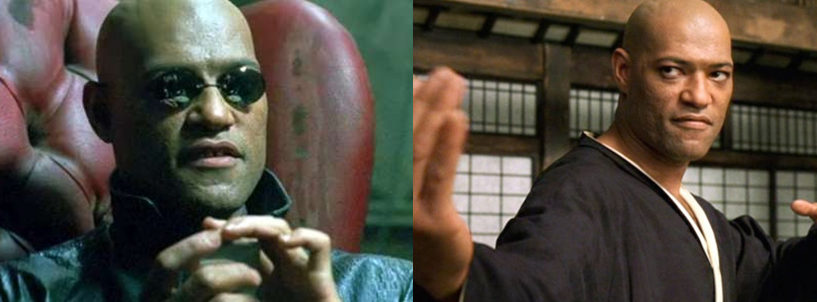
Morpheus, however, fully believes in Neo from start to finish and never once does his belief falter. Morpheus is the enigmatic captain of the Nebuchadnezzar and is regarded as a legendary figure not only by Neo but his crew as well. Years ago, the Oracle (Gloria Foster) prophesised the return of “the One”, a man born inside the Matrix who would be able to manipulate it in superhuman ways and spell the end of humanity’s subjugation, and Morpheus has dedicated his entire life to finding the One. For whatever reason (it’s not really explained how or why), Morpheus believes that Neo is the One and actively seeks him out, shows him the truth, and pushes him to break beyond what he has been conditioned to know. Never once does Morpheus’s conviction falter and Fishburne makes for a very fitting mentor and father figure; he anchors the film, offering exposition, and is the heart and soul of The Matrix. Subsequent sequels may have ruined (or spoiled) Morpheus’s mystique somewhat but it’s captivating in The Matrix as he seems so infallible and believable that you can’t help but be sucked in by his words. The rest of Morpheus’s crew is largely one-note and expendable; Switch (Belinda McClory) and Apoch (Julian Arahanga) are pretty forgettable and have maybe three lines between them and Mouse (Matt Doran) is the young, naïve crew member whose death is meant to be heartbreaking because of his youth but ends up falling a little flat as his characterisation amounts to “enthusiastic/annoying kid”. Tank (Marcus Chong) and Dozer (Anthony Ray Parker) stand out a little more thanks to Tank acting as the team’s operator (when inside the Matrix, he directs them, uploads additional training material and resources, and provides them with a way to dial out) and their status as brothers born naturally in the real world.

MatrixFights
The fights are varied and grow in intensity.

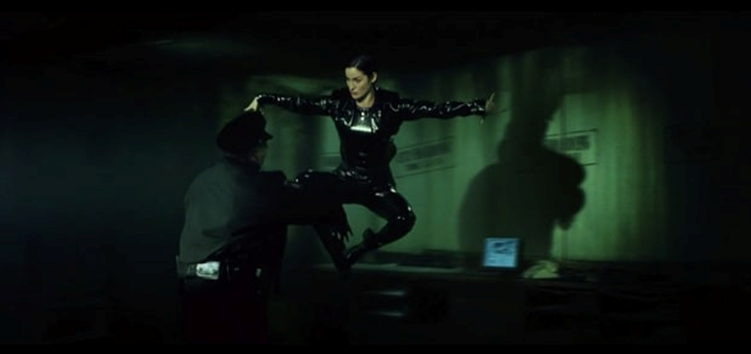
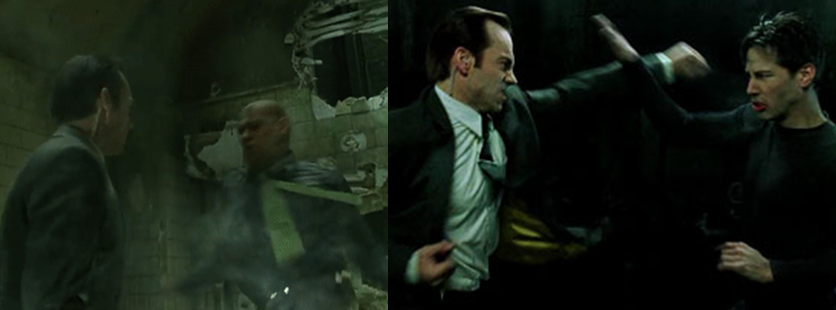
Of course, as good as the majority of the cast and characters are, the film’s main draw is its extensive action and fight scenes. Thanks to a combination of computer-generated imagery (CGI), wire work, and an extensive training regime, the film’s fights are high intensity and a spectacle to see; the film begins with Trinity performing that iconic leaping kick in slow motion as the camera pans around her, includes a playfully enjoyable sparring session between Neo and Morpheus, emphasises the aggression and nigh-unstoppable nature of the agents when Morpheus is effortlessly pummelled by Smith, and ends with a long, multi-layered fistfight between Neo and Smith. Unlike the majority of action films, The Matrix presented a world where characters don’t need to appear athletically competent to perform superhuman feats as knowledge and techniques are literally downloaded into their minds, instantly turning them into a master of the arts when plugged into the Matrix. Unfortunately, the special effects falter a bit in the real world; the sets and interiors are great, with the film favouring the “lived in” look of similar movies like Event Horizon (Anderson, 1997) and made popular by the Aliens movies (Various, 1979 to 2017), but the CGI elements haven’t aged too well. The squid-like Sentinels, especially, look particularly cartoony these days and most of the sequences involving them and the Nebuchadnezzar don’t quite hold up to the more practical effects of the film. Similarly, some fight scenes, particularly those using bullet time or other camera tricks, can result in the actors taking on a rubbery appearance but, when they’re inside the Matrix, I feel this effect actually works better and serves to highlight the falseness of that reality.

The Nitty-Gritty:
The Matrix still holds up very well to this day thanks to its enduring themes and the intensity of its otherwise over-the-top fight sequences. There are, of course, a few plot holes and questions raised by the film’s concept that are either not answered in subsequent sequels or poorly addressed. First and foremost for me is the question of how, exactly, child birth happens when humans are simply grown in endless fields. The idea of the fields themselves seems to suggest that the machines are cloning humans, but this isn’t really addressed; neither is how the awakened humans built their ship and other equipment, where their food and clothes come from, or how they don’t simply freeze to death under the scorched skies that blanket the real world.

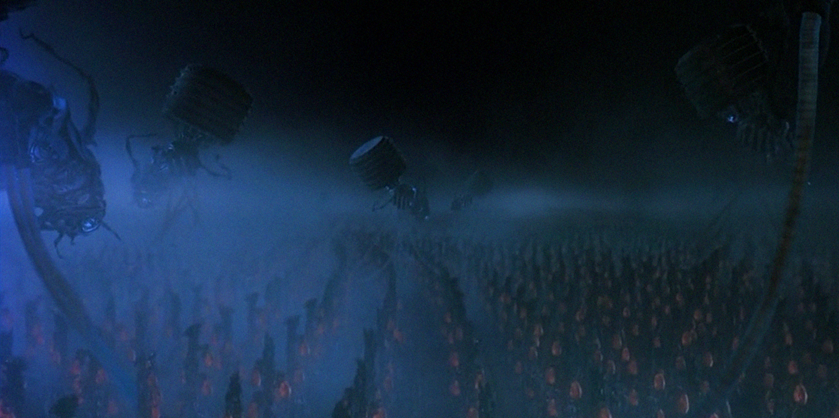
MatrixBatteries
The machines grow and harvest humans to use them as a power source.

Most of these questions are left intentionally unanswered in this film; we’re told (briefly) about Zion, the last human city, and given snippets of information regarding their war against the machines but nothing concrete. This adds to the mystery of what exactly happened to turn the world into a post apocalyptic hellhole ruled by machines and is completely believable; if all of humanity were blasted to smithereens, why would we have any specific information some one hundred years later? Truthfully, the real world is of little consequence in The Matrix; it’s there and a stark contrast to the artificial world of the Matrix but is never portrayed as being preferable. Instead, the idea is that the truth and the concept of being free from the machines’ control is preferable to being a slave, a literal biological battery, to the will of the machines. As a result, any human awakened to the truth is immediately drafted into the resistance effort but Morpheus is explicitly honest about their chances:

MORPHEUS:
They are the gatekeepers. They are guarding all the doors, they are holding all the keys, which means that, sooner or later, someone is going to have to fight them.

The agents embody this philosophy; practically nameless and faceless, the agents are able to possess (more like overwrite) any person currently plugged into the Matrix, effectively allowing them to endlessly respawn even in the rare instances that they are defeated or incapacitated. Yet, Morpheus also states that everyone who has ever tried to fight an agent has died, which isn’t that surprising considering that, as computer programs, they are faster, stronger, and far more durable than a mere human.

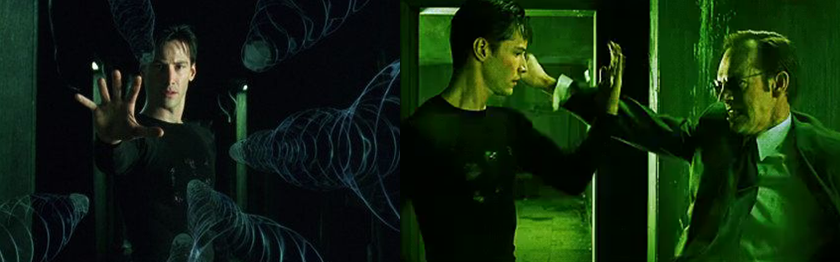
MatrixTheOne
As the One, Neo effortlessly stops bullets and parries Smith’s attacks with one arm.

In a reflection of Morpheus’s conviction, though, he doesn’t hesitate to take on Smith in hand-to-hand combat to allow Neo to escape; Morpheus, previously portrayed as calm, collected, and a severely disciplined fighter, is absolutely dominated in this fight. His near infallibility is then tested to the limit when the agents subject him to a concoction of drugs, torture, and questioning to try and obtain access codes to the Zion mainframe. Morpheus resists, however, and retains enough of his strength (both physical and mental) to break his bonds once Neo and Trinity affect their action-packed rescue plan and, throughout the entire movie, maintains a quiet confidence that, in time, Neo will see the truth about himself. It is therefore heartbreaking when Neo is executed by Smith, leaving Morpheus so distraught that he doesn’t even care about living any more. In the wake of Neo’s death, Trinity finds the resolve to finally admit her feelings for him and, with a kiss, restores Neo to life. As cliché as this sounds, it’s actually one of the most affecting scenes in the film; previously, the Oracle said that Neo was “waiting for something”, specifically suggesting that “something” was his next life, and Neo’s resurrection sees him assume the confident, God-like status of the One at last. His wounds healed, the speed and power of Smith is as nothing; Neo easily blocks and parries Smith’s attacks with one arm, looking hilariously and awesomely bored by the conflict, and easily dispatches the agent by blasting him to pieces. Now able to view the complex code of the Matrix itself, Neo ends the film fully able to manipulate and alert the environment as he blasts off to the sky to the sounds of Rage Against the Machine (a fitting band if there ever was one).

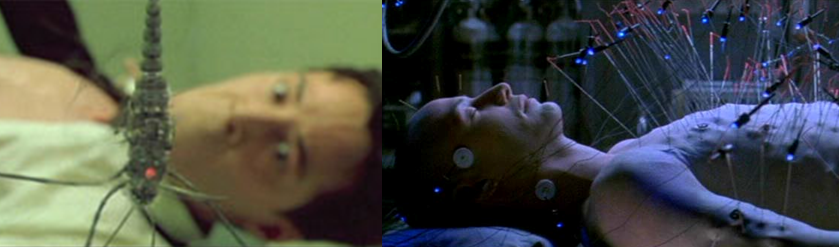
MatrixFlaws
The film is not without a few logistical concerns regarding its world.

This ending is as exhilarating and cathartic as you could hope for; all throughout the film, Neo has struggled with the destiny Morpheus has laid out for him and seeing him grow in confidence and ability leads to some of the film’s more impressive action and fight sequences. The gunfight between him and Trinity and a bunch of guards is worth the price of admission alone but seeing Neo effortlessly take out Smith, especially after the gruelling physical battle they went through previously, never fails to get my blood pumping. That’s not to say that the film isn’t without a few flaws, though. Chief among them, for me, is the “bug” that Smith implants into Neo; it makes sense, as he wants Neo to lead him to Morpheus, and it’s a nightmarish sequence, but it’s rendered immediately mute when Trinity pulls it out of Neo in the very next scene. Ironically, if Smith had simply just waited outside Neo’s apartment building he would have been led right to Morpheus but…no, apparently the bug is more efficient. Additionally, the scene where Neo is awakened is a bit confusing; he swallows a pill to help the crew find him in the real world, randomly gets smothered by liquid glass with no explanation, and when he does wake up the Nebuchadnezzar isn’t even there to retrieve him until he is literally flushed away. Finally, while I like that the film addresses that Neo’s eyes and muscles would have suffered atrophy, I would argue that the plugged in humans would be next to useless in the real world, especially upon being unplugged.

The Summary:
The Matrix’s philosophical musings are far less as explicit as in its sequels; here, exposition is delivered in snippets that are easy to digest and understand. There’s no double talk or complicated words here; we’re simply told as much information as these characters know and even Morpheus explicitly says that he (and even the Oracle) doesn’t have all the answers for Neo’s (or our) questions. Clearly, the film is left with many questions still to be answered but, unfortunately, it didn’t really turn out that the Wachowski’s were capable of delivering interesting answers to those questions. As a result, as much as I enjoy the sequels, neither are on the same level as the original, which is still one of the most compelling and original movies ever made that never fails to deliver despite a few flaws. The Matrix still holds up really well even after all this time; sure, some of the effects aren’t as impressive as they once were and a lot of the tricks popularised in this film have been done bigger and better since then, but it’s still a great piece of cyberpunk cinema. The sequels may have somewhat tarnished the legacy of the first film, and retroactively raise more questions than answers, but the concept and action on display in The Matrix is just as exhilarating as ever. The film is also full of some strong performances; Keanu Reeves proved with this film that he was a competent leading man in Hollywood, Laurence Fishburne set himself up for similar mentor roles in the future, and the film all but launched Carrie-Anne Moss’s career and put Hugo Weaving on the map. It’s not a flawless film, or even a perfect one, but it’s still highly enjoyable from start to finish; effectively a live-action anime, The Matrix is a perfect example of a strong, original concept bringing new life into tried and tested ideas we’ve seen executed in previous films and media. Ahead of its time in many ways, The Matrix set the scene for the slew of action and superhero movies that followed and built upon many of the techniques on display here and its legacy still holds up to this day.

My Rating:

Rating: 5 out of 5.

Fantastic

What did you think of The Matrix when it first came out? Did you enjoy the sequels or do you feel they spoilt the concept of the first movie? Which of the film’s characters or many spin-offs was your favourite? Are you excited for the upcoming fourth movie or do you feel it’s maybe best to let the franchise lie? How are you celebrating National Science-Fiction Day? Whatever you think about The Matrix, or sci-fi in general, drop a comment below.