This review has been supported by Chiara Cooper.
If you’d like to support the site, you can do so at my Ko-Fi page.


Released: 14 September 2018
Director: Shane Black
Distributor: 20th Century Fox
Budget: $88 million
Stars: Boyd Holbrook, Brian A. Prince and Kyle Strauts, Jacob Tremblay, Olivia Munn, Sterling K. Brown, Trevante Rhodes, and Thomas Jane
The Plot:
When Captain Quinn McKenna’s (Holbrook) unit is slaughtered by a fugitive alien hunter (Prince/Strauts), he’s shipped off to a mental hospital while government agents, led by Will Traeger (Brown), examiner the Predator. However, when a larger, more powerful Predator (Prince/Strauts) arrives to finish off the fugitive, McKenna must team up with a bunch of military misfits to combat the creature, who targets his autistic son Rory (Tremblay) in a bid to breed the ultimate prey.
The Background:
Predator (McTiernan, 1987) began with the ridiculous concept of Rocky Balboa (Sylvester Stallone) fighting an extraterrestrial opponent in a big bug suit and ended up being a box office hit widely acknowledged as one of the best of its genre. However, development of a sequel took some time as star Arnold Schwarzenegger passed on the project, but ultimately resulted in a critically successful cult hit. Its disappointing box office gross meant that the franchise was kept alive in ancillary media and crossovers before producer Robert Rodriguez was brought in to spearhead a standalone sequel. Sadly, although Predators (Antal, 2010) was a minor hit at the box office, reviews were mixed and any hopes for a direct sequel were soon dashed when the studio brought back writer/director Shane Black to pen something of a soft reboot for the series. Aiming to bring some spectacle and prestige back to the franchise, Black redesigned and expanded upon the creature’s armour and appearance and seeded a tenuous link to the sequel in the casting of Jake Busey while also focusing the narrative around a father/son dynamic to deliver a fresh new take on the formula. Once again, Schwarzenegger turned down the chance to come back; veteran actor Edward James Olmos also saw his role entirely cut from the film to reduce its runtime and the film was struck by controversy after a known sex offender joined the cast. Inexplicably, filmed endings included cameos by a time-travelling Lieutenant Ellen Ripley and Rebecca “Newt” Jorden (both played by Breanna Warkins), though these were, thankfully, also excised from the finished movie. Despite being subjected to a slew of reshoots, The Predator’s $160.5 million box office made it another minor hit for the franchise, but the film was largely panned by critics. While some praised The Predator’s gore and mindless entertainment factor and the performances of the ensemble cast, the tone and pacing were criticised almost as much as the controversial depiction of autism as some kind of superpower. Even star Boyd Holbrook and director Shane Black later spoke out about the film and any plans of following up on the film’s blatant cliff-hanger ending were upended when Disney purchased 20th Century Fox and opted to produce a critically-lauded franchise prequel in 2022.
The Review:
As much as I hate to admit it, the Predator franchise has had a bit of a tumultuous history. Despite the success of Predator, the underrated Predator 2 (Hopkins, 1990) didn’t really match the worldwide gross or critical reaction of its predecessor. We then had to wait fourteen years to see the ultimate hunter return to cinema screens, this time for the much-maligned and mishandled AVP: Alien vs. Predator (Anderson, 2004). While I actually really enjoyed the follow-up, AVP: R: Aliens vs. Predator: Requiem (The Brothers Strause, 2007) was a box office bomb and the franchise seemed to be dead in the water. As I mentioned in my review of Predators, I had high hopes of the franchise’s third entry, which was both pretty well received and made over double its budget in worldwide gross yet somehow didn’t earn a direct follow-up. Instead, 20th Century Fox made the bizarre decision to bring back Shane Black, who had featured in the first film and even contributed uncredited rewrites to the script and made a name for himself as a director in the years since. Predators’ cliff-hanger was ignored in favour of returning to Earth for a more suburban jungle escapade with a ridiculous title and a strange mish-mash of the previous films that was supposed to act as a soft reboot…despite Predators having already done. The movie opens promisingly enough; the credits font and outer space beginning recall the opening of Predator and Alan Silvestri’s iconic Predator theme is nicely resampled by Henry Jackman into something noticeably punchier and more action-packed, and this emphasis is furthered by the depiction of a space laser battle between the “Fugitive Predator” and its peers. When its ship is damaged and ultimately crashes, the hunter escapes to the dense jungles of Mexico just in time to disrupt a hostage retrieval operation led by crack sniper Quinn McKenna.

McKenna stumbles upon the crash site and swipes the Predator’s helmet and gauntlet before witnessing his entire unit be slaughtered by the Fugitive. McKenna survives thanks to the gauntlet and beats a hasty retreat right as shady, arrogant Traeger and his team arrive to claim the Predator and its tech. Recognising that he’s stumbled into something far beyond his paygrade, McKenna has his loot mailed away for safety and is quickly apprehended and marked as the patsy. Far more than some mindless, musclebound soldier, McKenna is wise enough to see he’s being set up to take the fall yet continues to sport a snarky, bad-ass attitude throughout the film; though the damaged veterans he forms a bond with aggravate him with their bickering, tics, and childish behaviour, he’s fiercely loyal to them and sees them as his “unit” but, above all else, his priority is his family. Realising that his autistic son has been placed in mortal danger after the Predator tech he stole ends up at their house, McKenna pulls his team of misfits together and orders them to get their shit together to keep Rory safe. Similar to AVP: R, much of The Predator’s plot is focused on a suburban town where McKenna’s estranged wife Emily (Yvonne Strahovski) raises their son Rory as best as she can considering McKenna’s long stretches away from. As the wife of a military man, Emily is pretty capable in her own right; she doesn’t stand for any shit from McKenna’a loony new friends and openly defies Traeger’s authority, though her impact on the overall plot is minimal compared to Rory’s. A child savant of sorts, Rory is a quiet little boy with a penchant for puzzles and languages; the subject of ridicule amongst other kids, Rory’s autism sees him extremely sensitive to sounds and changes to his routines. He’s therefore hesitant to go out trick-or-treating, even with a mask on, and would much rather fiddle around with the Predator’s helmet when it accidentally gets redirected to their house. Inquisitive and curious, he quickly activates the Predator’s technology, inadvertently triggering a signal that brings bigger, badder “Upgrade Predator” to come hunting for the Fugitive. Rory’s condition means he struggles in social situations; alongside this outspoken nature is a lot of the same fighting spirit as his parents as he also openly mocks Traeger’s attempts to talk down to him and cannot help but put his extraordinary mind to use even when taking hostage by the Upgrade Predator. Rory’s even strangely desensitised to death and violence; he attains a body count of his own thanks to the helmet’s auto-fire capabilities and is noticeably unfazed when McKenna uses lethal force to rescue him from Traeger.

Despite impressing Traeger with his wit and demeanour, McKenna is fingered as a dangerous and unstable threat and shipped off to a nut house. On the bus, he meets a bunch of clinically-discharged fellow soldiers, all of whom have their own little quirks and character traits that make them all pretty entertaining. These five – Gaylord “Nebraska” Williams (Rhodes), Baxley (Jane), Coyle (Keegan-Michael Key), “Nettles” (Augusto Aguilera), and Lynch (Alfie Allen) – are already very familiar with each other thanks to attending group therapy together, with the film even suggesting by the end that Baxley and Coyle have a homosexual relationship, and have built a rapport based on mutual respect and dislike. Consequently, they’re very childish and like to rib on each other and their conditions; Baxley makes the most obvious impression such he suffers from Torrette’s syndrome and cannot help blurting out crude remarks, swears, or having facial and body tics. For the most part, this is played as comic relief and leads to some amusing banter between him and the rest of the group, and awkward situations when he accidentally slips out vulgar terms to the film’s female characters. Similarly, Coyle exhibits the most childish demeanour of them all; damaged after accidentally opening fire on his own men, he resorts to jokes, winding the others up, and rarely takes anything seriously, even the threat of extraterrestrial hunters, leading to some moments of contention between him and the others (and, even then, he continues to crack wise). “Nettles” is the most, shall we say, “socially awkward” of the group; he showcases a perverse nature that’s not really very appropriate and threatens to get him in trouble whenever female characters are around. Even Lynch, probably the most forgettable of the group, showcases a talent for close-up magic and has a penchant for overkill in his methods. Of them all, McKenna forms the closest bond with cool-as-a-cucumber Nebraska, a man who was once so disturbed and horrified by the constant cycle of death and conflict in his life that he shot himself in the head to try and end it. McKenna quickly becomes the default “adult” of the group, giving them something to focus on and orders to carry out once things get serious, although there are times when their dialogue is needlessly mumbled or drowning out by ambient noise.

McKenna and his bunch of misfits prove surprisingly effective; they might be damaged but their proclivity for violence and combat is not only beneficial once the Upgrade Predator comes to town but is even enhanced by their instability, despite their more lewd traits bringing the ire of Emily and evolutionary biologist Doctor Casey Bracket (Munn). Much like Special Agent Peter Keyes (Gary Busey) in Predator 2, Traeger is well aware of the Predators (with this now being the official designation of the creature and his race since it “cooler”), their methods and their technology, and is overjoyed to finally have a live specimen to examine. However, since alien biology is a little outside of his area of expertise, he arranges for Dr. Bracket to help study the creature under the enthusiastic guidance of Sean Keyes (Jake Busey). While the government is growing antsy at the increased frequency of Predator sightings, Keyes couldn’t be more excited at the prospect of studying an actual extraterrestrial lifeform; Dr. Brackett is similarly awestruck (though not enough to criticise the government’s naming of the creature’s as “Predators”, a running self-deprecating gag that really doesn’t land for me) though her excitement turns to horror when she learns that the Fugitive Predator’s genetic makeup is infused with human DNA, suggesting the creatures are either mating with other species or partaking in genetic engineering. barely surviving the Fugitive’s escape, Dr. Bracket bumps into McKenna and, while they awkwardly try to impress her and continually make fools of themselves due to their eccentricities, she tolerates them out of necessity and is forced to rely on them for protection after Traeger orders her execution to keep everything nicely covered up. Traeger’s concern is that the hunters are looking to invade, to supplant humanity before we destroy ourselves through war, social upheaval, or global warming, whichever comes first, and correctly guesses that the Fugitive was bringing humanity a weapon to fight back before they can strip-mine human DNA for their own purposes. Fundamentally, his concern is for the safety of the world, but Traeger’s methods make him a reprehensible individual since he’ll happily kill or threaten anyone, women and kids included, in order to get his hands on the Predator’s technology.

For the majority of the film, the Fugitive Predator is depicted and viewed as an antagonistic force and it’s difficult to argue against this; despite having ejected from its crashing ship, it still goes out of its way to stalk and kill McKenna’s unit, skinning one of them, luring them in with its voice imitator while cloaked, and blasting away with its signature plasma cannon. When it awakens in Traeger’s lab, the Fugitive goes on a tear, even biting the arm of one of his scientists with its mandibles, effortlessly manhandling others, slashing with its claws, and even using surgical equipment and a rifle to add to its body count. However, the film introduces the twist that this Fugitive is actually on our side; a renegade who disagreed with the gene-splicing program, it sought to not only warn humanity of an impending invasion but also prepare them to combat this, but you’d never know it as it slaughters humans at the slightest provocation. The Fugitive displays more personality than any Predator since, even the purposely humanised “Scar” (Ian Whyte) from AVP, showcasing a morbid sense of humour as it uses severed limbs to escape the facility, motioning to McKenna’s group to drop their weapons, and exhibiting the same understanding of human speech as its counterpart from Predators. The Fugitive Predator sports all of its usual weaponry and abilities but also brings some new toys to the table courtesy of its gauntlet, which shoots shurikens and spits out a small orb that allows him to cloak. We also see more of the Predator’s ship this time around; not only do we get to see it producing a wormhole for space travel and firing its armaments, but the Upgrade Predator’s craft results in some explosive ariel action sequences and plays a significant part in the finale. The Fugitive is modelled almost exactly like its counterpart from the first movie (Kevin Peter Hall); its armour, helmet, and even the design of its butt-ugly face all draw from Stan Winston’s classic design, evoking a sense of familiarity with the creature similar to Predators’ “Classic Predator” (Derek Mears). The Upgrade Predator is ridiculously tall and bulky; rendered entirely in CGI, this nightmarish abomination is not only bigger and stronger, it’s the first of its kind to have its words translated onscreen not just through subtitles but also a piece of in-film technology; like Predators’ “Super Predators” (Brian Steele and Carey Jones), the Upgrade hunts using hounds, but forgoes both the traditional helmet and armour thanks to its impenetrable exoskeleton and cybernetic implants. The Upgrade is the Fugitive’s superior in every way, easily crushing its rival’s head and ripping it off, and showcases both hyper aggression and hunting wiles that present it as the most dangerous Predator yet.
The Nitty-Gritty:
There’s a surprising amount of depth to The Predator, certainly far more than the usual themes of survival of the fittest, man vs. monster, and nature vs. technology that’s normally at work in these films (though these elements are still prominent). However, I’m not entirely sure if all of them are suitable, appropriate to the genre, or even work; obviously, I’m no expert on autism and don’t really know much about it beyond the fact that it can take many different forms. Still, I don’t think it’s ever been touted as the next step in human evolution, or depicted as being some kind of “superpower” than an alien race would want to harvest for their own benefit. The depiction of the condition is all over the place, with Rory being ostracised, socially awkward and hesitant, and prone to panic attacks as much as he is capable of seeing patterns that others miss and displaying an almost genius-level intellect at times. I guess we’re supposed to figure that the Predators would be able to extract the “benefits” of autism form Rory’s DNA to mitigate the disadvantages but it’s still a strange execution; it’s possible that the film was going for a sense of empowerment and inclusivity for the autistic community, but I wonder if it actually managed to accomplish that. Similarly, unlike every previous Predator movie, The Predator deals with the fallout of post-traumatic stress and focuses on a misfit group of soldiers who have been psychologically damaged from years of killing and warfare; even the relatively “normal” McKenna is depicted as being twisted and somewhat broken on the inside, meaning it doesn’t take much to label him as psychologically unstable, but his newfound unit exhibit far more explicit signs of emotional and psychological trauma. Again, I’m no expert; I know soldiers see and go through a lot and they need all the support available to them since they sacrifice so much for others, and I think it’s an interesting dichotomy to depict more vulnerable characters as opposed to the all-action, gun-toting soldiers seen in previous Predator movies, but a lot of their quirks are played as comic relief so again I have to question whether these depictions were wholly appropriate or respectful to our military veterans.

The Predator is, at times, a little at odds with itself; there’s a degree of comedy in the film that doesn’t always land, and it’s not always surrounding McKenna’s socially inept group. Traeger is constantly cracking wise and giving it the big-I-am, which helps to make him a thoroughly unlikeable character even when he’s not threatening a confused little kid and culminates in an extremely anti-climactic death when he blows his own head off with the Predator’s plasma cannon, and even the Fugitive Predator’s rampage in Traeger’s lab is played for laughs here and there. The Predator also attempts to expand upon and broaden the nature of the Predators, suggesting that they hunt not just for trophies and glory but also to acquire the best genetic sampling from spinal fluids in order to genetically enhance themselves. The film also suggest one of the reasons for increased Predator sightings is because humanity is drawing closely to self-extinction, infusing this action/sci-fi romp with a clunky environmental message, and depicts the Fugitive Predator as wanting to give mankind a fighting chance before its genetically superior peers wipe us all out and claim the planet as their own. While these all make for unique elements in the film, The Predator stumbles to stand out since it mashes together many plot threads and ideas from every previous Predator movie: The Fugitive hunts and stalks through forest areas like in Predator, is hunted and targeted by government types as in Predator 2 (it’s not explicitly stated in the film but Sean Keyes is actually the son of Peter Keyes), dips its toe into the Predator society like in AVP, depicts a suburban area being attacked like in AVP: R, and even features alien hounds and two warring Predator classes as in Predators. Predators also introduced the idea that the hunters change their weapons, armour, and tactics with each hunt and kill but The Predator takes that concept to the nth degree, resulting in the revelation that they’re artificially jump-starting their evolution by sampling DNA from other species. On the plus side, photographic evidence, dialogue, and weapons at Traeger’s facility all reference not only the first film but, finally, explicitly reference the events of the second; even Alexa “Lex” Woods’ (Sanaa Lathan) makeshift spear and Ms. Cullen Yutani (Françoise Yip) make brief appearances, subtly suggesting that the AVP movies are still canon in the Predator universe.
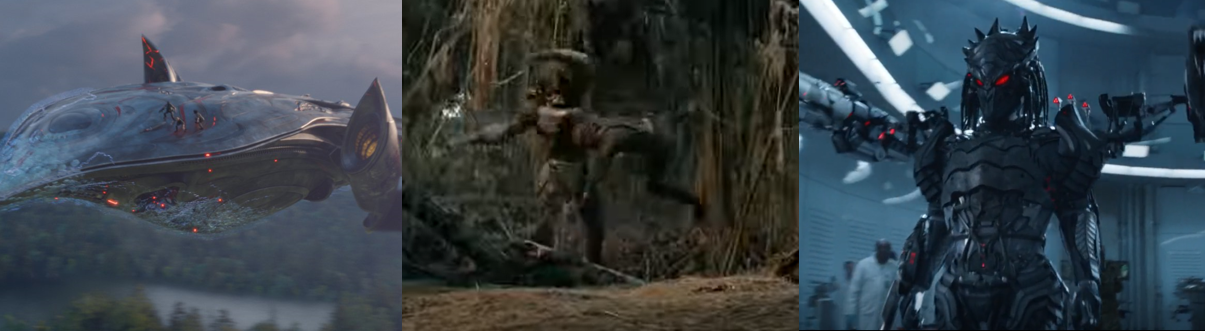
After Rory sketches a map to the Fugitive’s crashed ship, Traeger takes him hostage to acquire their technology; thanks to a conveniently tamed Predator hound, McKenna is able to lead his rag-tag group of soldiers there to rescue Rory. The two groups are forced to put their differences aside, however, when the Upgrade arrives, makes mincemeat of Traeger’s disposable grunts, blows Lynch’s arm off, and retakes the ship. Before destroying the ship, it challenges “McKenna” to lead the survivors in a traditional hunt, with “McKenna” as his prize; while this results in quite the body count, it’s Traeger and his men who suffer the most due to their arrogance, stupidity, and naivety, resulting in the Upgrade picking them off easily and Traeger blowing his own head off. In comparison, McKenna’s group work to lure the Upgrade into a trap using themselves as bait; while the Upgrade is damaged during the assault, this unfortunately results in Coyle and Baxley being mortally wounded and forced to mercy kill each other. When the Upgrade kidnaps Rory (the “McKenna” is spoke of), it attempts to leave on its ship and McKenna, “Nettles”, and Nebraska leap onto it to try and force it down; although McKenna and Nebraska manage to avoid being sliced up by the ship’s forcefield, “Nettles” isn’t so luckily and Nebraska ultimately chooses to sacrifice himself to destroy one of the ship’s engines and send it crashing to the forest below. Although outmatched by the Upgrade, McKenna is aided by the timely and ballsy intervention of Dr. Bracket and is…somehow…able to send the creature tumbling over a cliff; Rory then severs the creature’s arm with its ship’s forcefield and McKenna finally finishes it off by firing its own explosive bolt back at it using the blade from its severed arm. One final subversion of the classic “What are you?” line sees McKenna end the creature once and for all and he and Rory sombrely pay their respects to their fallen comrades. This would’ve been a decent place to end the movie but, instead, we get one final scene before ethe credits where a fully reinstated McKenna finally gets to see what the Fugitive brought for humanity: a ridiculously over the top nanotech battle suit that he plans to use to stave off future incursions for yet another unresolved cliff-hanger ending. Personally, I would’ve preferred to see Royce (Adrien Brody) and Isabelle (Alice Braga) emerge from the pod with a bunch of stolen Predator tech but what the hell do I know?
The Summary:
Honestly, as great as it is to see some vicious Predator action there are some flaws that cause The Predator to stumble, primarily revolving around the film’s pacing. It’s like Shane Black wanted to cram as much as possible as he could into the movie and set up for a sequel and, as a result, the focus is very sporadic. It seems that every time the narrative starts to get bogged down by all of the many different ideas Black is trying to incorporate and every time you begin to question the plot and things that don’t make sense, a gory action scene is thrown at you to distract from these issues. I feel it might’ve been simpler to paint the Upgrade Predator as the villainous rogue trying to engage in genocide rather than the Fugitive Predator as the later sure kills a hell of a lot of people for a creature that claims to be trying to save humanity with a “gift”. I like the acknowledgement, however brief, of previous Predator films but it does annoy me that The Predator didn’t actually try to wrap up the franchise’s loose ends and instead focused on setting up for a sequel that never happened. It’s is a shame as there was so much potential for The Predator to be a decent action/sci-fi film; it did a great job reminding audiences why the Predator is such a bad-ass creature but there’s nothing really new here as so much of it is simply remixed elements from all the previous Predator films. What new elements we do get are clunky at best and uncomfortable at worst; I really enjoyed the rapport and personalities of McKenna and his group, even if they are a bit too cartoonish at times, and I liked that the protagonists were all broken veterans struggling with their violent experiences. But the depiction of autism is problematic, the weird environmental message is very misplaced, and the sub-plot of the Predators genetically modifying themselves doesn’t have much impact as the Upgrade Predator is dispatched pretty easily all things considered. In the end, it’s a decent entry, but nowhere near as good as the originals or Predators and it’s easily the black sheep of the mainline Predator series.
My Rating:
Pretty Good
So, what did you think to The Predator? What did you think to the depiction of autism and PTSD? Which of the film’s characters did you like the most, or the least? What did you think to the Upgrade Predator and the idea of the creatures splicing genetic traits from other species? Were you disappointed that the film wasn’t a continuation of Predators and which of the Predator movies is your favourite? Whatever your thoughts on The Predator, do please leave a comment below or on my social media and be sure to pop back for more Predator action.

 Dr. K's Waiting Room
But if there is enough belief in the player then that counts.
LikeLike