
The first issue of Kevin Eastman and Peter Laird’s Teenage Mutant Ninja Turtles (TMNT) was published in May of 1984. Since then, the TMNT have gone on to achieve worldwide mainstream success thanks not only to their original comics run but also a number of influential cartoons, videogames, and wave-upon-wave of action figures. Even now, the TMNT continue to be an influential and popular commodity, proving that some fads don’t die out…they just get stronger!


Released: 9 November 2009
Developer: Ubisoft Nagoya
The Background:
Like so many kids back in the day, I was super into the Teenage Mutant Ninja Turtles (known as Teenage Mutant Hero Turtles here in the United Kingdom). The “Heroes in a Half-Shell” dominated playgrounds in the years prior to the rise of Mighty Morphin’ Power Rangers (1993 to 1996) and Pokémon (1997 to present) thanks to a slew of toys, merchandise, videogames. Konami’s original arcade title largely set the standard for subsequent TMNT videogames, with many of the franchise’s most revered titles being arcade-style beat-‘em-ups. By 2009, almost forty TMNT videogames had been released in arcades and home consoles, with most of them either being sidescrolling beat-‘em-ups or brawlers. It’s perhaps no surprise, then, that developers Ubisoft Nagoya turned to this tried-and-true gameplay style for this Nintendo DS-exclusive title. Unfortunately, there’s not a lot of information out there about the development and thinking behind this game, but I can say that it doesn’t seem to be one of the franchise’s more successful or revered games. While the presentation, references, and concept of the game drew some praise, the gameplay, button configuration, and graphics were criticised and the game was seen as a shallow effort to lure in fans with the promise of a throwback to the celebrated arcade games of old.
The Plot:
After returning from an adventure in the far future, the TMNT are faced with the threat of a cybernetic version of their greatest enemy, Oroku Saki/The Shredder, who sends his futuristic Foot Ninjas back through time in a bid for world domination!
Gameplay:
Teenage Mutant Ninja Turtles: Arcade Attack is a 2.5D sidescrolling beat-‘em-up in which the bulk to the game’s action takes place on the bottom screen, while the top screen displays your current score, rank, and plays the story cutscenes. Players can pick between the four Ninja Turtles, with each one having different strengths and weaknesses in addition to their trademark weapons: Leonardo is an all-rounder, Donatello has the best reach but is the slowest, Raphael has the worst reach but is the most powerful, and Michelangelo is the fastest and most agile of the four. Each of the TMNT has their own combos that are performed with successive presses of B or A, with the former attacking with their weapon and the latter seeing them kick. You can jump with X and perform jumping attacks by pressing B or A in mid-air, or hold down or tap the Y button to block or counterattack enemy attacks. A also allows you to revive your partner when they’re knocked down and to pick up weapons and health restoring food, while Y and B lets you grab and toss or launch enemies and pick up or push objects like barrels and traffic cones. Although there’s no dash function here, you can press the directional pad and Y to back flip out of harm’s way (even launching into a flying kick with A or B) or to sidestep, though I found both of these actions to be finnicky and unreliable. As you wade through enemies, you’ll build up a Co-Op Gauge; when it’s full, and flashing, you can press Y and B together to perform one of three powerful co-op moves, such as a giant swing, a diving shell smash, or the classic tossing of enemies towards the screen. However, I was only ever able to pull off the swing so it’s probably better to try to others with a human partner using the DS’s wireless feature.
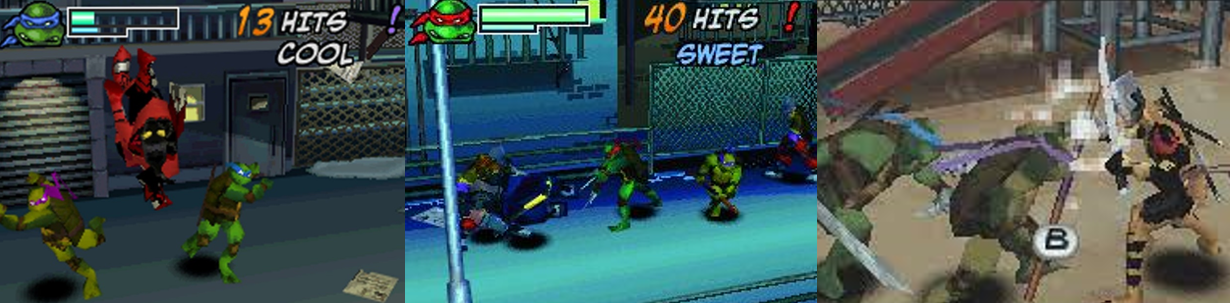
Even when you’re playing alone, you’ll be accompanied by a computer-controlled partner who you can select before a stage; the CPU does a decent job of fending off enemies but, while you can revive them, there’s no option for them to return the favour. If you’re defeated, you can spend some Shells to continue on from that point; otherwise, it’s back to the beginning of the stage for you. Shells are earned by performing well in stages; as you pummel enemies, you’ll build up a combo meter that increases your grade. At the end of a stage, this is factored into your overall score (alongside other data, such as how many hits you landed, how much damage you took, whether you used a Shell to continue, and such) and translates into more Shells for you to use to either continue or unlock extra game modes from the main menu. These modes are also made available by playing through the game’s story mode, which is comprised of eight stages, each of which is surprisingly long and light on interactive elements. You’re asked simply to run at an awkward right angle towards the edge of the screen, fighting between one and four enemies at once, with no bonus stages or much in the way of gameplay variety beyond the odd instance where you have to jump up to a higher level, mash B in a quasi-quick-time event when your clash weapons with an enemy, or the obligatory rising/descending elevator stage near the end of the game. There are four difficulty modes to choose from, with enemies being faster, smarter, and tougher on the higher settings in return for higher scores being on offer. The easiest setting, “Normal”, isn’t especially difficult to play through as you rarely face more than four enemies at once, but the enemies can be quite cheap and the gameplay isn’t really rewarding enough to make bashing them up all that enjoyable.
Graphics and Sound:
TMNT: Arcade Attack seems to be a little confused about its identity; the story is told using animated comic book panels that are modelled after the original Mirage Comics, which is amazing, but the plot seems to be rooted in the continuity of the 2003 to 2009 cartoon series despite the logo being closer to the original 1987 series. The game doesn’t include the classic TMNT theme song, or any notable music or voice acting, which really doesn’t help improve the experience or shake off the sense that this was a slapped together budget title to cash in on the franchise. While the black and white cutscenes are really good and perfectly capture the spirit of the original comics (and even include some funny running gags such as Mikey struggling with his nunchakus), the in-game graphics opt for a bright, colourful cel-shaded style that is similar to Teenage Mutant Ninja Turtles: Turtles in Time Re-Shelled (Ubisoft Singapore, 2009) but far less appealing; character models are distinctly low resolution, blocky, and lack idle animations. Their attacks are nice and fluid, however, and they have entrance and stage victory animations, and it is fun seeing them pull off more elaborate attacks when you punch in button combos, but the models are a far cry from the appealing sprite work of its predecessors.
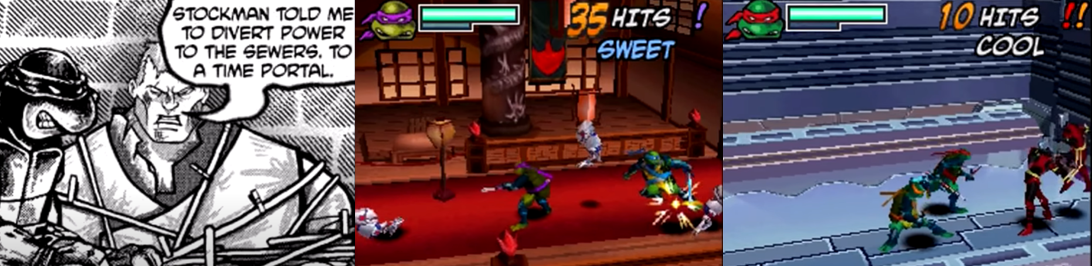
Environments equally as disappointing; the game does its best to recreate the locations of previous TMNT brawlers, placing you on the city streets, in a construction site, having you battle trough dark alleyways, the surprisingly clean sewers, across rooftops, and through an office building but there’s no real personality or excitement in these environments. Even when you get transported to the far future, you’re restricted to a traditional Japanese temple and a futuristic lab, with only cyberspace really having much to offer in terms of visuals. None of the stages have any hazards or obstacles to avoid; there’s not much really happening in the background, enemies simply drop in from the top of the screen or dramatically appear on screen rather than bursting from behind signs and such, and the stages go on for far too long, which really makes the game a drag. You’re also restricted in your movements; you can’t always move beyond the awkward angle of the game’s linear path, or backtrack too far, and you’re never asked to climb ladders or to transition to other screens as the game does all of this automatically. Stages do try to be a little distinct from each other by featuring different breakable objects, from tyre stacks to discarded televisions and pixelated cubes, but it’s not enough to make the environments any more interesting and, again, they pale in comparison to the 2D arcade games of yesteryear.
Enemies and Bosses:
Since this game is all over the place with its visual identity, I’m not really sure what you’re fighting here half the time. You start off beating up nameless, disposable street punks; the bigger variants attack with a hockey stick and can tank through your attacks, and you’ll learn that most of the enemies can block your attacks and grab and hurl you just like you can to them. Other punks will toss grenades, which can be hard to see and avoid as they seem to drop them right as you’re jumping in for an attack, but once you reach Stage 3 you’ll find some cybernetically enhanced members of the Foot Clan. As ever, these come in different colours and with different weapons; the basic ninjas can slide tackle you, others toss concussive grenades or shuriken, others wield laser pistols or will rush at you with katana swipes, and others shoot arrows or rockets. You’ll also battle hoards of Mousers, who swarm the screen and jump and bite at you or blast you with laser projectiles from their mouths, but at least you don’t have to worry about them clamping down on your hands and you can toss enemies into each other for extra damage and even send them flying with breakdance-style wake-up attacks.

Eight stages means five bosses (strangely, the first, third, and sixth stages don’t have boss battle…), each sporting a life bar but lacking disposable minions to distract and frustrate you. Your first test is against a golden Foot Ninja variant who wields two katana swords, back flips about the place, slides at you, and sports a jump attack. He’s not too difficult to take out as he’s basically just a tougher version of the regular Foot Ninjas, but Hun represents the game’s first real challenge. This hulking bruiser carries a bazooka that allows him to not only fire missiles from a distance but also doubles as a devastating melee weapon; he can absolutely tank your hits and smash you in the middle of a combo, too, so it’s best to wait for him to taunt you or become momentarily stunned from his attacks. Karai attacks at the end of the sewer stage; easily the fastest boss, she attacks with katana blades, tosses shuriken from mid-air, flies at you with a kick, and loves to endlessly block your attacks to make the battle needlessly long and aggravating. A cybernetically enhanced version of Doctor Baxter Stockman awaits in the far-flung future, proving the most versatile boss so far. His enhancements let him hover about with a burst of flaming jet, he knocks you flying with an electrical burst if you get too close, has a sliding uppercut and an electrically-charged fist, and blasts a Kamehameha-like laser across the screen that leaves him momentarily vulnerable to a good combo. Finally, you’ll battle the Cyber Shredder in cyberspace; this fearsome foe sweeps the arena with a wide red laser, flies at you with a spinning attack, emits a concussive blast after being knocked down, causes the ground to burst into flames, whips at you with a tentacle-like appendage, and dashes with a claw swipe or knee strike. The trick here is to hit and run, really; just leap in, hit a combo, and side step away until he’s open for another flurry and he’ll eventually go down.
Power-Ups and Bonuses:
As is to be expected from a TMNT game, you can restore your health by eating pizza found by smashing various objects around each stage; additionally, if you find some chop suey, you’ll restore a portion of your health. This is the first TMNT videogame I’ve ever played where you can actually pick up and use additional weapons; wooden boards, steel pipes, and stop signs can be tossed at enemies or used as temporary melee weapons and you can even toss shuriken, grenades, and destructible objects (though the latter will greatly reduce your walking speed).
Additional Features:
Perform well in each stage and you’ll earn yourself Shells that can be used as a continue if you’re defeated or to unlock additional gameplay modes. You can take on a Stage Attack to compete for the highest score and rank, a Survival mode against an endless wave of enemies, and a boss rush, all of which must be purchased with your Shells. Completing the story unlocks every stage in the game for you to replay at your leisure, though there’s no way to rewatch the game’s cutscenes outside of playing the story. While there aren’t any skins or unlockable characters, the TMNT do receive a futuristic glow up from Stage 6, though you can’t apply these at will, and of course TMNT: Arcade Attack can be played on higher difficulties or alongside a friend if they also have a copy of the game.
The Summary:
I’ve played a lot of Teenage Mutant Ninja Turtles videogames and, while many of them are basically mindless beat-‘em-ups with little on offer than the simple thrill of beating the piss out of countless colourful enemies, they still had more on offer than this misfire of a title. I get the idea behind Teenage Mutant Ninja Turtles: Arcade Attack: a quick, cheap, arcade-style brawler to appeal to fans of the TMNT’s old beat-‘em-ups, but the execution falls flat in almost every department except for the motion comic-like cutscenes and the shallow diversity of the combos. There’s a lot about the game that’s modelled after these arcade titles, particularly in the environments and the simple, pick-up-and-play format, but it just can’t live up to those titles because of the way it presents itself. Not only is it all over the place in terms of its identity, the presentation of the gameplay has this weird isometric angle, there are hardly ever any enemies onscreen, and the lack of environmental hazards or visual interest really hurts the title. It’s a shame as this would’ve been so easy to get right if the game had simply been a 2D brawler with 3D style backgrounds, or even more akin to Turtles in Time Re-Shelled, which was a far better 2.5D conversion of the classic arcade visuals. A disappointing lack of bosses and recognisable TMNT characters and enemies also keeps the game from being as good as it could be, as does the monotony of the strangely long stages, and I wasn’t impressed by the revive function not really working in single player. There are some decent unlockables, at least, but it’s undeniable that there are better TMNT games to play, with Teenage Mutant Ninja Turtles 3: Mutant Nightmare (Konami Computer Entertainment Studios, 2005) looking like a far better option for DS players.
My Rating:
Could Be Better
Have you ever played Teenage Mutant Ninja Turtles: Arcade Attack? How do you think it holds up against previous TMNT beat-‘em-ups? Which of the TMNT was your favourite to play as and why? Did you enjoy the Mirage Comics-style cutscenes and do you agree that the game’s identity is a bit muddled? Were you disappointed by the graphics, environments, and bosses? Did you ever unlock and clear every mode in the game? Which TMNT videogame is your favourite? How are you celebrating the TMNT’s debut this month? Whatever your thoughts on the TMNT, leave a comment down below or on my social media and pop back for more TMNT action!

 Dr. K's Waiting Room