
January sees the celebration of two notable dates in science-fiction history, with January 2 christened “National Science Fiction Day” to coincide with the birth date of the world renowned sci-fi writer Isaac Asimov, and HAL 9000, the sophisticated artificial intelligence of Arthur C. Clarke’s seminal 2001: A Space Odyssey (1968), being created on 12 January. Accordingly, I dedicated all of January to celebrating sci-fi in all its forms.

Released: 8 August 1986
Director: Nelson Shin
Distributor: De Laurentiis Entertainment Group
Budget: $5 to 6 million
Stars: Peter Cullen, Frank Welker, Orson Welles, Judd Nelson, Leonard Nimoy, Robert Stack, and Corey Burton
The Plot:
The Autobot/Decepticon war escalates when Megatron (Welker) kills the heroic Optimus Prime (Welker). When Megatron is empowered by the planet-sized Unicron (Welles), young Transformer Hot Rod (Nelson) must embrace his destiny as the Autobot’s new leader.
The Background:
In 1983, representatives from Hasbro were sent to the Tokyo Toy Show to find toys they could import to North America. While there, they spotted manufacturer Takara’s range of transforming robots and bought the rights to produce the toys under a single brand. Hasbro already had a partnership with Marvel Comics and thus turned to then-editor-in-chief Jim Shooter and Bob Budiansky to flesh out the overall story and character names for their new toy line. The premise centred on a war between the heroic Autobots and the evil Decepticons, with both factions being “More Than Meets the Eye” and capable of transforming into different forms. The toys were a big hit due in no small part to Hasbro accompanying them with an animated series that effectively doubled as a dedicated advertisement for their products. The Transformers (1984 to 1987) was a phenomenon for an entire generation and Hasbro sought to further capitalise, and advertise their new range of Transformers toys, with a feature-length animated movie. Despite the protestations of screenwriter Ron Friedman, Hasbro were determined to kill off the heroic Optimus Prime and many of the original characters to make way for a new crop of products, traumatising many impressionable youths and leading to a speedy revival. The production was supervised by Toei Animation vice president Kozo Morishita, granted a far greater budget to the television show, and was the final cinematic performance of the legendary Orson Welles, who was famously outspoken about the role. Released alongside a summer of blockbusters, The Transformers: The Movie was far from a box office hit and reviews were largely negative. Several reviews criticised the film for being a glorified, nonsensical toy commercial determined to bombard children with new products, though franchise fans loved the film and its intended audience ensured it became an endearing cult classic. While the movie’s poor box office meant a sequel never materialised, the cartoon and toys continued regardless and the franchise returned to cinemas about twenty years later for the first of many big-budget, live-action releases.
The Review:
I think it’s important to note that I don’t have much nostalgia for The Transformers. The original series ended shortly after I was born, and I don’t recall re-runs airing when I was a kid. I did have a VHS tape of a few episodes, though, and some of the toys (both official ones and knock-off ones), but I’m certainly not a die-hard fan. Yet, even I knew the awesome theme tune, the ridiculousness of the concept, and the death of Optimus Prime. Not necessarily when I was a kid, but certainly as I got older, especially as Transformers is one of those franchises that just keeps truckin’ along. Anyway, all this is to say that I’m hardly a Transformers expert; I barely know who’s who and I have only a basic grasp of the continuity and lore. Still, all I need to know heading into The Transformers: The Movie (because I guess The Transformers Movie would’ve made too much sense as a title?) is that the battle between the Autobots and the Decepticons raged for some time. Unlike in Michael Bay’s later movies, The Movie largely takes place in space and on alien worlds but the Autobots have established a city on Earth (in the far-off year of 2005, no less) and on our Moon. They’re regularly aided by human allies like Spike Witwicky (Burton) and his young son, Daniel (David Mendenhall), who repair and maintain both Autobots and their weapons while fighting alongside them in transforming mech suits. A helpful narrator (Victor Caroli) provides an overview of the plot, though you’re honestly better off listening to the lyrics of Lion’s hard rock remix of the Transformers theme song as it tells you everything you need to know. Led by the maniacal Megatron, the Decepticons have conquered the Transformer home world, Cybertron, and forced the rag-tag Autobots (led by Optimus Prime) to Earth and hidden bases on Cybertron’s moons. There, Optimus plots to pick up a shipment of Energon from Earth to power a counterattack in a desperate bid to retake their home, unaware that Megatron’s spy, Laserbeak, is reporting to its master via Soundwave (Welker).
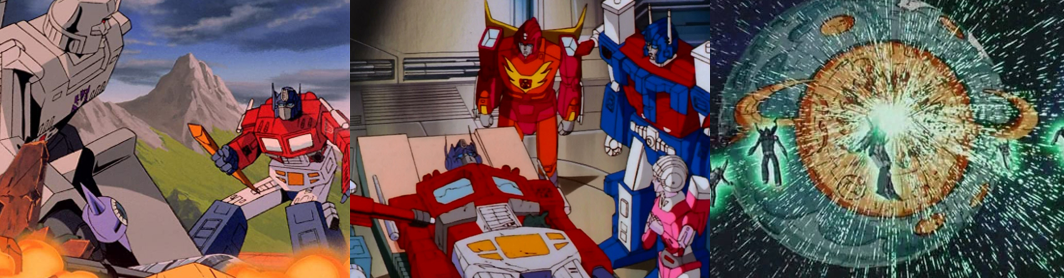
Thus, Megatron leads his long-suffering lieutenant, Starscream (Chris Latta), and his forces in intercepting the Autobot shuttle, massacring Ironhide (Cullen) and his crew and callously stepping over their smouldering remains to slip into Autobot City. Luckily, Hot Rod and Daniel spot the shuttle and notice the damage. Hot Rod lives up to his name and opens fire, confusing his war weary mentor, Kup (Lionel Stander), but scuppering the Decepticon’s…well, deception…and putting Autobot City on high alert. Despite the best efforts of Ultra Magnus (Stack) and Arcee (Susan Blu), the city takes heavy damage and many Autobots are killed before the city can be transformed into its defensive mode. Blaster (Buster Jones) sends a distress call and Optimus Prime makes haste to Earth and quickly turns the tide of the battle, engaging his hated rival in a one-on-one fight. Though evenly matched, Optimus isn’t prepared for Megatron’s aggressive and driven demeanour and suffers mortal injuries in the fight, largely thanks to Hot Rod unwittingly spoiling Optimus’s kill shot on Megatron. However, Megatron is equally injured and left to die by Starscream; though the loyal Soundwave spirits him to Astrotrain (Jack Angel). In the aftermath, with Autobot City badly damaged, Ultra Magnus, Hot Rod, Daniel, and the others watch helplessly as Optimus tragically dies. Before he passes, Optimus passes the “Matrix of Leadership” to a reluctant Ultra Magnus, who vows to lead the Autobots until a more suitable leader rises. Optimus prophesises that this will happen during the Autobots’ “darkest hour” and then dies, leaving a generation of children heartbroken. As for Megatron, he and his loyalists are unceremoniously tossed into space by Starscream and left to die, only to encounter Unicron, a planet-sized Transformer. Unicron offers to empower Megatron and his minions in exchange for their unfaltering servitude and for destroying the Matrix of Leadership, the one thing that threatens Unicron’s quest to conquer and consume worlds. Though livid at being a pawn to even a being as mighty as Unicron, Megatron quickly accepts and is reconfigured into the far more imposing Galvatron (Nimoy). No longer requiring a minion to fire him, Galvatron heads to Cybertron and executes Starscream with his new cannon form, reclaiming his position and heads back to Earth to kill Ultra Magnus.
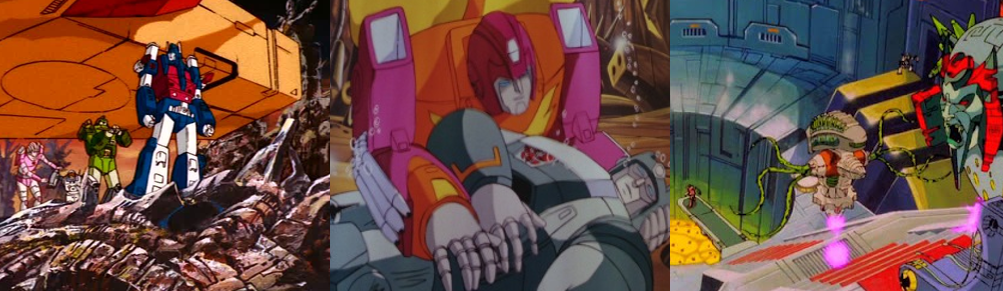
The Autobots flee in two shuttles; one leaves Hot Rod, Kup, and the Dinobots stranded on Quintessa and the other sees Ultra Magnus fake his death by separating the ship and eventually landing on Junkion. Thus, the story diverges somewhat, with Ultra Magnus, Arcee, Daniel, and the others trying to repair their ship and fending off Wreck-Gar (Eric Idle) and his oddball Junkions and Hot Rod and Kup struggling against Quintessa’s hostile natives. All too soon, the two are separated from the Dinobots, captured by Allicons, and brought before the multi-headed Quintessons (Regis Cordic and Roger C. Carmel). Tried in a kangaroo court, they are sentenced to death but, just as he defied the judge’s authority, Hot Rod valiantly fights back against the Sharkticons. Luckily, they’re saved by the Dinobots after their leader, the child-like Grimlock (Gregg Berger), is led there by their new ally, the rhyme-speaking Wheelie (Welker). Although they successfully turn the Allicons and Sharkticons against their masters and reunite with Ultra Magnus and the others, and even make peace with the Junkions by using the “universal greeting” and offering Energon, their celebration is short lived when they arrive on Junkion to find Ultra Magnus blown to pieces by Galvatron and the Matrix of Leadership stolen. Luckily, the Junkions reassemble Ultra Magnus and even provide them with a ship to pursue Galvatron back to Cybertron, a suicidal prospect against Unicron’s awesome power and yet Hot Rod remains determined to confront the planet-devoured and his bloodthirsty minions. Hot Rod is just one of many supporting characters here but it’s obvious that he’s being given the limelight. He’s characterised as a somewhat reckless and impulsive Autobot who often acts without thinking and lacks the seasoning of his mentor. In contrast, Ultra Magnus is the definitive soldier; loyal, determined, and steadfast. And yet he hesitates when Optimus passes him the Matrix of Leadership and his inability to open it almost costs him his life.
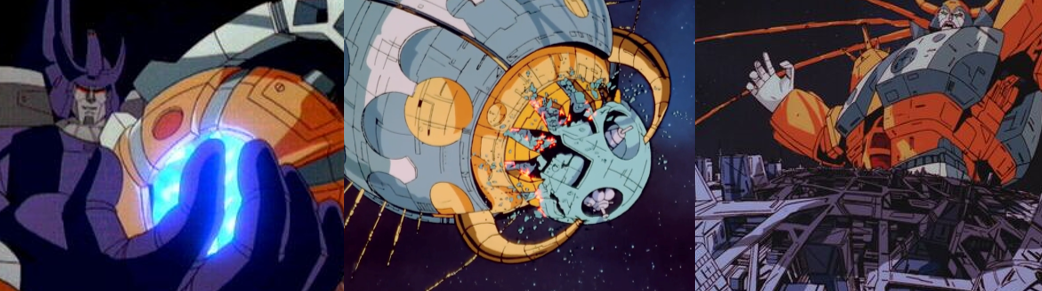
Megatron is more driven than ever here. He strikes without mercy, gunning down countless Autobots and ransacking their city to kill his hated rival, even if risking his own body and life. Though victorious, Megatron sustains heavy damage and is predictably betrayed by his allies, who descend into in-fighting without his leadership. Stubborn and proud, Megatron initially refuses to kneel to Unicron but acquiesces since he fears death more. As Galvatron, his determination is only increased with his added abilities and newly christened lieutenants, but his mission to kill Ultra Magnus and destroy the Matrix is fraught with “exaggerations” as he’s quick to claim victory without confirming his kills. Galvatron is thus constantly reprimanded by Unicron whenever he gets ahead of himself or dares to think of defying the planetoid robot. Unicron makes an immediate impression since he opens the movie by devouring Lithone in a truly unsettling sequence of death and destruction. Wandering the void like a force of nature, Unicron seeks only to devour planets to sustain himself, seemingly nonplussed by the lives he snuffs out in the process. The vast, enigmatic Unicron clashes with Megatron by demanding his servitude but only angers his subordinate more by devouring two of Cybertron’s moons and constantly inflicting pain upon him when his pride gets out of control. It’s interesting that Unicron even bothers creating minions since he could conceivably devour Cybertron and Earth and snuff out any resistance. Of course, then the movie wouldn’t happen and it’s better to not leave such things to chance as the finale shows that, for all his incredible size and power, Unicron is surprisingly vulnerable. The Transformers: The Movie was also, I believe, the introduction of the Quintessons, horrific tentacled, malicious robots with three heads and a sadistic streak who delight in dropping “innocent” prisoners to the Sharkticons. They’re a minor sub-plot here, something for Hot Rod to rally against, but are visually more interesting and disturbing than the Junkions, who are as annoying as Wheelie and Blur (John Moschitta) and speak only in television soundbites, a trait I more associate with Bumblebee (Dan Gilvezan), who’s barely featured.
The Nitty-Gritty:
The first thing to note about The Transformers: The Movie is how gorgeous the animation is. The film is brought to life by a detailed and intricate anime aesthetic that really makes every scene pop since you can feel the effort that went into every little detail. Sure, it’s weird that Optimus Prime spawns a trailer truck out of nowhere when he transforms and some transformation effects defy all known physics, but you have to forget about that when watching Transformers. The titular Robots in Disguise have never looked better, and their deaths are depicted in unsettling detail. Chest plates have laser holes blown through them, body parts go flying, and your favourite characters and toys are literally blasted to smithereens in incredibly detailed battle sequences bolstered by explosions, tearing metal, and, of course, a rocking soundtrack. Almost every scene is accompanied by some kind of music, be it Vince DiCola’s suitably dramatic score (Unicron’s theme is the perfect balance of awe and dread) or a power ballads. There’s the aforementioned Transformers theme by Lion, easily the best and most infectious version of the song, and songs by Kick Axe, Stan Bush, and, most bizarrely, “Weird Al” Yankovic. “Dare to be Stupid” plays after Hot Rod makes peace with the Junkions and is as surreal as the weird and annoying Junkions. Stan Bush’s “Dare” and “The Touch” make up for this, even if these power ballads somewhat undercut the death and destruction happening onscreen. The Transformers: The Movie is a very loud and chaotic affair; characters are always yelling and moving, and the pacing is a mile a minute, which is somewhat overwhelming. It’s difficult to keep track of who’s dead and alive at times (I legitimately thought Spike was dead at one point) and the movie never really stops to take a breath (except for when Optimus dies). I do like how it focuses entirely on the robotic characters, though; Spike and Daniel are merely supporting characters, which is exactly how it should be. The Transformers: The Movie is also surprisingly dark; there’s a lot of gruesome deaths, constant peril, and much destruction. Spike even drops a “Shit” at one point, which I’m sure had a few mothers clutching their pearls as Little Jimmy was bawling over Optimus Prime.
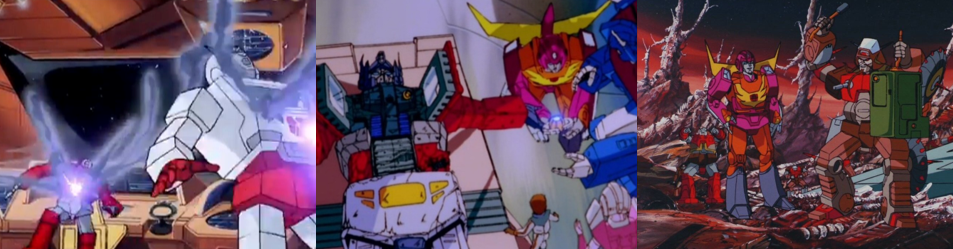
Speaking of whom, let’s discuss this tragic and life-changing moment. The battle between Optimus Prime and Megatron is a brutal, no-holds-barred affair that sees the two mortally wounded within a few blows. Surprisingly, Optimus Prime is often taking the brunt of the assault and, though he eventually turns the tide, he seems half dead when he moves to execute his rival, who predictably falls back on deception to finish his foe. Although the Junkions and Hot Rod simply piece Ultra Magnus and Kup back together, Optimus Prime is damaged beyond repair and delivers a stirring speech to his comrades before passing, his body dramatically turning grey. It’s true that the film meanders without Optimus Prime’s charisma and visual appeal to fall back on, but his death certainly raises the stakes. The Autobots are almost completely wiped out by Megatron’s attack and constantly on the run, forced to fake their deaths to catch a break and suffering many losses, with Galvatron delighting in blasting Ultra Magnus to pieces and Daniel being concerned that his father has suffered the same fate. Thanks to Unicron’s glow-up, the Decepticons easily overpower the Autobots and force them to flee into new dangers. While the Dinobots offer some much needed power, their childish demeanours hold them back just as Hot Rod’s inexperience leads him to make erratic decisions. To be fair, neither Ultra Magnus nor Kup’s years of experience really help all that much since their so incredibly outnumbered here. The Quintesson sub-plot is a bit of an odd diversion, though. I think it would’ve been better for Hot Rod and the others to somehow crash on Unicron and discover the Quintessons there, then they could regroup with the other Autobots in the finale. Still, the devastation brought to your favourite toys is almost laughable at times: characters are gunned down and tossed aside mercilessly to put the spotlight on Hot Rod and the others. It’s an interesting tactic considering Megatron and his loyalists are physically transformed without being callously killed, but it makes for a startling example of how violent this world can be when the creators take their gloves off.
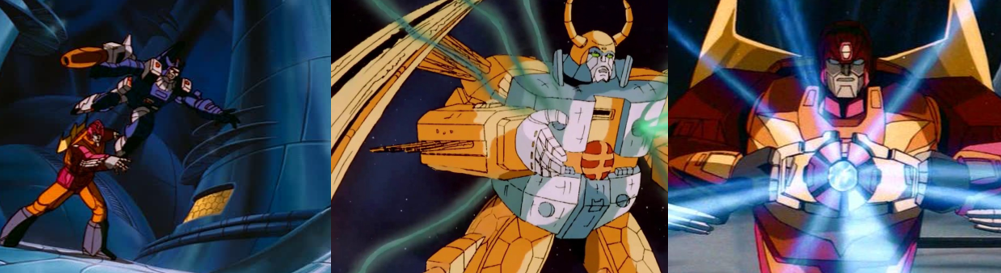
Casting an ominous shadow over everything is Unicron, a looming, unknowable figure about whom we learn nothing except he desires destruction and to continue on this path without resistance. Although he’s not seen all that much during the first two acts, Unicron remains ever present in his constant reprimanding of Galvatron and brief cutaways of him making demands or devouring worlds. Sick of being brought to heel like a dog, Galvatron captures the Matrix of Leadership and turns it against his planet-sized master. However, like Ultra Magnus, Galvatron cannot open the Matrix and is simply devoured by Unicron, who then transforms into a gigantic robot akin to a God and attacks Cybertron. Although the Decepticons are powerless against such a threat, the Autobots have better luck. The Junkions’ modifications to their craft allow them to largely survive Unicron’s plasma breath and crash through his eye to explore his insides. There, Hot Rod encounters Galvatron, who surprisingly suggests they team up against their common foe. Living up to his namesake and fuelled by the need to avenge Optimus Prime, Hot Rod naturally refuses and a fight ensues. Though outmatched, Hot Rod finds himself forever changed when he reclaims the Matrix of Leadership and hears Optimus Prime’s stirring endorsement. Empowered, adopting a sterner demeanour, the rechristened Rodimus Prime overpowers Galvatron and tosses him out into the void. Rodimus then successfully opens the Matrix (he had “the touch” after all), which destroys Unicron in an impressive, if somewhat anti-climatic, end. Unicron’s severed head is left orbiting Cybertron, which is somehow reclaimed by the Autobots (I guess Unicron’s attack killed or drove off the Decepticons?), with many of their allies revealed to have survived previous attacks. Rodimus Prime then delivers his own inspiring speech proclaiming a new era of peace and prosperity and the movie just ends, the momentum and kinetic action screeching to an abrupt end where all obstacles are overcome with ridiculous ease.
The Summary:
This was only my second, maybe third, time watching The Transformers: The Movie. As I said, I didn’t grow up as a big Transformers fan and my experiences with the live-action films have largely soured me on the franchise, but the original cartoon and this feature-length release have always appealed to me. I’ve watched from the sidelines as others have talked about the merciless offing of beloved characters and the death of Optimus Prime, an event that still hits hard even though he was later resurrected. The balls of this movie are to be commended; it’s not often you see beloved children’s characters blown to pieces by a cackling villain and, credit where it’s due, the movie excels because of this. The stakes are incredibly high here; it feels as though no one is safe, not even the newer characters, because Megatron is more crazed than ever and Unicron is always lurking in the background. Leonard Nimoy shines as the sadistic Galvatron, showing a side of himself I’ve never seen before, and the ominous, gravelly voice of Orson Welles adds a gravitas to Unicron that’s truly bone-chilling. The voice acting is top notch, to be honest; even the more annoying characters exude a lot of personality, which is only matched by the impressive and painstakingly detailed animation. Unfortunately, The Transformers: The Movie meanders in the middle; I didn’t really connect with Hot Rod or care about his Quintesson side plot, which largely felt like padding. There are a few holes here, too, like Unicron being both ridiculously powerful and surprisingly vulnerable and him relying on minions when he could just eat anything in his path. The film’s also a visual frenzy at times; I felt assaulted by colours, movement, and music and it was difficult keeping track of what was happening at times. In this regard, I think the film would’ve fared better if it had scaled down the cast but then they wouldn’t be able to sell all those toys, would they? It’s still better than any of Michael Bay’s movies but I still struggle to be that invested in the narrative, characters, and concept. It’s a bleak and stirring rollercoaster of a ride, for sure, but maybe it needed a little fine tuning and a lot less corporate greed to deliver a complete package.
My Rating:
Pretty Good
Is The Transformers: The Movie a pivotal event from your childhood? How did you react when Megatron gunned down all those Autobots and Optimus Prime shockingly died? What did you think to Megatron’s glow-up and his new abilities as Galvatron? Do you agree that the Quintesson side plot dragged a bit? What did you think to Unicron, and do you think he should’ve been depicted as a more awesome and powerful force? Were you happy to see Hot Rod become the new Prime or do you think Ultra Magnus, or someone else, was a better fit? What are some of your favourite Transformers episodes and how are you celebrating sci-fi this month? Share your memories of The Transformers: The Movie down in the comments and go check out my other sci-fi content.

 Dr. K's Waiting Room
You must be logged in to post a comment.