Back Issues [Crossover Crisis]: Jason vs. Leatherface


In April 1985, the first issue of the ground-breaking Crisis on Infinite Earths (Wolfman, et al, 1986) released and saw the temporary destruction of the “Multiverse”. To celebrate this momentous event, I’m discussing multiversal crossovers all throughout April in an event I dubbed “Crossover Crisis”.

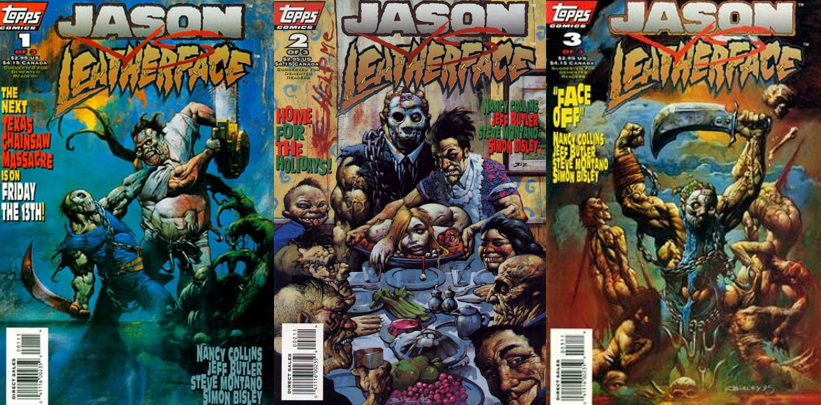
Writers: Nancy A. Collins and David Imhoff – Artist: Jeff Butler

Story Title: “Goin’ South”
Published: October 1995

Story Title: “A Day in the Life…”
Published: November 1995

Story Title: “Face Off”
Published: January 1996

The Background:
Following on the heels of John Carpenter’s Halloween (Carpenter, 1978), which popularised the “slasher” sub-genre of horror cinema, Friday the 13th (Cunningham, 1980) proved to be a box office success, justifying the release of numerous sequels. Immediately, the slasher franchise became synonymous with its unstoppable, machete-wielding, hockey mask-wearing killer, Jason Voorhees (Various), a horror icon who has transcended the genre, becoming a mainstream figure who has branched out into videogames, toys, and various comic books. These would explore Jason’s complex mythology and pit him against other horror icons and, in fact, this latter gimmick was used in his very first comic book appearance as Jason ended up befriending Jedidiah Sawyer/Leatherface and his cannibalistic family in this curious and oft-forgotten three-issue series. Leatherface, of course, first appeared in the highly controversial and influential Texas Chain Saw Massacre (Hooper, 1974), to which all masked slashers owe a great debt. Thanks to a myriad of sequels, remakes, and requels, the Texas Chainsaw Massacre franchise has suffered from the law of diminishing returns at times, though Leatherface and his iconic chainsaw remains a prominent horror figure. Given their childlike demeanours, violent bloodlust, and their unsettling family relationships, I guess it made sense for Topps Comics to have the two square off in this limited series, especially as the legal issues surrounding the long-awaited clash between Jason and Freddy Kruger (Robert Englund) wouldn’t be resolved for some time.

The Review:
Our story begins as most Friday the 13th films do: with a bit of context about Crystal Lake, affectionately known to the locals as “Camp Blood” thanks to the actions of Pamela Voorhees and her zombie-like killer of a son, Jason. Given that this comic was published in 1995, the most recent film was Jason Goes to Hell: The Final Friday (Marcus, 1993), one of two ultimately unsuccessful attempts to finally do Jason in for good, which explains Jason’s somewhat odd-looking appearance. He’s kind of a mixture of his look from Friday the 13th Part VIII: Jason Takes Manhattan (Hedden, 1989) and Jason Goes to Hell, meaning his bulbous head is kind of eating into his mask. He also starts the story still chained to the bottom of Crystal Lake, indicating that this comic book takes place sometime after Friday the 13th Part VI: Jason Lives (McLoughlin, 1986) rather than after Friday the 13th Part VII: The New Blood (Buechler, 1988) since he hasn’t decayed enough to resemble his look in that film. Honestly, trying to figure out where or even if this comic fits into the already spotty Friday the 13th timeline (or with that of the equally troublesome Texas Chainsaw Massacre films) is a fool’s errand; it’s better to just say it’s an alternative tale that takes place after Jason Lives and the original Texas Chain Saw Massacre. Anyway, the story sees Crystal Lake abandoned due to Jason’s many rampages; in its place is a big industrial factory that pumps its waste into the lake, contaminating it so badly that its owners, Linhart Amalgamated, decide to cut their losses and ditch the lake entirely so they can build a fancy business district on its foundations. Naturally, they do this on the cheap, but the dredging is successful and sees the polluted water and its toxic waste loaded onto containers and transported across the country via barge, truck, and train.

When Jason finds himself in Texas, he’s welcomed into the grotesque Sawyer family.

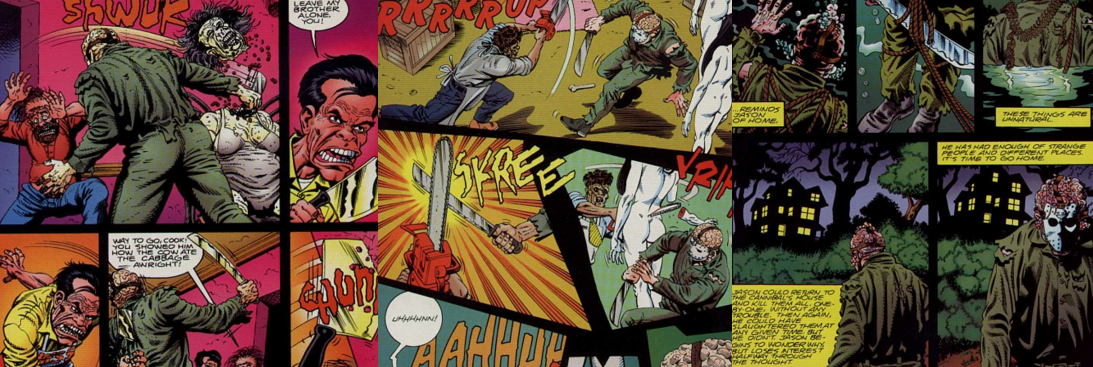
This sees Jason forcibly extracted from his underwater prison and reanimates him, just as the local crazy warned, and he bursts out of his confinement in such a rage that he chops up a train-hopping hobo and his doggy! Jason then barges into the control carriage and kills the relaxing train conductors, splitting the head of one right down the middle with his machete! The train consequently derails and dramatically explodes, leaving Jason lost in the woods of “Sawyerville” in Texas, where he’s just about to hack up some poor randomer when he’s interrupted by Nubbins Sawyer/The Hitchhiker and Leatherface, who are also chasing the terrified man. Encouraged by the Hitchhiker, Leatherface and Jason immediately go at it, with Jason somehow able to deflect Leatherface’s chainsaw with his machete and knock it from his hands. However, the two brutish killers share an intense look as they clash weapons and Jason chooses to behead the victim and peacefully hand Leatherface his chainsaw, earning him the admiration of the Hitchhiker. Against his very nature, Jason is compelled to follow the two back to their humble abode, which is adorned with decorations made from the flesh and bones of their victims, which are also cooked up for the family to eat by Drayton Sawyer/The Cook. When the Hitchhiker and the Cook applaud Jason’s killing skills and berate Leatherface, the hockey masked killer wanders upstairs to find the unmasked Leatherface blubbering. Sensing a kindred spirit in the hulking cannibal, Jason silently invites him downstairs to join the family for dinner, specifically the Cook, the Hitchhiker, the bloated corpse of Aunt Amelia, and decrepit former butcher Grandpa Sawyer. Though struggling with the alien emotions bubbling within his enraged mind, Jason feels so comfortable and accepted with the cannibalistic misfits that he communicates his name to them by writing on the wall with “Kool-Aid” (that’s most likely just blood) and being welcomed to the family.

When Jason sees the way the Hitchhiker treats Leatherface, it unearths some bad memories.

Jason stays with the family, even resting in his own bedroom, where his dreams are dominated by flashbacks to when he drifted out to sea and almost drowned as a child. Tensions quickly rise as the Hitchhiker insults Jason by demanding he take off his mask and eat some scrambled brains, and then attacks Leatherface after being reprimanded by the Cook, which gives Jason a flashback to the violence he suffered at the hands of his abusive father. The Cook briefly placates Jason with a tour of the house, showing off the macabre kitchen, where fresh bodies hang on meat hooks, human meat is stored in the freezer, and more bodies are cooked up in the smokehouse. The Cook takes an immediate shine to Jason, approving of his friendship with Leatherface and sharing his dreams to one day serve his unique food to the social elite. After showing off his long-dead dog to Jason, the Hitchhiker is ordered to the family gas station, where he creeps out a travelling couple. He then rushes back to recruit Leatherface to pick up the “groceries”, but the Cook suggests he take Jason out instead to show him their ways. The Hitchhiker attacks the man with a hammer, bashing his brains in, and admonishes Jason for throttling the woman to death too quickly as the Sawyers enjoy hearing them squeal and, while the Cook is disappointed that the dead bodies aren’t younger, it’s a successful trip for the cannibals. The Hitchhiker then excitedly shows off his art collection to Jason, a room full of dead bodies that have been turned into chairs and other furniture. He delights in showing off a lamp, plant pot, and chair all made from skulls and bones and his pride and joy: a corpse dressed up as Santa Claus with a red lightbulb for a nose! When Leatherface sneaks in and accidentally destroys the Hitchhiker’s chair, the maniacal Sawyer beats his dim-witted sibling mercilessly, berating him the entire time and again causing Jason to remember how his own father routinely beat and demeaned him before his mother (strangely called “Doris” here) cleaved his head in with a machete. Accordingly, Jason defends Leatherface, though the Hitchhiker is less than impressed since he can’t actually feel pain.
When the relationship breaks down, Jason finds himself ostracised and longing for home.

When Jason moves to stab the Hitchhiker with a bone, Leatherface steps in and Jason retires to the house, troubled by his hesitation and recent behaviour. He ends up in the attic, longing for simpler times at Camp Crystal Lake, and the Cook comes to find him and apologise for the Hitchhiker’s behaviour. He also reveals that he set aside his dreams to look after the family as a promise to their mother, his sister, Velma, suggesting a degree of inbreeding in the family, and asks Jason to help him get Grandpa downstairs for dinner. The Hitchhiker continues to scold Leatherface, however; after accusing the mongoloid of reading his comic books, the Hitchhiker beats him in a rage, again compelling Jason to defend his friend. This time, it earns him a switchblade to the chest, which naturally doesn’t faze the hulking murderer, and Jason tears the house apart in pursuit of the maniacal Hitchhiker. Angered at Jason’s outburst, which sees Aunt Amelia beheaded, the Cook tries to stop him with a meat cleaver and a chase ensues, with Jason smashing into the kitchen and preparing to eviscerate the two before Leatherface bursts in with his chainsaw whirring. After a moment’s hesitation, Leatherface strikes, slicing Jason’s stomach and rekindling his rage; incensed at the betrayal, Jason buries his machete in Leatherface’s shoulder and the two go at it. Leatherface suffers a deep cut to the wrist but fails to land a blow of his own before the Hitchhiker bashes Jason’s head in with a hammer. Although the Hitchhiker is eager to treat Jason the same as anyone else, the Cook doesn’t feel right about eating him; not only did he genuinely like Jason, he suspects his meat wouldn’t be too appetising so he decides that he deserves a decent send off. Despite their differences, Leatherface angrily insists that Jason keep his mask on and the family drive Jason’s brained body to the nearby lake, where they tie cinder blocks to his angles, put his machete in his lifeless hand, and dump him in with a ceremonial kick. This is enough to spark Jason back to life; he cuts through his bonds and rises from the lake, briefly tempted to slaughter the Sawyers for their betrayal, but deciding that he’s had enough of strange people and strange places and begins the long walk back to Crystal Lake and the comfort of the familiar.

The Summary:
This was an interesting anomaly of a comic; there’s definitely some crossover appeal between Jason and Leatherface and I think the story did a decent job of painting the two as kindred spirits, but I don’t think it fully lived up to this potential. This was more like Jason Meets the Sawyers since, while he does fight Leatherface very briefly twice throughout the story, he’s more touring their house and being welcomed into their family. I think one thing that’s kind of crucial for any crossover is seeing each character in the other’s location, but we don’t get that here as Jason spends the entire story in Texas, mostly in the Sawyer house, and I think it might have benefitted from having Jason and Leatherface spend more time together, killing randomers, and then demonstrating their differences in their methods. Leatherface is, essentially, a butcher, artist, and child-like figure but the comic only really delves into the last aspect of his personality. While this works in creating parallels between the way the Hitchhiker treats him and the way Jason’s father abused him, it doesn’t always land as the comic is understandably more interested in pairing Jason with characters who can actually talk beyond animalistic grunts.

While the two don’t fight much, they’re positioned as thematic parallels and the art’s suitably gory.

The artwork is pretty good; very exaggerated and stylised, but suitably gory and I really enjoyed the depiction of the Sawyer house, though it does seem like the story suffers from padding a bit as it stops to explore the Cook’s unrealised dreams and the Hitchhiker’s art collection. Because of this, I wonder if it might’ve been better as two thirty-page issues rather than being a three-issue arc as then we could’ve gotten to the titular fight a little faster. When Jason and Leatherface do fight, it’s very brief and not very bloody; neither really inflict much damage on each other and it just suddenly and anti-climatically ends when the Hitchhiker bashes Jason’s brains in. I enjoyed the text boxes that tried to explore Jason’s mindset and conflict over why he’s spared the family and chosen to stay with them, but at times it seems to be openly criticising the paper thin plot and the nonsensical reason behind why he would choose to stay with them. The narrative also suffers from repetition and constant flip-flopping; one minute Leatherface and Jason are buddies, sharing an unspoken bond, and the next Leatherface is attacking Jason with a chainsaw since he dared to raise a hand to the Hitchhiker. Similarly, the story repeats the same thread of Jason stepping in to defend Leatherface from the Hitchhiker more than once and it’s not really clear why the second time leads to a bigger falling out other than the story needing to end. Consequently, things get a bit muddled and boring considering it’s only three issues long, which is again why I think a two issue special would’ve been better. Still, it’s a fun little curio; the artwork is good, the gore is enjoyable, and the attempt to shed some light on Jason’s childhood and somewhat humanise him through Leatherface was admirable, if flawed. I’d actually like to see this done again, perhaps with a painted, gritty art style and a tighter plot, but it was inoffensive enough, if a bit forgettable.

My Rating:

Rating: 2 out of 5.

Could Be Better

What did you think to the showdown between Jason and Leatherface? Were you disappointed that they only fought a couple of times and that it was rather brief? Did you enjoy seeing Jason interact and bond with the Sawyer family? What did you think to the Hitchhiker and the focus on exploring the family’s…unique lifestyle? Which horror icons would you like to see clash in a comic or movie? What’s your favourite Friday the 13th and Texas Chainsaw Massacre film? Whatever your thoughts on this horror crossover, feel free to leave them in the comments or on my social media.


10 FTW: Surprisingly Good Horror Remakes

We’ve heard it all a thousand times by now: “when will Hollywood stop with the remakes!?”, “Why can’t Hollywood come up with new ideas!?”, “Remakes suxxorz1!!” Honestly, while some films should never be re-made and some remakes do baffle the mind, remakes aren’t the plague of cinema that a lot of people like to think they are. In fact, some are pretty damn good.

If you’re one of those bleeding heart Twitter people, though, who just like to decry remakes in general, maybe you should take a moment to consider this small list of horror remakes that are not only surprisingly good but, in some cases, actually surpass their originals:

Halloween
10 Halloween (Zombie, 2007)

We’re kicking things off with quite the controversial choice here. I’ll argue until the end of time that John Carpenter’s Halloween (Carpenter, 1978) is the forefather of all modern horror, particularly the slasher genre. It’s a subtle, atmospheric piece with a fantastic, mysterious antagonist and the truly frightening prospect that random unspeakable acts of horror can happen in a suburban environment. Rob Zombie’s take, however, is a loud, frenetic, uncomfortably gruesome take on the property. Michael Myers (Daeg Faerch/Tyler Mane) is an incredibly disturbed young boy from a violent and abusive family who becomes a remorseless, emotionless, unstoppable tank of a killing machine. Zombie delves right into his own take on Michael’s backstory, presenting in grotesque detail the exact events that turn Michael into a nigh-supernatural killer.

In many ways, the initial focus of the film acts as a kind of prequel to the events of Carpenter’s original, as the remainder of the film’s runtime is devoted to recreating Michael’s killing spree in Haddonfield, with the primary difference being that nearly the entirety of the film is told from Michael’s perspective. Sure, Malcolm McDowell, great as he is, cannot hope to compete with the fantastic Donald Pleasence but the film is bolstered by the incredibly cute Scout Taylor-Compton (who is arguably more attractive and relatable to modern audiences than Jamie Lee Curtis) and even appearances by Brad Dourif and Danielle Harris (and what an appearance hers is!) While it’s unlikely to be as iconic or influential as Carpenter’s benchmark film, for those who find the original and its sequels dated and slow, Rob Zombie’s remake is a much-needed kick up the ass that, for better or worse, dragged Halloween kicking and screaming out of obscurity.

Poltergeist
9 Poltergeist (Kenan, 2015)

I know, right? How could Hollywood ever even entertain the idea of remaking Tobe Hooper/Steven Spielberg’s 1982 horror classic? Well, they did, and don’t be mistaken; it’s not actually that bad. While it lacks probably my favourite scene from the original, where corpses rise from the Freeman’s unfinished swimming pool, the remake is just as terrifying and engaging as the original, with the added bonus of having a modern-day make-over that is far more accessible than the now-dated original. Don’t get me wrong, the original is still a classic, but Sam Rockwell and Kennedi Clements put in some great performances, easily on par with those of Craig T. Nelson and the late JoBeth Williams. Did Poltergeist necessarily need a remake? Probably not, and the fact that numerous haunted house stories since the original have all pulled from or mirrored Hooper’s seminal horror classic probably didn’t help to differentiate Kenan’s new take on the property, but I feel it’s a largely misrepresented film that is nowhere near as bad as some people think.

It
8 It (Muschietti, 2017)

Although I spoke about this film quite recently, it is deserving enough to make this list. Watching Tommy Lee Wallace’s 1990 miniseries, great as it is and as amazing as Tim Curry’s performance in that is, you can’t help but think that Stephen King’s novel deserved to be told without the restraints of a television miniseries. Focusing exclusively on the child side of King’s story, and bringing the events forward to the 1980s rather than the 1950s, Muschietti adheres closely to King’s text while still putting his own spin on events. Bill Skarsgård’s take on Pennywise is suitably unsettingly and otherworldly; what he lacks in Curry’s charisma he more than makes up for by being genuinely creepy and a fearsome menace. Muschietti also focuses on the friendship and troubles of his child protagonists incredibly well, anchoring them to the film’s central narrative and allowing King’s themes of childhood and loss of innocence to play out beautifully. With a lengthy runtime and concluding on a fantastic tease for a second chapter, this new version of It, while not without its issues (primarily regarding screen time for the many characters), did not disappoint in realising the gruesome potential that the miniseries could only hint at.

7 Dawn of the Dead (Snyder, 2004)

Released at the peak of Hollywood’s new-found fondness for zombie films in the early-to-mid-2000s, largely spearheaded by 28 Days Later (Boyle, 2002) and the God-awful Resident Evil (Anderson, 2002) and its decent-enough sequel, Resident Evil: Apocalypse (ibid, 2004), Zack Snyder’s remake of George A. Romero’s massively-influential 1978 film of the same name takes the general themes and premise of its source material and ramps them up with some incredible action, grotesque gore effects, and a much-needed modern day gloss. While zombie purists may lament the inclusion of the fast-moving, animalistic undead introduced in 28 Days Later, Snyder’s rapid editing and penchant for style over substance make the creatures more vicious and scary than in Romero’s original film. With some great supporting performances by the likes of Ving Rhames and Michael Kelly (and even a brief cameo by Ken Foree, repeating his iconic line from the original film), Snyder’s Dawn of the Dead is a non-stop masterpiece of zombie cinema that never slows down to the snail’s pace that Romero’s introspective original prefers to adopt.

Texas Chainsaw Massacre
6 The Texas Chainsaw Massacre (Nispel, 2003)

One of the primary reasons I was inspired to make this list, The Texas Chain Saw Massacre (Hooper, 1974) was a film that desperately needed this remake! Seriously, the original might have been shocking and gruesome at the time but, since then, it has not aged well; it’s a slow, dull piece of cinema that drags on way too long, with questionable acting and a lifeless soundtrack. The only redeeming quality comes from the maniacal Sawyer family, and even they are a hooting, loud bunch of camp. Produced by Michael Bay’s Platinum Dunes, which would go on to be responsible for a variety of horror remakes, The Texas Chainsaw Massacre is much better than it had any right to be. With an uncomfortable gradient, shocking soundtrack, and even some decent performances by Jessica Biel and Eric Balfour, Nispel’s remake downplays the cannibalistic nature of the franchise in favour of grotesque torture-porn levels of horror.

While the film reintroduces Leatherface (Andrew Bryniarski), one of horror’s most iconic figures, and even suggests a tragic backstory for the character, Nispel’s Chainsaw brought us one of the most despicable and significant horror icons in years in the form of Sherriff Hoyt (masterfully embodied by the great R. Lee Ermey). Hoyt, a tobacco-chewing, foul-mouthed sadist, drives the plot of this remake, raises its quality to another level, and his popularity was arguably responsible for the equally-enjoyable prequel, The Texas Chain saw Massacre: The Beginning (Liebesman, 2006). On a side note, though, am I the only one shocked that, including remakes and reimaginings, the Chainsaw franchise is made up of eight separate movies? Crazy!

The Blob
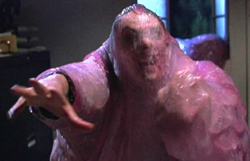
5 The Blob (Russell, 1988)

Now we’re getting somewhere! Irvin Yeaworth’s original 1958 film, starring Steve McQueen, was a campy piece of B-movie mush that has come to resemble a comedy more than a science-fiction piece. Channelling the likes of David Cronenberg and John Carpenter, Chuck Russell’s reimagining, however, takes the story of the bulbous alien lifeform to far more grotesque levels. Incorporating some incredibly disgusting practical effects, the population of a small town is literally dissolved by the titular amoeba. Although some of the composite shots are obviously dated by today’s standards, an entirely CGI rendition of the Blob would probably have aged incredibly poorly by now. Instead, The Blob retains a level of camp in its premise but, with its gruesome effects and no-nonsense attitude, is a great example of how effective and impactful practical effects can be.

Friday the 13th
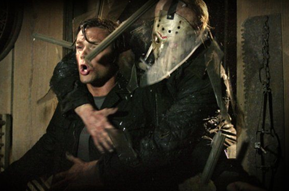
4 Friday the 13th (Nispel, 2009)

We’re back with Marcus Nispel and Platinum Dunes for this masterfully well-crafted remake of not only the original 1980 classic but, also, the first three sequels. Similar to Halloween, for those who find the original movies to be dated and cut-and-pasted, by-the-numbers slasher films with very little to differentiate them from each other until Friday the 13th Part V: A New Beginning (Steinmann, 1985) then this is the film for you! In fact, I often encourage newcomers to the franchise to watch this film and then jump straight to Jason Lives! Friday the 13th Part VI (McLoughlin, 1986); not because the continuity would tie together but, by doing that, you watch one kick-ass film with loads of gratuitous mid-2000s sex (which is far more graphic, enjoyable, and realistic than sex scenes from the 1980s) and horror imagery that sums up the first four entries of the franchise incredibly well and then you can delve into the enjoyable nonsense of zombie Jason Voorhees.

Beginning with the brutal decapitation of Mrs. Voorhees (Nana Visitor) and detailing how Jason (Caleb Guss/Derek Mears) witnessed her murder and grew up alone in the wooded forests of Camp Crystal Lake, as well as detailing Jason’s transformation from the lesser-known burlap sack look to the now-iconic hockey mask, Friday the 13th is filled with some incredibly gruesome kills as Jason uses bear traps, snares, and other tricks to entrap and kill hapless teenagers all over the shop. Add to that some strong performances by Danielle Panabaker, Aaron Yoo, and Jared Padalecki and you have an intense, non-stop horror film that, like Jason, comes at you a mile a minute. Honestly, the only bad thing I have to say about this film is that, despite making $92.7 million on a budget of $19 million, we never saw a sequel; even Rob Zombie’s Halloween got a shitty sequel!

The Thing
3 John Carpenter’s The Thing (Carpenter, 1982) and The Thing (Heijningen Jr, 2011)

Here’s some more controversy for you: I actually liked Matthijs van Heijningen Jr’s version of The Thing. It starred Mary Elizabeth Winstead, who I absolutely adore, and, while marketed as a remake, was actually, ingeniously, a prequel to John Carpenter’s 1982 horror/sci-fi classic. Based exclusively on a brief scene from Carpenter’s film, van Heijningen Jr’s The Thing details how a Norwegian research team unearth an extraterrestrial craft and unwittingly awaken a shape-changing, parasitic alien lifeform and concludes with the survivors attempting to hunt down and eliminate the creature’s final form, which leads directly into the beginning of Carpenter’s The Thing.

Drawing loosely from both Christian Nyby’s 1952 B-movie classic The Thing From Another World! and the story that inspired it, Who Goes There? (Campbell, 1938), John Carpenter’s The Thing is one of the quintessential examples of the effectiveness of practical special effects to the horror genre. Kurt Russell and Keith David lead the charge when their small Antarctic outpost is slowly assimilated by the titular alien creature, leaving the survivors to descend into distrust and anarchy as they struggle to fight off the ever-growing menace both outside and within their number. Carpenter’s film features some truly incredibly moments of practical effects wizardry, from a torso sprouting razor sharp teeth, to a severed head growing spider-like appendages and a dog literally splitting in two as tentacles blast out from its head; yet, while its similarly-impressive practical effects were tampered with in post-production, I never felt like Heijningen Jr’s The Thing was sub-par to Carpenter’s film. Instead, it works amazing well as a companion piece, allowing one to binge-watch both movies side-by-side and be suitably entertained.

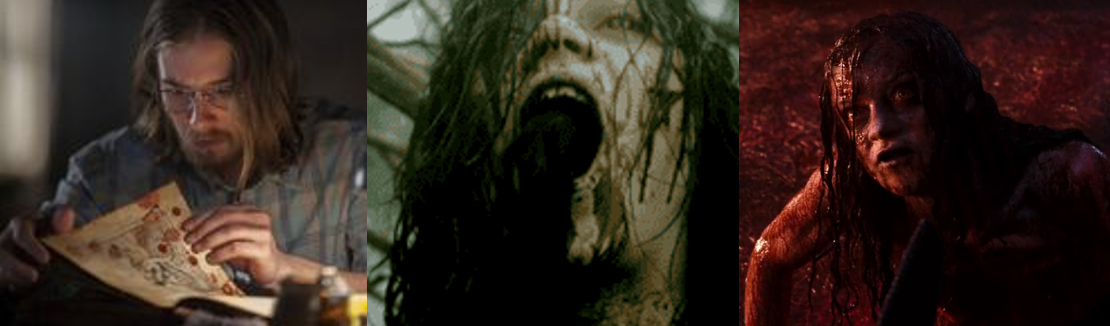
2 Evil Dead (Alvarez, 2013)

Similar to The Texas Chain Saw Massacre, Sam Raimi’s landmark 1981 horror film The Evil Dead was in desperate need of a remake. Sure, the stop-motion, puppetry, and practical effects were great considering the limited time and budget Raimi had available to him but, over time, neither they nor the acting have aged incredibly well. In fact, for me, Evil Dead II: Dead by Dawn (Raimi, 1987), which retells the events of the original in its opening moments, already surpassed Raimi’s original film by leaps and bounds: Ash (epitomised by Bruce Campbell) is a far more capable, well-rounded character, the effects are much better, and the film adopts a quirky style of black comedy that was sorely missing in the original. Fast forward to 2013 and, rather than attempt to emulate Raimi’s black comedy style, Fede Alvarez approaches his remake with an intense seriousness.

The horror is brutal and horrendous to look at; there’s no laughing deer heads here. Instead, characters saw their arms off, are attacked by nail guns, get beaten by crowbars, and are forced to tear their arms off at the elbow in gruesome fashion. The plot is largely the same, with a group of largely likeable characters accidentally awakening an ancient evil, but the stakes are much higher; here, the evil seeks to take on a physical form and bring about the apocalypse whereas in Raimi’s original film it simply wanted to claim the souls of those trapped in the cabin. While it lacks a character as iconic as Ash, Evil Dead makes up for it with some truly difficult to watch moments that are both sickening and perversely entertaining; even Raimi’s controversial tree rape scene is included and utilised in a far more effective and plot-relevant way and that alone is reason enough to place this film over the original, in my view.

The Fly
1 The Fly (Cronenberg, 1986)

This is it, the quintessential argument that not all remakes are bad and that they can, in some cases, vastly surpass their originals. While Kurt Neumann’s 1958 film of the same name may be closer to the original story and is still a pretty decent piece of 1950s science-fiction, despite its now campy tone, Cronenberg took the idea of a man teleporting himself with a fly and took it to whole new levels. Before, the man bore the head and arm of the fly as a result of the accident and slowly deteriorated into madness; here, though, thanks largely to an absolutely stellar performance by the always-amazing Jeff Goldblum, Cronenberg details the physical and mental degradation of his main character, Seth Brundle, in painstakingly brutal detail. Brundle, a brilliant scientist, initially embraces his newfound physical attributes before realising that he has been stricken by an infection on a cellular level not unlike AIDS or cancer. Soon, his body deteriorates at an alarming rate, with top-notch special effects being employed to make Goldblum practically unrecognisable through heavy make-up and full-body prosthetics.

As he alienates those around him, Brundle’s mind also begins to depreciate; initially desperate to reverse the effects, he soon comes to believe that he was never a man to begin with and prepares a gruesome legacy for himself whereby he will merge his crippled body with that of his lover (a strong, heartwrenching performance by Geena Davis) and his unborn child. In the process, he not only dissolves his rival’s hand and foot with corrosive fly vomit but literally bursts out of the remains of his decrepit human skin to emerge as a grotesque fly-like creature, before finally, tragically, forcing his lover to end his torment. The Fly transcends boundaries; it is a horrific tale of science gone wrong, a body horror with terrifying consequences but, at its heart, it is also an extremely tragic love story. Cronenberg did what many fail to do with their remakes; he took the original concept and not only put his own spin on it but also transformed it into something entirely separate from the source material and yet vastly superior to it in many ways.

Arguably, remakes like A Nightmare on Elm Street (Bayer, 2010) (which attempted to put a unique spin on the franchise and ended up becoming a carbon-copy retelling of Wes Craven’s seminal 1984 original), Total Recall (Wiseman, 2012), RoboCop (Padilha, 2014) could really learn a thing or two from The Fly, and many of the remakes on this list. If you’re going to remake a movie, don’t just retread the same material as before; go back to the source, back to the text, and either produce a more faithful adaptation or extrapolate the core themes and general premise and produce a great movie, rather than a simple, insulting cash-grab.