
Talking Movies: The Dark Tower

Talking Movies
DarkTower

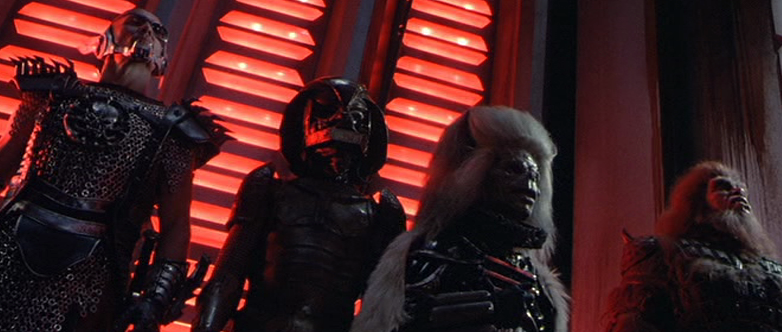
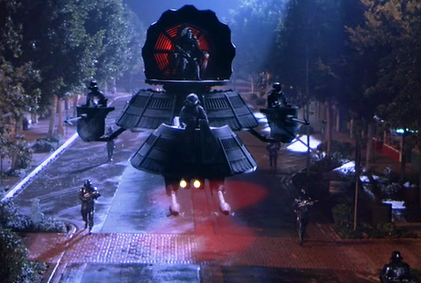
Between 1982 and 2012, notable horror writer Stephen King produced a series of seven novels (and one spin-off) that made up what he referred to as his magnum opus. Over the years, numerous writers and directors have attempted to launch a film series base don King’s Dark Tower books, only to run into various issues at every turn. Finally, after nearly ten years in development hell, 2017 sees the release of Nikolaj Arcel’s adaptation of King’s work. The Dark Tower tells the story of a young boy named Jake Chambers (Tom Taylor), who suffers from regular nightmares and visions of a mysterious Dark Tower, a malevolent Man in Black (Matthew McConaughey), and a grizzled Gunslinger named Roland Deschain (Idris Elba). Jake’s dreams also involves the Man in Black and his henchmen, who wear false faces, strapping children to a device that draws their life-force out to attack the Dark Tower

Given that Jake is clearly struggling to cope with the loss of his father, his mother, Katheryn (Laurie Chambers), tries to help Jake by sending him to a psychiatrist (José Zúñiga), to no avail. However, when he suspects that two representatives of a mental institute are emissaries of the Man in Black, he runs away from home and tracks down a dilapidated house he saw in his dreams. Inside, he finds a control console that opens a doorway to another dimension, Mid-World, and, after being attacked by the house itself, he enters to find himself stranded in the vast alien desert from his nightmares. Eventually, he runs into Roland, who is on his own quest for revenge against the Man in Black after the sorcerer killed not only his entire people but also his father (Dennis Haysbert). After learning that Jake’s dreams can lead him to the Man in Black, Roland reluctantly allows Jake to tag along with him through the desolate remains of times and worlds long gone in order to get his revenge.

The first thing you really need to know about this film, if you’ve read the Dark Tower books, is that this is not a page-for-page adaptation of the series. It’s not even a direct adaptation of the first book; instead, the film draws influences from many of the different books and, if Arcel is to be believed, is actually a canonical sequel to the final book in the series. Therefore, if you were hoping to come into this to see the events of The Gunslinger (King, 1982) play out, you’ll be disappointed. To be fair, The Gunslinger is probably too short to be its own film, much less the first part in a seven film series. Additionally, Roland’s famous Ka-tet do not feature at all, although many events from the books in which they appear are represented: Roland is injured and poisoned after an attack and must get treatment on Jake’s world (“Keystone Earth”). There, he visits a gun shop and stocks up on bullets; he also briefly teaches Jake how to shoot like a Gunslinger and takes part in a shoot-out at the Dixie Pig, similar to The Song of Susannah (King, 2004).

Apparently, The Dark Tower is supposed to launch an ongoing television series, with the main characters all reprising their roles, and even a sequel that will involve more content from The Drawing of the Three (King, 1987). However, the film feels more like a stand-alone, condensed version of the books and it does not conclude on an obvious cliffhanger or with explicit sequel-bait. To veer into spoiler territory, Jake is apprehended by the Man in Black due to his incredibly powerful psychic powers and strapped into the chair from his nightmares. However, having had his true calling to protect the Dark Tower awoken by Jake’s influence, Roland blasts his way through the Dixie Pig and confronts the Man in Black, putting a bullet through his head. Roland then destroys the machine, and the base in which it was housed, and ends the Man in Black’s assault against the Dark Tower. After, he and Jake return to Mid-World together and the film ends with basically everything wrapped up: Jake has realised that he’s not crazy and achieved closure over the loss of his father and Roland has realised his revenge and rediscovered his calling. Although the theme throughout is that darkness will continually attempt to destroy the Dark Tower (I guess I should say at some point that this would result in horrific monsters entering the multiverse and destroying all life) and there are some hints towards a larger, looming evil (the Crimson King), watching the film you get the real sense that everyone was aiming to make only one movie.

Having read all of the books and only found maybe a third of them to be enjoyable, I actually really liked The Dark Tower. It drew the most interesting aspects from the books and paid homage to the larger world that King created (in addition to numerous references to his other stories) without being bogged down by some of the more convoluted and cringe-worthy moments from the books (such as King including himself as a character, the pointlessness of The Waste Lands (King, 1991), or the weirdness of Blaine the psychopathic train). The Dark Tower is Jake’s story; you follow him as the main character and Roland, while being the more enigmatic, bad-ass, and mysterious of the two, is really more of a side character until Jake ends up on Mid-World. Because of this, we only really learn about Roland’s past and the mechanics of King’s multiverse through Jake’s conversations with Roland, in which we are told just enough to know the stakes but not be overwhelmed by the complexities of King’s multi-layered worlds.

The downside to this is that we don’t get much exposition into the Man in Black. McConaughey plays the role with a nuanced relish, clearly revelling in being the personification of evil, and while kills without remorse and clearly desires the destruction of the Dark Tower and the prospect of ruling the darkness that would follow, we never find out what is exact motivations are except that he is pure evil. There is no mention of him serving the higher power of the Crimson King, no explanation regarding his henchmen, and no real tangible motivation behind any of the antagonists except that they’re clearly evil because they want to destroy the multiverse. The only reason this works in the film is due to the fact that The Dark Tower is disappointingly short; at a mere 95 minutes, the film moves at a brisk pace, emphasising action and fast-paced shoot-outs when it can. While it never feels rushed or suffers from jump cuts or even massive plot holes, it is disappointing that the film was not afforded a longer run time; I honestly feel that, if this is the only Dark Tower film to be made, they could have done the books (and the unique narrative of the film) more justice by affording it a two-and-a-half-hour runtime instead.

Fans of the books will probably be disappointed with The Dark Tower; unlike another films based on a long-running book series, The Dark Tower is not a straight-up adaptation of its source material. If it is to be the first in a film series or launch a multi-media franchise, it doesn’t appear to have done a great job of doing so. I feel as though, if there are more films made, this film will be looked at as being like The Matrix (Wachowski Brothers, 1999) in that it feels more like a stand-alone film that wasn’t meant to have a sequel. However, there is plenty of material to still draw from and plenty of potential in the ideas raised in the film to warrant at least two more movies; the disappointment comes from The Dark Tower’s inefficiency at setting these up (but, at the same time, the fact that it is not massively concerned with setting up future films makes it much easier to watch than, say, The Mummy (Kurtzman, 2017), which was criticised for being more concerned with setting up future films in the “Dark Universe” tan telling a good stand-alone story). In the end, though, I enjoyed The Dark Tower for what it was: a fantasy/action film with a compelling protagonist (Elba plays the grizzled, war-weary Roland to perfection, proving that race can have no baring on an actor’s ability to effectively portray a role), engaging set-pieces (Roland’s efficiency at dispatching his foes is unmatched; every shot is an instant kill, even when he’s poisoned to the point where he can barely stand), a charismatic antagonist (McConaughey lives his role, exuding a barely-contained hate and malice beneath an ice-cold exterior), and some extremely enjoyable allusions to other King works buried within the expansive war-torn dimension of Mid-World. It was very enjoyable while it lasted; my only real gripe is that it should’ve easily been a longer film. However, if you go into it expecting slavish fidelity to King’s magnum opus you will be disappointed, so I’d recommend putting your expectations for that aside and enjoying it as a stand-alone fantasy/action piece instead.

My Rating:

Rating: 3 out of 5.

Pretty Good

Recommended: Sure, I would say give it a watch. If you’re a die-hard Dark Tower fan though, expect to be a little disappointed.
Best moment: Roland’s battle against the Taheen that come to kidnap Jake is pretty great, with his proficiency and aim being top-notch despite his weakened condition,
Worst moment: The run-time; for a film with such potential and the expansive nature of King’s work, 95 minutes just doesn’t cut it.

Talking Movies: Masters of the Universe

Talking Movies
MOTULogo

In 1987, one of the most criminally underrated and visually entertaining science-fiction/fantasy films was released. Now, thirty years later, it’s time to take a look back at the gloriously over-the-top Masters of the Universe and give it some much-overdue time in the sun. Directed by Gary Goddard, whose experience was mostly rooted in theme park attractions, on a budget of $22 million and released by Cannon Films, Masters of the Universe is the live-action adaptation of the popular line of toys and animated series of the same name. Following the success of Star Wars (Lucas, 1977) and originally designed as a toy line based on Conan the Barbarian (Milius, 1982), Mattel’s Masters of the Universe franchise depicted an ongoing battle between the heroic forces of Eternia, led by the superhuman He-Man, and the dark aspirations of the evil Skeletor. He-Man’s barbaric appearance, untamed shoulder-length hair and penchant for medieval weaponry obviously showcased his connection to Conan but Mattel made the character, and the franchise, unique by introducing a strong science-fiction element that would run parallel to the sword-and-sorcery influences of Conan.

MOTUToys
I used to pick these little beauties up from car boot sales for £1 a shot!

Furthermore, He-Man became a Superman-like figure in that he was able to transform from the meek, unassuming Prince Adam and into the “mightiest man in the universe” by unsheathing his sword and uttering the now-iconic phrase, “by the power of Eternia; I have the power!” Similar to the Clark Kent/Superman dynamic, very few characters were actual aware of this transformation, despite the incredible similarity between the two characters (something the 2002 relaunch of the series managed to circumvent by having the physical differences between the two characters far more obvious). Anyway, the He-Man and Masters of the Universe toys were successful enough to produce an animated series of…let’s just say questionable quality. Despite this, though, the toys and the series were popular enough to warrant a live-action adaptation. Despite the film’s budget being twice that of Star Wars, and with a proven media franchise behind it, the production Masters of the Universe suffered from two very distinct problems: being produced by Cannon Films (who were infamous for producing B-level science-fiction and action movies, had released the infamously terrible Superman IV: The Quest for Peace (Furie, 1987) only a month of two before Masters of the Universe, and were clearly no 20th Century Fox when it came to film or franchise production and management) and having aspirations way beyond the budget and the limitations of the studio.

MOTUHeManvsSkeletor
“I told you this was always between us”.

The plot, which sees He-Man (Dolph Lundgren) and his allies transported from Eternia to then-modern-day Earth by a trans-dimensional device known as the Cosmic Key, originally spent more time on Eternia and in Castle Grayskull. Instead, the film opens with Castle Grayskull, the home of the all-powerful Sorceress (Christina Pickles), being suddenly ambushed by the entirety of Skeletor’s (played gloriously by Frank Langella) forces. After rescuing Gwildor (Billy Barty), He-Man and his allies – Man-At-Arms (John Cypher) and Teela (Chelsea Field) – discover that Gwildor’s Cosmic Key was stolen from him by Skeletor’s lieutenant, Evil-Lyn (Meg Foster), and that Skeletor used the device’s ability to transport people across time and space to ambush the Sorceress. He-Man and his allies attempt to use the Cosmic Key to rescue to Sorceress, only to be repelled by Skeletor’s vast numbers and forced to flee, crash-landing on Earth. In the chaos, they lose the Key and it is picked up by a very young Tom Paris….er, I mean, Robert Duncan McNeill (who plays high school DJ Kevin Corrigan) and his girlfriend, Julie Winston (played by an also-scarily young Courteney Cox). Enraged by the existence of another Cosmic Key and desperate to have He-Man kneel before him as he absorbs the powers of the universe, Skeletor sends a team of his finest – Blade (Wesley Snipes…er, I mean, Anthony De Longis), Saurod (Pons Maars), the Beast Man (Tony Carroll), and Karg (Robert Towers) – to retrieve the Key, kill all who stand in their way, and bring He-Man to him so he can break him physically, mentally, and emotionally.

MOTUSkeletorsMercenaries
Stop and appreciate the amazing practical effects used in this film.

However, despite Blade wielding two swords eerily similar to that of He-Man’s, the ferocity of the Beast Man, the Predator-like appearance of Saurod, and the cunning of Karg, these bozos are completely outmatched by He-Man and his allies. Less than impressed with this news, Skeletor vaporises Saurod and forces Evil-Lyn to go with them and atone for this failure. In the meantime, He-Man and his allies have met up with Kevin and Julie and, despite interference from Detective Lubic (played with relish by James Tolkan), have been attempting to figure out how the Cosmic Key actually works. However, their efforts are thwarted when Evil-Lyn leads a massive shoot out in a music shop and then uses her powers of illusion to pose as Julie’s recently-deceased mother and reclaim the Key. Although He-Man valiantly fights back against Skeletor’s forces, Skeletor arrives in person to collect the Cosmic Key and forces He-Man to surrender to him or else watch the execution of his friends and allies. A man of his word, and victorious, Skeletor departs after injuring Julie and rendering the Cosmic Key inert.

MOTUSkeletorsEntrance
Skeletor’s grandiose entrance ate up a good chunk of the budget but boy, was it worth it!

However, while He-Man is being tortured at Castle Grayskull, Kevin is coerced into using his knowledge of music to play the melody necessary to transport everyone back to Eternia. Although they manage to rescue He-Man, they are ultimately too late to stop Skeletor from absorbing the powers of the universe through the Great Eye. Transformed in a living God, Skeletor unleashes the full extent of his wrath towards his hated adversary, furious at He-Man’s refusal to kneel before his power. However, through sheer force of will and physical durability, He-Man reclaims his sword and engages Skeletor in combat, ultimately shattering his mystical staff and causing Skeletor’s powers to leave him. Although blindsided by Skeletor’s final attack, He-Man successfully tosses his nemesis down a seemingly-bottomless shaft and wins the day. In the end, the Sorceress is freed, Lubic retires to Eternia, and Kevin and Julie are returned to Earth just before the plane crash that killed Julie’s parents, resulting in a happy ending for all. Masters of the Universe is an impressive piece of cinematography; the set pieces, special effects, and scope of the tale are incredible. Castle Grayskull alone looks like it ate up a sizeable amount of the film’s budget, not that you’d ever know as the scenery is constantly chewed at and dominated by the enigmatic performance of Frank Langella as Skeletor.

MOTUSkeletor
Langella is practically unrecognisable under the Skeletor make-up, save for his booming voice.

Langella absolutely looks to be having the time of his life, hissing with pure venom and spouting lines, with just the right inflection, that remain chilling and quotable to this day (“I must possess all or I possess nothing”, “in death I make him a martyr, a saint! No, I want him broken!”, and let’s not forget when he actual obtains the powers of the universe!). Lundgren is perfectly serviceable as He-Man; he obviously has the build and the exact look for the character. To the chagrin of many Masters of the Universe fans, the film does not mention Prince Adam at all or depict He-Man turning back and forth. You can easily explain this by saying that, most likely, Adam became He-Man right before the film started, though I prefer to believe that Prince Adam just isn’t a part of this canon. Lundgren has always been a bit like a poor man’s Arnold Schwarzenegger and it’s a shame that Masters of the Universe didn’t fare better critically and financially (making a dismal $17 million worldwide) because a successfully franchise might have helped Lundgren to step outside of Schwarzenegger’s shadow a bit more. The supporting cast is pretty great, too. In place of Orko (again to the chagrin of Masters of the Universe fans but, seriously, Orko was the most annoying cartoon character since Scrappy Doo!), we get the warlock Gwildor who, though easily the most annoying character in the film, is still charming in his own right and never outstays his welcome. Man-At-Arms is played to perfection by John Cypher, who depicts him as a loving father, the veteran of many wars, He-Man’s trusted confidant, and also with a dash of well-placed humour (nonchalantly stating that he “[feels] a little hungry” right on the eve of the big shoot out).

MOTUHeMansAllies
Who needs a stupid, annoying floating wizard-thing anyway?

Teela is probably the blandest of the supporting cast but she gets plenty of opportunities to shine in battle and to voice her opinion; she chastises Gwildor for creating the Cosmic Key and thereby unwillingly causing the invasion of Castle Grayskull and vehemently begs He-Man not to surrender to Skeletor despite his heroic sacrifice sparing the lives of innocent people. Similarly, Skeletor’s lieutenants are a big positive of the film. Even guys like Saurod and the Beast Man, who don’t get a lot to say or do, really, are visually engaging and show some layers to their characters. Blade even mentions that he’s “waited a long time” to face He-Man in combat, hinting at a past history between those two. While Karg is ultimately pushed aside once Evil-Lyn takes charge, he nonetheless is a nightmarish little creature. As for Evil-Lyn, Meg Foster seems to be savouring the role almost as much as Langella, playing it with a seductive relish that makes her both detestable and fascinating. Even the human protagonists have some layers to them; sure, both actors are noticeably green here and would go on to refine their craft but Kevin’s struggle to define himself outside of high school is very relatable and Julie’s grief over her parents’ death makes her a sympathetic character. She never becomes a damsel in distress either and, when she is tricked by Evil-Lyn, you totally buy it because she has been largely unsuccessful at coping with her loss throughout the film. Of all the human characters, though, it is Lubic who shines the brightest; I’ve yet to see a role that Tolkan does not fully throw himself into and this is no exception, playing the hard-nosed unbeliever to perfection and ultimately becoming a valuable ally by the film’s conclusion. For a film that is, ultimately, a massive toy commercial,

MOTUPower
“I HAVE THE POWERRRRRRRR!!!”

Master of the Universe has some stellar performances by some great, and underrated, actors, proving that quality casting can elevate any film. This is aided not just by the special effects and set pieces, but also by Bill Conti’s score; a epic, regal theme accompanies the action, rising to a crescendo when Skeletor makes his dramatic (and, no doubt, extremely costly) appearance on Earth. Many fans are understandably annoyed at the lack of swordplay there is in this film; He-Man primarily draws his sword to deflect laser fire and only engages in sword-on-sword combat a handful of times throughout the movie. While Lundgren looks great holding the sword, he only really shows some competence with the weapon in the final battle and prefers to use a laser blaster for the majority of the film. Similarly, Skeletor’s faceless black stormtroopers all wield laser rifles, although they are nowhere near as bad with their aim as their obvious Star Wars counterparts. Personally, I’ve never minded the preference on blasters over swords; it makes the times when He-Man does use his sword mean much more, plus the toys did come with blasters at various times. Ultimately, the poor reception of Masters of the Universe is, to me, unjust. The film even has a final scene after the credits, pre-dating Marvel by decades, where it is revealed that Skeletor survived his fall. This was planned to be followed up on in a sequel but, after the film performed so badly, all of the sets, costumes, and props were retooled for Cyborg (Pyun, 1989). A reboot has been in the works for seemingly forever; although McG was attached to be the director, a tentative release date of 18 December 2019 has been announced so, perhaps, we’ll see He-Man onscreen once more. I have no doubt that Masters of the Universe can be done better and be a massive hit, if done right, but just because the original film isn’t 100% accurate to the toys or to the animated series, or largely set on Earth, doesn’t make it a failure or justify overlooking its place as a masterfully crafted, enjoyable science-fiction/fantasy romp. For me, Masters of the Universe is far more engaging and action-packed than Star Wars (it’s not a popular opinion, but I find the original film to be quite dull and to not have aged as well as its later sequels), far less of a chore to watch than Conan the Barbarian (again, as much as I like that film, its pacing can make repeated viewings a slog to get through), and I fully believe that it should be celebrated not just as a cult film or as a piece of nostalgia but for being a gorgeous, charming, action-packed slice of cinematic gold.

My Rating:

Rating: 5 out of 5.

Fantastic

Recommended: Definitely; Frank Langella alone makes this worth the price of admission!
Best moment: The entire finale of the film, right from the moment He-Man’s allies burst into Castle Grayskull up until Skeletor’s ultimate defeat.
Worst moment: Probably our introducing to Kevin and Julie and their last scene together (barring the magical snow globe they get) as their acting is a bit janky in these scenes.

Talking Movies: Spider-Man: Homecoming

Talking Movies
Spiderman

Following the unfortunate critical and commercial failure of the underrated Amazing Spider-Man 2 (Webb, 2014), Sony and Columbia Pictures decided to cancel their plans for a third film and numerous related spin-offs that would form their own shared cinematic universe. The plus side to this was that negotiations and talks opened up between Disney/Marvel Studios and Sony Pictures which saw Spider-Man be recast and incorporated into the massive, unstoppable media juggernaut that is the Marvel Cinematic Universe in Captain America: Civil War (Russo and Russo, 2016). To capitalise on the success of Civil War and the popular reaction of Tom Holland’s youthful, wise-cracking portrayal of the character, Marvel Studios rearranged their scheduled list of films to allow for a solo movie to truly integrate the character into their shared universe.

Spider-Man: Homecoming (Watts, 2017) opens moments after the conclusion of The Avengers/Avengers Assemble (Whedon, 2012) where salvage expert Adrian Toomes (Michael Keaton…I’ll say that again, Michael Keaton!) and his crew are screwed out of their contract to salvage the remains of the battle between the Avengers and the Chitauri by Tony Stark’s (Robert Downey Junior) newly-formed clean-up team, Damage Control. Out of pocket and against the wall, Toomes and his crew reverse-engineer Chitauri tech to construct an elaborate flying harness and wing rig and create weaponry they can sell on the black market. Eight years later, Peter Parker (Tom Holland) is taken to Berlin by Happy Hogan (Jon Favreau) after being recruited by Tony Stark; once there, he is given his spiffy new Spider-Man costume and participates in the new-iconic airport battle seen in Civil War. Being dropped off at home by Stark, Parker is promised that the team will be in touch with him soon with a new mission. However, eight months later, he has heard no word from Stark or Hogan, despite leaving them numerous messages, and is getting frustrated with being nothing more than a “friendly neighbourhood Spider-Man”.

A chance encounter with Toomes’ gang, who wield advanced, retrofitted Chitauri weaponry, brings Toomes’ activities to the attention of Spider-Man. Angered that his eight-year operation, which has remained under the radar of the Avengers and the police, Toomes kills Jackson Brice (Logan Marshall-Green) and passes his signature weapon, and self-appointed alias of “the Shocker”, on to Herman Schultz (Bokeem Woodbine) and vows to kill Spider-Man for interfering in his work. When Peter’s attempts to bring Toomes’ nefarious activities to Stark’s attention apparently fall on deaf ears, he and his incredibly enthusiastic friend friend, Ned (Jacob Batalon) unlock the full potential of Peter’s spider-suit and he takes matters into his own hands. However, when his over-eagerness causes catastrophe, Stark takes the suit back and reprimands his reckless actions. Humbled and disheartened, Peter attempts to focus on the school’s annual homecoming dance and his date, long-time love interest Liz Allen (Laura Harrier) only to once again forced into a deadly confrontation with Toomes in his Vulture persona.

Spider-Man: Homecoming, much like Ant-Man (Reed, 2015) is a welcome breath of fresh air in the Marvel Cinematic Universe primarily because of its dramatic shift in focus from worldwide, earth-shattering, universe-spanning events to simple, yet still dramatic, issues at a more grounded level. The film cleverly showcases that the actions of the Avengers have far-reaching consequences; every time they battle an advanced enemy, they leave behind chaos and remnants that, in this case, birth an entire gang of criminals in possession of advanced weapons. With the Avengers focused on bigger threats and fighting each other, it’s up to street-level superheroes like Spider-Man to stand up for the everyman in the street. Unlike other depictions of Spider-Man, Holland is young and fresh; he rarely takes the mask off, never shuts up once the suit is on, and embodies the youth and enthusiasm of the character’s Ultimate incarnation in spectacular fashion. Additionally, he is young enough to still be in high school and realistically dealing with the problems that come with this situation: constant berating from the loud-mouth Eugene “Flash” Thomson (Tony Revolori), trying to fit in with the more popular kids, and living up to his responsibilities to the academic decathlon team he is a part of. Add to this the fact that he is hiding his duel identity from his Aunt May (Marisa Tomei) and desperately trying to prove that he has what it takes to be an Avenger and you have a very nuanced performance full of heart and humour.

Spidey goes up against one of his traditionally lamer villains; the Vulture has always just been an old guy with wings who robs banks and does very little else. The same goes for the Shocker, who was turned into a walking recurring joke in the Ultimate Spider-Man comics. Here, though, teamed up, they present a formidable threat to the fledgling Spider-Man; within the first ten minutes of the film, Toomes is made relatable and his motivations are completely understandable. He may well be one of the most layered and ruthless villains not only that a live-action Spider-Man has faced but also in the Marvel Cinematic Universe. The best part is that the film not only features Phineas “The Tinkerer” Mason (Michael Chernus) but, more interestingly, introduces an associate of Toomes, Mac “The Scorpion” Gargan (Michael Mando), who alludes to a team-up of the villains in the future. This promises that Spider-Man will, hopefully, face new onscreen enemies in future films rather than rehashing the same villains we’ve seen before. The film does have some negative points, though; I get that Marvel don’t want to go through Peter’s whole origin again as it’s been done to death by now but I would’ve liked to have seen a quick recap of it over the opening titles just so we can see how this version of Peter dealt with that time of his life. An unfortunate by-product of this is that there’s only subtle allusions of Uncle Ben and the great mentor figure in Peter’s life is Tony Stark (however, Stark and Iron Man feature sparingly throughout the film and in no way take the spotlight away from Spider-Man).

Also, I’m not sure why they chose to have Toomes figure out Spider-Man’s secret identity as it didn’t really factor into the film in a meaningful way. Finally, Spidey’s super high-tech suit stretches believability quite a bit as his suit is skin-tight and form-fitting, so it’s hard to believe that it’s packed full of Iron Man-esque tech (I would’ve liked to have seen the Iron Spider-Man suit used as an alternative to this). However, these are extremely small, minor nitpicks; the film is incredibly funny, packed full of action, and never falls into unnecessary drama. As a coming-of-age story that teaches Peter his place in the wider scope of the Marvel Cinematic Universe, Spider-Man: Homecoming succeeded spectacularly and I fully expect any minor issues to addressed in his future appearances.

My Rating:

Rating: 5 out of 5.

Fantastic

Recommended: Highly, it’s Spider-Man in the Marvel Cinematic Universe!
Best moment: A fantastic recreation of a sequence from The Amazing Spider-Man issue thirty-three, in which Peter is trapped beneath some wreckage and must will his way out through sheer brute strength.
Worst moment: The lack of exposition into the origins and motivations of this new interpretation of Spider-Man.

Talking Movies: Batman v. Superman: Dawn of Justice

Talking Movies
BatmanVSuperman.png

In 2013, director Zack Snyder released his gritty, modern interpretation of Clark Kent/Superman after a long hiatus and after Superman Returns (Singer, 2006) almost killed the franchise with ridiculous plotlines and nonsensical decisions. Man of Steel (Snyder, 2013) caused quite a deal of controversy for its darker, more grounded approach and the massive amounts of destruction caused by the battles between Clark Kent/Superman (Henry Cavill) and General Zod (Michael Shannon). Personally, I enjoyed the movie for making Superman awesome again and showcasing the impact of super-powered beings doing battle in highly-populated areas. Batman v Superman: Dawn of Justice follows-up on Man of Steel’s themes and narrative by introducing the first-ever live-action meeting between the two iconic superheroes. It should be noted that this post is going to be full of spoilers and talk about the film’s narrative, so if you haven’t seen the film then it’s probably best not to read on further. With the conclusion of Christopher Nolan’s Dark Knight trilogy (2004 to 2012), the role of Bruce Wayne/Batman was taken up by Ben Affleck in a casting decision that also caused a stir of controversy, mainly due to Affleck’s previous work on Daredevil (Johnson, 2003). Personally, this decision riled me the wrong way. While I actually enjoyed Daredevil (especially The Director’s Cut), I cannot say that I am much of a Ben Affleck fan; also, I felt that his casting took the role away from other actors who could have shined in that sort of role. Basically, this casting felt like the producers were trying to leech of Affleck’s star power.

1
The loss of Robin has affected Bruce’s attitude, just as it did in the comics.

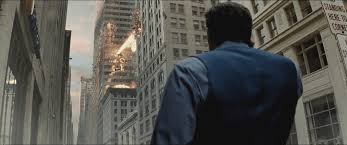
However, Affleck’s portrayal of Wayne/Batman is a true gem of a surprise; Affleck plays an older, grizzled, veteran Batman who is constantly haunted by nightmares, fatigue, and inner turmoil. In the film, Wayne has been Batman for about twenty years; Gotham has gone to hell despite his presence (Wayne Manor is dilapidated, for reasons unknown, and the Gotham Police Department is similarly run-down and seemingly abandoned) and his approach towards his vigilantism has become cruel and violent. This is not just due to his age but also to the dramatic shift in Wayne’s entire persona and attitude after the loss of his partner, Robin, at some point in the past. As a result, Batman (refreshingly commonly referred to as “The Bat” on numerous occasions) tortures and brands criminals in his night-by-night activities and, at a number of points in the film, brandishes firearms and racks up quite the body count. If people were pissed that Michael Keaton’s Batman killed people back in the day, then I wouldn’t be surprised to see Affleck’s Batman attract some debate given that he clearly guns down, blows up, and drives through quite a few goons. Personally, again, I have no problem with that because of the movie’s context. Batman is older, admittedly slower; he’s worn down by age, weariness, and his new mission in life: mainly, the destruction of Superman. It transpires that Wayne was present during the events of Man of Steel and witnessed Superman and Zod’s fight devastating Metropolis, causing the deaths of numerous Wayne employees.

2
Affected by the events of Man of Steel, Batman makes it his mission to end Superman.

As a result, despite the protestations of his ever-loyal butler Alfred (Jeremy Irons), Batman has decided to view Superman as a potential threat that doesn’t need stopping…he needs killing. It doesn’t help Wayne’s mindset that he is constantly haunted by nightmares of not only the deaths of his parents (as standard) but also visions of a dystopian future where Superman rules as a tyrant. These visions are given further credence not only by a surprise visit by Barry Allen/The Flash (Ezra Miller) in a scene straight out of Crisis on Infinite Earths (Wolfman, et al, 1986) where he warns Wayne of this apocalyptic future and urges him to “find us”, but also through the machinations of Lex Luthor (Jesse Eisenberg). Given the controversy caused by Man of Steel, the world is suitably divided by Superman’s presence. A big side plot in the film is the world’s views on Superman; while many view him as a hero, saviour, and messianic figure, others are also fearful of his presence and uncomfortable with his status as an all-powerful alien who answers to no one. While Batman comes to represent the extremes of the latter, Superman’s extended family – the ever-pretty Amy Adams and Lois Lane and his mother, Martha (Diane Lane) – represent the former, urging Clark to be a symbol of hope and/or remove himself from the equation entirely and leave the world to its own issues. Luthor capitalises on the divide that Superman causes and works it to his advantages; through his devious machinations, Luthor gains access to the remains of Zod’s Kryptonian ship, the body of Zod himself, and frames Superman as a destructive force through a series of terrorist actions. This is aided by the general consensus that, because Superman acts as an independent force, his actions have consequences for the rest of the world that led to a number of deaths, a fact that weighs heavily on Superman’s conscience and his belief in himself and what he’s doing.

4
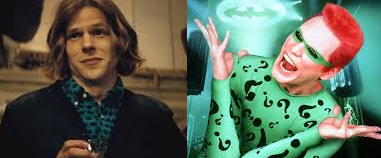
Separated at birth?

For me, the casting of Eisenberg is the exact opposite of Affleck’s: while I generally believed that he could bring something unusual to the role, he is less of a gem and more of a scenery-chewing, ham-fisted version of the character. In his defence, I was glad to see that he wasn’t the corporate, suit-wearing version; Eisenberg brings a manic, hyperactive energy to the role that masks his true, devious intentions; however, while it kind of portrays the character as a quirky, eccentric tycoon, it lends itself more to Jim Carrey’s over-the-top acting from Batman Forever (Schumacher, 1995) people continue to lament to this day. Luthor, implied to be from observing how often Superman saves Lois Lane from danger, pieces together Superman’s secret identity and kidnaps his mother and places Lois in peril in order to bend Superman to his will. He has also been fuelling Wayne’s thirst for blood by manipulating him over time, effectively setting the two against each other in order to publically discredit and shame Superman. However, Luthor’s ultimate plot involves not only the discovery of Kryptonite (which Wayne manages to intercept and use to his own advantage) but also the genetic tampering of Zod’s remains. Accessing forbidden Kryptonian technology, Luthor creates a hulking genetic monstrosity whose sole purpose is to kill Superman: he creates Doomsday.

5
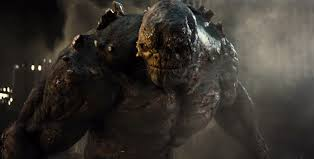
Doomsday serves as the penultimate threat of the film.

Doomsday, whom many online have criticised as being shoe-horned in to unite the central characters, also surprised me. When I first saw the footage of Doomsday from an earlier trailer, I lamenting his presence as it causes so many issues. People have been asking me over the last few years how Batman and Superman can fight and I have explained, over and over, that the two have not only fought numerous times in the comics but also that Batman has often come out on top more than once. Superman, for all his powers, is fallible and has numerous weaknesses; Doomsday, however, traditionally has no such weaknesses and, in a fight against him, the most useless ally you would want would be Batman. However, the film’s version of Doomsday is markedly different; it’s somewhat weaker, physically, and vulnerable to Kryptonite but remains as immensely powerful as ever, if not more so. Doomsday emits concussive blasts of heat energy, seems to float or straight-up fly a few times, and expels shockwaves of energy every time it evolves to repair from damage and attacks. In Superman’s favour, he learns from Man of Steel and attempts to take Doomsday into space and away from the planet; however, this plan is foiled by the governmental decision to nuke them once their out in orbit, which brings Doomsday back more powerful than ever. Joining Superman and Batman to oppose Doomsday is Diana Prince/Wonder Woman (Gal Gadot), who appears at numerous points in a sub-plot concerning her attempts to retrieve vital data of metahumans from Luthor.

6
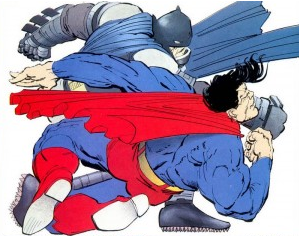
Miller’s influence on Snyder is painfully obvious.

It turns out that Luthor has kept tabs on Barry Allen/the Flash, sightings of Aquaman (Jason Momoa), and the augmentation of Victor Stone into Cyborg (Ray Fisher) and is eager to keep Luthor from eliminating these metahumans. In service of this, she runs into Wayne at numerous points, who discovers that Diana has been around for about a hundred years and is more than she seems. Diana opts to interject herself into the conclusion and assist Batman and Superman, relishing the battle against Doomsday. For the first-ever live-action portrayal of Wonder Woman, Gadot bring both beauty and strength; while her casting also attracted controversy, she was actually portrayed very well and as integral to not only this film but also the formation of the upcoming Justice League. However, the primary title of this movie involves the fight between Batman and Superman. These two clash immediately due to their ideals and approaches and because of Wayne’s vendetta against Superman, but don’t actually come to blows until the third act. For this battle, Snyder draws implicitly from The Dark Knight Returns (Miller, 1986); Batman dons a cybernetic suit exactly as in the comic, blasts Superman with Kryptonite gas as in the comic, and beats him into submission just like in the comic. I guess, in execution, the fight between the two comes across as very similar to the showdown in Freddy vs. Jason (Yu, 2003) in that the entirely film builds the tension towards the confrontation, and builds it some more, and, when the tension finally snaps, it is a very satisfying event.

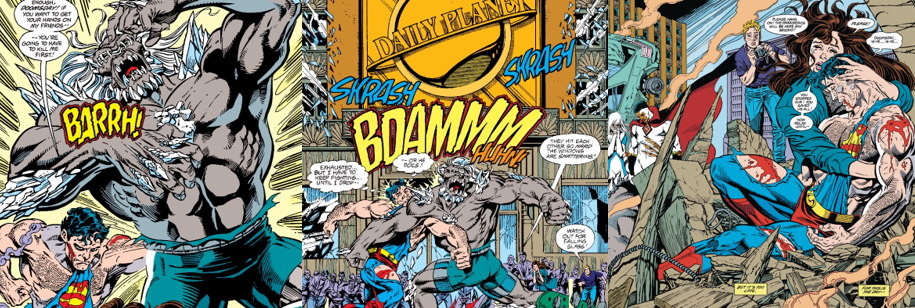
Superman famously died in battle against Doomsday in 1992.

Batman, as mentioned before, is violent and aggressive in his fighting style; his combat prowess is ripped straight from the Arkham series of videogames (Rocksteady Studios/Warner Bros. Interactive Entertainment, 2009 to 2015) and there is no question that, once Superman is suitably weakened, Batman is the superior fighter. Superman, in a change of pace, shakes off the effects of Kryptonite over time and it merely weakens him, rather than kills him. However, that’s alright because Batman is more than willing to stab a Kryptonite spear through Superman’s head! Batman bests Superman, beating him into submission, and is poised for the kill before Superman begs him to save his mother after the fact and Lois rushes in to help clear the air. It is at this moment that Batman comes to his senses and realises that Superman is a selfless man trying to do good; however, this revelation comes off quite rushed. Indeed, once the revelation that Wayne and Clark’s mothers share the same first name (a point I had never actually considered or thought of before) is brought up, Wayne does a complete turn around. Not only is he now willing to assist Superman’s causes, he also pledges to unite the other metahumans in honour of Superman’s penultimate sacrifice.

Oh, didn’t I mention that Superman dies?

Well, honestly, I was pleasantly surprised that Snyder saw this through as totally as he did. As I said on numerous occasions before the movie came out, you cannot involve Doomsday and not do The Death of Superman (Jurgens, et al, 1992) from the comics. Doomsday’s entire purpose is to kill Superman; leaving that out would be like using bane and not having him break Batman’s back. In fact, one of the major issues I had with Smallville (2001 to 2011) using a version of Doomsday was that it obviously wouldn’t be killing Clark (Tom Welling) and would be portrayed as another “villain-of-the-season”. Here, Doomsday and Superman kill each other through mutual impalement; this heroic act brings Batman entirely over to Superman’s cause. It also (through the effective use of a military/state funeral, the more emotional funeral in Smallville, and the montage of reaction shots to the news of Superman’s death) turns Superman into a matriarchal symbol of hope and heroism, effectively ending the divisive conflict he caused in life.

8
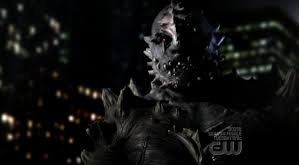
Smallville‘s Doomsday was an abomination.

Of course, a two-part Justice League movie is scheduled to begin filming soon and Superman is already confirmed as being part of the line-up. As a result, the film’s final shot is of Superman’s grave trembling slightly, signalling his inevitable return (and without the four bogus clones as in the original story, one would assume). However, the fact that Snyder actually had the balls to do The Death of Superman, in my mind, completely justifies and exonerates the inclusion of Doomsday. It wasn’t just some half-assed inclusion there to be brought down by the trinity of superheroes; it was there to unite them, the Justice League, and the world by killing Superman, so kudos for that. Visually, the film is actually quite magnificent; say what you will about Snyder as a storyteller, the man knows how to be cinematic. Batman shines the most throughout because of this, being shot in pitch black and having his action scenes be energetic and clear to see. Snyder’s visual symbolism extends to Superman as well; while the God and Christ metaphors have been done to death with Superman, here they actually have relevance in the plot so they don’t come off as cheap or superficial. The visual dichotomy of the film is wonderfully done; the contrast between Metropolis and Gotham City is apparent, the costumes all pop out and appear functional, and Batman’s weapons and gadgets are showcased to the fullest.

It really feels as though the film-makers held nothing back (except for the half-hour of cut footage rumoured to be on the home release) and that has, in the eyes of many, caused more controversy. I have heard of critics attacking the film for being “choppy” at the start, shoe-horning in the Justice League elements and Doomsday, and having nonsensical decisions woven into the dialogue, script, and plot. To them, I say, these are valid points in some cases. However, I never experienced any issues with the pacing or the editing; sure, it’s a long film, but films are these days and, when you’re enjoying a movie, that’s not a bad film. I found myself engaged with the plot; I wanted to know more about Wayne Manor, Gotham, and Batman (which is a perfect way to re-introduce this version of the character and will be expanded upon in future DC films), I followed along easily enough with Luthor’s plot and the side-plots involving the Justice League, and never felt that anything else done an injustice or there for the sake of it. The fact is that DC and Warner Bros. are very late to the shared universe party; Marvel Studios have gained the upper hand after building their individual heroes separately and now having them cross over regularly. While DC’s television efforts are popular and are beginning to cross over, their television shows will not be a part of this forthcoming DC film universe and the studio, which has largely been happy to produce mainly Batman and Superman movies after the lacklustre reception of Green Lantern (Campbell, 2011), doesn’t have the time or the release schedule to introduce the Flash, Aquaman, Wonder Woman, Cyborg or the other Justice Leaguers. Instead, what will set DC movies apart from Marvel’s from now on is their cross-connectivity and their immediate focus of having their films and character converge right off the bat, which could make for some exciting future releases.

Overall, yes, this film has some flaws but nowhere near as many as I was expecting and it certainly doesn’t deserve the critical backlash it is currently facing. It re-introduces Batman, presenting a grizzled, more violent version of the character who seems just as mental as the villains he faces, and brings more humanity and empathy to Superman. The visual presentation is top-notch, more than making up for any narrative deficiencies, and the thematic portrayal of both characters is largely in keeping with their portrayals in several prominent comic books, even the vaunted Dark Knight Returns. Snyder had the balls to do new thins with this movie: he incorporates Robin (no one knows which one but, most likely it was Jason Todd, meaning Nightwing could be active in this universe), a character no one has used in film for nearly ten years (and that’s just criminal); he utilised Doomsday to its fullest extent; he addressed and upped the scale of destruction from Man of Steel; and the apocalyptic future witnessed by Wayne, which is implied to be the result of Superman’s actions (somehow), and Luthor’s manic rant at the end (I half-expected him to announce that “a Crisis is coming”) lend credence to the rumours that the Justice League will come together to battle Darkseid. Make no mistake, the DC movies are a violent one where actions have consequences and the heroes amongst us may cause more trouble than the villains but it is one soon to be united by heroes and villains alike and, for the first true attempt and making headway towards a Justice League movie, I would say that Snyder has delivered on all fronts.

My Rating:

Rating: 3 out of 5.

Pretty Good

Recommended: Sure, why not? The film is beautifully shot, exciting, and engaging. It’s maybe not the best-paced film and has it’s issues, but it’s Batman…versus Superman!
Best moment: Easily the entire final act of the film from the titular clash between the two heroes, into Batman’s vicious rescue mission, through to the Trinity joining forces against Doomsday.
Worst moment: Jesse Eisenberg’s performance as Lex Luthor totally ruins what should have been a far more cerebral, menacing characterisation.