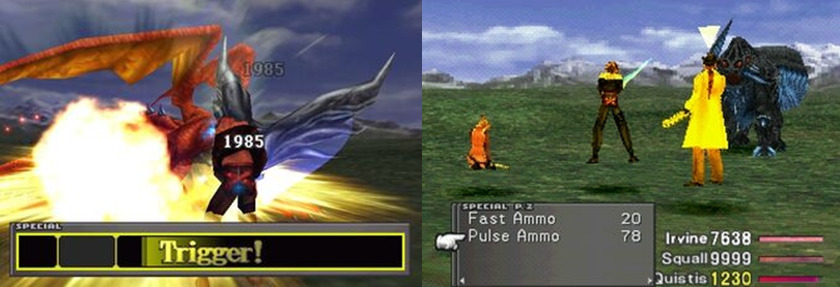
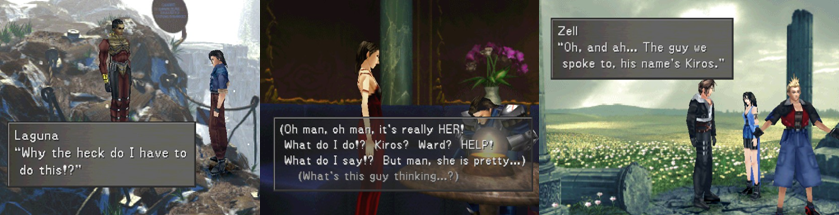
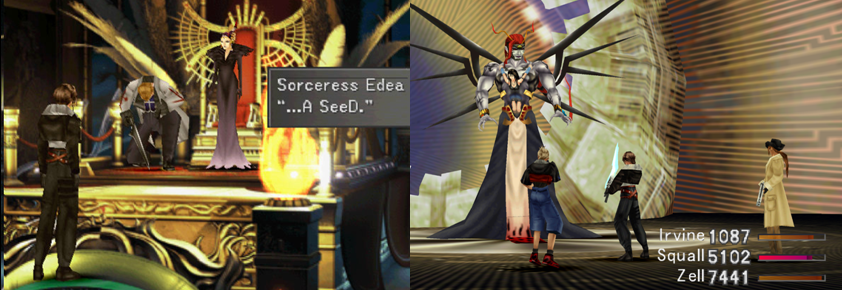
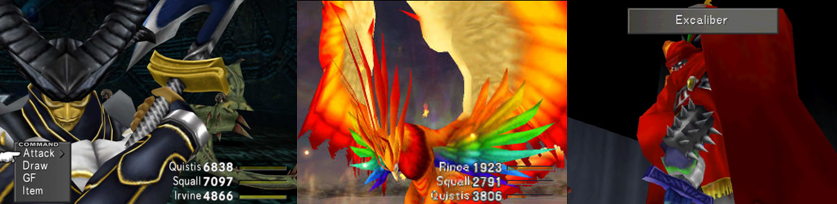
Game Corner: Final Fantasy IX (Xbox Series X)

Released: 13 February 2019
Originally Released: 7 July 2000
Developer: Square
Original Developer: Squaresoft
Also Available For: Android, Nintendo Switch, PC, PlayStation, PlayStation 3, PlayStation 4, Xbox One, Xbox Series S

The Background:
Final Fantasy VII (Square, 1997) is unquestionably one of the definitive role-playing games (RPGs) and probably the most popular Final Fantasy title, selling over twelve million copies worldwide and making its way onto many “top ten” lists. In comparison, Final Fantasy VIII (ibid, 1999), despite being a best-seller, is often the subject of criticism. For the ninth game, Square decided to veer away from the pseudo-futuristic settings of its predecessors and move back towards a medieval fantasy aesthetic like the original games. This fantastical setting would be home to the various anthropomorphic characters who made up the game’s cast, all of whom were designed by Shūkō Murase, Toshiyuki Itahana, and Yoshitaka Amano. Main character Zidane Tribal was purposely designed to be the inverse of his predecessors: young, agile, brash, and outspoken with an eye for the ladies, a philosophy that extended to his supporting cast and the lighter tone of the narrative. Determined to return to the roots of the franchise by reviving narrative concepts such as the Crystals, Fiends, and fantasy elements, the developers tweaked the battle system to be both familiar and slightly different, returning character classes (or “Jobs”) to the franchise to make each character unique both visually and in terms of their abilities. Final Fantasy IX became the second-highest selling game in Japan upon release and was met with critical acclaim. Reviews praised the back-to-basics approach, amusing characters, and detailed environments and character models, though main villain Kuja was seen as inferior to his predecessors In later years, Final Fantasy IX has been recognised as an under-rated entry in the franchise, which perhaps prompted Square to release this enhanced version of the game in 2019. Featuring graphical updates and helpful boosters to speed up the gameplay, Final Fantasy IX found new life and new success on modern consoles and became much more accessible as a result.

The Plot:
In the medieval fantasy world of Gaia, thief Zidane Tribal kidnaps princess Garnet Til Alexandros XVII as part of a ploy by the neighbouring nation of Lindblum. However, he ends up joining forces with Garnet and a diverse cast of characters to take down her mother, Queen Brahne of Alexandria, who has sparked an all-out war between Gaia’s nations.

Gameplay and Power-Ups:
Final Fantasy XI is a traditional turn-based RPG set in a fictional and very fantasy-orientated medieval land. Unlike the previous two Final Fantasy titles, players now form a team (or “party”) of up to four characters, each with their own set of skills, magic, and abilities that are analogous to the classic Final Fantasy Job system. Primarily, players control Zidane, a peppy monkey-boy thief, though you’ll control his teammates at various points and will be encouraged to view their character-building moments and forced to split the playable roster into separate teams. In terms of controls, Final Fantasy XI is nice and simple: use the control stick or directional pad to move your character around the various towns, overworlds, and locations and to select commands in battle, execute those commands. Talk to teammates and non-playable characters (NPCs), activate objects and open chests with A, and back out of menus with B. Open up the main menu with Y, challenge characters to a game of Tetra Master with X, and use Right and the Left Triggers to move the camera on the overworld. RT also enables an “auto battle” function, effectively removing control from the player in battles. In battle, you can press Y to switch characters, hold the Left and Right Bumpers to escape (if possible), and select battle commands (attack, defend, casting spells, using items, and such) from several in-game menus. Pressing the View button opens the map on the overworld (which is eventually enhanced to show location names and allow fast travel) and helpful notes when on menus (a Moogle says what each item or spell does, for example), while pressing Menu pauses the game. From the pause screen, the shoulder triggers and bumpers activate some helpful boosters, such as turning off random battles and setting your maximum attack power to 9999 and speeding up the gameplay, all while still allowing you to obtain Achievements.

Engage in fantasy battles, powering up with Trance and more powerful weapons and gear.

There are some other helpful settings in the main menu, too. You can change the borders and text speed, set your default movement speed to run or walk, turn a helpful cursor on or off so you can always locate your character, and set the battle system to turn-based or “wait”. If you set it to wait, enemies won’t attack while you’re selecting moves, easing the pressure on you. You can also turn certain camera movements on or off to further speed up the gameplay, and certain items also affect this as they increase your chances of attacking first, avoiding damage, and the speed your Active Time Battle (ATB) gauge fills up. When exploring the overworld and the various swamps, forests, caves, and castles, you’re randomly attacked by monsters. Defeating them earns you experience points (EXP), ability points (AP) for your character’s different abilities (as dictated by the gear they have equipped), Gil (Gaia’s currency), and random items (potions, elixirs, and the like). Battling also fills the ATB gauge; once full, you automatically enter a “Trance” state that increases your attack power and speed and allows access to more powerful attacks. Each character carries a weapon to inflict damage on enemies; these are applied manually or you can select “Optimise” to equip the best options. Weapons and gear can be swapped for more powerful options you either steal, find, buy, or “synthesise” in specialist shops to increase their attack power and add various buffs or status effects to your attacks. Different equipment (armour, rings, headbands, and such) do the same, allowing characters to learn abilities that can then be equipped providing you have enough AP. These increase your maximum health and/or magic points (HP/MP, respectively), have you automatically counterattack or take damage for party members, increase you chances of stealing, escaping, or attacking first, negate back attacks, and make you resistant to status effects like poison, petrify, stop, and mini. Each character has different special attacks, too: Zidane steals from enemies, Vivi Ornitier and Eiko Carol cast magic twice in a row, Quina Quen eat enemies to learn their attacks, and Freya Crescent leaps to attack from the air, for example. These abilities are then enhanced through Trance, adding more powerful attacks to your arsenal that will attack or affect multiple enemies, deal greater damage and inflict status effects upon them, or heal or revive your party, though at the cost of MP.
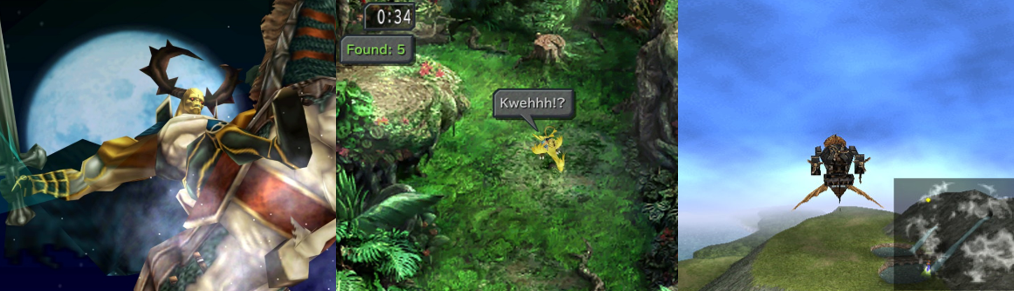
Summon Eidolons, ride Chocobos, and traverse Gaia in various airships.

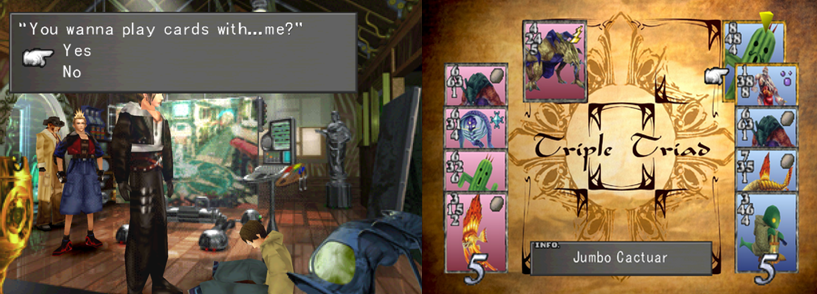
Characters like Eiko and Garnet (who later takes the name “Dagger”) can also summon “Eidolons”, powerful creatures that deal huge damage. Other beneficial magic includes healing spells, spells that cure status effects, and spells that revive downed players, abilities also accomplished by various items, using a tent at save points, or resting at inns (though this will cost you). Google save points are all around Gaia and you can eventually summon a Moogle on the overworld with X. Moogles also teach you the game’s mechanics, sell items, weapons, and accessories, and have you ferry letters around. Some key items must also be selected from your inventory to be used, such as the Gysahl Greens that summon a rideable Chocobo at specific parts of the map, and orbs or keys to open pathways. Initially, your Chocobo simply travels across the open fields but, as you play the aggravating Hot and Cold mini game to find treasures, it’s enhanced to traverse mountains, water, and even fly. However, you’ll also get access to different ships, ones that traverse water and, eventually, the skies, allowing you to quickly fast travel. When in the castle town of Lindblum, Air Cabs take you to the different districts; Memoria features teleport pads, but mostly you use ropes or ladders to explore. When you’re not battling, you can play Tetra Master, a card game almost every NPC plays. As you explore and battle, you’ll acquire cards; these have different strength ratings that, when placed on a grid, allow you to steal your opponent’s cards. Use the arrows on each card and their strength rating to judge where best to place them and fill the board with your colour to win, though I’d recommend making liberal use of nearby save points as NPCs are unfairly skilled. While it’s largely an optional distraction, you must win a small tournament in Treno to progress the story. Speaking of which, you’re regularly prompted to watch an Active Time Event (ATE). A prompt appears onscreen and, when selected, the game shifts to an NPC or teammate as they contemplate their situation or get into mischief. These are optional, and can arguably distract from the main game, but I liken them to regular cutscenes but with a little more character.
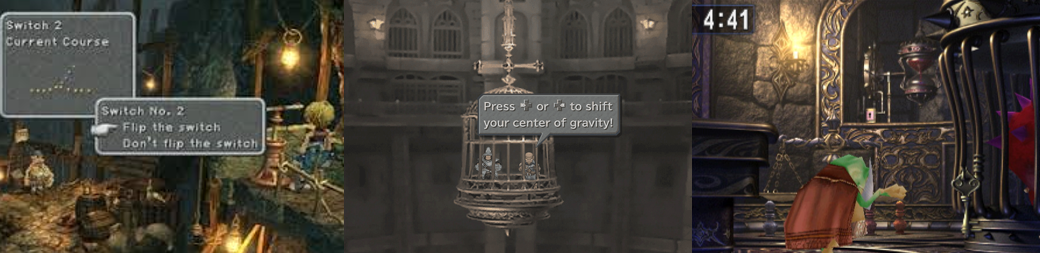
Various mini games and additional mechanics add some (often aggravating) variety.

As is common Final Fantasy games, the difficulty scales in Final Fantasy XI; the further you progress, the more powerful enemies become, even in areas you’ve previously explored. Puzzles are generally quite simple: you’ll be activating switches and consoles, collecting items, pulling levers, and traversing mazes in different areas without too much difficulty. There is a lot of back and forth and repetition involved, though, such as when you explore Fossil Roo and change the track the spider-like gargant takes to reach the exit, or when you wander Pinnacle Rocks looking for Ramuh to piece together his fable and earn him as a summon, or taking the correct path in a looping forest to reach the Black Mage village. You’ll light candles to uncover hidden stairways, explore rooms to find hidden passages, search for your teammates when they’re captured or inevitably wander off or have an identity crisis, mashing A to escape quicksand, and cooking dinner for your party. This, like some other parts of the game, requires you to select the right order from a list to get the best results, with some decisions leading to you battling a swarm of enemies. Final Fantasy XI is full of little mini games, with many being mandatory: you jump rope in Alexandria, take part in a play and sword fight with Zidane’s friend, Blank, and question your life decisions as you swing a cage back and forth to rescue Adelbert Steiner and occasional party member Marcus. Marcus and Beatrix, General of Alexandria’s armies, temporarily join the party at various points, with the latter often teaming with Steiner in side battles. Similarly, there’s a part where you play as Regent Cid Fabool IX (who’s been transformed into frog) and must carefully sneak past a Hedgehog Pie and then balance a set of scales to rescue Zidane’s friends. When exploring Ipsen’s Castle, you can open a secret passageway by picking the correct sequence and then mix ingredients for the Ancient Aroma. In Pandemonium, you get thirty seconds to slip past light plumes and the random battles they contain to cross a temporary bridge, as well as altering some headings to activate platforms. You’ll also power up and activate orbs in Oeilvert to learn valuable lore about Terra and Garland’s plan to fuse it with Gaia.

Presentation:
I loved the chibi character models of Final Fantasy VII and its industrial, futuristic steampunk prerendered backgrounds. Final Fantasy VIII was a huge visual improvement, both in terms of the more detailed character models and environments. Returning to a medieval setting for Final Fantasy IX is a shame for me as I prefer the more futuristic settings, but my God is this game full of charm! Zidane is the polar opposite of the brooding Cloud Strife and the melancholy Squall Leonhart, being peppy, agile, mischievous, and eternally optimistic. Zidane fancies himself a romantic, pirate-like figure; his charms are mostly wasted on Dagger but she warms to his enthusiasm and heart. When he learns his origins from Garland, Zidane becomes morose and lashes out at his friends, who endure tough battles to snap him out of his uncharacteristic mood. While he’s the focus of the story and gets the most character development, Zidane has competition in Vivi, a clumsy, insecure Black Mage who’s constantly feared and hated due to his destructive brethren who embarks on a journey of self-discovery. Zidane clashes with Steiner, the oafish captain of Alexandria’s guards, and Amarant Coral, a brutish thug and loner with a grudge against Zidane. Freya is an old ally of his searching for her lost love, while Eiko is a young girl with a crush on him who’s both envious of Dagger and also tries to get them to admit their feelings. Then there’s the supporting cast, such as Zidane’s roguish crew, the Tantalus Theater Troupe, who initially seek riches but are roped into saving the world, the jester-like Zorn and Thorn who constantly hound and mock the player, and the enigmatic Kuja, a flamboyant villain who lacks the menace of his predecessors but makes up for it in theatricality. It’s a very light-hearted, whimsical adventure for the most part; slapstick comedy and goofy moments pepper the narrative (especially whenever the androgynous and perpetually hungry Quina is around). However, there’s a lot of heart and emotion and high stakes as the story progresses, with characters questioning themselves and being forced to find the courage to fight for something worthwhile.

Medieval fantasy lands soon give way to surreal, alien landscapes.

While the overworld is largely similar to those of the last two games, comprising various land masses (fields, deserts, a snow region), lakes, and a vast ocean, the towns are closer to those seen in pre-Final Fantasy VII, now brought to life in more detail than ever before. The medieval and fantasy theme delivers bustling castle towns, lavish stone palaces, and quaint little villages. Technology is of a similar steampunk style, but far less advanced (airships and complex machinery aside), with towns relying on wind and water power for the most part. While it’s all very beautiful, it’s an aesthetic I find quite samey; Alexandria and Lindblum are quite similar in many ways, for example, though they get more personality after they’re attacked and left in disarray. One aspect I was keenly aware of was that each area is home to a different species, often anthropomorphic ones, and these different species intermingle throughout the game, adding to its distinct visual style and giving it a diverse world. Caverns, ice caves, great trees, murky swamps, and arid deserts filled with abandoned temples and structures are everywhere. Qu Marshes are full of tall crass and frog ponds, the Iifa Tree looms ominously and sports gigantic, twisted branches, and you’ll find isolated settlements in forests and atop mountains. Ruins, great gates, and abandoned towns add a sense of desolation but things really become surreal and visually interesting when you’re transported to Terra, a bizarre alien landscape whose architecture emphasises glaring eyes, spheres, and a quasi-magical awe. Like the chilling Black Mage production line in Dali, the warped, crystalline Terra and its main town, Bran Bal, is where the genomes (Zidane and Kuja’s people) are created as puppets for Garland’s plot. Though you only visit Terra once, its spirit lives on in the desolate landscape of Pandemonium, a ruined dimension of chaos and memory that threatens to eradicate all life.
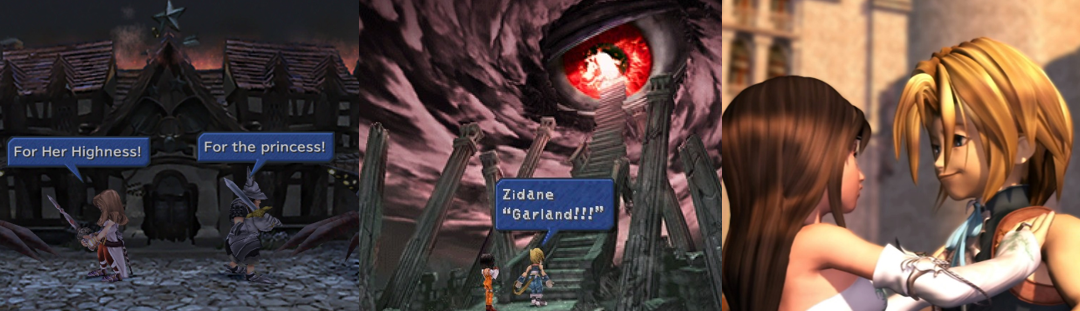
The game has a strong visual appeal, with fun characters and rising stakes.

Unlike in previous Final Fantasy games, dialogue is delivered through speech bubbles, allowing multiple characters to talk at once and adding a level of personality not seen before. There’s no voice acting beyond a few roars and squeals and such, but each character exudes personality in their body language; Steiner even lives up to his nickname, “Rusty”, since his armour clanks as he walks. Legendary composer Nobuo Uematsu remixes classic Final Fantasy themes for this throwback, infusing every grand town and castle with a regality or sense of adventure, and every warped nightmare realm with a sense of foreboding as this whimsical adventure takes a dark turn. While no tunes were as memorable as “Dancing Mad”, “One Wing Angel”, or “Maybe I’m a Lion”, I enjoyed the fantasy score. Pre-rendered cutscenes and FMV sequences show our heroes comically swinging through the skies, emotionally reunite, and the all-out destruction of castle towns by powerful summons. Many cutscenes are standout moments, such as the characters flying the Invincible through a swarm of Silver Dragons, Dagger and Eiko summoning Alexander to repel Bahamut, and Zidane braving the Iifa Tree to rescue Kuja. Cutscenes are also told using the in-game models, of course, and these are often animated over FMV sequences. The transition is much less jarring than in previous games and, similarly, the distinction between the overworld models and the battle models is basically none this time around. Battles still load up an enclosed arena, characters still pose triumphantly as the victory fanfare plays, and their weapons change appearance as you equip new ones. Unfortunately, I did notice a considerable lag when the game loads battles that I don’t remember from the last two games. Since random encounters happen very frequently, it can get frustrating staring at a black screen and thinking the game’s crashed every other battle.

Enemies and Bosses:
Final Fantasy is known for having some bizarre enemies, but Final Fantasy IX may be some of the weirdest I’ve seen from the series. Sure, you’ve got some returning faces (Bombs, the ever-annoying Cactuars and Tonberries, Goblins, Hedgehog Pies, Malboros, and such) but these are joined by literal zombies, yetis, warrior skeletons, sand golems, lizard men carrying tridents or hatchets, amorphous red blobs with too many eyes for comfort, and a strange living house on spider legs! Giant armoured tortoises, vulture-like birds, oversized beetles, large worms and crabs, ravenous wolves, and sicken toads are commonplace, existing alongside powerful dragons, chimeras, giant trolls, terrifying robe-wearing ogres, and seemingly innocuous treasure chests that turn out to be Mimics. Epitaphs are living stone statues that conjure replicas of your party, Gimme Cats yield barely any rewards upon defeat and simply demand your items, Grand Dragons and Behemoths can KO with one hit even with the boosters activated, Jabberwocks and monstrous Mistodons are the stuff of nightmares, and you’ll be caught completely off-guard by the small, sheep-like Yans and being decimated by their powerful magic. Enemies inflict harmful or aggravating status effects, confusing you, poisoning you, or keeping you from using certain attacks. They heal themselves and their allies, cast elemental magic, and even blow party members away, though many can be stolen from to acquire powerful or rare items. When visiting Treno, you can challenge a powerful monster in the weapon shop if you’re feeling brave, though sadly this is the only opportunity to do this and it’s limited to certain monsters.
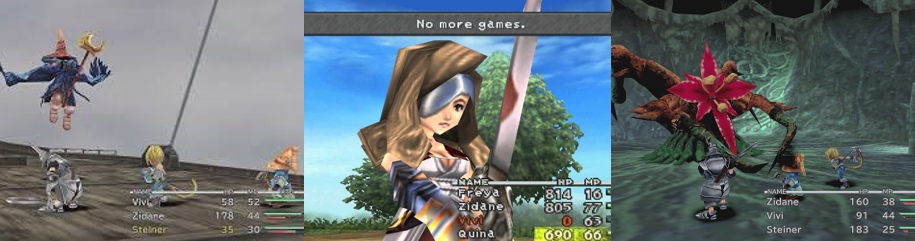
Aggressive Black Mages, powerful soldiers, and monstrous plants all stand in your way.

There are many boss battles in Final Fantasy XI, and some enemies must be fought multiple times. Steiner, for example, initially tries to stop you in Alexandria; you’ll battle him three times during your escape, though he’ll either flee or be felled by a Bomb, and he’ll refuse to attack Garnet so you can use this to your advantage. You also have three unwinnable fights with Beatrix where, after you deal enough damage, she uses Stock Break or Climhazzard and flees. You’ll battle Zidane’s boss and father figure, Baku, twice, with the first essentially acting as a battle tutorial, though he’s quite clumsy and often trips. Amarant is also fought before he joins your team; his battle is interesting as he hops all around the arena, making it difficult to target him, though he also casts Death, which can be a problem as you fight him as Zidane alone. Many Black Waltz’s, bloodthirsty Black Mages, attack Gaia’s towns and are thus greatly feared. They use elemental attacks, can freeze your party members, and even utilise dual magic attacks, though the third one you encounter also refuses to attack Dagger. Red Dragons pounce in Mount Gulug (though they’re naturally weak to Blizzard) and two serpentine beasts – Ralvurahva and Ralvuimago – must be fought to pass Gargan Roo. In the early game, Dagger and Vivi are both captured by the appropriately named Prison Cage, a strange plant-like creature from the Evil Forest that sucks HP from its captives. You must be mindful of this and hurting your allies, as it’s game over if their HP drops to zero. The Evil Forest is also home to the Plant Brain, a hideous malicious bud that attacks with lashing tentacles and by casting Thunder or afflicting Darkness through Pollen, though Fire attacks and Blank’s support will win the day (at the cost of the forest).

Bosses become more monstruous and fearsome as you progress.

Your reward for rescuing Lindblum during the Festival of the Hunt is a battle against the boar-like Zaghnol, which enhances its Thunder spells and rams you with Heave. While exploring Gizamaluke’s Grotto, Zorn and Thorn manipulate the cobra-like Gizamaluke into attacking you, though the Bird Killer ability counterbalances its powerful Water spell. While exploring Cleyra and the desert of the Outer Continent, you’ll fight the ravenous Antlion, which reduces your HP to single digits with Sandstorm, counterattacks when attacked physically, and inflicts Trouble (which can only be cured with Annoytment). You’ll finally confront Zorn and Thorn, who fuse into the Lovecraftian entity Meltigemini, which poisons you and stops you earning AP with Virus, though it is weak to Fire magic. Deep in the Iifa Tree, you confront the tree-like demon Soulcage to dispel the Mist spewing from the tree. It can cast LV5 Death and infuriate party members with Mustard Bomb and its attack power is raised if you use Fire spells, but it’s undead so you can use a Phoenix Down to reduce its HP to 1 or use Life or Elixir to instantly kill it. In Fossil Roo, you spring past hazards as the Armodullahan chases them. If hit, you battle it, desperately avoiding its Death spells, until it falls down a hole but you can outrun it if you’re quick. When forced into journeying to Oeilvert to obtain the Gulag Stone, players battle the Ark, and airship-like being that can confuse your team or reduce them to 1 HP but will become a summon upon defeat. Also, when in Ipsen’s Castle, the insectile Taharka attacks when you steal the four elemental mirrors, increasing its defence when it curls into a ball but being notable susceptible to Heat, Silence, and Sleep spells.
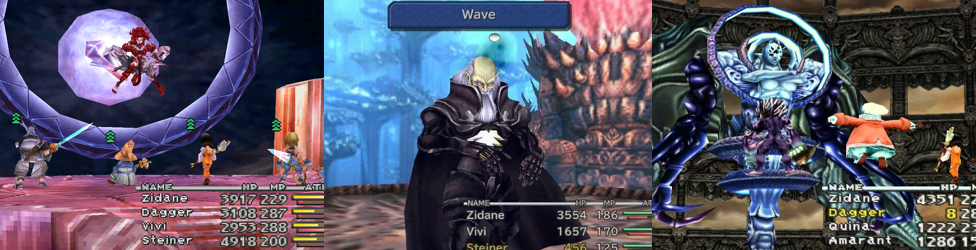
Kuja’s threat is usurped by Garland, who’s usurped by Necron!

When the party learns of the four elemental temples, they split up to explore them and are attacked be the four Guardians of Terra, though the player only battles the Earth Guardian, a regal skeleton that attacks with Earth Shake. As you enter Memoria, you’ll battle the Nova Dragon, which tosses you with Psychokinesis, inflicts heavy damage with Twister and Tidal Wave, and counterattacks when physically hit. The four guardians are recreated by Kuja in Memoria and randomly attack as you explore: the four-armed Maliris favours Fire magic, Tiama is a three-headed dragon (almost a Cthulu-type being) that uses Wind magic and can blow you off the battlefield, Kraken is a disgusting octopus-like creature that fires Water or Ink from its tentacles or inflicts Freeze, and Lich is the Earth Guardian reborn, now more likely to cast Death. In Pandemonium, you endure a three-stage gauntlet against the Silver Dragon, Garland, and Kuja with no respite between. While the Silver Dragon favours Wind spells like the Nova Dragon, Garland likes to freeze the party with Stop (causing a game over if all four are afflicted) and obliterate their HP with Flare. In comparison, Kuja casts Demi, Ultima, and Flare Star, the latter of which cannot be protected against with Shell or Reflect. This is an unwinnable battle, as Kuja enters Trance to end the battle, and battle him (as “Trance Kuja”) again after besting the four guardians and Deathguise, another cobra-like dragon capable of annihilating ill-prepared parties with Meteor. Trance Kuja heals with Curaga, casts Flare, Holy, and Flare Star, though these same spells (or similar) can be turned against him. Once again, this is an unwinnable fight but, this time, you’re transported to the Hill of Despair and challenged to assemble a refreshed party to battle Necron, a being from beyond time and space who appears out of nowhere, drawn to Kuja’s despair. This surreal, angelic being is fought in a void and boasts powerful magic spells, including Blue Shockwave (which reduces one character to 1 HP), Grand Cross (which randomly inflicts different status ailments), and Neutron Ring to deal heavy damage. Necron can also attack four times in a row, easily pummelling the unprepared, so it’s best to have abilities like Regen, Auto-Life, and Mighty Guard enabled.

Additional Features:
There are fifty-one Achievements in Final Fantasy XI, with very few obtained through simple gameplay. You’ll get one for finishing the game, sure, and for winning one, ten, and 100 Tetra Master matches, but you’ll be hard-pressed to defeat 10,000 enemies or reach level 99 without grinding endlessly. Similarly, while it is possible to view 79 ATEs in a single playthrough, if you miss even one you can’t go back and view it or tick it off on a second playthrough, same goes for buying every item from Stiltzkin the Moogle (I missed that he was in Bran Bal). While guiding the residents of Cleyra to safety, entering Trance fifty times, causing Moguo to have a tantrum, and having Vivi win the Festival of the Hunt are pretty easy, getting an encore from the nobles, catching ninety-nine frogs, and jumping rope 100 and 1000 times are more than a chore! Similarly, you’ll be playing Hot and Cold a lot to upgrade your Chocobo’s beak and uncover all the hidden treasures across Gaia, though you can obtain most of the Ultimate Weapons if you search around Memoria. Other Achievements are gained from delivering Moogle mail and repairing their Mognet, uncovering the secret of the Eidolon Wall by interacting with the images etched there, obtaining four Moonstones, capturing a golden frog, and trading thirteen rare cards to Queen Stella. If you defeat the Behemoth in the Treno weapon shop with Dagger, you’ll get an Achievement (something easier said than done even with the boosters on!), and you’ll get another for getting a Very Good Omen from the fortune feature in Dali, where you also earn a nifty model airship if you bring an NPC three coffees hidden throughout Gaia.

You’ll have to endure tedious side quests to reap the best rewards and challenge the bizarre Ozma.

Other Achievements are much more time consuming. You can’t acquire Zidane’s Ultimate Weapon unless you upgrade your Chocobo, which must also be done to find hidden treasure chests and reach Chocobo’s Air Garden. This is a hell of an ask and an aggravating task, but your reward is battling the spherical superboss Ozma, an existential cosmic being capable of fully regenerating itself and attacking before you do, decimating the party with powerful spells like LV5 Death, LV4 Holy, Doomsday, and Meteor. Ozma is also practically unreachable unless you befriend all the friendly monsters across Gaia (which also awards another Achievement). These randomly appear (accompanied by a whimsical jingle) asking for ore or diamonds or other items and allow you to attack Ozma unrestricted once appeased. The Ragtime Mouse also randomly appears throughout the overworld, challenging you answer his quiz to earn rewards and another Achievement. All the boosters in the world won’t help too much with these tedious tasks, and be careful what you activate as there are cheat boosters in the main menu that disable Achievements. If you fancy synthesising the best weapons and gear, search around in Memoria to find Hades, an optional superboss that likes to inflict numerous status ailments and reduce you to 1 HP with Judgment Sword but will synthesise the best gear upon defeat. Additionally, you can take on the Tetra Master tournament as often as you like (and challenge numerous NPCs) and pop along to the Trena auction house to win rare items, some of which are needed for Achievements. If you reach Memoria in under twelve hours, you’ll also acquire Steiner’s Ultimate Weapon, Excalibur II, and you’ll even be ranked on your treasure hunting abilities by a mysterious four-armed man. Finally, completing the game unlocks a movie gallery and an additional card game from the main menu, if you fancy checking those out.

The Summary:
I first played Final Fantasy XI on the PlayStation 3 back in the day after years of being a SEGA and Nintendo kid. The darker, more melancholy and futuristic nature of its two predecessors appealed to me a lot more so it was always jarring entering a medieval fantasy world, a trope that had been done to death even back then, but the sheer visual appeal and wacky nature of the game’s characters quickly won me over. I was excited to return to Gaia, especially with the helpful boosters this version offers, and the story and characters are just as appealing as ever. Everyone has such life and personality to them and, while the game is very goofy, there’s an emotional undercurrent through it and it gets pretty dark at times when castles are being destroyed and characters are questioning their origins and morality. While I wasn’t massively blown away by the game’s locations or music, few of which really stood out for me, the diverse cast and bizarre enemies made up for it, as did the bonkers existential narrative that the otherwise simple plot descends into by the end. Gameplay is solid throughout; battles are as easy to navigate as ever, with a few tweaks to the formula to harken back to the old Job system and make characters unique through their abilities. I was a bit disappointed by the Trance state as I missed the big Limit Break attacks of the past games, but they open up new attack options and the summons are as impressive as ever. While it can lag at times and the mini games can be frustrating and the ATEs a little distracting, I think the whole package comes together nicely to pay homage to the franchise’s rich history and deliver a suitable love letter to the games that made Final Fantasy a household name. It may not be as mainstream as Final Fantasy VII or as controversial as Final Fantasy VIII, and I’d agree that it’s unfairly forgotten or overshadowed by its more successful and appealing predecessors and successors, but Final Fantasy XI is everything you could want from an RPG. Strong story, fun and engaging characters, intricate battle system, and a fair amount of replay value if you’re willing to put the time into doing tedious tasks for high rewards.

My Rating:

Rating: 4 out of 5.

Great Stuff

Are you a fan of Final Fantasy IX? Were you pleased to see it return to the medieval roots of the series? Who was in your party in Final Fantasy IX and which character was your favourite? Were you surprised when Necron randomly appeared at the end? Did you ever find all the treasures and defeat Ozma? Whatever your thoughts on Final Fantasy IX, and the Final Fantasy series, drop a comment below and go check out my other Final Fantasy content.

Game Corner: Final Fantasy: Pixel Remaster (Xbox Series X)

Released: 26 September 2024
Originally Released: 18 December 1987
Developer: Square Enix / TOSE
Original Developer: Square
Also Available For: Android, Mobile, Nintendo Switch, PC, PlayStation 4, PlayStation 5, Xbox One, Xbox Series S (Pixel Remaster); EZweb, Game Boy Advance, i-mode, J2ME, MSX2, Nintendo 3DS, Nintendo Entertainment System (NES), PlayStation, PlayStation Portable (PSP), WonderSwan Color (Original / Ports)

The Background:
Midway through the 1980s, videogame developer Square first branched into the Japanese videogame industry with simplistic role-playing games (RPGs), racing titles, and platformers for the Nintendo Famicom. Cautious to risk their sales, they initially refused to allow Hironobu Sakaguchi to develop a more complex RPG, however the success of Dragon Warrior (Chunsoft, 1986) saw Square reconsider this decision. Accordingly, Sakaguchi put together a small team to develop what he saw as his last chance to achieve success in the industry. Though Sakaguchi was known as a hard taskmaster, his team worked hard to conceive of the game’s turn-based battle system and lore, inspired by Dungeons & Dragons, and advocating for as much player choice as possible. Yoshitaka Amano joined the project as the character designer while Nobuo Uematsu came on board as the composer, while Nasir Gebelli was brought in to code the game and design an additional sliding puzzle minigame. Against the odds, Final Fantasy proved a critical and commercial success and a game-changing entry in the RPG genre, despite its difficulty and laborious mechanics. This success launched a slew of sequels, spin-off titles, and multimedia ventures, turning Sakaguchi’s last-gasp at success into perhaps the most prolific RPG franchise in all of gaming. Over the years, Final Fantasy has been ported to multiple consoles, adding visual and gameplay upgrades to each new version, such as the quality of life tweaks, a “Bestiary”, and additional dungeons seen in the warmly received Game Boy Advance version that I first played. This rebuilt version of the game was originally exclusive to mobile platforms and Steam, before jumping to home consoles and, eventually, the Xbox series in late-2024. Although this Pixel Remaster removed some features from previous ports, it boasted a much-needed visual upgrade to the classic game and included some modern features to make the experience more accessible, resulting in a largely praised collection of RPG classics.

The Plot:
Upon arriving in the medieval fantasy land of Cornelia, four Warriors of Light are charged with rescuing Princess Sarah from the rogue Cornelian knight, Garland. However, their journey sees them embroiled in a paradoxical plot to upset the four elemental Crystals and spread chaos across the land using four mythical Fiends.

Gameplay and Power-Ups:
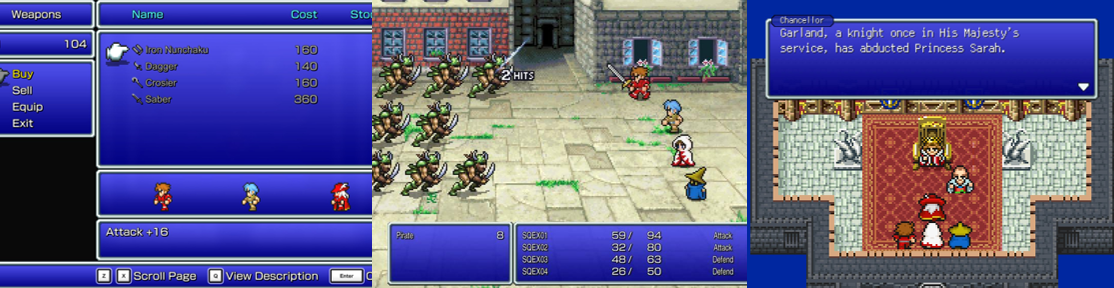
Final Fantasy: Pixel Remaster is a spruced-up overhaul of previous 16-bit remakes of the original Final Fantasy. Accordingly, the game is a traditional turn-based RPG title in which players explore a vast overworld and various dungeons from a top-down perspective and engage in regular, random battles while exploring outside towns. As soon as you start the game, you must form a team (or “party”) of four characters, picking from six different character classes (also commonly referred to as “Jobs”). Each has different strengths and weaknesses and can be equipped with different gear, and each class is later upgraded after you acquire a specific key item and talk to the legendary king of dragons, Bahamut, which allows even a Warrior to cast magic. Due to sticking closely to the original NES version, Final Fantasy: Pixel Remaster’s actions are relatively simple, with you using A to talk to non-playable characters (NPCs), open treasure chests, enter your Airship, and to select commands from the various menus. B backs out of these menus and cancels your last order, while “Start” pauses the game. Y brings up a full screen map, which clearly shows towns and things of interest and is a godsend since this was missing in previous versions. A mini map also appears onscreen, which you can toggle with the Right Trigger. X opens the main menu, where you can tinker with either the party or the in-game settings. You can rearrange the order of your party (which changes the overworld sprite), though you won’t be placing characters in front or behind to increase or reduce damage. You can also use various items both in and out of battle, equip various gear (weapons, shields, and clothing, for example), and review or use any spells you’ve acquired from the various magic shops found in each town. When in battle, you can choose to attack, cast magic (which can only be done so many times), use items, or flee. You can still be attacked when fleeing, and you’ll forfeit any experience points (EXP) and Gil (the currency of Final Fantasy) you would’ve earned from a victory. Finally, you can enable the “Auto-Battle” option to have the CPU repeat your last inputs and speed up encounters.

Gear up your party of chosen warriors and prepare for an arduous, fantastical quest.

Battles were frequent in the original Final Fantasy, with anywhere from one to nine enemies randomly attacking after one step or more. These are a bit less annoying in the Pixel Remaster, however, and you can even toggle them off from the “Boost” menu. I’d recommend battling every enemy you encounter, not just to stock up on Gil and randomly dropped items, but also to gain EXP and level-up your party up to stand a better chance against later battles and bosses. The “Boost” menu also allows you to increase the Gil and EXP you receive, meaning you can level-up your characters and increase their stats even faster. This ups their attack power, evasion, and maximum health points (HP), enabling them to take more hits before being knocked out or more easily flee. Each class utilises different weapons and gear and has pros and cons. The Warrior, for example, can wield powerful swords and block damage with shields, but their magic is limited. The Thief attacks with high accuracy, but their gear selection is poor; the Monk can easily flee but cannot use shields and fights best bare-handed. The White and Black Mages specialise in healing and offensive magic, respectively, with the Red Mage being the jack of all trades and probably your best bet for overall coverage. Although you cannot summon powerful monsters to aid you in battle or utilise class-specific moves like stealing items or learning enemy attacks, you can use certain gear in battle to cast magic without cost. You can cast elemental magic against enemies, such as Fire, Blizzard, and Thunder, or restorative spells on your party to cure status effects like Poison or Stone and even return them to life. Magic is a bit weird in this game, with you having to buy it for extortionate prices and characters only able to learn select spells according to different “magic levels”. Better, more useful spells like Flare, Holy, and Warp can all be learned as you progress, allowing you to deal or heal additional damage, escape from dungeons, and up your attack or evasiveness, among other buffs. While some status ailments (like Darkness and Paralysis) disappear after battle, others (Poison and Stone, for example) can only by cured using magic or items; even resting at an inn won’t remove these effects, which can be aggravating.

Some dungeons have hazards to watch out for and you’ll soar through the sky in an Airship.

On the plus side, the Pixel Remaster utilises both autosaves, quick saves, and a manual save anywhere outside of a battle screen, you can find loads of treasure in each area, and you can always backtrack to cheaper inns if you’re low on Gil. Still, Final Fantasy: Pixel Remaster certainly doesn’t hold your hand. While things are pretty linear at the start, you’ll soon be left wandering the overworld with little direction on where to go and what to do. NPCs offer hints and inform you of their current troubles, but it’s mostly up to you to figure out where to go next. It’s not uncommon to stumble upon caves and blocked paths, or NPCs who require items but won’t tell you where to find them. It’s equally easy to miss crucial pick-ups or interactable elements in some dungeons, such as the Cavern of Earth, where you must return with the Earth Staff to proceed further. Most dungeons are simply mazes of tight corridors and stairs, though teleports pop up in the Flying Fortress. Some dungeons contain cracked floor tiles that drop you to lower areas, lava or spiked floors that sap your health, a maze of doors that turn you around, and even areas where random encounters are increased! Unless you battle one of the main bosses, you can’t exit a dungeon until you purchase the Warp spell, so it pays to have a good stock of healing items and to watch your resources so you can stay alive long enough to leave the more labyrinthine areas. You’ll need key items like the nitro powder, oxyale, and the magic key to unlock new areas or progress further and it’s recommended that you spend time grinding as the difficulty can spike at times, especially in the endgame. While you wander about on foot most of the time (and should therefore enable the “run” option in the settings), you soon acquire a pirate ship to cross the sea, a rowboat to travel through shallow streams, and eventually an Airship to fly over the map with no fear of random encounters (though limited places to land).

Presentation:
Final Fantasy has been completely overhauled here, ditching the indistinct and outdated 8-bit graphics and adding an additional graphical flair to the 16-bit paint job seen in the Dawn of Souls (Square Enix/TOSE, 2004) version I first played. This not only brings Final Fantasy more in line with the standard set by Final Fantasy VI (Square, 1994) but also adds some visual effects to compliment the sprite work, such as fog, rushing water, twinkling snow, and more theatrical spells in battle. This also means that sprites are far more detailed and lively, towns and dungeons pop with colour and little details, and a touch of Mode 7 brings an additional gravitas to your flights around the overworld. The graphical overhaul extends to the game’s cutscenes, which introduce the basic story and show new areas unlocking or being altered by your actions. This is all bolstered by a remix of Nobuo Uematsu’s timeless score, which gives each area a distinct identity and makes boss battles more dramatic. However, as slick and detailed as the game looks, there are still some holdovers from the 8-bit days. Sprites constantly run in place, for example, and, though each character in your party can be named, they’ll never speak during the game. Still, your party exudes a decent amount of character at times, splitting out from your lead character during key events, celebrating victories, slumping in defeat, and even keeling over when afflicting with status ailments. Character sprites change when you upgrade their classes (or press the shoulder triggers) to keep things visually interesting and they’ll even whip out different gear when you equip new weapons, which was a nice touch. Battle animations are limited, with basic attacks never connecting with either party, but magic effects are very impressive, with flames bursting from the ground, tidal waves sweeping your party away, and bolts of lightning raining down. There are some nice visual effects are times, too, such as clouds passing by beneath the Flying Fortress, bosses disintegrating upon defeat, harmless bats flittering about in caves, and the Airship and Mirage Tower making their grand entrances.

The graphical overhaul brings a whole new lease of life to this classic RPG title.

Final Fantasy: Pixel Remaster has both feet firmly planted in a medieval fantasy setting. Accordingly, you’ll visit numerous towns in the shadow of large, stone castles and populated by colourful NPCs, from dwarves, to dragons, to mermaids. Some even speak with regional accents not unlike Scottish or Irish, which was a welcome detail, and others change their dialogue after you’ve liberated their towns or defeated whatever evil threatens them. Each town is very distinct, though they share common elements such as stone paths, rural brick buildings, wells, churches, and churchyards. Castle Corneria is an ornate abode of marble statues and beautiful carpets, Pravotia is a town criss-crossed by moats and under siege by Bikke’s pirates, Mount Duergar is a dwarf mine where blacksmiths toil, and Melmond is a town in ruins thanks to a local vampire. While caves and dungeons are primarily differentiated by colour palettes and different layouts, some stood out, such as the volcanic Mount Gulg, the trepidatious Cavern of Ice, and the pyramid-like Mirage Tower. Depending on where you are, the battle backgrounds also change, ranging from a swamp-like marsh to a dark cavern to a cosmic barrage of colours by the end. In-game cutscenes shine with their use of sprite-based assets, such as the king’s men hastily constructing a bridge to speed you on your quest and Bahamut majestically spreading his wings before upgrading your classes, with the game’s ending providing a sneak peek at the peace your actions have brought each location. The game performs exceptionally well, with battles loading and progressing with a slickness the NES could only dream of, though the game can still be tedious due to the constant grinding to survive its progressively more powerful enemies. The methodical nature of its genre means you may get frustrated by the barrage of battles, even with the boosts and Auto-Battle enabled, though things are far less aggravating than in previous versions thanks to the autosaving allowing for quick reloads.

Enemies and Bosses:
There are loads of fantastical, monstrous, and aggravating enemies to contend with in Final Fantasy, with many being recycled as palette swaps but augmented by greater attack power, magic, or coming in larger groups. Various goblins, snakes, tarantulas, and sharks are commonplace enemies, for example, alongside more recognisable enemies such as the Sahagin lizardmen, who naturally make their debut here. Golems, crocodiles, hydras, various dragons, and undead enemies like mummies, vampires, and ghouls all crop up alongside giant worms, bizarre cycloptic creatures, wolves, tigers, and ogres. For the most part, these enemies are relatively unspectacular, lashing out with simple melee attacks and going down in just a few hits. Others, like zombies, Chimera, and the techno-organic Soldiers, both resist and are immune to certain elemental magic. Undead enemies, for example, are particularly weak to Dia spells, the different Elemental enemies will be weak to their corresponding element, and many drop items or gear upon defeat. While enemies can flee from battle, which is to your benefit, some will automatically regenerate health as the battle goes on and many eventually cast magic of their own. While this means they can blast you with Fire or strike you with Icestorm, it’s the status ailments that’ll give you the most trouble. Enemies can “slow” you, paralyse you to keep you from attacking, whittle away your health in and out of battle with poison, and halve your accuracy by inflicting Darkness. Your party can also be subdued by being put to sleep or turned to stone, or even knocked out with one hit if Death is evoked. Luckily, you can equip gear that’ll nullify many of these status effects, and use items and magic to cure them, but they can significantly impact battles even when you’re at a high level, especially when confronted by a swarm of enemies.

While things start simple with an errant knight, you’re soon battling mythological beasts!

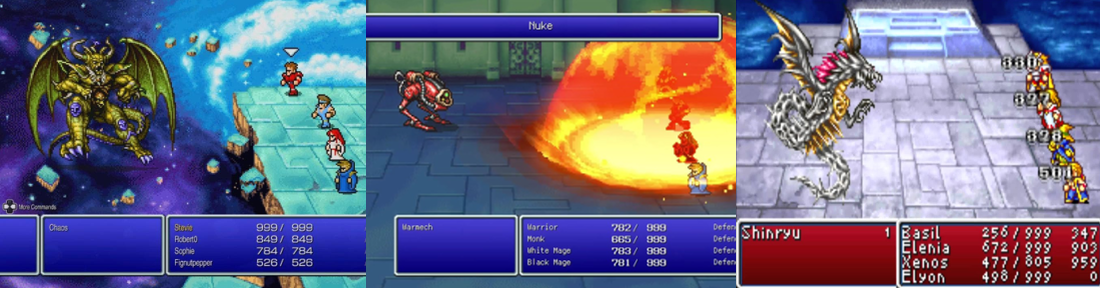
While many treasure chests are guarded by specific encounters with the likes of Evil Eyes, Dragon Zombies, and Piscodemons, these are merely tougher enemy variants and don’t really classify as bosses. Your first test comes at the Chaos Shrine when you confront Garland, an armour-clad knight who certainly looks and talks tough and has no elemental weaknesses but is easily put down if you grind to about level twenty since he relies solely on melee attacks. After wiping the floor with Bikke’s pirates and securing a boat, you’ll cross the sea to Elfheim and investigate the Western Keep, tangling with Piscodemons and rescuing the elf-king…who turns out to be the Dark Elf monarch Astos. Like Garland, Astos has no elemental weaknesses but boasts a greater health pool and debilitating spells like Slowra, Dark, and the ever-aggravating Death. You’ll fight many variants of the Vampire boss as regular enemies after encountering him in the Cavern of Earth. Luckily, he’s weak to Fire magic and, naturally, Dia, which can make short work of him and nullify his paralysing Gaze attack. Your primary goal in Final Fantasy is slaying the Four Fiends and restoring the four elemental Crystals, and these mythical creatures represent some of the game’s most impressive and detailed sprites (even if they are mostly static). The Grim Reaper-like Lich is up first, attacking with Fira, Blizzara, and Thundara as well as paralysing you with Hold and putting your entire party to sleep. Weak to Fire, Ice, and Dia magic, Lich is the toughest enemy of the early game but is easily overcome within a few turns if you’ve optimised your equipment, levelled-up, and have the appropriate magic. Marilith is tougher still, resisting or having no discernible elemental weaknesses, roasting you with Fira and handicapping you with Darkness. This was the first real challenge I faced, but a fun one as I was at a high level and could withstand Marilith’s high attack power.

As tough as Chaos is, the game’s optional superbosses will absolutely decimate the unprepared!

Minotaurs, armoured turtles, and oriental-style monsters pepper the convoluted path to Kraken, a Cthulu-like monarch who inflicts Darkness with Ink and decimates your party with Thundara, though it’s naturally weak to Thunder attacks. The final Fiend, Tiamat, is the most horrific; a multi-headed dragon who can poison and chill the entire party with Poison Gas and Blizzard. With a high health pool and no elemental weaknesses, Tiamat can be quite the hurdle for an unprepared or under levelled party. The Four Fiends are fought again, attacking in specific spots as you explore the Chaos Shrine 2,000 years in the past. The battles are mostly the same, bar some new moves to their arsenals, though you should be a lot tougher by this point. They serve as the perfect appetiser to the game’s final boss, who turns out to be Garland, having ensured his survival with a time loop and transformed himself into the demonic Chaos! Chaos is, without a doubt, the toughest of the regular bosses, boasting a whopping 20,000 HP and no discernible weaknesses. Chaos sports some devastating attacks that can wipe out your party with ease, such as a unique version of Flare, a powerful tsunami and cyclone, and the one-hit KO Earthquake, alongside incredibly powerful elemental magic. Your best bet is to get your levels high, equip Ribbons (since Protect Rings won’t help against Earthquake), and cast Haste, Invisira, and Curaga as soon as possible. Holy and Flare are your best bet here, but it’s a gruelling battle, one only surpassed by the death machine, Warmech, a superboss that may surprise you when you approach Tiamat. Unfortunately, this version of the game removes the additional dungeons and optional superbosses from the Dawn of Souls version, meaning you’ll need to shell out a fair bit of money if you want to tackle returning faces like Gilgamesh, Deathgaze, and Shinryu, as well as an even tougher variant of Warmech, Omega, and even the ever-ridiculous Phantom Train!

Additional Features:
There are twenty-three Achievements to earn in this version of Final Fantasy, with six earned from completing story-based objectives like rescuing Princess Sarah and restoring the Crystals, and three more for defeating 100, 300, and 500 enemies. You’ll get additional Achievements for getting your whole party to level 50, obtaining up to 100,000 Gil, playing the hidden slide puzzle game, and finding some and then all of the game’s treasure. There’s loads of treasure to be found in Final Fantasy: Pixel Remaster (more than you can ever carry!), and most of it is guarded by tougher enemies or hidden away in optional rooms and alternative routes in dungeons. If you’re frugal or activate the Gil multiplier boost, like me, you can easily amass enough Gil to buy new gear and spells, but you’ll eventually amass more Gil than you can carry and won’t have to worry about keeping your items fully stocked. You must search around, pay attention, or use a guide to get the best rewards, such as Excalibur and Masamune, the two most powerful swords, though getting the best spells is simply a question of cash and properly thinking about what your characters are capable of learning. Like previous re-releases of Final Fantasy, the Pixel Remaster includes a “Bestiary”, which fills as you encounter new enemies and bosses, cluing you in on their strengths, weaknesses, and the rewards they drop. Unfortunately, defeating the Four Fiends no longer unlocks the four additional areas from the Dawn of Souls remake, so you won’t get to test your mettle against those optional superbosses, though you can still go seek out the elusive Warmech if you want an extra challenge.

The Summary:
I’ve only played a few Final Fantasy titles, so I’ll be the first to admit that I was wary about tackling Final Fantasy: Pixel Remaster, primarily because of the time and energy required to play it. However, I enjoyed my time with the Dawn of Souls version and this version of the game has some benefits over even that version, such the boost features that increase the Gil and EXP you earn and the Auto-Battle mode, which really benefitted my playthrough. It also helped to be able to save at any time and to be frugal with my Gil and spending, and to spend some time between dungeons levelling-up so I was prepared for future challenges. It helps that the game looks awesome; the constantly walking sprites were distracting but, otherwise, Final Fantasy greatly benefits from the graphical tweaks and improvements. This includes adding a visual flair to enhance the redrawn sprites and making battles even more spectacular with some truly impressive sprite art. The story is paper thin for the most part and the main characters largely lifeless, but the world is brought to life through the varied locations and lively NPCs, who are all different races and offer something different to the player. I enjoyed the twist at the end that Garland was creating a self-sustaining paradox and the challenge offered by the Four Fiends, though the difficulty curve was very much like a rollercoaster at times, with some debilitating attacks making even regular enemies an uphill battle if you get unlucky. It would’ve been nice to see a bit more direction about where I needed to go and what I needed to do at times, perhaps by having the priest at the various churches pointing you in the right direction, but it was fun exploring and figuring things out (and online guides are always available). In the end, while it’s obviously dated and lacks many of the more enjoyable features of its previous ports, this much-needed overhaul of Final Fantasy was a lot of fun to play through and I was glad to revisit the game it and see how many of the franchise’s recurring elements got their start, even if it’s obviously been far surpassed.

My Rating:

Rating: 3 out of 5.

Pretty Good

Have you ever played the Pixel Remaster of Final Fantasy? What did you think to the new additions and were you able to figure out the Magic Level system? Which character classes made up your party? What did you think to the difficulty curve and the final battle against Chaos? Did you ever defeat Warmech and complete the Bestiary? Which Final Fantasy game is your favourite? Whatever your thoughts and memories of Final Fantasy, drop a comment below, support me on Ko-Fi, and check out my other Final Fantasy content.
Game Corner: Final Fantasy VIII Remastered (Xbox One)

GameCorner
FF8RLogo

Released: September 2019
Originally Released: February 1999
Developer: Square Enix
Original Developer: Square
Also Available For: Nintendo Switch, PC, PlayStation, PlayStation 3, PlayStation 4. PlayStation Portable, and PlayStation Vita

The Background:
So, everyone knows about Final Fantasy VII (Square, 1997); it’s one of the definitive role-playing games (RPGs) and one of, if not the, most popular titles in he Final Fantasy series, selling over twelve million copies worldwide and making its way onto many “top ten” lists over the years. But what about the inevitable sequel? Where does Final Fantasy VIII land in the grand scheme of things? Developed during the localisation of its predecessor, Final Fantasy VIII marked the first time that the Japanese and American teams collaborated on a Final Fantasy title. Like pretty much every single numbered Final Fantasy title, Final Fantasy VIII wasn’t a sequel to Final Fantasy VII but, rather, an entirely new title, set in a new world, with new characters and events taking place, which may have been jarring for those whose only experience with the franchise was Final Fantasy VII. I first played Final Fantasy VIII on the PlayStation 3, immediately after finishing Final Fantasy VII on the same system, and found it to be a dramatic step up in terms of graphics, gameplay mechanics, and features. Where Final Fantasy VII felt like Square where just dipping their toes into the world of 3D and polygonal graphics, Final Fantasy VIII featured far more detailed character models, environments, and graphics overall, resembling titles like Resident Evil 2 (Capcom, 19998) and Parasite Eve (Square, 1999). It also helps that I really like the design and characterisation of the game’s protagonist, the stoic loner Squall Leonhart, and enjoy the game’s more science-fiction-inspired aesthetic. Yet, Final Fantasy VIII is often the subject of criticism, whether due to the dramatic visual and gameplay alterations I takes or simply because of how influential Final Fantasy VII was, but is this a fair assessment of the game or is there more on offer in this under-rated classic?

The Plot:
When the time-travelling sorceress Ultimecia plots to possess the gorgeous Rinoa Heartilly in a quest to “compress time, Squall Leonhart must team up with his fellow SeeD graduates and reconcile his fractured memories and feelings for Rinoa, all while butting heads with his rival, Seifer Almasy.

Gameplay:
Essentially, Final Fantasy VIII plays very similar to its predecessor and other Final Fantasy titles from this time, being a turn-based RPG with a large overworld populated by innumerable non-playable characters (NPCs) and littered with a varied of monsters to battle to gain experience points (EXP). Players take on the role of Squall, who one of only two party members you can rename this time around, and journey across the world map battling enemies, recruiting Guardian Forces (GFs) to his cause, and engaging in a number of side quests and mini games as he goes. When you’re not in one of the game’s towns, many of which incorporate a lot of futuristic technology, you’re travelling across the world map and every other step puts you at risk of being sucked into a random battle encounter. Like Final Fantasy VII, Final Fantasy VIII uses an Active-Time Battle (ATB) system that, unless switched off in the menu, means you’ll take damage from your foes while you select your move. If you choose to attack, you’ll run forwards and deliver a blow, whittling your opponents health points (HP) down until they are defeated and earning you some EXP, items, and Gil (the in-game currency).

FF8RDraw
Draw magic from enemies and either stock it for later or cast it right away.

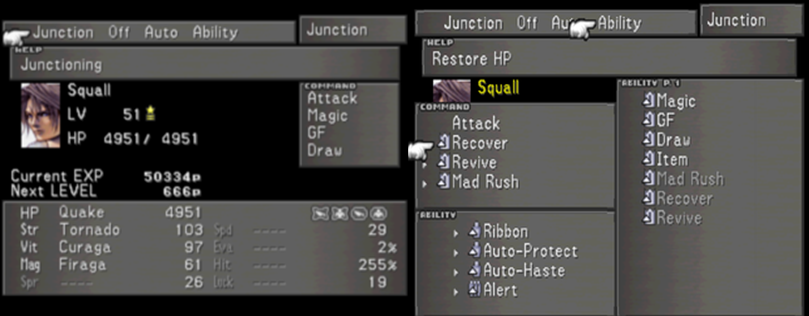
One of the most controversial aspects of Final Fantasy VIII is the way it complex way it handles magic and Summons; the only way to learn new magic and to restore your magic points (MP) outside of resting at an inn or with items is to use the games “Draw” system. Selecting “Draw” (or visiting a “Draw” point) will have your character literally draw magic and MP from their foe and you’ll be given the choice to either cast that magic or stock it for later use. This effectively means that you can never run out of MP as you can keep sucking it out of your enemies, meaning that you’re never running around looking for an inn or shop to buy Ethers and Elixirs to restore your MP. Personally, I love this system because it eliminates this stress; you can have different characters “Draw” and specialise in different magic, effectively allowing you to customise your party as you see fit. Final Fantasy VIII calls its Summons “Guardian Forces” (or “GFs”); you can use “Draw” to acquire new GFs but, for the most part, you’ll have to battle and defeat GFs in order to recruit them and Squall’s first mission is to do just that with Final Fantasy mainstay, Ifrit. Once you have a GF, you have to “Junction” it to a character; this allows you to summon the GF in battle to deal powerful attacks, buff your character’s stats, and gives you access to other magic and benefits.

FF8RJunction
Use the “Junction” mechanic to increase your stats and abilities in battle.

Effectively, this system is very similar to the Materia system used in Final Fantasy VII; each GF allows you to increase your character’s stats and inflict or resist certain status effects and they even level-up, unlocking new attacks, attributes, and increasing in power, just like Materia. This is pretty much a mandatory mechanic in Final Fantasy VIII since can’t even use your magic or even items without Junctioning a GF as these are commands you can only assign once a GF has been Junctioned to a character. Furthermore, if you want to gain buffs to your stats (like increased HP, strength, speed, or whatever), you need to win battles to earn AP so that your GFs can learn these techniques; similarly, if you want to gain HP whilst walking, reduce (or eliminate) random battles, or even haggle with the game’s various shops to receive a discount, you’ll need that AP. Some of these techniques take less AP than others but, to access the best abilities, you’ll need to earn a lot of AP and, once you have them, you’ll be switching on the fly between different commands depending on what you’re doing. Now, don’t get me wrong, all these gameplay mechanics are very confusing; it doesn’t help that, for the first hour or so of the game, you’re constantly lectured about each new mechanic, how to use it, what it means, and the best way to get the most out of the “Junction” system. In comparison, it seemed like information abut Materia and levelling up and Summons was spread out much more effectively in Final Fantasy VII but, despite that, it’s not that difficult to wrap your head around the “Junction” system…as long as you think of it as being an altered form of Materia and the “Draw” mechanic means you never have to worry about running out of MP, so don’t stress over nothing.

FF8RLimitBreak
Unleash your Limit Break to deal massive damage.

The “Limit Break” system returns, albeit in a slightly altered form; rather than triggering as your party takes damage and a meter builds up, you potentially gain access to your Limit Break when your character’s health drops low enough, making it more of a last-ditch desperation attack. Whereas the Limit Breaks in Final Fantasy VII were largely automatic, here you can choose to interact with the Limit Breaks if you wish; for example, pressing R1 at the right time as Squall attacks with his “Renzokuken” Limit Break delivers additional damage and you’ll be required to press different button combinations to perform different attacks when performing Zell Dincht’s “Duel” Limit Break. You can perform additional, more powerful blows and flourishes when performing a Limit Break by equipping different weapons, reading documents, or acquiring certain items. Interestingly, Final Fantasy VIII features a unique twist on the random battle formula in that the enemies you encounter dynamically increase in strength and difficulty as your party levels-up. in addition, you’ll also level-up every time you time you acquire 1000 EXP points, meaning that you can, effectively become massively overpowered in the early portions of the game with very little effort at all. I prefer to play the game as I play every Final Fantasy and RPG, however, progressing the plot and grinding levels in-between towns and around new areas, meaning I never experienced any advantages or issues with this system.

FF8RMiniGames
A few awkward, button-mashing mini games appear during the course of the game’s story.

You can use magic or items to heal your characters or remove status effects; you also have to heal your GFs as they can also take damage from enemies. Once again, you can only save on the overworld or at specific save points; if you die, you get a game over and have to reload your last save file, so it’s recommended that you save often and heal up at inns whenever you can. You’ll also be tasked with completing a series of awkward mini games; I don’t know what it is about the 3D Final Fantasy titles and having these odd button-mashing sequences shoe-horned in but they can be pretty annoying simply because of how vague the game is about how you’re actually supposed to complete these mini games. Rather than purchasing new weapons, Final Fantasy VIII features a crafting system, of sorts; as you explore the world, you’ll find copies of Weapons Monthly magazine, which contains blueprints that detail the items and gear you’ll need to craft stronger weapons for each character. In order to obtain each character’s most powerful weapon, you’ll need to travel all over the world battling specific monsters and enemies to acquire these items; you can use your GFs abilities to steal these items or increase the odds of them appearing and, once you have them, you can visit a weapon shop to get your upgrade. It’s worth noting, however, that you don’t actually need to read the Weapons Monthly magazines to acquire these upgrades and, with the right amount of patience and a lot of grinding, you can actually acquire Squall’s ultimate weapon, the Lion Heart, on the game’s first disc.

FF8RSquallRinoa
Squall and Rinoa’s relationship forms the core of the game’s story.

As in every Final Fantasy game, narrative and characterisation are the driving force of the game’s complex story. While every main character has an arc of some kind and their own unique characteristics, at its core, Final Fantasy VIII is a love story first and foremost and a battle against a malignant time-travelling sorceress second and it is therefore Squall who undergoes to most dramatic changes as the plot unfolds. Beginning as a stoic loner, he learns to not only emote and open himself up more, but the bulk of the game’s main theme is centred around his growing affection for Rinoa and his acceptance of his love for her and the friendships he has formed. Unfortunately, though, the other playable characters don’t get quite the same focus; none of them have sub-plots or explicit character arcs and, thanks to the game’s emphasis on more realistic character models, the six main playable characters lack a lot of the same aesthetic appeal as those seen in Final Fantasy VII; Squall has a bad-ass look and Zell resembles an anime character but, even though characters like Quistis Trepe have recognisable traits (she struggles with her failure as a teacher), they don’t make an impact in the same way as the likes of Barret Wallace or Vincent Valentine and I struggled to settle on my preferred team. I ended up going with Squall, Irvine, and Rinoa but there were aspects about this line-up that continued to irk me; Irvine’s Limit Break, for example, requires you to buy or craft ammo and Rinoa’s “Angel Wing” Limit Break is useful but only if your swap around her magic and can deal with losing control of her once you select it. Final Fantasy VIII expands upon its world, characters, and narrative by including an entire sub-plot with three additional, playable characters. At various points throughout the game, your party will mysteriously fall asleep and assume to roles of Laguna Loire, Kiros Seagill, and Ward Zabac. These older, more seasoned characters are a battle-tested team and contrast with Squall and his relatively young and untested group. Through their side story, which takes place about seventeen years in the past, we learn about a lot of the events that factor into Squall’s characterisation and the way this world works.

FF8RLaguna
Laguna’s side story fleshes out the game’s world and lore.

The SeeDs are mercenaries trained to perform a wide variety of jobs but, first and foremost, their goal is to assassinate sorceresses before they can become too powerful; this is directly related to the main plot of the game, as the dark sorceress Ultimecia projects her consciousness and manipulates events….completely unaware that she is actually creating her own undoing. Laguna’s side plot serves to further drive the game’s main themes of love and loss; though initially dismissive of Laguna for his foibles and the concept of friendship and relying on others, Squall comes to realise that he is part of a team and a family and progresses from only expressing himself trough his inner monologue to actually opening up to his friends and team mates. Unlike Final Fantasy VII, which gave each of its characters a clear arc and developed them as the story progressed, Final Fantasy VIII pretty much hedges all of its bets on you relating to, and growing to love, Squall, Rinoa, and their relationship and, if you don’t really connect with these characters or their love story, you might struggle to connect with Final Fantasy VIII. Additionally, Final Fantasy VIII is a very complex experience, even for a Final Fantasy title; it’s a slow, atmospheric experience; you can’t skip the cutscenes but, thankfully, you can fast travel in the towns and around the map this time. Luckily, though, the game’s map is a dramatic improvement on Final Fantasy VII’s; areas are actually named and highlighted, making it much easier to know where you have to go…assuming that you paid attention to the dialogue boxes and cutscenes. If you didn’t, you’ll probably have to consult a guide or risk wandering around in circles desperately trying to figure out who to talk to or where to go. As always, I recommend consulting a guide if you need to, over-levelling your party, saving as often as possible, and doing everything you can to simplify the game’s complex mechanics as best you can. It seems daunting but it is possible and, once you have your party set up as you like, all you have to worry about it surviving battles and bosses rather than trying to wrap your head around the intricacies of the “Junction” system.

Graphics and Sound:
There’s no denying that Final Fantasy VIII is a massive step up on it predecessor both in terms of its in-game graphics and cutscenes; rather than replicating Final Fantasy VII’s chibi, anime-style aesthetic, Final Fantasy VIII renders its characters as realistically as possible and the character models remain on model instead of there being several wildly different character models across the overworld, battle screens, and cutscenes.

FF8RGraphics
In-game cutscenes, models, and backgrounds are vastly improved.

This means that Final Fantasy VIII more closely resembles other 3D, polygonal videogames of the time, like the two Resident Evil (Capcom, 1996) sequels rather than a mish-mash of pre-redendered backgrounds and chubby 3D polygons. While I actually really liked Final Fantasy VII’s artistic style and blend of anime cute and bio-organic sci-fi, and it is annoying that Squall pulls his gunblade out of thin air in cutscenes, Final Fantasy VIII is a clear graphical improvement over its predecessor in every way. You’ll travel to many diverse environments, from caves to towns to ornately-decorated castles and sprawling towns, all of which are an impressive blend of natural landscape, a marriage of steampunk and 1950s technology and aesthetics, and elaborate, futuristic sci-fit. Even the battle screen is cleaner, forgoing the traditional battle dialogue box and incorporating more dynamic camera angles and detailed backgrounds and the Xbox One remaster only emphasises this further by applying a crisp, fresh coat of paint to the original.

FF8RGraphics2
CG cutscenes have dramatically increased in number and quality.

Final Fantasy VIII also features a lot more CG cutscenes and, honestly, every one of these is leaps and bounds beyond its predecessor; the action and camera and character movements is slick and fluid and, while they’re still obviously not on par with today’s graphics and cutscenes, they’re far beyond the limited and stilted cutscenes seen in Final Fantasy VII. Final Fantasy VIII also improves on the placement and use of dialogue boxes for in-game cutscenes; dialogue boxes are now much smaller and clearer and appear in various places around the screen like speech bubbles rather and being a large box that obstructs a sizeable portion of the screen. Final Fantasy VII also includes more of long-time Final Fantasy composer Nobuo Uematsu’s greatest work; while none of the game’s tracks are as iconic as “One-Wing Angel”, Final Fantasy VIII still features some fantastic tracks such as “The Man with the Machine Gun”, “The Extreme”, and the awesome “Maybe I’m A Lion”. The game forgoes traditional character themes in favour of its influential main theme ballad, “Eyes On Me”, a pop song performed by Chinese singer Faye Wong that perfectly encapsulates the game’s main themes of love and loss; “Eyes On Me” was so influential that it not only sold over 400,000 copies but it was also the first piece of videogame music to ever win “Song of the Year” at the Japan Gold Disc Awards.

Enemies and Bosses:
As you explore the world of Final Fantasy VIII and resolve Squall’s complex social issues, you’ll take part in a whole bunch of random battles against enemies of all shapes and sizes. Your party will often butt heads with the military force of Galbadia, who are under the influence of Ultimecia’s magic; these battles are generally pretty easy, even when the Galbadian’s attack with magic or in larger groups, and only really become a challenge once you come up against their mechs and robots. Final Fantasy VIII is, of course, absolutely infested with monsters. These range from the dinosaur-like T-Rexaur (one of the most difficult enemies you’ll battle against in the game’s early moments), gigantic dragons, demonic shadows, poison-spewing, man-eating plants, monstrous turtles, weird-ass, floaty face…things, and even these horrific alien creatures who have overrun the game’s Airship and will continually regenerate if you don’t destroy them in coloured pairs. The majority of these monsters fall to the planet in a constant cycle based on the correct alignment of the Moon and even originate from the surface of the Moon; later in the game, you get to see this in motion which, as far as I know, is the first time a Final Fantasy game directly explained where all these weird and wacky monsters actually come from.

FF8RGFBosses
GFs act as the majority of the game’s boss encounters.

It took me a little while to realise that Final Fantasy VIII seems to be lacking in boss battles; most of the time, you’ll fight against a GF as a boss (or mini boss), which doesn’t really feel like a boss battle as it’s more like proving you’re worthy enough to use the GFs power. By that logic, Ifrit acts as the game’s first boss and, as you progress, you’ll come across other GFs in various areas; most of the time, like with Cerberus, you can choose not to engage with these GFs but, if you do, you’ll have to go out of your way to “Draw” the GF from a later, more challenging boss in Ultimecia’s Castle.

FF8RSFRBosses
You’ll battle Seifer, Fujin, and Rajin a few times during the game’s story.

When you’re not fighting GFs, you’ll battle against Galbadia’s finest giant robots; the first one you face, the spider-like X-ATM092, can’t actually be defeated and, instead, must be damaged enough so you can make your escape and then either avoided or disabled long enough for you to run. Other times, you’ll butt heads with the main character’s rivals, Seifer and his buddies, Fujin and Raijin. Although Seifer eventually upgrades to becoming a penultimate mini boss as he is manipulated to act as Ultimecia’s “Knight”, you never battle all three at once, which is a bit of a missed opportunity but, essentially, they’re very similar to the battles against the Turks from Final Fantasy VII.

FF8RCastleBosses
Ultimecia’s Castle is full of powerful superbosses.

Once you reach Ultimecia’s Castle, you’ll be stripped of your abilities and forced to take on the enemies within without your GFs and magic…that is until you defeat one of her eight superbosses. Fittingly, these creatures represent the game’s toughest challenge yet (although the Ruby Dragon can be a pain in the ass thanks to its high HP and “Breath” attack) but, by this point, you should be well levelled-up and full at ease with the game’s various mechanics and controls. Nevertheless, each of these superbosses has a unique design, character traits, and requires specific strategies; Sphinxaur takes on a second form after enough damage is done, the Red Giant can absorb a huge amount of punishment (and spouts a crazed response every time he’s attacked), and Trauma can only be spawned after solving a puzzle and is protected by smaller machines, for example.

FF8RCastleSuperbosses
Tiamat and Omega Weapon offer perhaps the game’s greatest challenge.

Easily the most challenging bosses in Ultimecia’s castle are Tiamat and Omega Weapon, both of which are optional battles (though Omega Weapon involves splitting into two teams, ringing a bell, and running to a specific point to trigger the battle). Like many of the superbosses in Ultimecia’s Castle, you can “Draw” GFs from these bosses if you missed them earlier in the game but you’ll be more concerned with setting up your party to endue their powerful attacks. Both of which can deal massive damage, absorb elemental attacks, and have huge amounts of HP but it is Omega Weapon that offers the greatest challenge. With HP in the millions and capable of casting both “Death” and ending your party with “Light Pillar” (which deals 9999 damage and thus results in a one-hit KO), Omega Weapon offers such a tough challenge that, upon defeat, you’ll earn a special “Proof of Omega” award so you can prove to your friends that you got past this absolute tank of a superboss.

FF8RSorceresses
As a SeeD, it’s your duty to destroy sorceresses.

In addition, you’ll have to face-off with a few sorceresses during a playthrough of Final Fantasy VIII; being as she prefers to possess and manipulate sorceresses from the far future, Ultimecia doesn’t actually physically appear until right at the final parts of the game meaning that, before you confront her in her ominous castle, you’ll mostly be battling the current-day sorceress, Edea, who has been possessed by Ultimecia. As her chosen “knight”, you’ll usually have to dispose of Seifer before you can properly get your hands on Edea, which can make these battles a bit tougher. Later, when the malevolent sorceress Adel literally falls from the sky, she/he/it is leeching off of Rinoa so you have to be sure to target only Adel and not use attacks that hit more than one target or else you’ll risk injuring or killing Rinoa and losing the battle.

FF8RGriever
Griever’s ability to blast away your magic and GFs is a serious threat.

Once you finally fight your way through Ultimecia’s Castle and unlock all of your abilities, your party falls victim to Ultimecia’s “Time Compression” ability and ends up stranded in the far future, where Ultimecia rules unopposed. This final battle has multiple stages, each with their own concerns; initially, you battle Ultimecia one-on-one but she randomly decides which of your three party members she wants to battle against and, during the battle, will erratically KO or remove one of your party from the battle screen. This means that, if you don’t revive your strongest party members, you could be stuck facing Ultimecia with characters you’ve chosen to ignore up until this point. Once she is defeated, Ultimecia summons the most powerful GF in the Final Fantasy VIII world, Griever, a monstrous lion-like creature inspired by Squall’s lion iconography. Griever’s threat mainly comes from its ability to completely drain your MP, blast away entire stocks of your magic, and one-shot your GFs with “Lethal Strike”. However, once defeated, Ultimecia “Junctions” herself to Griever and the two form a monstrous combined form that can do everything both previous bosses could, meaning the longer the battle lasts, the more likely it is you’re going to lose your magic stocks, GFs, or party members and also deal massive damage through your defences with “Great Attractor”.

FF8RUltimeciaFinal
Ultimecia’s final form shows her on the cusp of immortality!

Once you manage to defeat this monstrosity, Ultimecia will ascend to her God-like final form; rather than the resplendent grandeur of Safer∙Sephiroth. Ultimecia’s final form is a grotesque eyesore that is halfway between human, monster, and eldritch horror. In this form, she can again destroy your magic stocks, remove any positive buffs you cast on your party, one-shot your GFs, reduce your HP to one point, and cast “Apocalypse” on the party for up to 8000 points of damage. Destroying different halves of Ultimecia’s body results in her using different spells and attacks but, once she starts narrating, it means she’s all out of HP and all you have to do is keep attacking her until the battle ends and Ultimecia is finally defeated. When I first fought Ultimecia when playing Final Fantasy VIII on the PlayStation 3, I found this battle to be particularly difficult; unlike Sephiroth’s final forms, which increase in difficulty depending on your level, characters, and tactics, Ultimecia can completely ruin any strategy you have by wiping away your most powerful party members or dispelling your magic. It’s hard to revive characters if Griever wipes out your stock of “Life” and your GFs won’t be much use if Ultimecia kills them in one move, meaning you’re constantly having to think on your feet and adapt to the battle; add to that the multiple forms that you must face one after the other and you’re left with a far more challenging final boss than in the previous game.

Power-Ups and Bonuses:
Just like in the Xbox One port of Final Fantasy VII, the remastered version of Final Fantasy VIII allows you to alter the game’s mechanics and difficult by pressing in the analogue sticks: press them both in and you’ll turn off the random battles, press in the left stick and you’ll increase the game’s speed by three times, while the right stick powers up your party, giving them constant access to their Limit Breaks and effectively granting them infinite HP and MP. As I only found out about these latter two options right at the end of Final Fantasy VII, I decided to activate them right from the start for the sequel, dramatically speeding up my playtime. It’s worth noting that, even with these activated, your party is still susceptible to status effects (confusion, poison, etc) and can still be killed by the likes of Omega and Ultima Weapon but, still, activating these boosters basically means you never have to worry about wasting Gil in inns or expending MP healing during battle and makes reaching level 100 an absolute breeze. Not only that, if you switch the battle style to “Wait”, you can end up completely obliterating every enemy and superboss you face by spamming your character’s Limit Breaks and ensuring that they never even get the chance to land a single hit!

FF8RRoaming GFs
A few roaming GFs may randomly appear to aid you in battle.

While you’ll gain access to most of the game’s GFs by Drawing them from certain bosses or battling them head-on in specific areas, some are only accessible by using certain items. Additionally, you can complete a side quest (made difficult thanks to the presence of the deadly Tonberry enemies) to battle Odin; upon defeat, Odin will randomly appear during any of your battles and deliver a one-shot KO to your opposition, which can be an extremely useful feature. That is until Odin tries this against Seifer and is cut cleanly in two; luckily, Gilgamesh fills very much the same role but his attacks cause a random amount of damage to your enemies, meaning he’s often more of a hindrance. Similarly, you can acquire the Phoenix Pinion after a side quest which, upon use, calls forth the Phoenix GF, which will randomly arrive to resurrect your entire party if you’re lucky.

FF8RTransport
There’s a few means of transportation on offer in Final Fantasy VIII.

As usual, you are afforded a few vehicles and means to explore Final Fantasy VIII’s expansive world; if you manage to call forth a Chocobo in one of the game’s many Chocobo forests, you can ride one of the birds across the land but you’ll lose it as soon as you dismount. In a change of pace, you can hire out a car to traverse the map but this costs you Gil and the car’s can run out of fuel. You even get to control the Balamb Garden itself for a while as it conveniently has a mobile form that allows it to float across the sea and land when you’re able to come ashore at a beach front. Eventually, you’ll gain control of the Airship, the Ragnarok, which allows you to travel pretty much anywhere but, as good and diverse as all these options are, the game’s camera when on the overworld is needlessly obtrusive and I struggled to find an angle that actually allowed me to properly see where I was going and enough of my surroundings.

Additional Features:
Whereas a great deal of your time and energy was devoted to the capturing, breeding, and racing of Chocobos in Final Fantasy VII, Final Fantasy VIII instead features the card game Triple Triad as its primary mini game. While you can acquire and ride Chocobos to reach new areas and speed up your traversal across the world map, Triple Triad is a feature in pretty much every town of the game and involves most of the game’s NPCs. The game takes place on a 3x3x3 grid, with each player having at least five cards; ten cards are played, each with a different number and element associated with it, and the goal is to capture all of the opponent’s cards. At least, that’s how I understand it; I’m not very good at card games at the best of times and rushing through the dense, seemingly never-ending tutorial, so I never really had much interest in Triple Triad.

FF8RTripleTriad
Triple Triad is everywhere but I couldn’t really get on with it.

You can acquire new cards after defeating enemies or using the GF Quezacotl’s “Card” ability to turn certain enemies into cards but, outside of acquiring every card and a few Achievements, I never saw any real need to get too involved in Triple Triad and played through Final Fantasy VIII perfectly fine without playing more than one game (though, if you want to earn every Achievement, you’ll have to play at least one game and complete a whole side quest involving challenging NPCs to a game of cards so…good luck with that). While it’s not a requirement to play Triple Triad to access the best weapons and items, it is one of two time-consuming options available to you; the other is to battle specific enemies in the hopes that they drop the item you require or use Quezacotl’s “Card” ability to transform the monster into a card and then use the “Card Mod” ability to transform the card into that item. This can be a bit of a hassle as these enemies are rare, meaning you’ll have to wade through a great deal of random battles to track them down and, to use the “Card” ability, you need to deal enough damage to the monster first, which can be difficult when you’re at a higher level. Once you acquire the Ragnarok, travel across the overworld is much easier than before, allowing you to better access some difficult-to-reach areas of the map and acquire more GFs. The Airship is also the only way to access the unmarked Island Closest to Heaven and Island Closest to Hell, which are teeming with tough enemies and hidden “Draw” points to help you level-up and gain more AP, and the Deep Sea Research Center. Here, you’ll have to walk slowly towards a pulsating piece of machinery to avoid being thrown into random battles and then you’ll be forced to battle two Ruby Dragons back-to-back before you can take on Bahamut.

FF8RDeepSea
Explore the Deep Sea Research Center and you’ll eventually battle another superboss!

After defeating Bahamut (which is easier said than done), you’ll be acquire it as a GF and, when you leave and return, you can access a new area of the Deep Sea Research Center. After diverting power to open a series of doors, you can then travel down several floors filled with the game’s most powerful enemies on your way to confronting the game’s option superboss, Ultima Weapon. You can “Draw” the GF Eden from Ultima Weapon, as well as the powerful “Ultima” magic, but you’ll have to endure the same problems as when fighting Omega Weapon (meaning your party can be decimated in one hit it you aren’t properly prepared for the battle). As you travel around, winning battles, completing quests, and taking steps, you’ll be awarded with a SeeD salary. To increase your SeeD rank and, thus, your salary, you can enter the “Tutorial” menu and take a written test. There are thirty tests, each with ten questions and, every time you complete a test, you’ll gain a rank and earn more Gil to spend on items and upgrades. Luckily, you don’t need to worry about actually knowing the answers as you can just consult an online guide and cheese it, ensuring that you earn the associated Achievement and the maximum amount of Gil. Speaking of Achievements, there’s quite a few on offer here and they’re pretty easy to achieve. You get an Achievement every time to acquire a new GF, ensuring you’ll get the majority of the Achievements even without a guide, one for finishing the game, and one for completing certain side quests. These can be trickier to unlock considering how complex and time-consuming the side quests can be (such as the PuPu side quest that sees you tracking down UFOs and aliens) but they’re generally far easier than the ones seen in Final Fantasy VII. Like in Final Fantasy VII, though, I did encounter some issues in getting the Achievements to pop or my Xbox One to acknowledge that I had completed the Achievement; the only advice I can really give if this happens to make sure you save beforehand and try it again, perhaps after logging out or performing a hard restart on your machine.

FF8RBanner

The Summary:
For me, trying to pick between Final Fantasy VII and Final Fantasy VIII is like trying to pick between The Legend of Zelda: Ocarina of Time (Nintendo EAD, 1998) and The Legend of Zelda: Majora’s Mask (ibid, 2000); in fact, this analogy is strikingly fitting as one is generally universally revered and the other is usually divisive, at the very least. However, I really don’t feel like the game deserves the hate or disdain it often unfairly attracts; the “Junction” system is functionally no different to the Materia system, the “Draw” mechanic means you never have to worry about running out of MP and are free to customise your party as you see fit, and the game as a really slick presentation. Seriously, it blows my mind how much of an improvement Final Fantasy VIII is compared to Final Fantasy VII in terms of graphics and you have to believe that, if Final Fantasy VII had been rendered in the same style as its sequel, no one would have anything bad to say about Final Fantasy VII ever again.

FF8RRemaster
The Remaster only highlights Final Fantasy VIII‘s aesthetic quality.

It’s not just the aesthetics that make Final Fantasy VIII an enjoyable experience in and of itself; the game’s pacing is far better than its predecessor meaning that, while you miss out on truly fleshing out and exploring each party member like in Final Fantasy VII, it’s far easier to stay on track and focused on the game’s core narrative. Plus, Final Fantasy VIII doubles down on Squall’s characterisation and development to have him evolve from a stoic, closed-off loner to a confident, inspiring leader. Not only that, the game puts full focus on his love story with Rinoa, making their relationship the central focus of the game and crucial to squall’s development as a character. Is it perfect? Well…no, but (and here’s a controversial statement) no game is; even Final Fantasy VII had some issues! Newcomers may struggle to come to grips with the game’s new mechanics thanks to the influx of obtrusive tutorials and the unintuitive menus and gameplay mechanics, the overworld camera is disappointingly janky, and game goes way overboard with its random encounters (seriously, these happen almost every other step!) but there’s still a lot to like about this game. Once you simplify the “Junction” system and get your party setup how you want, it’s simple to concentrate on “Drawing” magic, winning battles, and levelling-up your party and their GFs; the map is easy to navigate thanks to the much-appreciated fast travel system and areas being clearly marked; the game’s system of increasing enemy levels as your own level increases means you’re always able to earn the EXP and AP you need to grow stronger; and the game’s story is very engaging. Beyond the exploration and development of Squall and Rinoa’s relationship, we’ve got a story that not only transcends time and space and leads you to battling a truly mental multi-form final boss but also questioning concepts such as life, death, love, and loss, making for a truly enjoyable and unique experience.

My Rating:

Rating: 5 out of 5.

Fantastic

And breathe! So, what did you think about Final Fantasy VIII? Did you struggle with the Junction, Draw, and GF system or, like me, do you find it to not bad as bad as people make it out to be? Where does Final Fantasy VIII rank in your hierarchy or Final Fantasy titles? Who was in your party in Final Fantasy VIII and how did you set up your GFs? Did you like the more science-fiction-orientated approach that the game took or do think that the series strayed too far from the traditional fantasy-inspired aesthetics of the franchise? Do you subscribe to the theory that Squall died at the end of disc one? Did you use the boosters implemented into this Remaster or did you go it old school? Whatever your thoughts on Final Fantasy VIII, and the Final Fantasy series, drop a comment below.

Game Corner: Final Fantasy VII (Xbox One)

GameCorner
FF7Logo

Released: March 2019
Originally Released: January 1997
Developer: Square Enix
Original Developer: Square
Also Available For: Mobile, Nintendo Switch, PC, PlayStation, PlayStation 3, and PlayStation 4

The Background:
It’s hard to talk about Sony’s PlayStation without talking about Final Fantasy VII. Traditionally released on Nintendo’s 8-bit and 16-bit titles prior to Square’s move to the PlayStation, Final Fantasy VII was released at a time when every recognisable videogame franchise worth a damn was making the jump from 2D to 3D. For many, Final Fantasy VII was not only their first Final Fantasy videogame but also their first experience of a role-playing game (RPG). Lauded upon release, the game went on to not only win numerous awards but also to sell over ten million copies on the PlayStation alone. So influential was Final Fantasy VII that it inspired a whole host of additional spin-off media from Square Enix, including the fantastic computer-generated movie Final Fantasy VII: Advent Children (Nomura, 2005) and the under-rated RPG/action shooter Dirge of Cerberus: Final Fantasy VII (Square Enix/Monolith Soft, 2006). Ironically, my experiences of Final Fantasy VII were quite limited at the time; I was knee-deep in my Nintendo 64 phase and still playing Mega Drive titles when it released, so I’m pretty sure it passed me by completely at the time. I had dabbled in a few previous Final Fantasy titles, however, thanks to emulators but I didn’t really become aware of the series until Final Fantasy VIII (Square, 1999) and even watched Final Fantasy VII: Advent Children before I first played Final Fantasy VII on PlayStation 3. However, with Xbox One owners like myself unable to play the recently-released Final Fantasy VII Remake (Square Enix, 2020) thanks to Sony’s current stranglehold on that title, I was fortunate enough to be gifted the Xbox One port of the PlayStation original which, thanks to the coronavirus lockdown, I was able to play through quite recently.

The Plot:
The Shinra Electric Power Company harvests Mako energy, draining the Lifestream of the Planet, and making life miserable for the lower classes. Cloud Strife, a former member of Shinra’s military branch, SOLDIER, reluctantly joins forces with the eco-terrorist group AVALANCHE to oppose Shinra, only to end up defending the world when legendary SOLDIER Sephiroth enacts  a mad plot to absorb the Lifestream and become a God.

Gameplay:
Final Fantasy VII is a traditional, turn-based RPG that emphasises exploration, strategic combat, item and party management, and has a heavy prominence placed on its complex and dense narrative. Players primarily take control of Cloud and form a party of up to three members (each of whom you can re-name, if you want) to engage in random battles across the game’s extensive overworld and many dungeons and locales, encountering a variety of non-playable characters (NPCs), enemies, obstacles, and mini games along the way. Players navigate numerous fantastically varied, pre-rendered environments in their quest; as you explore, you’ll find chests to open, items to pick up, buildings to enter, and innumerable numbers of NPCs to talk to. It’s through conversations with NPCs and your party members that you’ll learn more about Final Fantasy VII’s world, its dense lore, and the different cultures and societies that dwell within it. As a Final Fantasy title, you’ll easily sink over eighty hours of playtime into Final Fantasy VII, most of it watching cutscenes and engaging with the complex narrative. The rest of the time, you’ll most likely be battling and levelling up. As you explore the overworld, you’ll walk over fields, through forests, explore caves, dungeons, high-tech facilities, and even journey to the centre of the Planet itself. When not in a town, every step you take puts you at risk of entering into a random battle against a number of enemies; when a random battle occurs, you can try to run if you wish but, if you turn and fight, you’ll be presented with a number of options. Each character has strengths and weaknesses; some have higher hit points (HP) or magic points (MP); some can take more damage, or deal out more attack power, or are faster or slower. Having a diverse party is the first step towards winning battles, which take place using the game’s Active Time Battle (ATB) system. When a battle begins, the enemy and the player’s party exchange moves until the battle is ended in a constant cycle; take too long selecting your next move and you’ll leave yourself open to an attack.

FF7LimitBreak
Unleash your Limit Break to deal massive damage.

You can, however, alter this system in the game’s “Config” menu, which allows you to both increase the speed of in-game battles and reduce them to a more manageable, turn-based structure. Either way, when battling, you can choose to defend yourself to reduce incoming damage, select which enemy to target, or use an item to heal a character or otherwise turn the tide in your favourite. When battling, once the “Time” meter is full, you can choose how to engage the enemy. If you choose to attack, your character will rush forwards and deliver an attack to deal damage. When hit with an opposing attack, your party’s “Limit” meter will fill; once full, you can perform a powerful Limit Break, which will deal greater damage to your opponents and sometimes provide beneficial aids to your party. When using magic, keep in mind that some enemies will have their HP restored if you use elemental magic against them. Characters use magic when you assign them Materia, which is a kind of crystallised form of Mako energy; Materia allows characters to heal or revive each other, erect protective barriers, cast elemental spells (Fire, Thunder, etc), poison foes, turn them to frogs, and a whole slew of other benefits.

FF7Summons
Summon powerful beasts to aid you in battle.

The most powerful and useful Materia you can acquire allows you to call upon the powers of a Summon to aid you in battle; these bestial creatures can deliver heavy damage to bosses and groups of enemies and even resurrect your fallen comrades, but Summons drain a lot of your MP to use and some of them can only be used once per battle unless you link their Materia to another Materia to allow consecutive use or added effects upon their summoning. If all of your party is defeated in battle, the game is over and you must reload from your last save point; if you win, though, you’ll earn experience points (EXP). When you earn enough EXP, your characters will level up, increasing their stats and learning new, more powerful Limit Breaks. You also earn Ability Points (AP), which allow your Materia to level up as well and allow access to more powerful spells (Cure 2, Quake 3, etc); sometimes you’ll get items from victories as well and, of course, you’ll earn Gil.

FF7MiniGames
There are numerous mini games to distract you.

Gil is the currency of Final Fantasy VII; with this, you can purchase items and weapons and pay to restore your HP and MP at the various inns located in the game’s many towns and cities. Each character can be equipped a weapon, an arm band, and an accessory; these have slots that allow them to use Materia, protect them from certain attacks (or types of attack), and raise their stats. To obtain the most powerful weapons and Materia, you’ll have to not only battle some of the game’s toughest enemies and bosses but you’ll also have to complete a number of mini games and side quests. As you explore Final Fantasy VII, you’ll come across numerous side quests, mini games, and distractions from your main quest; there’s a side quest where Cloud most pose as a girl, for example, or a section where you must chase weird creatures through an ancient, maze-like city, defend a mountain from invading forces, snowboard down a mountain, and explore the depths of the ocean in a submarine. Visit the Gold Saucer and you’ll be provided with a wealth of mini games for you to waste your time on while the Planet looms moments from destruction. You can visit the arcade and throw basketballs into hoops, replay the somewhat-clunky motorcycle pursuit (wherein Cloud makes a dramatic escape, swiping at pursuers with his hefty Buster Sword), take on progressively difficult enemies one after another in the Battle Square in hopes of purchasing rare items and upgrades, or take a member of your party on a date.

FF7Chocobos
Capture, race, and breed Chocobos.

Additionally, if you choose to acquire the game’s two extra characters, you’ll get sucked into their side stories and side quests, one of which sees you first forced to do battle without your Materia and, later, battle progressively-difficult enemies in a pagoda, while the other involves a tough boss battle and a lot of dialogue. After Sephiroth summons Meteor and the Planet edges closer and closer to destruction, you’ll travel the world without Cloud to acquire the Huge Materia; getting this involves a lot of mini games, like button mashing in perfect harmony to speed up and slow down a train, chasing down and destroying an enemy submarine, or strategically placing troops to defend a giant condor egg. One of the game’s biggest side quests involves the capturing, breeding, and racing of Chocobos. These ostrich-like creatures can be found on the overworld when you have a Chocobo Lure Materia equipped and walk over their tracks but, unless your powerful enough to one-shot the enemies they are often accompanied by, you’ll need to shell out for some “greens” to distract them. Once you’ve caught a Chocobo, you can ride them around the overworld but, eventually, you’ll get the chance to buy up to six stables to keep your Chocobos in. You can then feed them to raise their stats and attributes and race them at the Gold Saucer; even when you allow the computer to race for you, though, this can be a time-consuming task as, to breed better, different-coloured Chocobos, you’ll need to win a lot of races and take part in a few battle sin the interim, all to breed the ultimate Chocobo, a Gold Chocobo, which can run over land, sea, and mountains to reach the game’s most powerful Materia. None of this is especially difficult but it is very time-consuming and I can’t say I was happy to have to do it all over again after doing it on the PlayStation 3 but, now that I’ve gotten a Gold Chocobo, I can rest easy in the knowledge that I won’t have to do that again.

FF7Distractions
You’re asked to perform a lot of different actions to advance the game’s plot.

Final Fantasy VII loves to throw a curveball at the player; just as you think you’ve mastered the game’s ATB system, you’ll be asked to press buttons at the right moment to perform a march or provide CPR. These little distractions and varieties in the gameplay can be fun when they’re optional but many of them are required to advance the plot, as well as netting you more EXP, more Gil, better items and Materia, and even a couple of extra party members. At times, they can feel like unnecessary padding as it seems like every time the team visits a town, you spend an hour or so running around doing some kind of arbitrary task that seems contradictory to the game’s otherwise ominous plot. Later in the game, such button-mashing sections are crucial to the game’s plot and failing them can cost you an Achievement or two or cause you to either miss certain rewards and Materia or have to earn them some other way through another side quest or at a high Gil cost. Similarly, just when it seems like you’ve gotten a grip on the game’s quirky nature, the entire complexion changes when Sephiroth murders Aerith, forever removing her from your party and as a playable character, summons Meteor to destroy the Planet, and the kaiju-like WEAPON emerge from the ground and go on a rampage. After this point, Cloud leaves the party for a time and you’re forced to fly around in the Airship with different party members collecting the Huge Materia all while a massive glowing sphere hover sin the sky. Even the overworld theme changes at this point, becoming more ominous; different WEAPON wander around the map and must be battled and Cloud is forced to confront the truth about himself and his path before rallying the team to confront Sephiroth.

FF7Characters
Each character has a story arc, a backstory, and nuance to them.

Characterisation is a large part of Final Fantasy VII’s narrative; each party member has a unique backstory and their own personality quirks and, as you progress, you’ll learn more about them and what makes them tick. Characters are surprisingly layered as well; Cloud has a reputation for being an edgy loner but he has some amusing moments, like when he’s forced to act in a play with Aerith (or Aeris, whatever you prefer) Gainsborough, or the way he shrugs dumbfounded whenever talking to Yuffie Kisaragi or Cait Sith. Barret Wallace, too, has a lot of layers to his character; he’s a passionate eco-warrior with a quick temper but also a doting father and carries a dark secret that the game forces him to confront, and this is true of each of the characters, in a way. Final Fantasy VII’s ability to flesh out each of its characters really increases your emotional investment in the game’s plot; even Sephiroth, who kills without a thought and is more than happy to crack the Planet open on a whim, is a tragic figure affected by the machinations of Shinra. Which characters you engage the most with will undoubtedly affect how you arrange and organise your party, though the narrative is structured in such a way that you are forced to have each member of the team in your party at least once (with the obvious exception of the optional characters).

FF7Map
The game’s map isn’t very clear, making navigation tricky at times.

With all that said, Final Fantasy VII can be a stressful experience; like all Final Fantasy titles at that point, Final Fantasy VII is quite a slow, measured experience. Cutscenes can’t be skipped, meaning if you die after a lengthy section of dialogue you have to sit through it all over again; random battles can take place every couple of steps, which can be frustrating when you’re low on HP and/or MP (you can turn them off by pushing in the analogue sticks but then you won’t gain EXP or AP), and there’s no fast travel system. This last is especially annoying thanks to the game’s map; while it’s useful, it’s not very clear. Towns and areas of interest are marked by small dots rather than names and, if you want to travel there, you’ll have to do so manually; I have to say that, once the Highwind upgrades to rocket boosters, it would have been nice to implement a fast travel mechanic. Similarly, as was the tradition at the time, you can only save the game at designated save spots or on the overworld, meaning that if you haven’t saved for a while and make a massive mistake, you’re in for a lot of backtracking. As a result, it’s wise to save often and consult one of the many comprehensive guides to be sure that you haven’t missed anything and are fully prepared for what’s ahead. I favour over-levelling my party so that I don’t have to worry too much about healing during a battle but, even then, you’ll encounter bosses and enemies that decimate your party in just a few hits.

Graphics and Sound:
As the franchise’s first foray into 3D, and being an early PlayStation title, Final Fantasy VII favours pre-rendered backgrounds, sprite work, and polygonal graphics, resulting in a game that, it could be argued, has a contradictory tone. On the one hand, you have these dank, desolate, steampunk-like industrial backgrounds or an apocalyptic calamity hanging overhead but, on the other, you have these super cute, chibi-style character models.

FF7Graphics
No matter the environment, you can always spot your character.

While Square went on to perfect the graphical presentation of the series in subsequent sequels, I actually really like the blocky, polygonal character models. Not only are they full of charm, appeal, and character, they are more than capable of conveying the character’s emotions (whether that is anger, stress, sadness, or confusion). Plus, it helps them to stand out against the game’s myriad of different environments; whether you’re stuck in a sandstorm, infiltrating a Mako Reactor, or exploring an ominous cave, you’ll always be able to spot Cloud and his cohorts.

FF7Cutscenes
The cutscenes often mix the in-game models with higher quality CG elements.

Add to that the fact that the game has some impressive CG cutscenes and, quite often, segues seamlessly from the standard in-game environment to a CG cutscene, incorporating the block characters alongside these striking cinematics. You’ll also be treated to quite a few higher quality CG cutscenes that render the characters in a more visually appealing manner; from the game’s breathtaking introduction, to the awakening of WEAPON, to the tour around the Gold Saucer, Final Fantasy VII is always a visual treat thanks to its distinct visual style. Without question, Final Fantasy VII features some of the best work from long-time series composer Nobuo Uematsu; this game features probably my favourite rendition of the traditional Final Fantasy theme and victory fanfare as well as the super catchy song that plays at the Gold Saucer (I could seriously listen to that all day, every day, and never get sick of it) and what has to be not only the best boss battle theme but also the greatest Final Fantasy theme of all time, “One-Winged Angel”. Even without that, though, that game’s orchestral soundtrack is extremely catchy and diverse, being epic and sombre when required and infusing each area with even more life and character.

Enemies and Bosses:
Final Fantasy VII’s world is filled with all manner of strange creatures; we’ve got weird little cacti, giant snakes, dragons, frogs, sentient masks, ghosts, bugs, horrible little lantern-carrying, hooded amphibians who are more than happy to shiv you to death, biomechanical monstrosities, toxic flytraps, laser-shooting fungi, and even sentient houses! Every new area has new enemies to contend with and I swear they get as incomprehensible as the game’s plot at times. All of these weird, obscure creatures exist side-by-side with more human-looking foes; you’ll battle a slew of Shinra flunkies, mechanical creations, and their covert arm, the Turks. Each battle requires slightly different strategies; even though I prefer to simply plough ahead, dealing as much damage as possible, even I will concede that it’s sometimes better to battle smart and use an enemy’s weakness against them. When you fight Reno and Rude of the Turks, for example, Rude won’t attack Tifa Lockheart because, as a smart man, he is infatuated with her; therefore, it can make battles against them much easier to have her in your party. Other times, it may be best to equip items and accessories that nullify status ailments or absorb elemental attacks, keeping your party safe and healed when they’re being attacked.

FF7MechBosses
Mechs and robots are plentiful in Final Fantasy VII.

You’ll also come up against some powerful mechs, often piloted or commanded by high-ranking Shinra officials. These mechanical monstrosities often have multiple parts to them, some which exclusively deal certain types of damage or cast certain spells. By the time you confront Shinra’s toughest mechs, you’ll most likely be well versed in casting Big Guard, Regen, and the likes of Comet and Ultima, which can vastly improve your odds in these battles as Final Fantasy VII’s biggest and baddest bosses often end up being a test of your endurance thanks to their high HP.

FF7WEAPONBosses
Battle the monstrous WEAPON to save lives and earn rewards.

You’ll also battle some truly monstrous bosses as you progress through the game’s story; some of these are simply creatures that you have disturbed in your travels or unleashed upon you by Shinra but you’ll also have to do battle the Planet’s defenders, the gigantic WEAPON. The story directs you to oppose Diamond WEAPON as it marches against Midgar but, to battle Ultimate WEAPON, you need to chase it down on the world map and survive a number of encounters with it, causing it to flee until you’re finally able to keep it in one place. The effort is worth it to acquire Cloud’s most powerful weapon, though.

FF7JenovaBosses
Whatever form it takes, Jenova means bad news for your party.

And then there’s the extraterrestrial calamity known as Jenova, whose cells are responsible for Sephiroth’s uncanny power and resulting madness. You’ll battle this creature in various different forms over the course of the game; mostly, it’ll be this mass of alien tentacles and amorphous lumps but you’ll also battled a mutated form of Shinra scientist Professor Hojo after he infuses himself with Jenova’s cells. Whatever its form, Jenova is a formidable foe that often requires you to attack its different, regenerating parts in specific ways. This comes to a head when you make it through the Northern Cave and to the planet’s core, where you’ll battle Jenova∙SYNTHESIS; how you battle this boss, and which characters you have, will determine the strength of the subsequent boss, Bizarro-Sephiroth. This chrysalis-like shell can have HP in the 180-thousands and is often battled with two or three parties at once, making for an extremely challenging ordeal, especially as it heals itself quite regularly.

FF7SaferSephiroth
Safer∙Sephiroth’s ultimate attack destroys the solar system!

Once you best it, though, you’ll finally go one-on-one with Sephiroth, who by this point has used the Lifestream to transform into the God-like Safer∙Sephiroth, a multi-winged eyesore whose ultimate attack literally destroys the entire solar system! If you’ve over-levelled, acquired the ultimate weapons for your team, unlocked the most powerful Limit Breaks, and acquired the strongest Summons, this boss isn’t too much of a challenge though. When I battled Safer∙Sephiroth in this playthrough, I cast Regen and Wall so that my party’s health would constantly regenerate and incoming attack and magic damage would be reduced, cast DeBarrier on Safer∙Sephiroth to allow my attacks to hit at full force, and put him down with one use of Knights of the Round. In actuality, Safer∙Sephiroth’s health and difficulty increases depending on the average level of your party and how you fought the bosses immediately prior to him, so you may have more difficult against him depending on the choices you make, but, generally speaking, I had more trouble with Ultimecia’s final form in Final Fantasy VIII. As if to reward you for all your hard work and the trials you have endured, Final Fantasy VII presents you with one final confrontation with Sephiroth. Thankfully, though, this is a battle you absolutely cannot lose and is more of a scripted event. Here, Cloud and Sephiroth go face-to-face within the Lifestream itself and, with a simple press of a button, you unleash Cloud’s ultimate Limit Break, the always-cool Omnislash, finally defeating Sephiroth once and for all with both ease and grace,
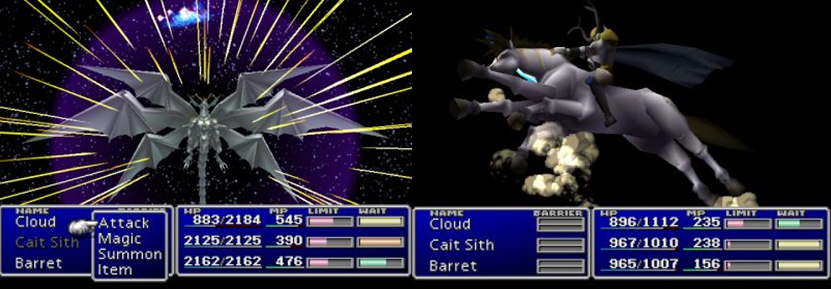
Power-Ups and Bonuses:
The only way to truly master Final Fantasy VII is to grind, grind, and grind some more. Winning battles gains that all-important EXP and AP, both of which are required to strengthen your characters and their magic. Some characters won’t even learn their best Limit Breaks unless you defeat a certain amount of enemies with them, all-but-forcing you to use characters like Aerith and Cait Sith if you want to fully power them up and unlock all of the game’s Achievements. The same is true for Materia; levelling it up not only allows access to more powerful magic, it also duplicates the Materia for others to use and leads you towards acquiring the all-powerful Master Materia, items which are essential to taking on the game’s optional bosses. In nearly every town or city you visit, there will be a weapons shop; here, you can purchase new weapons, arm bands, and accessories for your characters. These can be pricey, though, necessitating a lot of grinding or exploration for extra Gil and it’s worth noting that, while you might get a significant buff by buying a new weapon, you can just as easily find a more powerful one in a chest shortly after spending your hard-earned Gil. To acquire a character’s ultimate weapon, you may be required to complete a side quest or specific task; to get Vincent’s, for example, you first need to acquire him by completing a side quest, then either get a hold of the submarine or breed a coloured Chocobo to access a hidden cave behind a waterfall, then read some dialogue, and then you need to win ten random battles before returning to the cave to acquire the Death Penalty…but, to get Cid Highwind’s, you simply talk to the right NPC three times in a row. Sure, this is quite late into the game and you have to first travel to and from space but it’s a lot simpler.

FF7Transport
The game’s map, and modes of transport, open progressively, getting bigger and better as you go.

As mentioned, your Gold Chocobo will allow you to travel anywhere and acquire the most powerful Summon, Knights of the Round, but they’re not the only way to traverse Final Fantasy VII’s extensive overworld. You’ll acquire in a buggy, a little sea-based aeroplane, a submarine, and, eventually, upgrade to the comfort of Cid’s Airship, the Highwind; given how much of your time is spent travelling on foot, you’ll really appreciate the convenience of the Highwind allowing you to heal for free and travel at high speeds. Furthermore, there are two optional characters you can acquire at various points throughout the game; the hyperactive ninja Yuffie will randomly ambush you in forests and only joins you after you defeat her and then pick specific dialogue options, while the stern and stoic Vincent is locked away in a Shinra mansion and can only be acquired by battling a particularly challenging mini boss. There are some benefits to taking the time to get these characters though; not only do you get an Achievement for each, but having Yuffie in your party later on allows you to acquire the Leviathan Materia and Vincent is one of the more useful characters thanks to his powerful Limit Breaks (he also looks awesome).

FF7SecretBosses
You’ll need to be at the top of your game to battle these two.

As if that wasn’t enough, there are also two optional superbosses: Emerald WEAPON at the bottom of the sea and Ruby WEAPON in a sandy region. To fight Emerald WEAPON, you need a special Materia to eliminate the time limit imposed by being underwater and, to fight Ruby WEAPON, you have to be out of your mind! Seriously, these two are no joke; Ruby WEAPON can blast one of your party out of the battle entirely and both deal massive damage while sporting tank-like HP. In all my attempts at battling them the only one I came close to dealing any real damage to was Emerald WEAPON and even then it wiped the floor with me. To best these two, you absolutely have to have top-tier party members, Materia, and Limit Breaks along with a lot of luck and a well-thought-out strategy. Defeat Emerald WEAPON, and you’ll not only earn a whole bunch of EXP, AP, and Gil, you’ll also get the Earth Harp, which you can take a seemingly-innocuous NPC in the town of Kalm to earn three Master Materia: Master Summon, Master Command, and Master Magic. Not only does this net you an Achievement, it means that you have full access to every Summon, spell, and command in the game, which can not only massively overpower your party but also free up your weapon and armour’s Materia slots to add further buffs. If you visit this NPC prior to fighting Emerald WEAPON, you can trade him another item to earn the Underwater Materia, which can make the battle against Emerald WEAPON a bit easier by eliminating the threat of your party drowning. Defeat Ruby WEAPON, and you’ll get the Desert Rose, which Kalm’s generous NPC will trade you a Gold Chocobo for (though, in my experience, it’s far easier to breed your own Gold Chocobo).

Additional Features:
As you might expect, Final Fantasy VII comes with a bunch of Achievements, most of which are tied to some of the game’s more difficult and time-consuming mechanics. There’s one for reaching Level 99, for example, one for acquiring the maximum amount of Gil, one for mastering every Limit Break, one for having Cloud’s drag disguise being more appealing than Aerith or the delectable Tifa, and one each for defeating Emerald and Ruby WEAPON. It’s worth noting that some of the game’s weapons, accessories, and Achievements are dependant on you doing certain actions at various points in the game; you won’t be able to get the “See the Light” Achievement if Aerith is dead, for example, and you’ll have manipulate events early on if you want to take Barret on a date at the Gold Saucer. Similarly, if you don’t properly explore Nibelheim during a flashback, you can’t get Tifa’s last Limit Break. Another thing to note that this game sometimes struggles to register your Achievements; I had to beat the game three times and remove and re-upload my Xbox profile just to get the “A Feat of Meteoric Proportions” and “Wheel of Fortune” Achievements to register and there was a significant delay in the “The Slash to End All Slashes” and “Roundtable Destruction” Achievements popping, too. Apparently, this is a common issue with this game so I’d recommend saving frequently and making sure you have a strong and stable connection to Xbox Live.

FF7Boosters
Activate these boosters to cheese the game in no time at all!

If you’re finding the game difficult and struggling against these superbosses, the Xbox One version of Final Fantasy VII includes a feature that absolute breaks the game in half. I only found out about this feature after defeating Safer∙Sephiroth but it would have really helped to speed up my play time if I’d known about it beforehand. So, if you press in the left and right analogue sticks, two icons appear on the left-hand side of the screen: a fist and a “X3”. The fist grants you super-regenerating HP and MP and fills your “Limit” meter so fast that your Limit Breaks are constantly available; while can still be defeated with this activated, it’s massively unlikely and allows you to absolutely tank any enemies you encounter. This is made even more advantageous when you pair it with the “X3” booster which, as you might guess, speeds the game up to three times its usual speed. It was only by having both of these activated that I finally bested Emerald and Ruby WEAPON but, had I known they were an option, I would have used them the entire time as they’re absolutely game-breaking and would have really sped up all that Chocobo breeding!

FF7Conclusion

The Summary:
Final Fantasy VII is, by no stretch of the imagination, a masterpiece. It is an exhaustive, massively engaging experience filled with action, humour, despair, and hope. While the plot can get side-tracked delving into each character’s backstory, every event is specifically designed to flesh out the lore and characters. It doesn’t take long before you’re hooked on the distinct and charming visual style and the deeply nuanced characters and world-ending plot. Despite a few of the more annoying trappings of the series, the game is pretty much perfect from start to finish; it does a decent job of easing you into its mechanics and eccentricities (unlike Final Fantasy VIII which, as much as I love it, loves to dump information, training, and exposition onto you within the first half an hour) to the point that, after a while, you don’t even realise you’ve gotten the hang of the game’s core gameplay. The mini games and button-mashing sequences don’t last long and you’re often not penalised if you fail them, however if you play smart and save often (making liberal use of the save slots available), you can always better prepare yourself for whatever lies ahead. If you’ve never played an RPG before though, and prefer much more action-orientated titles, than I obviously wouldn’t recommend Final Fantasy VII. When I first played the PlayStation 3 version, I had the official Brady Games guide with me. This time around, I went on memory and instinct for the first chunk and was surprised at how well I did without at guide and how accessible the game can be. Sure, there are moments where you’ll have no idea where to go or what to do but that’s because you probably weren’t paying attention to the dialogue in the cutscenes. However, once I realised I had missed Tifa’s Limit Break (and after Meteor was cast), I went back to a guide to make sure I didn’t miss anything that would improve my chances in the endgame; a guide is also pretty much mandatory to breed a Gold Chocobo, as well. However, if you’re playing the Xbox One version, you can absolute cheese it with the boosters activated, making it more than accessible for casual or first-time players. If you take the time to play at a more appropriate speed, you’ll be required to invest a lot of your time, effort, concentration, and commitment but it’s well worth it. Even characters I don’t really use, like Red XIII and Cait Sith, have layers and nuances to their characters and I found their input to be useful even when the game forces me to deviate from my part of Cloud, Barret, and Vincent. Once you allow yourself to become engrossed in this deep, detailed world with is rich lore of genocide and strife, you’ll find a story rife with themes of alienation, persecution, and betrayal; a story that teaches us to value the life we have now and work with the planet, rather than against it. At the same time, you’ll battle some kick-ass monsters and go toe-to-toe with a literal God…and that’s always cool
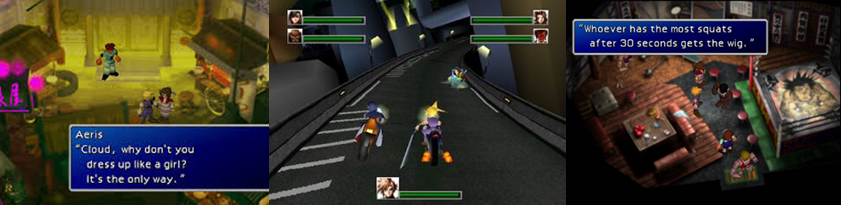
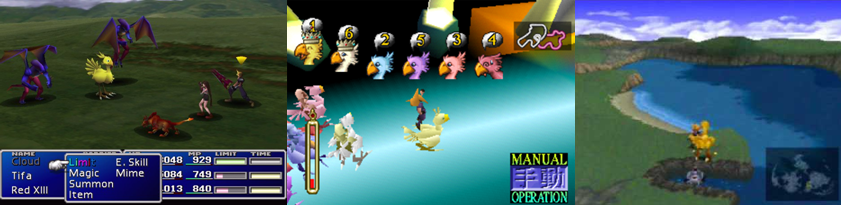
My Rating:

Rating: 5 out of 5.

Fantastic

Phew, so…Final Fantasy VII, eh? What did you think of this much-lauded title? Where does it rank in your list of Final Fantasy games, or RPGs? Who was in your party when you played the game? Did you have a favourite section, Summon, or character? Did you know that you could cheese this version of the game of do you prefer to play at the original pace? Is the knowledge of Aerith’s news to you and are you now enraged because I spoiled a game over twenty years old? Have you been playing the recent remake and, if so, how does it hold up compared to the original? Did you enjoy the other Final Fantasy VII games and media released over the years? Whatever you think, whatever your thoughts, feel free to talk about them in the comments below.