Screen Time [National Anime Day]: Attack on Titan (Season One)


15 April has been designated National Anime Day to celebrate the stylistic genre, which achieved mainstream success thanks to animators like Osamu Tezuka.


Season One

Air Date: 7 April 2013 to present
UK Distributor: Netflix, et al
Original Network: MBS/NHK General TV
Stars: Bryce Papenbrook, Josh Grelle, Trina Nishimura, Jessica Calvello, Lauren Landa, Matthew Mercer, and R Bruce Elliott

The Background:
Attack on Titan began life as a Japanese manga written and illustrated by Hajime Isayama and has been published in Bessatsu Shōnen Magazine since September 2009. Drawing from personal experiences regarding the fear of strangers you cannot communicate with, the isolated and enclosed nature of Japanese culture, and the Muv-Luv visual novel series (âge/5pb, 2003 to 2016), Attack on Titan was very well received, selling over 100 million copies by the end of 2019 and quickly etching itself into worldwide popular culture. As a result of the manga’s popularity, Attack on Titan has been adapted into videogames, live-action movies, and an ongoing anime. The anime was produced by Wit Studio and Production I.G, directed by Tetsurō Araki, and dubbed into English by FUNimation Entertainment. Like the manga, the anime was received generally positively, with critics praising the storyline, animation, and music but criticising the crudeness or the titular Titans and the bleakness of the story’s tone.

The Plot:
For a hundred years, the last vestiges of humanity has lived in cities surrounded by enormous walls that protect them from gigantic man-eating humanoids referred to as Titans. After his mother is devoured by a Titan before his eyes, Eren Yeager (Papenbrook) vows to join the Titan-hunting Scout Regiment alongside his friends Mikasa Ackerman (Nishimura) and Armin Arlert (Grelle) and rid the world of the Titans once and for all.

The Review:
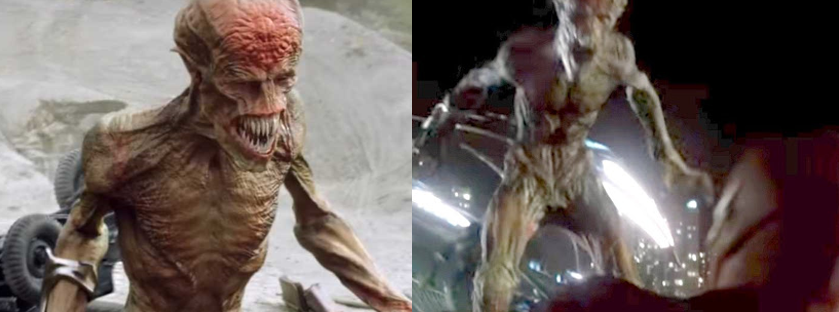
In a world where we are literally swamped with all kinds of bat-shit crazy ideas for manga, anime, and videogames, Attack on Titan offers what can only be described as a “unique” premise: one day, about a hundred years ago, the gigantic cannibalistic Titans simply showed up and started eating humans left, right, and centre. They appeared seemingly out of nowhere and decimated humanity, driving them behind fifty-foot high walls and to the point of near extinction. Since then, humanity has lived in relative peace, training generations of soldiers to battle the nigh-indestructible Titans and scout out new areas for expansion and the acquisition of resources. The titular Titans are gruesome, disturbing creatures; ranging in height from around three to fifteen meters tall, they vary in appearance from constantly-grinning or alarmingly stoic-faced naked humanoids, to twisted, frenetic freaks and skinless, steam-emitting monstrosities. Deceptively fast and light despite their enormous size, the Titans are superhumanly strong and constantly regenerate from any injury unless attacked at their one weak point at the base of the neck. The Titans generally attack without reason or mercy, devouring humans not for sustenance but, apparently, simply out of some kind of base instinct (though more intelligent Titans do exist).

Horrific, intelligent Titan variants pose a real threat to humanity’s survival.

The Colossal Titan (which is so huge that it can peer over the walls that keep humanity safe from the Titans) systematically destroys the weakest part of Wall Maria to allow its brethren to enter the outer area of the city. This act alone earns the Colossal Titan (and the Titans in general) Eren’s hatred as it directly leads to the death of his mother and kick-starts his entire crusade to hunt down and destroy all of the Titans. Later in the season, Eren and Squad Levi encounter a skinless Female Titan that specifically targets Eren and is capable of hardening its skin at will and is smart enough to cover its neck when under attack. Similarly, the Armoured Titan is not only highly resistant to the army’s anti-Titan cannons but methodically picks and choose its targets, unlike the horrific Abnormals, which run and skitter around in an unhinged frenzy.

The Titans are practically unstoppable and have driven humanity to near extinction.

Honestly, one of the best parts of Attack on Titan is the Titans themselves; they are horrific creatures that are cold, unmoved, and seemingly unstoppable. Just one Titan is capable of swatting attackers right out of the air, stomping on them, or chomping down on them in the apparent blink of an eye. Often, two or three Titans are seen as a significant threat to the populace and those trained to protect them but, other times, soldiers (specifically the army’s more highly-skilled individuals) will be able to cut Titans down almost effortlessly and, yet, the Titans continue on regardless and it is stated at one point that humanity has never, in a hundred years, scored anything close to a significant victory until the episode “Primal Desire: The Struggle for Trost, Part 9” (Koizuka, 2013).

The O.D.M. allows the characters to perform superhuman feats.

Opposing the Titans are the city’s military; trained in the use of Omni-Directional Mobility Gear (O.D.M.), these guys are able to fly all over the place thanks to the O.D.M.’s gas-powered grapple hooks. Once mastered, the O.D.M. pretty much turns every character into Peter Parker/Spider-Man as they swing, fly, and rappel all over the place with superhuman skill and ease, attacking Titans with their swords and yet, despite all their skill and extraordinary physical prowess, they are still splattered into mush or devoured by the hundreds in seemingly every campaign, willingly throwing their lives away even when escape would be a far better proposition. Attack on Titan centres around three human characters: Eren (the hot-headed, idealistic protagonist), Mikasa (Eren’s stoic, but highly skilled adopted sister and self-appointed bodyguard), and Armin (their childhood friend who is more of an academic than a fighter). Of the three, Eren is easily the most relatable and interesting; wracked with guilt after never appreciating his mother and haunted by fragmented memories of his father, he is driven by an unrelenting desire to succeed in the military, join the Scout Regiment, and experience life beyond the walls of the city to hunt down and destroy every Titan he finds. Eren is quite the flawed character; despite his bravado and commitment to his mission, he struggles to master the O.D.M. gear, is far less capable at battling the Titans than Mikasa or Captain Levi (Mercer), the military’s most decorated and powerful soldier, and isn’t as well-read as Armin.

Somehow, Eren is able to transform into the Attack Titan to take the fight to the Titans.

However, his heart cannot be denied; in the face of a Titan assault in “First Battle: The Struggle for Trost, Part 1” (Ezaki, 2013), Eren immediately takes command and leads the charge against the Titans. Briefly paralyzed with fear in the face of the Titans’ awesome power, he barely hesitates to sacrifice himself to save Armin from being swallowed by the Bearded Titan, apparently dying in the process. Luckily, however, Eren later resurfaces in his own Titan form, the Attack Titan, apparently mysteriously having the innate ability to transform into a Titan when injured and with a clear, defined goal. At first, and sporadically throughout the season, Eren cannot fully control this transformation and struggles to understand it; understandably, it causes a lot of fear and mistrust amongst his fellow soldiers, who constantly treat him either with respect and awe or terror and hatred, and his superiors constantly flip-flop on whether to use his powers to aid them or simply execute him.

Levi is the army’s most formidable soldier and a decorated Titan killer.

Eventually, Eren is assigned to Squad Levi and the direct scrutiny of Captain Levi, a stoic but superhumanly capable soldier who is equal to the strength of a hundred fully-trained soldiers. Levi is the anime’s standard detached, bad-ass character, slicing up even the near-unstoppable Female Titan in a whirlwind of blades and fully prepared to sacrifice his entire regiment (comprised of the army’s best and longest-living Titan hunters, it must be said) to protect Eren.

Though stoic, Mikasa has a natural aptitude for combat.

Levi’s demeanour is largely mirrored by Mikasa, a damaged young girl whose entire family was slaughtered before her eyes until she was saved by Eren, the two of them killing her attackers in a mindless fury. Since then, Mikasa has attached herself to Eren, following him everywhere, even to military school and out into the 104th Regiment. Though not quite as stoic as Levi, Mikasa is nevertheless capable of killing entire swarms of Titans all by herself through some innate physical prowess that is never really explained. It’s hinted numerous times throughout the season that Mikasa’s feelings towards Eren border on something more than friends and family but both are quick to either brush off this suggestion or are far too focused on the far more prominent threat of destroying the Titans.
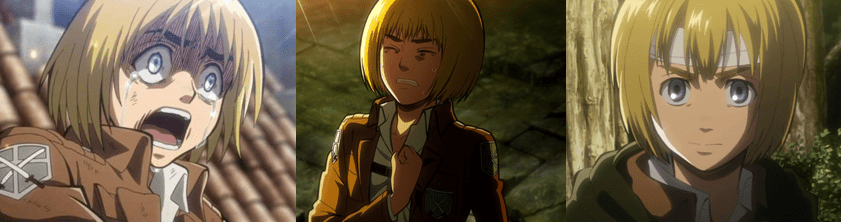
Armin is the weakest and most annoying of the three protagonists.

Finally, there’s Armin, easily the weakest and most annoying character of the three. Many episodes either grind to a halt or entirely focus on one of the three debating the merits of teamwork, humanity, or reliving their memories and feelings through long-winded internal (or external) monologues or flashbacks but never is this more annoying when the focus is placed on Armin. The weakest link of his regiment, Armin’s prowess lies more in academics, strategy, philosophy, and introspective analysis; he’s quick to give in to despair (though, to be fair, so are a large number of the anime’s soldiers and characters in the face of the Titans’ inexorable threat) and to stand useless and in fearful awe in the midst of a heated battle where untold numbers of his friends and peers are decimated by the Titans to incessantly monologue about his shortcomings or the bravery of others.
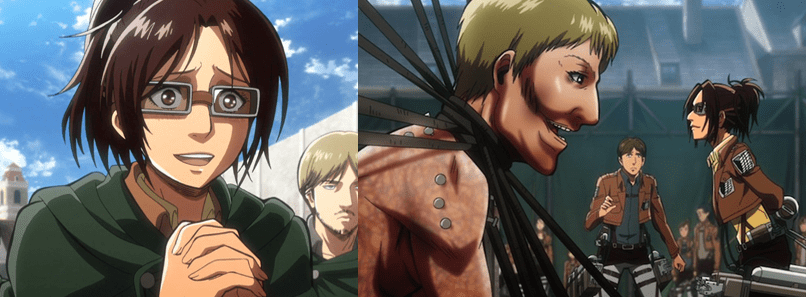
Hange Zoë is easily the worst and most annoying character of the season.

Still, as annoying as Armin is, he’s got nothing on Hange Zoë (Calvello), a military scientist who is so incredibly obsessed with the Titans that she has been driven to what appears to be near insanity. Loud, obnoxious, and exploding into a crazed frenzy at the drop of a hat, Zoë wants nothing more than to study and investigate the Titans, growing uncomfortably close to captive Titans and disconcertingly obsessed with Eren and his unique physiology. Though her experiments and studies have uncovered numerous helpful insights into the Titan’s composition and nature (and has led to the creation of numerous weapons to bring them down or kill them), her character is largely both uncomfortable and annoying at the same time as she often cares more for the well-being of the Titans than her fellow humans.
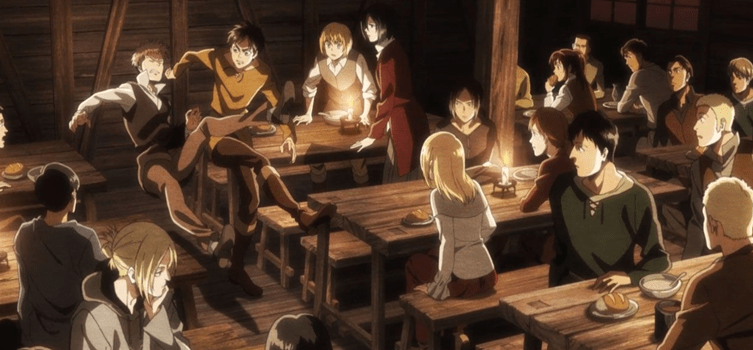
Many of the supporting characters are easily forgotten until they suddenly die.

Rounding out the cast are a number of expendable soldiers and civilians; sure, most of them have names and character traits but it’s largely pointless to remember them or grow too attached as they are liable to either get splattered into a bloody mess, eaten alive, horribly dismembered, or found as little more than a bloodied and mutilated corpse. Often, another character would lament their comrade’s fate and I would find myself struggling to remember who they were, what they did, or when they last appeared. Interestingly, the city is made up of varying classes, each of which experience life within the walls differently and views the military, and the Titans, in different ways: many criticise the need for expensive military ventures and pursuits, others are living comfortably deep within Wall Sina, while those in the outer areas live relatively underprivileged lives. Like a lot of post-apocalyptic narratives, I have many questions regarding the world of Attack on Titan; I’ve looked into the series and researched it a little bit to get some answers regarding the history of this world and how the walls and city were erected but, in the context of season one, we get very little information regarding how the city was built and how they survive.
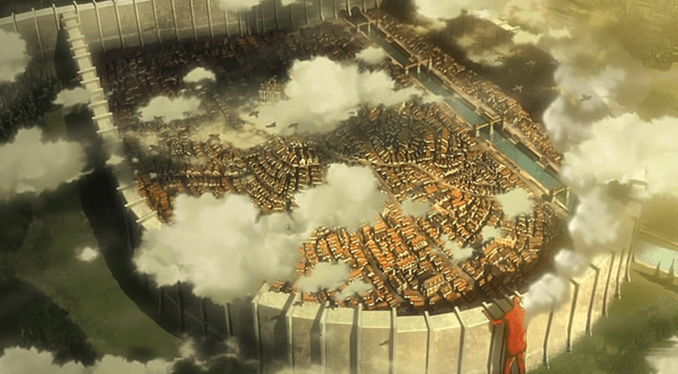
I have many questions about the city, its society, and the lore of this world.

For some reason, currency and wealth is still a thing within the city; many of the wealthier citizens are frustrated at their “taxes” paying for what amount to little more than suicide missions against the Titans and the Royal Family live in opulence within Wall Sina. Equally, there is a lot of mention of rations and finite resources; every time Titans breach the walls and cause a mass evacuation, food and supplies are strained so badly that it is often seen as a good thing when hundreds of soldiers are killed by Titans so that the city’s resources can last a bit longer. I have many questions regarding this: shouldn’t the city just be entirely focused on training soldiers, fortifying their defences, and building a military society rather than giving people the option of living passive lives? Why is money and wealth a thing? How can money really mean anything in this type of world? Where do the resources come from? How were all these houses built, to say nothing of the walls that protect the city? How do the citizens even have the means to build anything with such finite resources? Why aren’t the soldiers, especially the veterans, better at killing Titans when the creatures are largely predictable, have a well-known weak spot, and seem so cumbersome and slow despite their surprising speed and daunting strength?

Eren isn’t the only one who can transform into a Titan, raising many questions for season two.

These questions are generally disregarded in season one and, for the most part, it works; despite characters knowing a lot about the Titans’ physiology, the creatures and their origins are a complete mystery to the characters and they are constantly forced to learn as they go and endure horrific losses to gain slivers of new information about them. How Eren, and others, are able to spontaneously produce Titan bodies is left obscure and the motivations of the Titans’ cannibalistic ways are up for debate at this point. The season ends, however, not only with the knowledge that Eren is not unique as Annie Leonhart (Landa) is revealed to not only be a traitor to the humans but also capable of transforming into a Titan herself, but also that gigantic Titans are encased within the walls of the city, ending the season on a massive cliff-hanger as we’re faced with the knowledge that human-to-Titan individuals are more commonplace than first thought and that there is more to the history of this world than we, and the characters, are aware.
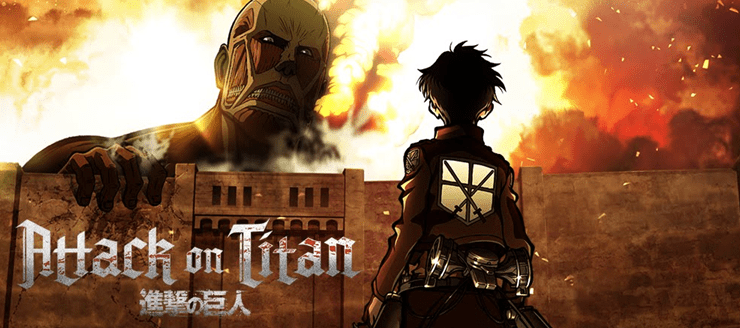
The Summary:
I had heard a lot about Attack on Titan for quite some time; I am not, by my own admission, the most well-read anime fan as I find a lot of the most popular anime films and series to be dense almost to the point of being impenetrable and with so many episodes (most of them being filler or padding) that I just don’t have the time or patience to fully invest my energy and effort.

There are so many monologues! It really grinds the pace and action to a halt.

However, when I saw Attack on Titan was on Netflix, I figured I’d watch a few episodes and see if it hooked me. Within three episodes, I was interested enough to carry on but, by around episode fifteen, the series had started to lose me. I quite liked Eren’s flawed character and the constant life and war lessons he was forced to learn through numerous encounters with the Titans and characters like Mikasa and Levi helped make the anime exciting and engaging when it was actually focused on action rather than constantly slowing the plot down with endless monologues and prattling on and on (often, inexplicably, when characters are moving at high speeds) about teamwork, friendship, and the futility (or glory) of war.

Attack on Titan excels whenever Titans are onscreen or the action picks up.

Attack on Titan excels when it focuses on the Titans and the action-packed assaults against them; seeing Eren and his fellow soldiers swing and fly all over the place, either being crushed, devoured, or successfully cutting down the creatures is exciting and gorgeous to behold and really showcases the detail and intricacies of the anime’s smooth and slick animation. Sadly, though, entire episodes can go by without the merest hint of action or appearances by the titular Titans; while this can lead to some interesting character development, more often than not episodes drag their runtime out focusing on characters who quickly die, strategies that immediately fail, or retreading the same ground about Eren, Mikasa, and Armin’s characters and backstory.

Some flashbacks and slower moments help flesh out the main characters.

Occasionally, our protagonists will learn and grow as characters, which is nice to see, but often they’ll learn a lesson or some self-confidence in one episode only to immediately have to relearn this again in the next (or subsequent) episode. It makes for a disjointed pace and gives me far too much time to think about the rules of this world and questioning how their society even works much less proves so unreliably effective against the Titans even with years of experience in fighting them. As a result, despite the massive cliff-hanger at the end of the season and what I’ve read of how the plot develops later on, I can’t see myself coming back to Attack on Titan again. At least, not the anime, anyway.

My Rating:

Rating: 2 out of 5.

Could Be Better

What are your thoughts on Attack on Titan? Did you enjoy the series or, like me, did you have issues with its plot, pacing, and content despite its interesting premise, creatures, and characters? Did you ever read the manga; if so, do you prefer it to the anime? Perhaps you prefer the live-action films, or the Attack on Titan videogames; if so, which is your favourite and why? Which character, or Titan, is your favourite? Do you also find Zoë and Armin annoying characters? How are you celebrating National Anime Day today? Whatever you think about Attack on Titan, or anime in general, please do leave a comment below.

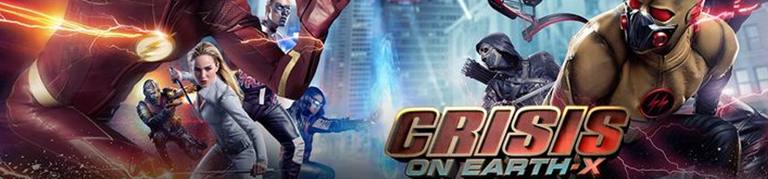
Screen Time [Crossover Crisis]: Crisis on Earth-X


In April 1985, the first issue of the ground-breaking Crisis on Infinite Earths (Wolfman, et al, 1986) released and saw the temporary destruction of the “Multiverse”. To celebrate this momentous event, I’m discussing multiversal crossovers all throughout April in an event I dubbed “Crossover Crisis”.


Air Date: 27 November 2017 to 28 November 2017
UK Network: Sky One
Original Network: The CW
Stars: Stephen Amell, Grant Gustin, Melissa Benoist, Caity Lotz, Carlos Valdes, Dominic Purcell, Chyler Leigh, Brandon Routh, Franz Drameh, Victor Garber, and Tom Cavanagh

The Background:
After the success of Invasion! (Various, 2016), the scope and interconnectivity of the “Arrowverse” began to steadily grow; The Flash (2014 to present), in particular, began to explore more and more of the multiverse while DC’s Legends of Tomorrow (2016 to present) exclusively dealt with concepts of time travel and alternate timelines. Invasion! ended up being the first of many annual crossovers between the CW shows and, accordingly, development of the next big crossover began in 2016. This time around, the showrunners were able to better plan and prepare for the crossover; however, while this allowed for Supergirl (2015 to present) to be included in the line-up, Black Lightning (2018 to present) was notably absent from the event, which drew inspiration from the annual crossovers between the Justice Society and Justice League of America in the Silver Age of DC Comics.

The Plot:
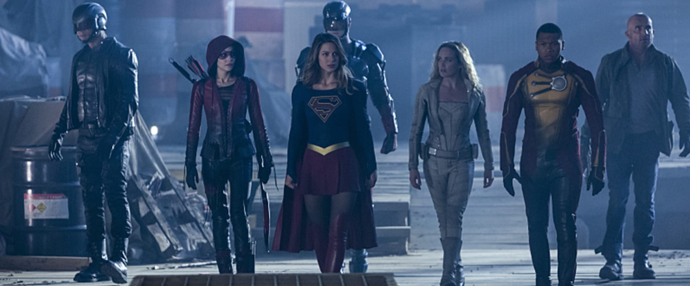
When the long-awaited wedding between Barry Allen/The Flash (Gustin) and Iris West (Candice Patton) is interrupted by evil doppelgängers from Earth-X, a dystopian world populated by Nazi versions of the Arrowverse heroes, they must call upon Oliver Queen/Green Arrow (Amell), Kara Danvers/Supergirl (Benoist), and the time-travelling Legends in a desperate battle to save their world from becoming over-run by their totalitarian doubles.

The Review:
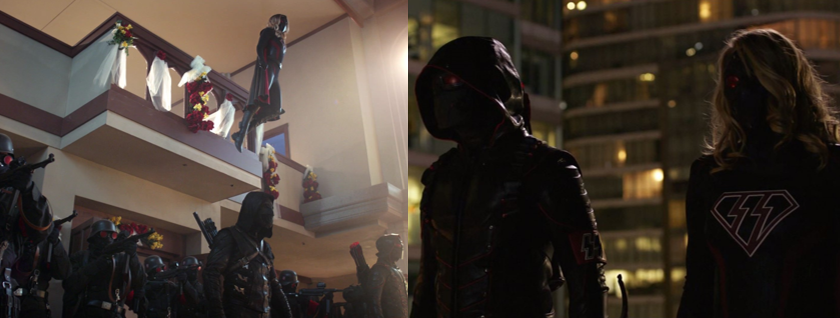
Crisis on Earth-X begins, appropriately enough, in “Part 1” (Teng, 2017), which was the eighth episode of the third season of Supergirl and introduces us to Earth-X, a parallel world that is under the iron grip of a Nazi regime. Oliver Queen/Dark Arrow (Amell) is the Führer and leader of the ruling cabal, the New Reichsmen, who use brute force and murderous tactics to spread fear amongst the populace and rule largely unopposed except for a band of plucky Freedom Fighters who are hopelessly outmatched. Hungry for new worlds to spread their regime to, they seize a temporal gateway and travel to Earth-1 in search of further conquests.

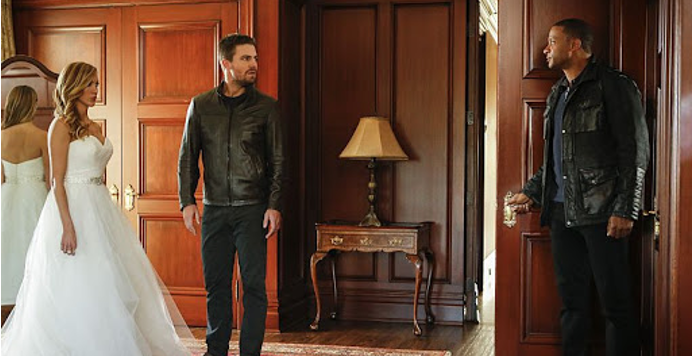
The large majority of the Arrowverse gathers together for Barry and Iris’s long-awaited wedding.

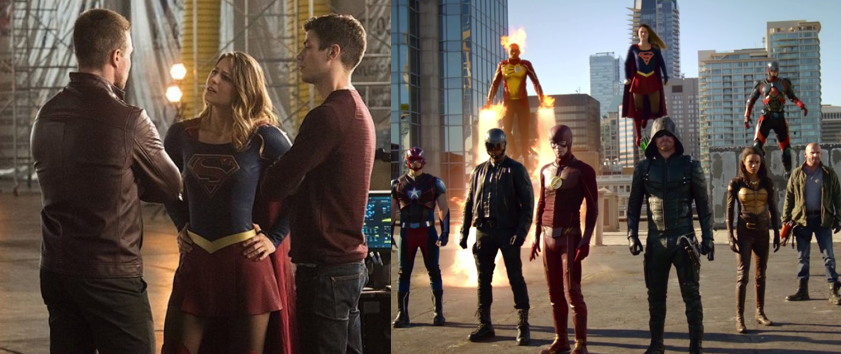
Most of our heroes from Earth-1 are concerned primarily with the impending marriage of Barry and Iris; the daily routine of our multiversal time travelling heroes is given a comedic background as Green Arrow, the Legends (Sara Lance/White Canary (Lotz), Mick Rory/Heat Wave (Purcell), Jefferson Jackson (Drameh) and Doctor Martin Stein (Garber)/Firestorm, Ray Palmer/The Atom (Routh), Nate Heywood/Steel (Nick Zano), Zari Tomaz (Tala Ashe), and Amaya Jiwe/Vixen (Maisie Richardson-Sellers)), and Supergirl (Benoist) put their individual issues and missions on hold to travel to present day Earth-1 for the wedding, bringing these characters together for a happier, more social event rather than an impending crisis. Amidst this, Kara is still reeling from the return of Mike Matthews/Mon-El (Chris Wood) and her sister, Alex (Leigh), is struggling with a recent breakup. The revelation that Mon-El is not only alive but also already married has shaken Kara’s usually positive outlook; like any good CW/TV lesbian, Alex decides to throw herself at the nearest bisexual character (Sara); and Oliver is motivated by Barry’s plunge into marriage to (unsuccessfully) re-propose to long-term love interest Felicity Smoak (Emily Bett Rickards). Additionally, Stein and Jackson are facing the sudden realisation that their time as Firestorm may be coming to an end thanks to a cure developed by Cisco Ramon/Vibe (Valdes) and the Earth-2 Harrison Wells (Cavanagh).

Evil Nazi doppelgängers interrupt the wedding and plot to attack Earth-1.

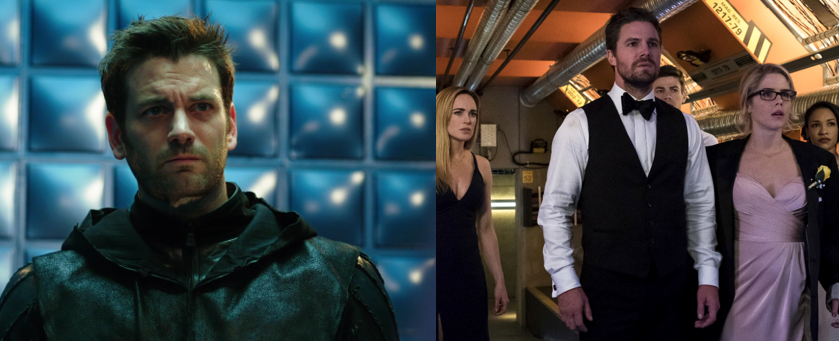
Although Stein is overjoyed at the prospect of returning to his family and a normal life, Jefferson is struggling with the idea of losing their partnership, friendship, and the bond that Firestorm brings the two. Characteristically, Stein misinterprets Jefferson’s feelings regarding the situation and attempts to fashion a way for Jax to continue being a super-powered Legend without him or Firestorm. With all this drama hanging in the air, tensions are a little highly strung on the morning of the wedding and it’s something of a relief (for everyone but Barry and Iris, that is) when Kara Zor-El/Overgirl (Benoist), Dark Arrow, and Tommy Merlyn/Prometheus (Colin Donnell) gate crash the ceremony with their troops. Of course, a massive fight scene breaks out (it’s super lucky and convenient that guys like Oliver and Mick brought their weapons to the church…), the main focus of which pits Overgirl against Supergirl, Oliver against Dark Arrow, and Sara and Alex against Prometheus in a bit of a mirror match, of sorts. Of course, it isn’t until the fight is concluded and Prometheus is captured that the true identities of their opponents are revealed since all the Earth-Xers are sporting bad-ass masks.

Oliver is shaken when the Earth-X Prometheus turns out to be an evil version of his dead best friend.

“Part 2” (Bamford, 2017), which took place in season six, episode eight of Arrow, delves into the consequences of this; as always when he comes face to face with Tommy Merlyn, Oliver is shaken by the appearance of his long dead best friend. Harry also offers a quick bit of exposition into the background of Earth-X, a 53rd Earth that is so horrific that it lacks the usual numerical designation; unlike in Invasion!, Oliver is now far more adjusted to the concept of the multiverse and metahumans but his emotional attachment to Tommy (which is fuelled by his own feelings of grief and guilt at his Tommy’s death) blind him to Prometheus’s uncompromisingly cruel nature. Oliver’s already dramatic and brooding life is further complicated by Felicity’s unexpected rejection of his proposal, which kind of just exists simply to add to the character’s aggro; it’s a common thing in Arrow that seemingly every time Oliver tries to grow as a character and a person, normally dependable people suddenly let him down and then he’s the one who has to learn a lesson to adjust to this before things just work out anyway, which is kind of how the Arrowverse likes to handle its dramatic moments: needless conflict amidst actual, tangible conflict.

In a crossover full of cameos, Wally and Diggle are unfortunately given the shaft.

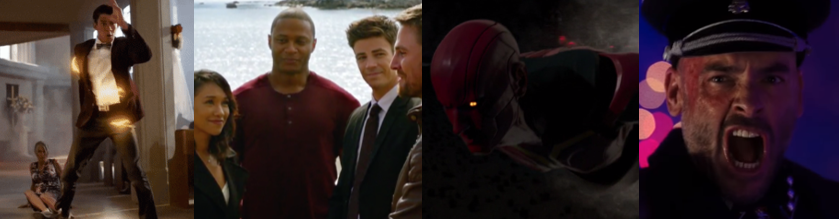
Crisis on Earth-X also features an appearance by Jessica Parker Kennedy, who would later be revealed to be Barry and Iris’ time-travelling daughter, Nora; once again, though, in a crossover featuring a slew of cameos and characters, Wally West/Kid Flash (Keiynan Lonsdale), John Diggle/Spartan (David Ramsey), J’onn J’onnz/Martian Manhunter (David Harewood), and Mon-El are completely side-lined but the event has time for appearances by Ray Terrill/The Ray (Russell Tovey), the Earth-X Leonard Snart/Citizen Cold (Wentworth Miller), Metallo (Frederick Schmidt), Red Tornado, and even a much welcome appearance by Paul Blackthorne as SS Sturmbannführer Quentin Lance. Perhaps the best thing about Crisis on Earth-X’s large cast of characters is the return of Cavanagh as the Reverse-Flash, still the most charismatic and memorable of all the Flash’s villains. Thawne is, it turns out, the actual Thawne from Earth-1, having cheated death thanks to complex (and convenient) time travel shenanigans. While Green Arrow and Supergirl are naturally disturbed and disgusted with their evil counterparts, Barry’s fight against Thawne is far rawer and emotionally charged given their history and Thawne’s sadistic vendetta against him.

Good or evil, Oliver finds a way to be relevant and keep up with his superpowered allies.

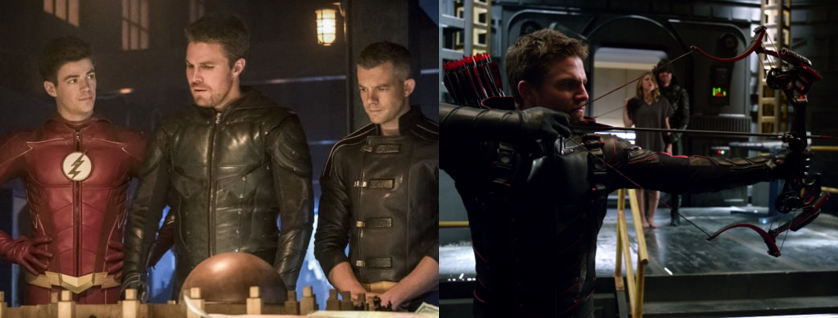
Once again, despite neither him or his Earth-X doppelgänger sporting superpowers, Oliver manages to find a way to make himself relevant and useful in the explosive conflict; his Kryptonite arrow, however, is far less useful than one might expect but Dark Arrow ends up being skilled and competent enough to take on Heat Wave, Doctor Caitlin Snow/Killer Frost (Danielle Panabaker), Curtis Holt/Mister Terrific (Echo Kellum), Rene Ramirez/Wild Dog (Rick Gonzalez), and Dinah Drake/Black Canary (Juliana Harkavy) all at the same time. This is especially evident in “Part 3” (Helbing, 2017), which aired as the eight episode of the fourth season of The Flash), when, trapped on Earth-X alongside Barry, Sara, Alex, Stein, and Jefferson, Oliver is the only one able to break free of their power-dampening restraints thanks to his ability to freely dislocate his thumb. While this quickly becomes a moot point as they are soon rescued by the Earth-X Snart, who introduces them to the pitiful Earth-X resistance movement, Oliver is able to (briefly) successfully impersonate his doppelgänger to infiltrate a convenient, if well-guarded, facility that offers their only chance of returning home. Concurrently, their Earth-1 allies are trapped in the anti-metahuman cells at Scientific and Technological Advanced Research Laboratories (S.T.A.R. Labs) and Kara is held captive under power-dampening red sunlight. For all the power, greed, and conviction of the Earth-Xers, their motivations come down to a desperate need to save Overgirl from dying through a heart transplant with Supergirl with only Felicity and Iris left behind to help her. It’s interesting, and surprising, for a crossover between the Arrowverse’s greatest heroes that two non-powered supporting characters end up being the key to turning the tide against the Earth-Xers as they rescue Kara using little more than their grit and ingenuity and the foresight to summon the remaining Legends.

With the defeat and death of their generals, the Earth-X invasion is averted.

The finale, “Part 4” (Smith, 2017), was the eighth episode of the third season of DC’s Legends of Tomorrow; similar to the final episode of Invasion!, saving the Legends episode to last causes a sudden and noticeable flood of characters to join the already inflated cast. The timely intervention of the Atom saves Kara but, unfortunately, even Gideon (Amy Louise Pemberton) is not capable of saving Stein’s life from a fatal bullet and he dies having sacrificed himself to return everyone to Earth-1 and to keep Jefferson alive. It’s an emotional and dramatic moment for the entire team but, especially, for those two, whose relationship has developed into a fantastic father/son dynamic amidst the dysfunctional family of the Waverider and would forever change the Legends dynamic going forward. Though hurt and grieving following Stein’s death, Oliver and Sara’s pragmatic attitude galvanises the heroes into uniting against the Earth-Xers and their own version of the Waverider, the Wellenreiter, which they use to launch a devastating attack on Earth-1 unless Kara turns herself over to them. Rather than go gallivanting off through time and space, the Legends join their fellow heroes for an all-out counterattack against the Earth-Xers, resulting in a massive brawl in the streets. In the end, the day is won through a combination of teamwork and co-ordination to disable the Wellenreiter and Overgirl succumbing to her solar poisoning. Her explosive death directly leads to Oliver executing his counterpart and, thanks to Barry suitably scaring off Thawne, the crisis is averted, and Barry and Iris are finally married. Invasion! was a very rushed and lacklustre excuse to bring together the Arrowverse against a simple extra-terrestrial threat; while the spirit of each show was evoked as best as possible and each episode did its best to focus on a core group of characters amidst a bloated cast, the crossover was let down by a frantic pace and some dodgy CGI. Crisis on Earth-X, in comparison, is a far more well balanced affair and, in many ways, seems like a much easier and more simpler concept to bring together the CW shows as it doesn’t require fully CGI characters or entirely new ideas; it’s simply a fight between the heroes of the Arrowverse and their violent and sadistic doppelgängers. Of course, it’s not the first time many of these heroes (especially Green Arrow and the Flash) have fought against dark versions of themselves but it’s a pretty simple and effective narrative device; plus, not only does it allow characters to literally fight against their own dark nature, it’s fun to see the actors portraying such radically different versions of themselves. While Dark Arrow isn’t that much different from Green Arrow, Overgirl is the exact opposite of Kara’s normally optimistic and enthusiastic nature, allowing Benoist to flex her range into sadistic bitch territory.

The Summary:
There’s a definite sense in Crisis on Earth-X that the Arrowverse was really beginning to hit is stride and becoming much more ambitious with its characters, concepts, and crossovers; the shows have come a long way from the relatively grounded Arrow (2012 to 2020), almost being unrecognisable with their fragrant and frequent use of obscure and complex sci-fi concepts such as time travel, aliens, and the multiverse. Thanks to having the time to properly focus on these concepts in shows like The Flash and Legends of Tomorrow, crossovers such as these were not only able to occur in the first place but actually felt like a natural and inevitable inclusion rather than being a rushed and desperate attempt to catch up to the competition like in the movies. Of course, dodgy CGI does raise its head once again in Crisis on Earth-X, particularly in the scene where Green Arrow helps Flash and Supergirl reinforce a collapsing superstructure by firing a load of CGI arrows and lines across the girders and whenever the Ray’s powers are on show. Still, these moments are far less intrusive and noticeable than in Invasion!, which is surprising considering Crisis on Earth-X features far more super-powered individuals and a much bigger scope. Once again, the costume design is absolutely spot on; the Earth-X Schutzstaffel-inspired uniforms give the normally bright and colourful heroes a dark and menacing look that is only exacerbated when the narrative switches to Earth-X and we see just how different the totalitarian parallel world is to Earth-1 and the rest of the multiverse.

Crisis on Earth-X certainly outdid its predecessor in terms of stakes, standards, and scope.

Something I really enjoyed about this second crossover was that there was a lot more for everyone to do this time around and far more dynamic and varied character interactions, largely thanks to the fact that the pacing and focus of the crossover is much better this time around; each episode feels like a part of a larger, unified narrative that is the geared towards serving the purpose of the crossover rather than being a regular episode of its main show with the crossover plot shoe-horned in. The ramifications of the crossover had lasting effects on the Arrowverse as a whole as well; not only did it end with the long-awaited marriage of Barry and Iris, and open the doors for bigger and better multiversal events in the future, but it forever changed the dynamic of Legends of Tomorrow, and Jefferson’s character, through the sudden and dramatic death of Stein. Invasion! had the suggestion of high stakes but the plot was so concerned with focusing on the interpersonal drama rather than actually depicting the Dominators as a meaningful threat that there was never really the suggestion that the heroes could fail or lose in any way. This time around, the loss of Stein and the depiction of a dystopian alternative world where many have either died or are pure evil raised the stakes for future crossovers, allowing for a degree of unpredictability to permeate subsequent events.

My Rating:

Rating: 4 out of 5.

Great Stuff

How did you find Crisis on Earth-X? Did you prefer it to Invasion! and where would you rank it compared to the other Arrowverse crossovers? What did you think to the concept of evil, Nazi versions of the Arrowverse heroes? Were there any characters you would have liked to see have more focus in the crossover or were you, like me, far more impressed with the pacing and balance this time around? How did you feel about Stein’s death and which of the four shows is your favourite? Whatever your thoughts on Crisis on Earth-X, be sure to leave a comment below and check back in next Sunday as Crossover Crisis continues!

Screen Time [Crossover Crisis]: Invasion!


In April 1985, the first issue of the ground-breaking Crisis on Infinite Earths (Wolfman, et al, 1986) released and saw the temporary destruction of the “Multiverse”. To celebrate this momentous event, I’m discussing multiversal crossovers all throughout April in an event I dubbed “Crossover Crisis”.


Air Date: 29 November 2016 to 1 December 2016
UK Network: Sky One
Original Network: The CW
Stars: Stephen Amell, Grant Gustin, Melissa Benoist, Caity Lotz, Carlos Valdes, Dominic Purcell, David Ramsey, Brandon Routh, Willa Holland, and Victor Garber

The Background:
In October 2012, Arrow (2012 to 2020) premiered on the CW; a successful first season saw the show not only continued for another eight years but also herald the start of the “Arrowverse”, a series of interconnected superhero shows that kicked off with The Flash (2014 to present), explored time and space in DC’s Legends of Tomorrow (2016 to present), and delved into the multiverse with the advent of Supergirl (2015 to present). Characters and concepts from each show would often cross over and, in time, the Arrowverse became a surprisingly complex continuity that, inevitably, led to a massive three-episode crossover. The event, titled Invasion!, was heavily inspired by a DC Comics event of the same name from the late-eighties, united the Arrowverse heroes against an external, extra-terrestrial threat. The three episodes were shot concurrently and gave the CW its most-watched week in six years. Invasion! was met with largely favourably reviews, with each series’ episodes ranked amongst the highest for their respective seasons. The success of Invasion! led to further, increasingly elaborate crossovers between the CW shows, all of which I’ll be covering throughout April.

The Plot:
When an aggressive extra-terrestrial race known as the Dominators (Micah Fitzgerald) arrive on Earth looking to conquer the planet, Barry Allen/The Flash (Gustin) and his team at Scientific and Technological Advanced Research Laboratories (S.T.A.R. Labs) team up with Oliver Queen/Green Arrow and his allies, Kara Danvers/Supergirl (Benoist), and the Legends, led by Sara Lance/White Canary (Lotz), to combat the threat of invasion!

The Review:
Each of the three parts of Invasion! are, quite helpfully and naturally, titled “Invasion!”. The crossover begins in media res with season three, episode eight of The Flash (Downs, 2016) before flashing back to ten hours earlier, where Team Flash are in the middle of testing out Wally West’s (Keiynan Lonsdale) recently acquired super speed. Though he shows a great deal of potential and promise, his sister, Iris (Candice Patton), urges the team not to encourage his dreams of following in Barry’s footsteps out of worry for his safety. The team is in a bit of a fractured state as Cisco/Vibe (Valdes) is having trust issues with Barry after his time travel shenanigans in the “Flashpoint” episode (Warn, 2016); Barry’s main arc in the crossover was trying to live with the ramifications of his selfish actions, which caused numerous alterations to the timeline and affected his confidence and relationships. In the midst of this, the Dominators suddenly arrive on Earth, which surprises even Barry, who by this point has already travelled to other parallel worlds. Thanks to information provided by Advanced Research Group United Support (A.R.G.U.S.) director Lyla Michaels (Audrey Marie Anderson), the team learns that the Dominators have been arriving on Earth since the 1950s, attacking and abducting humans and then disappearing seemingly at random. Lyla asks the team to stand down, believing they would be no match for the Dominators so, obviously, Barry immediately ignores that decision and goes to Oliver for help.

Invasion! balances its large cast by focusing each episode of a certain number of characters.

Against Oliver’s wishes and Felicity Smoak’s (Emily Bett Rickards) objections, his sister, Thea/Speedy (Holland), and John Diggle/Spartan (Ramsey) agree to help rendezvous with the Legends at an abandon S.T.A.R.S. warehouse. Barry then immediately jumps over to Earth-38 to recruit Supergirl and the first tentative meeting of the Arrowverse super friends takes place. Thanks to the inclusion of the Legends, Invasion! immediately becomes compounded by an influx of characters: there’s team leader Sara, Mick Rory/Heat Wave (Dominic Purcell), Doctor Martin Stein (Garber) and Jefferson Jackson/Firestorm (Franz Drameh), and Ray Palmer/The Atom (Routh), amidst all the supporting characters from both The Flash and Arrow. While this threatens to bog the narrative down a bit and can be overwhelming for newcomers, each episode smartly places much of its focus on the main cast of their main series. Accordingly, much of the Flash part of the crossover focuses on Wally’s resentment of the team’s distrust in his abilities, Cisco’s issues with Barry, and Doctor Caitlin Snow’s (Danielle Panabaker) struggles with adjusting to her newly discovered ice powers, which Stein helps her reconcile.

Despite her power and optimism, Kara is met with some scepticism for being an alien visitor.

Supergirl brings a modicum of background knowledge of the Dominators from her Earth but, by virtue of Oliver’s suggestion, Barry is named the team leader; Oliver, however, is largely distrustful of Kara upon first meeting and, as the more serious and grim of the entire group, pushes her, and the entire team, not to hold back in order to fight with peak efficiency in the coming battle. Because of her unmatched superpowers, she is made the guinea pig for the team to test their skills and teamwork out on and this (and the frosty reception she later receives in crossover) causes some notable friction between her and Oliver since she isn’t impressed at being treated like an alien. A cautious, distrustful character by nature, Oliver characteristically take some time to warm to others as it is but his relationship with Kara is particularly unique as, just as he was forced to adapt to and accept “metahumans” (DC’s name for superpowered individuals), he initially struggles to trust and accept aliens and the idea of a multiverse. Because of this, and her status as an outsider to the remainder of the cast, Supergirl’s optimism and enthusiasm is tested during Invasion! as she must work to prove herself in the eyes of her new team mates but, thankfully, her drive and abilities are enough to win over even her most ardent doubters.

Barry and Ollie must subdue their friends when they fall under the Dominators’ control.

The tension is only exacerbated when Cisco pressures Barry to reveal the implications of Flashpoint to the team, which drives a wedge between them; while Kara still trusts Barry regardless, it’s only through a tough love pep talk from Oliver that Barry snaps out of his self-doubt and realises that he can still make a positive difference despite the mistakes of the past. Ultimately, these plot points converge somewhat when the Dominators force Oliver and Barry to fight their mind-controlled friends, wherein the unique and surprisingly effective teamwork of the two is enough to free them from the control of the Dominators. The second part of the crossover, which takes part in season five, episode eight of Arrow (Bamford, 2016), is probably the weakest of the three since it doubles as an anniversary episode of Arrow; with Oliver trapped in a virtual reality dreamland, Team Arrow (Curtis Holt/Mister Terrific (Echo Kellum), Rene Ramirez/Wild Dog (Rick Gonzalez), and Rory Regan/Ragman (Joe Dinicol)) work with Cisco and Felicity to figure out how to locate and free Oliver from his prison. Fittingly, given the largely more grounded and practical nature of Arrow, Rene echoes Oliver’s scepticism and distrust of metahumans but, nevertheless, agrees to pool their resources for the greater good just like Oliver.

Oliver is trapped in, and tempted by, the Dominators’ dream world.

Normally a grim, pragmatic, and focused individual, Oliver is overwhelmed by the fantasy world the Dominators have placed him into but, because of the horrors of his past and the trauma he has lived through, is quickly able to sense and recognise that he is living in a dream world. Despite being reunited with his mother (Susanna Thompson), father (Jamey Sheridan), and deceased former love, Laurel Lance (Katie Cassidy), Oliver ultimately chooses to reject the promise of a peaceful, “normal” life in favour of returning to his never-ending fight because he is driven to atone for both his sins and those of his father through his work as Green Arrow. Sadly, as heart-breaking as the Arrow-centric episode is (and as fun as it is to get cameos from Malcolm Merlyn (John Barrowman) and Damien Darhk (Neal McDonough)), the focus on this dream world is a jarring left turn for Invasion! and seems more like a regular, standalone episode of Arrow rather than a continuation of a big crossover event. As a result, the Dominators and the larger plot basically disappear from the crossover until the very end of the episode in favour of focusing on reliving all of Arrow’s greatest moments and characters in celebration of the show’s 100th episode. While I’ve never been the biggest fan of Legends of Tomorrow, the final episode of Invasion! (Smith, 2016), which takes part in the seventh episode of Legends’ second series, at least gets the crossover back on track towards the larger Dominator plot.

Each character brings a different approach and skillset to the fight.

After regrouping with the rest of the super friends, and returning to Lyla’s intel from the first episode, the team splits into groups, with one group travelling back to 1951 in the Waverider to interrogate a Dominator and another group staying behind to work on a way to defeat the Dominators with the resources they have. Interestingly, none of the primary superheroes travel with the Legends; this allows Heat Wave, Nate Heywood/Steel (Nick Zano), and Amaya Jiwe/Vixen (Maisie Richardson-Sellers) a chance to shine in battle with the Dominators while Cisco works through his aggro with Felicity and, back in the present, Stein attempts to adjust to the sudden appearance of a daughter (Christina Brucato) in his life after the events of “Pilot: Part 2” (Winter, 2016). This time-travel jaunt, and these concurrent plot threads, converge in the revelation of the Dominators’ physiology, capabilities, and true mission: the destruction of all metahuman life because the aliens have deemed them a threat. A couple of things that are generally quite consistent about the Arrowverse are the interactions between characters (which usually strikes just the right balance between humour and drama but, quite often, steps a bit far into one side or the other as the narrative demands) and the action and fight scenes. Each character fights and approaches battles in a different way, with the Flash being very innovative, Green Arrow utilising his hard-hitting and efficient martial arts, Supergirl ploughing ahead with her peerless strength, and each of the Legends showcasing equally unique strategies in battle (Atom uses his robotic suit, Canary her weapons and martial arts, Firestorm their nuclear powers, and so on). The result is a wide variety of individual personalities and abilities who, while often clashing, work really well together; the actors have a great rapport with one another (some more than others, like Barry, Oliver, and Kara, for example), which allows for some great moments of levity and drama, and it’s a thrill to see these colourful and distinct superheroes all coming together in the face of a greater threat.

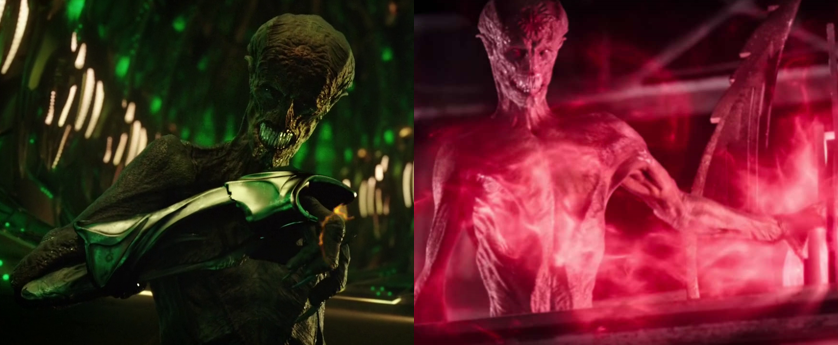
The Dominators are a formidable, if questionably rendered, force to be reckoned with.

I also really like that the conflicting dichotomies of each show is held intact; accordingly, Arrow’s Star City is ominous, dangerous, and constantly shown at night-time and characters like Oliver and Rene are stoic and distrustful, especially of metahumans since they (as in Team Arrow) are comprised, largely, of normal, non-powered individuals and somewhat resent the abilities of those with superpowers. Although none of Supergirl’s supporting cast make an appearance in this particular crossover, she brings an almost naïve and near-boundless enthusiasm and positivity despite the rough welcome she receives from some members of the cast. This is echoed in Barry and the more vibrant, colourful world of Central City, all of which are presented as a thematic parallel to Arrow throughout the Arrowverse. The controlled chaos of Legends of Tomorrow is similarly evoked; Legends has always focused more on the dysfunctional family dichotomy that the crew of the Waverider share as, while they’re all very distinct and opposing personalities, they are able to function as a time-travelling team and take their mission to police and protect time very seriously (even if they don’t necessarily act serious 100% of the time). However, one of the main things holding back Invasion!, much like many of the CW’s shows, are the special effects; for a television budget, the shows have always been ambitious and done pretty well, especially when it comes to costume design. Unfortunately, Invasion! decides to use CGI to render the Dominators rather than practical or more traditional effects, which does knock the quality of the crossover down quite a bit since they don’t hold up too well. The Dominators, for all their obscurity, make for a relatively formidable threat to bring the Arrowverse together; sporting advanced technology, mental capabilities, super strength, and a vicious, bloodthirsty nature, they are as cruel as they are fearsome, the Dominators are able to turn friends and allies against each other and place their victims into a virtual reality dream world in order to manipulate their thoughts and steal their knowledge.

The Summary:
For the first proper crossover between the Arrowverse shows, Invasion! is decent enough but a far cry from the crossover events that would follow; I think the main issue with the crossover is that it feels very rushed and clearly takes place in the middle of a number of unrelated and conflicting storylines for each character and show in the Arrowverse. As if the Arrow-centric episode wasn’t proof enough of this, the fact that Supergirl isn’t included with the crossover is and it all comes down to the simple problem of time. Later crossovers handled the placement and build-up of their crossovers a lot better, either purposely writing them to be standalone events or spending a great deal of time building up to them; Invasion!, though, is tonally all over the place, moving at a near breakneck pace and yet also being jarringly slow when it should be far more action-packed.

There’s not much to the Dominators but it’s a good enough excuse to unite the Arrowverse.

Still, it’s not bad for a first attempt; the Dominators may not be a particularly well-known threat in the DC universe but they serve their purpose here. Their design, while suffering from dodgy CGI, is ambitious, impressive, and suitably horrific and they are depicted as a significant threat. While we never really get a sense of their actual limits or power, they are certainly perceived as a force formidable enough to bring all these heroes together and even have Barry volunteer to sacrifice himself to end their threat. Their danger comes, mainly, from their intricate and advanced technology, their unique approach to warfare, and their sheer numbers, all of which hang over the crossover like an ominous cloud, making the Dominators as much an existential threat as an extra-terrestrial one. Essentially, they exist as the perfect excuse to bring together the Arrowverse super friends, so they’re mainly there just to be defeated (with an anti-climactic amount of ease, it has to be said) but at least they don’t operate on a hive mind, which is a refreshing change of pace.

Invasion! brought together the Arrowverse and cemented its version of the DC Trinity.

I’ve complained a bit about Invasion!’s conflicting focus and pace and, while that is an issue, it does allow the crossover to focus on something that is a big part of the Arrowverse: interpersonal drama. Despite the powers, abilities, and experience of each hero, these are all flawed and vulnerable characters and, if there’s one thing regular watching of the Arrowverse will teach you, it’s that our protagonists must learn new lessons about themselves, the world, and their team as much as they must battle against more tangible, often overwhelming, odds. The best thing about the crossover, beyond seeing all of these superheroes coming together for the first time, is the development of the Arrowverse Trinity (Kara, Barry, and Oliver), which would be the tentpole of further Arrowverse crossovers going forward and opened the door for so many new stories, characters, and possibilities which, as we’ll see in the coming weeks, the Arrowverse explored far deeper than I ever expected at the time.

My Rating:

Rating: 3 out of 5.

Pretty Good

How did you find Invasion!? Which character, cameo, and part was your favourite? Which of the CW Arrowverse shows was your favourite and why? What did you think to the Dominators as a threat? Are there any DC characters you’d like to see used in the Arrowverse or, perhaps, get their own show? Did you ever read the comic book Invasion! is based upon and, if so, how do you feel the crossover handled the story? Which of the Arrowverse crossovers was your favourite? Whatever your thoughts on Invasion!, and the Arrowverse in general, feel free to leave a comment below and check in again next Sunday as Crossover Crisis continues!

Screen Time: Pokémon Origins

Air Date: 2 October 2013
Worldwide Network: Pokémon TV 
Original Network: TV Tokyo
Stars: Bryce Papenbrook, Lucien Dodge, Jamieson Price, Kirk Thornton, and Kyle Hebert

The Background:
The brainchild of executive director Satoshi Tajiri, Pokémon began life as Capsule Monsters (later changed to Pocket Monsters and rebranded as Pokémon for the games’ worldwide release), a role-playing game inspired by Tajiri’s childhood days wandering through forests and collecting bugs. Thanks largely to the decision to produce two versions of the game, each with different Pokémon to collect and encouraging gamers to battle and trade with their friends to catch every Pokémon, the games sold very well in Japan and were soon localised for a worldwide audience. Fearing that American audiences would struggle to connect with the game’s cute concepts and creatures, Nintendo apparently spent well over $50 million localising, rebranding, and marketing the games for their international release. It turns out, however, that Nintendo were wrong to doubt Pokémon’s appeal; still, when Pokémon: Blue Version and Pokémon: Red Version released in 1998, they were accompanied by an anime, a trading card game, and more advertisements and media coverage than you could shake a stick it. Of course, history shows us that this aggressive strategy paid off; Blue and Red sold over 30 million copies worldwide, birthing one of Nintendo’s most popular and enduring videogame franchises ever, and the anime continues to air to this day, with feature-length movies and television specials being regularly produced.

Thanks to a co-ordinated marketing campaign, Pokémon dominated an entire generation.

In short, Pokémon was not just some short-lived fad of one generation but a multimedia blockbuster franchise that has spanned multiple generations and shows no signs of stopping. By 2013, there were over 720 Pokémon to be found, battled, and traded in comparison to the 150 regularly-obtainable Pokémon of the original videogames. The anime was well into its sixteenth season, having aired over 780 episodes, the sixteenth feature-length movie had just been released, the excellent ongoing Pokémon Adventures manga (Various, 1997 to present) was entering its eleventh chapter, and Pokémon was celebrating its fifteenth anniversary that year. This was also the year that Production I.G, Xebec, and OLM, Inc. produced a ninety-minute animated special, split into four parts, which retold the events of the original games in a way that was more faithful to the source material than the regular, ongoing anime. First broadcast on TV Tokyo ten days before the release of Pokémon X and Pokémon Y (Game Freak, 2013), the episodes were dubbed into English with a new voice cast and made available both on home media (in some countries) and to watch on various online platforms, including Pokémon TV.

The Plot:
Red (Papenbrook) and his childhood friend and rival, Blue (Dodge), have been chosen to select their first Pokémon from Professor Oak (Hebert). Tasked with completing Oak’s lifelong dream of capturing and recording data on all Pokémon, they set out into the region of Kanto, battling both Gym Leaders and the nefarious Team Rocket in a quest to not only capture every Pokémon but also become Pokémon League Champion.

The Review:
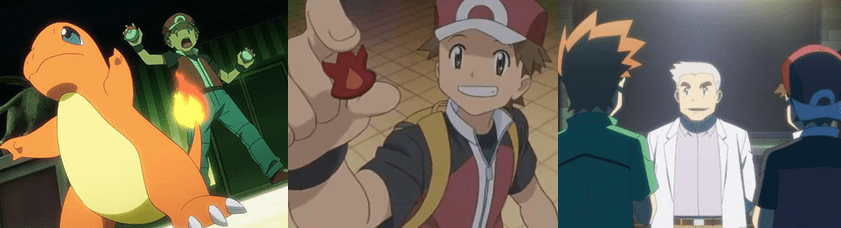
Pokémon: Origins is split into four parts, “File 1: Red” (Kawasaki, 2013), “File 2: Cubone” (Kuroda, ibid), “File 3: Giovanni (Takahashi, ibid), and “File 4: Charizard” (Tomiyasu, ibid). The animation style is quite different to that of the existing Pokémon series; for one thing, Origins looks much more professionally rendered and of a higher quality than even some of the Pokémon feature films. For another, many episodes feature music inspired directly from the videogames, with the classic Pokémon battle theme playing during Pokémon battles and the iconic, creepy Lavender Town theme playing when the story reaches the haunted Pokémon Tower. Of course, the anime did feature remixed versions of some recognisable Pokémon themes but nowhere to the degree of Origins; Origins also opens and closes each episode with a game save/load screen and includes dialogue boxes ripped right from the videogame.

Origins includes many aspects and mechanics from the videogames.

This closer fidelity to the source material brings Origins more in-line with Pokémon Adventures, which recreated many of the gameplay mechanics of the videogames with a surprising amount of detail and loyalty compared to the anime but also took the source material a bit more seriously as well, featuring blood, much higher stakes, and even Pokémon dying. While Origins doesn’t go fully down this path, it does go out of its way to stay closer to the source material than the anime: Red receives Technical Machines (TMs) and Hidden Machines (HMs) in the form of floppy discs, just like in the game; Pokémon battles (while generally much faster and glossed over thanks to Origins’ short runtime) are much more intense and closer to how they go down in the games (there’s no bullshit strategies like sprinkling water on an Onix to make it weak to electric attacks); and many of the items (such as the PokéFlute, the fishing rods, and the Silph Scope) from the videogame make an appearance, albeit a brief one.

Sadly, Origins glosses over many of the game’s important battles and plot points.

Something that lets Origins down, though, is the brevity of its narrative and the way it devotes the focus of each of its four episodes. “File 1: Red” begins in standard fashion, with Red and Blue beginning their Pokémon journey, establishing their rivalry (which is much friendlier than portrayed in the games or the early days of the anime), and Red learning the basics of Pokémon battling and capturing from Brock (Johnny Yong Bosch). However, from “File 2: Cubone”, each subsequent episode begins, and includes, a recap and a montage of sorts that glosses over what I consider to be some very important story beats: Red tells us about, and we briefly see, how he defeats the majority of the Gym Leaders (we only see him battle two in full throughout the course of the series), acquires the aforementioned fishing rods, captures the majority of his Pokémon (again, we only really see him capture a handful in any kind of detail), the evolution of his Charmander (Shin’ichirō Miki), and even his battles against the Elite Four and, most egregious of all, some of his most important encounters with the villainous Team Rocket.

Red and Blue begrudingly team up but Team Rocket are easily defeated despite their reputation.

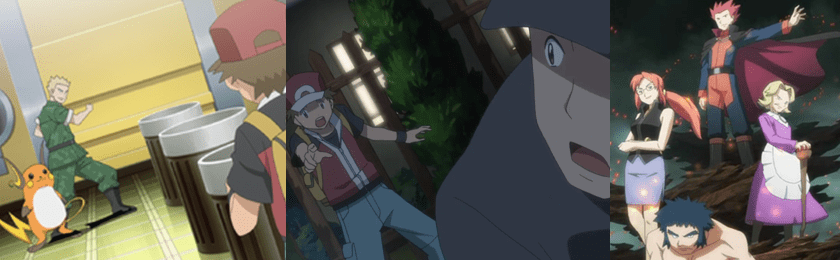
Obviously, there are only four episodes of this mini series so the story cannot cover everything from the videogames but, for me, glossing over Red’s first meeting with Team Rocket and his eventual vendetta against them is a bit of a mistake. Take “File 2: Cubone”, for example; sure, it features Team Rocket having overtaken the Pokémon Tower, but it’s far more concerned with the trauma the group caused Cubone (Cristina Vee) and the ghost that haunts the tower. Red and Blue begrudgingly team up to solve both problems but Team Rocket is easily defeated first off-screen by Blue and then with a ridiculous amount of ease by Red, who successfully scares them off after defeating one of their Pokémon. Considering how the townsfolk were so afraid of Team Rocket’s power and threat earlier in this episode, this is more than a little disappointing and I would have preferred to see Red’s journey through Mt. Moon and his battle against Lieutenant Surge to help properly establish Team Rocket’s threat in this world. On the plus side, at least the group isn’t portrayed as largely ineffectual bunch of goofballs and Red takes his opposition to their plot a lot more seriously than Ash Ketchum (Veronica Taylor/Sarah Natochenny).

Although he stumbles in the first episode, Red quickly becomes a competent and capable trainer.

When comparing Red to Ash, it’s like comparing night to day or apples to oranges. There are some similarities but these are generally due to the fact that both characters are based on the avatar from the games and therefore follow the same path the player forges in the source material. While both are big Pokémon fans and excited to become Pokémon trainers and both start out knowing very little about the actual mechanics of Pokémon battling, capturing, and the scope of their journey, it takes Red a bit more time to learn that a close bond with his Pokémon is required to grow stronger and succeed in battle. While Brock does help to teach him these lessons, Red’s bond with Charmander is nowhere near as intense as Ash’s with Pikachu (Ikue Ōtani) yet he quickly becomes a far more competent trainer than Ash; in a surprising amount of restraint, Pikachu only appears in a brief cameo and, to separate Red from Ash even more, Red not only uses a far more competent Electric-Type Pokémon in Jolteon (Unknown) but only captures a Pikachu after he has become the Pokémon League Champion! Granted, most of this is implied, seen in montages, or takes place between episodes but Red captures way more Pokémon (mainly because he’s much more committed to completing the PokéDex than Ash), easily defeats pretty much every trainer and Gym Leader he comes up against, and has a far more well-balanced and well-trained team than Ash has ever had. Hell, Red even ends up with Articuno (ibid) in his squad and, generally speaking, has much more in common with his counterpart from Pokémon Adventures, who was also a far more competent and capable trainer compared to Ash.

Blue is humbled in defeat, realising Red’s bond with his Pokémon has made him superior.

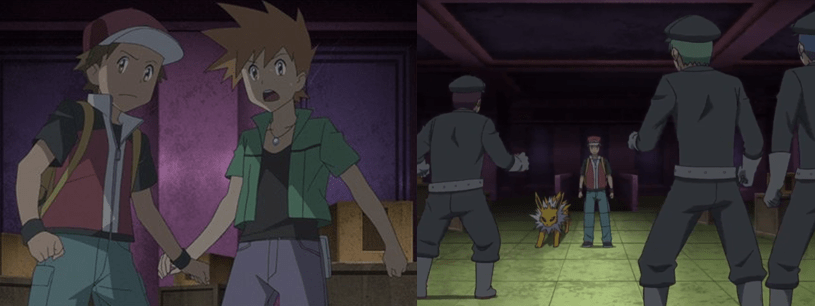
One thing that helps separate Origins from the anime is the relationship between Red and Blue; in the games, and the anime, these two had a largely antagonistic relationship throughout the story until facing off in the Pokémon League. Here, though, while Blue is arrogant and a blowhard and determined to complete the PokéDex before Red and become a more powerful and capable trainer than him (he picks Squirtle (ibid) not because it matches his name but specifically because it will give him the type advantage over Red’s Charmander), he and Red have a much more friendly rivalry than one based on actual animosity. Blue sees himself as Red’s superior and seems to both be motivated to beat Red to the punch wherever possible and happy to walk away from confronting the likes of Team Rocket when it doesn’t suit him but the two are generally more about ribbing on each other and winding each other up about their progress and abilities than actually hating each other. Sadly, though, because of the brevity of the mini series, Red and Blue only battle head to head twice in this story; the first time, Red is soundly defeated as his strategy of mindlessly attacking without having properly developed trust and partnership with his Charmander prove his downfall. Brock specifically uses Blue as an example of a trainer who has established this bond and it is from both of them that Red learns to put his love and trust into his Pokémon, which are treated as his beloved partners and allies rather than mere tools. However, when they face-off again in “File 4: Charizard”, the tables have turned; though Blue has already become the Pokémon League Champion, he falls to Red despite having amassed a team powerful and diverse enough to conquer any and all opponents not because of his lack of strength but because he had failed to maintain the bonds of trust and friendship between himself and his partners. Humbled by his defeat, Blue nevertheless congratulates Red on his victory and accomplishments and the two retain a friendly rivalry for the final episode of the anime, one based on Blue’s desire to one-up Red at any opportunity while still acknowledging his skill and capability.

Battling with Red awakens a passion that Giovanni had long forgotten.

Despite much of Origins being reduced to quick montages, there is still a strong sense of Red’s capability throughout the anime; after learning valuable lessons from Blue and Brock, Red goes from strength to strength, easily defeating other trainers and Gym Leaders even when he has a massive type disadvantage. Not counting that initial battle against Blue, Red only runs into two roadblocks throughout his journey, the first being his showdown against Giovanni (Price). Though Red’s first meeting with the Team Rocket boss is glossed over in a recap, his battle against him for the Earth Badge is a significant part of the aptly-named “File 3: Giovanni”. The strength of Giovanni’s Rhyhorn (Unknown) alone is enough to wipe out all of Red’s team even when Red has the type advantage but Red’s determination and passion for both battling and towards his Pokémon awakens something in Giovanni he had long forgotten. Exhilarated by the thrill of the battle (even though it’s ridiculously one-sided in his favour for the majority of the time), Giovanni is impressed, humbled, and even grateful to have been defeated by such a zealous trainer. So touched is Giovanni that he disbands Team Rocket and wishes Red well on the remainder of his journey, urging Red to follow the path that he (Giovanni) strayed from long ago and pledging to carve a new path for himself going forward.

Mewtwo represents Red’s final, and greatest, challenge.

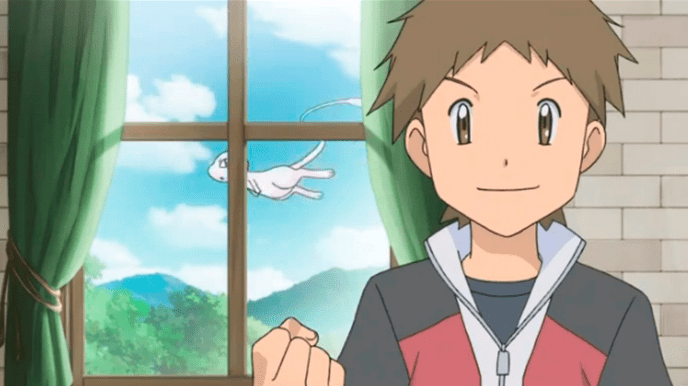
The second obstacle Red encounters is hinted at in “File 2: Cubone” and forms the central focus of “File 4: Charizard” and it is, of course, Mewtwo (ibid). Mewtwo’s threat is immediately established by how badly, and easily, it overwhelms Blue, leaving him badly injured and putting the wind up the usually arrogant trainer. Nevertheless, motivated by the desire to finally complete Oak’s PokéDex, Red heads to Cerulean Cave to confront the creature, which is still a genetic copy of the mythical Pokémon Mew (Christine Marie Cabanos) but, unlike in the anime and manga, it never speaks or communicates in any way other than brutal, aggressive battle. Far from the nuanced, tortured character in other media, Mewtwo is portrayed more as simply an extremely powerful Pokémon to be captured like any other, which is much more in-line with its position in the games as a “super boss” of sorts rather than a pivotal plot point. However, even Red is unable to match Mewtwo’s monstrous power; luckily, though, he was gifted two Mega Stones by the mysterious Mr. Fuji (Kirk Thornton) in “File 2: Cubone” and, even more helpfully, they just so happen to react to the close bond between Red and Charizard (Shin’ichirō Miki) and allow Charizard to mega evolve into Mega Charizard X (did I mention that Origins came out around the same time as Pokémon X and Y?) This is enough of a power boost to allow Red to overwhelm Mewtwo faster than it can react and capture it with a ridiculous amount of ease; seriously, Red throws two Ultra Balls and captures Mewtwo with the second, which is some serious bullshit when you think about how many damn balls it can take to snag Mewtwo in the games. I would have liked to see Red use a Master Ball but, sadly, he never acquires one in Origins as it’s merely an unfinished prototype in this story.

Origins ends with Red eager to find more Pokémon, starting with the mythical Mew.

Regardless, Red is successful and captures all 150 Pokémon but his mission is far from over as, while celebrating with Oak and Blue, he remembers that Mewtwo was created from Mew and rushes out a bundle of excitement and anticipation at the prospect of encountering and capturing still more Pokémon. It’s here, and in Red’s steadfast determination in battle, that we see the closest links between Red and Ash: both are stubborn in battle and endlessly excited about capturing and finding new Pokémon. However, Red ends Origins a far more accomplished and experienced trainer; he’s the Pokémon League Champion, for one thing, and now has numerous Legendary and incredibly powerful Pokémon in his possession. In this regard, Origins ends exactly as a standard game of Blue or Red would end, with the character having numerous Pokémon at their disposal and ridiculously overpowered. While Ash does also grow and become more accomplished as a trainer, this takes…what? A hundred episodes? Two hundred? And even then he still makes rookie mistakes; no such foibles befall Red but, to be fair, much of his growth as a trainer and a character is implied, rushed through in montages, or takes place between episodes and relies heavily on the viewer’s familiarity with the videogames to fill in the blanks whereas the anime is able to use many (many) episodes to show Ash’s numerous lessons and growth.

The Summary:
Pokémon: Origins is an extremely enjoyable, gorgeously-animated anime; everything from the character designs, Pokémon battles, and sounds is fantastic to look at and closely reminiscent of the source material. Unlike the anime (and a lot of Pokémon media), Pokémon do not constantly speak their names and instead have more realistic, animal sounds like in the games; Japanese text is also left unaltered, which is refreshing, and while many elements, mechanics, and important plot points from the games are glossed over, at least they’re actually included here rather than either being ignored or significantly altered. As much as I enjoy the anime (specifically the films because of their focus on Legendary Pokémon), it can be grating at times to follow a character as annoying and unreliable as Ash and, because of that, Red is a breath of fresh air. Like his manga counterpart, Red is competent, brave, and determined; he starts out as a rookie, knowing very little about the basics and nuances of Pokémon battling, and quickly matures to the point where he can defeat Gym Leaders with ease, single-handedly brings down Team Rocket (something Ash is still struggling to do), and not only captures Legendary Pokémon but casually uses them as part of his team just like the player would. His fidelity to the player’s character and journey is commendable; he learns the same lessons that the player does throughout the game while still being his own distinct character separate from the player’s avatar, Ash, and even his manga counterpart.

Origins‘s fidelity is impressive, though it rushes through many usually-important plot points.

It’s this fidelity to the source material that elevates Pokémon: Origins and makes up the majority of its appeal; the anime strayed too far from the gameplay mechanics and spirit of the games for my taste, as much as I enjoy it, so it’s refreshing to see such a well-crafted and well-animated series tell a very similar story to the anime but in a way that is so much closer to the source material. The only thing that lets Pokémon: Origins down is the brevity of its narrative; limiting its story to just four episodes means so much of the game’s story gets glossed over and the focus can be a bit skewed at times. While, at its core, it focuses on Red’s journey and his mission to complete the PokéDex and his ongoing rivalry with Blue and Team Rocket, I can’t help but feel like this would have benefitted from being more like ten episodes to spend a bit more time on Team Rocket, Red’s battles against the Kanto Gym Leaders, and, specifically, his battles against the Elite Four.

My Rating:

Rating: 4 out of 5.

Great Stuff

What did you think about Pokémon: Origins? How do you think it holds up when compared to the anime and numerous feature films? Did you enjoy how faithful it was to the source material or do you feel that it was weighed down by focusing on fidelity over telling a more unique story? Do you agree that certain parts were rushed or were you happy with the story it told? Which character, or Pokémon, is your favourite and why? How did you capture Mewtwo when you first played Pokémon? Whatever you think, do please leave a comment below and join me next Saturday for National Pokémon Day!

Screen Time: Batwoman (Season One)

BWLogo
Season One

Air Date: October 2019 to May 2020
UK Network: E4
Original Network: The CW
Stars: Ruby Rose, Rachel Skarsten, Meagan Tandy, Nicole Kang, Camrus Johnson, and Dougray Scott

The Plot:
Three years after Bruce Wayne (Warren Christie) disappeared from Gotham City, taking his vigilante persona Batman with him, Kate Kane (Rose), Wayne’s cousin, returns to Gotham to confront her childhood demons and ends up becoming Gotham’s newest vigilante protector, Batwoman.

The Background:
Ever since the “Arrowverse” began with the first episode of Arrow (2012 to 2020), we have seen hints and references towards Gotham City and its resident bat-themed vigilante. Nowhere was this more explicit than in Arrow, where Oliver Queen/The Hood/The Arrow/Green Arrow (Stephen Amell) mostly occupied himself not with being a left-wing protector of the socially handicapped and more with being a pseudo-Batman, adopting not only many of the Dark Knight’s more grim and stoic mannerisms but also the majority of his rogue’s gallery. By the time the Arrowverse eventually swelled to the point where they were actually able to pull off a pretty decent adaptation of Crisis on Infinite Earths (Wolfman, et al, 1985 to 1986), things had changed quite considerably. Not only had an unconnected show, Gotham (2014 to 2019) delved into the origins of almost every one of Batman’s popular villains, Batman (Alain Moussi and Maxim Savarias) and Bruce Wayne (Iain Glen) had appeared and featured quite prominently in Titans (2018 to present) and, prior to the Arrowverse’s “Crisis on Infinite Earths” (2019 to 2020) crossover, Kate Kane/Batwoman had been introduced in the CW’s previous crossover, “Elseworlds” (2018). Unfortunately, like many other DC television projects, the Arrowverse is slightly handicapped by not currently being able to include Bruce Wayne or Batman in any direct capacity. I honestly feel like, were The CW allowed to use Batman, we would have gotten nine years of the Caped Crusader rather than the Emerald Archer but, despite this block (which, to be honest, makes no sense because of Titans and Gotham), the Arrowverse had been able to make sly nods to familiar elements of the Batman mythos. Kevin Conroy even appeared as an aged, disillusioned alternative version of Batman in “Crisis on Infinite Earths” but it’s safe to say that the shadow of the Bat loomed heavily over not just the Arrowverse but, somewhat obviously, over Batwoman especially.

The Review:
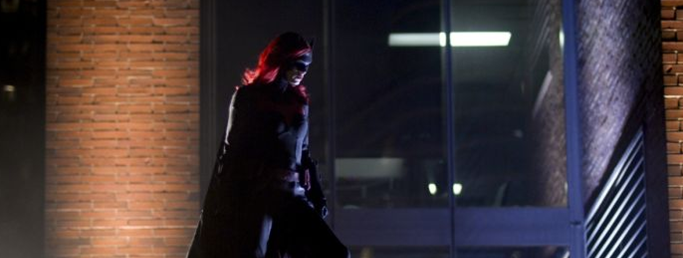
It’s no secret that I am a massive fan of Batman and, yet, I’ve struggled a bit with the way he’s represented in live-action. I got into Arrow quite late into its run but really came to resent how it transposed Batman’s characteristics and rogues onto Green Arrow, even though it worked in the context of the Arrowverse where Oliver’s more stoic and serious approach to crimefighting juxtaposed with the more optimistic approach of Barry Allen/The Flash (Grant Gustin). While I am also somewhat familiar with Batwoman from the comics, I can’t say I’m a massive expert on her beyond the basics and basically went into Batwoman hoping more for an interesting female-led superhero show. I couldn’t really get into Supergirl (2016 to present), despite how good Melissa Benoist looks and is as the titular Supergirl/Kara Danvers or the inspired decision to cast Jon Cryer as Lex Luthor in its later seasons; honestly, the show seemed to be filled with way too much sexual tension between Supergirl, her female co-stars, and basically between every female character in the show…which is weird as I never got that vibe from the male-led Arrowverse shows. Batwoman, however, has the distinction of already being a lesbian character; not only that, she’s quite a guarded, tough character, meaning that the show is less about her desperately trying to repair failed relationships with her friends to the point where you suspect she is in love with them and more about her standing up, loud and proud, as being an equal to the men in her life. As such, Ruby Rose is a great choice for Kate Kane/Batwoman; she looks fantastic in the suit (when its shot in minimal lightning and kept in shadow), and has a tough-as-nails demeanour about her made all the more apparent by her signature snark, scowl, and abundance of tattoos. Unfortunately, like Supergirl, Batwoman faces many comparisons to Batman throughout the show; episodes are frequently intercut (and, in my view, ruined) by voiceovers from media gossip Vesper Fairchild (Rachel Maddow), who comments on Batwoman’s hair, wardrobe, and effectiveness compared to Batman and Kate is constantly asking Luke Fox (Johnson) for input on how Batman would handle certain situations (she even had to have her Batarangs “recalibrated” to account her for having shorter, weaker arms).

BWArrowAlice
Batwoman‘s main plot is adapted from the “Elegy” story.

Despite this, Kate is very much her own character; she never sought to become Batwoman and, instead, utilised a modified version of Bruce’s suit and technology to assist in her investigation into Alice (Skarsten), a mentally unstable maniac who themes her crimes after her namesake from Alice’s Adventures in Wonderland (Carroll, 1865). You might think having the show’s main villain being a knock-off of D-list Batman villain the Mad Hatter is a mistake but, it turns out, that the link between Batwoman and Alice was a big part of the “Elegy” (Rucka, et al, 2009 to 2010) storyline during Batwoman’s time in Detective Comics (1937 to present). As a result, the main plot of Batwoman focuses on Kate’s discovery that Alice is actually her long-lost, long-presumed-dead twin sister, Beth. Like Arrow, the story of Kate and Beth’s childhoods and pasts is told through flashbacks, through which we see how Batman (in broad daylight, the first of many issues this show has) failed to properly secure the car young Kate (Gracyn Shinyei) and Beth (Ava Sleeth) were in, resulting in the death of their mother and Beth ending up a prisoner of the sadistic August Cartwright/Dr. Ethan Campbell (John Emmet Tracy and Sebastian Roché) and forced to befriend his disfigured son, Jonathan Cartwright/Mouse (Sam Littlefield). Unfortunately, after only a few episodes, I kind of lost interest in Alice as a character and a villain; she’s just crazy for the sake of being crazy and is more annoying than anything, especially as she often flip-flops between being a full-on murderous sadist and being a scared girl desperate for help. As a villain, she’s just not that compelling and it gets very annoying how she is constantly captured, only to escape, or seems to be on the road to rehabilitation only to immediately do a 180 and Kate falls for her act every. single. time.

BWDougray
Dougray Scott is a welcome addition to the cast.

Left mentally unbalanced by her time in captivity, Alice leads the Wonderland Gang in targeting her estranged father, Commander Jacob Kane (Scott); quite how Batwoman managed to snag Dougray Scott is beyond me but he’s a great addition to the show, lending a gravitas and feeling of professionalism that is sorely missing due to Batman, Alfred Pennyworth, and Commissioner James Gordon all being absent. Jacob heads up a private security agency known as the “Crows”; for all intents and purposes, they are Gotham’s police department as, while they work with the Gotham police, they’ve basically transplanted them in Batman’s absence. Scott has great chemistry with Rose; the two have a frosty relationship with many wrinkles and a lot of friction as Kate believes her father gave up on Beth and turned his attention to blaming, and hating, Batman instead. She also strives to be seen as an equal and beneficial to his cause, though repeatedly turns down his offers to join the Crows as she comes to accept her role as Batwoman. Eventually, their relationship improves but his views and opinions on Batwoman begin to sour, with the season ending with Kane declaring all-out war on Batwoman and any who aid and abet her. Rounding out the cast, and the drama, is Kate’s ex Sophie Moore (Mandy), who denied all knowledge of their same-sex affair in order to graduate from military academy and join the Crows. Kate is heartbroken when she returns to Gotham and finds Sophie married to fellow Crows agent Tyler (Greyston Holt) and much of the show’s wonky relationship drama hinges on their “will-they, won’t-they” back and forth as Kate attempts to move on to other relationships and finds a decent distraction in her vigilante activities. This becomes more complicated when Sophie’s relationship breaks down after her past with Kate is revealed to Tyler and when Sophie inexplicably becomes attracted to Batwoman (who publically outs herself as a lesbian, thus becoming instantly attractive to all lesbians).

BatwomanJulia
Julia is pretty and bad-ass but ends up being a bit of a stereotype.

The seeds for this were planted a few episodes in with the inclusion of Alfred’s little-know-of daughter, Julia Pennyworth (Christina Wolfe), a semi-cockney, bad-ass spy who Kate has a past sexual relationship with, because if it’s one thing that is true across not only the Arrowverse but all fictional television, all gay people are immediately and uncontrollably attracted to each other. This is exemplified further when Julie starts making semi-regular appearances; circumstances see her working alongside Sophie and growing closer to her and, of course, a sexual relationship builds between them. We’ve also got Kate’s younger stepsister, Mary Hamilton (Kang), who operates perhaps the most well-known illegal clinic where she treats castaways from Gotham’s hospitals and basically functions as Batwoman’s medical support as the show goes on. Once Alice is revealed to be Beth, Mary and Kate’s relationship begins to suffer and comes to a breaking point after Alice fatally poisons Mary’s mother (and Kate’s stepmother), Katherine Hamilton-Kane (Elizabeth Anweis), and she dies in Mary’s arms. Kate is then torn between her desire to both reach Beth, bring Alice to justice, repairing her relationship with Mary, and the fact that Alice has ensured that Jacob is framed for the crime, which shakes the city’s faith in the Crows and has them clamouring for Batwoman instead. Eventually, however, Mary figures out Kate’s dual identity and feels slighted for some time at her step-sister keeping her in the dark about her actions; this relaxes somewhat after she is officially let in on the secret and then desperately tries to become part of Kate’s Bat-Team. Honestly, far too many people find out Kate’s identity over the course of the season, which really compromises her integrity as Batwoman for me.

BWBatCave
Batwoman‘s Batcave is like an updated version of the 1960’s ‘cave.

As a result, Batwoman becomes a far more public figure than I am honestly comfortable with for a Bat-branded vigilante. It is very heavily implied that Batman was just as publically celebrated and the subject of news reports but Batwoman straight-up ends up plastered all over social media and even explicitly outs herself as gay when the city begins to “ship” her with Samuel “Slam” Bradley (Kurt Szarka), an attractive hero cop who makes a brief appearance. Other characters from the Arrowverse also appear in the series’ tie-in to the “Crisis on Infinite Earths” crossover which, honestly was the only reason I actually watched this show week to week. Moving on from the casting, I have to talk about the show’s aesthetic; first, while the Bat-Signal is present, it has to be the lamest iteration I’ve ever seen. Normally, it’s this massive floodlight but, in Batwoman, it’s this piddling little thing that looks like it’s struggle to light a hallway much less cast the iconic Bat embalm into the night sky. Second, like Arrow, much of Batwoman takes place in cityscapes. This means there’s a lot of offices, conveniently abandoned warehouses, and scenes that take place on the city streets. Despite the fact that Gotham has been without Batman for three years, the city has, arguably, never looked cleaner and more well-kept; similar to how Gotham appeared flawless during the daytime scenes of The Dark Knight (Nolan, 2008), Batwoman’s Gotham seems like a relatively safe place to life for the most part. This is implied to be because of the presence of the Crows and the convenient absence of Gotham’s more colourful super criminals but, still, I kind of expect my Gotham to be just as dark and dirty as Star City was in Arrow, which was rarely ever shown in the daytime. Like all of her Arrowverse cohorts, Batwoman has a secret base of operations where she can suit up and monitor events in the city. You might have heard of it; it’s called the Batcave. Batwoman’s Batcave, though, is perhaps the cleanest and most simplified version of the ‘cave I’ve ever seen. Even the Arrow’s Arrowcave, with all its obnoxious high-tech furnishings, looked more like a Batcave than Batwoman’s, which seems to be a cross between the Bat-bunker from The Dark Knight and the iconic Batcave from the 1960’s Batman television series (1966 to 1968) with its sixties-style flashing lights and terminals (it even has a little toy Tyrannosaurs rex which, to be honest, is a nice little allusion to the impractically gigantic T-Rex Bruce likes to keep in he Batcave).

BWSuit
Luke adapts the Batsuit to fit Kate’s…specifications…

Luke Fox practically lives in the ‘cave, functioning as Batwoman’s tech support and “guy in the chair”; you’d think this would be a great way to introduce the wheelchair-bound Barbara Gordon/Oracle and inject some sexual tension between her and Kate but, instead, we have a hybrid of Lucius Fox and Alfred. In the comics, Luke became the Bat-themed vigilante Batwing and I wouldn’t be surprised if Luke doesn’t take up this codename at some point in the show’s run; hell, if Jimmy (sorry, “James”) Olson (Mehcad Brooks) can suit up as the vigilante Guardian over on Supergirl than anything is possible. While Fox is initially relegated to Batwoman’s tech support (developing her gadgets and suit, monitoring and communicating with her when she’s out in the field, and so forth), he gets a bit more focus as more and more people join their team and, especially, when he feels compelled to confront the man who killed his father (yeah, Lucius Fox is also dead in this series…) right when Kate is struggling with having taken a life. Fox is apparently some kind of genius as Batwoman’s suit is apparently so sophisticated that it’s full of technology that monitors her heartbeat, oxygen levels, and all kinds of stuff that I find difficult to believe is weaved into a far more form-fitting outfit than anything Batman is known to wear. Initially, Kate wears a modified version of the standard Batsuit as she takes to the streets and is thought to be Batman but, after she sees all the good she’s doing and the hope she’s bringing, she has Fox alter it further to include a wig and her signature red colouring and is officially announced as Batwoman.

BWHero
The Bats are publicly celebrated as heroes and saviours rather than myths.

This is one of the things I actually have an issue with in the show; when Batwoman was introduced in “Elseworlds”, Batman was a myth so powerful that even Oliver Queen didn’t believe that he was real. Jump over to Batwoman, though, and not only is Batman openly the subject of media gossip and coverage, he’s a widely known and celebrated hero of Gotham City. The Crows, especially Jacob, despise Batman for his anonymity and for abandoning the city and even Kate was distrustful of the Caped Crusader until she found out who he was; once she did, she was inspired by his legacy and began continuing Bruce’s journals to chronicle her own journey. My issue here is the idea of Batman as a “hero”; as I prefer Batman to be an urban legend, feared by criminals, distrusted by the police, and a figure of mystery to the general public, something about gossip columnists openly discussing his methods and the entire city acknowledging his presence and celebrating him as they would the Flash rubs me the wrong way. Even Arrow handled this aspect of its titular vigilante better, with Oliver’s hooded alter ego not really being publicly acknowledged or celebrated for some years so it’s a bit weird for me to see Gotham’s citizens “crying out” for their hero’s return. And then there’s Batwoman’s portrayal of Bruce Wayne; through dialogue with Fox, Kate learns more about Bruce’s motivations, how he handled the burden of his duel identity, and the reasons behind him walking away from Batman and Gotham. To begin with, Bruce/Batman is almost this mythic figure, some lofty ideal that Kate can only dream to live up to, much less match. But then some cracks begin to form, the first being when Fox reveals that Bruce commissioned the creation of a gun that could penetrate the Batsuit, with the implication being that, were his technology to fall into the wrong hands, Bruce would be happy to kill the perpetrator. The second, and most egregious, is the revelation later in the series that Bruce quit being Batman after he killed the Joker (here also referred to as Jack Napier).

BWKill
Batwoman wasn’t too shaken when she killed the alternate Bruce Wayne…

Let that sink in for a second: Batman was not only willing to kill to stop someone who stole his Batsuit, he also killed the Joker, and felt he had to quit being Batman because of it. While I don’t actually mind Batman killing, it’s unsettling when so much emphasis is put on Bruce’s uncompromising moral standing only to throw it all away by him creating a gun and killing his greatest enemy. Worse still is that Fox only reveals this to Kate after she has strangled August Cartwright to death for what he did to her sister and mother. Now, again, I don’t mind Batman killing under the right circumstances; I grew up with Michael Keaton’s fantastically haunting portrayal of the character so I’m used to a Batman who is willing to cross the line now and then and fully believe that, in his line of work, casualties and fatalities are bound to happen. It’s also worth noting that Batwoman is a former soldier and, especially in the comics, is not adverse to killing when it’s absolutely necessary. Over the space of three episodes or so, though, Kate struggles with her actions in a way that, again, Oliver Queen never really did; when he first returned to Star City, Oliver killed specific targets and his enemies without a second’s thought. Later on, he tried to “do better” by not killing but easily went back to shooting arrows through people’s hearts not long after and he’s no less a hero for it, so why would Batwoman (or Batman, for that matter) be? Still, Batman’s code against killing is an important aspect of the character and going against that is always going to ruffle a few feathers; it also seems like a really lame, super easy excuse to write Bruce/Batman out of the show. It’s also worth noting that it was taking a life that led to the aged Bruce becoming a remorseless killer in “Crisis on Infinite Earths” and that Kate killed him (whether by accident or design) during a fight and showed very little remorse over this.

BWVillains
Batwoman featured a few of Batman’s D-list rogues.

Moving on, though, the show features a small selection of Batman’s D-list rogues; though she has no ties to the Mad Hatter, Alice’s mere presence alludes to his existence; the Joker, as mentioned, is disappointingly dead; and a version of the Executioner (Jim Pirri) also appears. Being that this is a female-led show, and a lot of the show’s plot is focused on female empowerment, there are a few female villains in Batwoman (the oft-forgotten Magpie (Rachel Matthews) and Nocturna (Kayla Ewell), for example) but most episodes revolve around Alice in some way, shape, or form, and her efforts to get revenge on Kate and her father and temptation towards redemption. Thomas Elliot (Gabriel Mann) also shows up early in the season as a friend and rival of Bruce’s but is quickly revealed to have deduced Bruce’s identity as Batman and to be as crazy as a bag of cats so he ends up in Arkham Asylum. Thankfully, though, Batwoman is full of face transplants and glorified plastic surgeons and, through the influence of Alice and Mouse, Elliot breaks out of Arkham, gets his face sliced off, and ends up wrapped up in bandages and taking on the persona of Hush. Unfortunately, though, Elliot is both just another crazy guy and another rich guy in a suit, so he’s far from the physical or intellectual threat as the comic book Hush, though the season does end with a massive cliff-hanger as Elliot applied a patchwork skin to his face to assume Bruce Wayne’s identity. Something Batwoman likes to employ, for whatever reason, is the implementation of licensed songs to punctuate its more dramatic (read: soap opera) moments. Songs like these may have fit into teen dramas like Smallville (2001 to 2011) but they seem massively out of place in a Bat-centric show. Luckily, Batwoman takes its lead more from Arrow for its action sequences and fight scenes; generally, episodes will open with some kind of chase, kill, or action sequence. Kate (and/or Jacob) will then investigate something, or have some kind of confrontation, and then she’ll hit the streets as Batwoman, maybe take out some goons, before working towards a finale against whomever is the main threat of the episode. Fight scenes are far more hands on and up close and personal than in Arrow, though, as Batwoman favours hand-to-hand combat over a bow and arrow. Like Green Arrow, Kate masks her voice with a voice synthesiser, which I always prefer over the idea of the Bat-characters putting on a voice (despite how good these voices have been), but this doesn’t stop multiple characters guessing or knowing her identity within only six episodes.

BWConclusion

The Summary:
Ultimately, the season started off quite well and had a lot of promise but fell off a cliff very quickly; after a few episodes, Batwoman becomes very formulaic, makes some questionable decisions regarding Batman’s legacy and the inclusion (or exclusion) of famous Bat­-characters, and ended on a massive cliff-hanger that, by the looks of it, we either won’t get resolved in a second season or it will be significantly different because of the behind the scenes shenanigans. After flip-flopping about a hundred times, Alice decides she hates Kate and Batwoman as they betrayed her and got her locked up in Arkham Asylum. Thankfully, she makes fast friends with Thomas Elliot, who has snapped and basically believes Bruce Wayne to be his best friend, and she and Mouse concoct a bizarre plan to cut off Elliot’s face (and have him disguise himself ((because face transplants are super easy and impossibly convincing in Batwoman)) so they can get out of there. The remainder of the season focuses on Alice trying to acquire, and then decode, Lucius’ journal so she find out how to penetrate the Bat-Suit and kill Batwoman…despite the fact that she had a means to do this earlier in the season.

BatwomanFinale
Batwoman ends on quite a cliffhanger that will probably have a poor resolution in Season Two.

In a contrivance that makes my head spin, it turns out the Kate’s suit is so incredibly bullet proof that the only thing in the world that can penetrate it (beyond the special bullet introduced earlier in the season that the writers forget about) is…Kryptonite. This presents a problem as Supergirl (whom Batwoman has a very rushed but quite charming, friendship with) entrusted Kate with a shard of Kryptonite to use against her if she ever went rogue. Although Luke compresses the only other shard into powder, Alice is heartbroken when she is forced to kill Mouse as he threatens to leave without her and swears to kill Kate once and for all. This coincides with Elliot assuming the role of Bruce Wayne and Jacob’s vow to end the Bat infestation in Gotham City to keep vigilantes from supplanting his organisation and leaves Batwoman on a massive cliff-hanger but most likely will get swept under the carpet when the series returns to television. I was interested in Batwoman for a couple of reasons: first, I wanted to see the second part of “Crisis on Infinite Earths” and the legendary Kevin Conroy as a live-action Bruce Wayne and, second, I was interested to finally see a Bat-themed show as part of the Arrowverse. Unfortunately, despite some decent casting, action sequences, and costume design, Batwoman started to lose me around the third episode (basically the moment it was revealed that Bruce had developed that Batsuit-ending gun).

BWSupergirl
Seriously, these two need to just get a room!

It wasn’t as annoying as Supergirl or as pointless as DC’s Legends of Tomorrow (2016 to 2020) but it’s still not on the same level as The Flash (2014 to present) or even Arrow; I pretty much only dip in and out of Legend of Tomorrow because they made the smart decision to put John Constantine (Matt Ryan) on the team and completely gave up on Supergirl after the show devoted all of its runtime to Kara desperately trying to repair her relationship with Lena Luthor (Katie McGrath), which descended to the point of parody when it seemed like they were desperately in love with each other but in vehement denial over it. Yet, I feel the same thing is going to happen with Batwoman; it wasn’t as explicit with its comparisons of Batwoman to Batman or at pushing its pro-female agenda, so it’s much easier to watch than Supergirl, but a lot of its narrative decisions were questionable. Not having Bruce Wayne/Batman in the show really hurts it, in my opinion; this would have been a great opportunity to combine the Arrowverse series with Titans and have Iain Glen reprise his role in an older, mentor role after being incapacitated. Instead, Bruce is just…gone and, while his retirement kind of worked for Nolan’s films, it never sits well with me when Batman just gives up his life-long crusade. And what about Dick Grayson? Jason Todd? Tim Drake? All the rest of Batman’s cast of characters, both friend and enemy? Where are all of them in this world? The questions Batwoman raise far overshadow any of its positives and I can’t say that Batwoman really impressed me in its first season and, considering that Ruby Rose has decided to walk away from the show and the role will be completely recast and supplanted, I doubt that it’ll be a suitable replacement for Arrow, no matter how many seasons it runs for.

My Rating:

Rating: 1 out of 5.

Terrible

What did you think of season one of Batwoman? Are you interested in seeing subsequent seasons and appearances by Ruby Rose in the Arrowverse or would you rather the CW pulled the plug on this show? What are your thoughts on the way Batwoman handled the portrayal of Bruce Wayne/Batman and Gotham City? Whatever you think about Batwoman and the Arrowverse, feel free to leave a comment below.
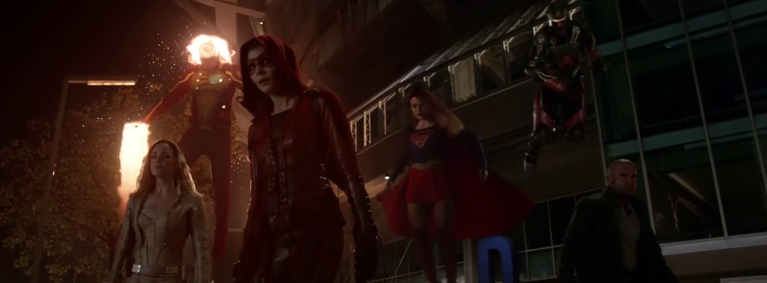
Screen Time: That ’70s Marvel Cinematic Universe

Superheroes may dominate television screens these days, but it all started back in the seventies. Long before the Marvel Cinematic Universe (MCU) took cinemas by storm and drummed up enough cash to sink a small cruise liner, Marvel Comics had ventured into live-action adaptations of their comics books by licensing their properties to studios like CBS and Universal Television. This produced the iconic Incredible Hulk (1977 to 1982) television show that firmly entrenched the Green Goliath in the cultural consciousness and produced tropes that became synonymous with the character for years to come.

You wouldn’t like him when he’s angry…

However, The Incredible Hulk wasn’t the only live-action adaptation of a Marvel Comics property to be produced in the seventies; in fact, there were so many productions (or, at least, so many Marvel characters) around this time that a version of the MCU can be seen to have existed long before Iron Man (Favreau, 2008) graced cinema screens. So, today, I’m going to take a quick look back at some of these productions and have a chat about the MCU we very nearly saw come together back in the days of Pink Floyd, frayed jeans, and mullets…

70sMarvel

As I mentioned, The Incredible Hulk kicked all of this off; starring Bill Bixby as Dr. David Bruce Banner, the show depicted a scientist recklessly experimenting on himself with gamma radiation in a bid to unlock the hidden strength and potential of the human body. When he absorbs too much gamma radiation, moments of stress and anger cause him to transform into the green, bestial Hulk (Lou Ferrigno), a creature of limited intelligence, immense rage, and incredible strength.

70sMarvelMcGee
McGee relentlessly hounded Banner.

Believed dead at the Hulk’s hands, Banner is forced to wander around the country in search of a cure, helping those in need with both his intelligence and the strength of the Hulk when pushed too far, all while being relentlessly pursued by reporter Jack McGee (Jack Colvin). The show was famous for coining the phrase: “Don’t make me angry. You wouldn’t like me when I’m angry”, which has since become so synonymous with the character that it has appeared in most Hulk adaptations. Equally popular was both Bixby’s portrayal of Banner as a wandering nomad, desperate to cure himself of his alter ego and return to normal life, and Ferrigno’s portrayal of the Hulk (a role that Arnold Schwarzenegger auditioned for and that originally went to mammoth actor Richard Kiel).

70sMarvelFerrigno2
Ferrigno always had a place in Hulk adaptations.

Ferrigno has since become so associated with his role as the Hulk that he went on to not only voice the character in the animated Incredible Hulk (1996 to 1997) television series but also collaborated with Mark Ruffalo in voicing the Hulk in the MCU and cameoed in both Hulk (Lee, 2003) and The Incredible Hulk (Leterrier, 2008), a movie that was heavily influenced by the ‘70s television show. If there’s any downside to the show, and Ferrigno’s performance, it’s that they both popularised the notion that the Hulk is a feral, growling creature rather than a semi-to-impressively articulate individual. While Stan Lee himself may have signed off on this at the time (“I had the Hulk talking like this: “Hulk crush! Hulk get him!” […] that would have sounded so silly if he spoke that way in a television show” (Lee, quoted in Greenberg, 2014: 19 to 26)), I feel this was more a case of Lee signing off on anything for the licensing revenue. This portrayal even carried over into the MCU, where the Hulk was capable of rudimentary speech (one or two growling lines here and there) but did not properly articulate until Thor: Ragnarok (Waititi, 2017); to compare, Bradley Cooper was snarking up cinema screens as Rocket Raccoon in Guardians of the Galaxy (Gunn, 2014) before Hulk was allowed to properly talk.

The Incredible Hulk returned with a bang.

In any case, The Incredible Hulk ran for eighty episodes before finally coming to an end on 12 May 1982. Banner’s adventures, however, continued in the made-for-television film The Incredible Hulk Returns (Corea, 1988). While the TV show shied away from including any Marvel characters aside from Banner and the Hulk, much less his fellow Marvel cohorts, The Incredible Hulk Returns featured two of the most unlikely inclusions you could imagine given the show’s relatively rounded approach to its source material. After successfully suppressing the Hulk for two years, Banner’s idyllic life is turned upside down when an old student of his, Donald Blake (Steve Levitt), seeks him out. Right as Banner is on the cusp of finalising a potential cure in the Gamma Transponder machine, Blake reveals that he discovered an enchanted hammer in Norway that, upon his command, releases the mighty immortal warrior Thor (Eric Kramer) from Valhalla.

70sMarvelHulkThor
I honestly can’t tell the difference…

When Thor upsets Banner, he briefly battles with the Hulk and damages Banner’s the Gamma Transponder, but the two (three, I guess) are forced to work together to stop criminals from stealing Banner’s research and harming his life interest, Dr. Margaret Shaw (Lee Purcell). In the end, while Shaw is rescued, Banner is forced to destroy a vital component to the Gamma Transponder and, with the Hulk’s presence catching McGee’s attention, promptly returns to the road to seek out a new cure for himself. When I was a kid, I never got the chance to watch The Incredible Hulk, so one of my first exposures to it was with The Incredible Hulk Returns, which I found to be hugely enjoyable largely because of the thrill of seeing the Hulk in live-action and the banter between Blake and Thor. Rather than transforming into Thor, as in the comics, Blake instead brings Thor forth with the hammer and is charged with guiding him in life and in the fulfilment of a number of heroic deeds so he can take his place at Odin’s side in Valhalla. It’s absolutely mental, especially as a continuation of the TV show, but Kramer is so much fun as the loud-mouthy, arrogant, meat-headed Thor that you can’t help but smile when he’s onscreen, especially when he’s drinking and fighting in a bar or battling with (and alongside) the Hulk.

Banner forms a kinship with Daredevil.

I said I never really watched the show but, in truth, my first ever exposure to the Bixby and Ferrigno team was the follow-up movie, The Trial of the Incredible Hulk (Bixby, 1989), in which Banner, now a desolate soul who’s lost all hope, wanders into a city and, after disrupting a mugging on an underground train, is wrongfully imprisoned. As luck would have it, his appointed attorney is none other than Matt Murdock (Rex Smith), a blind lawyer who also patrols the streets at night as the black-clad vigilante Daredevil. Murdock is pursuing evidence against Wilson Fisk (John Rhys-Davies), an entrepreneur whom Murdock (rightfully) believes is a dangerous crime boss. While Banner is content to stay safely locked up in jail, the idea of being put on trial causes him to Hulk out and, eventually, team up with Murdock/Daredevil in bringing Fisk to justice.

John Rhys-Davies was great as Fisk.

The Trial of the Incredible Hulk is notable for a couple of reasons; it features Stan Lee’s first-ever live-action cameo in a Marvel production, it heavily adapts elements of Frank Miller’s iconic run on the Daredevil comics, and the titular trial only actually takes place in a nightmare Banner has while imprisoned. Nevertheless, Rhys-Davies is exceptional as Fisk; he’s never referred to as the Kingpin onscreen but that doesn’t stop him being a cool, calculating puppet master of a villain; his eventual escape (in a God-damn rocket ship!) is a loose end that was never tied up as the final TV movie, The Death of the Incredible Hulk (Bixby, 1990), chose to bring an end to the Incredible Hulk series and did not feature any additional Marvel characters.

Hammond was a decent Peter Parker…and he had a great stunt double.

Hulk wasn’t the only one to get his own live-action TV show though; after the feature-length pilot, Spider-Man (Swackhamer, 1977), proved popular, Marvel’s web-head got his own thirteen episode series in the form of The Amazing Spider-Man (1977 to 1979). In addition, episodes of the show were edited (“cobbled”, is probably a better word) together into two made-for-television movies, Spider-Man Strikes Back (Statlof, 1978) and Spider-Man: The Dragon’s Challenge (ibid, 1981), both of which (along with the pilot) are the only exposure to this show I’ve had. The Amazing Spider-Man starred Nicholas Hammond as Peter Parker (with the show’s stunt co-ordinator, Fred Waugh, taking the role of Spider-Man, which was pretty obvious given their wildly contrasting size and builds) and, if you thought that this show took more from the source material than The Incredible Hulk then you’re going to be woefully disappointed.

70sMarvelSpiderFights
I mean…they did the best the could…

Jonah Jameson (played by both David White and Robert F. Simon) featured quite prominently but Robbie Robertson (Hilly Hicks) and Peter’s Aunt May (Jeff Donnell) only appeared in the pilot episode and, though Spidey tussled with hypnotists, terrorists, and gangs, he never once butted heads with any of his colourful rogues gallery. Spidey (and Parker) also initially ran afoul of Police Captain Barbera (played with gruff, loveable glee by Michael Pataki), but this character was sadly dropped for the show’s second season. The Amazing Spider-Man was an ambitious project, especially for the seventies; Spider-Man is a character who requires a lot of effects and stunt work to pull off correctly and is arguably far more dependent on modern computer effects than the likes of even the Hulk. As a result, while the show featured an incredibly faithful recreation of Spidey’s origin, costume, and web shooters and did its best to portray Spidey’s wall-crawling and web-slinging through wires, pulleys, and other camera tricks, the show always came across as being far more absurd than its Universal counterpart.

70sMarvelDrStrange
For whatever reason, Doctor Strange got a movie too.

There was more to come from Universal Television, however, as they also produced a Dr. Strange (DeGuere, 1978) made-for-television movie that featured Peter Hooten in the title role (I guess Tom Selleck was unavailable…) and Jessica Walter as Morgan Le Fay. This one’s especially obscure and many have probably never heard of or seen it; it actually got a DVD re-release in 2016, coincidentally around the same time as Doctor Strange (Derrickson, 2016) was released in cinemas. Interestingly, Stephen Strange is portrayed as a psychiatrist rather than a physician and stumbles into his destiny as the Sorcerer Supreme when Le Fay possesses one of his patients, Clea Lake (Eddie Benton). The movie also featured other recognisable faces from the source material, such as Wong (Clyde Kusatsu) and the Ancient One (Michael Ansara), which is already a bit of a leg up on the Hulk and Spider-Man outings. What scuppered Dr. Strange, though, was, again, the fact that it was produced at a time when special effects simply were not up to the task of doing the character justice. It also didn’t help that the film was criticised for being overly long and boring and lacking any real urgency. In all honesty, there really isn’t much to see here that’s worth you rushing out to watch except the novelty of seeing a C-list character like Strange get a live-action movie well before his time.

70sMarvelCapBikeKITT
Yeah, I don’t think K.I.T.T. had anything to worry about…

CBS also had one another Marvel character to offer the seventies; Captain America (Holcomb, 1979) brought the star-spangled Avenger to life on television screens and…dear Lord, is this a sight to behold! Reb Brown starred as Steve Rogers, a former marine-turned-artist living in the present day whose patriotic father was known as “Captain America”. After he’s nearly killed by an attempt on his life, he’s inexplicably chosen to be administered with the super-serum F.L.A.G. (Full Latent Ability Gain), which turns him into a superhuman. He then decks himself out in a horrendous version of the Captain America costume and takes to the streets on a modified super-cycle so massively over-the-top with gadgets and features than even K.I.T.T. would blush! Luckily, by the end and the sequel, Captain America II: Death Too Soon (Nagy, 1979), Rogers adopts a more faithful version of the costume and uses his abilities to oppose the plans of General Miguel (inexplicably played by Christopher Lee!), who desires to create a dangerous chemical. I’m actually far more familiar with the equally-lambasted Captain America (Pyun, 1990), which is still a guilt pleasure of mine. Nevertheless, both films were released on DVD and, while Dr. Strange was lost to the mists of time and obscurity, these films appear to have at least partially influenced the MCU as Cap (Chris Evans) does favour a motorcycle (but, to be fair, so did the comics Cap…).

70sMarvelDaredevilThor
I would’ve watched a show with either of these two in.

Both The Incredible Hulk Returns and The Trial of the Incredible Hulk introduced Thor and Daredevil with the intention of setting them up for spin-off shows of their own but, for a variety of reasons, this never came to be and that’s a bit of a shame. Smith is no Charlie Cox but, while his Murdock was quite dull and boring, he gave a pretty good turn as Daredevil and it would probably have been easier and far cheaper to produce a Daredevil TV show than a Hulk or even Thor one. Similarly, I love the portrayal of Thor in Trial; sure, he doesn’t look or act anything like his Marvel Comics counterpart, but it could have been pretty fun to see him tossing fools around, getting into bar fights, and learning lessons in humility on an episodic basis. One thing that is equally unfortunate about all this is that the inclusion of Thor and Daredevil really took a lot of the focus off of Banner and the Hulk; sure, in the show, he was often a supporting player in a bigger story and other character’s lives, but these movies devoted so much of their runtime to pushing and establishing their new characters that it’s easy to forget that Banner and Hulk are even in them. The Death of the Incredible Hulk rectified this, but at the cost of killing both characters off in what was, while emotional (as a child, anyway), probably the lamest way imaginable.

70sMarvelTeamUp
All these guys co-existed at about the same time…

Unfortunately, there hasn’t been much love shown to The Amazing Spider-Man over the years; it’s never been released on home media outside of a few VHS tapes and, while Hammond appears to have been the basis for Parker’s design in the Spider-Man (1994 to 1998) animated series, he’s never returned to the character or the franchise again, not even for a quick cameo or a voice role (though I’m hoping the sequel to Spider-Man: Into the Spider-Verse (Persichetti, Ramsey, and Rothman, 2018) will rectify that). Interestingly enough, there were apparently talks in 1984 to produce a movie that would see Spider-Man cross paths with Banner and the Hulk, with Spidey even donning the black costume during the film. There were, apparently, also talks of an additional made-for-television Hulk movie, The Revenge of the Incredible Hulk, which would have seen Banner (somehow) revived and forced to recreate the accident that turned him into the Hulk (or be reborn as the Hulk with Banner’s intellect, depending on what you read) but neither of these ideas ever came to fruition and were ultimately halted when Bixby sadly died in 1993.

70sMarvelMagic
Magic linked these shows together, however tenuously.

However, none of this changes the fact that, sometime around 1978 to 1979, there were all these Marvel characters running around on television screens at about the same time, all produced by two studios and, in some cases, airing on the same networks. What this effectively means, then, is that it’s easy to imagine an alternative world where negotiations never broke down and the shows and movies proved popular enough for Spider-Man to crossover with the Hulk and, by extension, interact with Thor and Daredevil. So, what if…? What if there were a threat so big, so far beyond petty street crooks and one-note villains that these heroes would be forced to band together? Dr. Strange was heavily steeping in magic and mysticism, which was already (however unfitting) be proven to be a part of The Incredible Hulk’s world; hell, even The Amazing Spider-Man dabbled in the paranormal at times.

70sMarvelFiskVigilantes
It’s easy to image these guys existing in the same place and time.

Perhaps the threat would involve Fisk waging a war against Daredevil and all costumed heroes? The city is never named in The Incredible Hulk Returns but it could easily be New York City, the same New York City that Spider-Man swings around in. Perhaps this would be a chance to do a supervillain team-up, of sorts, between Fisk and Le Fay or to introduce other classic Marvel villains, such as Loki and the Red Skull. I would have loved to have worked Nick Fury (David Hasselhoff) into this imaginary Marvel team-up but it’s difficult to do that seeing as Bixby died in 1993 and Nick Fury: Agent of S.H.I.E.L.D. (Hardy, 1998) didn’t release until 1998 but what if…? What if Bixby hadn’t suffered from cancer, or had beaten the disease and Banner had been resurrected in The Revenge of the Incredible Hulk? Perhaps we would have seen a version of the Professor Hulk or Grey Hulk personas, one that merged the brawn and the strength together, and Fury could have banded these heroes together to fight a common enemy.

70sMarvelSpideyDaredevil
Spidey and Daredevil often work well together.

Personally, though, I would have preferred to see Banner and Hulk as they were portrayed in the television series; Bixby would have been the veteran actor who held this team up together and I would have limited his Hulk outs to two or three occurrences. Have him be the team’s moral compass, the hesitant advisor who learns to reconcile with his enraged alter ego through working with the other heroes. Murdock, as the older of the two, could have also acted as a kind of mentor to Spider-Man as the two are often portrayed as friends in the comics and have a lot in common with their “everyman” approach to super heroism. While the effects would not have allowed us to properly see the two swing across the New York rooftops, I think they could have cobbled together enough to produce some semi-decent, maybe even slightly acrobatic, fight scenes between the two.

70sMarvelCapCompare
These guys are worlds apart.

You’d obviously think that Captain America would be the natural leader of this group but, remember, this isn’t the war-tested superhero we all know and love and I am not proposing an Avengers movie; Brown’s Cap is more of a secret agent, an enhanced super soldier who hasn’t nearly a fraction of the combat experience that Cap is usually known for. Because of that, I’d imagine him as the public face of the group and (in the absence of S.H.I.E.LD.), a source of the group’s intelligence resources. Perhaps Cap prefers to work alone and he has to learn to work with a group, rather than tackling everything head-on.

Thor still had a lot to learn about humility.

Instead, I’d have Doctor Strange be the de facto leader of the team by virtue of his age and power as the Sorcerer Supreme. His arc, perhaps, would have revolved around him needing to shift his focus from the bigger picture to factoring in the smaller issues that his peers face on a daily basis, effectively making himself both a public figure of the superhero community and improving his interpersonal skills. And then there’s Thor (and Blake, of course); Thor would be the group’s hot-headed jock, the guy who runs in, hammer swinging, trying to fix every problem with brute strength. This team up would be the perfect opportunity to teach Thor proper humility, to accept that he must work alongside mortals and lead by example rather than being a blundering buffoon. While he learned some of this in The Incredible Hulk Returns, it was clear that there was more to tell with his story and, perhaps, this team up and his learning of humility would be the final heroic act that would earn him his place in Valhalla, allowing Blake to, however sorrowfully, begin his life anew.
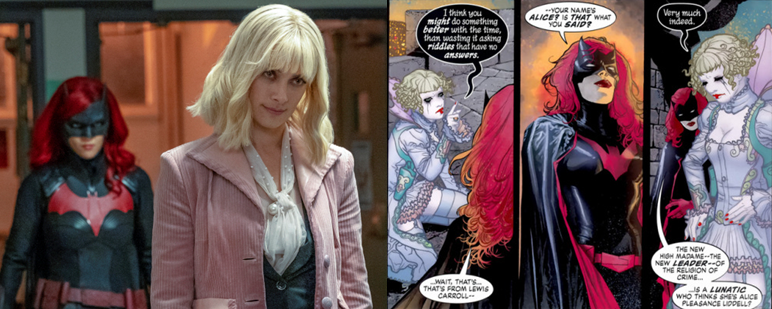
70sMarvelConclusion

In the end, for as hokey and cringe-worthy as a lot of these seventies Marvel shows were, it does disappoint me that we never got, at least, to see Spider-Man, Hulk, and Banner crossover onscreen. There was a lot to like about each of these, from the impressively realised costumes to the heart-felt emotion, to even the woeful action scenes and I would honestly have loved to see all of these characters come together to battle a common enemy. What do you think about Marvel’s television show and movies from the seventies? Do you have fond memories of The Incredible Hulk? Do you also wish that The Amazing Spider-Man would get a release on DVD? Perhaps you hated the monotony and ridiculousness of these shows. Whatever your opinion, leave a comment below and get in touch.

Screen Time: Superheroes on Television

Okay, I’ll admit: I’ve never been a big fan of superhero properties on television. Growing up, I never watched The Incredible Hulk (1977 to 1982) as it was never on television when I was a kid – the closest I got were the three made-for-television movies that came out of it (which, incidentally, I liked as a kid). Similarly, the only exposure I had to the old Amazing Spider-Man television show (1977 to 1979) was from the three “movies” that came out of it. In fact, probably the only superhero television show I was regularly exposed to as a kid was, of course, the 1960’s Batman show and even that was primarily through the movie. No, as a kid, I grew up watching superheroes in animation: Batman: The Animated Series (1992 to 1995), the ‘90’s Spider-Man cartoon, ad basically all of the Marvel properties at the time. That was where it was at; animation was much, much closer to the comic books than anything in live action at the time, even compared to the live action movies that were coming out as I grew up. When Smallville (2001 to 2011) first started airing, I pretty much gave it the pass by. I watched a few of the early episodes, but not much more. This really came out at a time when I was in my mid-teens, I believe, when loads of teen-centric shows were on E4 and the like (One Tree Hill (2003 to 2012), Dawson’s Creek (1998 to 2003), all that stuff) and I didn’t have time for any of it. Smallville easily fit into those categories, which was enough for me to ignore it, but when I did flick on to it over the years I became increasingly turned off by the deviations from the source material and the creative licensing taking place on the show.

SuperTVJSA.png
Smallville got way more interesting once it included more comic book elements.

Ironically, I believe that Smallville actually did improve over time, especially by referencing and including more comic book-related stuff, but when I realised it had hit the ninth series and Clark Kent (Tom Welling) was no longer living in Smallville, was working at the Daily Planet, basically married to Lois Lane (Erica Durance), and saving lives daily in multiple variations of his eventual Superman costume, and yet despite all this he was not Superman, I was irked, to be frank. I never quite understood the logic of making a show that is about a young Clark Kent, that charts his journey from an unsure teen to the eventual saviour of humanity, and yet never actually evolved into a Superman show for the last season even though it practically was given that Clark was battling Davis Bloome/Doomsday (Samuel Witwer), of all people, and chumming around with Oliver Queen/Green Arrow (Justin Hartley). The final episode finally capitalised on this and had Clark assume his birthright to defeat Darkseid, but many were disappointed that we never got a decent shot of him as Superman. I guess they were trying to avoid degenerating into Lois & Clark: The New Adventures of Superman (1993 to 1997) but, surprisingly, I enjoyed that show as a kid – it struck a very similar balance between drama and superheroics and didn’t have half of the comic book inclusions as Smallville and, if I’m not mistaken, was pretty popular and successful at the time.

SuperTVArrow
I didn’t start watching Arrow right away.

Anyway, after Smallville ended, I watched a few re-runs and my 50/50 split of the show only increased. Simultaneously, there were persistent rumours that Warner Bros. were trying to fill the gap with a potential Batman prequel show, following a young Bruce Wayne (apparently this was even the initial pitch for Smallville but Batman was toxic at the time due to Joel Schumacher), one that charted a pre-Robin Dick Grayson, an attempt at an Arthur Curry/Aquaman and Bart Allen/The Flash spin-off, and even a Green Arrow series! Ultimately, only one came to fruition but, rather than a spin-off featuring Hartley’s Green Arrow, we got an entirely new, unconnected series depicting the origin and evolution of the Emerald Archer. Again, I don’t recall actually watching much of Arrow when it first aired as it conflicted with work and my life and such, but I did watch the first episode at least, an a few episodes here and there. My resistance to Arrow stems from the fact that Warner Bros. seem to desperately want to make a Batman television show but were unable to due to Christopher Nolan’s Dark Knight films (2005 to 2012), so they used Green Arrow as a substitute. This rubbed me the wrong way, as Green Arrow – or “The Hood”, or “The Arrow”, or “The Archer”, or “Steve” – (Stephen Amell) would frequently clash not with classic Green Arrow villains but with Batman villains – Deathstroke (Manu Bennett) was a prominent villain in the fist season, just as he had been in Smallville and Teen Titans. Now, in the comics, Green Arrow initially did start out as a rip off of Batman – he had an Arrow-Cave, an Arrow-Mobile, a kid sidekick, and even an Arrow-Signal. However, for far longer, Green Arrow has been portrayed as a street-level vigilante who targets the corrupt and those untouchable by law, frequently killing them, and protecting the “little people”. This has existed alongside the more adventurous version that was a member of the Justice League; Green Arrow’s right-wing sensibilities and strong moral beliefs often clashed with other, more conservative superheroes, and his everyday life as Oliver Queen, multi-millionaire, often facilitated his vigilante actions through urban renewals and the like. Arrow follows some of this tangent, with Queen returning to “Starling City” after being marooned on an island (and, later, in Hong Kong) and surviving against nature and a clandestine organisation using the impractical weaponry of a simple bow and arrow. Queen’s mission is to take down the corrupt of the city and avenge his father’s death, which means he kills a great deal of people in the name of the greater good, which I agree with and like – Green Arrow has often been portrayed as a slightly more morally-unhinged version of Batman and, for all their similarities, they have often clashed because of this.

SuperTVTeamArrow.png
Arrow became much more of a team-based affair.

As Arrow went on, I largely ignored it because I didn’t agree with the seeming lack of faith Warner Bros. had in the character or the series. Like Smallville before it, the show avoids naming its titular hero even though he was popularly known as Green Arrow in Smallville. I’m sure there’s the case for this, that the show is meant to show Queen’s progression from a simple vigilante to the city’s hero (things like him upgrading his tech, adopting an actual mask, and renouncing killing support this) but why not just call him Green Arrow?  Ironically, I actually dislike the Green Arrow moniker as it’s kind of redundant – he wears green and shoots arrows, no shit!  Much like Green Lantern, I have an aversion to superheroes who preface their name with a colour and much prefer the show’s moniker of “The Hood” as it’s far more fitting. I got more into Arrow as the second season drew to a close due to the inclusion of Roy Harper/Arsenal (Colton Haynes) and the series-changing events initiated by Slade Wilson/Deathstroke (Manu Bennett). With Deathstroke having practically levelled the city and Queen basically poor, the show had raised its stakes for season three. Additionally, Queen had built a tight-knit group of allies, with Roy actually adopting the suit and outfit of Arsenal to become his sidekick! After years of Batman movies dodging, avoiding, criticising, and suppressing Robin, we finally had a depiction of a young teen sidekick that fit and actually made sense. My hope is that Arsenal’s inclusion and increased exposure will relax the embargo surrounding Robin and Nightwing at Warner Bros. and allow for their inclusion in their stupidly-unconnected series of DC films.

SuperTVSHIELD
Agents of S.H.I.E.L.D. is still tenuously related to the larger MCU.

Now, a big part of the reason I avoided Arrow was also because of the growing Marvel Cinematic Universe, which eventually spread into television with Agents of S.H.I.E.L.D. (2013 to 2020). After the events of The Avengers/Avengers Assemble (Whedon, 2012) Agent Phil Coulson (Clark Gregg) is revealed to be alive and builds a team of agents to investigate supernatural, paranormal, extraterrestrial, and superhuman incidents across the globe. The main thrust of the first series was the team coming together, leaning to trust each other, and the quest for answers regarding Coulson’s resurrection. However, this soon overlapped with the emergence of Hydra agents within the Strategic Homeland Intervention, Enforcement, and Logistics Division (S.H.I.E.LD.), which crossed over with the events of Captain America: The Winter Soldier (Russo and Russo, 2014), which saw the destruction of S.H.I.E.LD. Many supporting characters, and main character Grant Ward (Brett Dalton), were revealed to have been Hydra agents, and the unlimited resources available to Coulson were stripped away by the end of season one. Simultaneously, it is revealed that Director Nick Fury (Samuel L. Jackson) used an experimental serum and procedure, derived from an as-yet-unnamed alien source (it was recently revealed to be of Kree origin), to facilitate Coulson’s resurrection – this same serum drove HYDRA double agent Dan Garrett (Bill Paxton) mad and gave him superhuman abilities. Season one also included a side plot detailing the origin of a version of Mike Peterson/Deathlok (J. August Richards), a cyborg created to assist Garrett who eventually overcame his programming. Season two features a smaller team, with new characters, who are attempting to rebuild S.H.I.E.L.D. and uncover further truths behind their pasts, and future, as Coulson continually suffers from episodes induced by the alien serum that lead him, like Garrett, to scrawl strange alien symbols.

SuperTVFlash.png
The Flash became my favourite of the DC TV projects.

Truthfully, Marvel’s Agents of S.H.I.E.L.D. is far from perfect, or great. The best things about the show are the dialogue, which is witty and clever and full of Whedon-isms, the references and inclusion of lesser-known comic books characters (again, Deathlok…Deathlok, of all people!), and the fact that it ties directly in to the largely Marvel Cinematic Universe. Events from the films are often referenced directly in the show, supporting characters often appear, and it really feels as though the show is helping to build and expand upon the Marvel Cinematic Universe even though it is highly unlikely that any of the characters featured on the show will appear in the films. As a result, the show doesn’t feel “pointless”, unlike Warner Bros.’ efforts. After guest starring in Arrow, Grant Gustin returned as Barry Allen in his own spin-off, The Flash, which I initially decided to watch over Arrow as I was pretty sure there was no way they could shoe-horn in unfitting Batman elements into the show. The Flash is, in many ways, a carbon copy of Arrow; very quickly (hah!), like Queen’s base at Verdant, Barry based his team in Scientific and Technological Advanced Research Laboratories (S.T.A.R. Labs) nd has a team of specialists and supporting characters helping him that are analogous to Team Arrow and Oliver’s associates. The principal difference is The Flash’s inclusion and portrayal of metahumans. Barry gained superhuman speed after being struck by lightning during an explosion at S.T.A.R. Labs, which resulted in a wave of radiation emanating out from Dr. Harrison Wells’ (Tom Cavanagh) particle accelerator. The wave affected many members of Central City, bestowing them with superhuman abilities, and it is up to Barry and his team to subdue or assist all of them. This is in contrast to Arrow, which largely avoids metahumans for corrupt officials, ninjas, and grounded, street-level threats. Exceptions are usually the case of serums and scientific experiments, or clandestine organisations like the League of Assassins (another Batman-orientated organisation!). The Flash aired alongside Arrow’s third season, and the two frequently overlap and interact – characters often appear on both shows, which has increased my stake in both and, alongside the fact that they both air on days I can watch them, means I can now follow both.

SuperTVGotham
I wasn’t a fan of Gotham

Alongside The Flash, Warner Bros. finally got their Batman-prequel series underway with Gotham, which follows a young James Gordon (Ben McKenzie) in a pre-Batman Gotham City. This series is completely unrelated to The Flash and Arrow, however, and the three do not occupy the same continuity. Like The Flash, however, Gotham (2014 to 2019) had numerous problems with pace, particularly in the first episode. Both debut episodes threw so much at the viewer, introduced so many characters, plot lines, and comic book references that even I, an avid comic book fan, felt overwhelmed and actually a little insulted. Arrow took its time establishing Queen, his city, and his crusade – despite how much it annoys me that he isn’t known by the right name and constantly feels like a Batman substitute, I can’t fault Arrow for pace. Like Smallville before it, the show has been around a while now and has established a tone, pace, and atmosphere and can now afford to become more “comic book” and introduce more comic book elements – Ray Palmer (Brandon Routh) debuted in season three, hinting at the possibility of The Atom appearing at some point. The Flash, however, opened by throwing everything at us all at once: Barry’s mother was killed by a mysterious man-in-lightning when he was a boy, his father (John Wesley Shipp, from the old Flash TV series!) was arrested for it, Barry was raised by Detective Joe West (Jesse L. Martin) alongside his daughter, Iris (Candice Patton), whom Barry has been in love with for years. Barry grew up to become a forensic scientist, he was struck by the lightning, went into a coma, and when he woke up, Iris was dating Joe’s partner, Eddie Thawne (Rick Cosnett), and Barry secretly began working with Dr. Wells and his team to subdue metahumans…oh and, also, there’s all the mystery surrounding Wells’ true motivations.

SuperTVPenguin.png
Gotham‘s Penguin doesn’t really do it for me.

Think that’s a lot to take in in one episode? Try Gotham, which debuted with the murder of Bruce Wayne’s (David Mazouz) parents, Gordon’s initial partnership with the corrupt detective Harvey Bullock (Donal Logue), the tension between Gordon and his girlfriend regarding both his police work and her past as a lesbian, the suspicious of the Major Crimes Unit about Gordon, the length and breadth of Gotham’s corruption, the introduction of Selina Kyle (Camren Bicondova) as a cat-like street urchin, Edward Nygma (Cory Michael Smith) as a riddle-spouting forensic scientist, Oswald Cobblepott (Robin Lord Taylor) as a limping “Penguin” who angers his mob bosses, and Wayne’s stern-yet-protective butler Alfred Pennyworth (Sean Pertwee). Gordon, moved by Bruce’s plight, pledges to find his killer and is set up to kill a patsy, the father of a girl who greatly resembles Pamela Isley/Poison Ivy, by the mob. The mob consists of Carmine Falcone (John Doman) and Salvatore Maroni (David Zayas), who have both the police department and the mayor on the payroll, but is principally represented by “Penguin’s” boss, Fish Mooney (Jada Pinkett Smith), who is scheming to usurp Falcone’s power. “Penguin” learns of this and Gordon is forced to kill him to prove his loyalty. Gordon fakes the act, leaving “Penguin” to embark on a revenge plot and casting doubt on Gordon’s stature as a police officer. Meanwhile, young Bruce has decided to turn detective and investigate his parent’s killing, believing it to be a conspiracy, and also begin to train himself not to feel fear.

Damn, that is a lot to take in in one episode!

Thankfully, The Flash calmed it down after an episode or two and established a comfortable routine: Barry acts awkward with Iris and has come kind of self-doubt, a metahuman emerges, fight, Wells acts suspicious, the end. This “monster-of-the-week” formula dominates the show even to this day, but the show mixes it up with side-plots concerning the mysterious death of Barry’s mother, Iris’s obsession with “The Streak” (the show took quite a while to brand Barry as the Flash yet…despite all of his metahuman villains have carried their names) and their later romance, Wells’ suspicious nature, the presence of mysterious evil speedsters, exploring the multiverse, etc. Gotham, on the other hand, was far more violent and apparently attempting to channel police-procedural shows like CSI: Crime Scene Investigation (2000 to 2015), only with multiple references to Batman and Batman villains thrown at us in the most unsubtle way possible every episode. My continuation with the show was based on Sean Pertwee, whose presence as Alfred made the show somewhat bearable but I can’t say that I was too upset when it was finally concluded.

SuperTVLegends
Man, screw this show!

Warner Bros. also produced Supergirl (2015 to 2021) and DC’s Legends of Tomorrow (2016 to present). Easily the weakest offerings of their television line-up, DC’s Legends of Tomorrow is a direct spin-off of Arrow and The Flash, featuring characters introduced shows. However, the show is largely loud, overly complex, and suffers from even more pacing issues. Not only was the first episode a convoluted mess that rushed through its character introductions to set up the on-going narrative, every episode is a rush of plot conveniences, hammy dialogue, and poor scripting. In the first season, for instance, the team travel through various points of time and space in an effort to save the future from Vandal Savage (Casper Crump) but…if they have a time machine, why bother wasting time going back to various points to prevent him accumulating his power when they could travel back to just before his takeover and kill him then? Indeed, in the case of DC’s Legends of Tomorrow, the only stand-out characters for me were Leonard Snart/Captain Cold (Wentworth Miller) and Mick Rory/Heat Wave (Dominic Purcell), whose gruff, anti-hero ways and pre-existing partnership set them apart from the rest of the stilted, awkward group. Both actors chewed the scenery and stole the show at every opportunity, and Mick gained a decent character arc where the heroic sacrifice of his partner made him more accepting of his otherwise more naturally heroic partners.

SuperTVSupergirl.png
Supergirl was fun but a little too annoying for me.

Supergirl, however, is a horrific mess. I have times where I can be pretty pro-feminist but this show really grinds my gears. It seems as though Supergirl is incapable of conveying strong, independent female characters without making them soft, overly effeminate, or lesbians. Seriously, this show is rife with explicit lesbianism; even heterosexual female characters carry a lesbian vibe from them. This boggles my mind; Arrow, a show largely aimed more at the male demographic, doesn’t feature a load of gay males or in-your-face sexual tension between the males so why does a female-driven show feel the need to do so? Also, throughout the first season, Kara Zor-El (the titular Supergirl, portrayed by the sweet, cute, and incredibly likeable Melissa Benoist) is constantly playing second fiddle to her more famous cousin (later portrayed by Tyler Hoechlin); Supergirl is constantly having to prove herself and to live up to Superman’s legacy and constantly compared to him, and judged by how much more impressive he is. I find this quite disturbing, to be honest. Today’s society is much more female-dominated and driven than ever before; woman are in positions of power and have far more equality than ever before, yet Supergirl prefers to send the message to young girls that they will constantly be held down by those around them until they prove that they are just as good, if not better, than males. Plus…she constantly keeps fiddling with her glasses! Even when she is around people who are aware of her duel identity!

SuperTVArrowverse
One big happy family.

Additionally, although set on an alternative Earth, Supergirl has crossed over with The Flash (and, by extension, its other shows) by utilising the multiverse aspects introduced in season two of The Flash , unlike Marvel, whose shows all take place within the larger cinematic universe, none of Warner’s DC properties tie in, or relate in any way, to their own cinematic universe that tentatively began with Man of Steel (Snyder, 2013) and continued with Batman v. Superman: Dawn of Justice (ibid, 2016). In fact, Warner Bros. included the Flash in their upcoming cinematic line-up and, as they often have concerning Green Arrow’s inclusion, have consistently gone on record as stating that the character’s will be entirely separate from those on television. Similarly, Gotham does not serve as a prequel to Ben Affleck’s Batman; as a result, we have a situation similar to when Superman Returns (Singer, 2006) came out whilst Smallville was still on the air in that conflicting versions of the same character will co-exist at the same time onscreen. For us comic book fans, this is not a problem: comic book aficionados are well versed in handling multiple, conflicting portrayals of the same characters, but the general audience…not so much. Indeed, Warner Bros. often reference the DC multiverse when justifying this decision, which is crazy beyond belief as the DC multiverse is a concept so confusing that they’ve had to destroy and rebuild it about three times in the last five years! Surely Arrow’s popularity alone, which arguably has helped to facilitate a DC Cinematic Universe, justifies its place in the oncoming cinematic canon?

SuperTVSHIELD2.png
A bit more continuity between TV and film would be nice.

This ties back in to my early remark about Marvel’s Agents of S.H.I.E.L.D. not feeling “pointless”. Sure, the show has flaws. Sure, the characters may not reintegrate with the Marvel Cinematic Universe for some time, if at all. But events matter. What happens in a Marvel Studios movie will impact another character, and those events may often be referenced in Marvel’s Agents of S.H.I.E.L.D. When the Arrowverse collides in their crossovers, it has little impact on the big-screen offerings, which also never really factor into their television counterparts in a meaningful way. This is what separates my enjoyment of current superhero television shows: continuity. It’s important for consistency, it’s important to maintain audience (especially the generally, non-comic book audience), and it’s important for integrity. It’s why I can forgive Marvel’s Agents of S.H.I.E.L.D.’s flaws, because the show is expanding upon and a direct part of Marvel’s larger cinematic universe, and it’s why I can forgive Arrow constantly portraying “The Arrow” as a bastardised version of Batman, because it’s integrating with The Flash is the closest thing we have to continuity between DC properties at the moment. Whether or not the films will offer an equal alternative remains to be seen.