It’s October and Halloween is right around the corner and what better way to mark the occasion and bring some extra views of any self-respecting content creator’s blog than by taking a look back at Resident Evil: Fire and Ice, a four-part comic book series published by WildStorm between 2000 and 2001. WildStorm had previously published a five-issue mini series that told interludes, heavily truncated recaps of the first two Resident Evil videogames, and introduced a whole slew of minor characters and original creators to what was, at the time, a far less complex lore. The Fire and Ice comics continue with this premise, ditching the anthology format to follow the hitherto-unknown Special Tactics and Rescue Service (S.T.A.R.S.) Charlie team, consisting of the heavily muscled team leader Falcon, newcomer and munitions expert Raquel Fields, and a whole bunch of one-dimensional nineties throwbacks with more diversity than you can shake a stick at: we’ve got the anti-authority Australian Quan Williamson, Patrick Brady (a former zoo keeper now endowed with minor superpowers), Mexican quasi-Native American Rosa Cardenas (whom it is implied Quan has a crush on but who actually has feelings for Brady…), and the somewhat unhinged tech-savvy Jesse Alcorn.
Falcon’s team runs afoul of traps as sophisticated as quicksand and some darts!
After splitting into two sub-teams, issue three rejoins Falcon’s team in Mexico where, you may remember, Falcon, Raquel, and Jesse managed to track down an Umbrella laboratory in Mexico. As they approach the pyramid-like structure, however, they fall victim to some of the oldest, most clichéd desert-based traps in the business: quicksand and darts! All that was missing was a pit of spikes with skewered skeletons and a rolling boulder and the writers would have nailed every cliché in the book.
Who needs a hacker anyway?
Narrowly escaping, Jesse states that he’s unable to crack the code on the entrance because of the sheer number of possibilities; he reckons it would take his computer “days” to break into the facility, which Raquel gives him some grief about. And rightfully so; I mean, what good is a damn computer hacker when they can’t even do the one job you bring them along for? Luckily, Raquel actually remembers that she’s good with explosives in this issue and simply blows the door open; if only that was an option in the videogames!
WildStorm deals the Licker a short hand once again.
Upon entering the pyramid, Jesse is immediately attacked by a Licker, further cementing himself as perhaps the most useless member of Charlie team so far. In true WildStorm fashion, the Licker is barely shown and easily dispatched by Jesse’s far more competent team mates and the three make their way deeper into the facility, where they not only discover Umbrella’s scientists cooking up new horrors in giant, gunk-filled tubes but also, inexplicably, spot Rosa and Brady held in captivity (this is presumably on some kind of monitor but, like last issue, the art isn’t very clear and makes it seem as though Falcon spots the two in the next room).
Whitlam has created a newer, better virus…but you can’t see it yet!
Back in Alaska, Rosa and Brady are being held captive in a dungeon-like cell after the events of the previous issue saw them attacked and captured by Umbrella agents Klaus and Mr. Venk in Alaska and Quan alone out in the frozen wastes of the Alaskan mountains. Quan rushes back to their last known location and finds only a radio transceiver that fell from Brady’s pocket in the last issue and allows him to listen in as the now grown-up (and, apparently, somewhat cybernetic) Dexter Whitlam monologues to Rosa and Brady about his evil plan. Building upon the work of William Birkin and refining the best aspects of both the Tyrant-Virus (T-Virus) and G-Virus, Whitlam reveals (much to Klaus’ chagrin) that he has crafted a new virus, the X-Virus, which he claims represents “a quantum leap in killing power” and boosts the victims strength, ferocity, augments their “natural fighting ability”, and renders them virtually unstoppable. He also reveals that, up until this point, the characters haven’t yet encountered anything actually infected with the X-Virus; the G-creatures were merely created to find suitable subjects for the X-Virus and, as Rosa and Brady were, somehow, the only two test subjects to not only survive but also kill two of the G-creatures, Whitlam believes that they will make ideal candidates for a dose of X-Virus.
A Tyrant breaks free and goes on a brief rampage.
Back in Mexico, and spurned on by the impending threat to the lives of their team-mates, Falcon’s team renders all of the Umbrella scientists unconscious with a gas bomb and moves to retrieve the data from their computers (assuming Jesse can hack in, of course) but, somehow, a Tyrant breaks free from its captivity and goes on a rampage. Partially stunned by the pain from her mysterious infection, Raquel is easily tossed aside and, with Jesse cowering under a table, this leaves Falcon to face the beast alone with only his shotgun. This is WildStorm, though, and they have never quite been able to portray Umbrella’s fearsome bio-organic weapons as the formidable threats they are in the videogames, particularly the Tyrant, and this is no different. It simply walks towards Falcon, who unloads shot after shot until he blasts a hole through its head and then fires a few more shots just to be on the safe side, proving once again that, in these comics, a Tyrant is a mere inconvenience more than a life-threatening menace.
At least time it took a rocket launcher to finally put the Tyrant down…
While attempting to locate an antidote to the X-Virus on the lab’s computer, Jesse accidentally activates the obligatory self-destruct sequence and the three barely make it out alive. The Tyrant emerges from the flames but, again, it’s just an inconvenience as Raquel has all the time in the world to load up a rocket launcher and blast it to pieces while barely breaking a sweat.
What is it with this art? Why does the Tyrant look so bad?
The issue ends with the sub-team stranded in the desert, surrounded by cactus plants shaped in a biohazard symbol, with no way to reach their comrades. It also ends with a dangling plot thread as, when Falcon admonishes Jesse for risking their lives, Jesse acts very shifty and claims that the self-destruct was merely an unavoidable accident. Like the last issue, the artwork really lets this issue down. The whole series, so far, has lacked the polish and visceral gore of Resident Evil: The Official Comic Magazine, which suffered from similar writing issues and problems with the portrayal of recognisable Resident Evil characters, creatures, and tropes but at least had some decent gore to look at. Here, though, everything is so bland and simple and dull; even the Tyrant looks like a cheaply-drawn knock-off and there’s even less sense of threat or danger even with the inclusion of a Tyrant and the compulsory ticking clock that has become a staple of the Resident Evil series.
Fire and Ice‘s characters are a bland bunch of one-dimensional clichés.
Again, it doesn’t help that there’s very little to really keep us invested in WildStorm’s original characters; I can’t say that Fire and Ice would be better if the likes of Jill valentine, Barry Burton, and Chris Redfield replaced Charlie team but at least we’d be able to fill in the gaps about their personality and backstory. Here, we don’t really know anything about these characters beyond a quick introduction in issue one and some one-dimensional characterisation in these subsequent issues. It’s nice that WildStorm were able to give some of their minor characters more of a spotlight but Whitlam is just the clichéd mad scientist archetype, Falcon looks and acts like he stepped right off the set of Predator(McTiernan, 1987), and the rest of them are just a bunch of holdovers from the “Dark Ages” of nineties comic books. The next issue is the last in this series and it feels like I’ve learned very little to nothing about these characters and nothing of any real note has actually happened, and that’s a shame considering how WildStorm fumbled their last Resident Evil comic series.
My Rating:
⭐⭐
Rating: 2 out of 5.
Could Be Better
Do you agree or do you feel I’m being too harsh on WildStorm and the Fire and Ice series? Do any of the characters stand out to you? Which Resident Evil character is your favourite, either from the games, comics, books, or movies? Which piece of ancillary Resident Evil media is your favourite or would you like to see produced? Drop a comment down below and come back next Tuesday for my review of the fourth and final issue of WildStorm’s Fire and Ice miniseries.
It’s October, which means it’s Halloween and it’s the duty of every content creator to do some kind of horror-themed content. As a result, I’m taking a look back at WildStorm’s second series of Resident Evil comic books, the four-issue Fire and Ice series published between 2000 and 2001. This time around, WildStorm have ditched the anthology format in favour of a continuous, original story revolving around a bunch of original characters, the hitherto-unknown Special Tactics and Rescue Service (S.T.A.R.S.) Charlie team. Last issue, Falcon’s Charlie team made short work of a circus full of infected zombies and were introduced to a new team member, munitions expert Raquel Fields, who is hiding a hideous mutation on her arm. Having recovered a disk naming two Umbrella facilities (one in Alaska and one in Mexico), the team has split into two and the last issue ended with Falcon’s sub-team face-to-face with a literal Day of the Dead south of the border…
There’s a bit of dissension in the Alaska team…
Issue two opens in Alaska with the second sub-team (the knife-wielding Australian Quan Williamson, former zoo security guard turned semi-superhuman bad-ass Patrick Brady, and team leader Rosa Cardenas) riding snowmobiles down the frigid mountains of Alaska. There’s a little bit of dissension in the early going as Quan, whom we were informed through a few dialogue boxes and brief snippets of his backstory has a bit of a problem with authority, takes umbrage with Rosa’s orders. However, a stern word from her is enough to quell that and he heads out while a monstrous bear watches on.
Raquel lops off her bony growth, which is clearly the best solution…
The story then jumps back to Mexico where Falcon’s team (including newcomer Raquel and tech-savvy Jesse Alcorn) open fire on the legions of zombies in an ironic perversion of the Day of the Dead festival. Oddly, despite Raquel being the munitions expert, it is Jesse who prepares a bomb while Raquel covers him; however, while doing so, she discovers a strange, bony growth coming out of her arm and decides the best way to deal with it is to chop it off with a meat cleaver! Meanwhile, back in Alaska, Brady tries to allay Rosa’s concerns over Quan’s absence by theorising that he has a crush on her; she dismisses this, however, and suggests, in a near-inaudible whisper, that she would be more interested if Brady had a crush on her. We’re only on the second issue, guys, are we really doing this sort of thing? I guess it’s an easy, cliché, artificial way of creating some kind of investment in these characters so we care more when their lives are in jeopardy or they get infected or die but it just kind of comes out of nowhere as I’m not really seeing anything that suggests any kind of sexual tension or attraction between any of these characters.
Once again WildStorm awkwardly shoe-horns in the puzzle aspects of the videogames.
Anyway, they are interrupted by some kind of flying creature; it’s not really revealed what it is but it’s apparently threatening enough for the two to rush back to their snowmobiles to get their weapons. However, they are stopped in their tracks when they find they are surrounded by large, monstrous bears and bipedal walruses whales, and even a particularly fearsome looking penguin! Back in Mexico, Raquel blows the explosives but gets into it with Jesse when he inexplicable runs towards the explosion rather than staying clear (honestly, the artwork doesn’t make it massively clear what’s going on in these panels). Falcon quells the dissension and gets the team back on track towards their primary goal (…pretty sure we just saw that with the other sub-team…). Raquel draws Falcon’s attention to a particular piece of artwork in one of the ruined houses that bares a set of runes that Falcon says match up with those identified by Jill Valentine and Chris Redfield from the Spenser Mansion. This despite the impossibility of even spotting such a small, insignificant set of etchings and Jesse scoffing at the importance of the painting.
They couldn’t have just driven straight there?
The clue leads the team to Umbrella’s laboratory, a temple-like structure somewhere in Mexico, and while I like the attempt to call back to the puzzle solving elements of the videogames…the team had a disk of data that led them to Alaska and Mexico. They acquired it from Umbrella so why were they just knobbing around in town rather than going directly to the lab? Why did they need to find an obscure clue to lead them to the obviously ominous structure? It just feels like they could have driven through the Day of the Dead festival and fought those zombies on the way to the lab and weaved the puzzle elements in some other way, like opening the entrance or something.
Brady knocks out a monstrous whale and then stupidly trips and knocks himself out!
The story jumps back to Alaska, where Quan has just finished setting up the “evac helipad” (which just looks like some lights stuffed into the snow) when he gets called back to assist Rosa and Brady with their situation. It turns out that whatever has infected these animals hasn’t just allowed whales and walruses to walk on land but also allows penguins to fly (so I guess the thing that flew at them earlier was a penguin, then…). Thankfully, my earlier criticisms regarding Brady’s suitability as a S.T.A.R.S team member comes to the forefront here as, though he’s able to blow the leg off a mutated wolf…thing and knock out a whale with the butt of his gun, he stupidly trips and falls in an effort to save Rosa from being beaten and skewered to death by a bear and walrus. As he falls, he smashes his face on an ice-hard rock but it only stuns him; in other comics and media (and in real life) this would probably kill him but I guess Raccoon City puts a lot of funding and effort into training and toughening up their zoo security guards.
Klaus and Venk return from WidStorm’s previous mini series.
Luckily, a mysterious individual and his sharp-shooting comrade, Mr. Venk, tranquilise the creatures and load them, and the S.T.A.R.S. team members, into their van to transport them back to preserve Whitlam’s research. If you’ve read WildStorm’s original Resident Evil: The Official Comic Magazine, or my weekly reviews of each issue of that series, you’ll recognise the names and faces being tossed around in these last few panels: the unnamed, monocle-wearing man is Klaus; he and Mr. Venk appeared in WildStorm’s original comic series where they recruited the troubled youth Dexter Whitlam (who had transformed to and from a “G”-like creature using a stolen sample of Umbrella’s G-Virus) to Umbrella in issue five.
This issue’s art is bland and lacking the gore that made the first mini series bearable.
I quite enjoy how this series allows WildStorm to expand upon the roles of the original characters they created to fit into the Resident Evil lore; as I mentioned last week, none of these characters are particularly engaging or visually interesting thanks to them holding on to a lot of the worst one-dimensional clichés of comic books of the nineties (bulging muscles, a disdain for authority, and a penchant for leather and violence) but I’d much rather see these minor characters getting a bit more of the spotlight than WildStorm creating even more uninspired original characters. What lets this issue down, though, is the artwork; the art wasn’t particularly striking in the first issue but it’s even worse here. While Lee Bermejo (who would go on to much bigger and better things at DC Comics) and Shawn Crystal make decent use of shadows and lighting, the creatures are bland, boring, and rendered very gloomy; it’s not always clear what’s attacking the characters or what is going on, and everything looks painfully simple and dull. It also doesn’t help that the issue doesn’t really have any of the blood, guts, and gore that the original mini series showcased; the macabre spectacle tends to salvage the lacklustre writing of WildStorm’s Resident Evil comics and, without it, we’re left with these clichéd, one-dimensional characters who are trying way too hard to look, sound, and act tough rather than exuding the effortless cool and charisma of Resident Evil’s most popular characters.
My Rating:
⭐⭐
Rating: 2 out of 5.
Could Be Better
Are you familiar with WildStorm’s Fire and Ice Resident Evil comic books? What are your thoughts on the plot and characters so far? Which obscure or forgotten Resident Evil videogame or character would you like to see expanded upon in other media? Do you have a favourite piece of ancillary Resident Evil media? Drop a comment down below and come back next Tuesday for my review of issue three.
Earlier this year, in a shameless attempt to grab more views around the release of the slightly disappointing Resident Evil 3 remake (Capcom, 2020), I did a weekly review of a five-issue comic series based on Capcom’s popular survival horror franchise which was published between 1998 and 1999. Given that, at the time, there were only two Resident Evil titles to work from, with the third still in production, Resident Evil: The Official Comic Magazine didn’t have a lot of material to work with and, whether through a direct mandate from Capcom or a conscious decision on the part of its creative team, largely decided against including direct adaptations of the source material and, instead, preferred to tell spin-offs, side stories, and interludes. Most of these, honestly, didn’t really add much, if anything, to the series lore; we saw what happened in the diner moments before Claire Redfield arrived in Raccoon City, for example, and follow Jill Valentine, Chris Redfield, and Barry Burton on a zombie slaughtering tour across Europe and Leon S. Kennedy fight giant, mutated bat creatures but a lot of it fell far from the mark.
Honestly, Resident Evil: The Official Comic Magazine was at its best when it was telling recapped, truncated, or heavily modified adaptations of the firsttwo games and was saved from mediocrity by some truly stunning and gory artwork. Although the series was short-lived, WildStorm revisited the Resident Evil franchise with a four-issue follow-up series published between 2000 and 2001 that, as it’s Halloween this month, I’ll be looking into. The Fire and Ice series focused entirely on original characters, some of whom even return from Resident Evil: The Official Comic Magazine, and featured many of the same writers and artists as that first five-issue series, so it’ll be interesting to see if WildStorm have better success this time around with their original characters and stories than they did last time or if they’ll spew out more drivel like Jill inexplicably battling with a werewolf.
Fire and Ice introduces us to a third S.T.A.R.S. arm, Charlie team.
Issue one opens up with the hitherto-unknown Special Tactics and Rescue Service (S.T.A.R.S.) Charlie team battling against circus freaks infected with the Umbrella Corporation’s infamous G-Virus. The team, led by Falcon, consists of the knife-wielding Australian Quan Williamson, the high-kicking Rosa Cardenas, the tech-geek Jesse Alcorn, and Patrick Brady, who lugs around a comically large energy blasting bazooka.
From simple security guard to highly-train, semi-superhuman S.T.A.R.S. member.
If Brady sounds familiar, it’s because he appeared in Resident Evil: The Official Comic Magazine where he was a simple security guard at the Raccoon City Zoo; although he managed to survive against a hoard of infected zoo animals, he was bitten by an infected prairie dog and exposed to the G-Virus. Luckily, he was saved by Leon (…because of course he was) and a S.T.A.R.S medical team were able to reverse the G-Virus effects (…despite the fact that they had failed in every other attempt). Somehow, as a side effect, Brady could also “sense the presence of the G-Virus” which, alongside his “natural fighting skills” (I mean, he was a security guard so I guess he had some training but I doubt it’s anything like Leon or Chris’s. Plus, I remember him panicking and running a lot in his first appearance…) got him a spot on Charlie team.
Charlie team is…colourful, if nothing else.
After filling us in on Brady’s story, the comic then spends the next few pages introducing us to the rest of the team: Falcon, a muscle-bound archetypal action hero who seems like Terry Crews before Terry Crews was a thing and also briefly appeared in Resident Evil: The Official Comic Magazine, is a former Army Ranger who was betrayed by his superiors and framed for an unexplained “international incident” before being inexplicably recruited by S.T.A.R.S. Rosa Cardenas is a bad-ass goth chick; a Mexican raised on a Hopi Indian reserve who is proficient in “tracking skills” who has a personal grudge against Umbrella and their experiments after her mother was killed in the aforementioned diner during the Raccoon City outbreak. Quan Williamson is not only Australian but also of “Thai descent” who left behind his promising academic career and his love of vehicles and machinery because of his natural aversion to authority and his desire to form a band, though his life was forever changed after he witnessed Leon’s fight against the aforementioned bat-men. The violent and slightly unhinged Jesse Alcorn also has a disdain for authority bordering on the psychotic as he used his “amazing computer skills” to hack in NORAD and nearly caused a nuclear war, after which he was given a choice: life in prison or join the S.T.A.R.S. Charlie team.
Falcon is angered that Umbrella were waiting for them and specifically name him.
By this point, you might have noticed a common thread being weaved throughout the members of Charlie team: not only are they somewhat reminiscent of Task Force X (known by their more colourful title as the Suicide Squad) from DC Comics, each of them has either briefly featured on WildStorm’s previous Resident Evil comic series or has some link, however tenuous, with an existing and popular Resident Evil character. This reminds me very much of the way Paul W. S. Anderson would rope in popular Resident Evil characters like Jill Valentine (Sienna Guillory), Carlos Olivera (Oded Fehr), Claire and Chris Redfield (Ali Larter and Wentworth Miller), and Leon Kennedy (Johann Urb) into his later Resident Evil movies (2002 to 2016) simply to give their approval to Alice (Milla Jovovich), the all-action star of his film series. As in those films, this association does very little to endear me to these original characters as all it does is make me wish I was watching (or reading about) the actual Resident Evil characters rather than these knock-offs. Frustrated by the onslaught of circus freaks and animals looking to tear their throats out, Falcon gives the order for the team to deploy a series of bombs and blow the whole circus to cinders. In the aftermath, they discover a mortally wounded Umbrella employee who, with his dying breath, not only hints that Umbrella were aware and prepared specifically for Charlie team’s arrival but also drops Falcon’s name, sending him into a rage.
Raquel is assigned to a sub-team but is hiding a mysterious infection.
Back at their headquarters, Falcon introduces the team to their newest member, munitions export Raquel Fields, who essentially acts as the audience surrogate for the remainder of the issue as Falcon gives a brief introduction to his team members and then delves into a full-two page spread recapping the events of the firsttwoResident Evil games and detailing Charlie team’s overall mission goal: to track down, and put down, Umbrella once and for all. Although she claims to have missed the opening mission due to being knocked out in a training session, it turns out that Raquel is undergoing a severe mutation from a wound she sustained that she is going to great lengths to keep hidden from her team-mates. Having acquired a disk from the Umbrella agents at the circus, the team is then split into two sub-teams to investigate Umbrella’s laboratories in Alaska and Mexico, where they are apparently working on developing new viral strains. Rosa is placed in charge of Quan and Patrick in Alaska while Jesse, Raquel, and Falcon head south of the border; it’s this scene that really hammers home just how militaristic S.T.A.R.S. actually is; this was briefly shown in Resident Evil: The Official Comic Magazine but, generally, especially in the original Resident Evil videogames, the team always seemed to be more like a black ops arm of the Raccoon City police department rather than an extension of the U.S. military (even though they clearly had ties to the military).
The issue ends on a cliffhanger with a literal Day of the Dead!
The issue ends on a cliffhanger as, when Falcon and the others arrive in Mexico, they discover that the annual Day of the Dead festival has become a literal Day of the Dead as the townsfolk are actually flesh hungry zombies! The final page of the issue is a teaser for issue two (which hints at a Tyrant but…well, we’ll see) and a quick blurb from editor Jeff Mariotte introducing readers to this new mini series.
The action is loud and bloody…when it actually happens.
Disappointingly, the first issue of Resident Evil: Fire and Ice contains more exposition than action; it reminds me of the first issue of Resident Evil: The Official Comic Magazine, which was more interested in retelling events than actually showing us them directly and creating tenuous links to characters we know and love from the videogames. However, when the action does kick in, it’s just as bloody and explosive as ever and the artwork is decent enough, for the most part, but the character designs are extremely derivative and very nineties for a comic released in 2000. Each character is decked out in bulging muscles or impractical leather and buckle-clad outfits, wielding massive weapons and sporting such impractical accessories as eye goggles and a Mohawk. Visually, it allows you to easily tell each character apart, which is especially helpful when you’re dealing with original characters, but none of them exude the simple aesthetic of the earlier Resident Evil characters who didn’t need anything more lavish than practical, military-grade hardware and gear.
My Rating:
⭐⭐
Rating: 2 out of 5.
Could Be Better
Did you read Fire and Ice when it first released? If so, what did you think of Charlie team? Did you ever read the earlier Resident Evil comics published by WildStorm? Which Resident Evil videogame or character would you like to see a comic book series about? Do you have a favourite piece of ancillary Resident Evil media? Drop a comment down below and be sure to check out my review of issue two.
Released: 2015 Originally Released: March 2002 Developer: Capcom Original Developer: Capcom Production Studio 4 Also Available For: GameCube, Nintendo Switch, Nintendo Wii, PC, PlayStation 3, PlayStation 4, and Xbox 360
The Background: I mean…you’ve heard of Resident Evil (Capcom, 1996), right? It was one of the seminal titles for Sony’s burgeoning PlayStation and, through its atmospheric horror and stringent emphasis on conserving resources, practically invented (if not massively popularised) the “survival-horror” subgenre. Yet, for everything the game does right, it can’t be denied that the original Resident Evil has seen better days; graphics that were once groundbreaking and innovative have since become embarrassingly blocky and clunky, to say nothing of the dodgy, B-/porn-movie level voice acting peppered through the original release. Thus, in 2002, Capcom developed a complete remake of their iconic horror title as part of a deal to release new Resident Evil titles exclusively on the GameCube. This remake overhauled the graphics and voice acting considerably but also added a whole bunch of new areas to explore and enemies to encounter. Yet, despite improving on its predecessor (and many of its sequels) in almost every way, being one of the most atmospheric and terrifying entries in the series, and being critically praised upon its release, the Resident Evil remake sold comparatively poorly and was one of the many reasons why Capcom would go on to adopt a more action-orientated approach to their popular franchise. I never owned a PlayStation back in the day, though I do recall playing the original Resident Evil here and there, so my first real exposure to the franchise was the amazing port of Resident Evil 2 (Capcom, 1998) for the Nintendo 64. After opting for a GameCube over the PlayStation 2, I went out of my way to pick up the Resident Evil remake and loved it but, at the time, couldn’t really give it the focus and attention such an immersive game required. However, sometime before I reviewed pretty much every single Resident Evil title for the Xbox One, I was gifted the Resident Evil: Origins Collection (ibid, 2016) and put a lot of time into this under-rated remake. I recently returned to the game to sweep up some missing Achievements and decided to make up for not posting a review of it then.
The Plot: When a series of mysterious and violent deaths occur in the Arklay Mountains outside of Raccoon City, the Special Tactics and Rescue Service (S.T.A.R.S.) Bravo team are dispatched to investigate. However, when all contact with Bravo team is lost, Alpha team heads in to find them, only to be attacked by mutated dogs and driven into a sinister mansion where they are soon separated and attacked by hoards of flesh-eating zombies!
Gameplay: Resident Evil is a traditional survival-horror videogame that sees players choosing between two playable characters: Jill Valentine and Chris Redfield. While both ostensibly play the same, they do have specific strengths and weaknesses (Jill can carry more items but Chris can take more damage, for example; Jill can also open certain doors and drawers with her lock pick while Chris always carries a lighter to solve certain puzzles) and encounter different characters and use different weapons over the course of the game.
Your controls and perspective are limited for increased tension.
Like all mainline Resident Evil titles at the time, Resident Evil employs a restrictive control scheme; however, the “tank controls” of the original game have, thankfully, been tweaked so that characters can freely explore their fully-rendered surroundings with far more freedom of movement. Your perspective is still limited by a series of dynamic and atmospheric camera angles, meaning that you won’t see any two areas from the same viewpoint; this is great for building tension and enabling the game’s jump scares but somewhat intrusive when, in the heat of desperately trying to escape from an enemy, the camera perspective suddenly switches on you and your controls become effectively reversed, meaning that it’s always best to plan ahead for a possible escape route.
Inventory management is key to your survival.
This foresight is most emphasised in the game’s stringent inventory system; as was the standard for Resident Evil titles at the time, characters can only carry a certain number of items before their inventory is maxed out and learning how best to manage your inventory is the key to your survival. Many items (herbs, mostly) can be combined together to take up less inventory space while others must be examined to find another item (usually an elaborate key of some kind). If your inventory is full, you can deposit your items into one of the many fourth-dimensional Item Boxes scattered throughout the game’s many locations to be retrieved at a later date. To help you navigate the game’s maze-like areas, you can also find a series of maps that helpfully display locked doors, whether areas have any items you need, and where typewriters and Item Boxes are located. You can also pick-up defensive items (daggers, tasers, and flash grenades) that will either instantly kill or severely incapacitate any zombie that tries to take a bite out of you and also use your fuel canteen and lighter to ignite corpses and stop them returning as Crimson Heads. Story is a huge part of Resident Evil; as you progress, cutscenes will reveal more of the mysteries behind the mansion and Umbrella but you’ll also pick up files and documents as you play that further flesh out the story, the history of the mansion, the specifics of Umbrella’s bizarre experiments, and even provide hints towards the game’s puzzles.
Combat is often a case of fight or flight.
Combat in the remake is smoother than in the original but still far chunkier and restrictive compared to the Capcom’s more action-orientated titles, primarily because tackling foes head on is generally discouraged even if you do have ample supplies of ammo. Zombies (and the other Bio-Organic Weapons (BOWs) created by the malevolent Umbrella Corporation) absorb your bullets like a sponge and, even if they do go down for the count, will return after a certain amount of in-game time has elapsed faster and stronger than ever. Even if this doesn’t happen, they are largely replaced by the deadly Hunters later in the game that will require more than your standard pistol ammo to put down so conserving your resources is paramount to your ability to survive. When attacked, your character’s health and current status is displayed through an EKG-like display. When it turns yellow or red, falling into “Caution” or “Danger” status, or a blue-purple for the “Poisoned” status, your odds of survival will decrease dramatically; your character will begin to limp and hobble around, severely reducing your mobility, and it is highly advised that you make use of the herbs and first-aid sprays to replenish your health and return your status to “Fine”. In keeping with the style of the series at the time, your progress can only be saved by using an Ink Ribbon at one of the many typewriters you’ll find across the game’s locations; if you die, you’ll have to re-load your last save point and try again but be warned because your final score takes into consideration how many saves you make across a playthrough so, if you want the best results, it’s encouraged that you limit your saves.
You may need help escaping the game’s many death traps.
Some enemies deal more damage than others, some are even capable of killing you in one swipe of their claws, and the game’s many environments are also filled with instant-death traps that require you to solve puzzles in a certain way or make certain choices so that you can be saved by one of the game’s supporting characters. These characters will also provide you with better weapons and helpful items; one, Rebecca Chambers, even becomes playable at a key moment to help Chris synthesis concoctions that normally only Jill can produce. Rebecca, and Barry Burton, also help out by solving puzzles and defeating certain bosses for you if you make the right decisions, which can be extremely useful for conserving your resources and aiding a speedrun. Resident Evil is chock full of puzzles, traps, and elaborate areas to explore; the bulk of your game time is spent exploring the disturbing Spencer Mansion, whose doors are locked behind themed keys and rooms are filled with ornate statues and lavish decorations, but you’ll also explore a neighbouring graveyard, an underwater passageway, an Aqua Ring, and, of course, a high-tech laboratory filled with Umbrella’s bizarre experiments. In each area, you’ll have to solve puzzles either by interacting with them or bringing items with you; these may be a key, or a battery to power a lift, or intricate medallions to access hidden walkways, meaning that no item you find will ever be completely useless.
Graphics and Sound: Even now, some twenty years after it was originally released for the GameCube, the Resident Evil remake holds up fantastically well; while the original became dated very quickly, the remake still looks gorgeous and up to the standards of even Capcom’s recent efforts. Environments are fully-rendered and bathed in a variety of lighting; most areas are swamped in shadow or lit only by the suitably dramatic lightning from outside the mansion, while others are fully lit so you can bask in the ornate decorations and Gothic aesthetic of your surroundings.
Resident Evil‘s various Gothic and twisted locations are all rendered beautifully.
As you explore further, you’ll venture out into the wind- and rain-swept areas outside of the mansion, explore a creepy, dilapidated cabin and a disgusting semi-flooded passageway beneath it, and even a dank tomb reminiscent of something out of a Bram Stoker novel. These elaborate locations are offset by the more clinical, high-tech areas created by Umbrella; the Aqua Ring and laboratory have been wrecked by the corporation’s experiments, juxtaposing Umbrella’s fiendish modern technology with the lavish, almost supernatural qualities of the mansion and its surroundings.
The cutscenes propel the game’s elaborate narrative forward.
Unlike the original, which spliced cringe-worthy live-action sequences in with its equally cringey dialogue, the remake opts for fully-rendered computer-generated cutscenes to tell its story (which, thankfully, is just as over-the-top as ever). The script has been entirely overhauled, meaning that the game makes far more sense and the narrative is played far more seriously this time around, which only adds to the feeling of dread inspired as you skulk around the dark, tight, winding corridors of the mansion. Music is sparse and used (or omitted) to create tension or inform the player that they are in a safe (or dangerous) area; subdued and melancholy, you’re far more likely to hear the rustling of footsteps, the chattering shrieks of some unseen creature, or the soft moans of a zombie waiting just off-screen than anything else. When the jump-scares happen, they are often punctuated by the sudden introduction of a heart-pounding tune that keeps you constantly on edge even when revisiting areas you know have been cleared of enemies.
Enemies and Bosses: The main obstacle you’ll encounter in your desperate fight to survive will be the many zombies that populate your surroundings; the most common enemy, zombies will slowly shuffle towards you, moaning and groaning, and will try to take a bite out of you at any opportunity. A few well-placed shots will put them down but, to destroy them for good, it’s best to whip out the shotgun and tilt your aim towards their heads, blow them to pieces with the grenade launcher, or hope that your pistol gets a lucky headshot. You’ll also encounter one of the most annoying reoccurring enemies in the entire franchise, the zombified dogs known as Cerberus. These little bastards are fast and agile, leaping at you, pinning you down, and chomping at your arm and are always a bastard to get a good shot at. Ravenous crows can also be found in certain areas but these will generally just sit there, cawing ominously, and won’t attack you unless provoked. To mix things up a bit in the remake and add even more tension to your gameplay, the developers introduced a mechanic whereby any zombie that hasn’t had its head blown off or burned to a charred corpse will return to undead life as a faster, far more vicious and deadly Crimson Head after enough time has passed. This adds another layer to the game as you must choose between dodging the slower, weaker zombies or taking the time to burn up their corpses rather than risking your health and ammo on their supped-up evolution.
Spiders may poison you but the Hunters will rip your head off!
As you venture outside of the mansion, you’ll also have to contend with snakes dropping on you and hissing at your feet, giant spiders that can poison you, and voracious mutated sharks just waiting to chomp you in two. Once you return from this side quest, most of the zombies in the mansion will have been replaced with the ferocious Hunters; these dangerous frog-like creatures leap and run at you, swiping with their claws, can kill you in one hit, and you’ll even encounter a sturdier variant that can also poison you. Once you delve into Umbrella’s secret laboratory, you’ll also have to battle the nightmarish Chimera creatures, weird little human/insect hybrids that skitter along the floors and ceilings just waiting to take your head off!
Umbrella’s experiments have mutated animals to monstrous sizes!
Umbrella’s experiments also give birth to some gigantic and horrific bosses; you’ll encounter the giant snake, Yawn, a couple of times, a monstrous tarantula, a colossal acid-spewing plant, and the prototype of the Crimson Heads down in a tomb. Interestingly, a lot of these bosses can either be avoided entirely or destroyed by solving a puzzle or the intervention of a supporting character. Plant 42, for example, can be destroyed by mixing a chemical compound to kill its roots; the aforementioned giant tarantula can be avoided entirely and you destroy the massive shark in the Aqua Ring by electrocuting it with a nearby control panel. The remake introduces a new recurring boss to the story as well, the immortal and unkillable Lisa Trevor. As the prototype for many of Umbrella’s later, more monstrous experiments, Lisa is a deformed, shambling mess who is completely resistant to all forms of gunfire. When you hear the rattling of hear chains and the low, despairing moans, all you can do is run and desperately try to avoid her incredibly powerful blows. Unlike Mr. X or Nemesis, Lisa doesn’t stalk you around the mansion, which is helpful, and your encounters with her pretty much all take place in an area that allows you to easily dodge past her and stay out of her reach. When the time comes to finally confront her, Barry or Albert Wesker will provide cover fire, allowing you to push four stones down a pit, uncovering the corpse of Lisa’s mother and driving the poor girl to leap to her death.
Hold out long enough and you’ll get the chance to put the Tyrant down for good.
After exploring the length and breadth of Umbrella’s hidden laboratory, Wesker, your commander in chief, reveals himself to be a traitor and unleashes Umbrella’s most powerful BOW: the grotesque Tyrant, which quickly skewers Wesker and seemingly endinghis threat forever. You’re then left to deal with the Tyrant yourself, which can be tricky given the creature’s massive reach and damage-inducing claws but, thanks to the layout of the laboratory, you can easily run circles around it, shooting at it whenever you can, and putting it down through a mixture of perseverance and patience. Depending on how you played the game and which characters have survived, you may have to battle the Tyrant once more as the now-obligatory self-destruct countdown takes place and you wait to be rescued from a helipad. This time, the Tyrant is much faster, dashing at you from afar and stabbing and slashing at you with its claws but, after enough damage has been dealt and/or time has past, you’ll soon acquire a rocket launcher to blow the creature to smithereens and make your dramatic escape.
Power-Ups and Bonuses: Unlike later Resident Evil titles, there’s no way for you to increase your inventory capacity or upgrade your weapons or ammo with add-ons and elaborate combinations. However, as you explore your surroundings, you will find better and more powerful weapons, some of which are exclusive to each character; Chris, for example, gets his hands on a good, old-fashioned shotgun while Jill opts for a grenade launcher. To get the game’s most powerful weapons, though, you’ll need to solve certain puzzles, meet certain criteria, or beat the game within a certain time limit on different difficulty settings. Bring a certain medallion with you on the way to Lisa’s cabin or allow Barry to die at Lisa’s hands, for example, and you can acquire a super-powerful Magnum and the way that you handle fellow S.T.A.R.S. agent Richard Aiken can net you a powerful assault shotgun.
Additional Features: As you might expect, the Xbox One version of the game has quite a few Achievements linked to it that you can get. Most of these are story-based and therefore unmissable but others test your skills in increasingly challenging ways; there’s Achievements tied to saving (or not saving) your fellow S.T.A.R.S. team mates, one for finding 100% of the items across the game’s many locations, two tied to speed runs, one for acquiring every weapon, and even one that asks you to beat the game using only a knife to kill enemies and bosses.
Beat the game fast enough and you’ll earn infinite weapons.
Beating the game allows you to option to replay it on one of four difficulties, ranging from “Very Easy” to “Hard”, each of which places different items, amounts of ammo and Ink Ribbons, and even enemies across the game. As is the style of Resident Evil titles, you are rewarded for how fast you complete the game, how many saves and deaths you have, and for finishing the game on higher difficulty levels. Beating the game quickly enough or “Normal” or higher can net you the Samurai Edge or even the infinite rocket launcher, both of which will make subsequent playthroughs and absolute breeze. You can also unlock different costumes for your characters, allowing you to play using skins from later Resident Evil titles, and even a couple of new game modes. “Real Survival” is basically Hard mode but you can no longer access all of your items from every Item Box, “Invisible Enemy” mode turns all of the game’s enemies invisible, and beating the game with both characters on “Normal” finds you hounded throughout every subsequent playthrough by one dangerous zombie strapped with game-ending grenades!
The Summary: The Resident Evil remake is still a fantastic gaming experience; it took everything that worked from its blocky, cringe-inducing original and ramped it up to eleven. Arguably, Resident Evil has never looked better thanks to the game’s gorgeously-rendered environments, atmospheric use of lighting, and impressive in-game cutscenes and this remake still stands as the last true example of a traditional survival-horror Resident Evil title thanks to the way it incorporates the restrictive controls and camera angles of the franchise’s early days but tweaks and refines them with a more modern finish. Honestly, back when this game came out, I fully expected Capcom to use the same engine to remake Resident Evil 2 and Resident Evil 3: Nemesis (ibid, 1999) and I would have perfectly happy with that given how well this worked for not only the remake but also Resident Evil Zero (ibid, 2002). They didn’t, of course, and the closest we’ve gotten to something akin to the Resident Evil remake was Resident Evil 5’s (ibid, 2009) “Lost in Nightmares” downloadable content. As much as I like the remakes Capcom have produced and the way the franchise is heading back towards creepy, atmospheric, almost claustrophobic horror, I can’t help but be saddened that they don’t continue to tweak and refine the game engine they crafted for this remake as it really does deliver the definitive version of Resident Evil.
My Rating:
⭐⭐⭐⭐⭐
Rating: 5 out of 5.
Fantastic
What did you think of the Resident Evil remake? How do you think it compares to the remakes Capcom have recently produced, or even to the original? Do you prefer the original over the remake? Would you have liked to see more Resident Evil titles adopt the game engine used here or do you prefer the more action-orientated style of even the recent remakes? Either way, feel free to share your thoughts and comments below.
So it’s probably old news by now but we finally saw the release of the Resident Evil 3 remake (Capcom, 2020) recently and, to mark the occasion, I’ve been taking a look back at Resident Evil: The Official Comic Magazine, a five-issue comic book released by WildStorm back in 1998 to 1999. If you’ve stuck with me through it all, well done; if not, you can read up on my thoughts on issue one, two, three, and four easily enough.
Issue five, published in February 1999, would be the last issue in this series and, honestly, it probably couldn’t have come at a better time. Rather than choose to be a by the numbers adaptation of the first two videogames, WildStorm mostly opted to tell side stories, interludes, and recaps of Resident Evil (ibid, 1996) and Resident Evil 2 (ibid, 1998). While this worked to begin with and nicely fleshed out some of the Resident Evil lore, choosing to be an anthology series rather than focusing on the events of the videogames has produces more misses than hits in retrospect.
Dexter stumbles across a freakin’ Tyrant!
This final issue begins with “…And the Last Shall Be First” (Oprisko, et al), a story in which a teenage boy, Dexter Whitlam, pushed to the edge by schoolyard bullies, steals and injects himself with a vial of G-Virus in order to exact revenge upon his tormentors. Desperate for revenge against his bullies, Dexter stumbles across an Umbrella facility where a Tyrant is being held in stasis; it was at this point that I was hoping Dexter would release the bio-organic weapon (BOW) so that we could finally see it wreck some serious havoc as, up to this point, BOWs like the Tyrant had been given the shaft by WildStorm.
G-Dexter enacts a bloody revenge.
Instead, though, Dexter steals a G-Virus sample (I guess Umbrella were planning on experimenting on the Tyrant with it?) and, while he initially plans to create his own BOW, he is driven to injecting himself and transforms into a “G”-like monster. G-Dexter hunts down and kills his tormentors but is subdued by Mr. Venk, an Umbrella operative, and taken to an Umbrella facility where, inexplicably, his G-infection is apparently cured. Reverted back to normal, he is offered the chance to join Umbrella and put his intellect to their use.
Dexter is one of the few people to recover from the G-Virus.
It’s kind of sad that “…And the Last Shall Be First” is the only time a G-infected human is given a chance to do anything of note as, even in issue two’s direct adaptation of Resident Evil 2, “G” was taken out like a bitch. Here, we finally see what “G” is capable of as G-Dexter slashes fools up with his claws and mutilates his bullies with extreme prejudice. Unfortunately, though, it seems like a wasted effort as it’s not like this is the origin of a character we know from the videogames; had the story been tweaked and reworked slightly, it could have given us an interesting glimpse into William Birkin’s childhood but, alas, we’re left with the potential of “G” being wasted on a random original character who, honestly, isn’t all that compelling; it’s the same “nerd bullied to the brink” story you’ve seen a hundred times before…but with the G-Virus involved.
Turns out it’s a prequel to Claire’s story…
The next side story, “Emmy’s Bloody Spoon” (Adams, et al), follows another couple, Deb and Terry, who decide to take their honeymoon in Raccoon City, of all places. They make a pit stop at a diner which, wouldn’t you know it, comes under siege from a zombie attack. Despite the best efforts of the little old lady behind the counter, they’re all massacred by a lone zombie, who is interrupted by the arrival of Claire Redfield. So, what we have here is a brief prelude to the start of Claire’s story in Resident Evil 2, showing how the diner came to be infected when she rocked up in town. The story ends the moment Claire arrives, though, and therefore doesn’t really tell us anything we really needed to know at that point as WildStorm were showing us the rate of infection in Raccoon City back in issue two so, other than filling in a very small hole in the overarching Resident Evil story, this feels, again, like wasted potential as they could have used these pages to tell a short story about Claire and Sherry after Resident Evil 2, or expand upon their time in Raccoon City but, instead, we get this…
A threatening Tyrant, that makes a change!
The issue ends with the conclusion of the three-issue story WildStorm have been telling about Chris Redfield, Jill Valentine, and Barry Burton trying to locate Umbrella’s European headquarters. “Kane & Abe” (ibid) opens by pretty much skipped over exactly how the three avoided being eaten by their attackers in the last issue’s conclusion and jumps right into Chris and Barry loading up on weapons to go find Jill. Jill stumbles upon Abe, an Umbrella scientist, and Kane, a massive Tyrant-like BOW that Jill is unable to stop with just her pistol, which is a nice change of pace considering how easily “G”, Mr. X, and a Tyrant were taken care of without any real effort in previous issues). Abe sets off the obligatory self-destruct and disappears, leaving Jill, Chris, and Barry to subdue Kane long enough to make their dramatic escape just as the castle explodes. The issue then ends with Claire and Leon S. Kennedy just happening upon the three like it was nothing, finally bringing an end to Claire’s long search for her brother.
There’s a *slight* resemblance here…
Once again, WildStorm foreshadows Resident Evil – Code: Veronica (Capcom Production Studio 4, 2000) through the Gothic aesthetic of the German castle, European setting, and the reunion of the Redfields. The BOW the protagonists tangle with is also very similar to the Hypnos Tyrant from Resident Evil: Survivor (TOSE, 2000), of all things, and the action-orientated nature of their battle through the castle is more than reminiscent of the gameplay changes first seen in and Resident Evil 4 (Capcom Production Studio 4, 2005).
The story rushes to an unsatisfying conclusion.
However, this was a very rushed conclusion to a three-part story; entire plot points and sequences are ignored and the story just jumps from one thing to the next with little in between to fill in the gaps. It’s almost as if WildStorm shouldn’t have wasted time in the last issue recreating the game’s laborious puzzles and, instead, focused on moving the narrative along in an interesting and action-orientated way.
There’s some great, gory art in these comics.
In the end, Resident Evil: The Official Comic Magazine ended with a bit of a whimper. They didn’t do a proper adaptation of a Resident Evil videogame until issue two, didn’t start a multi-part story until issue three, and most of the stories they did tell, while interesting, were pretty forgettable and inconsequential in the grand scheme of things. I applaud their efforts to tie each story together in subtle ways, and to refer to the events of the videogames; the artwork was strikingly gory and consistently good all the way through each of the five issues and they made an effort to adapt all the different nuances of the videogames, from the characters to the story, the creatures, and even the puzzles. While some of these land better (and are more suitable) than others, at least they gave it a fair shake of the stick and tried to expand upon what was, at the time, only a two game franchise.
It’s like Capcom restriced the stories WildStorm could tell…
Reading back these issues, it almost seems as though Capcom restricted the type of stories WildStorm were allowed to tell as, rather than go into detail about what the survivors did before, between, and after Resident Evil and Resident Evil 2, the writers dance and skirt around the issue, throwing as much smoke and mirrors (or, more appropriately, blood and guts) at the reader as they can to disguise the fact that they haven’t actually expanded upon these characters much at all…possibly because they weren’t allowed to given that Capcom had a couple of sequels and spin-offs in the works.
There was a lot of potential in expanding upon these characters.
They tried to expand upon side characters like Ada’s boyfriend John and inject William Birkin with a bit more menace but both of these efforts were pretty much ignored and retconned by Capcom in subsequent sequels. With that in mind, it seems all the more sensible to me to have used these issues to tell adaptations of the first two videogames alongside one or two interludes and side stories per issue. Show a little more of Albert Wesker’s mindset, delve deeper into Chief Irons’ corruption, maybe just do a story the follows Mr. X bludgeoning its way through the Raccoon City police station. But to waste pages and effort on telling us what happened before Claire arrived at that diner seems like a waste of time to me, especially when you’re giving the shaft to the Lickers and BOWs like “G”.
Sadly, WildStorm’s Resident Evil comics are now hard to come by.
WildStorm would revisit the Resident Evil franchise a couple more times over the years; they told the story of the hitherto-unknown Special Tactics and Rescue Service (S.T.A.R.S.) Charlie team in the four-issue Resident Evil: Fire & Ice series, published in 2000 and 2001. This comic featured many of the same writers and artists as Resident Evil: The Official Comic Magazine and even returned some of the original characters and places to the lore, like Patrick Brady from issue two and Saguaro Wells from issue four. They also published a prequel to Resident Evil 5 (Capcom, 2009) between 2009 and 2011 and, while they collected each of these different publications into trade paperbacks, they are all long out of print. Overall, Resident Evil: The Official Comic Magazine was a pretty enjoyable experience but it had the potential to be so much more; it could have used its artists and writers to bring the videogames to life in a new way for comic readers and given fans of the videogames a lovely piece of ancillary media to collect. Instead, it’s more of a forgettable tie-in that peaks with the second issue, though it would be nice to see the collection get a reprint at some point.
My Rating:
⭐⭐
Rating: 2 out of 5.
Could Be Better
Did you ever read any of the Resident Evil comics published by WildStorm? Would you be interested in the series receiving a reprint as the collection is currently out of print? Do you have a favourite piece of ancillary Resident Evil media? Drop a comment down below and stay in touch for more content and articles.
The release of the Resident Evil 3 remake (Capcom, 2020) is still a big enough news item for me to continue my retrospective on Resident Evil: The Official Comic Magazine, a comic book released by WildStorm back in 1998 to 1999 that ran for five issues and covered events between, during, and after Resident Evil (ibid, 1996) and Resident Evil 2 (ibid, 1998).
Issue one recapped and filled in events from the first game, while issue two focused entirely on covering the events of the second. The third issue oddly introduced supernatural elements to the lore and began a three-issue arc that would continue in issue four, released in December 1998.
Leon shows up to save the day.
The issue’s first story, “Night Stalkers” (Oprisko, et al), revolves around giant, man-bat creatures created by Umbrella’s G-Virus attacking and small Nevada town. Their bite infects a young boy, turning him into a zombie, but their true purpose is to spirit townsfolk away to a hidden Umbrella lab, where the lunatic scientist Dr Callos, can turn them into more bat-men. Luckily, Leon S. Kennedy rocks up to investigate and, after a brief scuffle, is captured by the man-bats and taken to Dr Callos’ laboratory. Leon manages to overload the machine Callos has been using to control the man-bats and they turn on their creator, ripping him to shreds while Leon makes his escape and the air force move in to eradicate the lab.
A similar creature would appear in Resident Evil Zero.
This was a slightly better attempt at mixing the supernatural with Resident Evil as, unlike last issue’s “Wolf Hunt” (Adams, et al), “Night Stalkers” shows these vampire-like creatures to be products of Umbrella’s G-Virus rather than anything mythical. Once again, the comic oddly foreshadows Resident Evil Zero (Capcom, 2002), which featured a giant infected bat as a boss battle, though that was noticeably less humanoid than the man-bats featured here.
Much of this story foreshadow’s Resident Evil 4.
Without really knowing it, this story also provides a bit of a glimpse into Leon’s life between Resident Evil 2 and Resident Evil 4 (Capcom Production Studio 4, 2005); Leon even arrives in a small town using a little jeep, very much like the opening of Resident Evil 4, and is both decidedly more capable and written as more of an action hero as in that game . It’s not really revealed who he’s working for here; he wears a modified version of his riot gear but, judging from his rescuers, appears to work for the United States government.
Mr. X makes his grand entrance.
“Special Delivery” (Mostman, et al) makes a minor attempt to address a concern I had with issue two’s adaptation of Resident Evil 2 as it follows two Umbrella helicopter pilots as the fly around delivering Umbrella’s bio-organic weapons (BOWs) to specific areas. Their first drop-off is Mr. X, whom they dump right on top of the Raccoon City police station; though this is the only time he is featured in the story, it’s interesting to see behind the scenes of his delivery as, in the game, he just comes crashing in with a bang.
The pilots are carrying some deadly cargo…
The pilots then drop off a massive man-eating plant, similar to Plant 42, at a chemical warehouse and a Tyrant at a mineshaft working to synthesise anti-viral agents. Just as they’re about to make their last delivery, though, Umbrella’s deceitful nature kicks in and a canister activates, releasing a squid-like BOW on the chopper that promptly kills them in brutal fashion. Side stories like this are a great use of this comic as it allows us to see a version of events we’re normally not privy to in the videogames; Resident Evil, especially the earlier titles, was always ore about reacting to the events and trying to survive through them rather than worry about the hows and the whys. That came through the files and notes and was generally revealed the deeper you got into the games but, around this time, all we really had to go on about Umbrella were documents found strewn around the game’s environments, biased third-party information, and the drudgery that was Resident Evil: Survivor (TOSE, 2000).
Of course Chris can pilot the plane safely!
The issue ends with a continuation of last issue’s “Dead Air” (Adams, et al), “Zombies Abroad” (ibid), which begins by solving the pesky problem of safely landing the zombie-infested plane that Chris Redfield, Jill Valentine, and Barry Burton are in. Luckily, Chris is able to do this without any real issue and the rest of the zombies are subdued (thanks to Barry using a make-shift flamethrower, which seems incredibly dangerous in a pressurised aircraft…) before they can infect other passengers).
Jill, Barry, and Chris kill their way across Europe.
After landing, the three do a whistle-stop tour of some of England’s most iconic landmarks in search of Umbrella’s European headquarters and find nothing but zombies. The story then just jump cuts to France and becomes an action-packed montage of the three blowing zombies away outside the Eiffel Tower, in the Louvre, and in the Netherlands until they reach a castle in Germany.
The three solve some puzzles to find clues and hidden areas.
Here, the story slows way down and pulls inspiration from the investigatory and puzzle-solving elements of the videogames; Jill finds a mysterious photograph, Chris discovers a hidden passageway after fiddling with a suit of armour, and Barry finds a hidden note after playing an organ in a near-exact recreation of many of the arbitrary puzzles of the first videogame.
Boy, you said it, Chris!
The story ends on another cliffhanger, with each of our three heroes left in a face of jeopardy. I’m at odds with this one; on the one hand, it’s fun to see these three working together and blowing away zombies but, on the other, there’s a few questions raised. Like, when did the Tyrant-Virus (T-Virus) spread to Europe? Up until this point, it’s only infected small, mid-western towns and areas in America. When was the T-Virus released? If Umbrella’s headquarters weren’t in any of the places the three visited, it’s a bit weird that they’d encounter so many zombies.
It’s a bit late in the game to be focusing on puzzles…
Also, while it’s nice to see the comic really go all-in with adapting the game’s puzzles, I’m not entirely sure if it works for a comic book. Comic books are generally all about frenetic action and, so far, these Resident Evil comics have always had a good balance between gory fire fights and nods to the game’s slower mechanics. I kind of feel like they could have used an entire issue to tell a slow story where we follow a lone character investigating their surroundings, finding clues and maybe solving some puzzles while building threat and looming tension as we see zombies or BOWs closing in on them but suddenly juxtaposing seven pages of zombies getting their heads blown off with elaborate puzzles in a Gothic setting just feels a bit odd here.
The potential is there but I’m not sure the execution was right…
Other than a few additional pieces of artwork from Carlos D’Anda, that’s about it for this issue. At this point, the formula is starting to wear a little thin; it really does feel like WildStorm would have been better off doing maybe three full issues adapting the first game, then three more focusing on the second game, with one side story or interlude in each to help flesh out the Resident Evil lore. They seem, instead, to have been aiming for an anthology-based title but I’m not sure it’s really paying off as we’re only four issues in and they already seem to be struggling for content and story ideas. As there wasn’t much to go on at this point apart from the characterisations and documents we see in the videogames, it might have been smarter to stick to being a straight-up adaptation rather than try and cobble together new content out of, effectively, nothing.
My Rating:
⭐⭐
Rating: 2 out of 5.
Could Be Better
Did you ever read the Resident Evil comics published by WildStorm? Would you be interested in the series receiving a reprint as the collection is currently out of print? Do you have a favourite piece of ancillary Resident Evil media? Drop a comment below and come back next Tuesday for my rundown of issue five.
I’m still riding the coat-tails of the Resident Evil 3 remake (Capcom, 2020) with my retrospective on Resident Evil: The Official Comic Magazine, a five-issue comic book released by WildStorm back in 1998 to 1999 that filled in events between, during, and after Resident Evil (ibid, 1996) and Resident Evil 2 (ibid, 1998) to flesh out the Resident Evil lore outside of the videogames.
We’ve already seen how issue one used four stories to tell a recap of Resident Evil and interludes between that game and its sequel, and how issue two reduced the stories within to three while expanding the page count and revolving entirely around the events of the sequel. Issue three, released in September 1998, keeps the three-story format but also reverts to telling interludes and side stories to the main series videogames.
A wolf-like creature has been killing students.
The first story, “Wolf Hunt” (Adams, et al) takes place before the events of Resident Evil and revolves around Jill Valentine going undercover at Racoon City College after some particularly gruesome murders take place there. Barry Burton accompanies her as back-up and she is soon attacked by a wolf-like creature. She immediately kills it and the story ends with the strong implication that it was actually a werewolf.
Turns out it was a werewolf…apparently?
This was basically a nothing story and really didn’t add much to Jill or Barry’s backstories or personalities beyond showing them working together before resident Evil. It s interesting to see Albert Wesker giving them orders and showing life in the Special Tactics and Rescue Service (S.T.A.R.S.) before the Tyrant-Virus (T-Virus) outbreak but, ultimately, it could have just been any story and supernatural elements shouldn’t really be involved with Resident Evil.
The G-infected eel is quite the persistant beast.
WildStorm finally introduce the Licker in the second story, “Danger Island” (Oprisko, et al), in which a couple find their island vacation ruined when a capsule containing the creatures breaks open on the island, releasing both them and the G-Virus upon the populace. Stan and Leslie (the aforementioned couple) soon find themselves beset upon by all manner of gigantic mutated creatures mutated by the G-Virus, in particular a massive eel that ensures that the Lickers don’t get a chance to actually do anything.
Birkin, of all people, arrives to silence their victory.
Stan is eventually able to kill the eel and, though he and Leslie are injured, they survive (using herbs to ease their wounds) and manage to call for help, only for William Birkin to show up and (it’s strongly implied) execute them to keep Umbrella’s secrets. This story focused more on the variety of mutated bio-organic weapons (BOWs) players can encounter in the Resident Evil videogames. There’s only one zombie, shown very briefly, ensuring that the story can focus entirely on the G-eel that relentlessly pursues Stan and Leslie. It’s a shame that the Lickers weren’t given more focus as the story could easily have been about them hunting prey using the island’s forestry as camouflage but it did provide a bit of a look at Birkin’s despicable character (even if he wasn’t really much of a hands-on kinda guy in the videogames).
Jill, Chris, and Barry prepare to head to London.
The issue ends with “Dead Air” (Adams, et al) which is not only the first in a multi-part story (a first for the comic) but also a direct sequel to side stories seen in the last two issues. This story sees Chris Redfield, Barry Burton, and Jill (looking a lot like Chris’s sister, Claire, for some reason), travel to London after the events of the first game. This is interesting as, while other stories and the videogames had eluded to Chris travelling to Europe to investigate Umbrella further, I don’t believe it was ever stated that he went with his old partners, at least not before Resident Evil 5 (Capcom, 2009).
Jill beats the infected pilot to death!
As you might expect, a T-Virus outbreak occurs once they’re in the air, forcing the characters to have to battle them without their usual weapons. Amidst the outbreak and the desperate situation, Jill realises that she’s beaten the infected pilot into mush, leaving the plane hurtling through the air in a downward spiral.
Surprisingly, Resident Evil hasn’t had much plane action.
This story opts for the more close-quarters combat players can come to expect from Resident Evil’s claustrophobic environments but we’ve yet to actually battle an outbreak on a plane before; there was that outbreak on the narrow cabins of the train in Resident Evil Zero (Capcom, 2002) but the closest the series has come to exploring an airborne outbreak was in the opening scenes of Resident Evil: Degeneration (Kamiya, 2008), which is a bit surprising really.
Imagine equipping THAT to your inventory!
After issue two only included a brief artist’s gallery, issue three features another interview with Resident Evil producer Shinji Mikami, though it’s decidedly less interesting as the last one as he mainly dodges questions about Resident Evil sequels and talks about his childhood. In the end, issue three is a lot weaker than issue two but, between “Danger Island” and “Dead Air”, there’s some decent action/horror to experience here. Starting a multi-part story on issue three rather and issue one was an…interesting idea as, usually, continuous stores are used by comics to entice readers into buying the next issue. I guess the strength of the Resident Evil brand was enough that WildStorm felt they could wait a few issues before trying to do sequential stories.
My Rating:
⭐⭐⭐
Rating: 3 out of 5.
Pretty Good
Did you ever read the Resident Evil comics published by WildStorm? Would you be interested in the series receiving a reprint as the collection is currently out of print? Do you have a favourite piece of ancillary Resident Evil media? Drop a comment below and come back next Tuesday for my rundown of issue four.
This month is all about the Resident Evil 3 remake (Capcom, 2020) and, as such, I’m taking a look back at the official Resident Evil comic released by WildStorm back in 1998 to 1999. The five-issue Resident Evil: The Official Comic Magazine mostly filled in events between, during, and after Resident Evil (ibid, 1996) and Resident Evil 2(ibid, 1998) to flesh out the Resident Evil lore outside of the videogames.
Issue two, released in June 1998, features only three stories compared to the four of issue one but has more pages devoted to each one). From this issue, the comics also start to use the God-awful American variant of the classic Resident Evil title font, most likely as this issue is more focused on events surrounding the second videogame.
Issue two includes an adaptation of Resident Evil 2.
Another major change is that this issue actually includes a straight-up adaptation of Resident Evil 2, including dialogue lifted straight from the videogame. Whereas the closest issue one got was a recap on the first game, “A New Chapter of Evil” (Adams, et al) details pretty much the entirety of Leon S. Kennedy and Claire Redfield’s stories, picking up with them being separated on the streets of Raccoon City and following both on their journey through the Raccoon City police station and the Umbrella facility beneath the city streets.
Leon’s story gets some fair representation here.
As in the game, the story jumps back and forth between the two but, ostensibly, the plot remains the same just without any Lickers: Leon makes it to the police station, where he meets and is eventually attacked by Marvin. After catching up with Claire, he bumps into Ada Wong and is shot by Annette Birkin after having a run-in with a G monster. Patched up by Ada, Leon dispatches of a giant mutated alligator and they descend into the Umbrella facility. Ada betrays Leon and falls to her death while trying to steal the G-Virus, leaving him with little time to escape the facility.
And that’s seriously all for Mr.X…
As all this is going on, Claire (who begins the story packing a lot more heat than her videogame counterpart) has an extremely brief and uneventful run-in with Mr. X. seriously, she takes him out with just “five rounds”, off panel, and he never appears again. It’s like the writers only played snippets of Claire’s story.
“G” goes down like a bitch every time.
Anyway, Claire meets Annette’s daughter, Sherry, and they witness the corrupt Police Chief Irons be killed by Sherry’s father, William, who has mutated into “G”. Claire dispatches “G” (once again with laughable ease) and comforts Sherry after her mother is killed. They hook back up with Leon and, after finally doing away with “G”’s final form, they escape the facility just as it self-destructs.
“G” infects the animals in the city zoo.
As an adaptation of Resident Evil 2, “A New Chapter of Evil” is both extensive and rushed; loads of Claire’s story is skipped entirely, with Mr. X practically being a non-player, and the threat posed by “G” is almost completely non-existent as the characters defeat it while barely breaking a sweat. Hell, it takes Leon more effort to kill the alligator than “G”! Yet, as a quick run through of the game’s major story events, this is serviceable enough, though it feels as though the issue would have benefitted greatly from devoting its entire page count to their adaptation rather than twenty-odd pages. “Mutant Menagerie” (Oprisko, et al) briefly shows how Birkin was driven to infect himself with the G-Virus after being gunned down for his research samples. Mutating into “G”, all he can think of is to infect as many hosts as possible, which leads him to the Raccoon City Zoo.
Patrick is successful…or so it seems!
This is bad news for the on-shift security guard Patrick Brady, who soon finds himself fighting to survive with limited ammunition and resources against infected tigers, pandas, snakes, apes, and prairie dogs. After he realises that he’s all alone, he fights through the zoo and its infected creatures to overload the zoo’s power generator and keep the animals from escaping. Though seemingly successful, he passes out from fatigue while one last prairie dog looms in for a snack.
A zoo was similarly infected in Outbreak: File #2.
This story does a pretty good job of relating the desperation that accompanies Resident Evil videogames; Patrick doesn’t have a lot at his disposal and is up against the odds, much like the player often is. He also is forced to battle through hordes of enemies to reach an elaborate objective, which is pretty much par for the course of all Resident Evil titles. Interestingly enough, one of the scenarios in Resident Evil Outbreak: File #2 (Capcom, 2004) saw characters dealing with a wide variety of infected creatures at the Racoon City zoo, though I would be surprised if that game took any inspiration from this particular story.
This issue really downplays the threat of the Tyant to an absurd degree.
The final story, “Lock Down” (Oprisko, et al) follows Barry Burton about a week after the events of Resident Evil; traumatised by what he experienced, Barry opts to visit a psychiatrist but, wouldn’t you know it, the building is suddenly infested with zombies! Swiping an access key, Barry is handed a map and instructions by a dying guard and is forced to battle his way through not only zombies but a Tyrant in order to piece together a bomb that will destroy the building. Funnily enough, Barry struggles more with giant mutant cockroaches than the Tyrant and he is able to leap to safety as the building explodes.
All he’s missing is an Item Box…
If the first story was an adaptation of Resident Evil 2’s plot, the second adapted the survival/horror gameplay, this last story goes all-in with representing the arduous side missions and tasks players must complete while battling mutated creatures and monsters. Barry must search the building using a map to find the three bomb parts, even blasting a zombie apart to get a key to open a locker for one piece, and then assemble the bomb before escaping to safety.
This comic fleshed out Barry’s character before the games did.
It’s interesting how the first issue was basically an anthology comic of side stories and companion pieces to the first two Resident Evil videogames and it isn’t until the second that WildStorm produced a more traditional adaptation of the source material. That being said, while “Lock Down” does wonders for fleshing out Barry’s personality (he has a snarky, gritty action-hero attitude that wouldn’t really be seen for some time), the clear standout of this issue is “A New Chapter of Evil”. A lot of this is due to my personal bias for Resident Evil 2 but I feel it’s a stronger statement to feature an adaptation of the videogame alongside smaller side stories rather than just filling the pages with recaps or interludes.
My Rating:
⭐⭐⭐⭐
Rating: 4 out of 5.
Great Stuff
Did you ever read the Resident Evil comics published by WildStorm? Would you be interested in the series receiving a reprint as the collection is currently out of print? Do you have a favourite piece of ancillary Resident Evil media? Drop a comment below and come back next Tuesday for my rundown of issue three.
Released: April 2020 Originally Released: September 1999 Developer: Capcom Original Developer: Capcom Also Available For: PC and PlayStation 4
The Background: I’ve touched upon this before but, back in 1999, Capcom were on a bit of a roll with their survival/horror franchise, Resident Evil (Various, 1996 to present). Under pressure to develop multiple Resident Evil spin-offs and sequels, Capcom ending up dividing their production team into two: one would work on a title exclusive to SEGA’s Dreamcast while another would work on Resident Evil 3: Nemesis. Although Nemesis bore a sequential number, it was, for all intents and purposes, more of an extension of Resident Evil 2 (Capcom, 1998); it ran on the same engine, reused a lot of the same locations, and its story ran concurrently with Capcom’s fantastic sequel. The game was noticeably shorter than its predecessor but bolstered by a whole slew of new control mechanics, crafting options, and the presence of the hulking Nemesis, a massive bio-organic weapon (BOW) that would relentlessly chase protagonist Jill Valentine through the zombie-infested streets of Racoon City. Pretty much immediately after the release of the Resident Evil 2(Capcom R&D Division 1, 2019) remake, fans cried out for the same treatment to be afforded to Nemesis. It turned out that they were pestering Capcom for a game that had been in development for about three years. Utilising the same RE Engine as its predecessor to realise its characters and gore in glorious high definition, Resident Evil 3 sought to present this fan favourite sequel with a whole new coat of paint.
The Plot: In the midst of a zombie outbreak in the town of Raccoon City, former Special Tactics and Rescue Service (S.T.A.R.S.) member and survivor of a similar outbreak, Jill Valentine, finds herself relentlessly pursued by Umbrella’s newest BOW, the Nemesis, as she desperately tries to escape the chaos alongside Umbrella Biohazard Countermeasure Service (U.B.C.S.) mercenary Carlos Oliveira.
Gameplay: Ostensibly, Resident Evil 3 plays pretty much exactly as its predecessor but with a few more bells and whistles. The first thing you’ll notice when choosing the play the game’s single-player story is that you only have one option available; unlike Resident Evil 2, which offered the chance to play the story from the perspective of either Leon S. Kennedy or Claire Redfield, Resident Evil 3 places you squarely into the shoes of Jill Valentine and the spotlight pretty much stays on her throughout the game’s story. Although you begin the game in a first-person perspective, this is only a fleeting addition and, instead, many of Resident Evil 2’s gameplay mechanics take precedence; you can place times into magical Item Boxes, save at Typewriters, and combine gunpowder and herbs together to craft more ammo and better healing items. Gunpowder is far more plentiful here than in its predecessor and, while a lot of the same (or similar) weapons return, there’s some new additions and upgrades here (the grenade launcher, for example, fires the traditional grenade, fire, and acid rounds once again and can thankfully fire more than one shot at a time).
Quick-time events are peppered throughout the game.
While the game is far more action-orientated than its predecessor, there’s still a few of the classic Resident Evil puzzles here that’ll have you collecting jewels, picking locks, and adjusting control panels to power up or unlock new areas. Unlike the previous game, there’s a few cheeky quick-time events (QTEs) sprinkled in here for good measure (thankfully nothing to the extent of other Resident Evil titles) that will see you pressing A and holding R1 to start and drive a car at Nemesis or holding the control stick to push levers or escape Nemesis’s tentacles.
You’ll need to master the quick step to avoid damage.
Jill controls exactly the same as Leon or Claire…for the most part. When attacked by zombies or other BOWs, you can perform a side-step by pressing R1. If performed correctly, Jill will roll out of harm’s way, time will slow down, and you’ll be afforded the chance to deliver a critical shot to the enemy’s weak spot. In order to master Resident Evil 3, especially on its higher difficulty settings, it’s basically mandatory that you get good at this dodging mechanic but I can’t say that it’s that easy. I struggled to pull off a perfect dodge at the best of times and found the mechanic to be more clunky than useful. When Jill is attacked, you’ll be prompted to mash the A button. You might be inclined to think that this is a welcome return of the shake-off mechanic from previous Resident Evil titles (and which was sorely missing from Resident Evil 2, where you were guaranteed to get hurt if you were grabbed) but you’d be wrong. Instead, mashing the A button simply lessens the damage the attack does to you rather than allowing you to shake the enemy off. If you think you can use a defensive item to escape the enemy’s clutches you’ll also be disappointed as, while all those items return in this game, you can no longer jam a grenade down a zombie’s throat, though you can blow up groups of zombies using explosive barrells or stun them by shooting electrical boxes.
Resident Evil 3 is far more action-orientated.
This was a major loss for me as these items were incredibly helpful at escaping damage and dispatching enemies in one go but there’s a good reason these have been omitted: Resident Evil 3 is far more action-orientated than its predecessor. This was true of the original game as well but, whereas that title was hampered by the franchise’s signature “tank” controls, Resident Evil 3’s vastly improved control scheme and increased focus on ammo, crafting, and engaging enemies in combat makes it far easier to take the fight to your shambling enemies rather than having to decide been fight or flight. Speaking of which, one feature that was unique to Nemesis was the ability to pick between battling the Nemesis or running from the fight. If you chose to battle it, you’d be rewarded with some upgrades for your weapons and health capacity but you’d be in for a tough fight as Nemesis didn’t go down easily. Resident Evil 3 does away with these options, meaning that, when Nemesis appears, you either dodge past it and run for your life or attack it to stun it (possibly earning yourself an upgrade or two as you go).
Nemesis can enter one save room…
Similar to Mr. X in Resident Evil 2, Nemesis pursues Jill with relentless abandon; it smashes other zombies out of the way, crosses distances in the blink of an eye, bludgeons Jill with powerful swings and slams, and grabs her with its annoying tentacles. Many reviewers and previews stressed that Nemesis would even follow you into save rooms but this isn’t actually true; it can enter one save room if you choose to run back that way but, as you’re more likely to engage with Nemesis or run away from it, it’s not likely you’ll see this in play so you can save without fear.
Carlos revisits some familiar locations…
At a couple of key moments during the game, you’ll switch to playing as Carlos, who plays a little differently to Jill. He has access to different weapons (like an assault rifle), delivers a massive punch to enemies when performing a perfect dodge (similar to Jake Muller), and explores different areas (most notably a truncated version of the police station from Resident Evil 2). Given that Nemesis was much (much) shorter than its predecessor, I was really hoping that Capcom would expand upon the story in the remake by having a separate scenario where players play as Carlos all the way through but, alas, they’ve stuck to the formula of the original game, meaning that you swap to Carlos for a brief period but will be sticking with Jill for the majority of the game. This is disappointing as, like many reviewers have noted, Resident Evil 3 is a much shorter experience than its predecessor. Considering that you have to finish Resident Evil 2 in under three hours to unlock the best weapons and perks, though, having a game that clocks in at around three to five hours (depending on how good you are) doesn’t seem that bad in retrospect. However, it can’t be denied that the game is noticeably shorter; it seems Capcom were banking on Resident Evil: Resistance, an asymmetrical-multiplayer game included with Resident Evil 3, extending the life-span of the game but, while Resistance is an interesting inclusion, dodgy connection issues and my personal lack of interest in online multiplayer make this a questionable choice.
Graphics and Sound: When I reviewed Resident Evil 2, I said that “graphically, the game has no equal right now” and those same, high-quality graphics return here. Resident Evil 3 makes fantastic use of lighting, swamping areas in a moody, unsettlingly darkness that is only lit by Jill or Carlos’ little torch or flickering lights. Resident Evil 3 is far more open than its predecessor; now, you’ll explore the streets of Raccoon City as it descends into chaos around you, entering wrecked pharmacies, restoring power to a spider-infested power plant, and breaking into a toy shop, among other things. Each area is rendered in fantastic detail and Raccoon City has never looked better; areas from the previous game are back in their full glory as well and expanded upon in a natural way. You might be blocked off from exploring the entirety of Resident Evil 2’s locations but seeing where certain previously-blocked alleyways lead or noticing familiar locations is always a thrill.
Just watch those brains splatter everywhere!
The graphics extend to the game’s enemies as well; zombies have never been gorier than in these remakes. You can blast their limbs off and expose their tendons and skulls with well-placed shots and will marvel at how truly grotesque Umbrella’s BOWs can be thanks to the game’s realistic graphics engine, which makes characters (and viscera) look more real and stomach-churning than ever. Having said that though, there were a couple of times when the graphics went a little janky; generally, when picking off zombies from a distance in larger areas, I found the enemy models were jerky and of low quality (though this did remind me of the original PlayStation titles). Of all the Resident Evil titles, I’ve played Nemesis the least so I’m not massively familiar with its soundtrack but, like in Resident Evil 2, the game opts for ominous, subdued melodies as you explore your surroundings and ramps up the tension whenever enemies (especially Nemesis) are onscreen. Seriously, when that bastard is hot on your heels with a rocket launcher, a lot of the adrenaline you’ll feel is thanks to his foreboding theme.
Enemies and Bosses: If you’ve played a Resident Evil title before, you’ll be familiar with a lot of the enemies here; some of the zombies are exactly the same as those encountered in the Resident Evil 2 remake and the annoying zombie dogs are also pretty much identical (though, thankfully, far less prevalent here). There’s some now variants, given the game’s new settings but, for the most part, you’ll be battling or dodging the same neck-munching monstrosities as before; as in the last remake, zombies can take loads of damage before they’ll go down for good. Many times, you’ll think a zombie is finally dead only to find it clambering up your leg moments later.
Some disgusting new enemies lurk around the corner…
There are some new enemies here, though; the Tremors (Underwood, 1990) inspired worm enemy from the original game is gone, replaced with the bipedal Hunter γ, a grotesque, slimy frog-like thing that will eat Jill whole if she gets too close. Notorious by their absence in Resident Evil 2, spider-like enemies crop up at that Raccoon City power plant where they slash at Jill with their spiked legs or infect her with a parasite that will, eventually, burst out of her in gory fashion. You’ll also encounter Pale Heads, naked zombies with regenerative capabilities that are best put down with acid rounds, the returning Lickers and Hunters (which dodge your fire, can rip out your throat in one swipe, and must have their protective shell blasted open before they can be put down), and Nemesis-infected zombies. These are regular zombies with big, stupid-looking globs on their heads; these globs slash at the player with tentacles and can only be destroyed when they open up and expose their glowing eye.
Nemesis eventually becomes a massive, acid-spitting monstrosity.
Throughout the game, you’ll also encounter the Nemesis; like Mr. X, Nemesis is a massive bullet sponge and capable of dealing tremendous damage, meaning it’s usually better to run from these battles (running is generally mandatory as well). Nemesis can be put down, however; if you manage to dodge its attacks and blast its power core, it will eventually drop to one knee stunned, which will give you a chance to run for it. As you battle Nemesis, it will mutate into bigger, more animalistic and uncontrollable forms; these must be fought in a series of boss battles that range from blasting a fuel tank on the monster’s back, to shooting it down from a clock tower, to powering up a gigantic rail gun to finally put Nemesis down for good. As much as I like Nemesis, part of me was always disappointed that it eventually degenerates into yet another massive glob of tentacles, glowing weak points, and sharp spikes but there’s no denying that Nemesis and its various forms greatly benefit from the fresh coat of paint this remake offers (even if its individual encounters are notably reduced).
Power-Ups and Bonuses: As you play and explore your surroundings, you’ll pick up new weapons. Jill begins with a standard handgun but soon acquires a shotgun, a grenade launcher, and a magnum; Carlos, however, starts with a handgun and an assault rifle and doesn’t get to pick up any other additional weapons. Unlike in the original, where Nemesis dropped an upgrade almost every time you put it down, here you’ll only get a couple of upgrades from defeating the creature. Other weapon upgrades can be found in safes or in other areas, allowing you to add sights, grips, and other benefits to your weapons. As you play, you’ll earn points; the better you perform, and the more of the game’s challenges you complete, the more points you’ll earn. Many of these challenges are tied to the game’s Achievements and are story based but many others are purely to unlock new concept art and models; you’ll be awarded points for killing a certain amount of enemies with certain weapons (and overall), finishing the game on higher difficulty settings, and more.
Spend your points in the Shop to get extra content.
Once you clear the game, you’ll unlock the Shop, where you can spend these points on new weapons (including a heated knife and infinite rocket launcher), a new costume for Jill, and other bonus perks like coins that regenerate your health over time or increase your strength and defence. Clearing the game on higher difficulties will also unlock other, even harder difficulty settings (Nightmare and Inferno), which will make the game more challenging and lead to more points being earned.
Additional Features: As many of the game’s unlockables are tied to the Shop, there is far less on offer here than in other Resident Evil titles. There’s no New Game+, no alternative story mode, and no additional costumes beyond the one in the Shop and the pre-order bonuses. Many of the perks and items from the Shop will make your next playthrough easier but there’s a distinct lack of replay value here as there’s not much incentive to play again as all you’ll get are Achievements. Nemesis never included side stories like Resident Evil 2 but it did include the “Mercenaries” mode; both of these are absent here as Capcom instead put all the replay incentive into Resistance. In this mode, you’ll play online with four other plays either as a Survivor or a Mastermind. The Survivors must…survive…in typical Resident Evil fashion (collecting items and ammo, solving puzzles, and battling enemies) while the Mastermind tries to obstruct and kill the Survivors from behind a security camera.
Hinder other players as the Mastermind.
I played a couple of games in each mode and found the game an interesting novelty but it’s not really my thing. For one thing, I had a lot of network and connectivity issues; two games just ended entirely and, more often than not, I kept getting warped, stuck, or glitched into the environment. I had a similar experience with the game’s obvious inspiration, Friday the 13th: The Game (IllFonic/Black Tower Studios, 2017) but, overall, I found that title to be far more stable and enjoyable. A lot of my experience with Resistance may have been tainted by my poor connection while playing and my general dislike of online games so I’m sure people who enjoy such games will find plenty to like about this additional title.
The Summary: Resident Evil 3 is a fantastic companion piece to Resident Evil 2; its predecessor was always more of an extension of Resident Evil 2, kind of like an extended piece of downloadable content (DLC), and this remake doesn’t really do much to change that. When the Resident Evil 2 remake came out, I was hoping that Capcom would merge Nemesis with the game so that, after clearing it, you’d unlock Jill and Carlos’s story and play through their side of the events as I really didn’t think Nemesis had enough content to justify a full-blown remake without massively expanding upon its narrative and gameplay. Unfortunately, this didn’t happen and it really should and could have given that Resident Evil 3 was developed pretty much alongside and immediately after Resident Evil 2 and I would have been happy to wait another year to play a combined Resident Evil 2 and 3 remake. Instead, Resident Evil 3 offers an all-too-brief, action-heavy gameplay experience that, while enjoyable to play and absolutely stunning to look at, just can’t hold up to the depth and variety of Resident Evil 2. Regrettably, it looks as though Capcom won’t be offering anywhere near the level of DLC for this game that they did for Resident Evil 2, meaning that it’s probably best if you wait for this to go on sale before picking it up.
My Rating:
⭐⭐
Rating: 2 out of 5.
Could Be Better
Did you pick up the Resident Evil 3 remake? What did you think of it? Do you agree that it was a bit lacking compared to Resident Evil 2? What are your thoughts on the original game? Which of the classic Resident Evils is your favourite? Leave a comment below and be sure to check out my ongoing review of the WildStorm Resident Evil comics for the remainder of this month.
To continue to milk the release of the Resident Evil 3remake (Capcom, 2020), I figured I’d spend the next few weeks taking a look back at the official comic book magazine released by WildStorm between 1998 and 1999.
Resident Evil: The Official Comic Magazine ran for five issues and mostly featured stories that filled in events between, during, and after Resident Evil (ibid, 1996) and Resident Evil 2 (ibid, 1998). Many of these stories and events, and the characterisations of familiar Resident Evil characters, may have since been rendered non-canon by subsequent sequels and reboots but, nevertheless, these comics do a great job of fleshing out the Resident Evil lore outside of the videogames.
Wesker is assigned to investigate some strange murders.
Issue one released in March 1998 and featured cover art by the always-fantastic Jim Lee and four full-length stories. The first, “S.T.A.R.S. Files” (Adams, et al), is a minor prelude to Resident Evil in which Albert Wesker is charged by his mysterious superior officer to form two teams to investigate a series of murders in Raccoon City.
Wesker gives a rundown on his recruits…
Wesker compiles a report (how very Resident Evil) in which he runs down each member of the Bravo team and his Alpha team, their abilities, a bit of their backstory, and how much of a threat they pose. He talks about his willingness to blackmail Barry Burton into being his second-in-command, criticises both Rebecca Chambers and Brad Vickers, and gives a little bit of background to Chris Redfield and Jill Valentine. The story ends with the Bravo team heading out to Raccoon Forest and Wesker promising that the team won’t find out anything. Obviously, this story was written long before Resident Evil Zero (Capcom, 2002), so the Bravo team exists simply to be written off but this story, while brief, does provide some insight into Wesker’s motivations and mindset at a time when he was still a one-note, clichéd villain rather than a superpowered mastermind.
John created many of Resident Evil‘s iconic BOWs.
The second story, “Who Are These Guys?” (Adams, et al), sheds a bit of light into how all of those files and notes you pick up in Resident Evil titles are created by showing the story, and degeneration, of Ada Wong’s boyfriend, here called John Fay. It turns out that John was the scientist responsible for experimenting with the Tyrant-Virus (T-Virus) on animals, such as dogs and sharks, thus creating some of Resident Evil’s most memorable bio-organic weapons (BOWs).
John succumbs to the T-Virus and becomes just another zombie.
In the course of his research, and the story, John contracts the T-Virus and begins degenerating into a zombie; he just about manages to scrawl out passwords and codes for Ada before being blown to pieces by Jill. This was an interesting story, fleshing out a character I don’t think we’ve ever seen in the videogames and visually detailing the degenerative process the T-Virus has on a human. It’s quite fun to see how John’s note was written out, and how all he amounts to is being just another zombie to be dispatched during the game.
This story recaps the events of the first game.
“Dangerous Secrets” (Oprisko, et al) mixes things up a bit by telling a story about the survivors of Resident Evil as it literally takes place two days after the end of the game. The story is, basically, a recap of the events of the first game, recreating the team’s first encounter with a zombie, the infected crows, the fight against Yawn and Enrico’s assassination, their battles with the Hunters, Wesker’s betrayal and death, and the destruction of both the Tyrant and the mansion itself.
It’s all a matter of perspective…
Tying in with the previous story a little bit, “Dangerous Secrets” also shows the characters actually using the files and notes they found in the mansion and Umbrella’s laboratory to their advantage to piece together what happened, how the T-Virus was created, and what it does to those infected. There’s also a really amusing part where Chris and Rebecca both reference how Jill was captured and imprisoned in a cell but Jill remembers the events slightly differently, believing that it was Chris that was imprisoned. This is a great reference to the contradictory story parts the player encounters when playing Resident Evil and good way of pasting over those continuity errors before the production of the Resident Evil remake (Capcom Production Studio 4, 2002) and other sequels; the idea being that each scenario is as valid as the other as it’s simply from that character’s perspective (it’s also slightly implied, through Jill’s thought bubble, that Chris is intentionally lying because he’s ashamed of being captured).
The story acts a bridge between the first two games.
This story is also where Barry’s betrayal is revealed to Chris, explaining in detail how Wesker threatened Barry’s family to get him to go along with his plot to release the Tyrant. The story comes to an end with Chris planning on investigating Umbrella further and Leon S. Kennedy arriving in Raccoon City, effectively bridging the gap between Resident Evil and Resident Evil 2 and (although unintentionally) Resident Evil – Code: Veronica (ibid, 2000).
Ada confronts Birkin, anaware they’re being spied on…
Speaking of Resident Evil 2, the comic’s final story, “Raccoon City – R.I.P.” (Adams, Oprisko, et al), details Ada’s arrival in Racoon City to confront William Birkin (who looks a little…different to how he appears in Resident Evil 2) just as the first zombies begin to crop up around the city (which is a bit of a continuity error as zombies weren’t supposed to appear until after Birkin is killed).
Gun Shop Kendo gets a brief cameo…
Their conversation is overheard by an unidentified third party, who then visits a bar that is promptly trashed by zombies. He heads to Gun Shop Kendo to grab a shotgun before being attacked by a zombie at a petrol station, which explodes in the fracas, killing him and his attackers.
Sadly, Leon wouldn’t duel-wield for some time…
A trucker witnesses the explosion and is immediately set upon by zombies, who are taken out by a duel-wielding Leon, thus filling in a few blanks between Resident Evil and Resident Evil 2. Despite casting a bit more focus on Ada and her characterisation and detailing how quickly the T-Virus spread to Raccoon City, “Raccoon City – R.I.P.” is easily the weakest of this issue’s four stories; it’s got a lot more continuity errors, puts far less emphasis on recognisable characters, and the art isn’t as good.
Mikami talks about some original character concepts.
Issue one also features a really insightful interview with Resident Evil producer Shinji Mikami, who details some of the production and design influences on the game and series, directly referencing the impact Night of the Living Dead (Romero, 1968) had on the game’s production. He also talks about how the version of Resident Evil released in the United States is actually harder than the Japanese version so that they could make more money of repeated game rentals (remember when those were a thing?) and some cut characters, including an original version of Barry who more resembles Arnold Schwarzenegger. In the end, this is a decent first issue; it’s more of an anthology and companion piece to the videogames rather than a by the numbers adaptation, with only “Dangerous Secrets” directly reinterpreting the videogame into comic book form. However, it has to be said that this story is easily the best this issue has to offer as it features all the characters and events you remember from the first game recreated with some stunning (and gory) art by Carlos D’Anda.
My Rating:
⭐⭐⭐⭐
Rating: 4 out of 5.
Great Stuff
Did you ever read the Resident Evil comics published by WildStorm? Would you be interested in the series receiving a reprint as the collection is currently out of print? Do you have a favourite piece of ancillary Resident Evil media? Drop a comment below and come back next Tuesday for my rundown of issue two.


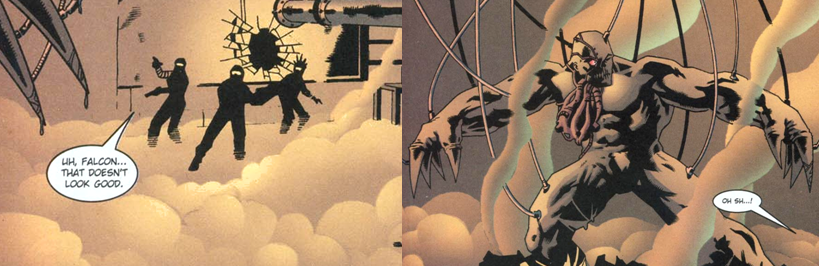




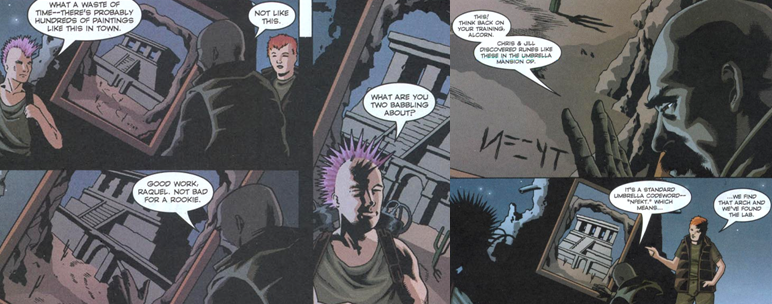


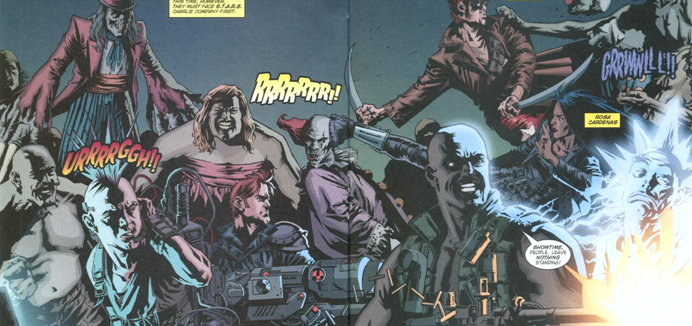
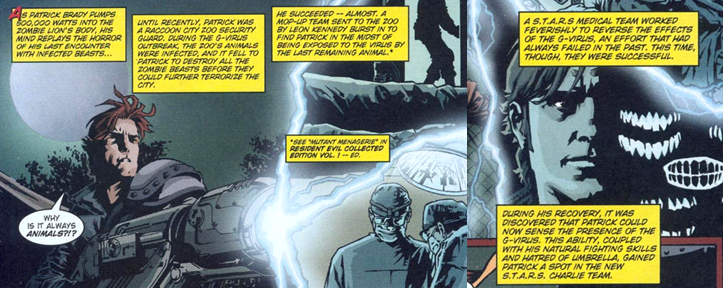
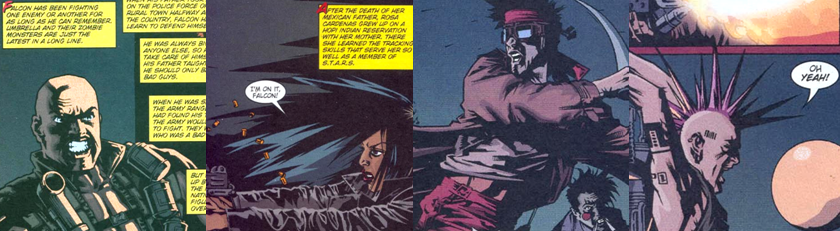





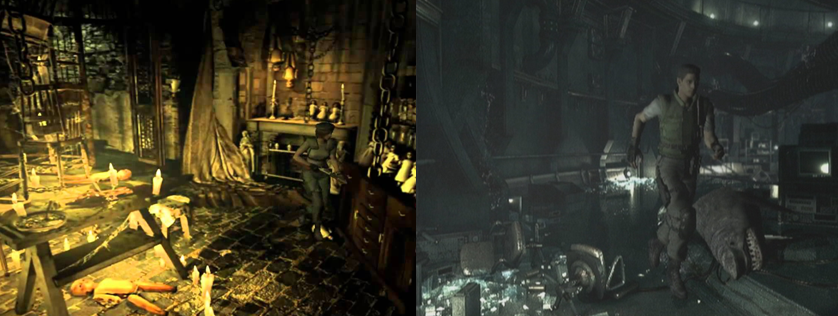

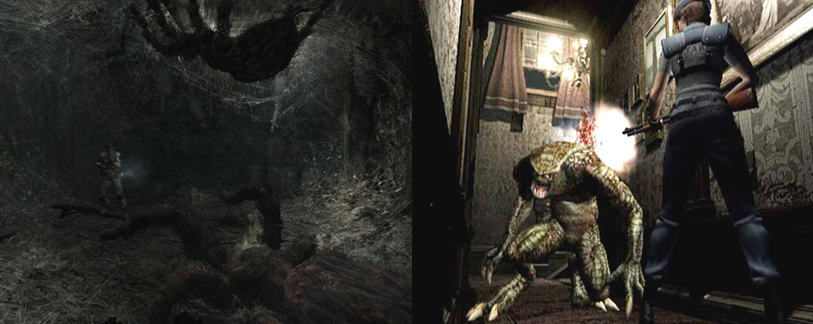


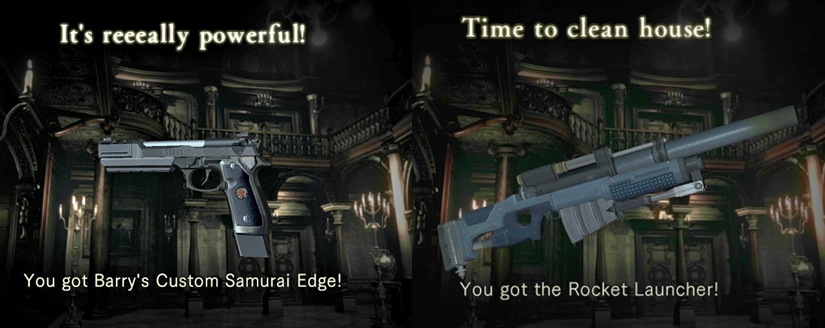


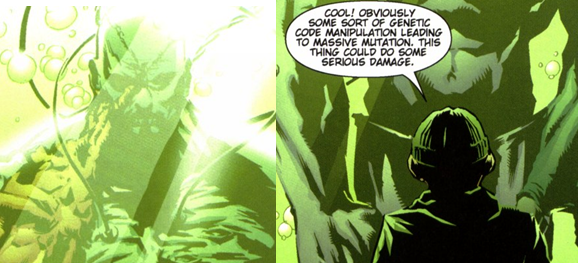
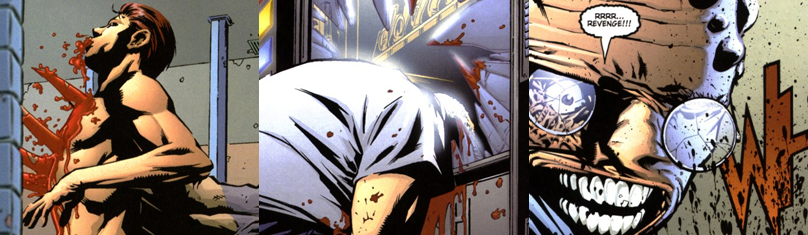


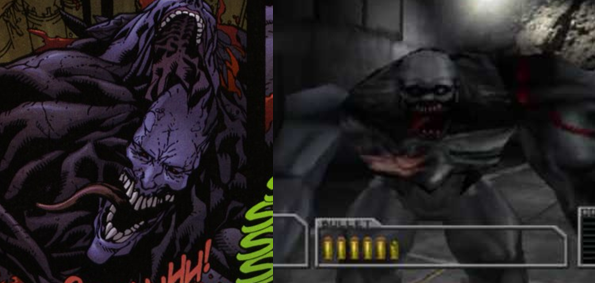


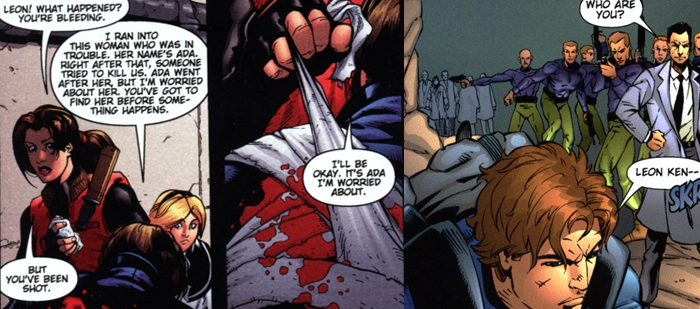
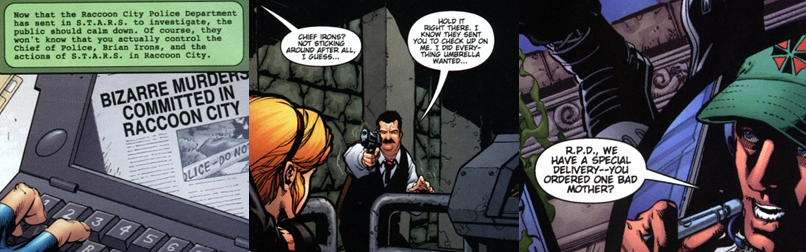


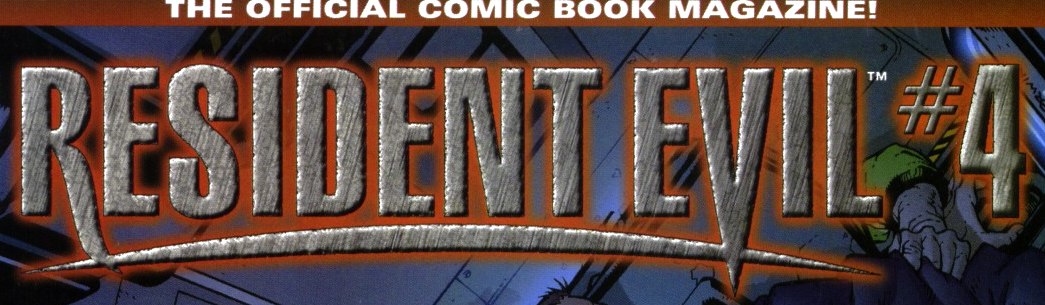
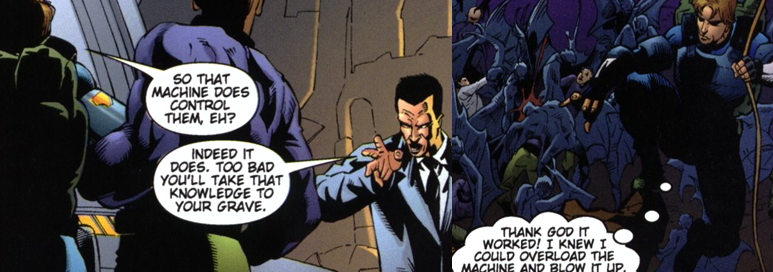

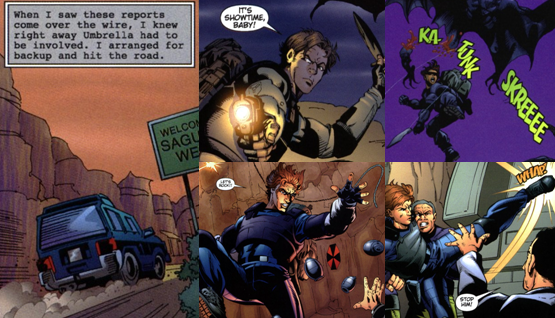
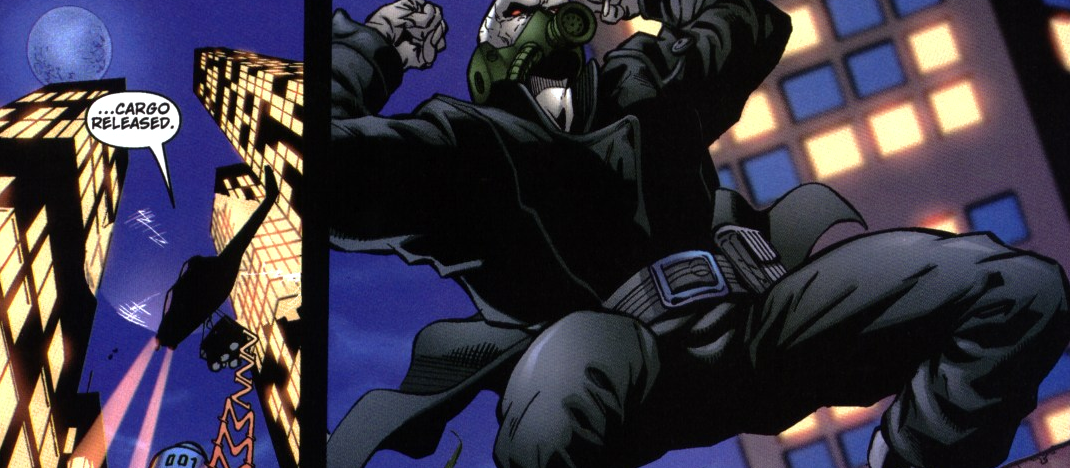


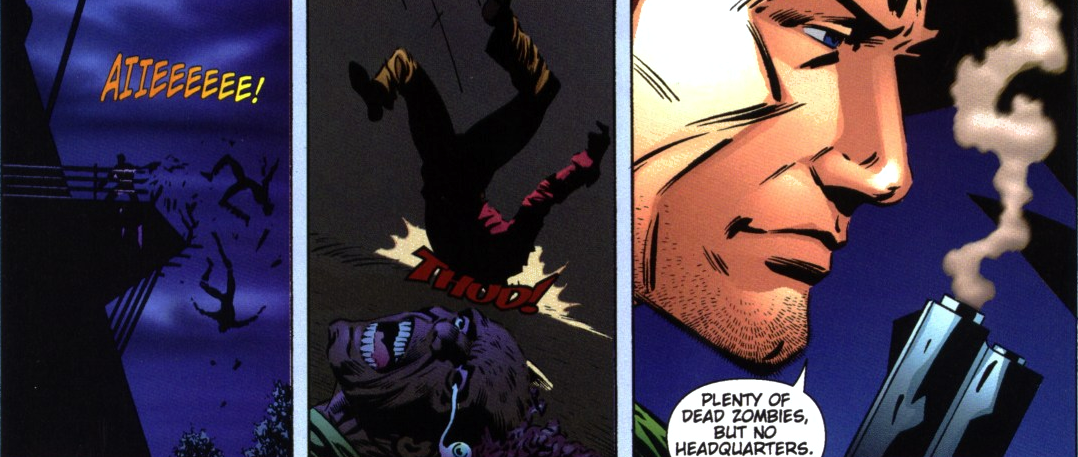


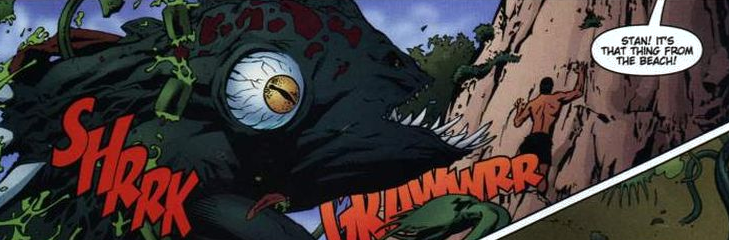


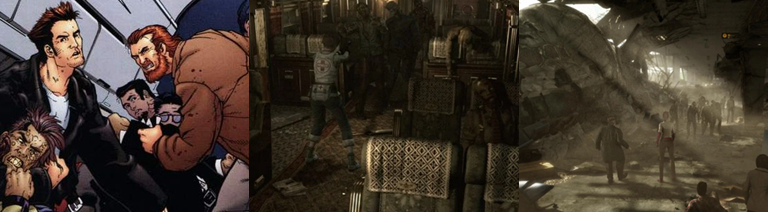
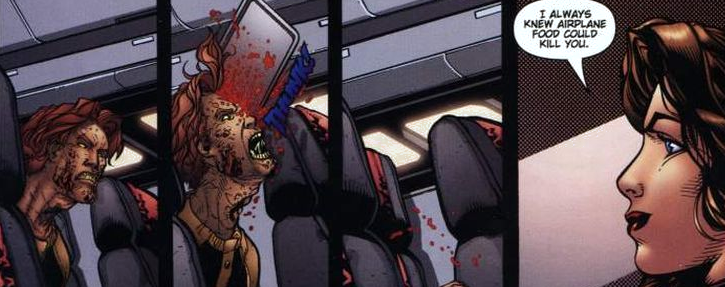


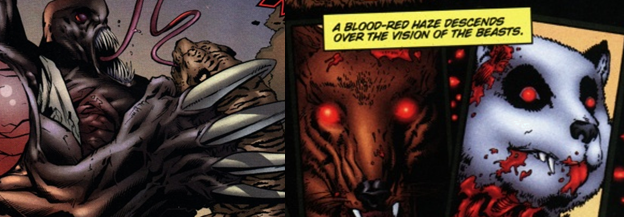
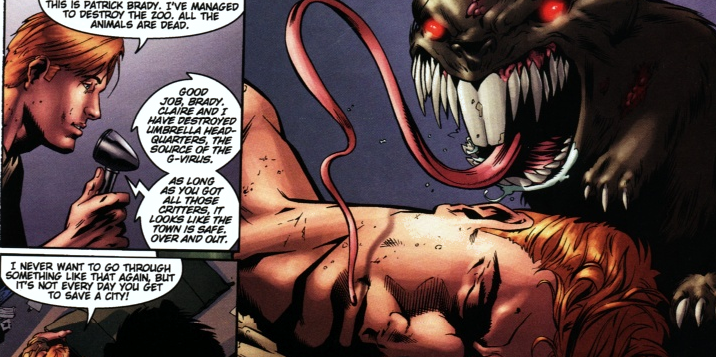


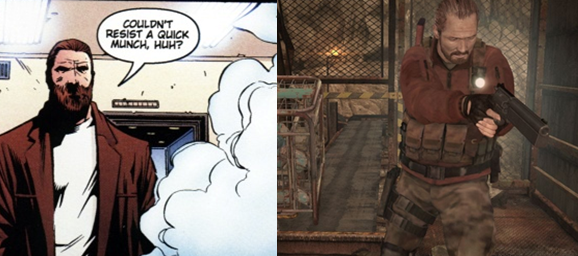


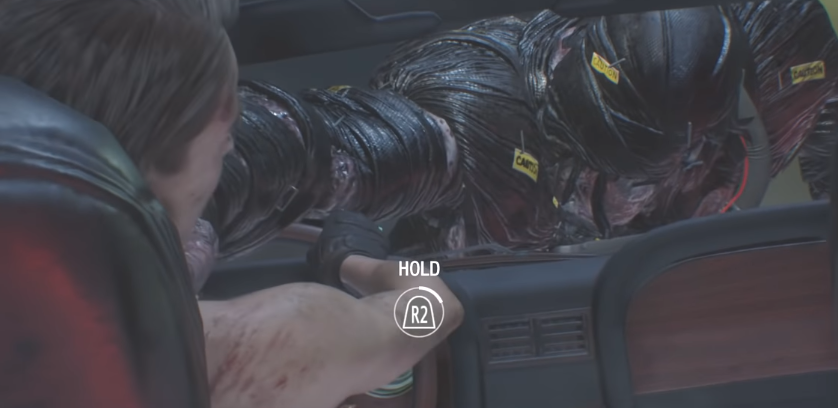






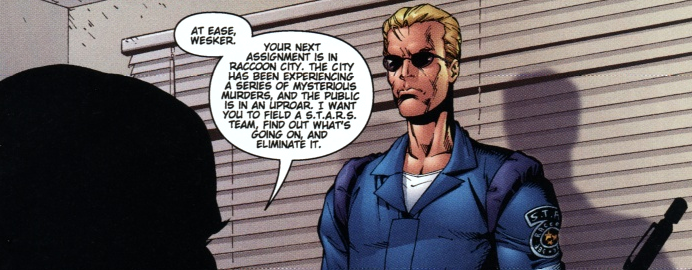


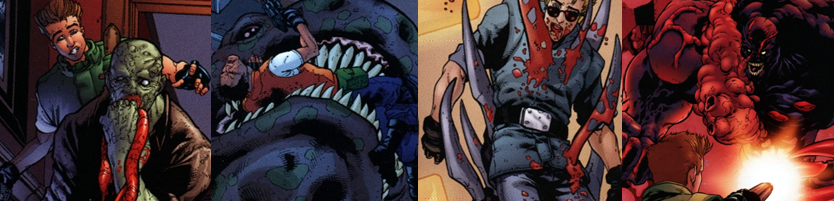

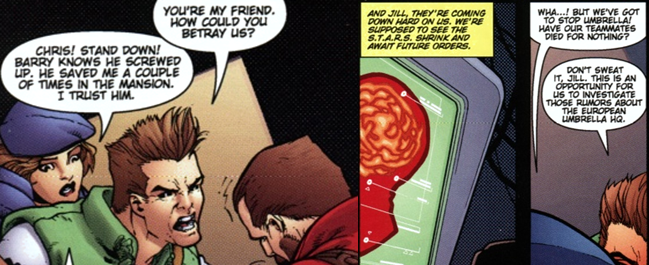
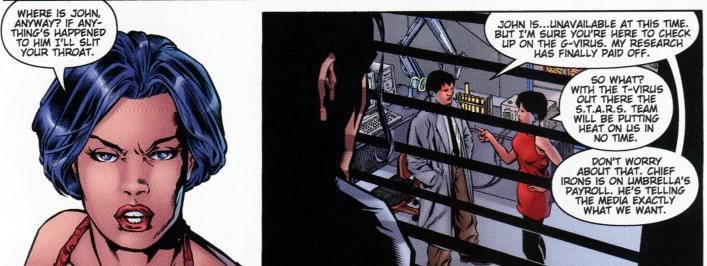
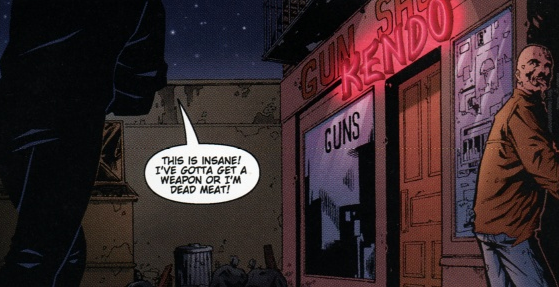
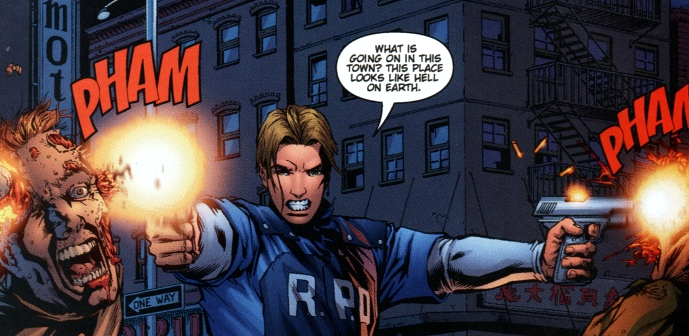
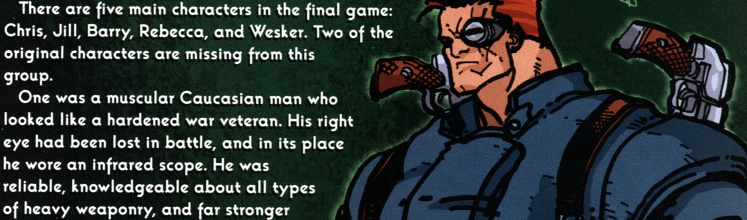

 Dr. K's Waiting Room
You must be logged in to post a comment.