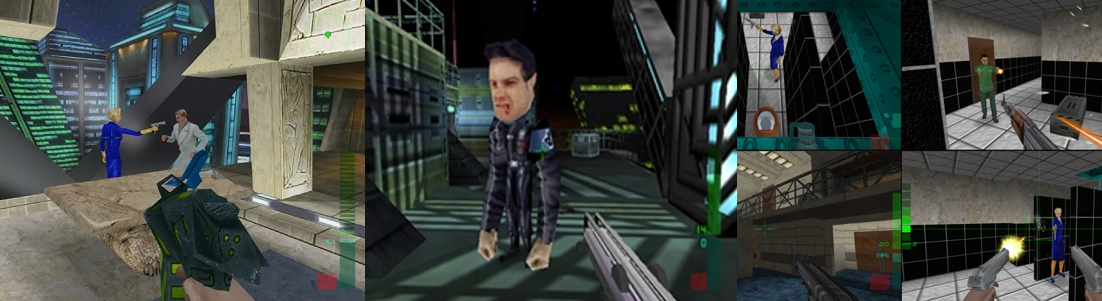
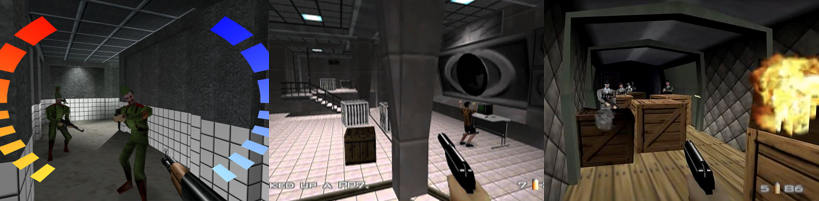
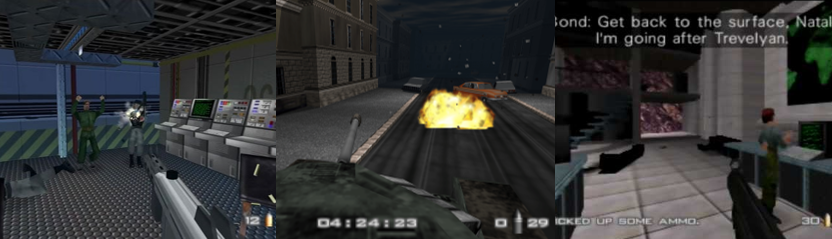
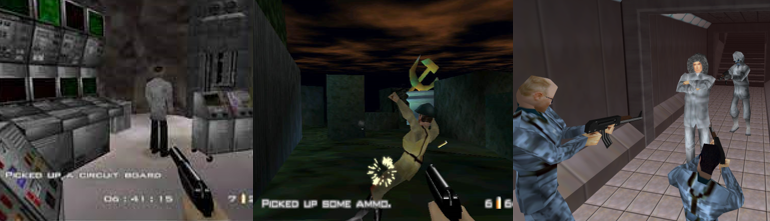
Game Corner [00-Heaven]: GoldenEye 007 (Xbox Series X)


To celebrate the release of Dr. No (Young, 1962), the first of the James Bond movies (Various, 1962 to present), October 5th is known as “Global James Bond Day”. This year, I’ve been spending every Saturday commemorating cinema’s longest-running franchise, and one of the most recognised and popular movie icons.


Released: 27 January 2023
Originally Released: 23 August 1997
Developer: Rare
Also Available For: Nintendo 64, Nintendo Switch, Xbox One, Xbox Series X

The Background:
It was tough to get any better than a game of four-player GoldenEye 007 back in the day. The endlessly accessible and enjoyable first-person shooter (FPS) was a staple at many a sleepover in my youth and was directly responsible for making me the James Bond fan I am today. Popularised by Sean Connery’s immortal portrayal, Ian Fleming’s super spy was in a bit of a drought in the late-nineties thanks to legal issues and Timothy Dalton resigning from the role. The iconic British institution came back with a bang, however, with Pierce Brosnan’s critical and commercial debut, which was followed by a tie-in game for the Nintendo 64 some two years later. Developed by British studio Rare under the direction of Martin Hollis, the game was originally conceived of as a 2D platformer for the Super Nintendo Entertainment System and as a rail-shooter before the developers got to grips with the Nintendo 64 hardware. After a year of development, David Doak joined the team and implemented stealth mechanics using a radius test. Successive gunfire would attract nearby enemies and players were encouraged to spy on enemy characters using the game’s two-way mirrors. Six months before the release date, programmer Steve Ellies added the now iconic multiplayer mode, though the likeness of former Bonds and the names of certain weapons were changed for legal reasons. The developers also toned down the violence to appease Nintendo’s concerns and included a number of unlockable cheats. In a world where videogame tie-ins are notorious for being rushed, bugged, and unfulfilling affairs, GoldenEye 007 proved the exception. Not only was it one of the best-selling Nintendo 64 games but the game was met with unanimous (and continuous) praise for its gameplay, mission-based mechanics, and multiplayer. Although Rare soon lost the James Bond license, GoldenEye 007’s legacy continued to be felt not just with its spiritual sequel, Perfect Dark (Rare, 2000), and in other FPS titles, but throughout subsequent James Bond tie-in games. There were rumours and clamouring for a re-release for decades, though rights issues always saw these stall. In 2010, Eurocom released a reimagining of the title to mixed reviews but hopes were raised when leaks of an Xbox One version appeared online. On the eve of the game’s 25th anniversary, these rumours were officially announced to be true when it released exclusively on the Xbox One and Nintendo Switch series of consoles and featuring a number of enhancements. So beloved is the original game that this enhanced version of GoldenEye 007 was equally lauded, especially for its nostalgia factor, though some were disappointed that the Xbox version didn’t include online multiplayer.

The Plot:
Renowned super spy James Bond/007 in drawn into a globe-trotting adventure as he races to stop a rogue 00 agent Alec Trevelyan (now a terrorist known as “Janus”) from causing a global financial meltdown with a satellite weapon known as “GoldenEye”.

Gameplay:
GoldenEye 007 is a first-person shooter in which players are placed into the shoes of world-renowned super spy James Bond and charged with completing various objectives across eighteen stages (referred to as “Missions”) taken from the movie of the same name, and two bonus Missions that loosely adapt elements and events from classic Bond films Live and Let Die (Hamilton, 1973), The Man with the Golden Gun (ibid, 1974), The Spy Who Loved Me (Gilbert, 1977), and Moonraker (ibid, 1979). Unlike FPS classis like Doom (id Software, 1993) and rail-shooters like Time Crisis (Namco, 1995), GoldenEye 007 offers a range of movement and control options, making Bond a far more versatile and capable FPS character compared to some of his counterparts. This new version of the game improves things even more thanks to modern controllers having two control sticks, but there are a range controls available and players can even customise them if they wish. The default controls see you firing Bond’s current weapon with the Right Trigger, activating consoles, opening doors, and disabling alarms and such with A, crouching to avoid incoming fire or enter vents with B, and aiming with the Left Trigger. You can also press Y and the Left and Right Bumpers to cycle through your available weapons, or manually select them by pausing the game, which brings up Bond’s fancy gadget watch. This also allows you to read up on your mission objectives, gives you the option of switching to different control schemes (each named after a different Bond Girl and with one even allowing an awkward two-player mode where only player moves while another one shoots), select gadgets like a key decoder or Bond’s laser watch, and quit the current Mission. On the original Nintendo 64 version, strafing was accomplished with the C-buttons and allowed you to rapidly dart across environments at higher speeds. Here, you can use the left analogue stick to accomplish this same task, and you’ll also find that your aim benefits from a slight auto-aim function.

Take on the role of 007, gun down enemies, and complete various objectives.

Unlike in modern FPS games, Bond is surprisingly vulnerable and will not regenerate health when taking cover from enemy fire. In fact, most things you take cover behind will explode in your face, so it’s better to keep moving and make use of the game’s controls to peek around corners or use silenced weapons or Bond’s handy karate chop to knock enemies unconscious without raising alarm. When taking damage, Bond will react accordingly, which can throw off your aim and see you being bounced about in a crossfire. Explosions are usually an instant death sentence as well so be sure to avoid grenades, rockets, and exploding crates whenever possible. While you can’t replenish Bond’s health, you can pick up body armour strewn across the environment to add an extra bit of protection, but there are no checkpoints in GoldenEye 007 so once you see that blood filling the screen or the “Mission Failed” notification, you’ll have to start over from the beginning. The game offers three difficulty settings (“Agent”, “Secret Agent”, and “00 Agent”), with a fourth being unlocked that allows you to customise various difficulty options, and the difficulty setting you play on directly impacts the behaviour of the game’s enemies, the bonuses you unlock, and the mission objectives you’re given. For example, when playing on “Agent”, you’re generally only given a couple of mission objectives. “Runway” on this mode simply asks you to acquire a key and escape in a plane, but higher difficulties have you destroying anti-aircraft guns first. Later Missions can become extremely complex and difficult because of this. Each Mission is preceded by a number of dossiers in which M, Q, and Miss Moneypenny will explain the specifics of each objective, often with pictures, so you have to be mindful about going in all-guns blazing as you don’t want to accidentally destroy a vital piece of machinery or gun down an ally. Because of this, many 00 Agent Missions require better use of stealth, such as attacking with short bursts of fire or while unarmed, enemies will be noticeably more formidable, and you’ll need to explore more of the environment and have less access to body armour, dramatically increasing the challenge.

Each Mission and difficulty setting offers unique objectives and mechanics.

Mission objectives are quite varied, but also shared across the game;. You’ll be deactivating alarms and consoles (sometimes by interacting with them, other times by blowing them up), acquiring keys, key cards, and documents, and meeting with allies like Doctor Doak, Valentin Zukovsky, and Dimitri Mishkin. Environments are often littered with cameras and alarm systems that will attract enemies to your location or even lock you out of rooms if you’re not quick to disable them, and enemies can sometimes be holding hostages who you’ll need to free without killing the innocent. This can be easier said than done, especially on missions that require you to protect, escort, or work alongside Natalya Simonova. All of the game’s non-playable characters (NPCs) tend to run in front of your bullets but Natalia is the worst, running around in a mad panic amidst a gunfight or leaving herself an open target while messing about with computers. Things quickly become quite obtuse and tricky as you’re tasked with destroying weapons caches, calling for back-up (without destroying the radio equipment), re-aligning an antenna cradle, and wandering around a statue park to meet with the mysterious Janus. Many mission objectives require the acquisition and use of Bond’s gadgets, such as using his laser watch to cut through grates, attracting keys with his magnet, planting tracking devices, and photographing objects, sometimes while racing against a time limit. Gameplay is somewhat broken up in the two instances where you can hop into an armoured tank, with it being mandatory to barrel through the streets of Saint Petersburg in said tank while trying not to run down too many innocent civilians. If you fail even one objective, the entire Mission is a bust, but you can continue playing if you want. This can be a good way to get an idea of the layout of the environment and find other mission objectives for your next playthrough to get a faster completion time, something that’s necessary to unlock all of the game’s cheat options. In addition to your time, your accuracy, shots fired, and kills are all tracked after a Mission is completed, meaning you can always try and improve your approach to a Mission.

Graphics and Sound:  
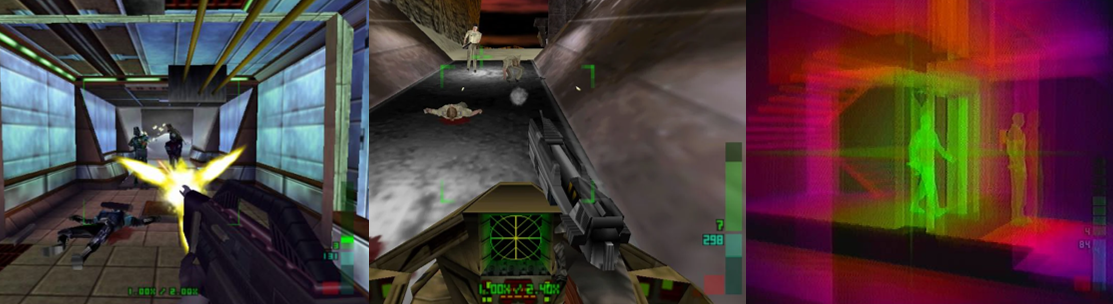
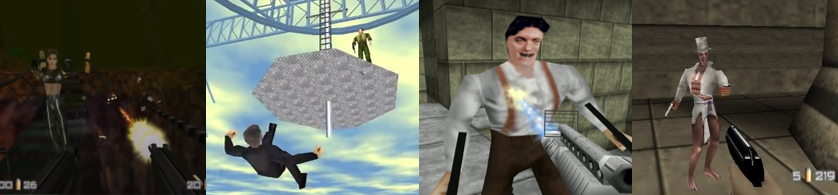
Even back on the Nintendo 64, GoldenEye 007 did a pretty good job of recreating scenes and characters from the movie. Sure, the character models are blocky and their faces hideous and many environments are a little too bland, polygonal, and swamped with fog, but they managed to capture the essence of the film really well, expanding upon minor elements and areas, especially in the first few Missions, and making them fully-fledged locations. The only issue I had was that the developers included two versions of Surface and Bunker. I would have preferred to see a Casino and Paris stage used instead to add a bit more variety to the early game, but at least there are differences between the two stages to both differentiate them and showcase the passage of time. There are even entirely new environments that weren’t seen in the film, like Silo, Depot, Caverns, and stages based on small parts of the film (like Dam, Runway, Frigate, and Train) are expanded on with additional mission objectives and aesthetic quirks. Of course, the most memorable location remains Facility, which lovingly recreates and expands upon the opening scenes of the film and remains the quintessential map for multiplayer skirmishes. My least favourite stages were always Statue, Jungle, and Cradle as they’re quite difficult to navigate and full of dense fog and hazards, to say nothing of the tougher enemies dwelling within.

While the graphics are dated, nostalgia means the game retains its visual appeal.

Every Mission begins with a bit of an overview of the location before the camera pans around and into Bond’s head, literally placing you in the role of the world’s most famous spy. Cutscenes, in the traditional sense, are few and far between and limited to these opening camera pans and a little animation of Bond looking all cool as he exits the stage, with the majority of the game’s story being relayed through the mission dossiers and onscreen dialogue. There are occasions where you can continue on and this dialogue will still play out, but if you try and rush Janus in Statue or don’t heed his advice to holster your weapon then you’ll fail the Mission. There are some graphical limitations to GoldenEye 007 that definitely date it, as well. There’s no reloading animation (guns simply disappear and reappear with a reloading sound effect), enemies have repetitive animation cycles (though they do kneel down, roll, cross their arms when dual-wielding, and react when shot in the ass), and there can be a bit of slowdown when too many explosions fill the screen. Still, little details like bullet holes, splashes of blood on clothing, and screams of pain help to keep things very immersive. Additionally, the soundtrack is incredible; composed by Rare stalwarts Graeme Norgate, Grant Kirkhope, and Robin Beanland, the soundtrack is both recognisably Bondian and unique, harkening back to Éric Serra’s movie score and the Bond themes made so famous by John Barry.

Enemies and Bosses:
Bond’s mission is impeded by the finest polygonal soldiers and grunts money can buy. While there’s not much to differentiate them in terms of animation, the game’s enemies all don different attire depending on the Mission (sporting parkas in Surface, camo gear in Jungle, and tactical outfits in Caverns) and wield various weapons. Many carry the KF7 Soviet or Klobb, two notoriously inaccurate weapons; others bust out the DD44 Dostovei or dual-wield the ZMG (9mm). The challenge posed by the game’s enemies directly relates to the difficulty setting you’re playing on and the Mission you’re playing. Enemies are pretty clueless in Dam but wander around the Caverns carrying super-powerful US AR33 Assault Rifles and blast at you with Moonraker lasers in Aztec. Janus’s special forces, and some guards aroused by alarms, will also carry shotguns or toss grenades, and you’ll also have to keep an eye out for high-impact turret placements that can shred your life meter in seconds. Enemies are quite vulnerable, even on “Secret Agent”, dropping after a few good torso shots or a headshot, but sometimes their guns can block your bullets and the sheer number of enemy bodies can make it difficult to land decent shots, in which case it’s best to target explosive parts of the environment to send them flying.

In addition to the movie’s baddies, you’ll encounter some classic Bond villains here,

Although boss battles aren’t commonplace in GoldenEye 007, there are a few instances where you’re tasked with killing one of Janus’s henchpeople in a firefight. The first of these you’ll encounter is Colonel Arkady Grigorovich Ourumov, who cannot (easily) be killed in the first few encounters. Ourumov fires at you from a distance in Silo, you pursue him in Streets, and then you finally gun him down at the end of Train, just like in the movie. Shooting Xenia Onatopp in Train will buy you some much-needed extra time with the floor grate, but she puts up a far greater fight when you confront her in Jungle. She’s armed with both a super-powerful RC-P90 and a grenade launcher and can be difficult to hit thanks to the fog, the explosions from her grenades, and her armour-piercing shots. Your best bet is to hang back, firing from a distance, or get up nice and close and fill her face with AR33 fire. This method of staying back serves you well in the final Mission of the main game, Cradle, where you go head-to-head with rogue MI6 agent Alec Trevelyan/Janus. In this Mission, you must realign the antennae, fending off Janus’s elite guard and the sentry guns set up about the place, blasting at Trevelyan as he fires his AR33 and tosses grenades to cover his escape. Trevelyan can absorb a great deal of damage but, once you’ve hurt him enough, he’ll dash to a specific area of the map and drop down to a small platform, just like in the film’s finale, where you’re given precious seconds to reorientate yourself and deliver the final blow. When you unlock the bonus missions, Aztec and Egyptian, you’ll face off with classic Bond villains Jaws and Baron Samedi. The former carries two AR33s and is a veritable bullet sponge, though he’s a big target and shots to the face are recommended. The latter mysteriously resurrects and wields a different weapon each time as you search through the pyramid for Francisco Scaramanga’s fabled Golden Gun, which can kill any enemy, including the supernatural Samedi, in one hit.

Power-Ups and Bonuses:
Naturally, there’s quite a bit you can find throughout each Mission to aid your progress. Body armour allows you to take a few more hits and effectively acts as a secondary health bar and you can pick up any weapons dropped by downed enemies. Green crates can often be found which contain new weapons or ammo, and you’ll also be able to swipe keys and key cards from guards and NPCs alike to acquire mission-specific items or additional toys. Bond can karate chop enemies without expending ammo, but this leaves him extremely vulnerable so it’s best to use this from behind. Similarly, the sniper rifle butt can be used to hit and defeat enemies when up close. He’s also afforded numerous weapons, including his iconic Walther PPK (known as the PP7), which also comes with a silenced variant, and his trusty watch, which cuts through grates and enemies alike with its laser. Bond can also dual-wield for additional damage (and ammo expenditure) and you can even have him hold two different weapons if you’re quick at cycling through them. A variety of machine guns are on offer, from the near-useless Klobb to the simplicity of the D5K Deutsche and the burst fire of the RCP-90. You can also grab high-explosive weapons, such as grenades, grenade and rocket launchers, and three types of mines (remote-activated, proximity triggered, and timed), but be sure to avoid the blast zone. Throwing and hunting knives can also be used for a more personal touch, but I like the power and accuracy offered by the two shotguns and the Couger Magnum. The game’s best weapon is the one-shot Golden Gun and the faster variants unlocked through cheats, but you can also make use of the tanks cannon to blast at soldiers and anti-aircraft guns and zap enemies with lasers when you acquire the Moonraker laser.

Additional Features:
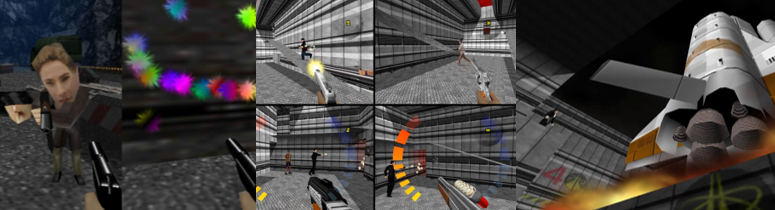
There are fifty-five Achievements on offer in GoldenEye 007, with twenty being awarded simply for clearing each of the game’s Missions on any difficulty setting. You’ll get three separate Achievements for finishing the entire game on each of the three difficulty settings, and 10G each time you finish a Mission in a specific time frame on a specific difficulty and unlock a cheat option. Yes, blasting through Missions as quickly as possible on each of the difficulties will unlock a wide variety of cheats, from invincibility, invisibility, all guns, infinite ammo, and even options for a hilarious “big-head mode” and to speed up or slow down the in-game action. Achievements are also earned by playing the game’s multiplayer mode. Although the Xbox version doesn’t allow for online multiplayer, you and your friends can still get together in person to battle head-to-head, or in teams, across a variety of repurposed maps.

The game’s replay value is bolstered by fun cheats, a banging multiplayer, and various unlockables.

You can battle simply for points, set limits on how many lives and time you have to play, set weapons to be one-hit kill, battle for control over the mythical Golden Gun, and play a capture the flag scenario, with each option named after a classic Bond film. All of the game’s characters, major and minor, are available to pick from alongside two classic Bond villains, Oddjob and Mayday, with the former (and Jaws) offering different challenges based on their height. Completing the game on Secret Agent and 00 Agent will also unlock two bonus Missions: Aztec and Egyptian. In Aztec, you’re placed in a fantastic recreation of Hugo Drax’s missile command centre from Moonraker and must confront Jaws, escape a rocket’s test fire, and then sabotage the Drax shuttle before it takes off. In Egyptian, you’re tasked with navigating a maze-like pyramid in search of the Golden Gun and hounded by Baron Samedi, who returns three times to cause you trouble but the biggest challenge here is remembering the sequence to reach the aforementioned Golden Gun as you’ll be cut down by sentry guns if you step on the wrong tiles. Some additional weapons can also be used when utilising the All Guns cheat, which can make it fun to revisit previous Missions, and you can even tweak the enemy behaviour, strength, and awareness when you unlock 007 Mode to make the game even easier or harder depending on your preference.

The Summary:
Obviously, nostalgia is a huge part of GoldenEye 007’s appeal. Graphically, the game hasn’t aged very well, and it’s definitely been superseded by other Bond games and FPS titles in terms of presentation, gameplay mechanics, and content but there’s something very appealing to GoldenEye 007’s simplicity. It’s nice to be placed in a surprisingly large number of polygonal environments and simply head to a goal, with additional objectives adding relay value and challenge to the game, meaning GoldenEye 007 can be surprisingly complex that more you play on higher difficulties. The game is full of fun little Easter Eggs as well, from character animations and dialogue to oddities placed in each environment, and I enjoyed how NPCs on one difficulty suddenly become vital objectives in the next. There’s a lot to do here as the game challenges you to play on harder difficulties and find the fastest, most efficient way of beating its Missions to unlock everything. There’s also a nice variety of weapons that can all be held at once, meaning you can easily mix and match your gameplay style on the fly, and a fun assortment of objectives that often encourage stealthier gameplay but give you the tools to engage in a manic firefight. The multiplayer is as enjoyable as ever, too; I’m not fussed about the lack of online functionality as I don’t play online and it’s great to be able to jump in and mess about like in the old days. After decades of GoldenEye 007 being restricted to an old console, it’s simply astounding to see it made available once again. It’d be great if more licensed games got the same treatment but I’m happy to say that GoldenEye 007 is just as much of a blast to play through now as it was all those years ago.

My Rating:

Rating: 4 out of 5.

Great Stuff

Was GoldenEye 007 a favourite of your youth? What did you think to this re-release and were you surprised when it was finally announced? How do you think the game holds up today? Did you ever finish it on 00 Agent and unlock everything? Which Mission, weapon, or location was your favourite? Do you have fond memories of playing the multiplayer? What’s your favourite James Bond videogame? I’d love to know your thoughts and memories of GoldenEye 007 so please leave them in the comments and go check out my other Bond reviews.

Game Corner: Jet Force Gemini (Xbox One)

GameCorner
JetForceGeminiLogo

Released: August 2015
Originally Released: October 1999
Developer: Rare
Also Available For: Nintendo 64

The Background:
You wouldn’t really know it now but Rare were a big deal back in the nineties. They were responsible for the excellent Donkey Kong Country series (ibid, 1994 to 1996) on the Super Nintendo Entertainment System (SNES) before taking home console gaming by storm with the renowned GoldenEye 007 (ibid, 1997), one of the few licensed videogames to not only be good but also one of the greatest first-person shooters (FPS) ever made thanks to its highly enjoyable split screen multiplayer. Following this, Rare ventured into the 3D action/platformer genre with Banjo-Kazooie (ibid, 1998), a whimsical collectathon that secured Rare’s places as one of Nintendo’s premier third-party developers. During their time developing for the Nintendo 64, Rare were generally known for producing videogames that were either bright, colourful fantasy adventures. Conker’s Bad Fur Day (ibid, 2001) later turned this expectation on its head with its graphic violence and crude sense of humour but, before that, Rare deviated from this norm through Perfect Dark (ibid, 2000), GoldenEye 007’s spiritual successor, and Jet Force Gemini, both of which were darker, far moodier titles that veered into science-fiction and futuristic technology. Given how much I enjoyed Rare’s titles back in the day, I spent quite a bit of time with Jet Force Gemini on the Nintendo 64, either borrowing it from a friend or actually owning a copy for a brief period of time. One of the main reasons I chose the Xbox One over the PlayStation 4 was that console had the exclusive title Rare Replay (ibid, 2015), a compilation of thirty of Rare’s greatest hits over their many years, which contained, among many other gems, Jet Force Gemini. As I had never finished the game, and often struggled with it at certain points, this seemed like the perfect time to return to the game and put that loose end to rest once and for all.

The Plot:
After their fleet is wiped out by the insectoid armies of the villainous Mizar, the remaining members of the intergalactic law enforcement team Jet Force Gemini split up to infiltrate Mizar’s warships. The team discover that Mizar has enslaved the bear-like Tribals and resolve to defeat the alien’s forces.

Gameplay:
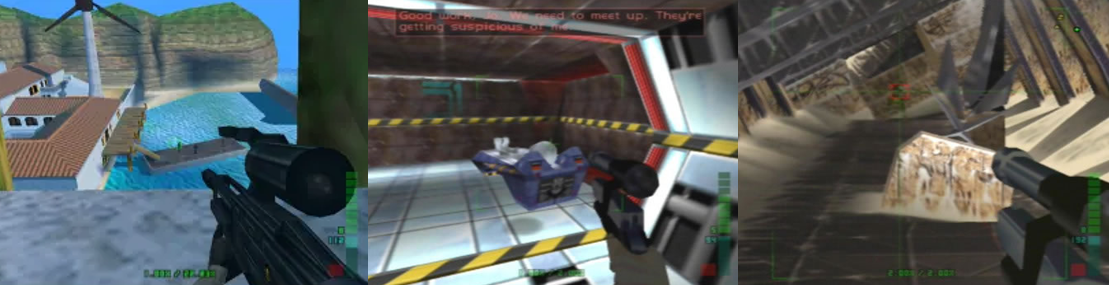
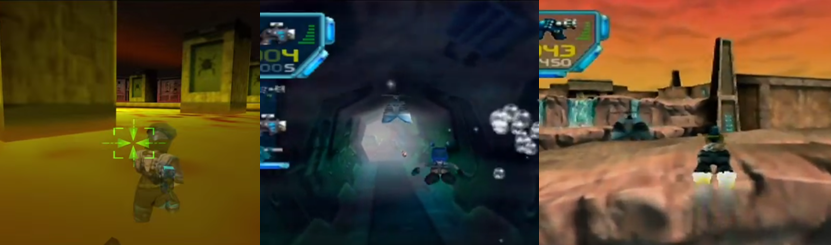
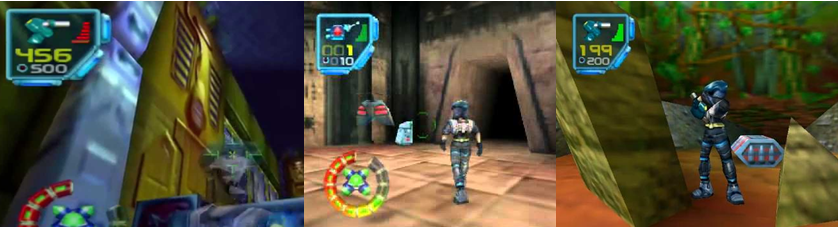
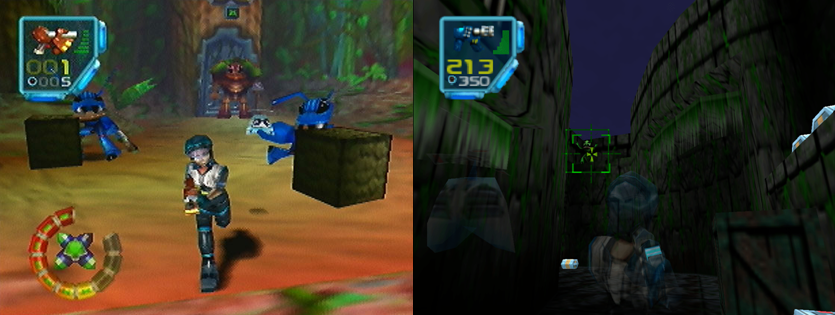
Jet Force Gemini is a third-person action/adventure shooter with a heavy emphasis on exploration, backtracking, and some light (if frustrating) platforming and puzzle solving. When you start the game, you’re put in control of Juno, the male member of the titular team but soon rescue his female partner, Vela, and their mascot, the semi-cybernetic pooch Lupus. Functionally, each character controls the same, running and jumping around their environment and various weapons to blast away any insects that get in their way. When you play Jet Force Gemini, the very first thing you should do is opt to switch to the new control scheme implemented into Rare Replay. Without this, you may struggle to control your character, aiming reticule, and co-ordinate your inventory. I don’t remember this being a problem on the Nintendo 64 version but, in the absence of that system’s C-buttons, the default controls for Jet Force Gemini map the strafe and weapon selection to the right analogue stick, meaning you’ll often switch weapons when trying to strafe. This control scheme also makes precision aiming a tedious and pixel-perfect operation but both of these issues are largely remedied by switching to the duel analogue control scheme offered by the Xbox One version. This doesn’t correct some of the other control issues, though. As you explore, you’ll do so from a third-person perspective, which is where the controls become relatively tight and responsive but the camera is obsessed with staying locked behind your back, somewhat skewing your view when you’re trying to make difficult jumps. When enemies appear onscreen, the view switches to a pseudo-first-person perspective; at the press of the left bumper, your character become translucent, an aiming reticule appears onscreen, and you’re tasked with strafing behind cover and around your foes as you mow down enemies. The new control scheme makes this far more enjoyable but I still found this shift in perspective to be jarring every time it happens and that the game’s base controls don’t necessarily make moving and shooting the easiest task.

JetForceGeminiCharacters
Each character can explore their environments in different ways.

For one thing, your characters control in a variation of the classic “tank controls” of early PlayStation and survival-horror videogames. You can travel in all eight directions and it seems as smooth as the controls in Banjo-Kazooie but this is a deception. For example, you’ll be running ahead at full speed and suddenly have to either make a right turn or turn around; your character then skids to a halt, sliding along the floor as they go, and either makes the turn in a wide arc or you’re forced to reverse backwards like a truck! The slipperiness of the characters is a major flaw; it’s great that Juno and Vela can grab onto ledges, which often saves you from plummeting to your death, but often you’ll fly right off an edge or a platform simply because the characters slip and slide all over the place. The camera really doesn’t help matters; it’s completely out of your control unless you hold down the left bumper and entire the quasi-first-person mode, meaning you don’t have full 3600 control of the camera like in Banjo-Kazooie. As the camera is always seemingly zoomed in just a little bit too much and permanently lodged behind your character, this makes jumping across gaps or to floating platforms a massively annoying task as there’s never a good camera angle to judge your jump and there’s a significant delay in the characters’ jumps (not to mention the slipperiness and the way they kind of freak out a bit when they land from a jump). Each of the three characters explores the environments a little differently and has access to different abilities: Juno can run through magma without issue, Vela can swim deep underwater (and, thankfully, has no need for air during these sections), and Lupus can hover for brief periods of time. Lupus can’t grab edges or duck but all three characters have a super jump (activated by simply holding down the jump button) and are able to find and use new weapons as they explore their surroundings. To progress through stages, you’ll generally have to unlock doors either by destroying all enemies in an area or using a coloured key. You’ll also encounter a number of non-playable characters (NPCs) who offer you additional items but only after you bring them something in return, forcing you to go off on a side quest to another world and run around in desperate circles as each of the characters trying to find what you need as, again, there’s no map or indication of where to go or what to do, forcing you to experiment with the three characters, different routes, or to consult a guide.
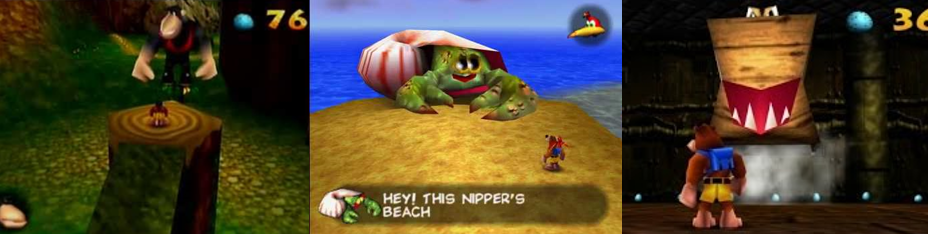
JetForceGeminiAmmo
Ammo is plentiful, which is good as you’ll burn through it pretty fast.

As for the weapons, you’ll be relieved to hear that there’s no need to reload in this game; ammo packs are in plentiful supply and often dropped by enemies, though you’ll be burning through some of your more effective ammunition as you mow down your enemies. This wouldn’t be so bad if the standard pistol had infinite ammo but it’s doesn’t. It also comes hampered with a power meter, of sorts, that keeps you from spamming the fire trigger over and over as the speed and power of your shots will decline the more you fire the gun until the bar refills. Each character’s health is represented by a glowing band in the bottom left of the screen; the band surrounds the logo of the team and drains as you take damage. You can replenish your health by collecting Gemini gems and expand your health by finding the appropriate items but, while you effectively have up to four health bars, you’ll find your health whittled away to nothing in short time when you’re ambushed by large groups of enemies if you don’t find cover or beat a hasty (if clunky) retreat. When you begin a stage, you’re given two continues; you can’t earn any additional continues but, if you exhaust them all, you do continue playing from the last auto-save point (and you can also manually save the game from the menu), which seems to make the continue system utterly redundant as you can just keep continuing as often as you need to. Jet Force Gemini begins in a very linear fashion; you can switch to Vela and Lupus after rescuing them from Mizar’s forces and each one makes their way through three different worlds before meeting up with their teammates at Mizar’s Palace. Once you fulfil this objective, the game opens up into a free play mode, of sorts, allowing any character to visit any world or location at any time. Unfortunately, you can’t switch to a character on the fly; when you select your character, the game forces you to sit through an unskippable cutscene of the character arriving and landing or docking at their location and you must begin the stage from the beginning.

JetForceGeminiExplore
It’s tough to properly explore the game’s vast worlds without an onscreen map.

Switching to a new location is easily done from the map screen in the game’s menu but, when you select a location, you’re forced to start from the beginning of the stage rather than jumping to one of the other points of the stage. Also, when you’re exploring a stage, there is no onscreen map or menu-accessible way to help guide you through and this becomes incredibly frustrating during the game’s later stages as a lot of areas in the game’s generally diverse stages look the same and it’s easy to get turned around, lost, or simply struggle to progress as you have no real idea of where you should be going. This becomes even more annoying when you’re forced to backtrack to every location with each character and hunt high and low for the missing spaceship parts you need to reach the final confrontation with Mizar; Rare never liked to hold your hand when it came to exploration but omitting a stage map was a real boneheaded move and makes the game more tedious and annoying than it needs to be. During the free play portion of the game, you’ll have to revisit each location at least three times, once as each character, in order to locate new weapons, upgrades, story-progressing items and, of course, rescue all of the Tribals. As you explore stages, you’ll find these cute little critters scattered around, usually in your line of fire; touching them teleports them to safety and you must rescue every last one of them in order to complete the game. If a Tribal dies, you can continue playing and “simply” replay the stage to rescue them the next time around but, here’s the kicker; even if you’ve rescued Tribals, they still appear in the stage when you return, meaning that you never really feel as though you’re actually progressing with rescuing the little koalas. You can track your progress from the menu screen but, honestly, it isn’t very clear and I would have much preferred it if Tribals disappeared from the stages once they were rescued.

Graphics and Sound:
Jet Force Gemini has a very distinct visual style; ostensibly a sci-fi adventure, the game is filled with large, open areas, futuristic technology, and alien creatures. There’s a mish-mash of all kinds of scenery and styles in this game; one minute, you’ll be exploring a swamp-like world, the next you’ll be trapped in the large vertical halls of a spaceship, then you’ll be dropped into a vast desert or a desolate, metallic prison. Each world and location has its own look and feel though the gameplay mechanics are, largely, the same for each location; even on worlds filled with magma, Vela can find pools to dive into and Lupus will find gaps only he can cross, for example, and most locations task you with making some awkward jumps to desperately trying to navigate maze-like hallways and locations. While I am largely impressed with the size and scale of each of the game’s worlds, in many ways they are too big; a similar issue plagued Banjo-Tooie (ibid, 2000), which featured a large interconnected map that seemed both empty and full of life at the same time. The individual locations of Jet Force Gemini are more akin to somewhere between the size of Banjo-Kazooie’s stages and those of Banjo-Tooie, made even larger by the alternate paths the different characters can take, but some can feel far too monotonous thanks to all the areas looking the same and seeming far too big.

JetForceGeminiCutscenes
Sporadic cutscenes progress the game’s basic plot.

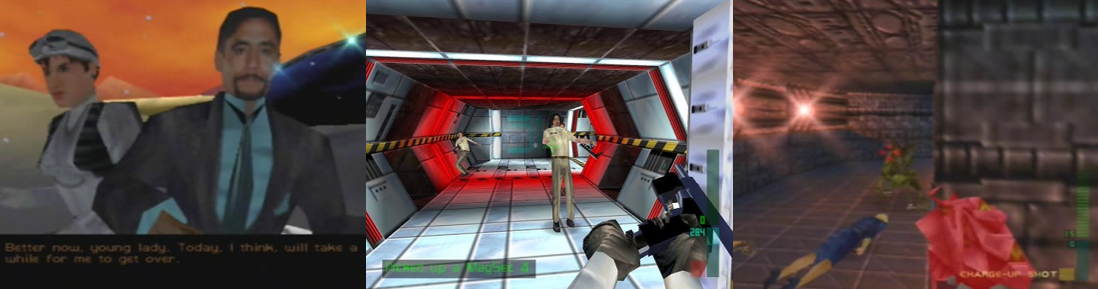
The game features a far more operatic and dramatic soundtrack compared to Rare’s other titles; a mixture of bombastic heroic themes, ominous, foreboding ambient sounds, and heart-pounding boss music all work really well to set the tone of the game but it feels a little more generic compared to the likes of Banjo-Kazooie. Jet Force Gemini also features a few unskippable cutscenes, many of which seem to be masking the game’s loading times; every time to return to an area, you have to sit through the same cutscene of your ship flying in and landing, which gets very annoying after a while. Cutscenes feature no voice acting, relying on text boxes to convey the story, and only a handful of characters speaking in the charming gibberish seen in the Banjo videogames, which is disappointing. The game’s presentation is bombastic and over-the-top (enemies explode in a shower of goo and limbs) but the plot is generally played entirely straight, with only the game’s wackier NPCs showcasing some of that quirky Rare humour.

Enemies and Bosses:
For all the diversity of its worlds and locations, Jet Force Gemini drops the ball a bit when it comes to enemy variety. No matter which location you visit, you’ll encounter the same enemies, with only slight variations depending on the stage you visit or the path you take. Mostly, you’ll come up against the generic blue drones who run around in a blind panic, blasting at you from behind cover and dropping in just a few hits, but you’ll also encounter a couple of variants on this enemy.

JetForceGeminiEnemies
Enemies aren’t especially varied but can have a lot of personality.

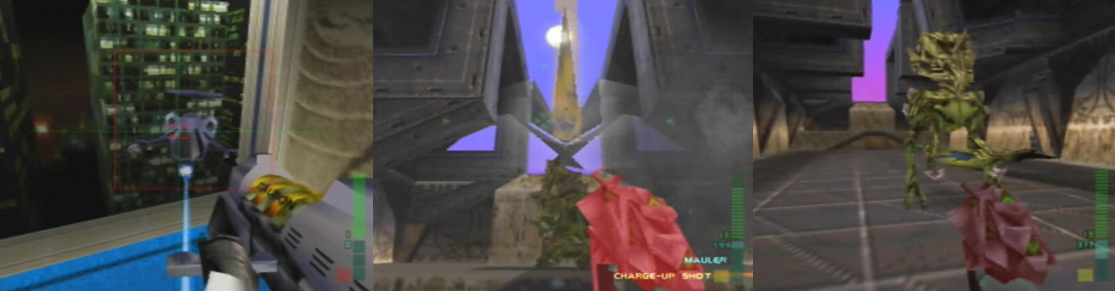
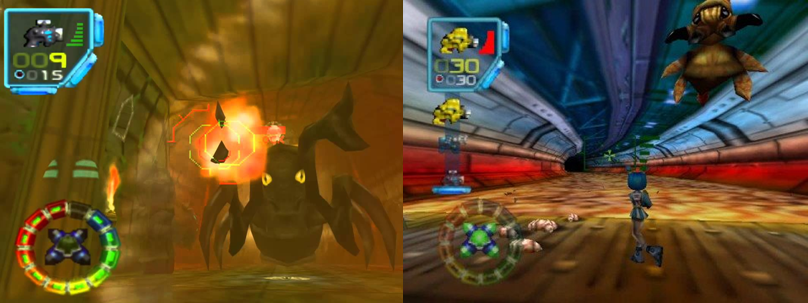
One of the more annoying variants are the shield-wielding drones, who constantly hide behind impenetrable shields and force you to either fight with the game’s controls and chase them down or strafe around them or use one of your more powerful weapons. Green drones usually adopt a sniper position to whittle your health down from up high and afar and the large, purple beetle-like enemies will either blast at you with rapid fire or explosive shells, and the red drones are far tougher and smarter. Despite the lack of variety, the enemies are surprisingly smart, ducking behind cover and running from your fire, and have a shocking amount of personality; sometimes, they’ll throw their weapons down and surrender, you can blast their weapons out of their claws and sending them into a panic, some drones will resort to tossing a grenade at you (often committing suicide in the process) or rushing at you head-first, and, if you land a headshot, you can blow their heads off and collect them to unlock bonus features. Alongside these drones, you’ll also exchange fire with variety of flying, or floating, robots. These little bastards will float around in groups of anywhere from three to, like, thirty, either hovering in a swaying formation or swooping around in predictable, but annoying, attack patterns. Usually, you’ll fun head-first into ambushes of these robots, which can whittle your health away in a flurry of laser fire in no time at all, forcing you to back up or find cover and hope that you have enough machine gun ammo to blow the little bastards out of the sky.

JetForceGeminiBosses
Bosses can be hard to hit thanks to the game’s janky controls.

As unfortunate as it is that Jet Force Gemini is lacking in enemy variety, it’s equally unfortunate that there aren’t many bosses on offer here. Luckily, the five bosses we get are gigantic and impressive in their scale but, regrettably, they’re generally more annoying than fun. To battle these bosses, you’re locked into a static area, able only to jump and strafe left and right to avoid incoming fire and their explosive (often cluster-based explosives) shots; the lack of cover and health in these battles is annoying and difficult enough but actually dealing damage to the bosses can be an issue in and of itself.

JetForceGeminiBosses2
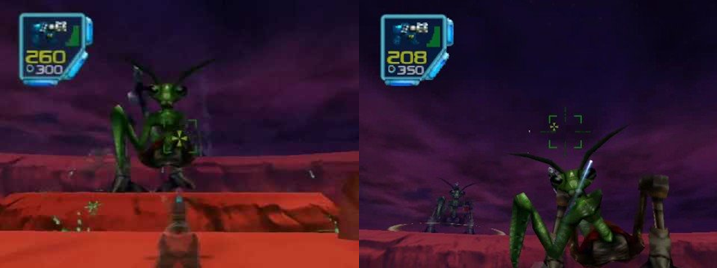
These two assholes can go fuck themselves!

Easily the most annoying boss in the game are the Mechantids, two gigantic cybernetic praying mantises (Mantii? …Whatever) who dance around in the background and can only be attacked when they leap onto a platform closer to Lupus. When battling this boss, and the game’s other bosses, you’re given a very small window of opportunity to actually deal some damage; miss it, and your shot will either do nothing or careen off into the void and you’ll either take damage or have to try your luck in the next window. Given how slippery and awkward the game’s aiming mechanics are, this happens more often than not; seriously, I had this same issue in the poorly-implemented shooting sections of Banjo-Tooie and Conker’s Bad Fur Day and I still can’t understand how Rare, the guys who made GoldenEye 007, struggled so much to incorporate shooting and aiming mechanics into their later games or why they ever thought it’d be a good idea to put them into 3D action/platformers and it really makes these boss battles far more frustrating than they need to be.

JetForceGeminiBosses3
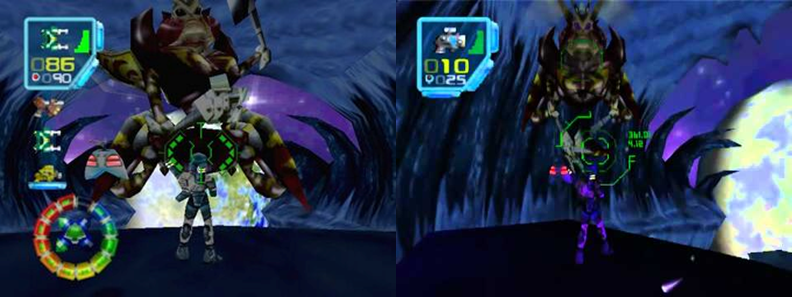
Mizar is easily the game’s toughest boss battle.

You’ll do battle with the game’s big bad, Mizar, twice in the course of the game; the first battle is more intimidating than it actually seems and can be easily won by simply blasting Mizar in the face with your tri-rocket launcher when he leaves his head exposed. Once you finally rescue all the Tribals and repair their ship, you’ll battle him again in the game’s toughest battle yet; the final boss battle has four phases, each made all the more difficult by the sheer number, power, and frequency of Mizar’s attacks and the lack of health, ammo, cover, and checkpoints. Oddly, considering the game is so focused on have three distinct characters, you only ever battle Mizar with Juno, which is super annoying as it would make this final battle much more bearable if you could switch between team members. Mizar’s only weak point in this final battle is a small piece of machinery fixed to his back; you have to weather a slew of asteroids that home in on you, dodge his claw attack, and then struggle to get your homing missiles locked in on this impossibly small target to get a few shots in, before desperately dodging his eye lasers, freezing breath, and damnable lightning attacks. Each time you deal damage to Mizar, these attacks increase in frequency until finally, he loses his wings and arms and starts blasting at you indiscriminately. Luckily, in this final phase, all you have to do is unload your tri-rockets and best weapons into his exposed head but that is very much dependant on you having enough health to survive to that point.

Power-Ups and Bonuses:
As you explore Jet Force Gemini’s many locations, you’ll come across a number of collectables and upgrades; these aren’t quite as numerous as in some of Rare’s other titles and collectathons but they are still quite varied, for the most part. You’ll find glowing crates that contain new weapons, keys, or story-progressing items, Gemini gems and ammo crates are scattered across the locations alongside capacity-increasing backpacks and health-increasing power-ups, and you’ll also pick up Mizar Tokens to spend on replenishing your health or ammo at certain automated stations. The game features a wide variety of additional weapons to choose from: there’s the rapid-firing machine gun, the tri-rocket launcher, grenades, cluster bombs, shurikens, homing missiles, a chargeable plasma shotgun, and a sniper rifle, among others. Generally, though, I found myself relying on the basic pistol, machine gun, or tri-rocket launcher as the sniper rifle doesn’t mesh well with the game’s janky, slippery controls, the plasma shotgun is all-but-useless (even when fully charge), and the homing missiles are disappointingly weak. Also, I found I was more likely to toss a grenade right in my face due to the overly exuberant way they bounce around the areas, making them more of a liability than a viable weapon. It doesn’t help that your weapons only really do damage when the aiming reticule emits a lock-on beep, meaning you can literally toss grenades or fire rockets dead-on at enemies and have them do no damage at all because you didn’t get a direct lock on to the enemy.

JetForceGeminiMultiplayer
Mini games and multiplayer options are available, however ill-fitting.

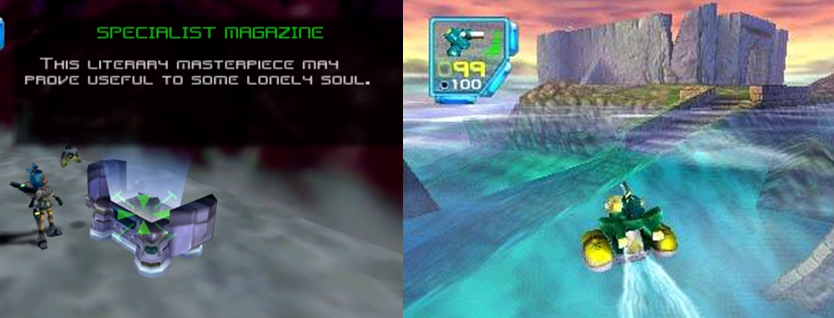
Once the three protagonists rendezvous at Mizar’s Palace, the Tribals upgrade their armour; while this doesn’t give them additional health and doesn’t seem to increase their durability, it not only places Lupus into a cute little tank but also allows them each to charge up a jetpack at fuel pads so they can reach new areas. Unfortunately, this can only be done at certain points, though, so you won’t be flying across entire gaps and stages with this mechanic. The game’s action/shooting elements are offset by the inclusion of some racing mini games, none of which control anywhere near as well as Diddy Kong Racing (ibid, 1997), and a split screen multiplayer that is clunky and awkward and the furthest thing from GoldenEye 007’s generation-defining action. You also assemble a little robotic companion, Floyd, who can be controlled by a second player to help take out any enemies; this is super useful for when ammo is tight but I would have liked an auto-fire setting for those (long and lonely) times when you don’t have a friend around. Search hard enough and you’ll find Floyd pads that task you with flying and blasting through tight tunnels from a first-person perspective collecting items under a tight time limit as the cute little robot, earning medals, story-progressing items, and unlocking multiplayer options.

Additional Features:
As you explore your surroundings, you’ll collect Mizar Tokens, drone heads, and find hidden totem poles that, when activated, unlock additional skins for the game’s multiplayer mode. This is largely similar to the mode seen in Conker’s Bad Fur Day, offering a traditional deathmatch, king of the hill, and capture the flag style shooting arenas that ape those seen in GoldenEye 007. You can also take part in target shooting games and race against your friends but none of these multiplayer modes offer the same level of depth or fun as those seen in Rare’s earlier titles. Honestly, Rare should have focused more on the co-operative aspects of the game. Floyd is great for a younger or inexperienced player but the game really should have been expanded to a full-on split screen co-op mode. The game is about team work, after all, and I imagine it would have been much more fun to explore stages as two of the three characters at the same time, uncovering secrets and rescuing Tribals that much faster. Playing the Xbox One version on Rare Replay also allows you to earn some of the most annoying Achievements ever, all for only 20 or 30G apiece. Some aren’t too bad; it’s likely you’ll acquire over 300 ant heads without too much issue as long as you remember to collect the severed heads when they fly off and you’ll easily mow down over a thousand enemies but rescuing every Tribal just to earn 20G is a bit of a piss-take. It’s honestly a shame that Rare didn’t put in a patch to address the Tribal issue; they patched in a new control scheme, after all, and it would have been nice to scrap the need to rescue every single Tribal. I mean, keep the Achievement for an added challenge but keeping this mechanic just drags the entire second half of the game down and ruins the lasting appeal of the game.

The Summary:
Jet Force Gemini has a lot going for it; visually, it’s quite impressive, with a lot happening onscreen at once and some large, layered areas to explore. Unfortunately, it does feel like the game engine is taxing what the Nintendo 64 is capable of; the Xbox One version seems to run better but there’s still a lot of slowdown at times, obvious loading, and some graphical distortion at work. I could live with this if it wasn’t for the game’s dreadful controls and camera; similar issues dragged Banjo-Tooie and Conker’s Bad Fur Day down for me and it’s hard to really hold Jet Force Gemini in as high regard as Banjo-Kazooie when I’m constantly fighting with the slippery controls, taking ridiculous fall damage from the slightest of drops, and desperately trying to get the aiming reticule to go where I want it. It feels like, after seeing success with FPS and action/platformers, Rare decided to mash those two styles together for the majority of their subsequent releases and Jet Force Gemini was the first sign that Rare were planning on bogging down Banjo-Tooie, Conker’s Bad Fur Day,­ and even Donkey Kong 64 (ibid, 1999) with unnecessary FPS and multiplayer elements. Jet Force Gemini’s controls just don’t really mesh well with these features and aspects; they struggle in the core single-player story until you finally get to grips with them and the game would have been much more enjoyable with a two-player, split screen co-op mode rather than awkwardly shoe-horning in traditional deathmatch multiplayer options. Yet, while it’s far from the quality of Banjo-Kazooie, GoldenEye 007, or even Perfect Dark, there is something about Jet Force Gemini that is appealing. When the game veers more into Rare’s trademark quirky humour, it’s a lot of fun; perhaps it would have been better to have the three playable characters have one distinct playstyle (Juno plays like an FPS, Vela as a 3D action/platformer, and Lupus is a racer/shooter) rather than trying to mash everything together. Unfortunately, it’s not like Rare really learned from this experience as they continued to mash other elements into their games and, generally, they just serve to distract from the more enjoyable elements of their titles.

My Rating:

Rating: 4 out of 5.

Great Stuff

What did you think of Jet Force Gemini? Did you also struggle with the controls or did you not have as much of an issue as I did? What did you think of the game’s more mandatory issues, like rescuing the Tribals and finding all the ship parts? Where do you rate Jet Force Gemini on the list of top Nintendo 64 and/or Rare titles? Whatever you think, feel free to leave a comment below.

Game Corner: Conker’s Bad Fur Day (Xbox One)

GameCorner
ConkerTitle

Similar to Banjo-Tooie (Rare, 2000), Conker’s Bad Fur Day (Rare, 2001) is an action-platformer originally released near the end of the Nintendo 64’s lifespan that I had planned on picking up back when it first came out but, due to a combination of having no money and other priorities at the time, I was never able to. I remember borrowing a copy and briefly playing it but nothing concrete; since then, I had trawled Amazon and eBay to try and find a copy, only to find it reaching extortionate prices as one of the rarest and most expensive Nintendo 64 titles even in an unboxed state. In 2005, Microsoft released a prettied-up remake for the Xbox 360 which I planned to get once I bought the Xbox One. Luckily for me, however, the title was including in the Rare Replay (Microsoft Studios/Rare, 2015) collection and, after sixteen years of waiting and anticipation, I was finally able to play this elusive title with high hopes of an experience comparable to that of its predecessors, Banjo-Kazooie (Rare, 1998) and Banjo-Tooie.

Boy, was I disappointed.

In Conker’s Bad Fur Day, you assume control of an anthropomorphic, beer-drinking red squirrel named Conker who, after a particularly bad night of drinking and debauchery, attempts to stumble home to his girlfriend, Berri. However, the Panther King’s side table is missing a leg and his lackey, Professor Von Kriplesac, suggests using a red squirrel as a substitute; thus, Conker is not only beset by the Panther King’s minions but also a series of increasingly daft missions and side quests, and the search for wads of cash that are dotted about the land. Although the overworld and scope of the game feels smaller than Banjo-Tooie, the concept is similar; Conker traverses a large overworld, which provides access to a number of sub-worlds, in which he must complete a number of side quests and missions to be awarded with cash. Once Conker has accumulated enough cash, he can access other worlds and the game expands further. Each world allows Conker to perform new actions and afford him different abilities, but he cannot carry these over into another world (for instance, in one world, Conker wields a shotgun to dispatch zombies, but he cannot use this weapon in the overworld or in other areas). There are also numerous times throughout the game when Conker can utilise a context-sensitive pad to open up new areas or reach the ever-elusive cash.

Conker’s Bad Fur Day utilises a life system, which is a bit of a step back from Banjo-Tooie, which gave the player unlimited lives. Conker has to grab squirrel tails in order to gain extra tries at beating the game but, once they run out, it’s game over and you have to start again from the last save point. Conker’s health is measured in segments of chocolate, which can be found dotted around every level of the game. However, this is where the game’s most glaring issue lies; Conker is probably the weakest videogame protagonist ever. Conker takes damage when he falls from anything higher than a couple of steps (meaning that a fall from a great height will result in instant death more often than not), chocolate segments are few and far between, and there’s no way to expand or enhance his life bar. There are numerous times when Conker either takes double damage or dies instantly from one shot, making the game feel very cheap and frustrating as it’s not so much a question of player skill and more the fact that Conker is so incredibly weak, especially compared to Banjo and Kazooie.

Conker’s basic controls are fluid and smooth; Conker runs, jumps, swims, and can hover in the air by spinning his tail like a helicopter all with the same grace and poise you expect from a Rare title. Conker’s main enemies whenever he is performing these basic platforming actions are the camera, which swings around wildly and is oddly intrusive, and the fact that Conker can easily slip from paths and walkways; without the ability to grab ledges, it’s far too easy to fall to your doom. However, it’s when you gain access to his additional abilities where the game’s flaws begin to really rear their head. When Conker receives the aforementioned shotgun, you have a choice between using it from a third-person perspective (which makes it difficult to aim) or from a first-person viewpoint (where the controls are reversed, slow, and clunky). Similar to the forced first-person shooting segments from Banjo-Tooie, any time Conker has to use guns really brings the game down and makes for some of the most frustrating parts of the game; Conker reloads too slowly, has terrible aim, and the shooting is annoyingly bad from a company that perfected first-person shooting in GoldenEye 007 (Rare, 1997) and utilised a far better third-person shooting mechanic in Jet Force Gemini (Rare, 1999). Honestly, I expected much better from Rare after they proved they can do first- and third-person shooting and action platforming a lot better in their previous titles. The fact that all these elements are so poorly implemented in this game really makes it difficult to play through and to enjoy.

However, Conker’s Bad Fur Day has many elements that are enjoyable; the game looks and sounds amazing, with some of the wackiest and strangest anthropomorphic characters you’ll ever encounter (Conker encounters a talking pot of paint, an opera-singing giant turd, mafia weasels, and battles a Xenomorph, amongst other things). Heading into this game, I was fully aware of its mature content; blood bursts from enemies as they are blown apart, characters swear every other word, and the game definitely isn’t taking itself seriously at all. To my surprise, Conker isn’t actually the foul-mouthed character I expected heading into the game. He’s a drunkard (the opening moments have you controlling him as he stumbles about and pees everywhere) and a greedy little git (he attacks wads of cash with a frying pain and stuffs them down his shorts with reckless abandon) but it’s actually the other characters he meets that swear and provide most of the mature content.

Conker’s Bad Fur Day is also, to its detriment, an oxymoron; the game has a lot of variety but also way too much repetition. So, one minute you might be gunning down wasps, rolling balls of poo into a giant turd mountain, or retrieving objects to fulfil your missions but you can guarantee that if you have to do these things once you’ll have to do them again, anywhere from three to five times. It gets extremely frustrating to have to repeat these actions so many times, especially while fighting the controls; for example, in the first level, Conker has to find some cheese for a mouse. You have to find three pieces of cheese and each one has to be collected separately and also find five bees to pollinate a sunflower (which you later have to use to bounce to a wad of cash but good luck getting the timing of the bouncing right and, when you do get the timing right, the controls fight you so you miss the ledge and fall from a height high enough to cause you significant damage!)

1.png
Seriously, this damn sunflower took me the better part of forty minutes to get past!

Similarly, there’s a part where you have to scare some cows into pooping to access a new area. To do this, you have to trick a bull into hitting a target, jump on the bull, and scare the cow. Once it’s pooped, you kill the cow and another waddles out, and you have to repeat this again twice more. There’s an even worse task in the Rock Solid disco. Conker has to get drunk, stagger around, and pee on a rock monster so it turns into a ball, then roll it into an opening. You then have to roll it along a narrow path, hope you don’t fall off, and onto a switch to rescue Berri. You then have to do this twice more and, if you don’t get enough pee on the rock monsters, they pop up and attack you. Things like this are so incredibly tedious and laborious tasks that get old and frustrating very quickly. Later on, Conker gets transformed into a vampire bat and must poop on some villages to stun them and then carry them to a meat grinder. The controls make all this extremely difficult and annoying to pull off, especially considering how often you have to repeat the task. Things only get worse in the It’s War! Chapter; in a parody of Saving Private Ryan (Spielberg, 1998), Conker joins the war against the Nazi-like Tediz. While this makes for some of the game’s most amusing and controversial moments, it is also host to easily the absolute worst part of not only this game, but maybe any game I’ve ever played.

After defeating the boss, Conker has a limited time to navigate through tight corridors full of laser trip wires; if you touch the wires, explosives go off and cost Conker at least two pieces of health. At various points, Tediz will also attack Conker with bayonets, forcing you to switch to the awkward first- or third-person shooting perspectives to attack them. Once you make it through these obstacles, though, you get locked in a room full of Tediz who start shooting at you; you get about two seconds to whip out a bazooka before you’re blown to pieces. The only way to succeed is to try and try and try again and again to master the trip wires and the Tediz in the corridor so you get through flawlessly and have all of your health for this final shoot-out to give you a gnat’s wing of a chance to positioning yourself properly to shoot all the Tediz. There’s no health in this areas, no chance for error, oh, and, also, if you shoot your bazooka too haphazardly then you’ll blow yourself up!

2.png
Good luck getting through this crap without the fifty-lives code!

However, for every bad part of the game, there are positives; the boss battles are amusing and interesting, the worlds are full of life an activity (although there’s far less to collect than in the Banjo games), and the storyline is very funny and tongue-in-cheek. Ironically, though, the final area and final boss is perhaps the easiest part of the game. In a shocking twist, Berri is killed before Conker’s eyes and a Xenomorph bursts out of the Panther King. Conker has to (clunkily) beat the Xenomorph down and then throw it into an airlock (three times, naturally…). As the Xenomorphs moves in for the kill, the game locks up; Conker breaks the forth wall to get the programmers to help him out and wins the day, but forgets to get Berri brought back to life. Conker ends up being crowned the new king and sits, disenchanted and annoyed, surrounded by the characters he has helped out throughout his little quest (all of whom he hates). Conker’s Bad Fur Day is a beautiful and challenging game…but it’s so damn frustrating and annoying! I don’t mind a challenge but this game takes it to another level! There is absolutely no hand-holding and no quarter given; this would be fine if the controls and camera didn’t work against you all the time and if Conker wasn’t so weak. I wouldn’t mind repeating some of the tasks you have to do if they were actually fun by the third time; once, maybe, but having to repeat some many laborious tasks really gets annoying very quickly. The boss battles are all multi-layered and challenging, though a lot easier than the platforming and puzzle-solving aspects of the game. The humour is crude, rude, and hilarious at certain points; it’s obvious that Rare were having a lot of fun just pushing the envelope and doing whatever they wanted in this title.

However, it also feels like they’re openly mocking the player and purposely implanting terrible gameplay mechanics; that must be the case as I know they can do better action platformers, better first person shooters, and better third person shooters. The game also has a tacked on multi-player component which involves these shooting aspects, however I’ve not played it and have no urge to given how bad the controls are for these parts of the game. And that’s the summary of it all, really. I have no urge or desire to ever play this game again, and that’s really disappointing to me. I loved the Banjo games and everything they did; I love a good, bright, fun action platformer and I’m all for variety and trying now things…but this game just has far too many negative points for me to ever hold it in as high regard as I do Banjo-Kazooie or even Banjo-Tooie, which is a massive personal disappointment for me.

My Rating:

Rating: 2 out of 5.

Could Be Better

Game Corner: Banjo-Tooie (Xbox One)

GameCorner
BanjoTooie

To reach Gruntilda, Banjo and Kazooie had to traverse a variety of worlds and collect a multitude of items, the most important of which were Jiggies – which were required to access new worlds and climb higher up Gruntilda’s castle. The game was a huge success for Rare, heralding a number of successes for the company on the Nintendo 64, and has been a personal favourite of mine for nearly a decade now for its charming aesthetics, catching music, amusing characters, and vibrant worlds.

One of gaming’s most unique duos.

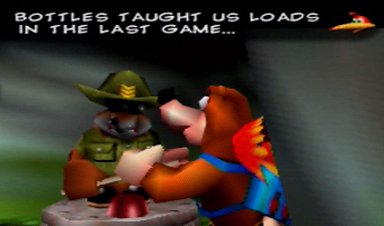
Back in 1998, Rare developed an incredibly intricate and amusing platform videogame called Banjo-Kazooie. The game starred a slightly slow, but very helpful, honey bear named Banjo, who first featured in Diddy Kong Racing in 1997. Banjo, humorously garbed in bright yellow short-shorts, carried around his friend and counterpart – a Breegull named Kazooie – in a blue back-pack. Together, the two were tasked with rescuing Banjo’s kid sister, Tooty, from the evil witch Gruntilda, aided along the way by Bottles, a short-sighted mole who teaches the two their attacks and abilities, and Mumbo-Jumbo, a shaman who transforms the duo into other forms to aid their quest. In 2000, Rare finally produced a sequel, Banjo-Tooie, which was released near the end of the Nintendo 64’s lifespan and has consequently become one of the rarest and most expensive videogames around, even when bought unboxed. As a result, obtaining a copy has been a goal of mine for years, ever since I briefly played it in 2001, and in 2013 I was finally able to procure a copy and play the game through to completion. Of course, since then, the title (alongside the original and many of Rare’s top titles from the area, before, and beyond) was given a high-definition remaster that I later picked up as part of Rare Replay for Xbox One.

BanjoTooieGrunty
Grunty is back and out for revenge!

Banjo-Tooie picks up two years after Gruntilda’s defeat. Trapped underneath a giant boulder, she summons her sisters, Mingella and Blobbbelda, to free her so she can avenge her defeat. Now little more than a skeleton, she destroys Banjo’s house, killing Bottles, and prepares a special ray gun that will suck the life out of the planet and restore her physical form. Eager for another adventure and desiring revenge for he death of Bottles, Banjo and Kazooie head out to travel new worlds and put the witch to rest once and more all. The first thing to note about Banjo-Tooie is how much bigger it is than its predecessor. Not only can players run around Spiral Mountain (the tutorial area from the first game) and re-enter the mouth of Gruntilda’s Castle, the player can explore and travel through an all-new overworld that is intricately connected to the playable levels in the game. For instance, rather than opening up worlds to enter in a central hub as in the previous game, the players go from one hub to the next following the path of Gruntilda’s digging machine through a huge overworld. Whilst exploring each level, the player can open up shortcuts to other levels, the most obvious being Chuffy the Train, but other sluiceways, tunnels, and paths also exist which connect one world to the next and allow players to traverse what now feels like an entire world rather than an enclosed space.

BanjoTooieJamjars.png
Jamjars has some new moves to teach Banjo and Kazooie.

The main aim of the game is still to collect loads of items, but the actual task is much less tedious. Previously, the player was awarded for collecting each world’s 100 musical notes, but the number you collected reset every time you left a world and re-entered it. Now, the number carries over, and they are a lot easier to find and collect. Jiggies, however, are found in a multitude of ways, as before, with each world now being home to a formidable boss battle which will test Banjo and Kazooie’s new skills. Speaking of which, Bottles’ brother, Jamjars, is on hand to teach the duo additional moves. While Banjo and Kazooie are capable of every move from the last game bar one (Banjo’s bear swipes are absent), Jamjars loads the player up with a variety of new eggs to shoot at enemies (which becomes a focal point in the game during its many first-person-shooter sequences), the ever-handy Grip Grab that allows Banjo to hang on to ledges, and the ability to have Banjo and Kazooie separate from each other to tackle switch-based puzzles. Mumbo now becomes a secondary character, as players use his magic to access unreachable areas and acquire Jiggies, while Humba Wumba’s spells are used to turn the duo into new forms, which are new required for a multitude of Jiggy-based tasks and even to conquer certain bosses.

BanjoTooieStopNSwop
Banjo-Tooie has many secrets and collectables.

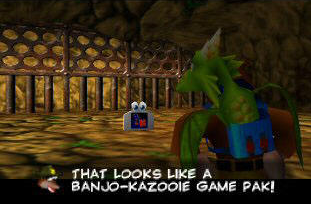
One of the greatest things about Banjo-Kazooie was its many secrets, most of which were meant to be accessed in Banjo-Tooie through a unique “Stop and Swap” feature that, theoretically, would have seen players swap one cart for another to unlock new content. Though this feature was eventually dropped, the ever-mysterious Ice Key and Secret Eggs return in this game, now used to unlock new moves and the awesome Dragon Kazooie, though the full extent of this feature would not be made accessible until the Xbox 360 HD remixes. Banjo-Tooie also features a multiplayer mode, allowing for up to four players to take part in Goldeneye 007-like deathmatches and other modes that, honestly, I haven’t played but I imagine are similar to the same multiplayer modes seen in Conker’s Bad Fur Day. Like The Legend of Zelda: Majora’s Mask, Banjo-Tooie features many recycled characters and character models, as characters encountered in the previous game return to aid or hinder the duo at various points.

BanjoTooieCutscenes
It’s all about the story…except when it’s not…

In the end, playing Banjo-Tooie was an awesome experience, but a couple of things let it down for me. Firstly, why remove Banjo’s bear swipes? This seems like a nit-pick, but I expected Banjo to have the attack when he goes solo and he never acquires it, meaning that he is limited to his Pack Whack move. Second, when you acquire a Jiggy, Banjo and Kazooie no longer go into a cute little celebration animation. The Jiggy is simply collected and you move on. While I don’t necessarily mind this, as the lack of the celebration means you don’t get any wasted momentum, it kind of makes acquiring Jiggies mean a lot less as the characters no longer seem to care. Next, the game takes a long time to get started – the opening cutscene is quite long and, at various points at the game’s beginning, the action cuts to a cutscene that shows Gruntilda’s plan in motion. Then you never hear anything of her plot until the final boss, which is pretty jarring – Gruntilda uses her restoration ray once and you never hear anything of it again, so the threat seems diminished and an afterthought by the conclusion. You also never confront her two sisters, which seemed a given, though the addition of a boss for each level kind of made up for that.

BanjoTooieTRex.png
There’s a bunch of new transformations to play around with.

Certain other aspects are a bit tedious as well; before, when you tried to exit a level as a transformed Banjo and Kazooie, Mumbo’s magic would automatically wear off. Here though, you must return to Wumba to transform back into the duo to exit – similarly, Mumbo and either character alone cannot exit levels and must switch back to do so, which can get a bit tedious. There’s a ton of backtracking in this game, which can be frustrating but it’s great to see how characters and events in one level can affect and influence the other, so I didn’t mind this too much and it didn’t really feel like it was padding the game out, more that the world was big and interconnected, so backtracking is more like a given. Also, in comparison to the first game, the ending felt a little limp and the overall game time seemed less – I finished the entire game in just under 25 hours, whereas I remember working on Banjo-Kazooie for a long time, but that may have just been rooting around for more secrets and such.

My Rating:

Rating: 4 out of 5.

Great Stuff

In the end, the game is a masterful example of how to make a great action/platform title – colourful worlds, great music, amusing characters, loads (and loads) to do, see, and collect, great controls (flying and swimming can be a bit testy, as before, however), and a pretty simple premise. Games like this aren’t really made much anymore – once you beat videogames these days, there’s not much incentive to pick up and play again, but in the Banjo titles there’s always more to do. As the Nintendo 64 copy is quite expensive, I recommended Xbox owners download both titles (or purchase Rare Replay) and play them to death and think themselves lucky to be able to experience the full games.