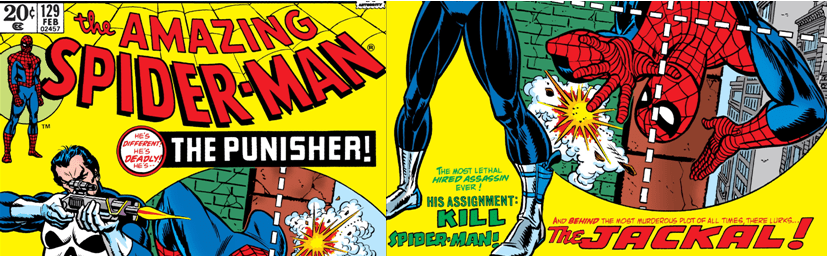
Story Title: The Punisher Strikes Twice! Published: February 1974 Writer: Gerry Conway Artists: Ross Andru, Frank Giacoia, and Dave Hunt
The Background: By February 1974, Marvel’s iconic web-slinger had become a mainstay of the publication since his 1962 debut in Amazing Fantasy #15. Having earned his own ongoing title, The Amazing Spider-Man, the following year and already running afoul of the likes of Doctor Otto Octavius/Doctor Octopus, Flint Marko/The Sandman, and, of course, Norman Osborn/Green Goblin, who had recently played a pivotal role in the death of Parker’s long-term girlfriend, Gwen Stacy. It’s into this tumultuous and emotional time of Spidey’s life that Gerry Conway and Ross Andru introduced not only the Jackal, a crazed scientist whose cloning technology would later result in one of Spider-Man’s most infamous storylines, but also the Punisher. Inspired byThe Executioner (Pendleton, et al, 1969 to present), designed by Gerry Conway, and named by Marvel mastermind Stan Lee, the Punisher was a hit with readers, despite being introduced in more of an antagonistic role, and began to appear in other Marvel comics, as well as his own self-titled series in 1986, with each subsequent appearance adding more layers and motivations to his character.
The Review: The Punisher, and the Jackal, are first seen in the Jackal’s hidden laboratory where the goblin-like villain expresses great admiration for the Punisher’s ability to shoot a stone statue of Spider-Man…as though destroying a static target is any indication of the Punisher’s prowess against a moving target, especially one as acrobatic as Spider-Man. The Punisher echoes these sentiments, stating that he’ll need his “Mechanic” to look over the Jackal’s concussion rifle before he takes on the real thing. While the Jackal also describes the Punisher as “[liking] the death – the killing – the joyful revenge”, Punisher rebukes this and claims that he only kills those who deserves to die….and that Spider-Man deserves such a fate.
Spider-Man is just as angst-ridden and burdened by guilt and responsibility as ever.
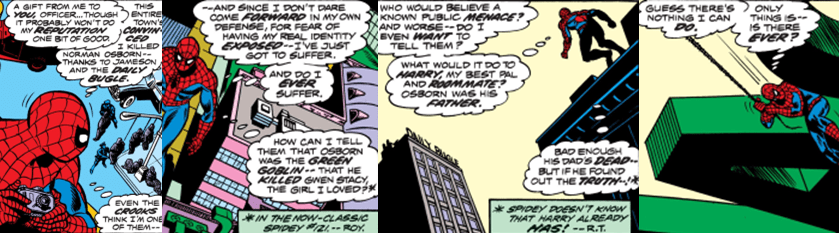
Speaking of Spider-Man, we join our heroic web-head in the midst of breaking up an armed robbery; it’s pretty standard fare for Spider-Man, showcasing his impressive agility, strength, and dexterity with his web-shooters as he stops the crooks and leaves them at the mercy of New York’s finest. Still, even with the prospect of earning some coin from his action-packed photographs of the bust, Spidey is tormented not only by the fact that the entire city is convinced that he killed Norman Osborn but also by the death of his beloved Gwen Stacey and the fact that he cannot bring himself to reveal Norman’s identity as the Green Goblin out of fear of devastating Norman’s son, Peter’s best friend, Harry Osborn (oblivious that Harry is already aware of this fact).
The Punisher lands the first strike against Spider-Man!
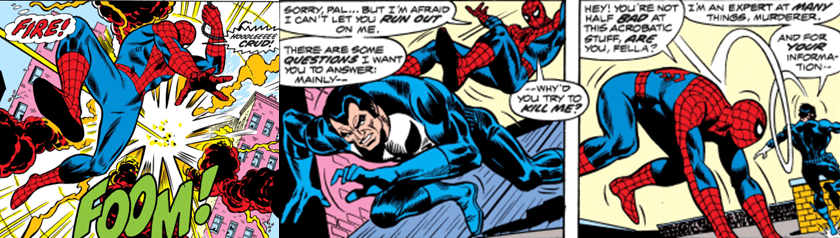
After flirting with J. Jonah Jameson’s secretary Betty Brant, Peter tries to sell his newest pictures to Jonah and is made aware of the Punisher’s one-man war against the mob. Chomping at the bit for a piece of “the most newsworthy thing to happen to New York since Boss Tweed”, Jonah orders Peter to bring him pictures of the Punisher yesterday! Switching to Spider-Man, Peter has barely enough time to worry about how he’s going to track the Punisher down when he is immediately fired upon by the skull-garbed mercenary! Saved by his patented spider-sense, Spider-Man confronts the Punisher on a rooftop where the hitman momentarily ensnares Spidey in a titanium alloy wire, brands Spidey a murderer, and expresses his hatred of criminals no matter what form they take.
The Punisher is angered and insulted by the Jackal’s interference.
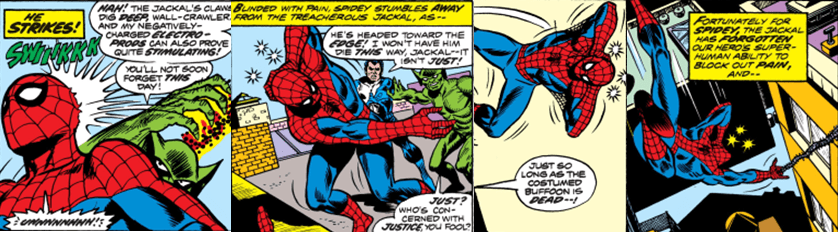
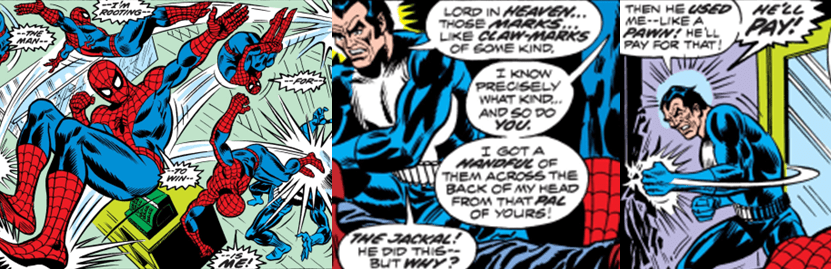
Breaking free of his bonds, Spidey begins to pummel the Punisher but is attacked from behind by the Jackal; disorientated and stunned by the Jackal’s “negatively-charged electro-prods”, Spidey tumbles from the rooftop (much to the Punisher’s dismay) but manages to save himself on instinct. After recovering and returning to the scene of the battle, Spidey discovers a clue on the Punisher’s discarded weapon but returns home, exhausted, to repair his damaged costume and catch his breath, unaware that an increasingly paranoid and disturbed Harry is eavesdropping at his door. After a brief segue to Mary-Jane Watson (who is still in her annoying, flaky “party girl” mindset at this point), the story dramatically cuts to the Punisher swatting the Jackal and berating him for interfering in his battle against Spider-Man. Punisher is angered at being roped into the Jackal’s murderous ways as Frank desires the complete destruction of crime, not the deaths of innocents.
Spider-Man subdues the Punisher and reveals the truth of the Jackal’s deception.
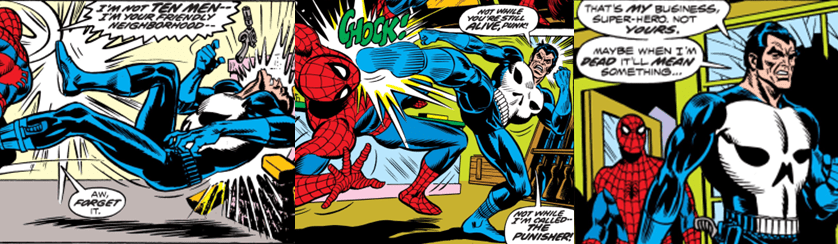
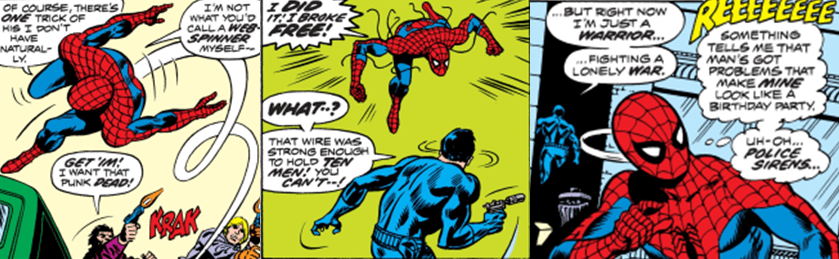
Later that day, Spider-Man follows through on his clue and arrives at the Punisher’s armoury on to find his “Mechanic”, Reiss, dead on the floor. The Punisher manages to get the drop on him (no spider-sense to save Spidey this time) and immediately pins the crime on Spider-Man. Refusing to believe Spider-Man’s pleas of innocence and yet unable to counteract his superhuman speed, strength, or agility, the Punisher is eventually subdued and forced to listen to reason when Spidey shows him the all-too-familiar claw marks on Reiss’ body and reveals that the Punisher’s gun was labelled up specifically to incriminate him. Realising that he has been manipulated by the Jackal, the Punisher swears revenge and heads off into the night. Spider-Man beats a hasty retreat as the police arrive and the Jackal looks on, vowing to destroy them both and ending the issue on a cliff-hanger that would later lead to Spider-Man doubting his very identity!
The Summary: “The Punisher Strikes Twice!” is a fairly run-of-the-mill Spider-Man story, indicative of the story style of Marvel Comics back in the day; there’s a lot of extraneous dialogue, text boxes, and thought balloons that constantly keep the reader up to date with where we are and what characters (specifically Spider-Man) are thinking and feeling. It’s not necessarily a bad thing but it hasn’t aged well for me and I often find it a bit of a chore to read through some of the older Marvel stories because of their tendency to favour stilted writing, exposition-heavy dialogue, and antiquated narrative devices. Still, it’s quite a pivotal issue, introducing one of Spidey’s most nefarious foes in the Jackal and continuing his sense of guilt and dismay over the whole Gwen Stacey/Green Goblin/Harry Osborn saga. The Jackal isn’t much to shout about here in his debut, being little more than a monstrous ghoul who manipulates the Punisher into trying to kill Spider-Man presumably so that he can take over New York as the top crime boss. The issue does a decent job of establishing the Jackal as a manipulative asshole but we learn almost nothing about him beyond his desire to want Spider-Man dead; considering the Green Goblin has only just been taken off the board, it might have been a little too soon for another mysterious, imp-like puppet master enemy whose identity is a secret to crop up.
The Punisher is pretty durable and parts ways with Spidey on…partially amicable terms.
Yet, the issue is exciting and action-packed thanks not only to Marvel’s distinct, eye-catching colours and Spidey’s dynamic versatility when in action but also due to the inclusion of the Punisher. Introduced with a bang (despite how lame destroying a statue is…), the Punisher wastes no time trying to kill Spider-Man, believing him to be a murderer and little more than a masked criminal thanks, no doubt, the Jonah’s numerous news stories in the Daily Bugle and the city’s belief that he killed Norman (and, as I recall, Gwen and George Stacey as well). We don’t learn much about the Punisher in his debut appearance but we learn enough; he’s decked out in his iconic skull costume (which makes an immediate impression) and his aggressive, focused mindset separates him from the usual hired guns seen in Marvel Comics at the time (who were generally little more than just generic thugs with guns). As the issue progresses, we learn that the Punisher has a strict moral code (he is angered when the Jackal’s interference nearly causes Spider-Man’s death in a dishonourable way), an intense hatred of crime and criminals, and that he was a Marine for three years. The Punisher is also quite a sturdy and formidable opponent; not only is he a crack shot and loaded with little gadgets and tools to help give him the edge in battle but he’s also fast and strong enough to get the drop on Spider-Man, take blows from Spidey, and to cause the web-head pain when he lands a good, solid kick.
It’s a fairly standard Spider-Man story elevated by the debut of the Punisher.
In the end, he remains tight-lipped about his past and his exact motivations but is satisfied enough that Spidey isn’t the true enemy and returns to his endless war on crime maybe not on “friendly” terms with the web-head but certainly on far more amicable terms than they began at the issue’s start. Overall, it’s a pretty decent story; it’s standard sixties/seventies Spider-Man fare, with all the angst and action you can expect from this era of Marvel and Spider-Man, with the added bonus of a mysterious, intriguing new anti-hero at a time when violent anti-heroes weren’t as played out as they would come in later years. Thanks to Spidey’s endless internal monologue, it’s easy to pick up the issue and get right into the story and catch up with where the characters are and the art is both simple and yet beautifully detailed at the same time. Obviously, this was just the tip of the iceberg for the Punisher but Marvel certainly had a way with introducing dynamic, complex new characters as antagonists and then fleshing them out later on and I’d say they did just as good a job with the Punisher in his debut as they did with other characters who got a full-blown origin story in their first appearance.
My Rating:
⭐⭐⭐⭐
Rating: 4 out of 5.
Great Stuff
Did you read “The Punisher Strikes Twice!” when it was first published? What did you think of the Punisher’s dramatic debut? What do you think of the Punisher as a character and which storyline of his do you think is the best, or the worst? How are you celebrating the Punisher’s debut this year? Whatever you think about the Punisher, drop a comment below.
Superheroes may dominate television screens these days, but it all started back in the seventies. Long before the Marvel Cinematic Universe (MCU) took cinemas by storm and drummed up enough cash to sink a small cruise liner, Marvel Comics had ventured into live-action adaptations of their comics books by licensing their properties to studios like CBS and Universal Television. This produced the iconic Incredible Hulk (1977 to 1982) television show that firmly entrenched the Green Goliath in the cultural consciousness and produced tropes that became synonymous with the character for years to come.
You wouldn’t like him when he’s angry…
However, The Incredible Hulk wasn’t the only live-action adaptation of a Marvel Comics property to be produced in the seventies; in fact, there were so many productions (or, at least, so many Marvel characters) around this time that a version of the MCU can be seen to have existed long before Iron Man(Favreau, 2008) graced cinema screens. So, today, I’m going to take a quick look back at some of these productions and have a chat about the MCU we very nearly saw come together back in the days of Pink Floyd, frayed jeans, and mullets…
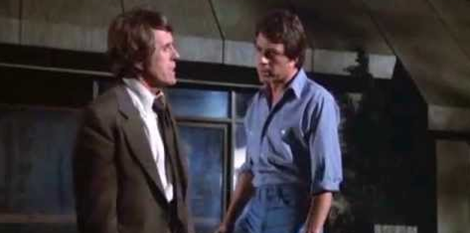
As I mentioned, The Incredible Hulk kicked all of this off; starring Bill Bixby as Dr. David Bruce Banner, the show depicted a scientist recklessly experimenting on himself with gamma radiation in a bid to unlock the hidden strength and potential of the human body. When he absorbs too much gamma radiation, moments of stress and anger cause him to transform into the green, bestial Hulk (Lou Ferrigno), a creature of limited intelligence, immense rage, and incredible strength.
McGee relentlessly hounded Banner.
Believed dead at the Hulk’s hands, Banner is forced to wander around the country in search of a cure, helping those in need with both his intelligence and the strength of the Hulk when pushed too far, all while being relentlessly pursued by reporter Jack McGee (Jack Colvin). The show was famous for coining the phrase: “Don’t make me angry. You wouldn’t like me when I’m angry”, which has since become so synonymous with the character that it has appeared in most Hulk adaptations. Equally popular was both Bixby’s portrayal of Banner as a wandering nomad, desperate to cure himself of his alter ego and return to normal life, and Ferrigno’s portrayal of the Hulk (a role that Arnold Schwarzenegger auditioned for and that originally went to mammoth actor Richard Kiel).
Ferrigno always had a place in Hulk adaptations.
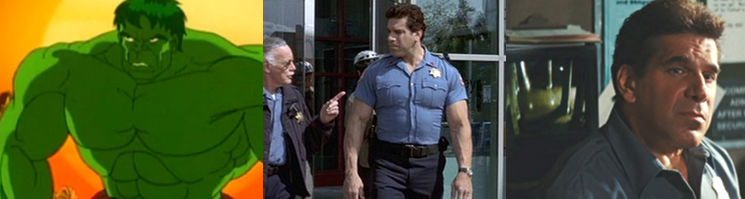
Ferrigno has since become so associated with his role as the Hulk that he went on to not only voice the character in the animated Incredible Hulk (1996 to 1997) television series but also collaborated with Mark Ruffalo in voicing the Hulk in the MCU and cameoed in both Hulk(Lee, 2003) and The Incredible Hulk(Leterrier, 2008), a movie that was heavily influenced by the ‘70s television show. If there’s any downside to the show, and Ferrigno’s performance, it’s that they both popularised the notion that the Hulk is a feral, growling creature rather than a semi-to-impressively articulate individual. While Stan Lee himself may have signed off on this at the time (“I had the Hulk talking like this: “Hulk crush! Hulk get him!” […] that would have sounded so silly if he spoke that way in a television show” (Lee, quoted in Greenberg, 2014: 19 to 26)), I feel this was more a case of Lee signing off on anything for the licensing revenue. This portrayal even carried over into the MCU, where the Hulk was capable of rudimentary speech (one or two growling lines here and there) but did not properly articulate until Thor: Ragnarok (Waititi, 2017); to compare, Bradley Cooper was snarking up cinema screens as Rocket Raccoon in Guardians of the Galaxy(Gunn, 2014) before Hulk was allowed to properly talk.
The Incredible Hulk returned with a bang.
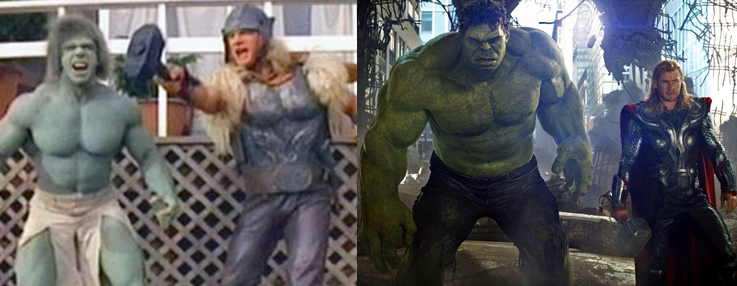
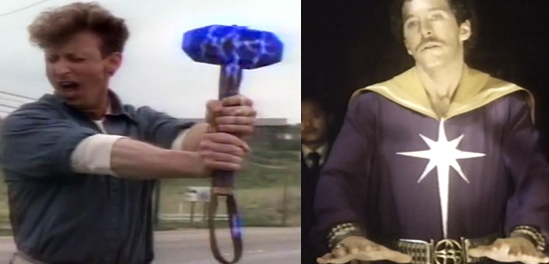
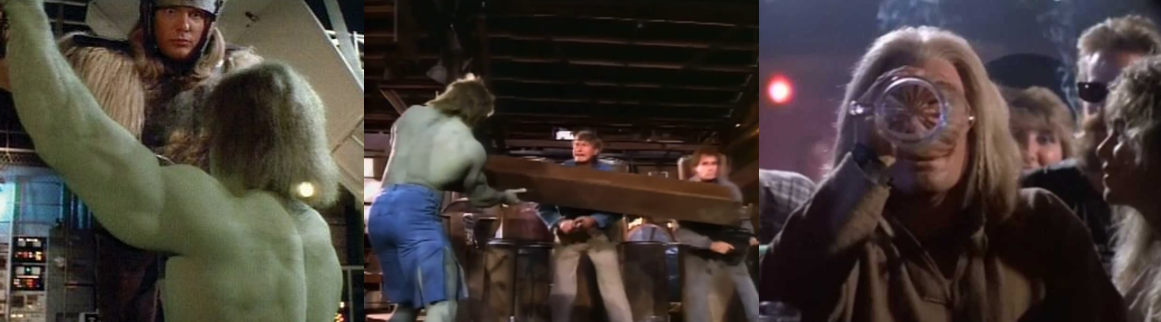
In any case, The Incredible Hulk ran for eighty episodes before finally coming to an end on 12 May 1982. Banner’s adventures, however, continued in the made-for-television film The Incredible Hulk Returns(Corea, 1988). While the TV show shied away from including any Marvel characters aside from Banner and the Hulk, much less his fellow Marvel cohorts, The Incredible Hulk Returns featured two of the most unlikely inclusions you could imagine given the show’s relatively rounded approach to its source material. After successfully suppressing the Hulk for two years, Banner’s idyllic life is turned upside down when an old student of his, Donald Blake (Steve Levitt), seeks him out. Right as Banner is on the cusp of finalising a potential cure in the Gamma Transponder machine, Blake reveals that he discovered an enchanted hammer in Norway that, upon his command, releases the mighty immortal warrior Thor (Eric Kramer) from Valhalla.
I honestly can’t tell the difference…
When Thor upsets Banner, he briefly battles with the Hulk and damages Banner’s the Gamma Transponder, but the two (three, I guess) are forced to work together to stop criminals from stealing Banner’s research and harming his life interest, Dr. Margaret Shaw (Lee Purcell). In the end, while Shaw is rescued, Banner is forced to destroy a vital component to the Gamma Transponder and, with the Hulk’s presence catching McGee’s attention, promptly returns to the road to seek out a new cure for himself. When I was a kid, I never got the chance to watch The Incredible Hulk, so one of my first exposures to it was with The Incredible Hulk Returns, which I found to be hugely enjoyable largely because of the thrill of seeing the Hulk in live-action and the banter between Blake and Thor. Rather than transforming into Thor, as in the comics, Blake instead brings Thor forth with the hammer and is charged with guiding him in life and in the fulfilment of a number of heroic deeds so he can take his place at Odin’s side in Valhalla. It’s absolutely mental, especially as a continuation of the TV show, but Kramer is so much fun as the loud-mouthy, arrogant, meat-headed Thor that you can’t help but smile when he’s onscreen, especially when he’s drinking and fighting in a bar or battling with (and alongside) the Hulk.
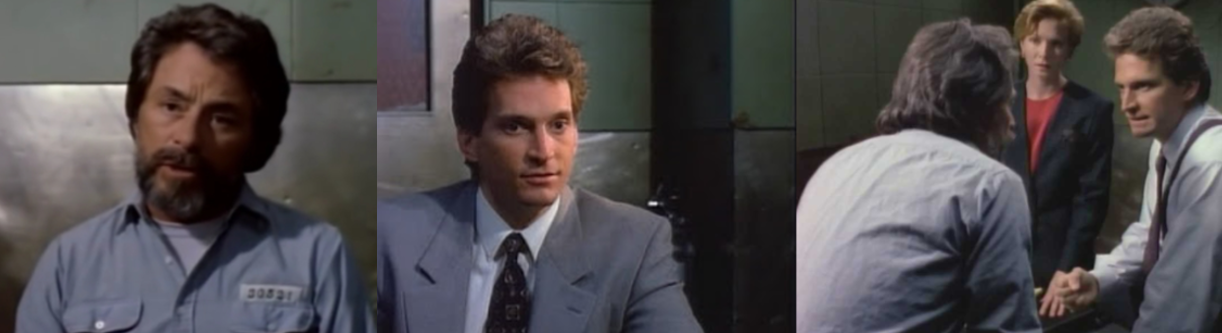
Banner forms a kinship with Daredevil.
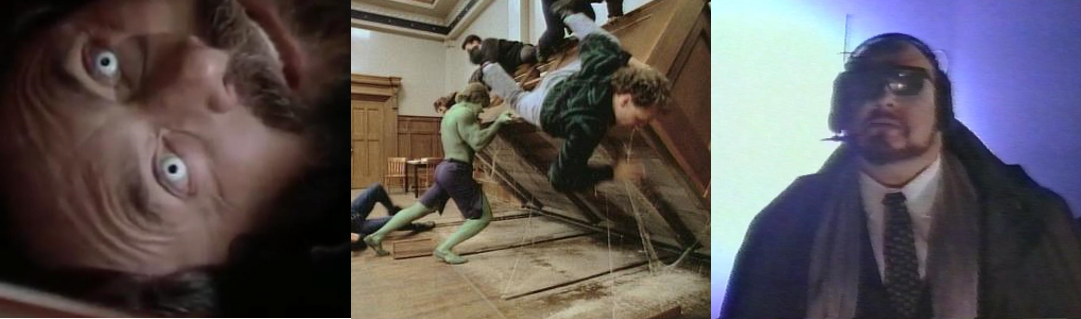
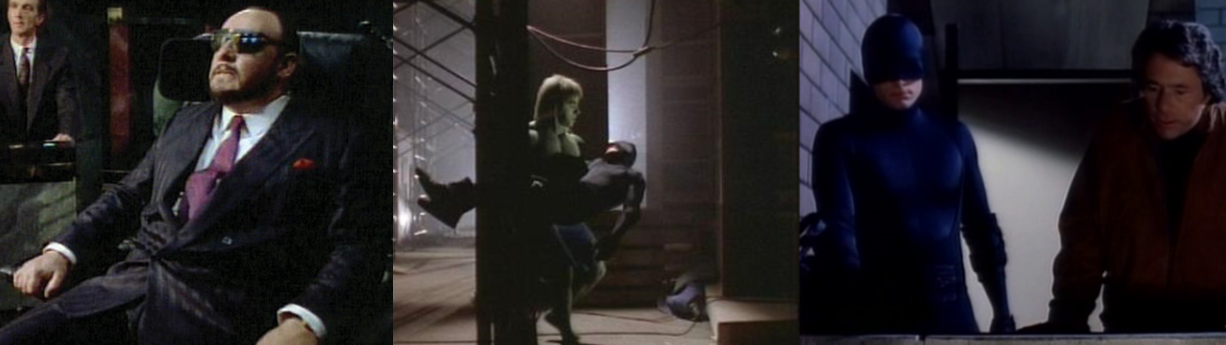
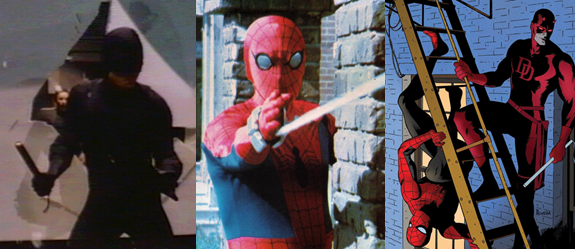
I said I never really watched the show but, in truth, my first ever exposure to the Bixby and Ferrigno team was the follow-up movie, The Trial of the Incredible Hulk (Bixby, 1989), in which Banner, now a desolate soul who’s lost all hope, wanders into a city and, after disrupting a mugging on an underground train, is wrongfully imprisoned. As luck would have it, his appointed attorney is none other than Matt Murdock (Rex Smith), a blind lawyer who also patrols the streets at night as the black-clad vigilante Daredevil. Murdock is pursuing evidence against Wilson Fisk (John Rhys-Davies), an entrepreneur whom Murdock (rightfully) believes is a dangerous crime boss. While Banner is content to stay safely locked up in jail, the idea of being put on trial causes him to Hulk out and, eventually, team up with Murdock/Daredevil in bringing Fisk to justice.
John Rhys-Davies was great as Fisk.
The Trial of the Incredible Hulk is notable for a couple of reasons; it features Stan Lee’s first-ever live-action cameo in a Marvel production, it heavily adapts elements of Frank Miller’s iconic run on the Daredevil comics, and the titular trial only actually takes place in a nightmare Banner has while imprisoned. Nevertheless, Rhys-Davies is exceptional as Fisk; he’s never referred to as the Kingpin onscreen but that doesn’t stop him being a cool, calculating puppet master of a villain; his eventual escape (in a God-damn rocket ship!) is a loose end that was never tied up as the final TV movie, The Death of the Incredible Hulk(Bixby, 1990), chose to bring an end to the Incredible Hulk series and did not feature any additional Marvel characters.
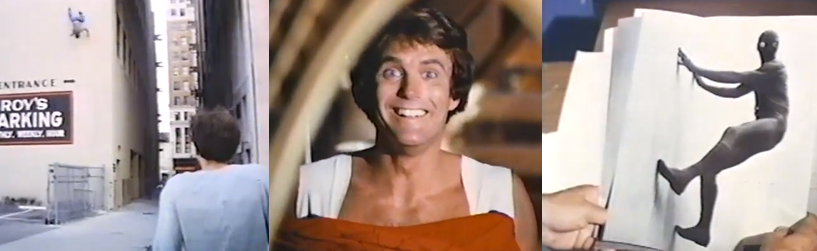
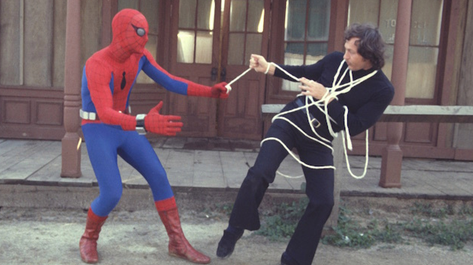
Hammond was a decent Peter Parker…and he had a great stunt double.
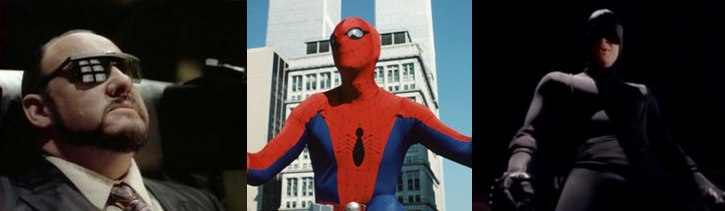
Hulk wasn’t the only one to get his own live-action TV show though; after the feature-length pilot, Spider-Man(Swackhamer, 1977), proved popular, Marvel’s web-head got his own thirteen episode series in the form of The Amazing Spider-Man (1977 to 1979). In addition, episodes of the show were edited (“cobbled”, is probably a better word) together into two made-for-television movies, Spider-Man Strikes Back (Statlof, 1978) and Spider-Man: The Dragon’s Challenge (ibid, 1981), both of which (along with the pilot) are the only exposure to this show I’ve had. The Amazing Spider-Man starred Nicholas Hammond as Peter Parker (with the show’s stunt co-ordinator, Fred Waugh, taking the role of Spider-Man, which was pretty obvious given their wildly contrasting size and builds) and, if you thought that this show took more from the source material than The Incredible Hulk then you’re going to be woefully disappointed.
I mean…they did the best the could…
Jonah Jameson (played by both David White and Robert F. Simon) featured quite prominently but Robbie Robertson (Hilly Hicks) and Peter’s Aunt May (Jeff Donnell) only appeared in the pilot episode and, though Spidey tussled with hypnotists, terrorists, and gangs, he never once butted heads with any of his colourful rogues gallery. Spidey (and Parker) also initially ran afoul of Police Captain Barbera (played with gruff, loveable glee by Michael Pataki), but this character was sadly dropped for the show’s second season. The Amazing Spider-Man was an ambitious project, especially for the seventies; Spider-Man is a character who requires a lot of effects and stunt work to pull off correctly and is arguably far more dependent on modern computer effects than the likes of even the Hulk. As a result, while the show featured an incredibly faithful recreation of Spidey’s origin, costume, and web shooters and did its best to portray Spidey’s wall-crawling and web-slinging through wires, pulleys, and other camera tricks, the show always came across as being far more absurd than its Universal counterpart.
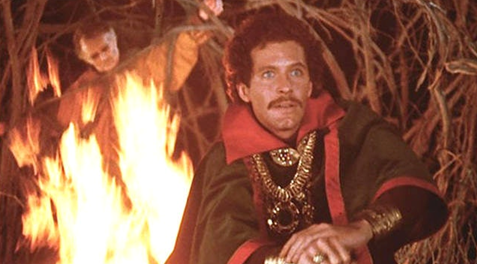
For whatever reason, Doctor Strange got a movie too.
There was more to come from Universal Television, however, as they also produced a Dr. Strange (DeGuere, 1978) made-for-television movie that featured Peter Hooten in the title role (I guess Tom Selleck was unavailable…) and Jessica Walter as Morgan Le Fay. This one’s especially obscure and many have probably never heard of or seen it; it actually got a DVD re-release in 2016, coincidentally around the same time as Doctor Strange (Derrickson, 2016) was released in cinemas. Interestingly, Stephen Strange is portrayed as a psychiatrist rather than a physician and stumbles into his destiny as the Sorcerer Supreme when Le Fay possesses one of his patients, Clea Lake (Eddie Benton). The movie also featured other recognisable faces from the source material, such as Wong (Clyde Kusatsu) and the Ancient One (Michael Ansara), which is already a bit of a leg up on the Hulk and Spider-Man outings. What scuppered Dr. Strange, though, was, again, the fact that it was produced at a time when special effects simply were not up to the task of doing the character justice. It also didn’t help that the film was criticised for being overly long and boring and lacking any real urgency. In all honesty, there really isn’t much to see here that’s worth you rushing out to watch except the novelty of seeing a C-list character like Strange get a live-action movie well before his time.
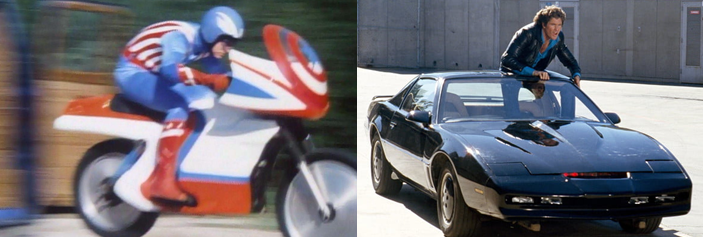
Yeah, I don’t think K.I.T.T. had anything to worry about…
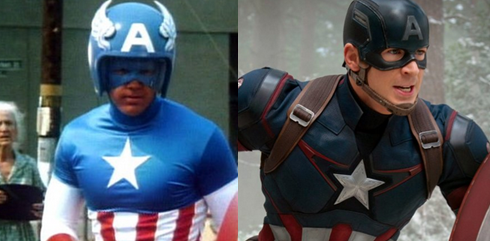
CBS also had one another Marvel character to offer the seventies; Captain America (Holcomb, 1979) brought the star-spangled Avenger to life on television screens and…dear Lord, is this a sight to behold! Reb Brown starred as Steve Rogers, a former marine-turned-artist living in the present day whose patriotic father was known as “Captain America”. After he’s nearly killed by an attempt on his life, he’s inexplicably chosen to be administered with the super-serum F.L.A.G. (Full Latent Ability Gain), which turns him into a superhuman. He then decks himself out in a horrendous version of the Captain America costume and takes to the streets on a modified super-cycle so massively over-the-top with gadgets and features than even K.I.T.T. would blush! Luckily, by the end and the sequel, Captain America II: Death Too Soon (Nagy, 1979), Rogers adopts a more faithful version of the costume and uses his abilities to oppose the plans of General Miguel (inexplicably played by Christopher Lee!), who desires to create a dangerous chemical. I’m actually far more familiar with the equally-lambasted Captain America (Pyun, 1990), which is still a guilt pleasure of mine. Nevertheless, both films were released on DVD and, while Dr. Strange was lost to the mists of time and obscurity, these films appear to have at least partially influenced the MCU as Cap (Chris Evans) does favour a motorcycle (but, to be fair, so did the comics Cap…).
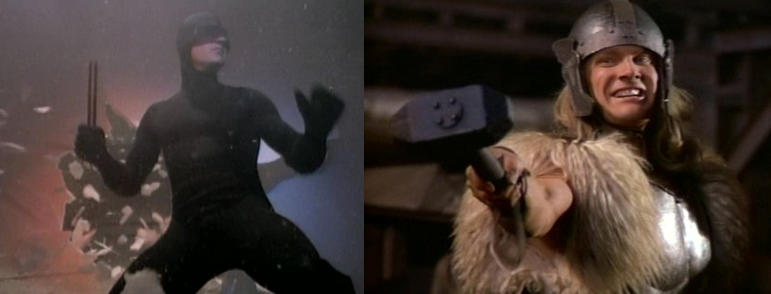
I would’ve watched a show with either of these two in.
Both The Incredible Hulk Returns and The Trial of the Incredible Hulk introduced Thor and Daredevil with the intention of setting them up for spin-off shows of their own but, for a variety of reasons, this never came to be and that’s a bit of a shame. Smith is no Charlie Cox but, while his Murdock was quite dull and boring, he gave a pretty good turn as Daredevil and it would probably have been easier and far cheaper to produce a Daredevil TV show than a Hulk or even Thor one. Similarly, I love the portrayal of Thor in Trial; sure, he doesn’t look or act anything like his Marvel Comics counterpart, but it could have been pretty fun to see him tossing fools around, getting into bar fights, and learning lessons in humility on an episodic basis. One thing that is equally unfortunate about all this is that the inclusion of Thor and Daredevil really took a lot of the focus off of Banner and the Hulk; sure, in the show, he was often a supporting player in a bigger story and other character’s lives, but these movies devoted so much of their runtime to pushing and establishing their new characters that it’s easy to forget that Banner and Hulk are even in them. The Death of the Incredible Hulk rectified this, but at the cost of killing both characters off in what was, while emotional (as a child, anyway), probably the lamest way imaginable.
All these guys co-existed at about the same time…
Unfortunately, there hasn’t been much love shown to The Amazing Spider-Man over the years; it’s never been released on home media outside of a few VHS tapes and, while Hammond appears to have been the basis for Parker’s design in the Spider-Man (1994 to 1998) animated series, he’s never returned to the character or the franchise again, not even for a quick cameo or a voice role (though I’m hoping the sequel to Spider-Man: Into the Spider-Verse (Persichetti, Ramsey, and Rothman, 2018) will rectify that). Interestingly enough, there were apparently talks in 1984 to produce a movie that would see Spider-Man cross paths with Banner and the Hulk, with Spidey even donning the black costume during the film. There were, apparently, also talks of an additional made-for-television Hulk movie, The Revenge of the Incredible Hulk, which would have seen Banner (somehow) revived and forced to recreate the accident that turned him into the Hulk (or be reborn as the Hulk with Banner’s intellect, depending on what you read) but neither of these ideas ever came to fruition and were ultimately halted when Bixby sadly died in 1993.
Magic linked these shows together, however tenuously.
However, none of this changes the fact that, sometime around 1978 to 1979, there were all these Marvel characters running around on television screens at about the same time, all produced by two studios and, in some cases, airing on the same networks. What this effectively means, then, is that it’s easy to imagine an alternative world where negotiations never broke down and the shows and movies proved popular enough for Spider-Man to crossover with the Hulk and, by extension, interact with Thor and Daredevil. So, what if…? What if there were a threat so big, so far beyond petty street crooks and one-note villains that these heroes would be forced to band together? Dr. Strange was heavily steeping in magic and mysticism, which was already (however unfitting) be proven to be a part of The Incredible Hulk’s world; hell, even The Amazing Spider-Man dabbled in the paranormal at times.
It’s easy to image these guys existing in the same place and time.
Perhaps the threat would involve Fisk waging a war against Daredevil and all costumed heroes? The city is never named in The Incredible Hulk Returns but it could easily be New York City, the same New York City that Spider-Man swings around in. Perhaps this would be a chance to do a supervillain team-up, of sorts, between Fisk and Le Fay or to introduce other classic Marvel villains, such as Loki and the Red Skull. I would have loved to have worked Nick Fury (David Hasselhoff) into this imaginary Marvel team-up but it’s difficult to do that seeing as Bixby died in 1993 and Nick Fury: Agent of S.H.I.E.L.D. (Hardy, 1998) didn’t release until 1998 but what if…? What if Bixby hadn’t suffered from cancer, or had beaten the disease and Banner had been resurrected in The Revenge of the Incredible Hulk? Perhaps we would have seen a version of the Professor Hulk or Grey Hulk personas, one that merged the brawn and the strength together, and Fury could have banded these heroes together to fight a common enemy.
Spidey and Daredevil often work well together.
Personally, though, I would have preferred to see Banner and Hulk as they were portrayed in the television series; Bixby would have been the veteran actor who held this team up together and I would have limited his Hulk outs to two or three occurrences. Have him be the team’s moral compass, the hesitant advisor who learns to reconcile with his enraged alter ego through working with the other heroes. Murdock, as the older of the two, could have also acted as a kind of mentor to Spider-Man as the two are often portrayed as friends in the comics and have a lot in common with their “everyman” approach to super heroism. While the effects would not have allowed us to properly see the two swing across the New York rooftops, I think they could have cobbled together enough to produce some semi-decent, maybe even slightly acrobatic, fight scenes between the two.
These guys are worlds apart.
You’d obviously think that Captain America would be the natural leader of this group but, remember, this isn’t the war-tested superhero we all know and love and I am not proposing an Avengers movie; Brown’s Cap is more of a secret agent, an enhanced super soldier who hasn’t nearly a fraction of the combat experience that Cap is usually known for. Because of that, I’d imagine him as the public face of the group and (in the absence of S.H.I.E.LD.), a source of the group’s intelligence resources. Perhaps Cap prefers to work alone and he has to learn to work with a group, rather than tackling everything head-on.
Thor still had a lot to learn about humility.
Instead, I’d have Doctor Strange be the de facto leader of the team by virtue of his age and power as the Sorcerer Supreme. His arc, perhaps, would have revolved around him needing to shift his focus from the bigger picture to factoring in the smaller issues that his peers face on a daily basis, effectively making himself both a public figure of the superhero community and improving his interpersonal skills. And then there’s Thor (and Blake, of course); Thor would be the group’s hot-headed jock, the guy who runs in, hammer swinging, trying to fix every problem with brute strength. This team up would be the perfect opportunity to teach Thor proper humility, to accept that he must work alongside mortals and lead by example rather than being a blundering buffoon. While he learned some of this in The Incredible Hulk Returns, it was clear that there was more to tell with his story and, perhaps, this team up and his learning of humility would be the final heroic act that would earn him his place in Valhalla, allowing Blake to, however sorrowfully, begin his life anew.
In the end, for as hokey and cringe-worthy as a lot of these seventies Marvel shows were, it does disappoint me that we never got, at least, to see Spider-Man, Hulk, and Banner crossover onscreen. There was a lot to like about each of these, from the impressively realised costumes to the heart-felt emotion, to even the woeful action scenes and I would honestly have loved to see all of these characters come together to battle a common enemy. What do you think about Marvel’s television show and movies from the seventies? Do you have fond memories of The Incredible Hulk? Do you also wish that The Amazing Spider-Man would get a release on DVD? Perhaps you hated the monotony and ridiculousness of these shows. Whatever your opinion, leave a comment below and get in touch.





 Dr. K's Waiting Room
You must be logged in to post a comment.