Released: 11 January 2018 Originally Released: 26 November 2015 Developer: Team Ninja Also Available For: Arcade, PC, and PlayStation 5
A Brief Background: With over seventeen mainline games, the Final Fantasy franchise has been a staple of the role-playing genre since its 1987 debut, popularising and largely defining role-playing games (RPGs) for generations of players. Not only has the franchise dabbled in more action/adventure mechanics, the Final Fantasy series has also produced a wide array of spin-off titles, including real-time strategies, mini games, and their characters featured in obscure polygonal fighter Ehrgeiz: God Bless the Ring (DreamFactory, 1998). In 2008, to celebrate the 20th anniversary of the franchise, Square Enix officially brought Final Fantasy into the fighting genre with Dissidia Final Fantasy, an RPG-inspired action fighter that gathered the franchise’s most recognisable heroes and villains and became a critical and commercial success for Sony’s oft-forgotten handheld, the PlayStation Portable (PSP). This release was expanded upon three years later with the release of Dissidia 012 Final Fantasy, a combination prequel, sequel, and enhanced version of the original game. Reviews largely praised the expanded mechanics and additional fan service, and it was later followed by a three-on-threearcade spin-off. Developed by Team Ninja and including characters from the franchise’s latest releases. Dissidia NT’s arcade success led to an enhanced home console port, one that included all previous fighters and was equally praised, despite its chaotic combat.
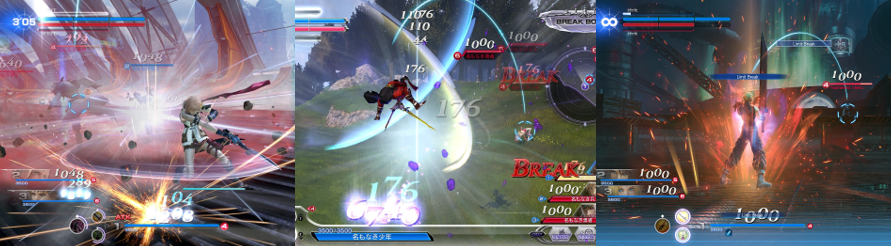
My Progression: I had a great time playing the two Dissidia games back when I had a PSP so I jumped at the chance to experience this high-definition version of the game. While far removed from the traditional turn-based gameplay of the series (and even its more modern, action-orientated slant), the Dissidia series has always been a great tribute to the franchise, bringing together some of its more iconic characters and locations in a suitably convoluted battle between the forces of good and evil. Dissidia NT is similar in this respect, featuring champions of light and dark battling for cosmic entities Materia and Spiritus and retaining some of the same gameplay mechanics, but with a very different presentation. The most noticeable difference is that the game is a three-on-three fighter, which immediately brings it down a notch in my eyes. I’ve never liked this sub-genre of fighting games and it really annoys me how many titles have succumbed to this formula. In Dissidia NT, it seems to have been implemented towards online play; you’re supposed to battle online with and against friends, earning clout and points and such and communicating using text/chat features. However, single player components are present, though there’s no way to have a simple one-on-one experience as in the previous games. This impacts the game’s mechanics and difficulty, especially as arenas are large and occasionally troublesome to navigate. You must beat each member of the opposing team (or destroy their “core” in what’s essentially a capture the flag mode) to achieve victory. You do this by targeting either an opponent or their team’s core with L2 or R2, dashing towards them by holding R1 (which lasts as long as your stamina bar), and attacking with either Circle, Square, or Triangle in conjunction with movements of the left stick. Circle unleashes one of three “Bravery” attacks that deplete your foe’s Bravery points and will eventually “break” them, which is your time to strike with Square. Square attacks deplete your opponent’s Health Point (HP) and you can hold Circle or Square to charge these and make your attacks more powerful, but you can only have one HP attack equipped at a time. Triangle gives you access to your two “EX Skills”, which provides buffs to you and your teammates or lays traps for your foes.
Engage in chaotic battles against some of Final Fantasy‘s most iconic characters.
You also have a few defensive options. L1 lets you guard, side step, and parry attacks, you can jump (and double jump) with X, and run up trees and walls. You can use Circle to revive a teammate if you’re fast enough, refill HP and boost Bravery with certain EX Skills, perform “cancels” and air and ground recoveries, and attack “Summon” stones to build a meter. Once full, you’ll unleash a Summon, a powerful creature from Final Fantasy lore that impacts the entire battlefield, unleashing powerful attacks, obscuring the screen, draining Bravery, and applying other buffs. Your enemies can do the same, but it’s often not too difficult to stay out of the Summon’s attack range. What is difficult, though, is chasing down and attacking your foes. The camera swings around wildly, you must often hop up obstacles, and your opponent’s either dash away at high speed, seem to fly or hover above you indefinitely, and you’ll get blasted from behind and all angles without warning. Every battle is contested within a time limit, which adds to the pressure, and carries a difficulty rating ranging from Bronze to Gold and above. Winning harder battles awards more Gil to spend in the shop, more experience points to level-up and become stronger, and other treasures (usually player icons and chat messages but also character skins). Each character has a “type”, such as “Assassin” or “Marksman”, and favours certain attacks. Rinoa Heartilly, for example, attacks with her canine companion, Kefka Palazzo favours ranged magic attacks, and Shantotto is small and agile. Many characters utilise swords or blades, but even then their attacks and styles are vastly different: Cloud Strife, for example, attacks slower than Zidane Tribal, while Squall Leonhart utilises explosive sword swings and the Warrior of Light attacks with a more traditional sword and shield. As you level-up, your characters learn new attacks, adding ranged or close quarters abilities to their repertoire, as well as making them tougher and faster. Unfortunately, battles quickly become a noisy mess of visuals, notifications, and distractions. I found a decent rhythm targeting one enemy, dealing damage, and then switching to another and cycling between them, attacking cores as needed, and even then I’d be battered about like a ragdoll from offscreen attacks and unexpected Summons.
You’ll need to grind for hours in repetitive battles just to unlock the Story Mode’s cutscenes!
Dissidia NT comes with a comprehensive tutorial in which a helpful Moogle walks you through every aspect of the game and you can also review attacks and stats from the pause menu and before each battle. Summons are gifted seemingly at random and can be picked before a battle; you can customise your player card and profile; and you can purchase music, icons, and various bits and pieces from the shop. The game does boast a story mode but it’s sadly a massive step back compared to the last two games, which were very story driven and mixed up different characters in fun ways in seemingly never-ending battles against “puppet” copies of the cast. In Dissidia NT, story mode is handicapped by the “memoria” system. You can only earn memoria by levelling-up, so you must participate in numerous online or offline battles to gain levels and progress in the story mode. Looking at the story map in this mode, there are at least thirty “nodes” to unlock, so you’ll need to level-up at least that much to experience it, and many of these nodes simply unlock nonsensical cutscenes where the characters wander about and ruminate on their cycle of conflict. When you finally unlock a “Battle Trial”, you’ll have to pick from three pre-set characters to fight and will unlock this for the “Gauntlet” mode. This is where you’ll waste spend most of your time winning successive battles to gain levels and treasures, basically meaning you need to grind away for hours just to unlock a cutscene and see the Onion Knight (why he’s not called Luneth is beyond me) striking out with the likes of Y’shtola Rhul. This is extremely tiresome and killed my excitement for the game; I just wanted to blast through the story mode, expecting it to be a chapter-based affair told from the perspective of the heroes and villains. Instead, I was forced to grind away in tiresome battles to level-up, only to limp my way towards two story-based battles where I couldn’t even play as my go-to characters, Cloud and Leon.
Continue? I was so disappointed to find that Dissidia NT is geared more towards online play and monotonous grinding than providing a compelling fighting experience. It’s doubly disappointing after completing the first two games and expecting more of the same, only to be met by a chaotic three-on-three brawler that restricts you with its arcade sensibilities. The game is a mess of tutorials, messages, mechanics, and instructions, with your allies and Moogle helper constantly banging on. Battlefields become difficult to navigate thanks to obstacles, destructible elements, and being far too big at times. It makes sense given the expanded roster but it makes it very difficult to chase after your target when your stamina drains so quickly and they just stay up in the air for ages. It’s a shame as the game does look great, characters are all represented faithfully, sporting unique EX Skill animations (Zidane and Kuja enter “Trance”, Cloud and Sephiroth have “Limit Breaks”, etc) and skins (Jecht goes shirtless, Cloud sports his Final Fantasy VII: Advent Children (Nomua, 2005) attire, and Cloud of Darkness takes a more monstrous form), and fun characterisations (Shantotto is always rhyming, Kefka is bat-shit crazy, Squall relies on his internal monologue, and Noctis Lucis Caelum is perpetually confused). The game’s arenas and music are pulled from each of the mainline titles but, this time, even Final Fantasy Tactics (Square, 1997) and Final Fantasy Type-O (Square Enix 1st Production Department, 2011) are represented. You’ll battle in the plains of Cornelia, the purple throne room of Pandaemonium, within the crystalline Interdimensional Rift, on the streets of Midgar, and outside the Royal City of Rabanastre, amongst others. Some stages have destructible or interactable elements; others have little Easter Eggs in the background. Each battle is preceded with some banter between the two teams and ends with either a victory pose (and the traditional fanfare) or your crushing defeat. Rewards are bestowed even in defeat and you’ll unlock new characters and Summons as your progress (or part with your hard-earned cash).
Bigger battles and customisation options are available…if you put in the time or money.
Looking ahead, it seems there are fifty-seven panels to unlock in Story Mode, with most of them being cutscenes. Despite Spiritus being prominent to the story, clashing with Materia and desiring the same level of the destruction as the demonic Chaos, he’s not fought in this mode. Instead, your final battle is against the ancient dragon god Shinryu, a gigantic creature that sports two intimidating forms. You’ll also take part in battles against the game’s Summons, meaning your team will go head-to-head with the likes of Bahamut, Ifrit, and Shiva, which all looks thrilling, but I can’t see myself bothering to grind up the nearly sixty levels to unlock all these battles. While some characters are unlockable, Materia and Spiritus aren’t among them and you must part with your real-world money to add to the roster (though, again, there’s little incentive as the game’s so shallow and repetitive). I’m sure the online and multiplayer functions are fun, but I wasn’t impressed enough by the single player modes to test them out. There are also fifty-six Trophies to unlock here, granting you rewards for spending memoria, claiming treasure, completing Story Trials, and winning ranked matches. Unfortunately, as good as the game looks and as smooth as most of the gameplay is, Dissidia NT just doesn’t live up to the standards of its predecessors. There was a real opportunity here to present the gameplay of the portable games in a high-def, arcade-style, all-action brawler. Throw in three-on-three battles as a side mechanic, if you must, but focus on one-on-one gameplay as a priority. Similarly, I get wanting to be an online experience but…is it really too much to ask for a simple ten to twelve-fight tournament mode? Fighting games have been doing that since at least 1991 and I don’t think it’s too much to ask to have that thrown in here. Hell, the developers could’ve made things easier for themselves by just using basic cutscenes for intros and endings rather than the middling, muddled up cinematics you work so hard to unlock here.
But maybe I’m missing the point. Maybe Dissidia NT is a thrilling online experience. Perhaps the battles get easier and more enjoyable once you’re gotten past Level 20. Maybe the Summon battles are worth all that effort. Perhaps you enjoyed the three-on-three experience? If that’s the case, let me know in the comments and go check out my other Final Fantasy content.
Released: 10 April 2010 Developer: Square Enix Business Division 1 Also Available For: PC, PlayStation 5, Xbox One, Xbox Series X/S (Intergrade Version)
The Plot: The Shinra Electric Power Company drains the planet’s “Lifestream” by harvesting its “Mako” energy, making life miserable for the lower classes. Ex-SOLDIER Cloud Strife reluctantly teams with eco-terrorist group Avalanche to oppose Shinra, only to end up defending fate itself when Sephiroth, a celebrated SOLDIER, enacts a mad plot to alter the timeline and become a God.
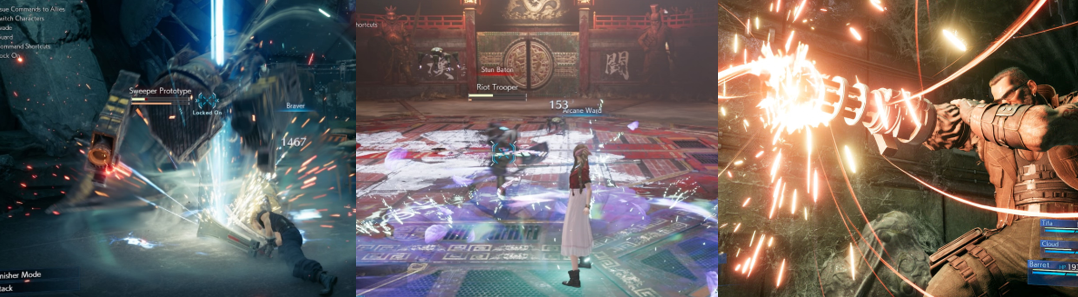
Gameplay and Power-Ups: Final Fantasy VII Remake is, as the title suggests, an action-orientated remake of the classic RPG Final Fantasy VII. As in the original game, players assume the role of stoic mercenary Cloud Strike, a troubled young man who wields various swords as tall as he is, and team up with some colourful characters in a bid to first stick it to a corporate conglomerate, then to defend both the world and fate itself. If you’ve never played the original game, this is a great way to experience the story for the first time. However, Remake does dabble in multiple timelines and rely on references near the later stages so some familiarity with the original is required. Those who are well-versed in the original and the series will find new gameplay options available here that mix things up. Obviously, the turn-based mechanics are gone, replaced with the franchise’s more modern third-person, active battle system. You can set up battles to somewhat resemble the original system with “Classic” mode, where attacks are automated and you simply focus on making decisions, though I chose to play on “Easy” mode and have full control over Cloud and his allies. Battles are semi-random; enemies appear and occasionally respawn in specific areas for you to battle for experience points (EXP) and Gil, but you won’t be assaulted every other step like in the original game. When in combat, Square unleashes your standard attack and holding it performs either a multi-hit swing or an automated combo, depending on who you’re controlling. Triangle activates each character’s signature move: Cloud switches between the faster, weaker “Operator” stance and the slower, more powerful “Punisher” stance, while Barret Wallace unleashes a powerful blast from his gun arm that must be recharged, Tifa Lockhart executes a whirlwind uppercut, and Aerith Gainsborough deals magical damage with Tempest. X opens the command menu, slowing the battle to a snail’s pace as you select magic attacks, items, or character abilities. Circle allows you to evade, you can guard by holding R1 to reduce incoming damage, L1 opens your shortcut menu (allowing you to quickly perform preset actions), and you can lock-on to targets by pressing in the right stick. While in the “Commands” menu, L2 or R2 issue commands to your two teammates and you can switch to them with the directional pad, though they’ll battle independently without your input.
Combat is fast and action-packed as you pummel enemies with spectacular special attacks.
Although battles are much more chaotic and action-packed, many of Final Fantasy VII’s mechanics return here. Your health points (HP) are depleted as you take damage, with characters being knocked unconscious after enough hits, and utilising spells such as Fire, Cure, or Barrier drains magic points (MP). Attacking enemies builds up the Active-Time Battle (ATB) gauge and allows you to perform certain actions. You need at least one bar to consume a restorative item, cast a spell, or perform a character’s special abilities, with stronger magic and attacks consuming two bars. These special abilities are dictated by the weapons you hold; each weapon unlocks a new ability once you use it enough, allowing you to use it whenever you like with different weapons, and these abilities essentially replace the multiple “Limit Breaks” of the original game. Limit Breaks are still present, however, and again activated when a small gar fills up during battles. Selecting a special ability or Limit Break can turn the tide of trickier battles as you’ll deal greater damage or inflict wider status effects so they’re worth experimenting with. Victory not only earns you EXP to boost your level and stats (attack, defence, speed, etc) but also nets you Skill Points (SP). These are spent in a surreal menu not unlike Final Fantasy X’s (Square, 2001) Sphere Grid and boost your stats further or grant you additional Materia slots. As you explore and interact with non-playable characters (NPCs), you’ll find Materia that can be equipped to weapons, armour, and accessories. Materia allows you to cast spells in battle, from elemental attacks like Fire, Thunder, and Blizzard, to defensive spells like Barrier and Haste, to boosting your stats and assessing enemy weaknesses. Materia also levels-up through battle and the acquisition of Ability Points (AP), and levelling-up certain Materia lets you cast more powerful spells, though these consume more MP and have a noticeable charge time. Certain weapons add elemental effects to your attacks and most enemies have some kind of elemental weakness, so having a diverse set of Materia is key to mastering the combat system. It also helps to take advantage of buffs and status draining magic, capitalise on “critical hits”, and pummel your target when they’re “staggered”.
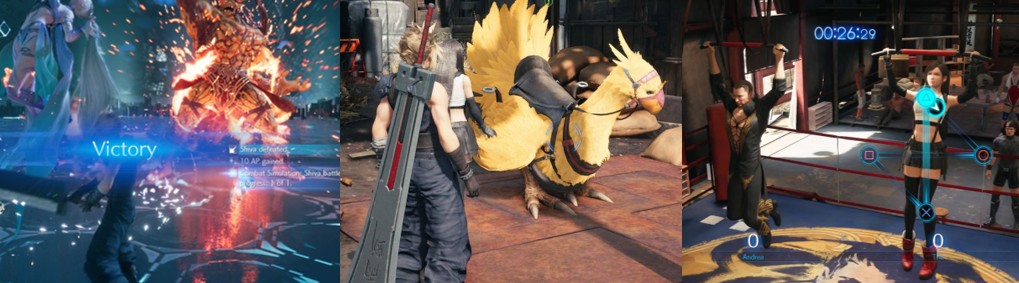
Completing side quests and mini games nets you Summons, fast travel, and other rewards.
When facing more powerful enemies, this staggered state is crucial to victory as landing successive hits builds the “Summon” meter. If you have a Summon Materia equipped, you can call forth a powerful beast to fight alongside you. Unlike in the original game, you issue orders to the Summon from the Commands menu and it’ll fight with you until the bar depletes. There are only four Summons available, with three locked behind virtual reality missions where you must defeat them to earn them, but they’re well worth bringing out during tougher boss battles. Victory, chests, and completing side quests also nets you Gil, which you spend on items to restore your HP, MP, or remove status effects like sleep and toad, purchase weapons and accessories, and buy more Materia. You can also use it to rest in inns, but I found little use for this as the game’s littered with helpful benches that restore your party to full health and Cloud even has a free room he can rest in during the first part of the game. This meant I never bought any items and rarely used them in battle and was much more frugal with my MP expenditure than usual, especially as I took the time to complete side quests to gain greater levels and gear. At various points throughout the chapter-based story, you’re encouraged to complete side quests for the destitute inhabitants of the Slums or the boisterous locals at Wall Market. These see you finding and feeding Chocobos to unlock a fast travel system, collecting medicines, defeating enemies that’ve infested the scrapyard and other areas, finding mischievous local kids, and playing songs to cheer people up. You’re usually rewarded with Gil but you’ll also unlock new Materia or be gifted SP or certain gear. Though these side quests did feel like padding at times, it was a great way to flesh out the game’s supporting characters and develop a deeper connection to the Midgar residents, meaning it has more emotional impact when Shinra decimates the area and kills most of them as recompense for your disruptive actions.
Gameplay is mixed up with some racing, interactable, and puzzle solving sections.
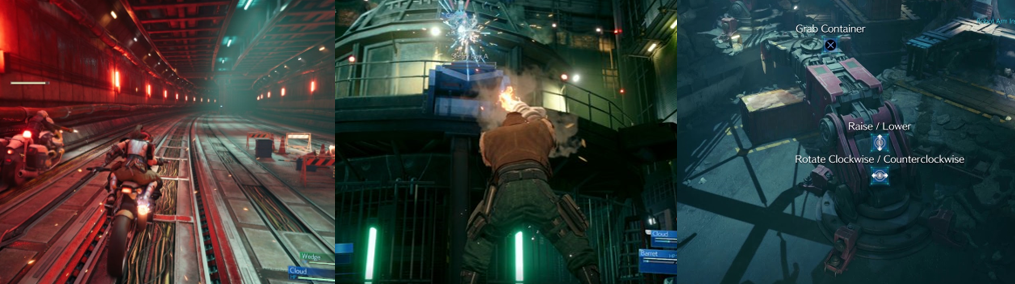
While Final Fantasy VII Remake is heavy on combat, you can run from most battles and much of your time between fighting is spent interacting with party members, other members of Avalanche, and the NPCs in the Slums and other Sectors. These interactions also see you participating in various mini games, such as a squat and pull up contest where you rhythmically press buttons in the correct order, culminating in a full-blown rhythm game where a cross-dressing Cloud shows off his dance skills! There are two sections where you race along the Midgar highways on a motorcycle; both see you swinging your sword at Shinra’s soldiers or blasting them with a beam attack, though the second jaunt sees you dodging anaerial bombardment and taking on a massive tank! While most areas are sprawling and daunting in their size, your helpful mini map, onscreen compass, and the larger in-game map steer you in the right direction. Puzzles generally involve squeezing through gaps, pushing things aside, or activating consoles and levers but you’ll also be moving crates (and giving Aerith a ride) using gigantic robotic hands, switching between parties to open doors, asking Red XIII to hop along walls to pull levers, and rescuing terrified children following Shinra’s horrendous counterattack. When bringing down the Mako Reactors, you’re given a time limit to battle to safety; when infiltrating Shinra headquarters, you find and upgrade identification cards and crawl through vents; and you’ll be firing grapnel guns with Triangle to escape the Slums, blasting walls with Barret’s gun arm to find goodies, and draining water to progress in the bug-infested sewers. Shinra-branded crates are scattered everywhere, and you can smash these for items, to restore a little MP with Mako Shards, and to collect Moogle Medals to trade in the slums. You’ll be competing in the colosseum to progress the story and gain levels, searching for cats and allies, following a disconcerting trail of glowing slime, clambering on overheard poles, and shifting disused trains around in your quest. None of it’s too demanding but the game does slow down noticeably during the more padded and tedious moments.
Presentation: Final Fantasy VII Remake is absolutely gorgeous. The graphical standard is so high that it’s basically like playing through Final Fantasy VII: Advent Children(Nomura, 2005) and a far cry from the chibi-like polygons of the original! However, I did notice some texture warping in the environment now and then and a delay loading the correct, high-quality textures here and there. Still, character models are now expressive and incredibly realistic, with your party’s weapons and gear reflecting what you’ve equipped in every cutscene (so, for example, Cloud doesn’t default to the Buster Sword when you’ve equipped the Nail Bat) and them being more expressive than ever. Cloud, especially, benefits from this as the story revolves around him and him slowly coming out of his shell as he interacts with his unlikely friends and other NPCs. He’s socially awkward at times and hesitant to form deep connections, meaning he’s left quite uncomfortable by Jessie Raspberry’s advances and Aerith’s teasing. He constantly clashes with Barret, who constantly gives Cloud a hard time and it takes a while for him to see Cloud in a different light when he willingly opposes Shinra and defends Midgar. Barret is a standout character for his passionate love for the planet and his little girl, Marlene, but I was surprised to see how big a role supporting characters like Jessie, Biggs, and Wedge have this time around. They desperately try to pierce Cloud’s armour and he begrudgingly comes to care for them, making their injuries and deaths all the more impactful, but it’s obviously his care for Tifa and Aerith that have the most impact on his character. Beset by migraines and assaulted by visions of his past, a distorted version of events, and Sephiroth, Cloud is a deeply troubled young man initially just looking to get a payday who naturally assumes a leadership role and goes out of his way to protect his newfound friends, even accepting Red XII without hesitation.
Midgar has never been so lively and expansive! it’s truly awe-inspiring to behold.
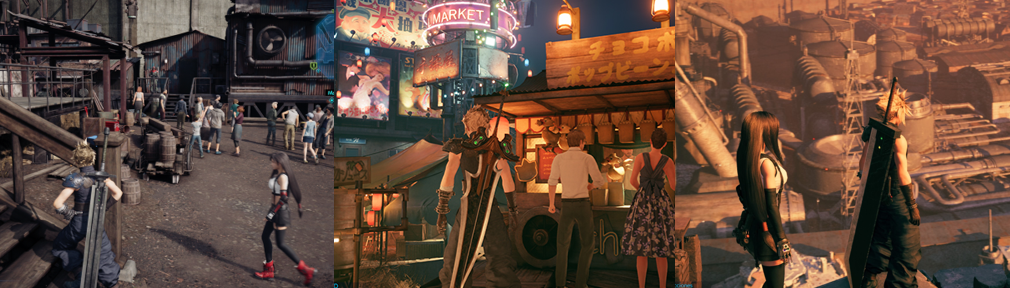
These narrative moments are pivotal to Remake’s story and directly tie into your extended time in Midgar and its various Sectors. While you can argue it unnecessarily drags things out, I did form a deeper bond with the welfare of the NPCs and this area since I interacted with everyone and got a sense of their society. Remake is quite linear and restrictive at times, however; it’s rare that you’ll get lost as your destination is either clearly signposted or you’re barred from going in different directions. You can explore a bit, though, and will find nooks and crannies hiding chests, Materia, health-restoring benches, or other minor goodies. Sometimes you have to go out of your way to find these, like directing moving platforms to an area behind some giant fans that you temporarily disable to snag some Materia. The game often highlights when you might’ve missed something with characters giving you the option to go back, but you can ignore these prompts if you just want to progress. You’ll be exploring Midgar’s Slums often, venturing into the squalor and interacting with the locals at the scrapyard, orphanage, or various shops. Aerith’s church is also here, of course, as is her beautiful house. You’ll also venture deeper into the oppressive and dark, steampunk-styled streets of Midgar to visit Jessie’s family, clamber up a pillar to escape, and toil in the dank sewers beneath Don Corneo’s opulent mansion. Quite often, you’re treated to a sprawling view of Midgar, which looms over the Slums like a dark shadow or stretches to the horizon, either twinkling with lights or left in ruins. The environments all recall the pre-rendered backgrounds of the original game but in a much greater scale. This is best felt when exploring the Mako Reactors, which feel large and lived in and fully operational, and when escaping the wreckage of the Slums and venturing into Shinra headquarters.
Cloud’s emotional journey takes a dramatic twist by the end.
Shinra headquarters is a high-tech skyscraper housing offices, an luxurious library (where the mayor is hidden away like a bad secret), toilets, and a museum dedicated to Shinra’s Mako research. It’s also home to Professor Hojo’s sprawling laboratory, where his Mako experiments created abominations and super-soldiers alike. Although Cloud is beset by fragmented memories, they become much more volatile here as Professor Hojo drops hints regarding his true past and his visions of Sephiroth manifest in physical form. We get brief glimpses of Cloud and Tifa’s childhood and a fiery incident involving Sephiroth, but nothing concrete, of course. Sephiroth’s presence is much more prominent here than during the original game, with his presence altered to potentially be time displaced and often accompanied by ominous, robed spectres known as “Whispers”. These pop up at key moments to keep the timeline intact but rage out of control in the finale, engulfing Shinra headquarters and warping Cloud and his friends to a desolate, whirlwind of a wasteland for the game’s final battle. Final Fantasy VII had one of the best soundtracks in all of videogaming, to say nothing of the franchise, and it’s well represented here. All the memorable themes make a return and can be freely listened to from jukeboxes once you’ve acquired CDs from vendors and side quests, and they even dynamically shift depending on what you’re doing. While your party won’t strike poses after every battle, they do in the combat simulator and Barret likes to hum the “Victory Fanfare” after a win, which is fun. A new remix of “One-Wing Angel” plays during the final battle, which always ups the ante of these situations, and Cloud’s confrontation with Sephiroth echoes their final encounter in Advent Children and recreates the automated showdown from the end of the original game. Finally, Remake ends with a tantalising teaser for what’s to come as we witness an alternative timeline where Zack Fair survived his dramatic last stand and leaves the ultimate fate of these characters up in the air since Sephiroth’s messing with the timeline.
Enemies and Bosses: It’s been a while since I played Final Fantasy VII so I admit that I didn’t recognise many of the enemies I cut down throughout the remake. Some Final Fantasy staples are recognisable, of course, like the flaming Bombs, frog-like Hedgehog Pies, and the deceptively dangerous Tonberries. Many battles pit you against Shinra’s forces; these militant goons wield machine guns, toss grenades, hide behind riot shields, and even fly using helicopter blades. Shock troopers, faster, more annoying “elite” variants, and even 3rd class SOLDIERS also crop up, alongside turrets, small drones, and cannons. Some of these are placed amidst the environment and can be pre-emptively destroyed by Barret; others come to life from the background or pop up from holes in the ground. Shinra also employs large mechs known as “Sweepers” that boast buzzsaw appendages, flamethrowers, and missile launchers. Their clandestine operatives, Rude and Reno of the Turks, occasionally attack from a chopper and their troops are often accompanied by monstrous guard dogs seemingly bred from Red XIII. Various bizarre monsters, presumably discarded experiments or the result of Shinra’s hazardous actions, are also fought in the Slums and other Sectors. Ravenous rats, crane-like birds, disgusting insects, and weird amphibious creatures are as commonplace as living junk and bandits looking to pick a fight. Ghosts and the ominous Whispers are also encountered numerous times, alongside lizardmen, wolf-like beasts, and the truly peculiar “Unknown Entities” birthed from Professor Hojo’s lab! Many attack in groups and utilise similar magic to you, but you’ll find they invariable have elemental weaknesses, items to be stolen, or are all bark and no bite, especially if your levels and weapons are particularly strong. I’d recommended using Assess to keep a record of their weaknesses, hitting the touch panel on the controller to review each enemy afterwards, and equipping Enemy Skill to learn some of their more troubling abilities for yourself. The game also logs battle intel on each creature for you to review and this ties into the VR side quest to snag new Materia as well.
Shinra’s mechs and agents will hound you throughout the story.
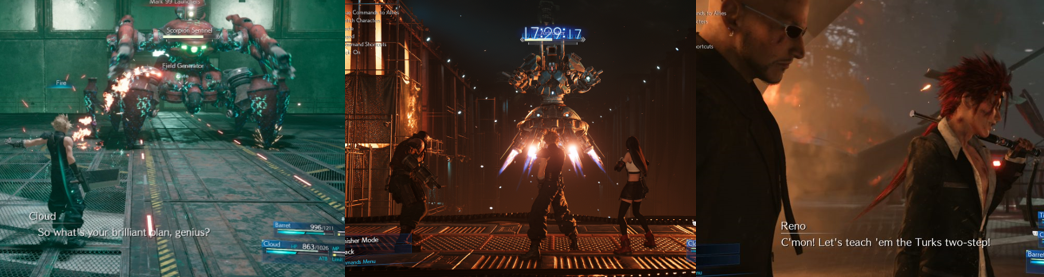
Shinra’s military arm is second to none in the world of Final Fantasy VII and, consequently, you’ll be battling some massive, heavily armed mechs. The Scorpion Sentinel is a significant first boss since you’re also battling a twenty- or thirty-minute timer during the escape portion. The Scorpion Sentinel sets a precedent for the game’s bosses in that they all consist of multiple phases, with the environment changing or the boss altering its appearance and attacks as you deal damage. Able to lock on and bombard you with missiles, leap to the walls, and fire a devastating laser beam from its tail, the Scorpion Sentinel isn’t to be underestimated but, as with every other boss, can be staggered by targeting its appendages and elemental attacks (in this case Thunder) turn the tide. The Crab Warden is somewhat similar, though favouring flame bursts and electrifying the floor and with a central generator and pilot for you to target once you bust through its defences. The Airbuster continues the trend, though the difficulty of the timed fight is set by you since you can sabotage the machine while exploring the Mako Reactor. The Airbuster boasts a large beam cannon, launches its fists, and flies out of reach to pepper you with missiles. In the second phase, it sits at the end of a narrow walkway and will decimate you with its beam unless you take cover, while filling the space with laser beams in the third phase. The Valkyrie flying machine chases you down as you escape the Slums, favouring rapid-fire chainguns and explosive artillery, the tank-like Arsenal must have its wheels cut from under it on the highways, and you must swap between parties to battle the snake-like Swordipede in the depths of Shinra headquarters. This electrified mech flies about, tossing a buzzsaw and blasting you with an electrical field that can make it tough to hit. Alongside these mechs, you’ll battle Shinra’s human forces: Reno and Rude, in particular, are a troublesome duo, attacking with both speed and power. You’ll also match wits with SOLDIER 3rd Class Roche, earning his begrudging respect in a duel, and must target Rufus Shinra’s canine companions to keep him from counterattacking with a shotgun to your face!
Bizarre, monstrous creatures lurk in the shadows and burst free from Professor Hojo’s lab.
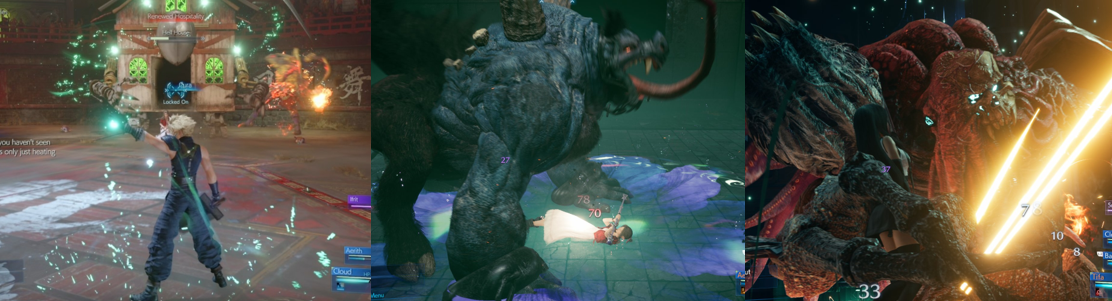
You’ll also face some large, generally grotesque monsters. If you want to summon Shiva, Chocobo and Moogle, and the Fat Chocobo, you must first defeat them in VR simulations, which isn’t too difficult given their obvious weaknesses. While competing in the Wall Market colosseum, you’re forced to fight the Hell House, a strange sentient house that’s initially immune to physical attacks, protects itself with Barrier, sends fireworks into the arena, and uses its jet boosters to stay out of reach. While in the sewers, you battle the troll-like Abzu, targeting its horns with Fire magic and avoiding its devastating pounce and poisonous water. A damaged Abzu reappears when you revisit the sewers, now accompanied by its pig-like offspring, retreating to tunnels to flood the room but otherwise retaining the same attacks. Abzu is good practice for the Type-0 Behemoth, a ravenous beast best crippled by attacking its torso and hind legs so you can target its horns, which make it otherwise invulnerable. Similar to the Whispers, who spawn the “Enigmatic Spectre” mini boss, the ghosts that haunt the trainyard are governed by the Ghoul, a poltergeist-like entity that teleports, becomes intangible, and inflicts Silence. This is merely the prelude to the Grim Reaper-like Eligor, who races around in a chariot, sweeps the floor with its eye laser, and can only be attacked from behind (preferably by ice-based magic). Finally, there’s Specimen H0512, a Cthulhu-like chimera with no elemental weaknesses, poisons and who “Slows” you with Noxious Expulsion and Mako Expulsion, slams one of your team around like a ragdoll, and spawns disgusting little minions to distract you.
Sephiroth reaches out from across time to try and undo his defeat and realise his mad goals.
Final Fantasy VII Remake includes an all-new form of Jenova, Jenova Dreamweaver, a malformed, Lovecraftian, tree-like entity fought in Shinra headquarters. This writhing, tentacled thing is rendered vulnerable by attacking its appendages, which spawn throughout the arena, pushes you back with Cast Aside, targets a single character with the hard-hitting Vengeance laser orb, and envelops itself in an impenetrable barrier with Rejection. It’s a fun, three-stage fight that keeps you on your toes, but the tension really ramps up once you enter the “Singularity” and are confronted by the titanic Whisper Harbinger. This towering monstrosity is too big and too far away to hit, but it does create three Whisper-like avatars: Whisper Rubrum, Whisper Viridi, and Whisper Croceo. Though colour-coded, they have no elemental weaknesses and instead absorb elemental attacks; they also constantly teleport and respawn, so it’s better to focus on one at a time. Deal enough damage and they’ll cast Correction, separating your party and forcing you to flee as the Whisper Harbinger wrecks the floating environment and showers the floor with lightning blasts. When Barret and Red XIII leave to attack Whisper Harbinger directly, you’ll face Whisper Bahamut, which throws explosive purple flame balls and the devastating, unavoidable Megaflare. Defeating it, and the other avatars, sees the Whisper Harbinger lose health and eventually crumble but this is a gruelling multi-stage fight that I’m not sure has checkpoints between each phase. Victory sees you confront Sephiroth, first as Cloud alone and then alongside his friends. Sephiroth is fast, casting elemental attacks, attacking with a sword beam, launching a three-swipe attack, and being the most aggressive and damaging enemy you’ll face. His Aeolian Onslaught can be tricky to dodge, his Hell’s Gate creates an explosion of light that hits anyone nearby, his Flamewall restricts your movements, and his Octoslash is effectively a one-hit KO attack. Once you deal enough damage, Sephiroth casts Meteor; you then have until the count of ten to finish him off before your whole party is decimated! This is a tough fight but also incredibly enjoyable. It echoes the Advent Children finale while also bolstering Cloud’s relationships since his friends arrive to help him for each phase of the fight.
Additional Features: Final Fantasy VII Remake has fifty-four Trophies up for grabs, with one awarded each time you clear a story chapter and when you finish the game. You’ll get additional Trophies for completing side quests, like decorating the orphanage, helping out Johnny, and defeating Summons in VR. Collecting CDs, calling upon a Summon, levelling-up Materia and your characters, and mastering weapons all award Trophies as well. While it’s easy enough to win a battle and stagger an enemy, mastering the darts mini game, receiving praise from Jessie for your motorcycle skills, completing all the squat and pull up challenges, and beating the game on “Hard” mode are a bit more taxing. “Hard” mode is unlocked once you finish the game and disables items and restricts you to healing at benches, making for a far greater challenge. Beating the game also unlocks a chapter select option so you can retry any remaining side quests all while retaining your current level and gear. Your EXP and AP is also doubled at this point, which is helpful, a play log is unlocked, and additional battles are added to the combat simulator. Completing Chadley’s Battle Intel requests lets you battle and add Bahumut and Leviathan to your team, and you’ll need to defeat all these Summons to take on the optional superboss the Pride and Joy Prototype. In addition to a bevy of options, from combat controls to camera positions, you can also upload your save file to the PlayStation 5 to continue your game there. The PlayStation 5 version is the only way to play an interlude mission involving Yuffie Kisaragi, so it’s probably better you upgrade to that version to get the full experience.
The Summary: Unsurprisingly, I’m a big fan of Final Fantasy VII. I enjoyed playing through it and have been waiting for a remake for a long time, though I never expected Square to go this far with it! I would’ve settled for a graphical overhaul of the original, with additional CGI FMVs tossed in to bolster the experience but, much like Capcom, Square went above and beyond in remaking arguably their most successful RPG and the results are clear to see. Final Fantasy has never looked better; Remake is like playing through a high-budget CGI movie, with an incredible sense of detail and depth to every environment. Making you interact with NPCs and spend more time helping them out fleshed out every character, not just the supporting roles, making them richer and more nuanced than ever. I loved the classic turn-based battle system and was worried I’d struggle here as a result, but combat is fast, fluid, action-packed, and intuitive. It’s fun issuing orders or switching to characters on the fly, taking cover, healing, or dishing out damage across the battlefield, to the point where it would’ve been great if this was a co-op experience! While the playable roster and the available gear is limited and you’re restricted to what amounts to the first disc of the original game, there’s a lot to see and do here and I liked the twist that this is more of a retelling of these events than a complete retread. The bosses were large and engaging and the sense of empowerment and progression was great; I played on “Easy” and didn’t get a single game over but enjoyed the sliding difficulty scale as the stakes increased. I’m glad it finally came to the Xbox and would gladly replay the game there, especially to experience the Intergrade add-on. Regardless, Final Fantasy VII Remake is an outstanding visual and gameplay experience, easily accessible to newcomers and packed with fan service for long-time fans, revitalising and expanding upon the original game in bold, new (and, crucially, fun) ways to present a truly amazing feat of videogaming.
My Rating:
⭐⭐⭐⭐⭐
Rating: 5 out of 5.
Fantastic
Have you played Final Fantasy VII Remake? If so, what did you think to it and how do you think it holds up against the original? Were you disappointed that the project was split into three parts across two console generations? What did you think to the Whispers and the changes made to the story? Did you enjoy getting to know Midgar more intimately here? Which of the side quests was your favourite? Did you struggle against Whisper Harbinger and Sephiroth? Would you say it’s worth upgrading to the PlayStation 5 to continue the story? Which Final Fantasy game is your favourite? Let me know your thoughts on Final Fantasy VII in the comments and be sure to check out my other Final Fantasy content on the site.








 Dr. K's Waiting Room
You must be logged in to post a comment.