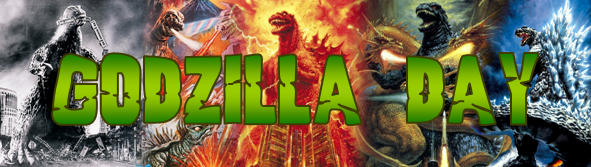
Toho’s famous atomic beast, and easily the most recognisable kaiju in the entire world, Gojira first emerged to wreck the city of Tokyo on this day all the way back in 1954 and, in 2016, the day was subsequently declared “Godzilla Day”.


Released: 20 December 1964
Director: Ishirō Honda
Distributor: Toho
Budget: Unknown
Stars: Haruo Nakajima, Yosuke Natsuki, Shoichi Hirose, Akiko Wakabayashi, Masanori Shinohara, and Takashi Shimura
The Plot:
An alien prophetess (Wakabayashi) predicts catastrophic attacks from Godzilla (Nakajima) and Rodan (Shinohara), leading to Mothra intervening to defend humanity. However, when the hydra-like space dragon King Ghidorah (Hirose) appears, the warring kaiju must set aside their differences to battle this devastating new foe.
The Background:
6th August 1946. The height of the Second World War. The Americans dropped two nuclear weapons on Hiroshima and Nagaski, killing tens of thousands of people and forcing the Japanese Imperial Army to surrender. The radioactive fallout saw thousands more dying, and post-war Japan was gripped with nuclear fear, a fear that birthed Gojira, the living embodiment of nuclear destruction. However, soon after this debut in Godzilla (Honda, 1954), the King of the Monsters turned from Japan’s destroyer to its reluctant saviour, defending the country from other kaiju attacks as a matter of principal. Following the commercial success of Godzilla’s last two movies, Ghidrah, the Three-Headed Monster was rushed into release; it included the return and redesign of fellow kaiju Rodan after a nearly ten-year absence, a recycled Mothra animatronic with marginal changes, and Toho’s most complex kaiju yet, the three-headed dragon King Ghidorah. Arguably Godzilla’s greatest nemesis, King Ghidorah was conceived by Godzilla creator Tomoyuki Tanaka and inspired by the Lernaean Hydra and the Orochi of Japanese folklore, and its debut feature was so successful that it reappeared in Toho’s next giant-monster film the following year.
The Review:
Our story opens with reporter Naoko Shindo (Yuriko Hoshi) visiting a communications centre that’s trying to contact extraterrestrials. Headed by their resident expert (Someshô Matsumoto), they truly believe that “flying saucer people” are out there, and wary of non-believers, so much that Naoko’s scepticism is blamed for their failure to communicate with the aliens. For a group of presumed scientists and academics, they’re oddly fanatical about this; since the world is experiencing an unseasonable heat wave, they’re concerned that a catastrophe is looming and believe the saucer people are their only chance of salvation and find Naoko’s ditzy disinterest to be insultingly narrow-minded…even though she’s simply there to do a job and desires proof. You know, the kind of evidence scientists strive to gather. A small meteor shower interrupts their meeting and draws Naoko’s friend, Professor Murai (Hiroshi Koizumi), and his team to investigate. They discover a large cocoon-like meteor that randomly emits magnetic waves and leaves them baffled. Naoko’s brother, Detective Shindo (Natsuki), likes to tease Naoko about her friendship with Murai; although grown adults, they still bicker like children, and she doesn’t appreciate his remarks or him getting in the way of her career. Shindo is stunned when he’s assigned to protect the visiting Princess Salno of Selgina (Wakabayashi), who’s facing assassination from her ruthless uncle (Shin Ôtomo), who desires her throne. Shindo is even more stunned when Salno appears to be killed when her plane explodes and she crops up as a doomsaying Prophetess who claims to be from Mars and warns that the world faces impending doom unless humanity changes their ways and takes better care of the environment, much to the jeers and doubts of the public.
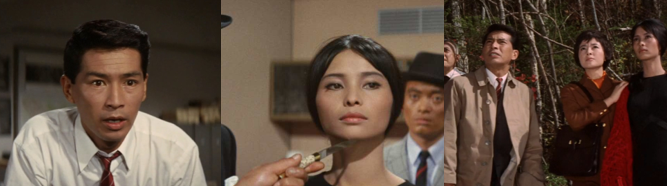
Assuming that Salno faked her death to escape her uncle’s assassin (Hisaya Ito), Shindo volunteers to bring her into protective custody, causing a brief conflict when he finds Naoko shielding her in hopes of getting an exclusive story. Drawn from her plane before the explosion by a disembodied alien presence that possesses her, psychiatrist Doctor Tsukamoto (Shimura) later reveals that the Prophetess is just one of a displaced, highly advanced alien race that fled to Earth and assimilate themselves into humanity, losing many of their fantastic abilities in the process, when the Red Planet was decimated by Ghidrah. One of the deadpan Prophetess’ remaining abilities is the ability to predict pending disasters that are repeatedly mocked and ignored; she warns people away from Mount Aso, where the prehistoric kaiju Rodan emerges from the volcano, and advises the fairy-like Shobijin (Emi and Yumi Itō) not to sail home to the benevolent Mothra on Infant Island, which they heed and are thus spared a violent death from Godzilla’s atomic breath. Despite the looming kaiju threat, the assassin and his cohorts continually hound the Prophetess, determined to kill her as per their orders, in a bizarre side-plot that honestly distracts from what we’re all here to see (but I guess it makes a change from following a soldier or a reporter as these films often do). Even with the three kaiju battling in the foreground, the assassin tries to complete his mission and yet somehow misses the easiest kill shot in the world! Although Shindo rushes to her aid and a brief firefight ensues, the assassin is ultimately crushed under falling rocks from the kaiju battle. In all the chaos, Shindo is wounded from a bullet and the Prophetess takes a grazing shot to the head and a nasty fall that conveniently sees the alien presence driven from her body…

By this film, kaiju are well established; despite them slumbering for great lengths of time and occasionally defending humanity, they’re generally regarded as unpredictable and dangerous. One of the most popular and benign is Mothra, who’s such a celebrity that his fairy companions appear on television to reveal that one of the Mothra larvae has died since the previous film and that the remaining larvae is worshipped as a God. Sadly, for a film that boasts four kaiju, it takes ages to see them onscreen, and over forty minutes for Godzilla to show up! Even worse, although Godzilla’s clearly enraged at Rodan’s presence and they awkwardly exchange blows, the film initially focuses on dull political debate and fades to black right as things are getting interesting. The meteor eventually yields the most visually striking aspect of the film, and Godzilla’s greatest nemesis, the titular Ghidrah, a three-headed dragon covered in golden scales. With the Japanese military refusing to employ atomic weapons, they turn to the Shobijin to plead for Mothra’s help. Unfortunately, the fairies admit that Mothra alone isn’t strong enough to battle Ghidrah and the only hope for victory is for the larvae to convince Godzilla and Rodan to team up against the demonic dragon. It takes some time for Ghidrah to cross paths with its foes; until then, the focus is on Godzilla and Rodan, who battle furiously with neither one having a clear advantage (Rodan’s fight allows it to keep Godzilla off-balance and even pick him up and dump him on some power lines, but Godzilla’s functionally indestructible and simply grows more enraged the longer the fight rages on). Their pig-headedness means Ghidrah causes havoc unopposed by either the kaiju or the miliary; indeed, the military don’t even mobilise their tanks or planes to engage Ghidrah and, instead, the ineffectual government places all their faith in Mothra and his desperate plan to join forces with Godzilla and Rodan.
The Nitty-Gritty:
You may have noticed a few inconsistences in my review; these are due to me watching the English dub, which has the Prophetess and her people originate from Mars rather than Venus, pronounces and spells Ghidorah’s name differently and drops its regal title, and changes the traditionally female Mothra to a male. While some purists may argue that the original Japanese audio and English titles are superior (and they’re often right), I usually always go with the dubbed version just to make things easier and because of the often-hilarious line delivery. The film contains an environmental message that echoes sci-fi classic The Day the Earth Stood Still (Wise, 1951); decades before global warming was the hot buzz word, Ghidrah, the Three-Headed Monster warns about such disastrous concerns as climate change and global warming. The Prophetess foretells that humanity is doomed if they don’t change their ways, but this message falls a little flat as her warnings are not actually about mankind directly and instead refer to the monstrous kaiju that threaten their world. While technically these creatures (with the exception of Ghidrah) could be said to be man-made, given they were mutated by radiation and such, they’re usually always more depicted as a force of nature. Godzilla, especially, is usually always the embodiment of nature’s wrath and man’s hubris taking destructive revenge upon the world, so it’s a little weird to say “you’re dooming yourselves” when actually you mean “a big-ass alien monster’s gonna wreck shit”.
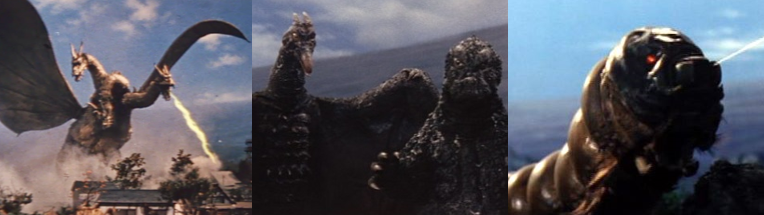
Although it takes forever for Godzilla to finally make an appearance, he’s as impressive as ever; while the suit is bulky and incapable of blinking, it’s always a joy to see Godzilla trampling model buildings as people flee in terror. Emerging from its cocoon in a shower of sparks and animated lights, Ghidrah makes for an intimidating foe with its three screeching heads and chaotic lighting blasts; like Rodan, Ghidrah devastates everything in its path with a supersonic crash and, like Godzilla, it emits destructive energy beams, but in the form of wild and crackling lightning. Unfortunately, it does look incredibly ungainly with its bulbous body and lack of arms; while its three dragon-like heads go some way too make up for this handicap, biting and attacking with malicious intent, they also look a bit dodgy flopping and flailing all over the place and I really do think Ghidrah would be even more threatening if it had arms and talons to grab and attack with and just make its body look a little less comical. Unlike their counterparts, Rodan and Mothra are far less versatile and clunky; Rodan may still be a man in a suit but his flying scenes are realised through obvious wires and a powerful wind machine, while Mothra is purely a partially animatronic creature that bumbles about the place spitting silly string because, maddeningly, the filmmakers decided to keep Mothra in his larvae form rather than utilise the more visually interesting (if equally restrictive) moth form. Rodan’s flying scenes are, admittedly, pretty ridiculous; I admire the filmmakers for trying to inject some variety with their kaiju designs and have always had a soft spot for Rodan, but it’s laughable seeing the static model being strung along on wires (alongside a jet engine sound effect) and bashing into Godzilla. Godzilla still uses his atomic breath rather than a destructive beam of energy, meaning both are noticeably weaker than I’d usually expect from the King of the Monsters; Rodan can take the breath at point-blank range and even comically disorientates Godzilla by pecking him repeatedly in the head!
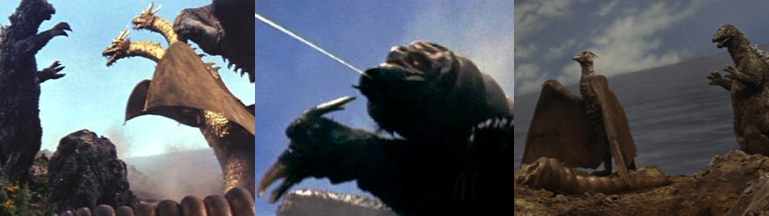
Honestly, the fight between Godzilla and Rodan is pretty ridiculous thanks to the filmmakers just being a little too ambitious; Rodan flies about, pecks at Godzilla and its tail, and pushes the Big G back with powerful wind blasts, and Godzilla mostly flails his little arms, whacks Rodan with his tail in a glorified slap fest, and sends rocks flying at his foe that fail to hit with any convincing impact. The two even play dead man’s volley with the boulders, which is presented as two Apex Predators looking to prove their might, and they’re only subdued when Mothra tangles them up in silly string to plead for their co-operation. The Shobijin are on hand to translate; despite their differences, Godzilla and Rodan agree that they have nothing to gain from helping humans and have no interest in getting involved and would rather fight each other. However, the two quickly change their minds when they see Mothra bravely taking on Ghidrah alone and be easily overwhelmed by its lightning bolts. Not that Godzilla or Rodan initially fare much better; Godzilla gets blasted into a bridge and engulfed in raging flames and Rodan injures itself more than its monstrous foe when it knocks Ghidrah out of the air. With Rodan forced to take cover from Ghidrah’s lightning, Godzilla literally drags Mothra back into the fray and goes back to his tried-and-true strategy of chucking and kicking rocks and gets blasted in the crotch for his troubles! Eventually, Godzilla, Rodan, and Mothra come together as best as they (and their cumbersome suits) allow to overwhelm Ghidrah; Godzilla wrestles with it, absorbing the brunt of its attacks, while Mothra nips at its tail and engulfs it with String Shot while being carried on Rodan’s back. Somehow, this is enough to force the hydra to flee, bringing the battle to an anti-climatic end. In the aftermath, Princess Salno exhibits no memories of her time as a Martian beyond a lingering gratitude for Shindo and Mothra heads back to Infant Island with the Shobijin, bidding a fond farewell to his new allies, who have set aside their grievances.

The Summary:
Geez, I may apologise for Godzilla movies a lot and cut them some slack, but this was a pretty awful movie to sit through! The tone is all over the place, emphasising the importance of respecting the world and avoiding global disaster on one hand and then having slapstick kaiju violence the next. While Ghidrah may look intimidating and is depicted as a crazed, destructive alien beast, it’s defeated with a pathetic amount of ease; the film makes a big deal about how Mothra isn’t strong enough to defeat the creature, yet all Godzilla does is hold it still and all Rodan does is carry Mothra so he can string it up! The bulk of the monster madness is focused on Godzilla and Rodan, which would be fine if the fights weren’t so laughably bad! This is only Godzilla’s fifth movie so I understand that all the kinks weren’t figured out yet, and I get that there’s only so much you can do with puppets and suitmation, but maybe the filmmakers should’ve set their goals a little lower and simply focused on Godzilla battling with Mothra and left Rodan out of this since it really didn’t do much against Ghidrah that couldn’t have been accomplished without it. The film also spends way too much time focusing on this batshit crazy Martian presence, or whatever, when it should’ve been focused on the mystery of the glowing meteor. I would’ve skipped the Prophetess and incorporated her environmental message into Shindo, rewritten him to be a scientist investigating the meteor, and had Naoko cover the emergence of the kaiju. Again, I get that we need to follow human characters, but they dominate the film’s runtime and just aren’t very interesting, especially compared to what should’ve been an epic assembling of four bad-ass kaiju with the fate of the Earth at stake. Instead, I never felt like humanity was threatened by Ghidrah and the kaiju action was severely lacking due to the imitations of the suits, meaning Ghidrah’s big debut film ended up being a dull and ultimately forgettable experience for me.
My Rating:
Could Be Better
What did you think to King Ghidorah’s debut film? Were you also disappointed by the bonkers human sub-plot, or did you enjoy the alien narrative? What did you think to the build up to King Ghidorah’s appearance and powers? Did you also find the kaiju battles lacking? Which incarnation of King Ghidorah is your favourite? What is your favourite Godzilla movie and why? How are you celebrating Godzilla Day this year? Whatever your thoughts on Godzilla and King Ghidorah, feel free to leave a comment below and be sure to check out my other Godzilla and kaiju reviews across the site!



 Dr. K's Waiting Room
You must be logged in to post a comment.