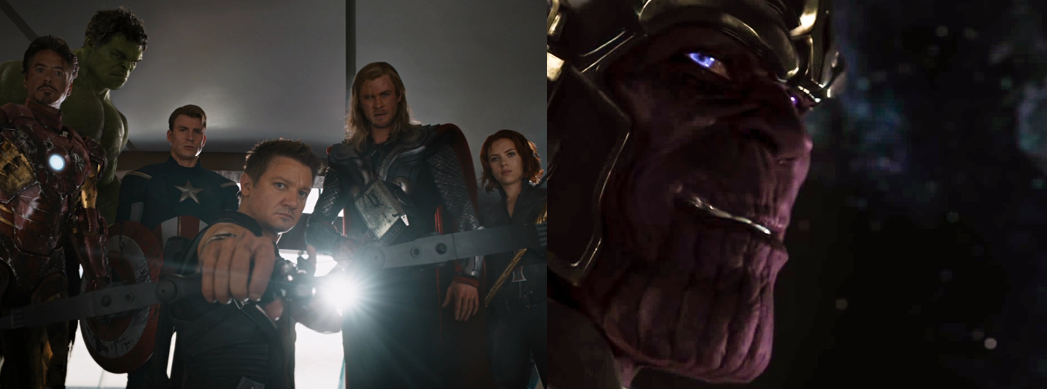
Screen Time [Multiverse Madness]: What If…? (Season One)


In September 1961, DC Comics published “Flash of Two Worlds” (Fox, et al), a landmark story that brought together two generations of the Flash: the Golden Age Jay Garrick and the Silver Age Barry Allen thanks to the concept of the multiverse, an infinite number of parallel universes that allowed any and all stories and characters to co-exist and interact. Marvel Comics would also adopt this concept and, to celebrate the release of Doctor Strange in the Multiverse of Madness (Raimi, 2022) this month, I’ve been both celebrating the Master of the Mystic Arts and exploring the Marvel Cinematic Universe’s (MCU) equivalent of the multiverse every Sunday of May.


Air Date: 11 August 2021 to 6 October 2021
Network: Disney+
Stars: Hayley Atwell, Chadwick Boseman, Samuel L. Jackson, Benedict Cumberbatch, Mark Ruffalo, Michael B. Jordan, Chris Hemsworth, Ross Marquand, and Jeffrey Wright

The Background:
As a big comic book fan, it’s been absolutely amazing seeing the MCU become a multimedia juggernaut and some of Marvel Comics’ most beloved characters and concepts come to life on screen. Although Marvel Studios dabbled in television ventures with the likes of Agents of S.H.I.E.L.D. (2013 to 2020) and their Netflix shows, they really doubled down on TV productions for the MCU’s fourth phase to produce content for their parent company’s streaming service, Disney+. With MCU head honcho Kevin Feige behind them, the Disney+ shows aimed to maintain and expand the ongoing continuity of the MCU, but I don’t think anyone could have predicted that Marvel Studios would delve so deeply into the multiverse that we’d seen an adaptation of What If…? What If…? began life as a semi-consistent series of hypothetical, often light-hearted (or downright dark), stories that presented Marvel heroes and storylines with subtle (or major) changes. The Disney+ show followed this format and recontextualised the premise as an animated anthology series that would explore what the MCU would be like if characters or events had unfolded differently. The show’s animation was headed by Stephan Franck and sported a cel-shaded design that emphasised hyper-realism; as the MCU was officially exploring the concept of the multiverse, episodes could be part of the franchise’s overall canon and many recognisable faces, names, and voices returned to put a new spin on their iconic roles; however, although voice recording was able to continue remotely during the COVID-19 pandemic, this production sadly marked the final performance of the late Chadwick Boseman as T’Challa/Black Panther. What If…? was received extremely well and the series was praised as a love-letter to the fans; despite some reservations about the format and presentation, reviews were primarily positive and spin-offs were quickly announced as either being in production or on the cards. Crucially, the multiversal scope of the series would be revisited in the live-action MCU films and characters and concepts from the show even seem set to cross over into the main MCU canon going forward.

The Plot:
From beyond the multiverse, the cosmic being known as Uatu the Watcher (Wright) observes as the events of the MCU unfold differently, resulting in Peggy Carter (Atwell) becoming Captain Carter, Doctor Stephen Strange (Cumberbatch) becoming a force for evil, a zombie infection running rampant, and T’Challa (Boseman) becoming Star-Lord. However, when a version of Ultron (Marquand) acquires the Infinity Stones and threatens the entire multiverse, the Watcher must break his oath of non-interference to assemble a heroic force capable of fending off this threat.

The Review:
Because of the nature of the series, I think it’d be much better to look at each individual episode, what they do and how they work by themselves, and then talk about some overall themes and give my opinion on the entire concept down in the summary. The first season of What If…? is a nine-episode series of animated adventures that examine familiar characters and events in the MCU but change things about in subtle, or major, ways to create entirely new stories as part of the MCU multiverse. These alternate realities are observed by the enigmatic Watcher, a cosmic being bound only to observe and never directly interfere, and who acts as the narrator of the show. The Watcher’s opening narration explains the basics of the multiverse; as we were told in Avengers: Endgame (Russo and Russo, 2019), time and reality in the MCU is not a single, linear, fixed path. Instead, multiple timelines and alternate universes exist, with the deviations occurring from different decisions being made at key moments in time, however big or small. In this regard, time is less like a line and more like a river, with an infinite number of paths trailing off all over the place, and the Watcher acts as our impassive guide to this vast multiverse. The Watcher also serves as our narrator, quickly catching us up on the events preceding the episode and explaining when, where, and how each divergent timeline was created; however, he has taken a solemn vow to never interfere in the events he witnesses, no matter how gruesome or extreme they are.

Peggy takes Steve’s place and is forced to make the ultimate sacrifice to stop Hydra’s interdimensional beast.

The series kicks off with “What If…Captain Carter Were the First Avenger?” (Andrews, 2021), essentially a retelling of Captain America: The First Avenger (Johnston, 2011). Unlike in the original timeline, Strategic Scientific Reserve (SSR) Agent Peggy Carter chooses to stay and watch on the ground as skinny, ill-bodied Private Steve Rogers (Josh Keaton) prepares to become a super soldier. However, when the Nazi sleeper agent attacks the experiment this time around, Peggy manages to keep him from escaping with a sample of the serum but Steve is wounded, so Peggy ignores the orders of her commanding officer, John Flynn (Bradley Whitford), and voluntarily becomes enhanced to the peak of human physical conditioning before the experiment is lost forever. Promoted to head of the SSR, Flynn is outraged at the result; disgusted that the super soldier serum was wasted on a woman, he refuses to allow Peggy to actively participate in the war, much less on the front line, out of sheer prejudice, much to her chagrin and fury. As before, Hydra figurehead Johann Schmidt/The Red Skull (Marquand) seeks to usurp Adolf Hitler and claim victory for himself with the mysterious and all-powerful Tesseract. Flynn, however, is unimpressed by the threat and unwilling to risk even one man, let alone an entire platoon, on recovering the cube; luckily, inventor Howard Stark (Dominic Cooper) believes so strongly in the Tesseract’s threat that he furnishes Peggy with a striking Union Jack-style costume and a familiar Vibranium shield so that she can single-handedly recover the Tesseract from Schmidt’s Hydra colleague, Doctor Arnim Zola (Toby Jones), decimating an entire convoy of Hydra’s soldiers with efficiency and glee and earning herself an official promotion to “Captain Carter”. Although he lost his best shot at fighting alongside his friend, Sergeant James Buchanan “Bucky” Barnes (Sebastian Stan), Steve is fully supportive of Peggy’s newfound strength and abilities and only too glad to pilot Stark’s Tesseract-powered “Hydra Stomper” armour. However, following an action-packed montage, Steve is apparently lost during a familiar assault on an armoured train; though grief-stricken, Peggy forces information out of Zola and leads an all-out assault against the Red Skull’s fortress, where they find Steve alive but are too late to stop the Red Skull from opening a dimensional rift with the Tesseract. The tentacles of a gigantic, interdimensional, Lovecraftian creature breach the portal, killing Schmidt and threatening all life on Earth; Peggy and Steve fend off the beast as Stark tries to shut down the portal, but Captain Carter is forced to sacrifice herself to the unknown by physically forcing the creature through the rift. The story then skips ahead to find the Tesseract being reactivated, spitting Peggy and the remains of the beast’s tentacles out into a Strategic Homeland Intervention, Enforcement, and Logistics Division (S.H.I.E.L.D.) facility where she meets Director Nick Fury (Jackson) and Agent Clint Barton/Hawkeye (Jeremy Renner) and learns the bittersweet news that the Allied Forces won the war but she is now seventy years in the future, and thus forever cut off from her friends and loved ones.
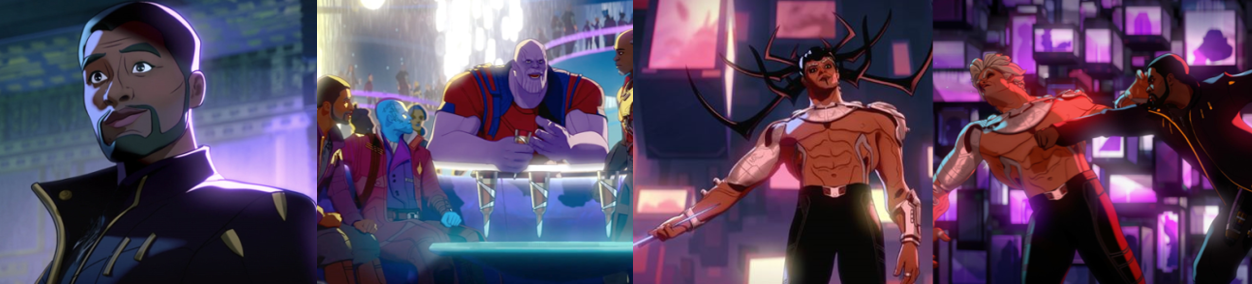
T’Challa is a galaxy-renowned force for good who has a positive influence on even the Mad Titan!

While the first episode arguably played things a little safe, we really see the potential of a What If…? series with the second episode, “What If…T’Challa Became a Star-Lord?” (Andrews, 2021), which wildly deviates from the story of Guardians of the Galaxy (Gunn, 2014). Young T’Challa (Maddix Robinson) longed to explore beyond Wakanda but was shielded from the chaotic outside world by his beloved and overprotective father, T’Chaka (John Kani), only to be abducted due to a mistake by Yondu Udonta’s (Michael Rooker) subordinates. Surprisingly, he was excited at embarking on adventures throughout the cosmos with the Ravagers and, while T’Challa doesn’t possess the Black Panther’s near-superhuman abilities, he sports all of Peter Quill’s (Brian T. Delaney) gadgets in addition to his Wakandan fighting prowess. His greatest assets, however, are his charisma, diplomacy, and reputation as a Robin Hood-type figure. Indeed, T’Challa is far more competent, notorious, and respected than his mainstream MCU counterpart; not only does Korath the Pursuer (Djimon Hounsou) know who he is, he views sparring with Star-Lord as the greatest honour and willingly joins his crew. T’Challa’s positive influence means the Ravagers put their skills towards helping others rather than for personal reward, thus sparing Drax the Destroyer’s (Fred Tatasciore) family and even convincing Thanos (Josh Brolin) that his destructive aspirations weren’t the answer to the galaxy’s problems! Touched by T’Challa’s mission to save others after the presumed destruction of Wakanda, Nebula (Karen Gillan), now a far less violent and far more beautiful woman, proposes a heist to steal the Embers of Genesis, a cosmic dust capable of ending galactic hunger, from Taneleer Tivan/The Collector (Benicio del Toro). While sneaking around the Collector’s museum, T’Challa finds a Wakandan spacecraft and is angered to find that Yondu lied to him about Wakanda in order to help him realise his true calling as an adventurer. The two reconcile in the best way possible: by teaming up to fight with this much more formidable version of the Collector, who is enhanced by weapons, technology, and items retrieved from some of the MCU’s most powerful and prominent individuals and races. Thanks to their teamwork, the Collector is disarmed and left at the mercy of his captives, and T’Challa forgives Yondu’s deception before reuniting with T’Chaka and his people in Wakanda, bringing his two families together in celebration over their mutual friend. Across the world, however, a greater threat awaits when Ego (Kurt Russell) comes looking for his son, here a mere Dairy Queen employee.
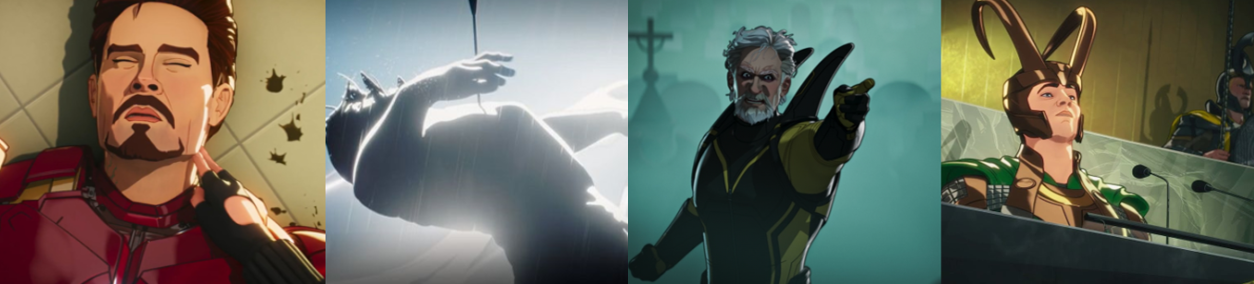
Pym is revealed as the culprit but, after he’s apprehended, Loki usurps his threat and conquers the world!

“What If…the World Lost Its Mightiest Heroes?” (Andrews, 2021) takes us back to the middle of Iron Man 2 (Favreau, 2010) and Nick Fury and Natasha Romanoff/Black Widow’s (Lake Bell) latest effort to recruit Tony Stark/Iron Man (Mick Wingert) to the Avengers Initiative. Fury is horrified when his attempt to stave off Stark’s palladium poisoning apparently has the unexpected side effect of killing the would-be Avenger; this tragedy is quickly followed by Thor Odinson (Hemsworth) being accidentally killed by Hawkeye’s errant arrow and the archer later being found dead while locked in an impenetrable S.H.I.E.L.D. cell. Fury suspects that his recruits are being targeted by an unknown party, and charges Natasha to escape Brock Rumlow’s (Frank Grillo) custody and make contact with Doctor Betty Ross (Stephanie Panisello). Though initially distrustful of Natasha due to her association with those who’ve hounded her friend, colleague, and former lover, Doctor Bruce Banner/The Hulk (Ruffalo), Betty is convinced to take a closer look at the injector used on Stark and theorises that a microscopic projectile fired from the needle killed the superhero. Hungry for blood after learning of Hawkeye’s death, Natasha agrees with Fury’s theory that their killer is targeting Avengers recruits; unfortunately, General Thaddeus “Thunderbolt” Ross (Mike McGill) arrives looking to arrest Banner and sparks his transformation into the rampaging Hulk as in his solo film. However, the seemingly immortal Green Goliath also falls victim to the mysterious killer when he violently explodes from the inside out, and things escalate even further when Loki Laufeyson (Tom Hiddleston) arrives looking to avenge Thor’s death. Fury manages to buy himself one day to solve Thor’s murder on the promise of delivering the culprit to the God of Mischief and, when Natasha finds that a dead agent’s credentials were used to access S.H.I.E.L.D.’s database, she’s brutally beaten to death by an unseen assailant, and only able to tell Fury that all the deaths are relating to “hope”. This, however, is enough to piece together the perpetrator’s true identity: Doctor Hank Pym (Michael Douglas), who targeted Fury’s recruits in the guise of the size-altering Yellowjacket after his daughter, Hope van Dyne (Evangeline Lilly), died while working for S.H.I.E.L.D. A broken, bitter, twisted old man, Pym blames Fury and has become a deranged killer due to his grief and anger. However, Pym and his tech are outmatched when Fury is revealed to be Loki in disguise but, after Pym is defeated and taken into Asgardian custody, Loki double-crosses Fury and declares himself ruler of humanity. To combat this threat, Fury gets back to work assembling his super team, starting with calling Carol Danvers/Captain Marvel (Alexandra Daniels) back to Earth and uncovering Captain America’s frozen body.

A grief-stricken Dr. Strange finds he cannot save his love no matter how much he alters the past.

The show shifts over to the world of magic and mysticism for “What If…Doctor Strange Lost His Heart Instead of His Hands?” (Andrews, 2021), which presents a world where Dr. Strange and Doctor Christine Palmer (Rachel McAdams) are still a couple in a loving relationship. Fully supportive and enamoured by Dr. Strange, Christine encourages his ego and his skills as a surgeon, but sadly her influence doesn’t extend to his driving skills. However, in this world, Dr. Strange is relatively unharmed from the car crash that took his MCU counterpart’s hands but is left grief-stricken when Christine dies as a result of his negligence. In a bid to fill the void in his life, and his heart, Strange travels the world and, once again, ends up studying the mystic arts at Kamar-Taj under the tutelage of the Ancient One (Tilda Swinton). Like his mainstream counterpart, Strange becomes the Master of the Mystic Arts after the Ancient One’s death and successfully bargains with the Dread Dormammu (Cumberbatch), but remains preoccupied with the mistakes of his past and the promises offered by the Eye of Agamotto’s time-bending abilities. Haunted by memories of happier times with Christine, Strange ignores the warnings of the Ancient One and his manservant, Wong (Benedict Wong), and uses the Eye to place his current consciousness into the body of his past self. Unfortunately, the tragedy still occurs no matter how safely he drives, which route he takes, or even his refusal to go to the award speech as Christine dies again and again whether he’s there or what he does. Dr. Strange’s anguish at being unable to save Christine isn’t helped by the Ancient One’s explanation that her death cannot be averted as it would create a potentially universe-destroying time paradox (if Strange prevents her death, he won’t become a sorcerer and be able to go back and save her).

Strange Supreme saves Christine, but only briefly and at the cost everything that ever is or was in his reality.

Refusing to believe that Christine is fated to die, and angered at the Ancient One’s refusal to help him break this “absolute point” in time, Dr. Strange uses the Eye to flee from the confrontation and consult the ancient tomes of the Lost Library of Cagliostro. There, he meets O’Bengh (Ike Amadi) and learns that one can potentially gain the power he requires by absorbing magical beings; thus, Dr. Strange conjures a variety of demonic, Lovecraftian, and magical creatures (including gnomes, familiars, dragons, and even the octopus-like creature Captain Carter fought). When they won’t willingly share their power, he resolves to forcibly take it, and quickly becomes obsessed with gaining more and more magical power from these entities over the course of centauries to become “Strange Supreme”. As he does so, he grows increasingly monstrous and takes on more of their attributes, but is shocked to learn from O’Bengh that he’ll never be powerful enough to achieve his dreams due to the Ancient One using magic from the Dark Dimension to split him in two and create two concurrent timelines. His other half, who took Wong’s advice and moved on from Christine’s death, is charged by an echo of the Ancient One to oppose his dark doppelgänger before his ambition erases all of reality. When Strange Supreme’s attempts to coerce his other half into joining his cause are rejected, a magical battle ensues that spans multiple dimensions. Despite Wong’s protective spells and Strange’s efforts to talk down his dark half, Strange Supreme’s centauries of basking in the powers of countless magical beings makes him the superior and he’s ultimately able to absorb his missing half. Finally whole again, Strange Supreme succeeds in undoing Christine’s death but is transformed into a demonic being by the effort this requires; understandably, she is horrified by his nightmarish appearance, and he’s left helpless to stop the time paradox from devouring all of his reality. Desperate to preserve the world, he begs the Watcher for help but he refuses to get involved, despite wishing to punish Strange Supreme’s reckless arrogance, and the once Sorcerer Supreme is left alone, despondent, and remorseful in the tiniest pocket of reality with nothing but his grief and regret for company.

Banner is horrified to find the world, and many of its heroes, infected by a zombie virus.

One popular, recurring storyline in Marvel Comics in recent years has been the Marvel Zombies spin-off (Various, 2005 to present) that tells of a devastating zombie plague overwhelming the Marvel universe (and beyond). A version of this reality is explored in “What If…Zombies?!” (Andrews, 2021), which finds the Hulk crash-landing into the Sanctum Sanctorum as in Avengers: Infinity War (Russo and Russo, 2018) only to find it, and the streets of New York City, deserted. When Iron Man, Dr. Strange, and Wong arrive to take care of Ebony Maw (Tom Vaughan-Lawlor) and Cull Obsidian (Terry Notary), Banner’s elation soon turns to horror when the three are revealed to be vicious, flesh-eating zombies who tear Thanos’s children to shreds, instantly infecting them in the process, and Banner is only saved from the same fate thanks to the timely intervention of Dr. Strange’s Cloak of Levitation, a swarm of ants commanded by Hope van Dyne/The Wasp, and Peter Parker/Spider-Man (Hudson Thames). Spider-Man’s amusing orientation video shows that the MCU’s zombies largely confirm to the “rules” commonly associated with their kind; they’re decomposing corpses with a voracious hunger who turn others with a single bite and can only be killed by removing the head or destroying the brain. However, they’re not as mindless or shambling as traditional zombies; they’re intelligent enough to co-ordinate their attacks and utilise tech like the Iron Man armour and magic like the Sling Rings. In a change of pace, the Watcher reveals a definite origin for the zombie outbreak by relating how Janet van Dyne (Michelle Pfeiffer) became infected with the virus while stuck in the Quantum Realm; when she bit Hank Pym, he brought the virus back with him and the entire world was quickly overrun once the Avengers were turned.
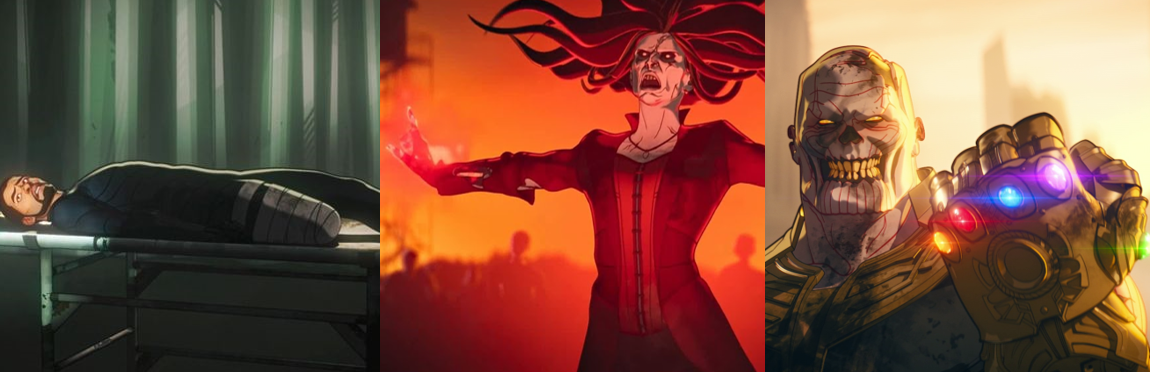
The survivors narrowly escape Zombie Wanda, completely unaware of a greater threat waiting in Wakanda.

Banner joins up with the few uninfected survivors and learns from Okoye (Danai Gurira) of a possible cure at Camp Lehigh, New Jersey; the group travel to the Grand Central Station, where they’re attacked by zombified versions of Sam Wilson/The Falcon (Anthony Mackie), Hawkeye, and Captain America. Although they lose Harold “Happy” Hogan (Jon Favreau), the group is able to get the train working and fend off the zombies thanks to Okoye and the Wasp. However, the train is attacked by Zombie Cap, who infects Sharon Carter (Emily VanCamp) and forces Bucky to end his undead existence, retrieving his shield in the process, but Hope is also infected from a small cut she receives after disposing of Sharon. Although Peter tries to remain optimistic that she’ll be cured before she can turn, Hope sacrifices herself to atone for her part in causing the outbreak by carrying the group through a horde of zombies and dropping them off at Camp Lehigh. There, they find the zombies refuse to breach the camp thanks to the presence of the Mind Stone in the Vision’s (Paul Bettany) head; he and the severed head of Scott Lang (Paul Rudd) reveal that the Mind Stone’s properties can reverse the zombie virus, and the group is excited to spread the cure throughout the world from Wakanda. However, Banner learns that they’re not the first to respond to the Vision’s beacon, and Bucky is horrified to find that the Vision has been feeding parts of other survivors (including T’Challa) to a zombified version of Wanda Maximoff (Elizabeth Olsen) since she’s proven resistant to the Mind Stone and he’s been unable to kill her due to his love for her. When Wanda breaks free and proves uncontrollable due to her powers and hunger, the Vision rips the Mind Stone out of his head to atone for his actions and the group’s escape is covered by Bucky and the Hulk, who finally emerges from Banner’s psyche and is able to resist the zombie’s bite and hold back Wanda so the others can take off. The one-legged T’Challa, beheaded Lang, and shellshocked Peter console themselves with the knowledge that they’ll be able to save the world once they reach Wakanda, completely unaware that the nation has already succumbed to the infection and is under the rule of a zombified Thanos and his partially-completed Infinity Gauntlet!

Killmonger rescues Stark and becomes his most trusted confidante to kill his way to his birthright.

We then go back to where the MCU all started in “What If…Killmonger Rescued Tony Stark?” (Andrews, 2021), which recreates the opening moments of Iron Man (Favreau, 2008) with one key difference: right as Tony Stark is about to be injured by one of his own missiles, he’s saved by N’Jadaka/Erik Stevens/Killmonger (Jordan), who fends off the Ten Rings soldiers looking to kidnap Stark and thus means that the genius, billionaire philanthropist never learns the humility or courage that led to him becoming Iron Man. Instead, he remains a conceited, arrogant, self-serving glory hound who believes that he needs to build bigger, better weapons to protect America’s interests. To that end, he drafts in Killmonger, who wastes no time in publicly outing Obadiah Stane (Kiff VandenHeuvel) as the man who bankrolled the Ten Rings’ attack on Stark, and Stark is so grateful to his saviour that he quickly promotes Killmonger to his new Chief Operations Officer, alienating Virginia “Pepper” Potts (Beth Hoyt) in the process. Killmonger swiftly becomes Stark’s closest friend and confidante and, together, they create robot drones, the “Liberators”, based on Killmonger’s fandom for anime. Killmonger pushes Stark to use Vibranium as a power source for the Liberators, and Stark sends in Colonel James “Rhodey” Rhodes (Don Cheadle) to steal some from Ulysses Klaue (Andy Serkis). However, the Black Panther attacks the meeting to recover stolen Vibranium, only for Killmonger to reveal his true intentions and kill T’Challa with one of Stark’s weapons. He chastises Rhodey for wearing the uniform of his oppressors and kills him with the Black Panther’s claw to make it seem like they killed each other; thanks to Just A Rather Very Intelligent System (J.A.R.V.I.S.; Bettany), however, Killmonger’s actions are revealed to Stark. Stark tries to avenge his friend’s murder using a Liberator, but Killmonger easily bests the drone and kills Stark with a Dora Milaje spear, which escalates the tensions between the United States and Wakanda into all-out war. General Ross assumes control of Stark’s assets and the Liberators are pushed into mass production; Killmonger then kills Klaue in order to deceive the Wakandans, then seizes control of the Liberators to lead his people in “defeating” the invading army. His victory and battle prowess wins over his uncle, T’Chaka, and earns him the mantle of the Black Panther; however, T’Challa’s astral warnings of Killmonger’s impending defeat are left a distinct possibility not only due to Ross’s obsession with continuing the war but also when Pepper and Shuri (Ozioma Akagha) agree to work together to expose Killmonger’s deception.
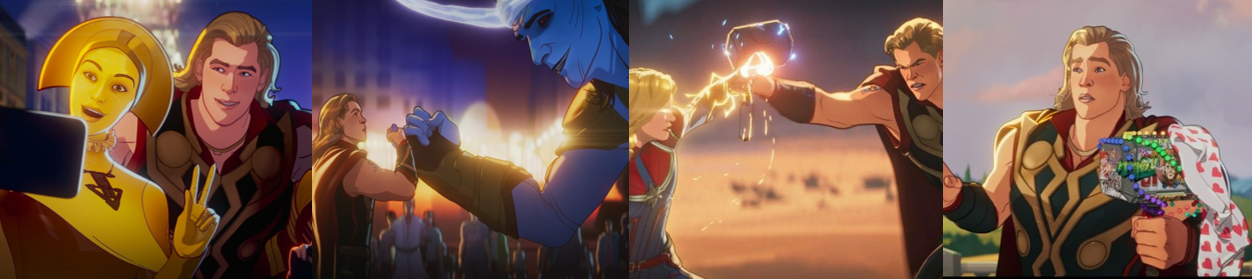
This Thor just wants to party, but his good time is spoiled by Captain Marvel and Jane blabbing to Frigga.

“What If…Thor Were an Only Child?” (Andrews, 2021) lightens things up a bit by retelling the events of Thor (Branagh, 2011); in this version of the story, in the absence of a brother to grow up alongside, Thor is little more than a lackadaisical, party-loving frat-boy who, despite still being worthy of Mjölnir, is far more interested in wasting time revelling with his friends than following his mother, Frigga’s (Josette Eales), instructions to behave or becoming a bore like his father, Odin Allfather (Anthony Hopkins). To avoid the all-seeing gaze of Heimdall (Idris Elba), Thor and his drinking buddies head the Midgard, the most backwater, insignificant world in all the Nine Realms, and invite guests from all over to join them in a massive, nonstop party. Tracking the cosmic disturbance and fearful of an alien invasion, Doctor Jane Foster (Natalie Portman) investigates and is both disturbed to find that Thor’s parties are so out of control that they can kill planets and won over by the Thunder God’s otherworldly charm. Jane and her intern, Darcy Lewis (Kat Dennings), join the party, quickly being swept up in all the intergalactic chaos and merriment on display; Darcy even marries Howard the Duck (Seth Green), and Jane and Thor get matching tattoos, but soon wake up to massive hangovers and the arrival of S.H.I.E.L.D. Acting Director Maria Hill (Cobie Smulders) is deeply concerned that Thor is leaving a trail of destruction as he takes his party on the road, and calls in Captain Marvel to assist with the perceived threat. Thor’s reunion with fellow party animal Prince Loki of Jotunheim is interrupted by Captain Marvel’s arrival; Thor brushes off her demands that he leaves, and a fight ensues that sees the two battle all across the globe. Despite Thor’s petulant, childish nature, the two are seemingly equally matched in terms of power and durability, but Carol’s forced to hold back her full power to avoid damaging the world or endangering lives. Since Jane disagrees with attacking or eliminating Thor since she’s so enamoured by him, she uses her tech to contact Heimdall and literally tells on Thor to Frigga. As Hill prepares an all-out nuclear strike against Thor, he’s terrified by Frigga’s impending arrival and begs his guests to help him clean up all evidence of their shenanigans. Despite Thor’s best, most frantic efforts to put right all the anarchy he and his friends had caused, she sees through his deception; however, rather than being mad at Jane for selling him out, he thanks her for teaching him a lesson in humility and asks her out…only for he, and the Watcher, to be stunned by the sudden appearance of an alternate version of Ultron!
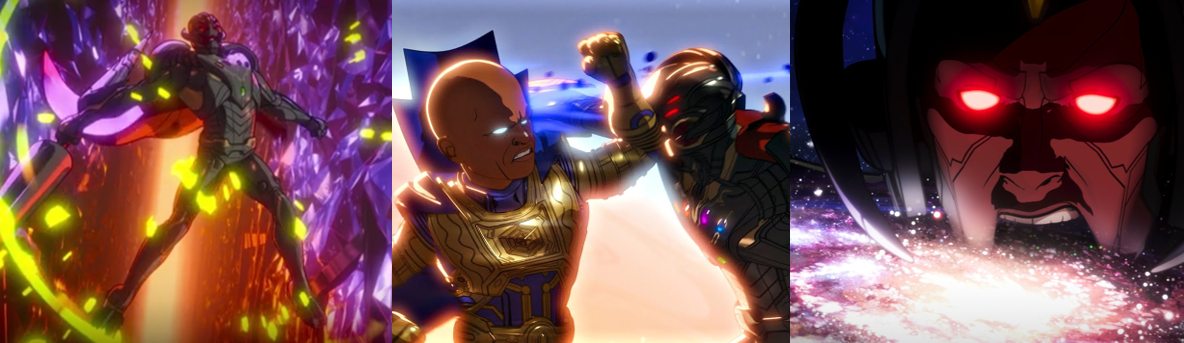
This alternate version of Ultron is such a threat to the multiverse that the Watcher is forced to intervene.

This cliff-hanger is explained in the following episode, “What If…Ultron Won?” (Andrews, 2021), which presents a post-apocalyptic world where Black Widow and Hawkeye are the only Avengers left to oppose the all-powerful Ultron. In this world, Hawkeye not only sports his ridiculous mohawk and a mechanical right arm, but Ultron successfully fulfilled its goal to cause an extinction-level event by claiming the Vision’s body as its own, killing Iron Man, Cap, and Thor, and launching a worldwide nuclear attack that decimated humanity. When Thanos arrived looking to retrieve the Mind Stone, Ultron split him in two with one shot and claimed the Infinity Stones for itself, becoming a God-like being capable of laying waste to entire worlds and Realms with its endless supply of drones. Asgard, Ego, Xandar, and countless others all fall before Ultron’s power and even Captain Marvel is unable to oppose it; having eradicated the vast majority of life across the universe and ascended to a higher pane of existence, Ultron not only sees but also hears the Watcher. Although the Watcher previously considered intervening in Dr. Strange’s story, he held true to his vow of non-interference since he deals in a cosmic balance beyond the lives of mere mortals, even ones as powerful as the Master of the Mystic Arts. However, Ultron’s threat is so terrifying even to this cosmic observer that the Watcher is sorely tempted to assist Natasha and Clint in their efforts to coerce Zola’s artificial intelligence into helping them. The Watcher is pleased when their perseverance pays off but, although Zola is able to possess one of Ultron’s drones, he cannot shut down Ultron’s hive mind as Ultron is outside of the known universe, meaning Clint is forced to sacrifice himself so that Natasha and Zola can escape. The Watcher is aghast when Ultron not only does the impossible and breaches his cosmic observatory but is also able to match even the Watcher’s cosmic power. Their battle sees them literally smashing the dimensional barriers into numerous alternate realities and sees Ultron devour a whole universe and force the Watcher to flee. While Ultron prepares to lay waste to the entire multiverse, the Watcher is forced to turn to Strange Supreme for help in opposing Ultron’s threat.

The Guardians of the Multiverse join forces to end Ultron’s threat.

This story, and the entire show, comes to a head in the final episode, “What If…the Watcher Broke His Oath?” (Andrews, 2021), which sees the Watcher recruiting Captain Carter, T’Challa Star-Lord, Killmonger, Party Thor, and a previously unseen version of Gamora (Cynthia McWilliams) to join Strange Supreme as the Guardians of the Multiverse. He enlists each of them right as they’re in the middle of tying up loose ends from their respective episodes and emphasises that every one of them is needed to protect something even bigger than their individual lives or concerns. Captain Carter immediately recognises the gravity of the situation, while Strange Supreme sees this as his chance at true redemption, and, despite the odds, they all tentatively agree to work together to combat Ultron, steal his Soul Stone, and destroy it using Gamora’s “Infinity Crusher” device. While Strange Supreme struggles to contain the dark magics within his body, Gamora is troubled by Killmonger’s obsession with Ultron’s technology, and Thor accidentally attracts Ultron’s attention, but the group is thankfully shielded by Strange Supreme’s protection spell. Following Captain Carter’s lead, the Guardians are able to launch a co-ordinated attack that allows T’Challa to swipe the Soul Stone; when Ultron makes short work of Zombie Wanda and follows the Guardians to its home reality, it gets summarily pummelled by the Guardians’ repeated attacks and Strange Supreme’s ability to counteract both Ultron’s Time Stone and match its enlarged form with his monstrous magic. Although they’re stunned to find the Infinity Crusher ineffectual because it and the Infinity Stones are from different realities, Ultron’s threat is ended when Captain Carter helps Natasha avenge Clint and fire an arrow containing Zola’s consciousness into Ultron’s armour, erasing its sentience once and for all. In the aftermath, Killmonger claims Ultron’s armour and proposes using the Infinity Stones to “fix” their universes; when they refuse, he attempts to destroy them and they’re saved by a Zola-controlled Vision, who tries to take the Infinity Stones for himself. Before they can properly get into a potentially devastating battle over the gems, Strange Supreme freezes them in time and seals them within a pocket dimension, ending their threat once and for all. The Watcher trusts Strange Supreme with watching over the two, and returns everyone to their proper place and time; since Natasha’s world was left lifeless by Ultron, the Watcher sends her to help Nick Fury overthrow Loki, and then alters his vow of impassive observation to a pledge to protect the multiverse when needed.

The Summary:
At first, I wasn’t too sold on What If…?’s animation style; the slick, computerised cel-shaded look has never been a favourite of mine, but I was quickly won over by it due to how closely each character and episode mirrors their live-action counterparts. Everything from the recreation of certain shots, to the musical cues, to the costumes and likenesses perfectly emulates the source material each episode is based on, meaning we get the brown-hued colour scheme of World War Two for Captain Carter, the barrage of bizarre cosmic colours for Star-Lord, and the industrial, high-tech grey of Stark and S.H.I.E.L.D. facilities. Although some notable names from the MCU didn’t return to lend their voices to their iconic characters, What If…? employs the services of some incredibly gifted soundalikes and even goes the extra mile in presenting a version of Bruce Banner that resembles both Edward Norton and Mark Ruffalo, which is fitting considering we encounter this character between his solo film and his first big MCU crossover. Animation also means that What If…? is theoretically able to do absolutely anything it desires, regardless of budget, and is limited only be the imagination of the animators; thus, while things are a little on the safe side with slightly different retelling of Captain America: The First Avenger, Thor, and other MCU films, it’s not long before we’re seeing massive Lovecraftian creatures, a whole host of Marvel heroes interacting in ways we’ve not really seen before, an additional taste of the cosmic madness of the universe (and multiverse), and a wide variety of both horrifying and oddball concepts to really test the waters of what the MCU is capable of going forward.
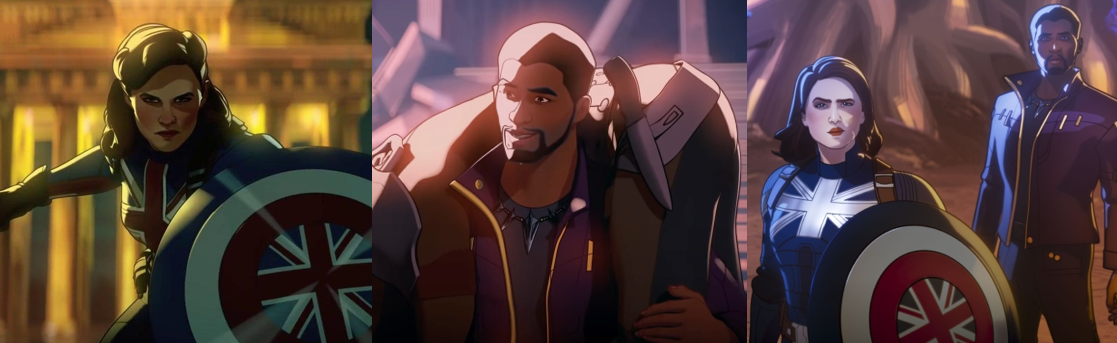
Captain Carter and T’Challa Star-Lord are just as competent, if not more so, as their MCU counterparts.

I really liked that, despite their reversed roles, Peggy and Steve still have a mutual attraction based on mutual respect and their respective struggles; Peggy faces an uphill battle due to being a woman in a male-orientated world (and war) that constantly weighs her down even after she’s enhanced by the super soldier serum, and of course Steve has been overlooked and undervalued his entire life due to his gaunt frame and sickly nature. While everyone else is either incredulous due to her being a woman or impressed by her fighting prowess because she is a woman, and she must prove her worth through her deeds to win them over, Steve admires the person that she is and her fighting spirit; he’s the only one that doesn’t judge her for her gender and who doesn’t need convincing that she’s the right person for the job and is only too grateful to be an active combatant alongside her in the Hydra Stomper. Peggy is also quite different in the role; like Steve, she attacks it with a sense of duty and honour, but she also takes far more joy in her newfound abilities. There’s a sense that she’s finally able to let loose, that she’s been given the physical gifts to realise her full potential, and she literally dives head-first into making the most of that opportunity. T’Challa’s characterisation as a galaxy-wide force for good is a fitting tribute to the late Chadwick Boseman; unlike Peter Quill, T’Challa is a well-respected and competent space mercenary, and I loved the running gag that he’s somehow able to convince even the most maladjusted individuals to give up their villainous or tyrannical ways simply through presenting a convincing argument. Korath is only too willing to change sides simply out of his worship of Star-Lord, and his crew follow his lead into doing good deeds simply because he was such a positive influence on them. Unfortunately, he’s not able to have the same influence on the Collector, who’s not only blinded by his position in this universe, but also driven by his inherent greed and given a major power boost thanks to his artefacts. However, while threats still remain in this timeline, on the surface it seems to be a far more peaceful and united universe simply thanks to T’Challa’s positive influence on others.
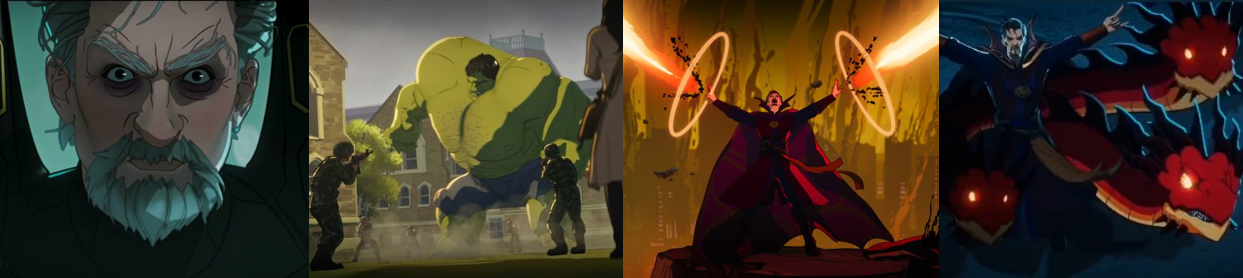
What If…? isn’t afraid to get very dark and show twisted or corrupted versions of these popular characters.

Things take a turn to the dark side once the Avengers (especially Stark) start getting killed off; What If…? is a self-contained show within the larger MCU multiverse, meaning literally anything can happen to anyone, and seeing the franchise’s core six heroes be so brutally murdered really hammers that home. It also gives Hank Pym, someone introduced later into the MCU, a chance to be a more prominent player in this sandbox; seeing him active in the MCU’s first phase is a great way of fleshing out the world in a unique way, especially as he’s become a murdering psychopath. This is a Pym whose neuroses and paranoia have been pushed to breaking point, which deftly showcases just how much of a threat a guy with Pym’s intellect and technology can be to even the most superhuman individuals. Of course, the epitome of dark character turns is the tragic tale of Strange Supreme; it’s absolutely heart-breaking to see Dr. Strange left so desperate and despondent by Christine’s loss that he fell deeper and deeper to the darkness. His frustration and anguish at being unable to change the past see him become obsessed with gaining more and more power, to the point where he is fixated only on being reunited with his love. This makes him blind to all pleas, even those of his uncorrupted counterpart, and it isn’t until all of reality is about to be erased forever that he realises the error of his ways. Sadly, by then, it’s much too late for him to undo anything; Christine once again dies in his arms and everything that ever was is unravelled due to his time paradox; even the Watcher judges his heinous actions, and the once mighty Strange Supreme is left alone and repentant in the tiniest slither of reality. It’s a poignant and gut-wrenching take on the snarky, stubborn, and arrogant Sorcerer Supreme, one that shows just how dangerous a threat he could be if he lost his strong moral compass, and it’s a testament to the show that the character remained a tragic and relatable figure right up until the end rather than simply being a malevolent antagonist.
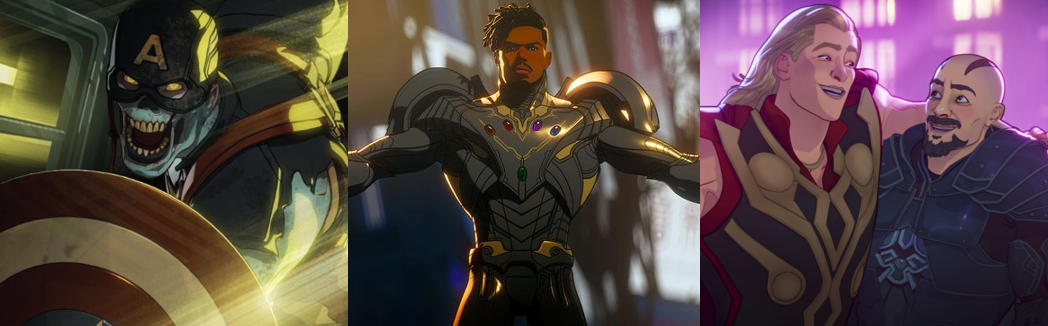
What If…? showed characters are their grimmest and worst and also at their most carefree.

Easily the darkest tale is the inclusion of zombies; never before has the MCU veered so closely towards traditional horror and I really appreciated the bleak, gory change of pace. It was fantastic seeing the MCU’s most powerful characters reduced to animalistic ghouls, forcing the few survivors to battle their lifelong friends and making painful sacrifices to ensure the safety of others against overwhelming odds. This was also a prime opportunity to show a new side to the Vision; him luring in survivors just to feed his love is a haunting glimpse at the darker side of his cold, calculating logic. We’ve seen such behaviour, this overpowering sense of denial, in zombie films before and, here, it served as a gruesome reminder of just how close to the brink this alternate reality is to total collapse. This continued in Killmonger’s welcome reappearance, with his alternate tale basically showing what could have happened if he had succeeded in his goals of reclaiming his Wakandan birthright; Killmonger was always one of the MCU’s more driven and dangerous antagonists and his episode showed just how truly vindictive and sadistic he really was. He had no qualms about deceiving or using anyone and any resource at his disposal, and even incited an all-out war just so that he could get himself into a position of trust and power, which serves as a stark reminder to just how ruthless a villain he really was. The party-loving version of Thor is the polar opposite; Party Thor cares little for battle or being a king and just wants to enjoy himself. He revels in being the centre of attention and throwing the biggest, most outrageous parties in all the Nine Realms and is lauded amongst his guests as being the wildest party animal around. Thor is a consummate free spirit and a friend to all; alien races, Gods, and recognisable beings from all across the cosmos cheer his name and share in his revelry, making for some of the most light-hearted and amusing moments in the entire series as Surtur (Clancy Brown) tries it on with Lady Liberty and Frost Giants deface Mount Rushmore. This episode also leads to one of the best fist fights in the series as Thor and Captain Marvel trade blows, but he delights in the fight as much as he does in enjoying himself with mead, and only the disapproval of his mother finally shakes Thor from his apathy and pushes him to make amends for his reckless merriment.
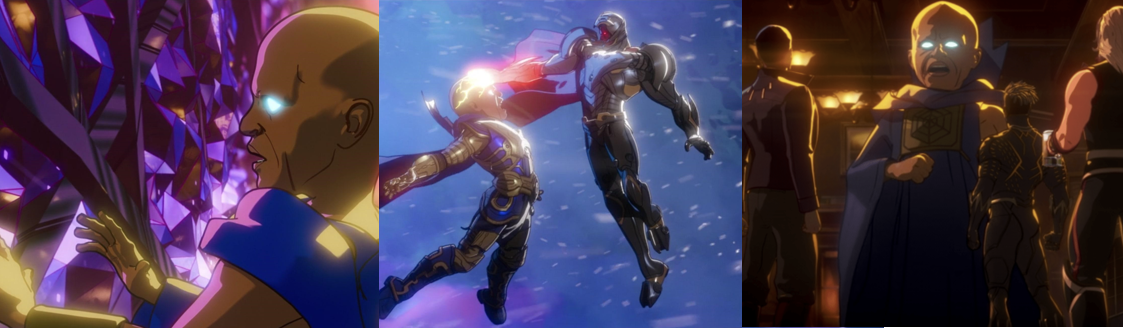
The Watcher is forced to take action for the first time in his long life in order to defend the multiverse.

Of course, things come to a suitably dramatic and action-packed conclusion with the final two episodes, which finally force the Watcher into action. Up until then, the watcher existed outside of the normal universe, powerful and cosmic enough to remain completely undetected, but Ultron’s sentience and force grows to such an extent that it’s able to sense the Watcher, breach his observatory, and begin a maniacal campaign to conquer and destroy the entire multiverse. Untold aeons of quietly observing the multiverse haven’t exactly dampened the Watcher’s power cosmic, but in the face to Ultron’s might, enhanced by the six Infinity Stones, the enigmatic onlooker is forced to do the one thing he has never done and ask for help, calling upon the characters he has been observing and asking them to intervene where he cannot. Seeing these wildly different versions of these characters interacting was a blast; they arguably got on the same page much faster than the regular Avengers (which is no doubt due to the short length of the episodes) and were able to launch a united attack on Ultron as a result. Indeed, Ultron kind of got a bit shafted in the last episode; it went from going toe-to-toe with a cosmic being to getting battered about by a handful of mortals and Godlings simply because the Guardians were able to keep the pressure on and keep Ultron from activating the Infinity Stones. Realistically, Ultron could’ve just “snapped” them all away, but then that wouldn’t be anywhere near as exhilarating for a final battle now, would it? Seeing Killmonger claim the gems and just the idea of what his twisted imagination would use them for was a cool moment, as was the idea that he might someday escape his trap to threaten the multiverse again, and just about the only issue I had with that last episode was the random inclusion of a Gamora when they could’ve maybe employed Zombie Wanda instead. Overall, though, I thoroughly enjoyed this series; the presentation, the humour, the fun twists on established characters, and the bizarre stories were all really fun and engaging and I can’t wait to see more from this as the MCU continues to expand into more and ore obscure concepts.

My Rating:

Rating: 5 out of 5.

Fantastic

Did you enjoy What If…?? Which episode was your favourite, and which of the alternate characters did you like the most? Did you enjoy the Watcher’s inclusion and characterisation? What did you think to all the cameos and the animation style? Did you enjoy seeing Ultron as an all-powerful force and what did you think to its battle with the Watcher? Were you also disappointed that Gamora didn’t get her own episode? Are you a fan of the What If…? comics and, if so, which was your favourite? What other hypothetical scenarios would you like to see explored in a future season? Whatever your thoughts on What If…?, sign up to drop a comment down below and check back next Sunday for the final instalment of Multiverse Madness.


Talking Movies: What If…? Thanos and the Masters of Evil

Talking Movies

In Avengers: Infinity War (Russo and Russo, 2018) the Mad Titan, Thanos (Josh Brolin), finally made a significant appearance in the Marvel Cinematic Universe (MCU). When the idea of a two-film saga based on the Infinity Gauntlet comic book (Starlin, et al, 1991) was first announced, I, like many others, had many theories about what was going to happen, who was going to live and die, and how everything was )going to go down. For example, before Thor: Ragnarok (Waititi, 2017), I was certain that Thanos’ big entrance was going to immediately establish his threat by hanging him storm into Asgard kill Odin Allfather (Anthony Hopkins), and claim the Tesseract (and, obviously, the Space Stone it help). After all, how better to establish this big bad villain than by having him kill a God?

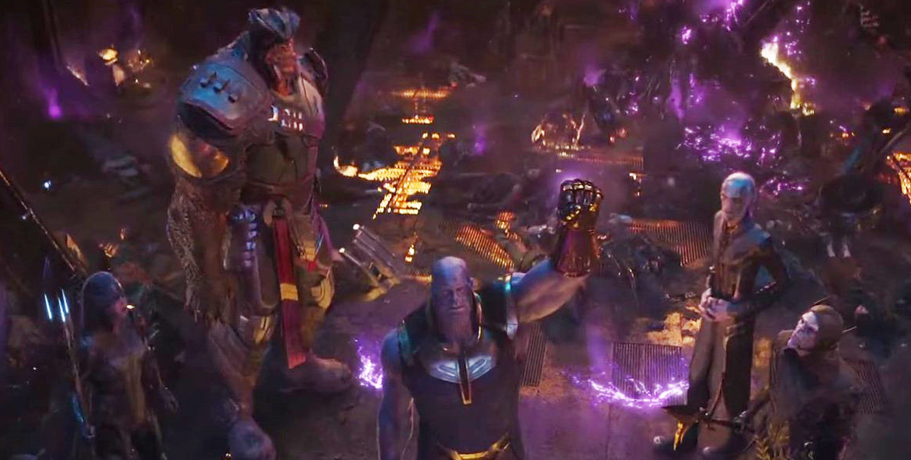
Thanos’ Black Order made their MCU debut in Avengers: Infinity War.

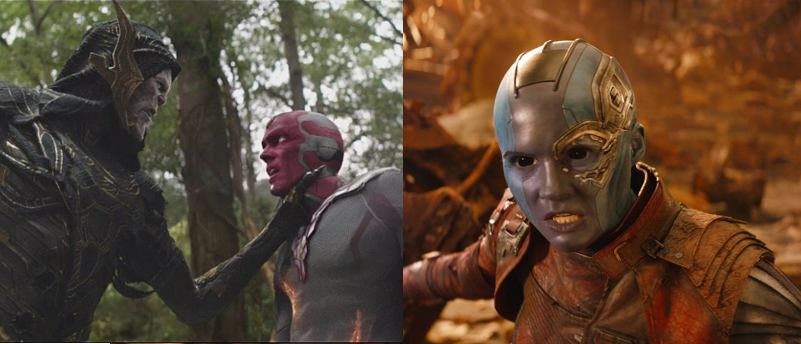
Instead, of course, Thanos wrecked Thor Odinson’s (Chris Hemsworth) ship and slaughtered half of the Asgardians onboard. Still an impressive feat, to be sure, but one that focused more on Thanos’ grandeur and pretentious philosophy rather than his actual physical strength thanks to the bulk of the work being undertaken by his underlings, the “Children of Thanos”. Headed by Ebony Maw (Tom Vaughan-Lawlor), Cull Obsidian (Terry Notary), Proxima Midnight (Carrie Coon/Monique Ganderton), and Corvus Glaive (Michael James Shaw), the Children of Thanos didn’t actually appear in The Infinity Gauntlet and are, instead, relatively recent additions to Thanos’ ranks who first appeared (as the “Black Order”) in Infinity (Hickman, et al, 2013). In the film, we don’t really learn much about these guys at all except that they enforce Thanos’ will with unquestioning loyalty and that he trusts them to help him gather the remaining Infinity Stones and, while they certainly look visually interesting, they’re mostly disposable bad guys for the Avengers to fight in place of Thanos.

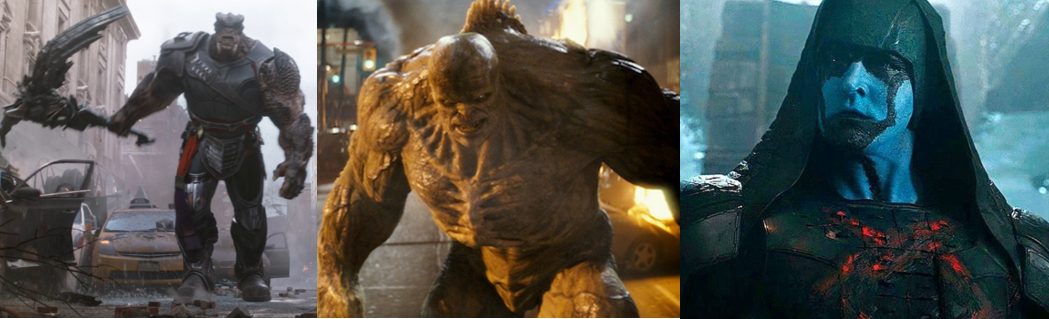
While Abomination is a good choice, I definitely think Ronan could’ve taken Cull’s place.

Now, I’ve never read Infinity; I have no emotional attachment to the Black Order or any of the characters and, as a result, they were merely nothing more than henchman to me and I only really recall one of them being referred to be name (“I take it the Maw is dead?”) While I enjoyed their inclusion in the film, I can’t help but feel like they could have been dropped and supplanted with some other, more recognisable MCU villains had some other films and events happened just a little differently. For example, take Cull Obsidian; he’s Thanos’ muscle who basically does nothing and is largely inconsequential. What if, instead of killing Ronan the Accuser (Lee Pace) in Guardians of the Galaxy (Gunn, 2014), Ronan had been soundly defeated and humbled and, having seen the extent of Thanos’ power (he did destroy Xandar (offscreen), which was what Ronan wanted, after all, and would be enough to bring Ronan to heel, I would wager), he pledged himself fully to Thanos’ cause to get revenge against the Guardians of the Galaxy? I’m not massively familiar with Ronan but it seems to me like it was a bit of a miss-step to kill him off when he could have fulfilled a role in Thanos’ little gang at the very least, if not remain as a recurring antagonist for the Guardians. Another potential replacement for Corvus would be Emil Blonsky/Abomination (Tim Roth) who, at the time, had been conspicuous by his absence from the MCU. However, arguably, it wouldn’t make as much sense for Thanos to recruit the Abomination as he’s not exactly floating around in the depths of space for him to encounter.

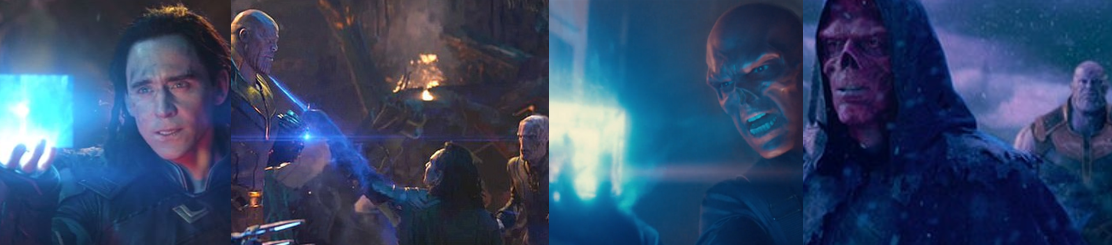
What if Loki or the Red Skull had aligned themselves with Thanos in place of Ebony Maw…?

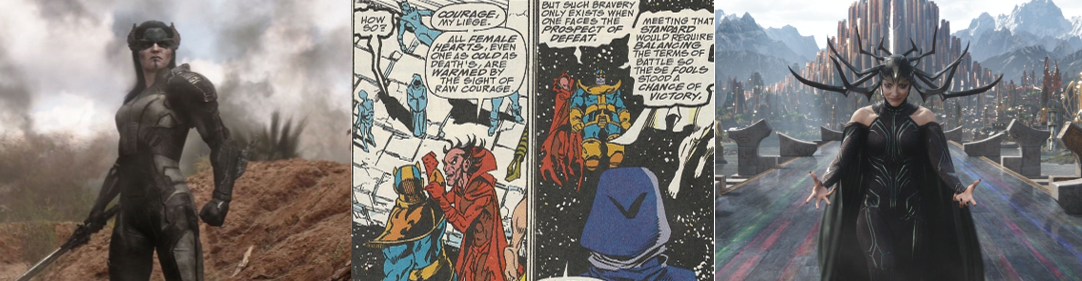
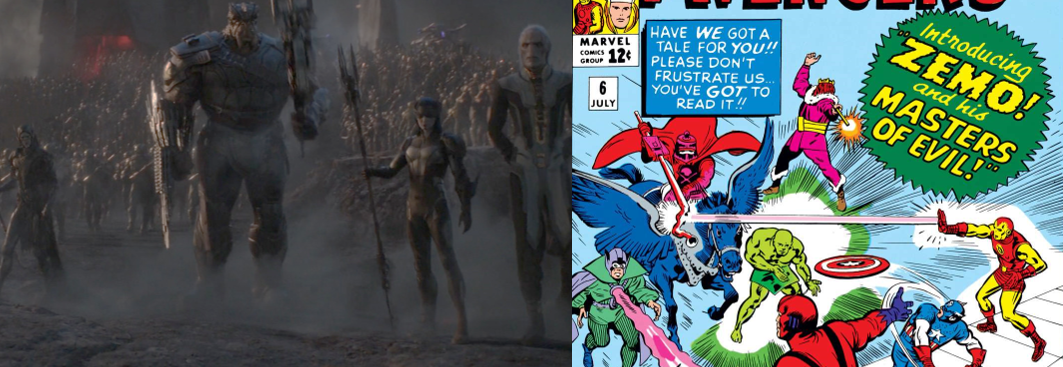
Intrigue was equally high in the build-up to The Avengers/Avengers Assemble (Whedon, 2012); I was hoping to see a version of the Masters of Evil, with Loki Laufeyson (Tom Hiddleston) joining forces with Johann Schmidt/The Red Skull (Hugo Weaving) – who was clearly transported away from Earth by the Bifrost at the end of Captain America: The First Avenger (Johnston, 2011 – and either the Abomination or Doctor Samuel Sterns/The Leader (Tim Blake Nelson) once they got to Earth. While I was happy with the first Avengers team-up we got, I do feel this was another missed opportunity that we never saw this anti-Avengers team-up. Consequently, I feel like we could have swapped out Ebony Maw for either of these characters; in The Infinity Gauntly, Thanos was advised by Mephisto, a role many expected Loki to play in Infinity War given his mischievous and devious nature. Naturally, of course, you could argue that this wouldn’t really fit with Loki’s character arc by that point but remember how he feigned loyalty to Thanos and then tried to stab him in the neck? Well, imagine that but throughout a large portion of the movie. Loki pledges fealty, willingly hand shim the Tesseract, and spends the remainder of the film waiting for the perfect moment to strike and then he’s killed for his efforts. Obviously, the Red Skull finally showed up in Avengers: Endgame (Russo and Russo, 2019) in a slightly different role as the Stonekeeper (Ross Marquand), but again…what if the Red Skull had replaced Ebony Maw? How much more interesting and impactful would it have been to see the Red Skull empowered by Thanos and making a triumphant return as Thanos’ chief torturer? Sure, if his death was the same then you could argue that he would’ve been “wasted” or been killed off too easily but I still feel like this would have been a better use of the character than as the keeper of the Soul Stone (a role that could’ve been filled by character’s envisioning the Stonekeeper as someone close to them, perhaps?)

With some tweaks, nebula could have taken Corvus’ role as Thanos’ chief assassin.

Corvus Glaive is a trickier one to “replace” in this hypothetical alternate world, however I have one  suggestion: Nebula (Karen Gillan). Now, similar to Loki joining Thanos, this would require quite a few changes to Nebula’s character arc; in Guardians of the Galaxy Vol. 2 (Gunn, 2017), she finally buried the hatchet with her “sister”, Gamora (Zoey Saldana) and it was great seeing her grow as a character, put aside her hatred, and learn how to work alongside the Guardians and the Avengers. In The Infinity Gauntlet, Nebula spends most of her time as a mindless zombie thanks to Thanos’ wrath but plays a vital role in his downfall by stealing the Gauntlet for herself (and promptly being driven mad by its power). By tweaking her character arc, or having it so that Thanos either intimidates or reprograms her into subservice, you could replace Corvus with a more prominent and recognisable character and still find ways to weave her existing arc into the story. Like, what if, after Guardians of the Galaxy Vol 2, Nebula is forced into Thanos to serve him (maybe he threatens to kill Gamora/the Guardians or promises to “repair” her once he’s assemble the Gauntlet) in Corvus’ place; she could still have been ripped apart and tortured to force Gamora into revealing the Soul Stone’s location and would have even more motivation to turn against her “father” since he would have lied to and manipulated her once again.

If Hela wasn’t going to take Death’s place, she could’ve replaced Proxima Midnight.

Another character who I, like many, expected to play a prominent role in Infinity War was Hela Odindottir (Cate Blanchett), a character who a lot of people expected would take the role of Lady Death as the object of Thanos’ affections. Of course, this didn’t turn out to be true as Hela was killed in Thor: Ragnarok and Thanos’ motivations were changed from worshipping Death to wanting to bring a sense of balance to the galaxy. Still, how awesome would it have been if Hela had taken Proxima Midnight’s place in the Dark Order? If killing the Allfather didn’t show you that Thanos was a bad-ass, bringing the Goddess of Death to heel totally would have and could have made for a much more memorable female villain for the finale in Wakanda. Again, there’s the question of her being killed off but what better way to help showcase Wanda Maximoff’s (Elizabeth Olsen) sheer power than by having her shred a Goddess to pieces? Or you could rewrite her death to maybe come at the hands of her brother, Thor, and his new weapon, Stormbreaker, to sell the awesomeness of the weapon.

As cool as the Black Order were, would a version of the Masters of Evil have been better…?

Ultimately, I was more than happy with Avengers: Infinity War, Endgame, and the MCU’s portrayal of Thanos overall. His underlings were find cannon fodder for the film and helped to serve as extensions of the Mad Titan’s will but I do feel it would have been even more awesome to see these more recognisable villains swayed to Thanos’ cause so that we could see them interact with their rivals, and other heroes, in new and interesting ways. Sure, many have cropped up again since then and the potential of a Masters of Evil in the MCU is still there, I just think that maybe these huge movies could have been made even bigger if things had been slightly changed to accommodate these more familiar characters. Do you agree or disagree? Maybe you’re a big fan of the Black Order from the comics? Perhaps you’d have like to see a different route taken? Do you even want to see the Masters of Evil in the MCU? Either way, feel free to sound off in the comments below.

Back Issues [A-Day]: The Avengers #1


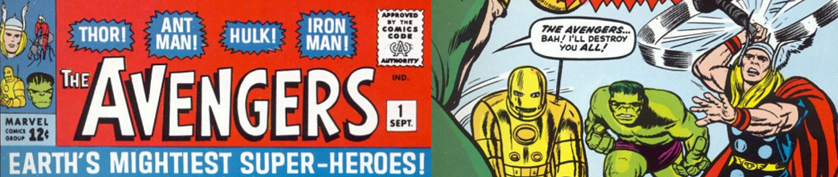
Having introduced comic readers to a whole host of colourful characters, in September of 1963 the legendary duo of Stan Lee and Jack Kirby brought together six of Earth’s mightiest heroes to form the Avengers. A super team like no other, with a constantly rotating roster, the Avengers has become the premier team of Marvel Comics and, thanks to the team and its individual members forming the backbone of the Marvel Cinematic Universe, have become an unbelievably popular and successful franchise in their own right.


Story Title: The Coming of the Avengers!
Published: September 1963
Writer: Stan Lee
Artist: Jack Kirby

The Background:
In 1960, DC Comics brought together their most popular and powerful characters to form the Justice League of America. Never ones to let the competition get a leg up on them, and having seen successful with the Fantastic Four and the debut of the X-Men in that very same month, Marvel Comics head honcho Martin Goodman asked Stan Lee to create a similar team of superheroes. Helpfully, Lee and a number of his most famous collaborators had already established a number of colourful characters to bring together: Tony Stark/Iron Man, Doctor Bruce Banner/The Hulk, Doctor Donald Blake/Thor Odinson, and Doctor Hank Pym/Ant-Man and Janet van Dyne/The Wasp. Since the debut issue, the Avengers have been a consistent and influential presence in Marvel Comics; the roster constantly shifted and changed, with the Hulk leaving the team in the second issue and Lee memorably dusting off the long-retired character of Steve Rogers/Captain America in issue four. Since then, the team has expanded and changed many times, seen spin-offs and splinter groups, been disassembled and reassembled, and taken part in all manner of massive cosmic events in the decades since their introduction.

The Review:
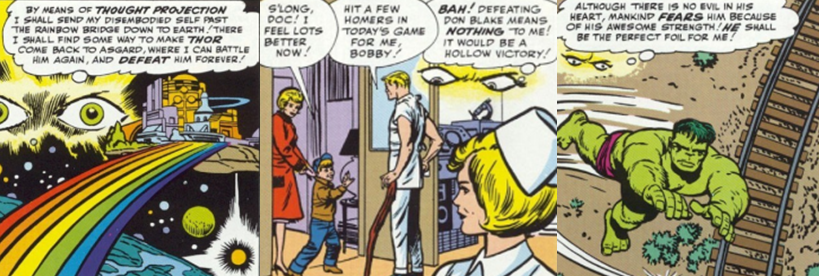
“The Coming of the Avengers” begins with Thor’s brother, Loki Laufeyson, the God of Mischief, imprisoned on the “dreaded Isle of Silence” in the mythical realm of Asgard. This is, of course, back when Loki was a despicable, irredemable villain whose previous mad schemes for power and conquest were thwarted by his brother; consequently, Loki is incensed at being exiled to the barren wasteland by Odin Allfather and plots a devious scheme for revenge.

Loki burns with a desire to destroy Thor, not Blake, and sees the Hulk as his chance to do so!

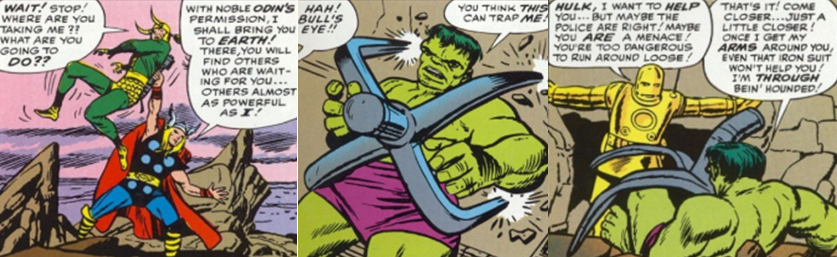
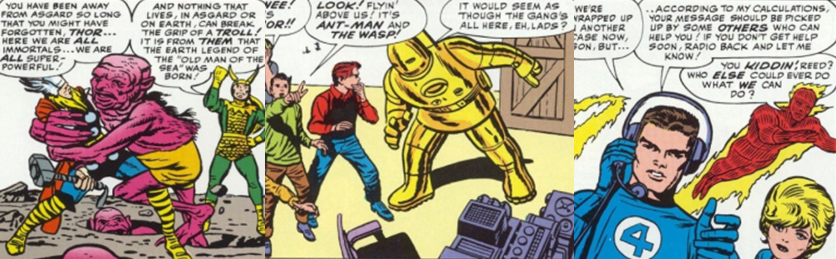
Though his physical self is trapped, Loki is able to use his vast magical abilities to project his disembodied self across the length of he dimension-spanning Bifrost and down to Earth, the planet Thor loves so dearly. He spies in on Donald Blake but dismisses him as a lame and insignificant mortal; he is acutely aware that Blake and Thor are one and the same but desires victory over Thor, not his crippled mortal shell. After many long hours, Loki comes upon the Incredible Hulk and is instantly intrigued by the creature’s brute strength and disdain for humanity. Thanks to Loki’s manipulations, the Hulk is blamed by the media when a train almost derails (despite the fact that the Hulk went out of his way to keep the train on track after Loki’s tricked him into damaging the tracks). Concerned for the well-being of his friend, Rick Jones desperately attempts to contact the Fantastic Four for help but Loki intercepts the broadcast and successfully coerces Blake to transform into Thor.

Words almost can’t express how much I despise Janet’s characterisation in these early comics!

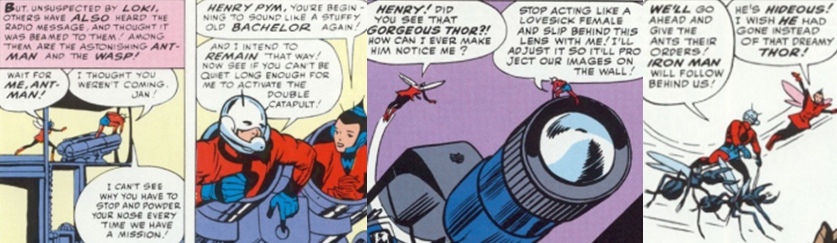
However, Rick’s broadcast is also intercepted by Ant-Man and the Wasp and Tony Stark, who eagerly leap into action to stop what they perceive to be one of the Hulk’s trademark rampages. Though he’s now decked out in his slightly more streamlined gold plated armour (which can also charge through solar power), Stark is still entirely reliant upon his iron plated chest device to keep him alive but, nevertheless, he’s eager to test the strength of his armour against the Hulk’s much-vaulted power. The Fantastic Four eventually pick up the transmission regardless of Loki’s interference but are unable to assist since they’re already busy on another case but Rick and his fellow “Teen Bridge” are star-struck when Thor, Iron Man, Ant-Man, and the Wasp all show up to answer their summons. This is probably as good a time as any to talk about how much I loathe Janet van Dyne, especially in her earlier appearances in the sixties and seventies! She’s such a ditzy, scatterbrained little tart; all she ever does is think about her hair, make-up, and appearance and constantly fawn over other men right in front of her partner/husband, Hank. Sure, Hank is generally much more focused on his work, the mission, or being professional and is largely neglectful and ignorant of Janet but that doesn’t excuse her God-awful characterisation. Similar to Susan Storm/Invisible Girl, Jean Grey/Marvel Girl, and many of Marvel’s supporting female characters at the time, Janet is constantly patronised and spoken down to by men but, unlike many of them, she actually deserves such harsh treatment since she’s more of a glorified model or brainless celebrity than a capable superheroine, much less an individual worthy of their respect since all she wants to do is drool over Thor’s muscles!

Loki is apprehended but the battle between Iron Man and the Hulk continues to rage!

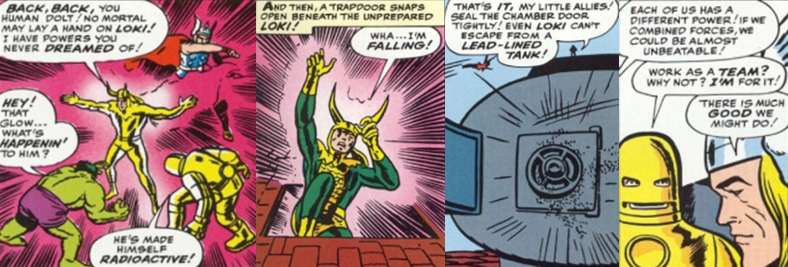
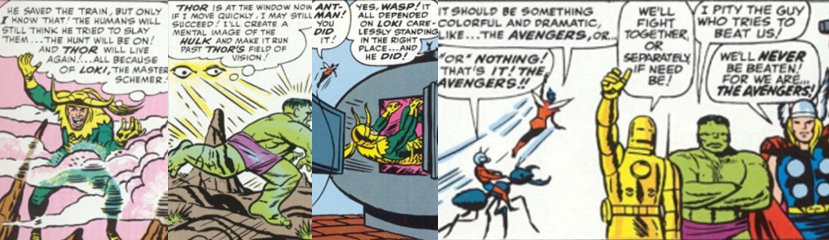
Anyway, having inadvertently brought together some of Earth’s mightiest heroes, Loki changes tactics and uses his powers to trick Thor into thinking the Hulk is right outside their door! Acting without thought or logic, Thor immediately heads out to battle the Green Goliath and immediately heads to Asgard when he realises that the “Hulk” is merely one of Loki’s visions…just as Loki planned all along! Meanwhile, the Hulk, now free from Loki’s control, has…disguised himself as Mechano the Mechanical Man and hidden himself away at a circus? Thanks to Ant-Man’s uncanny helmet, which allows him to control and communicate with ants, Pym is able to first locate the Hulk and then use countless numbers of ants to cause a cave-in beneath the beast’s feet. Unimpressed and irritated, the Hulk easily bursts free of the trap and reacts with anger when Ant-Man attempts first to calm him and then to trap him. As in his debut appearance, the Hulk is far more than the mindless, rampaging beast he is generally known as; he’s eloquent and intelligent, using words like “masquerade” and being smart enough to disguise himself as a circus performer and use weapons to blow the Wasp out of the air and render her helpless. The Hulk is kept from crushed the Wasp into a fine paste by the timely arrival of Iron Man; after Iron Man’s attempts to lure the Hulk into a trap fail, he gives chase but the Hulk is wily enough to allow Iron Man to pass harmless overheard so that he (as in the Hulk) can deliver a crippling blow to Stark’s “propulsion battery”. Over in Asgard, Odin grants Thor permission to travel to the Isle of Silence to confront Loki and he has to overcome numerous traps and hazards conjured by Loki’s black magic along the way. Thor perseveres and shatters Loki’s magical barrier using his enchanted hammer, Mjölnir, in his mission to “avenge” Loki’s foul deed. However, Thor is kept from attacking Loki first by the sudden arrival of a monstrous troll, a nature of the isle, and then by Loki’s deceitful illusions.

Loki is defeated with ridiculous ease and a new super team is born!

Regardless, Thor triumphs again by summoning lightning to drive the creature away and then dispels Loki’s duplicates with an implausible twirling of his hammer. Though Thor has Loki in his grasp and intends to bring him to Earth to answer for his deception, there’s still the little problem of the Hulk to contend with; Iron Man, having repaired his battery, continues his pursuit of the Hulk to an automobile factory, where the Hulk is able to endure and outwit Iron Man’s attempts to subdue him. Thor interrupts the battle and reveals that Loki was behind everything; Hulk’s desire to make Loki pay for framing him is momentarily avoided when Loki breaks free of Thor’s grasp and prepares to resume his battle with his hated brother…only for a hoard of ants to open a trapdoor beneath his feet and cause him to fall into an lead-lined chamber. With the threat ended, Ant-Man suggests that the six of them join forces as a team, which the others (including the Hulk, despite everything he went through during the issue) readily agree to and it is the Wasp who suggests the team’s name: The Avengers!

The Summary:
“The Coming of the Avengers!” is a breath of fresh air after the year I’ve had looking back at early origin stories and comic books; even compared to standalone stories of the time, it’s refreshing to not have the plot be endlessly bogged down with recaps of the characters’ origins and to not have every other piece of dialogue by a description of that character’s ability. Characters do still have an annoying tendency to monologue and describe what they’re doing as they’re doing it but it’s a far more action-packed issue than some other comics I’ve read this year, that’s for sure.

The brisk pace means some characters get more focus than others but there’s still time for cameos…

If you’re a newcomer to Marvel, this is obviously a bit of a disadvantage since you’d have no idea who any of these characters are; the only characters who really get any extended backstory and focus are Thor and Loki, which is only natural considering it is Loki who drives the main plot of the issue. However, we never see an appearance from the Hulk’ alter ego (Banner isn’t even mentioned in the issue), Ant-Man and the Wasp are never seen outside of their costumed identities, and the comic even has time to waste panels on a cameo by the Fantastic Four. The intention, however, is pretty clear: Rick’s first thought is to call the Fantastic Four since there are only a couple of superhero teams in existence at that time and the implication is that Loki is a threat worthy of the Fantastic Four’s involvement, which thus makes the Avengers appear just as capable and formidable by proxy. Not that the Avengers really need any help in that regard; each character has already had numerous chances to shine and show how capable they are in their solo issues but what better way to showcase that to its fullest than by pitting them against the Hulk, the most powerful mortal in Marvel Comics at the time?

For all his power and scheming, Loki is incredibly ineffectual and his plan massively backfires!

Iron Man, especially, is eager to pit his skills and augmented strength against the Hulk’s (who sadly never gets to tussle with Thor to see which of the two truly is mightier) and it’s certainly unique seeing Ant-Man and the Wasp futilely try to subdue the beast with traps and trickery. It’s not a perfect story by any means; I could talk for days about Janet’s characterisation and she basically does nothing except buzz around, pine after Thor, and name the team and Loki never thinks to use his powers to send the Hulk into a mindless rampage to help tip the balance in his favour. Indeed, though Loki’s powers are vast and have the potential to be extremely dangerous, he’s pretty ineffectual as Thor easily fights off his illusions, he’s anti-climatically defeated by Ant-Man and the Wasp (of all people), and all he succeeds in doing is uniting Earth’s Mightiest Heroes as a team. He might have had more success if he’d tried to manipulate them into fighting each other or used his powers to better effect but, as an excuse to bring together six of Marvel’s most formidable superheroes into a super team, “The Coming of the Avengers!” succeeds far more than it fails…it just needed to be a bit longer and have a bit more interaction between the characters.

My Rating:

Rating: 3 out of 5.

Pretty Good

How do you feel about “The Coming of the Avengers!”? Do you feel it was an effective introduction to Marvel’s newest and greatest team or do you, perhaps, find it a little weak and light on content? Which of the original line-up is your favourite? What did you think to the Wasp’s characterisation and the treatment of females during this time? Which version of the team is your favourite or who would you like to see on an Avengers roster one day? Do you think the singular threat of Loki was suitable enough justification for bringing together these heroes or would you have preferred a bigger threat? How are you celebrating the debut of the Avengers today and what are some of your favourite Avengers storylines, characters, or adaptations? Feel free to share your thoughts and opinions on the Avengers in the comments below.

Movie Night [National Superhero Day]: Avengers Assemble


In 1995, Marvel Comics created “National Superhero Day” and, in the process, provided comics and superhero fans the world over with a great excuse to celebrate their favourite characters and publications.


Released: 4 May 2012
Director: Joss Whedon
Distributor: Walt Disney Studios Motion Pictures
Budget: $220 million
Stars: Robert Downey Jr, Chris Evans, Mark Ruffalo, Chris Hemsworth, Scarlett Johansson, Jeremy Renner, Tom Hiddleston, Clark Gregg, Stellan Skarsgård, and Samuel L. Jackson

The Plot:
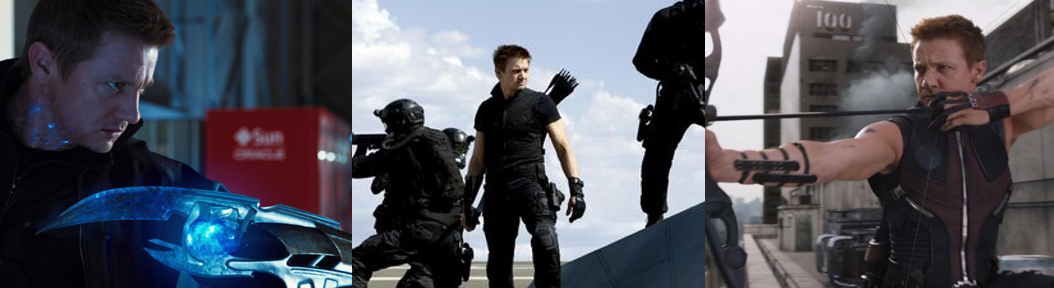
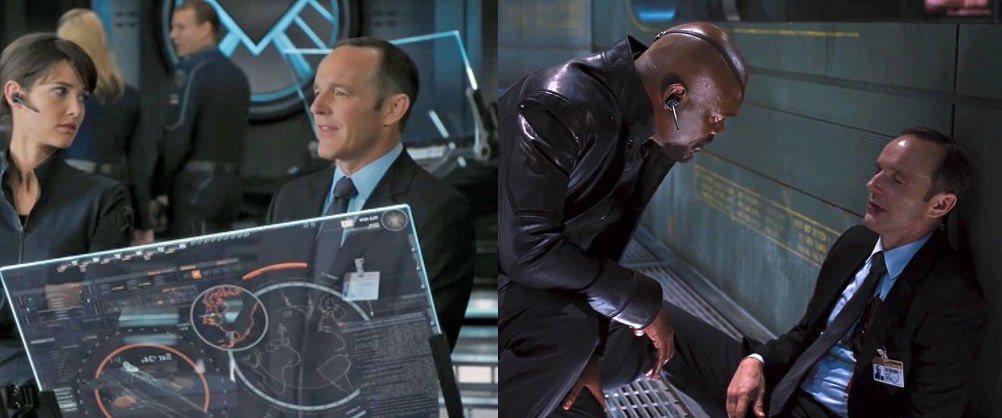
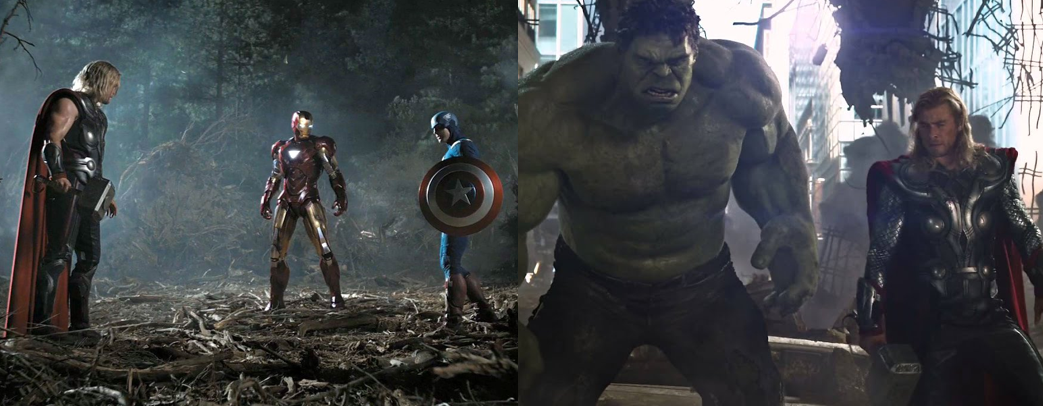
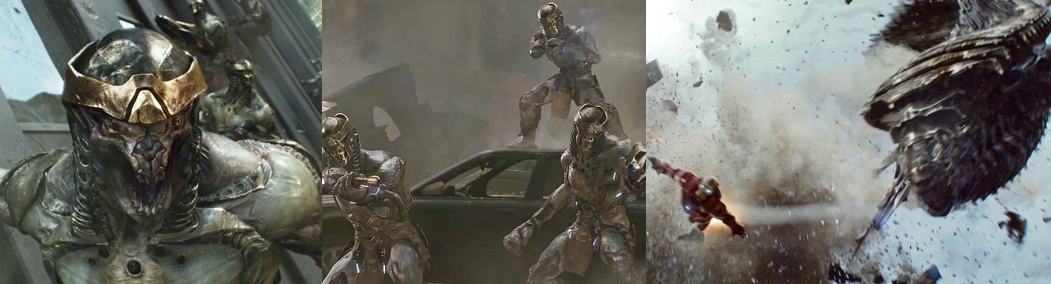
When Loki Laufeyson (Hiddleston) arrives on Earth wielding a mind-controlling spear and in search of the Tesseract, Nick Fury (Jackson), director of the Strategic Homeland Intervention, Enforcement and Logistics Division (S.H.I.E.L.D.) activates the “Avenger Initiative”. Tony Stark/Iron Man (Downey Jr), Steve Rogers/Captain America (Evans), Doctor Bruce Banner/The Hulk (Ruffalo), Thor Odinson (Hemsworth), Natasha Romanoff/Black Widow (Johansson), and Clint Barton/Hawkeye (Renner) are called into service and must find a way to co-exist before they can combat this otherworldly threat.

The Background:
The development of an Avengers film began in 2003 with an outrageous plan to release a series of solo films for each character before having them all meet up, similar to how the Avengers formed in the comics back in 1963 courtesy of Martin Goodman, Stan Lee, Jack Kirby, and Dick Ayers. It was an unprecedented move, one which saw fledging studio Marvel Studios roll the dice on lower-tier heroes such as Iron Man and win big time with a slew of massively successful and popular superhero films, each one hinting towards a much larger, shared cinematic universe. When the time came for Earth’s Mightiest Heroes to finally meet onscreen, Marvel Studios turned to Joss Whedon to rewrite the script and direct the film and included Iron Man (Favreau, 2008) and Iron Man 2 (ibid, 2010) director Jon Favreau as an executive producer. After some differences of opinion, Marvel Studios chief Kevin Feige chose to recast Edward Norton in the role of Banner/Hulk and easily the biggest superhero film of all time was officially underway. The Avengers (known as Avengers Assemble here in the United Kingdom) was an absolutely phenomenal success, making over $1.500 billion at the box office, receiving rave reviews, and kicking off the extraordinary blockbuster success we know of today as the Marvel Cinematic Universe (MCU).

The Review:
Avengers Assemble was the first time we had ever seen superheroes come together in a big screen, big budget movie. Before the MCU, before Iron Man, superheroes always existed in isolated bubbles and never interacted and, as a big fan of the interconnected world of the comics (not just in Marvel but in DC Comics and pretty much ever comic publication), I was excited to see these characters come together onscreen for the first-time and will always lean towards an interconnected, shared continuity. It was a risky venture taking admittedly B to D-tier characters like Iron Man and Captain America and shaping a series of movies around them but Avengers Assemble totally justified that risk, allowing these volatile egos and characters to share the same screen and mixing fantasy, science-fiction, magic, and technology all together in one action-packed adventure.

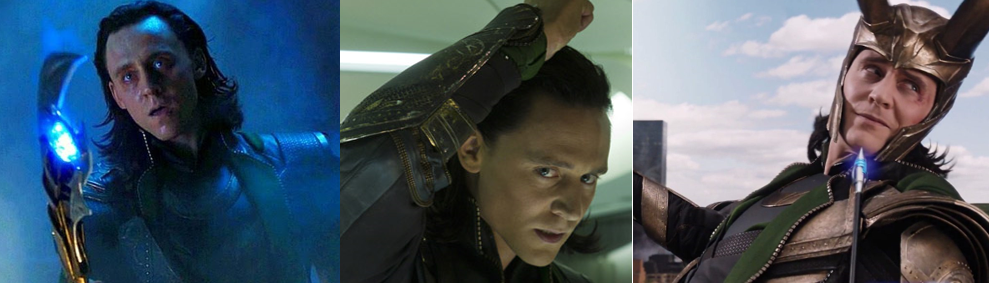
Loki comes to invade Earth and realise his grandiose desires for power and servitude.

Loki’s threat is immediately established when he suddenly arrives on Earth and makes short work of Fury’s men and then uses his spear to take control of Professor Erik Selvig (Stellan Skarsgård) and Barton. Though only a singular villain, one whom Thor has been able to best in combat before, Loki is a significant threat to the world since he is, effectively, a God and he has the entire Chitauri army at his command. Before the Chitauri arrive, though, Loki is formidable enough to justify bringing in Iron Man (despite Fury’s earlier reservations) and Cap since Thor wasn’t supposed to be able to get back to Earth. When Thor does arrive, his mission to capture Loki and bring him back to Asgard is hampered by Earth politics (since Fury wants to hold Loki accountable for the death and destruction he’s already caused) and as a result Loki manages to manipulate the fledgling Avengers into bickering and fighting with each other rather than him, allowing him to take possession of the Tesseract and bring the Chitauri to Earth. While he avoids active, physical combat, Loki is a daunting opponent when he does engage in battle, able to go toe-to-toe with Thor (thanks, largely, to Thor holding back out of love for his brother), easily catching Hawkeye’s arrow, and tossing Stark out of a window with just one hand. His downfall comes not only through the unification of the Avengers but is spelt out by Stark, who monologues about how, win or lose, they would hunt down and hold Loki personally responsible to ensure that he never truly wins, and, of course, more explicitly through the sudden and hilarious beat down he receives at the hands of the Hulk.

It’s a rough experience for Cap, who has awoken to a world that has radically changed.

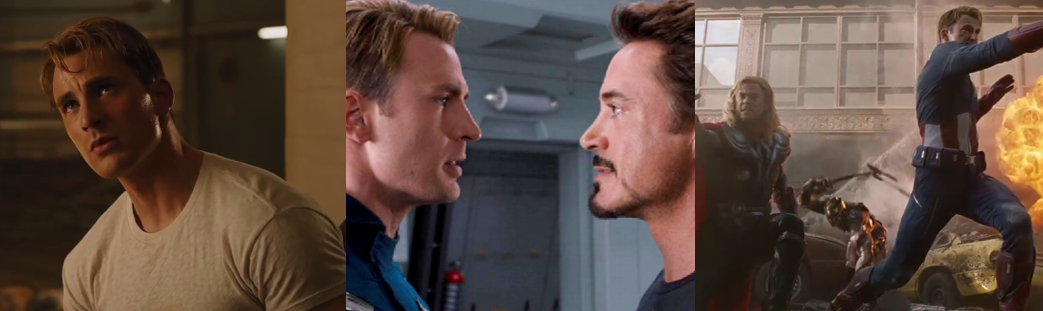
Essentially, the film is a significant chapter in Cap’s story; since Captain America: The First Avenger (Johnston, 2011) ended with Cap being dethawed in the modern day, this was only the second time we had seen him in action; unfortunately, because of the nature of the film, Cap’s reintegration into society is largely glossed over and, rather than being dwelled upon, is replaced with Cap wishing to be given a mission, a focus, a reason to fight in the modern world. As a result, he unquestioningly follows Fury’s directions primarily out of instinct, duty, and a need to have a reason to go on in a world that has largely passed him by; he clashes with Stark’s rebellious attitude, believing that they should follow orders like soldiers, but is convinced enough to investigate further and is disgusted to find Fury in possession of Chitauri technology and with contingencies in place to combat the Avengers since they have the potential to be a threat to humanity. Cap is all business when in battle, instinctively taking command and exuding leadership even though he is the most out of touch and out of place of all the characters; his initial antagonism with Stark is eventually put aside to lead the team during the Chitauri invasion and Cap fights to the bitter end even when he is vastly overpowered by the alien forces, taking the most damage of any of his team mates (including the “weaker” members like Natasha and Barton).

Stark joins the team with his own agenda but eventually comes to respect and defer to his peers.

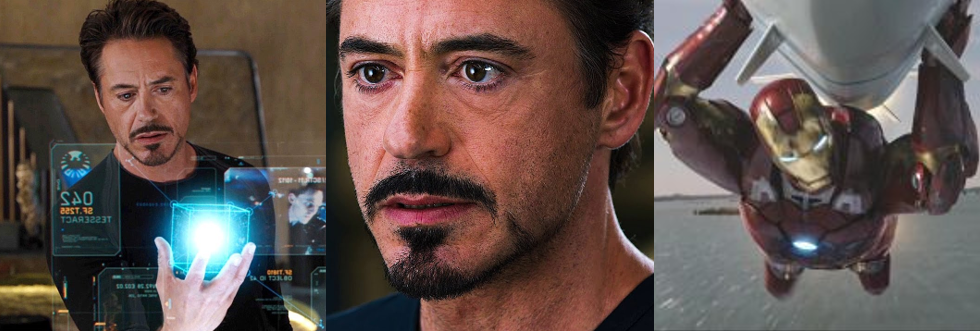
Stark is just as stubborn and snarky as ever; he’s clearly insulted by Agent Phil Colson (Gregg) and Fury’s decision to relegate him to a “consulting” role in the Avengers Initiate despite his claims to not want to be part of the team and believes himself to be the only one smart and capable enough of combating Loki’s impending threat. He comes aboard with the program purely out of a selfish desire to lord himself over Fury and the other Avengers and to learn more of S.H.I.E.L.D.s secrets, using them to call Fury out on his hypocrisy, and constantly goading his team mates (particularly Banner) into being themselves and rejecting Fury’s orders and control. While the prevailing arc for the entire team is learning to work together, Stark personifies this as he is the most antagonistic and reluctant to work as a team; he’s the most affected by Coulson’s death due to him knowing the agent the best, his experiences witnessing death and suffering first-hand in Iron Man, and his inability to properly cope with death and loss. Coulson’s death galvanises Stark, turning his incredulity to vengeance and giving him the motivation to not only put aside his ego to work with the team but also acknowledge Cap’s superior leadership skills.

The naturally apprehensive Banner has attained a measure of tenuous control over the Hulk.

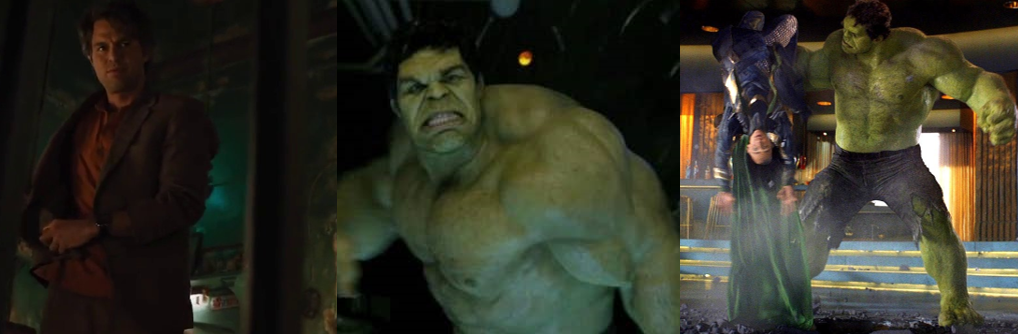
Banner appears very differently to where we left him in The Incredible Hulk (Leterrier, 2008); fearing the unpredictability and ferocious nature of the Hulk, he has stayed in hiding, suppressing the Hulk with some success, but is unable to deny his innate wish to help others in need with his scientific and medical expertise. Banner has managed to keep the Hulk at bay not only through a risky and unique technique (he’s “always angry”, indicating that he constantly keeps his emotions at a level where the Hulk is satiated but doesn’t actually emerge) and a vehement refusal to acknowledge or speak the Hulk’s name. Banner is convinced to help advise on Loki’s spear by Natasha’s beauty and simply her asking him nicely, rather than forcing him to comply, but, while he is clearly excited to be working with S.H.I.E.L.D. and the Tesseract and forms a fast, budding friendship with Stark (with Stark goading Banner and acting like an annoying brother to him), he quickly comes to realise that Fury’s intentions aren’t entirely noble and questions the validity and ability of a team that is little more than a “timebomb” of ego and emotions. When the Hulk is forcibly unleashed as part of Loki’s plan, he is unbridled rage and fury, lashing out at everything and everyone around him in a mindless rage since the transformation was against Banner’s will. Later, during the Battle of New York, Banner initiates the transformation willingly and the Hulk is much more…maybe not “docile” but let’s say willing to cooperate, taking Cap’s orders and specifically targeting to Chitauri threat while protecting and aiding his teammates. A measure of Banner’s influence and the Hulk’s intelligence is seen as the Hulk makes the effort to save Iron Man from his fatal fall and his dismissive grunt of “Puny God!” after beating the piss out of Loki.

Thor’s complex relationship with Loki is a pivotal plot point throughout the film.

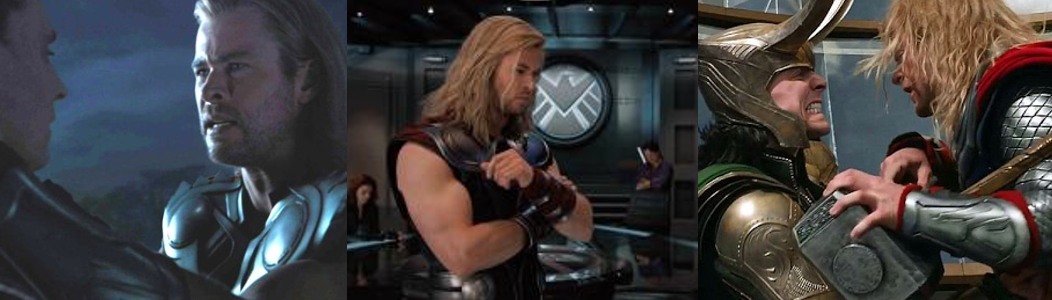
Thor’s arrival on Earth comes out of nowhere and is quickly waved away with a brief line about “dark energy”; personally, I never liked this or understood why the filmmakers had the Bifrost be destroyed in Thor (Branagh, 2011) when they knew very well that Thor would be back in Avengers Assemble but it is what it is and Thor is there. Thor is handicapped by his emotions towards his brother; he is elated and heartbroken to see Loki alive after believing him dead and just wants his brother to abandon his crusade and come home. Loki, however, is too full of jealously, rage, and resentment and constantly taunts, defies, and dismisses his brother, who finds himself unable to simply wade in, muscles bulging, and retrieve Loki thanks to opposition from Iron Man, Cap, and Fury and the greater issue concerning the Tesseract. Thor offers knowledge of another world, another level of understanding, that is unique amongst his teammates and spends much of the film believing his brother still has good in him and wishing to return him home. After Loki kills Coulson before Thor’s eyes and tries to kill him with a trap intended for the Hulk, Thor reluctantly gears up and enters the fray, so determined to stop his brother’s mad schemes that he’s willing to fight alongside the Avengers and submit to Cap’s orders since he, like Cap, is a stranger in this world and still learning how to navigate modern, human society.

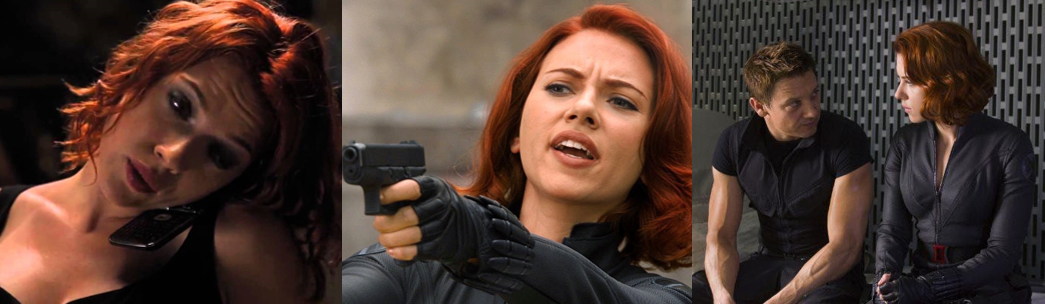
Natasha remains a mystery despite the showcase of her skills and hints towards her past.

Natasha is still relatively new in this film since audiences only saw a fraction of her true character and abilities in Iron Man 2 so it’s good that she gets a solo action scene at the start of the film to showcase her physical and manipulative abilities. We learn bits and pieces of her character and backstory through her interactions with Banner, Loki, and Barton but she remains very much a mystery even by the end of the film. This would, of course, continue over the years since Black Widow was one of the last of the original Avengers to get a solo film, meaning an air of mystery constantly surrounds her, but much of her arc is focused on her relationship with Barton (which is one of duty, gratitude, and mutual, platonic respect) and her commitment to Fury and S.H.I.E.L.D. Like Cap, she follows orders unquestioningly but it also feels like she has her own agenda and reasons for going along with S.H.I.E.L.D.; while she, like Barton, is one of the weakest links in the Avengers, she’s still capable enough to hold her own against the Chitauri…for a time, at least.

Though he spends the majority of the film under Loki’s spell, Barton proves a formidable opponent.

Barton, who is only referred to as Hawkeye once in the film, spends most of the movie under Loki’s command (though this does harken back to his comic book beginnings as a villain); as a result, all we know about him is the few bits and pieces Natasha reveals about their relationship and their background. However, we do get to see him in action on more than one occasion; he’s a crack shot, almost to superhuman levels, and is able to bring down an entire Helicarrier with a single, well-placed arrow. He is an essential soldier in Loki’s army, offering him insight into Fury’s operation and resources, but is also able to provide the Avengers with key information regarding Loki after Natasha literally knocks some sense into him. He proves himself capable enough in the finale by providing much needed and peerless cover from a high vantage point, from which he is able to take out multiple Chitauri with a few well-aimed shots. He’s easily the least developed of all the characters thanks to the role he plays in the film but it works for the plot and means we’re left wanting to know more about him and his backstory. Fury plays a much larger role in this film than in the previous MCU movies since he’s a pivotal supporting character rather than a mere cameo; he believes that Loki represents a very real threat to humanity but also believes wholeheartedly in the concept of heroes and the ability of the Avengers Initiative to combat Loki’s threat.

Coulson is the glue that connects Fury’s Avengers and his death galvanises the team into action.

Fury opposes the World Security Council when they dismiss the Avengers as a legitimate solution and when they order a nuclear strike on New York which, along with his own brand of snark and dry wit, makes him a rebellious and layered character in his own right. However, he’s also a secretive and manipulative individual, constantly telling everyone only as much as they need to know and a handful of half-truths (as Stark says: “Fury’s secrets have secrets!”) and believes in having contingencies against any and all possible threats, both foreign and domestic. While he doesn’t fight alongside the Avengers in the final battle, he’s crucial to their formation and is a charismatic and alluring figurehead for their group. Sadly, this was as prominent as Fury would be for some time, with him quickly going back to being either a cameo or supporting character over the years, which is a shame as it’s always great to see Samuel L. Jackson in the role and interacting with these characters. Similarly, Coulson also gets much more screen time and development this time around; still acting as Fury’s go-to and the liaison between S.H.I.E.L.D. and the Avengers, Coulson (whose first name is revealed to be “Phil” rather than just “Agent”) is the relatable man among Gods, the common thread that links all of these volatile personalities together. Initially, all they really have in common beyond their heroic tendencies is their relationship with Coulson, with Stark having the closest link to him and Coulson being especially in awe of Cap, his hero and idol, and Coulson’s death is both sudden and heartbreakingly brutal. It’s a fantastic moment that serves to galvanise and motivate the them and, as much as I’ve enjoyed some episodes and seasons of Agents of S.H.I.E.L.D. (2013 to 2020), it did annoy me that his dramatic death was undone so soon after the film’s release. Thankfully, the MCU movies don’t acknowledge Coulson’s resurrection so his tragic death remains the principal motivating factor behind the coming together of Earth’s Mightiest Heroes.

The Nitty-Gritty:
Considering the large cast of bombastic, unique characters and actors, Avengers Assemble is fantastically well paced; sure, Natasha and, especially, Barton don’t get anywhere near as much screen time or development as established guys like Cap or Stark but they get several character defining moments and character beats that help to keep them relevant and integral to the plot. The film isn’t full of non-stop action but it never feels slow or like it’s wasting time; any time there isn’t some kind of physical conflict, there’s a conflict of character, beliefs, or ideologies as each of the characters interacts with each other in different ways. The central conflict in the film is between the individual Avengers as much as it is with Loki as each one must learn how to interact and co-operate with the other, which leads to some friction between Rogers and Stark, disdain from the God-like Thor, and distrust from the understandably agitated Banner. This all comes to a head in one of the film’s most intense moments where the fledgling Avengers argue over Fury’s manipulations, the threat each of them oppose, and their conflicting egos in a scene that is easily as powerful as any of the film’s fight scenes. Here, each character talks and argues over each other; lots of fingers are pointed, egos are bruised, and accusations are made thanks to the influence of Loki’s spear, which exacerbates their most negative aspects and fuels the distrust and tension between the group. It’s an amazingly realised scene, with lots of dynamic camera work on offer and allows the characters to vent their frustrations and concerns about each other, the mission, and the inevitable escalation of conflict that threatens Earth now that it has experienced otherworldly threats and, in it, these conflicting personalities actually grow stronger as a result of their brutal honesty.

Seeing these colourful and volatile individuals interact is every fan’s dream come true!

However, amidst this, there are also numerous amusing little moments that help to add to the film’s levity and develop each character: Rogers handing Fury a $10 bill after being awe-struck by the Helicarrier, Stark pointing out that one of the S.H.I.E.L.D. agents is playing Galaga (Namco, 1981), Thor’s humiliation regarding Loki’s actions and heritage, and Banner’s flashes of anger all help to make the characters real and relatable. One of the best examples of this is Cap’s confrontation with Loki in which he, despite being “out of time”, recognises Loki’s evil and potential threat and openly opposes him just as he did a similar dictator in World War Two and engages him in combat despite Loki’s clear physical advantage over him. Cap’s whole character is that he continues to fight no matter the odds and that is continuously seen in Avengers Assemble as, even when outclassed or outnumbered, he continues to get back up and go on with the fight until it’s done, one way or another, and fails to give in to intimidation from concepts beyond his time such as Gods, aliens, and advanced technology. Their interactions with each other are equally impressive, with the heroes just as likely to come to blows as they are to work together; this means we get to see these bright, colourful costumed characters fighting with each other as much as alongside each other. Iron Man fights with Thor, Cap joins in to make it a triple threat, Black Widow fights with Hawkeye, and Thor memorably goes toe-to-toe with the Hulk to set up a friendly rivalry that would be fantastically revisited in Thor: Ragnarok (Waititi, 2017). It’s a staple of superhero team-ups that the heroes simply must fight at least once and Avengers Assemble delivers on this in spades; we’ve watched each of these characters in their own films, or be involved in other MCU films, over the years so to see them match wits, trade blows, and fight together is a true fanboy’s delight.

The Chitauri are, admittedly, underwhelming antagonists but they serve their purpose.

The finale is little more than a battle against mindless, indistinguishable alien hoards who, conveniently, operate in a hive mind and are “easily” shut down by Stark tossing a nuclear weapon at their mothership. I honestly expected a version of the Masters of Evil for the first Avengers movie, with Loki joining forces with Johann Schmidt/The Red Skull (Hugo Weaving) outside of the Realms and then teaming up with Emil Blonsky/The Abomination (Tim Roth) and/or Samuel Sterns/The Leader (Tim Blake Nelson) once they reach Earth for a smaller scale, six on six style team vs. team movie and, in some ways, it is a bit disappointing that the Avengers only went up against one villain and an army of drones but it really works in the film since the entire point of the movie is to bring these volatile characters together. The actual antagonist could have be anyone or anything and it wouldn’t really matter but it being Loki works wonders thanks to Tom Hiddleston’s iconic performance; he’s truly a snake in the grass, a wily, manipulative, vindictive villain who is intelligent and cruel enough to match wits with each of the Avengers both physically and vocally and the only previous villain I could see being able to do anywhere hear as good a job would be Hugo Weaving.

The Avengers win the day but a greater, far more powerful threat looms in the background…

One issue I have though is that, as much as I loved the “Avengers Assemble!” scene we eventually got, I still don’t get why we couldn’t have heard that iconic cry during that awesome panning shot of the team standing back-to-back. I think we definitely could have heard this cry in each of the team-up films and appearances of the group and it wouldn’t have taken away from that impactful scene; if anything, it would have added to it since it would be a rallying cry for the reunited heroes. Still, the Battle for New York is amazing in its scope; the Chitauri may be interchangeable alien drones but they are relentless. The Avengers are able to combat them and easily defeat them but their numbers are legion and, apparently, inexhaustible and it isn’t long before they are overwhelmed even with the might of Thor and the Hulk. The Chitauri’s larger reinforcements and advanced weaponry and sheer numbers mean that it is simply a matter of time before the Avengers, for all their power, are overwhelmed and Loki is successful, meaning that the Avengers’ main concern is holding the line and keeping the invasion at bay while their team mates confront Loki and cut off the source of the invasion. All throughout the film, Loki converses with “The Other” (Alexis Denisof) and is clearly being given power and resources from an unseen third party, revealed at the very end of the film to be none other than Thanos (Damion Poitier). At the time, we could never have anticipated the extent to Thanos’s threat and importance to the MCU but the bringing together of cosmic characters like Asgardians and threats like the Chitauri and Thanos only hinted at how large and varied the MCU was destined to become.

The Summary:
Avengers Assemble is still one of the biggest and most entertaining movies in the MCU and, perhaps, ever made. Of all the movies in the MCU’s first phase, it’s easily my favourite and, for me, set the standard not just for subsequent MCU team-up movies but for every film in the MCU going forward. No longer were these characters going to exist in their own isolated bubble; they would interact with their fellow characters, reference the larger world we finally saw in all its glory, and be part of something much bigger and greater than a series of self-contained films. For me, this is the greatest appeal of the MCU; before Iron Man, superhero films were always solo affairs and we never saw heroes interact with each other. Thanks to the MCU, all of that changed and, finally, the movies came to resemble the comics by having a shared universe that has a tight continuity and an actual tangible, long-term plan. The film is alive with character moments, an amusing dry wit, and action-packed sequences but, as thrilling as the bombastic fight scenes can be, it’s all the little interactions and interpersonal conflicts that really make this film so entertaining and appealing to me even to this day.

My Rating:

Rating: 5 out of 5.

Fantastic

What are your thoughts on Avengers Assemble? How do you feel it holds up now that the MCU has become this massive, multimedia juggernaut? Were you disappointed that the film focused solely on the one villain and side-lined Hawkeye with a mind control sub-plot or were you satisfied with Hiddleston’s performance and the interpersonal conflicts between the characters? Which of the Avengers is your favourite and which of the comic’s characters are you excited to learn more about or see join the team? Which of the MCU movies, shows, or characters is your favourite and why? How are you celebrating National Superhero Day today? Whatever your thoughts, leave a comment below and be sure to stick around for more superhero and comic book content throughout the year.