
Released: 7 July 2022
Originally Released: 22 March 2001
Developer: Monkey Craft
Original Developer: Namco
Also Available For: PlayStation 2 (Original Release); Nintendo Switch, Nintendo Switch 2, PC, PlayStation 4, PlayStation 5, Xbox One, Xbox Series S (Phantasy Reverie Series)
The Background:
After Sonic the Hedgehog (Sonic Team, 1991) put anthropomorphic mascots on the map with its incredible success, bizarre characters like Sparkster, Earthworm Jim, and even a sentient period paved the way for later 3D platforming icons. When it came time for Namco Bandai to toss their hat into the market, videogame director Hideo Yoshizawa originally envisioned a ceramic fighting robot named Amenti before Yoshihiko Arai pitched the strange, rabbit-like Klonoa to appeal to kids and adults. Klonoa: Door to Phantomile (Namco, 1997) impressed critics with its simple controls and cute visuals, and development of a sequel began soon after. Initially planned for the PlayStation, Klonoa 2 transitioned to the more powerful PlayStation 2 in order to expand the 3D space and give players more control and freedom. Klonoa’s design was tweaked to make him easier to animate and more mature, which was reflected in the more emotionally nuanced story. Like its predecessor, Klonoa 2 was met with universal praise for its addictive gameplay, impressive visuals, and near-perfect controls. However, Klonoa 2 was also criticised for its short length and, despite largely positive reviews, its sales were lacking and a planned Wii remake was allegedly cancelled. After decades of being stuck as an expensive PlayStation 2 exclusive, Klonoa 2 was finally re-released and remastered in this well received, modern overhaul for new generations.
The Plot:
When Klonoa is fished from the waters of Lunatea by Lolo, a priestess-in-training, and her friend, Popka, he joins them to stop sky pirates from spreading hopelessness.
Gameplay and Power-Ups:
Surprisingly, given most 2D and 2.5D franchises made the jump to 3D back in the day, Klonoa 2: Lunatea’s Veil is a 2.5D action platformer that looks and plays exactly like its predecessor. I was fully expecting that Klonoa would’ve transitioned to something more akin to the Spyro videogames (Various, 1998 to 2018) as even Earthworm Jim got a clunky, third-person 3D adventure back in the day. Instead, Klonoa 2 sticks to its roots so closely that it barely changes anything from the first game, though some of this may be because this version of the game is based upon the game engine of the short-lived Wii revival. This means that players once again travel through various colourful stages (known as “Visions”), though they’re much larger and each area has anywhere from two to seemingly five levels. Klonoa 2 still allows a second player to jump in and give Klonoa a boost with Y and the controls remain unchanged from before. By default, you’ll jump with A or Y, holding the button to flutter Klonoa’s ears to help cross gaps, and pressing B or X to fire “Wind Bullets” from his magical ring. You again use these to grab nearby enemies and throw them at other baddies, to the background or foreground to activate switches or smash Nagapoko Eggs for goodies, or to activate switches. When an enemy is in your grasp, pressing the jump button twice launches them beneath you to destroy whatever’s under you and boost you higher, and I was happy to see that there are far less sections where you must desperately string double jumps together to hit switches in a certain order. Enemies usually always respawn to give you plenty of “ammo”, though no new features have been added to Klonoa’s arsenal beyond you now pressing the Left or Right Bumper to pull off a taunt or a useless twirl. You can disable the onscreen timer and tutorials from the game’s settings and (to start with) pick between “Easy” (which grants infinite lives and more health) and “Normal” (which limits your lives and reduces your maximum health) difficulties. While bottomless pits and flaming hazards still spell instant death for Klonoa, you can partially or fully restore his health with Small or Large Hearts, hit Memory Clocks to activate checkpoints, collect one of the many 1 Up Coins for extra lives, or earn even more for every 100 Dream Stone collected.
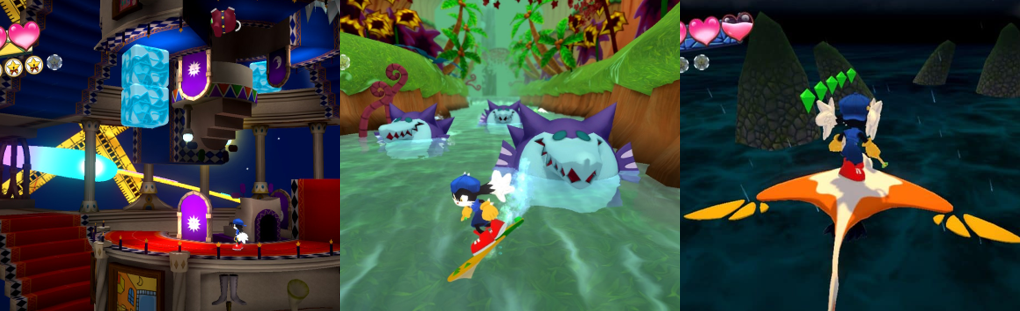
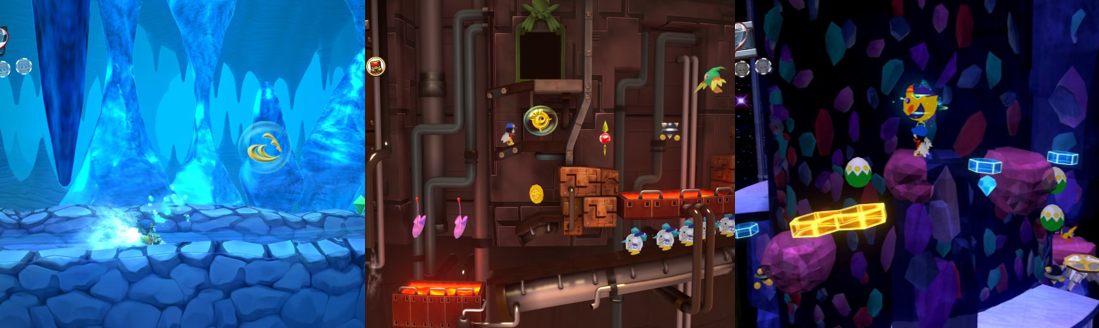
Mirror Spirits still appear to temporarily double the value of Dream Stones, Klonoa will often need keys to open doors in Visions (usually backtracking to use them and then activate something to progress further), and he can now collect six stars in each Vision rather than rescuing Phantomiles. Though they function the same (held within bubbles in Visions), these earn you “Mommett Dolls” to deliver to the Mommett House to unlock extra game modes. Though you’re more likely to hit switches to open paths, timed switches still appear, as do disappearing platforms, which get smaller and more precarious as the game progresses. Gondolas and moving platforms also appear, as do springs to rocket you high into the air, and you’ll also hit switches to spawn (or despawn) blocks. You’re more likely to be working out how to toss Boomies at just the right time so they explode to activate these switches from afar, or nabbing Likuries to absorb enemies and change their colour to then break matching coloured crystals. These can be surprisingly taxing puzzles as you must work out how to clamber to higher ground before the Likurie returns to you, requiring you to snag coloured bulbs to get higher (or carry you across endless pits). You’ll also be tossing enemies to gigantic Ow-Gows so they’re distracted from eating you, grabbing Erbils to rocket higher and smash through crates above you, tapping A while holding a Kiton to fly around for a short time, or blasting away using a Jetimo. Klonoa also gains a gnarly hoverboard that he uses to surf over water, sand, and surfaces alike. These effectively replace the water slide sections from the first game and appear quite often, either from a 2.5D or 3D perspective, and see you hopping gaps, making tight, precise movements to stay on narrow or crumbling paths, and using your double jump to reach higher ground. Twice you’ll cut through the sky on either a bird or a plane, tossing enemies to break obstacles in your way. You must often press B to ring magical bells to progress the story, and you’ll be constantly backtracking to Baguji’s Island from the larger world map to get more information and unlock new areas.
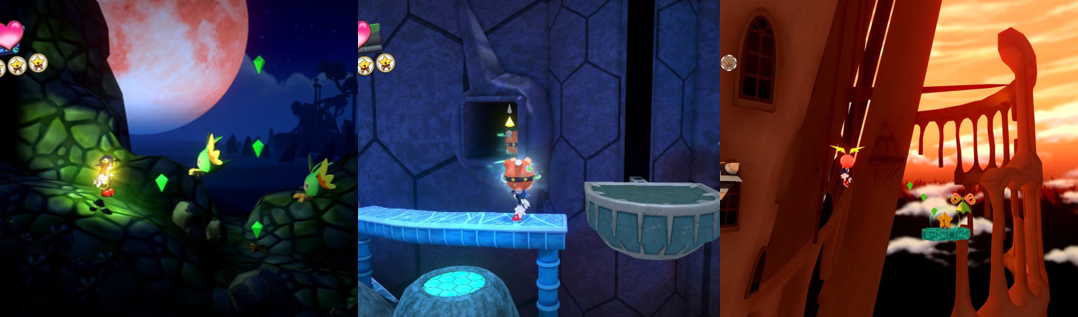
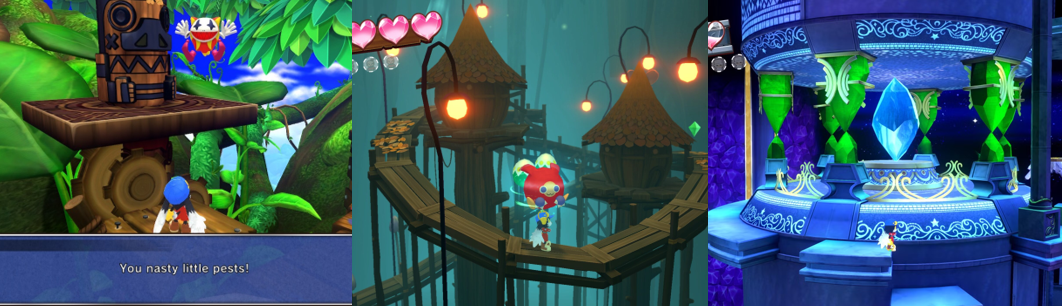
While Klonoa 2’s worlds are noticeably bigger than before, the basic gameplay loop remains unchanged, and a lot of the same gimmicks return. You’ll be clearing gaps, using swinging, moving, and stationary platforms, activating lifts, and battling against conveyer belts in your quest. Klonoa 2’s “big” new gimmick are the many cannons dotted all over, which blast you across stages, up higher, or to and from the foreground. Often, you must toss enemies or Boomies to the background and then quickly rocket over to use them to blow up rocks to snag keys; othertimes, they simply lead to alternate paths and goodies. However, there are some new mechanics at work here, mainly in Mira-Mira’s “Maze of Memories” which includes twisted geometry, a maze of doors, and a feature when you rotate the screen to make the floor the ceiling. When in the endgame, you’ll revisit previous areas, now made more dangerous, and must stick close to Goddess statues to avoid choking to death on poisonous gas, toss Boomies into three engines and flee to safety before they explode, and get carried across a disturbing void. While it seems daunting dodging Spikers, flame bursts, and hopping to platforms or other handholds, you can just cling to whatever’s carrying you and take a hit without being knocked off, which makes it much easier. La-Lakoosha features a pendulum you must toss enemies at the destroy pillars to progress, the Mobile Tank Biskarsh chases you with a laser through the war-ravaged streets of Volk City, giant enemies also chase you in Mira-Mira, and players must grab Flolo to light up dark areas when traversing the nightmarish Dark Sea of Tears. Often, big springs blast you high up and you must direct Klonoa to land on other springs or platforms to progress, enemies sometimes chase you towards or away from the camera to add a little spice, spike pits threaten to end your run, and the funfair-like Joliant has you dodging rollercoasters, tossing enemies at a Nagapoko Egg shooting range, and smacking a pirate ship so it swings you to higher ground.
Presentation:
As mentioned, I was surprised to find Klonoa 2 barely deviates from the last game, recycling many of the same enemies and hazards and retaining the rigid 2.5D presentation. It does open out a little bit, though, offering more third-person sections through its hoverboard gimmick but, for the most part, everything looks, feels, and sounds as good as it did before. While much of the game’s colourful aesthetic still recalls NiGHTS into Dreams (Sonic Team, 1996), Klonoa 2 features a fantasy land being invaded by nightmares and doubts rather than taking place in a dream world. Though nothing’s changed about his abilities, Klonoa has had a bit of a visual downgrade, now wearing a hoodie rather than his cool buckle outfit and strangely having taunts mapped to the shoulder buttons. He’s still a fun character, though, and seems a touch more mature this time around, and still speaks in gibberish and sound bites. Dialogue is thus related through speech bubbles and there are a few more happening here as Klonoa chases down the mischievous Tat, offers council to Lolo, and gets the lowdown on besmirched sky pirate Leorina from Baguji. Klonoa and his enemies still have large hit boxes that can make platforming tricky, but this time I noticed some odd distortion in the music at times, as though the hardware were struggling to keep the game running. Lunatea is a pretty varied world whose map opens up as you progress the story and has you backtracking to Baguji and even in some Visions to move things along. While Klonoa 2 only recalls the bizarre visuals of the first game at the end, each area has a lot to see in the backgrounds and many of them are mismatched and remixed for the endgame, where the King of Sorrow throws the land into chaos and makes previously simplistic areas more taxing with tougher enemies, trickier puzzles, and so many pits.
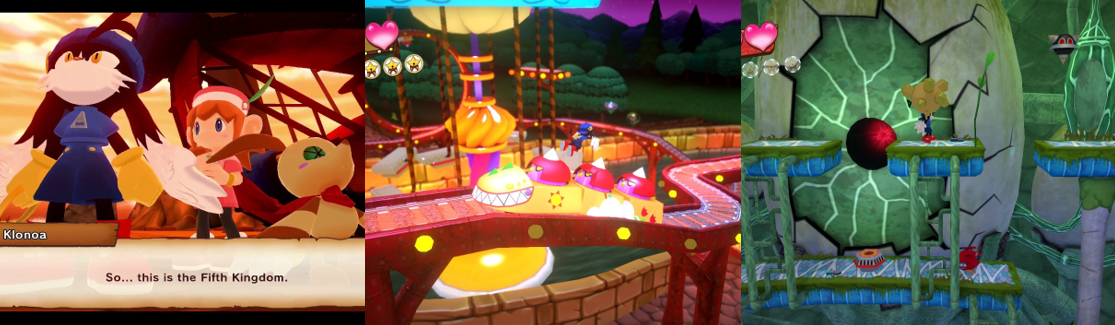
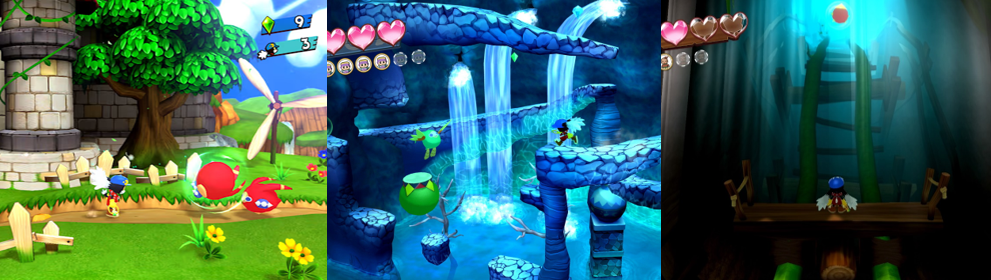
Players begin in the Sea of Tears, a stormy, rainswept port where lightning flashes and waves crash against the rocks in the background. This area leads you through an ethereal coral cave and features a large priestess statue near the end. This brings you to La-Lakoosha, a town situated near a large waterfall where wind currents carry you between platforms, and Klonoa explores a mushroom cave and travels a spiral path to the Claire Moa Temple. While Joliant impresses with its carnival lights, sounds, rides, and fireworks, it’s also home to a funky haunted house that includes a haunted library, scary trees, a graveyard, and a spook working a giant cauldron. You’ll also board through a jungle-themed water slide stage and then drop into the rancid sewers beneath Volk City, which is on fire and under heavy bombardment that sees buildings crumble and flaming debris litter the streets. After avoiding insta kill sewage and molten metal in the city’s distinctly steampunk underground factory, you must activate and explore the ancient Ishras Ark. The vessel sits near towering mountains whose windmills and gears must be activated and their frigid peaks boarding past (and into) a gigantic dragon’s skeleton and down past a snowy village. All these areas are remixed by the King of Sorrow, often having you work backwards through previous areas or go from the left to the right, encountering more Ow-Gows and puzzles involving Boomies and Likuries. These more nightmarish, topsy-turvy levels can be daunting with their desolate, patchwork backgrounds and ominous music, and things only get more troublesome with how many pits, temporary platforms, and changes have been made. Previously stationary platforms will now swing, more insta-kill fire appears, tranquil caves will be full of toxic gas, and the very sea will have dried up, revealing only sand, floating islands, and an exposed coral palace whose statues try to crush you. Things get very surreal when you battle the corrupted Leorina and the maniacal King of Sorrow, with cosmic voids and swirling vortexes replacing the previously whimsical and cartoonish backgrounds, and the game again ends on an emotional note as Lolo learns to overcome her doubts thanks to Klonoa’s support.
Enemies and Bosses:
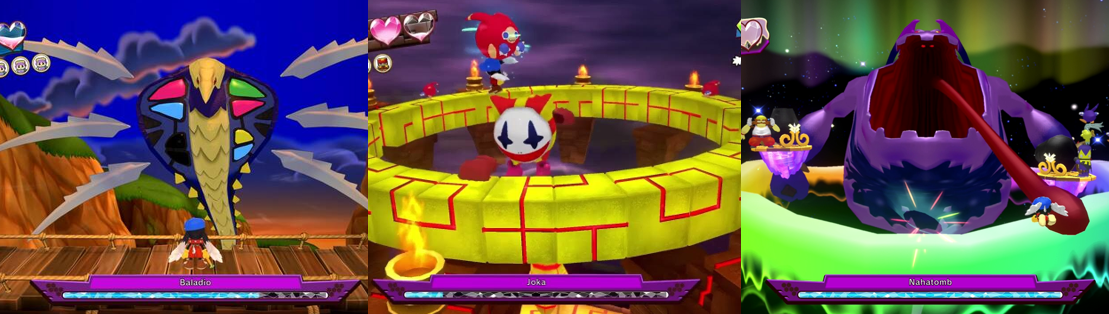
As far as I could see, almost every enemy encountered in the first game returns in Klonoa 2, completely unchanged in every way. Klonoa must grab and toss these constantly respawning enemies to defeat others or activate switches, or to reach higher ground, with all but the large ones and those wearing helmets dying in one hit. The various coloured Moos are still your most persistent enemy, with Red Moos patrolling back and forth, bird-like Green Moves hovering overhead, and Black, Gold, and Silver Moos hiding behind shields and/or carrying spears. Moos also jump on snowboards to chase you, Zippoes still run full tilt at you, some enemies toss spiked balls from the background and floating Spikers are a constant headache before you, and Slazzas still toss boomerangs (though appear far less frequently). Glibz return, still armed with twin cannons, Spindles must still be defeated by double jumping over them, and Boomies have a much expanded role as you toss them at switches or into engines. There are some new enemies here too, such as hornets that attack with their stingers, shark-like Digons who dive from the background, and Ow-Gows, who must be fed to keep them from munching on Klonoa. Just as Leorina acts as a dark opposite of Klonoa, wielding a makeshift magical ring, so too does her companion, Tat, act as a counterpart to Popka. You’ll chase Tat through Joliant’s fun park, tagging her either on foot or while boarding along, and even fight her in two mini boss battles. The first sees her (in a spooky disguise) rolling cannonballs along the floor in Joliant’s haunted house, where you must propeller fly up to pop the balloons. In the second, giant mechanical Tat’s pop from pipes in Volk City’s underground factory, again rolling cannonballs. This time, you must grab Moos and toss them at her constructs as they spiral around, kind of like a game of Whac-A-Mole. There are also six bosses to fight, each with two phases and two health bars, though this time the game at least mixes things up and sometimes has you boarding along instead of just running on a circular or stationary platform.
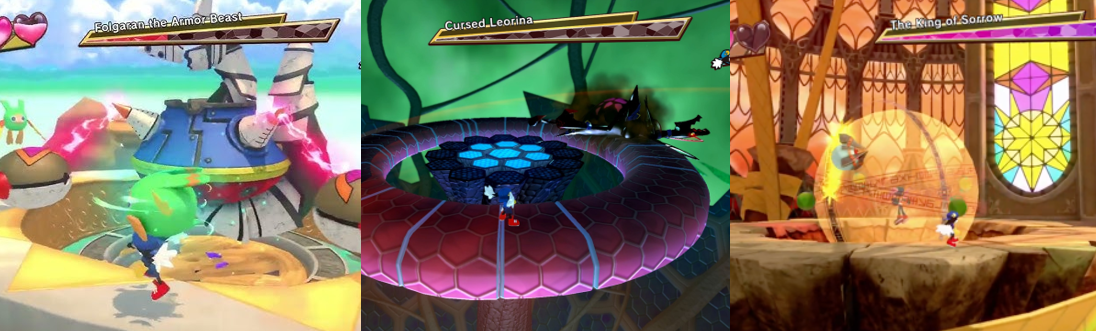
The “Armored Beast” Folgaran spins in the centre of a circular path, exposing its weak spot (its butt) as it rotates but spinning faster and extending its claw-like arms as the fight progresses. While this is extremely easy, Leptio can be trickier as you must throw Moos at him while avoiding his duplicates, hit him as he rolls around the ring, and knock over his drill-like enclosure, dodging his flailing robotic limbs. As he rolls in this mech, you must time a throw from across the stage to put him down. The Mobile Tank Biskarsh can also be difficult as you must grab a Green Moo and spring high up, dropping your projectile into the vent on the tank’s roof and avoiding its leap. It then jumps further and faster and drives at you from the background, meaning it can be difficult timing your shots. Polonte is fought as you snowboard down a mountain. You must jump over spike balls and ice formations, passing through gates to speed up and ram him. In the second phase, these are far harder to avoid and you must snag and toss snowboarding Moos (best done while jumping). When you finally face off with Leorina, she transforms into an insectile beast and stomps around a stage, only being vulnerable when you Erbils-jump into her underbelly. When she hides beneath the platform and you must blast away her orb and smash an enemy into the ground to damage her, finally finishing her off with another Erbils-jump as she charges her big attack. Finally, there’s the King of Sorrow, a much easier final fight than Nahatomb’s. First, you board through a swirling vortex, passing between spiked trails and tossing Nemo Moos at him. Though he’s a difficult target and bops you with his staff up close, he’s pretty easy to beat in this phase. In the second, he hides behind an energy shield, blasting flames and trying to hit you with the mechanical tips of his tentacles. You must snag these and toss them at the orbs on his shield a few times, easily ending his threat after a couple of rotations.
Additional Features:
This version of Klonoa 2 has ten Achievements up for grabs, with players earning one each time they defeat a boss and gaining an additional one if they get every Achievement in both games. You get another Achievement for finding all the Mommett Dolls, which also unlocks a couple of additional Visions to play. If you find all 150 Dream Stones in every Vision, you’ll also unlock a Picture Viewer at the Mommett House, where you can battle the bosses again (though you can also do this by revisiting the boss Visions). Completing the game on either difficulty unlocks “Hard” mode and the movie viewer, and this version also offers an awful pixel filter if you feel like making the game look like an early PlayStation title.
The Summary:
I was slightly hesitant about Klonoa 2: Lunatea’s Veil as I was sure that it would’ve evolved the original game’s fun, if simplistic, 2.5D gameplay into something more akin to a 3D collectathon. Instead, the game is almost indistinguishable from the first, with no additional power-ups or abilities for its funky (but adorable) title character beyond a snowboard. This isn’t a bad thing as the game’s still fun to look at and play, it’s just surprising that the developers didn’t expand upon or change the formula for the jump to the PlayStation 2. I was glad to see that the janky double and triple jump sections were largely gone and I did enjoy the hoverboard sections, though the game still didn’t do as much as it could with its main throwing gimmick. I liked the expanded role given to Boomies and how the Likurie puzzles make you rethink your actions, though the reliance on cannons took a lot of control away from me and constantly returning to Baguji got annoying. Still, I liked that the Visions were much bigger, the bosses had more phases and strategy to them, and that the game was as colourful and quirky as before. I can’t say there’s anything in Klonoa 2 to make it any better or worse than the original as the differences are extremely minor. I ultimately had just as much fun with it as I did the first game, so it’s only fair to give it the same score, but it might’ve scored higher had those nightmarish remixes been giving more prominence and if the developers had expanded Klonoa’s abilities a bit more.
My Rating:
Pretty Good
Did you enjoy Klonoa 2: Lunatea’s Veil? What did you think to the changes made for the Phantasy Reverie Series version? Were you surprised to see the game virtually unchanged from the first entry? What did you think to the boarding sections and new puzzles? Do you agree that Klonoa’s design isn’t as strong this time around? Did you find the bosses too easy, despite their additional phases? Which Klonoa game is your favourite and do you think the franchise needs a new entry? Tell me your thoughts on Klonoa in the comments and go support me on Ko-Fi for more reviews like this.


 Dr. K's Waiting Room
You must be logged in to post a comment.