Movie Night [Godzilla Day]: Godzilla vs. King Ghidorah


Toho’s famous atomic beast, and easily the most recognisable kaiju in the entire world Gojira first emerged from the waters of outside of Japan to wreck the city of Tokyo on this day all the way back in 1954. In 2016, the day was declared “Godzilla Day” and, as a result, I am also appropriating November 3rd to shine a spotlight on the undisputed King of the Monsters.

Released: 14 December 1991
Director: Kazuki Ōmori
Distributor: Toho
Budget: $12 million
Stars: Kōsuke Toyohara, Anna Nakagawa, Megumi Odaka, Chuck Wilson, Yoshio Tsuchiyam, Kenpachiro Satsuma, and Hurricane Ryu

The Plot:
Time travellers offer to get rid of Godzilla (Satsuma), Futurians create the terrifying King Ghidorah (Ryu), leaving science-fiction writer Kenichiro Terasawa (Toyohara) and remorseful Futurian Emmy Kano (Nakagawa) to desperately revive Godzilla ensure Japan’s survival.

The Background:
When he made his big-screen debut in Godzilla (Honda, 1954), Gojira (more popularly known worldwide as Godzilla) represented very real lingering fears regarding the threat and consequences of nuclear war. However, it didn’t take long for Godzilla to be recast from Japan’s destroyer to its a saviour. While he often caused a great deal of destruction, Godzilla would often team up with other kaiju, such as Mothra and Rodan, to fend off a greater threat and cement his place as an iconic figure in pop culture. Perhaps Godzilla’s greatest nemesis is the three-headed dragon King Ghidorah (also known as “Ghidrah” and “Monster Zero”), a titanic winged beast created by Godzilla creator Tomoyuki Tanaka and inspired by the Lernaean Hydra and the Orochi of Japanese folklore. Initially depicted as an ancient alien monstrosity from Venus, King Ghidorah’s debut feature was so successful that he reappeared the following year and was a natural choice to recoup some of the studio’s losses after the disappointing box office of Godzilla vs. Biollante (Ōmori, 1989). Believing audiences wanted time travel plots given the success of Back to the Future Part II (Zemeckis, 1989), director Kazuki Ōmori specifically tailored the script to include this and place greater emphasis on developing the personalities of the monsters rather than the human characters. The movie reused the Godzilla suits from Godzilla vs. Biollante, but with some modifications that slightly altered Godzilla’s face and allowed actor Kenpachiro Satsuma a better range of movement when in water, and the redesigned King Ghidorah featured far more advanced wirework puppetry than its predecessor. Ultimately, Toho’s hopes of surpassing Godzilla vs. Biollante were not to be as Godzilla vs. King Ghidorah made noticeably less than its predecessor and the film is generally regarded as a visually impressive, if convoluted, entry in the franchise. The film also attracted controversy for its depiction of events from World War Two but this wouldn’t be the last Godzilla film, or the last we’d see of King Ghidorah. Godzilla was back in action a year later and his nemesis returned to do battle time and time again in many forms.

The Review:
I have been a massive Godzilla fan since I was a little kid, but my exposure to the scourge of Japan was actually quite minimal growing up. Godzilla films weren’t exactly commonplace on TV back in the day so I (and a lot of kids my age) really started getting into the franchise with the impending release of Godzilla (Emmerich, 1998). To celebrate the release of that film, I believe it was BBC2 that dedicated an entire night to Godzilla and other kaiju, and this evening of documentaries, quizzes, and comedy was capped off by the first Godzilla movie I ever watched, Godzilla vs. King Ghirodah. Godzilla had battled his most famous nemesis before, back in the “Shōwa Era”, but this was their first meeting in the “Heisei Era”, which began in 1984 and basically rebooted the franchise with bigger and better suits and new, ferocious monsters for the Big G to fight. This is also probably my favourite era of Godzilla movies since this is when I really started getting into the franchise, though I feel it’s only fair to also point out that I am watching the dubbed version of the film (because I can’t get enough of that “You bastards!” line delivery!)
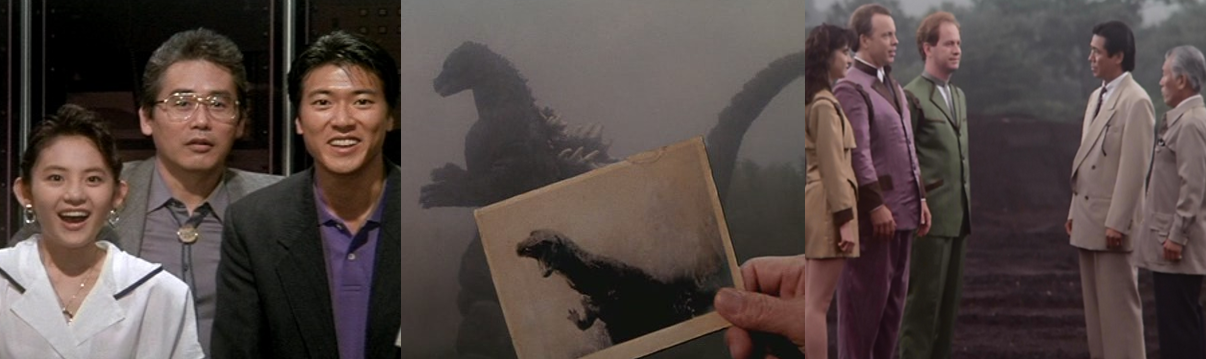
Terasawa’s research into Godzilla coincides with the Futurians’ arrival from 2204.

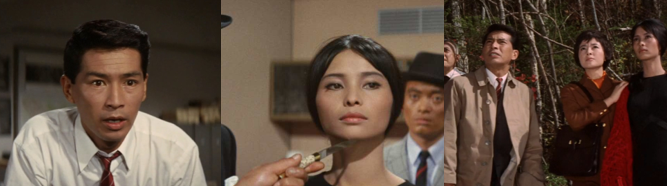
Oddly enough, as if all the kaiju action wasn’t enough, Godzilla vs. King Ghidorah heavily features a time travel plot. The film begins in 2204A.D., where King Ghidorah is little more than a mutilated skeleton at the bottom of the ocean, before jumping ahead to the then-present day of 1992 where all of Tokyo is shocked by the sudden arrival of a strange spacecraft on Mount Fuji. The unidentified flying object (UFO) instantly makes headlines but science fiction writer Kenichiro Terasawa has grown weary of the genre that has made him a “rich man” for his employers, Super Mystery Magazine, and is more interested in writing a detailed history of Godzilla. To that end, he interviews a number of World War Two veterans, including wealthy businessman Yasuaki Shindo (Tsuchiya), who were present on Lagos Island when Japanese troops were unexpectedly protected from the United States forces by the Tyrannosaurs rex-like Godzillasaurus, which they revere as a benevolent, powerful, protective spirit. Consequently, they believe the same to be true of Godzilla, especially as the world’s most famous kaiju is the mutated form of this dinosaur following hydrogen bomb tests. As is often the case in Godzilla films, the human characters are divided into journalists like Terasawa and the Japan Self-Defense Forces’s (JSDF) desperate attempts to combat the kaiju threat. In their efforts to uncover more information about the UFO, the JSDF turn to Miki Saegusa (Odaka), a character who has the rare distinction of appearing in subsequent Godzilla movies and is something of Godzilla expert and a budding psychic (because that’s often a thing in these movies, too). Because of this, she’s part of a team of specialists selected to ensure Japan’s future after the Futurians – Grenchiko (Richard Berger), Wilson (Chuck Wilson), Emmy, and their android, M-11 (Robert Scott Field) – deliver a morbid warning to Japan’s government, headed by the Prime Minister (So Yamamura).
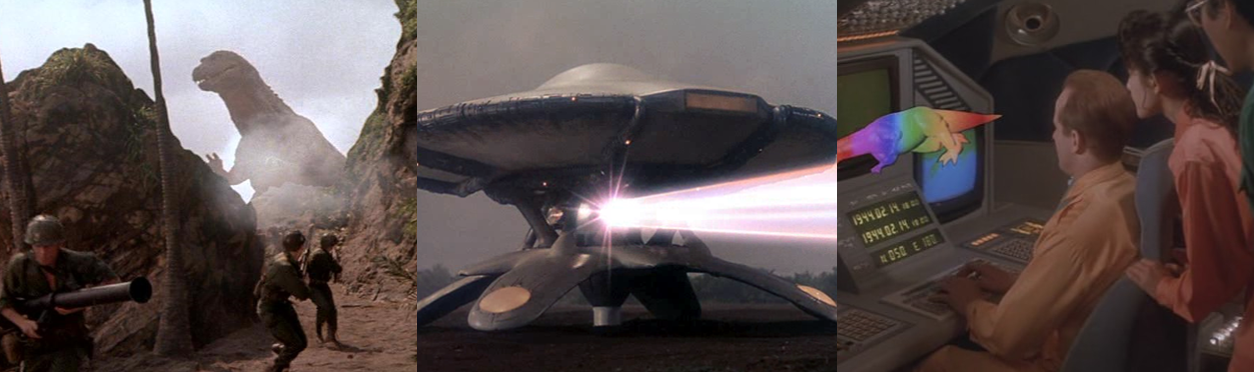
Thanks to time travel shenanigans, Godzilla is removed from history.

There, the seemingly benign Futurians completely disregard any sense of temporal paradoxes and time displacement to warn of a terrible future where Godzilla has decimated Japan following an unprovoked attack and devastating nuclear fallout. As proof, Emmy presents Terasawa’s book on Godzilla, thus bringing him into the JSDF’s investigation and confirming his theory that the Godzillasaurus became Godzilla. Thus, the Futurians propose travelling to Lago Island in 1944 and teleporting the Godzillasaurus to 1992, thereby sparing Japan’s social and economic future. Terasawa, Miki, and dinosaur expert Professor Hironori Mazaki (Katsuhiko Sasaki) join this expedition despite there being more qualified and experienced people, but Wilson hypocritically explains that this is because they can’t risk a temporal problem by sending, say, Shindo back to Lagos since he was already there as a young man (but changing the past by removing Godzilla is apparently fine…) Although Terasawa is disheartened to learn that his book didn’t make an impact in the future, he and the others are astounded by the Furtuians’ time ship. They travel through very Doctor Who-like swirls of colour to arrive in the past (spooking “Major Spielberg” (Daniel Kahl) in the process) and witness first-hand as the Godzillasaurus defends the brave and outnumbered Japanese troops. This is the first taste of kaiju action and it’s a little different from what we’re used to. Although it’s easily able to intimidate and crush the U.S. soldiers, the Godzillasaurus is far from the invincible titan we know and love and is easily felled by the Navy’s missiles. Badly wounded, the dinosaur is easily transported to 1992 by the Futurians, but they leave a substitute in its place: three small, winged Dorats that are hideously transformed by the nuclear radiation into a hydra-liked dragon!
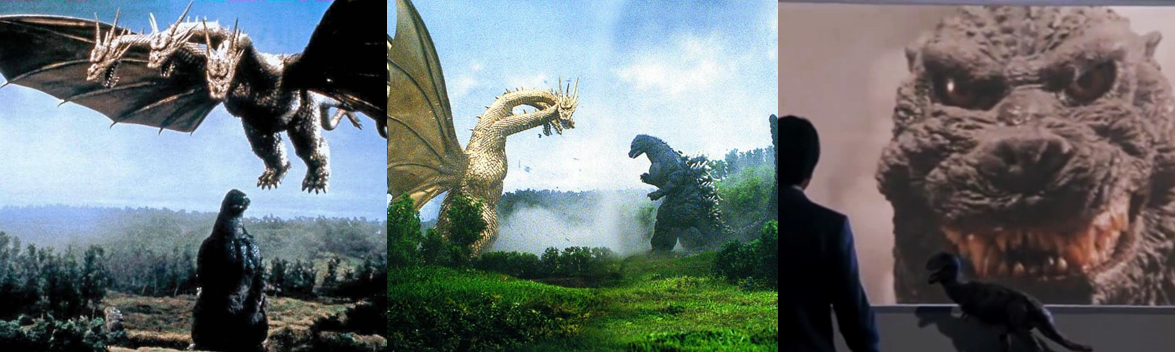
A bigger, more violent Godzilla defeats King Ghidorah and then turns on Japan!

When Terasawa and the others return, expecting to face a more prosperous future without Godzilla (…though everyone still remembers Godzilla in another example of the film’s inconsistent time travel mechanics), they find Japan under attack by this three-headed mutate, the titular King Ghidorah. A screeching, golden-scaled, devil-like monstrosity, King Ghidorah mercilessly unleashes devastating lightning blasts upon Japan and the sight of it gliding through the skies and between skyscrapers is quite the nightmarish visage. Unrelenting and aggressive, King Ghidorah is controlled by the Futurians to wipe out Japan, which has actually become an economic superpower greater than the U.S., China, and even all of Europe. Feeling remorseful for her actions, and not wishing to see her home country annihilated, Emmy reveals the truth to Terasawa but their attempts to stop the government kick-starting the Godzillasaurus’s transformation into Godzilla with Shindo’s secret nuclear submarine fail when they’re intercepted by M-11. Thus, over forty minutes into the film, Godzilla and its iconic theme tune finally make an appearance as a newer, far bigger and far more hostile version of Godzilla is near-instantly created when it also absorbs the radiation from a crashed Russian submarine. It immediately clashes with King Ghidorah but not out of any sense of duty or to protect Japan as Shindo believes. This is purely a clash of territory and pride and Godzilla has no qualms about destroying parts of the city, and even obliterating Shindo himself, with its destructive atomic breath. Oddly, the two are said to be evenly matched, despite the fact that this new Godzilla is also said to be far more powerful than before thanks to being born from modern nuclear weapons. Godzilla thus topples its rival and lays waste to Tokyo, leaving Japan’s survival in the hands of Emmy and M-11, who jump to the future to augment King Ghidorah’s corpse and defend Japan against their violent attacker.

The Nitty-Gritty:
I mentioned up top that I purposely chose to watch the dubbed version of Godzilla vs. King Ghidorah. This is always my go-to viewing option for foreign-language films but it can’t be denied that the dubbing is pretty atrocious throughout the film, especially whenever the Futurians are speaking. Godzilla movies have always been deeply entrenched in the fallout from World War Two; the kaiju owes its existence to the War and is pretty much always surrounded by allegory of the dangers of conflict and nuclear power. However, it’s rare that a Godzilla movie actually tackles the Second World War directly and I believe that Godzilla vs. King Ghidorah was the first film in the franchise to actually depict events from the War and so many veterans from the conflict as being central to its story. Here, the U.S. is depicted as an invading, hostile force that overwhelmed the Japanese with ceaseless aggression. Though some American troops wish to see the conflict end, they do so under the shroud of victory for the stars and stripes rather than a more generalised end to the death and fighting. The Japanese forces are mercilessly cut down by their better equipped enemy and their final assault against the U.S. troops is framed as a brave and noble suicide run for the glory of the “motherland”, which is definitely a different perspective on the conflict and helps to humanise the Japanese forces.
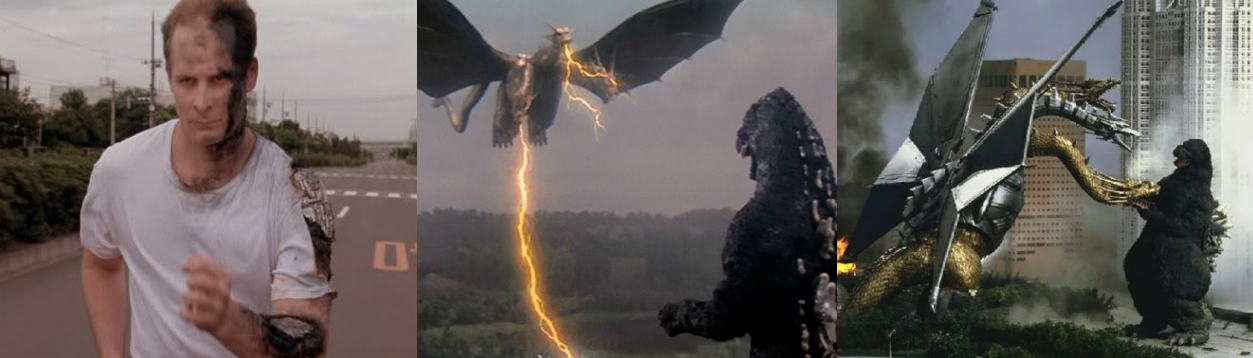
While M-11 and the sci-fi effects look terrible, the suitmation scenes are explosion fun!

One of the major appealing factors of these Godzilla movies has always been the “suitmation” and practical special effects. Godzilla vs. King Ghidorah continues to evoke the Gerry Anderson aesthetic in its models, water scenes, and especially when depicting the UFO, which flails about unconvincingly compared to the awesome rubber kaiju suits. The UFO delivers such dated and questionable effects as a beaming technique and hologram effects that would put Star Trek: The Original Series (1966 to 1969) to shame and evokes the same concern and environmental message (and special effects) seen in The Day the Earth Stood Still (Wise, 1951), and offers a knock off of Skynet’s finest infiltrator units in M-11. Exhibiting superhuman strength, speed, and durability in ways that would make Colonel Steve Austin (Lee Majors) cringe, M-11 is perhaps their greatest weapon outside of their impressive teleportation device, which instantly transmits objects across both time and space. Thankfully, the film doesn’t rely on these dodgy optical effects and the rubber suits are soon out in full force. King Ghidorah is one of the franchise’s most technically impressive monsters, a combination of a man in a suit, animatronics, and puppetry that cuts through the sky, stomps around on elephantine feet, and constantly spews crackling electricity. Though far bigger and subjectively more powerful than Godzilla, King Ghidorah is hampered by the humans that control it, meaning it goes wild once Terasawa, Emmy, and the reprogrammed M-11 storm the Futurian time ship in a laser pistol fight. This allows Godzilla to blast off one of King Ghidorah’s heads and send it crashing into the ocean, leaving this aggressive and unfriendly Big G to rampage through Tokyo unopposed.
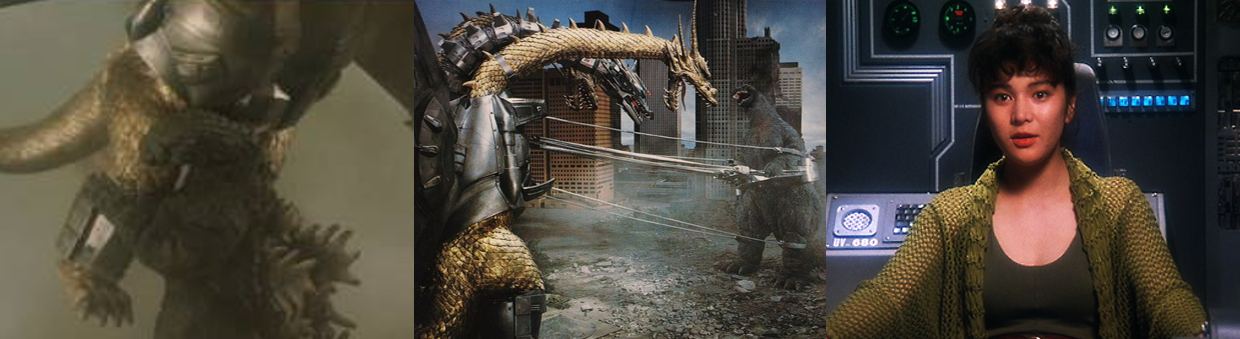
After a brutal scuffle, Mecha-King Ghidorah anti-climatically defeats Godzilla.

With Godzilla’s personality and aggression fundamentally altered and heightened, Japan has no hope of fending off her attacker with either conventional weaponry of the JSDF’s high-powered energy beams. Godzilla simply shrugs off attacks, topples skyscrapers and landmarks, and obliterates everything with its unmatched atomic breath. However, after a jaunt to the future, Emmy comes back piloting the cybernetically-enhanced corpse of King Ghidorah and battles with Godzilla to protect her beloved country. The humans we’ve been following become completely obsolete in this climatic and action-packed finale, which sees Grenchiko and Wilson atomised and the fate of Japan in the hands of Emmy and Mecha-King Ghidorah. Thus, the finale comes down to a rare case of a human piloting a mechanical kaiju-destroying creature rather than two wild monsters going at it. However, while Mecha-King Ghidorah is bolstered by future technology and armour, this new Godzilla is more powerful and aggressive than ever. It easily withstands Mecha-King Ghidorah’s boosted lightning and relentlessly attacks with its atomic breath, forcing Emmy to take a different approach, at great risk to herself. She grabs Godzilla in mechanical clamps and flies it to the ruins of Tokyo, dumping it in the sea. Though Mecha-King Ghidorah is destroyed, Emmy survives and reveals that she’s Terasawa’s ancestor (making the subtle attraction and flirtation between them a little awkward) before returning to the future. However, Godzilla soon reawakens at the bottom of the ocean but decides it would rather stomp away than resume its attack, making for an anti-climatic finish as it’s always disappointing when Godzilla is simply tossed aside rather than actually defeated.

The Summary:
I’m massively biased towards Godzilla vs. King Ghidorah since it was the first Godzilla movie I ever saw and got me hooked on the franchise, and there’s a lot to like here. The suits and monster-on-monster action are big, detailed, and very action-packed. King Ghidorah, especially, had never looked better prior to this film. While its design is a little clunky and bizarre since it lacks arms, its three heads, incessant screeching, and explosive lightning make for a formidable threat and it was pretty cool seeing it come back augmented with futuristic technology as Mecha-King Ghidorah. Godzilla is also pretty great in this film; while it takes a long time for it to show up, we get a revised origin for the kaiju and a return to its more aggressive personality as time travel shenanigans see it reborn as a hostile creature more akin to its original depiction. It is absolutely relentless in its rampage, spewing atomic breath all over the place and appearing more terrifying and formidable than ever. Sadly, the kaiju action takes way too long to kick in, leaving us with this bizarre time travel plot that’s full of temporal anomalies and reduces King Ghidorah to a puppet of these pantomime-like villains whose cringe-worthy lines and personality rob them of any menace. It was interesting, if a little unorthodox, to depict scenes from World War Two and explore an alternative origin for Godzilla, but the poor attempts to copy from better, big-budget science-fiction films really handicaps the overall plot. I feel like Godzilla vs. King Ghidorah overcomplicates and overstuffs things, making its human characters more inconsequential than usual as they don’t really get much to do except be stunned and betrayed. Also a disappointment is the film’s finale, which simply sees Godzilla dumped into the ocean…which is where it generally lives anyway so I’ll never understand how this is supposed to defeat it. Still, when the kaiju are actually going at it and when the dubbing is at its exaggerated best, the film is very enjoyable, but it does a drag a bit as the plot trips over itself to limp towards the titular clash of these two long-standing rivals.

My Rating:

Rating: 4 out of 5.

Great Stuff

What did you think to Godzilla vs. King Ghidorah? How did you feel about its time travel plot and the changes made to Godzilla’s creation? Did you like King Ghidorah’s revised origin and what did you think to Mecha-King Ghidorah? Were you also disappointed by the film’s inconsistent and nonsensical time travel shenanigans and poor attempts to rip-off other sci-fi films? What is your favourite Godzilla movie and why? How are you celebrating Godzilla Day this year? Whatever your thoughts on Godzilla vs. King Ghidorah, or Godzilla and kaiju films in general, feel free to leave them below.


Movie Night [Godzilla Day]: Ghidrah, the Three-Headed Monster


Toho’s famous atomic beast, and easily the most recognisable kaiju in the entire world, Gojira first emerged to wreck the city of Tokyo on this day all the way back in 1954 and, in 2016, the day was subsequently declared “Godzilla Day”.


Released: 20 December 1964
Director: Ishirō Honda
Distributor: Toho
Budget: Unknown
Stars: Haruo Nakajima, Yosuke Natsuki, Shoichi Hirose, Akiko Wakabayashi, Masanori Shinohara, and Takashi Shimura

The Plot:
An alien prophetess (Wakabayashi) predicts catastrophic attacks from Godzilla (Nakajima) and Rodan (Shinohara), leading to Mothra intervening to defend humanity. However, when the hydra-like space dragon King Ghidorah (Hirose) appears, the warring kaiju must set aside their differences to battle this devastating new foe.

The Background:
6th August 1946. The height of the Second World War. The Americans dropped two nuclear weapons on Hiroshima and Nagaski, killing tens of thousands of people and forcing the Japanese Imperial Army to surrender. The radioactive fallout saw thousands more dying, and post-war Japan was gripped with nuclear fear, a fear that birthed Gojira, the living embodiment of nuclear destruction. However, soon after this debut in Godzilla (Honda, 1954), the King of the Monsters turned from Japan’s destroyer to its reluctant saviour, defending the country from other kaiju attacks as a matter of principal. Following the commercial success of Godzilla’s last two movies, Ghidrah, the Three-Headed Monster was rushed into release; it included the return and redesign of fellow kaiju Rodan after a nearly ten-year absence, a recycled Mothra animatronic with marginal changes, and Toho’s most complex kaiju yet, the three-headed dragon King Ghidorah. Arguably Godzilla’s greatest nemesis, King Ghidorah was conceived by Godzilla creator Tomoyuki Tanaka and inspired by the Lernaean Hydra and the Orochi of Japanese folklore, and its debut feature was so successful that it reappeared in Toho’s next giant-monster film the following year.

The Review:
Our story opens with reporter Naoko Shindo (Yuriko Hoshi) visiting a communications centre that’s trying to contact extraterrestrials. Headed by their resident expert (Someshô Matsumoto), they truly believe that “flying saucer people” are out there, and wary of non-believers, so much that Naoko’s scepticism is blamed for their failure to communicate with the aliens. For a group of presumed scientists and academics, they’re oddly fanatical about this; since the world is experiencing an unseasonable heat wave, they’re concerned that a catastrophe is looming and believe the saucer people are their only chance of salvation and find Naoko’s ditzy disinterest to be insultingly narrow-minded…even though she’s simply there to do a job and desires proof. You know, the kind of evidence scientists strive to gather. A small meteor shower interrupts their meeting and draws Naoko’s friend, Professor Murai (Hiroshi Koizumi), and his team to investigate. They discover a large cocoon-like meteor that randomly emits magnetic waves and leaves them baffled. Naoko’s brother, Detective Shindo (Natsuki), likes to tease Naoko about her friendship with Murai; although grown adults, they still bicker like children, and she doesn’t appreciate his remarks or him getting in the way of her career. Shindo is stunned when he’s assigned to protect the visiting Princess Salno of Selgina (Wakabayashi), who’s facing assassination from her ruthless uncle (Shin Ôtomo), who desires her throne. Shindo is even more stunned when Salno appears to be killed when her plane explodes and she crops up as a doomsaying Prophetess who claims to be from Mars and warns that the world faces impending doom unless humanity changes their ways and takes better care of the environment, much to the jeers and doubts of the public.

Shindo and his sister are caught up with a mysterious woman who claims to be from Mars!

Assuming that Salno faked her death to escape her uncle’s assassin (Hisaya Ito), Shindo volunteers to bring her into protective custody, causing a brief conflict when he finds Naoko shielding her in hopes of getting an exclusive story. Drawn from her plane before the explosion by a disembodied alien presence that possesses her, psychiatrist Doctor Tsukamoto (Shimura) later reveals that the Prophetess is just one of a displaced, highly advanced alien race that fled to Earth and assimilate themselves into humanity, losing many of their fantastic abilities in the process, when the Red Planet was decimated by Ghidrah. One of the deadpan Prophetess’ remaining abilities is the ability to predict pending disasters that are repeatedly mocked and ignored; she warns people away from Mount Aso, where the prehistoric kaiju Rodan emerges from the volcano, and advises the fairy-like Shobijin (Emi and Yumi Itō) not to sail home to the benevolent Mothra on Infant Island, which they heed and are thus spared a violent death from Godzilla’s atomic breath. Despite the looming kaiju threat, the assassin and his cohorts continually hound the Prophetess, determined to kill her as per their orders, in a bizarre side-plot that honestly distracts from what we’re all here to see (but I guess it makes a change from following a soldier or a reporter as these films often do). Even with the three kaiju battling in the foreground, the assassin tries to complete his mission and yet somehow misses the easiest kill shot in the world! Although Shindo rushes to her aid and a brief firefight ensues, the assassin is ultimately crushed under falling rocks from the kaiju battle. In all the chaos, Shindo is wounded from a bullet and the Prophetess takes a grazing shot to the head and a nasty fall that conveniently sees the alien presence driven from her body…

Mothra is asked to unite rivals Godzilla and Rodan when Ghidrah goes on a rampage.

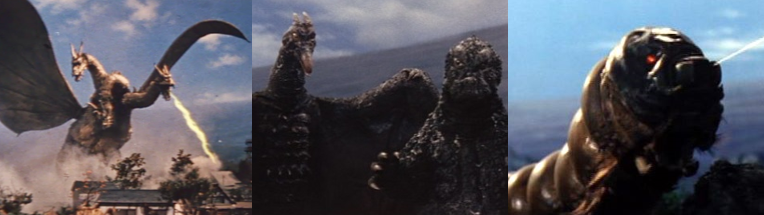
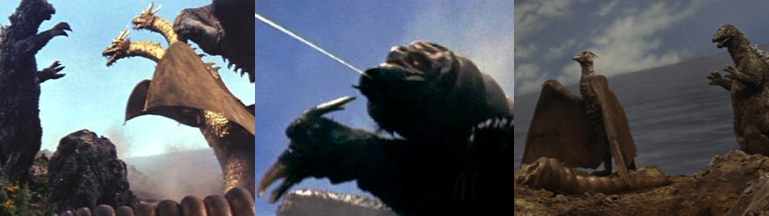
By this film, kaiju are well established; despite them slumbering for great lengths of time and occasionally defending humanity, they’re generally regarded as unpredictable and dangerous. One of the most popular and benign is Mothra, who’s such a celebrity that his fairy companions appear on television to reveal that one of the Mothra larvae has died since the previous film and that the remaining larvae is worshipped as a God. Sadly, for a film that boasts four kaiju, it takes ages to see them onscreen, and over forty minutes for Godzilla to show up! Even worse, although Godzilla’s clearly enraged at Rodan’s presence and they awkwardly exchange blows, the film initially focuses on dull political debate and fades to black right as things are getting interesting. The meteor eventually yields the most visually striking aspect of the film, and Godzilla’s greatest nemesis, the titular Ghidrah, a three-headed dragon covered in golden scales. With the Japanese military refusing to employ atomic weapons, they turn to the Shobijin to plead for Mothra’s help. Unfortunately, the fairies admit that Mothra alone isn’t strong enough to battle Ghidrah and the only hope for victory is for the larvae to convince Godzilla and Rodan to team up against the demonic dragon. It takes some time for Ghidrah to cross paths with its foes; until then, the focus is on Godzilla and Rodan, who battle furiously with neither one having a clear advantage (Rodan’s fight allows it to keep Godzilla off-balance and even pick him up and dump him on some power lines, but Godzilla’s functionally indestructible and simply grows more enraged the longer the fight rages on). Their pig-headedness means Ghidrah causes havoc unopposed by either the kaiju or the miliary; indeed, the military don’t even mobilise their tanks or planes to engage Ghidrah and, instead, the ineffectual government places all their faith in Mothra and his desperate plan to join forces with Godzilla and Rodan.

The Nitty-Gritty:
You may have noticed a few inconsistences in my review; these are due to me watching the English dub, which has the Prophetess and her people originate from Mars rather than Venus, pronounces and spells Ghidorah’s name differently and drops its regal title, and changes the traditionally female Mothra to a male. While some purists may argue that the original Japanese audio and English titles are superior (and they’re often right), I usually always go with the dubbed version just to make things easier and because of the often-hilarious line delivery. The film contains an environmental message that echoes sci-fi classic The Day the Earth Stood Still (Wise, 1951); decades before global warming was the hot buzz word, Ghidrah, the Three-Headed Monster warns about such disastrous concerns as climate change and global warming. The Prophetess foretells that humanity is doomed if they don’t change their ways, but this message falls a little flat as her warnings are not actually about mankind directly and instead refer to the monstrous kaiju that threaten their world. While technically these creatures (with the exception of Ghidrah) could be said to be man-made, given they were mutated by radiation and such, they’re usually always more depicted as a force of nature. Godzilla, especially, is usually always the embodiment of nature’s wrath and man’s hubris taking destructive revenge upon the world, so it’s a little weird to say “you’re dooming yourselves” when actually you mean “a big-ass alien monster’s gonna wreck shit”.

The film is definitely ambitious with its suit effects, though maybe a little too ambitious at times.

Although it takes forever for Godzilla to finally make an appearance, he’s as impressive as ever; while the suit is bulky and incapable of blinking, it’s always a joy to see Godzilla trampling model buildings as people flee in terror. Emerging from its cocoon in a shower of sparks and animated lights, Ghidrah makes for an intimidating foe with its three screeching heads and chaotic lighting blasts; like Rodan, Ghidrah devastates everything in its path with a supersonic crash and, like Godzilla, it emits destructive energy beams, but in the form of wild and crackling lightning. Unfortunately, it does look incredibly ungainly with its bulbous body and lack of arms; while its three dragon-like heads go some way too make up for this handicap, biting and attacking with malicious intent, they also look a bit dodgy flopping and flailing all over the place and I really do think Ghidrah would be even more threatening if it had arms and talons to grab and attack with and just make its body look a little less comical. Unlike their counterparts, Rodan and Mothra are far less versatile and clunky; Rodan may still be a man in a suit but his flying scenes are realised through obvious wires and a powerful wind machine, while Mothra is purely a partially animatronic creature that bumbles about the place spitting silly string because, maddeningly, the filmmakers decided to keep Mothra in his larvae form rather than utilise the more visually interesting (if equally restrictive) moth form. Rodan’s flying scenes are, admittedly, pretty ridiculous; I admire the filmmakers for trying to inject some variety with their kaiju designs and have always had a soft spot for Rodan, but it’s laughable seeing the static model being strung along on wires (alongside a jet engine sound effect) and bashing into Godzilla. Godzilla still uses his atomic breath rather than a destructive beam of energy, meaning both are noticeably weaker than I’d usually expect from the King of the Monsters; Rodan can take the breath at point-blank range and even comically disorientates Godzilla by pecking him repeatedly in the head!

Eventually the three kaiju come together to scare Ghidrah off with ridiculous ease.

Honestly, the fight between Godzilla and Rodan is pretty ridiculous thanks to the filmmakers just being a little too ambitious; Rodan flies about, pecks at Godzilla and its tail, and pushes the Big G back with powerful wind blasts, and Godzilla mostly flails his little arms, whacks Rodan with his tail in a glorified slap fest, and sends rocks flying at his foe that fail to hit with any convincing impact. The two even play dead man’s volley with the boulders, which is presented as two Apex Predators looking to prove their might, and they’re only subdued when Mothra tangles them up in silly string to plead for their co-operation. The Shobijin are on hand to translate; despite their differences, Godzilla and Rodan agree that they have nothing to gain from helping humans and have no interest in getting involved and would rather fight each other. However, the two quickly change their minds when they see Mothra bravely taking on Ghidrah alone and be easily overwhelmed by its lightning bolts. Not that Godzilla or Rodan initially fare much better; Godzilla gets blasted into a bridge and engulfed in raging flames and Rodan injures itself more than its monstrous foe when it knocks Ghidrah out of the air. With Rodan forced to take cover from Ghidrah’s lightning, Godzilla literally drags Mothra back into the fray and goes back to his tried-and-true strategy of chucking and kicking rocks and gets blasted in the crotch for his troubles! Eventually, Godzilla, Rodan, and Mothra come together as best as they (and their cumbersome suits) allow to overwhelm Ghidrah; Godzilla wrestles with it, absorbing the brunt of its attacks, while Mothra nips at its tail and engulfs it with String Shot while being carried on Rodan’s back. Somehow, this is enough to force the hydra to flee, bringing the battle to an anti-climatic end. In the aftermath, Princess Salno exhibits no memories of her time as a Martian beyond a lingering gratitude for Shindo and Mothra heads back to Infant Island with the Shobijin, bidding a fond farewell to his new allies, who have set aside their grievances.

The Summary:
Geez, I may apologise for Godzilla movies a lot and cut them some slack, but this was a pretty awful movie to sit through! The tone is all over the place, emphasising the importance of respecting the world and avoiding global disaster on one hand and then having slapstick kaiju violence the next. While Ghidrah may look intimidating and is depicted as a crazed, destructive alien beast, it’s defeated with a pathetic amount of ease; the film makes a big deal about how Mothra isn’t strong enough to defeat the creature, yet all Godzilla does is hold it still and all Rodan does is carry Mothra so he can string it up! The bulk of the monster madness is focused on Godzilla and Rodan, which would be fine if the fights weren’t so laughably bad! This is only Godzilla’s fifth movie so I understand that all the kinks weren’t figured out yet, and I get that there’s only so much you can do with puppets and suitmation, but maybe the filmmakers should’ve set their goals a little lower and simply focused on Godzilla battling with Mothra and left Rodan out of this since it really didn’t do much against Ghidrah that couldn’t have been accomplished without it. The film also spends way too much time focusing on this batshit crazy Martian presence, or whatever, when it should’ve been focused on the mystery of the glowing meteor. I would’ve skipped the Prophetess and incorporated her environmental message into Shindo, rewritten him to be a scientist investigating the meteor, and had Naoko cover the emergence of the kaiju. Again, I get that we need to follow human characters, but they dominate the film’s runtime and just aren’t very interesting, especially compared to what should’ve been an epic assembling of four bad-ass kaiju with the fate of the Earth at stake. Instead, I never felt like humanity was threatened by Ghidrah and the kaiju action was severely lacking due to the imitations of the suits, meaning Ghidrah’s big debut film ended up being a dull and ultimately forgettable experience for me.

My Rating:

Rating: 2 out of 5.

Could Be Better

What did you think to King Ghidorah’s debut film? Were you also disappointed by the bonkers human sub-plot, or did you enjoy the alien narrative? What did you think to the build up to King Ghidorah’s appearance and powers? Did you also find the kaiju battles lacking? Which incarnation of King Ghidorah is your favourite? What is your favourite Godzilla movie and why? How are you celebrating Godzilla Day this year? Whatever your thoughts on Godzilla and King Ghidorah, feel free to leave a comment below and be sure to check out my other Godzilla and kaiju reviews across the site!

Movie Night: Godzilla: King of the Monsters

GodzillaLogo

Released: June 2019
Director: Michael Dougherty
Distributor: Warner Bros. Pictures
Budget: $170 to 200 million
Stars: Kyle Chandler, Vera Farmiga, Millie Bobby Brown, Charles Dance, and Ken Watanabe

The Plot:
Five years after Godzilla first revealed himself, the covert organisation Monarch has been studying other “Titans” around the world. However, when rogue MI6 agent Alan Jonah (Dance) plots to unleash the Titans to reshape the world, Monarch must fight alongside Godzilla to defend the planet.

The Background:
After a watered down showing in Godzilla (Emmerich, 1998), Godzilla (Edwards, 2014) reintroduced Toho’s classic kaijū creature to a worldwide audience but was far from the fast-paced, action-orientated giant monster movie I was expecting. Rather than take inspiration from some of the later Godzilla films or even from Pacific Rim (del Toro, 2013), Godzilla drew more from Cloverfield (Reeves, 2008) and Edwards’ own Monsters (2010), preferring subtly and atmospheric build up rather than full-on monster action. After making over $500 million from a $160 million budget, a sequel was inevitable and, after King: Skull Island (Vogt-Roberts, 2017) set the stage for the introduction of more of the classic Toho kaijū creatures, the stage is set for Legendary Pictures’ Monsterverse.

The Review:
Godzilla: King of the Monsters
is a massive film (no pun intended); without wasting any time at all, we are immediately thrown into a world where giant creatures (known as “Titans”) are lying dormant throughout the world under the supervision of Monarch. The world is waiting anxiously for the next Titan emergence, unsure which are here to protect us and which are there to destroy us; this is tied in closely to one of the many protagonists that features in this movie, Dr. Mark Russell (Chandler), whose son died during a battle between Godzilla and an unnamed Titan.

GodzillaJonah
Charles Dance steals every scene he’s in.

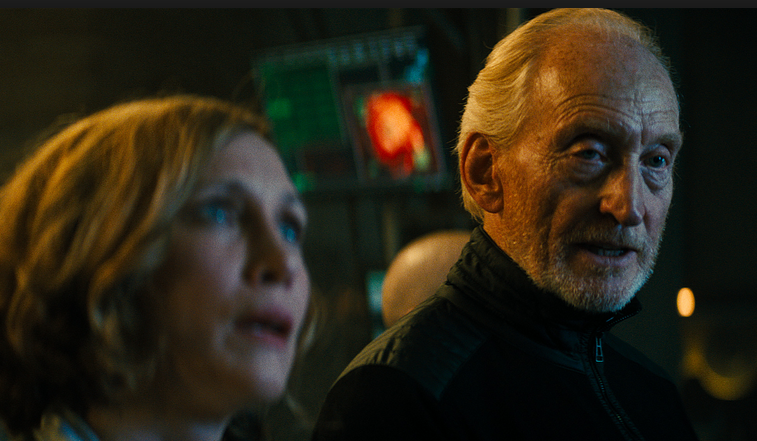
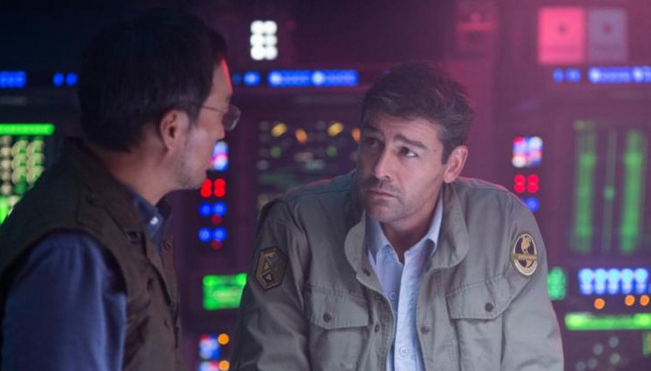
While Russell is therefore very much against Godzilla and all Titans, his estranged wife, Dr. Emma Russell (Farmiga), who has developed a machine (known as the ORCA) that can analyse and emit Titan sound patterns. Alongside their daughter, Madison (Brown), Emma uses the ORCA to awaken and calm the mythical Mothra but they are abducted by the renegade eco-terrorist Alan Jonah (Dance), who wants to use the ORCA to awaken all of the Titans and destroy the world so that the scourge of humanity can be cured.

GodzillaHumans.PNG
As always, humans detract from the monster action.

Like all Godzilla movies, King of the Monsters is let down by its human characters; there are a lot of human characters in this film and I can’t say that I was massively interested in any of them apart from Jonah and the returning Dr. Ishirō Serizawa (Watanabe), both of whom could have easily been featured more prominently in the movie. The family drama between the Russells is nothing you haven’t seen before and contains some truly baffling twists that leave you scratching your head every time the characters stop to spout their exposition.

GodzillaRodan.PNG
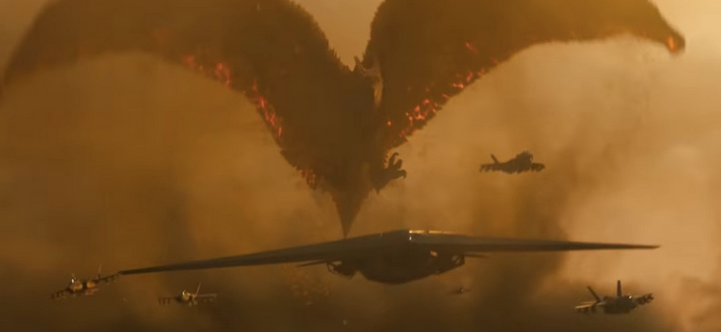
Rodan makes a triumphant return to cinema screens.

However, Godzilla movies are always really about one thing: massive monsters wrecking shit and fighting each other. While Godzilla featured the titular character sparingly, which was frustrating for me as a big Godzilla fan but a pretty good introduction to the character for audiences who had never experienced him before, King of the Monsters features him very heavily; now, though, Godzilla has to share screen time with three other Titans that will be familiar to any fan of the franchise: Mothra, Rodan, and King Ghidorah. King of the Monsters also features a truly epic soundtrack; the classic Godzilla theme is back, bringing a real ominous menace to Godzilla (despite him being a purely heroic character in the Monsterverse), and the classic Mothra theme and song gets featured as well, and the sound and music really helps ramp up the tension and the action in the movie.

GodzillaGhidorah.PNG
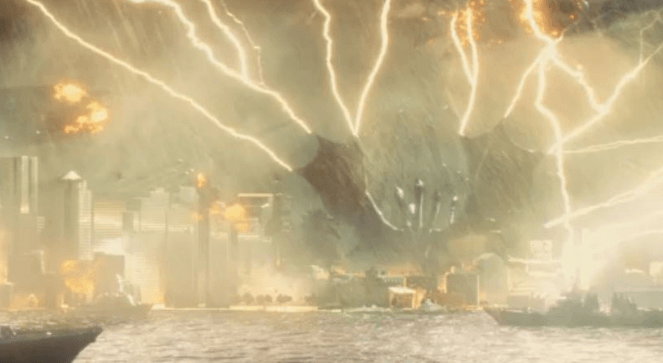
King Ghidorah isn’t here to play games!

Seeing Mothra, Rodan, and King Ghidorah onscreen is amazing and their effects look spectacular; it would just be nice to see them in either full day light, as in Kong: Skull Island, or at least lit up by anything other than a film tint or lightning. King of the Monsters also features a truly epic soundtrack; the classic Godzilla theme is back, bringing a real ominous menace to Godzilla (despite him being a purely heroic character in the Monsterverse), and the classic Mothra theme and song gets featured as well, and the sound and music really helps ramp up the tension and the action in the movie. While the film features far more monster-on-monster battles than its predecessor, it still falls back on the tired trope of these battles taking place at night, in the rain, in the sea, or otherwise somewhat obscured by other plot elements. One nice change, though, is that the human characters are usually right there in the middle of the action so it makes sense to cut back to them and the film never awkwardly and abruptly cuts away from its kaijū action like its predecessor.

The Nitty-Gritty:
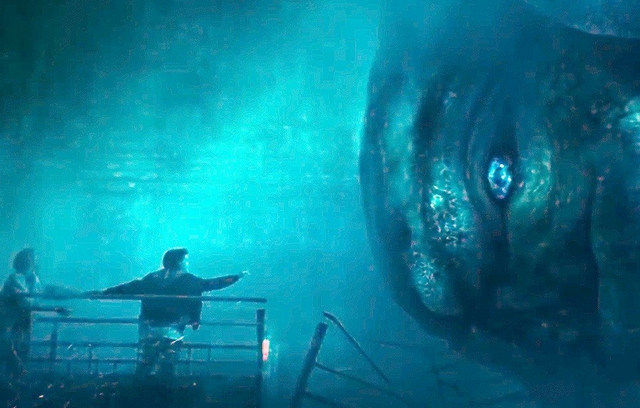
It’s a Godzilla movie, so you know he’s going to wreck some serious shit and the trailers already showed that he battles Mothra, Rodan, and King Ghidorah. What wasn’t really shown, though, was that there are apparently seventeen Titans across the world, all of which get awakened in this movie but we only really focus on a handful of them. The movie makes many mentions of King Kong and Skull Island to set up the upcoming Godzilla vs. King Kong movie but Kong doesn’t actually appear in any meaningful way here; the other Titans we do see appeared to be original creations to me (one seems to be another MUTO, one is a giant woolly mammoth, one is a giant crab…), which was a little disappointing but then I guess it makes sense to not showcase all of the classic kaijū without a proper introduction. King of the Monsters has some nice throwbacks to previous Godzilla movies; for the bulk of the movie, King Ghidorah is referred to as “Monster Zero”, the Navy uses an Oxygen Destroyer missile to try and kill Godzilla and King Ghidorah, Godzilla ends up needing to be resurrected by a nuclear bomb and takes on a version of his “Burning Godzilla” form (like in Godzilla vs. King Ghidorah (Ōmori, 1991) and Godzilla vs. Destoroyah (Okawara, 1995), respectively), and the movie is basically a remake of Ghidorah, the Three-Headed Monster (Honda, 1964).

GodzillaMothra
Titans are lying dormant across the globe.

Emma turns out to actually be allied with Jonah, which started as a surprising betrayal and then very quickly descended into a nonsensical decision. Like Jonah, she believes that humanity needs to be culled by the Titans so the that world can flourish and recover from pollution and overpopulation and all that usual stuff but, unlike Jonah, you never really feel that she has the same conviction or basis for this belief. I honestly believe the movie would have worked better if Jonah had killed Emma to obtain the ORCA and simply taken Madison hostage, then we could have delved a bit more into Jonah’s twisted world view without having Emma there to make the whole thing seem crazier than it actually is. Aside from this, the Oxygen Destroyer fails to kills King Ghidorah because he’s actually an alien life form and not of the Earth’s natural order; it does, however, appear to kill Godzilla, which allows King Ghidorah to awaken all of the Titans at once and compel them to rampage across the globe. Monarch tracks Godzilla to his radioactive undersea refuge, planning to use a nuke to kick-start his recovery, and Serizawa willingly sacrifices himself to set off the bomb and bring Godzilla back to full power. Godzilla’s emergence following this is truly epic and, for a moment, seems like he may have turned against humanity but, no, he instead uses his newfound strength to team up with Mothra against King Ghidorah and Rodan for a massive final battle.

GodzillaGodzilla.PNG
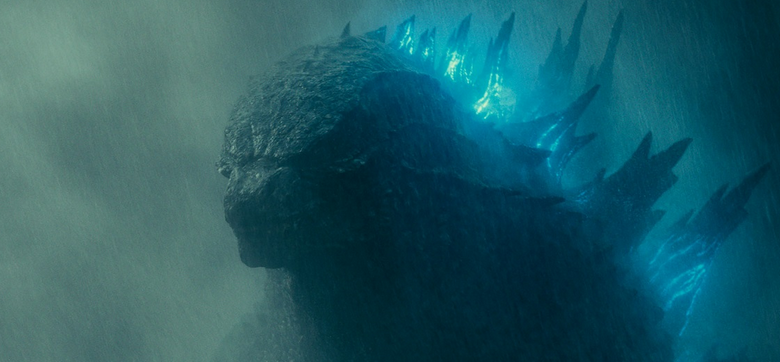
Though obscured by nigth and rain, Godzilla is still impressive to look at.

If you know anything about Godzilla movies and Mothra, you already know that Mothra dies in this battle; seriously, Mothra always dies, generally to transfer her power to Godzilla or to inspire Godzilla to battle and it’s no different here. Godzilla is able to destroy King Ghidorah using its out of control nuclear power (which looked, for a moment, like he was going to meltdown as in Godzilla vs. Destoroyah) and is hailed as the new king of the monsters by the remaining Titans. Over the credits, we get many mentions of another Mothra egg, earthquakes and disturbances on Skull Island, Jonah purchasing one of Ghidorah’s heads, and more Titans awakening across the globe to set up Godzilla vs. King Kong and future Monsterverse movies. Interestingly, the one criticism I have about this movie is that it might have made more sense to do Godzilla vs. King Kong here to help bridge the gap between Godzilla and Kong: Skull Island and do the big Godzilla, Mothra, Rodan, King Ghidorah showdown as the third movie as I find the idea that Kong can stand against Godzilla laughable, to be honest. I imagine that the movie will be more about a scuffle between the two Titans before they team up against more monsters escaping from the hollow earth but, my main concern, is that it’s hard to top King Ghidorah, who is Godzilla’s biggest foe….maybe they’ll do Destoroyah though…

The Summary:
If you were disappointed by the lack of monster action in Godzilla, then Godzilla: King of the Monsters is the movie for you. If you dislike human protagonists taking away from giant monster battles, then Godzilla: King of the Monsters may still disappoint but it is inevitable and unavoidable for movies like this to have human plots alongside their monster action. For a movie like Godzilla: King of the Monsters, it’s best to switch your brain off and go along for the ride as, in the end, all that matters is that giant monsters are waking up and Godzilla has to fight them to defend the world and, when it comes to monster-on-monster battles, Godzilla: King of the Monsters has you covered.

My Rating:

Rating: 4 out of 5.

Great Stuff