Movie Night [K-DAY]: Tremors


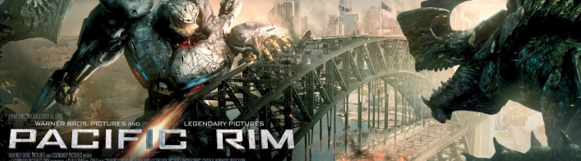
In the absolutely bonkers science-fiction film Pacific Rim (del Toro, 2013), the monstrous Kaiju first attacked humanity on 10th August 2013. The attack ended a few days later on August 15th but, in that time, San Francisco, Sacramento, and Oakland were completely devastated and the Kaiju War officially began. Accordingly, August 10th became known as “K-DAY” and is, for me, a fantastic excuse to talk about some giant monster movies!


Released: 19 January 1990
Director: Ron Underwood
Distributor: Universal Pictures
Budget: $10 million
Stars: Fred Ward, Kevin Bacon, Finn Carter, Bobby Jacoby, Tony Genaro, and Michael Gross

The Plot:
Tired of their dull lives, handymen Earl Bassett (Ward) and Valentine “Val” McKee (Bacon) plan to leave the small desert town of Perfection, Nevada. However, they happen upon a series of mysterious deaths and a concerned seismologist, Rhonda LeBeck (Carter), studying unnatural readings below the ground that are soon revealed to be giant, prehistoric, worm-like monsters!

The Background:
While making safety videos for the United States Navy in the mid-1980s, screenwriters Brent Maddock and S. S. Wilson came up with the random idea of “land sharks” keeping them trapped on a large boulder. Another of their friends, Ron Underwood, used his knowledge as a documentary director for National Geographic to help them develop a believable creature for what would become the script for Tremors but it wasn’t until their script for Short Circuit (Badham, 1986) proved to be a commercial success that the film became a viable concept. Although star Kevin Bacon initially belittled the project and only signed on because he was broke, he later spoke highly of his time on set, his experience with co-star Fred Ward, and his desire to revisit the franchise. The Graboids were designed by Amalgamated Dynamics, including a full-scale creature made from lightweight foam and buried in desert to give it a used look. Though originally shot as an R-rated film, the filmmakers decided to make some cuts and changes to appeal to a wider audience. Unfortunately, this didn’t actually translate to the film’s box office; Tremors barely cleared $16 million in profit, which Maddock blamed on the mediocre marketing. Critically, Tremors fared slightly better; the balance between horror and comedy was praised, as was the B-movie feel of the film, and the entertainment value of the special effects and performances. Ultimately, Tremors birthed a surprisingly long-running franchise, that was comprised of multiple direct-to-video sequels, with Michael Gross becoming the series lead, a short-lived television series, and even an aborted attempt to return Kevin Bacon to the franchise in 2017.

The Review:
Tremors immediately establishes a few very important things right from its opening scene: first, we’re following a couple of blue-collar working men who have a brotherly banter that lends the film a comedic edge, and second that we’re stuck in the middle of nowhere in a dead-end town. Perfection is a small town surrounded by mountains that’s almost entirely self-sufficient; old Walter Chang (Víctor Wong) runs the only shop in town, Doctor Jim Wallace (Conrad Bachmann) acts as the town’s medical aide, and upstart Melvin Plug (Jacoby) spends his days lazing around and winding people up. There’s only a handful of people in town and not all of their characteristics and relationships are as easily defined as mother/daughter duo Nancy and Mindy Sterngood (Charlotte Stewart and Ariana Richards). For example, it’s unclear what Nestor Cunningham (Richard Marcus) or Miguel (Genaro) do or where Melvin’s family is, but everyone there looks after each other and works to provide some kind of service, even if they’re not always immediately clear.

Begrudging handymen Val and Earl find their big escape interrupted by subterranean monsters. 

Of course, this issue doesn’t apply to Val and Earl, two disgruntled local handymen who fill up their days taking out people’s trash, putting up razor wire and fences, and doing house clearances. Although Earl is the elder of the two, more seasoned and wiser to the ways of the world (and women), he’s just as bad as his young partner; the two share a fun, relatable banter, regularly playing rock/paper/scissors to decide who gets the shit jobs and accepting beer and lunches alongside payment for their jobs. The main differences between the two are that Earl is the more grounded and pragmatic and despairs of Val’s head-in-the-clouds mentality, especially when it comes to forethought and his opinions on women. Val has a very specific set of criteria for his women, preferring picturesque bimbos with low intelligence and little personality, whereas Earl believes he needs to be more realistic in his expectations. The two make a major contribution to the town, essentially maintaining the entire upkeep, and are renowned for being “best on a horse”, but Val and Earl are deeply unsatisfied with their lot in Perfection. They’re in underpaid, mediocre jobs and believe that they can strike it big by packing up and starting over in the nearest town, Bixby. There’s a sense that they’ve been threatening to leave for some time but they’re ecstatic to finally be taking the plunge and heading to a new life, only to stumble upon the dehydrated corpse of Edgar Deems (Sunshine Parker) atop an electrical tower and find themselves forced to stay in town as more bodies are found and a serial killer is suspected. The two leap into their truck to get help from Bixby since Perfection has no way of contacting anyone outside the valley, only to find their truck briefly hung-up on an incline and dragging a strange, snake-like creature back to town!
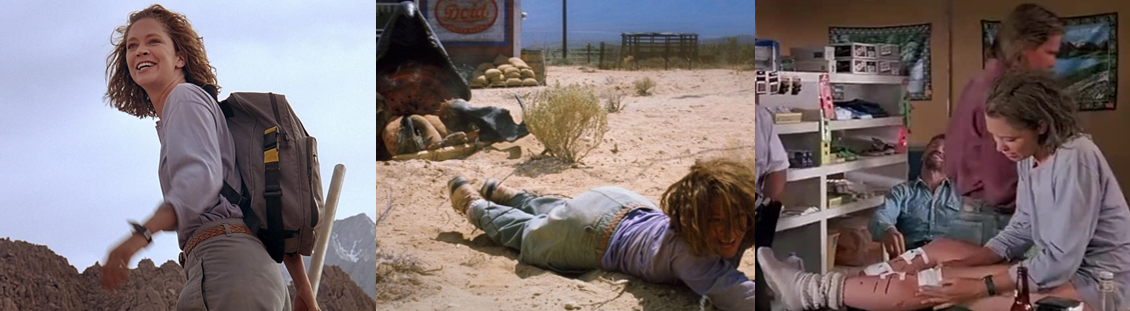
Seismologist Rhonda helps the locals to fight off the previously unheard of prehistoric creatures.

While out in the desert, Val and Earl come across graduate student Rhonda, who’s spending a semester investigating seismographs in Perfection and the surrounding area. Initially, Val is unimpressed by Rhonda, who doesn’t meet any of the criteria on his checklist, but Earl is eager for the two to spend more time together as she’s just the sort of down-to-earth young woman Val needs in his life. Rhonda’s research proves instrumental in discovering the extent of the threat lurking beneath the soil of Perfection, but even she is horrified to stumble across the duo with the corpse of a massive, carnivorous worm-like creature (later dubbed a “Graboid” by Chang and Melvin). Although she has no idea where the creatures came from or how they’ve remained undetected until now, a cursory investigation of the corpse allows her to deduce that Graboids are blind, hunt by sound, burrow using dozens of spiked appendages, and snag their prey with their mouth tentacles. Rhonda’s seismology readings reveal that three more of the creatures are lurking in the valley and she’s both captivated and terrified when she, Val, and Earl are stranded on rocks for most of the day and an entire night after narrowing escaping a Graboid. It’s during this impromptu marooning that Val and Rhonda first start to get closer; he gives her his jacket to keep her warm, helps her pole vault to her truck so they can escape back to town, and even tends to her wounds after she’s caught up in barbed wire. Although she’s hardly an expert, she’s the closest thing the townsfolk have but they struggle to process her instructions to stay quiet and stay high up. They’re more concerned with the who, how, and why of the creatures and only take their threat seriously when Graboids start bursting up through the ground and devouring their residents.

Survivalists Burt and Heather provide the firepower needed to repel the cunning Graboids.

While their main way of surviving is to take refuge on high ground, Perfection isn’t entirely defenceless; Burt and Heather Gummer (Gross and Reba McEntire) have built a veritable impenetrable war room just outside of town, one full of firearms as small as a pistol and as large as an elephant gun, alongside their all-terrain vehicle and homemade explosives. Survivalists who believe in being prepared, they settled in Perfection due to its perfect “geographic isolation” and are armed to the teeth for any impending disaster…except for “underground, god-damn monsters” and even then, they are the town’s best shot at fending off the Graboids and helping the survivors escape town. At first, Burt and Heather are unaware of the true extent of the threat as they’re out of town for the big reveal and are too busy crafting ammo to make heads or tails of Val’s frantic warnings, unwittingly luring a Graboid to their house. Luckily, despite the creature’s size and near-impenetrable girth, it ”broke into the wrong god-damn rec room” and is eventually blasted to death by Burt and Heather’s considerable weaponry. Although they’re unable to rescue the others when the Graboids disable their vehicle, they dig in and prepare weapons and ammo to fend off the creatures when Val successfully commandeers a heavy track loader to carry the survivors to safety. While he brings all their gear with them, Burt is clearly irritated at being driven from his home and deferring to Val and Earl’s expertise regarding the Graboids. Believing they stood a better chance making a stand in town where they had all the resources they needed to survive, Burt almost comes to blows with Val when the survivors are stranded on rocks and left to face starvation and dehydration just like Edgar. Luckily, Heather and Earl are on hand to be the voice of reason in their conflict, but Burt is clearly rubbed up the wrong way; though, ultimately, it’s his armaments that allow the displaced inhabitants to finish off the Graboids.

The Nitty-Gritty:
Tremors is a fantastic mixture of comedy, drama, action, and horror; it never takes itself too seriously and is clearly happy to be nothing more than an enjoyable monster movie with a budget. Every time Val and Earl are bitching about their lot in life, competing to see who’s making breakfast or arguing about their priorities for each day, it’s juxtaposed with some horrific visuals like the remains of Old Fred (Michael Dan Wagner) being found under his hat in a field of bloody patches that used to be sheep and the duo uncovering the buried remains of the doctor’s car. Tremors does a great job of building tension throughout the film, first by employing a sweeping first-person perspective that would make Sam Raimi proud and showing the slightest bulge of dirt in place of revealing the creatures too early, and then in using noise and silence to great effect. Since the slightest sound is enough to attract the Graboids, it’s wince-inducing to see the characters creep around and whisper to each other, scramble to unplug appliances, and when Mindy innocently goes pogo-sticking through town. Even when the survivors reach high ground they’re not entirely out of danger; the Graboids are big, strong, and surprisingly intelligent and co-ordinated, testing the fragile buildings for weaknesses and easily sucking down most vehicles and toppling flimsier structures.

The Graboids are brilliantly brought to life using tension, mystery, and impressive practical effects.

Of course, as great as the character interactions and banter are in Tremors, the big selling point of the film are the creatures themselves. Initially believed to be snake-like creatures, Val and Earl are stunned to find that these appendages are simply tongue-like tentacles belonging to the beak-like mouth of a far larger, more monstrous creature that’s so far beyond their comprehension that the townsfolk believe that they’re aliens or some kind of government experiment gone wrong (a “big surprise for the Russians”). Ultimately, their true origin is of no consequence and the characters quickly focus on how to survive, fight, and escape the creatures. Massive and impossibly fast due to their spiked appendages, the Graboids easily detect and chase down their prey, sucking them through the dirt and digesting them in the blink of an eye or lashing at them with their tongues like voracious anacondas. Creative camera trickery enables the film to build a great deal of effective tension for the Graboid’s first big reveal, which perfectly sets up the ending of the movie and a fatal flaw in the Graboid’s nature: they mindlessly charge after their prey and flee from intense sounds, such as explosions, since they’re painful to them. Stinking, ravenous creatures, the Graboids are impressive practical effects brought to life by puppets, animatronics, and composite effects to make them appear large and almost alien in design. When underground, they’re all-but immune to damage and the same is true when they emerge; it takes everything Val and Earl have to wrench their truck free from one of the creature’s tongues and an incalculable number of bullets for Burt and Heather to put just one down. Although formidable and with a seemingly unsurpassed patience (they’ll wait for days for their prey to simply die if need be), the Graboids are not invulnerable; they can be killed with a great deal of effort, tracked using Rhonda’s equipment, struggle to lift heavier objects or break through solid rock, and can be briefly scared away by dynamite charges.

Stranded and faced a slow death, the survivors dispatch the final Graboid and find a new lease of life.

However, the Graboids are unnervingly intelligent; when the survivors take refuge on their rooftops, the creatures circle the structures and attempt to shake them loose, leading Val and Earl to enact a desperate plan to use the track loader to carry their friends to the safety of the surrounding mountains. At first, this seems to work and the townsfolk make slow and steady progress away from town, only for them to end up falling afoul of a Graboid trap when they dig a trench to up-end the vehicle and strand the survivors on a small crop of rocks. With tensions running high and resources running low, Burt makes an off-beat remark about preferring suicide over starvation and inspires Val to try one last trick to take out the prehistoric wildlife. By tossing rocks and stones far from their position, they attract a Graboid and trick it into swallowing on of Burt’s lit explosives, blowing it into a stinky mess of orange chunks. However, the last remaining Graboid, “Ol’ Stumpy”, proves far smarter than its kin and simply spits the dynamite back out, leaving Val, Earl, and Rhonda stuck on the desert floor and facing instant death the moment they move. Reckless to the end, Val takes a chance and makes a run for it, using himself as bait to cause the Graboid to go hurtling to its death after being inspired by Earl’s earlier tall tales of being in a stampede. In the aftermath, Val and Earl hope to gain a level of fame from their experience and Rhonda prepares to build an academic career out of the creatures and start a new life with Val, who finally gives into the mutual attraction they built over the course of the film, much to Earl’s approval.

The Summary:
Many times, you’ll hear people talk about movies being “guilty pleasures”. However, Tremors isn’t one of them; I never feel guilty about watching and enjoying this hugely entertaining horror/comedy. The film is stuffed with wit and charm, from the brotherly banter between Val and Earl to Burt and Heather’s trigger-happy abrasiveness, to even one-dimensional supporting characters finding ways to stand out with either an abundance of personality or some cheesy, quotable lines. The premise is delightfully low-budget but is delivered in a way that recalls blockbusters like Jaws (Spielberg, 1975) in the use of tension, first-person shots, and the eventual reveal of an impressive animatronic monster that devours the cast one by one. The Graboids themselves are one of the most unique creatures to grace cinema; massive, yet scarily quick, blind and yet surprisingly versatile, and with a cunning and ravenous nature that makes them both ridiculous and terrifying at the same time. The visual of characters scrambling to reach higher ground or desperately trying to stay quiet really works, as does the rumbling of the ground and structures and the mystery surrounding the creatures. I liked how the characters were always struggling to fight back; even when they have the weapons, the Graboids don’t go down easy and they’re constantly forced to think on their feet to come up with ingenious, and hilarious, ways to dispatch and outsmart the voracious sand-worms. While I have a soft spot for some of the sequels, Tremors remains the best of the franchise thanks to the dynamic between Val and Earl and the simplicity of the creatures; the idea of being trapped for days and slowly dying of dehydration or hunger only exacerbates the Graboid threat, meaning you’re damned if you stay still too long and doomed if you try to move. I definitely feel like Tremors is often unfairly forgotten about; it’s absolutely a hidden gem in the monster movie genre and deserves a lot more attention than it gets. It’s a rollicking good time with a fantastic blend of gore, action, comedy, and horror that never fails to impress me no matter how many times I watch it.   

My Rating:

Rating: 4 out of 5.

Great Stuff

Are you a fan of Tremors? Did you enjoy the dynamic between Val and Earl? What did you think to the idea of sand worms terrorising a small, isolated town? Which of the supporting cast was your favourite and did you expect Burt to take on such a key role across the franchise? Do you enjoy the Tremors films and, if so, which of the sequels is your favourite What’s your favourite kaiju movie, and how are you celebrating K-Day today? Whatever your thoughts on Tremors, kaiju, or monster movies in general, please do leave a comment below or respond to my social media and be sure to check back in for more giant monster content in the near future!

Movie Night [K-DAY]: Pacific Rim


In this absolutely bonkers science-fiction film, the monstrous Kaiju first attacked humanity on 10th August 2013. The attack ended a few days later on August 15th but, in that time, San Francisco, Sacramento, and Oakland were completely devastated and the Kaiju War officially began. Accordingly, August 10th became known as “K-DAY” and is, for me, a fantastic excuse to talk about some giant monster movies!


Released: 12 July 2013
Director: Guillermo del Toro
Distributor: Warner Bros. Pictures
Budget: $180 to 200 million
Stars: Charlie Hunnam, Idris Elba, Rinko Kikuchi, Charlie Day, Robert Kazinsky, and Ron Perlman

The Plot:
In 2013, alien monsters dubbed Kaiju emerged from an interdimensional portal at the bottom of the Pacific Ocean. To combat these creatures, humanity built massive robots called Jaegers, which are mentally controlled by pilots, and sealed their cities behind gigantic walls. By 2020, the war has taken its toll and washed-up Jaeger pilot Raleigh Becket (Hunnam) is called out of retirement and teamed with rookie pilot Mako Mori (Kikuchi) as part of a last-ditch effort to defeat the Kaiju.

The Background:
Although Godzilla has proven to be the most famous kaiju creature ever created, the atomic monster is very much a creation of Japan and the West has struggled to really have a counterpart to the Big G; sure, King Kong came first and has significantly influenced cinema, but we’ve not really created a giant creature to match Godzilla’s popularity. Celebrated filmmaker Guillermo del Toro sought to change that when he learned of Travis Beacham’s concept for a kaiju film that would become Pacific Rim; del Toro worked closely with Beacham to refine the script, suggesting scenes and concepts and urging his visual designers not to look to previous kaiju films for inspiration in the hopes of crafting something fresh and new that would introduce both the Kaiju and Mecha genres to a new audience. Industrial Light & Magic were behind the film’s spectacular and varied special effects; over one-hundred Kaiju and Jaegers were created for the filmmakers to choose from, and the Kaiju were specifically designed to evoke the man-in-a-suit aesthetic of classic Kaiju films while the Jaegers took inspiration from landmark buildings and war machines. Pacific Rim went on to gross over $400 million at the box office and was met with generally positive reviews: critics praised del Toro’s imagination and visuals, the spectacular action sequences and the chemistry between the actors. While some criticised the dialogue and plot, the film was accompanied by a poorly received videogame, an anime and, eventually, a less critically and commercially successful sequel, and talks of a crossover with Legendary Pictures’ “MonsterVerse” continue to do the rounds.

The Review:
I remember being a little late to the Pacific Rim party; a co-worker told me about the trailer and the concept and, as a massive kaiju fan, I was immediately intrigued but boy did I underestimate how bat-shit crazy the trailer and the resulting movie actually was! Pacific Rim outlines its concept in its opening moments, even providing a translation of the words “Kaiju” and “Jaeger” for our convenience, to help establish the premise of the film. Rather than falling from the stars, alien life comes from a mysterious portal, the “Breach”, deep beneath the Pacific Ocean. Later in the film, it’s revealed that the Kaiju are a genetically-engineered extermination force created by the alien “Precursors”, and their impact is immediate and violent and aims for nothing less than the extinction of humankind. Unlike in some giant monster movies, Pacific Rim provides a glimpse of the Kaiju’s destructive potential within the first few moments, showing (through news reports) the devastation brought to San Francisco in the first attack by a near-300-foot-tall creature subsequently dubbed “Trespasser” by the Pan Pacific Defense Corps. In six days, Trespasser destroyed three cities and claimed “tens of thousands of lives” before the military was finally able to put the beast down with tactical nuclear missiles; though the world tried to move on from this attack, another Kaiju emerged six months later, then a third, a fourth…and all too soon, it became evident that these weren’t isolated incidents but actually a full-blown invasion.

Raleigh is struggling with his brother’s death but unable to deny his desire to pilot a Jaeger again.

To combat the colossal invaders, the world’s governments finally set aside their differences to formulate a joint defence initiative, and the Jaeger Program was born. Rather than rely on jets, tanks, and heavy, nuclear artillery, humanity created monsters of their own, gigantic mechanical machines called Jaegers. Jaegers are massive, heavily armoured, and sport all kinds of bells and whistles; from missiles to swords, rocket propulsion and even a plasma cannon. Rather than being gigantic robots, Jaegers are controlled by at least two human pilots (Crimson Typhoon’s Cheung (Charles Luu), Hu (Lance Luu), and Jin (Mark Luu) Wei Tang are the only three-pilot team) by “Drifting” to share the neural strain. Still, it takes a great deal of mental and physical strength to pilot a Jaeger; pilots need to fully trust each other, their movements and thoughts need to be in perfect synchronisation, and they also need to be “Draft compatible” otherwise the strain becomes too much and will almost certainly result in death. This is a problem for our main character, Raleigh; his bond with his older brother, Yancy (Diego Klattenhoff) made them a formidable team in command of Gipsy Danger, but he was left grief-stricken and guilt-ridden after Yancy was killed by the Kaiju “Knifehead”. Thanks to the neural uplink, Raleigh experienced all of Yancy’s pain and fear at the moment of death and that, as much as the strain of piloting Gipsy Danger alone, traumatised Raleigh so badly that he quit the fight. Since the frequency and aggression of the Kaiju attacks escalates to the point where the Jaegers can’t be built fast enough to fend them off, the United Nations cuts funding to the project in favour of massive walls to shield major coastal cities from attacks. Raleigh finds himself drafted back into service when the walls prove completely useless when the Kaiju make their return, and he’s forced to join the few Jaeger pilots who remain from all corners of the world to once again bring the fight to the invaders.

Mako longs to put her training and trauma to use in directly fighting the creatures that took her family.

Only those with the strongest mental capacity succeed at piloting Jaegers; Drifting takes a heavy toll as the pilots are bombarded with the thoughts, memories, and fears of their co-pilot, and Raleigh is initially sceptical that he can have a bond as strong as the one he had with his brother. Additionally, he faces some distrust and resentment from the likes of Chuck Hansen (Kazinsky); Chuck and his father, Hercules (Max Martini), pilot Striker Eureka, the most powerful and successful Jaeger in the corps but, while Hercules is accepting of Raleigh given his knowledge of he and Yancy’s time piloting Gipsy Danger, Chuck is resentful of Raleigh abandoning the cause and arrogant in his skills as one half of the top Jaeger team. Central to Raleigh’s reintroduction to the Jaeger program is the timid Mako Mori (Kikuchi), who, despite being in awe of his physical appeal, initially doubts his suitability as a pilot due to his reckless nature and is tasked with finding him a suitable co-pilot. Naturally, Raleigh finds her an alluring presence, especially given he’s surrounded by grizzled soldiers (most of whom are men), but his interest in her only increases when, during a training session, he finds that they’re Drift compatible. Unfortunately, Mako is still struggling with a traumatic experience from her childhood where she was left paralysed with fear during a Kaiju attack. This, alongside Raleigh’s lingering guilt over Yancy’s death, means that she struggles to push past her ordeal and shows just how mentally fit a Jager pilot has to be to keep their focus on the here and now rather than getting lost in the allure of memories. Her desire to fight is admirable, but she not only lacks the proper combat experience but is also held back by her adopted father, and commanding officer, the grizzled and hard-nosed Marshal Stacker Pentecost (Elba).

The no-nonsense Pentecost is absolutely committed to ending the Kaiju threat, no matter the cost.

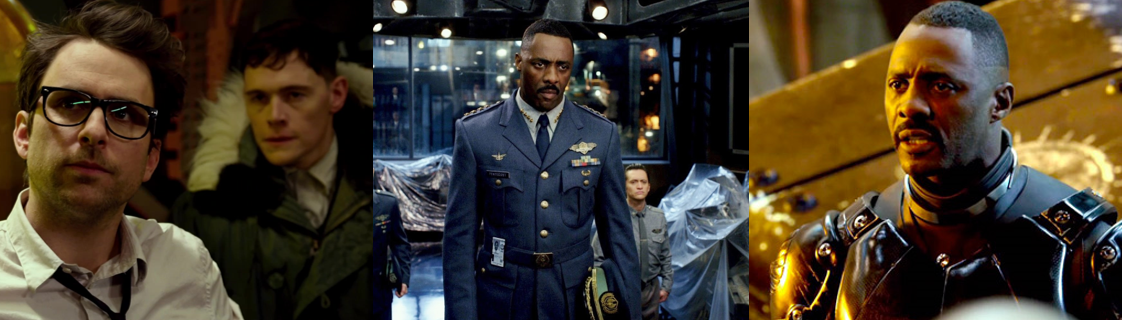
Pentecost is a man who absolutely exudes authority from his very core. Commanding respect from all around him, Pentecost disregards the United Nations’ threat to cut their funding and instead initiates a widespread recruitment initiative to get whatever pilots he can into the few Jaegers he has left but, while he’s able to inspire Raleigh to return to the cause by appealing to his innate fighting spirit, Pentecost is not quite as willing to allow Mako the chance to sign up to the Jaeger program since he knows she’s not mentally prepared and he’s extremely overprotective of her. Though a straight-talking figure with a penchant for rousing, pragmatic speeches and demands, Pentecost only delivers the information he deems necessary to his Rangers; his goal is not to be their friend, or their father, but rather a consistent source for them to focus their efforts on, but his steadfastness falters when Mako is involved purely because he is so protective of her. Years ago, he saved her from a Kaiju attack and he’s been grooming her to focus her anger and desire for revenge, crafting her into the perfect soldier and pilot, but time is against him and he is reluctant to let her step into a Jaeger without more training. Pentecost’s options, however, are quickly becoming limited; not only are the Kaiju attacks predicted to increase, but he’s also dying from radiation poisoning from his days of piloting Jaegers with insufficient shielding, all of which culminates in him strapping into a Jaeger once more in a last, desperate bid to seal the Breach once and for all. The Breach, and the Kaiju themselves, are closely monitored by eccentric and bickering scientists Doctor Newton “Newt” Geiszler (Day) and Doctor Hermann Gottlieb (Burn Gorman), two extremely different and conflicting personalities who have vastly different opinions on the Kaiju threat. While Gottlieb is convinced that the Breach will soon stablise and remain open, allowing not only for Category V Kaiju to emerge but for the creatures to attack in full force, Newt is obsessed with the idea of Drifiting with a living Kaiju brain in order to earn more about them. While he’s able to glean some intel on the creatures using this technique, he’s forced to turn to black marketeer Hannibal Chau (Perlman), a peculiar gangster who has profited from selling harvested Kaiju organs on the black market since it’s exceedingly difficult to gather specimens from the creatures.

Monstrous Kaiju emerge from the Breach to exterminate humanity!

Newt’s compulsion to Drift with the Kaiju brain causes him a great deal of mental strain, and also results in the first-ever double Kaiju attack and the discovery that the Breach can only be opened in the presence of Kaiju DNA, which proves pivotal in the final, desperate assault on the portal. The Kaiju are demonic, monstrous beings that sport thick, leathery hides, bony appendages, and which plough through cities and conventional weapons without fear in a single-minded quest to eradicate all life in their path. The creatures originally emerged millions of years ago, during the time of the dinosaurs, but couldn’t survive in the climate so they waited centuries until, thanks to our destructive and pollutive ways, humanity had “practically terraformed” the planet into a far more hospitable environment for the invaders. Over the years, Kaiju attacks have become frequent but also highly predictable; the Pan Pacific Defense Corps monitor the Breach closely and are able to determine the size and strength of each creature, which is given a suitably fitting moniker and categorised according to the “Serizawa Scale”, with Categories I and II being the weakest. The most powerful Kaiju in the film is “Slattern”, the first Category V Kaiju ever recorded; they sport acidic blood, self-destruct on death, emit a highly toxic substance called “Kaiju Blue” that contaminates the environment, and some can even emit electromagnetic pulses as the Precursors strive to better adapt their creatures for combat against humanity. Monstrous and lacking in anything other than pure, unadulterated destruction in the name of their creators, the Kaiju threat is often downplayed since they have become so frequent that people have learned to expect and live with them. Jager pilots are treated like celebrities, Kaiju are turned into action figures or revered by “groupies” like Newt for their impressive physiological allure, and yet Pentecost is right there on the ground level able to see with his own eyes that the attacks are increasing and witnessing his pilots dying trying to defend what’s left of humanity from all-out apocalypse.

The Nitty-Gritty:
One of the things I enjoy about Pacific Rim is how humanity is literally depicted as teetering on the brink; it’s not quite a post-apocalyptic story, but it’s verging very close to one as the Kaiju attacks increase. There’s a definite sense that everything, literally everything, is being put into the Jaeger project and the massive walls being erected; while bustling cities still exist and much of society continues on regardless, I think it’s fair to assume that these won’t last forever and you can see glimpses of how close humankind is to being snuffed out forever in just how elaborate the Jaegers, the Shatterdome, and even the walls are as there’s no way that we aren’t burning through our resources at an alarming rate producing such extravagant defensive measures. Crime and profiting from the Kaiju attacks is also rampant, as best evidenced through Hannibal Chau, and the death toll and absolute devastation brought by the Kaiju is beyond catastrophic, and yet many still disregard or downplay the threat. While we’re told that all the world’s governments and people have come together to fight the Kaiju, there’s a significant number of people not working towards that cause, and the United Nations disregard the Jaeger program simply because they’d rather hide behind ineffectual walls.

While visibility is low at times, the giant monster battles are the most memorable part of the film.

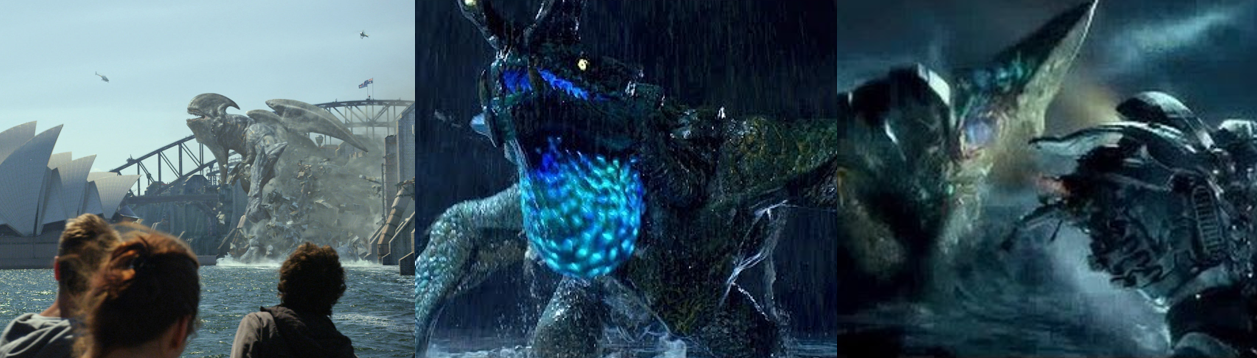
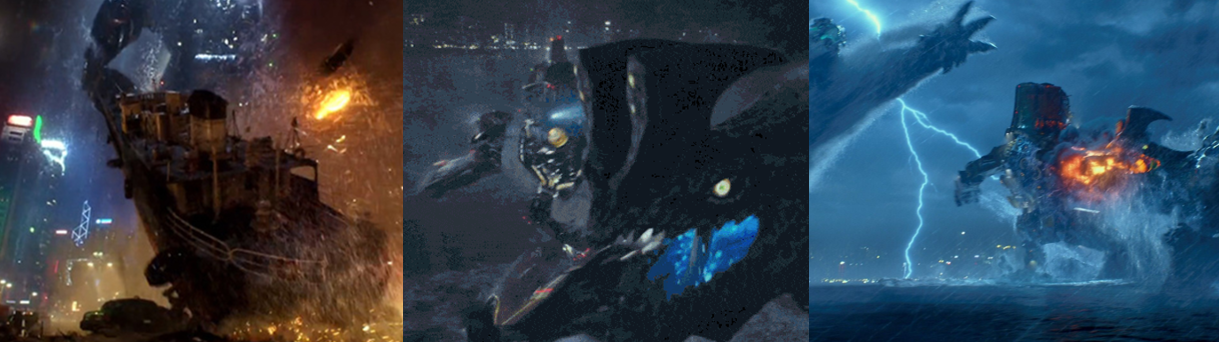
Easily the most appealing aspect of Pacific Rim is the effects; like many of my favourite science-fiction films, Pacific Rim features a marriage between the practical and the fantastical for its aesthetics. The Jaegers and the Shatterdome have a huge amount of weight and depth to them, feeling large and cumbersome and having a real impact when they’re onscreen while also sporting a slick, steampunk-like presentation. This exists alongside the bustling, neon-drenched streets of Tokyo and futuristic, advanced technology like holographic interfaces and the Drift equipment. The film is an absolutely bonkers premise, one that immediately drops audiences into a world constantly under threat from not one but multiple giant monsters and where our best defense is giant mechanical machines. You might think that there’s got to be a better and less expensive way to fight the Kaiju than this, but that wouldn’t be anywhere near as visually striking now, would it? In true Guillermo del Toro fashion, there are plenty of practical effects to be found here, particularly in the rendition of the organs and body parts harvested from the Kaiju, though the Kaiju and Jaeger are largely rendered using spectacular CGI. The two titanic concepts make for a constant visual spectacle as they match blows between skyscrapers, tearing down landmarks like the Golden Gate Bridge and storming through Sydney, though there are instances where the action is noticeably difficult to follow thanks to taking place at night, at sea, and with rain pelting down and distorting the impressive visual effects. The low visibility can make the Kaiju a little difficult to distinguish, but they all look very different; some have horns on their heads, or are more bulbous, or sport split jaws and long, glowing tentacle-like tongues. Slattern is the largest and most dangerous, sporting three whip-like tails and a spiny protrusion of its chest for close and long-ranged damage, but the Kaiju are also capable of giving birth to smaller, equally vicious offspring. Thankfully, the Jaegers are more than up to the task of combating them; though their primary form of attack is to engage in hand-to-hand combat, the Jaegers also pelt the Kaiju with missiles, cut them up with blades and saws, and Gypsy Danger even uses a boat as a melee weapon in the streets of Tokyo!

Thanks to Pentecost’s sacrifice, the Breach to the Kaiju dimension is successfully sealed.

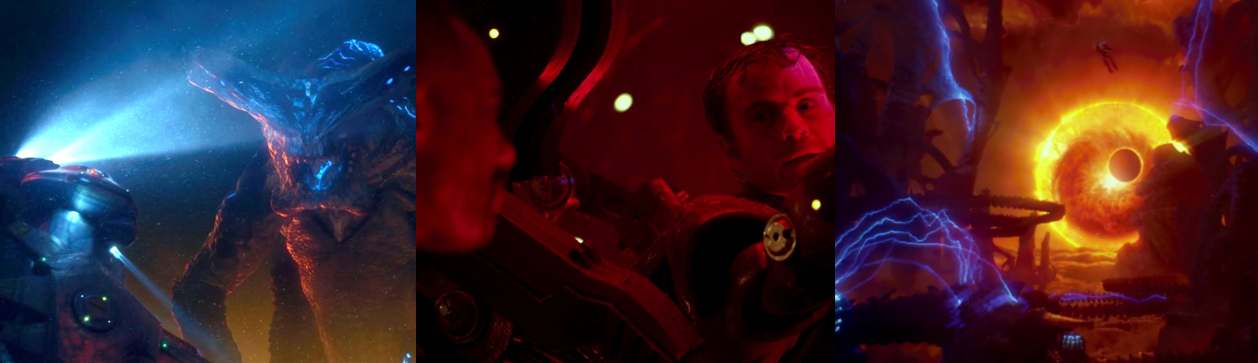
With time fast running out and the promise of increased Kaiju attacks becoming a startling reality, Pentecost is forced to put his final plan in motion; scrambling all of his remaining pilots and Jaegers together, he plans to strap a nuclear warhead on the back of Striker Eureka and drop it into the Breach to collapse the portal once and for all. However, Hercules is injured during an earlier attack, forcing Pentecost to replace him as Chuck’s co-pilot and, impressed with Mako’s compatibility with Raleigh, to sign off on his adopted daughter piloting Gypsy Danger into battle. After finally getting on the same page and Drifting with a Kaiju brain, Newt and Gottlieb relate that the Jaegers must latch onto a Kaiju in order to enter the Breach or else the weapon will simply be deflected, as always, but this is made all the more difficult by the first instance of a triple Kaiju emergence, and the appearance of Slattern at the Breach. What follows is an action-packed battle between the last two Jaegers and the three Kaiju deep beneath the ocean which sees Striker Eureka damaged in the attack, forcing Pentecost and Chuck to sacrifice themselves to clear a path for Gypsy Danger. Since Gypsy Danger is an older, nuclear-powered Jaeger, the mech itself acts as the pay load and they’re able to skewer Slattern and ride it into the ethereal, bizarre dimension that lays beyond our own world. In a last minute bit of tension, Raleigh scrambles to overload Gypsy Danger’s nuclear reactor but he’s ultimately successful, collapsing the Breach and escaping back to the surface alongside Mako with the assumption being that the Kaiju assault has been ended once and for all.

The Summary:
I feel like Pacific Rim has kind of been forgotten a bit over the years; at the time, it was a pretty spectacular prospect, and American-made giant monster movies weren’t exactly the norm, though the first few Transformers movies (Bay, 2007 to 2011) were acclimatising audiences to seeing big, mindless robotic creatures duking it out onscreen. Pacific Rim has a lot more going for it than those dumb-ass films, however, though maybe there’s a little too much happening in the film: we’ve got Kaiju, portals, giant mechs, neural links, advanced technology…I’m honestly surprised there aren’t actual psychics here, too. Still, I enjoy that there’s a lot of action and destruction and variety; the low lighting can make some of the fights a little difficult to make out, but the Jaegers are all quite distinctive with their different paint jobs, limbs, movements, and weapons. The Kaiju have very similar leathery hides but also look a lot different when we get a good shot at them; glowing with neon blue highlights and sporting massive claws and monstrous, demonic appendages, they waste no time in making an immediate impression and the film is bolstered by a decent influx of action. Interestingly, it’s not the giant monsters of robotic mechs that are the most over the top thing about the film, it’s the acting. Filled with brilliant character actors, Pacific Rim is strengthened by a shot of machismo and some truly scenery-chewing performances by Charlie Day, Burn Gorman, and Idris Elba. Elba is the clear standout with his gruff demeanour, which he maintains despite carrying the weight of the world on his shoulders, though Charlie Hunnam is just charismatic enough to work as the square-jawed, reluctant hero. Naturally, it’s the big monster/robot battles that are the true spectacle of the film and make it a rollicking movie to throw on with some beers and pizza; there’s a decent attempt at a deeper message regarding uniting against a common foe and taking better care of our world, but you’re watching Pacific Rim to see giant mechs smashing seven kinds of shit out of Godzilla wannabes and that’s exactly that it delivers.

My Rating:

Rating: 4 out of 5.

Great Stuff

Were you a fan of Pacific Rim? Did you enjoy the concept, or was it a little too over the top for you? Which of the Kaiju and Jaegers was your favourite? What did you think to the human characters, particularly Idris Elba and his rousing speeches? Who would you Drift with if you were a Jaeger pilot? What’s your favourite kaiju movie, and how are you celebrating K-Day today? Whatever your thoughts on Pacific Rim, kaiju, or monster movies in general, please do leave a comment below or respond to my social media and be sure to check back in for more giant monster content in the near future!

Movie Night [K-DAY]: Cloverfield


In the absolutely bonkers science-fiction film Pacific Rim (del Toro, 2013), the monstrous Kaiju first attacked humanity on 10th August 2013. The attack ended a few days later on August 15th but, in that time, San Francisco, Sacramento, and Oakland were completely devastated and the Kaiju War officially began. Accordingly, August 10th became known as “K-DAY” and is, for me, a fantastic excuse to talk about some giant monster movies!


Released: 18 January 2008
Director: Matt Reeves
Distributor: ParamountPictures
Budget: $25 million
Stars: Michael Stahl-David, T.J. Miller, Lizzy Caplan, Odette Yustman, Jessica Lucas, and Mike Vogel

The Plot:
To celebrate Robert “Rob” Hawkins’ (Stahl-David) new job in Japan, his friends are throwing him a farewell party that is being recorded by his best friend, Hudson “Hud” Platt (Miller). However, Rob’s party, and his issues with friend and potential love interest Beth McIntyre (Yustman), are interrupted when a gigantic creature suddenly emerges from the sea and rampages throughout New York City!

The Background:
Perhaps unsurprisingly, Cloverfield owes a great deal of its existence to Godzilla; producer J. J. Abrams first thought up the idea of creating an American counterpart to the famous kaiju when visiting Japan and partnered with writer Drew Goddard and director Matt Reeves to bring the concept to life. The film’s creature, a mysterious beast whose exact origins were left intentionally vague, was designed by legendary special effects artist Phil Tippett and his studio to be biologically functional but also more like a force of nature than a malevolent aggressor. Cloverfield went through a number of different titles, built an incredible amount of hype through the heavy use of viral marketing, and was shot entirely using a found footage approach that left some audience members feeling sick. The film went on to gross over $172 million worldwide and was widely praised for its atmosphere and effects, though the camera techniques and allusions to real-world terrorist attacks like 9/11 were criticised. Although Reeves had an idea for a sequel, the film was followed by a couple of loosely-connected films before a direct follow-up was finally announced in January 2021.

The Review:
Cloverfield was such a strange and intriguing movie at the time; we’d seen found footage films before, of course, but they were still quite new and their marketing tended to be very surreal and metatextual. This was probably one of the first times I remember my friends really getting into a film’s viral marketing; they trawled through the website reading titbits about Slusho! and Bold Futura, and message boards were alive with people desperately analysing the vague trailers for any kinds of clues as to the monster’s identity, with many claiming that it would be Cthulu. Personally, I stayed away from all that; it was fun to see but I was hooked on the trailer alone and didn’t really see the need in wild speculation. It turned out, of course, that a lot of the viral marketing and expanded lore seen online was ultimately inconsequential to the film but it was still a fun, immersive, and unique way to promote the film.

Rob’s a regular guy whose sole focus during the attack is rescuing Beth no matter the danger.

The film primarily revolves around six characters caught up in the chaos of its events but the main character is Rob, a pretty average guy who is about to leave New York City for a new job in Japan. Rob’s just a normal, everyday sort of guy but he’s clearly a likeable and popular bloke as he has a lot of friends and acquaintances at his big leaving party, but he starts the film in a bit of a bind as not only is he leaving behind his friends and family for a foreign country but there’s also tension between him and his long-term friend Beth. Prior to the film, as seen in frequent cutaways to previous footage recorded by the camera, Rob and Beth hooked up and spent a fun-filled day at Coney Island but clearly his plans to leave caused a rift in their relationship and, despite the fact that he’s leaving, he’s clearly in love with her and wants to be with her, and so is kind of miffed when she brings a date to his party. His personal drama is put on hold, however, when a violent earthquake and power outage suddenly hits and the city is attacked by a gigantic creature. Rob’s first and primary overwhelming concern throughout the chaos that follows is getting to Beth and ensuring her safety; he fully plans to go through with this alone but his friends, scared out of their minds at the monster’s presence, don’t want to separate so they willingly follow along, which ultimately leads to many of them dying all so that Rob can get to Beth in a desperate attempt to get everyone out of there alive.

Beth and Rob’s relationship is on the rocks but he risks everything to save her.

Tensions are frayed between Rob and Beth at the start of the film; after they slept together, he didn’t call or talk to her since he felt it was better to not get too attached as he was leaving for his new job. This left Beth heartbroken, however, and as hurt as Rob was by the whole thing, but neither of them were properly able to convey their feelings towards the other before the monster’s arrival. Their relationship is easily one of the most relatable in the film; having been friends for years, they had a spur of the moment romance but each felt like they couldn’t properly commit to their feelings because Rob had been offered a lucrative position as vice president of his company and she would never ask him to give that up just like he felt he had to go through with it despite his feelings for her. Beth is absent for a large portion of the film but Rob’s entire motivation is centered around finding her so that they can all leave together, no matter how great the danger is. When they find her, she’s seriously injured and trapped in her apartment but they manage to get to her in time and she’s incredibly grateful that he came back for her; with her safe, the group is finally able to make efforts to escape but, unfortunately, rescuing Beth cost them precious time and they’re left stranded in Central Park. With the military preparing a massive bombing run to try and destroy the creature, Beth and Rob seek shelter and admit their love for each other before presumably being killed in the ensuing attack.

Rob’s brother and friends opt to go with him to find Beth, with disastrous results.

Rob is primarily aided in his quest to save Beth by his brother, Jason Hawkins (Vogel), and his fiancé, Lily Ford (Lucas); at the start of the film, Jason is annoyed that Lily has tasked him with carrying the camera and recording farewell messages at Rob’s party, so he quickly passes the job on to Hud so that he can enjoy himself. Jason and Rob have a very relatable and realistic relationship; Jason loves his brother but recognises that he’s kind of a douchebag and not good enough for Beth. Still, he adamantly encourages his brother to seize the opportunity with Beth and is the first one to suggest getting out of the city after the creature attacks. His decision to head to the Brooklyn Bridge costs him his life, however, when the creature inadvertently destroys the bridge and kills him in the process, which devastates both Rob and Lily. Lily is the pragmatist of the group; of them all, she’s the most responsible and serious and initially just wants Rob to have a great leaving party so that he knows how much they all love him. Constantly annoyed at Jason’s childish antics, she’s forever having to keep him and Hud on track so that things go off smoothly, but her sensible demeanour gives way to abject terror when the creature appears; though she and the others try to talk Rob out of risking crossing the city to rescue Beth, she’s the first to willingly agree to go with him and actually ends up being the only one of the group to unequivocally be seen surviving the events of the film.

Hud continues to document the events, regardless of the danger to himself and others.

The group, and the chaotic events that surrounded them, are constantly recorded by Hud, a well-meaning but somewhat socially inept friend of Rob’s who has an excitable personality but also a reputation for being a bit of a screw up and a bullshitter. He’s perfectly happy avoiding any responsibility that’s more complicated than putting up a goodbye banner but finds the job of recording the guests quite enjoyable, despite the fact that he keeps cutting people off and getting distracted by Marlena Diamond (Caplan). Even when the group are stumbling through the darkness and surrounded by rats, with sounds of destruction rumbling on the streets above, Hud continues to respond to the stress with awkward humour, nonsensical rambling, and terrified sarcasm, which may annoy his companions but is a completely understandable way to react considering the circumstances. Since she’s a friend of Lily’s and merely an acquaintance of Rob’s, Marlena is a bit of an outsider at the party and with the group and is initially annoyed by Hud’s badgering and awkward advances but is left shell-shocked by the creature’s attack and having seen it eating people. With little other choice than to accompany the others in order to survive, she briefly bonds with Hud after saving him from one of the parasites that accompany the creature, though she falls ill and eventually explodes in a shower of gore from the creature’s bite.

Clover rampages through the city, dropping deadly parasites and shrugging off the military’s might.

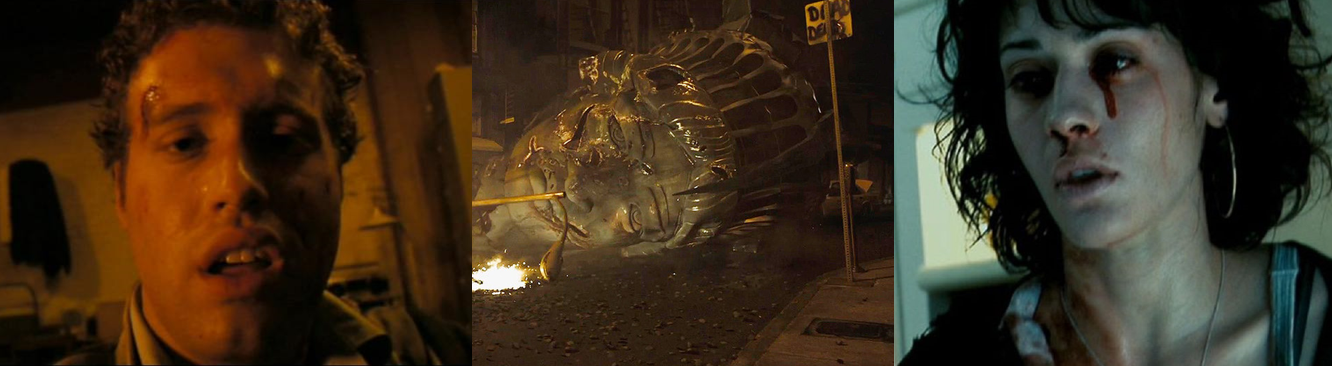
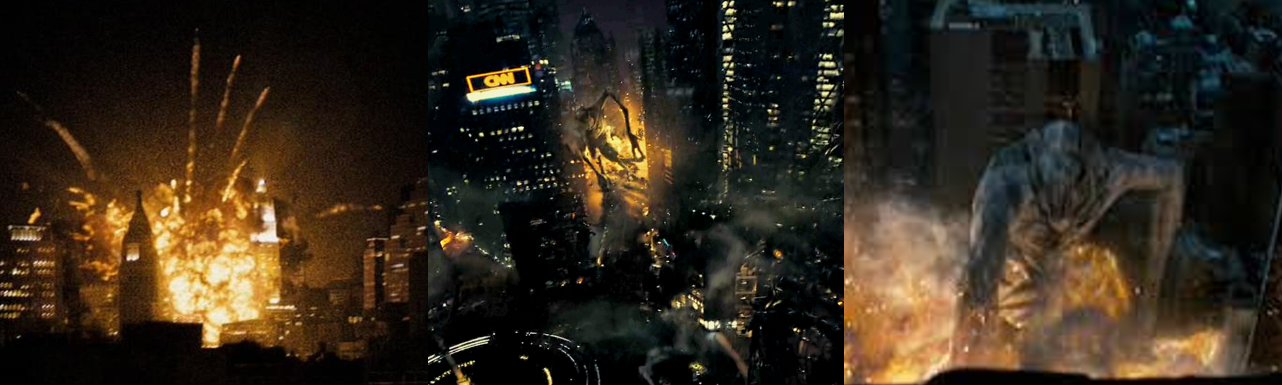
The military also plays a minor role in the film; completely outmatched and underprepared for the creature’s attack, they throw everything they have at it and fail in every attempt to do anything more than further enrage it. In the end, they’re forced to level the entire city in a last-ditch effort to destroy it and even this is left ambiguous by the film’s abrupt ending. The creature itself, often referred to as “Clover”, is largely obscured and hidden for the majority of the film; indeed, when it first strikes, the characters believe the disruptions are because of a terrorist attack and Clover’s initial destruction of the Statue of Liberty and arrival in the city is certainly framed and presented in a way to mirror such tragic events as 9/11 (buildings are half-destroyed and burning, the streets are littered with rubble and wreckage, and people are covered in ash, dirt, and debris). Clover’s movements appear to be a sporadic and mindless rampage as it flounders around seemingly at random, crashing into buildings and leaving confusion and destruction in its wake; this is reflected perfectly in Hud’s frenzied filming style as he desperately tries to get a good look at the creature while being overwhelmed by fear and panic.  To make matters worse, Clover is covered by these smaller crab-like parasites that scuttle around and attack everyone in sight, including our main characters, and make for a tense and dangerous secondary antagonist as their bite proves to be devastatingly lethal.

The Nitty-Gritty:
I mentioned at the start that Cloverfield’s marketing was immersive and a fun way to engage to audience and that’s fitting because in ties directly in to the found footage approach and first-person perspective of the film. Obviously, this genre isn’t for everyone; it’s wild and chaotic and unpredictable, the focus shifts and the camera is constantly moving about so we hardly ever get a clear shot of what’s happening, or the creature. One of the issues with found footage films is obviously the question of why the hell anyone would keep filming and carrying around a camera during something like this but Hud explicitly states that he’s recording it so that people can see “how it all went down”, which is a pretty good way of justifying his continued filming, and Hud’s sheer terror is perfectly conveyed through his erratic camera movements and tendency to get easily distracted, which is admittedly disorienting but extremely effective at conveying the panic and confusion caused by the creature’s attack.

Clover’s attack is purposely analogous to the horrors of a terrorist attack.

It’s pretty obvious what the filmmakers were going for with Cloverfield; not only are they crafting a wholly American monster film, they’re clearly paralleling the creature’s rampage to a terrorist attack. The film released some seven years after 9/11 but obviously the event was, and still is, very raw in the minds of people and audiences everywhere; everyone remembers where they were when they first heard about that day and scenes of the destruction, devastation, and confusion caused by the attacks continue to be powerful and horrifying. Evoking such imagery works massively in Cloverfield’s favour; in conjunction with the wild found footage approach, the entire event is seen as disorientating and appalling, and it’s perfectly understandable for the characters to initially suspect another terrorist attack. However, they are perhaps even more terrified when they review Hud’s footage and discover that “it’s alive!”; stunned and panic-stricken, they have even less idea of how to survive and react to such an attack so focusing on getting to Beth and escaping seems like the best idea simply because they’re desperate for a tangible and attainable goal to focus on in all the madness.

Clover’s mystery was as terrifying as its design and mindless rampage.

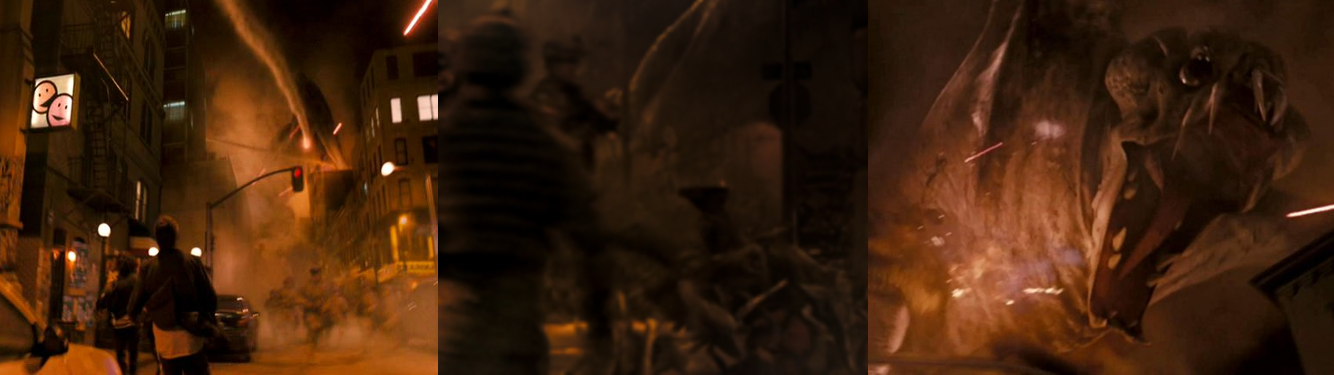
The monster fan in me remains fascinated by the creature; thanks to the film’s erratic filming style, we hardly ever get to see it and, for the majority of the film, its exact dimensions and biology are left to our imagination, which only adds to its intrigue and horror. Some of the best and most memorable screen monsters earned their reputation by being seeped in shadow or hidden for much of the film, and Clover is no different; generally, we just see a leg here, a flash of its body, and hear its braying roar echoing across the city. When we do see it, it’s this tangled mess of gangly limbs and a massive mouth full of fangs and we learn next to nothing about it, which only adds to its awe and mystery; Hud wildly speculates that it came from the ocean or possibly from space, both of which are subtly hinted at throughout the film, but ultimately its origins are meaningless and its horror only augmented by its mystery. Clearly, it’s a durable and dangerous creature; it causes an incredible amount of destruction in its mindless rampage and easily shrugs off the military’s weapons, even high-powered missiles and bombs, and is able to leap high enough to swipe a helicopter out of the air. Although it is said to eat people, it doesn’t seem to swallow and digest them as it spits Hud out after gobbling him up at the film’s conclusion. So great is Clover’s threat that the military decides to sacrifice the entire city of New York to destroy it, which leaves our final two survivors trapped, terrified, and presumably killed in the process, though the film leaves it ambiguous as to whether this actually destroyed the creature and a final, post-credits message when played backwards seems to suggest that it’s still alive…

The Summary:
Cloverfield is quite the intense and terrifying experience; found footage movies are difficult to get right as it’s so easy for them to come across as cheap and disorientating as anyone can grab a camera and just fling it about while shouting and screaming but Cloverfield uses this filmmaking technique extremely well to convey the mystery and sheer awesome terror of its rampaging monster. The characters really help sell this film, which is great because it’s much more focused on them than the gigantic creature; they react to both their interpersonal dramas and the appearance of a raging monster in a believable and realistic way and I enjoyed their banter and rapport, which was the right balance of familiarity, fear, and amiability. The star of the film is obviously the monster and Clover is one of the most intriguing, mystifying, and terrifying kaiju ever put to film; its biology makes it seem horrifyingly probably and its abilities are rooted in some kind of realism. Add to that the parallels to terrorist attacks and the sheer awesomeness of its rage and you have a creature that made an immediate impact that I just wanted to see more of and learn more about, only to be continually let down with follow-ups that largely ignored the best part of the film.

My Rating:

Rating: 4 out of 5.

Great Stuff

Were you a fan of Cloverfield? Did you get caught up in the viral marketing and what did you think the creature was before the film released? What did you think to the found footage approach to the film and are you a fan of that genre? Were you a fan of Clover? What do you think its true origins were and what did you think to the parallels to terrorist attacks? What’s your favourite kaiju movie, and how are you celebrating K-Day today? Whatever your thoughts on Cloverfield, kaiju, or monster movies in general, please do sign up to leave a comment below or respond to my social media and be sure to check back in for more giant monster content in the near future!
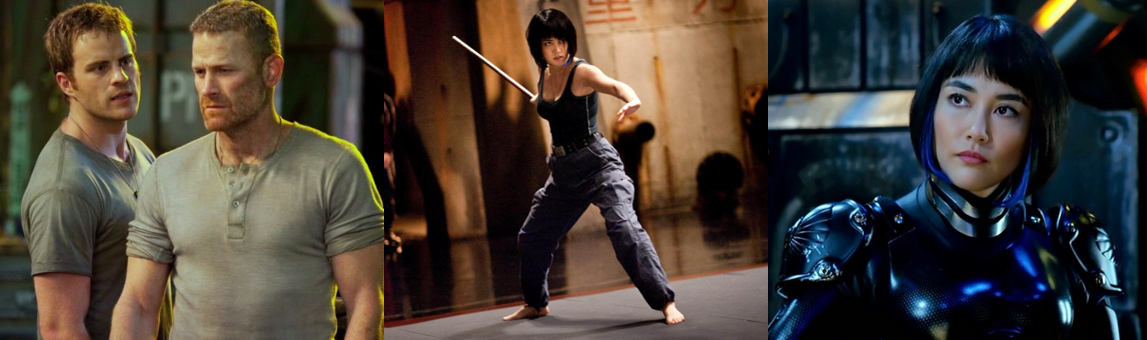
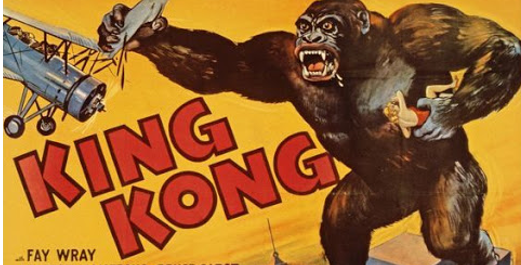
Movie Night [K-DAY]: King Kong (1933)


In the absolutely bonkers science-fiction film Pacific Rim (del Toro, 2013), the monstrous Kaiju first attacked humanity on 10th August 2013. The attack ended a few days later on August 15th but, in that time, San Francisco, Sacramento, and Oakland were completely devastated and the Kaiju War officially began. Accordingly, August 10th became known as “K-DAY” and is, for me, a fantastic excuse to talk about some giant monster movies!


Released: 7 April 1933
Director: Merian C. Cooper and Ernest B. Schoedsack
Distributor: Radio Pictures
Budget: $672,254.75
Stars: Fay Wray, Robert Armstrong, Bruce Cabot, and Frank Reicher

The Plot:
Renowned filmmaker Carl Denham (Armstrong) charters a ship to Skull Island in search of an elusive, prehistoric creature known as “Kong”. When Ann Darrow (Wray) is captured by the creature, Denham and first-mate Jack Driscoll (Cabot) resolve to rescue her and capture the beast to showcase it as a Broadway attraction.

The Background:
It’s hard to believe now but it was nearly a hundred years ago that filmmaker, adventurer, and former World War I aviator Merian C. Cooper first conceived of the iconic visual of a giant gorilla climbing to the top of the Empire State Building and being felled by modern technology. Initially wishing to produce a semi-documentary piece depicting a fight between actual gorillas and Komodo dragons, Cooper was inspired by the cost-cutting appeal of stop-motion technology to retool his concept using existing sets, props, and filmmaking techniques. The various dinosaurs of Skull Island, and King Kong himself, were designed by Marcel Delgado and brought to life using painstaking stop-motion techniques under the supervision of Willis O’Brien. A revolutionary filmmaking technique known as the “Dunning process” was employed to combine stop-motion and miniature shots with live-action actors and a huge animatronic bust of Kong’s head and body was constructed to capture close-ups of the creature. Audiences were in awe of the film and its ground-breaking effects, lining up to see the film upon its release, which was both staggered and somewhat limited but still brought in a profit of $650,000, with subsequent re-releases bringing King Kong’s total gross closer to $5.3 million. King Kong’s legacy, of course, speaks for itself, as it is widely regarded as one of the most influential movies of all time, has been preserved in the United States National Film Registry for its cultural and historical significance. It also spawned a few remakes and was one of the first and most prominent of the giant monster movies that would later be popularised by the Kaiju films of Japan.

The Review:
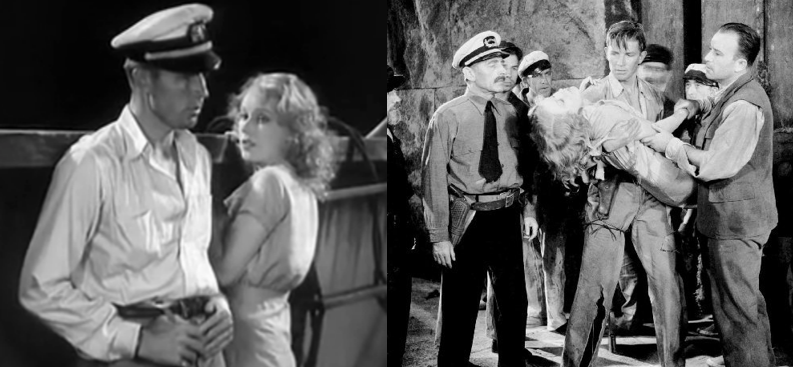
The first thing to note about King Kong is that, yes, it is filmed in black and white; while colourised versions of the film do exist, I recommend sticking to the original monochrome version for the true authentic experience. I understand, however, that black and white films can be off-putting for some but you’re simply robbing yourself of a true piece of cinematic history. 1933 was also a very different time in human history, to say nothing of cinema; as a result, dialogue is often loud, full of clunky exposition, and largely a product of its time. This means there’s a great deal of conveniences, contrivances, and sexist comments levelled in the film towards Ann; as the only female on the Venture, Denham’s chartered ship, she’s seen as a fragile and desirable object by many and little more than a prop for Denham, who needs a “pretty face” for the public to look at.

A gruff and cynical first-mate, Driscoll’s love for Ann comes against his better nature.

Denham is an unscrupulous and demanding egotist whose obsession with creating spellbinding films and content drives him to launch an expedition into the dangerous unknown; seemingly blind to the risks that the journey may bring, he cares only for capturing amazing sights on film and purposely misleads his cast and crew regarding their destination. Upon seeing Kong, Denham’s curiosity and greed are inspired and, regardless of the lives that have already been lost and the immense danger to Ann, he is driven to a crazed obsession at capturing the beast simply to string it up for the amusement of the paying public. Annoyed at backlash from the critics and the public for never featuring a girl in his films before, Denham is determined to silence his detractors but isn’t happy about it; he, like many of the Venture’s crew, see women as little more than a distraction. Driscoll echoes many of these sentiments, believing women to be a nuisance, especially out at sea. Despite his gruff demeanour and cynicism and believing her mere presence troublesome to the attentions of himself and the other men, he can’t help but be attracted to her and concerned for her well-being considering Denham is being disconcertingly secretive about their destination and intentions for them all. This, as much as anything, makes him incredibly protective of Ann and compels him to, begrudgingly and awkwardly, admit his love for her after her safety is threatened by the island’s natives.

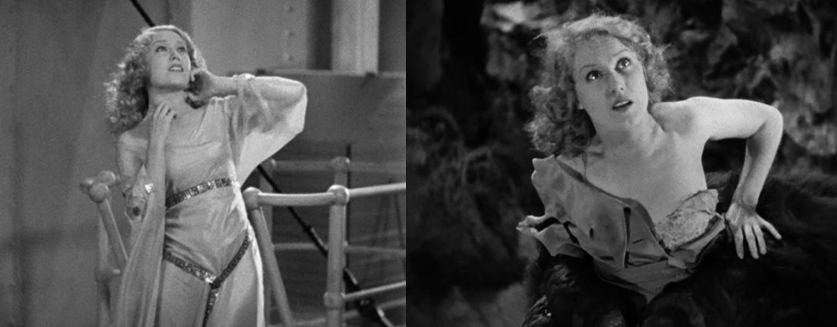
Ann is the original damsel in distress, though she does exude a modicum of personality at times.

Ann, for her part, is a gorgeous and fiery girl but does little to really assuage such preconceptions; driven to stealing to survive, she’s overwhelmed by Denham’s proposal for “money, adventure, and fame” and with little other choice, she signs on to the Venture out of desperation as much as the thrill. Her demeanour, however, is something of a handicap at best and a distraction at worst as she’s prone to swooning, screaming, and flights of emotional fancy. When captured by Kong, she’s, obviously, largely defenceless and helpless against his might and, yet, despite her traumatic experience with the creature, is truly heartbroken when he is killed at the film’s conclusion. Indeed, the savagery and primal nature of the beast may be frightening to Ann but she still has a respect and admiration for Kong’s uniqueness and the ferocity with which he fought to protect her. The remainder of the Venture’s crew is largely expendable and inconsequential; of them all, only Captain Englehorn (Reicher) plays a notable role since he’s…well, the captain of the ship and acting as an interpreter to the island natives. The other crew members are simply bodies to cast lewd aspersions towards Ann, question their mission, and to fall victim to Skull Island’s many hazards and dinosaurs. Speaking of which, Skull Island is home to a primitive tribe who live in fear and awe of Kong, offering him sacrifices and keeping him at bay with a gigantic wall, and, enamoured by Ann’s stark contrast to their women, kidnap her in attempt to appease the God-like creature.

Skull Island is home to many monstrous creatures that have escaped the ravages of time.

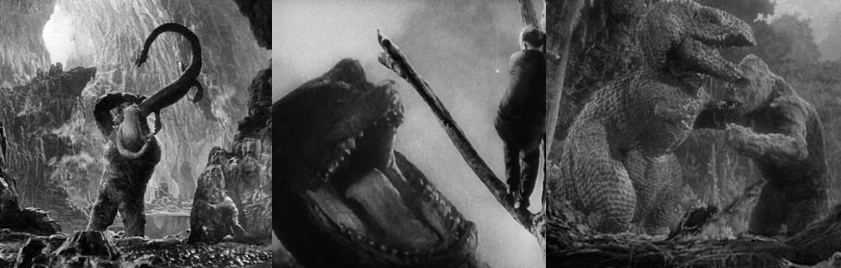
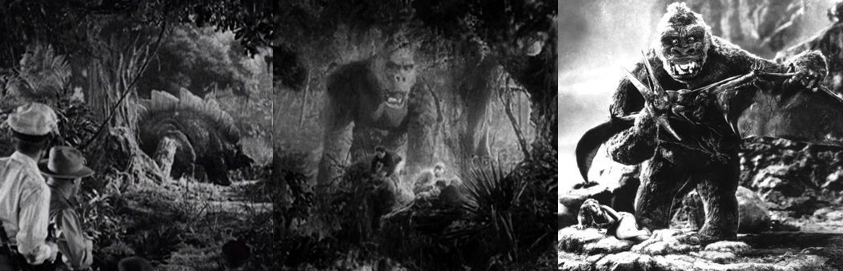
Kong’s presence hangs in the air like an ominous cloud; his mere name piques Denham’s curiosity and he and the crew are puzzled by the constant chanting of his name when they reach the island. This builds the tension to the creature’s eventual, memorable reveal to a crescendo since the size of the walls imply a gigantic creature but the result is somewhat almost unimaginable: a monstrous, twenty-foot-tall ape who becomes besotted by his latest prize and flees deep into the jungle with Ann as his “bride”. As protective and smitten by Ann as Jack, Kong exhibits a playful curiosity towards her and is especially taken by her golden hair; so infatuated with Ann is Kong that he rampages through the natives’ village after she is taken from him, destroying their homes, crushing them beneath his massive feet, and biting them in two and also engages in brutal combat with the dinosaurs of Skull Island to both keep her safe and to assert his unmatched dominance. Indeed, as impressive as Kong is, he’s not the only giant on Skull Island; dinosaurs still walk the Earth on its hidden lands, challenging Kong’s position as “King” and killing many of Englehorn’s crew. Even traditionally omnivorous creatures like the Stegosaurus and Brontosaurus are monstrous, dangerous killing machines on Skull Island but, of course, none are more formidable than the Tyrannosaurus rex. The battle with the T-Rex is especially brutal and impressive and shows off not only the film’s impressive stop-motion effects but also Kong’s versatility and unnatural capability as a fighter by overpowering the T-Rex and snapping its jaw. Clearly, Kong is not just a giant gorilla as his dimensions, form, and movements indicate he’s something truly unique even on an island of giant monsters!

The Nitty-Gritty:
One of the things I enjoy about King Kong is that it, like the old Universal Monsters films from back in the thirties, is a brisk and entertaining film; clocking in about around one hundred minutes, the film wastes little time in getting to the meat and potatoes of its concept (Skull Island). This is in stark contrast to Peter Jackson’s 2005 remake, which spent what felt like two ice ages aboard the ship (I still feel like they’re travelling there even now…), and which convoluted the simple premise of the original by trying to be bigger and better. In truth, this had already been accomplished by the impressive John Guillermin’s 1976 remake, which sported an incredibly extraordinary animatronic version of Kong, but even that has its slower, more laborious moments. The same can’t be said about the classic original, which establishes the suggestion of personality for its three leads and then promptly focuses on the remarkable creatures of Skull Island.

Impressive filmmaking techniques merge stop-motion effects with live-action shots.

Naturally, King Kong’s biggest appeal is in the painstakingly realised stop-motion effects that are used to bring these to life; thanks to arduous time, effort, and clever filmmaking techniques, the film is able to blend together stop-motion models with live-action shots or depict battles between monstrous creatures while characters look on in awe and fear. Obviously, some of these aren’t as impressive as they once were and it’s easy to see how the shots have been blended or merged together; the stop-motion is also noticeably jerked and somewhat crude at times, especially when depicting Kong’s facial expressions and emotions, and yet it’s still an incredible achievement for the time, impressive to behold, and extremely ambitious considering the restrictions and that the techniques were still new and being developed during this era. It would have been easy to simply focus on one beast, the titular Kong, but the filmmakers opted to go all-in and showcase a variety of complex dinosaurs on Skull Island, which really adds to the mystery and otherworldliness of the location, and the film does a pretty decent job of showing Denham, Driscoll, and the Venture’s expendable crew members battling with the various monsters of the island.

Though a king in his native land, Kong is overwhelmed by the ferocity of man.

Of course, it’s one thing to see Kong in the deep jungles of a fantasy island that time forgot but it’s another thing entirely to see him first bound and then tearing through the streets of downtown New York City! Once a king, now reduced to a mere spectacle to be ogled at, Kong’s escape and subsequent rampage is a stark reminder of the brutality and fierceness of nature as Kong steps on pedestrians, crushes cars, destroys trains, and even devours humans in his relentless pursuit of the object of his affections. Love, tragedy, and the brutality of nature are prominent themes throughout the film; Driscoll is driven to read head-first into the unknown to rescue Ann, just as Kong is when he ends up in New York. As iconic and timeless as King Kong is for its effects it is, perhaps, equally as memorable for its tragic ending; so obsessed with holding on to Ann is Kong that he is forced into climbing the Empire State Building in an attempt to get up high and in a position of dominance. Unfortunately, while the human characters are able to adapt to and conquer Skull Island with their weapons and fortitude, Kong is ultimately overwhelmed by the modern world and unable to probably navigate, respond to, or combat it and, as a result, he is gunned down and meets an inauspicious, tragic, and unforgettable end in his efforts to protect his “bride”.

The Summary:
Undeniably, King Kong is an absolute classic and near-timeless movie; it’s one of those films that everyone should take the time to watch simply for its contribution to cinema through its ground-breaking and incredibly ambitious special effects. Obviously, there are elements of the film that haven’t aged too well thanks to how society has changed and the effects look rather primitive compared to what Hollywood is capable of today but many of those techniques would not have been possible without King Kong, which still holds up remarkably well thanks to the impressive way that it blends live-action shots, sets, and stop-motion techniques together to create a truly moving and emotional tragedy about a misunderstood and savage beast being smitten by a gorgeous and emotional beauty. As creative as subsequent Kong films as been, and for all the monster movies that have followed, few have the spectacle and timelessness of King Kong, which continues to impress through its ambition and is well recommended not just for fans of monster movies but for fans of cinema in general.

My Rating:

Rating: 4 out of 5.

Great Stuff

Have you ever seen the original 1933 version of King Kong? If so, what do you think to it and how do you think it holds up today, especially compared to other monster films and subsequent remake sand interpretations of Kong? What did you think to the stop-motion effects? Do you think they were the best option available or would you have preferred to see a man in a suit or some other technique used? What’s your favourite version of Kong, or your favourite Kaiju movie, and how are you celebrating K-Day today? Whatever your thoughts on King Kong, Kaiju, or monster movies in general, please do leave a comment below and be sure to check back in for more giant monster content in the near future!