Back Issues [Independence Day]: Captain America Vol. 5 #8-14


First appearing in 1941, Captain Steve Rogers/Captain America, became one of Marvel Comics’ most recognisable and celebrated characters not just for his super patriotism but also for being a prominent member and leader of Marvel’s premier super team, the Avengers. As today is Independence Day, this is the perfect excuse to pay tribute to the star-spangled Avenger.

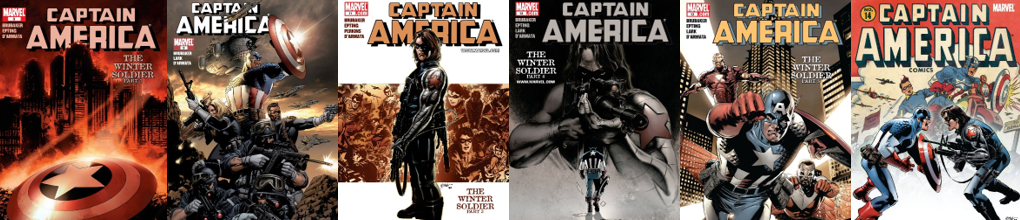
Story Title: “The Winter Soldier” (Part 1 to Conclusion)
Published: 20 July 2005 (cover-dated: September 2005) to 1 February 2006 (cover-dated: April 2006)
Writer: Ed Brubaker
Artist: Steve Epting and Michael Lark

The Background:
By 1941, World War Two was in full swing and, after Nazi Germany invaded Denmark and Norway, the United States finally joined the fight to oppose the triumvirate “Axis powers” of Germany, Japan, and Italy. The ever-escalating conflict meant patriotism and national pride were high in America and Joe Simon and the legendary Jack Kirby capitalised by having Captain America and his kid sidekick, James Buchanan Barnes/Bucky, take the fight to the Axis and encourage readers to support the War. After the War ended, superheroes declined in popularity and Captain America’s solo title was cancelled in 1954. However, he got a new lease of life when he was recast as a “man out of time” and joined the Avengers. For decades, Bucky was one of the few comic book characters whose death seemed permanent but that all changed with this story arc. It was writer Ed Brubaker, fresh off reinventing Cap’s comics as espionage thrillers, who dreamed up the idea of reviving Bucky as part of a life-long desire to reinvent him as a brainwashed, special ops soldier. Although Captain America editor Tom Brevoort initially opposed the idea, he eventually relented when Brubaker pitched the idea as recontextualising Cap’s greatest failure and crafting a new anti-hero for readers to connect with. “The Winter Soldier” was widely praised and is seen as one of the greatest Captain America stories ever told. It also reinvented Bucky for a modern age and set him up to assume the Captain America mantle later down the line. The story was so influential that it was adapted into videogames, cartoons, and brought to life in the Marvel Cinematic Universe, with Sebastian Stan receiving critical acclaim for his portrayal of the character.

The Review:
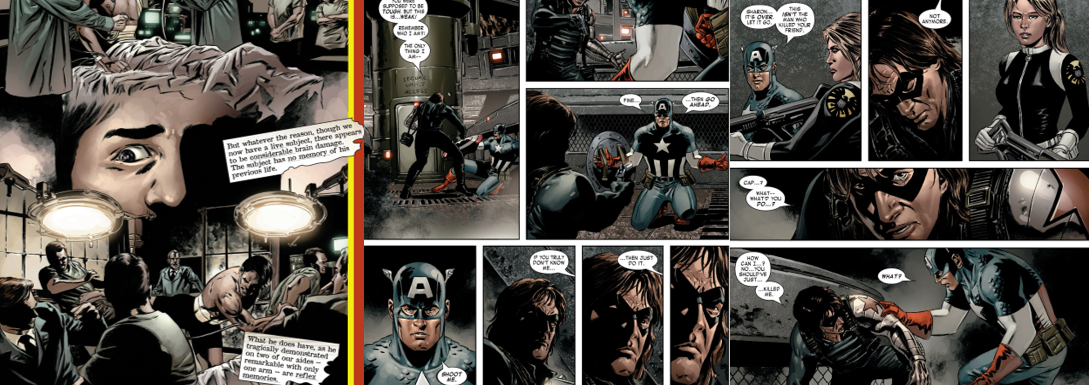
Our story begins way back in 1945 in an experimental Soviet submarine floundering in the English Channel. There, we find the crew intercepting coded messages from Nazi Germany confirming that Captain America was blown up over the Channel Islands and, accordingly, they move to intercept and discover a heavily injured, one-armed survivor floating in the sea. We then jump to the Helicarrier, the flying battleship headquarters of the Strategic Hazard Intervention Espionage Logistics Directorate (S.H.I.E.L.D.), where Nick Fury and Sharon Carter/Agent 13 show Cap photographic evidence of his old partner, Bucky, appearing older and alive and well despite seemingly perishing in that aforementioned explosion. Naturally, Cap isn’t just sceptical, he’s in full-blown denial, believing it must be some kind of trick and refusing to entertain the idea that his friend is not only alive but responsible for a horrific act of terrorism in Philadelphia. Specifically, a devastating bomb attack that saw Cap clash with Advanced Idea of Destruction (A.I.D.) whose beekeeper agents appeared to recover the tech, mercilessly gunning down any survivors, and set their Military Operatives Designed Only for Combat (MODOC) Squad on Cap. His skills tested by the seemingly semi-cybernetic ninjas as they quickly adapted to his superhuman abilities, Cap nevertheless bested his foes, though was wounded by a knife to the gut. Distracted by the wound, Cap was almost picked off by a MODOC soldier but was unexpectedly saved by a mysterious man in a domino mask and sporting a cybernetic arm, whom Cap recognised as his old partner, seemingly back from the dead and with no memory of his real name. Though his mysterious saviour fled, Cap’s told by Fury that he’s cropped up across the world over the decades as the “Winter Soldier”, a near mythical assassin for the Committee for State Security (KGB) who’s said to be kept in suspended animation between jobs. Unable to deny the evidence, Cap first lashes out and then commits to Fury’s plan to find Aleksander Lukin, the man behind the Philadelphia attack, and relieve him of his Cosmic Cube, dealing with the Winter Soldier if and when he crops up along the way.
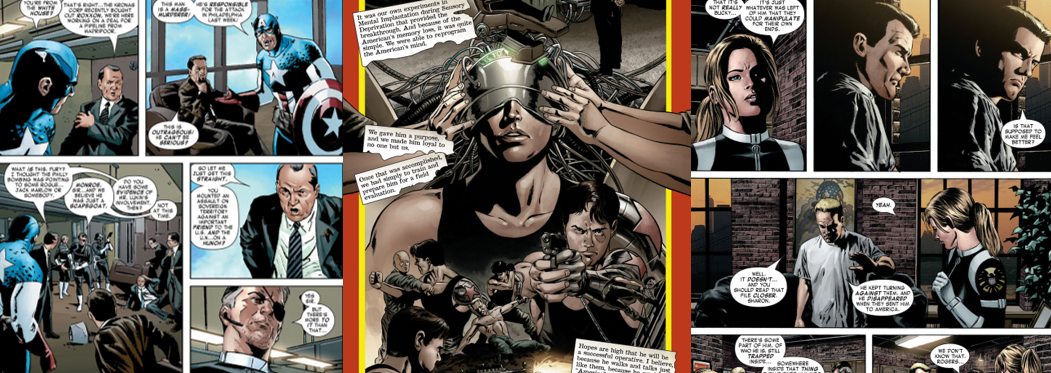
Already frustrated by bureaucracy, Cap’s distraught to learn of Bucky’s horrendous fate.

While Brock Rumlow/Crossbones picks off soldiers stationed at a “re-education facility” and kidnaps the amnesiac Synthia Schmidt, daughter of the Red Skull, to set up a future conflict, Cap and Sharon prepare to drop into Mongolia but find their relationship strained since, just the day before, Sharon raged at Cap for recommending she be kept off the mission. Although Steve argued that he was trying to avoid her going off on a vendetta since her boyfriend was killed in the Philadelphia attack, she believes he was trying to keep her from killing Bucky and remained steadfast in his belief that the overwhelming evidence against his former friend was either faked or a misunderstanding. It doesn’t help that, two days previously, Fury confided to Steve that the mission isn’t authorised by the United States government, primarily due to all the “red tape” and diplomatic drama Lukin caused with his own little empire, Kronas International, on the Mongolian border. Cap, Sharon, Fury, and a S.H.E.I.L.D. squad storm Kronas, setting aside their grievances to fight their way inside, only to find Lukin hosting a meeting with high-ranking American politicians! Though ordered to stand down, Cap is aghast to find they’re brokering an oil pipeline deal with Lukin and refuse to believe he’s anything other than a lucrative businessman since all the evidence points to a convenient patsy, Jack Marlow. Forced to leave and unable to act since Lukin has diplomatic immunity, Cap stews on the ride home though he, Sharon, and Fury vow to topple the maniac one way or another. Luckily for them, a dossier mysteriously vanishes from Lukin’s office and ends up in Cap’s apartment. The document details how the injured Bucky was saved from death by the freezing water, revived by Soviet doctors, and suffered from brain damage that left him only with the instinct to fight. Though dismayed to find he wasn’t subjected to the super soldier serum, Bucky was kept in stasis and later fitted with his prosthetic arm. Bucky was then subjected to invasive brainwashing, reconditioned to become a loyal soldier and assassin for the Soviets, and easily  assassinated high profile targets as the Winter Soldier. The dossier explains, in great detail, the Winter Soldier’s early missions, which were all completed successfully, and that he was kept in stasis since his mental state became increasingly unstable while conscious and threatened to undo their brainwashing.
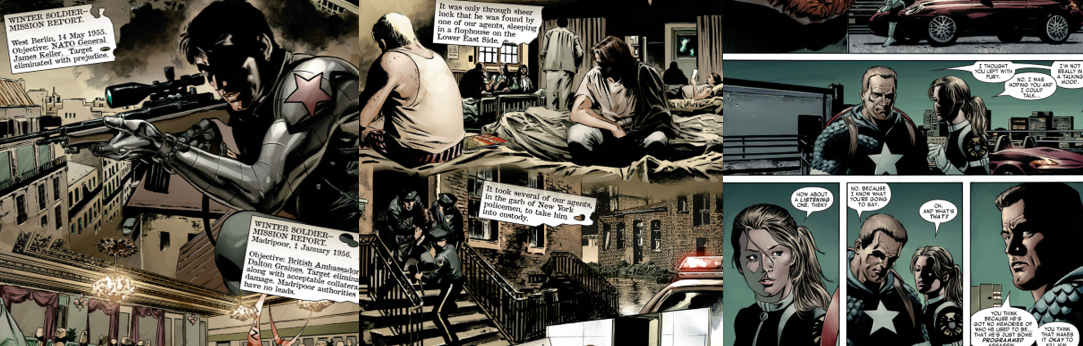
Bucky’s violent past as the Winter Soldier causes tension between Cap and Sharon.

This came to a head in 1973 when, after assassinating his latest target, the Winter Soldier  fled across America. Desperate to retrieve him, the Soviets aggressively interrogated anyone they could before finally following his erratic movements to New York City. Although he was apprehended, the incident rattled the Soviets and they decided not to deploy the Winter Soldier on American soil. The Winter Soldier was next charged with safeguarding Major General Vasily Karpov, who was highly suspicious of his “bodyguard” because of his background, though he took a perverse pleasure in the irony of an American protecting him. After successfully mitigating America’s efforts to invade the Middle East for about five years, the Winter Soldier was decommissioned and left to rot in an undisclosed location alongside other abandoned experiments. Disturbed by the dossier, Steve calls Fury and Sharon to discuss it further, believing Lukin used the Cosmic Cube to deliver the dossier to taunt him. Fury takes the document to be verified, though both he and Steve are confident that it’s accurate. Although Sharon believes that Bucky is lost to decades of Soviet brainwashing, Steve is adamant, based on the evidence, that a part of Bucky’s true self is still alive. Steve’s emotions are heightened by memories of when he and Bucky were celebrated War heroes. Back then, Bucky was an enthusiastic and thrill-seeking teenager in contrast to Steve’s more sombre respect for the harsh reality of war. Steve also remembers when he first met Bucky, then a plucky kid with some impressive fighting skills. Though initially hesitant because of his age, Steve agreed to take Bucky as his partner to inspire teenagers to sign up to the Army. Back in the present day, Steve and Sharon continue to butt heads and morals regarding the Winter Soldier: while Sharon believes he should be killed for his crimes, Steve refuses to entertain the idea that Bucky was anything other than an unwilling puppet.
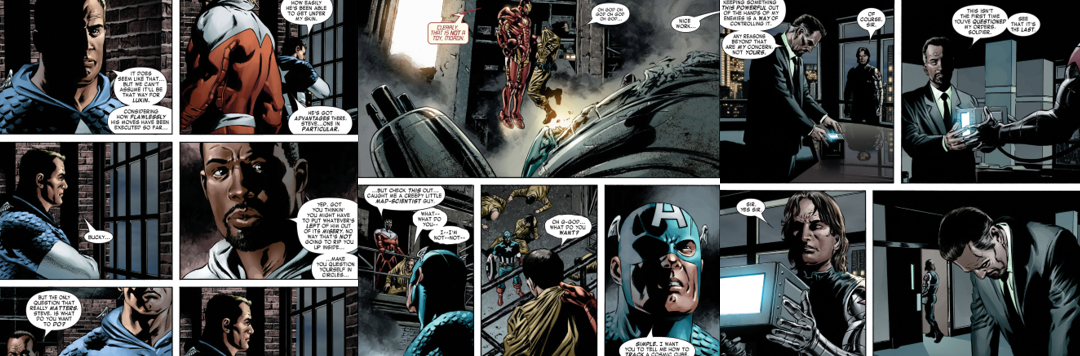
Falcon and Iron Man help Cap track down the Cosmic Cube, which is guarded by the Winter Soldier.

Meanwhile, Lukin hosts a bidding war for his Cosmic Cube, proving its reality-bending power not just by manipulating the bidders to attend but also compelling them to sign documents to make their corporations subsidiaries of Kronas. However, during a recess, Lukin stumbles and appears physically drained by the Cosmic Cube and is driven into a violent rage when his aide dares to caution against its use. While racing across the city rooftops, Cap also finds his emotions in turmoil, desperately willing himself to get it together to save his former partner. He remembers another time when the two were fighting through the Netherlands in pursuit of the Red Skull and they were horrified when their enemy sent boobytrapped prisoners of war to curtail their counterattack. Cap’s thoughts are interrupted by his friend and former partner, Sam Wilson/The Falcon, who offers Steve a friendly ear and speculates that there’s more going on with Lukin and the Winter Soldier. Unlike the sceptical Sharon and Fury, the Falcon agrees to help Steve save Bucky and the two bring in Anthony “Tony” Stark/Iron Man to raid an A.I.D. facility. Though they encounter some resistance from a gigantic, weaponised mech suit, the three subdue their targets and force them to hand over the means to track the Cosmic Cube. Thanks to Tony’s tech, the three discover that the Cosmic Cube is heading to a Kronas research facility, unaware that Lukin has tasked the Winter Soldier with spiriting the Cosmic Cube far away and burying it, believing it to be cursed. Unfortunately, Tony’s unable to accompany them as recent corporate shenanigans would make it look bad for him if he was seen tangling with Kronas. Thus, Steve and Sam head out by themselves (though, once she finds out about it all, Sharon organises a strike team) unaware that the Winter Soldier has taken up a sniping position.
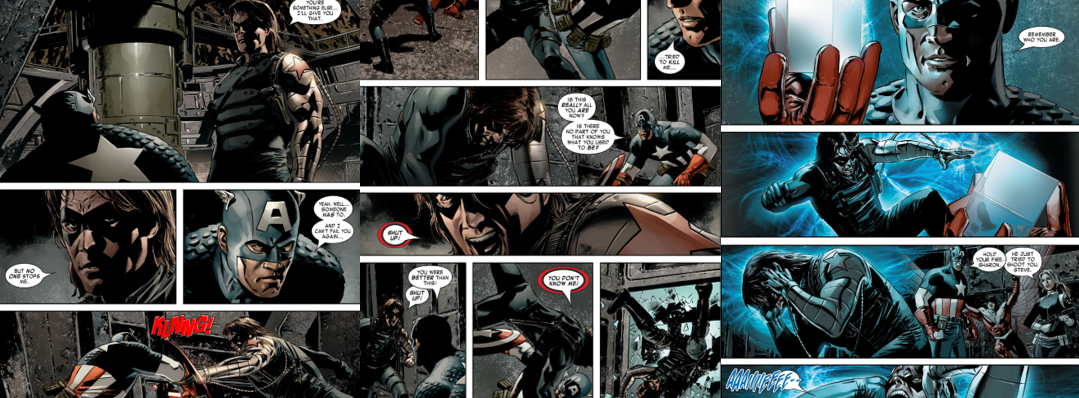
After a brutal slugfest, Cap restores Bucky’s memories with the Cosmic Cube.

Despite having the two dead to rights, the Winter Soldier misses a kill shot when the Falcon’s given a head’s up by the local birds and, his position compromised, calls in some backup to hold the gate. Undeterred, Cap charges through the troops, leaving the Falcon to cover his rear, and finally comes face-to-face with the Winter Soldier. Naturally, a brutal fist fight ensues during which Cap repeatedly tries to reason with his former friend and bring him to his senses and the Winter Soldier stubbornly refuses to listen to Cap’s words. Evenly matched, with the Winter Soldier’s bionic arm countering Cap’s vibranium shield, Bucky’s enraged by Cap’s repeated pleas, the fight spilling the two further into the facility. Realising that the Winter Soldier is determined to kill him, Cap surrenders and dares Bucy to pull the trigger. Sharon and the Falcon arrive in time to see not only the shot but also Cap’s superhuman reflexes; Steve dodges the bullet and tosses his shield, causing it to ricochet off the walls and knock he Cosmic Cube from the Winter Soldier’s grasp. Despite the Falcon earlier warning that no one has ever made the Cosmic Cube to work properly, Cap retrieves the artifact and utters a simple request: “Remember who you are”. Thanks to the Cosmic Cube’s reality warping powers, the Winter Soldier is bombarded by memories of both his past before he became an assassin and his time carrying working for the Soviets. Though Sharon’s ready to kill the Winter Soldier while he’s vulnerable, Cap talks her down and moves to comfort his traumatised friend. Overwhelmed by his actions and coming to his senses, Bucky lashes out in anger and remorse and grabs the Cosmic Cube, seemingly atomising himself as penance for his actions. However, Cap’s suspicions that Bucky’s still alive are quickly shown to be true, though Bucky’s left distressed by the ordeal. The story then ends with the reveal that Lukin shares his consciousness with the disembodied Red Skull, who chastises him for disposing of the Cosmic Cube and vows to assert full control in time.

The Summary:
This is my first time reading the “Winter Soldier” arc and I have to say that it lived up to the hype. Although I’m not the biggest fan of this art style, which was quite prominent in Marvel Comics at the time, it really adds to the mood and tension of the story. The arc is much more of a thriller than an all-out action piece, and a meditation on Captain America’s past and moral compass. As such, there isn’t really a primary villain for him to sink his fists into (an explosive scruffle with A.I.D’s mech is the best we get in this regard) and Cap instead battles more powerful enemies, such bureaucracy and international law. Despite possessing the Cosmic Cube, a device whose power is limited only by the wielder’s imagination (and their ability to keep a strong grip on it), Aleksander Lukin is more of an untouchable manipulator than a physical threat. As related by the Red Skull, Lukin never used the Cosmic Cube to its fullest extent, wary of its power and limited himself to small, controllable actions to mitigate its side effects. Indeed, the moment he experiences negative effects from wielding the Cosmic Cube, Lukin orders the Winter Soldier to dispose of it and is relieved to be rid of it. Still, Lukin remains a despicable villain, perpetrating horrendous acts of terrorism and hiding behind diplomatic immunity, making him the perfect foil for Captain America, who’s unable to bring Lukin to justice lest he spark a global conflict. Seen as a master manipulator who uses mind games and tricks to rile up his foes, Lukin otherwise hides behind his public façade and colludes with other, more disreputable forces (such as the Winter Soldier) to carry out his darker aspirations in secret.
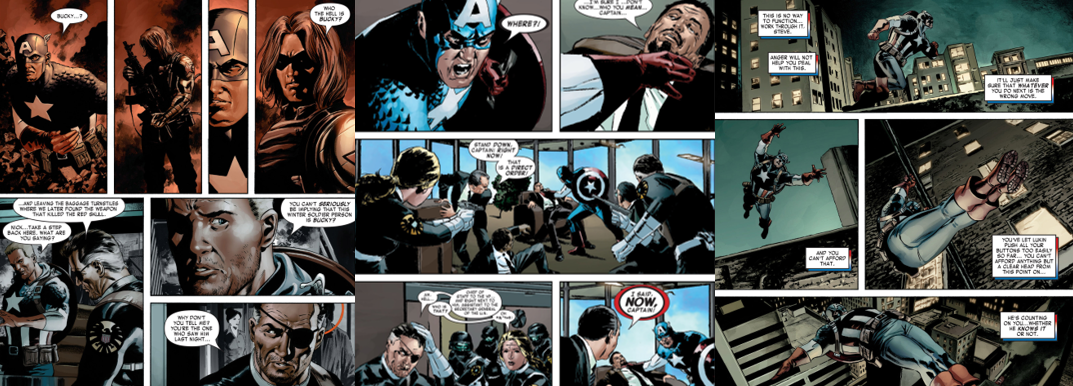
Cap’s emotions are all over the place thanks to Lukin’s machinations and Bucky’s reappearance.

Consequently, “The Winter Soldier” would’ve been an extremely trying and aggravating time for Captain America even without Bucky’s involvement. Steve claims to be level-headed and focused on the mission but repeatedly loses his cool throughout the story thanks to Lukin’s machinations and his inner dialogue shows a man wrestling with his emotions. He has many outbursts over these issues, putting an aggressive beating on A.I.D’s forces and lashing out at both Fury and Sharon when they try to get him to see sense. The only person he doesn’t flip out on is the Falcon, who loyally stands by his side and takes his side even if he has his own doubts about the situation and the Winter Soldier. Cap’s shown to be in deep denial over the whole situation, first refusing to believe that Bucky is still alive, then refusing to believe that he’s a Soviet assassin, and stubbornly refusing to entertain Sharon’s arguments about killing the Winter Soldier or that there isn’t some part of Bucky still alive inside the killer. He’s partially right about this but I wonder if Bucky would’ve regained his senses without Cap using the Cosmic Cube and the story is very ambiguous about this, allowing the reader to see all sides of the argument. It helps that Sharon has a fully justified argument for killing the Winter Soldier. However, while is he responsible for many deaths over the years, Sharon’s judgement is clouded by her personal feelings since Bucky killed her boyfriend. Simultaneously, there’s no doubt that Cap is also biased towards Bucky and, believing he failed the boy by both involving him in his life and causing his condition, Cap’s determined to “save” Bucky, even if it means going against his present-day allies. Numerous flashbacks further reinforce this, showcasing Bucky’s incredible aptitude for fighting, his infectious enthusiasm, and how the atrocities of war affected him over time. Cap’s always carried a great deal of guilt and regret about Bucky’s death so it’s a shock to see his partner alive and turned into a mindless weapon and Cap sees it as a chance for redemption, both for himself and for his young friend. Cap believes so blindly in Bucky that he eventually refuses to fight and leaves his life in the assassin’s hands, then braves severe consequences by wielding the unstable Cosmic Cube to restore Bucky’s memories to the fractured Winter Soldier.
Bucky was totally reinvented as a bad-ass, tortured assassin.

Of course, the star of the show here is the titular Winter Soldier. At the time, I was sceptical about bringing Bucky back since he was one of the rare comic book characters who seemed destined to be dead forever. However, just like when DC Comics brought Jason Todd/Robin back as the Red Hood, retconning Bucky to have survived that explosion was a genius move that not only added new layers to Cap’s characterisation but also brought a bad-ass new anti-hero into Marvel Comics. Sporting long hair, a stoic visage, a form-fitting leather outfit, and an awesome robotic arm, the Winter Soldier cuts an intimidating and mysterious figure that’s only enhanced by his decades of assassinations. Restored to life and brainwashed by the Soviets, Bucky was transformed into a living weapon, a “blank slate” they could program to kill anyone they wished, one who easily infiltrated their enemy’s ranks since he looked and sounded just like them. Depicted as a natural fighter whose first instinct is to fight, the Winter Soldier is a keen marksman and an adept assassin, eliminating numerous targets when activated and easily holding his own against Cap despite lacking superhuman abilities. However, the Winter Soldier’s psyche is fractured, his mental state unstable, and he was frequently noted to be unreliable when activated for too long. When deployed on American soil, the Winter Soldier became confused and almost escaped his Soviet masters, ultimately leading to him being mothballed. It’s not made clear how and why he was released from captivity, but Bucky’s appearance causes a great deal of turmoil for Cap and their encounters cause confusion and anger in the unstable assassin. Obviously, much of Bucky’s past and future was cleared up in subsequent stories but this was a fantastic revival of the character, one that turned Cap’s life upside down and forever transformed Bucky from a plucky, annoying kid sidekick into a sexy, bad-ass killer.

My Rating:

Rating: 4 out of 5.

Great Stuff

Have you ever read the “Winter Soldier” arc? If so, what were your thoughts and what did you think to Bucky being revived? Do you think Sharon was right and that Bucky should’ve been put down? Did you enjoy seeing Cap wrestle with his guilt and conflicting morals? What did you think to the Winter Soldier’s look and backstory? Can you name some of your favourite Winter Soldier moments? How are you celebrating Independence Day today? Whatever your thoughts, drop a comment below and be sure to check out my other Captain America content across the site!

Back Issues [Independence Day]: The Avengers #4


First appearing in 1941, Marvel Comics’ star-spangled super soldier, Captain Steve Rogers/Captain America, has become one of Marvel’s most recognisable and celebrated characters not just for his super patriotism but also for being a prominent member and leader of Marvel’s premier super team, the Avengers. Having successfully made the jump to live-action, Cap is now a widely celebrated, mainstream superhero and, given that today is Independence Day, this seems like the perfect excuse to pay tribute to the star-spangled man with a plan himself!


Story Title: “Captain America Joins…The Avengers!”
Published: 1 March 1964
Writer: Stan Lee
Artist: Jack Kirby

The Background:
In 1941, the Second World War was well under way; Nazi Germany overtook Denmark and Norway in April 1940 and the United States finally entered the fray in 1941 to oppose the combined “Axis powers” of Germany, Japan, and Italy. Due to the ever-escalating conflict, patriotism and national pride ran rampant in America, leading to Joe Simon and the legendary Jack Kirby debuting Captain America and his kid sidekick, James Buchanan Barnes/Bucky, who took the fight directly to the enemies of America and encouraged readers to support the war effort by any means necessary. However, after the War ended, superheroes saw a decline in popularity and Captain America’s solo title was cancelled in 1954, but the character got a second chance when he was recast as a “man out of time” in this issue of The Avengers. The Avengers came about as a direct response to rival DC Comics’ Justice League of America; Martin Goodman tasked Stan Lee with bringing together Tony Stark/Iron Man, Doctor Bruce Banner/The Hulk, Doctor Donald Blake/Thor Odinson, Doctor Hank Pym/Ant-Man, and Janet van Dyne/The Wasp as Marvel’s premier superhero team. With their ever-changing roster and prominence in some of Marvel’s biggest events and stories, the Avengers became a consistent and influential presence in Marvel Comics, even more so after the Star-Spangled Avenger joined their ranks in this historic issue.

The Review:
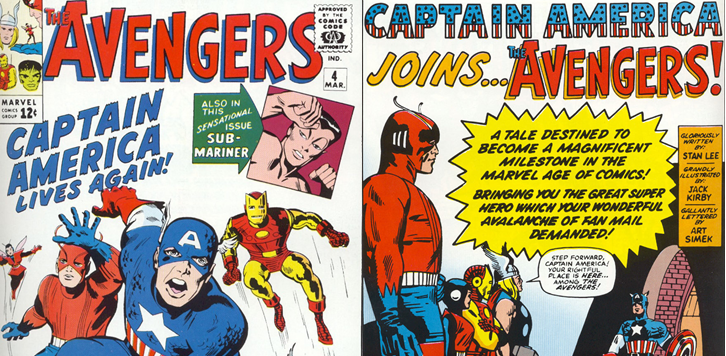
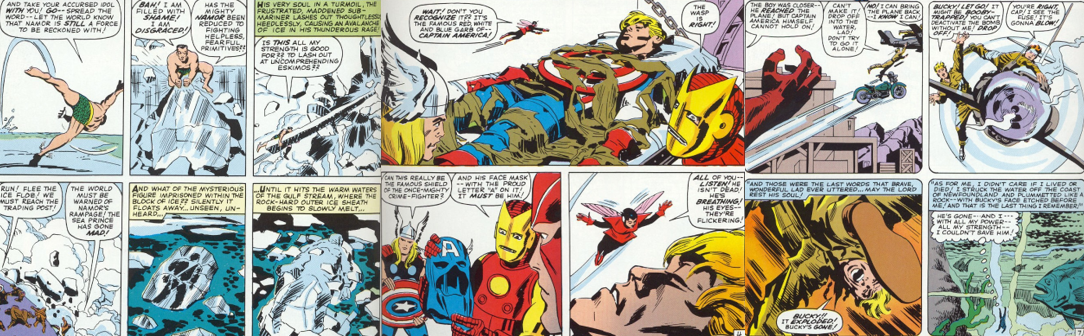
Marvel Comics always liked to hype up their stories and issues back during this time period; front covers would proclaim even the most bizarre-looking characters as being must-see events and issues generally always featured celebratory mentions of the creatives involved, and The Avengers #4 is no different. There are a couple of notable unique features in the full-page title splash for this story, though; first, a big explosive bubble of text directly attributes the return of Captain America to an “avalanche of fan mail” and a dialogue box at the bottom of the page makes sure to mention that “glorious” Stan Lee and “grand” Jack Kirby both collaborated on Captain America’s debut story, thereby lending further prestige to his return to the then-modern era of Marvel Comics. The story itself takes a little while to get started as the first page of panels is dedicated to recapping the Avengers’ battle against Prince Namor McKenzie/The Sub-Mariner and the Hulk in the previous issue; after the Hulk disappeared, Namor was forced to flee from the overwhelming odds and returned to the depths of the ocean. The sting of defeat is great for the proud Mutant but pales in comparison to the frustration he feels at being abandoned by his people after the inhabitants of Atlantis questioned his loyalty. Vowing to never stop searching for his lost people, Namor finds himself lost amidst the frozen wastes of the North Sea, where he comes across a tribe of Eskimos who worship a mysterious figure frozen in a block of ice. Interestingly, despite the Eskimos being isolated from the rest of the world, they instantly recognise “the dreaded Namor”, who wastes no time in mocking their idol and turning his anger upon them. In his rage, Namor decimates the frozen landscape, terrorises the simple folk, and hurls their frozen idol into the sea.

The Avengers are awestruck when they recover the perfectly-preserved body of the legendary Captain America!

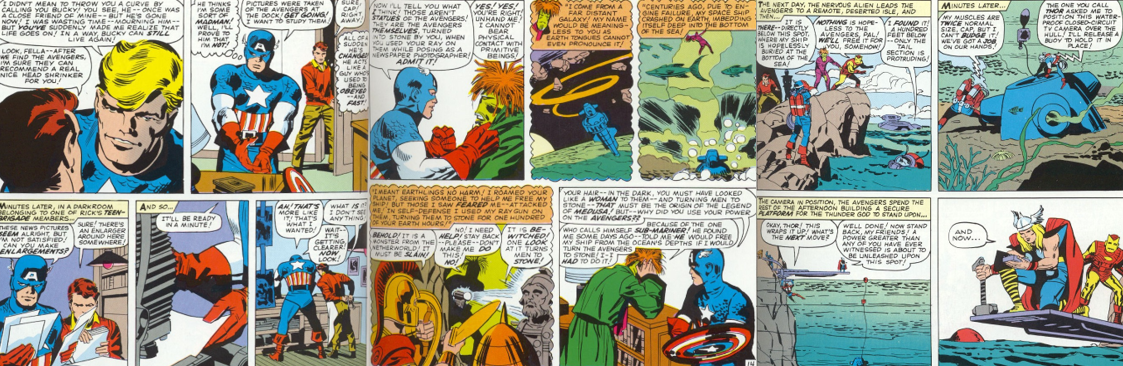
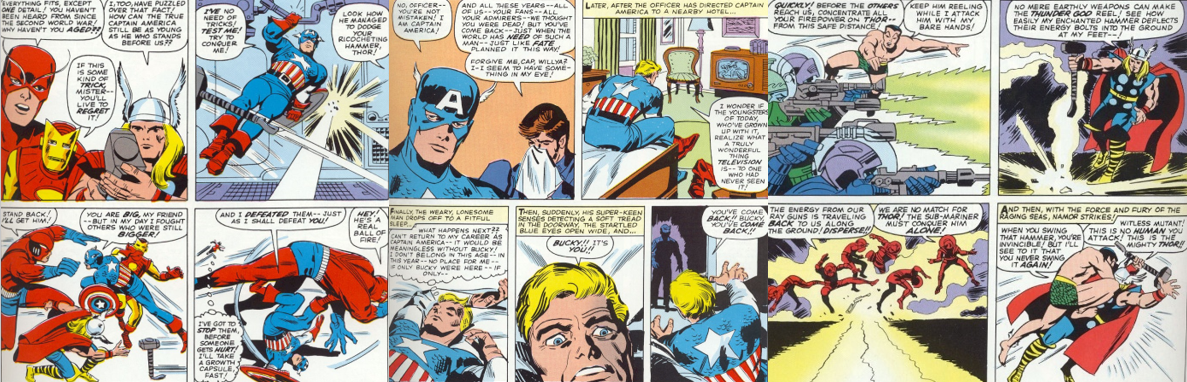
Free from the frigid temperatures of the northern climate, the ice block slowly melts and, by the time the Avengers come across it in their little submarine (I assume they were tracking Namor, that seems to make sense as to why they’d randomly be out there), the ice has completely melted, freeing the unconscious body trapped within. Giant-Man brings the body aboard and the team are stunned to find that it’s none other than the slumbering body of the legendary Captain America, a star-spangled crusader of justice so prolific that even Norse God Thor is aware of his accolades. The team’s shock at this discovery turns to panic when Cap suddenly awakens and lashes out in a confused daze, desperate to keep his kid sidekick, Bucky, from harm. Thor, Iron Man, and Giant-Man leap in to restrain the raging legend, but his madness quickly passes. Within the space of five panels, he resigns himself to the memory that Bucky is dead and reclaims his identity, shield, and mantle of Captain America. Though impressed, the Avengers are so puzzled by Cap’s youth and vigour that they suspect some kind of trick. Thus, Cap invites them to test him, easily dodging Thor’s magical hammer, overpowering even the hulking Giant-Man, and is only kept from embarrassing the group further when Wasp stops him in his tracks by challenging his chivalry. Suitably convinced that Cap is the real deal, tensions calm long enough for Cap to tell the tragic story of how he came to be encased within a block of ice. Back during the Second World War, Cap and Bucky were posing as security guards at an Army base when a mysterious Nazi figure launched an explosive-filled drone in a bid to either kill the two or rob the United States of a powerful weapon. Although Cap failed to reach the plane in time, Bucky leapt onboard and was seemingly vaporised when the plane exploded; the heartbroken Cap was hurtled into the ocean depths off the coast of Newfoundland, where he became encased in ice and effectively held in suspended animation. When the Avengers reach New York City, they’re greeted by the press, hungry for the big scoop on their battle against Namor and the Hulk, but the team are suddenly and inexplicably turned into stone statues by a flash of light! Cap missed the event since he was still inside the craft and, when he emerges topside to find everyone gone, he assumes that the statues are in honour of the colourful heroes and ventures out to explore the strange new world he’s found himself in without a second thought.

Cap tracks down the one responsible for petrifying the Avengers, an alien whom he vows to assist.

Cap is impressed by how much has changed, from clothing and fashion to the establishment of the United Nations and the upgrades to everyday vehicles, and stuns the public, who instantly recognise him as the legendary hero of World War II. Directed to a hotel by a helpful police officer, Cap briefly marvels at the wonders of television before dozing off in a troubled exhaustion. Already questioning his place in the modern age, Cap is startled to wake up and find Bucky alive and well in his hotel room…only to realise that it’s perennial sidekick and Avengers mascot Rick Jones. Concerned by the Avengers’ disappearance, Rick confronts Cap; since Cap was the last person to see them, Rick basically accuses him of being involved and threatens to set the Hulk on him if he doesn’t help find the team. This threat means little to Cap since he doesn’t know who the Hulk is and he’s still struggling with the uncanny resemblance between Rick and Bucky, but he promises to help find the team despite Rick’s rude demeanour. After reviewing the photos taken of the team by the press, Cap spies a suspicious man holding a camera-like gun and Rick wastes no time in contacting his “teen brigade” to try and find him amongst the teeming masses. Laughably, the teens come up with nothing but dead ends and false leads, but Cap finds the guy seemingly at random just by scouring the city’s rooftops. Once he spots the man he’s looking for, Cap wastes no time in springing into action and confronting him and his armed goons. Even these lowly mobsters recognise Cap and they’re easily overwhelmed by his indomitable shield, uncanny agility, and Herculean strength; while the goons quickly surrender, their leader desperately tries to turn Cap to stone with his ray gun, only to miss and be unmasked as a bizarre extraterrestrial lifeform! Unfazed by this, Cap threatens the alien (who goes unnamed in this issue but is eventually revealed to be named Vuk), who gladly tells his story to avoid being handled by “primitive beings”. Vuk crash-landed on Earth centuries ago and, encountering nothing but fear and hostility, would turn men to stone with his ray gun in self-defence, which Cap realises directly led to the myth of the hydra-haired, stone-eyed Medusa. Vuk relates that the Sub-Mariner promised to help Vuk return to the stars if he turned his weapon against the Avengers and, recognising the Sub-Mariner’s name from the past, Cap vows to help Vuk in return for undoing the damage he’s inflicted upon the Avengers.

As impressed by the team as much as they are with him, Cap helps fight Namor and joins the Avengers.

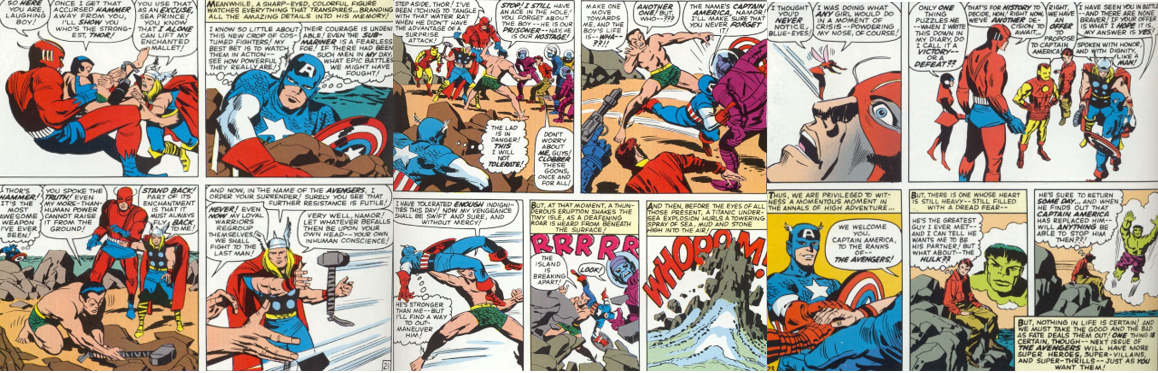
Namor witnesses these events from his deserted imperial castle using his “undersea scanner” and vows to avenge himself upon his enemies, a promise that suddenly becomes more viable when he conveniently stumbles upon a loyal troop of his elite guard. True to his word, Cap leads the Avengers in finding and freeing Vuk’s ship from the ocean depths, an act that earns them Vuk’s eternal gratitude and Cap’s admiration for the group’s unparalleled teamwork. Their victory is short-lived, however, as Namor and his elite guard suddenly attack the group; Iron Man goes toe-to-toe with Namor but his armour struggles to withstand the sledgehammer-like blows of the Sub-Mariner. In desperation, Iron Man blasts Namor with a “full [intensity] magnetic ray”, but this only grants him a temporary reprieve; with his armoured foe’s “greatest weapon” exhausted, Namor redoubles his attack, smashing a rock over Iron Man’s head and manhandling him to the ground. Momentarily powerless as he waits for his transistors to recharge, Iron Man is saved from certain death by the timely intervention of the Wasp, who Namor easily shrugs off before answering his lieutenant’s plea for help in subduing the rampaging Thor. Thanks to his mighty hammer, Thor easily holds back Namor’s forces by himself and repels the energy bolts fired at him by their ray guns, forcing Namor to leap at the Thunder God to tackle him directly. After slipping free of the Atlantean’s net and saving himself from drowning, Giant-Man returns to the fray to assist Iron Man, hurling the Atlanteans off-panel with his massive strength before rushing to aid Thor in tussling with Namor, who’s become obsessed with wrestling Mjölnir from Thor’s grasp. Watching from the side lines, Cap can’t help but be impressed by the power and courage of the Avengers and in awe of Mjölnir, a weapon so powerful that only the Mighty Thor can lift it. Although the Avengers clearly have Namor beat, the proud prince refuses to surrender and lowers himself to threatening Rick’s life. This irks Cap so much that he finally leaps into action, tackling Namor’s elite guard and briefly being overpowered by the Sub-Mariner before the tiny isle on which they’re all fighting suddenly (and conveniently) breaks apart from an undersea explosion caused by Vuk’s ship. Confident that his enemies will drown beneath the resulting waves, Namor commands his forces to retreat, unaware that the heroes easily survived by clinging to the remains of the island. Impressed by Cap’s prowess in battle, the Avengers ask him to join their little team and he gratefully accepts, but Rick is left pondering the fate of his friend and partner, the Hulk, whose rage at being “replaced” by Captain America is as sure as the inevitability that the Avengers will butt heads with the Sub-Mariner again before long.

The Summary:
I quite enjoyed “Captain America Joins…The Avengers!” I sometimes struggle with Jack Kirby’s more bizarre artwork and designs but there was none of that here (save for the Avengers’ submarine and the brief depictions of Atlantean technology), which really helped these colourful characters to stand out all the more prominently. I especially liked Cap’s brief walk around New York City and him being impressed by the advances in technology and society since his day, and the panels that took place underwater, which evoked a murky, almost alien environment. Unfortunately, paralleling this was the pretty haphazard and confusing flashback to Bucky’s final mission, where it’s a bit difficult to make out where the characters are in relation to the plane, and the depiction of Vuk, who ends up looking more like Beaker than anything remotely impressive. I also really didn’t care for the reveal that an alien was behind the Avengers’ petrification; it was weird that Cap took it in stride and that the story didn’t treat it as a big deal, and it just came out of nowhere. I think it would’ve been far better to have it be an Atlantean in disguise, maybe switch the order of events to show Namor recruiting his elite guard before the Avengers reach New York, and then Cap could just threaten the Atlantean into helping him. It’s a minor thing to complain about but that’s kind of the problem; Vuk doesn’t even get a name and it just seems so random to just insert a Medusa-like alien into the story when the primary focus is the antagonism against Namor. Normally, I’d also complain about the depiction of women and youth during this time but, aside from being a bit too rude and confrontational, I didn’t have much of an issue with Rick Jones here and I was actually very impressed by the restraint show with the Wasp. She doesn’t fawn or coo over Cap upon seeing him and actually proves quite useful in the scuffle with him and Namor…but then all that goodwill gets thrown away on the very last page where it’s revealed that the Wasp disappeared from the battle to powder her nose!

Cap impresses with his abilities and characterisation, as does Namor’s unquenchable pride.

However, I enjoyed the angst of the Sub-Mariner as depicted here; Namor’s anger against he surface world has only exacerbated since his people abandoned him after questioning his loyalty due to his mixed heritage and he’s desperate not only to find his people, but to subjugate humanity to prove his superiority. There’s a tragedy to Namor that’s present even here; he lashes out at everyone and everything because he doesn’t want to be alone and craves power and adulation, but he’s tormented by being a child of both worlds and his status as a Mutant amongst even his bizarre people. Depicted as both an underhanded tactician and a formidable physical force, Namor’s threat is enough to require the attention of all the Avengers even without his elite guard and I liked how he easily overpowered Iron Man and matched even Thor’s God-like power (even if he was unable to lift Mjölnir). Of course, the true star of this story is Captain America; I really enjoyed how the issue went to great lengths to talk up Cap’s status as a legendary figure and that even randomers in the street recognised him as a hero from their youth. The Avengers are awestruck by his presence and seem delighted to not only have him amongst them, but also to test his abilities in battle, and Cap is equally impressed by the team, who he wishes could’ve been by his side during World War II. While it seems like Cap quickly regains his senses and returns to his confident and commanding persona, the story does touch upon the grief and anguish he feels at Bucky’s death and his feelings of belonging in the then-modern world. Though impressed by how far the world has come since his day, Cap briefly feels as though he doesn’t belong there, and it isn’t until he’s back in action, tracking down the Avengers’ mystery attacker and engaging with the Sub-Mariner, that he truly feels himself again. This was the perfect way to sell newcomers and sceptics on Cap’s return and make him relevant amongst his modern contemporaries and I really enjoyed how he meshed with the Avengers and their mutual respect for each other. Take out the Vuk stuff (or replace it with something better) and this would’ve gotten full marks from me, but it’s still a blast to read and one of the quintessential Avengers and Captain America stories.

My Rating:

Rating: 4 out of 5.

Great Stuff

Have you ever read “Captain America Joins…The Avengers!”? If so, what did you think of it and did you enjoy seeing Captain America join the Avengers? Was this your first exposure to Captain America, and if not what was? Were you also disappointed by the inclusion of Vuk? What did you think to the depiction of Namor and Cap’s introduction to the then-modern world? Which of the Avengers is your favourite? How are you celebrating Independence Day today? Whatever your thoughts, drop a comment below or on my social media and be sure to check out my other Captain America content across the site!
Movie Night [Independence Day]: Captain America


First appearing in 1941, Marvel Comics’ star-spangled super soldier, Steve Rogers/Captain America, has become one of Marvel’s most recognisable and celebrated characters not just for his super patriotism but also for being a prominent member and leader of Marvel’s premier super team, the Avengers. Having successfully made the jump to live-action, Cap is now a widely celebrated, mainstream superhero and, given that today is Independence Day, this seems like the perfect excuse to pay tribute to the star-spangled man with a plan himself!


Released: 14 December 1990
Director: Albert Pyun
Distributor: 20/20 Vision / Columbia TriStar Home Video
Budget: $3 million
Stars: Matt Salinger, Scott Paulin, Kim Gillingham, Francesca Neri, and Ronny Cox

The Plot:
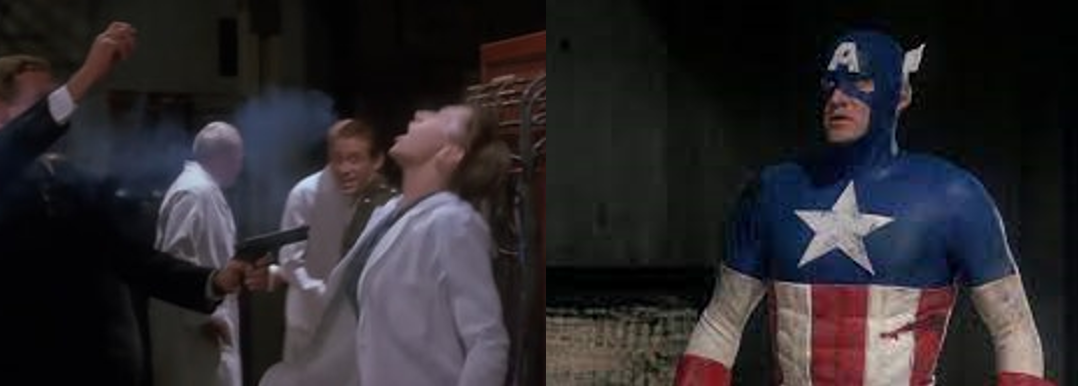
As the United States and Nazi Germany go to war in 1943, polio-stricken Steve Rogers (Salinger) is transformed into a superhuman solider, codenamed “Captain America”, and frozen in ice for fifty years after saving the U.S. from a ballistic missile launched by his Italian counterpart, Tadzio de Santis/The Red Skull (Paulin). When he awakens in the modern world, Steve finds the Red Skull alive and well and planning to brainwash President Thomas Kimball (Cox) in order to usurp his pro-environmentalist legislation.

The Background:
Since his debut in Marvel Comics, Captain America has had a bit of a tumultuous history; for a time, the Star-Spangled Avenger was the most popular patriotic superhero in all of comic books but, after the War, the popularity of superheroes began to falter and the character was literally put on ice for about ten years. Upon being revived and joining the Avengers, Cap once again returned to prominence in Marvel Comics. Along the way, Cap featured not only in a crude animated series in the 1960s and guest starred in some of Peter Parker/Spider-Man’s 1980s cartoons, but also a couple of live-action television films in the 1970s before Cannon Group founders Menahem Golan and Yoram Globus acquired the rights to the character in 1984. Six years of development hell caused the script to go through numerous rewrites and director changes before Albert Pyun came onboard and targeted a theatrical release date to coincide with the character’s fiftieth anniversary; eventually, however, the film was released straight to video and is regarded extremely unfavourably and has also gained some merit as a cult curiosity if nothing else.

The Review:
The first thing to note about Captain America is that the DVD transfer quality is absolutely dreadful; it genuinely looks like a VHS copy of the film was simply spliced onto the disc and left at that. It’s by no means an amazing film anyway but actually going to the effort of properly converting the film to DVD would have gone a long way to make the viewing experience a little less unsightly. The second thing to note is how drastically the film changes the Red Skull’s origin story; usually, he is Johann Shmidt, a crazed Nazi super soldier hellbent on obtaining power and spreading fear across the entire world but, here, he’s a much more tragic figure. Child prodigy Tadzio de Santis (Massimilio Massimi) is abducted from his family, who are killed right before his eyes, and forced to endure Doctor Maria Vaselli’s (Carla Cassola) experimental super soldier process by the Fascist Italian military. While the Italians are pleased by the procedure’s results, which transform its subjects into beings of incredible strength and intelligence but render them a bloodied, skeletal beast, Dr. Vaselli draws the line at subjecting the boy to the procedure and flees to America, leaving Tadzio to be transformed into a maniacal super soldier.

Although Vaselli is killed, Steve is transformed into a super soldier.

Vaselli flees and defects to America and, over the next seven years, perfects her procedure; “Project: Rebirth” is now capable of transforming even the weakest, frailest man into one as “fast and as strong as an athlete”. Wishing to create an entire regiment of super soldiers, the military are only too pleased when Steve Rogers, a young man crippled by polio, volunteers for the process; Steve, who is the epitome of the All-American boy, with a loving family, is determined to live up to the example set by his father, who died in service for his country. His girlfriend, Bernice “Bernie” Stewart (Gillingham), is distraught at Steve’s decision to leave, but promises to wait for him for as long as it takes for him to come back. Steve is taken to a rather unimpressive, dungeon-like laboratory hidden beneath a traditional American diner and, under the supervision of Dr. Vaselli and Lieutenant Colonel Louis (Michael Nouri), is subjected to a painful procedure involving lots of flashing lights and sparks. The result is the sudden increase of his muscle mass and his transformation into “Captain America”, a name specifically chosen to evoke the spirit of the good ol’ U. S. of A. Unfortunately, while the procedure is a success, a Nazi agent infiltrates the bunker. Although Steve uses his newfound strength to dispose of the Kraut, Dr. Vaselli and a number of other bystanders are killed in the fray. Dr. Vaselli takes the secret of Project: Rebirth to her grave and Louis is left with a single superhuman soldier rather than an army.

For all the film’s flaws, the Red Skull looks pretty bad-ass.

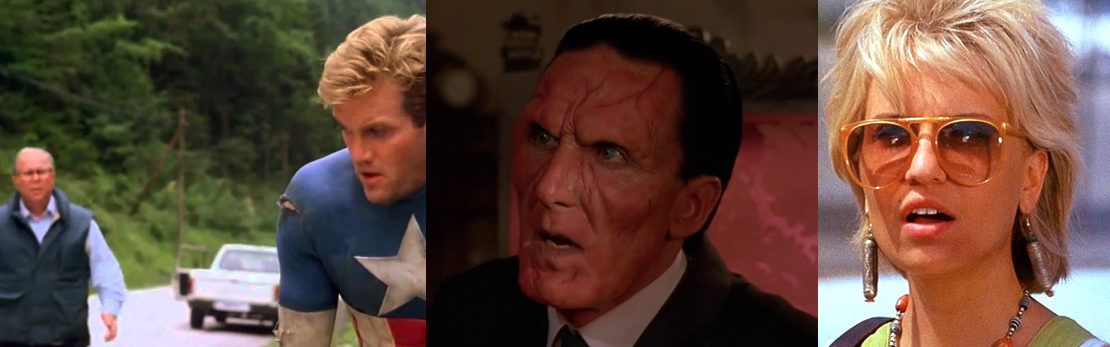
Bypassing such formalities as training, Steve recuperates from his injuries and is immediately dropped into the deep end. Garbed in a garish red, white, and blue fireproof uniform and carrying a circular, frisbee-like shield, Cap easily infiltrates a Nazi base, where the Axis forces are planning to launch a ballistic rocket at the White House. The rocket is guarded by Tadzio, now transformed into the hideous Red Skull. Say what you will about the film but the make-up effects on the Red Skull are actually pretty good; it’s a shame, then, that he only appears in this guise for a brief scene in the film. Anyway, the two have a bit of a punch up but, finding himself evenly matched in strength and outmatched in ferocity and strategy, Steve ends up strapped to the rocket after being pricked by the Red Skull’s little hand-needle-thing.

Steve is dethawed to find the world has moved on in his absence.

When Cap tries to take the Red Skull with him, his Nazi counterpart severs his own hand to escape; despite his desperate situation, Cap is able to deflect the rocket from its course, much to the awe of one young Thomas “Tom” Kimball (Garrette Ratliffe), and ends up buried in ice in Alaska. We are then treated to a montage as the next fifty-odd years pass; in that time, Tom grows up to become not only Ronny Cox but the President of the United States! Additionally, the Red Skull undergoes extensive plastic surgery (making him more like the Reg(ular) Skull!), raises a daughter, Valentina (Neri) to be his best hitwoman, and becomes the head of a shadowy crime family behind the assassination of many celebrities and political figures. Rather than kill Kimball, whose pro-environmentalist legislation angers the military-industrial complex, the Red Skull instead intends to kidnap the President and brainwash him to avoid turning him into a martyr (which, apparently, is much less trouble than paying for and organising an assassination; who knew?) Steve’s frozen body is finally discovered by a team of researchers and he breaks free, disorientated and initially believing himself to still be in the 1940s. Even when Kimball’s friend, reporter and conspiracy theorist Sam Kolawetz (Ned Beatty), tracks him down and explains what’s happened, Steve refuses to believe that it is anything other than a Nazi trap. Not even an attack by the Red Skull’s forces convinces him and it is only after feigning car sickness, stealing Sam’s car, and meeting Bernie’s daughter, Sharon (Gillingham), that the weight of his predicament finally hits him. After Bernie (and, it seems, Sam) are killed by Valentina and Kimball is successfully kidnapped, Steve resolves to head to Rome (begrudgingly taking Sharon along with him) to confront his nemesis once more.

The Nitty-Gritty:
In many ways, I have to admire Captain America; it’s not a million miles away from the source material, especially as established in Marvel Comics at the time, and is clearly limping along on fumes rather than benefiting from a big budget. Surprisingly, the film even goes to the effort of name-dropping Namor the Sub-Mariner and Jim Hammond/The Human Torch, hinting that this is a world where costumed heroes are actually present (although conspicuous by their absence).

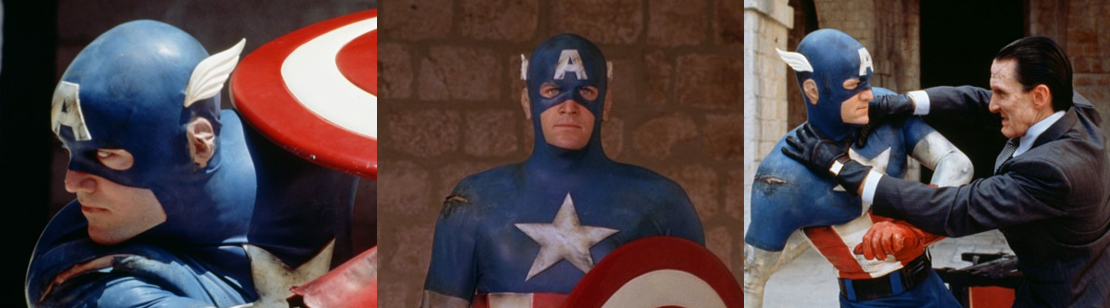
He might look 100% comic accurate but man, does Cap look like an absolute goon.

I mentioned the make-up effects on the Red Skull before and they really are impressive. Sadly, though, it seems the bulk to the special effects budget was spent achieving this effect as Cap’s infiltration of the Nazi base is woefully pitiful thanks to some obvious miniatures and, while I appreciate how faithfully the filmmakers recreated the Captain America costume, Cap really does look like an absolute clown running around in what looks like a really hot and uncomfortable latex suit with floppy rubber wing-ears and chucking a shiny oval shield that often looks far too much like plastic. Cap’s action scenes aren’t really up to much, either; the film’s chase and vehicle sequences are far better than the fight scenes, which are shot very frantically, feature an abundance of loud, exaggerated sound effects, and don’t really showcase Cap’s amazing strength or agility in any significant way.

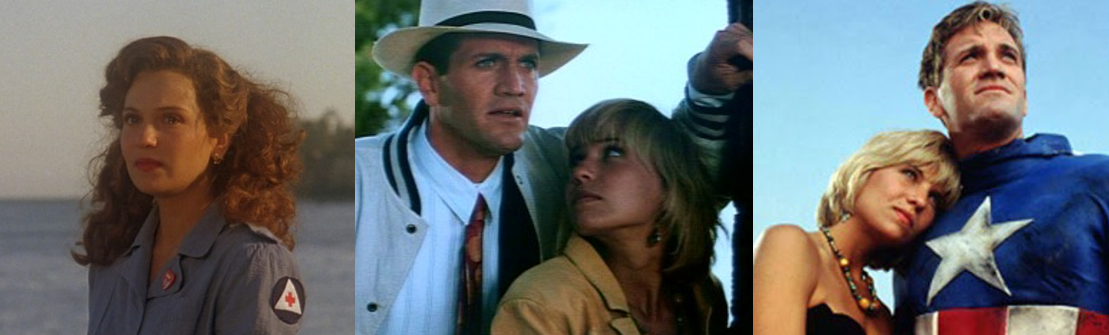
There’s not much for the women to do in this film but support, or fawn after, the goofy Steve.

Of course, any Captain America story has to deal with Steve being a man out of time and Captain America is no different; similar to the Marvel Cinematic Universe incarnation, though, this is largely glossed over. In the space of a few scenes, we see Steve confused and gawking at the then-modern world but, while he’s heartbroken to find that Bernie has aged into an old woman, married, and had a daughter, he quickly acclimatises to his new situation. After catching up on the last fifty years using VHS tapes, Steve immediately focuses on the bigger picture: tracking down the Red Skull using Dr. Vaselli’s diary. Sharon helps bring Steve up to speed and actually proves very helpful in Rome as, unlike Steve she can actually speak and read Italian; unfortunately, despite initially appearing quite a ballsy and independent young woman, Sharon quickly becomes little more than a babbling, screaming hindrance who is constantly overwhelmed by the events happening around her and who even ends up being taken as a hostage when they reach Rome.

Cap wins the day but…after watching this film, is anyone truly a winner?

Having learned of de Santis’ tragic childhood, and donning his God-awful suit once more, Cap infiltrates the Red Skull’s castle. It turns out, though, that Kimball doesn’t even need his help as he escapes his cell out of his own initiative (which perfectly fits with Kimball’s forthright and practical nature); he even teams up with Captain America for the finale (leading to one of the cheesiest thumbs-up ever), which sees Cap overpower all of the Red Skull’s goons. Although the Red Skull activates a bomb, Cap distracts him with a recording of his abduction as a child and finishes his Nazi counterpart off by knocking him to an explosive death with his shield. With the Red Skull dead and his daughter down for the count, Steve saves the President, ushering a new environmental age, and once again disappears into legend.

The Summary:
Man, that was a tough watch. Even the power of nostalgia can’t really save Captain America, which was another of the few live-action comic book adaptations I grew up with as a kid. It tries, desperately, to be this fun, action-packed little adventure but it just can’t seem to kick into the higher gear necessary to hit whatever tone it’s going for. Matt Salinger does a decent enough job as Captain America but, while he looks the part with his square jaw and All-American physique, the costume does him very little favours and he’s one of the oddest, most wooden actors I’ve ever seen. He constantly looks baffled and out of his depth, which you could argue is fitting considering Cap is massively out of his element in the modern day, but it seems more like he was told to act like a complete goof rather than as a cheesy but forthright icon. The Red Skull and Ronny Cox and some of the special effects make it worth a watch for those curious to delve into this dreg of a film but even the most die-hard Captain America fans will have difficulty defending this one.

My Rating:

Rating: 1 out of 5.

Terrible

Have you ever seen Captain America? If so, what did you think of it? Do you agree that it is a pretty dreadful film overall or do you, perhaps, have a soft spot for it? What did you think to the Red Skull’s make-up and Captain America’s suit and portrayal? What was your first exposure to Captain America and where do you rank him against other superheroes, where Marvel or otherwise? What story or character of his is your favourite and why? How are you celebrating Captain America’s star-spangled debut this month? Whatever your thoughts, drop a comment below.

Movie Night: Independence Day: Resurgence

Released: 24 June 2016
Director: Roland Emmerich
Distributor: 20th Century Fox
Budget: $165 million
Stars: Liam Hemsworth, Maika Monroe, Jessie Usher, Jeff Goldblum, Charlotte Gainsbourg, and Bill Pullman

The Plot:
It’s been twenty years since the Earth successfully defeated an alien invasion and, since then, humanity has reverse-engineered the alien technology to fortify their defences in anticipation of a second attack. However, humankind is overwhelmed when a gargantuan alien ship arrives and begins drilling into the Earth’s core, forcing the survivors to scramble to launch another desperate counterattack.

The Background:
Independence Day (ibid, 1996) was a massive financial hit back in the day; the film was the highest-grossing movie of 1996, made nearly $820 million at the box office, and inspired a renewed interest in blockbuster disaster films. The film was accompanied by a slew of merchandise and helped catapult star Will Smith into a leading man in Hollywood. And how did 20th Century Fox capitalise on this success? By waiting twenty years to produce a sequel! To be fair, writer/producer Dean Devlin had been planning a sequel since as early as 2001 but, despite being inspired to write a sequel in response to the September 11 attacks, the project was ultimately abandoned when he and director Roland Emmerich were unable to hash out the story. The two finally settled on a treatment in 2011 and planned to film two sequels back-to-back, however Fox refused to meet Smith’s salary demands and his character was written out of the plot. The filmmakers resolved to further explore the alien’s society and take advantage of the time jump to tell a generational story, and aimed to outdo the destruction seen in the first film. After finally settling on a title, Independence Day: Resurgence released to lacklustre reviews and failed to match the success of its predecessor with its $389.7 million box office. Although Emmerich’s plans for a third film were thrown into doubt by this result, he remained hopefully that the final chapter would be produced someday.

The Review:
It’s easy to forget just how big a deal Independence Day was when it first came out; it was massively hyped, accompanied by loads of trailers and posters and merchandise, and my friends and I often found ourselves watching the VHS time and again back in the day. Since then, there have been other, better alien invasion and disaster movies, for sure, and the film has probably lost a lot of its shine but it’s fun enough to return to every now and then for Will Smith’s charismatic performance, Jeff Goldblum’s trademark quirkiness, and Bill Pullman’s rousing speech (as well as the special effects and all that good stuff). However, I can’t really say that I was super hyped for a second film, especially one that took twenty years to be made; maybe if the sequel had come within five years of the first I might’ve felt more enthusiastic but, as it was, it just seemed like a waste of time and way too late in the day.

A group of young, sexy newcomers leads the fight against the renewed alien threat.

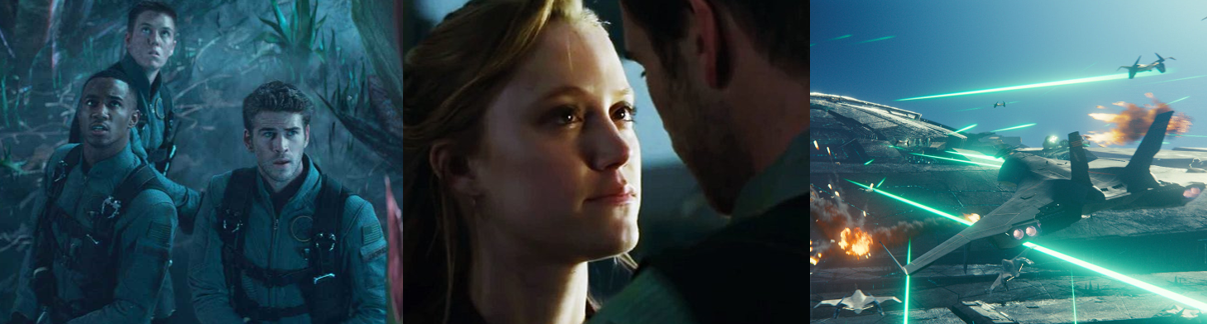
One element where the film really loses points is in the absence of Will Smith; obviously, these films are ensemble pieces and aren’t about any one character but Will Smith was a massive highlight  of the first film and, while I like the idea of young, sexy newcomers having to fend off a new alien invasion, none of them have even half the charisma of the Fresh Prince. In his place, and largely supplanting all of the roles from the first film, are three youths, two of whom are grown-up versions of characters who were children in the first film: Lieutenant Jake Morrison (Hemsworth), his fiancée (and daughter of former President Thomas Whitmore (Pullman)) Patricia Whitmore (played by the gorgeous Maika Monroe), and Captain Dylan Hiller (Usher), and the stepson of Will Smith’s Steven Hiller. It’s revealed in the film that Steve died between films during a test flight and Dylan has followed in his heroic stepfather’s footsteps to become Captain of the Earth Space Defense; however, while these three had a tight friendship prior to the events of the film, there are lingering hostilities between Dylan and Jake after their competitive nature almost led to Dylan dying during a test flight with Jake.

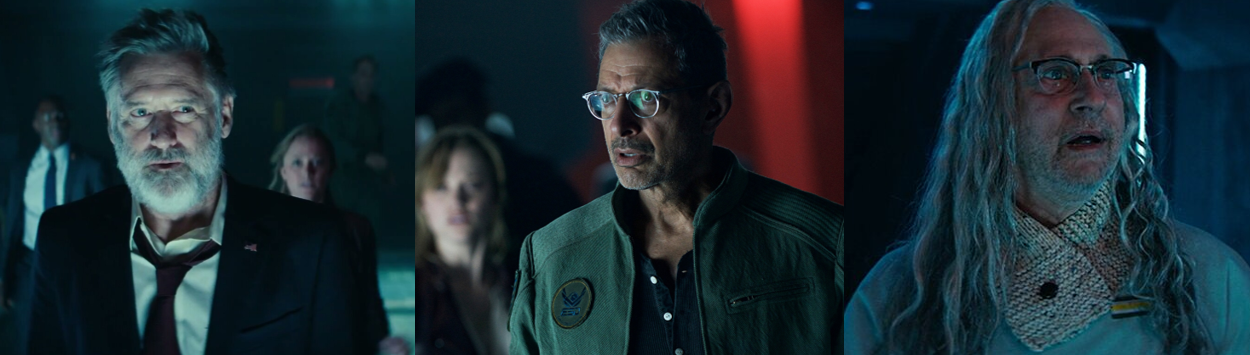
Returning character are shocked to learn of the aliens’ return and haunted by their experiences.

The three are joined by Lieutenant Rain Lao (Angelababy), daughter of the Moonbase’s stern commanding officer, Jiang Lao (Chin Han), and Lieutenant Charlie Miller (Travis Tope), Jake’s best friend and wingman who immediately falls for Rain and serves as the film’s lovable, if goofy, comic relief who I was honestly surprised to see survive to the end. As before, a big part of the movie is concerned with following the efforts of the military in scrambling to answer the aliens’ renewed threat. Primarily represented by General Joshua T. Adams (William Fichtner), the military are absolutely overwhelmed when another alien mothership, this one even bigger than the last, arrives in response to a distress call sent by the invaders of the first film. Of course, Independence Day: Resurgence also features a number of returning characters; in the twenty years since the last film, Thomas Whitmore (still largely refereed to as the President or “Mister President” by other characters as a sign of respect) has been plagued and driven to near madness by recurring nightmares and visions of the aliens’ return. David Levinson (Goldblum) now commands a great deal of authority as the director of the Earth Space Defense and the American government’s leading researcher on extraterrestrial technology; although he reunited with his ex-wife in the last film, she appears to have died between movies and is replaced by a poor attempt at a romance between David and Doctor Catherine Marceaux (Gainsbourg), who is researching the telepathic link individuals such as Whitmore share with the aliens. David’s father, Julius (Judd Hirsh) also inexplicably returns, now a successful author, as does Doctor Brakish Okun (Brent Spiner) who, despite clearly being killed in the first movie, is revealed to have merely been in a twenty year coma and who suddenly awakens as the aliens draw closer to Earth.

I find it difficult to believe that humanity was able to rebuild and excel as much as they have.

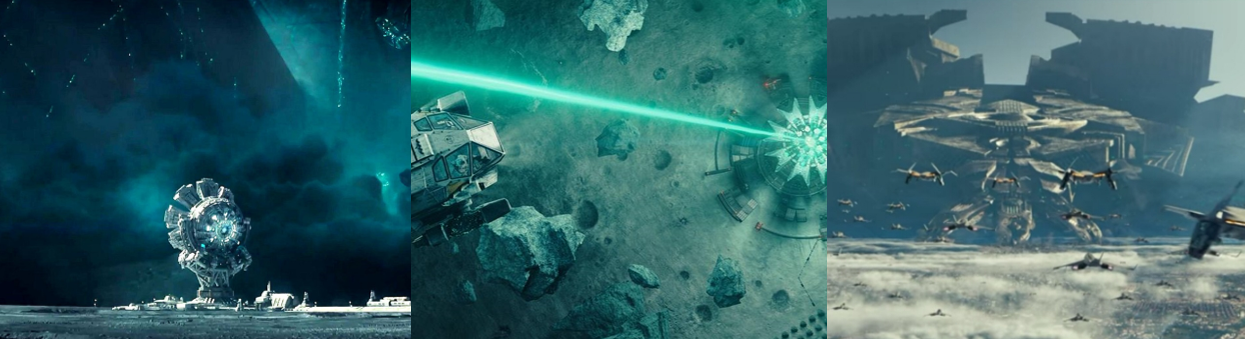
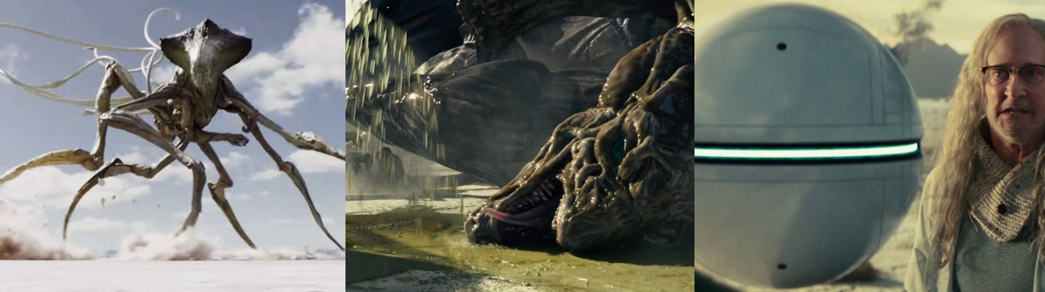
One of the primary aspects of Independence Day: Resurgence that never sat right with me is the idea that humanity was able to reverse engineer the alien technology to create clean energy, establish a space colony on the Moon, retrofit their iconic death ray into a defensive system, and basically craft a utopia for themselves in a mere twenty years. I have no doubt that humanity at its peak might have been able to accomplish some of this but the Earth was decimated in the first film; countless billions were lost, entire cities and infrastructure wiped off the planet, but yet this film expects me to believe that whatever was left of humankind was able to pull together enough resources to make space-capable fighter jets and all kinds of ludicrously futuristic technology that didn’t really exist in the first film? It’s pretty crazy and I think the filmmakers just got a bit carried away; utilising alien technology to improve our weapons and defences would have been much more believable but I guess if you’re gonna go big, you go all in! This ridiculous notion results in the reinforced Area 51 and the aforementioned Moonbase, which is populated by an international crew and who monitor space for potential threats. Naturally, Jake is the hot-headed, insubordinate pilot whose reckless actions initially see him initially branded as a liability but who ends up being instrumental in the eventual counterattack (of course, it also helps that he’s engaged to the ex-President’s daughter and is good friends with David). One aspect of the film that isn’t as prominent as it could have been is the idea that the alien invasion actually continued after the events of the first film; one of the alien ships landed and its inhabitants continued the war on the ground, where they clashed with Dikembe Umbutu’s (DeObia Oparei) forces for ten years and it is through Umbutu’s prophetic visions and drawings that the arrival of a mysterious sphere is first hinted at. This sphere arrives in our solar system via a wormhole and, fearing a possible alien attack, President Elizabeth Lanford (Sela Ward) makes the decision to pre-emptively shoot it down, unaware that it is actually there to assist humanity.

The Nitty-Gritty:
Independence Day: Resurgence seems to be trying a little too hard; it goes big, but maybe too big, in its attempts to not only recreate the hype and feel of the first film, but to surpass both. Independence Day was kind of like lightning in a bottle but the sequel seems like a shallow attempt to try and out-do its predecessor in every way. While a lot of this is reflected in the film’s far more bombastic scenes of global destruction and devastation, it’s also in some of the performances; try as Hemsworth and Usher do, they’re unable to recreate exactly the same witty dynamic as Smith and Goldblum. It pains me to say that Goldblum appears to have been let off the leash, turning David into a caricature of himself rather than naturally progressing his character thanks to the actor overindulging his trademark quirks and mannerisms.

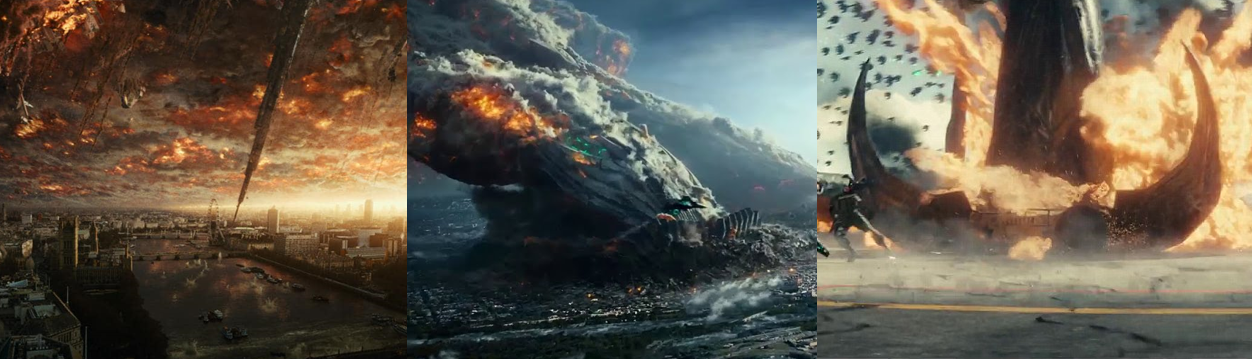
The destruction is definitely bigger but I wouldn’t necessarily say it was better…

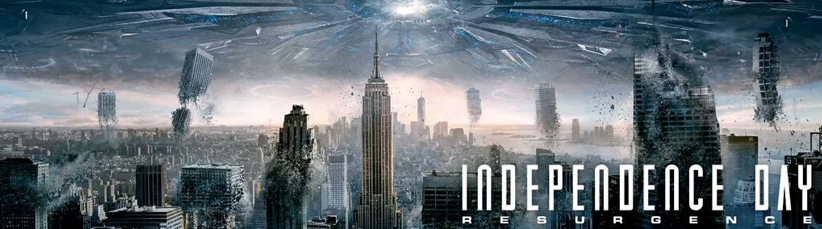
Of course, the actual aliens eventually do make their dramatic and violent return to Earth; arriving in an outrageously titanic alien ship that allows the invaders to literally land on the planet, the aliens cause more destruction than ever before thanks to their ship exuding its own gravitational pull. This literally tears the surface of the Moon to shreds and upends London and China, turning skyscrapers, vehicles, and the very land itself into hazards that our characters have to desperately navigate through to survive. As much as I criticise the film for trying too hard, it’s hard to not be impressed when the mothership ploughs into Earth’s atmosphere and absolutely wrecks cities through its sheer mass alone. Additionally, their weapons technology is just as daunting as ever; their impenetrable shields alone continue to make them a formidable and nigh-invincible force and not even their own death ray is capable of getting through their shield as they simply destroy all of the Earth’s retrofitted satellite defences as if they weren’t even there. While much of the film is focused on the desperate attempts by the world’s military to fend off the alien invaders, there are a few scenes depicting Julius leading some kids through the wreckage and carnage that exists primarily to add further stakes to the finale. As before, the Earth’s attempts at a counterattack are initially futile, despite all their bluster and gung-ho enthusiasm to avenge their loved ones, largely because humanity repurposed all of the alien technology except their shield-generators for their fighter jets. This results in another doomed aerial assault that leaves Jake, Dylan, and Rain presumed dead after the alien Queen lures them into trap that leaves them stranded on her mothership before destroying the remainder of Earth’s satellites and killing President Lanford.

After taking down the convenient alien Queen, humanity is recruited into an interstellar war.

Yes, this time around the aliens aren’t just “locusts” who ransack world after world for their natural resources but are revealed to be under the control of a Queen and consist of an always-convenient hivemind. This results in a desperate final battle against the Queen, who is protected by her own personal energy shield, that ever-so-helpfully results in the invaders being destroyed once she is finally taken down. Although the alien prisoners rejoiced at the arrival of their Queen just as President Whitmore and Dr. Okun feared her presence, they reacted in violent fear of the sphere, which turns out to house an artificial intelligence (Jenna Purdy) that gives the aliens an anticlimactic name (“Harvesters”) and reveals that the invaders have destroyed so many worlds and civilisations that the sphere has amassed a veritable army of refugees on a distant world who are committed to destroying the Harvesters forever. A highly advanced intelligence, the sphere is the last of its kind and the primary target of the alien Queen, who bursts free from her ship in a massive set of battle armour specifically to get to the sphere and extract the location of his planet from its memory. In a desperate bid to protect the sphere and take down the Queen, President Whitmore sacrifices himself to lure the Queen out and put a stop to this latest invasion attempt. In the aftermath, Dr. Okun is thrilled to reveal that the sphere is so impressed by our tenacity that it wants humanity to head out into the stars and lead a massive counterattack against the Harvester’s home world in one of the most blatant and ill-advised sequel hooks I’ve ever seen.

The Summary:
Look, I enjoy a big, dumb sci-fi film as much as the next guy but Independence Day: Resurgence is just trying way too hard; the young actors are attractive and enthusiastic enough but the film just lacks the same star power and pizzazz as the first film. Since the sequel hits many of the same beats as the original (incalculable global destruction, a futile aerial assault, a rousing speech from President Whitmore, and a desperate final gamble), it’s nearly impossible to not make comparisons between it and the first movie and, despite being bigger in almost every way possible, Independence Day: Resurgence ultimately fails to live up to the standards set by its predecessor and the expectations of twenty years in Development Hell. Yes, the devastation is impressive and the special effects are incredible (the aliens in particular look more fearsome than ever…when they are actually seen) but the film just doesn’t land in the same way as the original. Maybe it’s nostalgia, maybe it’s the weight of expectation, maybe it’s the outrageous levels of destruction but it just feels like the magic is gone and all that’s left is a shallow attempt to recreate a blockbuster hit long after its time in the sun.

My Rating:

Rating: 2 out of 5.

Could Be Better

What are your thoughts on Independence Day: Resurgence? Do you think that it lived up to its predecessor or do you agree that it was twenty years too late? What did you think to the far more devastating scenes of global destruction and the depiction of the far larger alien ship? Did you buy into the idea that humanity was able to so capably rebuild society after the first film and repurpose the alien technology? What are your thoughts on the changes made to the aliens and their hierarchy? Would you have liked to see more films continuing the story and what are your plans for Independence Day today? Whatever your thoughts, feel free to leave a comment down below.

Movie Night: Independence Day

Released: 3 July 1996
Director: Roland Emmerich
Distributor: 20th Century Fox
Budget: $75 million
Stars: Will Smith, Bill Pullman, Jeff Goldblum, Judd Hirsch, Margaret Colin, and Randy Quaid

The Plot:
When a series of flying saucers suddenly appear over and attack every major city across the world, United States President Thomas Whitmore (Pullman) is forced to mount a desperate counterattack alongside a rag-tag resistance, including ungainly MIT-educated satellite engineer David Levison (Goldblum) and gung-ho Marine F/A-18 pilot and aspiring astronaut Captain Steven Hiller (Smith).

The Background:
It’s easy to forget now but, back in the late-nineties, the writer/producer/director team of Roland Emmerich and Dean Devlin were a hot commodity in Hollywood, especially after the box office success of Stargate (ibid, 1994); in fact, it was during the promotion of Stargate that the two came up with the concept for Independence Day, an alien invasion movie that they intended to be based more around a large-scale, co-ordinated attack rather than subterfuge. Featuring cutting edge special effects to render the aliens’ devastating attack upon numerous iconic American landmarks, Independence Day (confusingly saddled with the subtitle ID4) was the highest-grossing film of 1996 and made nearly $820 million at the box office. Although receiving some criticisms, the film was generally well-received, won numerous awards, and kicked off a resurgence in blockbuster disaster movies, which quickly became the trademark of Emmerich and Devlin, before finally getting a long-awaited sequel some twenty years later.

The Review:
If there’s one thing Independence Day does really well, especially for its first half or so, it’s build up a great deal of tension regarding the alien invaders; we get a sense of the size of the alien mothership right away when it passes by the Moon and causes ripples on the surface. Almost immediately, the alien signal is picked up by the Search for Extra-terrestrial Intelligence (S.E.T.I.) and the American military begins to mobilise (more like scramble) to figure out what, exactly, is about to enter Earth’s orbit. Though the alien mothership, and the subsequent city-sized saucers, are somewhat simplistic and cliché in their “flying saucer” design, there’s a foreboding, ominous nature to their construction and you can tell, even before they start blasting away at major American landmarks and cities, that these E.T.’s are not here to make peace.

Despite his critics, Whitmore galvanises the nation, and the world, against the alien threat.

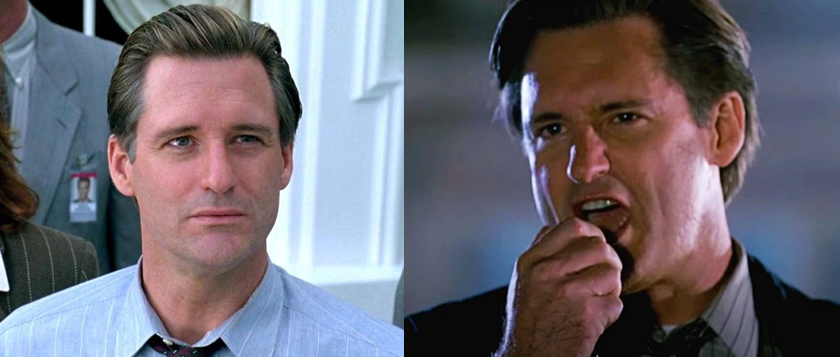
Naturally, the U.S. President is the figurehead for trying to calm the nation and sort out first a plan of communication and then, later, a plan of attack. At the start of the film, Whitmore is facing political backlash since he’s been forced to make a lot of compromises since being elected to office; with many in even his cabinet believing him to be a weak and ineffectual leader, Whitmore is eager to keep the peace and to not set off an interstellar war but finds himself caught completely off-guard when the aliens unleash their devastating attack. It’s an interesting leading role for Pullman, one that sees him having to juggle a myriad of conflicting emotions as Whitmore struggles to find a way to please everyone and hold together himself, his family, and the nation in the threat of global annihilation. It also, of course, results in one of the most iconic rousing speeches in all of cinema as Whitmore inspires the last remnants of humanity to strike back against their aggressors in a last-ditch attempt at survival.

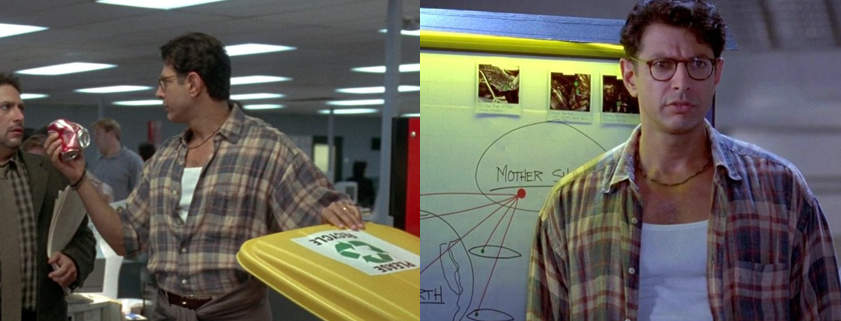
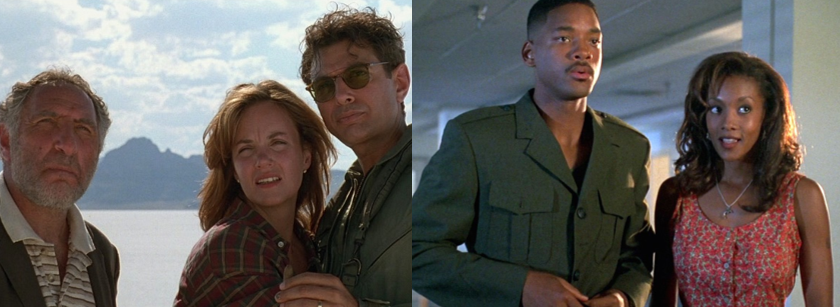
David, a committed environmentalist, becomes the unwitting saviour of humanity.

Compounding matters is the personal animosity between him and David; some time prior to the film, David punched Whitmore after suspecting him of having an affair with his then-wife, Constance “Connie” Spano (Colin). David, who is something of a technological prodigy, is able to decode the alien signal and determine that they are planning a co-ordinated attack but, while he is able to ensure that Whitmore, the Joint Chiefs, and Connie are evacuated safely, his warnings come too late to actually stop the initial attack. David, despite being little more than a cable repair man, is constantly portrayed as the smartest person in the room; a committed environmentalist, David is driven to help others and to save the world despite his emotional attachment to Connie and his frosty relationship with Whitmore and, although he’s not a member of the Presidential cabinet, he quickly becomes an instrumental figure in figuring out how to outsmart and outgun the invaders.

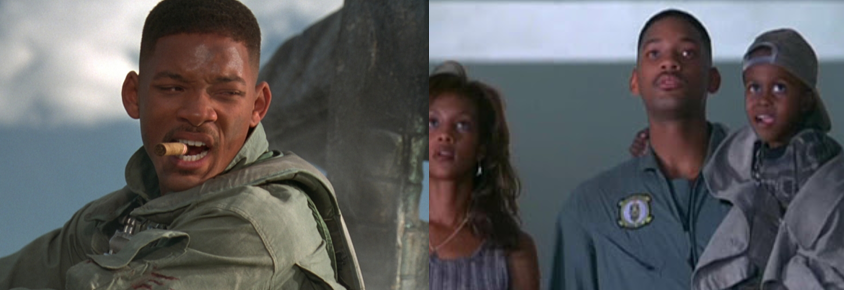
Will Smith brings his charisma and sass to the film, which cemented him as a a leading man.

When the aliens arrive, the U.S. military is, understandably, put on high alert; as a direct result, Hiller finds his leave cancelled and he begrudgingly returns to his regiment; in many ways, the aliens’ arrival means big things for Hiller, who wishes to become an astronaut but had his application rejected, potentially because of his relationship with stripper Jasmine Dubrow (Vivica A. Fox). Hiller enthusiastically joins the first counterattack against the aliens and is left the sole survivor from the campaign, which is doomed to fail thanks to the aliens’ superior technology and firepower. It’s important to remember that, at this point, Smith was still largely known for being the goofball Will from The Fresh Prince of Bel-Air (1990 to 1996) but Independence Day really helped to cement him as a charismatic leading man, especially in action vehicles such as this film. Though much of his gung-ho character is ripped from the likes of Top Gun (Scott, 1986), Smith brings a magnetism and down-to-earth likability to the role and his sass is, as always, especially on point to deliver some of the more entertaining, and quotable, moments of the film.

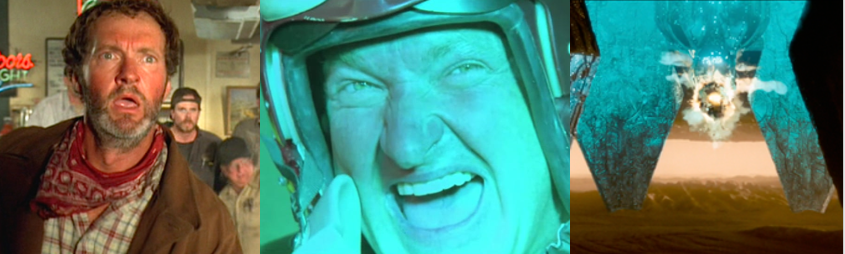
Russell, a dishevelled drunkard, turns out to be an unlikely hero.

While there are a number of female characters including in Independence Day, they are all largely there to simply support, and worry for, the men in their lives; even Jasmine, who is briefly seen as being a proactive and adaptable character, is quickly side-lined once the men of the film put aside their issues to formulate a viable counterattack. Compounding this is the fact that Independence Day is also bolstered by several additional characters, chief among them is Russell Casse (Quaid), a drunkard who claims to have been abducted by aliens some years prior. Russell, and his trailer park family, represent the normal, everyday people in a film largely made up of governmental, military, or other specialists but their story is perhaps the least compelling of all the characters in the film since, while it has a redemptive arc to it, they lack the magnetism and presence of the likes of Goldblum and Smith.

Despite how many characters the film has, there’s not a whole hell of a lot for the women to do.

Other supporting characters include General William Grey (Robert Loggia), Whitmore’s chief supporter after Connie, Secretary of Defence Albert Nimzicki (James Rebhorn), the cliché pushy politician who continually clashes with Whitmore and the others and advocates first for an immediate military response to the invaders and for the deployment of nuclear weapons, and Julius Levinson (Hirsch), David’s overbearing and pragmatic father and one of the standout supporting characters for his characteristic Jewish twang, the entertaining banter between him and David, and the brief injection of uncompromising faith he brings to the proceedings amidst all the chaos and technobabble. One of the more emotional sub-plots in the film involves the tragic death of Whitmore’s wife, Marilyn Whitmore (Mary McDonnell), which is one of the few named character deaths that is actually acknowledged and has a lasting impact since the film is full of mass death and destruction and the focus is generally more on soldiering through the tragedy rather than dwelling upon it.

The Nitty-Gritty:
Naturally, an important part of Independence Day is patriotism and duty; although other countries are briefly mentioned and even seen much later in the film, it is the U.S. who lead the fight against the aliens and the closest it gets to being any kind of diverse or multinational effort is the inclusion of a couple of Jewish and Mexican characters. Instead, the focus is solely on America and how they deal with the crisis; we only see American cities being attacked and other countries appear to be both clueless and leaderless until David is able to present a viable counterattack option and the U.S. rallies the remnants of humanity across the world into action.

Independence Day set the standard for disaster movies going forward.

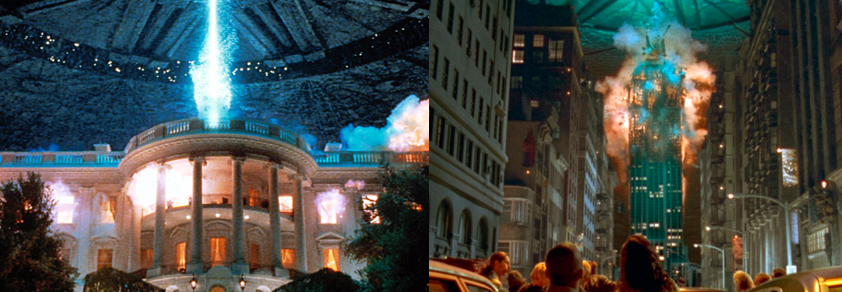
Still, if you’re not American or much of a patriot, like me, there’s one main appealing factor to Independence Day that, even now, continues to impress and that is the depiction of wide scale destruction and devastation. As if having gigantic, city-sized spaceships wasn’t bad enough, the invaders also have impenetrable energy shields, massive Death Star-like cannons mounted beneath their crafts that can obliterate entire city blocks in a single blast, and a seemingly endless supply of smaller attack ships that are faster, heavily armed, and also sport their own energy shields. Thanks to a combination of miniatures, cutting edge CGI, and some clever camera tricks, Independence Day delivers some of the most devastating scenes of widespread destruction ever put to cinema, especially at the time; even now, the shot of the White House being blown to smithereens is an effective and iconic effect that every subsequent disaster movie since has attempted to out-do or replicate in some way.

The aliens are a frighteningly aggressive and highly advanced invading force.

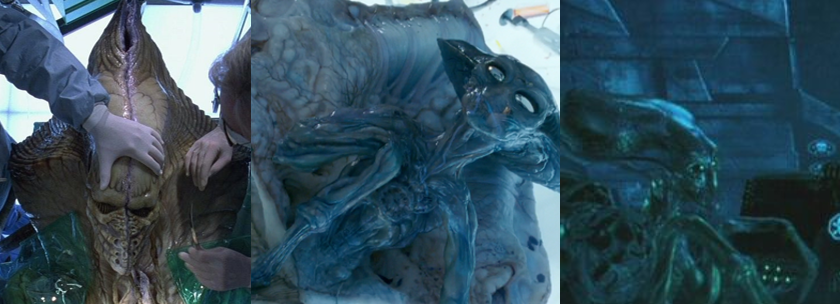
Additionally, Independence Day features one of the most unique alien designs in all of cinema; far from the stereotypical “Grey Aliens”, these invaders are large, biomechanical warriors intent solely on conquering the world through brute force. For most of the film, the aliens’ appearance is, smartly, left a mystery; when they are first seen, they are a horrific mess of tentacles and sport a gruesome, skull-like visage. After the story moves to Area 51, we learn more about the alien’s physiology from Doctor Brackish Okun (Brent Spiner in a memorable, scenery-chewing role) and that they are, actually, just as vulnerable and fragile as we are but are heavily protected by their advanced technology. The aliens also exhibit incredible physical strength, durability, and a degree of psychic ability since they can speak through Okun and project images of their intended plans for the Earth into Whitmore’s head.

Their plan might be totally bonkers but the chemistry between these two is undeniably compelling.

So great is the alien threat that they are able to decimate a large majority of the United States (and, presumably, the world) in just a couple of days, reducing humanity to a rag-tag group of survivors with few resources and even fewer chances of survival. Thankfully, the survivors cobble together one of the most ridiculous and convenient plans in all of cinema history when Hiller volunteers to pilot a crashed alien spacecraft (the one from Roswell, of course!) up to the alien mothership so that David can upload a computer virus (using an Apple PowerBook, naturally!) to momentarily disable the otherwise-impenetrable alien shields. Even now, it’s absolutely bonkers and shifts the film from a desperate scramble for survival and into a massive military counterattack but it works purely because Smith and Goldblum have undeniable chemistry together; in fact, their characters are so enjoyable that it’s a shame they weren’t paired up sooner (though, having said that, it almost feels like the two should have given their lives to destroy the mothership as the film suggests purely because their scene in this moment is so poignant and it would have greatly added to the emotional impact of the finale).

The Summary:
Independence Day was a massive deal back in the day; the teasers and trailers alone were enough to hype it as the must-see blockbuster event of the year, to say nothing of the toys and various other merchandise made to promote the film. For my generation, especially, there had never really been a film like it; The War of the Worlds (Haskin, 1953) was a bit before our time and disaster movies had pretty much died out by the end of the seventies. Than, all at once, both of these genres came together in an exhilarating way; bolstered by charismatic performances by the likes of Will Smith and Jeff Goldblum (always a personal favourite of mine), Independence Day may seem quite dated and trivial now but it was the real deal at the time and has easily become one of the most influential and memorable alien invasion movies in all of cinema thanks to it kick-starting a resurgence in disaster and alien invasion movies. Obviously, it’s a preposterous, almost nonsensical movie at times that asks for some pretty big leaps in logic and is far more about spectacle than substance but it’s still an impressive and entertaining film in its own right and easily the best production from the Emmerich/Devlin team even today.

My Rating:

Rating: 4 out of 5.

Great Stuff

What are your thoughts on Independence Day? Did you get caught up in the hype back in the day? Did you enjoy the mindless destruction and overly patriotic undertones or were you, perhaps, put off by the cliché characters and more questionable plot holes? What did you think to the performances of the lead actors and the depiction of wide-scale destruction? What are your thoughts on the aliens, their design and technology, and the way the film handled the invasion? What are your plans for Independence Day today? Whatever your thoughts, feel free to leave a comment down below.