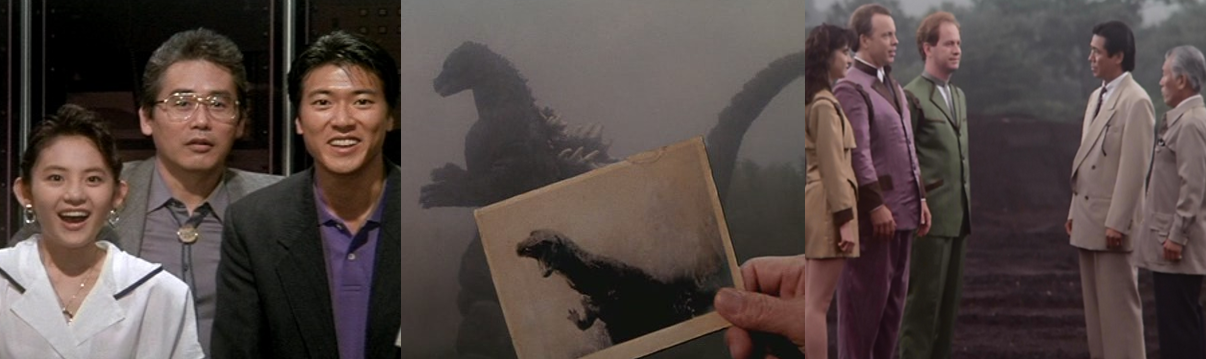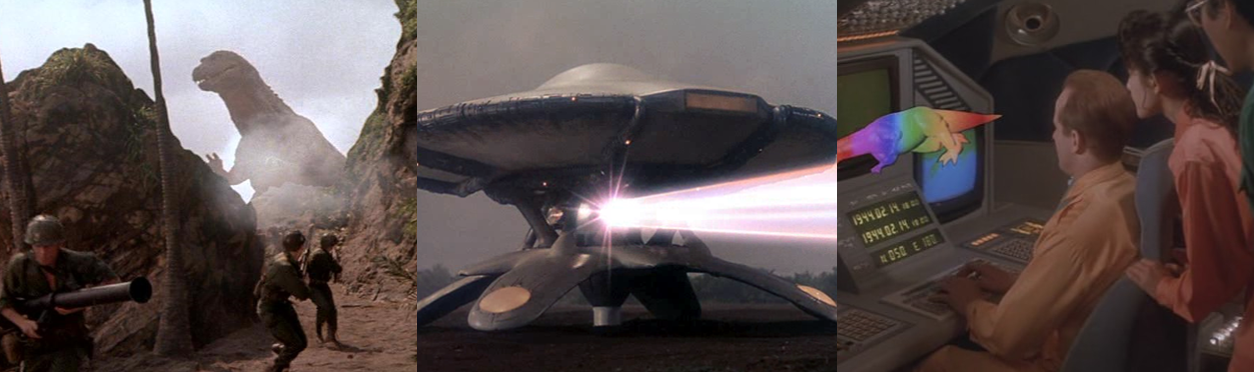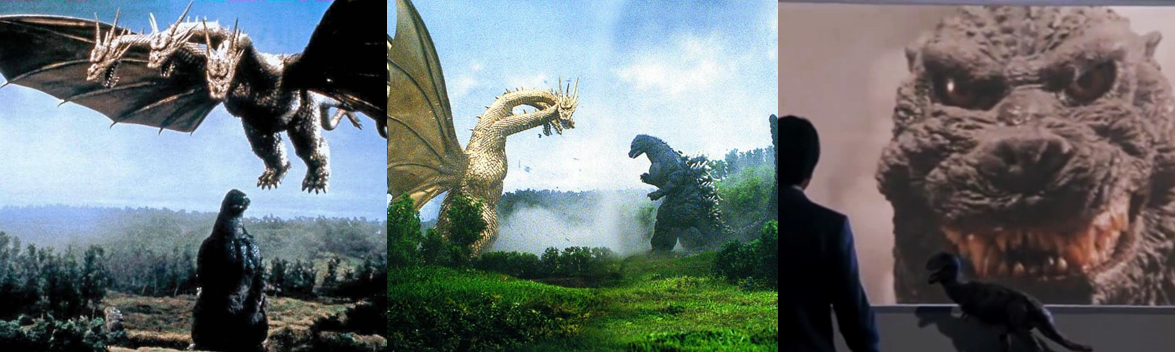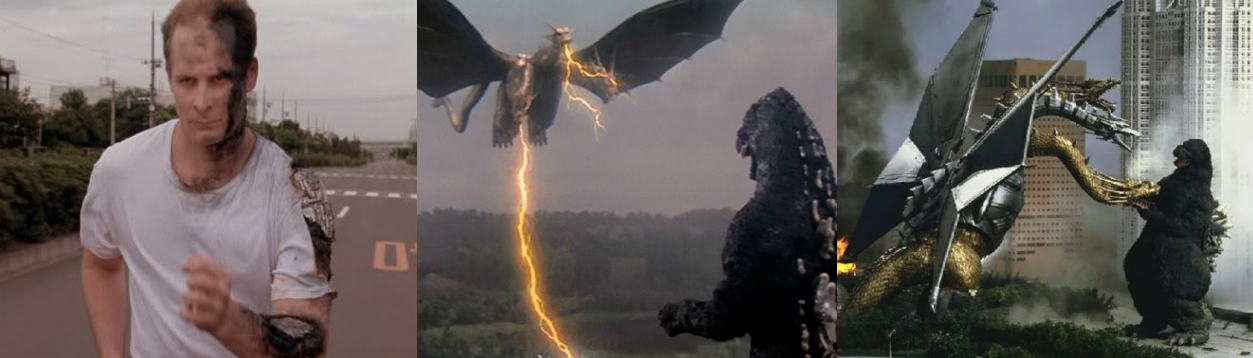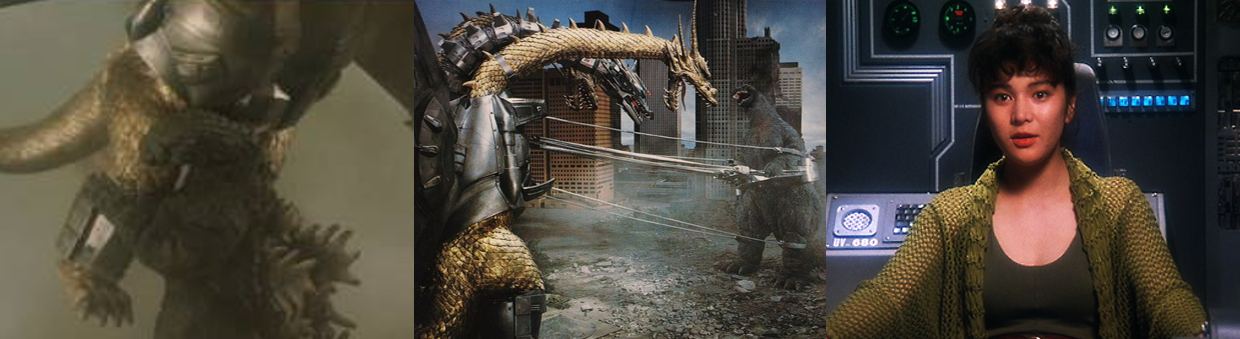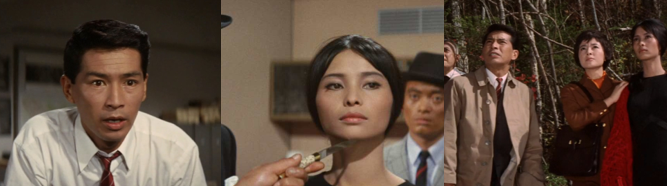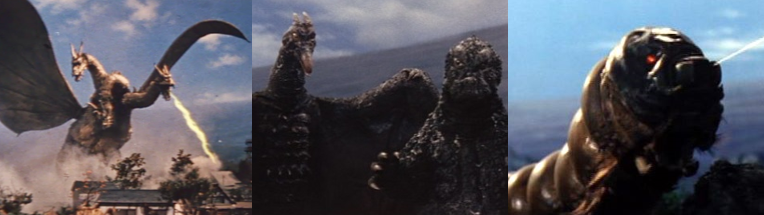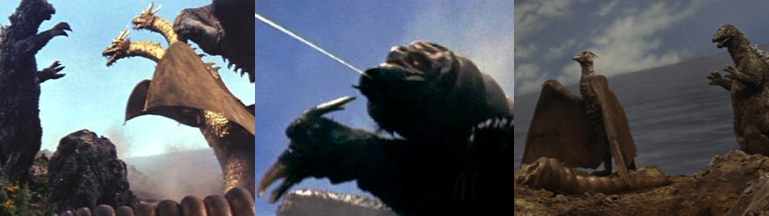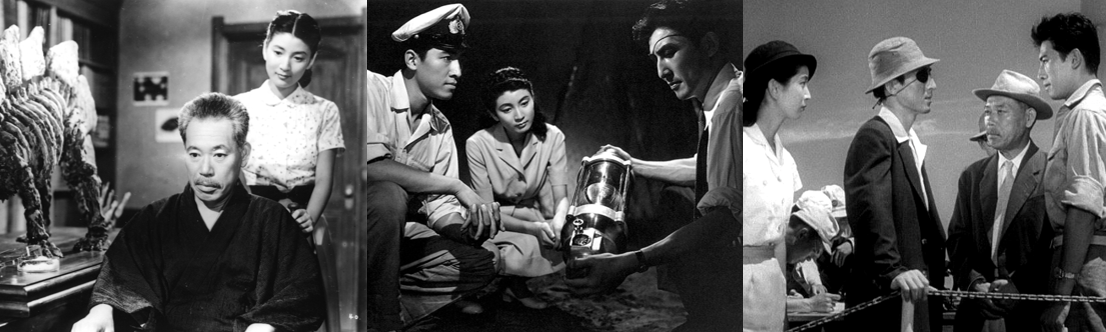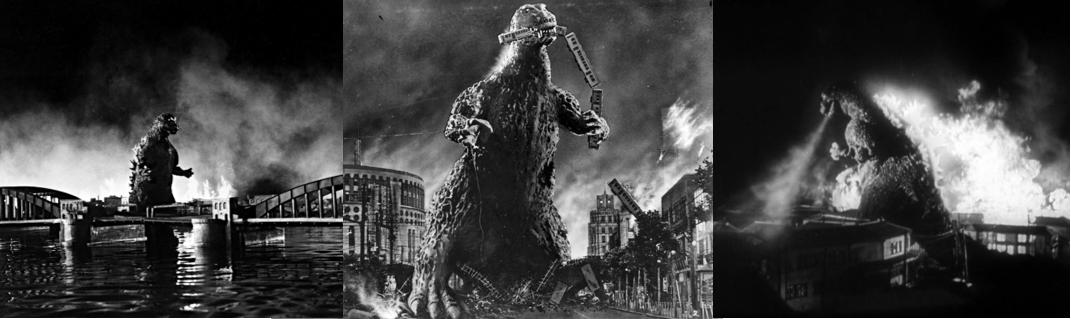
Movie Night [Godzilla Day]: Godzilla vs. Mechagodzilla


Toho’s famous atomic beast first emerged to wreck Tokyo on this day in Godzilla (Honda, 1954), and, in 2016, the day was subsequently declared “Godzilla Day”.


Released: 21 March 1974
Director: Jun Fukuda
Distributor: Toho
Budget: $1.2 million
Stars: Keisuke Shimizu, Isao Zushi, Saeko Kanagusuku, Kazunari Mori, Akihiko Hirata, and Kin’ichi Kusumi

The Plot:
Following the discovery of a doomsday prophecy regarding Godzilla (Zushi), the King of the Monsters seemingly goes on a rampage, only for the true culprit to be a mechanised doppelgänger (Mori) sent by aliens to destroy humanity!

The Background:
On 6 August 1946, and the height of the Second World War, the United States dropped two nuclear weapons on Hiroshima and Nagaski, killing tens of thousands of people and forcing the surrender of the Japanese Imperial Army. The radioactive fallout killed thousands more and left post-war Japan gripped with nuclear fear, a terror that took physical form with Gojira, the living embodiment of nuclear destruction. Although initially framed as Japan’s destructor, the King of the Monsters soon became the country’s reluctant saviour. Following the critical and commercial mauling of Godzilla vs. Megalon (Fukuda, 1973), Toho sought to reverse their fortunes by pitting Godzilla against a mechanical doppelgänger, Mechagodzilla, now one of Godzilla’s most persistent and popular enemies. Apparently the brainchild of producer Tomoyuki Tanaka and inspired by robot-themed anime and a similar metal duplicate of King Kong, Mechagodzilla was designed by Akihiko Iguchi and said to be made from a polyethylene material and fibre-reinforced plastic. While Godzilla vs. Mechagodzilla performed slightly better at the box office compared to its predecessor, the film was ridiculed for its laughable plot, goofy presentation, and continuing the downward spiral of the franchise into childish nonsense. Still, the special effects were praised and Mechagodzilla returned in many forms to hound its organic counterpart, lending some credibility to this film being considered one of the better Godzilla movies of the 1970s.

The Review:
While visiting Okinawa, brothers Keisuke (Daimon) and Masahiko Shimizu (Kazuya Aoyama) witness Princess Nami (Beru-Bera Lin) suddenly collapse from apocalyptic visions of a monster (suspiciously echoing King Ghidorah). While the brothers rush to her side, they largely brush it off as Masahiko is more focused on excavating the Gyokusen Cave. Fortuitously, Masahiko discovers a strange piece of metal just as government archaeologist Saeko Kanagusuku (Reiko Tajima) arrives to document the ominous cave drawings depicting the Azumi’s guardian deity, King Caesar, and artifacts also foretelling a catastrophic monster event. While flying to Tokyo to consult renowned Professor Wakura (Hiroshi Koizumi), who’s also Keisuke’s uncle, Saeko bumps into Keisuke and is accosted by a shady man in dark glasses (Shin Kishida) who claims to be a reporter. Saeko also spots an ominous black cloud that eerily mirrors the prophecy’s “black mountain” that heralds the arrival of a destroyer. While Masahiko brings his discovery to Professor Hideto Miyajima (Hirata) at Mount Fuji (which has been beset by earthquakes), who identifies it as the ridiculously named “Space Titanium”, Wakura’s research is suddenly interrupted by an armed man, Yanagawa (Daigo Kusano), though he’s fended off by Keisuke after a comical scuffle. Mt. Fuji later erupts and what appears to be Godzilla emerges, apparently ready to enact the prophecy. “Luckily” for the locals, one of the lamest kaiju ever, Anguirus (Kusumi), opposes Godzilla, ending up badly beaten, having his jaw broken, and forced to retreat. Still, Anguirus chips Godzilla’s skin and reveals metal underneath, lending credibility to Keisuke’s suspicions that something isn’t right with the King of the Monsters.
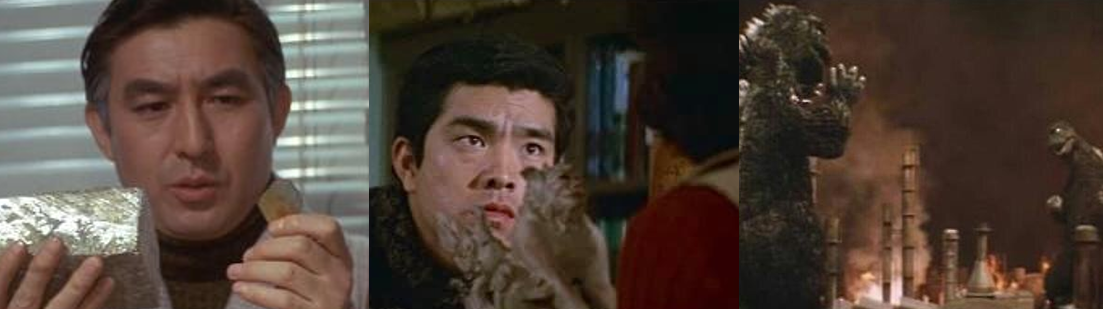
While studying space metal and prophecies, our characters are shocked when two Godzillas appear!

Keisuke retrieves a sample from the fight that Professor Miyajima also identifies as Space Titanium, leading the brothers to join the professor and his daughter, Ikuko (Hiromi Matsushita), investigating “Godzilla” as it’s obliterating the local port and confronted by a second, more recognisable Godzilla! The group watches, stunned, as the two fight and the battle is overseen by mysterious, silver clad onlookers in a hockey sci-fi set resembling Star Trek (1966 to 1969). The titular Mechagodzilla initially appears to be the Big G himself, its metallic appearance concealed by flesh so convincing that the nation believes Godzilla has gone mad, just as the prophecy foretold, despite him having a distinctly different roar, very different atomic breath, and even walking different. Their first battle destroys Mechagodzilla’s façade, revealing it as a cyborg controlled by the sneering, malevolent Simeon Supreme Commander Kuronuma (Goro Mutsumi) of “Black Hole Planet 3”. When Mechagodzilla requires extensive repairs, the Simeons force Miyajima to assist in return for Ikuko’s safety. Kuronuma also orders Yanagawa to steal the King Ceasar statue (to keep the deity from threatening their plans), only for Keisuke to again intervene, revealing the Simeons’ grotesque ape-like appearance, and leaving Yanagawa dead when the shady reporter reveals himself to be Interpol agent Nanbara. Revealing that Interpol knows of the bizarre alien plot, Nanbara aids Keisuke in infiltrating the Simeon base to save Professor Miyajima and Ikuko from a laughable death chamber that threatens to boil them alive. While aliens are commonplace in Godzilla movies, the Simeons are some of the most unimpressive, descending into animalistic grunts and snarls when their human façade is lost and memorable only because of their ultimate weapon (and even that’s a rip-off!)
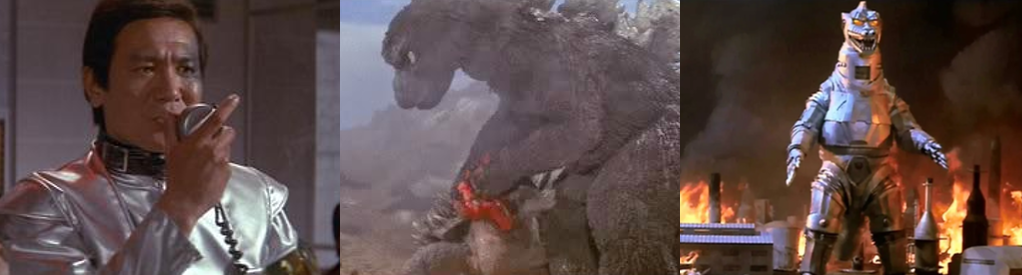
Mechagodzilla impresses by brutalising Anguirus and cutting an intimidating (if clunky) figure.

By this point, Godzilla’s firmly been established as Japan’s protector, so our heroes are stunned when he appears to go on a mindless rampage. Like Anguirus, Godzilla seems enraged by his doppelgänger as much as he is fiercely territorial over his people, leading Godzilla to attack Mechagodzilla with all his might and bathe in a lightning storm to boost his power. Sadly, Godzilla plays second fiddle to a handful of forgettable and interchangeable characters. I’m not sure what the benefit of having two professors was, for example, or why the female characters were so overlooked…or honestly what the point of having the brothers was since Keisuke and Nanbara would’ve made for a more entertaining duo. Most of the runtime focuses on a mad scramble to understand and then protect King Caesar’s artifacts, though I remain underwhelmed by the bizarre beast (Kusumi) and question why this screen time couldn’t have been allotted to Godzilla so he could battle his doppelgänger more. The film seems to depict King Caesar as the new kaiju on the block, but he looks so foolish and lacks the screen presence of Godzilla. Plus, thematically, it makes far more sense of Godzilla to be at the forefront considering Mechagodzilla is modelled after him, even if I’m not sure why the Simeons bothered. They barely managed to frame Godzilla, the prophecy seems to refer to another kaiju, and their motivations for conquest are so ill defined that I still don’t really know what they’re after. Indeed, they only seem to be included because someone behind the scenes was a fan of the then-recent Planet of the Apes films (Various, 1968 to 1973), with their true appearance being cheap, knockoffs of those movies.

The Nitty-Gritty:
So much of Godzilla vs. Mechagodzilla hinges on this bizarre Azumi prophecy, which warns that a monster will appear after a series of warnings and destroy the world. Princess Nami specifically has visions of this, and the characters initially believe the prophecy refers to Godzilla when he goes nuts, but it all leads to a mystical energy beam that reveals King Caesar’s hiding place. King Caesar is a benevolent deity worshipped by the Azumi and, upon being awakened, immediately battles Mechagodzilla alongside Godzilla. So… who is this prophecy referring to? As I said, it paints King Ghidorah as the true threat, though could also refer to Titanosaurus (Tatsumi Fuyamoto), who appears in the next film as another Simeon minion (alongside a repaired Mechagodzilla). However, in the context of this film, the prophecy makes no sense and takes up screen time that could’ve been spent fleshing out the Simeons or giving us more Godzilla vs. Mechagodzilla action. Interpol is depicted as a key organisation in combatting alien and kaiju threats, with Nanbara being a fun and mysterious ally to Keisuke, but very little about Godzilla vs. Mechagodzilla makes sense, even by Godzilla’s standards. All the Simeons want to do is use their ultimate weapon to terrorise the landscape and kill the local kaiju, feats that Mechagodzilla becomes incapable of performing. Sure, it bests Anguirus but he’s like the weakest monster. Once it meets Godzilla, Mechagodzilla is critically damaged, and the aliens are forced to kidnap a human scientist to accelerate its repairs…when you’d think the Simeons would be the best people to fix Mechagodzilla considering they created the damn thing!
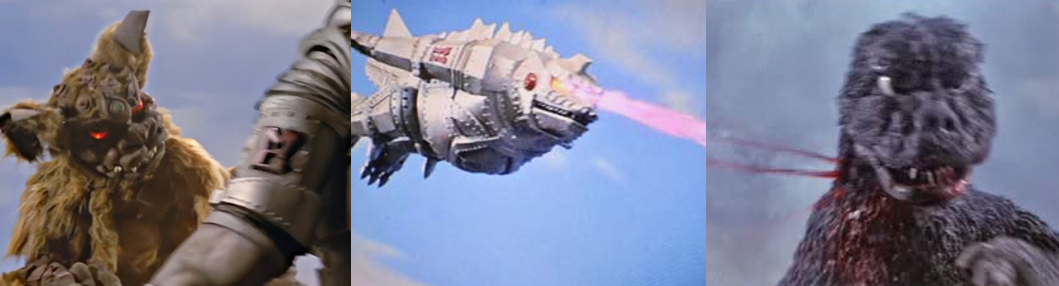
Mechagodzilla’s powerful arsenal briefly keeps Godzilla and his derpy ally at bay.

Godzilla’s looking pretty derpy here. His design has been softened and diluted to make him much kinder and more anthropomorphic, with him assuming a boxing stance and showing frustration when his atomic breath misses. Although Mechagodzilla is quite clunky and cumbersome and clearly limits Kazunari Mori’s movements, it’s an extremely striking and ambitious design. Sporting a version of Godzilla’s atomic breath, rainbow eye lasers, missile-like fingers, jet-like feet rockets, and a nigh-indestructible hide made of Space Titanium, Mechagodzilla sports quite the formidable design. However, it’s both directly controlled by the Simeons and prone to mechanical failures, requiring constant repairs and upgrades to enact the aliens’ diabolical plan. Mechagodzilla gets a serious power boost thanks to Professor Miyajima, gaining a cartoonish lightning bolt emitter from its chest and a fun jet form, and even spinning its head around to blast King Caesar and Godzilla at the same time! As ever, however, Anguirus looks absolutely awful. I’ve always hated this creature, with its weird squat legs, goofy face, and rubbery spiked back and tail, and he’s never struck me as a threat to anyone, so seeing him fighting the far superior Mechagodzilla was a joke. Anguirus tries his best, but I’d be lying if I didn’t take a perverse pleasure in seeing him tossed around and left a bloody, broken mess. King Caesar, a bizarre, lion…bear…thing that (a bit like Mothra) is woken from hibernation by a passionate (and super cheesy) song from Princess Nami. King Caesar’s meant to be a feared, all-powered protector but he looks like a raggedy puppet with his floppy, bat-like ears and his frayed hide flapping like a cheap costume. On the plus side, King Caesar is far more mobile than Godzilla and his metal double, moving much faster and hitting rugby tackles, but he just looks ridiculous and pathetic next to Godzilla and especially the impressive (if bulky) Mechagodzilla.
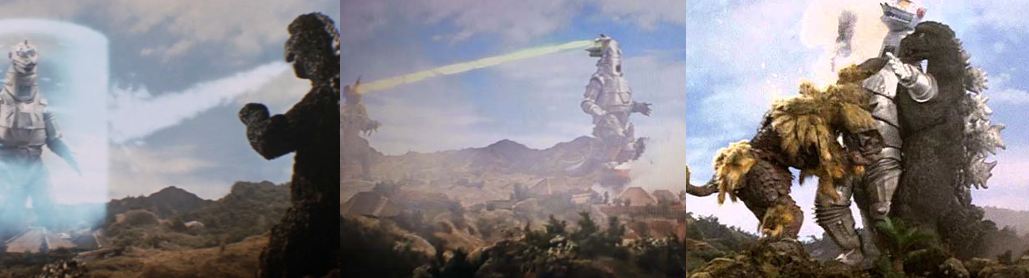
In the end, team work makes the dream work and sees Mechagodzilla reduce to scrap metal.

After Professor Miyajima repairs Mechagodzilla and their agents fail to acquire King Caesar’s statue, Kuronuma sends the supped-up Mechagodzilla against the Azumi deity. Unfortunately, Mechagodzilla’s trademark eye lasers prove ineffectual against King Caesar, who simply reflects them, and it’s so cumbersome that the spritelier King Caesar easily tackles it and tosses it with judo-like throws. Mechagodzilla’s finger missiles and chest bolt bring King Caesar close to suffering the same fate as Anguirus before Godzilla enters the fight. Mechagodzilla proves more formidable in their rematch, erecting an energy shield and fending off both kaiju with laser blasts, lightning bolts, and missiles. Mechagodzilla’s upgraded eye lasers and bolts even cause Godzilla to bleed, with arterial spray bursting from Godzilla’s wounds! However, Godzilla’s inexplicable new lightning powers grant him absurd magnetic abilities that attract his metallic foe and leave Mechagodzilla vulnerable to King Caesar’s tackles, and finally sees Godzilla wrench his metallic doppelgänger’s head off in an explosion of sparks. Aghast that his ultimate creation was defeated, things go from bad to worse for Kuronuma when Nanbara uses Professor Miyajima’s special magnetic pipe to disrupt the Simeon’s computer array, with Nanbara killing Kuronuma and his cohorts with ridiculous ease and he, Keisuke, and Miyajima fleeing from the alien’s base as it conveniently self-destructs. Oddly, the film and Masahiko’s dialogue imply Miyajima didn’t make it out of the base before it exploded, despite us clearly seeing that he did. Regardless, Princess Nami returns King Caesar’s statue and the Azumi deity returns to his slumber, while Godzilla heads back into the ocean for a rest, shards of Space Titanium raining all over for some other fool (benevolent or otherwise) to doubtless utilise in future movies.

The Summary:
It’s hard to expect much from many Godzilla movies. They have a formula and they stick to it, and I commend them for that but it’s clear to see that the formula was becoming very stale by this point. Godzilla lacks all the raw edge and menace he once had, being little more than a cartoon character come to life to fight on our behalf, which is potentially why he’s absent for so much of this movie as you can’t have your hero smashing cities! Indeed, it’s telling that this is exactly what Mechagodzilla does and that’s how we know “Godzilla” isn’t himself, beyond the obviously different roar and atomic breath. There was a lot of potential behind the Simeons using Mechagodzilla to turn the public and the military against Godzilla, but it is quickly squandered when Mechagodzilla’s obvious ruse is discovered and the mech goes in for repairs and Godzilla inexplicably vanishes. We’re then left following a bunch of idiots whose names I barely remember as they scrat about protecting King Caesar from Planet of the Apes and worrying about a prophecy that gets no payoff! The Simeons are some of the most ridiculous aliens I’ve ever seen, even for a Godzilla movie, and King Caesar is easily the worst kaiju design of them all, looking like a demented Muppet or a dog’s used chew toy! The only saving grace is Mechagodzilla, and even that’s a clunky, awkward, obviously plastic suit that looks extremely uncomfortable and cumbersome. Mechagodzilla has a fun array of weapons and could’ve been the catalyst from some really fun, bombastic fights, but again this all plays second fiddle to the Simeons and Godzilla ends up pulling some random lightning powers out of his ass to win (ironic, considering King Caesar could’ve been used as a substitute to tip the balance, but he sucks, so it’s no surprise). I was bitterly disappointed by Godzilla vs. Mechagodzilla, which promised so much and delivered so little, and I would honestly recommend simply watching clips of the titular fight that wasting your time on this mess of a film.

My Rating:

Rating: 2 out of 5.

Could Be Better

Am I being too harsh on Godzilla vs. Mechagodzilla? Maybe you think it’s one of the best Godzilla movies of its era. Perhaps you can explain the Simeon plot and why I should care about an overblown prophecy with no payoff. Maybe you have no taste and you like King Caesar and Anguirus and think Godzilla’s magnetic powers make perfect sense. Perhaps you prefer a different incarnation of Mechagodzilla, or have another favourite Godzilla you want to share? Whatever the case, celebrate Godzilla leaving a comment below, check out my other Godzilla and kaiju reviews, and donate to my Ko-Fi to suggest other Godzilla movies for me to cover!

Movie Night [Godzilla Day]: Godzilla vs. King Ghidorah


Toho’s famous atomic beast, and easily the most recognisable kaiju in the entire world Gojira first emerged from the waters of outside of Japan to wreck the city of Tokyo on this day all the way back in 1954. In 2016, the day was declared “Godzilla Day” and, as a result, I am also appropriating November 3rd to shine a spotlight on the undisputed King of the Monsters.


Released: 14 December 1991
Director: Kazuki Ōmori
Distributor: Toho
Budget: $12 million
Stars: Kōsuke Toyohara, Anna Nakagawa, Megumi Odaka, Chuck Wilson, Yoshio Tsuchiyam, Kenpachiro Satsuma, and Hurricane Ryu

The Plot:
Time travellers offer to get rid of Godzilla (Satsuma), Futurians create the terrifying King Ghidorah (Ryu), leaving science-fiction writer Kenichiro Terasawa (Toyohara) and remorseful Futurian Emmy Kano (Nakagawa) to desperately revive Godzilla ensure Japan’s survival.

The Background:
When he made his big-screen debut in Godzilla (Honda, 1954), Gojira (more popularly known worldwide as Godzilla) represented very real lingering fears regarding the threat and consequences of nuclear war. However, it didn’t take long for Godzilla to be recast from Japan’s destroyer to its a saviour. While he often caused a great deal of destruction, Godzilla would often team up with other kaiju, such as Mothra and Rodan, to fend off a greater threat and cement his place as an iconic figure in pop culture. Perhaps Godzilla’s greatest nemesis is the three-headed dragon King Ghidorah (also known as “Ghidrah” and “Monster Zero”), a titanic winged beast created by Godzilla creator Tomoyuki Tanaka and inspired by the Lernaean Hydra and the Orochi of Japanese folklore. Initially depicted as an ancient alien monstrosity from Venus, King Ghidorah’s debut feature was so successful that he reappeared the following year and was a natural choice to recoup some of the studio’s losses after the disappointing box office of Godzilla vs. Biollante (Ōmori, 1989). Believing audiences wanted time travel plots given the success of Back to the Future Part II (Zemeckis, 1989), director Kazuki Ōmori specifically tailored the script to include this and place greater emphasis on developing the personalities of the monsters rather than the human characters. The movie reused the Godzilla suits from Godzilla vs. Biollante, but with some modifications that slightly altered Godzilla’s face and allowed actor Kenpachiro Satsuma a better range of movement when in water, and the redesigned King Ghidorah featured far more advanced wirework puppetry than its predecessor. Ultimately, Toho’s hopes of surpassing Godzilla vs. Biollante were not to be as Godzilla vs. King Ghidorah made noticeably less than its predecessor and the film is generally regarded as a visually impressive, if convoluted, entry in the franchise. The film also attracted controversy for its depiction of events from World War Two but this wouldn’t be the last Godzilla film, or the last we’d see of King Ghidorah. Godzilla was back in action a year later and his nemesis returned to do battle time and time again in many forms.

The Review:
I have been a massive Godzilla fan since I was a little kid, but my exposure to the scourge of Japan was actually quite minimal growing up. Godzilla films weren’t exactly commonplace on TV back in the day so I (and a lot of kids my age) really started getting into the franchise with the impending release of Godzilla (Emmerich, 1998). To celebrate the release of that film, I believe it was BBC2 that dedicated an entire night to Godzilla and other kaiju, and this evening of documentaries, quizzes, and comedy was capped off by the first Godzilla movie I ever watched, Godzilla vs. King Ghirodah. Godzilla had battled his most famous nemesis before, back in the “Shōwa Era”, but this was their first meeting in the “Heisei Era”, which began in 1984 and basically rebooted the franchise with bigger and better suits and new, ferocious monsters for the Big G to fight. This is also probably my favourite era of Godzilla movies since this is when I really started getting into the franchise, though I feel it’s only fair to also point out that I am watching the dubbed version of the film (because I can’t get enough of that “You bastards!” line delivery!)

Terasawa’s research into Godzilla coincides with the Futurians’ arrival from 2204.

Oddly enough, as if all the kaiju action wasn’t enough, Godzilla vs. King Ghidorah heavily features a time travel plot. The film begins in 2204A.D., where King Ghidorah is little more than a mutilated skeleton at the bottom of the ocean, before jumping ahead to the then-present day of 1992 where all of Tokyo is shocked by the sudden arrival of a strange spacecraft on Mount Fuji. The unidentified flying object (UFO) instantly makes headlines but science fiction writer Kenichiro Terasawa has grown weary of the genre that has made him a “rich man” for his employers, Super Mystery Magazine, and is more interested in writing a detailed history of Godzilla. To that end, he interviews a number of World War Two veterans, including wealthy businessman Yasuaki Shindo (Tsuchiya), who were present on Lagos Island when Japanese troops were unexpectedly protected from the United States forces by the Tyrannosaurs rex-like Godzillasaurus, which they revere as a benevolent, powerful, protective spirit. Consequently, they believe the same to be true of Godzilla, especially as the world’s most famous kaiju is the mutated form of this dinosaur following hydrogen bomb tests. As is often the case in Godzilla films, the human characters are divided into journalists like Terasawa and the Japan Self-Defense Forces’s (JSDF) desperate attempts to combat the kaiju threat. In their efforts to uncover more information about the UFO, the JSDF turn to Miki Saegusa (Odaka), a character who has the rare distinction of appearing in subsequent Godzilla movies and is something of Godzilla expert and a budding psychic (because that’s often a thing in these movies, too). Because of this, she’s part of a team of specialists selected to ensure Japan’s future after the Futurians – Grenchiko (Richard Berger), Wilson (Chuck Wilson), Emmy, and their android, M-11 (Robert Scott Field) – deliver a morbid warning to Japan’s government, headed by the Prime Minister (So Yamamura).

Thanks to time travel shenanigans, Godzilla is removed from history.

There, the seemingly benign Futurians completely disregard any sense of temporal paradoxes and time displacement to warn of a terrible future where Godzilla has decimated Japan following an unprovoked attack and devastating nuclear fallout. As proof, Emmy presents Terasawa’s book on Godzilla, thus bringing him into the JSDF’s investigation and confirming his theory that the Godzillasaurus became Godzilla. Thus, the Futurians propose travelling to Lago Island in 1944 and teleporting the Godzillasaurus to 1992, thereby sparing Japan’s social and economic future. Terasawa, Miki, and dinosaur expert Professor Hironori Mazaki (Katsuhiko Sasaki) join this expedition despite there being more qualified and experienced people, but Wilson hypocritically explains that this is because they can’t risk a temporal problem by sending, say, Shindo back to Lagos since he was already there as a young man (but changing the past by removing Godzilla is apparently fine…) Although Terasawa is disheartened to learn that his book didn’t make an impact in the future, he and the others are astounded by the Furtuians’ time ship. They travel through very Doctor Who-like swirls of colour to arrive in the past (spooking “Major Spielberg” (Daniel Kahl) in the process) and witness first-hand as the Godzillasaurus defends the brave and outnumbered Japanese troops. This is the first taste of kaiju action and it’s a little different from what we’re used to. Although it’s easily able to intimidate and crush the U.S. soldiers, the Godzillasaurus is far from the invincible titan we know and love and is easily felled by the Navy’s missiles. Badly wounded, the dinosaur is easily transported to 1992 by the Futurians, but they leave a substitute in its place: three small, winged Dorats that are hideously transformed by the nuclear radiation into a hydra-liked dragon!

A bigger, more violent Godzilla defeats King Ghidorah and then turns on Japan!

When Terasawa and the others return, expecting to face a more prosperous future without Godzilla (…though everyone still remembers Godzilla in another example of the film’s inconsistent time travel mechanics), they find Japan under attack by this three-headed mutate, the titular King Ghidorah. A screeching, golden-scaled, devil-like monstrosity, King Ghidorah mercilessly unleashes devastating lightning blasts upon Japan and the sight of it gliding through the skies and between skyscrapers is quite the nightmarish visage. Unrelenting and aggressive, King Ghidorah is controlled by the Futurians to wipe out Japan, which has actually become an economic superpower greater than the U.S., China, and even all of Europe. Feeling remorseful for her actions, and not wishing to see her home country annihilated, Emmy reveals the truth to Terasawa but their attempts to stop the government kick-starting the Godzillasaurus’s transformation into Godzilla with Shindo’s secret nuclear submarine fail when they’re intercepted by M-11. Thus, over forty minutes into the film, Godzilla and its iconic theme tune finally make an appearance as a newer, far bigger and far more hostile version of Godzilla is near-instantly created when it also absorbs the radiation from a crashed Russian submarine. It immediately clashes with King Ghidorah but not out of any sense of duty or to protect Japan as Shindo believes. This is purely a clash of territory and pride and Godzilla has no qualms about destroying parts of the city, and even obliterating Shindo himself, with its destructive atomic breath. Oddly, the two are said to be evenly matched, despite the fact that this new Godzilla is also said to be far more powerful than before thanks to being born from modern nuclear weapons. Godzilla thus topples its rival and lays waste to Tokyo, leaving Japan’s survival in the hands of Emmy and M-11, who jump to the future to augment King Ghidorah’s corpse and defend Japan against their violent attacker.

The Nitty-Gritty:
I mentioned up top that I purposely chose to watch the dubbed version of Godzilla vs. King Ghidorah. This is always my go-to viewing option for foreign-language films but it can’t be denied that the dubbing is pretty atrocious throughout the film, especially whenever the Futurians are speaking. Godzilla movies have always been deeply entrenched in the fallout from World War Two; the kaiju owes its existence to the War and is pretty much always surrounded by allegory of the dangers of conflict and nuclear power. However, it’s rare that a Godzilla movie actually tackles the Second World War directly and I believe that Godzilla vs. King Ghidorah was the first film in the franchise to actually depict events from the War and so many veterans from the conflict as being central to its story. Here, the U.S. is depicted as an invading, hostile force that overwhelmed the Japanese with ceaseless aggression. Though some American troops wish to see the conflict end, they do so under the shroud of victory for the stars and stripes rather than a more generalised end to the death and fighting. The Japanese forces are mercilessly cut down by their better equipped enemy and their final assault against the U.S. troops is framed as a brave and noble suicide run for the glory of the “motherland”, which is definitely a different perspective on the conflict and helps to humanise the Japanese forces.

While M-11 and the sci-fi effects look terrible, the suitmation scenes are explosion fun!

One of the major appealing factors of these Godzilla movies has always been the “suitmation” and practical special effects. Godzilla vs. King Ghidorah continues to evoke the Gerry Anderson aesthetic in its models, water scenes, and especially when depicting the UFO, which flails about unconvincingly compared to the awesome rubber kaiju suits. The UFO delivers such dated and questionable effects as a beaming technique and hologram effects that would put Star Trek: The Original Series (1966 to 1969) to shame and evokes the same concern and environmental message (and special effects) seen in The Day the Earth Stood Still (Wise, 1951), and offers a knock off of Skynet’s finest infiltrator units in M-11. Exhibiting superhuman strength, speed, and durability in ways that would make Colonel Steve Austin (Lee Majors) cringe, M-11 is perhaps their greatest weapon outside of their impressive teleportation device, which instantly transmits objects across both time and space. Thankfully, the film doesn’t rely on these dodgy optical effects and the rubber suits are soon out in full force. King Ghidorah is one of the franchise’s most technically impressive monsters, a combination of a man in a suit, animatronics, and puppetry that cuts through the sky, stomps around on elephantine feet, and constantly spews crackling electricity. Though far bigger and subjectively more powerful than Godzilla, King Ghidorah is hampered by the humans that control it, meaning it goes wild once Terasawa, Emmy, and the reprogrammed M-11 storm the Futurian time ship in a laser pistol fight. This allows Godzilla to blast off one of King Ghidorah’s heads and send it crashing into the ocean, leaving this aggressive and unfriendly Big G to rampage through Tokyo unopposed.

After a brutal scuffle, Mecha-King Ghidorah anti-climatically defeats Godzilla.

With Godzilla’s personality and aggression fundamentally altered and heightened, Japan has no hope of fending off her attacker with either conventional weaponry of the JSDF’s high-powered energy beams. Godzilla simply shrugs off attacks, topples skyscrapers and landmarks, and obliterates everything with its unmatched atomic breath. However, after a jaunt to the future, Emmy comes back piloting the cybernetically-enhanced corpse of King Ghidorah and battles with Godzilla to protect her beloved country. The humans we’ve been following become completely obsolete in this climatic and action-packed finale, which sees Grenchiko and Wilson atomised and the fate of Japan in the hands of Emmy and Mecha-King Ghidorah. Thus, the finale comes down to a rare case of a human piloting a mechanical kaiju-destroying creature rather than two wild monsters going at it. However, while Mecha-King Ghidorah is bolstered by future technology and armour, this new Godzilla is more powerful and aggressive than ever. It easily withstands Mecha-King Ghidorah’s boosted lightning and relentlessly attacks with its atomic breath, forcing Emmy to take a different approach, at great risk to herself. She grabs Godzilla in mechanical clamps and flies it to the ruins of Tokyo, dumping it in the sea. Though Mecha-King Ghidorah is destroyed, Emmy survives and reveals that she’s Terasawa’s ancestor (making the subtle attraction and flirtation between them a little awkward) before returning to the future. However, Godzilla soon reawakens at the bottom of the ocean but decides it would rather stomp away than resume its attack, making for an anti-climatic finish as it’s always disappointing when Godzilla is simply tossed aside rather than actually defeated.

The Summary:
I’m massively biased towards Godzilla vs. King Ghidorah since it was the first Godzilla movie I ever saw and got me hooked on the franchise, and there’s a lot to like here. The suits and monster-on-monster action are big, detailed, and very action-packed. King Ghidorah, especially, had never looked better prior to this film. While its design is a little clunky and bizarre since it lacks arms, its three heads, incessant screeching, and explosive lightning make for a formidable threat and it was pretty cool seeing it come back augmented with futuristic technology as Mecha-King Ghidorah. Godzilla is also pretty great in this film; while it takes a long time for it to show up, we get a revised origin for the kaiju and a return to its more aggressive personality as time travel shenanigans see it reborn as a hostile creature more akin to its original depiction. It is absolutely relentless in its rampage, spewing atomic breath all over the place and appearing more terrifying and formidable than ever. Sadly, the kaiju action takes way too long to kick in, leaving us with this bizarre time travel plot that’s full of temporal anomalies and reduces King Ghidorah to a puppet of these pantomime-like villains whose cringe-worthy lines and personality rob them of any menace. It was interesting, if a little unorthodox, to depict scenes from World War Two and explore an alternative origin for Godzilla, but the poor attempts to copy from better, big-budget science-fiction films really handicaps the overall plot. I feel like Godzilla vs. King Ghidorah overcomplicates and overstuffs things, making its human characters more inconsequential than usual as they don’t really get much to do except be stunned and betrayed. Also a disappointment is the film’s finale, which simply sees Godzilla dumped into the ocean…which is where it generally lives anyway so I’ll never understand how this is supposed to defeat it. Still, when the kaiju are actually going at it and when the dubbing is at its exaggerated best, the film is very enjoyable, but it does a drag a bit as the plot trips over itself to limp towards the titular clash of these two long-standing rivals.

My Rating:

Rating: 4 out of 5.

Great Stuff

What did you think to Godzilla vs. King Ghidorah? How did you feel about its time travel plot and the changes made to Godzilla’s creation? Did you like King Ghidorah’s revised origin and what did you think to Mecha-King Ghidorah? Were you also disappointed by the film’s inconsistent and nonsensical time travel shenanigans and poor attempts to rip-off other sci-fi films? What is your favourite Godzilla movie and why? How are you celebrating Godzilla Day this year? Whatever your thoughts on Godzilla vs. King Ghidorah, or Godzilla and kaiju films in general, feel free to leave them below.

Movie Night [Godzilla Day]: Ghidrah, the Three-Headed Monster


Toho’s famous atomic beast, and easily the most recognisable kaiju in the entire world, Gojira first emerged to wreck the city of Tokyo on this day all the way back in 1954 and, in 2016, the day was subsequently declared “Godzilla Day”.


Released: 20 December 1964
Director: Ishirō Honda
Distributor: Toho
Budget: Unknown
Stars: Haruo Nakajima, Yosuke Natsuki, Shoichi Hirose, Akiko Wakabayashi, Masanori Shinohara, and Takashi Shimura

The Plot:
An alien prophetess (Wakabayashi) predicts catastrophic attacks from Godzilla (Nakajima) and Rodan (Shinohara), leading to Mothra intervening to defend humanity. However, when the hydra-like space dragon King Ghidorah (Hirose) appears, the warring kaiju must set aside their differences to battle this devastating new foe.

The Background:
6th August 1946. The height of the Second World War. The Americans dropped two nuclear weapons on Hiroshima and Nagaski, killing tens of thousands of people and forcing the Japanese Imperial Army to surrender. The radioactive fallout saw thousands more dying, and post-war Japan was gripped with nuclear fear, a fear that birthed Gojira, the living embodiment of nuclear destruction. However, soon after this debut in Godzilla (Honda, 1954), the King of the Monsters turned from Japan’s destroyer to its reluctant saviour, defending the country from other kaiju attacks as a matter of principal. Following the commercial success of Godzilla’s last two movies, Ghidrah, the Three-Headed Monster was rushed into release; it included the return and redesign of fellow kaiju Rodan after a nearly ten-year absence, a recycled Mothra animatronic with marginal changes, and Toho’s most complex kaiju yet, the three-headed dragon King Ghidorah. Arguably Godzilla’s greatest nemesis, King Ghidorah was conceived by Godzilla creator Tomoyuki Tanaka and inspired by the Lernaean Hydra and the Orochi of Japanese folklore, and its debut feature was so successful that it reappeared in Toho’s next giant-monster film the following year.

The Review:
Our story opens with reporter Naoko Shindo (Yuriko Hoshi) visiting a communications centre that’s trying to contact extraterrestrials. Headed by their resident expert (Someshô Matsumoto), they truly believe that “flying saucer people” are out there, and wary of non-believers, so much that Naoko’s scepticism is blamed for their failure to communicate with the aliens. For a group of presumed scientists and academics, they’re oddly fanatical about this; since the world is experiencing an unseasonable heat wave, they’re concerned that a catastrophe is looming and believe the saucer people are their only chance of salvation and find Naoko’s ditzy disinterest to be insultingly narrow-minded…even though she’s simply there to do a job and desires proof. You know, the kind of evidence scientists strive to gather. A small meteor shower interrupts their meeting and draws Naoko’s friend, Professor Murai (Hiroshi Koizumi), and his team to investigate. They discover a large cocoon-like meteor that randomly emits magnetic waves and leaves them baffled. Naoko’s brother, Detective Shindo (Natsuki), likes to tease Naoko about her friendship with Murai; although grown adults, they still bicker like children, and she doesn’t appreciate his remarks or him getting in the way of her career. Shindo is stunned when he’s assigned to protect the visiting Princess Salno of Selgina (Wakabayashi), who’s facing assassination from her ruthless uncle (Shin Ôtomo), who desires her throne. Shindo is even more stunned when Salno appears to be killed when her plane explodes and she crops up as a doomsaying Prophetess who claims to be from Mars and warns that the world faces impending doom unless humanity changes their ways and takes better care of the environment, much to the jeers and doubts of the public.

Shindo and his sister are caught up with a mysterious woman who claims to be from Mars!

Assuming that Salno faked her death to escape her uncle’s assassin (Hisaya Ito), Shindo volunteers to bring her into protective custody, causing a brief conflict when he finds Naoko shielding her in hopes of getting an exclusive story. Drawn from her plane before the explosion by a disembodied alien presence that possesses her, psychiatrist Doctor Tsukamoto (Shimura) later reveals that the Prophetess is just one of a displaced, highly advanced alien race that fled to Earth and assimilate themselves into humanity, losing many of their fantastic abilities in the process, when the Red Planet was decimated by Ghidrah. One of the deadpan Prophetess’ remaining abilities is the ability to predict pending disasters that are repeatedly mocked and ignored; she warns people away from Mount Aso, where the prehistoric kaiju Rodan emerges from the volcano, and advises the fairy-like Shobijin (Emi and Yumi Itō) not to sail home to the benevolent Mothra on Infant Island, which they heed and are thus spared a violent death from Godzilla’s atomic breath. Despite the looming kaiju threat, the assassin and his cohorts continually hound the Prophetess, determined to kill her as per their orders, in a bizarre side-plot that honestly distracts from what we’re all here to see (but I guess it makes a change from following a soldier or a reporter as these films often do). Even with the three kaiju battling in the foreground, the assassin tries to complete his mission and yet somehow misses the easiest kill shot in the world! Although Shindo rushes to her aid and a brief firefight ensues, the assassin is ultimately crushed under falling rocks from the kaiju battle. In all the chaos, Shindo is wounded from a bullet and the Prophetess takes a grazing shot to the head and a nasty fall that conveniently sees the alien presence driven from her body…

Mothra is asked to unite rivals Godzilla and Rodan when Ghidrah goes on a rampage.

By this film, kaiju are well established; despite them slumbering for great lengths of time and occasionally defending humanity, they’re generally regarded as unpredictable and dangerous. One of the most popular and benign is Mothra, who’s such a celebrity that his fairy companions appear on television to reveal that one of the Mothra larvae has died since the previous film and that the remaining larvae is worshipped as a God. Sadly, for a film that boasts four kaiju, it takes ages to see them onscreen, and over forty minutes for Godzilla to show up! Even worse, although Godzilla’s clearly enraged at Rodan’s presence and they awkwardly exchange blows, the film initially focuses on dull political debate and fades to black right as things are getting interesting. The meteor eventually yields the most visually striking aspect of the film, and Godzilla’s greatest nemesis, the titular Ghidrah, a three-headed dragon covered in golden scales. With the Japanese military refusing to employ atomic weapons, they turn to the Shobijin to plead for Mothra’s help. Unfortunately, the fairies admit that Mothra alone isn’t strong enough to battle Ghidrah and the only hope for victory is for the larvae to convince Godzilla and Rodan to team up against the demonic dragon. It takes some time for Ghidrah to cross paths with its foes; until then, the focus is on Godzilla and Rodan, who battle furiously with neither one having a clear advantage (Rodan’s fight allows it to keep Godzilla off-balance and even pick him up and dump him on some power lines, but Godzilla’s functionally indestructible and simply grows more enraged the longer the fight rages on). Their pig-headedness means Ghidrah causes havoc unopposed by either the kaiju or the miliary; indeed, the military don’t even mobilise their tanks or planes to engage Ghidrah and, instead, the ineffectual government places all their faith in Mothra and his desperate plan to join forces with Godzilla and Rodan.

The Nitty-Gritty:
You may have noticed a few inconsistences in my review; these are due to me watching the English dub, which has the Prophetess and her people originate from Mars rather than Venus, pronounces and spells Ghidorah’s name differently and drops its regal title, and changes the traditionally female Mothra to a male. While some purists may argue that the original Japanese audio and English titles are superior (and they’re often right), I usually always go with the dubbed version just to make things easier and because of the often-hilarious line delivery. The film contains an environmental message that echoes sci-fi classic The Day the Earth Stood Still (Wise, 1951); decades before global warming was the hot buzz word, Ghidrah, the Three-Headed Monster warns about such disastrous concerns as climate change and global warming. The Prophetess foretells that humanity is doomed if they don’t change their ways, but this message falls a little flat as her warnings are not actually about mankind directly and instead refer to the monstrous kaiju that threaten their world. While technically these creatures (with the exception of Ghidrah) could be said to be man-made, given they were mutated by radiation and such, they’re usually always more depicted as a force of nature. Godzilla, especially, is usually always the embodiment of nature’s wrath and man’s hubris taking destructive revenge upon the world, so it’s a little weird to say “you’re dooming yourselves” when actually you mean “a big-ass alien monster’s gonna wreck shit”.

The film is definitely ambitious with its suit effects, though maybe a little too ambitious at times.

Although it takes forever for Godzilla to finally make an appearance, he’s as impressive as ever; while the suit is bulky and incapable of blinking, it’s always a joy to see Godzilla trampling model buildings as people flee in terror. Emerging from its cocoon in a shower of sparks and animated lights, Ghidrah makes for an intimidating foe with its three screeching heads and chaotic lighting blasts; like Rodan, Ghidrah devastates everything in its path with a supersonic crash and, like Godzilla, it emits destructive energy beams, but in the form of wild and crackling lightning. Unfortunately, it does look incredibly ungainly with its bulbous body and lack of arms; while its three dragon-like heads go some way too make up for this handicap, biting and attacking with malicious intent, they also look a bit dodgy flopping and flailing all over the place and I really do think Ghidrah would be even more threatening if it had arms and talons to grab and attack with and just make its body look a little less comical. Unlike their counterparts, Rodan and Mothra are far less versatile and clunky; Rodan may still be a man in a suit but his flying scenes are realised through obvious wires and a powerful wind machine, while Mothra is purely a partially animatronic creature that bumbles about the place spitting silly string because, maddeningly, the filmmakers decided to keep Mothra in his larvae form rather than utilise the more visually interesting (if equally restrictive) moth form. Rodan’s flying scenes are, admittedly, pretty ridiculous; I admire the filmmakers for trying to inject some variety with their kaiju designs and have always had a soft spot for Rodan, but it’s laughable seeing the static model being strung along on wires (alongside a jet engine sound effect) and bashing into Godzilla. Godzilla still uses his atomic breath rather than a destructive beam of energy, meaning both are noticeably weaker than I’d usually expect from the King of the Monsters; Rodan can take the breath at point-blank range and even comically disorientates Godzilla by pecking him repeatedly in the head!

Eventually the three kaiju come together to scare Ghidrah off with ridiculous ease.

Honestly, the fight between Godzilla and Rodan is pretty ridiculous thanks to the filmmakers just being a little too ambitious; Rodan flies about, pecks at Godzilla and its tail, and pushes the Big G back with powerful wind blasts, and Godzilla mostly flails his little arms, whacks Rodan with his tail in a glorified slap fest, and sends rocks flying at his foe that fail to hit with any convincing impact. The two even play dead man’s volley with the boulders, which is presented as two Apex Predators looking to prove their might, and they’re only subdued when Mothra tangles them up in silly string to plead for their co-operation. The Shobijin are on hand to translate; despite their differences, Godzilla and Rodan agree that they have nothing to gain from helping humans and have no interest in getting involved and would rather fight each other. However, the two quickly change their minds when they see Mothra bravely taking on Ghidrah alone and be easily overwhelmed by its lightning bolts. Not that Godzilla or Rodan initially fare much better; Godzilla gets blasted into a bridge and engulfed in raging flames and Rodan injures itself more than its monstrous foe when it knocks Ghidrah out of the air. With Rodan forced to take cover from Ghidrah’s lightning, Godzilla literally drags Mothra back into the fray and goes back to his tried-and-true strategy of chucking and kicking rocks and gets blasted in the crotch for his troubles! Eventually, Godzilla, Rodan, and Mothra come together as best as they (and their cumbersome suits) allow to overwhelm Ghidrah; Godzilla wrestles with it, absorbing the brunt of its attacks, while Mothra nips at its tail and engulfs it with String Shot while being carried on Rodan’s back. Somehow, this is enough to force the hydra to flee, bringing the battle to an anti-climatic end. In the aftermath, Princess Salno exhibits no memories of her time as a Martian beyond a lingering gratitude for Shindo and Mothra heads back to Infant Island with the Shobijin, bidding a fond farewell to his new allies, who have set aside their grievances.

The Summary:
Geez, I may apologise for Godzilla movies a lot and cut them some slack, but this was a pretty awful movie to sit through! The tone is all over the place, emphasising the importance of respecting the world and avoiding global disaster on one hand and then having slapstick kaiju violence the next. While Ghidrah may look intimidating and is depicted as a crazed, destructive alien beast, it’s defeated with a pathetic amount of ease; the film makes a big deal about how Mothra isn’t strong enough to defeat the creature, yet all Godzilla does is hold it still and all Rodan does is carry Mothra so he can string it up! The bulk of the monster madness is focused on Godzilla and Rodan, which would be fine if the fights weren’t so laughably bad! This is only Godzilla’s fifth movie so I understand that all the kinks weren’t figured out yet, and I get that there’s only so much you can do with puppets and suitmation, but maybe the filmmakers should’ve set their goals a little lower and simply focused on Godzilla battling with Mothra and left Rodan out of this since it really didn’t do much against Ghidrah that couldn’t have been accomplished without it. The film also spends way too much time focusing on this batshit crazy Martian presence, or whatever, when it should’ve been focused on the mystery of the glowing meteor. I would’ve skipped the Prophetess and incorporated her environmental message into Shindo, rewritten him to be a scientist investigating the meteor, and had Naoko cover the emergence of the kaiju. Again, I get that we need to follow human characters, but they dominate the film’s runtime and just aren’t very interesting, especially compared to what should’ve been an epic assembling of four bad-ass kaiju with the fate of the Earth at stake. Instead, I never felt like humanity was threatened by Ghidrah and the kaiju action was severely lacking due to the imitations of the suits, meaning Ghidrah’s big debut film ended up being a dull and ultimately forgettable experience for me.

My Rating:

Rating: 2 out of 5.

Could Be Better

What did you think to King Ghidorah’s debut film? Were you also disappointed by the bonkers human sub-plot, or did you enjoy the alien narrative? What did you think to the build up to King Ghidorah’s appearance and powers? Did you also find the kaiju battles lacking? Which incarnation of King Ghidorah is your favourite? What is your favourite Godzilla movie and why? How are you celebrating Godzilla Day this year? Whatever your thoughts on Godzilla and King Ghidorah, feel free to leave a comment below and be sure to check out my other Godzilla and kaiju reviews across the site!

Movie Night [Godzilla Day]: Shin Godzilla


Toho’s famous atomic beast, and easily the most recognisable kaiju in the entire world, Gojira first emerged from the waters of outside of Japan to wreck the city of Tokyo on this day all the way back in 1954. In 2016, the day was declared “Godzilla Day” and, as a result, I am also appropriating November 3rd to shine a spotlight on the undisputed King of the Monsters.


Released: 25 July 2016
Director: Hideaki Anno and Shinji Higuchi
Distributor: Toho Pictures
Budget: $15 million
Stars: Hiroki Hasegawa, Yutaka Takenouchi, Satomi Ishihara, Mikako Ichikawa, Ren Ôsugi, and Mansai Nomura

The Plot:
When the gigantic, atomically-charged Godzilla (Nomura) wrecks the Kamata district of Tokyo, the Japanese government, military, and scientific communities debate endlessly about how combat the threat. Their procrastination costs countless lives and proves futile when Godzilla spontaneously evolves and threatens all Japan!

The Background:
When Gojira (more popularly known worldwide as Godzilla) made its big-screen debut in Godzilla (Honda, 1954), it represented very real lingering fears regarding the threat and consequences of nuclear war. Since then, the titanic monster has appeared in numerous films and been depicted as both a saviour and destroyer of Japan, a protector and an unrelenting force of nature that has become an iconic figure in pop culture over its many decades of cinema. While Godzilla’s first big-budget American debut didn’t quite land as well as producers Toho had expected, the success of the 2014 version inspired the studio to resurrect their famous monster after some twelve years in hibernation. Unrelated to the many Godzilla movies that had come before it, and the ongoing Legendary Pictures films, the film redesigned Godzilla into a terrifying new form, one that would dwarf all previous iterations of the character, and sought to use the creature as a terrifying allegory not just to the threat of nuclear disaster but also natural disasters such as tsunamis and earthquakes while at the same time providing a realistic critique on the ineffectiveness of governments to respond to such devastation events.

The Review:
I am a pretty big fan of the Godzilla franchise; thanks to a massive marathon that was on television years ago when I was a kid, I can comfortably say that I have seen pretty much every single one of Godzilla’s big screen ventures with the exception of maybe a handful of the early ones. One thing I’ve learned about watching Godzilla films is that they are just as much about procrastination and long-winded side plots as they are about massive kaiju levelling cities and kicking seven bells out of each other. Usually, Godzilla movies involve a side plot revolving around a plucky Japanese report (or two) and/or military figures and scientists; sometimes, they even involve bizarre concepts like time travel and aliens but no matter what type of side plot they choose to employ it all comes down to one word: filler.

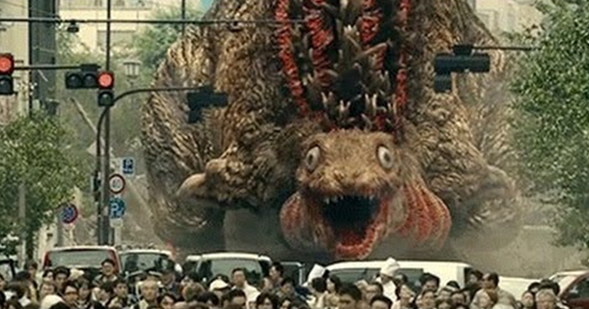
A very different Godzilla takes everybody by surprise when it suddenly rampages through Tokyo.

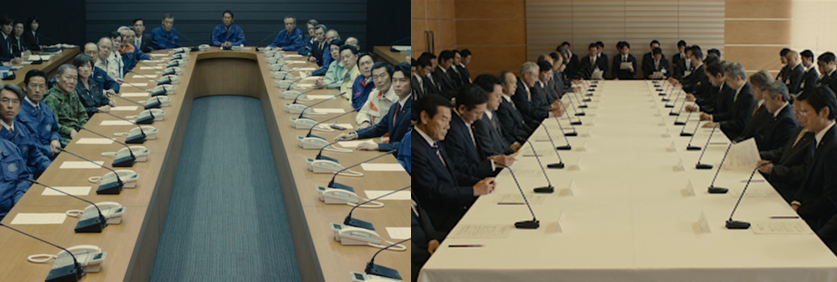
Shin Godzilla is rather unique in its use of filler in that the vast majority of its runtime is devoted not to the titular creature but to the seemingly endless debates and meetings within the Japanese governmental body. Prime Minister Seiji Okochi (Ôsugi) and his cabinet are understandably caught completely off-guard when what appears to be an underwater volcano or similar, relatively simple natural disaster floods the Tokyo Bay Aqua-Line turns out to be a gigantic quadrupedal creature that flops and flails its way through the Kamata district of Tokyo, leaving buildings destroyed and countless people homeless, injured, or dead, before promptly disappearing back to the sea. Initially, Okochi’s closest advisors and endless swarm of fellow politicians and officials are dismissively of young Deputy Chief Cabinet Secretary Rando Yaguchi’s (Hasegawa) instance that the initial phenomena could be a giant creature and that ignorance costs them precious response time and the lives of many. To solve the problem, the government decides to debate the matter, jumping from political opinions, to military options, to the baffled assumptions and confusion of scientists in a desperate bid to agree upon the correct and most appropriate course of action.

The governmental bodies are startlingly inefficient and eat up a lot of screen time.

Eventually, the United States begins to show an interest when the creature’s radioactivity is discovered to be a very real threat and sends Kayoko Ann Patterson (Ishihara) as their representative to help aid the Japanese government in discovering the creature’s origins. This, of course, leads to yet more debate and procrastination; there was seriously an extended sequence in the film’s first ten minutes or so that saw the P.M. ferried from one meeting to the next and to the next as meetings were organised and adjourned faster than any military action could be agreed upon, and these debates were focused on (almost to the point of parody) at the expense of any other onscreen action. I get it; the idea is to convey that the government is absolutely ineffectual, powerless, and ignorant when it comes to massive disasters. They would rather debate the matter in a committee, lying to the public to calm any discontent and lingering fear over organising any kind of actual military action to avoid causing unnecessary collateral damage. Placing a destructive force like Godzilla into the modern world, where policy and procedure and semantics are often more important than any actual action, makes for a startlingly effective allegory for the ineptitude of the world’s governmental bodies (and politics in general) but it doesn’t necessarily equate to a particularly exciting or engaging Godzilla movie. Characters appear and disappear on a whim and it doesn’t help that very few of them have a chance to stand out thanks to Japan’s strict code of honour and professionalism meaning that people spend more time changing into appropriate outfits, being respectful, and mulling over treaties and documents than actually showcasing any real personality.

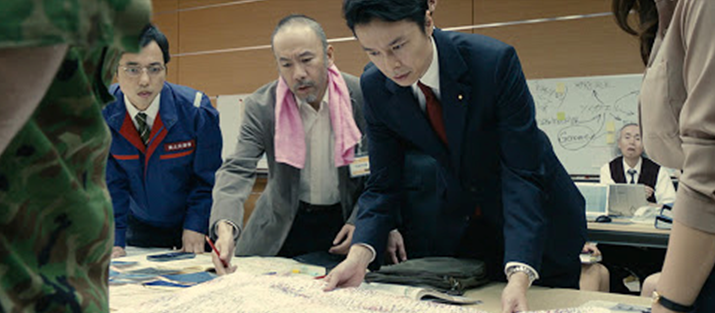
Thanks to the chaos, destruction, and death, Yaguchi steps into the role of a leader and commander.

The P.M. is hesitant to make any rash decisions out of fear of injuring innocents or causing undue damage, which costs the military perhaps their best chance at destroying the creature before it evolves into its bipedal form and, ultimately, his procrastination and hesitancy costs him his own life and those of his closest advisors. This allows for Yaguchi to eventually step into the role of the lead character after he manages to formulate one last desperate bid to subdue the creature with a coagulating agent. He is able to reach this conclusion thanks to intelligence provided by Patterson, a smarmy and self-aggrandising character with aspirations on becoming the President of the United States. When the many older interchangeable politicians eventually fail to agree on a viable plan of action (or die thanks to their incompetence), the film’s focus falls back onto these younger characters and a gaggle of misfits and scientists, a handful of whom are able to showcase a little more personality beyond spouting nonsense, such as Hiromi Ogashira (Ichikawa), whose pragmatic nature helps her to stand out in a sea of stuffy politicians.

The Nitty-Gritty:
Amidst all of this pointless, senseless, endless political debate, there actually is a few appearances of Godzilla to be found here and in forms that we haven’t really ever seen before. Sadly, though, there’s a strange hypocritical attitude towards Godzilla in this film; on the one hand, it’s clearly this unstoppable force of nature that threatens Japan and is apparently resistant to all forms of military reprisal and, on the other, the film mocks its name and even the very idea of it as a creature. Sure, a kaiju wrecking downtown Tokyo is an outlandish concept and one that is laughable in its ridiculousness, but in the context of the film it’s actually happening so it kind of feels like mocking the word “tsunami” after the weather formation has decimated an entire city. When it first emerges on land, Godzilla is this strange, floppy beast that lumbers around on four rudimentary flipper-like legs. Though the effects look really good, especially compared to the suits worn in some of the early films (which, to be fair, have their charm and the model and design work used to realise them is admirable), this first form looks really weird and it’s mainly because of Godzilla’s weird, floppy head and unblinking, gawping eyes.

Godzilla appears in many different forms, each one bigger and more menacing than the last!

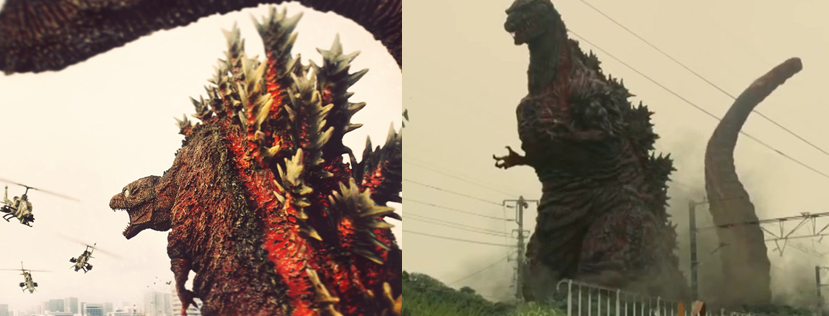
Biologically, it makes a lot of sense of Godzilla to begin in this form, which is much more marine-like and hampered by an overactive metabolism that causes it to soon overheat and retreat to the sea but, in execution, it just looks very goofy and unsettling and I’m not entirely certain why the filmmakers chose to not have the creature blink. Godzilla’s big thing in this film is its ability to evolve; soon into its crawling rampage, it attempts to transform into a bipedal form and, when it finally re-emerges from the sea, it has assumed an upright form that is largely familiar to any Godzilla fan…but dramatically larger and far more menacing than any other Godzilla seen before it. With rudimentary dinosaur-like arms (which are weaker and more useless than any previous Godzilla, being little more than static claw-like appendages for the most part), massive chunky legs, and an ostentatiously-large tail, this Godzilla sports jagged teeth, a rock-like hide, and small, piercing eyes (that still don’t blink; I’m sorry to harp on about it but I don’t really get that choice) in addition to his iconic roar.

Godzilla displays more destructive and versatile attacks than ever to lay waste to Tokyo and the military.

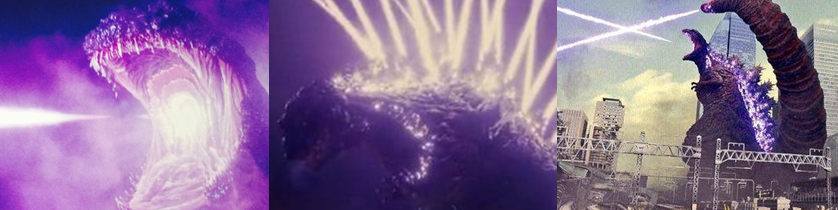
Completely resistant to all forms of attack, this Godzilla also boasts the most powerful and destructive version of its atomic breath yet; beginning as a plume of fire, it quickly becomes a devastating purple ray of death that fires from the creature’s gruesome split-jaw. Later, when the American’s actually manage to damage the creature, it starts spewing lasers from its back/fins and even from its tail, making it probably the most diverse and powerful of any Godzilla before despite the fact that it likes to just stand around as still as a statue or plodding slowly forwards with little to no purpose. Eventually, when all other conventional weapons have failed, Yaguchi spearheads a ludicrous plan to stave off an impending nuclear assault by launching a focused and co-ordinated attack on the creature’s head and legs and bury it under collapsing skyscrapers so a series of cranes can inject a coagulating agent into its mouth that, after the deaths of many and even more destruction, eventually manages to literally freeze Godzilla in place. Luckily, its radioactive half-life is conveniently discovered to be surprisingly short, meaning Tokyo can be reconstructed without fear of millions dying from radiation sickness. I find this extremely unlikely and actually quite odd; I would have expected Godzilla’s radioactivity to have been far more devastating in this film considering the climate at the time) but, instead, the creature is anti-climactically stopped just as its rampage was kicking up a notch and the film abruptly ends having wasted far too much of its run time on pointless and frankly boring political discussions.

The Summary:
One of the issues I had with Godzilla (Edwards, 2014) was that the film spent way too much of its time teasing the titular creature and cutting away from Godzilla’s rampage; I got why, as it was a great way to introduce new audiences to the character and to build suspense but, for those of us who are big Godzilla fans, we want to see the actual creature in action not spend all of our time with the human characters. This is, however, the price one must pay for being a Godzilla fan; human characters and side plots always exist in these films and distract from the kaiju action. It makes sense as you want to have characters you can relate to and root for and it helps put the film’s devastation and themes into context but it doesn’t change the fact that the kaiju action is what makes these films so enjoyable. And, in that respect, Shin Godzilla fails quite spectacularly; Godzilla has never looked more terrifying or displayed such incredible power and yet it’s largely just a massive, shambling slab of meat that barely moves and reacts to being attacked not because it’s in pain or enraged but more because that’s what the plot expects it to do. The film just spends way too much time focusing on its critique of government, politics, and red tape than it does actually focusing on Godzilla’s presence and threat, which is a shame as there was so much potential for a big-budget, traditional kaiju film but Shin Godzilla doesn’t really impress much beyond its commendable effects.

My Rating:

Rating: 3 out of 5.

Pretty Good

What did you think of Shin Godzilla? How did you feel about its pacing and focus? Did you like Godzilla’s redesign or do you feel it strayed a bit too far from its traditional appearance? Were you also disappointed by the film’s lack of focus on Godzilla and commentary on politics or do you feel it did a good job of shaking up the traditional Godzilla formula? What is your favourite Godzilla movie and why? How are you celebrating Godzilla Day this year? Whatever your thoughts on Shin Godzilla, or Godzilla and kaiju films in general, feel free to leave a comment below.

Movie Night [Godzilla Day]: Godzilla (1954) / Gojira


Toho’s famous atomic beast, and easily the most recognisable kaiju in the entire world, Gojira first emerged from the waters of outside of Japan to wreck the city of Tokyo on this day all the way back in 1954. In 2016, the day was declared “Godzilla Day” and, as a result, I’m only celebrating the undisputed King of the Monsters.


Released: 3 November 1954
Director: Ishirō Honda
Distributor: Toho
Budget: ¥100 million
Stars: Akira Takarada, Momoko Kōchi, Akihiko Hirata, Takashi Shimura, and Haruo Nakajima and Katsumi Tezuka

The Plot:
When a gigantic creature (Nakajima and Tezuka) born from nuclear radiation destroys a Japanese freighter, ransacks Odo Island, and rampages through Tokyo, Doctor Daisuke Serizawa’s (Hirata) experimental “Oxygen Destroyer” becomes the only hope of saving Japan!

The Background:
On August 6th, 1946, at the height of the Second World War, a nuclear weapon code-named “Little Boy” was dropped by the United States military on the Japanese city of Hiroshima, killing 70,000 people. A second bomb strike Nagaski three days later, killing a further 35,000 people, and in the Japanese Imperial Army summarily surrendered in aftermath of these devastating attacks. Since then, radiation and atomic fallout from the bombings have resulted in thousands of people falling sick and dying, and post-war Japan was gripped with fear regarding nuclear weapons and the threat of nuclear destruction. From this fear was born Gojira, the living embodiment of nuclear destruction, and was as inspirational to producer Tomoyuki Tanaka as King Kong (Cooper and Schoedsack, 1933) and The Beast from 20,000 Fathoms (Lourié, 1953) in Godzilla’s development. Director Ishirō Honda’s war-time experiences made him idea to the task of taking the concept seriously, while the titular creature went through a number of concepts before Teizo Toshimitsu, Akira Watanabe, and Eiji Tsuburaya settled on its final design.Combining elements of numerous dinosaurs, Tsuburaya initially planned to bring the creature to life using stop-motion animation but reluctantly utilised suitmation, resulting in a 220-pound suit that was so heavy, hot, and cumbersome that it took two stuntmen to wear it. Though the origin of the creature’s name is the subject of many tall tales, his iconic roar was the work of composer Akira Ifukube and Tsuburaya directed the film’s many complex models, miniatures, and special effects. In its original Japanese run, Godzilla was a modest financial success but was criticised for glorifying a real tragedy with an unbelievable, fire-breathing monster. Still, the film did well enough to receive an international release, where it was retitled Godzilla, King of the Monsters! (Morse and Honda, 1956) and featured a number of edits, including the insertion of Raymond Burr, where it made a further $2 million the original’s bleak themes. Since then, Godzilla spawned easily the greatest and most iconic monster movie franchise of all time and enjoyed a legacy that spanned over sixty years of invention, reinvention, and creativity and it all began here, with a metaphorical mediation on  the horrors of nuclear war.

The Review:
I can’t actually remember off the top of my head when I first became aware of Godzilla; I think it was just one of those cultural phenomenon’s that I had just picked up from references and homages in other media as I certainly don’t remember the movies being on television when I was a kid. I know I was fascinated by the creature, and the concept, in my pre-teen years and jumped at the chance to stay up late to watch a whole evening’s worth of content celebrating kaiju films, which included the first-ever Godzilla movie I ever watched from start to finish, Godzilla vs. King Ghidorah (Ōmori, 1991), which was all produced to coincide with the upcoming release of the 1998 American version of the film. After that, I was as hooked as I could possibly be and made a point to tape any subsequent Godzilla movies when they aired, and even went out of my way to get box sets from Australia to own the films (since hardly any of them are available here in the United Kingdom). Consequently, I’m more a fan of the Heisei and Millennium eras of the franchise, but I’m always up for a bit of black Showa action since that is where the series started, after all. The first thing to note about this review is that I am watching the original black-and-white version of the film with Japanese subtitles, meaning there’s no Raymond Burr and no hilariously bad dubbing; however, this isn’t actually my preferred way of watching Japanese films or anime and I’m perfectly fine with dubs over subtitled films. Still, it would be remiss of me to mention that the film quality hasn’t actually aged all that well; it’s quite grainy and dark, and actually seems inferior to even King Kong, but I’m hardly going to begrudge the film based on the technology and film quality of the time.

Japan’s islands are ravaged by a gigantic, radioactive creature who lives to kill… kills to live!

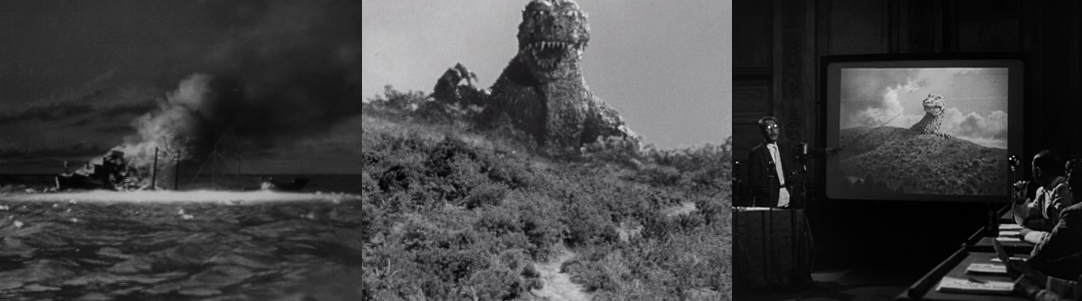
The film begins with a sudden and violent flash of light destroying the Japanese freighter Eiko-maru just outside of Odo Island; when the Bingo-maru is sent to investigate, it is also destroyed, the locals are thrown into a panic at the loss of life and the few survivors tell tales of the ocean simply exploding around them. Of course, the press catches wind of the story and speculation as to the cause of the accidents is only exacerbated after the natives of Odo Island find their fishing efforts ruined and stories of an ancient sea monster named “Godzilla” being blamed for it all by an elderly native (Kokuten Kōdō). Although these are initially dismissed, they turn out to be true when the island is ravaged by a fierce storm and a gigantic, dinosaur-like creature is briefly seen laying waste to the village. Traumatised by the devastation, the natives appeal for an investigation, which renowned palaeologist Doctor Kyohei Yamane (Shimura) agrees is the best course of action. Accordingly, he heads to the island to assess the damage and is accompanied by a team of scientists, his daughter Emiko (Kōchi), and Hideto Ogata (Takarada), a salvage ship captain who steers the boat. Amidst the wreckage on Odo Island, Yamane discovers that the village well has been contaminated by radioactive fallout and that massive radioactive footprints and extinct trilobites are littered throughout the village; the cause is immediately identified when the alarm bell rings and Godzilla is fully seen, and heard, for the first time, quite rightly sending everyone into a screaming panic! Although the creature disappears back into the ocean as soon as it emerges, Yamane has seen enough to postulate an original for the creature, believing that it is an ancient, sea-dwelling dinosaur of sorts that survived the extinction of its brethren to become the legendary creature the natives refer to as Godzilla and apparently disturbed from its long sleep at the depths of the ocean by recent atomic tests being conducted at sea.

The humans are decent enough, but as always the last thing you’re watching a Godzilla film for.

Although there is some debate about how public to make these events, the press print their story anyway, though few seem to take the impending threat of Godzilla seriously and find the idea of retreating to the safety of bomb shelters to be too much of an inconvenience. The military’s efforts to destroy the creature using depth charges are met with failure, and only cause further lives to be lost at sea when Godzilla retaliates, destroying both military and civilian vessels with its atomic breath. Yamane is distraught at the military’s efforts to kill Godzilla, as he wishes to study the creature further to discover the secrets of its biology and resistance to radiation, though he asserts that the creature is virtually indestructible since was able to absorb massive amounts of radiation and survive for millions of years without being harmed. One newspaper agrees one the scientific merit of the creature and sends a reporter, Hagiwara (Sachio Sakai), to interview Dr. Serizawa, a reclusive scientist horrifically scarred from and traumatised by the war, and to whom Emiko is engaged. Emiko agrees to take Hagiwara to see Serizawa since she wants to break off their engagement in favour of Ogata anyway, but he staunchly refuses to divulge any information on his latest research to Hagiwara. He does, however, provide a secret demonstration of his Oxygen Destroyer to Emiko, who is so traumatised by the devices ability to strip marine life to the bone through aggressive asphyxiation that she forgets all about mentioning their engagement. However, after Godzilla finally makes landfall and begins rampaging through first Shinagawa and then central Tokyo, shrugging off the fighter jets, missiles, and electrified fences erected to slow and stop its progress, she has no choice but to betray Serizawa’s confidence and goes to him with Ogata to plea for his help. Serizawa, however, is reluctant to employ the Oxygen Destroyer since he fears, and knows, that the military or other superpowers of the world will see its awesome destructive power as a weapon and force him to make more, but is spurred to assist after witnessing the sheer destruction caused by Godzilla.

The Nitty-Gritty:
As is to be expected from a Godzilla movie, much of Godzilla’s runtime is spent following a handful of human characters who react to the titular creature in different; thankfully, for a long-time Godzilla fan such as myself, the original film doesn’t actually set the template that so many others would follow and veers away from following reporters and/or soldiers and mostly focuses on Dr. Yamane, his concerned daughter, and her bland, would-be-lover. Yamane is different from every other character in the film in that he doesn’t want to see Godzilla destroyed; instead, he wishes to study the creature, to uncover the secrets of its strength and the potential benefits it could bring to mankind, and this even brings him into conflict with Ogata, who tries in vain to argue that the creature’s threat outweighs Yamane’s scientific curiosity. Were it not for the presence of Dr. Serizawa, Yamane would easily be the most interesting human character; while the reporters, soldiers, and government officials we do see are overwhelmed by Godzilla’s rampage, Serizawa is more concerned with the potential of others to pervert his research into something equally, if not more powerful, than nuclear weapons.

Godzilla is a fearsome force of nature who rampages through the city with an unquenchable fury.

Considering that Godzilla is the embodiment of nuclear terror and exudes radioactivity, the scientists don’t really do all that much to protect themselves from radiation; Yamane handles radioactive evidence with his bare hands and his team simply tell bystanders to stand back when they pick up signs of radiation, however once it makes landfall, its threat is taken very seriously. While the miniatures and model shots would improve over time (vehicles, such as helicopters, cars, and trains, suffer the worst in this film, though houses and structures tend to simply crumble and topple with ridiculous ease), the rear-projection effects are pretty ambitious for the time. Honestly, the entire film is bolstered by being in black-and-white and the graininess of the film stock; this, and the darkness that constantly bathes Godzilla, goes a long way to hiding some of the cruder effects and presenting the creature as a terrifying force of nature. I do have to commend the suit work, though; sure, it’s probably cheaper, easier, and less impressive than stop-motion effects but it definitely allows for a far ore versatile kaiju, one who can crash through a miniature version of Tokyo with ease and leave thousands either dead or slowly dying from radiation sickness. Of course, the star of the show, and the main reason that anyone watches this and any of the Godzilla films, is the Big-G himself. The film spends a great deal of time building anticipation to Godzilla’s full reveal, showing merely the flash of its atomic breath or the dark shadow of its leg as it topples buildings; even when we see its head and torso emerge over the mountains of Odo Island and out at sea, were still barely have an idea of what it actually looks like, which is a great way to paint it as this mysterious, fearsome, and almost mythological being. Long regarded as a creature of legend, Godzilla is like a living force of nature, easily shrugging off gunfire, missiles, and every attempt by the military to harm it. Seemingly without conscience, the creature emerges from the ocean and tramples its way through Shinagawa, killing untold numbers and causing devastation in its wake; while the military scrambles to organise mass evacuations and erect massive electrical fences, their efforts are entirely in vain (despite the incredibly speed that they’re able to put these defences together) and Godzilla easily tears its way into downtown Tokyo. The shot of the creature, seeped in darkness and with fire rage all around it as it roars in triumph and unleashes its destructive atomic breath, perfectly encapsulates everything that this original version of Godzilla represents: fear. Fear of the unknown, fear of the power of nature, fear of radiation, fear of nuclear fallout, and fear of our impending demise against forces we cannot possibly understand or hope to fight back against.

Godzilla shrugs off all of the military’s might but is finally killed by Serizawa’s Oxygen Destroyer.

You can make all the jokes you want about how ridiculous it is to see a man in rubbery suit flailing around and slapping at model buildings, but there’s a raw power to Godzilla in this film that is often forgotten in many of his interpretations; it’s not some cute, cuddly mascot or a benevolent creature looking to defend us from some greater evil, it’s all the fury of nature and man’s inhumanity to man given physical form, and nothing showcases the awesome ferocity of its nature than seeing it lay waste to one of the greatest and most prolific cities in the modern world. Although Dr. Serizawa is moved by Emiko and Ogata’s plea to help get rid of Godzilla, he is so determined to keep his Oxygen Destroyer from falling into the wrong hands or being perverted into a superweapon that he destroys all of his research notes and all evidence of the device save for the one he has created. Realising that he could be coerced into making another, but fully aware of the destruction and devastation being caused by Godzilla, he sees only one viable option: he must personally deliver the device to the bottom of Tokyo Bay, where Godzilla has retreated following its most recent rampage, and kill himself along with the creature to end two threats against the world in one blow. He does this willingly, despite Emiko’s (unconvincing) tears and Ogata’s insistence that he go in Serizawa’s place since the doctor has no experience using a diving suit; although Ogata insists on accompanying him to where the creature lies on the seabed, Serizawa refuses to leave and severs his lifeline to the ship after depositing the Oxygen Destroyer. The device has a near-instant and fatal effect, suffocating the creature and stripping it away to its bones, and sparing Serizawa’s loved ones from its threat. Those who are familiar with the multitude of Godzilla sequels and movies may be surprised to learn that Godzilla dies so conclusively (and, if we’re being honest, anti-climatically), but, while the crew and Serizawa’s friends salute his bravery, a troubled Dr. Yamane believes that another Godzilla may come into being if humanity is unable to learn from its mistakes and stop screwing around with nuclear weapons and technology.

The Summary:
Godzilla obviously isn’t going to appeal to everyone; I’ve known a lot of people who straight-up refuse to watch black-and-white films, let alone ridiculous kaiju movies featuring a man in a rubber suit smashing apart model buildings, but I think it’s still an important film for movie fans, especially, to check out for its message on the horrors of nuclear weapons if nothing else. The themes of fear and apprehension regarding nature and man’s destructive potential haven’t been diluted over time; if anything, they’ve only strengthen over the decades as global conflicts and arsenals have escalated, meaning that we’ve never been closer to blasting our world into oblivion than we are right now. Godzilla represents the fear of that threat; a literal beast that rises from the darkest depths of the ocean and punishes humanity for their stupidity and hubris, shrugging off all modern weapons and only being defeated by employing a weapon even more devastating than both it and the weapons that awoke and empowered it. While the human characters aren’t all that interesting and some of the effects haven’t aged too well, this is true of many kaiju movies from this period, and films in general from back in the day, and I think it’s better to concentrate on what does work about the film. The model shots, rear projection, and practical effects are all very ambitious and, arguably, allow the film to hold up a little better without the jerkiness of stop-motion animation. Characters like Dr. Yamame and Dr. Serizawa are clear standouts against the bland Ogata and the largely inconsequential Emiko; speaking out on the scientific potential of Godzilla and the harmful potential of scientific research, both characters help to drive home the primary themes of the movie (that war has brought about terrible consequences and that nature will punish us for our violent tendencies) as much as the titular creature, which makes an immediate impact as a ferocious and terrifying monster in its debut appearance.

My Rating:

Rating: 3 out of 5.

Pretty Good

Are you a fan of the original Godzilla? Which version do you prefer, the original Japanese movie or the American dub with Raymond Burr? What did you think to the build up to Godzilla’s appearance and the lore surrounding the creature? Were you a fan of the film’s characters and what did you think to the suitmation used to bring Godzilla to life? What is your favourite Godzilla movie and why? How are you celebrating Godzilla Day this year? Whatever your thoughts on Godzilla, or Godzilla and kaiju films in general, feel free to leave a comment below and be sure to check out my other Godzilla content!