
So, disappointingly, Ben Affleck is officially, 100% out as Batman. Despite my reservations about him being cast in the role, he delivered a really impressive performance as a tortured, grizzled Bruce Wayne who was driven to extremes after two decades of fighting an unwinnable war against crime in Gotham City. However, due to a multitude of reasons, Affleck is gone and, instead, The Batman (Reeves, 2021) will star Robert Pattinson in the title role as a younger Batman in his first years of activity. As with pretty much all Batman casting, this has caused some interesting ripples throughout the fandom but these discussions were only exacerbated when Reeves teased the first look at Pattinson’s Batsuit.
While this is obviously far from the clearest view, and leaked set images are showing either a much less refined stunt suit or lacking the filter of editing and post-production, there are some interesting choices at work here, such as Wayne apparently melting down the gun that killed his parents to form the symbol of his Batsuit. In any event, this seems like an appropriate time to take a look at some Batsuits from days gone by and talk about what makes them so iconic.
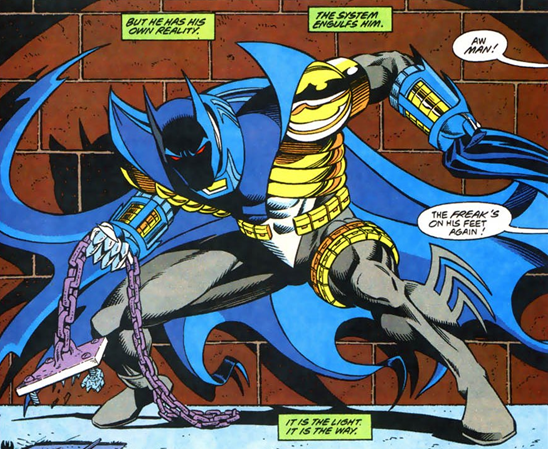
I am pretty certain I am in the minority here but I really dig the armoured suit that Jean-Paul valley put together during the Knightfall (Dixon, et al, 1993 to 1994) storyline. Initially, Valley just augmented the existing Batsuit with some wicked mechanical claws that could shoot out Bat-Shurikens, a grappling hook and, apparently, a laser but, for his big rematch against Bane, Valley decided to go the whole hog and produce an entirely armoured ensemble that enabled him to best Bane easily. As the Knightfall arc progressed, the suit took on a darker, far more menacing look as it changed from blue to red; Valley also became increasingly dependent upon the suit as his madness progressed, refusing to take it off and using it in increasingly violent (and fatal) ways. Eventually, however, the suit proved Valley’s undoing as he was unable to squeeze through the narrow tunnel Bruce Wayne lured him into, which finally forced him to remove the suit and begin a difficult road to redemption. What I like about this suit, though, is how futuristic and dangerous it looks; it’s got an aerodynamic flair, has all these neat gadgets and upgrades, and makes Batman look like a cold-blooded figure who takes no prisoners, which is exactly what Valley embodied. The suit rarely makes much of an appearance these days, though it did appear as a skin in Batman: Arkham Origins (WB Games Montréal, 2013) and informed Valley’s subsequent appearances as Azrael over the years.

Sometimes, you just need a completely bat-shit-crazy (pun intended) Batsuit and they don’t get much weirder than this one (well, maybe the Rainbow Batman…). First appearing wayyy back in 1958, the Batman of Zur-En-Arrh was an alien who, inspired by Batman, fought giant robots. Then, in the midst of the dreadful Batman R.I.P. (Morrison, et al, 2008) storyline, “writer” (I hesitate to call him that as his writing is atrocious and obnoxiously dense) Grant Morrison resurrected the Zur-En-Arrh concept as a “backup personality” Bruce implanted within himself that would kick in should he ever be psychologically compromised. What I love about this costume is the gaudy, outlandish, outrageousness of it; it’s all a mish-mash of reds, purples, and yellows the likes of which we haven’t seen clash since Alan Scott! Add to this the ruthlessness and unhinged nature of Morrison’s interpretation and you have one mental Batsuit that makes pummelling thugs into submission in Batman: Arkham Knight (Rocksteady Studios, 2015) all the more satisfying.

After wrapping up their excellent Batman: The Animated Series (Various, 1992 to 1999), Bruce Timm and Paul Dini decided to try something a little new with their animated ventures with Batman Beyond (ibid, 1999 to 2001). Batman Beyond took place quite far into the future and focused on a teenaged Batman, Terry McGinnis, who donned this futuristic Batsuit. There’s a lot to like about this Batsuit; first, there’s the trademark Dini/Timm simplicity. Second, there’s the fact that the cowl covers the entirety of Terry’s head; I’ve never really understood why Batman (and other, similarly-masked superheroes) feel the need to expose their jaw and mouth to the world so it’s great to see it obscured here. Then there’s all the futuristic modifications in the suit; it has jet boots, can glide, can turn invisible, and has all kinds of nifty gadgets to give Terry the edge in battling crime in Neo-Gotham. Since its debut, the Batman Beyond suit has cropped up more than once in comics, videogames, and other cartoons; Kate Kane, the modern Batwoman, also wears a costume that’s almost exactly identical.
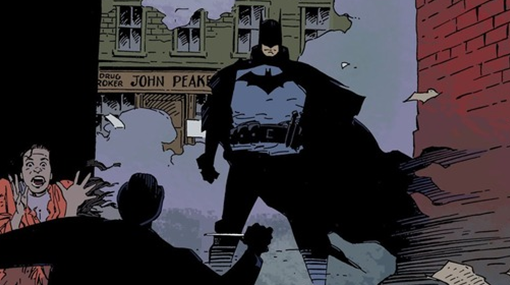
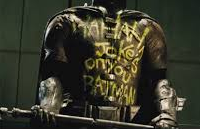
Retroactively labelled as one of the first ‘Elseworlds’ stories created by DC Comics, Gotham by Gaslight (Augustyn, et al, 1989) presents Bruce Wayne/Batman as existing in the 19th century and engrossed in the hunt for Jack the Ripper. As such, this Batsuit has a heavy steampunk-vibe to it (and I do love me some steampunk). Like other Batsuits on this list, the Gaslight suit works because of how simple and effective it is; this is a Batman that cannot rely on futuristic tech or fancy gadgets and is, instead, simply a very focused and highly trained man in a heavy, fit-for-purpose suit. The high collar, large pouches, and heavy-duty, militaristic feel given off this suit are fantastic and it’s probably one of the closest examples of what a realistic Batsuit would look like. In addition to being featured in a pretty decent animated film, this suit seems to have inspired Pattinson’s Batsuit, as well as the suit seen in the “Knightmare” scene in Batman v Superman: Dawn of Justice (Snyder, 2016).

As great as the fantastically camp Batman (Various, 1966 to 1968) television series was, and how scarily accurate it was as an adaptation of the happy-go-lucky Batman of the 1960s, it was to the benefit of everyone when editor Julius Schwartz, writer Dennis O’Neil, and artist Neal Adams decided to take Batman back to his roots as a serious, crimefighting detective in the seventies. During this run, Batman stories shed all the extraneous baggage of Bruce’s past; Dick Grayson went off the college, Bruce moved into a penthouse apartment for a time, the Joker became a serious threat once again, and Bruce matched wits with iconic villains like Ra’s al Ghul. Ostensibly similar in many ways to his previous attire, this Batsuit featured the iconic pill-like compartments on the belt and ditched the small ears and stocky aesthetic for longer ears and a far more muscular, refined physique. While the blue and grey colour scheme had long been a staple of Batman, it was under this run that it gained prominence as the definitive look for the more solemn crimefighting detective.

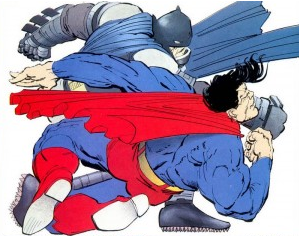
Over the years, Batman has donned many armoured suits to take down his more powerful foes but none are as iconic or as memorable as the armoured suit from The Dark Knight Returns (Miller, et al, 1986). Built specifically with the purpose of battling Superman, this suit is a hulking machine that is powered directly by Gotham’s electricity supply. Despite lacking an iconic bat symbol, this armoured suit means nothing except business; with spiked boots, massive gauntlets, and a plethora of gadgets and weapons, this armour is more than capable of subduing the Man of Steel. This suit was famously recreated in stunning detail for a similar fight scene in Batman v Superman: Dawn of Justice, as well as obviously featuring prominently in the Dark Knight Returns’ animated films (Oliva, 2012; 2013) but pretty much every armoured Batsuit can trace its origins and aesthetic inspiration back to this iconic garb.

After a momentary bout of uncharacteristic selfishness, Barry Allen/The Flash decided to run back in time and save his mother’s life; this one act, somehow, created an alternative timeline that was the focus of Flashpoint (Johns, et al, 2011). In this timeline, it was Bruce who died in Crime Alley rather than his parents, leaving his mother, Martha, a psychotic wreck as the Joker and his father, Thomas, as a far darker, more ruthless version of Batman. What I like about this suit is how it dramatically changes the Batsuit with only a few tweaks: the cowl has smaller ears, the eye lenses are blood red, the shoulder pads end in sharp spikes, a blood-red circle replaces the iconic yellow oval, and Thomas sports a matching blood-red utility belt and two gun holsters. That’s right, this is a Batman who revisits the character’s pulp roots and wields not one…but two pistols! Just upon first sight you can tell that this is not quite the Batman you know and love; similar to the Batsuit Jason Todd wore in the Battle for the Cowl (Daniel, et al, 2009) arc, this suit delivers a twisted, darker version of Batman and was, thankfully, also included as a DLC skin in Batman: Arkham Knight.

After finally reclaiming the mantle of the bat at the conclusion of the entire Knightfall saga, Bruce debuted a new Batsuit that drew heavy inspiration from Batman (Burton, 1989) in that, rather than being blue and grey, it was black and grey and comprised of heavy, sturdier Kevlar. This, for me, was a fantastic addition as, as much as I enjoyed the ‘60s show and liked the traditional blue and grey Batsuit, I much prefer an all-black or black and grey aesthetic, largely because I grew up with Burton’s Batman movies. As great as the Batman suit is, however, and as faithful as the Troika (Moench, et al, 1995) suit is to that movie, I much prefer the more armoured look Michael Keaton sported in Batman Returns (Burton, 1992). Either way, the change from blue to black was largely permanent as most Batsuits kept this colour scheme going forward and, for me, the only thing that stops this suit from being higher on the list is that it retains the yellow oval…which I’m not really a fan of.
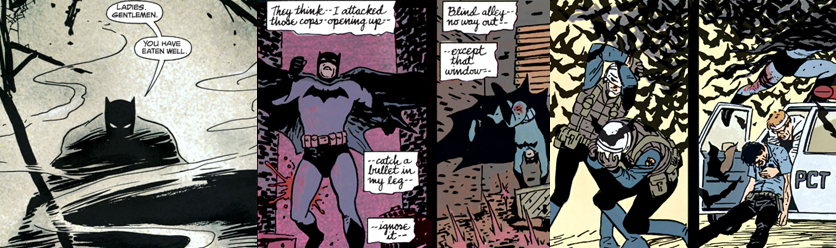
As lauded as The Dark Knight Returns is, I honestly feel that it is a chore to read; the art style is dodgy, the writing is dense and almost impenetrable, and, for all the work it does to present a grizzled, serious Batman, over the years I’ve come to find it doesn’t really live up to all its hype. Give me Batman: Year One (Miller, et al, 1987) any day. Presented as the first year of Bruce’s time as Batman, this Batsuit is, again, effective in its simplicity; sporting a black cowl, grey suit, and big, practical, militaristic pouches, this suit is the definitive “first time” Batsuit. Best of all, this suit ditches the yellow oval for a simple black bat chest logo, which was always and forever be my preference; I get that the embalm is double-shielded to draw enemy fire to his chest and away from his other, more vulnerable parts (…except his crotch, it seems) but I’ve never really liked the use of yellow or bright colors in Batman’s everyday attire.

I think that a lot of the appeal of Batman’s outfit, as featured in stories like Hush (Joeb, et al, 2002 to 2003), is simply that it is drawn by Jim Lee, who even made the gaudy, over-complicated ‘New 52’ suits look appealing. Lee’s Batsuit incorporates some of the best parts of its predecessors on this list: it’s got the shorter ears, a massive black bat on the chest, it’s got a blue/grey/black-on-grey colour scheme, and sometimes it’s got the big, practical pouches and other times it has the pellets. Lee’s suit has a little bit of everything in it and is, far and away, one of the most definitive renditions of Batman’s attire ever put to page. It doesn’t seek to reinvent the wheel like the ‘Rebirth’ outfit or over-complicated the suit with unnecessary lines and augmentations; instead it’s simply a purpose-built, form-fitting Batsuit that’s the jack-of-all-trades for Bruce’s nightly jaunts.
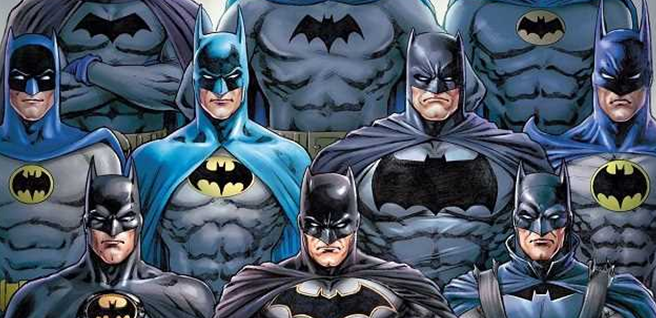
What Batsuits do you like? Do you have any guilty pleasures? What do you think of Robert Pattinson’s Batsuit so far? Sound off below and come back again for more lists and articles.





 Dr. K's Waiting Room
You must be logged in to post a comment.