Game Corner: AEW: Fight Forever (Xbox Series X)

Released: 29 June 2023
Developer: Yuke’s
Also Available For: Nintendo Switch, PC, PlayStation 4, PlayStation 5, Xbox One, Xbox Series S

The Background:
Once Scott Hall showed up on WCW Monday Nitro on 27 May 1996, the then-World Wrestling Federation (WWF) and World Championship Wrestling (WCW) engaged in a “Monday Night War” that defined a generation of wrestling fans. Things changed forever, however, when WCW went bankrupt and was absorbed by what’s now called World Wrestling Entertainment (WWE) and, despite some admirable efforts, the WWE has been the top dog of the American wrestling industry ever since. A true competitor arose in 2019, however, when Cody Rhodes, Kenny Omega, and Matt and Nick Jackson (with financial backing from Tony Khan) launched All Elite Wrestling (AEW). Not only was AEW an indie wrestling fan’s wet dream, but they also signed both undervalued wrestling stars and bona fide legends like “The Icon” Sting, who infamously defeated “Hollywood” Hulk Hogan for the WCW Championship on this day in 1997. AEW quickly established themselves as a true alternative to the WWE with action figures and merchandise, but it was the Jacksons who pushed for an AEW videogame, which immediately turned heads when Yuke’s (the developer behind some of the greatest wrestling games of all time) was brought in to develop the title. With the game engine being directly inspired by the celebrated WWF No Mercy (Asmik Ace Entertainment/AKI Corporation, 2000) and featuring a rare appearance by the late Owen Hart, the game promised to bolster its content with additional materials but quickly came under fire for its long development time. Despite downloadable content (DLC) trying to keep the game relevant, AEW: Fight Forever released with a strangely out of date roster and was met with mixed reviews. While the arcade-style, throwback gameplay was praised and innovative match types were praised, the main story and wrestler customisation options were criticised for being undercooked. However, the game sold well in the United Kingdom and Tony Khan promised to produce more AEW videogames in the future, leaving fans hopeful for an improved experience next time around.

The Plot:
When not competing in a series of customisable wrestling bouts, players take either a created wrestler or a member of the AEW roster on a year-long journey through the company’s biggest names and matches.

Gameplay and Power-Ups:
AEW: Fight Forever is an arcade-style wrestling title that plays very similar to the classic wrestling games produced by AKI, THQ, and Yuke’s back in the day, utilising a modified game engine and similar features of games such as the immortal WWF No Mercy. After customising their game card with icons, badges, and weapon decals, players are presenting with a laundry list of options befitting a wrestling videogame. You’ll probably want to explore the game’s options and settings first, where you can view various in-game statistics (wins and losses and such) and records, check out the current leaderboards, and toggle various options, such as the blood, entrance effects, casual play, and tutorials. As should be expected, the game offers a training mode where you can test out the initial fifty-strong roster, setting the computer-controlled opponent to different behaviours and positions to test different moves. Unless you disable in-game tutorials and hints, wrestling legends like William Regal, Jim “J.R.” Ross, and Taz chip in with insights into specific game mechanics or match types. Although the game’s controls are fully customisable, I managed fairly well with the default layout, which maps your high strike and kicks to X and Y, your grapples to A, and run to B. By holding A, X, or Y, you execute a strong attack or grapple to deal additional damage, while tapping the strike buttons executes a quick combo. You can also hit A, X, or Y while running for a running strike or takedown, attack enemies when they’re down in the same way, and swing the game’s various colourful weapons with X or Y. The right stick is used for taunting, which builds your momentum bar, allowing you to maintain stamina and execute signature and finisher moves (using the D-pad or the right stick, as prompted). If you’re covered or locked in a submission hold, mash the face buttons to try and kick or wriggle free, and mash them when locking in a submission to wear down your opponent’s body part or score a tap out victory.
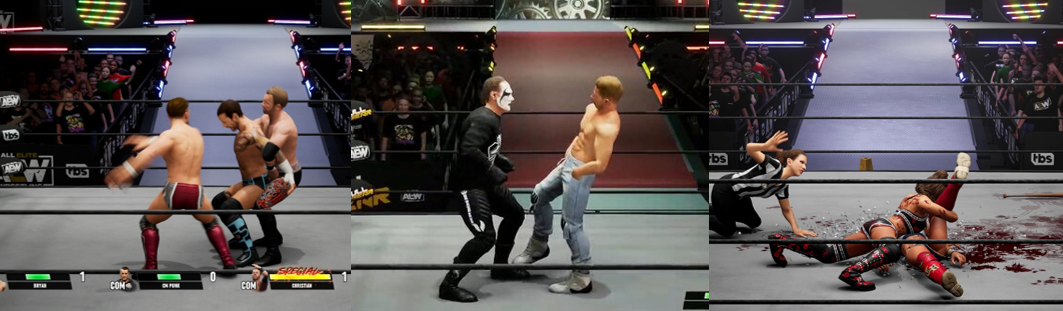
The glory days of fast-paced, arcade-style action are nicely evoked in Fight Forever‘s gameplay.

Each wrestler has at least one signature and finisher move, though some have more if they have a certain “Skill” equipped. You must pull off a successful taunt to activate your “Special” status, which allows you to hit as many finishers as you like until the status fades. These are performed from different positions (from a lock up, or the top rope, or when the opponent is down, etc), so be sure to review your wrestler’s moves from the pause menu. Once your opponent is down, press the Left Trigger to pin or the Right Trigger to pick them up. Grappling and pressing RT whips your opponent into the ropes, corner, or ringside equipment, and the Left and Right Bumpers are used for countering. This can be tricky as there’s no onscreen indicator for when to counter. Simply mashing the triggers doesn’t work either, so it’s all about timing. Skills also afford you temporary buffs, such as landing the first strike or doing a taunt, while others increase your versitality, such as adding springboard attacks and a quick kip up to your repertoire. You can increase the amount and strength of your finishers, buff your finisher countering ability, increase your resistance to submissions, power out of pins, and even steal your opponent’s finisher. When tagging with a partner, you can bring them in with LT and perform double-team moves to wear down your opponents. You can also exit the ring and throw your opponent into the steel steps, ring apron, ring posts, and barricade to deal additional damage. When you hit your signature moves or finishers, you’re treated to a replay, and a helpful picture-in-picture feature shows who’s coming out to interfere for or against you. You can assign a manager to even the odds, bust opponents open, and even utilise weapons in some matches. When playing “Road to Elite”, you must watch your health as you’ll be injured if it drops too low or you overexert your workouts, requiring you to visit the hospital. In matches, your wrestler holds damaged body parts and becomes disorientated from eye rakes and eye pokes, screwing up your controls for a short time.
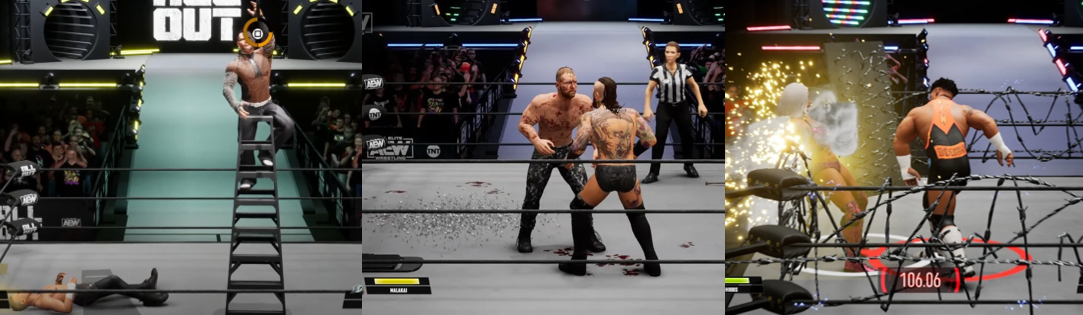
Though light on gimmick matches, Fight Forever has some unique and bloody match types.

There are a decent variety of match types here, from standard one-on-one matches to tag team bouts and multi-man matches. AEW: Fight Forever offers intergender matches, allows you to challenge for or defend AEW Championships, and manually change the champions if you wish. While you can’t alter the settings for every match, you can select additional options from each category, such as the “Lights Out” match (which adds weapons to the ring) and “Falls Count Anywhere” match (where you can pin outside the ring). Weapons are picked up, snatched from the crowd, or retrieved from under the ring with RT and break after a few uses but there are a lot of them here. You can set up and smash opponents through tables, swing baseball bats, steel chairs, and barbed wire implements alongside throwing football helmets, rideable skateboards, and covering the canvas with thumbtacks. Tag team matches can be a bit of a pain, especially if you’re not controlling your partner, as the CPU gets very aggressive when going for a tag and their partner often interrupts pins or hits double team moves. Your best bet is to down your opponent and then knock their partner off the apron or strategically pin your foe near your corner. Similarly, multi-man matches can get extremely chaotic as the game’s targeting is atrocious, either automatically switching to whoever it feels like or messing up your manual aim. “Road to Elite” features gauntlet matches where you battle three opponents in succession, handicap matches, and singles matches where your opponent’s allies will interfere to beat you down, all without a disqualification. Surprisingly, there’s no steel cage match, but you can play a ladder match, setting up a ladder with RT, holding B or LT to climb, and mashing buttons to whittle down a wheel and claim victory. Be careful, though, as the CPU may steal your victory if you get the wheel down to the last section and they make a successful climb.
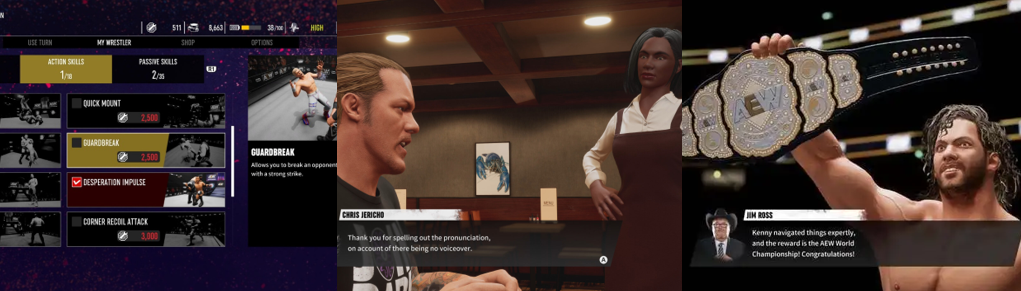
“Road to Elite” strangely simulates day-to-day activities in a botched attempt at immersion.

AEW: Fight Forever is notable for a couple of fun and unique gimmick matches, with the “Exploding Barbed Wire Death Match” being a particular highlight. In this match, the ring ropes are replaced by barbed wire, barbed wire tables are in each corner, and you have 120 seconds before the ring explodes, causing major damage to anyone near the ropes. You can toss and hit your opponent into the barbed wire to literally flood the canvas with blood, and set off explosions, which was a lot of fun. The “Casino Battle Royale” was less enjoyable for me and far less unique, essentially being a traditional Royal Rumble with a wacky name and having you pick a playing card to determine your position in the match. The goal is to wear down your opponents (up to twenty-one) so you can toss them over the ropes to win, gaining a title shot in “Road to Elite”. This is the game’s story mode, where you take any AEW star (or a custom wrestler) on a year-long story, making friends and enemies and winning championships as you go. Win or lose (and it’s fine to lose matches here), you’ll earn AEW Cash to spend in the in-game shop and Skill Points to spruce up your custom wrestler. AEW Cash can also be spent on better hospital treatment or buying items to boost your health, momentum, or Skill Points. Between matches, you’re given four “turns” to either workout, see the sights, eat, or do other bizarre tasks like press conferences and talk shows. If you work out, you’ll lose energy but gain momentum, but also risk getting injured. Eating restores your health, as do some other tasks, and seeing the sights increases your chances or meeting other wrestlers. There are multiple story paths to experience, all triggered at random, with you forming tag teams, being betrayed, joining or battling against one of AEW’s many factions, and vying for the company’s top prize. It’s a decent mode, but quite short to invite replays and can get repetitive as you have little control over what you’re doing outside of a match (save for a few dialogue choices). You can take selfies with AEW stars for your collection, sometimes endure horrendous gauntlets or fight while injured, and play a bunch of weird mini games for additional points.

Presentation:
AEW: Fight Forever generally impresses with its visuals, particularly the wrestler models. Unlike the WWE videogames, AEW: Fight Forever opts for a slightly exaggerated, action figure-like aesthetic not unlike WWE All-Stars (Subdued Software/THQ San Diego, 2011). Each AEW star closely resembles their real-life counterpart, even down to their in-game grunts and taunts (with Sting howling and “The Machine” Brian Cage shouting at the crowd), though the game was noticeably outdated at launch and is even more behind the times now. The women, especially, come off really well, which is nice to see as they often look monstrous in the WWE titles, and each has their accurate entrance music, including “Le Champion” Chris Jericho coming out to “Judas” and CM Punk using “Cult of Personality”. Unfortunately, AEW: Fight Forever opts to use truncated entrances like WWF No Mercy. While you can press buttons to activate pyro and other effects, this may be disappointing to some (not me, though, as I always skip entrances anyway). However, I was disappointed by the lack of commentary, even for signatures and finishers, opting for a customisable soundtrack instead, which was a shame. In fact, voice acting is very sparse, with the odd sound bite or insight cropping up now and then but the game primarily relying on text and dialogue boxes. While it obviously helps make the random story paths more manageable, it does come off as a little cheap, similar to when you visit various landmarks in “Road to Elite” and are met with laughably low quality still images. I occasionally saw some texture warping during these cutscenes as well, and some graphical glitches (such as entrance weapons disappearing). Similarly, there aren’t many options for wrestler customisation and skins, with only a handful of AEW stars having true alternate looks. However, I would say AEW: Fight Forever looks and performs far better than a lot of recent WWE games, likely because it’s a far simpler and stripped back title.

A flawed focus on bizarre gimmicks result in a solid, if barebones, experience.

If the trimmed entrances and lack of commentary didn’t give this away, the barebones arenas sure do. On the one hand, I’m not all that fussed as the arenas are largely superfluous and their presentation does recall the likes of WWF No Mercy. On the other hand, this game came out in 2023, so I’d expect the crowd to look less basic. The audience is seeped in darkness and indistinguishable most of the time, though the fans are very loud and add a lot of ambiance to matches. There are only a handful of arenas here, though, so things can get visually repetitive very quickly. You can build your own custom arenas, but I find these always look stupid and this isn’t helped by the weird fixtures, decals, and colour schemes the game offers. Strangely, AEW: Fight Forever doesn’t allow for backstage brawling, with no backstage areas included, or brawling in the crowd, which is just bizarre. The Exploding Barbed Wire Death Match adds some visual variety, and the “Stadium Stampede” DLC shows what the game could be capable of, but the developers apparently thought it more important to waste resources on weird-ass mini games. These see you playing baseball, participating in quizzes, collecting tokens, shoving opponents from the ring and onto coloured balls, matching Penta El Zero M’s movements, smashing coloured boxes, and running across football fields avoiding hidden holes. These certainly add some visual variety, but they’re so out of place that it’s like the developer’s notes got mixed up. Similarly, you’ll see cutscenes of your wrestler working out, chatting, visiting the hospital, getting beaten up, or meeting fans when playing “Road to Elite”, all things that are certainly different and fitting for a wrestler’s lifestyle but seem out of place. Finally, live-action footage, clips, and voice overs interspersed through “Road to Elite” show key moments in AEW history, which was nice, though you oddly don’t recreate many of these moments as you play.

Enemies and Bosses:
Naturally, every wrestler on the roster is your enemy, even your allies. While every wrestler controls and fights the same, with a set number of moves and abilities, your strategies may alter depending on who you fight. As each wrestler has multiple Skills, it’s worth becoming familiar with them as it does impact your play style. Custom wrestlers will set and refine these in the “Road to Elite” story mode, AEW stars have theirs set and cannot change them, and some even have unique Skills, such as “Freshly Squeezed” Orange Cassidy’s “Sloth Style” where he fights with his hands in his pockets. “Mr. Mayhem” Wardlow snatches guys out of mid-air, Powerhouse Hobbs briefly becomes immune to strikes, Maxwell Jacob Friedman/MJF bails out of the ring, and “The Bastard” Pac evades strikes and grapples with cartwheels and rolls. Similarly, you must adapt to superheavyweights like “No More B.S.” Paul Wight as undersized wrestlers will struggle to perform their usual moves due to the weight difference. Highfliers like Rey Fenix are smaller and more agile, often striking fast, quickly countering, and flying from the top rope. Jon Moxley lives up to his reputation as an insane brawler by focusing on strikes and excelling in hardcore environments, guys like “The American Dragon” Bryan Danielson are more technical, sporting a repertoire of submission holds and take downs, and career tag teams like Matt and Nick Jackson (The Young Bucks) have flashier double team moves to keep you off balance. In many cases, you can simply wait out or fight through your opponent’s unique skills, such as spamming combos on Wardlow until he starts feeling them and avoiding the top rope when facing opponents with the anti-air Skill.

Different matches and wrestler abilities can change the difficulty and complexion of a contest.

Some competitors (particularly custom wrestlers) may surprise you, however, as even smaller wrestlers can counter mid-air attacks or finishers. Generally, your opponents are only as difficult as you set the game and the match type dictates. For example, a 4-Way match pitting Darby Allin against Luchasarus, “The Redeemer” Miro, and John Silver will be an uphill battle for the colourful daredevil. Similarly, tag team matches can be a chore as the opponent’s partner constantly rushes the ring, just like in the old AKI games, and the Casino Battle Royale can end in an instant if you’re jumped from behind. Sometimes, your opponent’s attacks land faster and with more accuracy than yours but, other times, they simply stand there like a goober. The more you beat your opponent, the weaker they become, but the momentum bar charges ridiculously fast, and the match can change on a dime if your opponent gets a few good hits in or activates a buff. Generally, opponents rush you once the bell rings, so be ready to counter their attack…if you can get the timing of the blocking down. When playing “Road to Elite” on “Easy”, I found matches fluctuated. While I easily dominated most opponents, winning with a single finisher or even regular moves, others proved surprisingly aggressive, such as MJF with his dirty tactics and Pac, with his odd combination of speed and strength, yet I absolutely crushed Paul Wight, destroyed Chris Jericho, and easily toppled champions. This is true even in multi-man matches as you can get into a rhythm of wearing down a specific opponent (or keeping an eye on who’s taking a beating) and time your pins to happen as the other opponents are distracted for an easy win. “Road to Elite” got annoying for me simply because many paths push you into tag matches or gauntlets, and due to its random nature. You can access different paths and matches with different wrestlers, even competing in a Exploding Barbed Wire Death Match and battling a shadowy reflection of your wrestler in certain paths, and your opponents seem to be randomised each time to mix things up, though your general strategy of wearing them down to score a win remains the same.

Additional Features:
There are thirty-eight Achievements up for grabs here, which sounds like a lot but they’re surprising simplistic. Thankfully (but oddly), none of them are tied to online play. You’ll get an achievement for clearing “Road to Elite” once and then ten times, others for creating a custom wrestlers or competing in a custom arena, and another for winning a championship in an exhibition match. There’s an Achievement for buying an item, another for hitting a signature and finisher and scoring a victory, and another for hitting an opponent with a barbed wire bat in a “Lights Out” match. If you successfully perform certain tasks in “Road to Elite” (such as eating and working out), you’ll get more Achievements, and there are Achievements for utilising certain Skills in matches. Nothing too taxing, which is nice, but the Achievements also lack a lot of creativity and encourage repetition rather than replayability, which are two different things. There are additional “Challenges” too, daily, weekly, and untimed normal challenges. These award AEW Cash for defeating opponents, challenging harder difficulties, and performing a bunch of moves over time (such as 100 running attacks). It’s something to do, I guess, but hardly that innovative compared to other games. As you’d expect, you can go online to play in ranked, casual, and private matches. Sadly, you cannot download custom wrestlers or arenas, which is very surprising but hardly a big loss considering how lacklustre the game’s create-a-wrestler is.
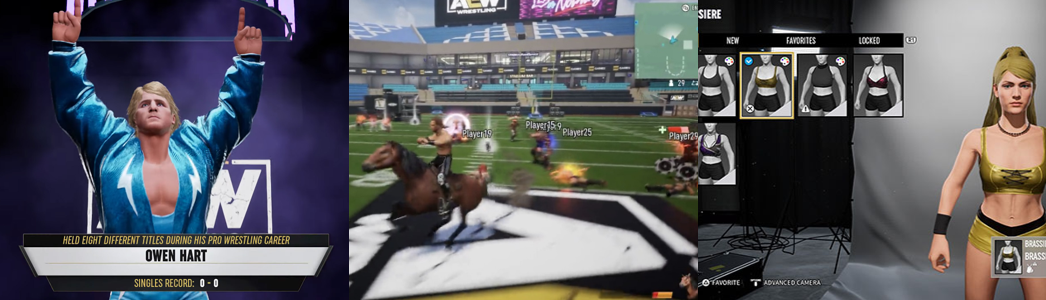
Some expected and bonkers inclusions can’t ease the sting of the barebones creation suite.

The create-a-wrestler mode is so lacking that it’s inferior to even WWF No Mercy, reminding me more of the laughable options seen in WWF WrestleMania X-8 (Yuke’s, 2002). You’re limited to picking set expressions and altering the basics of your wrestler’s appearance rather than changing every aspect, are given a paltry selection of clothes and accessories focused more on patriotic attire than AEW gear, and have so few options that it’s basically impossible to create current AEW stars. While there are a lot of names and moves to pick from and entrance options, it’s all disappointingly barebones, with even the shop offering little extra content. Team entrances are especially limited, it bugged me that I couldn’t even put a vest on my wrestler without picking a body suit, and it’s almost insulting how few options there are for masks and face paint. You can modify the AEW roster, but the options are again incredibly limited, meaning you can’t rejig “The Natural” Dustin Rhodes to look like Goldust. The create an arena is just as pointless, I couldn’t care less about the unlockable badges and such, and there’s little incentive on spending real-world money for the DLC wrestlers unless you simply must have Adam Copeland on your roster. They do add additional skins and moves, to be fair, and the “Stadium Stampede” mode (which is free to download but you need a subscription to play). This is a bizarre free-for-all arena battler where you compete against thirty other players on a football field, utilising horses, golf carts, and abilities, attacking enemies for poker chips to level-up your character. Lastly, you can use AEW Cash to purchase “The American Nightmare” Cody Rhodes and referee Aubrey Edwards, and unlock Paul Wight, “The Exalted One” Mr. Brodie Lee, and even the legendary Owen Hart by playing specific paths in “Road to Elite” for the former or winning 100 exhibition matches for the latter.

The Summary:
While I generally enjoy the WWE videogames put out by Visual Concepts and 2K, it has to be said that the formula has become very stagnant over the years. The games are great simulations of the televised product, but I miss the fast-paced, action-orientated arcade style of the good old days, when WWF No Mercy captured my attention for hours on end. I’m also a fan of AEW and seeing them try something new, so I was excited to get AEW: Fight Forever despite all the negativity surrounding it. On the surface, it delivers what I wanted: simple, pick-up-and-play arcade action that recalls the AKI/THQ wrestling games of old, updating those mechanics for modern gamers. Playing matches is a lot of fun, with moves being simple to pull off, the game performing really well, and a great deal of satisfaction coming from every victory. I liked that “Road to Elite” was quite varied and encouraged replays with its different, random paths, and that it tried something new by mimicking a wrestler’s lifestyle. Unfortunately, the game is handicapped by barebones options, with perhaps the worst create-a-wrestler I’ve seen for some years and nothing worth unlocking apart from a couple of extra wrestlers. The focus on ridiculous mini games was a bizarre choice that adds confusion and tedium rather than variety, and it was disappointing to have so little control over “Road to Elite”. While the game mirrors WWF No Mercy in many ways, content is not one of them, with key elements omitted from popular game modes for absolutely no reason. The Exploding Barbed Wire Death Match was a great inclusion and this was probably the first time I’ve enjoyed a ladder match in years, but there are surprisingly few match types to pick from, the roster is severely outdated (with basically no way to update it through the creation suite), and some matches and CPU behaviours can be needlessly frustrating. It’s a shame as there’s a lot of potential, but it seems the lengthy development time got strangely side-tracked with unwanted features (those damn mini games) rather than offering a truly memorable alternative to the WWE’s videogames.

My Rating:

Rating: 2 out of 5.

Could Be Better

Did you enjoy AEW: Fight Forever? What did you think to the throwback gameplay and arcade-style action? Were you disappointed by the barebones creation suite and strangely limited presentation? Did you enjoy the Exploding Barbed Wire Death Match? What did you think to “Road to Elite” and its bizarre mini games? Would you like to see a sequel improve upon the game’s mechanics and potential? Who was your go-to wrestler to play as an why was it Sting? Which of Sting’s eras, personas, and matches are your favourite? Whatever your thoughts on AEW: Fight Forever, and Sting in particular, feel free to voice them below, check out my other wrestling reviews, and donate to my Ko-Fi if you want to see more wrestling content.

Wrestling Recap: Extreme Elimination Chamber (December to Dismember ’06)

The Date: 3 December 2006
The Venue: James Brown Arena; Augusta, Georgia
The Commentary: Joey Styles and Tazz
The Referee: Mickie Henson
The Stakes: Extreme Elimination Chamber match for the ECW World Championship

The Build-Up:
Back in the days when the then-World Wrestling Federation (WWF) and World Championship Wrestling (WCW) competed in a vicious ratings war, Extreme Championship Wrestling (ECW) offered a different brand of sports entertainment. First founded in 1992 as Eastern Championship Wrestling, the company was re-branded by one of wrestling’s greatest minds, managers, and promoters, Paul Heyman, in 1993 and came to be known for its violent and controversial matches and content, which was instrumental in inspiring the WWF’s “Attitude Era”. Unfortunately, despite ECW’s rabid cult following, the company was unable to sustain itself after losing its television deal; many of ECW’s stars jumped to the WWF and the company officially closed its doors in early-2001. ECW lived on, however, not just in the rise of independent promotions but also in the confines of the rebranded World Wrestling Entertainment (WWE); the success of their Rise and Fall of ECW documentary (Dunn, 2005) saw the WWE host a special throwback event, ECW One Night Stand, in 2005 to celebrate the brand. It was so successful that a second event followed in 2006, one that would see ECW and many of its stars return as a third WWE brand. Unfortunately, despite initially being presented as an alternative product and a showcase for new talent, the WWE ECW was doomed to fail: it lacked the “Extreme” edge fans expected, Heyman’s influence was limited, and its top star and champion, Rob Van Dam, was stripped of his championship belts after being arrested on drug charges! The WWE seemed to lose interest soon after; although they promoted this pay-per-view event, very few matches were announced beforehand and the card was supplemented by Raw and SmackDown! talent. The entire show was built around this Extreme Elimination Chamber match, with former champion RVD being the first announced for the contest. There was also some drama surrounding Hardcore Holly’s involvement; he was initially scheduled to be a part of it before Bobby Lashley attacked him and took his place, failed to gain a spot in a match against RVD, and was finally included after Sabu was mysteriously attacked earlier on the show, a decision that irked the ECW original but would be just the tip of the iceberg when it comes to this universally lambasted event.

The Match:
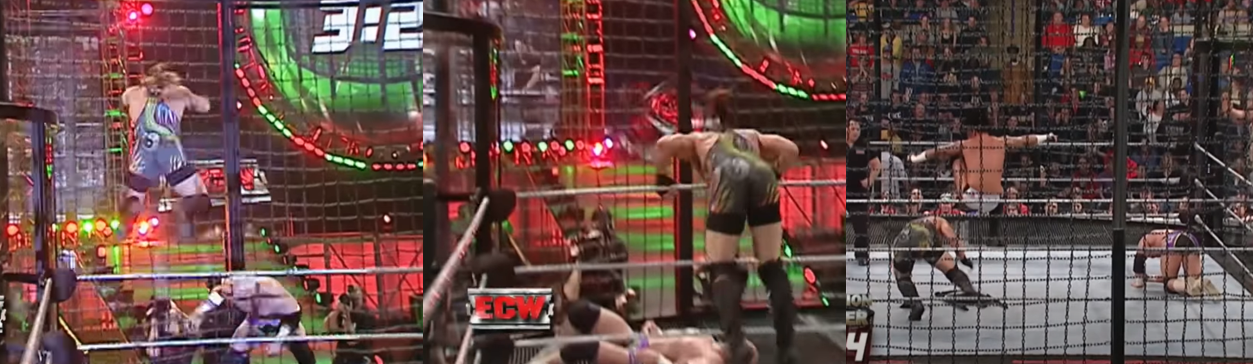
Considering ECW December to Dismember 2006 was already criticised for its lacklustre card and padding its runtime, it’s perhaps not surprising that this match was preceded by not just a hype video emphasising its violent and brutal nature, but also a lengthy pre-match promo from ECW general manager Paul Heyman. While the crowd, and even the commentary team, have no love for Heyman, who turned heel by ditching the ECW originals for up-and-coming stars like Bobby Lashley and CM Punk (and, naturally, the Big Show) as the future of the company. This promo went on for about three minutes and, afterwards, the show wasted even more time by dwelling on the chamber’s lowering around the ring. What made this match unique, and “Extreme”, compared to previous elimination chamber matches was that each competitor also carried a weapon: CM Punk had a steel chair, Test a crowbar, Lashley a table, and the Big Show had a baseball bat wrapped in barbed wire. Otherwise, the rules were the same; two men (RVD and Hardcore Holly) started the match and, around every five minutes, another competitor was released to join in. As was often the case whenever the Big Show actually got a serious push, much of Heyman, Styles, and Tazz’s commentary emphasised the champion’s size and strength; despite the fact that the Big Show had been beaten like a drum over the years by this point, he was hyped as “unbeatable” simply because he was a huge man with a newfound motivation since capturing the championship. Of all the competitors, rising star CM Punk,the epitome of an indie darling, and the ever-popular RVD made the most waves during their entrances. Even now, as big a fan of Test and even Hardcore Holly I am as a dependable midcarder, it’s hard to deny that these two stick out like a sore thumb; nobody in the audience wanted Holly in this match and their inclusion really speaks to how limited and lacklustre the WWE ECW roster was.

RVD proved the MVP of this thrown-together match, closely followed by crowd favourite CM Punk.

As mentioned, RVD and Hardcore Holly started the match after what felt like an ice age of stalling and entrances and they kicked off what was sold as the most devastating match in the entire WWE by…trading lock ups and punches. A clothesline exchange was enough for Holly to go for the cover, which earned him barely a one count, then Holly gently tossed RVD to the raised steel floor outside the ring. RVD leapt to the cage wall when Holly dodged his dive, which was admittedly pretty impressive; unfortunately, he ended up hitting the ropes when he tried a follow up dive, which was apparently enough to draw an “ECW!” chant from the crowd. Holly pressed his advantage by running RVD into the chain-link wall and slamming him on the steel but crashed and burned when he uncharacteristically went for a dive off the top rope and ate a boot for his troubles. RVD capitalised with his patented Rolling Thunder manoeuvre from the ring, over the ropes, and to Holly’s prone body on the outside, only to find himself deposited back into the ring from a suplex for a two count. Holly and RVD traded blows, with Holly landing his trademark dropkick, before CM Punk joined the action. The crowd exploded when Punk launched his steel chair right at Holly’s face and took out RVD with a springboard clothesline, only to be blasted with that same chair when RVD tossed it at his head! RVD followed up with his rolling monkey flip in the corner, which saw Punk slightly graze the chair with his tail bone, only for Punk to duck RVD’s spin kick and sweep him onto the chair with his speed and martial arts skill. Punk kept Holly out of the game with a springboard dropkick and continued to work over the busted open RVD, thrusting him head-first through the chair as it was wedged in the corner, only to have his momentum cut off when Holly swung him into the chain link wall for a near fall.

The crowd were unimpressed when RVD and Punk were eliminated, and by the botched pin on Holly.

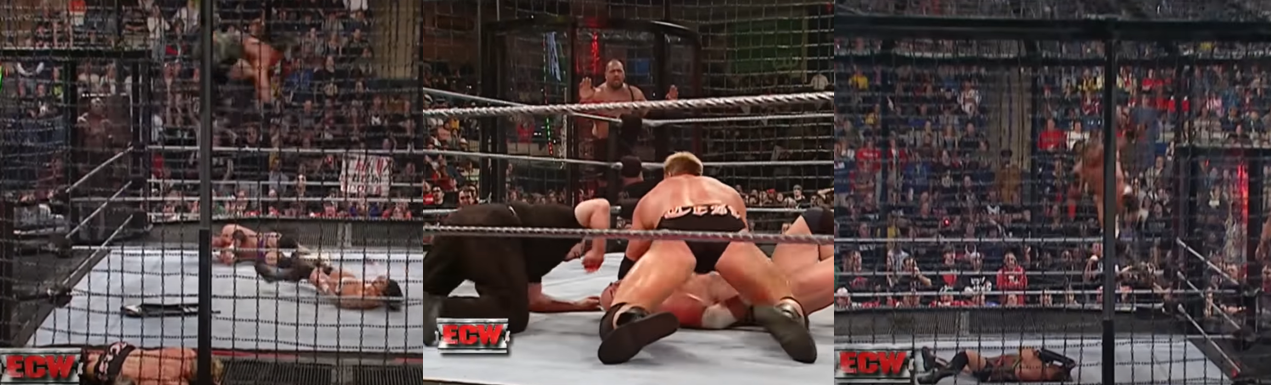
Holly continued his attack with a sidewalk slam to Punk before dumping him on the ropes and booting him right in the head and driving him to the mat with a superplex. Regardless, CM Punk kicked out of two follow-up pin attempts and all three men were fatigued when Test brutally attacked with his crowbar, slamming, clawing, and choking Punk and RVD to give Holly time to recuperate. RVD somehow found a second wind, attacking with the chair then eliminating CM Punk with the Five-Star Frog Splash, which initially caused the audience to pop but their cheers quickly turned to boos when they realised what’d happened. Test then shockingly hit Holly with his Big Boot; however, despite the referee not counting to three and Tazz insisting that Holly kicked out, Hardcore Holly was summarily eliminated in confusing, frustrating, and anti-climactic fashion. RVD then flew in with a side kick off the top rope that downed Test and left him in prime position for a Five-Star Frog Splash off the top of the Big Show’s pod; however, the Big Show grabbed at RVD and interrupted the move, allowing Test to attack with a chair, dump him off the pod, and land a massive elbow drop from the pod to the steel chair, which took RVD out of the match and left the audience incensed as they realised their two favourites were gone.

After some stalling, shenanigans, and mediocre action, Lashley captured the championship.

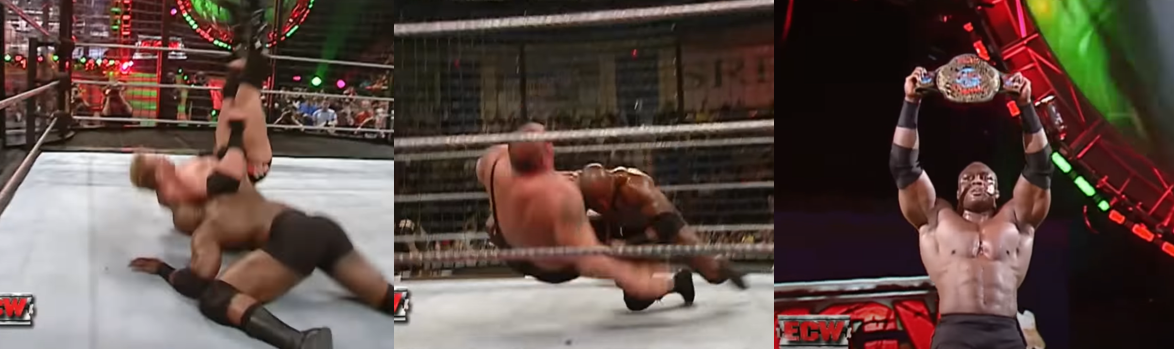
There was a huge lull in the match where Test was left to awkwardly stumble about the ring as the counter wound down; then, when Heyman’s riot squad refused to let him out, Lashley broke out of his pod by smashing the roof with his table. Although he almost slipped off the top rope, Lashley, hit a diving clothesline, kicking the chair in Test’s face, and smashing him in the gut with the crowbar. The Spear that followed then took Test out of the match, leaving Lashley to stalk around the ring for over a minute as he waited for the Big Show to be released. The Big Show lumbered out with his barbed wire baseball bat and hammered at Lashley, who desperately defended himself with the chair; quickly, Lashley tricked the Big Show into getting the bat caught in the cage wall, allowing the challenger to drive the champion into the steel mesh and right through a pod, busting him open and leaving him prone for a beating. The Big Show rallied, effortlessly tossing Lashley into the ring and flooring him with a clothesline; however, when he went for his trademark Chokeslam, Lashley countered into a huge DDT! The Big Show got pissed when Lashley deftly ducked his haymakers and tried to plant him with a running powerslam, but Lashley easily slipped off, hit the ropes, and collided with a Spear to finish the clearly winded champion and capture the ECW Championship to reluctant applause. I can understand why this match is so poorly regarded; there’s just not enough star power, heat, or intrigue behind it. The weapons added some spice but they were barely used and there was too much waiting around, not to mention the two clear fan favourites being unceremoniously dispatched and that botched pin on Hardcore Holly!

The Aftermath:
This wouldn’t be the last time that the Big Show and Bobby Lashley clashed over the ECW World Heavyweight Championship; on the very next episode of ECW, Lashley defeated the Big Show in a one-on-one match, retaining the belt and temporarily removing the Big Show from WWE programming. Lashley continued to mix it up with his fellow chamber opponents, clashing with RVD on ECW and defending the championship against Test at Royal Rumble, but he ended up embroiled in a “Battle of the Billionaires” at WrestleMania 23 as he represented Donald Trump in a match against WWE chairman Vince McMahon’s proxy, Umaga. This ultimately led to perhaps the most outrageous storyline of the revived ECW as McMahon and Lashley feuded over the championship, with the chairman actually capturing the belt in the process! Although December to Dismember wouldn’t be the end of ECW, it was the end of Paul Heyman’s tenure with the company, and the WWE, for some time; the show’s poor buy rate and attendance figures escalated tensions between Heyman and McMahon, with the former walking away from the company after his booking decisions regarding CM Punk, Rob Van Dam, and Bobby Lashley were ignored. Contrary to popular belief, ECW limped on for about two more years after December to Dismember, but the brand was never again afforded its own pay-per-view and December to Dismember went down in history as one of the worst produced, worst attended, and worst regarded wrestling events of all time.

My Rating:

Rating: 1 out of 5.

Terrible

What did you think to the Extreme Elimination Chamber match? Who did you want to see win the match at the time? Were you annoyed that Sabu was swapped out for Hardcore Holly? What did you think to CM Punk being the first person eliminated? Do you think the match should have made better use of its weapons? Were you excited that Bobby Lashley won? What did you think to the WWE’s revival of ECW? Would you like to see the December to Dismember event make a comeback? Whatever your thoughts, feel free to leave them below or drop a comment on my social media.

Wrestling Recap: Undertaker vs. CM Punk (WrestleMania NY/NJ)

The Date: 7 April 2013
The Venue: MetLife Stadium; East Rutherford, New Jersey
The Commentary: Michael Cole, John Bradshaw Layfield/JBL, and Jerry “The King” Lawler
The Referee: Mike Chioda
The Stakes: Singles match with the Undertaker’s WrestleMania winning streak on the line

The Build-Up:
The Undertaker had been a force to be reckoned within the World Wrestling Federation (WWF) ever since his dramatic debut as part of the “Million Dollar Man” Ted DiBiase’s Million Dollar Team on this day at the 1990 Survivor Series. After a year without any televised losses, the Undertaker was named the number one contender to Hulk Hogan’s WWF Championship belt and his victory over the Immortal One cemented the Deadman as a main event star for decades. While the WWF changed and rebranded, eventually becoming World Wrestling Entertainment (WWE), the Undertaker grew as a character and a spectacle; transforming from a largely mute, undead monster into a Satanic overlord, a bad-ass biker, and the conscious of the WWE, the Undertaker’s legendary career came to be synonymous with his uncanny ability to secure wins on the grandest stage of them all, WrestleMania. By this, the twenty-ninth WrestleMania, the Undertaker had twenty victories at the Showcase of the Immortals, having put away hated rivals such as Kane, Triple H, and the “Heartbreak Kid” Shawn Michaels among others. In recent years, his opponents specifically sought a match against him at WrestleMania seeking to snap this winning streak but few were able to make this into such a personal vendetta than CM Punk. After winning the right to face the Undertaker, CM Punk immediately set about disrespecting the memory of William Moody, who had portrayed the Undertaker’s long-time manager Paul Bearer and who had recently passed away. Alongside his own manager, Paul Heyman (who also had a storied history with the Deadman), CM Punk regularly called out the Undertaker, stole the Deadman’s mystical urn, and even dumped its contents over Big Evil in the lead up this match, which was the closest that CM Punk ever got to main eventing a WrestleMania.

The Match:
Before the match can even begin, there are two things that need to be gotten out of the way first: the first is another of the WWE’s excellently-produced video packages that not only works as a touching tribute to the late, great Paul Bearer but also does a fantastic job of telling the story of this heated feud up until that point and really painting CM Punk as an absolutely reprehensible dick. Since the Undertaker wasn’t around each week to help build towards the match, CM Punk fell back on his unparalleled mic skills to taunt and mock both the Deadman and Bearer specifically to wind the Undertaker up since a count out or disqualification would still count as a loss and all he was concerned about was getting that win and tarnishing the Undertaker’s winning streak. The second, and biggest thing to get out of the way, are the competitor’s entrances; by this point, the Undertaker’s appearances at WrestleMania had become a spectacle all unto themselves and his entrances often went on as long as some wrestling matches! This year was no different as the Deadman’s entrance ran around five minutes long and saw him slowly, ominously stalk his way to the ring in a shroud of smoke while shadowy figures clutched at his feet in a truly spinetingling visual! However, the Undertaker wasn’t the only one to get a big entrance this year as Living Colour played CM Punk down to the ring with a live performance of “Cult of Personality”, though of course Michael Cole and his cohorts couldn’t be stopped from offering pointless and distracting commentary once the two were in the ring.

Cm Punk’s early strategy involved goading and disrespecting the Undertaker to wind him up.

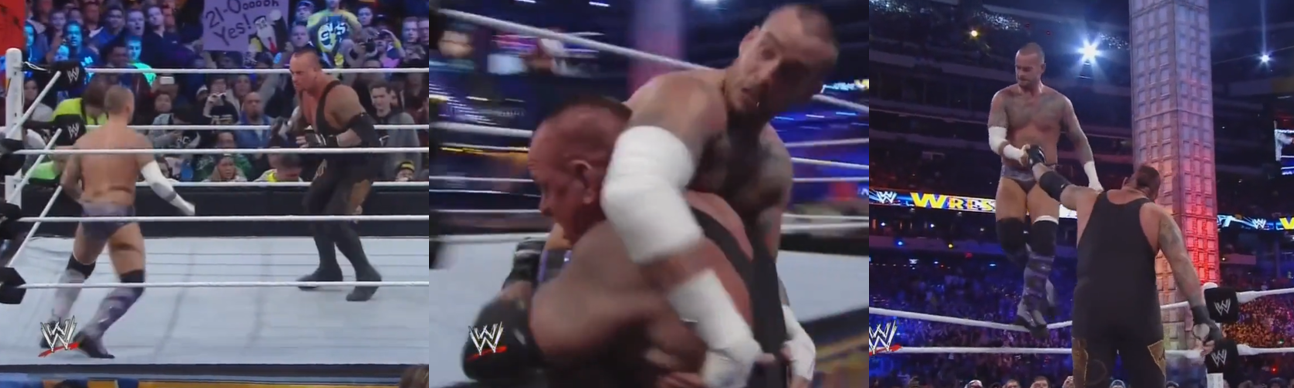
As soon as the bell rang, the two went for each other, both with their hands up and looking for an opportunity to land a strike or a grapple. CM Punk, the quicker and smaller of the two, goaded the Undertaker by dodging a strike, slapping him in the face, and slipping out of the ring in order to put a quick beating on the Deadman after a short chase. Although the Undertaker tried to manhandle Punk into the corner, he easily slipped away and continued to taunt the Undertaker, kicking himself free of a Chokeslam attempt and ended up eating a big boot to the face and being unceremoniously dumped to the outside for his troubles. On the outside, the Undertaker beat CM Punk around the barricade before whipping him into it and smashing his face off the announcer’s table. The Undertaker stripped the table down and then rammed CM Punk spine-first into the ring post before rolling him back into the ring to deliver his patented leg drop across the ring apron. Once they were both back between the ropes, the Undertaker pressed his advantage, pounding on CM Punk in the corner and intimidating the referee for chastising him; working over CM Punk’s left arm, the Undertaker went for his “old school” rope walk but CM Punk jerked him off the top rope with an arm drag and, despite the pain in his arm, stomped on the Undertaker while the Deadman was down and hit a walk rope of his own in a blatant show of disrespect before landing a side Russian leg sweep and going for the first pin of the match.

CM Punk pressed his advantage at every opportunity using his quickness and agility.

Obviously, the Undertaker kicked out; the match then slowed a bit as CM Punk locked in a ground-based submission so the two could catch their breath (while also giving Paul Heyman a chance to shout encouragement and taunts to both men, respectively) before the Undertaker went back to his game plan of beating CM Punk in the corner. This backfired on the Deadman, though, when he missed a running boot and injured his knee in the process, which allowed CM Punk to kick him out of the ring and land a big diving axehandle from the top rope to the outside. Back in the ring, CM Punk scored a two-count off a neckbreaker but his attempts to work over the Undertaker’s arm got cut off by the Deadman’s trademark strikes. Again, CM Punk scored a two-count off another quick neckbreaker and slapped on a choke hold, all while Paul Heyman shouted encouragement about him being “one second away” from victory. The Undertaker battled his way up to a vertical base and hit a suplex to throw CM Punk off, then crotched his arrogant opponent on the top rope when CM Punk tried to hit another rope walk. A single punch to the jaw sent CM Punk careening to the outside again but Paul Heyman threw himself in the Undertaker’s path to stop the Deadman doing his signature dive to the outside, almost getting Chokeslammed off the apron in the process, which allowed CM Punk to recover and hit a clothesline off the top rope for another two-count. Weary (and possibly a little out of it), the Undertaker left himself wide open in the corner for a running knee and got taken down with a clothesline, which set CM Punk up for his patented Diving Elbow Drop.

Both men survived some big moves and signature offense from their opponent.

Again, the Undertaker kicked out at two, so CM Punk prepared to hit his finishing move, the Go-To-Sleep/GTS; however, the Undertaker slipped off CM Punk’s shoulders, grabbed him by the throat, and hit a massive Chokeslam for his first near-fall of the match! The two then got into a slug fest that quickly went in favour of the Undertaker, who again pummelled Punk in the ring corner with strikes, a running attack, and his signature Snake Eyes manoeuvre but CM Punk weathered the storm and surprised the Deadman with a kick for another two-count. CM Punk then sent the Undertaker to the outside again with a clothesline and went back to the announcer’s table, which he just narrowly avoided being powerbombed through when he slipped out of the Last Ride. With the Undertaker lying prone across the table, CM Punk hopped to the top rope and hit another Diving Elbow Drop…though the table didn’t break on impact. CM Punk was aghast when the Undertaker beat the referee’s count, however, and made it back into the ring before a count of ten; distraught (and hurt following his awkward landing on the table), CM Punk was easily wrapped up in the Undertaker’s Hell’s Gate submission move. Punk, however, used his technical expertise to turn it into a pinning attempt, and then wrapped the Undertaker up in the Anaconda Vice that, for all its drama, mainly served to give the Undertaker a chance to catch his breath again. Soon enough, the Undertaker was on his feet and going for another Chokeslam but CM Punk wriggled free and hit a glancing GTS that the Undertaker completely no-sold and powered through to hit a Tombstone Piledriver out of nowhere! Incredibly, CM Punk kicked out at two, much to the delight of Paul Heyman and the crowd, who began to chant “This is awesome!”

Even an urn shot couldn’t stop CM Punk being planted with the Tombstone and becoming a statistic.

Another slugfest followed; however, when the Undertaker went for the Chokeslam, Mike Chioda was sent sprawling by an errant shot, which allowed CM Punk to smash the Deadman in the back of the head with the urn and avoid the Last Ride once again. CM Punk’s decision to mock the Undertaker with his signature pin cost him almost as much as the referee’s long count, however, as the Undertaker kicked out at two, driving Punk into a frustrated frenzy at his opponent’s refusal to stay down. The two then countered each other’s attempts at hitting their finishing manoeuvres before the Undertaker scooped CM Punk into a second Tombstone Piledriver and secured his incredible WrestleMania winning streak for another year. Showered by the adulation and respect of the crowd, the Undertaker than retrieved his urn and delivered one last tribute to his friend and manager while the announcer’s refused to keep their mouths shut and let the moment speak for itself. Ultimately, while the match was very good, I couldn’t help but feel like it didn’t quite kick into gear; the story was very traditional, with the in-ring action building and escalating to both men’s strengths and their tropes (the conniving little guy against the veteran big man) but it just felt like something was missing. Maybe if CM Punk had used some more underhanded tactics, given the Undertaker a bit of a run-around, or if the Undertaker could have had a couple of big bursts of energy it would have helped but it’s still a perfectly entertaining and acceptable match and I think the crowd probably would have bought Punk winning, though it never really seemed like he was going to as he didn’t get much of a chance to hit any big moves beyond those diving elbows.

The Aftermath:
This match put an end to the feud between CM Punk and the Undertaker; the next night on Raw, a distraught CM Punk came out to address how his historic run with the WWE Championship got cut short and he was denied the WrestleMania main event in favour of the Rock and John Cena. He and Paul Heyman eventually had a falling out when Heyman returned to the side of his old client, Brock Lesnar, turning Punk face in the process. On that same episode of Raw, Roman Reigns, Dean Ambrose, and Seth Rollins (collectively known as “The Shield”) attacked the Undertaker as he tried to pay tribute to Paul Bearer once more. He was saved by his brother, Kane, and Daniel Bryan (known as “Team Hell No”) and the three of them went on lose to the newcomers and the Undertaker’s vaulted WrestleMania winning streak was finally broken at the next year’s WrestleMania in a pretty disappointing match against Brock Lesnar.

My Rating:

Rating: 4 out of 5.

Great Stuff

What did you think to the contest between CM Punk and the Undertaker at WrestleMania? How would you rate it against the Undertaker’s other WrestleMania matches? Were you a fan of CM Punk disrespecting Paul Bearer’s memory to get heat for the match? Do you think the match should have been the main event bout of the night? How are you celebrating the Undertaker’s debut this year? What are some of your favourite matches and moments from his long and distinguished career? What dream match would you have liked to see him involved in? Whatever your thoughts, sign up to drop a comment below and or let me know what you think about the Undertaker on my social media.

Game Corner: WWE 2K18 (Xbox One)

GameCorner
WWE2K18Logo

As may already be evident, I have a long-standing preference for the WCW and WWF videogames released by AKI/THQ back in my youth; however, another WWF videogame series I have been particularly fond of and spent many hours and days of my childhood playing has been the WWF SmackDown! series released by THQ and Yuke’s on Sony’s PlayStation in 2000. Eventually, this series evolved into the WWE SmackDown! Vs. Raw franchise, which was released on multiple consoles between 2004 and 2010. I believe I came into this series with WWE SmackDown! vs. Raw 2008 Featuring ECW (Yuke’s/Amaze Entertainment/THQ, 2007) and bowed out with WWE SmackDown! vs. Raw 2011 (Yuke’s/THQ, 2010) as, by this point, it was pretty clear to me that I was simply purchasing the same videogame every year with additional wrestlers, some new match types, and minor improvements to the graphics and gameplay. As a result, I decided to buy a new title every two years or so and, after enjoying WWE ’13 (ibid, 2012) and deciding that WWE 2K15 (Yuke’s/Visual Concepts/2K Sports, 2014) was far too stripped back on features to justify the price tag, I settled on getting WWE 2K14 (ibid, 2013) and biding my time.

WWE’s videogames eventually aped the yearly formula of the FIFA series.

As a result, I have not bought or played a new videogame in 2K Sports’ WWE 2K series for about four years now, and with good reason; as the series made the jump to the Xbox One and PlayStation 4, reviews and feedback ranged from resoundingly negative to mediocre displeasure as 2K Sports apparently removed many expected gameplay mechanics and features in what was nothing less than a blatant attempt to sell features seen in previous PlayStation 3-era titles as being “new”. Despite the additions of never-before-seen superstars such as Sting, AJ Styles, and Samoa Joe, I decided to wait it out until the release of WWE 2K18 (ibid, 2017) to give the series a chance to iron out these kinks and to create an ironic sense of symmetry given that the last title I played was WWE 2K14. As such, it took me a little while to become accustomed to WWE 2K18’s control scheme; previously, these titles allowed you the option of controlling your wrestler with the directional-pad (or “D-pad”) and taunting with the analogue stick, which is my preferred control scheme given how it mirrors that of the AKI/THQ titles.

WWE2K18Submission
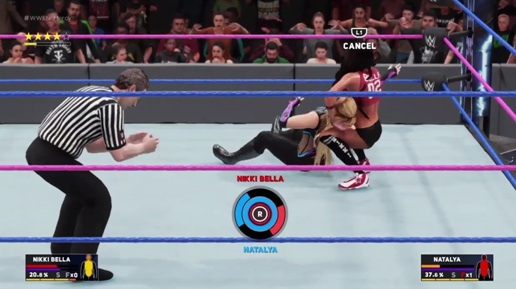
WWE 2K18 loves these little wheels of death!

However, WWE 2K18 does not allow you to change the control scheme, meaning that I was forced to control my wrestler with the left analogue stick and taunt using the D-pad which, for an old school player like myself who dislikes change, took some getting used to. One of the other main reasons I prefer D-pad control is that I find it easier to direct and aim my opponent during running attacks or Irish whips; I find the analogue stick makes such aiming harder as the stick is more sensitive. WWE 2K18 also features some new mini games which replace the ones I had grown accustomed to in WWE 2K14; when being pinned, for example, you now have to press X on a little wheel rather than stopping a little bar that bounces back and forth. This is actually a lot trickier than it sounds as it seems the videogame is set up to make kicking out of pins harder than before to, I guess, allow for more “realistic” matches. Additionally, there is no longer the “Breaking Point” submission system; instead, there’s either a tricky mini game involving the analogue stick or you must mash one of the four action buttons when they appear onscreen. I went with the button mashing option but have found that winning a match by submission is not as easy as it used to be, potentially because you can no longer select a match to be either quicker, normal, or epic; this, and the improved attribute system, means that you are forced to work for your submission victory.

WWE2K18Triple
Suffer enough damage and you’ll roll from the ring to take a break.

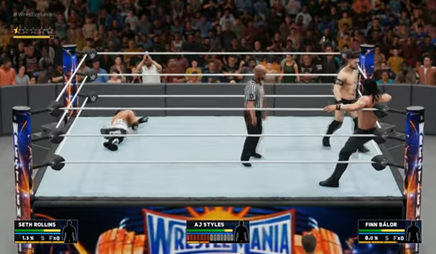
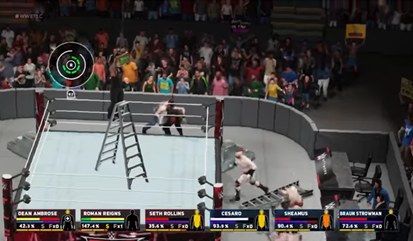
Other gameplay changes can be seen in multi-man match; now, when you or another player receives enough damage, they automatically roll out of the ring and you must mash buttons to fill up a bar and re-enter the match. It sounds good on paper and, again, appears to be tooled towards making matches more “realistic” but I found it more annoying than anything else as you could end up stuck on the outside and lose the match. This mechanic carries over into ladder/TLC matches as well, making them considerably more frustrating than usual as you incur far more damage much faster in these matches so you’ll spend a lot of time mashing buttons to get back into the matches. Also, in ladder/TLC matches, you no longer pull down the belt of briefcase using the right analogue stick; instead, you have to play a little mini game where you must fill up segments of a circle by rotating a ball into a small hole using the right analogue stick. It’s fun but quite distracting; I found myself concentrating more on the mini game than the match and, if you get interrupted with only a couple (or, even worse, one) segments left to fill, you are almost guaranteed to lose the match as the next wrestler to play the mini game will probably complete the circle while you’re busy mashing buttons to get back into the match.

WWE2K18TLC
Multi-man TLC matches are still the worst.

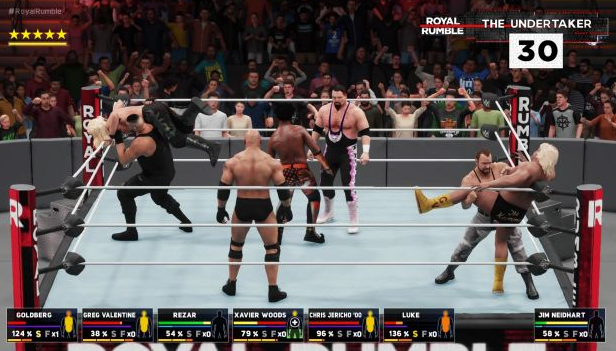
The Royal Rumble match is also noticeably different and, technically, more difficult; rather than hitting buttons in a quick-time event as in WWE 2K14, you now have to mash a button when trying to eliminate an opponent. Honestly, I’ve played a couple of these matches and never once eliminated anyone using the button-mashing mini game no matter what their health and stamina. I found the best way to eliminate wrestlers was the tried-and-true Royal Rumble finisher, clotheslining them out of the ring or countering a run attack, or by exploiting a glitch where, if you whip the opponent onto the apron and quickly punch them repeatedly, they simply fall from the ring.

WWE2K18Rumble
I struggled to legitimately eliminate anyone in the Royal Rumble…

As I always found ladder, TLC, and Royal Rumble matches tedious any way, these gameplay changes don’t bother me that much; you are not forced to play these matches and, on the whole, I would just avoid them. Some good changes have been made to tables matches, though; every time you hit your opponent with or into a table, it fills up a break meter and, once it’s full, you can smash the opponent through it using some new and expanded options. 2K Sports have also introduced a carry system, similar to the one from WWE SmackDown! vs. Raw 2007 (Yuke’s/THQ, 2006), which allows you to smash your opponent off the ropes, turnbuckles, apron, and other objects. They’ve also brought back in-crowd fighting, to a degree, allowing you to smash your opponent through (or hit them over) the barricade at ringside or toss them from the stage area to fight in little areas near the crowd.

WWE2K18Universe
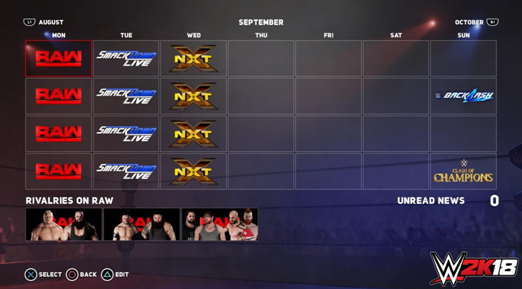
Universe mode is back, bigger and better than ever.

Although create-a-story and create-a-finisher are no longer options, WWE 2K18 is still full to the brim with creation options. I honestly spent maybe five days or so setting everything up the way I wanted it and creating wrestlers, entrances, victories, shows, and teams in the expanded Universe mode. As before, Universe mode allows you to create a show, place wrestlers and championships on the show, and then create monthly pay-per-view events for that show. I like to recreate the product as closely as possible so I created a Raw, SmackDown! Live, and NXT brand (with 205 Live and Main Event as minor shows) and, for all the Legends and duplicate wrestlers, a WCW Monday Nitro brand (with some crossover between them all). You can create more than one Universe at a time but I prefer to have it all in one place rather than jumping backwards and forwards all the time; I then moved every pay-per-view event to their correct calendar month and also created some additional pay-per-vews for my NXT and Nitro brands; this is extremely in-depth, allowing you to choose from a whole bunch of preset or created arenas (with scene transitions, an array of screen filters, a bunch of different referees, and more).

WWE2K18Materials
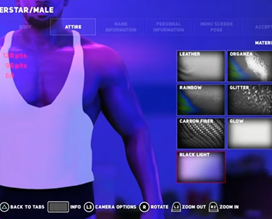
There are loads of colour and customisation options.

You can still create your own championship belts as well, if that’s your thing; given how many old school belts are in the videogame, I don’t tend to do much with this, though. Instead, my focus was on the massively deep create-a-wrestler mode; created wrestlers look more realistic than ever before and you can choose from a whole bunch of options, from wrinkles to scars, facial and body hair, eye colour, veins, muscle definition, and even how much body oil your created wrestler has! There are also a whole load of attire options, including blank attires that you can customise as you desire and also pre-set attires worn by the featured roster; you can change not only the colour of these attires but also the material type, which allows shirts and jeans and the like to be leather, take on a metallic hue, or even glow in the dark! Finally, there are far more options for names for your created wrestler this year and the in-game commentary team will refer to your created wrestler by these throughout their matches.

WWE2K18Store
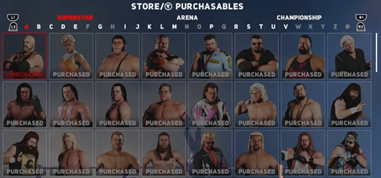
Apparently you can put a price on greatness.

Although there are many WWE and superstar-related images available to you in this mode, there are noticeably less options for body tattoos this years, unfortunately. This is where the Community Creations option will come into play; you are able to upload images to the 2K Sports website and transfer them into the videogame, meaning you can search in the WWE 2K18 for a whole bunch of professionally-designed images, logos, and tattoos to apply to your created wrestler. You can also download created wrestlers created by others to account for those wrestlers omitted from this years roster, though you are limited to twenty downloads a day and cannot download created wrestlers that feature aspects from wrestlers you’ve yet to unlock or purchase. Speaking of which, WWE 2K18 features an in-ring store mode, as is the norm for this series now. As you play matches, you are awarded virtual currency based on how many stars your match scored; the more stars you get through move variety, countering, and such, the more currency you earn. You can then spend this in the store to unlock Legends, and additional arenas and championships and, make no mistake, this is the only way to unlock this extra content. Previously, in WWE 2K14 at least, you could unlock new wrestlers by playing the 30 Years of WrestleMania mode but, here, you can only do this by purchasing them.

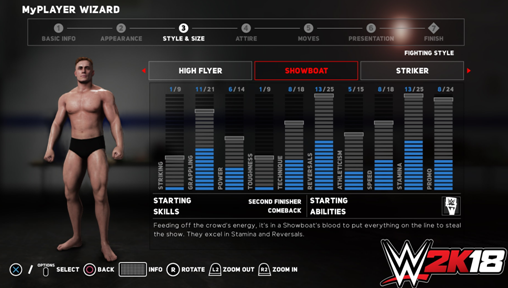
You can do this by playing any match in any mode and, also, through the MyPlayer mode, which is the career mode of the videogame. You have to create a wrestler, using far more limited tools and options, and work your way through training and wrestling on NXT before being called up to the main roster. You can make some limited decisions to decide whether you are a Company Man (a heel) or a Fan Favourite (a face). In my playthrough, I was initially called up to Raw and forced to lose a bunch of matches, so I jumped to SmackDown! Live, where I won the United States Championship, Money in the Bank ladder match, and Royal Rumble match and am currently feuding with Triple H and the Authority on the path towards the WWE Championship. Along the way, you can partake in side quests to earn rewards (new moves, attire, and currency), make a signature t-shirt to earn some extra cash, and perform in-ring promos and run-ins.

WWE2K18MyPlayer
You’ll need to pay to get the most out of MyPlayer mode.

Overall, this mode is quite enjoyable but, honestly, it’s a poor substitute for a Road to WrestleMania-type of mode. There are a lot of load times and some noticeable frame drops; you are also forced to walk/run from the garage to the producer and back every single week, which begs the question why they bothered putting in the free-roaming backstage area at all rather than just have a set-up similar to the PlayStation 3-era titles where you had a locker room with a phone and just did everything through text. There are some inconsistencies; I was regularly teaming with Sami Zayn then, randomly and with no explanation, my partner suddenly became Fandango. I was also once asked by Tius O’Neil to attack Primo Colón one week but, when I couldn’t find him, ended up attacking Kassius Ohno. There are also a lot of times when you do more promos than matches, when the match objectives aren’t completely clear (the Money in the Bank match springs to mind), and when your matches end due to interference more often than not but, these issues aside, it’s a pretty decent mode, though I found it more enjoyable and profitable to play Universe mode more than anything.

It’s interesting that the load times for the MyPlayer mode are so atrocious as, normally, they’re not that bad; matches in Universe mode load much faster than in WWE 2K14. I learned from some of my mistakes in WWE 2K14 and don’t have nearly as many custom arenas or created wrestlers, which may help with this, and also towards limiting crashes. WWE 2K14 would crash all the time, usually after a match but sometimes before one, and it was very frustrating. I have had a few crashes in WWE 2K18 but, as the matches and the videogame loads up a lot faster, it’s not as annoying. One bug that is annoying is, when downloading a created wrestler, attached logos and images will sometimes not download, meaning you’re left having to either find them separately or with an incomplete created wrestler/attire.

I haven’t played WWE 2K18 online yet, mainly because I don’t have Xbox Gold or whatever you need to do that but also because online players are trolling, move-spamming sons of bitches; also, the learning curve for timing reversals and having competitive but enjoyable matches that I actually won was quite steep. Sometimes, you’ll have a match and be in complete control and all the opponent has to do is a couple of moves and you can’t recover, then you get hit with one finisher and its over. A good feature, though, is that miss-matched opponents (like Braun Strowman against Kalisto) often trigger a squash match, where you gain full momentum and a finisher after your first hit and win the match in seconds for a decent payday.

WWE2K18STINGS
All the Sting you could ever want!

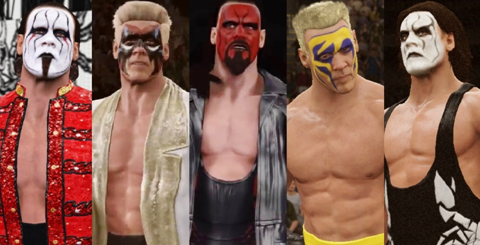
The roster in WWE 2K18 is as deep as you could want; there are some noticeable omissions from NXT but, otherwise, everyone you could want and more is in the videogame alongside some decent and surprising Legends. Hulk Hogan and Yokozuna are gone but Vader and the Big Boss Man are back; there are some crazy instances of numerous duplicates, such as five (five!) versions of Sting and separating Finn Balor and his Demon King attire (though the Demon King does still act as an alternative attire to regular Balor) but, mostly, there’s some good inclusions this year. The soundtrack, apparently “curated” by the Rock, is mostly miss rather than hit, with the only decent track being a radio edit version of Disturbed’s Down With the Sickness, though a similarly-edited version of Limp Bizkit’s Rollin’ is used as the entrance theme for Undertaker ’00 despite this particular version of Undertaker’s biker gimmick actually being more associated with You’re Gonna Pay. The in-game commentary is all-new, at least for me anyway, including the three-man team of Michael Cole, Corey Graves, and Byron Saxton; mostly, it is far better than what I experienced in WWE 2K14 but there still times when they refer to women as “guys”, talk inanely about things not even relevant to the match in progress, or ask each other questions that are never answered.

WWE2K18Balor
Graphically, WWE 2K18 is very impressive.

Overall, WWE 2K18 is a challenging and enjoyable affair; Universe mode is bigger and more expansive than ever, with shorter load times and significantly less crashes and glitches (so far), and the star rating system does make it feel as though each match is important and worth something. MyPlayer suffers a bit (though admittedly this may also be because I don’t want to waste my virtual currency upgrading the MyPlayer character unless I absolutely have to as I want to unlock the Legends) but is, otherwise, fun enough for what it is. I would have also liked to have seen, at least, Showcase matches similar to previous titles or themed around a wrestler (this year’s pre-order bonus, Kurt Angle, for example, or Shawn Michaels, or even the cover star, Seth Rollins) to assist with the unlocking of extra content. Creation options are deep and versatile; you can waste hours and even days crafting the perfect created wrestler (I know I did!) or downloading extra attires and wrestlers to fill out the already impressive roster. I am glad that I waited for 2K Sports to add in many of the features they previously omitted and refine their current-generation gameplay engine as it seems to have paid off; matches are far more realistic and challenging than in WWE 2K14, where I could win with a minimum of effort, which is good once you’re used to the control scheme and what is expected of you, if admittedly somewhat detrimental to those who just want to pick it up and play a quick match without any obligation to simulating a real-life WWE match. Based on my experience with this title, I will probably wait until WWE 2K20 for my next entry into the series as I would never recommend anyone buys these titles on a yearly basis but, if like me, you’ve been away from the series for a while, I would definitely recommend picking this one up.

My Rating:

Rating: 4 out of 5.

Great Stuff