To continue to milk the release of the Resident Evil 3remake (Capcom, 2020), I figured I’d spend the next few weeks taking a look back at the official comic book magazine released by WildStorm between 1998 and 1999.
Resident Evil: The Official Comic Magazine ran for five issues and mostly featured stories that filled in events between, during, and after Resident Evil (ibid, 1996) and Resident Evil 2 (ibid, 1998). Many of these stories and events, and the characterisations of familiar Resident Evil characters, may have since been rendered non-canon by subsequent sequels and reboots but, nevertheless, these comics do a great job of fleshing out the Resident Evil lore outside of the videogames.
Wesker is assigned to investigate some strange murders.
Issue one released in March 1998 and featured cover art by the always-fantastic Jim Lee and four full-length stories. The first, “S.T.A.R.S. Files” (Adams, et al), is a minor prelude to Resident Evil in which Albert Wesker is charged by his mysterious superior officer to form two teams to investigate a series of murders in Raccoon City.
Wesker gives a rundown on his recruits…
Wesker compiles a report (how very Resident Evil) in which he runs down each member of the Bravo team and his Alpha team, their abilities, a bit of their backstory, and how much of a threat they pose. He talks about his willingness to blackmail Barry Burton into being his second-in-command, criticises both Rebecca Chambers and Brad Vickers, and gives a little bit of background to Chris Redfield and Jill Valentine. The story ends with the Bravo team heading out to Raccoon Forest and Wesker promising that the team won’t find out anything. Obviously, this story was written long before Resident Evil Zero (Capcom, 2002), so the Bravo team exists simply to be written off but this story, while brief, does provide some insight into Wesker’s motivations and mindset at a time when he was still a one-note, clichéd villain rather than a superpowered mastermind.
John created many of Resident Evil‘s iconic BOWs.
The second story, “Who Are These Guys?” (Adams, et al), sheds a bit of light into how all of those files and notes you pick up in Resident Evil titles are created by showing the story, and degeneration, of Ada Wong’s boyfriend, here called John Fay. It turns out that John was the scientist responsible for experimenting with the Tyrant-Virus (T-Virus) on animals, such as dogs and sharks, thus creating some of Resident Evil’s most memorable bio-organic weapons (BOWs).
John succumbs to the T-Virus and becomes just another zombie.
In the course of his research, and the story, John contracts the T-Virus and begins degenerating into a zombie; he just about manages to scrawl out passwords and codes for Ada before being blown to pieces by Jill. This was an interesting story, fleshing out a character I don’t think we’ve ever seen in the videogames and visually detailing the degenerative process the T-Virus has on a human. It’s quite fun to see how John’s note was written out, and how all he amounts to is being just another zombie to be dispatched during the game.
This story recaps the events of the first game.
“Dangerous Secrets” (Oprisko, et al) mixes things up a bit by telling a story about the survivors of Resident Evil as it literally takes place two days after the end of the game. The story is, basically, a recap of the events of the first game, recreating the team’s first encounter with a zombie, the infected crows, the fight against Yawn and Enrico’s assassination, their battles with the Hunters, Wesker’s betrayal and death, and the destruction of both the Tyrant and the mansion itself.
It’s all a matter of perspective…
Tying in with the previous story a little bit, “Dangerous Secrets” also shows the characters actually using the files and notes they found in the mansion and Umbrella’s laboratory to their advantage to piece together what happened, how the T-Virus was created, and what it does to those infected. There’s also a really amusing part where Chris and Rebecca both reference how Jill was captured and imprisoned in a cell but Jill remembers the events slightly differently, believing that it was Chris that was imprisoned. This is a great reference to the contradictory story parts the player encounters when playing Resident Evil and good way of pasting over those continuity errors before the production of the Resident Evil remake (Capcom Production Studio 4, 2002) and other sequels; the idea being that each scenario is as valid as the other as it’s simply from that character’s perspective (it’s also slightly implied, through Jill’s thought bubble, that Chris is intentionally lying because he’s ashamed of being captured).
The story acts a bridge between the first two games.
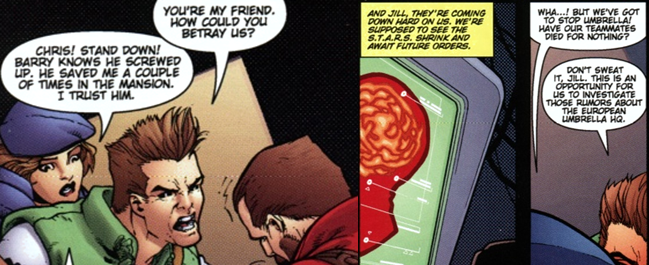
This story is also where Barry’s betrayal is revealed to Chris, explaining in detail how Wesker threatened Barry’s family to get him to go along with his plot to release the Tyrant. The story comes to an end with Chris planning on investigating Umbrella further and Leon S. Kennedy arriving in Raccoon City, effectively bridging the gap between Resident Evil and Resident Evil 2 and (although unintentionally) Resident Evil – Code: Veronica (ibid, 2000).
Ada confronts Birkin, anaware they’re being spied on…
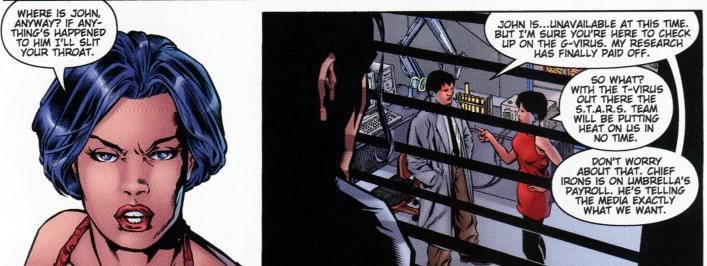
Speaking of Resident Evil 2, the comic’s final story, “Raccoon City – R.I.P.” (Adams, Oprisko, et al), details Ada’s arrival in Racoon City to confront William Birkin (who looks a little…different to how he appears in Resident Evil 2) just as the first zombies begin to crop up around the city (which is a bit of a continuity error as zombies weren’t supposed to appear until after Birkin is killed).
Gun Shop Kendo gets a brief cameo…
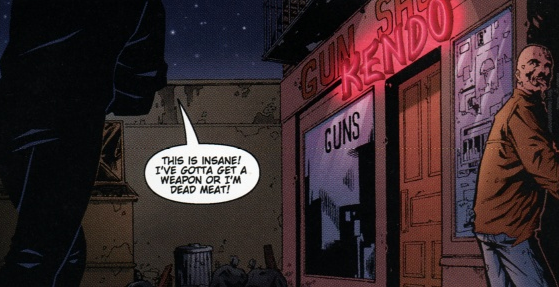
Their conversation is overheard by an unidentified third party, who then visits a bar that is promptly trashed by zombies. He heads to Gun Shop Kendo to grab a shotgun before being attacked by a zombie at a petrol station, which explodes in the fracas, killing him and his attackers.
Sadly, Leon wouldn’t duel-wield for some time…
A trucker witnesses the explosion and is immediately set upon by zombies, who are taken out by a duel-wielding Leon, thus filling in a few blanks between Resident Evil and Resident Evil 2. Despite casting a bit more focus on Ada and her characterisation and detailing how quickly the T-Virus spread to Raccoon City, “Raccoon City – R.I.P.” is easily the weakest of this issue’s four stories; it’s got a lot more continuity errors, puts far less emphasis on recognisable characters, and the art isn’t as good.
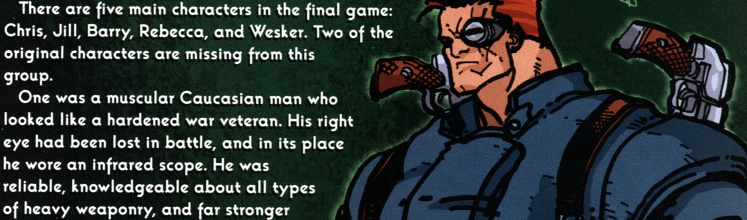
Mikami talks about some original character concepts.
Issue one also features a really insightful interview with Resident Evil producer Shinji Mikami, who details some of the production and design influences on the game and series, directly referencing the impact Night of the Living Dead (Romero, 1968) had on the game’s production. He also talks about how the version of Resident Evil released in the United States is actually harder than the Japanese version so that they could make more money of repeated game rentals (remember when those were a thing?) and some cut characters, including an original version of Barry who more resembles Arnold Schwarzenegger. In the end, this is a decent first issue; it’s more of an anthology and companion piece to the videogames rather than a by the numbers adaptation, with only “Dangerous Secrets” directly reinterpreting the videogame into comic book form. However, it has to be said that this story is easily the best this issue has to offer as it features all the characters and events you remember from the first game recreated with some stunning (and gory) art by Carlos D’Anda.
My Rating:
⭐⭐⭐⭐
Rating: 4 out of 5.
Great Stuff
Did you ever read the Resident Evil comics published by WildStorm? Would you be interested in the series receiving a reprint as the collection is currently out of print? Do you have a favourite piece of ancillary Resident Evil media? Drop a comment below and come back next Tuesday for my rundown of issue two.
Released: February 2019 Originally Released: February 2000 Developer: Capcom Production Studio 4 Also Available For: Dreamcast, PlayStation 2, GameCube, PlayStation 3, and Xbox One
The Background: After redefining the survival/horror genre with Resident Evil (Capcom, 1996), Capcom were under pressure to release ports of their popular franchise onto consoles other than Sony’s PlayStation. Unable to get a port of Resident Evil 2(ibid, 1998) for SEGA’s ill-fated Dreamcast off the ground, and with Sony claiming first-dibs on Resident Evil’s next numbered sequel, producer Shinji Mikami opted to develop two concurrent Resident Evil sequels. While Resident Evil 3: Nemesis (ibid, 1999) continued the story of Jill Valentine and was, largely, simply a side-story to Resident Evil 2, Resident Evil – Code: Veronica reunited Claire Redfield with her brother, Chris, and utilised the superior processing power of the Dreamcast to diverge what was quickly become a stale narrative formula into a more global story.
The Plot: Three months after escaping the destruction of Raccoon City, Claire Redfield is captured and imprisoned on Rockfort Island while attempting to reunite with her brother, Chris. After an outbreak of the Tyrant-Virus (T-Virus), Claire soon finds herself teaming up with a fellow inmate, Steve Burnside, and once again battling through hoards of zombies and the malevolent Umbrella Corporation’s Bio-Organic Weapons (BOWs) in a desperate attempt to survive.
Gameplay: Code: Veronica features exactly the same survival/horror gameplay as its predecessors; players once again utilise “tank controls” to navigate Claire, Steve, and Chris through a number of environments but, like in Nemesis, players can now pull back on the analogue stick while pressing A to perform a quick 180-degree turn, which makes dodging BOWs and attacks far easier.
Item management is key to your survival.
As is the tried-and-true Resident Evil formula, players must pick up files and notes to flesh out the game’s story and earn hints as well as collect and combine weapons, ammunition, key items, and healing times (herbs and first-aid sprays) in order to progress. It is crucial to your survival to be constantly aware of your environment and your resources as running out of ammo or herbs can be the difference between life and death. Players can store their items in Item Boxes, which are generally located in safe areas where players can restock and save their progress using an Ink Ribbon and a typewriter. You’ll need to make frequent use of these rooms in order to tackle the game’s puzzles, which can be as simple as moving crates and as complex as risking your life to crush a glass sphere under a massive weighted block.
You’ll get to play as this asshole a couple of times…
Unlike the first two Resident Evil’s, but almost exactly as in Nemesis, Code: Veronica sees players jump between different playable characters as they progress through the story. You begin as Claire trying to escape the zombie outbreak on Rockfort Island but also take control of the irritating Steve at one point, before switching to Chris about halfway through the game. Like in previous games, each have different skills that help them progress (Claire has a lock pick, for example) and players can choose to help out their sibling by clearing areas of enemies or leaving weapons or items behind for them to acquire.
Graphics and Sound: Unlike its predecessors, Code: Veronica ditches the classic pre-rendered backgrounds for three-dimensional environments that are rendered in real-time; this means that, while there are still some examples of fixed-camera angles, Code: Veronica features the most dynamic and cinematic camera the series had ever seen at that point. This works fantastically with the game’s incorporation of new, foreign locations for its story; while many of the game’s environments will be familiar to Resident Evil veterans (mansions, underground facilities, sewers and the like), you’ll also travel to the frozen wastelands of Antarctica and visit some gothic-inspired locales, though the “HD” makeover isn’t anywhere near as extensive as it has been in recent Resident Evil renovations.
Claire is suddenly a bullet-time bad-ass…
Thanks to the power of the Dreamcast, Code: Veronica not only features a much higher level of detail in character models, faces, and zombie details but also steps up the game’s use of CG cutscenes, which specifically portray Claire in a far more capable and tougher light than she appeared in Resident Evil 2. Just as Leon S. Kennedy jumped from a relatively competent rookie street cop in Resident Evil 2 to a martial arts superspy in Resident Evil 4 (Capcom Production Studio 4, 2005) with little in-game explanation, Claire is suddenly dodging bullets (from a helicopter, no less!) and performing grandiose, bullet-time actions. The game also features a foreboding soundtrack that echoes those of its predecessors; a lot of the time, areas are devoid of music, meaning all you can hear is the shuffle of rotting feet, the moaning of zombies, or the ominous growling of some unspeakable mutation. Subtle, soothing tunes let you know when you’re in a safe area and the dramatic score kicks in as monsters attack and dies down once they’re defeated, which is all standard fair for these early Resident Evil titles.
Enemies and Bosses: Code: Veronica features a lot of the standard enemies you’ve come to expect from a Resident Evil title; you’ll mainly encounter rotting, bloody zombies who shuffle about, claw along the floor, or burst through windows in their droves. There’s possibly the most variety in the zombies’ appearance here, though, as there’s reanimated corpses from a cemetery, naked zombies in a sauna, zombies with little worker hats, vomiting zombies, frozen zombies, and even zombies with glowing eyes like Albert Wesker. Speaking of which, Code: Veronica inexplicably returned Wesker to the series after he was skewered into ribbons of bloody flesh in the first Resident Evil; while you don’t get to fight Wesker here, he is heavily involved in the game’s plot, which revolves around Alfred and Alexia Ashford developing a new T-Virus strain.
I’m seeing a few similarities here…
The T-Veronica Virus offers a variety of additional BOWs for players to contend with; some will be familiar, like the deadly Hunters and giant spiders, and others are new, like the Tremors (Underwood, 1990) inspired Gulp Worm and Code: Veronica’s most persistent new enemy, the Bandersnatch, which can grab you from afar with its stretchy, clawed arms and will leap and haul tiself around the environment to get at you.
Good luck hitting this fucking thing!
You’ll also battle some messed up, multi-formed bosses that owe more than a small debt to John Carpenter’s The Thing (Carpenter, 1982); there’s a particularly gruelling close-quarters fight with a Tyrant in a plane, the blind, spider-limbed Nosferatu (who can swipe you right off a helipad and must be awkwardly shot at with a sniper rifle during a blizzard), Steve’s transformation into a hulking, axe-wielding frog-like creature that can only be ran from, and Alexia’s mutation from an insectile creature that flings flaming blood at you, bulges out into a grotesque, bug-spewing monstrosity, and finally ends up as a dragonfly-like annoyance that will take not only your best weapons (usually the Magnum) but also the unwieldy Linear Launcher to defeat.
Power-Ups and Bonuses: In true Resident Evil fashion, you can find additional and more powerful weapons as you play and explore your environments; both Chris and Claire can obtain an assault rifle, dual-wield submachine guns, the go-to fan favourite shotgun, and a grenade launcher with four different types of ammo while also being able to upgrade their base pistol to a burst fire mode or improve its power, respectively.
Additional Features: Players can unlock a couple of bonuses through gameplay. Completing the game unlocks “Battle Mode”, a time attack survival mode where you must battle hordes of enemies with infinite ammo and lets you pick between third- and first-person perspectives. You can unlock not only Steve but also Wesker for use in this mode and, as you might expect, finishing the game with an S-rank unlocks an infinite rocket launcher for your use. There’s also a handful of Achievements you can attain but, as this was originally an Xbox 360 title, they’re mostly tied to gameplay progression rather than Easter eggs or obscure actions on the player’s part.
The Summary: Resident Evil – Code: Veronica X is about as classic a Resident Evil title as you can get; it hits all of the beats you would expect from Capcom’s survival/horror franchise while also expanding its scope beyond the confines of Raccoon City for the first time. Narratively, this is also where the series begins to kind of fall of a cliff as the plot suddenly becomes far more dense, layered, and convoluted and shifts towards a focus on Wesker’s evil ambitions and away from a faceless corporation’s machinations. Yet, for as good as it is, Code: Veronica doesn’t really offer anything new; despite the benefits offered by the Dreamcast, the game is firmly entrapped in the gameplay mechanics and restrictions of the series, meaning that it’s more a case of the same-old, same-old rather than offering the fresh take on the series we’d see in Resident Evil 4. However, for those (like me) who were disappointed with the brevity of Resident Evil 3: Nemesis and like jumping back into a traditional survival/horror title, there’s enough here to sustain your interest and engagement, though you’ll most likely soon forget the experience once you jump to one of its successor titles.
My Rating:
⭐⭐
Rating: 2 out of 5.
Could Be Better
What are your thoughts on Resident Evil – Code: Veronica X? Did you play the original Dreamcast title or, like me, discover it through one of its many ports? Would you like to see an HD remaster of this title as well or do you think that it’s best left as it is? Sound off in the comments and come back for more Resident Evil content coming soon.
With Resident Evil VII: Biohazard (Capcom, 2017), I’ve finally reached the end of the big pile of Resident Evil ibid, 1996 to present) titles I got for Christmas. I was making decent progress in the game but kept getting distracted with life, work, and other games but, now that I’ve finally finished one of the most lauded Resident Evil titles ever made, the question is: does the game live up to the hype? After the absolute, balls-to-the-wall action-heavy approach they turned the franchise into in Resident Evil 6 (ibid, 2012), Capcom decided to answer their critics and bring the survival-horror aspects of Resident Evil back to the series but with a twist: this time, it’s in first-person!
Not gonna lie but I struggle with first-person perspective…
This was a bit of a hurdle for me right off the bat as, traditionally, I don’t really get on too well with first-person videogames, primarily because I don’t like being attacked from behind and I find them to be uncomfortable to play at times. Like, I enjoy the dread and constant tension the perspective offers here and in other, similar games but, when you’re just trying to have a bit of a casual play, it can be draining to be constantly on edge and first-person perspective can hamper controls, combat, and camera angles at times.
The charming Baker family invite you to dinner…
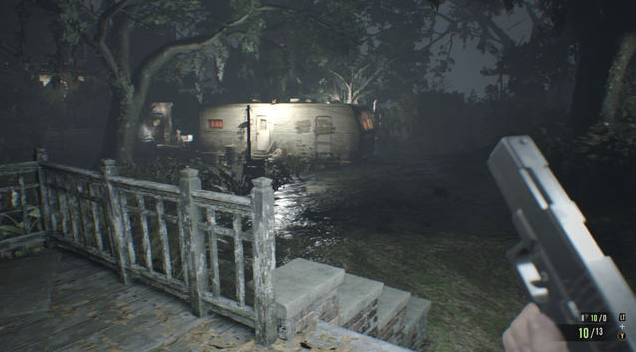
However, Resident Evil VII: Biohazard utilises its new perspective to great effect as players take on the role of Ethan Winters; unlike other Resident Evil protagonists, Ethan’s just…a guy…nothing special. He’s been drawn to an abandoned house in search of his wife, Mia, who has apparently taken a bit of a turn for the worst. After he’s attacked and has his hand cut off, Ethan is left at the mercy of the mental Baker family, a bunch of messed up back-water hillbillies who make the Texas Chain Saw Massacre’s (Hooper, 1974) family look normal. With his hand reattached by staples (…just go with it) and forced to cobble together items to survive and find a way out of the booby-trapped house, Ethan is relentlessly pursued by Jack Baker, who smashes through walls and attacks without mercy, repeatedly coming back from severe trauma and injury to torment you again and again as he absorbs blows, shrugs off bullets, and your supplies dwindle away to nothing.
The Molded are viscious buggers, far from your typical zombie fodder!
As Ethan progresses, solving puzzles, battling the bullet-sponge monstrosities known as the “Molded”, and exploring the Baker’s estate, he comes across Zoe Baker, who offers to help cure Mia by developing a serum to combat the infection that has warped her family. The source of the infection turns out to be a young girl, Eveline, who can control the minds of others, and Ethan is eventually forced to battle her in her monstrous final form. Resident Evil VII: Biohazard is unlike every other Resident Evil title before it. Sure, some tropes remain (Item Boxes, herbs, having to manually save (though using a cassette player rather than a typewriter), limited supplies, and a claustrophobic atmosphere) but, aside from some brief last minute (literally the very last minute) references to the previous titles, this looks and plays like an entirely different game. It’s a shocking departure, even more so than when the series switched to an over-the-shoulder, slightly more action-orientated approach in Resident Evil 4 (Capcom Production Studio 4, 2005); it seems that, every time Capcom wants to spice up their survival-horror franchise, a dramatic shift into another genre generally does the trick as long as there’s some restraint placed on the player to emphasise the survival aspects.
Things get very large and very ugly by Resident Evil VII‘s end…
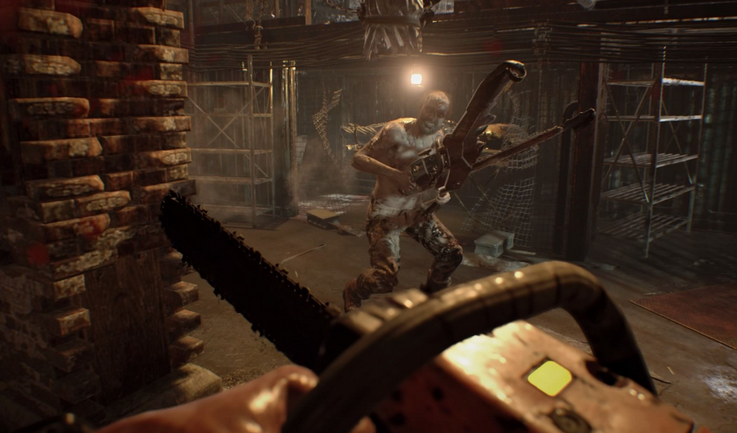
Resident Evil VII: Biohazard definitely emphasises this aspect as supplies are criminally low; it’s not really enough to have a herb anymore as it’s far more beneficial to also pick up some Chem Fluid to restore more health (as in other recent Resident Evil titles, this can be done with the touch of a button). This extends to ammo as well, as Ethan can combine different objects to create more, or new, ammo combinations. However, there’s never enough to truly feel comfortable in combat; the Molded take multiple shots (even from a good, old fashioned shotgun blast), forcing you to think strategically about when to fight, when to flee, and how to plan your route around enemies when a swarm turns up. Resident Evil VII: Biohazard’s bosses have quite a bit of variety; you start off desperately battling to survive as Jack Baker relentlessly attacks you with an axe or a chainsaw, progress to blasting a giant, slimy creature with the traditional giant red eyes, and end up blasting an enormous, pissed off woman right in the face. The first-person perspective makes these boss battles particularly intense as it doesn’t lend itself to the game’s limited combat; it’s tough to see where a boss is when its scurrying around you, even tougher to get a good shot off, and tricky to pull off sudden, quick-time event-like moments when you’re busy trying to get your vision lined up.
Trust nothing when it comes to Lucas’ escape rooms…
Once you’re made it through the main campaign, you can take on a variety of additional modes. Not A Hero follows series staple Chris Redfield (once again completely redesigned and working for the now-benevolent Umbrella Corporation) as he battles through the game’s last area to (what else!) a secret laboratory while End of Zoe follows Joe Baker, a slightly more hinged member of the Baker family who uses his apparently-superhuman strength to smash apart Molded and find a cure for Zoe. You can also race against the clock and blast the Molded to feed Jack in Jack’s 55th Birthday, face death again and again in the impossibly-difficult Ethan Must Die, and take on a few other similar survival modes. Despite its dramatically new approach, Resident Evil VII: Biohazard feels a lot like the original Resident Evil in many ways, mainly in its atmosphere and aesthetics. Like the original title, doors are arbitrarily locked by themed keys, Ethan must solve puzzles to open new areas (or to escape death traps set-up by Lucas Baker that more than resemble the Saw (Various, 2004 to present) films), and combat is an intense, strategic action.
You’re never short on horror in Resident Evil VII.
It was an interesting experiment by Capcom to use the restrictive first-person perspective to enforce the survival-horror aspect in a new, exciting way; it’s not exactly unique, as there’s lots of first-person games that take a similar approach, but it definitely worked to shift the franchise back towards survival-horror. Having played this before and after Resident Evil 2 (Capcom R&D Division 1, 2019), it’s clear that Capcom took a lot of the lessons they learned in developing Resident Evil VII: Biohazard and applied them to their remake. While I doubt that Capcom would ever use them in a full game again, I actually wouldn’t be averse to seeing first-person sequences return in future Resident Evil titles (maybe as side quests similar to the videotape flashbacks seen in this game); however, the important thing here is that the tense, atmospheric horror is retained and, given how well Capcom did in applying this atmosphere to Resident Evil 2, we should hopefully be in for some gory, engaging, terrifying Resident Evil titles once more thanks, largely, to Resident Evil VII: Biohazard.
So there’s been a bit of a delay in my playing and completing of the Xbox One Resident Evil (Capcom, 1996 to present) titles due to life and the release of Resident Evil 2 (Capcom R&D Division 1, 2019) but I finally played through and completed Resident Evil 6 (Capcom, 2012). Resident Evil 6 is the culmination of the more action-orientated approach the series took from Resident Evil 4 (Capcom Production Studio 4, 2005); while Leon S. Kennedy went solo in that title and played babysitter to the otherwise-useless Ashley Graham, players were forced to constantly play in co-op, either with a friend or with a questionable AI, in Resident Evil 5(Capcom, 2009), a title which also upped the action-centric focus of the franchise.
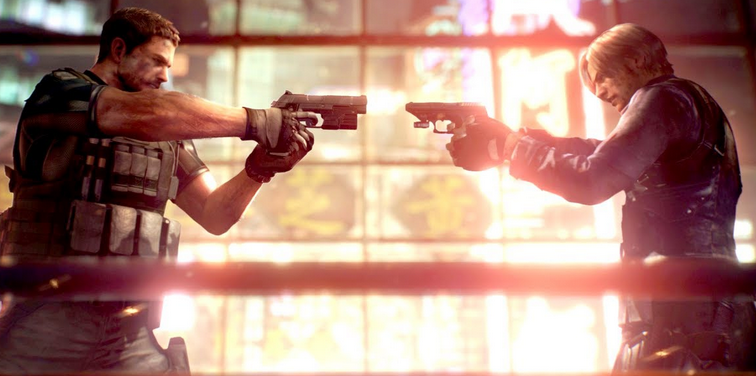
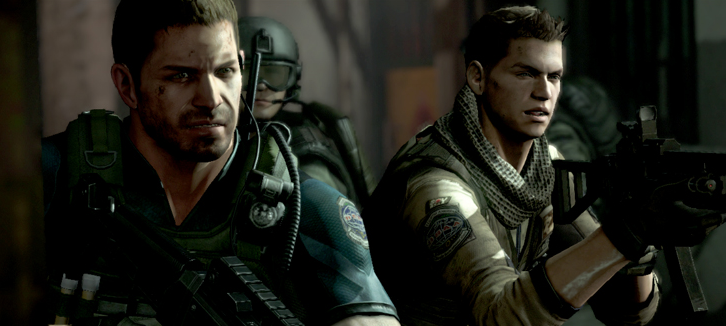
Chris and Leon get into a bit of a dick-measuring contest…
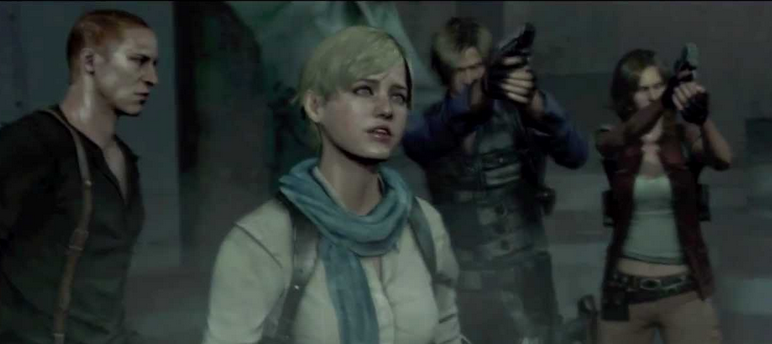
Resident Evil 6 continues down this route but expands upon it in numerous ways; the most obvious is the amount of playable characters available. Players can choose from four campaign modes, three of which follow the same mechanic of the Resident Evil: Revelations(ibid, 2012; 2015) games and lumber classic Resident Evil characters with a new companion. Players can pick between playing as Leon and Helena Harper of the Secret Service agent, Chris Redfield and BSAA grunt Piers Nivans, Albert Wesker’s son, Jake Muller, who teams up with the returning Sherry Birkin, now a member of the Division of Security Operations, or go it (mostly) alone as Ada Wong. Each character has their own narrative to follow and, as you play through each campaign, you will visit the same locations as other characters, though sometimes at different times, encounter some of the same enemies, and interact with the other character’s stories at various points. This results in perhaps the most complex and connected Resident Evil story ever; you’ll play a lot of the story events out of order so it’s only by playing through each campaign will you truly get a sense of what’s going down.
Things go to hell when another virus is unleashed…
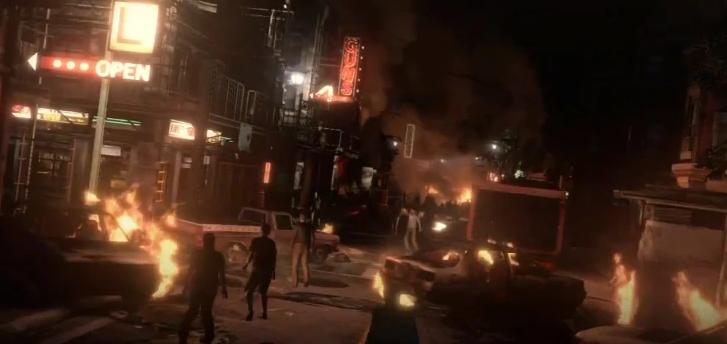
Essentially, though, it’s the same Resident Evil storyline you’re familiar with only with everything ramped up to eleven and taken to the extreme; a terrorist group known as Neo-Umbrella, apparently under the direction of Ada, develops a brand new virus, the C-virus, and unleashes it at various locations across the globe, causing people to turn into zombies, grotesque mutations, or enter a chrysalis and become these weird, insect-like creatures. Each of the characters pursues different goals in service of ending this threat: Leon and Helena find themselves framed for the murder of the President (who had become a zombie) by Neo-Umbrella affiliate (and National Security Advisor) Derek Simmons and fight to reveal Simmons’ role in the whole conspiracy; Chris and Piers relentlessly pursue Ada after she wiped out their platoon; Jake finds himself recruited by Sherry to bring down Neo-Umbrella because he happens to be carrying the anti-virus to the C-Virus in his blood and they are pursed by Neo-Umbrella’s Usantank; and Ada sneaks around aiding the other characters at various points, obtaining data and information, and uncovering the origins of her imposter.
It’s quite the twisting narrative, to be sure. To differentiate each campaign, the characters all receive slightly different HUDs, weapons, and melee attacks; Leon can duel wield pistols, for example, while Jake can switch to an unarmed mode to pummel enemies. Every character can use melee attacks, however, to stun enemies and set them up for instant kill moves or knock downs but these all drain a stamina meter that can only be filled by standing still. Disappointingly, and somewhat strangely, Jake has this meter and I didn’t really notice it refilling faster than any other characters; I kind of expected Wesker’s son, who is portrayed as this tough, semi-superhuman badass, to have an unlimited stamina meter, especially as he has less weapons to begin with. Another slightly annoying aspect of the weaponry is that the knife is back to being an equippable weapon, so you can’t shoot enemies and then switch to slashing and stabbing with a simple shoulder button press like in Resident Evil 4 and 5, which seems like a step backwards to me.
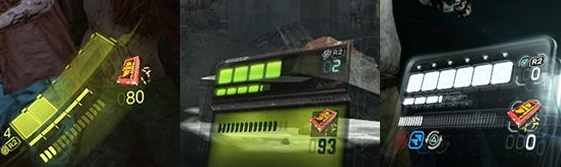
The HUDs look different but the gameplay is mostly identical.
Also a step backwards is the inventory interface; while other Resident Evil titles favour a grid-like system that clearly displays all your items and weapons, Resident Evil 6 opts for a linear interface that makes selecting a weapon far more time consuming, switching to a sub-weapon (like a grenade) feel very rushed, and forces you to combine herbs into pills and then store them in a pill case. While this means you can recover health at the push of a button, the entire interface makes it very difficult to juggle your inventory; I was playing for most of Leon’s story before I realised that the inventory isn’t unlimited, which it appeared to be, so you have to be constantly reloading every weapon and combining those herbs, which gets especially complicated when your pill case can only hold so much. All this serves to slow the gameplay down quite a bit, at points, or make combat very stressful as you’ll be desperately scrolling through the inventory to select a different weapon or combine your herbs so you can heal. This is also quite complicated and time consuming as, when you press the button to eat a herb pill, your characters will enter into a short animation where they pop the pill out and swallow it and you’ll only regain health once this animation is complete; I was killed quite a few times during this animation, which was very frustrating. Also frustrating is that pressing the button only restores one block of health; you’ll need to press it multiple times to recover enough health to actually have an impact on your gameplay.
Your partner is actually quite useful for taking out enemies.
Luckily, your partner is always on hand to aid you in these times of crisis; while you can’t swap and change items like in Resident Evil 5, the partner AI will still come over and help you if you get knocked down and are near death and their ammo appears to be unlimited, which can be useful in tough battles. What isn’t useful, though, is how unbelievably weak all of the characters are; it’ll only take a few bites from a zombie to sap all of your health to one measly block; enemy gunfire and attacks also have a really annoying habit of knocking you to the floor, forcing you to crawl around on your back trying to unload a shot and get to safety. The enemies are quite varied, which is nice; you’ll get the usual zombies, of course, but some of the weirder mutations, similar to those seen in the Revelations games, have deadly weaponry merged into their anatomy, like a particularly nasty chainsaw-armed asshole. Similar to Revelations 2, though, a lot of the intermediate and advanced enemies have seemingly unblockable one-shot kill attacks (I say “seemingly” as it may depend on how much health you have; if you have more than one block, you might be able to fight back in a quick-time event), which is made more annoying by the unskippable and overly long death scenes that accompany these enemies.
Resident Evil 6 loves a good quick-time event…
There are some new enemy variations at work here, too; there’s one enemy that will burst from its chrysalis as a swarm of insects, which is one of the more annoying and tougher enemies as you have to either chuck an incendiary grenade at it or wait until the big bug appears and hope you can kill it before the smaller bugs swarm over you and drain all your health. Comparatively, the boss battles are much less of an annoyance; they are long and consist of multiple stages and elements, but they generally boil down to a simple tactic of keeping your distance, shooting at the big glowing eyes/boils/similar weak spots, and let your partner do a lot of the shooting. Unfortunately, the enemies all tend to be bullet sponges; in Resident Evil 5, I found I could blast away with reckless abandon and there would always be more than enough ammo to find to keep going but Resident Evil 6 really cuts down on the resources. While I appreciate this as a fan of the classic Resident Evil videogames, it does kind of run contrary to the game’s heavily action-orientated approach; how are you expected to blast through hoards of enemies when your ammo drains away like nothing and the drop-rate is so low? Resident Evil 6 tries to compensate for this not only with the aforementioned melee attacks, which can be useful for conserving your ammo, knocking down enemies, and landing an instant kill, but also in its overabundant use of quick-time events (QTEs). Literally anything could be a QTE in this game; while I don’t recall too many happening in cutscenes like in Resident Evil 4, there are plenty at work in the videogame proper here. Grabbed by an enemy? Waggle the control stick! Being chased by a boss on a mine cart? You better press X and A together to duck under those low-hanging planks of wood! Tackled by a bigger enemy or brought another boss to its knees? Better hit that A, X, or R-trigger and then mash away at X to pummel them! It’s kind of fun in some cases, like when Leon is desperately trying to pilot a helicopter through China, but it’s a lot more fun to do a similar mission with Ada, where she can fire the helicopter’s weaponry.
A story this big and complex needs a lot of cutscenes…apparently…
Resident Evil 6 also really loves its cutscenes; you’ll sit and watch a cutscene filled with some suitably-dramatic tension or an impossible situation and then maybe take two steps forwards and another cutscene will happen. Similarly, you’ll be tasked with defeating a boss and struggling to take aim with the game’s janky sniper rifle controls and then suddenly a cutscene will interrupt you and you’ll realise that you wasted your ammo on the first couple of stages of the battle as all you really need to do is trigger the cutscene and survive to the final stage of the fight. Don’t get me wrong, I found the story interesting and complicated but it got very annoying to be constantly interrupted with the explosive arrival or return of a massive enemy or another twist in the tale. Also, call me crazy, but I don’t see the gameplay benefit of forcing me to walk sl-low-ly from one point to a door just to trigger another cutscene; just show Chris entering the building in the damn FMV! As in Resident Evil 4 and 5, Resident Evil 6 features numerous autosave points and adopts a chapter-based structure; each character’s story is split into five chapters and each chapter is maybe the length of two of Resident Evil 5’s, making casual play a bit more of a chore this time around. At the end of each chapter, you’ll get a medal based on how well you performed, maybe earn a dog tag (which can be customised and used as your gamer profile banner, I assume), and will be able to use the points you earn to buy new skills to equip. Again, though, this is a limited system; unlike previous Resident Evil titles, you can’t upgrade, improve, or buy new weapons between chapters and can only assign three skills at a time.
There’s a lot of online modes in Resident Evil 6.
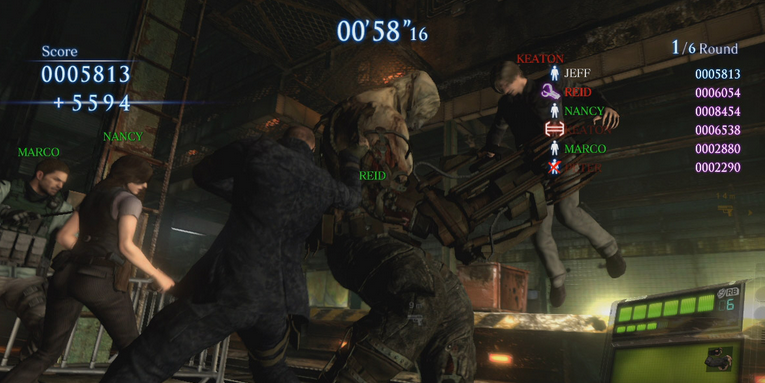
There are bunch of skill slots available, though, and you can switch between them in-game, but being able to equip only three at a time does make the entire skill tree a bit pointless. I would have much preferred being able to upgrade certain things, like weapon accuracy or melee effectiveness, for each character rather than being forced to equip better ammo pick-ups or infinite ammo as a skill. Like many of the other Resident Evil titles of this era, there are some additional modes available; the “Mercenaries” mode returns, where players to survive as long as possible against waves of enemies across the game’s various maps. In “Onslaught” mode, two players battle against waves of enemies while “Predator” pits up to six players against the Ustanak and “Survivors” is more of a classic death match set-up. I’ve only really played a bit of the Mercenaries mode as I have no desire to be depressingly owned by twelve-year-olds over the internet but I can’t say any of these extra modes hold much appeal for me. Unlike other Resident Evil titles, there aren’t really many incentives for completing the single-player campaign. You’ll get an extra scene at the end of everyone’s credit rolls, unlock New Game+ to play with the weapons and items you’ve previously acquired, and eventually unlock the ability to equip infinite ammo for various weapons but there are no additional costumes to unlock except for in the online modes. There are Serpent tokens hidden throughout each location that you can shatter to unlock concept art and the like, and you can play through each campaign again as the partner character, if you really want to play as Sherry again, and there are obviously a lot of Achievements to unlock, but I really missed unlocking extra costumes and weapons after a playthrough. I heard a lot of crap about Resident Evil 6 but I didn’t really believe it; I figured I would be happy to be playing as Leon once again and returning to his Resident Evil 4 style of gameplay but, ironically, Leon plays very differently to how he did in that game. Instead, every character feels and plays like they’re from Resident Evil 5; much more tactile, combat-focused, and relying on a bunch of over-the-top, QTE-heavy melee attacks to dispatch enemies. I was a bit confused, to be honest, as I figured Resident Evil 6 was going to mash together the Resident Evil 4 and 5 playstyle, the more first-person-shooter approach taken by Resident Evil: Operation Raccoon City(Slant Six Games/Capcom, 2012), and an entirely new, melee-centric playstyle.
Don’t even get me started on this fucking thing!
This seemed like the perfect time to mash together the older, more popular style of gameplay with Capcom’s newer, faster, FPS approach but…that’s not what has happened here. Instead, every character is essentially exactly the same, which doesn’t offer a lot in the way of variety; obviously, the Resident Evil characters were never that different in the original titles but that was more due to hardware limitations. Resident Evil 6 can’t really use that excuse, though, and really should have tried to make the characters more distinct in the way they play. In the end, I did enjoy Resident Evil 6 but it was much more of a slog to get through than any of the other titles; as annoying as I found the Revelations games, at least their chapters and missions were short and could be played in a casual burst. Here, everything is an annoyance; you’ll constantly be sent flying, knocked to the floor, run out of ammo and resources, wrestle with QTEs, die a lot, and probably get sick of seeing the same boss enemies crop up again and again and again. I found it much more enjoyable to focus on one campaign at a time and leave a little gap between starting the next campaign, which is a bit of a shame as I didn’t feel as fatigued playing through the campaigns in the previous games.
I had a plan. It was a simple plan. I would buy up all the videogames I hadn’t yet played for Xbox One at a rate of about one a month, complete them, maybe review them, and get as many Achievements as possible, all so that I could justify buying Resident Evil 2 (Capcom R&D Division 1, 2019) on release day. As you have gathered, that plan got a bit side-tracked as I ended up with every single Resident Evil title for Xbox One; though I managed to get through four of these (I didn’t actually do a review of Resident Evil 4(Capcom Production Studio 4, 2005)…my bad), I’ve had to put the last two on the back-burner to play this highly anticipated game. And it really was highly anticipated, especially by me. Resident Evil 2 (Capcom/Rockstar San Diego/Factor 5, 1999) was my gateway into the franchise; an essential purchase during my Nintendo 64 days and I used to waste entire weekends blasting through the different story modes as quickly as possible thanks to the infinite health and ammo cheats made available in the N64 version. I had an equally enjoyable time with the GameCube remake of Resident Evil (Capcom, 2002) and segued into playing the titles without the aid of cheats but the question remained as to whether I would actually be any good at the Resident Evil 2 remake without infinite health, ammo, and factoring in the new graphics, layout, and over-the-shoulder perspective.
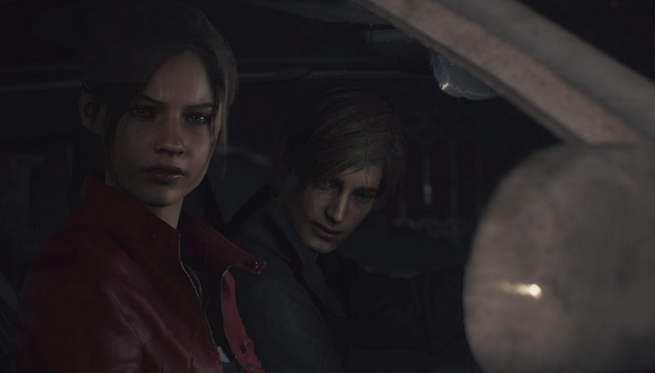
Safe to say these two have had better days…
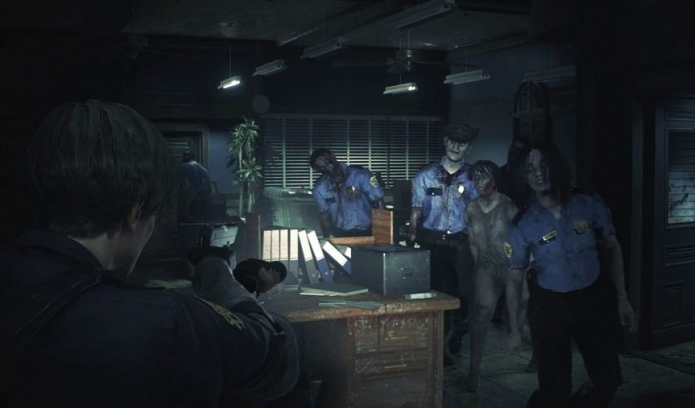
Resident Evil 2’s story is largely unchanged from the original; rookie cop Leon S. Kennedy and college student Claire Redfield arrive in Racoon City just as the entire population is turned into zombies due to exposure to the Umbrella Corporation’s new G-Virus. Taking shelter in the police station, both characters are pursed by a hulking Tyrant variant (“Mr. X”), encounter a constantly mutating creature (“G”), and run into various other characters as they try to survive the horror and escape the city with their lives. First of all, as you may have heard, read, or seen, Resident Evil 2 is an incredibly gorgeous creation; graphically, the game has no equal right now and the characters, environments, and creatures of the franchise have never been more realistic and frightening. The game’s use of light is fantastic; there’s hardly any areas of the game fully lit, so Leon and Claire are dependant on their torch to scan their environment for resources and enemies.
Tension is high as you explore your envionment.
This makes simply exploring rudimentary areas incredibly tense in a way that is so beyond the original game’s fixed camera angles; this tension is expanded further through the winding, claustrophobic nature of the environments. The police station has very few open areas and those it does have are either poorly lit or eventually become hazardous when Mr. X comes plodding along; the cell area, sewers, and laboratory are all equally closed in, meaning that you’re never quite sure what will be waiting around the next corner. Resident Evil 2 is a fantastic return to form when it comes to item management and conservation of resources; fresh off of three of the more modern titles, the sudden return to having very little in the way of ammo and health was jarring. Leon and Claire have a very limited inventory, so you’ll want to make use of the magic Item Boxes and multiple pouches to expand your inventory wherever possible. You should also take every opportunity to combine herbs and gunpowder for additional ammo as you’ll definitely need it in the game’s later stages. Because of this, you can’t just run around blasting zombies like fish in a barrel; the game actively discourages this as these zombies are built to last! A headshot may, if you’re very lucky, result in a one-hit kill but, nine times out of ten, you can empty an entire clip into a zombie’s head and it’ll still get up and keep coming for more. Discretion is definitely the better part of valour in Resident Evil 2 but you’ll be forced to make some tough choices when Mr. X starts chasing you through pitch-black corridors filled with zombies or Lickers!
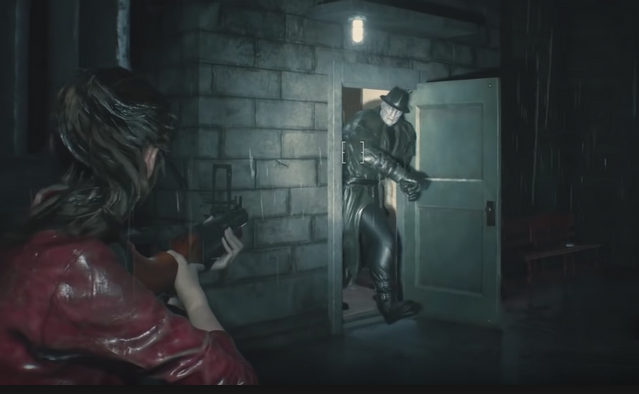
Don’t even try fighting this guy; just run, quickly!
Fortunately, there are other methods at your disposal; you can board up windows to stop zombies breaking into the station and counterattack any enemy with a knife, flash grenade, or hand grenade. These can also be used as regular weapons but the knife won’t last forever, so you can’t just go stabbing away without a care in the world. None of these weapons have a hope of killing Mr. X, though; unlike in the original game, he can only be momentarily stunned and will pursue you, even through doors, until you manage to give him the run-around.
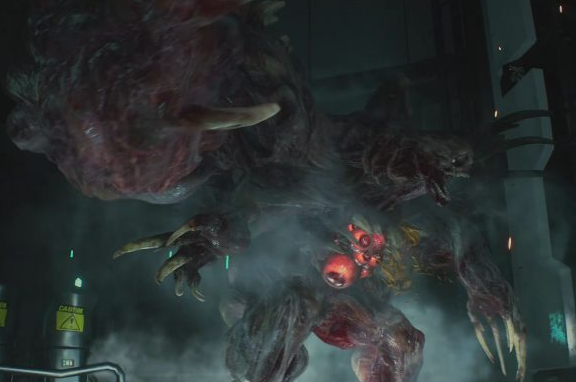
Use your wits to out-manuevure “G” and blast his weak spot!
You’ll also encounter a few boss battles, mainly against different forms of “G”; in the more modern games, these may have included quick-time events or button mashing sequences but, here, you are forced to go old school, dodging his attacks and waiting for the right moment to shoot his massive eyeball. It’s an exhilarating return to form as you’ll only have yourself to blame for not conserving your ammo or stocking up on healing items. Other boss battles, such as the one against the giant alligator and when you face “G” in the sewer, require you to set traps to win the day to help mix things up, while disgusting G-Virus monsters take the place of the giant spiders and appear as tougher enemies in the sewers.
A myriad of puzzles will test your skills.
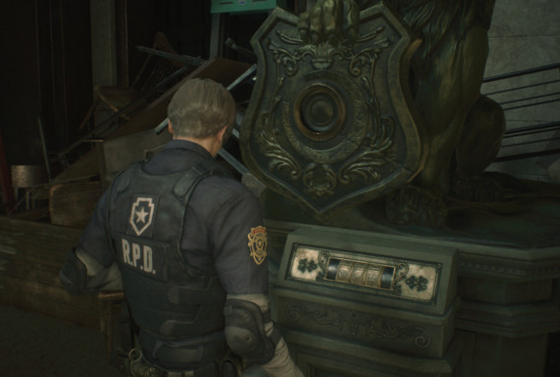
Also returning from the original game, but greatly expanded upon here, are the classic Resident Evil puzzles; as a former museum, the police station is full of weird shit, items, and mysteries that you’ll have to find, solve, and piece together in order to progress. One thing that is a bit odd is that, unlike every single Resident Evil title ever, you do not automatically discard items or keys once they’re no longer needed; instead, you have to do this manually, which is the only negative thing I have to say about the game and it’s purely because this has never been necessary in the past, but it’s an extremely minor complaint really. Navigation is pretty easy thanks to the map screen, which clearly shows you rooms you’ve been in, doors that are locked, and other points of interest, though it doesn’t hold your hand like some of the later titles and you’ll be required to use your brain and remember the layouts pretty well to get around obstacles or Mr. X and reach new areas. There’s a lot of variety at work in the game; at certain points, you’ll switch to playing as either the mysterious Ada or the adorable Sherry, both of whom play very differently to each other, not to mention Leon and Clear. Completing the game also unlocks variant costumes (including classic attires) and the “Second Run” mode, which tells the story from a different perspective, swaps around a lot of the item locations, and features different boss battles. Completing the game on each of these playthroughs is essential to battling the true final boss and seeing the game’s true ending; it’ll also unlock the “Fourth Survivor” mode, where you take an Umbrella commando through an infested police station, and the “Tofu Survivor” mode (…where you play as a piece of tofu) makes a welcome return.
If you want the best, you’ll have to be at your best!
You can also unlock in-game models, concept art, Achievements, and even infinite weapons if you dare take on some of the game’s more challenging options. Resident Evil 2 has three difficulty settings: Assisted (aim assist, weaker enemies, health recovers a little bit), Standard (no aim assist, no health regeneration, normal-strength enemies), and Hardcore (no aim assist, no health regeneration, tougher enemies, Ink Ribbons are needed to save at Typewriters, no auto-save points…basically the classic Resident Evil formula, meaning all of us old school gamers must be Hardcore by default!). To get the best weapons and reap the best rewards, you’ll be required to beat the game under a strict time limit on Hardcore mode but, with trial and error (or a handy online guide), you will find that the game can be beaten in under three hours. However, this doesn’t make Resident Evil 2 any less desirable to play; the tension and atmosphere alone are worth the price of admission as the game finally returns the franchise to its survival-horror roots. Newer gamers may struggle with this; enemies don’t drop gold or resources, you can’t punch boulders, and there’s very little hand-holding throughout the game. Either you stay sharp and be smart with your resources and pick your battles, or you get injured, waste your ammo, and die in short order, just like in classic Resident Evil tradition. Resident Evil 2 is nothing less than a masterpiece, from the graphical quality of the game to its gore, soundtrack, and the amazing job it does staying faithful to the original title, and the time period it was made, while still bringing everything a quantum leap forward using modern gameplay mechanics and capabilities. The game is a solid five-star effort and I can only hope that, going forward, Capcom leans more towards this formula for future Resident Evil titles and away from their more action-orientated approaches.





















 Dr. K's Waiting Room
You must be logged in to post a comment.