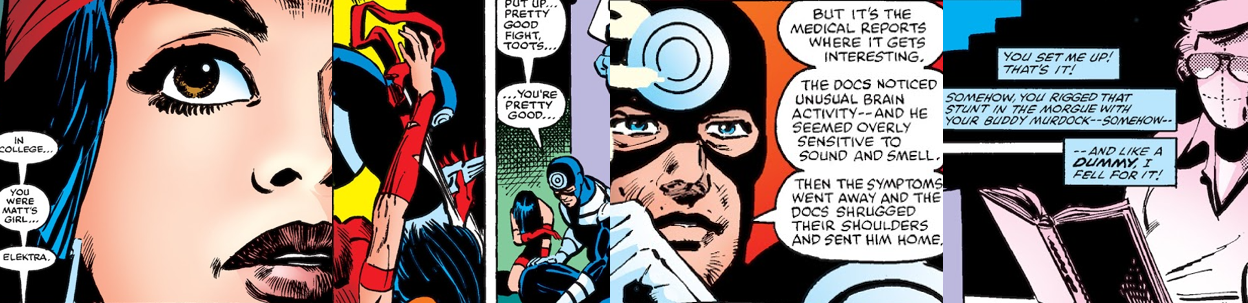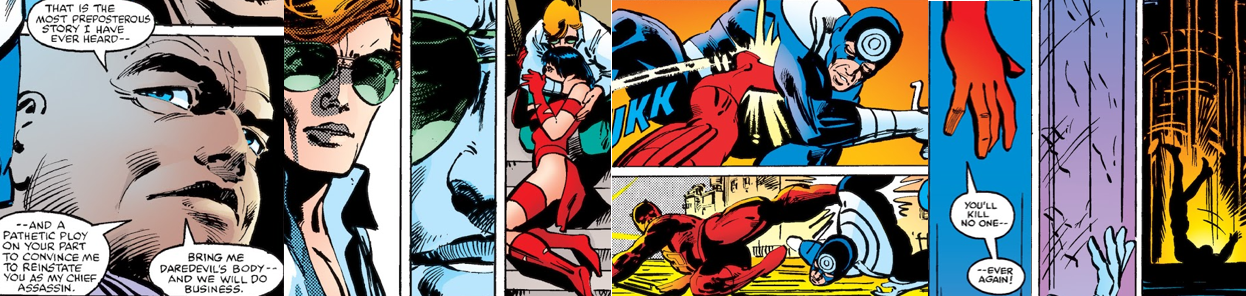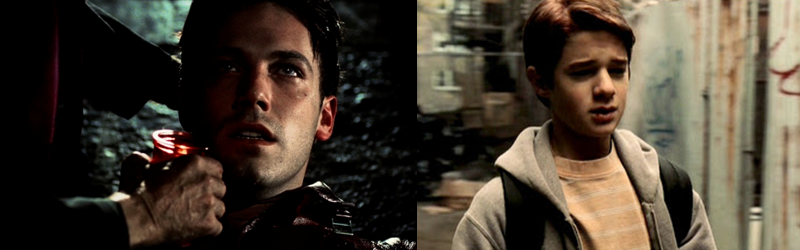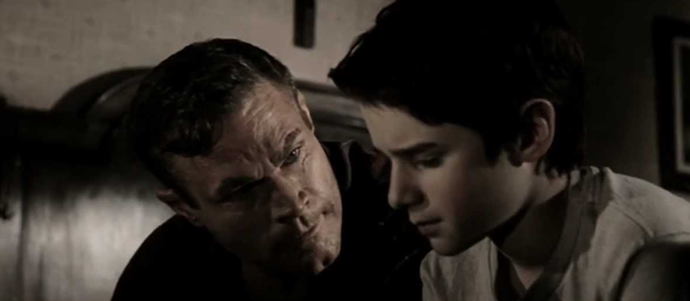
Back Issues [Dare-DAY-vil]: Daredevil #170-172


Blind lawyer Matt Murdock first made his debut in Daredevil #1 in April of 1964 and was co-created by writer/editor Stan Lee and artist Bill Everett, with input from the legendary Jack Kirby. While perhaps not as mainstream as characters like Peter Parker/Spider-Man, Daredevil has become one of Marvel Comics’ greatest creations and has featured in a number of ancillary media and merchandise, included a questionably-received big-screen adaptation in 2003 and a critically-successful Netflix series. Still, he’s one of my favourite Marvel characters so today is a great excuse to pay homage to the “Devil of Hell’s Kitchen”.


Writer: Frank Miller – Artists: Frank Miller and Klaus Janson

Story Title: “The Kingpin Must Die!”
Published: 3 February 1981 (cover-dated May 1981)

Story Title: “In the Kingpin’s Clutches”
Published: 3 March 1981 (cover-dated June 1981)

Story Title: “Gangwar!”
Published: 24 March 1981 (cover-dated July 1981)

The Background:
In the 1960s golden age for Marvel Comics, Stan Lee teamed with legendary names like Steve Ditko and Jack Kirby to create some of their most iconic superheroes. On 1 April 1964, Stan Lee and artist Bill Everett presented their most challenging hero yet in Matt Murdock/Daredevil, who would go on to become one of Marvel’s most popular and enduring characters thanks, in a big way, to the efforts of writer/artist Frank Miller. In 1970, the then up-and-coming Miller joined the book with issue 159 and soon took over writing and illustrating, spearheading some of Daredevil’s most influential stories. It was under Miller’s watch that Wilson Fisk, the mammoth Kingpin of Crime, became one of Daredevil’s most hated enemies; created by writer Stan Lee and artist John Romita Sr. and first debuting in the pages of The Amazing Spider-Man, the Kingpin was patterned after actor Robert Middleton and known as much for his conniving ways as his intimidating bulk. A complex character whose ruthlessness was matched only by his love for his wife, the Kingpin has become one of Marvel’s most iconic villains but is especially noted for his intense rivalry with street-level vigilantes like Daredevil, Spider-Man, and Frank Castle/The Punisher. The Kingpin has appeared prominently outside the comics, too, generally as a boss in various Marvel videogames, a notable antagonist in various animated ventures, and in live-action, delivered with charm, menace, and significant screen presence by the likes of the late Michael Clarke Duncan and Vincent D’Onofrio.

The Review:
This three-issue arc begins with Daredevil sprinting through New York City, attracting the awe of the locals, to question noted streetwise bum Turk Barrett at Josie’s seedy bar. Although Turk makes a desperate escape attempt, Daredevil brings his getaway to a violent end and learns from him that the city’s top crime bosses have put out a hefty $5 million contract on the Kingpin, the mysterious and powerful mogul who once ran the underworld like a business but has since retired to Japan. There, Fisk is sequestered in a huge mansion with his own private guard and regularly showcases his physical abilities by besting the finest martial arts experts with precision and power, explodes with rage whenever anyone mentions his former life, and desperately keeps his questionable past and tendencies from his beloved wife, Vanessa. Since Fisk is due to sell out his former colleagues in return for clearing his name and $7 million, Vanessa heads to New York to enlist the legal aid of Matt Murdock and his partner and best friend, Franklin “Foggy” Nelson, offering them $200,000 to represent Fisk in court. Before Matt can agree, their office is attacked; in the confusion, Matt investigates as Daredevil and confronts the man responsible, Bruno, a seemingly semi-cybernetic former hitman with a firearm in place of his left hand. Daredevil easily bests Bruno but is stunned when his accidentally severs Daredevil’s grapple line and fatally plummets to the street below. Realising that mob are hiring any assassin they can to do their dirty work, Daredevil prepares to intercept his old foe, Lester/Bullseye, before he can be recruited but is delayed by cantankerous police lieutenant Nick Manolis, who reveals that Vanessa was kidnapped during the action. Released on a technicality (a brain tumour created just enough reasonable doubt about his previous murderous actions), Bullseye is furnished with a swanky new costume and demands $10 million to kill the Kingpin, but gleefully jumps at the chance to battle his hornheaded rival when Daredevil shows up to confront him.
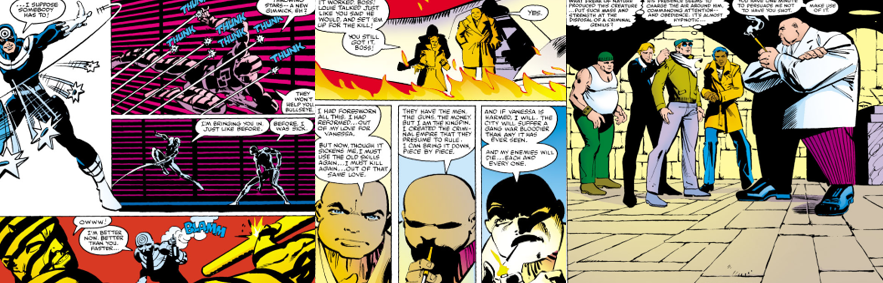
As if Bullseye wasn’t bad enough, Daredevil must deal with the Kingpin’s return to town.

Having previously saved Bullseye’s life, Daredevil feels a responsibility to keep him from wasting it with his violent ways, but Bullseye simply attacks with throwing stars, his confidence and aim better than ever now he’s no longer sick. Despite landing a glancing blow with a pistol, Bullseye’s unable to land a kill shot thanks to Daredevil’s superhuman reflexes; however, Bullseye is so embittered towards his foe and so determined to best and kill him that he sends ol’ hornhead flying out of a window! Although Daredevil saves himself with his grapple hook, Bullseye severs the line, sending Daredevil plummeting to the ground; thankfully, he uses a passing flagpole and crumbling gargoyle to slow his descent just enough to land safely (if painfully) into a passing garbage truck. Rumours of the Kingpin’s return spread through the criminal underworld, leading the mob to kidnap and torture Louie the String for information. Before he succumbs to his injuries, Louie leads them to an explosive trap on Staten Island, where the Kingpin laments returning to his former violent ways but vows to turn New York City into an all-out warzone if it means seeing his enemies suffer and die and return his love to him. To that end, the Kingpin and his underling, Lynch, systematically target the mob’s goons and demand Vanessa’s safe return, with Fisk even stating he’s willing to negotiate to end further bloodshed. Although Bullseye is secretly unimpressed by the bickering mobsters, the city’s crime lords believe they have the upper hand as long as they have Vanessa and order Bullseye to send word that they’ll trade her for all the dirt Fisk has on them, further raising his ire at being reduced to a mere errand boy. Recovering from his fall and unable to find any leads, Daredevil assumes the guise of “Shades” and starts asking questions about Vanessa at Josie’s bar, causing him to get jumped by the local goons. However, after easily fending them all off, he impresses Turk and block-headed grunt Grotto enough to earn an audience with the big man himself and is led into a dingy sewer.
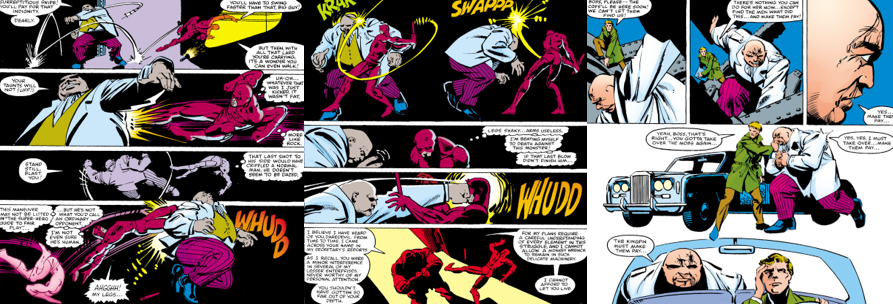
While the Kingpin proves a formidable threat in combat, he’s devastated by his wife’s death.

Matt is silently in awe of the Kingpin’s aura, finding that he more than lives up to his reputation as an intimidating presence; gathering himself, Matt claims to be a hitman from Ohio and offers his services, further impressing by jamming a goon’s gun with a pen without looking. Immediately afterwards, another of the Kingpin’s underlings arrives and, before dying from poisoning, delivers the mob’s demands for the exchange. Although Lynch is excited to see Fisk return to power and straighten out the disorganised underworld, Fisk has no interest in returning to his former life; he simply wants Vanessa back, leading Lynch to question if he’s lost his edge. However, Fisk demonstrates his vindictive cruelty when he finds “Shades” has broken into his vault; ready to kill him, the Kingpin is stunned when Daredevil attacks from the darkness. Although Daredevil makes jokes about Fisk’s weight, his swagger is shaken when he realises that the Kingpin is solid muscle; Daredevil’s speed and agility give him the edge in the fight, but every blow to the Kingpin’s rock-hard body wracks ol’ hornhead with agony and he soon tires himself out trying to damage the mammoth mogul. Thus, the Kingpin knocks Daredevil unconscious with a single blow and orders Turk and Grotto to tie him up and drop him into the city’s drainage system. Fisk then heads out to make the exchange, fully aware that the mob have set up a trap and turning the tables on them by incapacitating everyone in the vicinity – including Bullseye – with a high frequency sonic burst. However, as Fisk rushes to rescue his beloved wife, he’s stunned when someone triggers a mortar, causing the construction site to collapse. Though he survives being buried under all the girders and debris, Fisk is heartbroken when he can’t find Vanessa’s body and is suitably motivated to avenge her death by reassuming his former position and targeting his opposition without mercy. Thanks to his radar sense and sheer force of will, Daredevil avoids drowning and heads back to Josie’s bar to interrogate Turk again to catch up with the plot. Meanwhile, Fisk sets himself up in a subterranean stronghold and sends his few men out to disrupt the mob’s deliveries, turning the disparate crime lords against each other through a series of calculated attacks and stealing their cash and armaments. When Turk informs him of Daredevil’s survival, Fisk orders Lynch to move the files and set up an ambush, only for the goons to be attacked by Daredevil and lose the files; however, he’s humiliated to find he was duped by a briefcase full of newspapers!

Bullseye and Daredevil’s violent fight ends with the Kingpin manipulating himself back into power.

Bullseye takes advantage of the mob’s panic to demand a further $5 million to help them out, then hits up a bunch of small-time scumbags to learn the Kingpin’s location only to fall for another of the Kingpin’s traps. The Kingpin then confronts Bullseye and his mob employers, swaying Bullseye to his side and intimidating the mobsters into outing themselves to the cops. Afterwards, Fisk turns the full brunt of his rage on Lynch since it was he that set off the mortar and killed Vanessa to push him into returning as the Kingpin, so Fisk mercilessly breaks Lynch’s limbs and beats him to death as recompense. Fisk then gathers the city’s crime bosses to announce his takeover, only for them to be spooked when the skyscraper’s lights suddenly go out. Realising Daredevil is to blame, Fisk sends Bullseye to deal with him and the two fight once more, with Daredevil driven to make the assassin pay for all the lives he’s taken after Daredevil fought the urge to leave him to die before an incoming train. Relieving Bullseye of his weapons and discarding his billy club, Daredevil lunges for his foe, intent on making him feel the full force of his guilt and anger, but Bullseye fends off his furious assault by making use of his own weapon and smashing the vigilante in the face with a brick. Their brutal melee sees them land blow after blow, crash through a brick wall, and ends with them both choking the life out of each other, Bullseye determined to prove he’s better than his enemy and Daredevil seemingly willing to die alongside his foe. In the end, Bullseye passes out from the pressure, but Daredevil’s victory is short lived as the Kingpin and his goons arrive, armed and surrounding him. However, rather than gunning him down, Fisk gives Daredevil the files he has on the city’s crime lords and requests that he deliver them to the district attorney to have them arrested and allow Fisk to solidify his stranglehold over the criminal underworld once more. Although Daredevil considers making a desperate escape, the Kingpin advises against it; he even allows the Man Without Fear to take Bullseye as “a courtesy” and gives Daredevil no choice but to accept the offer as it will buy the city a brief period of peace while Kingpin works to reorganise and strengthen the fractured mob. Thus, Daredevil is forced to accept the offer and leaves, taking little solace in having brought Bullseye down and the story ends with a return to the city’s dank sewers, where a dishevelled and seemingly amnesiac Vanessa waders in search of money and food.

The Summary:
Daredevil’s first encounter with the Kingpin is quite the thrilling and intricate tale; while it starts off innocently enough, with Daredevil trying to get to the bottom of a disturbing anxiety in the criminal underworld, it quickly escalates as the Kingpin is forced to resume his violent former ways. While I’m not a big fan of Frank Miller’s sketchy artwork, he did some great work when working on Daredevil; most panels and characters are seeped in an inky darkness, giving a dark, moody edge to the story that contrasts with both Daredevil’s bright outfit and generally flippant demeanour and with his other, more colourful peers. The story focuses on a grittier, more violent subsection of the Marvel universe, one where mobsters are gunned down, blown up, and poisoned on the regular and gang warfare is constantly at risk of breaking out due to the fractured state of the criminal underworld. I enjoyed seeing the crime bosses struggle to keep their shit together; it took seemingly everything they had just to be in one room long enough to hire their assassins and I liked how they squabbled like children and were depicted with an arrogant sense of entitlement that slowly deteriorated into abject denial as the Kingpin’s power grew. It was fun seeing Bullseye grow disgusted by their bickering and disorganised ways and watching them crack as they lost their money, power, and men to the Kingpin. While it didn’t lead to all-out gang war, there were some striking instances of violence on the streets and around the city that showed not just how sadistic Bullseye is but how ruthless the Kingpin can be when he’s out for blood.
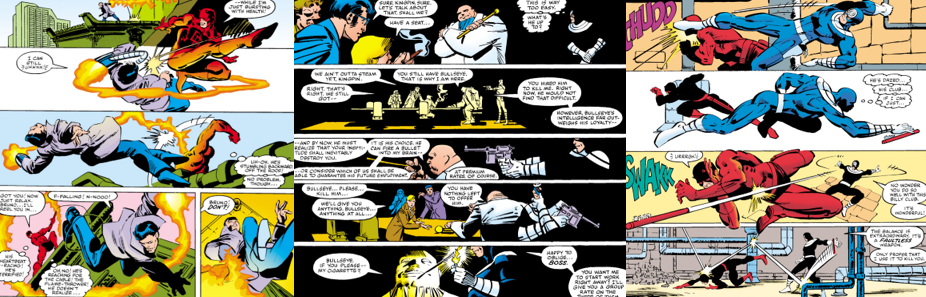
Evenly matched and equally hatful of each other, Bullseye and Daredevil have an intense rivalry.

Daredevil is caught right in the middle of this; there’s little time for Matt Murdock or his private life here, with just a few panels hinting that Foggy is going through some personal troubles and showcasing Matt’s latest relationship. His focus is solely on confronting and stopping the Kingpin, and on settling the score with Bullseye. I liked the sense of guilt Daredevil carries here; previously, he had the opportunity to leave Bullseye to die but chose to save him, a decision he openly regrets since Bullseye refused to change his ways and just kept on killing, meaning Daredevil feels directly responsible for those deaths. His confrontations with Bullseye start with him trying to reason with the assassin and turn to a murderous rage as Bullseye kills and tortures his way throughout the arc, switching his allegiances to whoever has the most money and power and desiring only to prove himself superior to his hornheaded foe. Bullseye’s abilities are showcased greatly here; he never misses except when fighting Daredevil, fuelling his pride and anger, and he’s highly adaptable, able to make use of throwing stars, knives, guns, and even Daredevil’s billy club with an almost superhuman deftness. Though a sadist, Bullseye is highly intelligent; he knows when to shut up and listen, when to switch sides, and is very aware of Daredevil’s tricks and abilities, meaning he does a great job of holding his own against his hated enemy. Daredevil’s abilities are constantly demonstrated both in visual form and through the narration boxes; he swings, moves, and fights with a superhuman swiftness, appearing as a constantly-moving blur at times, and has a force of will beyond most normal men as he pushes himself to escape from drowning, easily fights off numerous larger and armed foes without breaking a sweat, and makes good use of his billy club and enhanced senses to save himself and track down his prey. At the same time, he’s not depicted as infallible; he runs into a few dead ends, forcing him to assume a new disguise, interrogate Turk, and even talk to hookers for leads, and he takes his fair share of punishment not just when fighting Bullseye but also when battling the Kingpin.
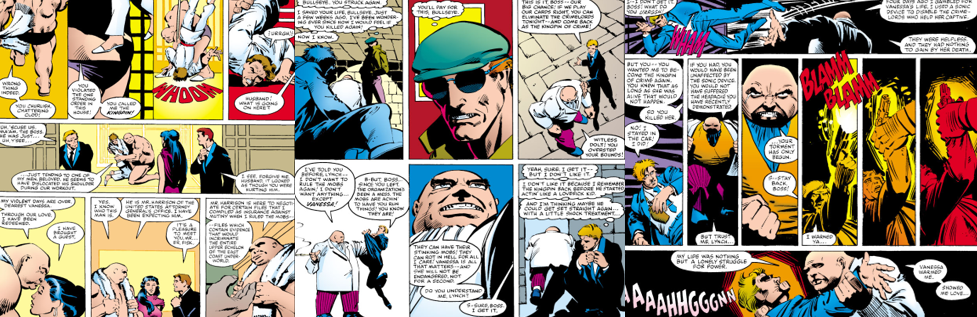
The Kingpin is a callous, passionate, and highly intelligent antagonist whose wrath knows no limits.

This is a great arc for introducing readers to the threat that the Kingpin poses. A calculating, vindictive, and extremely savvy businessman, Wilson Fisk is as devious as they come, regularly setting up traps and always thinking one step ahead of his enemies. Yet, despite his reputation as the Kingpin of Crime, Fisk is absolutely besotted by Vanessa, to the point where he swears off crime, moves across the globe, and forsakes his former life, even being willing to name and shame his former associates to clear his name and start a new life as a loving husband. He’s drawn back into the fray entirely against his will thanks to the machinations of his aid, Lynch, and, though he regularly laments having to welch on his promise to Vanessa, Fisk returns to his former ways with a looming menace and cold-hearted cruelty that’s matched only by his ferocious power and quick temper. Having only heard of the Kingpin as an urban legend, Daredevil is completely caught off-guard when he finds the Fisk’s bulbous form is pure, rock-hard muscle; the Kingpin is practically impervious to pain and injury, easily shrugging off bullet wounds and Daredevil’s best shots and breaking limbs and pummelling his enemies to death with ease. This arc does a masterful job of stablishing how intelligent and intimidating the Kingpin can be, forcing Daredevil to assist his eventual return to power to end with a tainted and grey-hued victory for the Man Without Fear, and I’d say these are essential issues to read for anyone who’s a fan of Daredevil, the Kingpin, and their complex and violent relationship.

My Rating:

Rating: 4 out of 5.

Great Stuff

Have you ever read this three-issue arc? If so, did you like the way it depicted Daredevil’s first encounter with the Kingpin? What did you think to the Kingpin, his begrudging return to power, and the way his motivations were showcased? Did you enjoy the brutal fights between Daredevil and Bullseye? What did you think to the depiction of the mob and Daredevil’s helplessness against the Kingpin? What are some of your favourite Kingpin stories and how are you celebrating the Man Without Fear this month? I’d love to know your thoughts so feel free to share them in the comments below or on my social media, and be sure to check out my other Daredevil content.

Back Issues [Dare-DAY-vil]: Daredevil #181


Blind lawyer Matt Murdock first made his debut in Daredevil #1 in April of 1964 and was co-created by writer/editor Stan Lee and artist Bill Everett, with input from the legendary Jack Kirby. While perhaps not as mainstream as characters like Peter Parker/Spider-Man, Daredevil has become one of Marvel Comics’ greatest creations and has featured in a number of ancillary media and merchandise, included a questionably-received big-screen adaptation in 2003 and a critically-successful Netflix series. Still, he’s one of my favourite Marvel characters so today is a great excuse to pay homage to the “Devil of Hell’s Kitchen”.


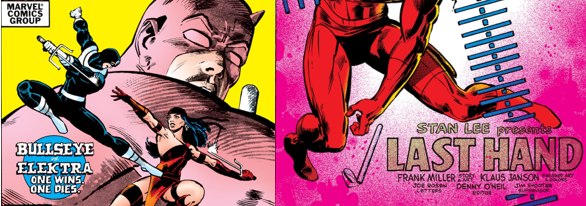
Story Title: “Last Hand”
Published: 29 December 1981 (cover-dated April 1982)
Writer: Frank Miller
Artists: Frank Miller and Klaus Janson

The Background:
The 1960s were a golden age for Marvel Comics as Stan Lee teamed with legendary names like Steve Ditko and Jack Kirby to create some of comicdoms most iconic superheroes. Stan Lee and artist Bill Everett created their most challenging hero yet when Matt Murdock/Daredevil debuted on 1 April 1964, and the Man Without Fear would go on to be one of Marvel’s most popular and enduring characters thanks, in no small part, to the efforts of writer/artist Frank Miller. The then up-and-coming Miller joined the book in 1979 with issue 159 and soon took over writing duties as well as pencils; responsible not just for the creation of Elektra Natchios but penning some of Daredevil’s most influential stories. Easily one of his most memorable stories was told in this special, double-sized issue in which he made the shocking decision to kill off Elektra at the hands of Marv Wolfman and John Romita Sr’s Bullseye. Although Elektra would be resurrected (and killed again) in later years, this doesn’t change the impact of her first death and Miller’s storyline was so pivotal to Daredevil’s character that this storyline was adapted in both the live-action film and the Netflix series.

The Review:
“Last Hand” opens with Benjamin Pondexter, the assassin known as Bullseye, stewing in a prison sell on Ryker’s Island and fantasising about blowing Daredevil’s brains out; after being humiliated by the Man Without Fear time and again, Bullseye is no longer satisfied with a clean, simple kill and desires to make him suffer, to break him, to hear him scream in agony. Bullseye’s hatred is palpable and made only worse by the fact that Daredevil could have left him to die in a subway but actually saved his life, demeaning him even further in his own eyes and those of his fellow inmates. While training his body in anticipation for his eventually rematch with Daredevil, Bullseye is crippled by one of his agonising headaches; although the brain tumour he once suffered with has been fixed, he suffers from debilitating migraines and is dependent upon pills to stave off the pain, which is just one more thing he blames ol’ hornhead for. During one of his few moments of reprieve out in the yard, the shackled Bullseye has a tense confrontation with Frank Castle/The Punisher, who is currently locked up as well, who delights in taunting Bullseye with the knowledge that Wilson Fisk/The Kingpin has replaced him with a new assassin-for-hire.

Bullseye, driven by hatred for Daredevil, escapes from Ryker’s after learning he’s been replaced by Elektra!

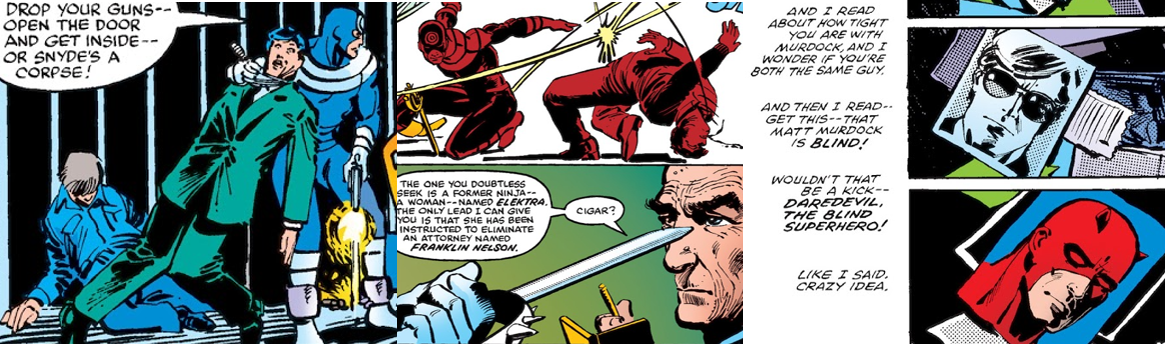
Enraged by this, and driven to have his revenge against Daredevil, he accepts an effort to appear as a guest on Good Evening, New York; however, when he feigns a headache, he temporarily blinds an armed police officer by spitting the pill in his face and causes the cop to shoot his shackles with an errant shot, thus freeing him from his shackles. Bullseye wastes no time grabbing the downed officer’s gun, gunning down his guards, and taking host Thomas Snyde as a hostage. Bullseye shoots his way out into the yard and, incredibly, is able to throw off a sniper and commander their helicopter using little more than a pistol and a microphone cord! Although he’s eager to track down Daredevil and get his revenge, Bullseye first heads over the Eric Slaughter’s hideout for a lead on the assassin who replaced him; there, he learns that the old man’s freelance organisation is preferable to Bullseye’s more erratic and dangerous ways, and promptly beats the crap out of two of Slaughter’s men. Impressed, the old man willingly gives information the name he requires: former ninja Elektra, who has been instructed to assassinate Matt Murdock’s best friend, Franklin “Foggy” Nelson. Bullseye’s reputation is such that Slaughter fears him almost as much as, if not more than, the Kingpin and lends him the services of his men. They put together a file on Murdock and Nelson for Bullseye and he is amused to the point of hysterics at the similarities between Murdock’s pictures and Daredevil, finding the idea of a blind superhero to be hilarious.

Bullseye and Elektra’s brutal fight ends with her skewered on her own sai!

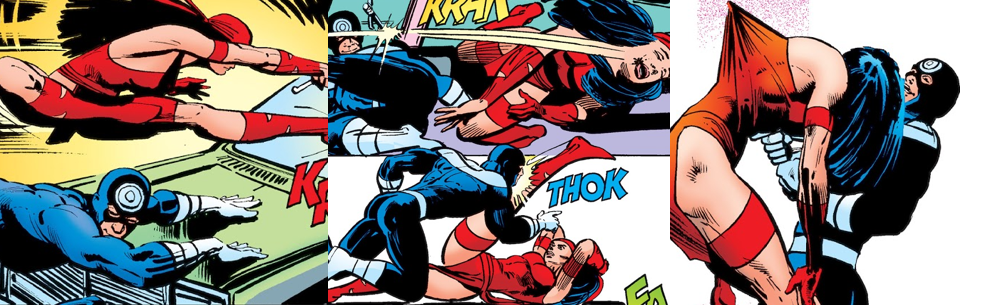
Bullseye begins following Murdock, watching him perform in court and being sickened by his good nature and humanitarianism; he literally slaps a bug on Nelson’s back so he can listen in on them and slices a taxi cab driver’s throat in order to obtain some wheels to follow Foggy’s cab. Quite conveniently, Foggy’s cab has been commandeered as well: by Elektra! Foggy just about pisses his pants when Elektra pulls over and prepares to execute him with her sai, but he saves himself when he realises that he recognises her as a girl Matt hooked up with when they were back in college. Although she falters in her duty because of her memories of her whirlwind romance with Matt, Elektra’s senses are attuned enough to hear Bullseye approach her with a pistol and she instantly springs into action: she disarms him with a leaping kick and catches him off-guard with her speed, strength, and skill. Their fight spills into a parking lot, and Bullseye uses his knowledge of ninja training to turn the tide against Elektra, matching her blow for blow but ultimately gaining the definitive upper hand when he tosses one of his razor sharp playing cards at Elektra’s throat, cutting her open and leaving her completely helpless as he grabs her and stabs her in the stomach with one of her own sais! Mortally wounded and bleeding out, Elektra staggers through the crowded streets to Matt’s flat, where she dies in his arms. Bullseye can’t help but be present when Matt and Foggy are called in to identify Elektra’s body and learn her cause of death; he heard Foggy mention that Elektra used to be “Matt’s girl” and is curious when Matt seems to stiffen up upon hearing his voice, as though he recognises him, and proves beyond a shadow of a doubt that his suspicion that Matt is secretly Daredevil is true by throwing a scalpel at Murdock’s head only for the blind lawyer to block it with his walking stick.

Bullseye ends up crippled but no less determined to one day further torment his foe.

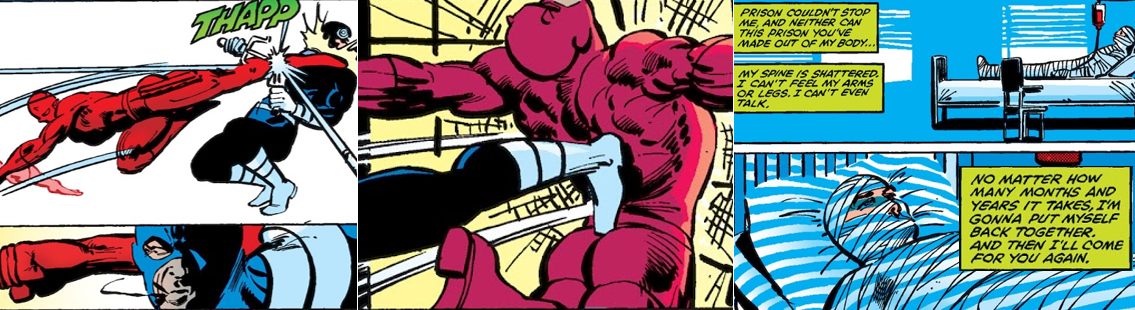
Armed with this knowledge, Bullseye brings this revelation to the Kingpin, supporting his hypothesis with medical evidence, but Fisk finds the very idea of a blind man being Daredevil preposterous. He does, however, assign Bullseye the task of killing Daredevil and bringing him his body, so the assassin heads to Murdock’s apartment to finally have his revenge…only to be blindsided by Daredevil! Unbeknownst to Bullseye, Matt has set up a decoy of himself, which is enough to throw off Bullseye’s confidence in his hypothesis, but he’s no less eager to get into it with his hated rival. Bullseye lures Daredevil to the rooftop and adds a psychological edge to their fight by wielding Elektra’s sais; their brutal clash sees them plummet through a skylight, battle across an elevated train track, and finally come to blows on a precarious wire over the city street. Since he doesn’t have Daredevil’s superhuman balance, Bullseye slips and falls and is enraged when his foe catches him; determined not to suffer another humiliation at Daredevil’s hands, Bullseye prepares to stab his enemy with a sai but, surprisingly, Daredevil drops the assassin to the street below with the intention of ending his murderous ways. However, given that Bullseye has narrated the entire issue, you may have guessed that the fall doesn’t actually kill Bullseye; although even the Kingpin believes him to be dead, Bullseye lies fully bandage in a hotel room with a shattered spine and unable to move his limbs. However, he takes solace in having hurt Daredevil, both by killing Elektra and breaking his friend Matt Murdock’s heart, and in his hatred. Though he cannot move or speak, his hatred is as strong as ever, if not stronger, and he vows to find his way back and continue hurt Daredevil until he’s finally dead.

The Summary:
“Last Hand” is certainly a unique Daredevil tale for a few reasons: first and foremost, it’s told entirely from Bullseye’s perspective. Right from the first panel, we’re let in on the twisted, hate-filled internal monologue of one of Daredevil’s most notorious foes and he’s portrayed as a sick, remorseless, calculating villain throughout. Taking a perverse pleasure in toying with and killing his victims, Bullseye is dangerous and lethal with even the most harmless of everyday objects; while his hatred towards Daredevil is great, this never clouds his judgement or ability; instead, he’s surprisingly observant and conniving, able to deduce that Matt and Daredevil are one and the same to the point where he absolutely nails everything about the Man Without Fear’s origin to the smallest detail, only to be met with scorn from the Kingpin and successfully duped into disregarding his theory thanks to Matt’s trick. Interestingly, though, Bullseye’s crippling headaches don’t factor into the story at all once he’s out of Ryker’s; you’d think that maybe this is what would cause his downfall in the end, but this plot point is completely forgotten once he’s garbed in his familiar outfit and back on the streets, as though finally returning to action cured his debilitating pains.

This is Bullseye’s story, and he not only changes Matt’s life forever but almost figures out his dual identity!

Another way this story stands out is just how little Daredevil actually appears in it; when we do seem him, it’s either through Bullseye’s memories or as a quick flash over to Murdock’s daily routine as a parallel to Bullseye’s time in prison. Thanks to Bullseye’s constant narration, Daredevil is seen as a stoic and grim vigilante, a far cy from his wise-cracking debut, one who is as focused and formidable at fighting as Bullseye. When we do see Matt and Foggy, they’re painted as “saps”; the kind of do-gooders who sicken Bullseye and he only takes an interest in them because they can lead him to his replacement and when he suspects that Matt is Daredevil. We learn very little explicit information about how Elektra’s death impacts Matt; since we are never privy to Matt’s thoughts beyond the few words he says in the story, the entirety of his emotions is told through the artwork. This is strikingly effective, as entire fight sequences and panels pass without any text, and Matt’s morose pain and rage are expertly conveyed in his no-nonsense approach to engaging with Bullseye. It’s also quite interesting seeing the Kingpin outright dismiss the idea of blind Matt Murdock being Daredevil; in time, Fisk would learn that this was actually true and set in motion an aggressive campaign to physically and mentally destroy his foe, but it’s amusing to see just how close he (and Bullseye) came to the truth only for it to be sacked off as being patently ridiculous. Sadly, we don’t really get much insight into Elektra here; like Daredevil, she’s a person of few words, and all of her emotion and turmoil is told through her facial expressions and her fight sequences, which paint her not just as a conflicted and formidable individual but, ultimately, as a victim of Bullseye’s sadistic lusts.

Bullseye pushes Matt to the limit, and sets him on motion towards a dark and destruction path.

Finally, the issue stands out by having a major character being so brutally killed off. There’s a case to be made that Elektra, a trained ninja assassin from birth, should have been able to best Bullseye in their fight but I think the story does a decent job of putting them on equal ground thanks to the emotional blow of suddenly being reminded of Matt and Bullseye’s trick cards. The panel of Bullseye skewering Elektra will forever be iconic, no matter how many times she returns from the dead, and seeing he stumble across town to be with Matt in her final moments was truly heart-breaking. It’s clear from Matt’s stoic expressions that he’s in great pain at her loss, and seeing him launch into an all-out assault when Bullseye brandishes his former lover’s weapons conveys just how personal this fight is for Daredevil. Indeed, it drives him to critically injuring Bullseye; Daredevil’s promise that Bullseye’ll “kill no one – ever again!” could be taken two ways, I believe: either Matt intended for the fall to kill the assassin, or he aimed to cripple him as the final panels show him to be. Either way, it’s a pretty dark place for Daredevil to go and shows just how sour and morally questionable his life as Daredevil can be at times. Overall, this is definitely a pivotal story in Daredevil’s long history and well worth a read for fans of the character, or those who want to explore him further, but maybe it suffers a little from not seeing things form Matt’s perspective; obviously, subsequent issues would delve into this in great detail but it might have been interesting to switch back and forth between Bullseye and Daredevil’s inner thoughts just to get a sense of what’s going though Daredevil’s mind.

My Rating:

Rating: 3 out of 5.

Pretty Good

Have you ever read “Last Hand”? Were you a fan of Elektra and, if so, what did you think to her death in this issue? What did you think of the story being told entirely from Bullseye’s perspective? Did you enjoy the fights in the story or do you think Elektra was given the shaft? Would have liked to see Daredevil’s thoughts in more detail? What do you think of Daredevil as a character and which storyline of his do you think is the best, or the worst? How are you celebrating Daredevil’s debut this year? Whatever you think about Daredevil, sign up to drop your thoughts below or leave a comment on my social media.

Movie Night: Daredevil: Director’s Cut


Blind lawyer Matt Murdock first made his debut in Daredevil #1 in April of 1964 and was co-created by writer/editor Stan Lee and artist Bill Everett, with input from the legendary Jack Kirby. While perhaps not as mainstream as characters like Peter Parker/Spider-Man, Daredevil has become one of Marvel Comics’ greatest creations and has featured in a number of ancillary media and merchandise, included a questionably-received big-screen adaptation in 2003 and this critically-successful Netflix series.


Released: 30 November 2004
Originally Released: 14 February 2003
Director: Mark Steven Johnson
Distributor: 20th Century Fox
Budget: $78 million
Stars: Ben Affleck, Jennifer Garner, Michael Clarke Duncan, Colin Farrell, Jon Favreau, and Joe Pantoliano

The Plot:
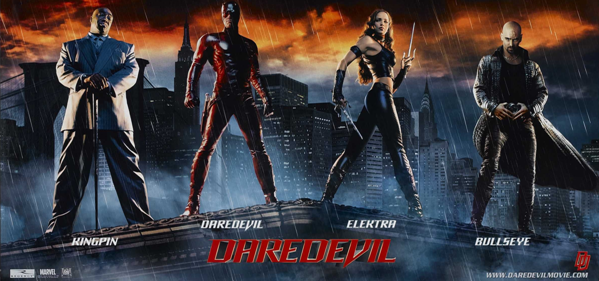
After being blinded by radioactive waste as a child and discovering his other senses are superhumanly keen as a result, Matt Murdock (Affleck) works as a lawyer by day and devil-garbed vigilante by night. While falling in love with the mysterious and beautiful Elektra Natchios (Garner), Daredevil draws the ire of Wilson Fisk/The Kingpin (Duncan), who hires the assassin Bullseye (Farrell) to rid him of Daredevil’s interference once and for all.

The Background:
Following his creation in 1964, Daredevil has been no stranger to multimedia ventures; while Angela Bowie’s 1974 proposal for a television movie was never produced, the character made his live-action debut in The Trial of the Incredible Hulk (Bixby, 1989), portrayed by Rex Smith, and made occasional appearances in various Marvel cartoons, particularly in the nineties, and a live-action movie was in the works since as far back as 1997 but could never quite get off the ground thanks to Marvel Comics’ legal issues at that time. Development finally gained traction in 2000, with 20th Century Fox (who would also find success with another of Marvel’s properties, the X-Men, around this time) distributing the film and Mark Steven Johnson signed on to both write and direct. Taking inspiration from the “Guardian Devil” (Smith, et al, 1998 and 1999) storyline and Frank Miller’s celebrated work with on the character, Daredevil was poised to be one of the darker, grittier superhero films of its time. Despite turning a sizeable profit, making nearly $180 million in worldwide gross (and having a rocking soundtrack that propelled one of my favourite bands, Evanescence, into mainstream popularity), Daredevil was less-than-favourably received upon release, with even star Ben Affleck speaking out against the film after its release (despite all the positive comments he had made to market the film…) The “Director’s Cut” of the film (which restored an entire sub-plot, swear words, and was far more violent) released about a year later, is generally regarded by many (including myself) to be the definitive version of the film, however, though the critical and commercial failure of spin-off Elektra (Bowman, 2005) and Affleck’s refusal to revisit the role put an end to any hopes for a sequel and Daredevil would not reappear in live-action until Marvel Studios regained the rights to the character about ten years later.

The Review:
Daredevil was released at a time when superhero movies were just really starting to hit their stride; they weren’t the multimedia juggernaut they are today thanks to the efforts of Marvel Studios and Disney so, while there were many highly regarded and influential superhero films released in the early 2000s, not all of them were guaranteed smash hits and even the ones that were haven’t exactly aged well (or have been done better) since then. As a result, most superhero films tended to feature a major focus on the character’s origin, a lot of fast-paced and frenetic action scenes, and a plot that moved at a relatively brisk pace to cover a lot of ground as quickly as possible. They, like many other action films of the time, were also heavily influenced by (or blatantly ripping off) The Matrix (The Wachowski Brothers, 1999) so black leather, “wire-fu”, and CGI were plentiful during this time and, of all the superhero movies released in the early 2000s, perhaps nowhere are all these now-cliché elements more apparent than in Daredevil.

Daredevil is framed by a flashback to Matt’s childhood to tell his origin story.

Daredevil begins in medias res with the titular vigilante wounded, seemingly fleeing from the police, and seeking sanctuary at Father Everett’s (Derrick O’Connor) church. As he lays incapacitated and hurt, Murdock begins to narrate his childhood and life up until that point under the illusion that his life is flashing before his eyes as he dies; this flashback-heavy first portion of the film separated Daredevil from its contemporaries as, while the Spider-Man films (Raimi, 2002 to 2007) featured a bit of narration from the main character, most superhero films started at the beginning and progressed from there, with us following the hero along his journey and learning alongside him/them. This technique, though, means that we experience Daredevil from a uniquely different perspective, that being through the haunted, tumultuous memories of its main character.

Jack discourages Matt from fighting and wants him to grow up to be a success.

We’re thus introduced to Murdock first as a battered and injured vigilante and then, very quickly as a young kid (Scott Terra) from Hell’s Kitchen who is constantly harassed by a gang of local youths. These bullies like to rag on young Matt because his father, Jack Murdock (David Keith), is not only an over-the-hill, washed up prize-fighter who once fought under the name “The Devil” and wore a devil-themed robe to the ring but has now taken to working as an enforcer for Fallon (Mark Margolis), a local mob boss. Matt, maintaining a staunch belief in his father’s glory days, accolades, and abilities, stands up to such bullies and trash talk and takes a beating as a result, much to the dismay of his father. Jack, however, wants more from Matt and discourages him from fighting, wishing instead for Matt to devote himself to his studies and to make something of himself and it is clear from their brief scenes together that the two have a very strong relationship, one built on mutual trust, respect, and dependency. Jack is determined to have Matt grow up unafraid, to be the best version of himself, and to not be a “bum like [him]” but this goes so far that he is too ashamed and too despondent to admit that he really has been forced to rough people up on Fallon’s behalf in order to provide for his family. The very next scene shows Matt witnessing this and, distraught and heartbroken, he flees from the sight only to end up narrowly avoiding a collision and being blinded by a biohazardous waste product as a result.

Blinded by toxic waste, Matt’s remaining senses are enhanced to near-superhuman levels.

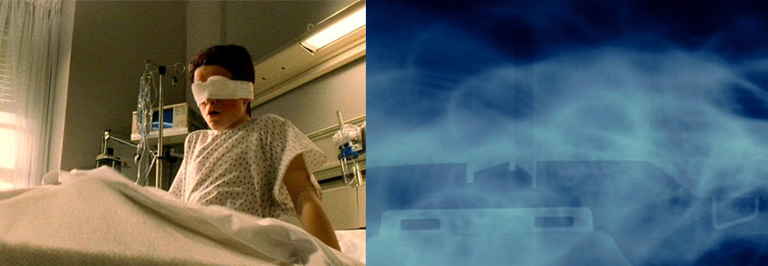
Similar to Spider-Man, an elaborate CGI sequence shows us the effect this has on Matt’s DNA and, when he awakens in hospital, he is immediately bombarded with sensory overload as, while he has been rendered permanently blind, his remaining senses (particularly his hearing, which gets the most attention) have been augmented to near-superhuman levels. Unlike in the character’s debut appearance, where Matt barely flinched at being blinded, very little time was spent dwelling on how he or his father felt about it, and where Matt never once struggled to adapt to his new abilities, Daredevil adds a few wrinkles to this turn of events. Firstly, because Matt’s accident happened as a direct result of him running away from his father, Jack feels a tremendous amount of guilt and shame about the accident; secondly, Matt is overwhelmed to the point of terror at his newfound abilities and struggles to get them under control. However, the two have such a strong bond, love, and dependence upon each other that Matt doesn’t bare a grudge and the two resolve to redouble their efforts to overcome their limitations, with Jack getting back into training and back into the ring and Matt continuing his studies using Braille and discovering that his echolocation provides him with a version of sight. In experimenting with his newfound abilities, he loses all sense of fear as he easily traverses rooftops and overwhelms his tormentors (who “dare” him to fight them) with little more than his walking stick and his dexterity. Of course, Daredevil is still a superhero story and what superhero origin is complete without a dash of tragedy? It turns out that Fallon has engineered Jack’s comeback and threatens both him and Matt to coerce Jack into taking a dive in his next fight; with his son in the crowd and refusing to compromise his principals, Jack refuses and wins through heart, determination, and brute strength/force of will. However, Fallon’s goons jump Jack after the fight and beat him to a pulp before an unseen third assailant delivers the finishing blow, beating Jack to death and leaving a red rose on his bloodied corpse.

Matt plays the role of “unassuming blind man” well but suffers the consequences of his double life.

Tragically, Matt hears it all and is absolutely heartbroken when he comes across his father’s beaten and bloody body. He resolves to keep his promise to his father to help those that others wouldn’t and seek justice one way or another, with the film glossing over his time in college and law school and jumping ahead several years to find him fully grown into Ben Affleck. The older Murdock is a haunted, heavily conflicted individual; in order to block out the constant barrage of noises, he sleeps in a sensory deprivation tank and regularly chews a number of pills and painkillers to dull the constant pain from the many wounds he has suffered in his nightly jaunts. The effects of his double life can be immediately seen not only in his weary expression but also the multitude of scars, bruises, and injuries his body exhibits; though Matt’s abilities make him faster and stronger than the average man, he’s still human and we constantly see him suffering blows and injuries during his activities as Daredevil, taking hard shots to the ribs and even losing a tooth during the film’s first big action scene. I’m no fan of Affleck (largely because of the way he crapped all over this movie after professing to be such a big fan of the comics during its marketing) but he’s actually really great as Murdock; the special contact lenses he wears are only a small part of selling him as a blind man as Affleck assumes a slightly skewed posture and thousand-yard stare, always positioning himself in such a way that you can tell he’s lacking his sight. Additionally, Murdock uses Braille to identify his belongings, and even folds his notes in certain ways to recognise them (though it’s not entirely clear if he needs to do this, since we know he doesn’t, or if it’s all part of playing up his persona as a simple blind man), all of which go a long way to showcasing how a blind man might life his life.

Matt is a brutal and resmorseless vigilante when he dons his Daredevil garb.

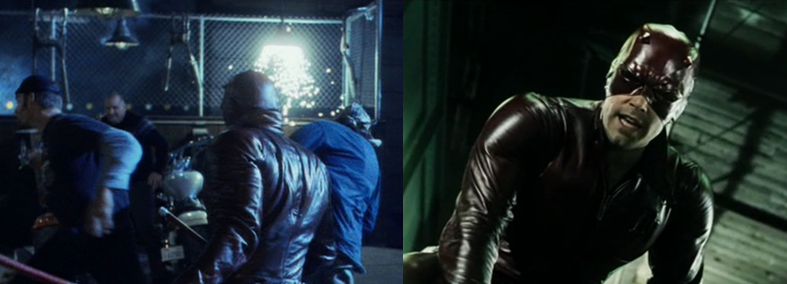
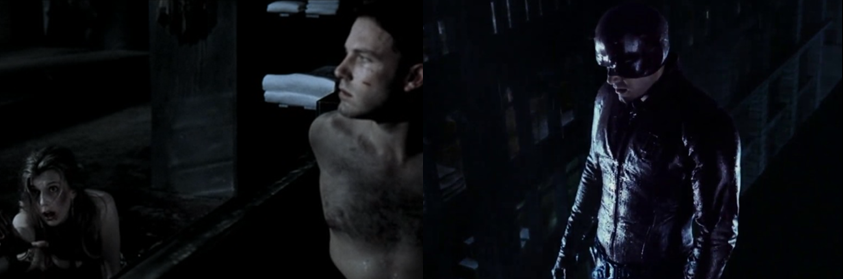
Affleck is also able to showcase a multitude of emotions with a surprising amount of nuance; Murdock is a pragmatic, yet passionate, bastion of the innocent in the court room, has a fantastically realised love/hate relationship with his friend and colleague Franklin “Foggy” Nelson (Favreau), and transforms into this violent, sardonic, brutal vigilante when donning the incredible blood-red leather outfit of Daredevil. It’s clear that Murdock is a man of many conflicting emotions and suppressed rage and that Daredevil is his outlet for those sensations; he takes deep offense to those who flaunt or break the law or who are under the clear influence of the mysterious Kingpin of Crime and takes it upon himself to bring such individuals to justice. His methods to achieve this are vicious and violent, involving the unrelenting beating of any law breakers and even more direct and indirect murder as he moves fast enough to avoid bullets that other thugs then take and not only willingly knocks Jose Quesada (Paul Ben-Victor), an obvious rapist and all-round bad person, to a gruesome death by train but even takes the time to mock him before his grisly dismemberment.

Favreau is great as the loveable, if goofy, Foggy Nelson.

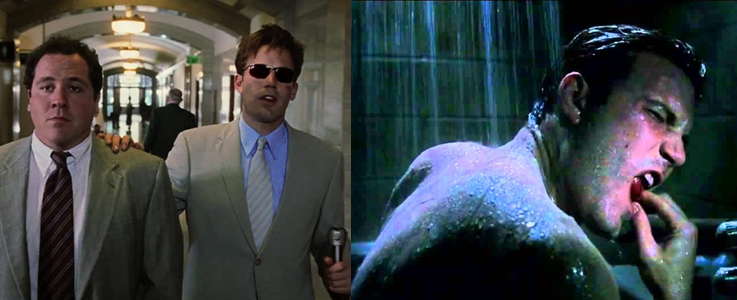
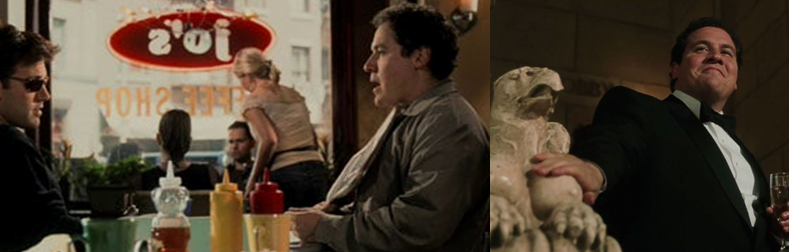
Clearly a tortured, haunted individual, Matt keeps others at arm’s length and actively sabotages his relationships because of his unwavering commitment to bringing criminals to justice as Daredevil and his unresolved issues. Foggy makes this abundantly clear as he calls Matt out on his bullshit time and time again while still being in quiet awe of Matt’s adaptability, dedication towards helping those in need even when they receive very little payment (or payment in fluke or sports gear, which makes for an amusing running gag), and his capability in the court room. Their relationship is a real highlight of the film, with the two sharing banter, matching wits, pulling pranks on each other, and even using Matt’s disability to wind up strangers or to win the sympathy of the jury. Any time these two are onscreen together, it’s a joy to see; Favreau is instantly charming and likeable as the goofy Foggy and, while he was always able to stand out by questioning Matt’s approach to the women in his life, the Director’s Cut expands Foggy’s role and gives him a character arc where he is able to resolve Dante Jackson’s (Coolio) case and help lead the authorities to the Kingpin.

Duncan exudes an arresting aura and jumps from eloquent calm to unbridled rage!

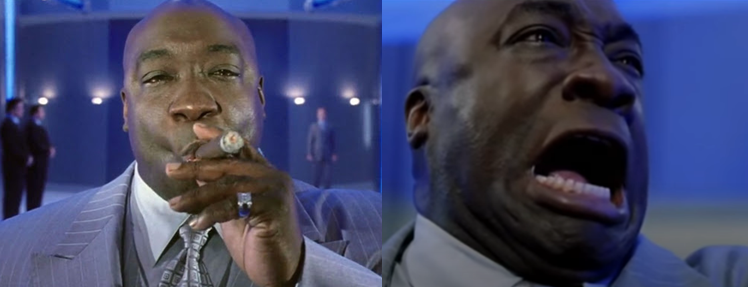
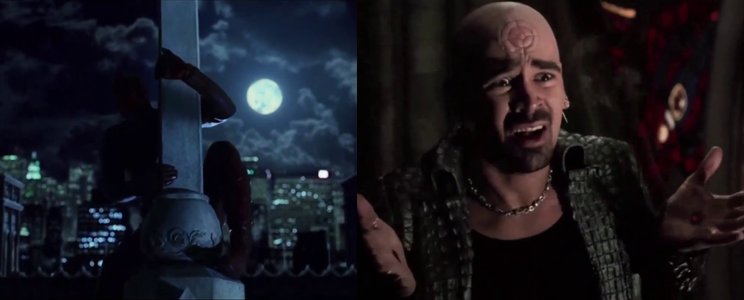
Speaking of Wilson Fisk/The Kingpin…how amazing was Michael Clarke Duncan? The man had such a charisma and a presence not only because of his massive frame but also his charming smile and deep, dulcet tones. Though traditionally a white character, Duncan is a perfect fit for the role and exudes power, charisma, and a commanding respect from the moment he is introduced in the film garbed in a flashy suit and puffing away on a chunky cigar. Though the character was an eloquent and calculating individual in the theatrical cut, the Director’s Cut goes even further in establishing Fisk’s threat when he is seen viciously bludgeoning two of his underlings (one with his massive cane and the other by first throttling and then breaking his neck), which makes it all the more ominous when he later lays a seemingly innocent hand on the shoulder of Nikolas Natchios (Erick Avari) and gets his large hands on Daredevil in the film’s conclusion. The added runtime afforded by the Director’s Cut also adds further nuance to Fisk’s character; on the one hand, you could argue that we don’t really learn much about him and that he’s every typical, one-note criminal mastermind but, on the other, you can really see a number of layers to Duncan’s performance. Like Murdock, Fisk is keeping his raw, animalistic urges and primal rage at bay with a suit (literally a business suit); he explodes in a burst of rage and pure, unbridled power then immediately calms and composes himself and is so eager to put his abilities to the test against Daredevil for the climatic final fight that he all but invites the vigilante in to take him on man-to-man. Cold, calculating, but also articulate and oozing menace, Duncan portrays Fisk as a man at war with his clearly street-smart upbringing and the sophistication required of his role. Indeed, while he takes immense pleasure in the suffering of others, he also maintains that none of his actions have ever been personal; it’s with a glimpse of regret, maybe even sorrow, that he admits to Daredevil that his entire criminal enterprise has only ever been “business” and nothing more. Fisk’s “business” finds itself somewhat compromised not only by Daredevil but also the continued attempts by reporter Ben Urich (Pantoliano), whose speciality is urban legends, to expose the Kingpin. Fisk solves that problem by hiring Bullseye, a charming, animalistic, cold-hearted, sadistic, masochistic hitman, to kill Natchios. Unlike Murdock and Fisk, we learn very little about Bullseye save that he is a ridiculously good shot who talks little, kills on a whim, and has a flair for the dramatic. Like Fisk, Bullseye enjoys killing but takes a perverse pleasure out of it rather than revelling in his power like Fisk does; he’s also incredibly egocentric and takes it personally when Daredevil causes him to miss a shot, happily accepting an extended contract to take out both Daredevil and Natchios’ daughter, Elektra.

Matt and Elektra flirt but sparring in a playground. It’s not awkward at all…

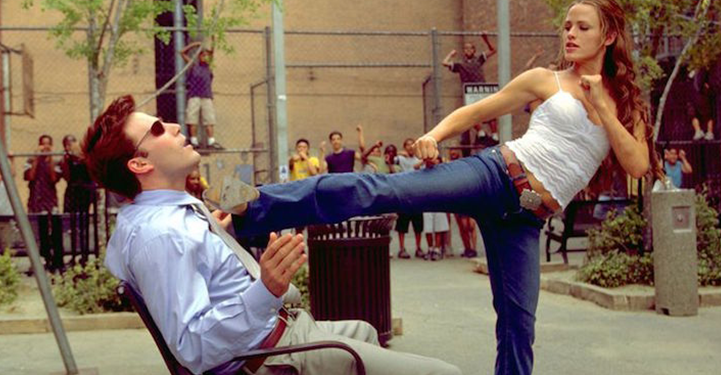
Of the three main characters in the film, it’s Elektra who I feel brings the weakest performance; I’m not really a fan of Jennifer Garner and find her to be a bit of a blank slate who is sleepwalking through the film. She phones it in well enough to portray Elektra as a strong, independent, and forceful character when she needs to be but her romance with Matt is incredibly rushed and convenient. He basically becomes infatuated by her on scent alone and they have an absolutely cringe-worthy flight/flirt in a neighbourhood playground that seems more like Matt stalking and forcing himself upon her than a genuine attraction. However, she respects Matt’s ability to perform heavily choreographed wire-fu enough to give him her name and the time of day. To be fair, Elektra is a fairly layered character; she hates being under the constant supervision of her father and her bodyguards and wants her independence yet is incredibly devoted to him and her family. She is feisty and strong-willed but also lonely and you get the sense that her relationship with Matt is the first time she’s really been able to open up to someone. After her father is killed, though, she turns into a cold, venge-seeking individual, blanking out Matt’s pleas to turn away from vengeance and showcasing her formidable martial arts and sai-based combat skills in preparation to take out the man she believes responsible for her father’s death: Daredevil. All-in-all, Daredevil’s cast is pretty solid, ranging from top notch to mediocre performances that do a serviceable job given the film’s run time. And there is a lot happening in this film, especially in the extended Director’s Cut, yet the film’s pace is relatively speedy all throughout, glossing over such things as how Matt was able to construct his suit, multi-purpose cane, and the “Devil-Cave” compartments of his apartment and often padding out action scenes or stunts with some very dodgy CGI. I remember the effects not being that bad at the time but they really haven’t aged well now, with the CGI Daredevil, especially, looking particularly rubbery and cartoony as he ludicrously jumps from building to building or battles Bullseye up a ridiculously large church organ. The film is at its best when the action and fight scenes are simple, raw, and gritty, such as the one-on-one action between Daredevil and Elektra, Bullseye, and, especially, Fisk. Perhaps because of the success of Spider-Man, though, and definitely because of the popularity of The Matrix, Daredevil seeks to portray not just Daredevil but also Elektra and Bullseye as being capable of performing incredible, physics-bending stunts. While this is somewhat fitting for Daredevil, who is generally about as agile and adept as Spider-Man in the comics, it definitely feels like the film would have benefitted from downplaying the more nonsensical stunts and focusing on more dark and gritty action and fights.

The Nitty-Gritty:
In contrast to the beliefs of some, one of the best things about Daredevil, for me, has always been its soundtrack; sure, either the score or a host of licensed tracks are usually playing over every scene in the film but Daredevil boasts some rocking tunes and uses them to really help establish the mood or the character onscreen at the time. Murdock drowns out the sounds of the city with some Seether, for example; Nickleback’s “Learn the Hard Way” plays while Daredevil kicks the crap out of Quesada and his goons (who all need to “learn the hard way” that their actions have consequences), Fisk is introduced to the sounds of N.E.R.D.’s “Lapdance”, the appropriately-named “Man Without Fear” by Drowning Pool and Rob Zombie brings a manic energy to Bullseye’s elaborate motorcycle chase against Natchios, and, of course, the iconic “Bring Me to Life” and “My Immortal” by Evanscence feature prominently to set the stage for Elektra’s grief and her thirst for vengeance. Honestly, I don’t give a damn how much music is in the film because when a film’s soundtrack is as bad-ass as this one, all you can really do is sit back and rock out!

The film is full of explicit religious imagery.

Fittingly, Daredevil is also rife not only with references to some of the character’s most influential writers (John Romita, David Mack, Joe Quesada, Brian Michael Bendis all get name dropped, Frank Miller and Stan Lee pop up for brief cameos, and, most egregiously of all, Kevin Smith has the gall to appear as a coroner named “Jack Kirby”) but also with religious imagery; the opening of the film provides a perfect excuse to recreate that iconic shot of Daredevil clinging to a cross atop a church, Matt is only able to control his newfound abilities by focusing on the ringing of a church bell, the Director’s Cut features a handful of quasi-dream sequences where Matt is visited by a Nun (actually his deceased mother), Daredevil subdues Bullseye by causing a sniper’s bullet to pierce his hands in the style of the stigmata, and Matt frequently finds solace in Father Everett’s church. In the theatrical cut, Everett was the only other person who knew of Matt’s dual identity and he strived to turn Matt towards a more righteous path; here, this role is largely the same but slightly different as the film focuses more on Matt’s dark path and the violence of his life. We’re led to believe that this comes to a head when he spares the Kingpin but, arguably, Fisk deserved to die more than any of Matt’s other victims. Instead, Matt is happy (or, at least, willing) to kill small fry like rapists in the opening but not the primary crime lord of New York simply to serve a wonky character arc and to set up sequel bait.

Matt is haunted by his past, his pain, his anger, and his struggle to reconcile his emotions.

One thing the Director’s Cut really brings to light is just how conflicted and full of anger Matt is; his violent double life is clearly at odds with his Catholic upbringing and is taking its toll on him, as expertly seen by a new scene where Matt is literally haunted by the screams and suffering of those he cannot help in the city. He lashes out at criminals when under the mask and takes his anger and frustration out on both them and his Devil-Cave when he is unable to save Natchios and, unlike in his original debut, Matt is a flawed and fundamentally broken character; he struggles with his newfound abilities at first and his quips are more like cruel taunts than light-hearted whimsy. There’s a sense that he does what he does out of a sense of duty to his father and because of his abilities but it’s also pretty clear that he’s using Daredevil to exert all of his emotions and rage; when he sees a child cower in fear of him, he is stunned and desperately tries to convince himself that he’s “not the bad guy”. Finding little solace in Father Everett’s talk of faith, Matt struggles to reconcile his actions and inner turmoil and he is noticeably tetchy and short with Foggy the next day as a result. This all goes to great lengths to explain why he was unable to get through to Elektra at the funeral since Matt is hardly a bastion of virtue. How can he hope to convince someone not to seek vengeance when he does it every night?

It might look impracticable and uncomfortable but Daredevil’s suit is straight up bad-ass!

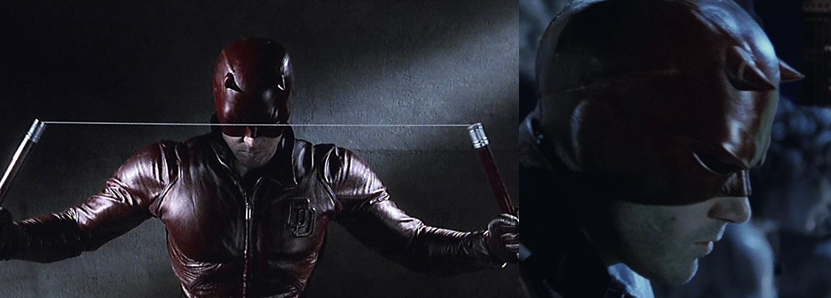
Another thing I always enjoyed about Daredevil was its dark and gritty aesthetic and the costume design; when taking to the streets as Daredevil, Murdock dons a thick, uncomfortable-looking but super bad-ass leather outfit that is a fantastic blood-red and is one of the few live-action superhero suits to actually use lens over the eyes. The practicality of this suit might be in question but it sure looks awesome (…when it isn’t rendered in shitty CGI), though I do find myself questioning how Matt was able to make it and the many duplicates hanging in his Devil-Cave. Matt also, of course, wields his multi-purpose cane (seriously, it’s a baton, nunchaku, a grappling hook, and even an axe!) but I find it hard to believe he could do both to such a high standard and exactly how does Matt manage to change into Daredevil in the middle of the city? There’s no way he’s wearing that suit under his clothes and he can’t be that close to his apartment all the time so either it’s a convenience for the sake of keeping the film’s frenetic pace going or Matt has stashed spare costumes all over the city!

Despite all her abilities, Elektra is no match for Bullseye…

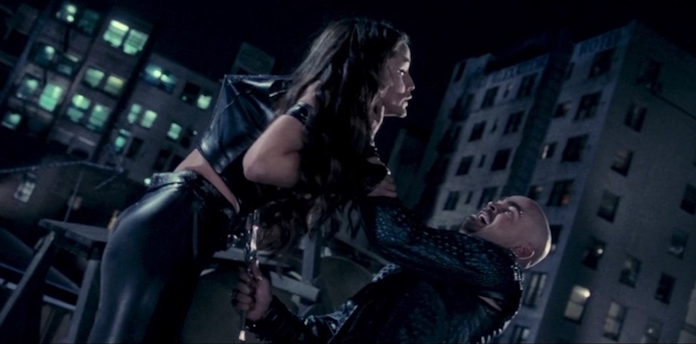
Bullseye and Elektra don’t fare quite as well as Daredevil on the costume front, unfortunately, with both opting for black leather and relatively simple attire despite Bullseye demanding a “fuckin’ costume” from Fisk. Still, Bullseye makes up for it with a preposterous bullseye scar on his forehead and an absolutely gorgeous Matrix-style trenchcoat that he even uses to disorientate and distract Elektra during their fight. This whole sequence is a bit of a let down, to be honest; earlier, in their civilian clothing, we saw Elektra and Matt go toe-to-toe and that they were largely evenly matched until Elektra got the better of him. Considering Matt’s augmented strength and reflexes, this is a pretty impressive feat and, overwhelmed by hatred and her desire for revenge and helped by the fact that Matt refuses to fight her, we see Elektra again able to best Daredevil in a fight, incapacitating him with a stab to the shoulder that, for all intents and purposes, leaves Daredevil seemingly near death! After discovering the truth about her father’s murder, though, she immediately redirects her anger towards Bullseye, a man we have seen exhibit absolutely not fighting prowess up until that point, and is summarily overwhelmed! Seriously, I get that Bullseye is agile and all about the misdirection and the perfect shots but he toys with Elektra all through their fight and kills her without barely breaking a sweat!

Daredevil and Kingpin settle their differences in a good, old-fashioned fist fight!

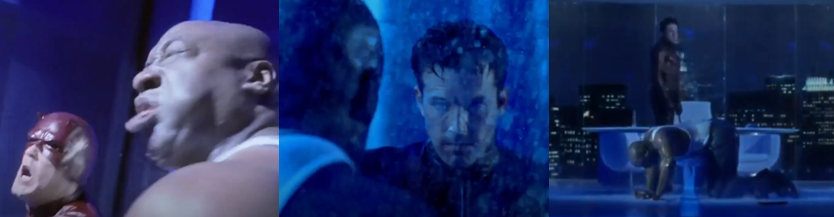
Daredevil’s fight against Bullseye isn’t much better as not only are they depicted as being physical equals (though at least Daredevil has the excuse of being badly wounded), the fight is hindered by the worst instances of CGI in the film that sees them leaping and hopping up about the place like in a videogame, Daredevil catching all of Bullseye’s shurikens with swift movements of his club, and Bullseye expertly snagging every single shard of broken stained glass and tossing them at Daredevil (who avoids them all with a superb series of well-timed backflips). It really hasn’t aged too well and is ridiculously over the top for what should have been a simple, brutal affair. Thankfully, the climactic fight between Daredevil and Kingpin makes up for this even more in the Director’s Cut; in the original version, this fight is depressingly short but, here, it’s noticeably longer and stands out from the rest of the film by beginning with the simple, raw sounds of the two adversaries kicking the crap out of each other. Thanks to his immense strength and Daredevil’s wounds, Fisk is able to subdue Daredevil with a concussion-induced blow to the head and a rib-breaking toss into a concrete pillar; like the bullies of Matt’s youth, Fisk is incredibly amused to find that his rival is “the blind lawyer from Hell’s Kitchen” but finds himself on the back foot when Matt uses the sprinkler system to focus his radar sense and brutally bring the Kingpin to his knees. Driven to the floor in pain and at Matt’s mercy, Fisk is spared and handed over to the police despite promising that he’ll get out, and tell others of Daredevil’s identity. Matt, however, is unfazed, believing that no one would believe Fisk’s story and vows to be ready for Fisk when he gets out, setting the stage for a rematch and an escalating conflict that, sadly, we never saw. Like when Matt threw Bullseye out of the church window and to what should have been his death (he survived but was left in a full body cast so I guess that makes it okay…?), this is treated as a heroic, character-defining moment as Matt finally choose the higher, more noble and heroic path…despite the fact that he’s killed before, both directly and indirectly, and leaving Fisk alive is arguably more dangerous to both him and the city.

The Summary:
While many of the CGI shots and fight/action scenes haven’t aged too well, there’s actually a lot to like here; Daredevil’s suit is incredible and, while the costumes are very Matrix-y (as are the fights), they still work and allow each character to stand out from each other. The cast (with the exception of Elektra) is also really strong; Affleck may have talked shit about the role but he’s really good, shaking off a lot of his boy scout persona and really selling the idea that he’s a blind man and an emotionally tormented sole trying to do good through violent actions and getting lost down a dark path, and Duncan is phenomenal as the Kingpin. He has a real weighty presence, exuding power and intimidation but also layering the character with subtle nuances; it’s like he’s constantly keeping his anger and brutality in check through the veil of civilisation and decorum and is itching to let his emotions loose. Daredevil allows Matt to do this but Fisk has few opportunities to do it; the only one not hiding behind some kind of a mask is Bullseye, who is unapologetically sadistic through and through The soundtrack is also incredible; sure, music and songs fill nearly every scene but the hard rock, metal, and nu-metal tracks are a welcome inclusion for me. It’s not perfect; the plot is kind of all over the place, even in the Director’s Cut, and full of conveniences and contrivances but it does a really good job of establishing this world and it’s a shame we never got to see this cast all come back for at least one more film. Seriously, we got two mediocre Fantastic 4 movies (Story, 2005 and 2007) but we couldn’t get a sequel to Daredevil? As much as I loved the Netflix series, I still think that’s a real shame since the intention was clearly to do something akin to “Born Again” (Miller, et al, 1986) in the follow-up.

My Rating:

Rating: 3 out of 5.

Pretty Good

What did you think about Daredevil: Director’s Cut? How do you think it compares to the theatrical version? What did you think to Ben Affleck in the title role, and the film’s cast in general? Did you enjoy the film’s soundtrack or did you find the constant influx of songs distracting? How well do you think the film holds up compared to its modern equivalents? Perhaps you prefer the Netflix series (I mean, who doesn’t, right?); if so, why and what are some of your favourite moments from that? Do you have a favourite Daredevil character or storyline you’d like to see adapted into live-action? Whatever your thoughts on daredevil, feel free to leave a comment down below.