
Released: 6 September 2024
Director: Tim Burton
Distributor: Warner Bros.
Budget: $100 million
Stars: Winona Ryder, Jenna Ortega, Michael Keaton, Catherine O’Hara, Willem Dafoe, and Monica Bellucci
The Plot:
Thirty-six years after Beetlejuice (Burton, 1988), Lydia Deetz (Ryder) and her stepmother, Delia (O’Hara), return to Winter River. However, when Lydia’s rebellious teenage daughter, Astrid (Ortega), is spirited to the afterlife, Lydia must summon Beetlejuice (Keaton) to rescue her.
The Background:
In 1988, gothic auteur Tim Burton brought audiences Beetlejuice. Initially a much darker concept with a deadly titular character, the film was a surprise hit that cemented Burton as a director. A commercial and critical success, Beetlejuice was followed by videogame tie-ins, a lauded cartoon, and even a well-received Broadway musical, but a sequel struggled to emerge over the next thirty years. A sequel was fast-tracked at the time and multiple scripts were developed, two of the most notable being Beetlejuice causing havoc in Paris in search of love and following the Deetzes to Hawaii. Talks started again in 2011, star Winona Ryder was confident about a sequel in 2013, and it almost got off the ground in 2016 before being shelved in 2019. A few years later, Burton and Ryder revisited the concept and production finally got underway with a new story, one that kept the spirit of the first film while expanding the lore into new, bizarre realms. New star Jenna Ortega developed a close bond with Ryder during filming, and Keaton insisted that Beetlejuice’s screentime be as limited as before so as not to overload the narrative. While Burton sought to utilise practical effects wherever possible to retain the B-movie feel of the first film, Father Time and various controversies kept some actors from returning for the sequel. After a few additional delays, Beetlejuice Beetlejuice finally released to widespread acclaim. With a box office of over $330million, reviews praised it as a visual return to form for Burton. Michael Keaton and Jenna Ortega were also praised for their performances, though some criticised the pacing and disparate plot threads and Burton remained characteristically aloof about the chances of a third entry.
The Review:
After a nice recreation of the first film’s overheard shot of Winter River, Connecticut and stirring work (as always) by composer Danny Elfman, we catch up with Lydia, who now works as a psychic medium, investigating haunted houses and discussing the supernatural on a television show. It turns out that her ability to see ghosts never went away; it just became stronger. This means she sees ghosts constantly (though unfortunately not as often as I’d like), though this ability has been exploited by her manager/partner, the flamboyant Rory (Justin Theroux). An overly dramatic narcissist who’s more concerned with keeping Lydia on the air, and him in a position of wealth and power, than her wellbeing or bonding with her daughter, Rory is basically the Otho Fenlock (Glenn Shadix) of the film. It’s difficult to see the attraction as Lydia, Astrid, and even her stepmother find Rory repulsive and two-faced. However, the film reveals that Lydia was previously married to free spirited explorer Richard (Santiago Cabrera), who encouraged and fostered Astrid’s adventurous side, but ended up dying during a trip to South America. Devastated by the loss, Lydia latched onto Rory during grief counselling, and he took advantage right away, moulding her into a television personality he could continue to leech from. Richard’s death drove a wedge between Lydia and Astrid. The teen resented her mother for avoiding the subject and believes she’s a fraud since the only ghost she cannot communicate with is her late father, leading to Astrid barely talking to her mother. Naturally, given the massive time gap, Lydia is very different now; far from a rebellious goth girl, she’s become a troubled mother who’s clearly uncomfortable in her relationship but trapped with no way out. Although Delia is still as overbearing as ever (even more so considering her bizarre art has actually taken off), the two are much closer now that they’re older. Lydia has grown to understand how difficult it was for Delia to deal with an unruly teenager and Delia is far more supportive of Lydia, disapproving of Rory and even reaching out to Astrid to give her mother a break.
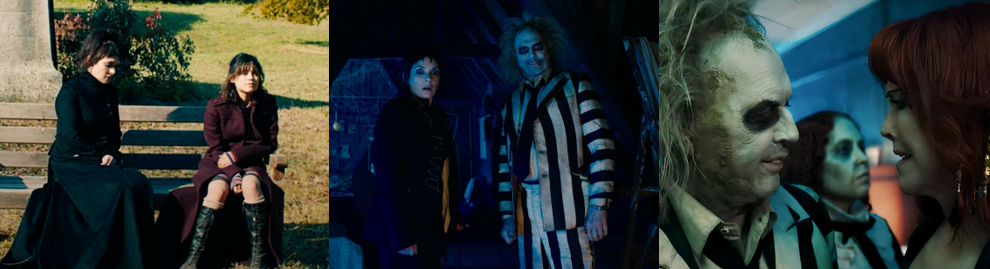
The three are brought together when Delia bluntly breaks the news that Lydia’s father, Charles (Unknown/Jeffery Jones), has died. And not just died: he survived a plane crash and was eaten by a shark! The sudden, ridiculous nature of his death is constantly returned to throughout the film; there’s an elaborate funeral, Delia tries to capitalise on her grief by turning it into art, and we follow Charles’ beheaded, blood-sprouting corpse as it wanders through the bureaucratic afterlife. Delia’s grief is painted as comical and exaggerated; it’s clear she truly loved him, foibles and all, but her reaction (photographing her agony and sculpting an elaborate and distasteful shark-themed headstone) is as strange as her art. Lydia is saddened but seemingly nonplussed; it doesn’t help that Rory hijacks the wake to surprise her with a proposal, or that Astrid continues to lash out at her. But what’s really bothering Lydia are the constantly visions she has of Beetlejuice. These cause her to react in horror when Astrid discovers one of Beetlejuice’s flyers, compounding the issues between them and causing Astrid to flee from the house. Distracted, she loses control of her bike and crashes into Jeremy Frazier (Arthur Conti), a teenage boy whom she’s immediately smitten by. Against Lydia’s wishes to leave the house out of fear of Beetlejuice, Astrid is allowed to hang out with Jeremy on Halloween night. However, this strangely alluring boy turns out to be a ghost, one who woos Astrid into journeying with him to the afterlife to exploit a loophole in the Handbook for the Recently Deceased that will restore his life. However, Astrid finds out too late that Jeremy wasn’t killed in an accidental fall; he murdered his family and died when the police came for him. He thus tricks Astrid into agreeing to swap her life for his, giving Lydia no choice but to summon Beetlejuice to rescue her.

Beetlejuice has expanded his bio-exorcism operation, employing an office full of voodoo-cursed mutes to handle his calls while he over his lost love, Lydia. When his ex-wife, soul-sucking witch Delores (Bellucci), literally pulls herself back together and trawls the underworld in search for him, reducing her victims to little more than rolled up deadflesh, Beetlejuice is caught up in the investigation. Headed by former actor turned cliché, hardboiled detective Wolf Jackson (Dafoe), the ghost cops are constantly one step behind Delores and Beetlejuice resorts to barricading his office and dressing his main underling, Bob (Nick Kellington), as a decoy. Luckily, Rory’s reckless calling of his name reunites Beetlejuice with Lydia and her desperation to save Astrid gives him a new opportunity to escape his undead drudgery. Out of options, Lydia agrees to marry him and he willingly brings her to the afterlife, though this act turns Wolf against him since it’s a violation of a sacred law, stacking the deck against the two. Unlike in the first film, Beetlejuice has only two main forms here: either his signature white and black suit or as a couple’s therapist. Michael Keaton easily slips back into the role and carries not just the first, middling half but the entire film. He taps into the same zany, macabre energy that made the first film so memorable and which is sadly lacking from this long-awaited sequel. Monica Belluci casts an alluring and intimidated figure, but Delores just wanders about sucking up souls and barely poses a threat in the finale. It’s Willem Dafoe who steals the show as a B-movie actor-turned-detective; I loved the running gag of his assistant, Janet (Georgina Beedle), constantly handing him coffee, his exposed skull, his over-the-top mannerisms, and his advice to “keep it real” at all times. Unfortunately, neither he nor Delores think to simply call Beetlejuice’s name three times when searching for him. At first, I thought this was maybe because that didn’t work in the afterlife, but Delia summons him when she unexpectedly ends up there, so that was a bit weird. Jeremy is also taken care of without much fanfare. His relationship and betrayal of Astrid seemed like it would be a focal point of the film, but instead it just gets swept under a rug like so many other plot points in this lacklustre sequel.
The Nitty-Gritty:
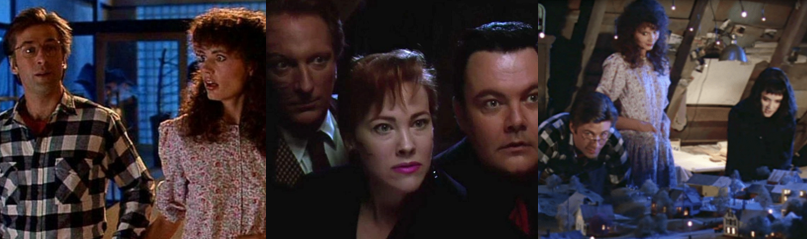
At its core, Beetlejuice Beetlejuice seems to be discussing the nature of grief. Lydia’s loss drove her to accept an unhealthy relationship in a moment of weakness and has effectively trapped her. That same loss caused Astrid to lose all respect for her mother, and grief similarly drives Delia to exaggerated forms of expression, like draping the house in a mourning shroud. This comes back to (literally) bite her when she’s fatally attacked by two asps she bought for a bizarre tribute to her husband, landing her in the afterlife, much to her chagrin. This was a very strange and uncomfortable moment, as was the Claymation sequence depicting Charles’ unnecessarily violent death. Like, I get it: Jeffery Jones did terrible things, but this just seemed unnecessarily spiteful and over the top. Similarly, death is apparently a subject we should be laughing at, according to this film, and can be played for a gag. That wasn’t really the case in the first one, where Adam and Barbara Maitland (Adam Baldwin and Geena Davis) died in a senseless manner, but it wasn’t played for laughs. Considering how violently Jeremy killed his parents and the continued twisted depiction of the souls stuck waiting for help in the afterlife, this choice just feels odd to me. The surreal nature of death continues when Richard spots Astrid in the afterlife and helps her and Lydia escape: he’s depicted as a half-eaten corpse with wriggling piranha still munching on him. Like, it’s kind of funny, I guess, but it makes these scenes more uncomfortable to watch than entertaining as beloved figures in these character’s lives are made into an undead mockery.

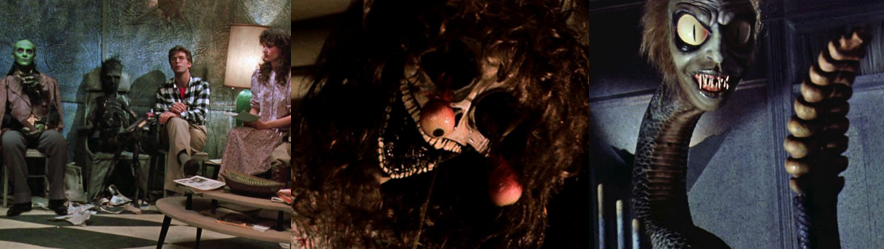
In the time between the two movies, it’s fair to say that Tim Burton has heavily leaned into his reputation as a quirky, gothic filmmaker and lost some of the grindhouse charm that made his early films so visually alluring. I give Beetlejuice Beetlejuice props for continuing to use practical effects, puppets, and filmmaking techniques wherever possible. It brings the strange afterlife to un-life in a very tangible way; oddly, however, the sandworms look worse here than before and seem more CGI than stop-motion. Still, we do get to explore more of the underworld that the last film, revealing that the dead take on various jobs after passing on (including cops and dry cleaners) and returning to the joke of them having to wade through red tape to get help. Beetlejuice has essentially franchised his services, presumably keeping him busy between films, but rather than actually see any of that, we’re left with dry scenes of him bossing about his employees. Keaton carries these moments, but I didn’t wait over thirty years to see Beetlejuice messing around behind a desk. He’s more himself when confronting Lydia and Rory, literally spilling his guts at one point, but this scene also repeats gags and moments from the first film, with him sewing Lydia’s mouth shut and terrifying Rory with a demonic visage. His character is expanded upon through some exposition into his past life as a graverobber and his relationship with Delores, but it’s a very odd sequence that goes on a bit too long and does little to make Delores an interesting character. Her look is great, as is her reassembling scene, but the only real threatening moment she has is when she sucks up poor old Bob. There was a great moment where Beetlejuice blows a hole into the afterlife and his employees escape into the real world. I thought this had a lot of potential to up the stakes but, instead, Wolf offhandedly mentions that they closed the breach, killing that plot thread. Then there were gags that just outlived their welcome. Like, Lydia rushes to stop Astrid being taken to “the great beyond” by the “Soul Train”. And that’s exactly what you think it is; the joke lands and you can imagine what that means. But no, we need not one but two extended sequences where the undead jive about to soul music and Burton hammers home that he’s making a pun about Blaxploitation.
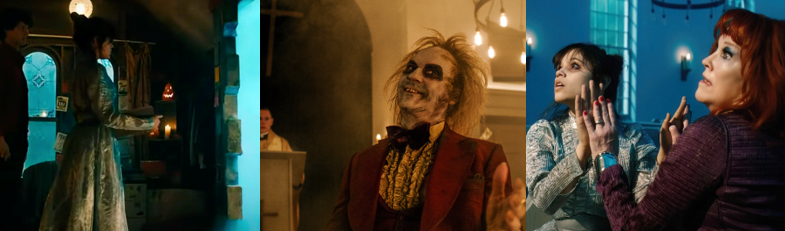
Lydia’s venture into the afterlife sees her reunite with Richard and rescue Astrid; however, it’s Beetlejuice who facilitates this as he surprisingly keeps his word and intercepts Jeremy, sending him to Hell before he can escape to the real world. The realisation that her mother was right all along, and getting some closure in seeing her father again, mends the bridges between Astrid and Lydia. However, Lydia begrudgingly agrees to marry Rory regardless since she’s still stuck in that co-dependent relationship. Luckily, her agreement with Beetlejuice solves that problem as he shows up to stake his claim to her hand, leading to one of the best moments of the film where he forces the influencers Rory invited to the wedding to be sucked into the phones they gawk at so often. As per the contract, neither Lydia or Astrid can speak Beetlejuice’s name, meaning he’s free to enchant everyone present into an extended sequence where they all mime and dance to Jimmy Webb’s “MacArthur Park”. Like the “Soul Train” nonsense, this bit just went on way too long; rather than recapture the magic of the similar scene from the first film, it hijacks the finale and derails the pacing. Perhaps if Wolf and Delores’ scenes had happened earlier, making them a part of the proceedings, it might’ve worked better, but it felt like it was never going to end, and the joke wore itself out very quickly. Wolf’s easily subdued by Beetlejuice’s immeasurable powers, though he falters when Delores comes barging in for revenge, a desire I get but it also feels like he would want revenge on her more since she tricked and poisoned him. Anyway, it doesn’t matter as he distracts her with Rory and Astrid just draws a portal to Saturn’s moon to summon a sandworm to devour Delores and Rory (a strangely harsh comeuppance) and rehash the first film’s ending. Though briefly sad to say goodbye to Delia, Lydia’s emboldened by her renewed relationship with Astrid and being free from Rory’s leeching influence; she confidently banishes Beetlejuice once more and quits her job to spend more time with Astrid. However, the film ends with a really shocking nightmare sequence where Lydia dreams of Astrid violently giving birth to a baby Beetlejuice and still being haunted by her memories of the cackling demon in a sequence atmospherically at odds with the rest of the movie, but which might’ve helped spice up the second act if it had been shuffled in there.

The Summary:
I was cautiously optimistic heading into Beetlejuice Beetlejuice. While my relationship with legacy sequels is more miss than hit and I resented how long it took for the film to be made, I was attracted by my love for the first movie, Michael Keaton’s energetic performance, and by how cute Jenna Ortega is. These elements are the strongest parts of the film; Keaton carries the entire movie, salvaging even the strangest sequences and being the most enjoyable part. It feels like Beetlejuice is more of a focal point this time with all the different, halfhearted plot threads revolving around him in some way, but he’s strangely handicapped in ways he wasn’t before, robbing him of any monstrous transformations. Jenna Ortega does a great job as the hurt, resentful Astrid and I enjoyed her budding romance with Jeremy. It was obvious he was going to be a ghost but I didn’t expect him to be a psychopath, but then this plot gets dropped and forgotten about. The whole Delores sub-plot felt wasted to me, too; it added unnecessary backstory to Beetlejuice and didn’t factor into the finale. Characters like Jeremy, Delores, and Wolf (as enjoyed as he was) actually detracted from Beetlejuice’s presence. Like, maybe the film would’ve worked better if Beetlejuice had masqueraded as Jeremy, luring Astrid to the other side to bait in Lydia. Beetlejuice’s threat could’ve then replaced Delores wandering about and Wolf’s pursuit of him, tying into his visions haunting Lydia and making Beetlejuice a vicious, spiteful (and, crucially, sole) antagonist. I wasn’t impressed with how far the film went to bury Charles’ character; Burton beat us over the head with this to the point where it was awkward, not amusing. In fact, the whole movie is uncomfortable in a lot of ways, lacking a lot of nuance and subtlety and viewing like a bad parody of the first film. Jokes and sequences that worked so effectively last time and dug up and puppeted around gratuitously for no reason. The nostalgia was already there with the returning actors and atmosphere, but it felt like everyone was trying too hard to recapture lightning in a bottle and there were too many cooks in the kitchen offering ideas and gags. In the end, Beetlejuice Beetlejuice just wasn’t worth the wait; the visuals and some performances are there, but the execution was lacking and it seemed to go out of its way to not live up to its potential.
My Rating:
Could Be Better
Were you also disappointed by Beetlejuice Beetlejuice? Did you find the tone and jokes to be oddly disjointed? What did you think to Michael Keaton’s return to form? Were you also disappointed to so many of the plot threads fizzled out? What did you think to the expanded depiction of the afterlife? Would you like to see another Beetlejuice film? Feel free to share your thoughts on Beetlejuice Beetlejuice in the comments below.





 Dr. K's Waiting Room
You must be logged in to post a comment.