
January celebrates two notable dates in science-fiction history: “National Science Fiction Day” on January 2 to coincide with the birth of world renowned sci-fi writer Isaac Asimov, and 12 January being when Arthur C. Clarke’s HAL 9000 was created. Accordingly, I dedicate January to celebrating sci-fi in all its forms.


Released: 8 August 2017
Originally Released: 1 March 2010
Developer: Inti Creates / Capcom
Metacritic Scores: 81 / 8.3
Also Available For: Nintendo Switch, Nintendo Wii, PlayStation 3, PlayStation 4, PlayStation 5, Xbox 360, Xbox One, Xbox Series S
Quick Facts:
In 2008, Mega Man godfather Keiji Inafune and Inti Creates returned the series to its 8-bit roots with a throwback title lauded for its old-school aesthetics and notorious for its abhorrent difficulty. Sales impressed enough for a sequel, which continued the 8-bit aesthetic but included an “Easy Mode” to make it more accessible. Alongside the returning Proto Man, Mega Man 10 added rival robot Bass in additional updates alongside new stages based on the Game Boy titles, and this downloadable content (DLC) was included in the second Legacy Collection. Mega Man 10 was well received and praised for its gameplay and accessibility, stage design and music, and how it improved on the previous game, though it was criticised for being too familiar and too short by some.
Gameplay and Power-Ups:
Like its predecessor, Mega Man 10 is a throwback to the 8-bit glory days of the Blue Bomber, though without all the distracting sprite flickering and slowdown. You battle eight initial stages and their “Robot Masters”, acquiring their “Special Weapons” before tackling Doctor Albert Wily’s latest death trap lair. Mega Man still sports a very stripped back arsenal, unable to slide, charge his shot, or gain additional armour as these abilities are divided between the other playable characters. All three have the same basic controls which, by default, see you firing your currently equipped weapon with X, unleashing a rapid-fire attack with B, and jumping with X or Y. Jumps are noticeably floaty when underwater or in space and players still replenish health and Special Weapon ammo by collecting capsules. While you can switch between Mega Man’s Special Weapons from the “View” menu, the Left and Right Bumpers allow for quick switching again and you can now save and visit the shop at Doctor Thomas Light’s lab from the stage select screen and after clearing every level (even Dr. Wily’s stages). You spend the screws you’ve collected on special items, such as restorative Tanks, 1-ups (both also found in stages) and helpers like Beat and Eddie (who save you from bottomless pits or dish out goodies, respectively). You also grab single-use items that protect you from spikes or double the damage you take, and an item that automatically refills whichever Special Weapon has the least ammo. The shop is much cheaper than in Mega Man 9 (though I was playing on “Easy Mode”) but also somewhat redundant as Mega Man 10 is noticeably easier. When in the “View” menu, you can activate your Tanks to refill your health and/or ammo and call upon Mega Man’s robotic canine companion Rush to spring you to higher ground or carry you across pits (until you hit a wall or the meter runs dry).
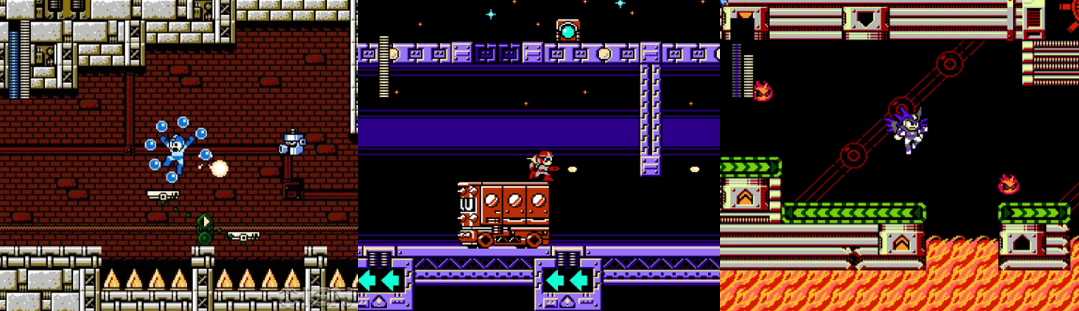
You can pick between Mega Man, Proto Man, and Bass from the start. Proto Man reflects projectiles with his shield, has a charged shot, and slides to avoid damage while Bass fires in all directions (when standing still), dashes, and combines with his robot dog, Treble, to don powerful armour. Bass is the weakest, however, and only Mega Man uses the returning Special Weapons from the Game Boy-inspired games. Special Weapons have little functionality outside of boss battles (I mainly used the Commando Bomb to destroy certain walls) but they make fighting Robot Masters a joke if you attack with the right ones. As ever, their abilities will be familiar to long-time players: the Chill Spike fires a freezing shot that leaves icicles on the ground for a short time, the Wheel Cutter sends buzzsaws travelling across every surface, and the Commando Bomb explodes and sends shockwaves on impact. The Triple Blade is a useful three-way shot, the Rebound Striker bounces about hitting anything in its path, and the Water Shield protects you and fires in a spiral spread. The Thunder Wool was probably the most troublesome Special Weapon as the thundercloud can be easily dissipated by enemies before it fires its lightning bolt. Some Special Weapons drain faster than others, though “Easy Mode” features a handy additional power-ups that fully restores your health and ammo. “Easy Mode” also reduces the damage you take and adds floating platforms over pits and some spike beds, greatly reducing the difficulty. Blade Man’s stage features see-saw-like platforms that carry you over spikes and pits, the time bomb platforms from Mega Man 6 (Capcom, 1993) return to help (and hinder if you linger too long), and you’ll run on treadmills in Sheep Man’s stage to temporarily activate platforms.
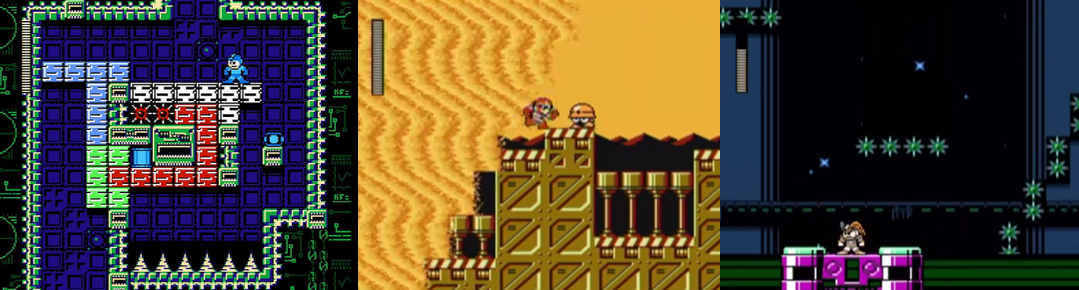
All the usual hazards return, including insta-death spikes, pits, flames, and slippery surfaces. Conveyor belts push you towards spiked walls in Solar Man’s stage, giant bubbles carry you to the same hazard in Pump Man’s stage, and shifting sand threatens to consume you in Commando Man’s stage. You must dodge or hop to speeding, kamikaze trucks in Nitro Man’s stage, drop down a few spike-lined shafts, and be sure not to linger when on Chill Man’s destructible ice cubes. Disappearing and reappearing blocks also show up (though you can usually use Rush Jet to bypass them), as do ladders and moving platforms. Sheep Man’s cyberspace-like stage features tetrominoes that disappear when you touch them (often dropping you to spikes or pits), Commando Man’s stage also features a unique sandstorm that pushes you along (and to your death if you’re not careful), and Pump Man’s stage sees you traversing pipes, having your jumps screwed up by falling water, and struggling against the flow of the murky underwater sections. Solar Man’s garish stage is more vertical, introducing fireball hazards from the walls and ceilings, and Dr. Wily’s fortress recycles most gimmicks to test everything you’ve learned. Dr. Wily’s tetrominoes and destructible blocks often lead to goodies, if you dare take the risk, and his third stage features a unique rising platform section where you must hop to pressure pads on either side to navigate insta-death spike fields. The see-saw platforms are underwater, where your jumps are floatier and you’re at greater risk of hitting insta-death spikes. When you climb ladders in his lair, enemies and hazards are placed to knock you off, though there are no horizontal autoscrollers or anxiety-inducing chase sequences to worry about here. Even the Legacy Collection 2’s janky-ass “save state” feature (which simply saves everything you’ve collected and returns you to your last checkpoint) is tolerable as Mega Man 10 is so much easier than the last game, meaning things are challenging but not frustrating and I enjoyed the chance to “get good” at the trickier sections. Die-hards can make things harder for themselves with “Normal Mode” or using Bass or Proto Man, but I’ll take a more relaxed “Easy Mode” any day over being needlessly stressed.
Presentation:
Like Mega Man 9, Mega Man 10 continues to ape the old-school 8-bit aesthetic of the NES games, though it seems the developers took more inspiration from the lauded Mega Man 2 (Capcom, 1988) this time. The sprites, especially in cutscenes, seem more basic than Mega Man 9’s and far closer to Mega Man 2’s. This doesn’t stop Mega Man 10 including nice, chunky, partially animated sprite art alongside its sprite-based cutscenes, though, with the story depicting Mega Man’s “sister”, Roll, getting sick and Dr. Wily first helping, then betraying, the heroes (only to be in their debt when he also gets sick). Mega Man’s sprite is otherwise unchanged from before, only blinking when idle and changing colour with Special Weapons, and still dramatically exploding upon death. He demonstrates each Special Weapon more thoroughly, however, the stage intros are a bit more detailed than before, and Proto Man even appears on the title screen. Mega Man 10 continues to showcase some super catchy chip tunes, nicely translates Bass from a 16-bit character to a chibi 8-bit anti-hero, and recreates the limitations of the NES even when it doesn’t have to (like placing larger bosses against a plain background, for example). Mega Man 10 is one of the rare Mega Man games to include five stages to Dr. Wily’s fortress rather than the usual four, thankfully separating the final battle against him to a unique area, one set about his ominous space station. Dr. Wily’s fortress is also bigger and more impressive than ever, the weapon select screen has been overhauled from the last game, and stages seem to be more detailed and varied compared to Mega Man 8, while still very much staying true to the simplicity of the NES titles.
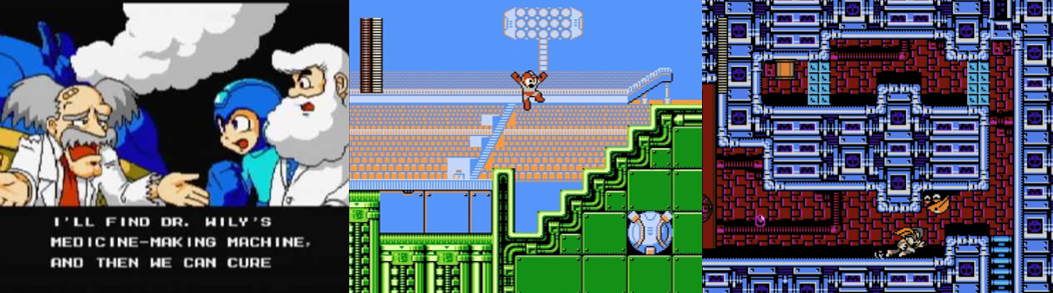
Chill Man’s stage is full of gleaming, slippery surfaces and features looming, frozen pyramids in the background, which turns to night and is beset by a thick snowstorm. Nitro Man’s stage boasts the twinkling night sky and a futuristic city background and is apparently set on a bustling highway as aggressive trucks speed from both sides. Commando Man’s stage initially echoes Pharaoh Man’s stage from Mega Man 4 (Capcom, 1991), starting as a scorching desert, though it quickly becomes clear the sand is littered with mines and plagued by sandstorms. Blade Man’s stage is a medieval castle, with cannons visible on the outer walls and banners, columns, and gaping windows set into the brickwork. Strike Man’s stage was the most impressive and unique as it’s set in a football stadium. You start on the pitch, with empty seats in the background, and battle past the surprisingly aggressive lockers, hop to basketball hoop platforms, and blast rocket-powered footballs to reach higher ground (or pass under them when they sport spikes). Sheep Man’s stage was a bit of a mess with its constantly shifting, cyberspace-like foreground, but I enjoyed the PC desktop theme seen throughout, especially in the Pointan enemies. Pump Man’s stage seems to be a cistern or dank sewer, featuring murky water and lots of pipes to jump to. Haiker N’s clog some of these and the underwater current can mess with your movements. Solar Man’s stage was by far the most garish, featuring a vivid and ugly red backdrop to a mechanical foreground beset by spinning gears, glowing pipes, and lava. The exterior to Dr. Wily’s fortress is drenched by an all-too-brief downpour and the inside is a mechanical hellhole that features previous gimmicks. As ever, these are the last visually interesting stages as it’s all just a mess of mechanical bits and bobs and unnecessarily loud colours, but stage five does feature a unique layout where the entire background is upside down due to the gravity. Oddly, there’s no gravity based gimmick here, though your jumps are floaty and the final battle does see the Earth hanging upside down for a fun visual.
Enemies and Bosses:
The hard-hat-wearing Metalls return with three variants: the regular spread shot Metall, ones that fly using propeller hats, and Numetall variants that spit sticky goo. The machine gun-wielding Sniper Joe from Mega Man 9 returns, still hiding behind his shield and jumping to fake you out, as do the jet-powered Shield Attackers. The floating Suzys are also back, as are Mega Man 2’s Molmoles (both are great for “farming” resources), Shrimparages, and annoying Sprinklans (which reflect your regular shot). New enemies include a fireball spitting robotic antlion hidden in Commando Man’s desert, a sound wave-firing totem pole found in Sheep Man’s stages and baseball throwing Mecha Pitchans in Strike Man’s stake. Sentient axes try to hack you in Blade Man’s stage, snowman-like Kaoa Geenos toss their heads in Chill Man’s stage, and heavily armoured Oshitsu Osarettsus await in Nitro Man’s stage. We’ve got weird robotic brains that link to turrets or little tanks, searchlight robots that screw with the direction of conveyor belts, floating and stationary cannons, mechanical flowers than unleash a charged laser blast, and relatively harmless cubes that multiply when hit. There are four mini bosses to encounter here, with two being recycled in Dr. Wily’s fortress. You battle a mechanical goalpost twice in Strike Man’s stage, riding its heavy fists to blast its head while avoiding being electrocuted, and hop to Tricastle’s spiked platforms to blast its eyes in Blade Man’s stage. Fenix and Suzak appear twice and are fought in tandem, with the robo-birds taking turns spitting flames and darting from side to side, as does the Octobulb. This is a pretty unique fight as you must run on a treadmill to power-up blocks to hop to so you can blast its lightbulb-like head, though you must be wary of its minions and the sparks it sends around the arena when the power runs out.
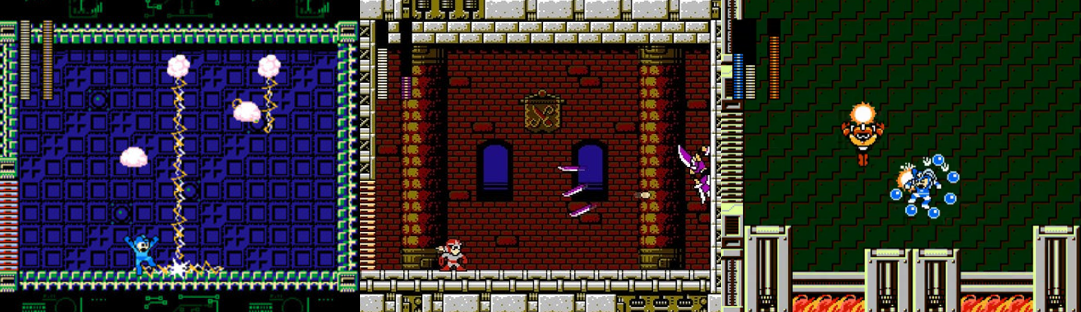
As always, Mega Man 10 can be made more challenging depending on the order you fight the Robot Masters, though many are so ridiculously easy that you can decimate them in a few hits with the right Special Weapon (on “Easy Mode”, anyway). I fought Chill Man first, who is weak to Solar Blaze, but your regular Mega Buster will do just fine. He leaps about firing his Chill Spike, which either freezes you or forms spikes if it misses. While this Special Weapons doesn’t travel too far, it’s more than enough to cool down Nitro Man, who races back and forth on his motorcycle and tosses his gear-like Wheel Cutter, which travels across the floor and up walls. This makes short work of Commando Man, a bulky sprite who stomps around firing his Commando Bomb at the walls or floor to cause a shockwave. While Blade Man impresses by clinging to surfaces, flinging his Triple Blade and darting at you like a missile, the Commando Bomb is all-but-guaranteed to hit him no matter how nimble he is. The Triple Shot is so overpowered against Strike Man that he barely got a chance to move, let along toss his ricocheting Rebound Striker shot! And good thing, too, as these balls can be troublesome to avoid as they careen off every surface, a mechanic that’s perfect for the bizarre Sheep Man. Sheep Man transforms into four storm clouds to fire lightning bolts and bursts with electricity when on the ground, but you won’t have to worry about picking which cloud hides the real Sheep Man if you toss a few Rebound Strikers. Although Pump Man is weak to the Thunder Wool, his Water Sheild and large hit box mean the attack can be dispelled before it can properly fire. Luckily, Pump Man simply hops about and fires an easily avoided spiral in mid-air, meaning you can just unload with the Mega Buster’s autofire mode. Like Strike Man, Solar Man was a joke with the Water Shield, which shreds him before he can even think about unleashing Solar Blaze. As always, each Robot Master is fought again in Dr. Wily’s castle.
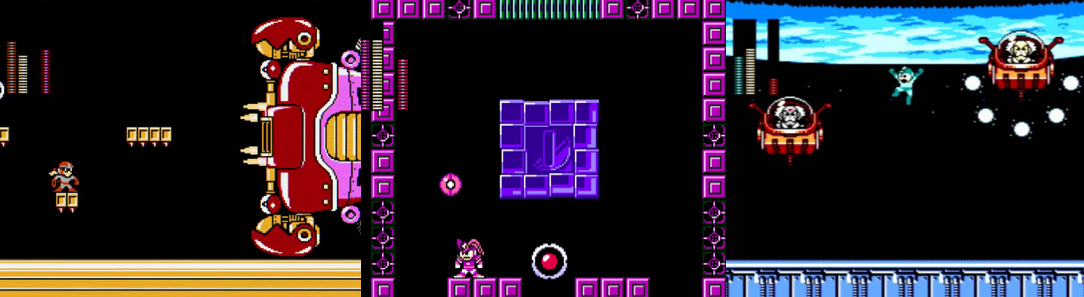
Dr. Wily’s stage also features three simulators that unleash drone mimics of nine former Robot Masters to try your new Special Weapons on, alongside a new version of the Yellow Devil. The “Block Devil” slowly assembles from the blocks surrounding you, which can be tricky to dodge and are immune to all damage. Once formed, it floats up and down and fires a big plasma shot from its central core, which must be hit with either Rebound Striker or Thunder Wool. This battle is more tedious than challenging since it involves a lot of waiting around for the Block Devil to assemble and disassemble. The Crab Puncher prior to it is much more interesting, being a big, cartoonish robot crab that shields its vulnerable eyestalks with its pincers (which can also be destroyed) and spits froth-like projectiles. The Commando Bomb and Thunder Wool work well here but you can also use the floating, spiked platforms to blast its weak spots. When you reach Dr. Wily’s fourth stage, you face a two-phase battle against his large, intimidating, skull-faced pirate ship-like craft. Though it sports a large hit box and fires homing missiles from its back, you can hop to the gigantic missiles that fire from its mouth to unload on the skull-like face with Solar Blaze. After enough hits, Dr. Wily’s cockpit is exposed and the ship regenerates its health, now flying overhead and firing spiral projectiles and devastating lightning bolts. These are easily avoided, however, and the Water Shield deals big damage to the cockpit (though Triple Blade also works). After beating it, you stock up on resources and head to Dr. Wily’s space station for the final showdown, thankfully one of the easiest of any Mega Man game I’ve played! The feverish Dr. Wily attacks in his UFO-like capsule alongside an obvious decoy, both firing plasma orbs, sending shockwaves across the ground, or firing a larger projectile between them. Though they teleport away pretty quickly, the lower gravity gives you the edge you need to get high enough to attack with the Chill Spike.
Additional Features:
In the original release of Mega Man 10, there were twelve Achievements up for grabs, but Legacy Collection 2 features only three (with you earning one for beating the game with each character). You get additional Achievements by taking on Legacy Collection 2’s “Challenges”, however, which remix stages and hazards from the four games and present time trials and boss rushes that I had no interest in trying to beat. Legacy Collection 2 also includes borders, filters, a music player, sound test, and extra armour to reduce the damage you take. There are additional challenges in Mega Man 10 as well, from simple stuff like running ahead, climbing ladders, and defeating bosses to trickier objectives like avoiding damage, dying, or playing without your helmet. You can make the game harder with “Normal Mode”, tackle it as either Bass or Proto Man, and play three “Special Stages” based on three of the Game Boy games. These act as a coda to the main game, charting Mega Man’s escape from Dr. Wily’s exploding space station, and see you acquiring Special Weapons from those games (the explosive Ballade Cracker, the Mirror Buster energy shield, and the arcing Screw Crusher) and using them against the so-called “Mega Man Killers”, Enker, Punk, and Ballade.
Final Thoughts:
Given how much I struggled with Mega Man 9, I wasn’t optimistic about Mega Man 10. Even when I saw the “Easy Mode”, I had my doubts as Capcom’s definition of “easy” differs greatly from mine. However, I was pleasantly surprised to find that Mega Man 10 is challenging, but not impossible, and vastly more enjoyable as a result. Every complaint I had about Mega Man 9 has been addressed, with the game offering more chances to save, use the shop (which is much cheaper), and being much fairer with its obstacles. Things can get rough, of course, thanks to the knock back and many bottomless pits and insta-death spikes, but it never had me tearing my hair out even if there weren’t any “Easy Mode” safety nets nearby. Although the Special Weapons continue to find their most use against Robot Masters and once again fail to be very imaginative, I liked that Mega Man, Proto Man, and Bass all played differently (though it might’ve been nice to swap between them at will). Mega Man 10 looked, played, and “felt” far more akin to Mega Man 2, rivalling that game with its soundtrack and level variety at times. While Solar Man’s stage is an eyesore, I liked Strike Man’s stadium-themed stage and Blade Man’s medieval castle. I was happy to see Rush Jet once again be a viable way to bypass obstacles, and that some stages featured alternative paths, and that the final boss was split into separate sections to make it less aggravating. The Robot Masters were as colourful and lively as ever, if far weaker than usual, though Dr. Wily’s defenders left a lost to be desired. Still, I had a lot more fun with Mega Man 10 than I was expecting as the difficulty curve is far more manageable this time around, making it a worthy successor to the NES classics.
My Rating:
Great Stuff
Do you agree that Mega Man 10 is superior to its predecessor, or did you find it too easy? Which character was your favourite to play as and what did you think of Mega Man’s new Special Weapons? Were you also glad to see the save function and shop be more accessible? Did you ever beat the game on “Normal Mode” and best the returning Game Boy bosses? Which sci-fi videogames are you playing this month? Use the comments section below to talk to me about Mega Man 10 and donate to my Ko-Fi to suggest more Mega Man content for the site.

 Dr. K's Waiting Room
One thought on “Game Corner [Sci-Fanuary]: Mega Man 10 (Xbox Series X)”