
January celebrates two notable dates in science-fiction history: “National Science Fiction Day” on January 2 to coincide with the birth of world renowned sci-fi writer Isaac Asimov, and 12 January being when Arthur C. Clarke’s HAL 9000 was created. Accordingly, I dedicate January to celebrating sci-fi in all its forms.

Released: 8 August 2017
Originally Released: 17 December 1996
Developer: Capcom
Metacritic Score: 6.9
Also Available For: GameCube, Nintendo Switch, Nintendo Switch 2, PC, PlayStation, PlayStation 2, PlayStation 4, PlayStation 5, SEGA Saturn, Xbox, Xbox One, Xbox Series S
Quick Facts:
After dominating Nintendo’s 8-bit consoles and successfully transitioning to 16-bit, Mega Man made the jump to the 32-bit era with Mega Man 8, with Keiji Inafune taking the helm following Tokuro Fujiwara’s exit from Capcom. The developers apparently struggled to adapt to the PlayStation hardware, and fought to keep Mega Man 8 2D. The game also featured tracks by J-pop band Ganasia and atrociously dubbed anime cutscenes by Xebec. Although Mega Man 8 sold well, reviews criticised its lack of innovation, uninspired visuals, and frustrating difficulty curve. While it inspired a spin-off title, Capcom chose to return to 8-bit visuals and gameplay for the next title.
Gameplay and Power-Ups:
Mega Man’s debut on the PlayStation and SEGA Saturn sticks so closely to the original 8-bit games that it could easily have been released on a 16-bit console with a few graphical adjustments. Aside from some visual changes and some voice acting and anime style cutscenes, the core gameplay is as familiar as ever, and actually a step back from Mega Man 7 (Capcom, 1995) and even some of the NES titles. Still rendered as an anime-style hero and wielding his “Mega Buster” arm cannon, Mega Man must tackle four new Robot Masters in whichever order the player chooses, then challenge four additional stages, and finally storm Doctor Albert Wily’s newest base, the Wily Tower. You’ll find Mega Man 8 more challenging if you tackle the Robot Masters at random as each one is vulnerable to another’s Special Weapon, which you acquire after defeating them and can, in some instances, be used to better traverse the environment. Like Mega Man 7, Mega Man 8 features an opening stage to learn the game’s controls, which can be customised but remain as simple as ever. The default setup sees you jumping with A or Y, firing your regular shot with X (or holding X to charge a bigger, more powerful shot), and utilising your currently selected Special Weapon with B. Mega Man can slide beneath enemies, projectiles, and through narrow passages by pressing down and A and can now swim by tapping A or Y. This does offer greater control when underwater, but it can be finicky as Mega Man’s quite an erratic swimmer! The Left and Right Bumpers let you quickly cycle through the Special Weapons you acquire by defeating Robot Masters, and these are manually selected from the in-game menu with the “View” button. Your Mega Buster comes with unlimited ammo and can even be fired in conjunction with your Special Weapons, but you’ll need Weapon capsules to replenish your Special Meter to use them. There are no Energy and Weapon Tanks this time, but you can still activate different shots and call upon Mega Man’s canine companion Rush from the main menu after defeating certain bosses.
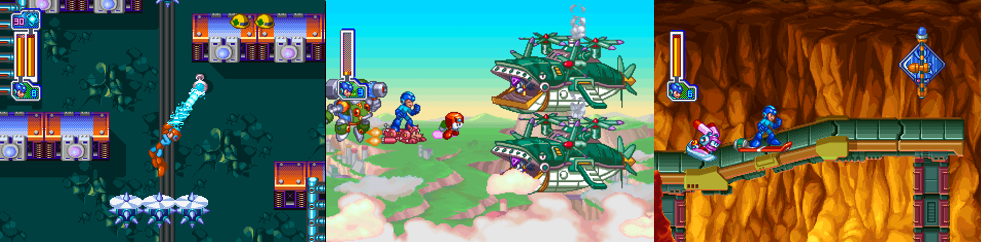
You can visit Doctor Thomas Light’s laboratory between stages to buy gear from Mega Man’s sister, Roll, using Bolts. These allow you to immediately exit any cleared stage, speed up your shots, slide, and ladder climbing, replace your regular shot with a piercing arrow or laser, reduce the cost of Special Weapons, and negate the pushback you receive when taking damage. Rush is significantly different here, allowing you to ride him like a motorcycle, gift random items, perform an airstrike, or continuously drop restorative items while his meter lasts. You can still use him to fly across stages, but only in specific areas, finally adding an autoscrolling shooter mechanic at the cost of keeping you from freely flying past hazards or springing to higher areas. Though Auto, Beat, and Eddie help blast incoming enemies when freed from capsules, Rush Health and Rush Item can only be summoned once per stage and I really felt the loss of Rush Coil and Rush Adapter as Mega Man 8 includes some dodgy platforming. There are eight new Special Weapons in Mega Man 8 and, in a change of pace, they’re surprisingly unique. The awkward Mega Ball can be kicked to ricochet around or bounced on to get higher, the Thunder Claw snags hooks to swing you across chasms, the Flash Bomb destroys enemies and illuminates dark areas, the Ice Wave freezes enemies and lava so you can briefly bypass hazards, the Tornado Hold allows you to float and move certain objects, the Homing Sniper locks on to nearby enemies, the Astro Crush rains meteors to clear the screen or break certain barriers, the Water Balloon damages anything caught in its bubbles, and the Flame Sword delivers fire damage up close and melts ice blocks. While I mainly saved these for the Robot Masters, they’re invaluable in Sword Man’s tomb and the Wily Tower as you’ll need them (mostly Thunder Wave) to progress. Finally, Mega Man 8 features aggravating jet-powered board sections, jumping gaps and sliding under obstacles, in some of the most frustrating sections! The screen scrolls awkwardly, making it very difficult to see what’s ahead, you’re giving little time to react, and your button presses often fail (though Astro Crush can help a little as you’ll briefly float when using it).
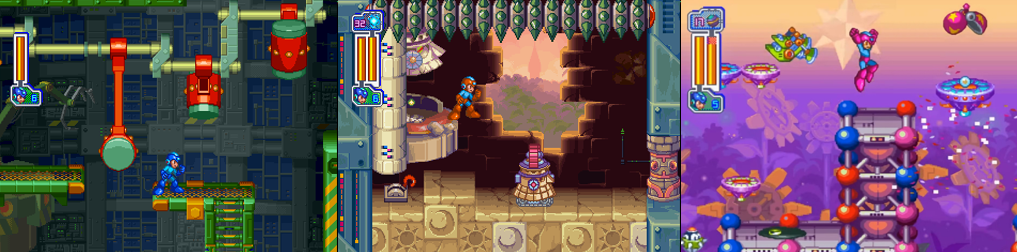
Naturally, all the usual hazards return, including various insta-kill spikes on walls, ceilings, and floors, insta-kill flame bursts that must be frozen, and giant mallets that knock you to your doom. Disappearing and reappearing platforms also return, fading in and out of reality at the worst times, as do various moving and spinning platforms and even ones that you must press switches to move. There are more switches than usual, too, activating Dr. Wily’s teleporters and moving weighted blocks out of the way. You’ll loop around maze-like catacombs, navigate past spiked mines in fragile bubbles, frantically jump and climb a mechanical tower as it descends into sand, and hop to timed explosive platforms up narrow shafts. Platforming is quite the chore in Mega Man 8, especially without Rush’s usual abilities. Some platforms are just out of reach or quickly fall out from under you, sometimes you must make pixel perfect jumps to precarious platforms, sometimes the Thunder Claw passes through hooks, and sometimes you must risk instant death by sliding and jumping for extra momentum. Ladders are sometimes just out of reach, you sometimes must force dangerous platforms to respawn alongside turrets and enemies to try again, and those autoscrolling sections move far too quickly to ever be fair. You’ll battle on rising elevators, get rid of destructible blocks (watching for pits and spikes as they appear), catch a ride off toy trains, fight against (or be aided by) blowing wind, and avoid crushing hazards as you go. Unlike previous Mega Man games, Mega Man 8 uses a save feature when you clear each stage, though it seems to force you to re-do the entire Wily Tower if you head back to the map screen between these stages. You can replay any stage using your new Special Weapons to find hidden paths and goodies, usually a Bolt to spend at Roll’s shop, though there are no hidden encounters with Proto Man or upgrades to find here.
Presentation:
Without a doubt, Mega Man 8 is the best looking 2D Mega Man game I’ve played so far. While Mega Man loses a few frames of animation compared to Mega Man 7, his body short circuits when he takes damage and he moves far smoother and has more personality than ever thanks to voice clips. The sprite-based cutscenes now bolstered by partially animated profile pictures and an infamous English dub that I found amusing and somewhat charming. The quality of these cutscenes might still be very outdated but they add a lot to this world and bring it even more in-line with its anime aesthetic, finally giving these iconic characters voices and personalities beyond story text. Mega Man sounds a little too young at times and Dr. Light sounds like he’s on the verge of a stroke, but these were fun and kinetic sequences that placed more emphasis on story than ever before. Mega Man’s rival, Bass, returns, with the two no closer to settling their differences, and even Proto Man helps in sticky situations. Sadly, the little tutorials and conversations between Mega Man and Dr. Light every time you get a new Special Weapon are gone, replaced by a somewhat impressive 3D model of Mega Man and some congratulatory text. Equally, while Mega Man 8 boasts a jaunty and unique techno-synth soundtrack, I can’t say I found any of the tunes all that memorable. I did like that the Robot Masters’ introductions featured voice clips and that they spawned into their arenas in a unique way, such as Aqua Man (not that one) emerging from the water and producing a rainbow displaying his name, Swords Sword Man cutting his way out of a statue, and Grenade Man blasting into the arena. However, while the game performs very well, with no slowdown due to the in-game action, screen and stage transitions are a bit jerky thanks to the PlayStation’s loading times.
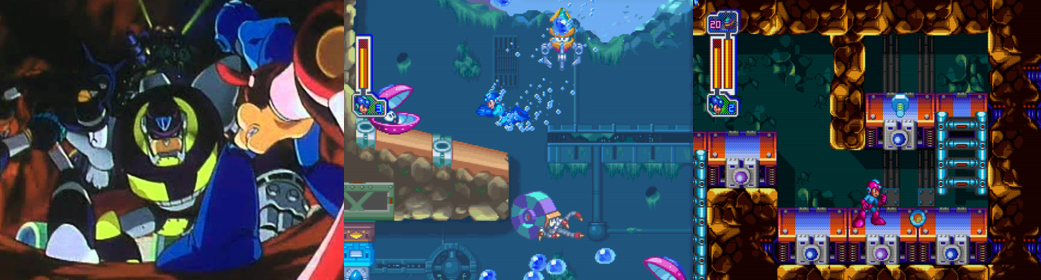
While there’s little on offer in Mega Man 8’s stages that wasn’t done to death in the previous games, Mega Man 8 offers the benefits of 32-bit hardware by…slapping some 3D models and prerendered textures in the backgrounds. To be fair, this does give stages more depth, colour, and life than ever, with overgrown wreckage seen in the background of the introductory stage, more foreground elements, and far more vibrant and detail environments in general, with blinking lights and moving parts prevalent. Grenade Man’s stage is a dangerous weapons factory, with giant 3D mallets swinging, explosive blocks everywhere, and even dynamite blocks that you must race across to avoid falling to your death. Frost Man’s stage is a flash-frozen city, with you traversing an icy highway (strangely with no loss of traction), ploughing through snow, and blasting past the bright city at night. Tengu Man’s stage is a series of floating pillars held aloft by propellers that features a wind gimmick. As you fly along on Rush Jet, a gigantic bird-like battleship sporting turrets looms through the clouds and you must gingerly fly through this to reach the Robot Master. Clown Man is fittingly in a wacky fairground stage where balloons float in the foreground, you fight through a toy factory so littered with moving foreground elements that they become distracting, and eventually navigate through a pirate ship attraction. After a brief interlude where Mega Man first encounters Duo in a rocky cave, it’s off to Astro Man’s surreal stage with its M.C. Escher-like backgrounds, giant mechanical sunflowers, and ladder maze. Aqua Man’s stage is almost entirely underwater, with a domed underwater city seen on the horizon, while Sword Man’s takes place inside a boobytrapped temple where you must utilise different Special Weapons to overcome obstacles and clear a path to the volcano-like interior. Search Man’s stage features a jungle theme, while the Wily Tower naturally mixes every gimmick and hazard and makes them ten times worse. Here, jet board sections are nearly impossible, walls and ceilings damage you on Rush Jet, and aggravating, often instant-kill hazards are everywhere in this mechanical hellhole that almost had me snapping my controller in two!
Enemies and Bosses:
As any long-time Mega Man player might expect, a fair few of Mega Man’s most recognisable enemies return here, in more detail and with improved animation cycles. There’s the Metalls, for example, who appear in the standard variant and a flaming version to spark dynamite fuses. The Bunby Tank returns from Mega Man 7 alongside Battons (with the vampire bat-like Succubatton draining your health with its bite) and a new Sniper Joe. These jump, hide behind their shields, shoot, and toss grenades, though they’re few and far between and easier to take out than previous Sniper Joes. Mega Man 8 also throws ice skating rabbits at you, bird-like robots that fly in swarms, grasshopper-like enemies that often hop between small platforms to mess up your jumps, and little toy soldiers that also drain your health when they latch onto you or hop from hot air balloons. Robotic snakes drop near-endlessly from holes, large flying whale-like battleships hover in the skies dropping Metalls and ice blocks, and three gorilla-like robots toss bombs, spiked balls, or giant boulders that double as makeshift platforms. Crocodile-like robots snap at you from holes in the floor, robotic dragons snake through the air, and shellfish-like robots float about underwater alongside oyster-like enemies that shield their vulnerable cores with their shells. Large cylinders float about dropping bombs and armoured rhinoceros-like Sydeckas fire missiles, but they’re nothing compared to the mini bosses that pop up. A floating mechanical eye awaits in Grenade Man’s stage, surrounding itself with and flinging debris not unlike Junk Man, the central core of Tengu Man’s battleship doubles as a laser cannon, a strange spinning disk with a lion’s face bounces around in Clown Man’s stage firing doubles of itself and little robots, a large fish-like robot emerges from a waterfall to ram you and destroy your log platforms in Aqua Man’s stage, and a gigantic, cog-like robot shoots fireballs in Sword Man’s stage as you desperately avoid a plunge into lava.
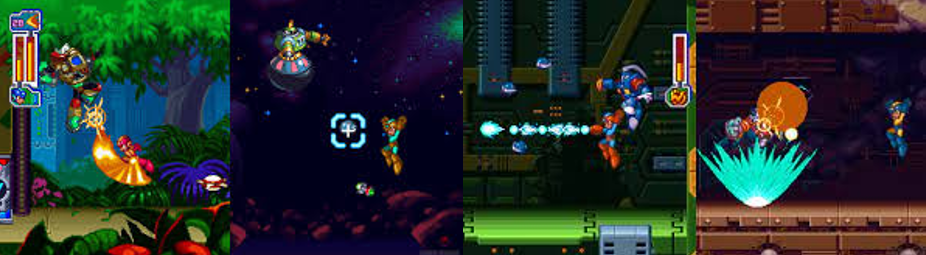
Your first test comes from a giant robot crab that requires you to awkwardly kick your Mega Ball into his weak spot (though Astro Crush basically one-shots it). Your best bet at tackling the game’s Robot Masters is to fight Grenade Man first as he’s very simple, using wall jumps, a dash, raining debris, and firing his signature Flash Bomb and being particularly weak to the Mega Buster. His Flash Bomb makes short work of Frost Man, a large but clunky robot who delivers a shockwave punch, tosses his Ice Wave, and whimpers when damaged. While the Ice Wave is very effective against Tengu Man, it’s tough to freeze him since he’s always flying and floating about, dashing in and flinging you into the sky for a somersault kick with Tornado Hold. This Special Weapon snatches Clown Man mid-swing and deals damage when he drops to send his Thunder Claw under the ground to grab you, though it might help to slide under his wild trapeze swings. Thunder Claw works pretty well against Grenade Man but I fought Astro Man next, who’s best fought with the Homing Sniper but the Flash Bomb is also good. Astro Man teleports about, flings small orbs to whittle down your health, and fills the screen with his signature Astro Crush. Despite its limited uses, this Special Weapon decimates Aqua Man, who fires a shot of living water that tracks across the screen, conjures waves, and shoots his destructible Water Balloon. These are great at taking out Sword Man, provided you aim at his torso. Sword Man leaps about swinging his Flame Sword, which cuts through the elusive Search Man, who hides behind bushes and takes cheap shots with his Homing Sniper. As ever, all eight Robot Masters are fought in the Wily Tower, this time in more unique arenas, though you’re also tested by Duo during the interlude. He sports a charged, explosive fist slam and ricochets about but is fought to a standstill as Proto Man interrupts the battle.
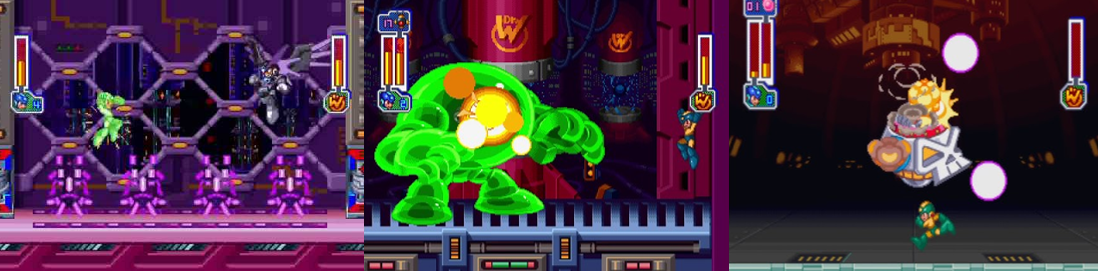
When in the Wily Tower, four additional mini bosses await, the first being a robotic penguin that requires the aggravating Mega Ball as you must perfectly position yourself to ricochet your shot up the shaft where Atetemino appears, avoiding the crates and missiles it drops. The Bliking aircraft is fought while on Rush Jet, so be sure to grab your other robo buddies to help. This thing fires screen-filling lasers and destructible mines and missiles, and can only be damaged (preferably with Astro Crush) when its wings are fully extended. Bass and Treble combine for a rematch, one far less taxing than Mega Man 7’s as he flies about, charges at you, fires his Mega Buster, and blasts a concentrated beam from above. The Yellow Devil is evoked by the Green Devil, who can only be damaged by blasting a hole to its mechanical core and firing your Flash Bomb or Thunder Claw. Thanks to it constantly deconstructing, summoning green waves and floor spikes, and filling the screen with its pieces, this is another exercise in tedium as you have such a small window of opportunity to strike. Success once again sees you battle Dr. Wily in a two-phase boss fight that’s far easier than the brick wall I ran into in Mega Man 7. Dr. Wily’s newest skull-like machine advances with a buzz-saw like appendage that it flings across the ground. This is easily jumped over, as are its charged laser beams and even its projectiles if you time your jumps right. You need to be quite close to hit it with the Flame Sword but the Water Balloon reportedly works quite well, too. True to form, Dr. Wily mans a UFO-like hovercraft for the final phase, one that teleports about the place and sends purple orbs out in a spiral or spread. While he’s often just out of reach, some of his shots home in, and he can rain Dark Energy into the arena, you should be able to finish him off with the Flame Sword (or, better yet, the Flash Bomb), especially if you still have Rush Health in reserve.
Additional Features:
Mega Man Legacy Collection 2 features twenty-one Achievements, with one popping when you complete Mega Man 8. You can also toggle various display options (screen size, borders and screen filters), view a character database and production art, activate “Extra Armour Mode” to reduce the damage you take, and take on additional challenges that have you play through remixed stages, boss rushes, and time attacks. Like the other games in the collection, Mega Man 8 lacks the rewind feature that would’ve made many of its more frustrating sections more tolerable and replaces it with a janky save state system that simply saves a new version of your last checkpoint rather than literally create a save state. Disappointingly, there are basically no secrets or collectibles in Mega Man 8 beyond the forty Bolts, and even those are difficult to amass in a single playthrough. While you can cobble together different combinations of items by visiting Roll, there are no new armours or additional weapons here, meaning there’s even less content than some of the 8-bit games! Incidentally, if you play the SEGA Saturn version (sadly not included in Mega Man Legacy Collection 2), you can battle Cut Man and Wood Man in Duo’s interlude and Search Man’s stage.
Final Thoughts:
Considering how much I struggled with Mega Man 7’s difficulty curve, I was apprehensive about tackling Mega Man 8, especially without the convenient rewind features. Thankfully, the final boss wasn’t anywhere near as much of an uphill battle and Rush’s new abilities made the lack of E- and W-Tanks more tolerable at times since Rush drops so many restorative items when summoned. Mega Man 8 makes a great first impression with its anime-style opening and colourful, detailed, vibrant stages. Sure, the voice acting is grating and ludicrous at times and the video compression is awful, but these cutscenes added a lot to the aesthetic and I was very impressed with the visual design of the stages. Unfortunately, Mega Man 8 is let down quite significantly by its gameplay. Not only does Mega Man sport no new abilities beyond his new Special Weapons, but he’s been robbed of many elements that made his games so much fun. I liked that we finally got autoscroller sections with Rush Jet, but I never expected to miss using Rush Coil and Rush Jet whenever I liked. The items in the shop weren’t very useful, it was disappointing that we don’t get to collect anything beyond Bolts, and those jet board sections can go die in a ditch! These sections are far too fast and punishing, often dangerously reducing your view space and requiring split-second decision making. The Robot Masters were fun and I liked the attempt to give the Special Weapons more versitality, but the Thunder Claw’s swing function was needlessly aggravating and the Mega Ball was a clunky and annoying addition. It’s such a shame as there was some real promise here but Mega Man 8 screws up even the most basic platforming mechanics with its janky controls and emphasis on pixel-perfect jumps, irritations only aggravated by the lack of a rewind function. Sadly, I’d say you’re better off sticking to the 16-bit games and even the later 8-bit titles as at least they offer collectibles, bonuses, and air-tight gameplay mechanics to make for challenging, but enjoyable experiences.
My Rating:
Could Be Better
What did you think to Mega Man’s 32-bit debut? Were you surprised to see Capcom stick to the 2D style of gameplay? Which of the new Robot Masters and Mega Man’s Special Weapons was your favourite? What did you think to Mega Man and Rush’s stripped back abilities? Did you also struggle with the jet-board and Rush Jet sequences? How are you celebrating the science-fiction genre this month? Whatever you thought about Mega Man 8, drop a comment below, go check out my other Mega Man reviews, and donate to my Ko-Fi to suggest more Mega Man content for the site.

 Dr. K's Waiting Room
One thought on “Game Corner [Sci-Fanuary]: Mega Man 8 (Xbox Series X)”