

Released: 29 June 2023
Developer: Yuke’s
Also Available For: Nintendo Switch, PC, PlayStation 4, PlayStation 5, Xbox One, Xbox Series S
The Background:
Once Scott Hall showed up on WCW Monday Nitro on 27 May 1996, the then-World Wrestling Federation (WWF) and World Championship Wrestling (WCW) engaged in a “Monday Night War” that defined a generation of wrestling fans. Things changed forever, however, when WCW went bankrupt and was absorbed by what’s now called World Wrestling Entertainment (WWE) and, despite some admirable efforts, the WWE has been the top dog of the American wrestling industry ever since. A true competitor arose in 2019, however, when Cody Rhodes, Kenny Omega, and Matt and Nick Jackson (with financial backing from Tony Khan) launched All Elite Wrestling (AEW). Not only was AEW an indie wrestling fan’s wet dream, but they also signed both undervalued wrestling stars and bona fide legends like “The Icon” Sting, who infamously defeated “Hollywood” Hulk Hogan for the WCW Championship on this day in 1997. AEW quickly established themselves as a true alternative to the WWE with action figures and merchandise, but it was the Jacksons who pushed for an AEW videogame, which immediately turned heads when Yuke’s (the developer behind some of the greatest wrestling games of all time) was brought in to develop the title. With the game engine being directly inspired by the celebrated WWF No Mercy (Asmik Ace Entertainment/AKI Corporation, 2000) and featuring a rare appearance by the late Owen Hart, the game promised to bolster its content with additional materials but quickly came under fire for its long development time. Despite downloadable content (DLC) trying to keep the game relevant, AEW: Fight Forever released with a strangely out of date roster and was met with mixed reviews. While the arcade-style, throwback gameplay was praised and innovative match types were praised, the main story and wrestler customisation options were criticised for being undercooked. However, the game sold well in the United Kingdom and Tony Khan promised to produce more AEW videogames in the future, leaving fans hopeful for an improved experience next time around.
The Plot:
When not competing in a series of customisable wrestling bouts, players take either a created wrestler or a member of the AEW roster on a year-long journey through the company’s biggest names and matches.
Gameplay and Power-Ups:
AEW: Fight Forever is an arcade-style wrestling title that plays very similar to the classic wrestling games produced by AKI, THQ, and Yuke’s back in the day, utilising a modified game engine and similar features of games such as the immortal WWF No Mercy. After customising their game card with icons, badges, and weapon decals, players are presenting with a laundry list of options befitting a wrestling videogame. You’ll probably want to explore the game’s options and settings first, where you can view various in-game statistics (wins and losses and such) and records, check out the current leaderboards, and toggle various options, such as the blood, entrance effects, casual play, and tutorials. As should be expected, the game offers a training mode where you can test out the initial fifty-strong roster, setting the computer-controlled opponent to different behaviours and positions to test different moves. Unless you disable in-game tutorials and hints, wrestling legends like William Regal, Jim “J.R.” Ross, and Taz chip in with insights into specific game mechanics or match types. Although the game’s controls are fully customisable, I managed fairly well with the default layout, which maps your high strike and kicks to X and Y, your grapples to A, and run to B. By holding A, X, or Y, you execute a strong attack or grapple to deal additional damage, while tapping the strike buttons executes a quick combo. You can also hit A, X, or Y while running for a running strike or takedown, attack enemies when they’re down in the same way, and swing the game’s various colourful weapons with X or Y. The right stick is used for taunting, which builds your momentum bar, allowing you to maintain stamina and execute signature and finisher moves (using the D-pad or the right stick, as prompted). If you’re covered or locked in a submission hold, mash the face buttons to try and kick or wriggle free, and mash them when locking in a submission to wear down your opponent’s body part or score a tap out victory.
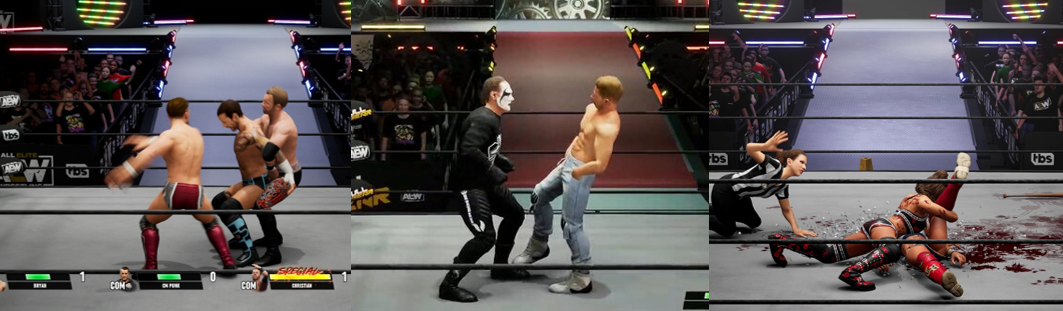
Each wrestler has at least one signature and finisher move, though some have more if they have a certain “Skill” equipped. You must pull off a successful taunt to activate your “Special” status, which allows you to hit as many finishers as you like until the status fades. These are performed from different positions (from a lock up, or the top rope, or when the opponent is down, etc), so be sure to review your wrestler’s moves from the pause menu. Once your opponent is down, press the Left Trigger to pin or the Right Trigger to pick them up. Grappling and pressing RT whips your opponent into the ropes, corner, or ringside equipment, and the Left and Right Bumpers are used for countering. This can be tricky as there’s no onscreen indicator for when to counter. Simply mashing the triggers doesn’t work either, so it’s all about timing. Skills also afford you temporary buffs, such as landing the first strike or doing a taunt, while others increase your versitality, such as adding springboard attacks and a quick kip up to your repertoire. You can increase the amount and strength of your finishers, buff your finisher countering ability, increase your resistance to submissions, power out of pins, and even steal your opponent’s finisher. When tagging with a partner, you can bring them in with LT and perform double-team moves to wear down your opponents. You can also exit the ring and throw your opponent into the steel steps, ring apron, ring posts, and barricade to deal additional damage. When you hit your signature moves or finishers, you’re treated to a replay, and a helpful picture-in-picture feature shows who’s coming out to interfere for or against you. You can assign a manager to even the odds, bust opponents open, and even utilise weapons in some matches. When playing “Road to Elite”, you must watch your health as you’ll be injured if it drops too low or you overexert your workouts, requiring you to visit the hospital. In matches, your wrestler holds damaged body parts and becomes disorientated from eye rakes and eye pokes, screwing up your controls for a short time.
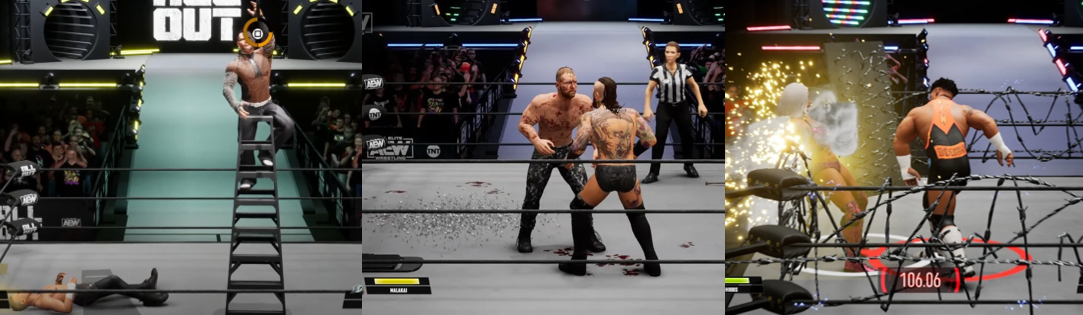
There are a decent variety of match types here, from standard one-on-one matches to tag team bouts and multi-man matches. AEW: Fight Forever offers intergender matches, allows you to challenge for or defend AEW Championships, and manually change the champions if you wish. While you can’t alter the settings for every match, you can select additional options from each category, such as the “Lights Out” match (which adds weapons to the ring) and “Falls Count Anywhere” match (where you can pin outside the ring). Weapons are picked up, snatched from the crowd, or retrieved from under the ring with RT and break after a few uses but there are a lot of them here. You can set up and smash opponents through tables, swing baseball bats, steel chairs, and barbed wire implements alongside throwing football helmets, rideable skateboards, and covering the canvas with thumbtacks. Tag team matches can be a bit of a pain, especially if you’re not controlling your partner, as the CPU gets very aggressive when going for a tag and their partner often interrupts pins or hits double team moves. Your best bet is to down your opponent and then knock their partner off the apron or strategically pin your foe near your corner. Similarly, multi-man matches can get extremely chaotic as the game’s targeting is atrocious, either automatically switching to whoever it feels like or messing up your manual aim. “Road to Elite” features gauntlet matches where you battle three opponents in succession, handicap matches, and singles matches where your opponent’s allies will interfere to beat you down, all without a disqualification. Surprisingly, there’s no steel cage match, but you can play a ladder match, setting up a ladder with RT, holding B or LT to climb, and mashing buttons to whittle down a wheel and claim victory. Be careful, though, as the CPU may steal your victory if you get the wheel down to the last section and they make a successful climb.
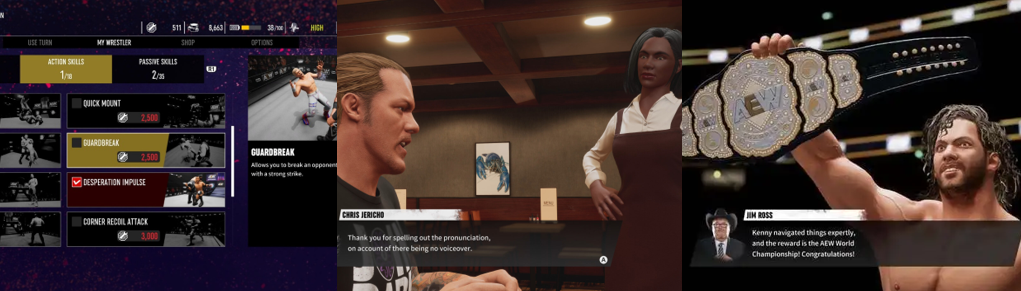
AEW: Fight Forever is notable for a couple of fun and unique gimmick matches, with the “Exploding Barbed Wire Death Match” being a particular highlight. In this match, the ring ropes are replaced by barbed wire, barbed wire tables are in each corner, and you have 120 seconds before the ring explodes, causing major damage to anyone near the ropes. You can toss and hit your opponent into the barbed wire to literally flood the canvas with blood, and set off explosions, which was a lot of fun. The “Casino Battle Royale” was less enjoyable for me and far less unique, essentially being a traditional Royal Rumble with a wacky name and having you pick a playing card to determine your position in the match. The goal is to wear down your opponents (up to twenty-one) so you can toss them over the ropes to win, gaining a title shot in “Road to Elite”. This is the game’s story mode, where you take any AEW star (or a custom wrestler) on a year-long story, making friends and enemies and winning championships as you go. Win or lose (and it’s fine to lose matches here), you’ll earn AEW Cash to spend in the in-game shop and Skill Points to spruce up your custom wrestler. AEW Cash can also be spent on better hospital treatment or buying items to boost your health, momentum, or Skill Points. Between matches, you’re given four “turns” to either workout, see the sights, eat, or do other bizarre tasks like press conferences and talk shows. If you work out, you’ll lose energy but gain momentum, but also risk getting injured. Eating restores your health, as do some other tasks, and seeing the sights increases your chances or meeting other wrestlers. There are multiple story paths to experience, all triggered at random, with you forming tag teams, being betrayed, joining or battling against one of AEW’s many factions, and vying for the company’s top prize. It’s a decent mode, but quite short to invite replays and can get repetitive as you have little control over what you’re doing outside of a match (save for a few dialogue choices). You can take selfies with AEW stars for your collection, sometimes endure horrendous gauntlets or fight while injured, and play a bunch of weird mini games for additional points.
Presentation:
AEW: Fight Forever generally impresses with its visuals, particularly the wrestler models. Unlike the WWE videogames, AEW: Fight Forever opts for a slightly exaggerated, action figure-like aesthetic not unlike WWE All-Stars (Subdued Software/THQ San Diego, 2011). Each AEW star closely resembles their real-life counterpart, even down to their in-game grunts and taunts (with Sting howling and “The Machine” Brian Cage shouting at the crowd), though the game was noticeably outdated at launch and is even more behind the times now. The women, especially, come off really well, which is nice to see as they often look monstrous in the WWE titles, and each has their accurate entrance music, including “Le Champion” Chris Jericho coming out to “Judas” and CM Punk using “Cult of Personality”. Unfortunately, AEW: Fight Forever opts to use truncated entrances like WWF No Mercy. While you can press buttons to activate pyro and other effects, this may be disappointing to some (not me, though, as I always skip entrances anyway). However, I was disappointed by the lack of commentary, even for signatures and finishers, opting for a customisable soundtrack instead, which was a shame. In fact, voice acting is very sparse, with the odd sound bite or insight cropping up now and then but the game primarily relying on text and dialogue boxes. While it obviously helps make the random story paths more manageable, it does come off as a little cheap, similar to when you visit various landmarks in “Road to Elite” and are met with laughably low quality still images. I occasionally saw some texture warping during these cutscenes as well, and some graphical glitches (such as entrance weapons disappearing). Similarly, there aren’t many options for wrestler customisation and skins, with only a handful of AEW stars having true alternate looks. However, I would say AEW: Fight Forever looks and performs far better than a lot of recent WWE games, likely because it’s a far simpler and stripped back title.

If the trimmed entrances and lack of commentary didn’t give this away, the barebones arenas sure do. On the one hand, I’m not all that fussed as the arenas are largely superfluous and their presentation does recall the likes of WWF No Mercy. On the other hand, this game came out in 2023, so I’d expect the crowd to look less basic. The audience is seeped in darkness and indistinguishable most of the time, though the fans are very loud and add a lot of ambiance to matches. There are only a handful of arenas here, though, so things can get visually repetitive very quickly. You can build your own custom arenas, but I find these always look stupid and this isn’t helped by the weird fixtures, decals, and colour schemes the game offers. Strangely, AEW: Fight Forever doesn’t allow for backstage brawling, with no backstage areas included, or brawling in the crowd, which is just bizarre. The Exploding Barbed Wire Death Match adds some visual variety, and the “Stadium Stampede” DLC shows what the game could be capable of, but the developers apparently thought it more important to waste resources on weird-ass mini games. These see you playing baseball, participating in quizzes, collecting tokens, shoving opponents from the ring and onto coloured balls, matching Penta El Zero M’s movements, smashing coloured boxes, and running across football fields avoiding hidden holes. These certainly add some visual variety, but they’re so out of place that it’s like the developer’s notes got mixed up. Similarly, you’ll see cutscenes of your wrestler working out, chatting, visiting the hospital, getting beaten up, or meeting fans when playing “Road to Elite”, all things that are certainly different and fitting for a wrestler’s lifestyle but seem out of place. Finally, live-action footage, clips, and voice overs interspersed through “Road to Elite” show key moments in AEW history, which was nice, though you oddly don’t recreate many of these moments as you play.
Enemies and Bosses:
Naturally, every wrestler on the roster is your enemy, even your allies. While every wrestler controls and fights the same, with a set number of moves and abilities, your strategies may alter depending on who you fight. As each wrestler has multiple Skills, it’s worth becoming familiar with them as it does impact your play style. Custom wrestlers will set and refine these in the “Road to Elite” story mode, AEW stars have theirs set and cannot change them, and some even have unique Skills, such as “Freshly Squeezed” Orange Cassidy’s “Sloth Style” where he fights with his hands in his pockets. “Mr. Mayhem” Wardlow snatches guys out of mid-air, Powerhouse Hobbs briefly becomes immune to strikes, Maxwell Jacob Friedman/MJF bails out of the ring, and “The Bastard” Pac evades strikes and grapples with cartwheels and rolls. Similarly, you must adapt to superheavyweights like “No More B.S.” Paul Wight as undersized wrestlers will struggle to perform their usual moves due to the weight difference. Highfliers like Rey Fenix are smaller and more agile, often striking fast, quickly countering, and flying from the top rope. Jon Moxley lives up to his reputation as an insane brawler by focusing on strikes and excelling in hardcore environments, guys like “The American Dragon” Bryan Danielson are more technical, sporting a repertoire of submission holds and take downs, and career tag teams like Matt and Nick Jackson (The Young Bucks) have flashier double team moves to keep you off balance. In many cases, you can simply wait out or fight through your opponent’s unique skills, such as spamming combos on Wardlow until he starts feeling them and avoiding the top rope when facing opponents with the anti-air Skill.

Some competitors (particularly custom wrestlers) may surprise you, however, as even smaller wrestlers can counter mid-air attacks or finishers. Generally, your opponents are only as difficult as you set the game and the match type dictates. For example, a 4-Way match pitting Darby Allin against Luchasarus, “The Redeemer” Miro, and John Silver will be an uphill battle for the colourful daredevil. Similarly, tag team matches can be a chore as the opponent’s partner constantly rushes the ring, just like in the old AKI games, and the Casino Battle Royale can end in an instant if you’re jumped from behind. Sometimes, your opponent’s attacks land faster and with more accuracy than yours but, other times, they simply stand there like a goober. The more you beat your opponent, the weaker they become, but the momentum bar charges ridiculously fast, and the match can change on a dime if your opponent gets a few good hits in or activates a buff. Generally, opponents rush you once the bell rings, so be ready to counter their attack…if you can get the timing of the blocking down. When playing “Road to Elite” on “Easy”, I found matches fluctuated. While I easily dominated most opponents, winning with a single finisher or even regular moves, others proved surprisingly aggressive, such as MJF with his dirty tactics and Pac, with his odd combination of speed and strength, yet I absolutely crushed Paul Wight, destroyed Chris Jericho, and easily toppled champions. This is true even in multi-man matches as you can get into a rhythm of wearing down a specific opponent (or keeping an eye on who’s taking a beating) and time your pins to happen as the other opponents are distracted for an easy win. “Road to Elite” got annoying for me simply because many paths push you into tag matches or gauntlets, and due to its random nature. You can access different paths and matches with different wrestlers, even competing in a Exploding Barbed Wire Death Match and battling a shadowy reflection of your wrestler in certain paths, and your opponents seem to be randomised each time to mix things up, though your general strategy of wearing them down to score a win remains the same.
Additional Features:
There are thirty-eight Achievements up for grabs here, which sounds like a lot but they’re surprising simplistic. Thankfully (but oddly), none of them are tied to online play. You’ll get an achievement for clearing “Road to Elite” once and then ten times, others for creating a custom wrestlers or competing in a custom arena, and another for winning a championship in an exhibition match. There’s an Achievement for buying an item, another for hitting a signature and finisher and scoring a victory, and another for hitting an opponent with a barbed wire bat in a “Lights Out” match. If you successfully perform certain tasks in “Road to Elite” (such as eating and working out), you’ll get more Achievements, and there are Achievements for utilising certain Skills in matches. Nothing too taxing, which is nice, but the Achievements also lack a lot of creativity and encourage repetition rather than replayability, which are two different things. There are additional “Challenges” too, daily, weekly, and untimed normal challenges. These award AEW Cash for defeating opponents, challenging harder difficulties, and performing a bunch of moves over time (such as 100 running attacks). It’s something to do, I guess, but hardly that innovative compared to other games. As you’d expect, you can go online to play in ranked, casual, and private matches. Sadly, you cannot download custom wrestlers or arenas, which is very surprising but hardly a big loss considering how lacklustre the game’s create-a-wrestler is.
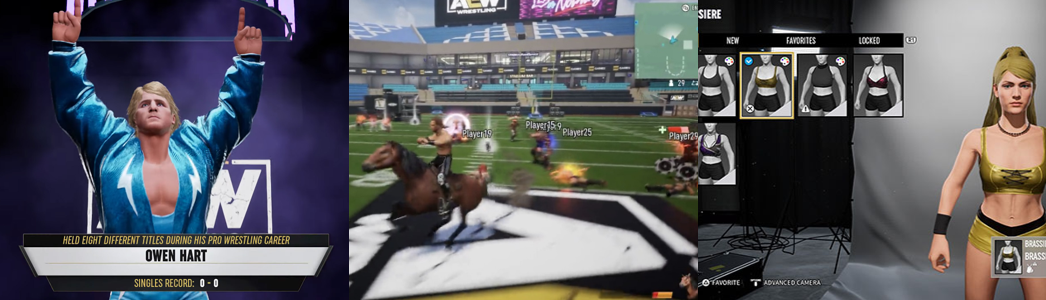
The create-a-wrestler mode is so lacking that it’s inferior to even WWF No Mercy, reminding me more of the laughable options seen in WWF WrestleMania X-8 (Yuke’s, 2002). You’re limited to picking set expressions and altering the basics of your wrestler’s appearance rather than changing every aspect, are given a paltry selection of clothes and accessories focused more on patriotic attire than AEW gear, and have so few options that it’s basically impossible to create current AEW stars. While there are a lot of names and moves to pick from and entrance options, it’s all disappointingly barebones, with even the shop offering little extra content. Team entrances are especially limited, it bugged me that I couldn’t even put a vest on my wrestler without picking a body suit, and it’s almost insulting how few options there are for masks and face paint. You can modify the AEW roster, but the options are again incredibly limited, meaning you can’t rejig “The Natural” Dustin Rhodes to look like Goldust. The create an arena is just as pointless, I couldn’t care less about the unlockable badges and such, and there’s little incentive on spending real-world money for the DLC wrestlers unless you simply must have Adam Copeland on your roster. They do add additional skins and moves, to be fair, and the “Stadium Stampede” mode (which is free to download but you need a subscription to play). This is a bizarre free-for-all arena battler where you compete against thirty other players on a football field, utilising horses, golf carts, and abilities, attacking enemies for poker chips to level-up your character. Lastly, you can use AEW Cash to purchase “The American Nightmare” Cody Rhodes and referee Aubrey Edwards, and unlock Paul Wight, “The Exalted One” Mr. Brodie Lee, and even the legendary Owen Hart by playing specific paths in “Road to Elite” for the former or winning 100 exhibition matches for the latter.

The Summary:
While I generally enjoy the WWE videogames put out by Visual Concepts and 2K, it has to be said that the formula has become very stagnant over the years. The games are great simulations of the televised product, but I miss the fast-paced, action-orientated arcade style of the good old days, when WWF No Mercy captured my attention for hours on end. I’m also a fan of AEW and seeing them try something new, so I was excited to get AEW: Fight Forever despite all the negativity surrounding it. On the surface, it delivers what I wanted: simple, pick-up-and-play arcade action that recalls the AKI/THQ wrestling games of old, updating those mechanics for modern gamers. Playing matches is a lot of fun, with moves being simple to pull off, the game performing really well, and a great deal of satisfaction coming from every victory. I liked that “Road to Elite” was quite varied and encouraged replays with its different, random paths, and that it tried something new by mimicking a wrestler’s lifestyle. Unfortunately, the game is handicapped by barebones options, with perhaps the worst create-a-wrestler I’ve seen for some years and nothing worth unlocking apart from a couple of extra wrestlers. The focus on ridiculous mini games was a bizarre choice that adds confusion and tedium rather than variety, and it was disappointing to have so little control over “Road to Elite”. While the game mirrors WWF No Mercy in many ways, content is not one of them, with key elements omitted from popular game modes for absolutely no reason. The Exploding Barbed Wire Death Match was a great inclusion and this was probably the first time I’ve enjoyed a ladder match in years, but there are surprisingly few match types to pick from, the roster is severely outdated (with basically no way to update it through the creation suite), and some matches and CPU behaviours can be needlessly frustrating. It’s a shame as there’s a lot of potential, but it seems the lengthy development time got strangely side-tracked with unwanted features (those damn mini games) rather than offering a truly memorable alternative to the WWE’s videogames.
My Rating:
Could Be Better
Did you enjoy AEW: Fight Forever? What did you think to the throwback gameplay and arcade-style action? Were you disappointed by the barebones creation suite and strangely limited presentation? Did you enjoy the Exploding Barbed Wire Death Match? What did you think to “Road to Elite” and its bizarre mini games? Would you like to see a sequel improve upon the game’s mechanics and potential? Who was your go-to wrestler to play as an why was it Sting? Which of Sting’s eras, personas, and matches are your favourite? Whatever your thoughts on AEW: Fight Forever, and Sting in particular, feel free to voice them below, check out my other wrestling reviews, and donate to my Ko-Fi if you want to see more wrestling content.

 Dr. K's Waiting Room