Toho’s famous atomic beast first emerged to wreck Tokyo on this day in Godzilla (Honda, 1954), and, in 2016, the day was subsequently declared “Godzilla Day”.


Released: 21 March 1974
Director: Jun Fukuda
Distributor: Toho
Budget: $1.2 million
Stars: Keisuke Shimizu, Isao Zushi, Saeko Kanagusuku, Kazunari Mori, Akihiko Hirata, and Kin’ichi Kusumi
The Plot:
Following the discovery of a doomsday prophecy regarding Godzilla (Zushi), the King of the Monsters seemingly goes on a rampage, only for the true culprit to be a mechanised doppelgänger (Mori) sent by aliens to destroy humanity!
The Background:
On 6 August 1946, and the height of the Second World War, the United States dropped two nuclear weapons on Hiroshima and Nagaski, killing tens of thousands of people and forcing the surrender of the Japanese Imperial Army. The radioactive fallout killed thousands more and left post-war Japan gripped with nuclear fear, a terror that took physical form with Gojira, the living embodiment of nuclear destruction. Although initially framed as Japan’s destructor, the King of the Monsters soon became the country’s reluctant saviour. Following the critical and commercial mauling of Godzilla vs. Megalon (Fukuda, 1973), Toho sought to reverse their fortunes by pitting Godzilla against a mechanical doppelgänger, Mechagodzilla, now one of Godzilla’s most persistent and popular enemies. Apparently the brainchild of producer Tomoyuki Tanaka and inspired by robot-themed anime and a similar metal duplicate of King Kong, Mechagodzilla was designed by Akihiko Iguchi and said to be made from a polyethylene material and fibre-reinforced plastic. While Godzilla vs. Mechagodzilla performed slightly better at the box office compared to its predecessor, the film was ridiculed for its laughable plot, goofy presentation, and continuing the downward spiral of the franchise into childish nonsense. Still, the special effects were praised and Mechagodzilla returned in many forms to hound its organic counterpart, lending some credibility to this film being considered one of the better Godzilla movies of the 1970s.
The Review:
While visiting Okinawa, brothers Keisuke (Daimon) and Masahiko Shimizu (Kazuya Aoyama) witness Princess Nami (Beru-Bera Lin) suddenly collapse from apocalyptic visions of a monster (suspiciously echoing King Ghidorah). While the brothers rush to her side, they largely brush it off as Masahiko is more focused on excavating the Gyokusen Cave. Fortuitously, Masahiko discovers a strange piece of metal just as government archaeologist Saeko Kanagusuku (Reiko Tajima) arrives to document the ominous cave drawings depicting the Azumi’s guardian deity, King Caesar, and artifacts also foretelling a catastrophic monster event. While flying to Tokyo to consult renowned Professor Wakura (Hiroshi Koizumi), who’s also Keisuke’s uncle, Saeko bumps into Keisuke and is accosted by a shady man in dark glasses (Shin Kishida) who claims to be a reporter. Saeko also spots an ominous black cloud that eerily mirrors the prophecy’s “black mountain” that heralds the arrival of a destroyer. While Masahiko brings his discovery to Professor Hideto Miyajima (Hirata) at Mount Fuji (which has been beset by earthquakes), who identifies it as the ridiculously named “Space Titanium”, Wakura’s research is suddenly interrupted by an armed man, Yanagawa (Daigo Kusano), though he’s fended off by Keisuke after a comical scuffle. Mt. Fuji later erupts and what appears to be Godzilla emerges, apparently ready to enact the prophecy. “Luckily” for the locals, one of the lamest kaiju ever, Anguirus (Kusumi), opposes Godzilla, ending up badly beaten, having his jaw broken, and forced to retreat. Still, Anguirus chips Godzilla’s skin and reveals metal underneath, lending credibility to Keisuke’s suspicions that something isn’t right with the King of the Monsters.
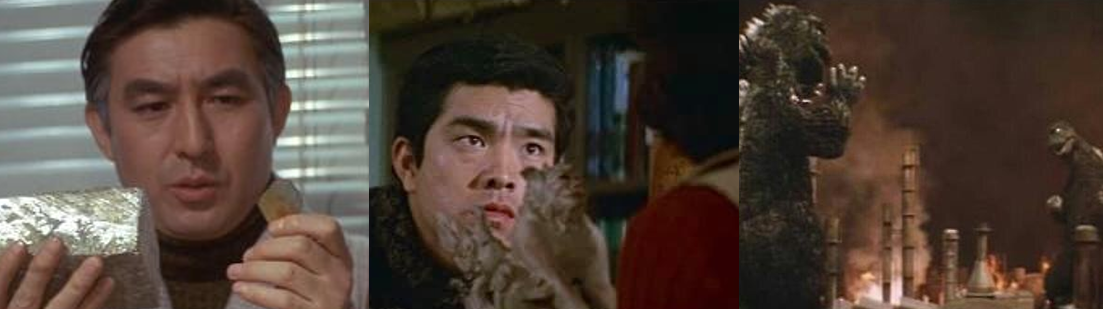
Keisuke retrieves a sample from the fight that Professor Miyajima also identifies as Space Titanium, leading the brothers to join the professor and his daughter, Ikuko (Hiromi Matsushita), investigating “Godzilla” as it’s obliterating the local port and confronted by a second, more recognisable Godzilla! The group watches, stunned, as the two fight and the battle is overseen by mysterious, silver clad onlookers in a hockey sci-fi set resembling Star Trek (1966 to 1969). The titular Mechagodzilla initially appears to be the Big G himself, its metallic appearance concealed by flesh so convincing that the nation believes Godzilla has gone mad, just as the prophecy foretold, despite him having a distinctly different roar, very different atomic breath, and even walking different. Their first battle destroys Mechagodzilla’s façade, revealing it as a cyborg controlled by the sneering, malevolent Simeon Supreme Commander Kuronuma (Goro Mutsumi) of “Black Hole Planet 3”. When Mechagodzilla requires extensive repairs, the Simeons force Miyajima to assist in return for Ikuko’s safety. Kuronuma also orders Yanagawa to steal the King Ceasar statue (to keep the deity from threatening their plans), only for Keisuke to again intervene, revealing the Simeons’ grotesque ape-like appearance, and leaving Yanagawa dead when the shady reporter reveals himself to be Interpol agent Nanbara. Revealing that Interpol knows of the bizarre alien plot, Nanbara aids Keisuke in infiltrating the Simeon base to save Professor Miyajima and Ikuko from a laughable death chamber that threatens to boil them alive. While aliens are commonplace in Godzilla movies, the Simeons are some of the most unimpressive, descending into animalistic grunts and snarls when their human façade is lost and memorable only because of their ultimate weapon (and even that’s a rip-off!)
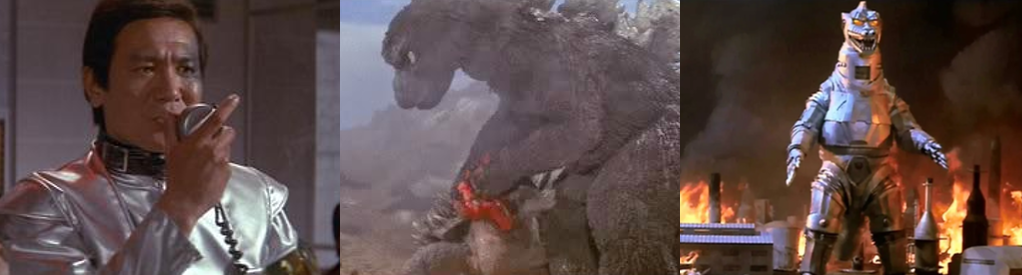
By this point, Godzilla’s firmly been established as Japan’s protector, so our heroes are stunned when he appears to go on a mindless rampage. Like Anguirus, Godzilla seems enraged by his doppelgänger as much as he is fiercely territorial over his people, leading Godzilla to attack Mechagodzilla with all his might and bathe in a lightning storm to boost his power. Sadly, Godzilla plays second fiddle to a handful of forgettable and interchangeable characters. I’m not sure what the benefit of having two professors was, for example, or why the female characters were so overlooked…or honestly what the point of having the brothers was since Keisuke and Nanbara would’ve made for a more entertaining duo. Most of the runtime focuses on a mad scramble to understand and then protect King Caesar’s artifacts, though I remain underwhelmed by the bizarre beast (Kusumi) and question why this screen time couldn’t have been allotted to Godzilla so he could battle his doppelgänger more. The film seems to depict King Caesar as the new kaiju on the block, but he looks so foolish and lacks the screen presence of Godzilla. Plus, thematically, it makes far more sense of Godzilla to be at the forefront considering Mechagodzilla is modelled after him, even if I’m not sure why the Simeons bothered. They barely managed to frame Godzilla, the prophecy seems to refer to another kaiju, and their motivations for conquest are so ill defined that I still don’t really know what they’re after. Indeed, they only seem to be included because someone behind the scenes was a fan of the then-recent Planet of the Apes films (Various, 1968 to 1973), with their true appearance being cheap, knockoffs of those movies.
The Nitty-Gritty:
So much of Godzilla vs. Mechagodzilla hinges on this bizarre Azumi prophecy, which warns that a monster will appear after a series of warnings and destroy the world. Princess Nami specifically has visions of this, and the characters initially believe the prophecy refers to Godzilla when he goes nuts, but it all leads to a mystical energy beam that reveals King Caesar’s hiding place. King Caesar is a benevolent deity worshipped by the Azumi and, upon being awakened, immediately battles Mechagodzilla alongside Godzilla. So… who is this prophecy referring to? As I said, it paints King Ghidorah as the true threat, though could also refer to Titanosaurus (Tatsumi Fuyamoto), who appears in the next film as another Simeon minion (alongside a repaired Mechagodzilla). However, in the context of this film, the prophecy makes no sense and takes up screen time that could’ve been spent fleshing out the Simeons or giving us more Godzilla vs. Mechagodzilla action. Interpol is depicted as a key organisation in combatting alien and kaiju threats, with Nanbara being a fun and mysterious ally to Keisuke, but very little about Godzilla vs. Mechagodzilla makes sense, even by Godzilla’s standards. All the Simeons want to do is use their ultimate weapon to terrorise the landscape and kill the local kaiju, feats that Mechagodzilla becomes incapable of performing. Sure, it bests Anguirus but he’s like the weakest monster. Once it meets Godzilla, Mechagodzilla is critically damaged, and the aliens are forced to kidnap a human scientist to accelerate its repairs…when you’d think the Simeons would be the best people to fix Mechagodzilla considering they created the damn thing!
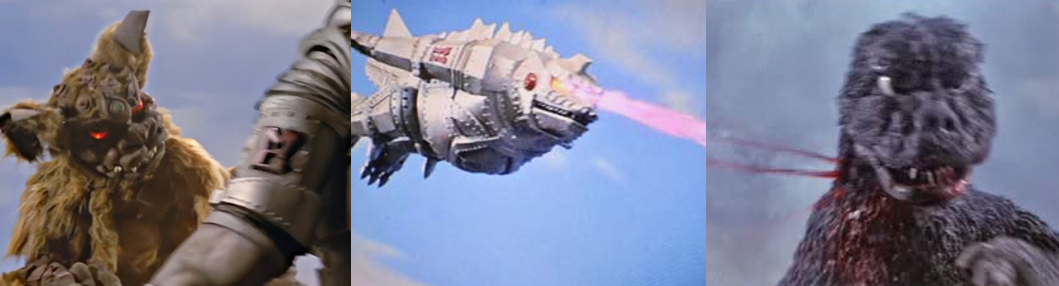
Godzilla’s looking pretty derpy here. His design has been softened and diluted to make him much kinder and more anthropomorphic, with him assuming a boxing stance and showing frustration when his atomic breath misses. Although Mechagodzilla is quite clunky and cumbersome and clearly limits Kazunari Mori’s movements, it’s an extremely striking and ambitious design. Sporting a version of Godzilla’s atomic breath, rainbow eye lasers, missile-like fingers, jet-like feet rockets, and a nigh-indestructible hide made of Space Titanium, Mechagodzilla sports quite the formidable design. However, it’s both directly controlled by the Simeons and prone to mechanical failures, requiring constant repairs and upgrades to enact the aliens’ diabolical plan. Mechagodzilla gets a serious power boost thanks to Professor Miyajima, gaining a cartoonish lightning bolt emitter from its chest and a fun jet form, and even spinning its head around to blast King Caesar and Godzilla at the same time! As ever, however, Anguirus looks absolutely awful. I’ve always hated this creature, with its weird squat legs, goofy face, and rubbery spiked back and tail, and he’s never struck me as a threat to anyone, so seeing him fighting the far superior Mechagodzilla was a joke. Anguirus tries his best, but I’d be lying if I didn’t take a perverse pleasure in seeing him tossed around and left a bloody, broken mess. King Caesar, a bizarre, lion…bear…thing that (a bit like Mothra) is woken from hibernation by a passionate (and super cheesy) song from Princess Nami. King Caesar’s meant to be a feared, all-powered protector but he looks like a raggedy puppet with his floppy, bat-like ears and his frayed hide flapping like a cheap costume. On the plus side, King Caesar is far more mobile than Godzilla and his metal double, moving much faster and hitting rugby tackles, but he just looks ridiculous and pathetic next to Godzilla and especially the impressive (if bulky) Mechagodzilla.
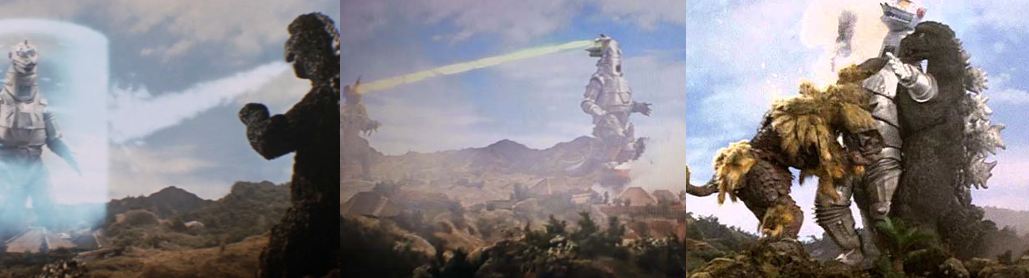
After Professor Miyajima repairs Mechagodzilla and their agents fail to acquire King Caesar’s statue, Kuronuma sends the supped-up Mechagodzilla against the Azumi deity. Unfortunately, Mechagodzilla’s trademark eye lasers prove ineffectual against King Caesar, who simply reflects them, and it’s so cumbersome that the spritelier King Caesar easily tackles it and tosses it with judo-like throws. Mechagodzilla’s finger missiles and chest bolt bring King Caesar close to suffering the same fate as Anguirus before Godzilla enters the fight. Mechagodzilla proves more formidable in their rematch, erecting an energy shield and fending off both kaiju with laser blasts, lightning bolts, and missiles. Mechagodzilla’s upgraded eye lasers and bolts even cause Godzilla to bleed, with arterial spray bursting from Godzilla’s wounds! However, Godzilla’s inexplicable new lightning powers grant him absurd magnetic abilities that attract his metallic foe and leave Mechagodzilla vulnerable to King Caesar’s tackles, and finally sees Godzilla wrench his metallic doppelgänger’s head off in an explosion of sparks. Aghast that his ultimate creation was defeated, things go from bad to worse for Kuronuma when Nanbara uses Professor Miyajima’s special magnetic pipe to disrupt the Simeon’s computer array, with Nanbara killing Kuronuma and his cohorts with ridiculous ease and he, Keisuke, and Miyajima fleeing from the alien’s base as it conveniently self-destructs. Oddly, the film and Masahiko’s dialogue imply Miyajima didn’t make it out of the base before it exploded, despite us clearly seeing that he did. Regardless, Princess Nami returns King Caesar’s statue and the Azumi deity returns to his slumber, while Godzilla heads back into the ocean for a rest, shards of Space Titanium raining all over for some other fool (benevolent or otherwise) to doubtless utilise in future movies.

The Summary:
It’s hard to expect much from many Godzilla movies. They have a formula and they stick to it, and I commend them for that but it’s clear to see that the formula was becoming very stale by this point. Godzilla lacks all the raw edge and menace he once had, being little more than a cartoon character come to life to fight on our behalf, which is potentially why he’s absent for so much of this movie as you can’t have your hero smashing cities! Indeed, it’s telling that this is exactly what Mechagodzilla does and that’s how we know “Godzilla” isn’t himself, beyond the obviously different roar and atomic breath. There was a lot of potential behind the Simeons using Mechagodzilla to turn the public and the military against Godzilla, but it is quickly squandered when Mechagodzilla’s obvious ruse is discovered and the mech goes in for repairs and Godzilla inexplicably vanishes. We’re then left following a bunch of idiots whose names I barely remember as they scrat about protecting King Caesar from Planet of the Apes and worrying about a prophecy that gets no payoff! The Simeons are some of the most ridiculous aliens I’ve ever seen, even for a Godzilla movie, and King Caesar is easily the worst kaiju design of them all, looking like a demented Muppet or a dog’s used chew toy! The only saving grace is Mechagodzilla, and even that’s a clunky, awkward, obviously plastic suit that looks extremely uncomfortable and cumbersome. Mechagodzilla has a fun array of weapons and could’ve been the catalyst from some really fun, bombastic fights, but again this all plays second fiddle to the Simeons and Godzilla ends up pulling some random lightning powers out of his ass to win (ironic, considering King Caesar could’ve been used as a substitute to tip the balance, but he sucks, so it’s no surprise). I was bitterly disappointed by Godzilla vs. Mechagodzilla, which promised so much and delivered so little, and I would honestly recommend simply watching clips of the titular fight that wasting your time on this mess of a film.
My Rating:
Could Be Better
Am I being too harsh on Godzilla vs. Mechagodzilla? Maybe you think it’s one of the best Godzilla movies of its era. Perhaps you can explain the Simeon plot and why I should care about an overblown prophecy with no payoff. Maybe you have no taste and you like King Caesar and Anguirus and think Godzilla’s magnetic powers make perfect sense. Perhaps you prefer a different incarnation of Mechagodzilla, or have another favourite Godzilla you want to share? Whatever the case, celebrate Godzilla leaving a comment below, check out my other Godzilla and kaiju reviews, and donate to my Ko-Fi to suggest other Godzilla movies for me to cover!

 Dr. K's Waiting Room