In the absolutely bonkers science-fiction film Pacific Rim (del Toro, 2013), the monstrous Kaiju first attacked humanity on 10th August 2013, which was subsequently branded “K-DAY”. To celebrate this event, and giant monster movies, I’m dedicating every Sunday in August to one of cinema’s most prolific monsters: King Kong!


Released: 14 December 2005
Director: Peter Jackson
Distributor: Universal Pictures
Budget: $207 million
Stars: Adrien Brody, Naomi Watts, Jack Black, Andy Serkis, Kyle Chandler, and Thomas Kretschmann
The Plot:
Vaudeville performer Ann Darrow (Watts) joins struggling filmmaker Carl Denham (Black) on a venture to Skull Island, only to be kidnapped by the might giant ape “Kong” (Serkis), prompting playwright Jack Driscoll (Brody) to lead a rescue.
The Background:
About a hundred years ago, filmmaker, adventurer, and former World War I aviator Merian C. Cooper brought his vision of a giant gorilla ascending the Empire State Building to life with King Kong (Cooper and Schoedsack, 1933), one of the most influential movies ever made. Followed by a comedic and divisive sequel that same year, a profitable but polarising clash with Godzilla, and a “Suitmation” blunder that ended Toho’s brief stint with the creature, an ambitious remake impressed critics and turned a profit in 1976. Although the 1986 sequel was critically and commercially panned, Universal Pictures pursued life-long King Kong fan Peter Jackson about a remake during the mid-nineties. Though initially hesitant, Jackson eventually agreed to the project, though production stalled due to studio concerns and wouldn’t pick up again until Jackson’s Lord of the Rings films (ibid, 2001 to 2003) proved box office hits. Though this gave Jackson carte blanche to revive King Kong, the budget ballooned during pre-production, which included the restoration of a lost scene of the original. The filmmakers spent hours reviewing footage of real-world gorillas and star Andy Serkis threw himself into the role, playing an integral part in the character’s motion capture process. Weta Digital supervised the visual effects, which reimagined Kong as a less anthropomorphised creature and pitted him against various dinosaur-like creatures. On the human side of things, Jack Black played against type as the opportunistic Denham, Adrien Brody enjoyed the challenge of such an effects-heavy film, and Jackson kept and released comprehensive production dairies during filming. The result was a nearly-$600 million blockbuster that was accompanied by an innovative videogame and wowed audiences with its visuals, Serkis’s captivating performance, and impressive reimagining of the original. Although some criticised the runtime and bloated script, there were plans for a sequel, and then a prequel, before both were scrapped in favour of a “MonsterVerse” reboot in 2017.
The Review:
While some visuals and shots appear to have been inspired by the 1976 remake of King Kong, Peter Jackson’s big-budget, CGI-stuffed epic is a love letter to the 1933 original at its core. Thus, King Kong is a period piece taking place in the middle of the Great Depression, when times are so hard that theatres are largely empty, working class people struggle to make ends meet, and the streets are filled with the destitute and homeless. Naturally, the 1% are still thriving and there’s still money to be thrown around and made, but it’s all firmly in the hands of the upper class and the rich, meaning aspirational filmmaker Carl Denham must beg for funding for his projects and struggling stage actress Ann Darrow resorts to stealing and being sorely tempted by to the burlesque scene. Whereas the original King Kong moved at a brisk pace, quickly spiriting characters between scenes, Peter Jackson’s movie takes its sweet time, building atmosphere and giving audiences ample time to become familiar with its bloated cast. Thus, we spend the first twenty minutes following Denham and Ann as their divergent paths cross due to happenstance. Hoping to film a romantic adventure in the jungle, Carl (…somehow…) acquires a map to the mysterious and uncharted Skull Island, where he plans to wow audiences with sights and sounds they’ve never experienced. Unfortunately, his producers are unconvinced by his bold claims and impulsive nature and eventually issue a warrant for his arrest, to say nothing of his lead actress quitting and forcing him to trawl the burlesque scene for a quick replacement. This is where he spots Ann, who he’s immediately entranced by and whom he woos with talk of high adventure and romance, convinced she’s the perfect fit not just physically but also emotionally since she’s the “saddest girl [he’s] ever seen”. Known more for her comedy, Ann is sceptical of Denham and, despite being close to starvation, initially rejects his offer before finally acquiescing since his project’s being penned by her idol, Jack Driscoll.
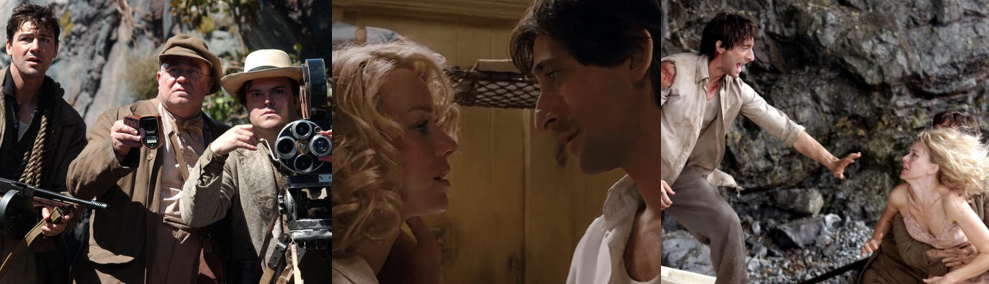
Thanks to Denham being a natural showman with a silver tongue and his fearless, convincing nature, the filmmaker convinces everyone of his vision even though they all seem to know that he’s bullshitting and they’ll never get paid. Cameraman Herb (John Sumner) and Denham’s personal assistant Preston (Colin Hanks) are touchingly loyal but the mysteriously gruff and confrontational Captain Englehorn (Kretschmann) is extremely sceptical and only convinced to cast off by promises of more money. This is exactly how Denham stalls Driscoll when he turns in his rough fifteen-page draft and tries to leave, only to be trapped onboard the ship and forced to work on the script in the animal pen (because Englehorn conveniently specialises in live animal captures). Despite this, Driscoll seems happy to join the venture, inspired by the mysterious allure of Skull Island and captivated by Ann, who admires his work and is equally attracted to him (despite a rocky start). Ann changes once on the ship, seemingly putting on the façade of a Hollywood starlet, and throws herself into the gig, delivering cheesy lines alongside arrogant film star Bruce Baxter (Chandler) and inspiring Driscoll to write a stage comedy tailored to her strengths. By the time they reach Skull Island, the two are unquestionably lovers and Driscoll shows a surprising amount of guts, desperately trying to shield Ann from the wild natives and partially leading the rescue attempt when she’s taken by Kong. While it takes time for Bruce to live up to his reputation as a screen hero, Driscoll eagerly arms himself and heads into the jungle, fighting giant bugs, outpacing rampaging dinosaurs, and even going alone when separated. Luckily, Driscoll encounters no further obstacles and goes right to where Kong has Ann captive and even returns to the native village in record time. However, the experience changes him (and all the survivors) and he distances himself from Denham’s Kong circus, sharing Ann’s shame in separating the giant beast from his homeland. Driscoll’s then inspired by his own writing to reunite with Ann and recaptures the fire he showed on Skull Island to brave Kong’s rampage and lure him away from civilians.
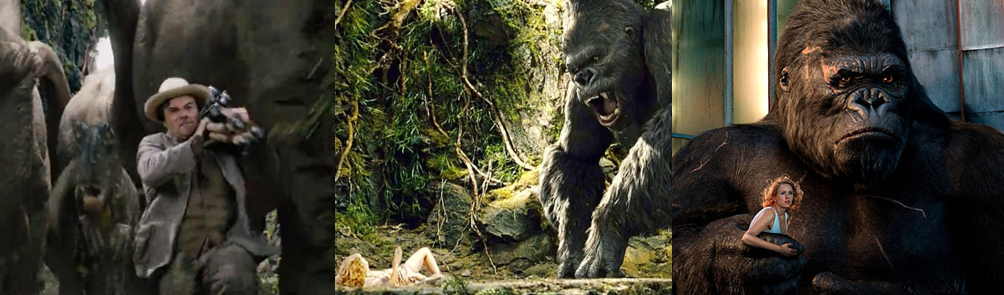
This is true of Ann as well. Although she’s initially horrified by Kong, Ann keeps her head and tries numerous ways to disinterest the beast, from playing dead, to running away, and finally performing her comedy routine. While the film heavily implies that Kong has toyed with and devoured his previous offerings, Ann’s dancing and buffoonery amuses him and spares her. Even when she admonishes him for pushing her around, Kong throws a tantrum and sulks rather than simply squashing or eating her, and Ann comes to be taken by not only him, but the beauty of Skull Island. This is matched only by the dangers living there and Ann is tossed about, firmly held in Kong’s grasp as he battles ferocious Vastatosaurus rexes, leading to her not only sympathising with his great loneliness and constant strife but also being indebted to him. While almost reluctant to leave Kong’s side, Ann is grateful to be saved but horrified when Kong is wounded and knocked unconscious by chloroform. She’s so guilt-ridden that she refuses to star in Denhem’s Kong show but seemingly senses Kong’s anguish, willing approaching him on the frigid streets of Broadway and sharing a few tender moments before the National Guard attack. While Driscoll echoes this sympathy, Denham does not; he misleads the crew from the start and is obsessed with making his picture, no matter the danger. Even when his crew are killed, he spins it into a positive and urges the survivors to rally, his enthusiasm turning to a malicious spite when his footage is wrecked. This sees him pivot towards capturing the beast, challenging Captain Englehorn’s reputation and being the one to KO Kong. Denham then fully transforms into a conniving showman under the bright lights of New York City, despite the survivors judging him for his actions, and never receives any comeuppance aside from his show and reputation being left in tatters.
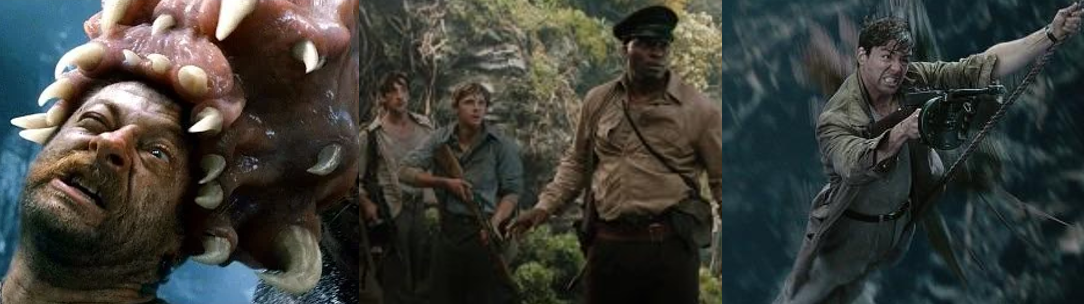
Had King Kong focused on these three and the way their experiences change them, it might’ve benefitted the run time. Ann is stunned by how hardened Denham is when she’s rescued from Kong and it’s clear all three are traumatised by their near-death experience, but the film focuses its runtime on the Venture’s motley crew. First, there’s Lumpy (Serkis), the gruff and disgusting chef who shares stories about Skull Island and its mysterious beast and who meets a gruesome end courtesy of some monstrous (if cartoonish) worms. Then there’s Ben Hayes (Evan Parke), a natural leader thanks to his days in the military who acts as a mentor to young Jimmy (Jamie Bell), whom he found as a savage stowaway some years ago. These two eat up a lot of screen time on the lengthy journey to Skull Island, with Jimmy eager to impress his mentor, strangely determined to rescue Ann despite them never sharing any screen time, and making not-so-subtle allusions to Heart of Darkness (Conrad, 1899) to emphasise the dangers of Skull Island. I do feel this dialogue and these allusions could’ve easily been given to Driscoll (he is a writer, after all) to reduce or even remove these two from the film as they don’t add anything and stick out like a sore thumb. Jimmy’s forced to step up after Hayes suffers a surprisingly violent death at Kong’s hands, comically saving Driscoll from some giant bugs, but he vanishes once they get to New York. Similarly, while I enjoyed Captain Englehorn’s strangely confrontational nature, he also vanishes after Kong’s subdued. He plays a vital role in rescuing the group when they’re trapped in the bug pit, however, and conveniently has enough chloroform to knock out a giant ape since he coincidentally deals in live animal capture, something that doesn’t come up until Denham decides to capture Kong. Finally, screen star Bruce turns out to be a complete coward but, considering none of them were prepared for Skull Island’s dangers, he’s absolutely right to be. Though he steps up to encourage Englehorn’s rescue, Bruce reverts to type when he’s cast as the “hero” in Denham’s Kong circus and then flees during the ape’s rampage, his sole focus on saving his own skin.
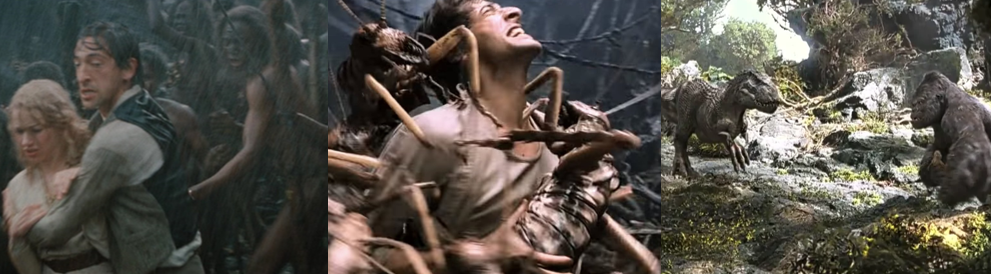
While it’s never made clear how Denham got the map to Skull Island, the Venture discovers it easily, only struggling with the thick fog, rough seas, and jagged rocks. Though the island appears deserted, it casts a distinctly ominous and malevolent appearance with its Kong-like rocks and the gigantic wall adorned with skeletons of previous sacrifices. The native tribe are more vicious and animalistic than ever, resembling Orcs from Jackson’s Lord of the Rings movies and often shot with shaky cam to highlight how savage they are. A primitive tribe who both worship and fear Kong, the natives assume more ape-like characteristics, appear to be cannibals, and are shockingly violent, murdering some of the crew with spears and skull bashing. Though scared off by gun fire, they comically pole vault to the Venture to abduct Ann, subjecting her to a ritual that is far more ghastly than usual thanks to torrential rain and their wild movements. Even the wall and its massive door is so much more elaborate here, with Ann suspended over a gorge filled with flames and magma like something out of Indiana Jones and the Temple of Doom (Spielberg, 1984). However, like the Venture’s crew, the natives disappear after Kong abducts Ann, never interfering with Denham’s capture plan or suffering Kong’s wrath when he chases her. Skull Island’s jungle is equally hostile, being a veritable lost world populated by giant, disgusting bugs and dinosaurs. Although there’s a palpable danger, isolation, and unpredictability and I appreciate that it’s populated by prehistoric creatures, they don’t always look good and there’s a definite sense of quantity over quality. The stampeding Brontosaurus baxteri are particularly cartoonish, especially when they fall and pile up, and I’m not sure we needed the bug pit scene. It’s great that Jackson revived it but it goes on way too long and it would’ve been much faster to have some of the crew perish from the fall or be picked off by a few giant bugs as they explore.
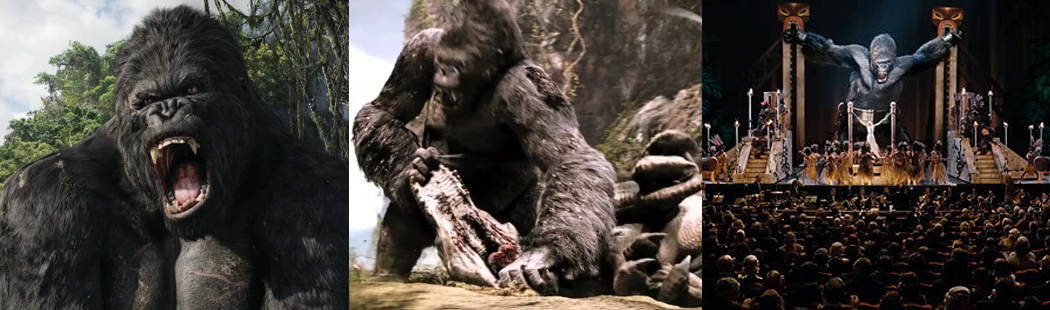
Unlike in previous King Kong movies, Kong is unmistakably a gigantic ape, with mannerisms and influences from various primates and Homo sapiens thanks to Serkis’s experience with portraying these creatures. Kong leaps, swings, clambers, and moves on all four limbs rather than being anthropomorphised. While this certainly makes him more realistic, he does lose some allure as he appears to be a unique and undiscovered prehistoric ape rather than some mythical beast. Still, there’s a lot of intrigue around Kong as the giant ape bones hint that he’s the last of his kind and he’s a very lonely creature who constantly fights for his position as “king” of the island. While Kong toys with his prey and is clearly an ancient being, he throws tantrums, reacts violently to trespassers, and flies into such a rage when Driscoll rescues Ann that he blunders into an obvious trap. Kong is a savage fighter, brutalising opponents and even devouring people, but is also capable of great sadness and emotion. He fiercely protects Ann from the V. Rexes and scoops her onto his shoulder, sharing his quiet place with her and being so captivated by her that he flies into a rage when Denham presents him with a substitute (Julia Walshaw). Strangely, despite nearly an hour on the Venture, we never see how Kong is brought aboard the ship or the conditions he’s kept in on the (presumably long) journey home. However, when Denham unveils Kong, he’s weak, possibly malnourished, and completely defeated. He’s enraged by the substitute and the flash bulbs, tearing through Broadway and scooping up any screaming blonde he comes across. Kong is as out of his depth in the concrete jungle as Denham’s party were on the island, struggling to navigate the cramped streets and being drawn to the highest point on pure instinct. Kong is probably his most impressive and nuanced here and a great deal of time and effort has gone into him, but I can’t help but be a little disappointed by how familiar he is. Like how many critics attacked Godzilla (Emmerich, 1998) for being an enlarging an iguana, I remain disappointed that Kong wasn’t more unknowable and bestial.
The Nitty-Gritty:
King Kong is an adventure into the unknown, with Denham selling his entire crew on the fortune and glory of the mysterious Skull Island. It’s honestly strange that more characters don’t call him out on this, with even the gruff Captain Englehorn going along despite not being paid and orders to turn Carl in. I really enjoyed the references to Fay Wray and Merian C. Cooper, the lines spoken by Ann and Bruce aboard the Venture mirroring the clunky dialogue of the original film, and even the photographers clambering on Kong’s corpse like in the 1976 film. While I appreciate the film fleshing out its characters, it really should’ve focused on Ann, Carl, and Jack. It takes twenty minutes for the Venture to cast off, almost an hour to reach Skull Island, over an hour for Kong to appear, and over two hours to get back to New York! Every aspect of the original is bigger, longer, and more grandiose but that doesn’t necessarily make it “better” as Jackson takes twice as long to make the same points. The pacing is also really strange as we spend so much time blundering though the jungle and yet Ann and Driscoll get back to the village in record time (even with the Terapusmordax obscenus’ assist). We have time to waste with a slow-motion reveal of the island’s name but not showing how Kong gets on the ship, or any of the return trip. Similarly, we get to see Ann and Kong slipping about on a frozen pool (an admittedly sweet scene) but interactions between her and Kong on the ship that could’ve achieved the same goal and been less cheesy. Finally, it’s bizarre that so many characters we’ve been forced to follow vanish once the film returns to New York. There’s no real payoff to Jimmy’s sub-plot and even Bruce reverts to type, with only Preston reappearing to cast judgement on Denham during his circus.
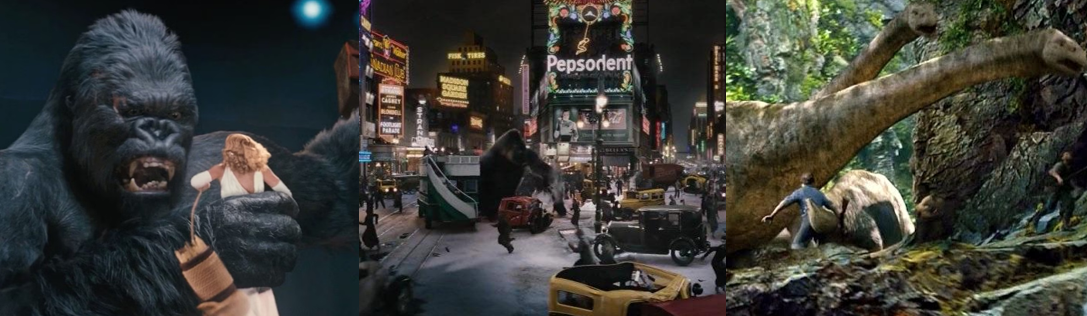
Still, King Kong’s greatest strengths are its visuals. The film emphasises that this is the 1930s with the accents, attitudes, and society of the time. I would’ve liked Ann to be more motivated by her desperate hunger and desire to avoid stripping off for money, but I liked how tactile and gritty the Venture was. Skull Island makes an immediate impression thanks not only to how menacing it’s portrayed but how real-world locations are used alongside practical effects, miniatures, and CGI. This makes the many pitfalls the crew suffer more believable, but sadly also makes obvious green screen moments stand out more. To be fair, Jackson may be evoking old school rear projection techniques, but that’s a generous excuse as the Brontosaurus baxteri stampede, Ann fleeing the V. Rex, and her and Hayes being manhandled by Kong are all times instances where the effects take a hit. The dinosaurs, especially, are far too cartoonish and I think Jackson was being far too ambitious here. Like, pick between the bug pit and the dinosaur stampede and put more time, effort, and money into one big effects scene rather than two. Jackson’s desire to outdo the original is most apparent when Kong fights three V. Rexes while clutching Ann, tumbling over a cliff, and being entangled in vines! Still, this is a big, heroic moment for Kong and he’s easily the best effect here, even in full light, with detailed fur and facial expressions conveying many emotions. Covered in scars from constant battle and sporting a cracked tooth, there’s a real sense of power, speed, and size when Kong’s crashing through the jungle and leaping about. These sequences cleverly focus on Ann to make them more harrowing, but Kong still lacks the true impact of a physical effect. There’s nothing practical about him, which is a shame as he really does look great, and I give the film credit for staging its finale in broad daylight to fully showcase Kong’s effects and dramatic end.
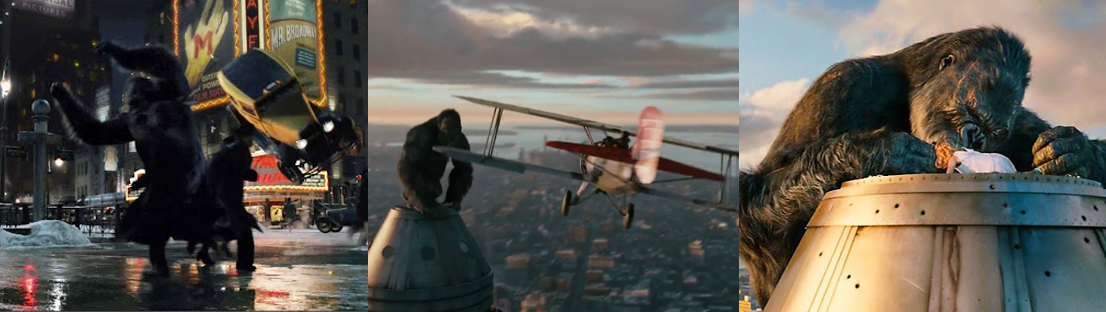
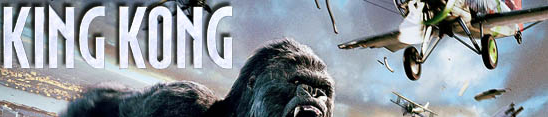
Even when his most loyal followers are killed, Denham persists with his obsession, only pivoting towards capturing Kong after he loses his precious footage. To his credit, Denham does mention the lives lost in capturing the “Eighth Wonder of the World” but goes full P.T. Barnum when introducing Kong, revelling in the accolades and spotlight and never once showing any remorse, even after Kong dies. Though weak, Kong flies into a rage during the show and easily breaks his heavy chains, rampaging through the theatre and charging through the slippery New York streets, desperate to reunite with Ann and causing destruction and death in his wild pursuit. Indeed, Kong Kong is surprisingly violent and bloody at times, with people impaled by spears, having their skulls crushed, being tossed aside or eaten by Kong, and Kong tearing apart the V. Rexes. Ann seems to sense Kong’s distress and goes to him to calm him after Driscoll valiantly tries to lure him away from people. Sadly, their sweet reunion is interrupted by the National Guard and Kong is soon scaling the Empire State Building, attracted by its lights and height. Ann goes with him willingly, no longer afraid and seeking only to calm Kong’s anger, and the two share another moment basking in the beauty of the city before the biplanes close in. As ever, Kong protects Ann first and foremost, even saving her from a plummet even as he’s bleeding to death from bullet wounds, but he’s noticeably more aggressive in the finale. Kong challenges the planes, swatting them from the sky when they fly too close, but ultimately succumbs to his wounds when they relentlessly fire upon him. Though Ann desperately pleads for them to stop, they attack when Kong’s back is turned and he collapses, sharing his final breaths with Ann on the top of the Empire State Building before plummeting to the street below. Though powerless to assist in this tragic end, Driscoll does push past the military to comfort Ann after the fall, which sees Kong reduced to a sad spectacle once again as the discredited Denham looks on.
The Summary:
As a big Kong Kong fan, and someone who loved Peter Jackson’s Lord of the Rings movies, you better believe I was hyped for this remake at the time. I remember going to see it at the cinema and being so disappointed and bored that I never bothered to pick it up on DVD and have largely avoided it whenever it’s on television. Visually, this King Kong is unparalleled even to this day. Skull Island has never been so terrifying and alive as it is here, with the natives giving off Cannibal Holocaust (Deodato, 1980) energy and the many dinosaurs evoking the Jurassic films (Various, 1993 to present). Oddly, though they’re unprepared for Skull Island’s dangers, Denham’s crew adapts remarkably well to the environment, braving the unknown to rescue Ann simply to be crushed or devoured by the wildlife. Sadly, though, “bigger” doesn’t always mean “better” and Jackson seems to have been far too ambitious here, cramming so much into the film that it takes away from Kong’s spectacle. And it’s a shame because Kong is spectacular here, despite essentially just being a giant ape rather than some otherworldly beast, showcasing a range of emotions and being a brutal, savage fighter who openly mocks his prey. Jackson’s efforts to pay homage to the film that inspired his career leads to a bloated, tedious film whose pacing is all over the place. While it’s nice to have more three-dimensional characters, it’s bizarre that so much screen time goes to characters who either die or disappear rather than to the three leads, who would’ve benefitted from this extra exposure. The film oddly glosses over some key points and seems strangely rushed at the end, with little emphasis placed on the juxtaposition of Kong in the concrete jungle versus the real jungle. I did like how Kong was more aggressive and fought so valiantly in the finale as it matched his fighting spirit on Skull Island, and his death remains as tragically hollow as ever, but it all lacks a lot of punch because the film is just way too long. The runtime would’ve greatly benefited from trimming or cutting some scenes because, as it is, King Kong is an undeniable visual spectacle and an amazing modern take on the concept, but too self-indulgent, too ambitious, and crippled by its lengthy runtime that does nothing but make it an obnoxious and tedious chore to sit through.
My Rating:
Pretty Good
Did you enjoy Peter Jackson’s version of King Kong? Do you agree that it’s far too long and focuses on too many side characters or did you appreciate the characterisations? Were you surprised at how violent the natives were and the viciousness of Skull Island’s inhabitants? What did you think to Kong, his appearance, and his more animalistic portrayal? Which version of Kong is your favourite how are you celebrating K-Day today? Whatever your thoughts on this big-budget King Kong remake, or other monster movies, drop a comment below, support me on Ko-Fi, and check out my other King Kong and Kaiju content!

 Dr. K's Waiting Room
4 thoughts on “Movie Night [K-Month]: Peter Jackson’s King Kong”