In the absolutely bonkers science-fiction film Pacific Rim (del Toro, 2013), the monstrous Kaiju first attacked humanity on 10th August 2013, which was subsequently branded “K-DAY”. To celebrate this event, and giant monster movies, I’m dedicating every Sunday in August to one of cinema’s most prolific monsters: King Kong!


Released: 17 December 1976
Director: John Guillermin
Distributor: Paramount Pictures
Budget: $23 to 24 million
Stars: Jeff Bridges, Jessica Lange, Charles Grodin, Rick Baker/William Shepard/Peter Cullen, and René Auberjonois
The Plot:
Ruthless oil executive Fred S. Wilson (Grodin) discovers a primitive world ruled by the giant ape “Kong” (Baker/Cullen/Shepard). When the beast kidnaps beautiful castaway Dwan (Lange), stowaway primate palaeontologist Jack Prescott, (Bridges) tries to save her amidst Wilson’s plot to commercialise the creature.
The Background:
As hard as it may be to believe, it was nearly a hundred years ago that filmmaker, adventurer, and former World War I aviator Merian C. Cooper dreamed up the iconic visual of a giant gorilla ascending the Empire State Building and wowed audiences with King Kong (Cooper and Schoedsack, 1933), largely regarded as one of the most influential movies of all time. Amazingly, King Kong was followed by a sequel that very same year, though Son of Kong (Schoedsack, 1933) leaned more into comedy and largely divided critics. After a planned revival fell through in the 1960s, the concept and character were repurposed into a battle against Godzilla, much to Cooper’s displeasure, resulting in a profitable but divisive clash. After a stint in animation, King Kong returned to cinema screens for a loose tie-in, King Kong Escapes (Honda, 1967), a much-maligned entry that ended Toho’s brief stint with the legendary ape monster. About ten years later, the idea of a then-modern remake was pitched, though there are conflicting reports about who we have to thank for this: some say it was Michael Eisner and veteran producer Dino De Laurentiis, while De Laurentiis claims it was all his idea. Regardless, Paramount Pictures financed the project and De Laurentiis worked with screenwriter Lorenzo Semple Jr. to update the story to focus on the energy crisis and culminate at the World Trade Center. To save on costs, all dinosaurs were omitted and an elaborate suit, animatronic, and puppets were used in place of laborious stop-motion techniques. Special effect artist Carlo Rambaldi constructed an impressive £500,000 mechanical Kong that infamously failed to work when the cameras rolled, forcing the production to rely on what Rick Baker saw as an inferior suit. Thousands of onlookers flocked to the World Trade Center for the dramatic finale, many being paid to be extras, and an extended cut of the film was assembled for home media. King Kong was largely praised for revamping the original unorthodox love story and for its impressive practical effects, though it’s also been criticised for its janky editing and composition and its strange balance of humour and drama. Though De Laurentiis was disappointed by the film’s $90.6 million box office, a critically and commercially panned sequel followed ten years later and the franchise remained dormant until Peter Jackson’s big-budget remake in 2005.
The Review:
Though it’s narratively very similar to the classic 1933 original, this King Kong separates itself in a few ways to put a different spin on the formula. I don’t mind this so much as I’ve always argued that remakes should try to do something new with their properties rather than being shot-for-shot or beat-for-beat recreations. In this case, we’re not following an adventurous film crew and their misadventures on Skull Island, but instead Fred Wilson, executive of the childishly named Petrox Oil Company, who assembles a crew to sail to an uncharted island. Since Petrox has been in a slump and the world is facing an energy crisis – and competition from other oil and petrol sellers is high – Wilson is banking everything on claiming a hitherto-undiscovered oil reserve on the mysterious Skull Island. Thanks to paying off an unnamed official in Washington, D.C., Wilson obtains top secret satellite imagery of the island which, as his resident science expert Roy Bagley (Auberjonois) explains, reveals the landmass hidden by a thick and mysterious fog. Their data indicates that the island is rich in oil and other minerals and Wilson is determined to get his hands on it to turn Petrox’s fortunes around, though stowaway associate professor Jack Prescott offers another, far more sinister perspective on the island. Prescott talks of journals and other evidence indicating that the island is not only inhabited, but ruled over by some gigantic, unknowable beast and attempts to persuade Wilson of Skull Island’s dangers and to let him join the expedition out of sheer scientific curiosity. Believing he has the inside track on Skull Island, Wilson is naturally sceptical and accuses Prescott of being a spy from a rival oil company, ordering Captain Ross (John Randolph) to lock the troublemaker up and doing a deep dive into Prescott’s background to figure out who he is. When this only corroborates Jack’s story, Wilson reluctantly allows him to join the crew as their official photographer but, for a good while, the two seemingly reach a mutual respect, especially when leading their later rescue mission.
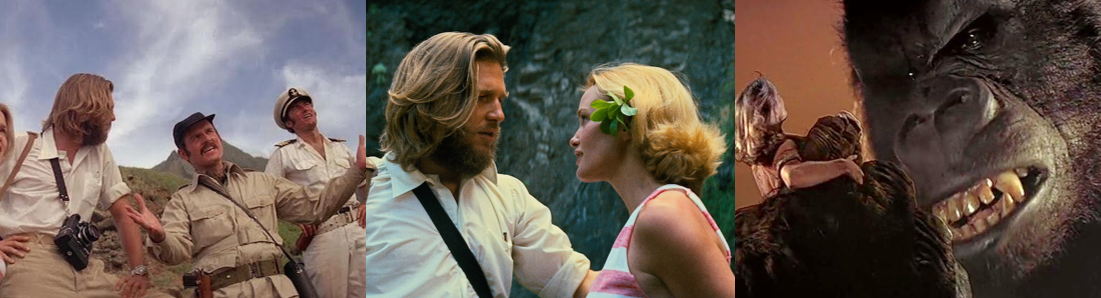
This comes about when Wilson’s ship happens upon a stray life raft carrying beautiful aspiring actress Dwan, who was left adrift when her yacht suddenly exploded. Dwan joins the crew as something of a mascot and a fancy, immediately catching Prescott’s eye and flirting with him, sharing her dreams of being a big star. While the romance angle was extremely rushed in the original film, I understood it as the film was much shorter and that was in keeping with the style at the time. Here, I’m not sure why Jack is so smitten with Dwan beyond her looks as she’s a bit of an airhead who wanders around with big doe eyes, chattering about her dreams, blabbering about how beautiful things are, completely oblivious to obvious dangers and being painfully naïve. Though she’s more likely to babble about her star sign than anything meaningful, it seems Prescott is captivated by her whimsical, carefree nature and he becomes very protective of her, as does the rest of the crew since she’s initially ordered to stay behind when they reach Skull Island. Instead, she accompanies the group and, predictably, observes the native’s rituals with a naïve wonder compared to Prescott’s more measured caution. When the tribe’s shaman (Keny Long) spots her, he immediately orders (in his native tongue) for her to be handed over as a sacrifice to their God, even offering six of the native women in return for Dwan, though both Prescott and Wilson naturally decline. This sees the natives kidnap Dwan in the dead of night and force her to be strung up as Kong’s latest bride and, like Prescott, Kong is immediately taken by the blonde-haired maiden. Dwan is helpless in Kong’s grasp, resorting to screaming and begging and then lashing out in fear and anger since she’s afraid of heights. Not wishing to anger the beast, whom she and Wilson believe intends to eat her, Dwan tries to soothe him with kind words, though her attempts to flee fail and she’s reduced to a mere damsel in distress. This gives Jack the chance to step up as he leads the rescue mission, exasperated by Wilson being more concerned with his oil (which turns out to still be gestating and thus unsuitable for mining), though he’s ultimately left to rescue Dwan alone when Kong kills most of the rescue party.
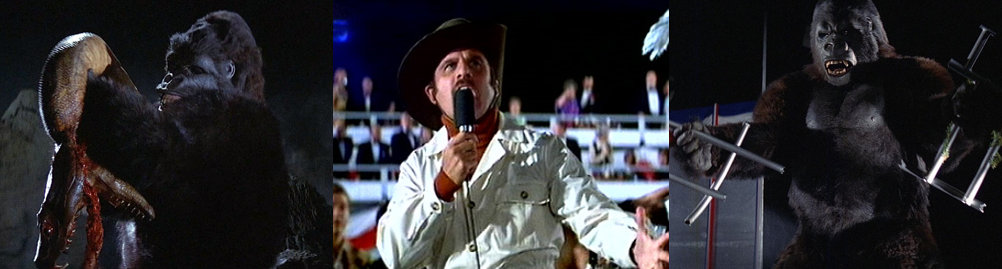
Since his plan has gone awry, Wilson comes up with a new plot to capture Kong and parade him around the United States as Petrox’s mascot. After calling in some supplies, he orders Captain Ross and his men to prepare an elaborate trap rather than send out a search party, digging a huge pit to chloroform the giant ape. While Kong’s busy battling a giant snake, Prescott grabs Dwan and bring her back to the native’s village. However, when the angered Kong pursues, he falls into Wilson’s trap and is soon being transported to America. The gas and lack of food and water take their toll on Kong, who sits heartbroken and throws a tantrum as they near the mainland, with his rage only soothed by Dwan. Once they reach America, Wilson turns from a greedy but otherwise reasonable man into a full-blown megalomaniac as he wins over Dwan by casting her in the lead role in Petrox’s new advertising campaign to recreate her time on Skull Island before the braying masses as Kong is held in chains. While Prescott initially signs on for this, his moral compass sees him reject the offer and urge Dwan to leave with him, but she’s so obsessed with being a star that she can’t turn Wilson down. While Dwan is terrified of Kong, she feels a great deal of sympathy for him and puts her life on the line to calm him when he threatens to sink the boat. Similarly, she begs Kong not to let her go in the finale so he’ll be spared death and even Jack is cheering Kong by the end after he’s double-crossed. Thanks to his extremely expressive face, Kong is more human and emotive than ever, showing great affection, pain, and anger as required. Though revered as a God by the natives, Prescott sees Kong as a unique species that needs to be preserved. He’s aware of the beast’s danger and desperate to get Dwan away from him, but constantly advocates for Kong to be left unharmed and is deeply disturbed when Wilson takes Kong from his homeland.
The Nitty-Gritty:
One of the things I love about the original King Kong is how it moves at a brisk pace and yet still showcases a lot of amazing effects and action. The romance subplot is hammy, for sure, but it’s all in good fun. Sadly, this King Kong suffers from a bloated runtime. It’s not as bad as the next remake, but the film chugs along at a snail’s pace, spending way too much time on the boat and trying to make us care about the blossoming attraction between Jack and Dwan. While Bridges and Lange have chemistry, Dwan’s portrayed as such a fickle and flighty bimbo that I find it hard to believe Jack could stand being with her beyond a quick bunk up. Hell, he even says to her (after she interrupts their desperate escape from Kong’s rampage for a drink) that she’d quickly grow bored of him since he can’t afford to keep her in the lifestyle she’s accustomed to. While she seems to genuinely deny this, I’m on Jack’s side here; Dwan would be seeking the next thrill after a month or two, for sure. I enjoyed Grodin’s bombastic performance as Wilson, who becomes quite affable during the second act but quickly descends into a spiteful villain who cares only about making a theatrical showcase of Kong. Having sacrificed many lives and shown a complete disregard for others, and Kong’s welfare (seriously, how did the big ape survive the trip back to America?), it’s only fitting that Wilson goes out in the stupidest way possible: running right into Kong and being crushed under his foot, despite him literally being able to flee in any direction! The natives don’t get much play here and disappear after sacrificing Dwan, but they’re portrayed as a stereotypical, primitive tribe who seek only to appease their God. They regularly repair the great wall to keep Kong out and send him women to satisfy his needs and Jack states that the tribe will most likely be disillusioned and downcast after they kidnap their deity.
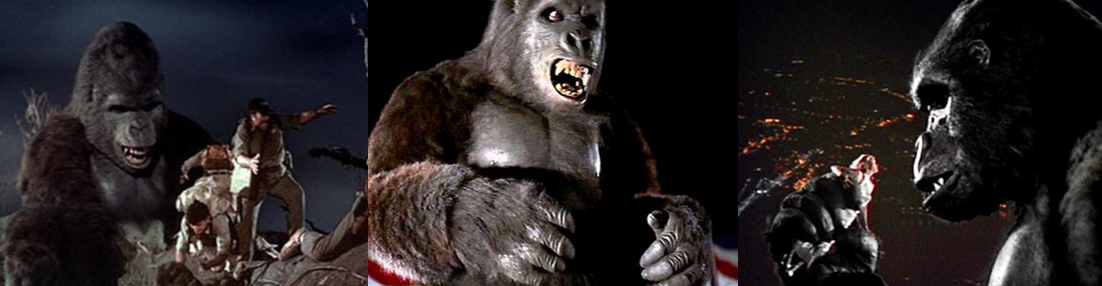
Though comprised of various real-world locations and elaborate sets, Skull Island isn’t as impressive as in the original film as this King Kong chooses not to have dinosaurs and other prehistoric creatures on the island. Indeed, the only other giant creature is a massive snake that Kong awkwardly wrestles with, which is a shame as I would’ve much rather seen more time spent exploring the island’s dangers than trapped on the boat with these assholes. Skull Island’s threat is thus in its landscape, which is comprised of a thick jungle and deep chasms and Kong who, despite his obnoxiously loud roar and thundering footsteps, can apparently sneak up out of nowhere and send Jack’s rescue party plummeting from their log bridge. As you’d expect, Kong is the film’s most impressive aspect and the suit really does look amazing. Kong towers over the miniatures and has a far greater range of movement than stop motion can provide, though he looks janky and awkward when briefly substituted for a robotic duplicate or filmed against rear projection. There’s obviously a lot of that (and forced perspective) here and it hasn’t aged as well as the black and white original, which gets more slack due to being limited by the technology of the time. Here, it’s painfully obvious when a giant Kong hand is holding Dwan before a projection of Kong and when Kong is smashing through miniatures. To be fair, these look far more impressive during Kong’s rampage through New York City, where he overturns a train and terrorises the public, though he looks extremely ungainly when climbing the World Trade Center. Kong’s most impressive feature is his highly expressive face, which sees him gaze upon Dwan with lovesick eyes, glare at people when they shoot him, and illicit a great deal of sympathy when trapped on the ship or suffering mortal wounds. Kong’s definitely more human than in the original, standing upright and lumbering about like a man, though the little head tilts and constant roaring tie into his animal side, as does his confusion and rage when surrounded by the unfamiliar sights and sounds of New York City.
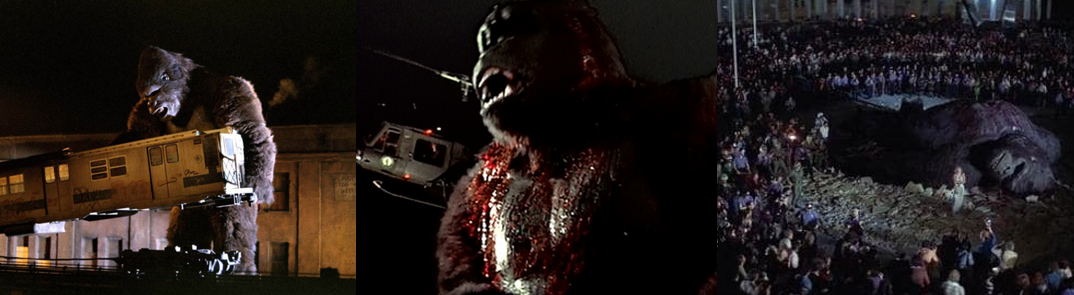
Remarkably, despite being unprepared for Skull Island’s true danger and having lost the chance to rape its oil deposits, Wilson snatches victory from the jaws of defeat by hastily trapping Kong. Being drugged, malnourished, and separated from his land and new love seems to physically drain Kong, allowing him to be chained up in a seemingly inescapable cage and paraded before the masses amidst Petrox’s massive billboards. However, Kong’s rage is stoked when reporters rush Dwan and push her about, giving him the strength to break free and rum amok, crushing people under his feet and terrorising the streets in his pursuit of her. While Jack gets Dwan to safety, she randomly demands a drink, sure that the river will deter the ape, and is naturally snatched by Kong when he simply wades through the water without issue. Luckily for Dwan, Prescott intuits that Kong will be drawn to the World Trade Center since the Twin Towers resemble a rock formation on Skull Island. Though Jack barters with the city officials to take Kong alive, he’s immediately double-crossed when soldiers shoot flamethrowers at Kong. Though unable to reach the roof of the South Tower, Jack’s even more helpless when Kong leaps to the North Tower, kills his assailants, and is approached by three attack choppers. Though the pilot (George Whiteman) orders his men not to fire with Dwan in the ape’s hand, Kong seemingly recognises the threat and accepts his fate, placing the aghast Dwan on the roof and prepares to face his attackers. While Kong does take a couple of the choppers down when they fly a little too close, he’s basically dead meat the moment they fire their massive chain guns. It’s honestly disturbing seeing bloody chunks and spray fly from Kong’s chest, neck, and belly and seeing his fur matted by gore, his breathing becoming more laboured and his screams more anguished as he’s riddled by seemingly explosive bullets. In the end, the assault is too much and Kong collapses first to the roof and then to the ground below. As reporters clamber on his prone body and Dwan desperately tries to comfort him, Kong’s heart slowly beats to a stop. The masses celebrate, jostling Dwan about and trying to snap her picture, all while a despondent Jack looks on, unable (and seemingly unwilling) to reach her.
The Summary:
This is the King Kong I grew up with. As a kid, I remember being awestruck by the Kong suit, which still holds up really well and is a fantastic way to give Kong more movement and expression than stop-motion or animatronics. While he lacks a lot of the charm of the original and doing a man-in-a-suit might seem a bit cheap, Kong is still incredibly impressive, especially his emotions and face, and he’s only let down by some dodgy rear projection and questionable performances. I didn’t mind Jeff Bridges here, he took the lead pretty well and seemed very charismatic, but he had more chemistry with Charles Grodin than Jessica Lange. Dwan is one of the weakest aspects of the film, being a shallow and wholly uninteresting character who seems too fickle and flighty for Jack to waste his time on. Wilson was great as a bombastic, greedy antagonist who takes any opportunity to turn his fortunes around. Sadly, King Kong is a slog to watch, with the film dragging on and offering little but a dull romance sub-plot and actors fumbling about on a jungle set. Things pick up in the finale but, by then, I wouldn’t blame you if you’d tapped out from boredom as the film lacks the magic of the original and doesn’t pace out its set pieces well. It’s a shame as I have fond memories of this one from my childhood but this King Kong is tough to rewatch, despite how unsettling the ending is and its ambitious suit effects.
My Rating:
Could Be Better
Have you ever seen the this 1976 remake of King Kong? If so, did you like it and how do you think it compares against the original and other King Kongs? What did you think to the suit effects and animatronics? Were you disappointed we didn’t get more giant monsters on Skull Island? Did you also find the film boring at times? What did you think to the changes it made to the original? Which version of Kong is your favourite and how are you celebrating K-Day this month? Whatever your thoughts on King Kong, Kaiju, or monster movies in general, leave a comment below, support me on Ko-Fi, and go check out my other King Kong and Kaiju content!

 Dr. K's Waiting Room
4 thoughts on “Movie Night [K-Month]: King Kong (1976)”