
Released: 7 July 2022
Originally Released: 11 December 1997
Developer: Monkey Craft
Original Developer: Namco
Also Available For: PlayStation (Original Release); Nintendo Switch, Nintendo Switch 2, PC, PlayStation 4, PlayStation 5, Xbox One, Xbox Series S (Phantasy Reverie Series)
The Background:
The massive success of Sonic the Hedgehog (Sonic Team, 1991) helped make anthropomorphic mascots hugely popular in the videogame industry, resulting in memorable characters like a gun-toting jackrabbit, an acrobatic bat, a superpowered earthworm, an intergalactic adventurer, a sword singing possum with a rocket pack, and a bear-and-bird duo. Interestingly, however, director Hideo Yoshizawa originally envisioned Klonoa as a ceramic fighting robot named Amenti before Yoshihiko Arai designed the strange, rabbit-like creature who would lead the game. Yoshizawa sought to make Klonoa an action game that was appealing to kids and adults, while lead designer Tsuyoshi Kobayashi refined the fast-paced gameplay to be limited to two buttons. First revealed at the 1997 E3 trade fair as Namco’s first bid to create a marketable 3D mascot, Klonoa was widely praised for its simple controls, colourful environments, and cutesy visuals, though some criticised its short length and lack of innovation. Although Klonoa spawned a few sequels, the original game’s price skyrocketed and the series lay dormant for nearly fifteen years before Bandai Namco teamed with Monkey Craft for an unexpected remaster of the first two games. Based upon the oft-forgotten Wii revival, this remaster of Klonoa: Door to Phantomile was largely celebrated for its colourful overhaul and for breathing new life into the franchise.
The Plot:
After his dream about an airship crashing comes true, Klonoa and his friend, Huepow, journeys to keep the dark spirit Ghadius from turning Phantomile into a world of nightmares.
Gameplay and Power-Ups:
Klonoa: Door to Phantomile is a 2.5D action platformer in which players control the cute little rabbit-thing Klonoa and explore six worlds (known as “Visions”), each with two levels apiece. While the game is geared towards solo play, a second player can jump in to have Huepow launch Klonoa into the air with Y, though you can disable this at any time. The game offers two control types and the ability to customise the controls, but they’re so simple I don’t see why you’d need to do this or need anything other than the default settings. These see Klonoa jumping with A or Y, fluttering his wings for some extra airtime if you hold the button, and shooting “Wind Bullets” from his magical ring with B or X. These latch onto nearby enemies so you can throw them, either at other enemies or to the background or foreground to activate switches, take out enemies, or smash Nagapoko Eggs for extra goodies. When holding an enemy, you can press the jump button twice for a double jump (which also destroys crates or enemies beneath you) and you must chain grabs and double jumps together in the game’s later Visions to reach higher areas. This can be extremely tricky as Klonoa and his enemies have large hit boxes, enemies constantly respawn so you never run out of “ammo”, and the timing required to execute these double and triple jumps can be aggravating. The game’s options offer numerous settings for you to play with, including disabling the onscreen timer and tutorials, and you can initially pick from two difficulty settings, with “Easy” offering infinite lives and more health while “Normal” limits your lives and reduces your maximum health. Klonoa’s quite durable unless he falls down a pit or into lava but can partially or fully restore his health with Small or Large Hearts, respectively. Memory Clocks act as checkpoints, Klonoa Coins grant extra lives, and you’ll also score extra tries for every 100 Dream Stones you collect.
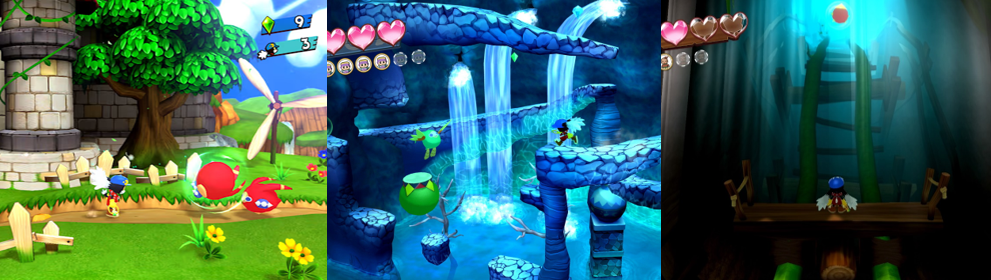
You can briefly double the value of Dream Stones if you spot a Mirror Spirit, toss enemies at Mysterious Seals to create new paths, and activate switches with your throws to open doors or new areas. Some of these are timed, while others must be hit in the correct order, which gets very irritating in Vision 6-2 thanks to the jump/grab requirements. Occasionally, Klonoa must obtain keys to open doors and these may be guarded by enemies, gifted by non-playable characters (NPCs), or hidden in crates and Nagapoko Eggs. Technically, your main goal (beyond reaching the exit) is rescuing the six Phantomiles hidden in each stage. These are held in bubbles that you must pop with your Wind Bullets or thrown enemies and they can be tricky to find as areas sport multiple paths, often leading to more Dream Stones and goodies alongside a Phantomile. You don’t need to rescue all the Phantomiles to progress, however, and can replay any Vision to find those you’ve lost. Each Vision also hides picture pieces to find, though this simply counts towards 100% completion rather than any tangible reward, and Klonoa can eventually ride Kara the fish, though only in cutscenes, so you’ll have to settle for sliding down water and sand slides and blasting across areas on water sprouts. While there are no additional power-ups, pick-ups, or upgrades to Klonoa’s repertoire, they’re not really needed as his basic abilities serve him well throughout. It might’ve been nice to have a 2.5D autoscrolling chase section where you ride Kara, however, or to perhaps extend or alter the nature of Klonoa’s Wind Bullets. Klonoa can use fans, wind currents, and springs to reach higher areas, though. These often test your flutter and double jump skills, which are further tested in brief sections where you ride moving platforms past enemies or flame bursts. Vision 3-1 also has you ride a log on a vine track as it speeds away from the camera, dodging spiked hazards and collecting Dream Stones.
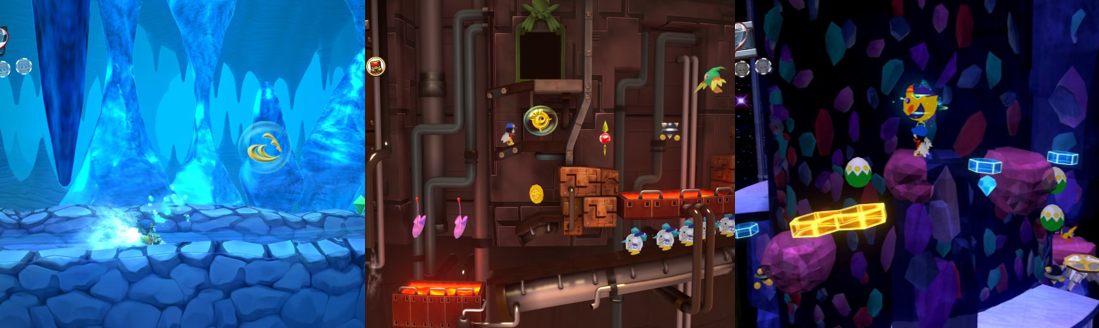
For the most part, Klonoa: Door to Phantomile is a simple, whimsical adventure that asks little of you. You can backtrack to previous screens to explore alternative paths and most collectibles are out in the open. You’re faced with simple platforming challenges such as hopping over gaps, riding platforms over pits or electrified floors, dodging projectiles, and leaping to tilting, moving, or temporary platforms (which reappear very quickly). Klonoa’s main gimmick is throwing enemies, but this rarely tests your puzzle solving skills as it’s hard to miss the big targets in the background or right in front of you. The difficulty does slowly ramp up, however, with areas becoming larger, sporting more alternative paths, and even being looping mazes. You must activate gondolas to progress in Vision 3-1, watch your step in Vision 4-2’s slippery ice cavern, avoid burning alive in Vision 5-1’s steampunk factory, and tackle a door maze in Vision 6-1’s ethereal castle. Here, you must track down and smash coloured crystals to clear doorways, though it can be tricky remembering which way to go. Similarly, Vision 5-1 has you exploring multiple paths to track down coloured orbs, avoiding flames and molten steel, and dealing with the “Eclipse” effect in Vision 5-2. This sees day turn to night and enemies become incapable of being grabbed, though extra platforms do appear to help you progress. Sadly, this mechanic only appears in this stage; it would’ve been cool to implement it throughout or have it featured in the unlockable “Hard” mode. You’ll briefly ride mine carts in Vision 1-2, simply jumping to grab Dream Stones as it falls apart, clamber up a cliff face in Vision 2-1, and activate gears and moving platforms in the mechanical tree factory explored in Vision 3-2. Platforming also gets progressively difficult by the end, with pits in abundance and small, often disappearing platforms being commonplace, sometimes with enemies chase you across them.
Presentation:
I’d long been curious about Klonoa: Door to Phantomile. I’ve always been a fan of 3D and 2.5D platformers and this looked like a cute, whimsical adventure sadly locked behind an expensive price tag. Thankfully, the game didn’t disappoint in terms of its visuals and Klonoa is a joy to behold. The game incorporates a cutsey, anime-like aesthetic to its polygonal characters, who pop with a cel-shaded, cartoony flavour as a result. Klonoa is like an anime character come to life, sporting oversized shoes, a Pac-Man logo on his beret, fun flappy ears, and big, expressive eyes that give him a lot of character. While he (and all the characters) speak in gibberish sound bite, his dialogue is fully readable in speech bubbles and he lets out some fun little sounds as you play, even twirling his magical ring when left idle. While Klonoa and his enemies have big hit boxes, it’s not usually a problem if you get the timing of your jumps down and he battles some bizarre enemies and encounters some surreal NPCs along the way. Each Vision houses different natives, such as tree spirits and talking fish, who will help or must be freed from their corruption. The story (and overall aesthetic design) reminded me a lot of NiGHTS into Dreams (Sonic Team, 1996), with Klonoa exploring a dream-like fantasy land at risk from the distinctly Khonsu-like Ghadius, though Klonoa plays a hell of a lot better than that game and is far easier on the eyes. The game also sports a jaunty soundtrack, with fun little tunes accompanying each area, and features quite an intricate story. I was stunned when Klonoa’s beloved grandpa was killed protecting the necklace from Ghadius’s jester-like henchman, Joka, and the ending (which sees Klonoa tearfully depart the dream world after learning his memories of Huepow were fabricated) was much more shocking than I expected from what seemed to be a simple, colourful platformer.
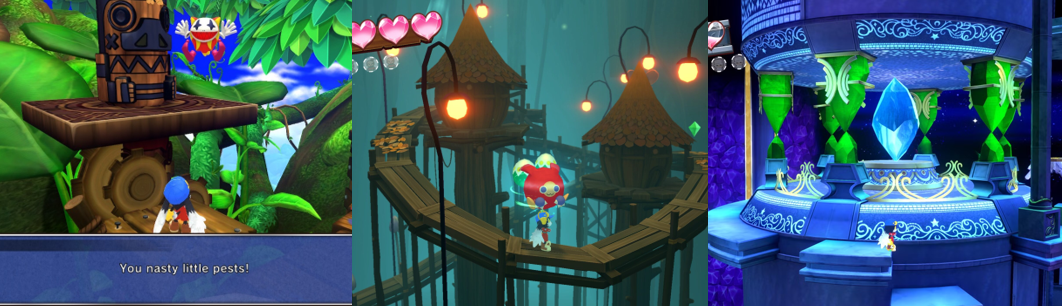
Each of Klonoa’s Visions is presented via a storybook-like world map, allowing you to freely select them between sessions or when reloading your save file. Klonoa’s seaside town of Breezegale sees you literally venturing from his house past giant windmills and cute, medieval-style houses, crossing bridges and heading up a spiral path before exploring Breezegale’s mine, where precious jewels glitter in the backgrounds and mine carts are scattered about. Vision 2-1 sees you traversing a dying forest full of abandoned tree houses, hollowed out tree trunks, and giant mushrooms. The second part places you in the fantastical Jugpot palace, made from a giant seashell, and features backwards-flowing waterfalls, marble platforms, and dank caves. Vision 3-1’s forest is thriving, with twisted vines all over and thick logs acting as your main path into a clockwork-like mechanical tree that you must activate to get its gears moving. Vision 4-1 sees you exploring the ruined Wind Kingdom, hopping to dropping stone platforms, passing a spooky graveyard, and slipping about in the ice cavern, where you smash rocks to progress. The visuals really pick up in the distinctly steampunk Temple of the Sun, where you traverse giant pipes and ride a platform across a track, collecting coloured orbs to venture within. The interior is made hazardous by the Eclipse gimmick, constant flame bursts, and you having to hit multiple switches to progress. Cress is mostly comprised of its beautiful, crystalline castle that’s full of mosaics, electrified floors, tricky platforming, and statues that need melting. It opens out into a gigantic, ornate cathedral with multiple doors, the void of the night sky in the background, and gives way to a swirling, nightmare void where players must battle the surprise final boss, Nahatomb. There’s a fair amount happening in each area, with each Vision showcasing different aspects of their environments. It’s quite fun taking a track or path one way and seeing the alternative paths stretch behind you, enticing you to try a different path and see what rewards and obstacles it yields.
Enemies and Bosses:
Klonoa must pick up and toss various strange enemies in his adventure, nearly all off which constantly respawn so you always have something to toss off (wait…). The most common enemy you’ll encounter are the spherical Moos and their variants: Red Moos simply walk back and forth and are easy cannon fodder, Green Moves flap their wings to fly and resemble birds, and Black, Gold, and Silver Moos hide behind shields. These can also have lances and charge you, or ride pogo sticks, forcing you to get behind them to snag and throw them. You’ll also encounter Monkey Moos, who swing from vines to knock you down pits, and helmeted Moos who must have their head gear knocked off before they can be nabbed. Knight-like Algores swing chain-whips with maces for a long-range attack, Pink Boins bounce up and down erratically, and cat (or maybe rabbit?)-like Mew-Mews do the same but release spiked balls as they land, and explosive, mouse-like Boomies must be tossed to destroy objects (while avoiding their blast radius). The will-o’-the-wisp-like Burnies are protected by a ring of flames that you must hop between to grab them and spider-like Dabbys spit spiked projectiles from their butts. Fish-like Fifis leap from water or up waterfalls to interrupt your platforming, but the indestructible Spikers are the worst for this, with you having to gingerly dash under or jump over them. Glibz hide behind their shells, giving you a small window to grab them before they unload with their twin cannons; spooky Plowms relentlessly chase you and appear out of thin air; and Slazzas toss boomerang-like projectiles. Smorks fly from the background of Vision 5-2 and can be difficult to grab thanks to the perspective, Zippoes charge at you, and Tetons will fly you higher if you grab onto them. Gigantic variants of many of these enemies also crop up, with them being stunned and inflated with your Wind Bullets to give your jumps a boost and only being destroyed when you toss enemies at them.
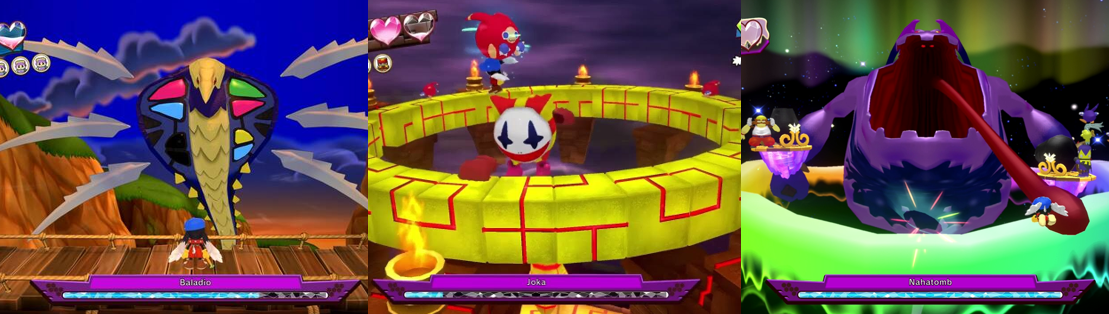
Each Vision ends with a boss battle fought on a circular path. Rongo Lango is the easiest, challenge as it jumps about producing shockwaves and slashing with its tail. Simply run under it, snag a Moo, and attack from behind to move on. I found the corrupted King Seadoph and his fish cohort, Pamela, trickier as the path is littered with spike balls and Pamela leaps from the water, occasionally raining bubbles that can be tricky to avoid. You must snag King Seadoph as he rides a ball and toss him at Pamela when she attacks, which can be tough with so much to deal with. Gelg Bolm was easier, but a touch tedious as you use springs to get above it and launch an enemy into its exposed core with the double jump, avoiding its giant seeds and slam attack. Baladium puts you on a swinging platform, which makes it difficult to snag enemies to throw at the coloured sections of its body. You must also avoid the explosive spheres, pillars, missiles, and Zagards Baladium spawns. When you finally confront Joka, he deflects your Moo projectiles with his twirling fists and becomes a thrashing, squid-like beast when the Eclipse hits until you turn floor blocks yellow, which can drag out the fight. Fighting Ghadius is all about speed and timing as you must avoid the teleporters (which reset the arena and see you dodging shockwaves) to toss Death Moos at him. These rain down, ricochet about, and are hidden inside a triangular energy field you must dodge and dispel by attacking a corner. By far the toughest and most tedious fight is the surprise final boss, Nahatomb. Nahatomb creates three rainbow shockwaves and ejects armoured Moos, which must be tossed to Phantomile’s leaders, who then blast Nahatomb with cannons. This isn’t too bad in the first phase (if you avoid his long, sticky tongue), but is compounded in the third by the leaders rotating beneath you and Nahatomb temporarily destroying your crystalline platforms. The second stage sees Nahatomb’s disembodied form firing eye lasers as you’re on a slanting platform, which you must avoid to toss Moos at flaming crystals in the background.
Additional Features:
There are fourteen Achievements to earn in this remastered version of Klonoa, with one gifted each time you defeat a boss and six more for finding and rescuing every Phantomile hidden in each Vision. This also unlocks the “Extra Vision” stage, which sees you scaling Balue’s tower and taking on the game’s most difficult platforming challenges, though there’s no new boss to face. You’ll also get an extra Achievement if you get every Achievement in this game and its sequel, and finishing Klonoa on either difficulty unlocks “Hard” mode, a time attack mode, and the movie viewer. This version of the game also gives you the option to turn on a pixel filter so it resembles the PlayStation original, but I wouldn’t recommend it as it’s very hard on the eyes compared to the slick, colourful glow up. While there are no Achievements or extras for finishing the game on the harder difficulties, you can unlock extra costumes, a character viewer, the option to play the game backwards, and a music test if you clear the Extra Vision.
The Summary:
I was really excited when Klonoa: Door to Phantomile was finally remastered for modern consoles. Both it and its sequel had been on my wish list for a while, but I couldn’t justify the cost, so it was a no-brainer for an avid platformer fan like me to pick the Phantasy Reverie Series up and finally give them a whirl. This version of Klonoa is absolutely stunning, with colourful visuals, eye-popping environments, and a main character so cute you’ll be close to tears. Klonoa is such a unique character, exuding an anime-excess while being adorable, and his world (while visually and thematically similar to NiGHTS into Dreams) is incredibly imaginative. The game felt very “Japanese”, if that makes any sense, with some bizarre enemies and concepts that had been tweaked just enough to appeal to Western gamers. The gameplay is simple but enjoyable, with the basic jumping, grabbing, and platforming being very satisfying. Things get much trickier as platforms become smaller, pits become deeper and wider, and your double jump prowess is tested, which can be frustrating. However, it’s fun searching across these deceptively large areas looking for collectibles and locals to rescue, though it’s a shame there weren’t any bonus stages or extra content to mix up the gameplay. The game is also disappointingly short, easily beaten in a few hours, but I didn’t mind that as it was a lot of fun to look at and a nice, cosy experience despite some aggravating sections and confusing boss battles. Ultimately, there’s a lot to like here, with a few unlockables to aim for and extra paths to explore. Fans of Klonoa should enjoy the stunning visual makeover and fans of 2.5D platformers should appreciate the visuals, tight controls, and memorable characters.
My Rating:
Great Stuff
Are you a fan of Klonoa: Door to Phantomile? If you’ve played the original version, what did you think to the Phantasy Reverie Series glow up and enhancements? Did you also struggle with the double and triple jump sections? Which of the game’s large, bizarre bosses was your favourite? Did you ever rescue all the lost locals? Which Klonoa game is your favourite and would you like to see the franchise make a comeback Whatever your thoughts on Klonoa, please leave them below and drop a donation on Ko-Fi to see more reviews like this.

 Dr. K's Waiting Room
One thought on “Game Corner: Klonoa: Door to Phantomile (Xbox Series X)”