

Released: 29 June 1998
Developer: Rare
Also Available For: Nintendo Switch, Xbox 360, Xbox One, Xbox Series S/X
The Background:
Beginning life as Ultimate Play the Game and having established themselves as one of the biggest UK-based video game development companies, Rare built a strong working relationship with Nintendo after revitalising their Donkey Kong franchise on the Super Nintendo Entertainment System (SNES). Eager to capitalise on this success, Rare began work on “Project Dream”, an ambitious adventure game starring first a sword-wielding boy and eventually a bear with a backpack. As the project grew, Rare switched development to the upcoming Nintendo 64, eventually retooling the concept into a 2.5D sidescroller and, ultimately, a 3D action/platformer collectathon heavily inspired by Super Mario 64 (Nintendo EAD, 1996). Rare’s staff ballooned and their work hours increased as they sought to refine the 3D camera system and encourage player exploration across multiple, colourful worlds, infusing the game with a quirky, British sense of humour. Unfortunately, a multiplayer mode was scrapped due to time constraints alongside an ambitious plan to swap data between cartridges to unlock extra content. Banjo-Kazooie was universally praised, with critics praising the gameplay and visuals and technical superiority over Super Mario 64, though the camera was criticised as being unwieldy at times. Although we’ve been denied a long-running series of sequels, we got a Game Boy Advance spin-off and an equally lauded sequel followed in 2000, the characters appeared in various spin-offs and limited merchandise, and Banjo-Kazooie is widely regarded as one of the best and most pivotal 3D platformers of all time.
The Plot:
When his sister is kidnapped by the vain Gruntilda “Grunty” Winkybunion, dim-witted Banjo and loud-mouthed Kazooie quest to retrieve the magical Notes and Jiggies in Grunty’s lair to rescue the terrified bear cub.
Gameplay and Power-Ups:
Banjo-Kazooie is a 3D action/platformer collectathon in which players guide the titular bear and bird duo across nine main worlds, accessed via a main hub world, searching for magical jigsaw pieces (“Jiggies”) and Musical Notes to unlock additional worlds and progress further up Grunty’s lair to rescue Banjo’s sister, Tooty. You begin outside on Spiral Mountain, a diverse area where players can choose to learn or practice the duo’s moves, which are taught by the short-sighted mole Bottles, whom you’ll encounter at various molehills. Banjo and Kazooie have various moves to take out enemies and traverse the game’s worlds, some of which are similar to Mario’s 3D abilities and others which are unique to them. Banjo takes the lead and swipes with his claws in a short combo with B or rolls into enemies when running and pressing B. A sees him jump and pressing it again in mid-air sees him get a boost from Kazooie to cross small gaps. Pressing B in mid-air performs the super useful Rat-a-Tat Rap, where Kazooie pecks at enemies, while holding Z and pressing B when standing still sees Kazooie charge with her peak. Pressing A when standing still sees the duo backflip to higher areas and you can hold either A or B when underwater to swim, though you must collect air bubbles or resurface to avoid drowning. Similarly, you restore your health by collecting Honeycombs, extend your life bar by hunting down Extra Honeycombs, and snag an extra life from the golden Banjo trophies dotted around, You have decent control over the camera, but it can be clunky and get stuck on the environment at times. Indeed, the unreliability of the camera and Banjo’s inability to grab ledges are the only gripes I have with the game, but they’re easily dealt with once you get into the swing of things.
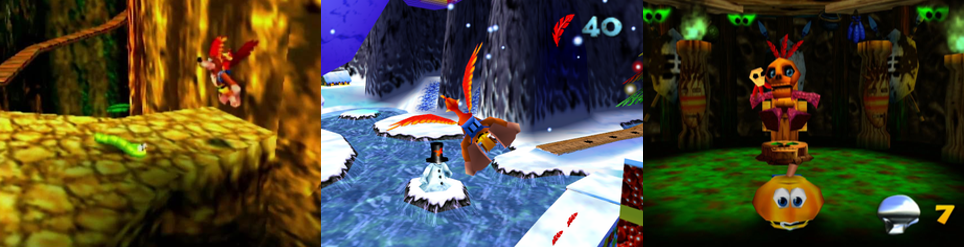
Banjo and Kazooie’s move set expands as you explore the game’s worlds, constantly adding new abilities to your arsenal that are tested by the environments. Kazooie fires eggs from her mouth or butt by holding Z and pressing C-up or C-down, respectively. This can be unwieldy as it’s difficult to precisely aim at targets but it’s great for picking enemies off from a distance and solving certain puzzles, such as extending bridges. The duo perform a ground pound by pressing Z in mid-air to crush enemies or activate switches to open new areas, reveal Jiggies, or start timed challenges. Holding Z and pressing C-left sees Kazooie dash across the landscape, greatly improving your movement speed and allow you to traverse inclines, while pressing C-right sees Kazooie shield Banjo with her wings, effectively making them invincible. Like your egg attacks, this “Wonderwing” ability lasts as long as you have ammo on hand (specifically Gold Feathers). Similarly, you’ll need Red Feathers and a Flight Pad to take to the air, where you can rise higher with A or blast at enemies and targets with B as long as you have Red Feathers to expend. Kazooie can also spring the duo to higher levels using Shock Jump pads, they can climb pipes and trees just by jumping to them, and Kazooie uses special shoes to vastly (if temporarily) increase her running speed or carry the duo across brambles and red-hot quicksand. You’ll also find numerous Mumbo Tokens everywhere; collect enough and the mystical shaman, Mumbo Jumbo, transforms the duo into various forms. These include a termite, a bee, a tiny crocodile, and a stout little walrus, with the transformation automatically ending once you venture far enough from the world. These forms are both amusing and incredibly useful: Banjo’s pumpkin form, for example, squeezes him into small spaces while his walrus form allows him to compete in a sledge race against the lazy polar bear, Boggy. The bee form lets you fly indefinitely by tapping B (though it’s even more unwieldy than the regular flying) and the termite allows you to clamber up steep surfaces that even best the Talon Trot. The crocodile form is the only one that can attack, snapping its jaws with B and easily crossing piranha-infested water, but it’s very small and no match for the bigger, tougher Mister Vile.
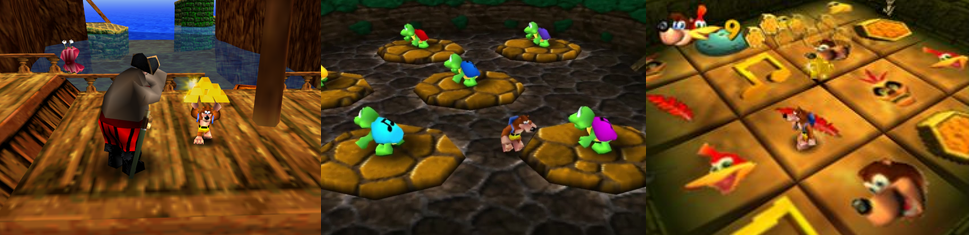
Like Super Mario 64, each world contains numerous collectibles you need to open new areas. There are 100 Musical Notes in each world and, when you leave the world, the Notes reset, so you’re better off collecting them all on your first go-through (which is possible, even when some areas require additional abilities to access). There are also ten Jiggies in each world, with one awarded when you find the five colourful Jinjos hiding in each world. Some Jiggies are out in the open, sitting on ruins or reached with a bit of platforming or careful traversal over narrow platforms, and others are guarded by bosses, revealed by hitting switches, or earned by solving puzzles. You’ll be smashing huts, hitting targets, completing races and timed events (such as jumping through hoops), and fending off waves of enemies to earn Jiggies. You’ll also aid various non-playable characters (NPCs), such as finding Captain Blubber’s gold, finding Boggy’s kids’ lost Christmas presents, rescuing Snorkel from a weighty anchor, and collecting acorns so Nabnuts can hibernate. Unlike in Super Mario 64, you’re not booted from the world upon collecting a Jiggy and your progress is saved even if you lose a life, though your Notes won’t be. Like that game, Jiggies are also found in the hub world, spawning when you activate switches in the main worlds, and you’ll also play some fun mini games to collect them. You’ll perform with Tiptup’s choir, spell out the game’s title on a sandcastle floor and on a Ouija board, match tiles and race through mazes in ancient pyramids, fly through hexagonal rings, defend sentient Christmas lights, and brave a dangerous fan room all to claim a prize. Jiggies become especially obtuse in Click Clock Wood, a world split into four seasonal sub-sections. You must complete tasks in the spring and summer to earn Jiggies in autumn and winter and vice versa, sprouting and watering a plant and helping Gnwaty throughout the seasons. The difficulty can spike in Clanker’s Cavern and Rusty Bucket Bay, where drowning is a constant threat alongside bottomless pits and polluted water that, like its ice-cold variants, quickly saps your air and health.
Presentation:
Banjo-Kazooie is an absolutely gorgeous game that still holds up today. Obviously, the game looks and runs a lot smoother on the modern re-releases but even the Nintendo 64 original stands the test of time thanks to its colourful visuals and quirky, fairytale-like world. Everything is so full of life and it’s truly remarkable and amusing. Banjo and Kazooie play pranks on each other when left idle, making daft sounds when jumping and attacking, and even the enemies are lively and peculiar, reacting when they spot you (my favourite’s being the Seaman Grublins, who shout an enthusiastic “Hi!” before charging!) Banjo, Kazooie, and all their supporting cast (and even collectibles) chatter with a whimsical babbling, communicating through gibberish, text bubbles, and pantomime movements. Enemies and hazards taunt you, collectibles encourage you to grab them, Bottles and Kazooie bicker constantly, and Grunty taunts you relentlessly as you explore or fail challenges. There’s a little bit of fog and pop-up but I can forgive it considering how large and varied each world is, especially compared to Super Mario 64. Like in that game, players visit worlds via a hub world, but these are unlocked in a fun and interesting way. You may need to explore or activate a switch to reach the puzzle pad and unlock the world, or activate a switch within the worlds to affect the hub world, and utilise various coloured cauldrons to fast travel throughout Grunty’s lair. Grant Kirkhope brings every environment to life with his infectious and whimsical soundtrack, which changes as you explore, becoming muted when underwater or ominous when exploring more dangerous areas. Grunty’s lair is a prime example, with Kirkhope’s rendition of “The Teddy Bear’s Picnic” warping and changing in each area. The soundtrack is, honestly, one of the best parts of the game and immediately makes an impact with Mumbo’s Mountain and only improves from there. Freezeezy Peak has a Christmassy overture that perfectly matches its festive aesthetic, Mad Monster Mansion is suitably spooky, and Click Clock Wood’s music alters depending on the season.
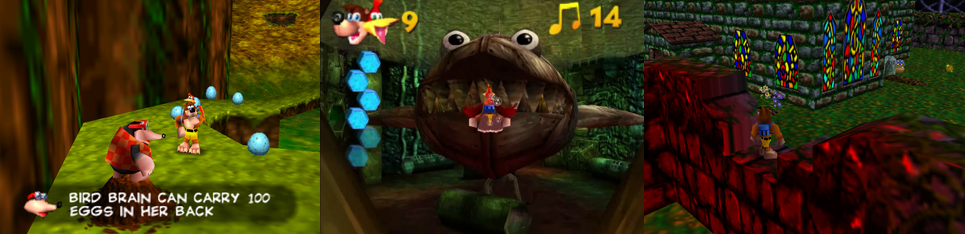
The worlds on offer are as unique as the game’s quirky humour, which is both snappy and witty and very British at times. While things start very tame in Mumbo’s Mountain, which has no bottomless spits or hazards to worry about (except maybe drowning or taking fall damage), drowning or being bitten by Snacker are constant threats in Treasure Trove Cove, which highlights how large and varied the game’s worlds are with its beach, open sea, lighthouse, and pirate ship. Clanker’s Cavern (essentially Grunty’s sewer) introduces air bubbles to keep you from drowning and centres around the enormous semi-cybernetic shark Clanker and the duo’s efforts to both scale and explore within him. Bubblegloop Swamp is a suitably murky and hazardous environment thanks to the narrow platforms over piranha-infested water, which test your platforming skills. The world branches off to a maze and a giant crocodile, and meeting Tiptup inside a giant turtle. Freezeezy Peak is comparatively smaller but has always been a favourite, despite the ice-cold water and the tricky flying challenges. The annoying Sir Slushes and NPCs like Boggy and his kids and the anxious Wozza the Walrus add a lot of depth to the area. I was never a fan of Gobi’s Valley, which is treacherous like Freezeezy Peak but trickier to traverse as you need to fly, run, ride magic carpets, and complete timed challenges to get inside its pyramids. You’ll brutalise poor Gobi to earn Jiggies, feed Rubee’s snake, and tackle ancient challenges to claim prizes. I’ve always enjoyed Mad Monster Mansion, another wide and varied world sporting a haunted hedge maze, mansion, and church. Tombstones spring to life, brambles prick your feet, pipes must be scaled and dropped down, and you must race into the church to play a giant organ and sneak past a cantankerous ghost. Rusty Bucket Bay can be very challenging with its polluted water and bottomless pits in the engine room; like Mad Monster Mansion, it can also be easy to get lost as there are so many areas to explore. Finally, Click Clock Wood is actually four worlds in one and changes with each season, introducing different enemies and hazards. You’ll run up piles of leaves and snow mounds, for example, or platform using blossoming leaf platforms, but also find the water dried up, frozen over, or some areas are inaccessible depending on the season.
Enemies and Bosses:
Banjo and Kazooie encounter some bizarre enemies on their quest. You can practice your moves against the anthropomorphic vegetables patrolling Spiral Mountain and battle territorial termites and the first of many Grublin variants in Mumbo’s Mountain. Most enemies aren’t much of a threat as, while Buzzbombs swoop at you, Bigbutts try to gore you and can only be stunned, and Chinkers duplicate when hit, but most are easily taken out with a few hits. As you progress further through Grunty’s lair, her Gruntling minions become more durable and the beehives that yield Honeycombs are protected by swarms of bees, adding some challenge to each encounter. Mum-mums and Tee-hees pose a problem as they can only be destroyed with the Wonderwing, while Boom Boxes and Sharpnel mines explode when defeated or they make contact with you. Various Chompas burst from pipes and portraits to deliver a jump scare or take a bite out of you, often knocking you from high places if you’re slow to Rat-a-Tat Rap. Life rings and pipes come to life, monsters burst from wooden panels, mutated and regular crabs must be tipped over to attack their vulnerable bellies, and thrashing tentacles clog up tunnels alongside many environmental hazards. These include fan blades, scorching hot lava, brambles, freezing cold water, unseen piranha, and stinging sandworms but one of your biggest obstacles will be fall damage and bottomless spits, especially by the end game. While you can mitigate fall damage by landing in water or using the Feathery Flap, you’re more likely to plummet to the ground and take considerable damage, so be sure to watch your step, especially in Click Clock Wood. You’ll also have to be mindful of the likes of Snacker and Chump (who are difficult to defeat as the duo have no swimming attacks), Slappas (mummified hands that try to squash you) and the snowballs tossed by the jeering Sir Slushes.
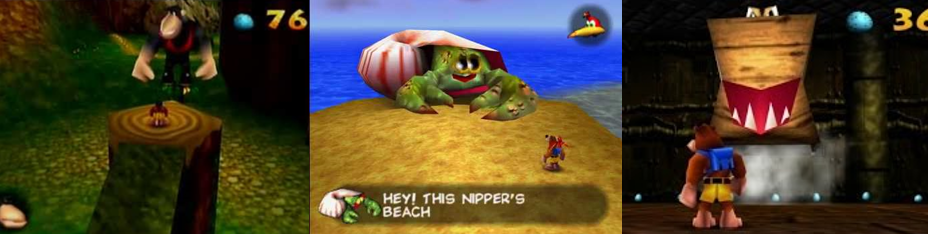
Banjo-Kazooie is a little light on traditional boss battles. While there are larger or challenging enemies battled in each world to acquire Jiggies, I would only classify a few as being traditional bosses. In Mumbo’s Mountain, for example, you battle Conga atop a tree. You must trick him into tossing his oranges to hit three switches for a Jiggy, feed one of his fruits to a hungry monkey for another, and then head up top to fire eggs at him for a third, but he’s more of an obstacle than a boss. While a tougher crab enemy awaits inside Treasure Trove Cove’s sandcastle, the gigantic Nipper is the game’s first real boss. He tries to clip you with his massive claws but it’s easy to dodge them and Rat-a-Tat Rap his eyes; three hits and he’s done, allowing you to enter his shell for a Jiggy. The closest Clanker’s Cavern has to a boss are the mutated Snippets you fight in a radioactive chamber. Similarly, you battle a gauntlet of frog-like Flibbets in Bubblegloop Swamp and a swarm Zubbas in Clock Clock Wood when you venture into their hive. Bubblegloop Swamp kind of has a boss in Mr. Vile, a mean crocodile who challenges Banjo’s croc form to gobble coloured worms but who isn’t fought in the traditional sense. Similarly, Sir Slushes supplant a boss battle in Freezeezy Peak; you must charge into them when flying to take them out and smash a larger Chinker to earn a Jiggy. Boggy also challenges you to two sledge races, one against your walrus form and one where you’ll need Kazooie’s speed shoes to win, with both being tricky due to you having to pass through slalom gates and avoid the freezing cold water. The closest Gobi’s Valley comes to a boss is when you race to swipe a Jiggy from Grabba, while Mad Monster Mansion simply has you sneak up on Napper. Rusty Bucket Bay does feature a showdown with Boss Boom Box, but it’s essentially just a bigger version of fighting a regular Bomb Box. He’ll split into smaller forms, exploding on contact, so either use your eggs or the Wonderwing, if you have enough Gold Feathers.
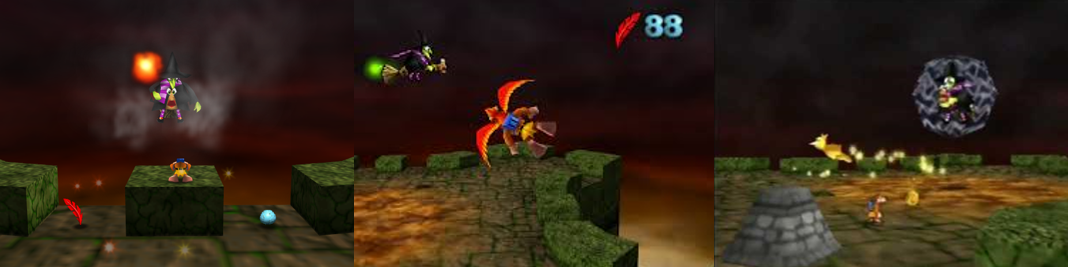
Even when you finally reach the top of Grunty’s lair and confront her, you must first endure Grunty’s Furnace Fun, a quiz show you must complete without dropping to the insta-death lava below. The quiz tests your knowledge of the game, asking you to name worlds and characters, identify music, and even battle previous bosses. As you explore Grunty’s lair, you’ll inevitably meet her kindly sister, Brentilda, who tells secrets about Grunty that’ll be answers in this quiz. Honeycombs and extra lives are strewn about the board and you can earn Joker cards to skip challenges, each of which is timed and deals damage if you fail. You can also take different paths to the end, where you’ll be treated to a roll call and what appears to be the ending before the duo realise that Grunty escaped! You then venture to the rooftop for the final showdown, stocking up on ammo if you have enough Magical Notes to open the doors. The battle against Grunty has multiple phases, each one ending with her tossing a homing shot that you must defend against with the Wonderwing. In the first phase, Grunty swoops down on her broomstick; you must Talon Trot out the way and hit her with a Rat-a-Tat Rap three times, dodging her explosive fireballs after each hit. Things get tricky in the second phase; not only do you have to avoid slipping to your doom but Grunty’s now out of reach. She tosses multiple fireballs from afar and you have a very small window to hop on the ledge and pelt her with eggs, which is incredibly tricky without precision aiming. If you hit her enough times, she’ll fly high up, forcing you to use a Flight Pad to follow. While her fireballs are easily avoided, it’s not so easy to direct your Beak Bomb but, eventually, you’ll hit her enough to cause her to erect an impenetrable shield. In this phase, you activate the Jinjo statues with your eggs, avoiding Grunty’s shots, to bring her to the ground, then frantically avoid her barrage of fireballs and homing shots to power up the Jinjonator and send her plummeting to her doom.
Additional Features:
There are 100 Jiggies to collect in Banjo-Kazooie, ten in each world and ten in Grunty’s lair. While you don’t need all of them to unlock every world, you will need plenty to solve jigsaw puzzles and earn an upgrade to your life bar prior to the final showdown. There are also 900 Musical Notes to find, 100 in each world, which again you’ll need if you want to access every area of Grunty’s lair and the ammo stocks prior to the final boss. You can return to any world at any time to hunt down any Jiggies and Notes you’re missing and check your progress from the pause menu. Each world also has two hidden Extra Honeycombs which are worth collecting as you’ll extend your health bar with them, alongside multiple Mumbo Tokens, which you’ll need to change form. If you explore Grunty’s lair, you’ll activate cauldrons to create short cuts and discover Cheato, Grunty’s rebellious cheat book who gives codes to enter in Treasure Trove Cove’s sandcastle to increase your eggs and feather stocks. You can also utilise online guides to enter longer cheat codes in the same way to access mysterious eggs and a giant Ice Key, items that are completely useless here but unlock extras in the Xbox 360 version. There are other cheats you can enter as well to give you infinite lives, eggs, feathers, and air, though some of these cheats disable leaderboards and saving on the Xbox 360 version. Speaking of which, there are twelve Achievements in this version that are all simple to get, whereas the Nintendo Switch version lets you create save states. Finally, you can return to Banjo’s house and complete Bottles’ timed jigsaw puzzle challenges for additional fun cheats, my favourite being one that transforms Banjo and Kazooie into a washing machine!
The Summary:
I played Banjo-Kazooie to death as a kid. I was absolutely enamoured by everything, from its quirky characters to its colourful visuals, and its infectious soundtrack brought me such delight. I searched high and low for every secret I could find, eagerly testing out the sandcastle cheat codes and trying to open doors or find new areas. The game invites this at every turn, encouraging exploration and experimentation and crafting an intricate and enjoyable interconnected world. There are some nitpicks, of course. The camera is finnicky and awkward, flying can be clunky, the life system is antiquated, and it’s annoying that you must recollect Notes each time you enter a world if you don’t get all 100 on the first go. However, these are minor complaints, and the positives far outweigh these issues. I loved that you stay in each world after collecting a Jiggy and that there was a lot of variety in how you acquired them. From simply grabbing them, to completing puzzles, timed challenges, or the odd boss battle, I always felt a sense of accomplishment with every Jiggy I got. Similarly, the worlds are endlessly enjoyable, even the more annoying ones like Gobi’s Valley. I loved how characters carried over between worlds, how you altered the hub world with switches, and how each world had such a strong visual identity. Banjo and Kazooie steal the show with their quirky antics, versatile move set, and mismatched partnership. I just adore how whimsical and random everything is; it’s a lot of fun encountering new, oddball enemies and seeing them taunt the duo. While some elements were refined and expanded in the sequel, Banjo-Kazooie remains the superior game for me. nostalgia has a lot to do with that but I’ll never say no to playing this game. It’s always a joy to come back to it and I was doubly impressed to learn that I remembered how to get everything even though it’s been years since I last played it.
My Rating:
Fantastic
Was Banjo-Kazooie part of your Nintendo 64 library back in the day? If you discovered it on modern platforms, how do you think they hold up to the original? What did you think to the game’s colourful visuals and quirky sense of humour? Which of the Jiggies was the most challenging for you to collect? Were you disappointed by the lack of traditional boss battles? Did you ever find all the game’s secrets and collectibles? Which world was your favourite and would you like to see the bear and bird duo make a proper comeback? I’d love to hear your thoughts and memories of Banjo-Kazooie so please share them in the comments, consider supporting me on Ko-Fi, and check out my other retrogaming content on the site.

 Dr. K's Waiting Room
5 thoughts on “Game Corner: Banjo-Kazooie (Nintendo 64)”