
To celebrate the release of this very movie on home media, June 3rd was declared “RoboCop Day” in the city of Detroit, providing the perfect excuse to celebrate RoboCop each year.


Released: 5 November 2014
Director: José Padilha
Distributor: Sony Pictures Releasing
Budget: $100 to 130 million
Stars: Joel Kinnaman, Michael Keaton, Gary Oldman, Jackie Earle Haley, and Abbie Cornish
The Plot:
Wounded by a car bomb, top cop Alex Murphy (Kinnaman) is transformed into a cyborg enforcer, or “RoboCop”, by Doctor Dennett Norton (Oldman) in a bid for OmniCorp CEO Raymond Sellers (Keaton) to bypass governmental law forbidding him to sell his militarised technology on American soil.
The Background:
In 1987, director Paul Verhoeven took Edward Neumeier and Michael Miner’s satirical commentary on 1980s commercialisation and media and gave us RoboCop, a modest critical and commercial success. RoboCop 2 (Kershner, 1990) released to mixed reviews and a lower box office but the franchise was essentially killed off with RoboCop 3 (Dekker, 1993), a universally panned, kid friendly affront to the violent satire of the first film. While RoboCop limped along in cartoons, toys, and low budget, made-for-television affairs, talks of a remake began circulating back in 2005/2006. Darren Aronofsky was initially tapped to direct but financial concerns saw the project repeatedly stall, leading to José Padilha taking his place and desiring a new, contemporary direction for the concept. Although Michael Fassbender and Russell Crowe were courted, Joel Kinnaman won the lead and the project immediately came under scrutiny when numerous media outlets criticised the new design for the title character, which was more akin to the Bat-suit featured in the Dark Knight trilogy (Nolan, 2004 to 2007). Padilha was said to be frustrated by the project and studio interference and, though RoboCop performed surprisingly well at the box office, reviews were largely unimpressed. Judged as inferior to the original, RoboCop as criticised for its dumbed-down take and uninspired execution. Though some praised the cast and the ambition on offer, plans for a sequel were cancelled in favour of a legacy sequel, which also soon fizzled out in favour of a proposed streaming series.
The Review:
The world of RoboCop is strikingly similar to ours, like in the original movie, though set a little further in the “near future”. In this depiction of 2028, OmniCorp is making headlines with their robotic peacekeeping corps, led by tactician Rick Mattox (Haley), which have been successfully sold to and utilised by the United States military in numerous overseas ventures. Made up of drones, humanoid robots (EM-208s), and larger Enforcement Droid-209/ED-209 automations, these efficient and pragmatic robots are reported to have spared countless American lives and been instrumental in “pacifying” foreign markets. At least, this is what the extremely biased, right-wing, ultra patriot Pat Novak (Samuel L. Jackson) regularly touts on his Novak Element television show. Far from the breezy, light-hearted nature of Media Break, The Novak Element aggressively criticises Senator Hubert Dreyfus (Zach Grenier), whose bill forbids the use of drones and robots on American soil, and champions OmniCorp CEO Raymond Sellers as a “true patriot” who’s being held back from bringing the same peace and prosperity to the American people. Dreyfus’s objections are pretty simple: a robot cannot be held accountable and feels no emotion about life, and is therefore unqualified to take a life. While this is a commendable moral position to take, it is interesting, confusing, and hypocritical that Dreyfus is seemingly unconcerned about the lives taken by the EM-208s, however this is a recurring element in this version of RoboCop. Novak repeatedly shuts down any discussions that go against his pig-headed beliefs, Sellers is sold as a visionary who’s protecting America’s interests, but the primary concern of everyone (even if their opinions differ) is on safeguarding American lives and championing the United States as the greatest country in the world. However, the American public is split right down the middle when it comes to having robot peacekeepers walking their streets, largely because they (like Dreyfus) don’t agree that an automaton should have the power to end an American’s life.

Despite OmniCorp making huge profits from their overseas ventures and the prosthetic research conducted by their chief scientist, Dr. Norton, Sellers is frustrated by Dreyfus’s bill and eager to capture a majority stakehold on domestic soil. Thus, to circumnavigate the specific wording of Dreyfus’ bill, Sellers brings in Dr. Norton and Tom Pope (Jay Baruchel) and Liz Kline (Jennifer Ehle), OmniCorp’s heads of marketing and legal affairs, respectively, to cook up a new “product” by placing a man inside a machine and therefore appease concerns. Although OmniCorp have a range of critically injured candidates and amputees to choose from, Dr. Norton rejects them on the basis that they lack the psychological strength to endure what’s essentially a horrendous full body prosthesis. Lucky for them, the perfect candidate lands in their laps when driven and determined cop Alex Murphy is horrifically injured in a car bomb courtesy of notorious drug dealer Antoine Vallon (Patrick Garrow). Like in the original film, we spend a bit of time with Murphy prior to his accident to get a sense of his character and learn that he detests crooked cops and is fixated on bringing down Vallon, even if it means going against the orders of his commanding officer, Karen Dean (Marianne Jean-Baptiste). Suspecting that Vallon has eyes and ears within the Detroit police department, Murphy limits his trust to his partner, Jack Lewis (Michael K. Williams) and is devastated when their unauthorised undercover operation ends with Lewis in hospital from a gunshot. Unlike in the original film, we see Murphy interacting with his wife and son, Clara (Cornish) and son David (John Paul Ruttan), seeing that Murphy’s a doting father and still has a close relationship with Clara, even if it seems strained by his work. Clara’s thus devastated to learn of Murphy’s critical condition, which would leave him deaf, partially blind, paralysed, and maimed, and covered in severe burns. It’s therefore out of sheer love and desperation (and a little coercion from OmniCorp) that Clara consents to have Murphy transformed into a cyborg, with Dr. Norton personally overseeing Murphy’s recovery. In easily the film’s most horrific scene, Murphy is horrified to learn what he’s become and almost demands to be put out of his misery, but Dr. Norton convinces him to keep going, if only for the sake of his family.
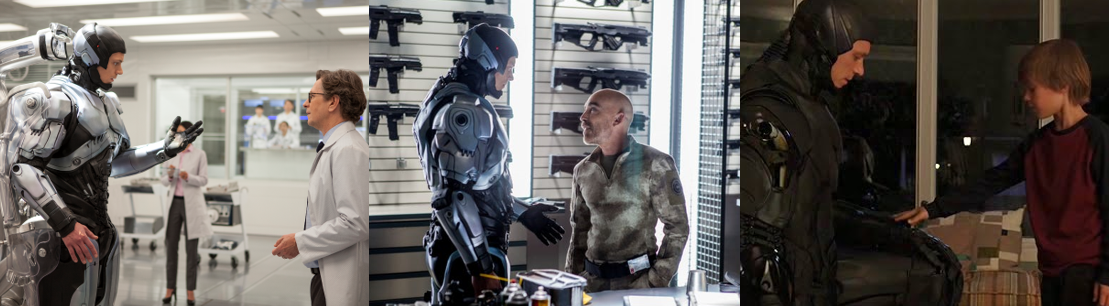
This version of RoboCop delves a lot deeper into the emotional and psychological turmoil faced by Murphy after his transformation. Stripped of 98% of his human anatomy and understandably distressed by his somewhat monstrous appearance, Murphy demands to never again be seen without his suit and battles depression, doubt, and sly persecution from Mattox, who scoffs at the idea of compromising a machine’s efficiency with organics and a conscience. Despite Dr. Norton’s pride in his work and faith in Murphy’s abilities, it turns out Mattox is right: murphy’s human instincts make him dramatically less efficient than the EM-208s. Unimpressed by what he sees as RoboCop’s “imperfections”, Sellers demands a workaround so he can sell RoboCop as a sleek, sexy, impressive product and Dr. Norton’s therefore forced to implant a new chip into Murphy’s brain. Now, when his visor goes down, RoboCop’s artificial intelligence takes over, though Murphy believes he’s in full control, thus appeasing Sellers and completely undermining the entire point of the project since it’s still a machine pulling the trigger. Then, to make matters even more laughable, Dr. Norton and his team decide the best time to upload the entire criminal database and internet access into RoboCop is right before his public unveiling, causing Murphy to have a seizure and forcing Dr. Norton to intervene again. This time, Murphy is practically lobotomized and little more than a cold, calculating machine with a human face (…and hand). Effectively reduced to the pragmatic, directive-compelled RoboCop of the first film, Murphy ignores social graces and his family in favour of hunting down Detroit’s most wanted. However, when Clara begs Murphy to come home and assuage David’s anxieties, Murphy’s human nature overrides his programming and drives him to get back on mission. Specifically, he accesses CCTV and other archives to not only uncover corruption in the police department that extends to Chief Dean, but also solve his own murder and finally bring Vallon to justice, though this defiance naturally leads him on to a collision course with OmniCorp.
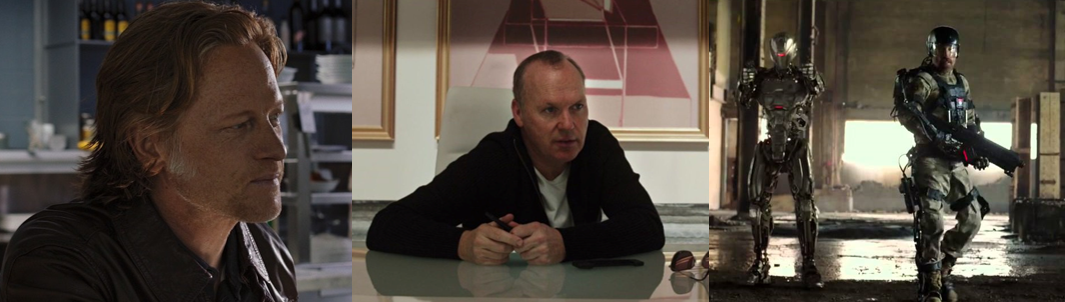
Far from a scheming conglomerate full of well-dressed executives looking to profit from Detroit’s misery, the new Omni-Consumer Products (OCP) is largely embodied by Raymond Sellers. A visionary entrepreneur, Sellers is a silver-tongued salesman who arrogantly ignores focus group feedback and pushes his own agenda for RoboCop, reasoning that people don’t know what they want until they get it and that simply placing a man in a machine and removing his humanity will silence his doubters and increase OmniCorp’s profits. Played with the perfect balance of charisma, smarm, and slimy superiority, Keaton presents Sellers as an industrious and charitable businessman who’s genuinely offering people a second chance through Dr. Norton’s robotics work and safeguarding American lives with his machines. However, behind all that is a corporate magnate who cares only about increasing his already considerable wealth. He makes promises to Clara that Murphy will be returned to them and then denies her access to him, threatening legal action if she speaks out; he disregards Dr. Norton’s frankly genius work and putting a career cop inside a machine in favour of stripping away Murphy’s instincts; and doesn’t hesitate to order RoboCop’s destruction once he’s outlived his usefulness. Indeed, when Murphy regains his humanity, Sellers simply spins a story about how Murphy’s suffered a psychotic break and his machine programming has turned him into a killer, despite such a story only working against the deployment of automations in the streets! While Sellers is eventually forced to get more hands on when he basically kidnaps Clara and David, Mattox isn’t afraid to test himself and his EM-208s against RoboCop. Derogatorily referring to Murphy as “Tin Man” and openly criticising him at every turn, Mattox relishes proving his superiority over RoboCop but is ultimately and ironically, undone by Murphy’s very human ally, Lewis. I enjoyed Mattox far more than Vallon, a crime boss who’s infiltrated the police department and whose grudge against Murphy causes RoboCop’s creation. A far cry from the wicked Clarence Boddicker (Kurtwood Smith), Vallon is basically an afterthought. There’s almost no catharsis when RoboCop catches up with him and I would’ve much preferred Mattox being given an expanded role as the one who injured Murphy to kick-start Sellers’ scheme.
The Nitty-Gritty:
Though RoboCop also has a distinctly loud and on-the-nose political agenda, it focuses all its satire into Pat Novak. RoboCop comments upon America’s perceived superiority over the rest of the world, the media’s flagrant bias towards far-right thinking, and touches upon prejudices. These are largely embodied by Mattox, who’s the only one who voices criticism of RoboCop, but also extends towards the foreign nations brought under heel by OmniCorp’s technology. RoboCop has always juggled themes of “man vs. machine” and questions regarding the human soul, and these elements return in this remake, where Murphy’s adjustment to his transformation is at the forefront. Unlike in the original films, where it’s ambiguous how much of Murphy is alive or just memories in RoboCop, this film explicitly states that Murphy is still alive and functioning, just without his biological body. His brain is now partially cybernetic, giving him unprecedented access to criminal databases, CCTV, and augmenting his strength and reflexes, but he’s not a “ghost in the machine”: he’s Alex Murphy with a full body prosthesis. Thus, Murphy reluctantly agrees to test his newfound cybernetic armour against the EM-208s and to reunite with his family, though he remains incredibly self-conscious and uncomfortable with his appearance. Although this RoboCop isn’t bound by directives, he can be remotely shut down and even have his will suppressed through procedures and programming, turning him into a stoic robot who effortlessly hunts down criminals. Yet, Murphy’s humanity and emotions are powerful enough to break this programming, reasserting his personality and compelling him to avenge his woes upon Vallon and confront the corruption in the police department. Despite him callously ignoring them, Clara and David remain devoted to Murphy and are distraught by OmniCorp’s lies. Placing additional emphasis on Murphy’s family was a nice touch, though he keeps his distance even before Dr. Norton suppresses his emotions simply because he’s uncomfortable in his new body and would much prefer to be dead. It isn’t until the finale, after reaffirming his humanity, that Murphy comes to accept his new life and be more comfortable around his loved ones.
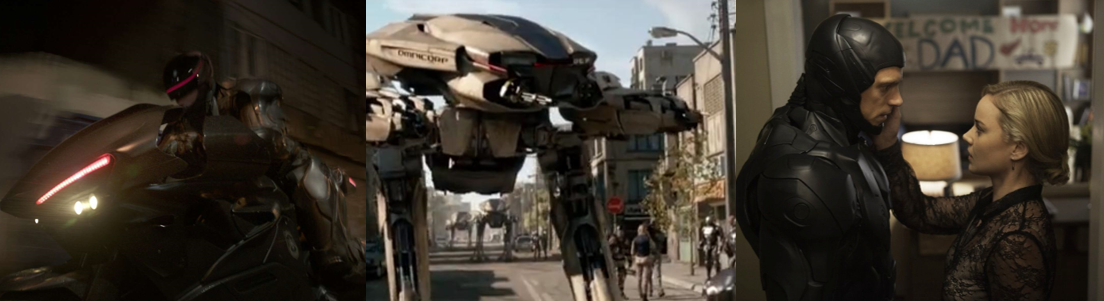
If you’re hoping for the same action-packed gore and gleeful cussing of the original, then I’m afraid you’ll be disappointed by this distinctly toothless remake. Murphy is caught in a car bomb rather than shot to pieces and RoboCop primarily fires a high-powered taser gun rather than blowing limbs off. RoboCop’s biggest action scenes also take place either in a virtual simulation or against automatons, severely reducing the film’s body count until Lewis joins him in busting up Vallon’s operation. On the plus side, RoboCop’s suit looks fantastic. While, at times, the illusion is lost, particularly when Sellers demands a black paint job, the initial suit is an impressive modern reimagining of the original. I particularly like the futuristic visor and the depiction of RoboCop’s helmet, which was the one inconsistency in the previous films, and Kinnaman’s movement in the suit. While he’s not as stiff and robotic as Peter Weller, Kinnaman still echoes some of that performance, especially when Murphy first wakes up and acclimatises to the suit. Once the AI takes over, RoboCop moves with a beautiful, fluid grace that shows the ghost of what this film wanted to be. While RoboCop rides around on an awesome motorcycle and sports an influx of visual aids, his black suit is really unfitting and makes him look ridiculously generic. He just looks like Christian Bale’s Bruce Wayne/Batman a lot of the time, which in turn makes the suit look fake and plastic-y. RoboCop does boast some impressive visual effects, however. The EM-208s look amazing, especially marching through the streets and when sparring with RoboCop, and the prosthetics seen in Dr. Norton’s lab are really well realised. The most impressive effect is saved for the unsettling scene where Murphy sees the full extent of his injuries, which have left him simply the remains of a head, a set of lungs, and a single hand. While the ED-209s lack the personality and clunky build of the original, they’re still an impressive walking tank and it was fun to see a troop of them in action overseas, and standing in RoboCop’s way in the finale. Sadly, RoboCop plays it far too safe regarding its action, sucking out all the gory fun and replacing it with a dull pace that really causes the film to drag. It doesn’t even use Basil Poledouris’ iconic score, save for the opening titles, favouring music by Pedro Bromfman that’s as generic and forgettable as the rest of the film.
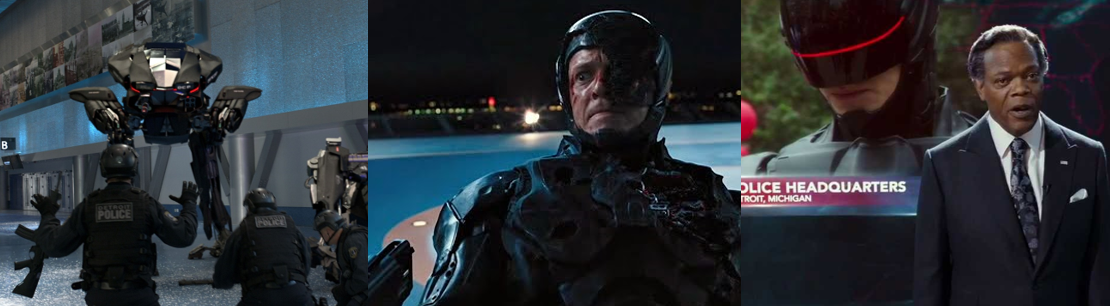
After Murphy’s breakdown sees Dr. Norton suppress his emotions, RoboCop becomes a hit with consumers and the public, finally giving Sellers the sway to challenge the Dreyfus Act. However, when Clara gets through to Murphy and his humanity forces its way back into the spotlight, Sellers cuts his ties with the project and orders Mattox to destroy RoboCop, ready to sell the idea that Murphy suffered a psychotic break and died from a seizure. To keep Clara from publicly criticising OmniCorp, Sellers brings her and David in to the deliver the news, confident that he’s swayed Dr. Norton by promising to further fund his research, only for the remorseful doctor to betray him, remove Mattox’s ability to shut Murphy down, and reveal the truth to Clara. While Murphy is furious at Dr. Norton for having lied to him, he forces his way past ED-209s and Mattox himself, suffering tremendous damage in the process thanks to Mattox’s superior firepower. Thanks to the intervention of his fellow officers, particularly Lewis, RoboCop reaches the rooftop, where Sellers is preparing to escape (while still playing the benevolent role with Clara and David). Unfortunately, Murphy’s programming won’t allow him to arrest or harm Sellers, who openly taunts him, threatening to kill Murphy and his family and pointing out that Murphy can’t do anything to stop him since he’s “just a robot”. Despite the incredible pain and the forcefulness of his programming, Murphy asserts enough will to fatally shoot Sellers at the same time as the devious executive shoots him. It’s a very different ending to the original, where Murphy confidently confronted OCP’s executives and asserted himself. Here, Murphys “dead or alive, you’re coming with me” line barely makes any sense and, since he’s only kept from acting because of Mattox’s special wrist bands. It might’ve been better if Clara or David had rushed Sellers to rip this from him and give Murphy the chance to fire. Regardless, Murphy is repaired and placed back in a more fitting suit, now having accepted himself and ready to embrace his newfound life. Pat Novak, however, is incensed that a “Motherf*****” like Dr. Norton is walking free after he spoke out against OmniCorp to keep the Dreyfus Act alive, though he remains adamant in his belief that America is the greatest country in the world and that, one day, her citizens will see sense and allow robots to keep the peace through good, old fashioned fascist oppression.

The Summary:
I’ve been a fan of RoboCop since I was a little kid, when I first saw the movie and was wowed by its over-the-top gore and fantastical main character. As big a fan as I am of the sequel, even I have to admit that the franchise basically peaked with the first movie and it’s been downhill ever since. Thus, I was somewhat curious when the remake was announced and went to see it opening week simply because I’d never had the chance to see a RoboCop film in the cinema before. Unfortunately, RoboCop is as disappointing now as it was back then. The thing about remakes is, you kinda need to do something different with the concept to make it stand out, otherwise it just feels like a needless rehash. RoboCop tries to do something different by focusing more on Murphy, his struggle to adapt to his new life, and his family turmoil, but it’s lost beneath a middling plot, forgettable characters, and a truly uninspired design for the character. It’s such a shame as the suit does look good and Kinnaman moves really well in it, but then they paint it black and it becomes the most generic thing I’ve ever seen. As if lacking the gratuitous violence, blood, and cursing wasn’t bad enough, RoboCop is almost completely devoid of satire save for Pat Novak and the underlying hypocrisy of OmniCorp’s motivations. Admittedly, these elements have a scary relevance in modern times, where bias right-wing media spreads fear and hatred, but all the elements that made RoboCop fun have been as stripped away as Murphy’s body. I didn’t mind the deeper dive into Murphy’s acclimation to his new abilities, but the pacing flip-flopped all over the place between his emotions (or lack thereof). It’s almost criminal how unfulfilling Murphy’s vendetta against Vallon was and how wasted Mattox was by comparison. Hayley and Keaton stole the show here, playing their roles with joyful relish, but Kinnaman is no Peter Weller and this is no RoboCop. As a standalone sci-fi concept, it’s decent enough, but it’s called RoboCop and fails to be anything but a surface level rehash of the original film, with none of the fun or enjoyable elements to make it an instant classic or anything more than a footnote in the history of sub-par remakes.
My Rating:
Could Be Better
Did you enjoy the RoboCop remake? Were you disappointed by how toothless it was? What did you think to the focus on Murphy’s emotional struggle and his family? Did you also find the film dragged or did you enjoy the slick action? What did you think to the new suit and RoboCop having a human hand? Which RoboCop movie is your favourite? How are you celebrating RoboCop Day today? Whatever you think about the RoboCop remake, feel free to drop your thoughts below, support me on Ko-Fi, and be sure to check out my other RoboCop content!

 Dr. K's Waiting Room
4 thoughts on “Movie Night [RoboCop Day]: RoboCop (2014)”