

Released: 11 January 2018
Originally Released: 26 November 2015
Developer: Team Ninja
Also Available For: Arcade, PC, and PlayStation 5
A Brief Background:
With over seventeen mainline games, the Final Fantasy franchise has been a staple of the role-playing genre since its 1987 debut, popularising and largely defining role-playing games (RPGs) for generations of players. Not only has the franchise dabbled in more action/adventure mechanics, the Final Fantasy series has also produced a wide array of spin-off titles, including real-time strategies, mini games, and their characters featured in obscure polygonal fighter Ehrgeiz: God Bless the Ring (DreamFactory, 1998). In 2008, to celebrate the 20th anniversary of the franchise, Square Enix officially brought Final Fantasy into the fighting genre with Dissidia Final Fantasy, an RPG-inspired action fighter that gathered the franchise’s most recognisable heroes and villains and became a critical and commercial success for Sony’s oft-forgotten handheld, the PlayStation Portable (PSP). This release was expanded upon three years later with the release of Dissidia 012 Final Fantasy, a combination prequel, sequel, and enhanced version of the original game. Reviews largely praised the expanded mechanics and additional fan service, and it was later followed by a three-on-three arcade spin-off. Developed by Team Ninja and including characters from the franchise’s latest releases. Dissidia NT’s arcade success led to an enhanced home console port, one that included all previous fighters and was equally praised, despite its chaotic combat.
My Progression:
I had a great time playing the two Dissidia games back when I had a PSP so I jumped at the chance to experience this high-definition version of the game. While far removed from the traditional turn-based gameplay of the series (and even its more modern, action-orientated slant), the Dissidia series has always been a great tribute to the franchise, bringing together some of its more iconic characters and locations in a suitably convoluted battle between the forces of good and evil. Dissidia NT is similar in this respect, featuring champions of light and dark battling for cosmic entities Materia and Spiritus and retaining some of the same gameplay mechanics, but with a very different presentation. The most noticeable difference is that the game is a three-on-three fighter, which immediately brings it down a notch in my eyes. I’ve never liked this sub-genre of fighting games and it really annoys me how many titles have succumbed to this formula. In Dissidia NT, it seems to have been implemented towards online play; you’re supposed to battle online with and against friends, earning clout and points and such and communicating using text/chat features. However, single player components are present, though there’s no way to have a simple one-on-one experience as in the previous games. This impacts the game’s mechanics and difficulty, especially as arenas are large and occasionally troublesome to navigate. You must beat each member of the opposing team (or destroy their “core” in what’s essentially a capture the flag mode) to achieve victory. You do this by targeting either an opponent or their team’s core with L2 or R2, dashing towards them by holding R1 (which lasts as long as your stamina bar), and attacking with either Circle, Square, or Triangle in conjunction with movements of the left stick. Circle unleashes one of three “Bravery” attacks that deplete your foe’s Bravery points and will eventually “break” them, which is your time to strike with Square. Square attacks deplete your opponent’s Health Point (HP) and you can hold Circle or Square to charge these and make your attacks more powerful, but you can only have one HP attack equipped at a time. Triangle gives you access to your two “EX Skills”, which provides buffs to you and your teammates or lays traps for your foes.
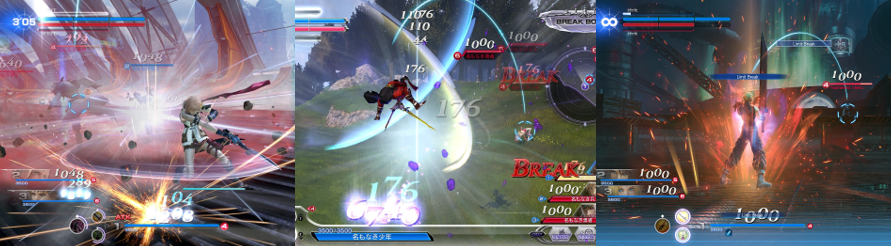
You also have a few defensive options. L1 lets you guard, side step, and parry attacks, you can jump (and double jump) with X, and run up trees and walls. You can use Circle to revive a teammate if you’re fast enough, refill HP and boost Bravery with certain EX Skills, perform “cancels” and air and ground recoveries, and attack “Summon” stones to build a meter. Once full, you’ll unleash a Summon, a powerful creature from Final Fantasy lore that impacts the entire battlefield, unleashing powerful attacks, obscuring the screen, draining Bravery, and applying other buffs. Your enemies can do the same, but it’s often not too difficult to stay out of the Summon’s attack range. What is difficult, though, is chasing down and attacking your foes. The camera swings around wildly, you must often hop up obstacles, and your opponent’s either dash away at high speed, seem to fly or hover above you indefinitely, and you’ll get blasted from behind and all angles without warning. Every battle is contested within a time limit, which adds to the pressure, and carries a difficulty rating ranging from Bronze to Gold and above. Winning harder battles awards more Gil to spend in the shop, more experience points to level-up and become stronger, and other treasures (usually player icons and chat messages but also character skins). Each character has a “type”, such as “Assassin” or “Marksman”, and favours certain attacks. Rinoa Heartilly, for example, attacks with her canine companion, Kefka Palazzo favours ranged magic attacks, and Shantotto is small and agile. Many characters utilise swords or blades, but even then their attacks and styles are vastly different: Cloud Strife, for example, attacks slower than Zidane Tribal, while Squall Leonhart utilises explosive sword swings and the Warrior of Light attacks with a more traditional sword and shield. As you level-up, your characters learn new attacks, adding ranged or close quarters abilities to their repertoire, as well as making them tougher and faster. Unfortunately, battles quickly become a noisy mess of visuals, notifications, and distractions. I found a decent rhythm targeting one enemy, dealing damage, and then switching to another and cycling between them, attacking cores as needed, and even then I’d be battered about like a ragdoll from offscreen attacks and unexpected Summons.

Dissidia NT comes with a comprehensive tutorial in which a helpful Moogle walks you through every aspect of the game and you can also review attacks and stats from the pause menu and before each battle. Summons are gifted seemingly at random and can be picked before a battle; you can customise your player card and profile; and you can purchase music, icons, and various bits and pieces from the shop. The game does boast a story mode but it’s sadly a massive step back compared to the last two games, which were very story driven and mixed up different characters in fun ways in seemingly never-ending battles against “puppet” copies of the cast. In Dissidia NT, story mode is handicapped by the “memoria” system. You can only earn memoria by levelling-up, so you must participate in numerous online or offline battles to gain levels and progress in the story mode. Looking at the story map in this mode, there are at least thirty “nodes” to unlock, so you’ll need to level-up at least that much to experience it, and many of these nodes simply unlock nonsensical cutscenes where the characters wander about and ruminate on their cycle of conflict. When you finally unlock a “Battle Trial”, you’ll have to pick from three pre-set characters to fight and will unlock this for the “Gauntlet” mode. This is where you’ll waste spend most of your time winning successive battles to gain levels and treasures, basically meaning you need to grind away for hours just to unlock a cutscene and see the Onion Knight (why he’s not called Luneth is beyond me) striking out with the likes of Y’shtola Rhul. This is extremely tiresome and killed my excitement for the game; I just wanted to blast through the story mode, expecting it to be a chapter-based affair told from the perspective of the heroes and villains. Instead, I was forced to grind away in tiresome battles to level-up, only to limp my way towards two story-based battles where I couldn’t even play as my go-to characters, Cloud and Leon.

Continue?
I was so disappointed to find that Dissidia NT is geared more towards online play and monotonous grinding than providing a compelling fighting experience. It’s doubly disappointing after completing the first two games and expecting more of the same, only to be met by a chaotic three-on-three brawler that restricts you with its arcade sensibilities. The game is a mess of tutorials, messages, mechanics, and instructions, with your allies and Moogle helper constantly banging on. Battlefields become difficult to navigate thanks to obstacles, destructible elements, and being far too big at times. It makes sense given the expanded roster but it makes it very difficult to chase after your target when your stamina drains so quickly and they just stay up in the air for ages. It’s a shame as the game does look great, characters are all represented faithfully, sporting unique EX Skill animations (Zidane and Kuja enter “Trance”, Cloud and Sephiroth have “Limit Breaks”, etc) and skins (Jecht goes shirtless, Cloud sports his Final Fantasy VII: Advent Children (Nomua, 2005) attire, and Cloud of Darkness takes a more monstrous form), and fun characterisations (Shantotto is always rhyming, Kefka is bat-shit crazy, Squall relies on his internal monologue, and Noctis Lucis Caelum is perpetually confused). The game’s arenas and music are pulled from each of the mainline titles but, this time, even Final Fantasy Tactics (Square, 1997) and Final Fantasy Type-O (Square Enix 1st Production Department, 2011) are represented. You’ll battle in the plains of Cornelia, the purple throne room of Pandaemonium, within the crystalline Interdimensional Rift, on the streets of Midgar, and outside the Royal City of Rabanastre, amongst others. Some stages have destructible or interactable elements; others have little Easter Eggs in the background. Each battle is preceded with some banter between the two teams and ends with either a victory pose (and the traditional fanfare) or your crushing defeat. Rewards are bestowed even in defeat and you’ll unlock new characters and Summons as your progress (or part with your hard-earned cash).

Looking ahead, it seems there are fifty-seven panels to unlock in Story Mode, with most of them being cutscenes. Despite Spiritus being prominent to the story, clashing with Materia and desiring the same level of the destruction as the demonic Chaos, he’s not fought in this mode. Instead, your final battle is against the ancient dragon god Shinryu, a gigantic creature that sports two intimidating forms. You’ll also take part in battles against the game’s Summons, meaning your team will go head-to-head with the likes of Bahamut, Ifrit, and Shiva, which all looks thrilling, but I can’t see myself bothering to grind up the nearly sixty levels to unlock all these battles. While some characters are unlockable, Materia and Spiritus aren’t among them and you must part with your real-world money to add to the roster (though, again, there’s little incentive as the game’s so shallow and repetitive). I’m sure the online and multiplayer functions are fun, but I wasn’t impressed enough by the single player modes to test them out. There are also fifty-six Trophies to unlock here, granting you rewards for spending memoria, claiming treasure, completing Story Trials, and winning ranked matches. Unfortunately, as good as the game looks and as smooth as most of the gameplay is, Dissidia NT just doesn’t live up to the standards of its predecessors. There was a real opportunity here to present the gameplay of the portable games in a high-def, arcade-style, all-action brawler. Throw in three-on-three battles as a side mechanic, if you must, but focus on one-on-one gameplay as a priority. Similarly, I get wanting to be an online experience but…is it really too much to ask for a simple ten to twelve-fight tournament mode? Fighting games have been doing that since at least 1991 and I don’t think it’s too much to ask to have that thrown in here. Hell, the developers could’ve made things easier for themselves by just using basic cutscenes for intros and endings rather than the middling, muddled up cinematics you work so hard to unlock here.
But maybe I’m missing the point. Maybe Dissidia NT is a thrilling online experience. Perhaps the battles get easier and more enjoyable once you’re gotten past Level 20. Maybe the Summon battles are worth all that effort. Perhaps you enjoyed the three-on-three experience? If that’s the case, let me know in the comments and go check out my other Final Fantasy content.

 Dr. K's Waiting Room