

Released: 13 February 2019
Originally Released: 7 July 2000
Developer: Square
Original Developer: Squaresoft
Also Available For: Android, Nintendo Switch, PC, PlayStation, PlayStation 3, PlayStation 4, Xbox One, Xbox Series S
The Background:
Final Fantasy VII (Square, 1997) is unquestionably one of the definitive role-playing games (RPGs) and probably the most popular Final Fantasy title, selling over twelve million copies worldwide and making its way onto many “top ten” lists. In comparison, Final Fantasy VIII (ibid, 1999), despite being a best-seller, is often the subject of criticism. For the ninth game, Square decided to veer away from the pseudo-futuristic settings of its predecessors and move back towards a medieval fantasy aesthetic like the original games. This fantastical setting would be home to the various anthropomorphic characters who made up the game’s cast, all of whom were designed by Shūkō Murase, Toshiyuki Itahana, and Yoshitaka Amano. Main character Zidane Tribal was purposely designed to be the inverse of his predecessors: young, agile, brash, and outspoken with an eye for the ladies, a philosophy that extended to his supporting cast and the lighter tone of the narrative. Determined to return to the roots of the franchise by reviving narrative concepts such as the Crystals, Fiends, and fantasy elements, the developers tweaked the battle system to be both familiar and slightly different, returning character classes (or “Jobs”) to the franchise to make each character unique both visually and in terms of their abilities. Final Fantasy IX became the second-highest selling game in Japan upon release and was met with critical acclaim. Reviews praised the back-to-basics approach, amusing characters, and detailed environments and character models, though main villain Kuja was seen as inferior to his predecessors In later years, Final Fantasy IX has been recognised as an under-rated entry in the franchise, which perhaps prompted Square to release this enhanced version of the game in 2019. Featuring graphical updates and helpful boosters to speed up the gameplay, Final Fantasy IX found new life and new success on modern consoles and became much more accessible as a result.
The Plot:
In the medieval fantasy world of Gaia, thief Zidane Tribal kidnaps princess Garnet Til Alexandros XVII as part of a ploy by the neighbouring nation of Lindblum. However, he ends up joining forces with Garnet and a diverse cast of characters to take down her mother, Queen Brahne of Alexandria, who has sparked an all-out war between Gaia’s nations.
Gameplay and Power-Ups:
Final Fantasy XI is a traditional turn-based RPG set in a fictional and very fantasy-orientated medieval land. Unlike the previous two Final Fantasy titles, players now form a team (or “party”) of up to four characters, each with their own set of skills, magic, and abilities that are analogous to the classic Final Fantasy Job system. Primarily, players control Zidane, a peppy monkey-boy thief, though you’ll control his teammates at various points and will be encouraged to view their character-building moments and forced to split the playable roster into separate teams. In terms of controls, Final Fantasy XI is nice and simple: use the control stick or directional pad to move your character around the various towns, overworlds, and locations and to select commands in battle, execute those commands. Talk to teammates and non-playable characters (NPCs), activate objects and open chests with A, and back out of menus with B. Open up the main menu with Y, challenge characters to a game of Tetra Master with X, and use Right and the Left Triggers to move the camera on the overworld. RT also enables an “auto battle” function, effectively removing control from the player in battles. In battle, you can press Y to switch characters, hold the Left and Right Bumpers to escape (if possible), and select battle commands (attack, defend, casting spells, using items, and such) from several in-game menus. Pressing the View button opens the map on the overworld (which is eventually enhanced to show location names and allow fast travel) and helpful notes when on menus (a Moogle says what each item or spell does, for example), while pressing Menu pauses the game. From the pause screen, the shoulder triggers and bumpers activate some helpful boosters, such as turning off random battles and setting your maximum attack power to 9999 and speeding up the gameplay, all while still allowing you to obtain Achievements.

There are some other helpful settings in the main menu, too. You can change the borders and text speed, set your default movement speed to run or walk, turn a helpful cursor on or off so you can always locate your character, and set the battle system to turn-based or “wait”. If you set it to wait, enemies won’t attack while you’re selecting moves, easing the pressure on you. You can also turn certain camera movements on or off to further speed up the gameplay, and certain items also affect this as they increase your chances of attacking first, avoiding damage, and the speed your Active Time Battle (ATB) gauge fills up. When exploring the overworld and the various swamps, forests, caves, and castles, you’re randomly attacked by monsters. Defeating them earns you experience points (EXP), ability points (AP) for your character’s different abilities (as dictated by the gear they have equipped), Gil (Gaia’s currency), and random items (potions, elixirs, and the like). Battling also fills the ATB gauge; once full, you automatically enter a “Trance” state that increases your attack power and speed and allows access to more powerful attacks. Each character carries a weapon to inflict damage on enemies; these are applied manually or you can select “Optimise” to equip the best options. Weapons and gear can be swapped for more powerful options you either steal, find, buy, or “synthesise” in specialist shops to increase their attack power and add various buffs or status effects to your attacks. Different equipment (armour, rings, headbands, and such) do the same, allowing characters to learn abilities that can then be equipped providing you have enough AP. These increase your maximum health and/or magic points (HP/MP, respectively), have you automatically counterattack or take damage for party members, increase you chances of stealing, escaping, or attacking first, negate back attacks, and make you resistant to status effects like poison, petrify, stop, and mini. Each character has different special attacks, too: Zidane steals from enemies, Vivi Ornitier and Eiko Carol cast magic twice in a row, Quina Quen eat enemies to learn their attacks, and Freya Crescent leaps to attack from the air, for example. These abilities are then enhanced through Trance, adding more powerful attacks to your arsenal that will attack or affect multiple enemies, deal greater damage and inflict status effects upon them, or heal or revive your party, though at the cost of MP.
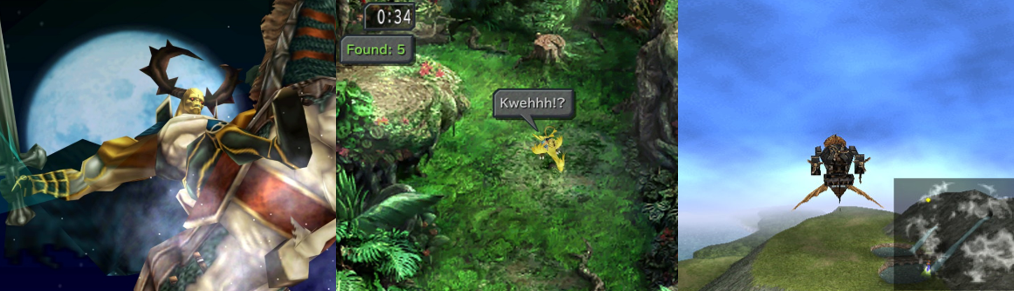
Characters like Eiko and Garnet (who later takes the name “Dagger”) can also summon “Eidolons”, powerful creatures that deal huge damage. Other beneficial magic includes healing spells, spells that cure status effects, and spells that revive downed players, abilities also accomplished by various items, using a tent at save points, or resting at inns (though this will cost you). Google save points are all around Gaia and you can eventually summon a Moogle on the overworld with X. Moogles also teach you the game’s mechanics, sell items, weapons, and accessories, and have you ferry letters around. Some key items must also be selected from your inventory to be used, such as the Gysahl Greens that summon a rideable Chocobo at specific parts of the map, and orbs or keys to open pathways. Initially, your Chocobo simply travels across the open fields but, as you play the aggravating Hot and Cold mini game to find treasures, it’s enhanced to traverse mountains, water, and even fly. However, you’ll also get access to different ships, ones that traverse water and, eventually, the skies, allowing you to quickly fast travel. When in the castle town of Lindblum, Air Cabs take you to the different districts; Memoria features teleport pads, but mostly you use ropes or ladders to explore. When you’re not battling, you can play Tetra Master, a card game almost every NPC plays. As you explore and battle, you’ll acquire cards; these have different strength ratings that, when placed on a grid, allow you to steal your opponent’s cards. Use the arrows on each card and their strength rating to judge where best to place them and fill the board with your colour to win, though I’d recommend making liberal use of nearby save points as NPCs are unfairly skilled. While it’s largely an optional distraction, you must win a small tournament in Treno to progress the story. Speaking of which, you’re regularly prompted to watch an Active Time Event (ATE). A prompt appears onscreen and, when selected, the game shifts to an NPC or teammate as they contemplate their situation or get into mischief. These are optional, and can arguably distract from the main game, but I liken them to regular cutscenes but with a little more character.
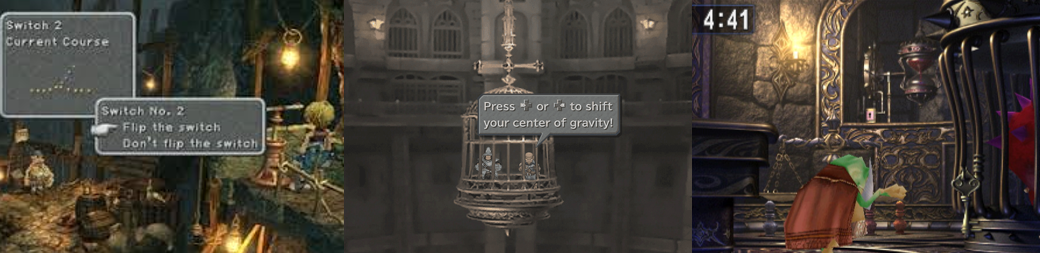
As is common Final Fantasy games, the difficulty scales in Final Fantasy XI; the further you progress, the more powerful enemies become, even in areas you’ve previously explored. Puzzles are generally quite simple: you’ll be activating switches and consoles, collecting items, pulling levers, and traversing mazes in different areas without too much difficulty. There is a lot of back and forth and repetition involved, though, such as when you explore Fossil Roo and change the track the spider-like gargant takes to reach the exit, or when you wander Pinnacle Rocks looking for Ramuh to piece together his fable and earn him as a summon, or taking the correct path in a looping forest to reach the Black Mage village. You’ll light candles to uncover hidden stairways, explore rooms to find hidden passages, search for your teammates when they’re captured or inevitably wander off or have an identity crisis, mashing A to escape quicksand, and cooking dinner for your party. This, like some other parts of the game, requires you to select the right order from a list to get the best results, with some decisions leading to you battling a swarm of enemies. Final Fantasy XI is full of little mini games, with many being mandatory: you jump rope in Alexandria, take part in a play and sword fight with Zidane’s friend, Blank, and question your life decisions as you swing a cage back and forth to rescue Adelbert Steiner and occasional party member Marcus. Marcus and Beatrix, General of Alexandria’s armies, temporarily join the party at various points, with the latter often teaming with Steiner in side battles. Similarly, there’s a part where you play as Regent Cid Fabool IX (who’s been transformed into frog) and must carefully sneak past a Hedgehog Pie and then balance a set of scales to rescue Zidane’s friends. When exploring Ipsen’s Castle, you can open a secret passageway by picking the correct sequence and then mix ingredients for the Ancient Aroma. In Pandemonium, you get thirty seconds to slip past light plumes and the random battles they contain to cross a temporary bridge, as well as altering some headings to activate platforms. You’ll also power up and activate orbs in Oeilvert to learn valuable lore about Terra and Garland’s plan to fuse it with Gaia.
Presentation:
I loved the chibi character models of Final Fantasy VII and its industrial, futuristic steampunk prerendered backgrounds. Final Fantasy VIII was a huge visual improvement, both in terms of the more detailed character models and environments. Returning to a medieval setting for Final Fantasy IX is a shame for me as I prefer the more futuristic settings, but my God is this game full of charm! Zidane is the polar opposite of the brooding Cloud Strife and the melancholy Squall Leonhart, being peppy, agile, mischievous, and eternally optimistic. Zidane fancies himself a romantic, pirate-like figure; his charms are mostly wasted on Dagger but she warms to his enthusiasm and heart. When he learns his origins from Garland, Zidane becomes morose and lashes out at his friends, who endure tough battles to snap him out of his uncharacteristic mood. While he’s the focus of the story and gets the most character development, Zidane has competition in Vivi, a clumsy, insecure Black Mage who’s constantly feared and hated due to his destructive brethren who embarks on a journey of self-discovery. Zidane clashes with Steiner, the oafish captain of Alexandria’s guards, and Amarant Coral, a brutish thug and loner with a grudge against Zidane. Freya is an old ally of his searching for her lost love, while Eiko is a young girl with a crush on him who’s both envious of Dagger and also tries to get them to admit their feelings. Then there’s the supporting cast, such as Zidane’s roguish crew, the Tantalus Theater Troupe, who initially seek riches but are roped into saving the world, the jester-like Zorn and Thorn who constantly hound and mock the player, and the enigmatic Kuja, a flamboyant villain who lacks the menace of his predecessors but makes up for it in theatricality. It’s a very light-hearted, whimsical adventure for the most part; slapstick comedy and goofy moments pepper the narrative (especially whenever the androgynous and perpetually hungry Quina is around). However, there’s a lot of heart and emotion and high stakes as the story progresses, with characters questioning themselves and being forced to find the courage to fight for something worthwhile.

While the overworld is largely similar to those of the last two games, comprising various land masses (fields, deserts, a snow region), lakes, and a vast ocean, the towns are closer to those seen in pre-Final Fantasy VII, now brought to life in more detail than ever before. The medieval and fantasy theme delivers bustling castle towns, lavish stone palaces, and quaint little villages. Technology is of a similar steampunk style, but far less advanced (airships and complex machinery aside), with towns relying on wind and water power for the most part. While it’s all very beautiful, it’s an aesthetic I find quite samey; Alexandria and Lindblum are quite similar in many ways, for example, though they get more personality after they’re attacked and left in disarray. One aspect I was keenly aware of was that each area is home to a different species, often anthropomorphic ones, and these different species intermingle throughout the game, adding to its distinct visual style and giving it a diverse world. Caverns, ice caves, great trees, murky swamps, and arid deserts filled with abandoned temples and structures are everywhere. Qu Marshes are full of tall crass and frog ponds, the Iifa Tree looms ominously and sports gigantic, twisted branches, and you’ll find isolated settlements in forests and atop mountains. Ruins, great gates, and abandoned towns add a sense of desolation but things really become surreal and visually interesting when you’re transported to Terra, a bizarre alien landscape whose architecture emphasises glaring eyes, spheres, and a quasi-magical awe. Like the chilling Black Mage production line in Dali, the warped, crystalline Terra and its main town, Bran Bal, is where the genomes (Zidane and Kuja’s people) are created as puppets for Garland’s plot. Though you only visit Terra once, its spirit lives on in the desolate landscape of Pandemonium, a ruined dimension of chaos and memory that threatens to eradicate all life.
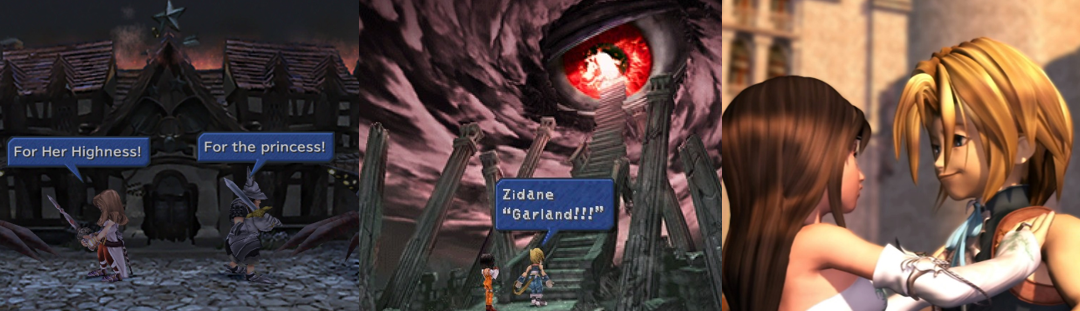
Unlike in previous Final Fantasy games, dialogue is delivered through speech bubbles, allowing multiple characters to talk at once and adding a level of personality not seen before. There’s no voice acting beyond a few roars and squeals and such, but each character exudes personality in their body language; Steiner even lives up to his nickname, “Rusty”, since his armour clanks as he walks. Legendary composer Nobuo Uematsu remixes classic Final Fantasy themes for this throwback, infusing every grand town and castle with a regality or sense of adventure, and every warped nightmare realm with a sense of foreboding as this whimsical adventure takes a dark turn. While no tunes were as memorable as “Dancing Mad”, “One Wing Angel”, or “Maybe I’m a Lion”, I enjoyed the fantasy score. Pre-rendered cutscenes and FMV sequences show our heroes comically swinging through the skies, emotionally reunite, and the all-out destruction of castle towns by powerful summons. Many cutscenes are standout moments, such as the characters flying the Invincible through a swarm of Silver Dragons, Dagger and Eiko summoning Alexander to repel Bahamut, and Zidane braving the Iifa Tree to rescue Kuja. Cutscenes are also told using the in-game models, of course, and these are often animated over FMV sequences. The transition is much less jarring than in previous games and, similarly, the distinction between the overworld models and the battle models is basically none this time around. Battles still load up an enclosed arena, characters still pose triumphantly as the victory fanfare plays, and their weapons change appearance as you equip new ones. Unfortunately, I did notice a considerable lag when the game loads battles that I don’t remember from the last two games. Since random encounters happen very frequently, it can get frustrating staring at a black screen and thinking the game’s crashed every other battle.
Enemies and Bosses:
Final Fantasy is known for having some bizarre enemies, but Final Fantasy IX may be some of the weirdest I’ve seen from the series. Sure, you’ve got some returning faces (Bombs, the ever-annoying Cactuars and Tonberries, Goblins, Hedgehog Pies, Malboros, and such) but these are joined by literal zombies, yetis, warrior skeletons, sand golems, lizard men carrying tridents or hatchets, amorphous red blobs with too many eyes for comfort, and a strange living house on spider legs! Giant armoured tortoises, vulture-like birds, oversized beetles, large worms and crabs, ravenous wolves, and sicken toads are commonplace, existing alongside powerful dragons, chimeras, giant trolls, terrifying robe-wearing ogres, and seemingly innocuous treasure chests that turn out to be Mimics. Epitaphs are living stone statues that conjure replicas of your party, Gimme Cats yield barely any rewards upon defeat and simply demand your items, Grand Dragons and Behemoths can KO with one hit even with the boosters activated, Jabberwocks and monstrous Mistodons are the stuff of nightmares, and you’ll be caught completely off-guard by the small, sheep-like Yans and being decimated by their powerful magic. Enemies inflict harmful or aggravating status effects, confusing you, poisoning you, or keeping you from using certain attacks. They heal themselves and their allies, cast elemental magic, and even blow party members away, though many can be stolen from to acquire powerful or rare items. When visiting Treno, you can challenge a powerful monster in the weapon shop if you’re feeling brave, though sadly this is the only opportunity to do this and it’s limited to certain monsters.
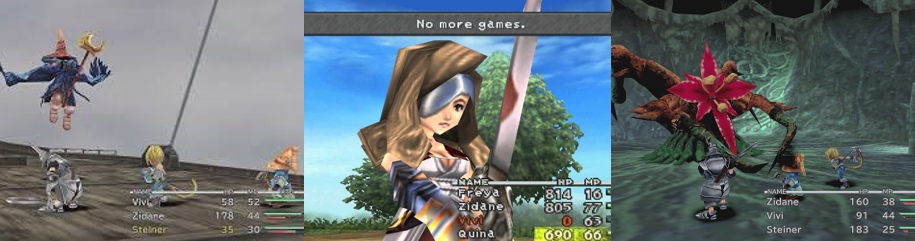
There are many boss battles in Final Fantasy XI, and some enemies must be fought multiple times. Steiner, for example, initially tries to stop you in Alexandria; you’ll battle him three times during your escape, though he’ll either flee or be felled by a Bomb, and he’ll refuse to attack Garnet so you can use this to your advantage. You also have three unwinnable fights with Beatrix where, after you deal enough damage, she uses Stock Break or Climhazzard and flees. You’ll battle Zidane’s boss and father figure, Baku, twice, with the first essentially acting as a battle tutorial, though he’s quite clumsy and often trips. Amarant is also fought before he joins your team; his battle is interesting as he hops all around the arena, making it difficult to target him, though he also casts Death, which can be a problem as you fight him as Zidane alone. Many Black Waltz’s, bloodthirsty Black Mages, attack Gaia’s towns and are thus greatly feared. They use elemental attacks, can freeze your party members, and even utilise dual magic attacks, though the third one you encounter also refuses to attack Dagger. Red Dragons pounce in Mount Gulug (though they’re naturally weak to Blizzard) and two serpentine beasts – Ralvurahva and Ralvuimago – must be fought to pass Gargan Roo. In the early game, Dagger and Vivi are both captured by the appropriately named Prison Cage, a strange plant-like creature from the Evil Forest that sucks HP from its captives. You must be mindful of this and hurting your allies, as it’s game over if their HP drops to zero. The Evil Forest is also home to the Plant Brain, a hideous malicious bud that attacks with lashing tentacles and by casting Thunder or afflicting Darkness through Pollen, though Fire attacks and Blank’s support will win the day (at the cost of the forest).

Your reward for rescuing Lindblum during the Festival of the Hunt is a battle against the boar-like Zaghnol, which enhances its Thunder spells and rams you with Heave. While exploring Gizamaluke’s Grotto, Zorn and Thorn manipulate the cobra-like Gizamaluke into attacking you, though the Bird Killer ability counterbalances its powerful Water spell. While exploring Cleyra and the desert of the Outer Continent, you’ll fight the ravenous Antlion, which reduces your HP to single digits with Sandstorm, counterattacks when attacked physically, and inflicts Trouble (which can only be cured with Annoytment). You’ll finally confront Zorn and Thorn, who fuse into the Lovecraftian entity Meltigemini, which poisons you and stops you earning AP with Virus, though it is weak to Fire magic. Deep in the Iifa Tree, you confront the tree-like demon Soulcage to dispel the Mist spewing from the tree. It can cast LV5 Death and infuriate party members with Mustard Bomb and its attack power is raised if you use Fire spells, but it’s undead so you can use a Phoenix Down to reduce its HP to 1 or use Life or Elixir to instantly kill it. In Fossil Roo, you spring past hazards as the Armodullahan chases them. If hit, you battle it, desperately avoiding its Death spells, until it falls down a hole but you can outrun it if you’re quick. When forced into journeying to Oeilvert to obtain the Gulag Stone, players battle the Ark, and airship-like being that can confuse your team or reduce them to 1 HP but will become a summon upon defeat. Also, when in Ipsen’s Castle, the insectile Taharka attacks when you steal the four elemental mirrors, increasing its defence when it curls into a ball but being notable susceptible to Heat, Silence, and Sleep spells.
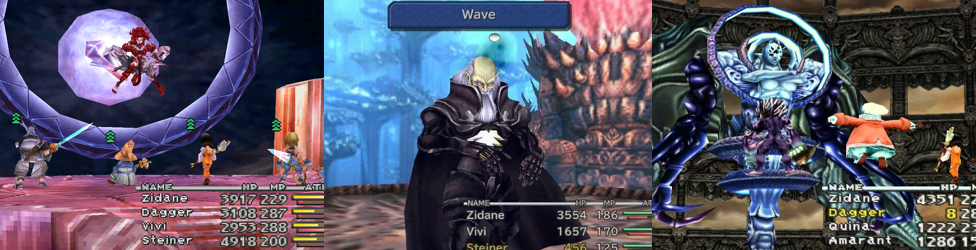
When the party learns of the four elemental temples, they split up to explore them and are attacked be the four Guardians of Terra, though the player only battles the Earth Guardian, a regal skeleton that attacks with Earth Shake. As you enter Memoria, you’ll battle the Nova Dragon, which tosses you with Psychokinesis, inflicts heavy damage with Twister and Tidal Wave, and counterattacks when physically hit. The four guardians are recreated by Kuja in Memoria and randomly attack as you explore: the four-armed Maliris favours Fire magic, Tiama is a three-headed dragon (almost a Cthulu-type being) that uses Wind magic and can blow you off the battlefield, Kraken is a disgusting octopus-like creature that fires Water or Ink from its tentacles or inflicts Freeze, and Lich is the Earth Guardian reborn, now more likely to cast Death. In Pandemonium, you endure a three-stage gauntlet against the Silver Dragon, Garland, and Kuja with no respite between. While the Silver Dragon favours Wind spells like the Nova Dragon, Garland likes to freeze the party with Stop (causing a game over if all four are afflicted) and obliterate their HP with Flare. In comparison, Kuja casts Demi, Ultima, and Flare Star, the latter of which cannot be protected against with Shell or Reflect. This is an unwinnable battle, as Kuja enters Trance to end the battle, and battle him (as “Trance Kuja”) again after besting the four guardians and Deathguise, another cobra-like dragon capable of annihilating ill-prepared parties with Meteor. Trance Kuja heals with Curaga, casts Flare, Holy, and Flare Star, though these same spells (or similar) can be turned against him. Once again, this is an unwinnable fight but, this time, you’re transported to the Hill of Despair and challenged to assemble a refreshed party to battle Necron, a being from beyond time and space who appears out of nowhere, drawn to Kuja’s despair. This surreal, angelic being is fought in a void and boasts powerful magic spells, including Blue Shockwave (which reduces one character to 1 HP), Grand Cross (which randomly inflicts different status ailments), and Neutron Ring to deal heavy damage. Necron can also attack four times in a row, easily pummelling the unprepared, so it’s best to have abilities like Regen, Auto-Life, and Mighty Guard enabled.
Additional Features:
There are fifty-one Achievements in Final Fantasy XI, with very few obtained through simple gameplay. You’ll get one for finishing the game, sure, and for winning one, ten, and 100 Tetra Master matches, but you’ll be hard-pressed to defeat 10,000 enemies or reach level 99 without grinding endlessly. Similarly, while it is possible to view 79 ATEs in a single playthrough, if you miss even one you can’t go back and view it or tick it off on a second playthrough, same goes for buying every item from Stiltzkin the Moogle (I missed that he was in Bran Bal). While guiding the residents of Cleyra to safety, entering Trance fifty times, causing Moguo to have a tantrum, and having Vivi win the Festival of the Hunt are pretty easy, getting an encore from the nobles, catching ninety-nine frogs, and jumping rope 100 and 1000 times are more than a chore! Similarly, you’ll be playing Hot and Cold a lot to upgrade your Chocobo’s beak and uncover all the hidden treasures across Gaia, though you can obtain most of the Ultimate Weapons if you search around Memoria. Other Achievements are gained from delivering Moogle mail and repairing their Mognet, uncovering the secret of the Eidolon Wall by interacting with the images etched there, obtaining four Moonstones, capturing a golden frog, and trading thirteen rare cards to Queen Stella. If you defeat the Behemoth in the Treno weapon shop with Dagger, you’ll get an Achievement (something easier said than done even with the boosters on!), and you’ll get another for getting a Very Good Omen from the fortune feature in Dali, where you also earn a nifty model airship if you bring an NPC three coffees hidden throughout Gaia.

Other Achievements are much more time consuming. You can’t acquire Zidane’s Ultimate Weapon unless you upgrade your Chocobo, which must also be done to find hidden treasure chests and reach Chocobo’s Air Garden. This is a hell of an ask and an aggravating task, but your reward is battling the spherical superboss Ozma, an existential cosmic being capable of fully regenerating itself and attacking before you do, decimating the party with powerful spells like LV5 Death, LV4 Holy, Doomsday, and Meteor. Ozma is also practically unreachable unless you befriend all the friendly monsters across Gaia (which also awards another Achievement). These randomly appear (accompanied by a whimsical jingle) asking for ore or diamonds or other items and allow you to attack Ozma unrestricted once appeased. The Ragtime Mouse also randomly appears throughout the overworld, challenging you answer his quiz to earn rewards and another Achievement. All the boosters in the world won’t help too much with these tedious tasks, and be careful what you activate as there are cheat boosters in the main menu that disable Achievements. If you fancy synthesising the best weapons and gear, search around in Memoria to find Hades, an optional superboss that likes to inflict numerous status ailments and reduce you to 1 HP with Judgment Sword but will synthesise the best gear upon defeat. Additionally, you can take on the Tetra Master tournament as often as you like (and challenge numerous NPCs) and pop along to the Trena auction house to win rare items, some of which are needed for Achievements. If you reach Memoria in under twelve hours, you’ll also acquire Steiner’s Ultimate Weapon, Excalibur II, and you’ll even be ranked on your treasure hunting abilities by a mysterious four-armed man. Finally, completing the game unlocks a movie gallery and an additional card game from the main menu, if you fancy checking those out.

The Summary:
I first played Final Fantasy XI on the PlayStation 3 back in the day after years of being a SEGA and Nintendo kid. The darker, more melancholy and futuristic nature of its two predecessors appealed to me a lot more so it was always jarring entering a medieval fantasy world, a trope that had been done to death even back then, but the sheer visual appeal and wacky nature of the game’s characters quickly won me over. I was excited to return to Gaia, especially with the helpful boosters this version offers, and the story and characters are just as appealing as ever. Everyone has such life and personality to them and, while the game is very goofy, there’s an emotional undercurrent through it and it gets pretty dark at times when castles are being destroyed and characters are questioning their origins and morality. While I wasn’t massively blown away by the game’s locations or music, few of which really stood out for me, the diverse cast and bizarre enemies made up for it, as did the bonkers existential narrative that the otherwise simple plot descends into by the end. Gameplay is solid throughout; battles are as easy to navigate as ever, with a few tweaks to the formula to harken back to the old Job system and make characters unique through their abilities. I was a bit disappointed by the Trance state as I missed the big Limit Break attacks of the past games, but they open up new attack options and the summons are as impressive as ever. While it can lag at times and the mini games can be frustrating and the ATEs a little distracting, I think the whole package comes together nicely to pay homage to the franchise’s rich history and deliver a suitable love letter to the games that made Final Fantasy a household name. It may not be as mainstream as Final Fantasy VII or as controversial as Final Fantasy VIII, and I’d agree that it’s unfairly forgotten or overshadowed by its more successful and appealing predecessors and successors, but Final Fantasy XI is everything you could want from an RPG. Strong story, fun and engaging characters, intricate battle system, and a fair amount of replay value if you’re willing to put the time into doing tedious tasks for high rewards.
My Rating:
Great Stuff
Are you a fan of Final Fantasy IX? Were you pleased to see it return to the medieval roots of the series? Who was in your party in Final Fantasy IX and which character was your favourite? Were you surprised when Necron randomly appeared at the end? Did you ever find all the treasures and defeat Ozma? Whatever your thoughts on Final Fantasy IX, and the Final Fantasy series, drop a comment below and go check out my other Final Fantasy content.

 Dr. K's Waiting Room
One thought on “Game Corner: Final Fantasy IX (Xbox Series X)”