

Released: 26 September 2024
Originally Released: 18 December 1987
Developer: Square Enix / TOSE
Original Developer: Square
Also Available For: Android, Mobile, Nintendo Switch, PC, PlayStation 4, PlayStation 5, Xbox One, Xbox Series S (Pixel Remaster); EZweb, Game Boy Advance, i-mode, J2ME, MSX2, Nintendo 3DS, Nintendo Entertainment System (NES), PlayStation, PlayStation Portable (PSP), WonderSwan Color (Original / Ports)
The Background:
Midway through the 1980s, videogame developer Square first branched into the Japanese videogame industry with simplistic role-playing games (RPGs), racing titles, and platformers for the Nintendo Famicom. Cautious to risk their sales, they initially refused to allow Hironobu Sakaguchi to develop a more complex RPG, however the success of Dragon Warrior (Chunsoft, 1986) saw Square reconsider this decision. Accordingly, Sakaguchi put together a small team to develop what he saw as his last chance to achieve success in the industry. Though Sakaguchi was known as a hard taskmaster, his team worked hard to conceive of the game’s turn-based battle system and lore, inspired by Dungeons & Dragons, and advocating for as much player choice as possible. Yoshitaka Amano joined the project as the character designer while Nobuo Uematsu came on board as the composer, while Nasir Gebelli was brought in to code the game and design an additional sliding puzzle minigame. Against the odds, Final Fantasy proved a critical and commercial success and a game-changing entry in the RPG genre, despite its difficulty and laborious mechanics. This success launched a slew of sequels, spin-off titles, and multimedia ventures, turning Sakaguchi’s last-gasp at success into perhaps the most prolific RPG franchise in all of gaming. Over the years, Final Fantasy has been ported to multiple consoles, adding visual and gameplay upgrades to each new version, such as the quality of life tweaks, a “Bestiary”, and additional dungeons seen in the warmly received Game Boy Advance version that I first played. This rebuilt version of the game was originally exclusive to mobile platforms and Steam, before jumping to home consoles and, eventually, the Xbox series in late-2024. Although this Pixel Remaster removed some features from previous ports, it boasted a much-needed visual upgrade to the classic game and included some modern features to make the experience more accessible, resulting in a largely praised collection of RPG classics.
The Plot:
Upon arriving in the medieval fantasy land of Cornelia, four Warriors of Light are charged with rescuing Princess Sarah from the rogue Cornelian knight, Garland. However, their journey sees them embroiled in a paradoxical plot to upset the four elemental Crystals and spread chaos across the land using four mythical Fiends.
Gameplay and Power-Ups:
Final Fantasy: Pixel Remaster is a spruced-up overhaul of previous 16-bit remakes of the original Final Fantasy. Accordingly, the game is a traditional turn-based RPG title in which players explore a vast overworld and various dungeons from a top-down perspective and engage in regular, random battles while exploring outside towns. As soon as you start the game, you must form a team (or “party”) of four characters, picking from six different character classes (also commonly referred to as “Jobs”). Each has different strengths and weaknesses and can be equipped with different gear, and each class is later upgraded after you acquire a specific key item and talk to the legendary king of dragons, Bahamut, which allows even a Warrior to cast magic. Due to sticking closely to the original NES version, Final Fantasy: Pixel Remaster’s actions are relatively simple, with you using A to talk to non-playable characters (NPCs), open treasure chests, enter your Airship, and to select commands from the various menus. B backs out of these menus and cancels your last order, while “Start” pauses the game. Y brings up a full screen map, which clearly shows towns and things of interest and is a godsend since this was missing in previous versions. A mini map also appears onscreen, which you can toggle with the Right Trigger. X opens the main menu, where you can tinker with either the party or the in-game settings. You can rearrange the order of your party (which changes the overworld sprite), though you won’t be placing characters in front or behind to increase or reduce damage. You can also use various items both in and out of battle, equip various gear (weapons, shields, and clothing, for example), and review or use any spells you’ve acquired from the various magic shops found in each town. When in battle, you can choose to attack, cast magic (which can only be done so many times), use items, or flee. You can still be attacked when fleeing, and you’ll forfeit any experience points (EXP) and Gil (the currency of Final Fantasy) you would’ve earned from a victory. Finally, you can enable the “Auto-Battle” option to have the CPU repeat your last inputs and speed up encounters.
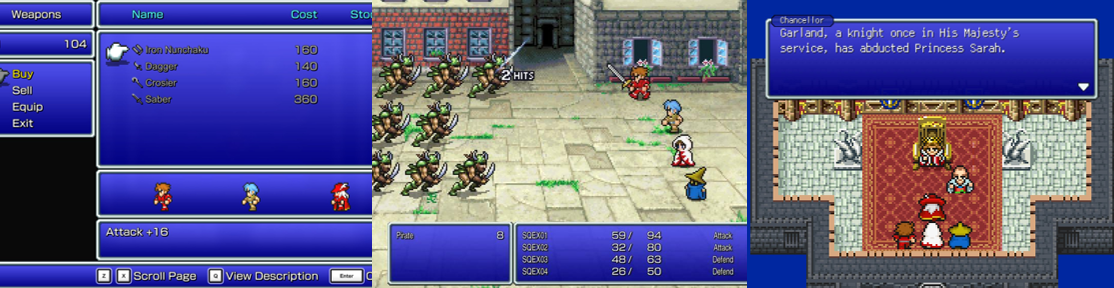
Battles were frequent in the original Final Fantasy, with anywhere from one to nine enemies randomly attacking after one step or more. These are a bit less annoying in the Pixel Remaster, however, and you can even toggle them off from the “Boost” menu. I’d recommend battling every enemy you encounter, not just to stock up on Gil and randomly dropped items, but also to gain EXP and level-up your party up to stand a better chance against later battles and bosses. The “Boost” menu also allows you to increase the Gil and EXP you receive, meaning you can level-up your characters and increase their stats even faster. This ups their attack power, evasion, and maximum health points (HP), enabling them to take more hits before being knocked out or more easily flee. Each class utilises different weapons and gear and has pros and cons. The Warrior, for example, can wield powerful swords and block damage with shields, but their magic is limited. The Thief attacks with high accuracy, but their gear selection is poor; the Monk can easily flee but cannot use shields and fights best bare-handed. The White and Black Mages specialise in healing and offensive magic, respectively, with the Red Mage being the jack of all trades and probably your best bet for overall coverage. Although you cannot summon powerful monsters to aid you in battle or utilise class-specific moves like stealing items or learning enemy attacks, you can use certain gear in battle to cast magic without cost. You can cast elemental magic against enemies, such as Fire, Blizzard, and Thunder, or restorative spells on your party to cure status effects like Poison or Stone and even return them to life. Magic is a bit weird in this game, with you having to buy it for extortionate prices and characters only able to learn select spells according to different “magic levels”. Better, more useful spells like Flare, Holy, and Warp can all be learned as you progress, allowing you to deal or heal additional damage, escape from dungeons, and up your attack or evasiveness, among other buffs. While some status ailments (like Darkness and Paralysis) disappear after battle, others (Poison and Stone, for example) can only by cured using magic or items; even resting at an inn won’t remove these effects, which can be aggravating.

On the plus side, the Pixel Remaster utilises both autosaves, quick saves, and a manual save anywhere outside of a battle screen, you can find loads of treasure in each area, and you can always backtrack to cheaper inns if you’re low on Gil. Still, Final Fantasy: Pixel Remaster certainly doesn’t hold your hand. While things are pretty linear at the start, you’ll soon be left wandering the overworld with little direction on where to go and what to do. NPCs offer hints and inform you of their current troubles, but it’s mostly up to you to figure out where to go next. It’s not uncommon to stumble upon caves and blocked paths, or NPCs who require items but won’t tell you where to find them. It’s equally easy to miss crucial pick-ups or interactable elements in some dungeons, such as the Cavern of Earth, where you must return with the Earth Staff to proceed further. Most dungeons are simply mazes of tight corridors and stairs, though teleports pop up in the Flying Fortress. Some dungeons contain cracked floor tiles that drop you to lower areas, lava or spiked floors that sap your health, a maze of doors that turn you around, and even areas where random encounters are increased! Unless you battle one of the main bosses, you can’t exit a dungeon until you purchase the Warp spell, so it pays to have a good stock of healing items and to watch your resources so you can stay alive long enough to leave the more labyrinthine areas. You’ll need key items like the nitro powder, oxyale, and the magic key to unlock new areas or progress further and it’s recommended that you spend time grinding as the difficulty can spike at times, especially in the endgame. While you wander about on foot most of the time (and should therefore enable the “run” option in the settings), you soon acquire a pirate ship to cross the sea, a rowboat to travel through shallow streams, and eventually an Airship to fly over the map with no fear of random encounters (though limited places to land).
Presentation:
Final Fantasy has been completely overhauled here, ditching the indistinct and outdated 8-bit graphics and adding an additional graphical flair to the 16-bit paint job seen in the Dawn of Souls (Square Enix/TOSE, 2004) version I first played. This not only brings Final Fantasy more in line with the standard set by Final Fantasy VI (Square, 1994) but also adds some visual effects to compliment the sprite work, such as fog, rushing water, twinkling snow, and more theatrical spells in battle. This also means that sprites are far more detailed and lively, towns and dungeons pop with colour and little details, and a touch of Mode 7 brings an additional gravitas to your flights around the overworld. The graphical overhaul extends to the game’s cutscenes, which introduce the basic story and show new areas unlocking or being altered by your actions. This is all bolstered by a remix of Nobuo Uematsu’s timeless score, which gives each area a distinct identity and makes boss battles more dramatic. However, as slick and detailed as the game looks, there are still some holdovers from the 8-bit days. Sprites constantly run in place, for example, and, though each character in your party can be named, they’ll never speak during the game. Still, your party exudes a decent amount of character at times, splitting out from your lead character during key events, celebrating victories, slumping in defeat, and even keeling over when afflicting with status ailments. Character sprites change when you upgrade their classes (or press the shoulder triggers) to keep things visually interesting and they’ll even whip out different gear when you equip new weapons, which was a nice touch. Battle animations are limited, with basic attacks never connecting with either party, but magic effects are very impressive, with flames bursting from the ground, tidal waves sweeping your party away, and bolts of lightning raining down. There are some nice visual effects are times, too, such as clouds passing by beneath the Flying Fortress, bosses disintegrating upon defeat, harmless bats flittering about in caves, and the Airship and Mirage Tower making their grand entrances.

Final Fantasy: Pixel Remaster has both feet firmly planted in a medieval fantasy setting. Accordingly, you’ll visit numerous towns in the shadow of large, stone castles and populated by colourful NPCs, from dwarves, to dragons, to mermaids. Some even speak with regional accents not unlike Scottish or Irish, which was a welcome detail, and others change their dialogue after you’ve liberated their towns or defeated whatever evil threatens them. Each town is very distinct, though they share common elements such as stone paths, rural brick buildings, wells, churches, and churchyards. Castle Corneria is an ornate abode of marble statues and beautiful carpets, Pravotia is a town criss-crossed by moats and under siege by Bikke’s pirates, Mount Duergar is a dwarf mine where blacksmiths toil, and Melmond is a town in ruins thanks to a local vampire. While caves and dungeons are primarily differentiated by colour palettes and different layouts, some stood out, such as the volcanic Mount Gulg, the trepidatious Cavern of Ice, and the pyramid-like Mirage Tower. Depending on where you are, the battle backgrounds also change, ranging from a swamp-like marsh to a dark cavern to a cosmic barrage of colours by the end. In-game cutscenes shine with their use of sprite-based assets, such as the king’s men hastily constructing a bridge to speed you on your quest and Bahamut majestically spreading his wings before upgrading your classes, with the game’s ending providing a sneak peek at the peace your actions have brought each location. The game performs exceptionally well, with battles loading and progressing with a slickness the NES could only dream of, though the game can still be tedious due to the constant grinding to survive its progressively more powerful enemies. The methodical nature of its genre means you may get frustrated by the barrage of battles, even with the boosts and Auto-Battle enabled, though things are far less aggravating than in previous versions thanks to the autosaving allowing for quick reloads.
Enemies and Bosses:
There are loads of fantastical, monstrous, and aggravating enemies to contend with in Final Fantasy, with many being recycled as palette swaps but augmented by greater attack power, magic, or coming in larger groups. Various goblins, snakes, tarantulas, and sharks are commonplace enemies, for example, alongside more recognisable enemies such as the Sahagin lizardmen, who naturally make their debut here. Golems, crocodiles, hydras, various dragons, and undead enemies like mummies, vampires, and ghouls all crop up alongside giant worms, bizarre cycloptic creatures, wolves, tigers, and ogres. For the most part, these enemies are relatively unspectacular, lashing out with simple melee attacks and going down in just a few hits. Others, like zombies, Chimera, and the techno-organic Soldiers, both resist and are immune to certain elemental magic. Undead enemies, for example, are particularly weak to Dia spells, the different Elemental enemies will be weak to their corresponding element, and many drop items or gear upon defeat. While enemies can flee from battle, which is to your benefit, some will automatically regenerate health as the battle goes on and many eventually cast magic of their own. While this means they can blast you with Fire or strike you with Icestorm, it’s the status ailments that’ll give you the most trouble. Enemies can “slow” you, paralyse you to keep you from attacking, whittle away your health in and out of battle with poison, and halve your accuracy by inflicting Darkness. Your party can also be subdued by being put to sleep or turned to stone, or even knocked out with one hit if Death is evoked. Luckily, you can equip gear that’ll nullify many of these status effects, and use items and magic to cure them, but they can significantly impact battles even when you’re at a high level, especially when confronted by a swarm of enemies.

While many treasure chests are guarded by specific encounters with the likes of Evil Eyes, Dragon Zombies, and Piscodemons, these are merely tougher enemy variants and don’t really classify as bosses. Your first test comes at the Chaos Shrine when you confront Garland, an armour-clad knight who certainly looks and talks tough and has no elemental weaknesses but is easily put down if you grind to about level twenty since he relies solely on melee attacks. After wiping the floor with Bikke’s pirates and securing a boat, you’ll cross the sea to Elfheim and investigate the Western Keep, tangling with Piscodemons and rescuing the elf-king…who turns out to be the Dark Elf monarch Astos. Like Garland, Astos has no elemental weaknesses but boasts a greater health pool and debilitating spells like Slowra, Dark, and the ever-aggravating Death. You’ll fight many variants of the Vampire boss as regular enemies after encountering him in the Cavern of Earth. Luckily, he’s weak to Fire magic and, naturally, Dia, which can make short work of him and nullify his paralysing Gaze attack. Your primary goal in Final Fantasy is slaying the Four Fiends and restoring the four elemental Crystals, and these mythical creatures represent some of the game’s most impressive and detailed sprites (even if they are mostly static). The Grim Reaper-like Lich is up first, attacking with Fira, Blizzara, and Thundara as well as paralysing you with Hold and putting your entire party to sleep. Weak to Fire, Ice, and Dia magic, Lich is the toughest enemy of the early game but is easily overcome within a few turns if you’ve optimised your equipment, levelled-up, and have the appropriate magic. Marilith is tougher still, resisting or having no discernible elemental weaknesses, roasting you with Fira and handicapping you with Darkness. This was the first real challenge I faced, but a fun one as I was at a high level and could withstand Marilith’s high attack power.
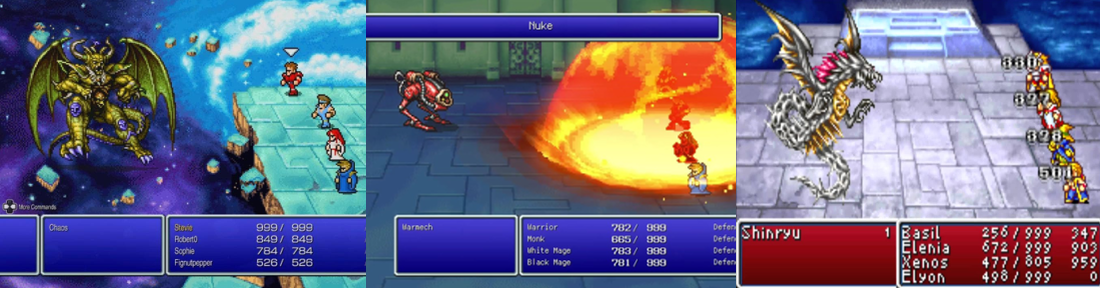
Minotaurs, armoured turtles, and oriental-style monsters pepper the convoluted path to Kraken, a Cthulu-like monarch who inflicts Darkness with Ink and decimates your party with Thundara, though it’s naturally weak to Thunder attacks. The final Fiend, Tiamat, is the most horrific; a multi-headed dragon who can poison and chill the entire party with Poison Gas and Blizzard. With a high health pool and no elemental weaknesses, Tiamat can be quite the hurdle for an unprepared or under levelled party. The Four Fiends are fought again, attacking in specific spots as you explore the Chaos Shrine 2,000 years in the past. The battles are mostly the same, bar some new moves to their arsenals, though you should be a lot tougher by this point. They serve as the perfect appetiser to the game’s final boss, who turns out to be Garland, having ensured his survival with a time loop and transformed himself into the demonic Chaos! Chaos is, without a doubt, the toughest of the regular bosses, boasting a whopping 20,000 HP and no discernible weaknesses. Chaos sports some devastating attacks that can wipe out your party with ease, such as a unique version of Flare, a powerful tsunami and cyclone, and the one-hit KO Earthquake, alongside incredibly powerful elemental magic. Your best bet is to get your levels high, equip Ribbons (since Protect Rings won’t help against Earthquake), and cast Haste, Invisira, and Curaga as soon as possible. Holy and Flare are your best bet here, but it’s a gruelling battle, one only surpassed by the death machine, Warmech, a superboss that may surprise you when you approach Tiamat. Unfortunately, this version of the game removes the additional dungeons and optional superbosses from the Dawn of Souls version, meaning you’ll need to shell out a fair bit of money if you want to tackle returning faces like Gilgamesh, Deathgaze, and Shinryu, as well as an even tougher variant of Warmech, Omega, and even the ever-ridiculous Phantom Train!
Additional Features:
There are twenty-three Achievements to earn in this version of Final Fantasy, with six earned from completing story-based objectives like rescuing Princess Sarah and restoring the Crystals, and three more for defeating 100, 300, and 500 enemies. You’ll get additional Achievements for getting your whole party to level 50, obtaining up to 100,000 Gil, playing the hidden slide puzzle game, and finding some and then all of the game’s treasure. There’s loads of treasure to be found in Final Fantasy: Pixel Remaster (more than you can ever carry!), and most of it is guarded by tougher enemies or hidden away in optional rooms and alternative routes in dungeons. If you’re frugal or activate the Gil multiplier boost, like me, you can easily amass enough Gil to buy new gear and spells, but you’ll eventually amass more Gil than you can carry and won’t have to worry about keeping your items fully stocked. You must search around, pay attention, or use a guide to get the best rewards, such as Excalibur and Masamune, the two most powerful swords, though getting the best spells is simply a question of cash and properly thinking about what your characters are capable of learning. Like previous re-releases of Final Fantasy, the Pixel Remaster includes a “Bestiary”, which fills as you encounter new enemies and bosses, cluing you in on their strengths, weaknesses, and the rewards they drop. Unfortunately, defeating the Four Fiends no longer unlocks the four additional areas from the Dawn of Souls remake, so you won’t get to test your mettle against those optional superbosses, though you can still go seek out the elusive Warmech if you want an extra challenge.

The Summary:
I’ve only played a few Final Fantasy titles, so I’ll be the first to admit that I was wary about tackling Final Fantasy: Pixel Remaster, primarily because of the time and energy required to play it. However, I enjoyed my time with the Dawn of Souls version and this version of the game has some benefits over even that version, such the boost features that increase the Gil and EXP you earn and the Auto-Battle mode, which really benefitted my playthrough. It also helped to be able to save at any time and to be frugal with my Gil and spending, and to spend some time between dungeons levelling-up so I was prepared for future challenges. It helps that the game looks awesome; the constantly walking sprites were distracting but, otherwise, Final Fantasy greatly benefits from the graphical tweaks and improvements. This includes adding a visual flair to enhance the redrawn sprites and making battles even more spectacular with some truly impressive sprite art. The story is paper thin for the most part and the main characters largely lifeless, but the world is brought to life through the varied locations and lively NPCs, who are all different races and offer something different to the player. I enjoyed the twist at the end that Garland was creating a self-sustaining paradox and the challenge offered by the Four Fiends, though the difficulty curve was very much like a rollercoaster at times, with some debilitating attacks making even regular enemies an uphill battle if you get unlucky. It would’ve been nice to see a bit more direction about where I needed to go and what I needed to do at times, perhaps by having the priest at the various churches pointing you in the right direction, but it was fun exploring and figuring things out (and online guides are always available). In the end, while it’s obviously dated and lacks many of the more enjoyable features of its previous ports, this much-needed overhaul of Final Fantasy was a lot of fun to play through and I was glad to revisit the game it and see how many of the franchise’s recurring elements got their start, even if it’s obviously been far surpassed.
My Rating:
Pretty Good
Have you ever played the Pixel Remaster of Final Fantasy? What did you think to the new additions and were you able to figure out the Magic Level system? Which character classes made up your party? What did you think to the difficulty curve and the final battle against Chaos? Did you ever defeat Warmech and complete the Bestiary? Which Final Fantasy game is your favourite? Whatever your thoughts and memories of Final Fantasy, drop a comment below, support me on Ko-Fi, and check out my other Final Fantasy content.

 Dr. K's Waiting Room
9 thoughts on “Game Corner: Final Fantasy: Pixel Remaster (Xbox Series X)”