

Released: 13 December 2022
Originally Released: 13 September 2007
Developer: Tose
Original Developer: Square Enix
Also Available For: Nintendo Switch, PC, PlayStation 4, PlayStation 5, Xbox One, Xbox Series S (Reunion); PlayStation Portable (Original)
The Background:
You’ve heard of Final Fantasy VII (Square, 1997), right? Of course you have! The game won numerous awards and sold over ten million copies on the PlayStation alone! But the story of Final Fantasy VII doesn’t end there. Seeking to expand their scope beyond just the gaming world, Square Enix announced Compilation of Final Fantasy VII in 2003, a multimedia venture that included the fantastic computer-generated movie Final Fantasy VII: Advent Children (Nomura, 2005) and numerous spin-off titles that expanded the lore and world of Final Fantasy VII. Crisis Core, a prequel story initially exclusive to the divisive PlayStation Portable, was one such title. Director Hajime Tabata wished to exceed fan expectations with the game, which focused on the younger days of popular characters Zack Fair and Sephiroth and built upon story elements that had been laid out for both by Tetsuya Nomura. Envisioned as an action game first and foremost, the team incorporated role-playing elements to craft something of a hybrid and emphasised an element of luck to the combat through the Digital Mind Wave (DMW) system. Upon release, Crisis Core was met with generally positive reviews; while the combat was praised, critics were divided on the DMW system but praised the game’s narrative and graphics. About fifteen years later, to commemorate Final Fantasy VII’s 25th anniversary, Square Enix developed a remake for then-modern consoles alongside Tose, one that completely overhauled the graphics, soundtrack, and voice acting. Although the story remained the same, the game was tweaked to closely align with the much-anticipated Final Fantasy VII remake project. Producer Mariko Sato advocated for numerous improvements to the original game, such as reducing combat interruptions, adjusting the magic speed, and including a “Hard” mode for returning players. Like the original game, Crisis Core Reunion was largely praised; while critics were divided regarding the characterisations and the DMW system, the improved gameplay was praised and it was one of eleven recipients of an “Award for Excellence” at the 2023 Japan Game Awards.
The Plot:
Before Final Fantasy VII, Zack Fair of the paramilitary organisation SOLDIER is assigned to find his mentor, Angeal Hewley, and fellow SOLDIER Genesis Rhapsodos and discovers a revelation that sets him against the malevolent schemes of his former masters.
Gameplay and Power-Ups:
Crisis Core: Final Fantasy VII Reunion is a HD reimagining of the original action/role-playing PSP title. Unlike the original Final Fantasy VII (and most of the Final Fantasy games I’ve played to this point), it’s less of a turn-based RPG and more of a mission-based, action-orientated title in which players control one character (Zack) rather than a party of diverse fighters. Zack is free to roam around various 3D locations (with many being recreations of environments seen in Final Fantasy VII) and automatically engages in random battles when exploring. When in a conflict situation, Zack can attack with X; successive presses of X unleash combination attacks (with some dealing additional damage from “critical hits”), and you can target enemies by pressing in the right stick and switch to different targets by pressing the Left Bumper and the right stick. A lets you dodge incoming attacks, the Right Bumper puts up a guard to reduce damage, and you can flee from most battles by running against the edge of the barrier that pops up in each combat scenario. You use the Left and Right Triggers to cycle through your available items and use them with B, restoring health points (HP), magic points (MP), and providing certain buffs to Zack or debuffs to enemies. The Left Bumper brings up the Materia command window; eventually, you equip different Materia to the four face buttons and RB and RT, allowing you to perform elemental magic attacks, healing spells, reduce damage, apply buffs, eliminate status effects, and more if you have enough MP. Outside of battle, you can dash with RT and hold it to run (a toggle option would’ve been nice), talk to non-playable characters (NPCs), and bring up the map with X. While there’s no mini map (which also would’ve helped), you can toggle on destination markers to help guide you to your objectives from the settings menu, and set the in-game language and toggle the camera tracking.
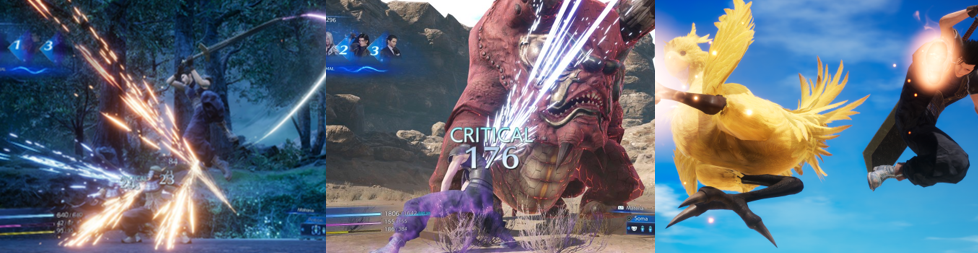
The game’s big unique feature is the DMW system, a slot-based game of chance that automatically plays in every battle and seems to spin faster and build up the more you attack. Each spin consumes Soldier Points (SP), which are gained from winning battles and fusing Materia, and the strength of each DMW image increases as the game progresses. The game says they’re made stronger by Zack’s emotional tie to the characters represented, but your DMW avatars actually level-up in battle just like him. When three of the same images appear in the slots, press Y to perform a Limit Break or press in both analogue sticks to unleash a powerful Summon. These super powerful attacks, often accompanied by an annoying cutscene that’s thankfully skippable, can lay waste to entire foes, completely heal you and bestow buffs, level-up your Materia, and more. Additionally, during combat, you are often granted limited buffs, such as temporary invincibility or infinite MP or Ability Points (AP, consumed when you dodge, block or use Command Materia like Assault Twister or the elemental blade attacks), which is super useful in a tight pinch. Like other Final Fantasy games, you must be mindful of status effects and elemental attacks; enemies can cast Silence to negate your MP or stun you, and some are weak to certain elemental attacks and resist to others so it’s worth exploiting these weaknesses. Although the game autosaves at various points and gives you the option of retrying a battle upon defeat, there are numerous manual save points in each location. These refill your HP, MP, and AP and offer a selection of Missions to play through alongside the main story. Indeed, while you can level-up and get stronger playing the story, the best way to grind, gain new items and Materia, and improve your combat prowess is through these missions. They all have a level grade so you can judge how difficult they are and are usually quite short, consisting of a handful of battles, though others throw you against seemingly endless waves of enemies, or have you rematching bosses or defeating Summons to add them to the DMW.
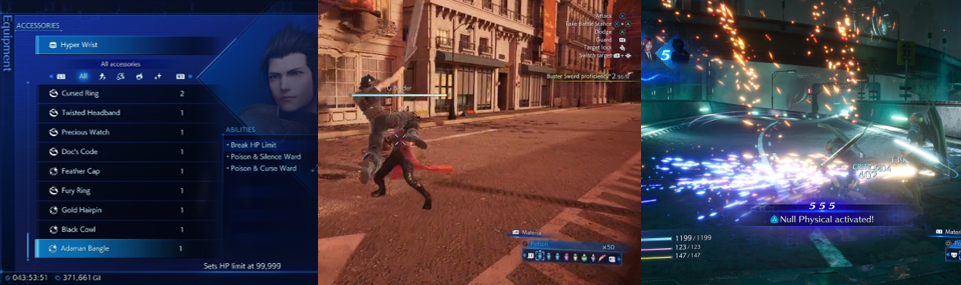
Although you don’t acquire new weapons or equip armour, Zack does eventually inherit the iconic Buster Sword. Once you have this, you can hit X and A to enter a “Battle Stance”, increasing your attack power and chances for critical hits, and your proficiency increases as you defeat enemies in this stance. Additionally, after Zack is promoted to SOLDIER 1st Class, you gain extra items and buffs (including refilling your gauges) if you win battles in certain ways (with magic attacks, Summons, or without taking damage, for example). You can customise Zack from the main menu, setting up five equipment presets for your convenience, fusing and selling Materia, and eventually purchasing items from various shops. You’ll do this with the Gil you obtain from battle, though I honestly never bought anything as the game is extremely generous with items (which I also rarely used) and restoring your gauges. Materia is fused together to become stronger, and is also be “mastered” over time, increasing its MP cost and its power. This menu also allows you to review the mail and tutorials characters send you, review your DMW progress, and equip various accessories to Zack. These provide passive buffs, such as increasing his stats, providing resistance to elemental attacks and status effects, and more. Items and Materia are also acquired from various treasure chests lying around, completing missions for NPCs, and as required by the story. There’s a part, for example, where Zack searches for various junk to build a flower cart (and impress) Aerith Gainsborough. Other times, you’re climbing ladders, searching for keys to open doors, defeating enemies for different keys, searching for clues to find a pickpocket, activating consoles and turning wheels to open pathways, and searching for additional lore or helpful pickups.
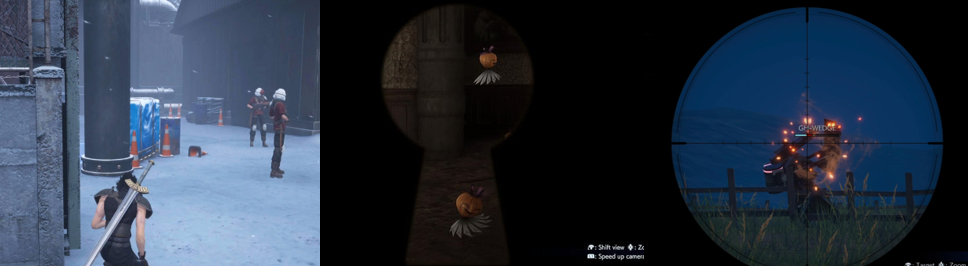
There are numerous mini games and gameplay gimmicks to break up the action, though they’re a bit hit and miss in their execution (despite awarding additional Achievements). Hidden pathways in Wutai lead to enemy troops that must be defeated to impress SOLDIER Director Lazard Deusericus and you can also choose to charge at enemies or take a stealthier approach in this section. Professor Hojo tests your skills in battle and a frustrating squatting challenge, Banora village hides numerous glowing spots that must be interacted with under a time limit, and then the village must be defended from a missile attack using carefully timed strikes. NPCs need rescuing from Shinra headquarters, spies are in Midgar, a Slums vendor challenges you to quickly grab his Materia, perfume can be blended to impress Aerith, and Junon’s perimeter must be defended from incoming enemies. Many side missions are contested under a time limit, which can be a bit stressful, but easily the most aggravating mission with Zack’s infiltration of the Modeoheim Mako Reactor. While you can simply storm in, you get an Achievement for staying out of sight, which is tricky as the guards spot you the moment you pop out from cover and you must rapidly tap Y to keep your body temperature up. There are seven wonders to find in Nibelheim, a mother trapped in a burning building, and keyholes to look through in the Shinra Manor to discover a random safe code. There’s number guessing game to play, fan clubs to join, and an annoying sniper mission where you pick off Shinra forces with an upgradable rifle. While it’s easy to retry the Modeoheim mission thanks to a nearby save point, this sniper mission doesn’t have that so you need to be fast and accurate to get that Achievement. Finally, in the end game, you’ll be battling monstrous monsters from the Lifestream to collect the Goddess Materia and running around a prison, unlocking cages and taking secret tunnels. The game has two difficulty settings, “Normal” and “Hard”. I played on “Normal” and found the difficulty oddly unbalanced. Some bosses were a complete joke, and then other times I’d be one-shotted by a damn Pachyornis! Most enemies are cut down in no time at all, making combat even more tedious and creating a bit of an uphill battle when you randomly face troublesome enemies who’ll decimate you if you don’t break their Boss Ability Gauge.
Presentation:
I briefly played Crisis Core on the PSP many years ago and was mildly impressed with its PlayStation 2-quality graphics on the handheld. Things were a bit clunky and restrictive, particularly Zack’s movement and the mission-based structure of the game, but it seemed decent enough, especially the high quality FMVs. All these visuals have been upgraded here to match the presentation of Final Fantasy VII Remake (Square Enix Business Division 1, 2020). This includes an all-new soundtrack, which features remixes of classic Final Fantasy VII themes to match each location and an awesome new rendition of “One-Winged Angel”, “Vengeance on the World”, and similar rocking riffs like “Black Wing Unfurled”. Zack is given so much more personality here than in his brief, skewed appearances in Final Fantasy VII; we track his entire journey from an enthusiastic protégé to a hero in his own right and watch as he forms relationships with Aerith, Tseng, Cissnei, and his perceptions of Angeal and Sephiroth change as the narrative progresses. There’s little distinction between the FMVs and in-game graphics, though there are few opportunities for Zack’s personality to stand out in battle beyond his quips and voice clips since battles don’t end with a victory pose. Still, battle animations and explosive and varied; the Limit Breaks and Summons, especially, impress, though it can be annoying when the DMW memories interrupt the combat flow. Zack’s character model also changes as the game progresses; he gets a new uniform, takes up Angeal’s Buster Sword, and gains his trademark scar throughout the story, though it’s a shame you can’t alter his appearance further with armour or accessories. The game also includes fun cameos from familiar faces like Yuffie Kisaragi, Vincent Valentine, Cait Sith, Reno, and Rude alongside allusions to Cid Highwind and Red XIII/Nanaki and fully exploring Zack’s friendship with Cloud Strife.
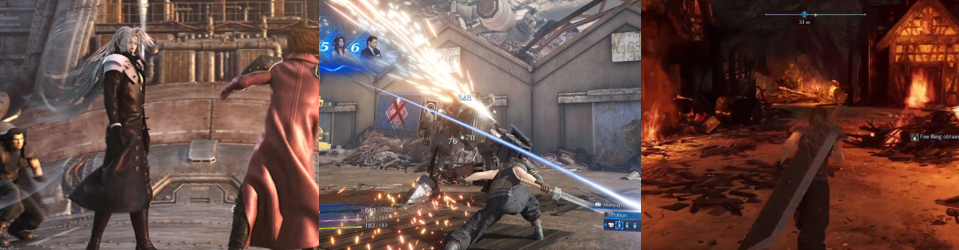
The game’s locations will be immediately familiar to anyone who’s played Final Fantasy VII. Memorable towns like Midgar, Sector 7, and Junon all appear in their steampunk glory, with Zack even naming Seventh Heaven, battling on the highway outside Midgar, and taking the fight to the Wutai. You’ll spend a lot of time exploring Shinra headquarters (home to Hojo’s laboratory, a Materia processing room, and a museum to the company’s achievements) and the bustling town of Midgar, with its iconic train station and desolate Slums, complete with market, playground, and Aerith’s church. You’ll travel to Nibelheim and explore the small town and its peaceful inhabitants, the spooky Shinra Manor and the hideous secrets hidden within, and the looming Mako Reactor that houses Jenova, and then bask in the horror when Sephiroth discovers his true origins and burns the town to the ground! In the endgame, you’ll return to Banora, once Angeal’s peaceful hometown now corrupted by the emerging Lifestream, and descend into the ethereal caverns beneath it where slumbering giants and monstrous enemies await. When tackling missions, you’ll battle in the desert, at the Chocobo Farm, and in steampunk locales that bring the ambitious pre-rendered backgrounds of Final Fantasy VII to life. Things are, however, a bit restricted; you’ll revisit the same caves and enclosed areas again and again, there are few houses to enter, and locations can be surprisingly barren. Handfuls of enemies are encountered at once, with battles against bigger waves restricted to loading each group, and the mission-based structure of the combat betrays the game’s handheld routes. Having said that, though, there’s an emotionally poignant finale where players can control Zack’s last stand against Shinra’s inexhaustible forces, even battling while severely injured and near death.
Enemies and Bosses:
Numerous enemies will dog your progress in Crisis Core Reunion, many of which are returning monsters from Final Fantasy VII. Zack battles various human soldiers, such as Wutai’s forces and even Shinra solders by the end game, each armed with lances, assault rifles, and grenades. More formidable variants also exist, wielding dual blades, casting elemental or restorative spells, and carrying larger weapons, like Wutai’s Crescent Unit. Perhaps the most notable humanoid enemies are the various “G” foes, imperfect and often monstrous copies of main antagonist Genesis who sport their own wings, more powerful magic, and even wield scythes or gunblades. Most of these can be put down without much issue, or by exploiting elemental weaknesses, but the numbers can be overwhelming if you don’t have the right Materia setup or are under-leveled. Naturally, various wild animals and creatures also roam the streets and wilderness of this world. Many have different names and appearances and abilities depending on the region and how far into the game you are. Bat-like Evil Eyes, demonic winged Evilgoyle, and ludicrous Hedgehog Pie are commonplace, as are elemental Bombs, spooky Jack o’ Lanterns, and insectile enemies like the annoying Killer Bees, various worms and beetles, and the lizard-like Sahagin. More bizarre foes like the egg-like Grangalan and spear-beaked Raijincho co-exist with more grotesque creatures, like the demonic Foulanders, strangely deformed Killer Stingers, and hefty Iron Claws. These are joined by mechs and robotic enemies, from disposable pawns like the Bee Saucers and Metal Saucers to more formidable, heavily armed constructs like the various Machines (which come in flying, drill, “death”, and missile variants, among others). While most enemies have an elemental weakness and some cast offensive and healing spells, many are simply there to be cut down by your attacks, meaning it’s easy to underestimate the Machines and G-variant enemies, which can almost act as mini bosses at times and, in some cases, can even be tougher than the likes of Sephiroth!
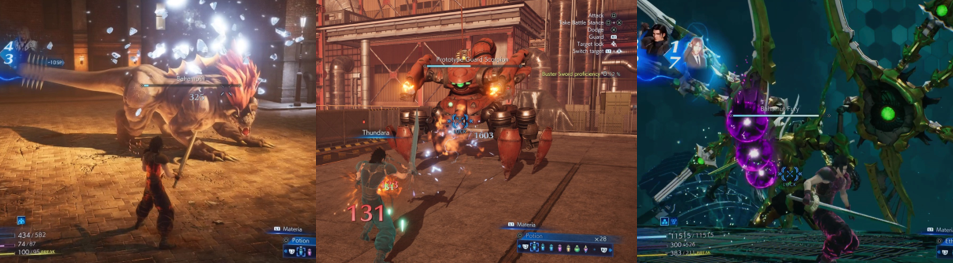
Each of the game’s ten chapters but one (Chapter 7) culminates in a boss fight against at least one enemy, though some are variations of others or have multiple phases. Zack’s first test is against the monstrous Behemoth, a dog-like demon that attacks with a tail and claw swipes and serves as a tutorial for the game’s DMW system. Other variations of this creature appear later in the game, with the Behemoth King proving a steep penultimate challenge that I found more troublesome than the final boss thanks to it casting Regen on itself, having no specific weaknesses, and tanking my hits. Your mission in Wutai culminates in a battle against the duo of Vajradhara Wu and Vajradhara Tai, variants of which also crop up in subsequent missions and who are more deadly when teamed up thanks to their Limit Break, large health pool, and devastating physical attacks. After besting them, you’ll test your skills against the fire demon Ifrit, the first of many Summons who must be defeated to add them to your DMW. Ifrit sports formidable fire-based magic and attacks and you’ll need projectile magic to attack him from afar, but he’s weak to ice attacks like Blizzard. Chapter 2 sees you battling the mechanical Guard Spider, while Chapter 6 sees this improved to the more familiar Guard Scorpion. Both attack with cannons, stomps, and a hail of bullets but the latter mech also sports an EM Field attack that must be avoided. Chapter 2 ends with a battle against the dragon king, Bahamut, who can be annoying with his slam attack and Thunder Strike. In Chapter 4, you’ll battle the larger and more impressive Bahamut Fury, though I found this fight far easier as Bahamut Fury spent a lot of time just standing (or floating) around doing nothing and I easily kept it from attacking with Exaflare despite it having no elemental weaknesses.
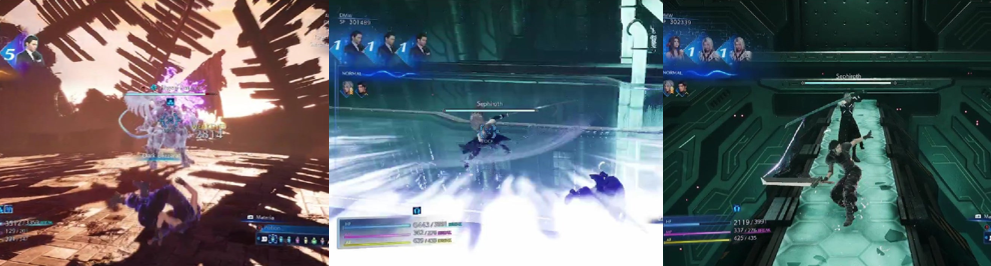
Things continued to be largely manageable in Chapter 3. Here, you fight the G Eraser copy of Genesis, which is noticeably nimbler and more versatile than the three Machines that guard the chapter’s end, which are bested by bringing along thunder, fire, and ice-based Materia. The same is true for the Support Machines and the General’s Tank in Chapter 6. The drama ramps up when Angeal undergoes a horrific transformation, merging with his monstrous copies to form a centaur-like abomination not unlike Ultima Weapon. Angeal Penance is best attacked from behind since its lance has good reach. It can also magically boost its defence, charge, and unleash a bunch of physical and elemental attacks. However, despite its imposing size, this fight was pretty easy; Zack’s very emotional during it so the DMW is often in your favour, meaning this boss is all bark and no bite. Shinra scientist Hollander undergoes a similar transformation after being corrupted by Genesis’s cells. Constantly healing himself, Hollander distracts you with Land Worms and takes away chunks of HP with his Dimension Missile attack or poisons you with his breath. Being a Final Fantasy VII game, you naturally battle Sephiroth as well, most notably after he goes insane in Nibelheim. This is a two-phase battle, with the first seeing Sephiroth attacking with his impossible long sword, teleporting, and unlashing Heartless Angel and his trademark Octaslash. Sephiroth almost always has his guard up, negating many of your attacks, so just dodge, heal, and wait for an opening. Sephiroth spawns four elemental crystals that restore his health and bolster his attacks with fire, thunder, and blizzard spells. These must be destroyed using the opposing element (Fire against Blizzard, for example), and you might want to cast Dispel to remove his buffs. Though challenging, he’s actually easier than some other, less notable bosses and enemies. Once you’ve depleted his health, you then attack him on a narrow walkway. It’s game over if he pushes you back, so focus on staying alive and pummelling him with everything you have until he takes his dramatic drop into the Lifestream.
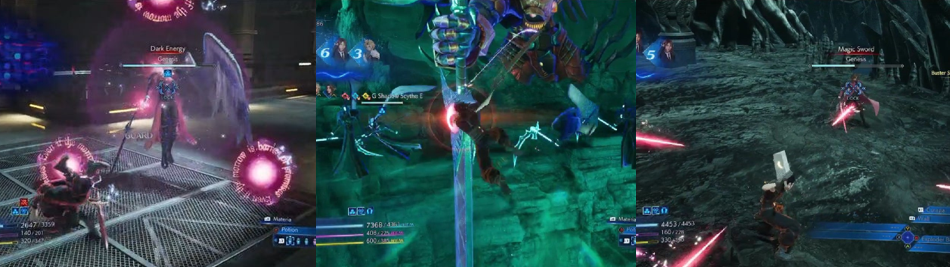
Edgelord antagonist Genesis, a fan of poetry and the flamboyant, is encountered and fought multiple times throughout the story. You first battle him in Chapter 5, prior to the fight with Angeal Penance, and many of the G-variant battles are tests for your one-on-one encounters with Genesis. In the first encounter, Genesis casts Regen on himself and magically increases his defence; he’s fast and tricky, attacking and Cursing you with Black Flurry and draining your MP with Osmose. Yet, I found this battle surprisingly easy; you can negate Genesis’ status effects with magics and items and simply batter him until he flees. In the finale, Genesis summons a gigantic, grotesque creature to fight on his behalf; Genesis Avatar cannot be harmed by physical attacks as it’s out of reach, so you’ll need projectile Materia like Thundaga or Ultima to chip away at it. You also need to keep your distance from his giant sword; it’ll create a shockwave when it hits and spawn G Shadow variants to distract you from attacking the Materia in the hilt. Similar to Bahamut Fury, though, this battle was a joke, especially compared to the Behemoth King and even the G Regicide that preceded it. Simply cast Wall, keep your distance when it unleashes Purgatorial Wave, keep your HP up, and attack the Materia until its defeated. After that, you’ll go toe-to-toe with Genesis once more. Again, he’s fast and can land combos on you. He can cast Apocalypse for big damage and stun-lock you with the Black Feather barrage, but he’s a ridiculously anti-climatic final boss and easily put down despite his agility, making for a dissatisfying final bout.
Additional Features:
Crisis Core Reunion boasts fifty-one Achievements to earn, with one popping after completing every chapter. You’ll also get Achievements for completing some, and all, of the Missions, winning your first battle, dealing 99,999 damage, obtaining and levelling-up all DMW images, unlocking every shop, and receiving mail from everyone possible. As mentioned, every chapter features a mini game or gameplay gimmick that is tied to the Achievements; it’s worthwhile creating a backup save file as you won’t be able to retry if you miss them, fail them, or progress past that chapter. Other Achievements come from collecting equipment, fusing Materia, clearing the “Hard” difficulty, and defeating the powerful superboss Minerva, something you can only do after unlocking and clearing every previous Mission. Missions are unlocked through story progression and talking with NPCs, so be sure to talk to everyone you see. Their difficulty ranges and some are extremely tedious, forcing you to defeat up to 1000 enemies in a row or battle previous bosses and Summons, but you’re rewarded with better Materia and items and such. After you beat the game, you’ll create a clear save file and can start “New Game+”. This carries over your current level, SP, Gil, play time, items, Materia, equipment, DMW progress, Buster Sword proficiency, and mail but not the Missions you’ve completed. You also still need to unlock a lot of this stuff again, such as the additional Materia slots, shops, and Buster Sword, but I imagine it makes a second playthrough – even on “Hard” mode – much easier. Other than that, there’s not much else here; no new costumes or skins, no chapter select, and no gallery or movie theatre, which is a bit of a shame.

The Summary:
As I mentioned, I played Crisis Core: Final Fantasy VII years ago when I first got a PSP. I didn’t get very far, though, mainly because I had a bunch of PSP games to play at the time and was a little put off by the strict mission-based structure of the game. Having finally played through this Reunion version, I can say that this structure is somewhat hampered at times and a little too quaint for a main console release, but it’s not as bad as I first thought. It is tedious having to go into the Mission menu and tackle each one in turn, but it was a fun way to level-up between the main story and combat was usually simple enough that they only took a few minutes to beat. The DMW system was certainly unique; the randomness wasn’t to my liking, but I enjoyed the variety in the attacks and benefits it gave you. This, along with battles constantly rewarding you, means the game can be pretty easy most of the time. Combat thus becomes quite dull very quickly as you just mash away and win, heal at a save point, and repeat until the chapter ends. There is a strange difficulty curve in Crisis Core Reunion, though; it’s really weird that Sephiroth and Genesis were so simple to defeat compared to the Behemoth King, and that enemies like the Pachyornis line could one-shot me yet I could survive Bahamut Fury with barely a scratch. This made combat a little unpredictable and annoying at times, almost as much as some of the mini games and the requirements to earn the Achievements associated with them. I enjoyed the dramatic dive into Zack’s backstory, his relationships with his mentor and peers, and his interactions with Final Fantasy VII icons like Cloud and Aerith. It was very impactful seeing Sephiroth’s downfall first-hand and playing an active role in the sacking of Nibelheim and Zack’s final stand, and the score and 3D recreations of Final Fantasy VII locations were a joy. In the end, it was an enjoyable enough action-orientated RPG but it a little clunky in its execution, with odd difficulty spikes and strange mechanics that make it fall short of its true potential.
My Rating:
Pretty Good
Have you played Crisis Core: Final Fantasy VII Reunion? If so, did you enjoy it? How do you think it compares to the original PSP release and did you like the new additions made to the game? What did you think to the DMW system and the mission-based structure? Did you enjoy Zack’s narrative and witnessing Sephiroth’s downfall? Did you ever complete all the side missions and defeat Minerva? Which other Final Fantasy VII side character would you like to see take the spotlight and which game in the Compilation of Final Fantasy VII was your favourite? Whatever your thoughts on Crisis Core, or Final Fantasy VII in general, leave a comment below and be sure to check out my other Final Fantasy content across the site.

 Dr. K's Waiting Room
2 thoughts on “Game Corner: Crisis Core: Final Fantasy VII Reunion (Xbox Series X)”