
January sees the celebration of two notable dates in science-fiction history, with January 2 christened “National Science Fiction Day” to coincide with the birth date of the world renowned sci-fi writer Isaac Asimov, and HAL 9000, the sophisticated artificial intelligence of Arthur C. Clarke’s seminal 2001: A Space Odyssey (1968), being created on 12 January. Accordingly, I dedicated January to celebrating sci-fi in all its forms.


Released: 15 November 1995
Developer: Shiny Entertainment
Also Available For: Game Boy Advance, Nintendo Switch, Nintendo Wii, PC, PlayStation, SEGA Mega Drive Mini II, SEGA Saturn, Steam, Super Nintendo Entertainment System (SNES)
The Background:
Back in the eighties and nineties, anthropomorphic characters were all the rage, with toys, cartoons, and videogame mascots seeking to capitalise on the popularity of the likes of the Teenage Mutant Ninja Turtles (TMNT) and Sonic the Hedgehog (Sonic Team, 1991). The TMNT were successfully licensed by Playmates Toys, who sought to follow this by basing a franchise of their own around Doug TenNapel’s sketch of an earthworm. Their efforts were met with early success; Earthworm Jim (Shiny Entertainment, 1993) was a big hit that earned widespread praise for its zany action and was accompanied by toys, comic books, and even a sadly short-lived cartoon. For the sequel, the developers expanded upon the original’s gameplay mechanics but, unlike the first, was developed first and foremost for the Mega Drive before being ported elsewhere. As before, the PC port included additional features, though a version for the Atari Jaguar never saw the light of day. Like its predecessor, Earthworm Jim 2 was widely praised, despite its greater difficulty and increased focus on the bizarre. Sadly, Earthworm Jim 2’s mostly positive reception couldn’t keep the franchise from being lost to time after failing to translate this early success into 3D and handheld ventures.
The Plot:
Annelid superhero Jim and his new sidekick Snott head out across the galaxy to rescue Jim’s beloved Princess What’s-Her-Name from a forced marriage to the nefarious Psy-Crow.
Gameplay and Power-Ups:
Like its predecessor, Earthworm Jim 2 is a 2D, run-and-gun action platformer that sees you reassume control of videogaming’s most bizarre superhero, Earthworm Jim, and blast your way through various bizarre levels. However, while much of the core gameplay remains the same, Earthworm Jim 2 veers away from the purely action-orientated focus of the first game and introduces more puzzle solving elements and gameplay variety. Unlike the previous game, your control scheme is set from the start: A fires your current weapon, B sees Jim’s suit crack his worm self like a whip, and C jumps. If you’re playing other versions of the game (like the SNES port), you can switch weapons with X but that feature isn’t available in this version. You can, however, pick between three difficulty settings (I chose “Easy” this time) and the game also employs a password system, though it’s not as simple as being presented with a series of icons after clearing a stage. Instead, players must search high and low for three flags (an Earth flag, a Jim flag, and a worm flag) to gain the password to skip ahead. You can still pass by continue lights to setup a respawn point, however, and collect extra lives, with the added bonus of also earning extra continues if you find cans of worms. Otherwise, Jim’s health and ammo are replenished by finding Suit Power and various ammo types. Jim’s suit can be fully replenished to 100% with the returning Super Suit Power pick-up, and boosted to 200% with the new chip sandwich power-up; his shot power can also be increased with a new power-up. Finally, Jim can duck (though this isn’t that useful) and climb up ledges, which I always appreciate in a 2D platformer.
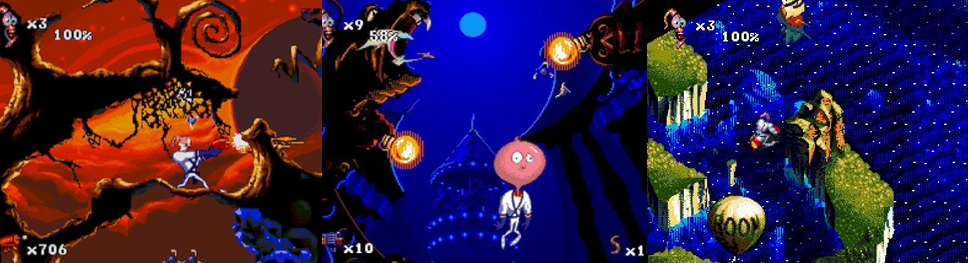
This time around, Earthworm Jim can collects a bunch of different ammo types for his Plasma Blaster. The default rapid-fire setting is still present, as is the Mega Blaster, but you can now grab a homing missile, a worthless bubble gun, a three-way spread, and the screen-clearing Barn Blaster. When you grab a different weapon, your gun automatically switches to it so be wary of wasting your more powerful shots; however, it’s not like there are many bosses to use them against. Jim can whip his worm self to conserve ammo but no longer uses this attack to swing from hooks. In fact, the swinging mechanic is thankfully downplayed and toned down compared to the last game. You can still do it but only when near snot-covered ceilings and sections, and by pressing C when jumping to have Snott latch onto these access points. The mechanic is much smoother and easier to control, and rarely appears. The tricky sections in See Jim Run, Run Jim Run are the exception as you must swing from moving sections, though the swinging is more of an afterthought this time. Similarly, Jim’s helicopter hover is also thankfully gone, replaced by a Snott parachute that’s much easier to perform (press A when jumping). Jim’s pocket rocket returns, but sadly only in one stage and now as a clunky isometric shooter. In The Flyin’ King, you must awkwardly nudge a TNT-carrying hot air balloon across a series of islands floating in the sea to take out Major Mucus in this snot-covered lair. Jim’s rocket has infinite ammo and firework-like turbos give a burst of speed but the screen quickly outpaces the balloon, forcing you to clumsily turn around with C to push it back on track. In the reverse of Buttville, Jim finds himself floating upwards in Inflated Head, deflating his head to avoid explosive lightbulbs and Flagitious the Cat’s attacks and slow down with B, and inflating with C (or using the many helium stations). Jim doesn’t get separated from his body this time, but he does assume the guise of a blind cave salamander to navigate through the intestinal layout of The Villi People. In this form, he can swim about by holding C and fire his regular shot with C, avoiding sticky amoebas, pinball bumpers, and being challenged by a nonsensical quiz and to bash bumpers in the correct sequence.
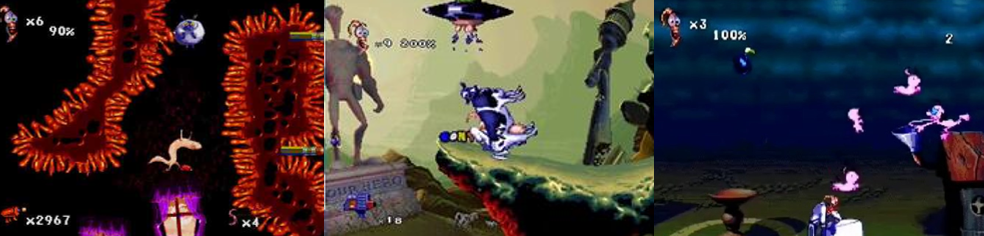
Most levels task players with doing more than just running and gunning. The first stage, for example, has you holding down to pick up pigs to weight down weighted platforms and open doors. A similar mechanic appears in Udderly Abducted, where you pick up and heft cows to barns to open gates. This is made more troublesome by some cows being on fire, giving you a few seconds to find a bathtub, the fragile platforms that break under your combined weight, and the indestructible UFOs seeking to abduct the cows. You can fend these off with your whip and use them to carry to cows up tricky sections, as well as blast cows across gabs with a cannon, but this level quickly becomes tedious when you are forced to find multiple cows. In Lorenzen’s Soil, you’re given 90 seconds to blast your way through dirt with an infinite Electro-Gun. You can grab stop clocks to gain more time, raise yourself higher by blasting dirt above you, and douse flaming hazards to progress, which is much easier and more fun than the numerous Puppy Love mini games. These replace Andy Asteroids and see you bouncing puppies to safety using a giant marshmallow. If you miss too many, Peter Puppy transforms and attacks, and you can only clear each of the three rounds by bouncing a bomb to Peter so he can take out Psy-Crow. This bonus stage nets you passwords and such, but quickly outstays its welcome when you’re bouncing multiple puppies at once. ISO 9000 sees you picking up hamster balls to power printing presses to jet across the stage, hitting switches to temporarily shut off boilers, and climbing dangerous filing cabinets to new areas. Level Ate takes place on a giant barbecue and sees you taking cover under sizzling meat to avoid killer saltshakers, alongside the usual worries of spikes and pits. One fun section of Anything But Tangerines sees Jim riding a stairlift and avoiding cantankerous grannies, who’ll rain down and beat him with their umbrellas, and many stages contain lightbulb teleporters that transport him to mini games or an oddball ending, as well as hidden areas behind the foregrounds.
Presentation:
Once again, Earthworm Jim 2 shines as one of the most visually interesting and colourfully cartoonish titles on the Mega Drive, or any system for that matter. Jim’s sprite has been overhauled, appearing slimmer and slightly more akin to his cartoon counterpart. He still has a bevvy of slapstick idle animations but is ready and raring to go this time, constantly jogging on the spot. Jim has more voice clips and reactions this time around, celebrating every time he picks up items and wailing whenever he’s in danger; even his life icon reacts to the game! The music’s also very much of the same ilk as before, occasionally favouring a calypso-like jingle or even shameless borrowing from “Cuban Pete”. Earthworm Jim 2 once again confines the details of its story to the hilarious instruction manual but you do get a brief gist of the plot during the company logos, when Princess What’s-Her-Name is kidnapped by Psy-Crow as Jim is serenading her with an accordion. Though Jim no longer exits levels on his pocket rocket, he does spring away using a weighted seesaw or calls for an intergalactic taxi. In ISO 9000, he has to literally chase down the exit door, which must be tricked into tripping over a giant wardrobe you toss in its way. Levels are still full of oddities to marvel at, though they largely serve a practical purpose this time. Dunking a pig in water seems pointless but using them to open doors isn’t, and cows are now carried and used to open gates rather than randomly being launched into space. While a large pixel art rendition of Jim displays the name of each level, you’re greeted by a bizarre photorealistic image of a cow complimenting your ability after clearing each stage. Completing the game sees Jim reunited with Princess What’s-Her-Name and a scroll of text congratulating your efforts, only for the Princess, Psy-Crow, and Jim to be revealed to be cows in disguise and the text to rewrite each time!
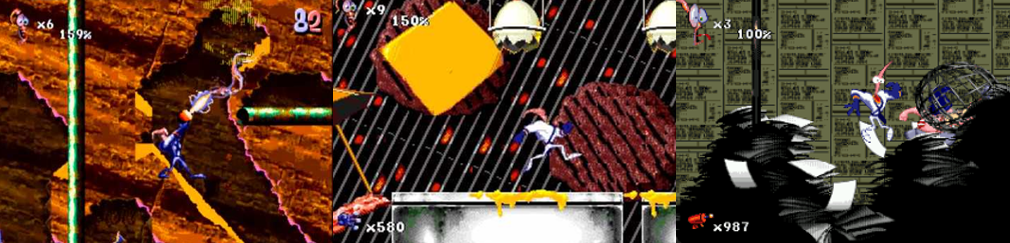
Earthworm Jim 2 features a bunch of new, bizarre environments that up the wackiness to eleven. While things start fairly innocuous in Anything But Tangerines, which boasts waterfalls and a blood-orange sunset, you’re soon blasting through crumbling soil, swimming about inside some giant unknowable creature (that’s apparently swallowed a pinball table and part of a house), and hauling cows across a post-apocalyptic landscape (which includes several half-destroyed monuments in the PlayStation version). Inflated Head stood out as one of the more memorable locations; it’s set against the background of a nightmare amusement park, with rollercoasters and such in the distance. I also enjoyed ISO 9000, which takes place in a giant printing press and sees you jumping to stacks of papers (with newspapers flying as you move) while more scroll in the background. I also really enjoyed Level Ate, with its platforms made of bacon, skewered fried eggs and meatballs, fork hazards, and flaming grills. Earthworm Jim 2 impresses with some prerendered backgrounds in the Puppy Love sections, which add a three-dimensional skew to the game. The Flyin’ King tries to capture this feeling more explicitly by being an isometric shooter, though it’s let down by the clunky controls. The level is impressive, though, with little pirate ships and cannons firing from the sea and islands and the level transforming into a snot-encrusted hellhole at the end. The final stage is a huge alien cathedral full of spinning beams, moving platforms, and bottomless pits. It can be a bit difficult telling which platforms you can walk on and which are part of the background, but I enjoyed the chase against Psy-Crow and seeing the detailed, ominous background loom past as I ran. Quirky humour is everywhere in Earthworm Jim 2, almost to its detriment. Sure, it’s fun seeing electric chairs as hazards, references to Mortal Kombat (Midway, 1992), and the crazy-ass enemy designs but I wonder if the developers were trying too hard to top the zaniness of the original here since gameplay is often bogged down by odd layouts and objectives.
Enemies and Bosses:
Similar to the first game, Earthworm Jim 2 only features a handful of enemies, though most are exclusive to each level they appear. These are also absolutely bonkers, ranging from floating octopi carrying blunderbusses and cantankerous grannies to cow-stealing UFOs and sentient straws looking to skewer you. Bob’s henchcat, Number Four, is said to appear in Anything But Tangerines but I must’ve missed him on my playthrough (though I was attacked by his rolling goldfish ball). Notably durable and aggressive ants and little larvae globs attack in Lorenzen’s Soil; sheep-like creatures float about in The Villi People and will explode, knocking you into bumpers or the health-draining tentacles; and you’ll find your pocket rocket weighed down by sumo wrestlers in The Flyin’ King. Waves of snot also push you back in this stage, while caped penguins fly into you as you’re carrying cows to safety in Udderly Abducted. While Flagitious is your main obstacle in Inflated Head, you must watch for lightbulbs to avoid having your wormy head popped. Lawyers return in ISO 9000, now resembling executioners and driven mad by all their paperwork. The filing cabinets are the worst hazard in this stage, though, as they bound around, immune to your shots, and are the only way to reach higher ground. Level Ate features snails seeking shelter from the evil saltshakers, forks that act as spikes, eggs that crack their yolks onto your head, and grills that’ll burn your feet alongside killer straws, of all things! While no enemies appear in See Jim Run, Run Jim Run, you’ll blast through barriers (both solid and rotating on gears), make tricky jumps, and snot swing from moving overhead access points to beat Psy-Crow to the end.
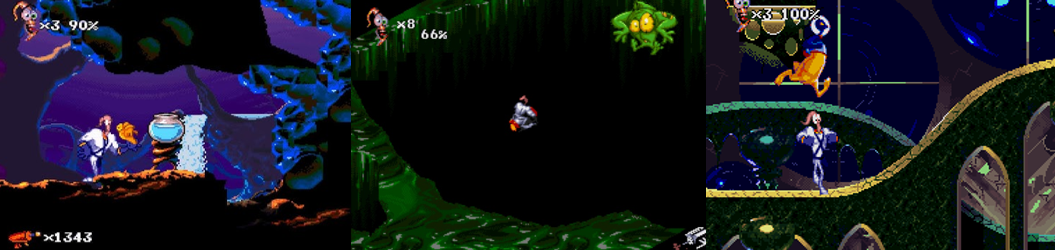
Strangely, Earthworm Jim 2 is surprisingly light on boss battles; many stages end with a bizarre challenge rather than a boss battle, which is disappointing considering how imaginative the first game’s bosses were. You’ll encounter Bob the Killer Goldfish at the end of the first stage and he’s defeated similar to before; simply walk up to his bowl and Jim automatically eats him. The Villi People sees you answering obscure questions and bouncing into bumpers before the stage just abruptly ends, Udderly Abducted asks you to rescue cows, and ISO 9000 has you trip the exit door to leave. Bosses are present, though, they’re just not as interesting as before: I barely realised that Lorenzen’s Soil’s unicycle-riding maggot was a boss, for example. This guy cycles back and forth spitting goop and spawning maggoty minions, but is easily blasted to death with your basic shot. Major Mucus returns, spitting snot from atop a snotty column in the snot-filled finale of The Flyin’ King. As long as you’ve brought the bomb-carrying balloon safely to the end, you can simply explode it to easily take him out. Though Evil the Cat seems to return, it’s actually his cousin, Flagitious, who spits darts and pounces from above in Inflated Head, though you just have to avoid him to reach the level’s end. Level Ate has a boss, an anthropomorphic T-bone steak fought on a giant pepperoni pizza! It hops up and down, dropping a plate on your head and spitting fireballs, leaving him vulnerable to your shots. Psy-Crow has been upgraded from a pest to the main antagonist; not only will he toss Peter’s puppies to their doom in bonus stages, but Jim must race against him in the final stage. While a 2D perspective isn’t the best for a race, this is more of an obstacle course. You can blast Psy-Crow to stun him but your main concern is making jumps and clearing your path, making for a finale so anti-climactic I was convinced a true final boss was looming…but, sadly, not.
Additional Features:
There are a lot more collectibles in Earthworm Jim 2 compared to the first game, but sadly they’re not all that useful. Sure, the flags will grant you a password to skip ahead but they’re quite tricky to track down and there’s no indication of which ones you have or how many are left to find. Similarly, Jim’s new ammo types are great, but I rarely had many opportunities to properly use them. You’re rarely surrounded by enough enemies to justify using the Barn Burner, for example, and it’s not like the game is packed with tough-as-nails bosses for you to use your stronger weapons on. Hidden areas make a return, of course, with lightbulbs teleporting you to a granny avoiding section or a test of strength. Most prominently, you can brave a spiky end in Level Ate to access the hidden Totally Forked stage, a level set in an abattoir and filled with useful power-ups. There’s still no high score table, though you can challenge harder difficulties and input various cheats. These refill your health, grant extra lives, continues, or invincibility, give you access to different guns, and let you skip stages. You can also input a debug mode cheat, like before, and take advantage of save states and rewind features if playing the Nintendo Switch Online version of the SNES port.
The Summary:
I adored Earthworm Jim and have been a huge fan of the character and franchise since I was a kid glued to the hilarious cartoon. I’d long coveted Earthworm Jim 2, a game much more expensive and harder to find than the original, and was eager to finally get into it, expecting more of the same but with the wackiness dialled up to eleven. While this is certainly true, I do wonder if the game is trying too hard to be more bonkers than the original. Things were weird in Earthworm Jim but they’re borderline nonsensical in Earthworm Jim 2, throwing a bunch of bizarre locations and enemies at you that don’t make a lot of sense in this world (I love Level Ate but, c’mon, what’s a giant grill got to do with a space-faring earthworm?) The game looks as fantastic as before, with shadows and details and a cartoonish appeal infused into every animation, making Earthworm Jim just as appealing and zany as ever. Every stage is packed with innovative features that have you solving puzzles in outlandish ways, like carrying cows to barns to using their milk to open gates. However, I wasn’t a huge fan on this focus on puzzle solving. It slowed the pace down considerably and was often a waste of the larger, more intricate stages. Equally, while Jim’s expanded arsenal is welcome, it feels superfluous to give him all these awesome weapons and have little to no enemies to use them on and next to no bosses to blast with them. Gone are the troublesome bosses of the first game, who forced you to think your way around their attacks, replaced by…a door that runs from you, a unicycling maggot, and Evil the Cat’s lesser-than cousin who you don’t even fight. The Puppy Love sections wore me out with their three-round structure, the quirkiness of Jim’s salamander form and inflated head felt wasted, and the isometric shooter felt out of place. I’m all for mixing up the gameplay and trying new things, but it felt like there was too much going on in Earthworm Jim 2. In trying so hard to throw new mechanics and increasingly bonkers scenarios at the player, the game lost some of the charm that made the original so appealing and was much more of a chore to play, despite being notably easier than its predecessor.
My Rating:
Pretty Good
How do you think Earthworm Jim 2 compares to the first game? What did you think to Jim’s tweaked abilities and expanded arsenal? Did you also struggle with the Puppy Love sections? Were you disappointed by the lack of boss battles? Which of the new gameplay mechanics was your most or least favourite? Do you think Earthworm Jim deserves a comeback? What are some of your favourite sci-fi-orientated videogames? Tell me your thoughts on Earthworm Jim 2 in the comments and then check out my other sci-fi content on the site.

 Dr. K's Waiting Room
One thought on “Game Corner [Sci-Fanuary]: Earthworm Jim 2 (Mega Drive)”