
January sees the celebration of two notable dates in science-fiction history, with January 2 christened “National Science Fiction Day” to coincide with the birth date of the world renowned sci-fi writer Isaac Asimov, and HAL 9000, the sophisticated artificial intelligence of Arthur C. Clarke’s seminal 2001: A Space Odyssey (1968), being created on 12 January. Accordingly, I dedicated January to celebrating sci-fi in all its forms.


Released: October 1994
Developer: Shiny Entertainment
Also Available For: Game Boy, Game Boy Advance, Game Gear, Master System, Nintendo Switch, Nintendo Wii, PC, SEGA CD, Super Nintendo Entertainment System (SNES); PlayStation 3 and Xbox 360 (HD remake)
The Background:
During the eighties and nineties, anthropomorphic characters were king. It seemed every cartoon, toy, or company mascot was some kind of humanoid animal, generally fighting otherwordly or intergalactic forces. The most prominent examples from this time were, of course, the Teenage Mutant Ninja Turtles (TMNT), though mascot platformers were prevalent in videogames thanks in no small part to the phenomenal success of Sonic the Hedgehog (Sonic Team, 1991). After successfully licensing the TMNT, Playmates made the bold decision to develop a franchise of their own. Impressed by Doug TenNapel’s sketch of an earthworm, they purchased the rights and TenNapel joined programmer David Perry and the rest of the team at Shiny Entertainment, simultaneously programming for both the Mega Drive and the SNES using custom-made tools. Created as a satire of the genre, the developers enjoyed exploring their creativity, free from the restrictions of licensed characters, and the project was expanded upon with a line of action figures, comics books, and a hugely enjoyable cartoon. This was made possible by Earthworm Jim’s critical and commercial success; critics praised the quirky story, fluid animations, and zany action. Sadly, Earthworm Jim’s time in the spotlight wasn’t to last. Though followed by a highly-regarded sequel, even a later high-definition remake couldn’t atone for Jim’s failure to capitalise on his early success in 3D and handheld ventures, leaving him another videogame icon sadly lost to time.
The Plot:
A renegade ship steals an ultra-high tech super suit from the evil Queen Pulsating, Bloated, Festering, Sweaty, Pus-filled, Malformed, Slug-for-a-Butt. Although intercepted by the Queen’s henchman, Psy-Crow, it lands on unassuming earthworm, Jim, transforming him into an anthropomorphic superhero.
Gameplay and Power-Ups:
Earthworm Jim is a 2D, run-and-gun action platformer in which you assume to role of perhaps the most unlikely and bizarre superhero in all of videogaming, an earthworm given incredible powers by an alien suit. Players guide Jim through various surreal worlds, from a crow-infested junkyard to claustrophobic underwater base, to Hell itself, blasting at everything in their way and pulling off some tricky platforming feats. Earthworm Jim has two attacks: one is to throw his worm body like a whip and the other is to unload with his Plasma Blaster. You can change the button configurations from the main “Options” menu, though I got along fine with the default: A to whip, B to fire, and C to jump. Jim has a good jump and can grab ledges to pull himself up. He can also spin his worm self like a helicopter blade to glide across gaps or down narrow shafts (though I had difficult pulling this off). For longer gaps, Jim can snag his worm self onto various hooks and swing across gaps, a finnicky system, especially when you must perform successful swings or make your way up hooked columns. The hit detection on the hooks is iffy at times and Jim is very cumbersome when swinging, but I found holding up on the directional pad helps. Jim can also cross chains using his hands and head to bypass gaps and spike beds, or whip wheels to open doors and gates. Jim’s default shot is a rapid-fire, ammo-chewing burst that cuts through most enemies. When your ammo runs dry, it’ll slowly refill but you can boost it by grabbing Plasma Power. Just be aware that your ammo isn’t refilled at the start of each stage.

Earthworm Jim can also grab Mega Plasma to fire a massive, concussive blast that’s great or blowing enemies away or whittling down bosses. Unfortunately, there’s no way to save this ammo for boss battles; once you grab the “Plasma!”, it becomes your default until you run out so choose your shots wisely. You replenish Jim’s health, which is measured in percentages, by grabbing Suit Power or a Super Suit Power for a full refill, grab extra lives, and Continue markers to respawn when you inevitably die. While everything in each level is out to hurt you, there are some things that’ll aid you. You must free hamsters in Down the Tubes, pressing A to chomp up Bob the Goldfish’s kitten guards, and also take control of extremely fragile spherical underwater craft to navigate between Bob’s lair. When in this craft, you have thirty seconds of air that you can replenish at air stations (if you’re careful enough) but you must avoid the narrow caves and walls as you boost around with A as the craft can only take so many hits. Jim also possesses his own pocket-sized rocket ship, which he’ll hop onto when finishing a stage. You’ll then race against Psy-Crow in numerous Andy Asteroids bonus levels, dodging asteroids and grabbing shields and accelerators for a burst of speed. You must hold A to accelerate and can collect “Fuel Pods” (though they do nothing) and even bash into Psy-Crow to slow him down. Fail to beat him to the end and you’ll have to battle him, but succeed and you’ll gain nothing except pride. Occasionally, Jim will be separated from his super suit. This first happens in the boss battle against Evil the Cat but also occurs in Level 5. Without his super suit, Jim’s just a regular earthworm and can only hop about, but you can jump into fan blades to be tossed ahead to reunite with your suit before Professor Monkey for a Head ditches it down a pit. Other times, you’ll be running on jewels to reach higher areas or teleport around, or take more traditional teleporters to reach new areas.

Earthworm Jim is quite the challenging experience. You can set the game’s difficulty in the “Options” menu, but even “Practice” gets pretty difficult as you progress further. Most stages are very linear, but you’ll be climbing, jumping, and running about in twisted, winding environments, often falling to lower levels or spike pits when you miss swings. Environmental hazards start quite mundane, such as debris falling down conveyor belts, flame bursts, electrical bolts, and such, but soon you’re facing monsters and bugs that bite you in two or being assaulted by voracious dogs and ghosts. In Down the Tubes, you won’t stand a chance against Bob’s muscular cat bodyguards and must jump to the alcoves above them and hold up until the past by, and ride ravenous hamsters to even the odds. Andy Asteroids stages get faster and more difficult as you progress, with more asteroids to avoid and Psy-Crow blasting ahead and stealing your power-ups, just as the very environment in later stages conspires against you. You’ll be whipping wheels to open gates, hitting levers to release hamsters, smacking switches to reverse escalators, and jumping to Dyson spheres that burst with electrical energy. The difficulty really ramps up in For Pete’s Sake, an escort mission where you must keep Peter Puppy safe from UFOs, tentacles, pits, and meteor strikes by either blasting hazards or whipping him. If he gets attacked, he transforms into a bestial form and shreds your health, setting you back a bit, too. This is a cakewalk compared to Buttville, though, a nightmare realm made almost entirely of spikes and tricky swing challenges. You’ll need to master Jim’s helicopter float just to get past the maddening first section, a narrow shaft full of spikes, to say nothing of avoiding swinging into the jagged spikes lining the floor of the stage.
Presentation:
Earthworm Jim is one of the most impressive games on the Mega Drive. It has a surreal, bonkers cartoon presentation that elevates it above the competition and gives it endless visual appeal. Jim is at the forefront of this, featuring numerous idle animations (from off-key singing, flexing, and blasting himself in the face), sound bites, and slick animation frames that make him a joy to control and watch. He reacts to everything, yelling in pain, swinging his worm self like a lasso, and reacting in horror at times, infusing him with a madcap personality that perfectly matches the insanity offered by the game. Between stages, partially animated pixel art compliments your gameplay and Jim turns into Tex Avery when meeting Princess What’s-Her-Name in the finale, only to be dejected when she’s crushed by an errant cow and consoling himself by swiping her crown! The cow isn’t even that random since players launch it in New Junk City, and weird, quirky humour like this is all over Earthworm Jim. From lawyers making up Evil’s minions in Hell, to the Professor literally having a monkey attached to his head, Earthworm Jim is crammed with visual gags and personality. The soundtrack compliments this, often being subdued or a simply bop, though What the Heck? does impress with a remix of “Night on Bald Mountain” underscoring the action. I did notice some instances where the music cut out, though, especially after pausing the game, though Earthworm Jim otherwise runs as smooth as butter and is a joy to play in terms of how responsive everything is. If you’re looking for story and cutscenes, you won’t find either here. The manual details the narrative alongside a few comic book pictures, but the game itself just starts up with no context and never tries to explain anything that’s happening, which is actually pretty great.
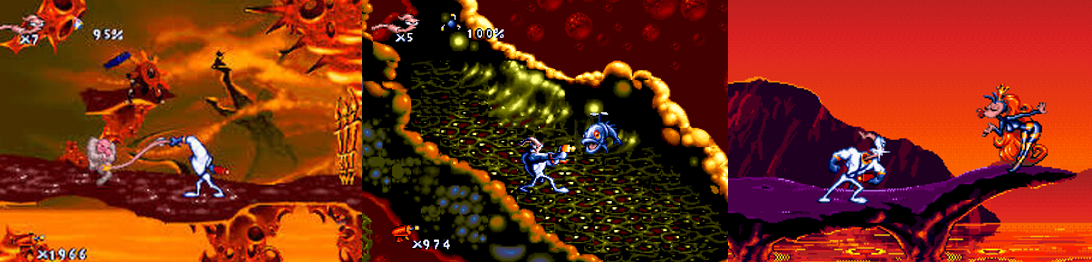
Earthworm Jim’s stages are absolutely bonkers. You start in New Junk City, a junkyard filled with bouncy tyres, fragmented cliffs, and monstrous dogs just waiting to bite your leg. There’s an impressive art deco effect to the background but it’s nothing compared to What the Heck?, where Evil the Cat hangs out in the distance and you must platform across sinister-looking Hell structures. Down the Tubes makes everything much more claustrophobic, restricting you to the glass tubes and rooms of Bob’s lair, but a water effect over the action and a beautiful rendition of the lair make this a visually memorable location. The simply named “Level 5” is a mad scientist’s dream of conveyers, escalators, 1950s-style machinery, and Dyson spheres. You’ll regularly by separated from your suit here and will briefly be encased in a mesh cage as the Professor toys with you. For Pete’s Sake is a simple barren, alien landscape but the looming planet, weighted platforms, seesaws, and never-ending onslaught of hazards bring it to life, to say nothing of Peter’s looming threat if your aim is a little off. Intestinal Distress is easily the most disgusting level, being made up of gross, mucus-like platforms and tubes, while Buttville is a spike-ladened nightmare hive. A lightning storm looms in the background, insta-kill hazards pop out from holes, and hooks and spikes close in all around you, really upping the threat level. The Andy Asteroids stages are simple chases through high-speed wormholes but those sensitive to flashing lights may struggle at the finish line, which bombards you with a strobe effect. Finally, the Snot a Problem challenges see Jim bouncing down a cliff on a bungee cord, bashing into Major Mucus and avoiding the Mucus Phlegm Brain below. If you’re lucky enough to own the HD version, you’ll be treated to a comic book-style intro sequence that gives a largely wordless account of Jim’s origin. There are also graphical differences between the Mega Drive, Mega-CD, and SNES versions and improved audio quality on the Mega-CD version.
Enemies and Bosses:
Surprisingly, there aren’t that many enemies in Earthworm Jim. The stage layouts and hazards are generally your most persistent enemy, with baddies merely existing as another obstacle to overcome. Defeating them makes your life easier since they won’t dog you when you inevitably miss a jump or a swing. None of them drop health or ammo and there’s no scoring system, so it’s literally a case of killing them to not lose health. New Junk City houses crows and ravenous dogs; crows swoop down and bite your head while the dogs bite your legs, though you’ll also have to watch for falling junk. What the Heck? sees you fighting off dark spirits (essentially a combination of the crows and dogs) and suited-up lawyers who block your shots with their cash-firing briefcases. Bob’s cat minions are completely invulnerable in Down the Tubes, requiring you to avoid or eat them with a hamster, but you’ll also encounter weird gas-spewing spheres that show up later in the game, too. Level 5 sees you attacked by the Professor’s weird science experiments, which explode into maggots when hit or see eyeballs constantly spawning to swarm you and disembodied brains pouncing in your face. Strange helicopter fish spit small fish at you in Intestinal Distress and bugs burst from nests in Buttville, compounding your attempts to safely navigate the spike-filled environment.
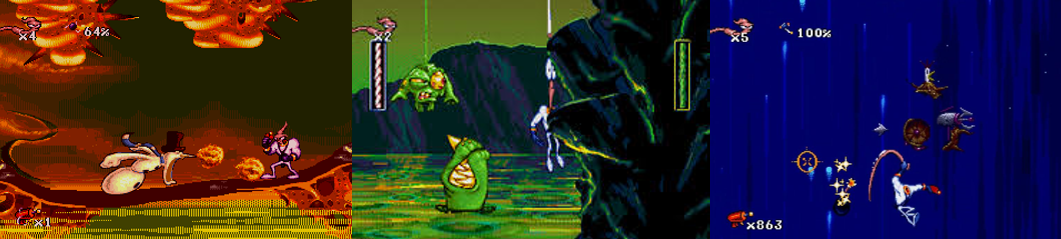
For Pete’s Sake charges you with temporarily subduing the many tentacles bursting from the ground and finding off UFO attacks and meteor storms. If Peter is hurt or falls, he becomes a bestial creature that attacks you, shrugging off your shots and setting you back. However, your most persistent foe is Queen Pulsating, Bloated, Festering, Sweaty, Pus-filled, Malformed, Slug-for-a-Butt’s main henchman, Psy-Crow. You’ll race him in the Andy Asteroids stages, barging him to slow him down and snagging power-ups to beat him to the end, but must battle him if you fail. Fortunately, this fight isn’t too hard; simply fire at him to stun him and then whip him until he flees. Some stages see you facing off with mini bosses, too, such as the living trashcan in New Junk City and the snowman waiting in What the Heck? The trashcan is tougher than it looks not just because of its powerful uppercut and it constantly launching debris, but also because it can only really be damaged by the Mega Plasma or from behind. The snowman is much easier, despite warping around by turning into goo and spitting fireballs. Similarly, battling Major Mucus in a bungee fight isn’t too bad; it’s similar to the rope section from Battletoads (Rare, 1991) and sees you barging the living snot ball into walls to whittle away its snot bungee. Still, you have to be careful of his counterattack, spinning top move, and the one-shot Mucus Phlegm Brain. Although you encounter Professor Monkey for a Head, you don’t get to fight him. Instead, you fire at him and chase him around his lab, and he sets his steampunk-style robot chicken on you. This thing is completely immune to your attacks and clucks about spitting egg bombs. You need to whip a target to drop explosives on it, the shoot or whip it while in freefall not unlike the Snot a Problem stage.

The first real boss you face is Chuck, the owner of the junkyard, though he’s actually easier to face than his sentient trashcan. Chuck drops anvils and crates and such from an overhead crane; simply avoid these and whip the crates onto the spring beneath him to deal damage. He’ll spit up fish and eventually move back and forth but he’s way easier to defeat if you time your whips properly. Evil the Cat is a touch trickier; he randomly pops up in What the Heck? to toss bombs and cause stalactites to rain down, then somehow separates Jim from his suit. In this phase, you must jump over his flame bursts until he destroys his platform, reuniting you with your suit. In the second phase, Evil attacks from the darkness and you must blast him nine times, avoiding the flame bursts, to finally put him down. Bob the Killer Goldfish is a joke by comparison, potentially because of how difficult Down the Tube’s underwater sections are. Simply walk up to Bob and Jim tips over his bowl, leaving him flailing on the ground. At the end of Intestinal Distress, you’re attacked by Doc Duodenum, a strange, mucus-like being that hops about and spits goo but it’s easily put down with your regular attacks. Queen Pulsating, Bloated, Festering, Sweaty, Pus-filled, Malformed, Slug-for-a-Butt herself awaits at the end of Buttville, her gigantic egg sac looming overhead not unlike the Xenomorph Queen. Gloop leaks from this and hurts you and you must hop to temporary spinning platforms, avoiding her scepter swipe and taking out the bugs swarming around her. The biggest threat here is the bed of spikes and potentially running out of ammo, but simply fire at her as you spin around and she’ll soon burst like a pimple. Frankly, the weird growth you fight before her is far harder. This…thing…spits goo, which is bad enough, but the ground is constantly moving you towards a spike wall and the ground also has spikes in it. It gets faster as you deal damage, too, and can really burn through your health and lives!
Additional Features:
With no high score table and no collectibles or unlockables, there isn’t much else on offer in Earthworm Jim. You can challenge the game on a harder difficulty, of course, and replay the game to try and reach new areas of each level for additional goodies, but your main reason for going back will be to discover the hidden areas. Not only are there secret areas hidden behind the foregrounds, you can access the secret stage Who Turned Out the Lights?, the Professor’s dark and dingy basement where spotlights briefly illuminate your surroundings and a hungry, unkillable creature stalks from the shadows. Other replay incentives include the cheat codes, inputted from the pause screen, that refill your health, ammo, grant an extra life, and allow you to skip stages. There’s also a debug mode that allows you to freely move the camera around each stage and grants invincibility (though, oddly, some enemies can still hurt you) that also protects you in underwater sections. Those playing the Mega-CD version can also play through an additional level, Big Burty, and battle the blind dinosaur of the same name. This stage (and Who Turned Out the Lights?) was missing from the HD version but was replaced by digital fantasy stages where a keyboard-playing cat ruled supreme. The HD version also included online and offline co-op mode where up to four players navigated all-new levels, in addition to leaderboards and Achievements/Trophies that challenged you to such tasks as collecting stuff, beating single and multiplayer levels, and finishing the game in under fifty minutes. Finally, if playing on Nintendo Switch Online, you can take full advantage of the save state and rewind features to really level the playing field on this challenging game.

The Summary:
I’ve played Earthworm Jim before, mainly on emulators, and have been a big fan of the series since it first came about. I loved the cartoon and have long coveted the action figures, so it was a must buy for my Mega Drive library once I started seriously collecting for the system. However, I’d previously played through the HD version on PlayStation 3, a game I remember beating without cheats. That wasn’t the case here. Earthworm Jim is almost unforgiving in its later stages, throwing spikes and pits and platforming challenges that will have you gripping your controller in frustration. So, yes, the debug mode helped a lot for this playthrough since it meant I didn’t have to worry about my health or oxygen, but it was no help at all with whipping those hooks or navigating the spiked, nigh-impossible nightmare that is Buttville. It also wasn’t much use against the damn trashcan, or that robot chicken, both of which can be a pain in the ass to defeat, especially as the game rarely indicates when your attacks deal damage. Racing against Psy-Crow can also become very difficult; fighting him isn’t so bad but it’s a waste of ammo, something you desperately need when navigating stages and defeating bosses. I do think the game would’ve benefitted from a meter system to measure Jim’s ammo. Like, firing his gun depletes a meter that refills over time, rather than forcing you to wait around for your ammo to slowly replenish. Still, while the game is very difficult at times, a lot of the time it’s simply challenging and you do get better at judging when to whip at hooks and how to navigate past hazards. It helps that Earthworm Jim looks fantastic; it has sprite animation so smooth and slick that it rivals the likes of Aladdin (Virgin Games, 1992) and Sonic the Hedgehog 2 (SEGA Technical Institute, 1992), basically resembling a playable cartoon. It plays really well, offering a quirky, action-packed experience while also making you think outside the box at times, especially when Jim loses his suit. Jim is also a wonderfully realised, bonkers character with so much life and personality and his enemies are equally memorable for their bizarre appearances and attack patterns. It’s not the most accessible game and at times will have you tearing your hair out, but my God is Earthworm Jim an enjoyable experience, if only to look at!
My Rating:
Great Stuff
Are you a fan of Earthworm Jim? How do you think the game holds up against other action platformers? Did you also find the game challenging at times, and struggle with the swinging mechanics? Which of Jim’s outrageous villains was your favourite? Did you ever beat the game on the hardest difficulty? Would you like to see Earthworm Jim make a comeback? What are some of your favourite sci-fi-orientated videogames? Feel free to share your memories of Earthworm Jim in the comments and then check out my other sci-fi content on the site.

 Dr. K's Waiting Room
3 thoughts on “Game Corner [Sci-Fanuary]: Earthworm Jim (Mega Drive)”