
January celebrates two notable dates in science-fiction history, “National Science Fiction Day” on January 2 and Arthur C. Clarke’s HAL 9000’s birthday on January 12. Accordingly, I’m dedicating January to celebrating sci-fi in an event I call “Sci-Fanuary”.


Released: 19 June 2024
Originally Released: 9 February 2004
Developer: Nintendo R&D1
Also Available For: Game Boy Advance (Original); Nintendo 3DS, and Nintendo Wii (Virtual Console)
A Brief Background:
Metroid (Nintendo R&D1/Intelligent Systems, 1986) owes its creation to Nintendo’s success with their industry-saving Nintendo Entertainment System (NES), producer Gunpei Yokoi and directors Satoru Okada and Masao Yamamoto collaborated on the title, and Alien (Scott, 1979). Alongside Castlevania (Konami, 1986), the game birthed a videogame subgenre dubbed “Metroidvania” and Metroid was praised for its challenging gameplay. Since being recognised as one of the greatest games ever made, Metroid spawned numerous sequels and spin-offs and was ported to many subsequent Nintendo consoles. Nintendo (and Metroid) veteran Yoshio Sakamoto oversaw the development of this Game Boy Advance remake, which came about when someone working on Metroid Fusion (Nintendo R&D1, 2002) suggested porting Super Metroid (Nintendo R&D1/Intelligent Systems, 1994) to the console. The developers fittingly sought to return to the franchise’s roots, while still adding new elements to make the game feel fresh and modern. Principally, this involved placing greater emphasis on the story, allowing players to pick between difficulty settings, providing Samus with a new form-fitting suit, and adding an epilogue to the story. Reviews for the enhanced remake were largely positive; its content and features and refined controls were praised, though many complained of its short length and that newcomers would get more from it. Still, Zero Mission was said to be one of the best Game Boy Advance titles and it finally found a life outside of its system once Nintendo made it available through their online consoles.
The Review:
Metroid: Zero Mission is a Game Boy Advance remake of the original game, following essentially the same narrative structure (bounty hunter Samus Aran explores Zebes, conquering monstrous bosses to confront Mother Brain, leader of the Space Pirates) and offering the same power-ups, but with a decidedly 16-bit glow up that basically reimagines the original game as though it were a 16-bit title. Consequently, the game looks, sounds, and plays almost exactly like Super Metroid and Metroid Fusion, enhancing Samus’s abilities with moves like the Speed Boost, Spineshark, and ledge grab and allowing her to better dispatch her enemies with an expanded move set, one ripped entirely from those aforementioned games. You fire her trademark blaster arm with B or X (eventually acquiring power-ups that allow you to charge a shot, temporarily freeze enemies, and fire through enemies and obstacles), jump with A (again upgrading this to the iconic Screw Attack and Hi Jump Boots), hold the Left trigger to stand in place and aim in multiple directions, and quickly acquire the Morph Ball to squeeze through tunnels. As you’d expect, you can acquire upgrades that let Samus jump and lay bombs in this form and upgrade her suit to reduce the damage she takes or resist extreme heat and acid pools. Zero Mission adds not only a mini map to the main screen but a large, detailed map for each area of Zebes, expanded whenever you find a Map Room and easily allowing you to see where you need to go (thanks to Chozo Statues highlighting your next objective) and any hidden secrets to find or bosses to confront. Pausing the game lets you review this map, see Samus’s currently available weapons and upgrades, and enter sleep mode. From the main menu, you can select up to three save slots (manually saving in various save rooms) and choose to play on either “Easy” or “Normal” mode.
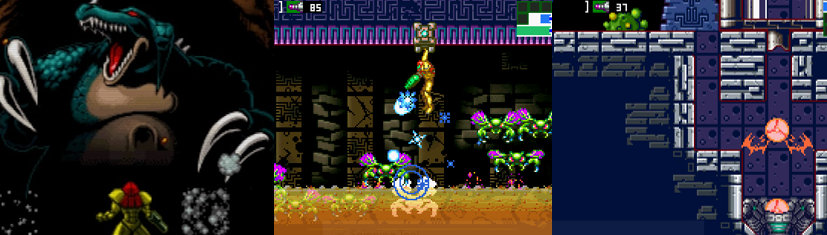
Thanks to the graphical upgrade, Zero Mission is almost completely indistinguishable from the original Metroid and aesthetically has much more in common with Super Metroid and Metroid Fusion as a result. The basic layout is still there (go left at the start of the game and you’ll still find the Morph Ball, for example), with you still ploughing through hallways, dropping down vertical shafts, and riding elevators to explore Brinstar, Norfair, Kraid’s Lair, Ridley’s Lair, and Tourian, but each area is far more visually interesting compared to its 8-bit predecessor. Lava and acid bubbles beneath you, platforms crumble, enemies constantly spawn, and you’ll be backtracking and finding alternate routes as your abilities expand, as always, all while traversing various rocky, mechanical, and ominous environments. Backgrounds are given far more depth and detail, rain effects sweep across the terrain, volcanic caverns smoulder, and enemies are far more detailed (and much bigger) this time around. The game’s story is also given an upgrade with partially animated sequences, Samus’s inner monologue, and in-game graphics providing suitably dramatic cutscenes. The soundtrack has also been upgraded, featuring 16-bit versions of Metroid’s tracks and various remixes that work in tandem with the graphical improvements to again allow the game to stand side-by-side with its 16-bit counterparts. Areas also have new gimmicks, such as the Morph Ball Launcher (which blasts you to new areas), overhead zip liners, and power generators and Chozo Statues that require your Morph Ball and recharge your health and missiles. The Speed Boost is incorporated to break through walls and reach new areas, some doors are barred by grotesque eyes, you’ll occasionally have to unleash small bugs to clear out vine blockages, dead bodies, discarded carcasses, and creeping vegetation are commonplace. Indeed, the entire world seems much bigger and more alive and dangerous than ever thanks to the updated visuals and ominous soundtrack.
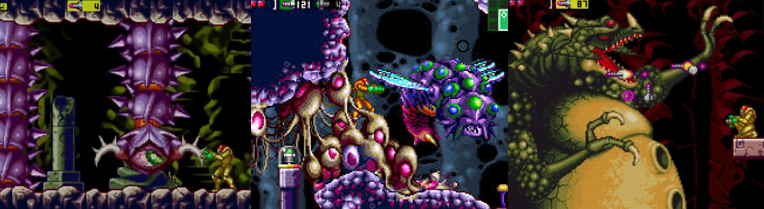
Those familiar with Metroid may also be surprised to find a few new enemies here: the hopping Barisutes act almost as mini bosses with their tough armour plated hides, larva-like Kiru Giru fill narrow tunnels and must be baited in to attack their underside with bombs (or shot from below), and Space Pirates shrug off even your strongest missiles. These appear alongside improved versions of the original enemies and Samus will have to hunt down, freeze, and explode every energy-draining Metroid in Tourian if she hopes to escape. Zero Mission also boasts five new bosses in the main portion of the game: two of these are gigantic, spiked, worm-like creatures that burst through the environment or up through acid, lunging at Samus and firing spores or spikes. The first, the Deorem, uses its spiked body to box you in and must be shot in its eye when it appears. The second, the Mua, lunges from an acid pit, giving you a small window to target its pulsating weak spot. Norfair itself later attacks by ensnaring a Kiru Giru in vines and unleashing spores. You must freeze the Rippers in the arena to hop to and attack the vines to send the enslaved creature crashing down. This monster lands in Ridley’s Lair, sheds its skin, and mutates into a grotesque wasp, the Imago, that flies around its nest, charging about and firing spikes from its stinger. You must use yourself as bait and then pelt the stinger with missiles to finally end it. Metroid’s classic bosses also appear in their respective areas, but they’re now reimagined duplicates of Super Metroid. Kraid is a gigantic, bulbous beast you must shoot in the head and mouth while hopping to temporary platforms, while Ridley flies about breathing fire, striking with his spiked tail, and trying to get his claws on you. Samus still braves a nightmare of projectiles and lava hazards when confronting Mother Brain, whose glass case must be shattered with missiles before you can attack her single eye, but her eye blast and the knockback from the swarming projectiles makes this a tricky affair.
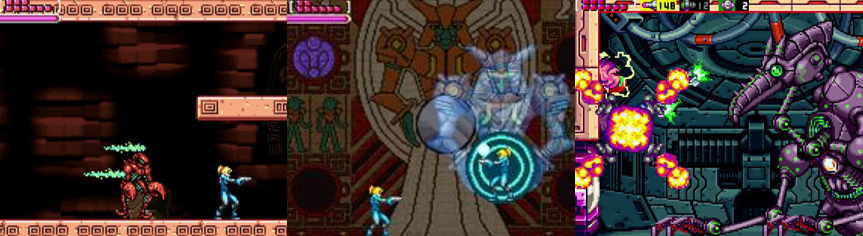
After making a desperate escape from Zebes, Samus’s ship is attacked and crash lands in the all-new Chozodia sector. Robbed of her armour and abilities, Samus has only her form-fitting Zero Suit and a crappy pistol on hand, meaning players must sneak past Space Pirates, laser traps, and spotlights, desperately running to safety when they inevitably trigger the alarm and only being able to briefly stun enemies. This is quite a tense and frustrating section; when you’re spotted, an alarm sounds, all doors lock, and Space Pirates chase you relentlessly. You can hide behind pillars or in dark corners, but it can be tough to find these when you’re in a panic and the Space Pirates sometime crawl through alternate paths or blast through destructible blocks to find you. Eventually, Samus makes it to the main bridges and the Chozo Ruins, where her mettle is tested by a holographic, lighting-casting projection. Make sure you don’t attack when the mirror of Samus is in the sphere as you’ll take damage. Instead, target the central sphere when images appear and you’ll regain all your abilities, and more. Previously, you’ll have explored different Chozo Ruins and acquired “unknown items” that were incompatible with your suit; these are enabled here. This allows you to plough through Space Pirates with ease with the Plasma Beam, continuously jump with finnicky Space Jump, and freely move through liquid with the Gravity Suit. You’ll also acquire the Power Bombs here and it’s advisable to backtrack to use these new abilities to uncover previously hidden expansions to your health and ammo. When you’re ready, you challenge Mecha Ridley which, though intimidating and powerful, is actually a pretty anti-climactic final boss. You can simply jump over its claw swipes, fireballs, and lasers and pummel the glowing core on its chest to defeat it with much less trouble than its biological counterpart. Samus then has five minutes to make it to an escape shuttle to finish the game, and players are of course treated to different ending images depending on how fast they made it to the end and how many power-ups they acquired. Completing the game also unlocks an additional gallery mode and, impressively, a fully playable port of the original Metroid.

The Summary:
Given I much prefer Samus’s 16-bit adventures to her original game, I was pleasantly surprised by Metroid: Zero Mission. The game is similar enough, but different, featuring a far more visually appealing graphical style that perfectly matches its 16-bit counterparts and updates the original game to be comparable to its successors. If anything, I feel like more could’ve been changed; the Chozodia was a fun addition, but it was more of an unexpectedly epilogue that served as padding. Perhaps if each area featured stealth sections where Samus was reduced to her Zero Suit as part of a Chozo test it might’ve helped with the game’s pacing. The new bosses could’ve been fought at the end of these sections, with the “unknown item” power-ups being rewarded and allowing Samus to get progressively more powerful, as usual. It was a tense and surprising inclusion, though, one that fundamentally changed how you play. I just wonder if more could’ve been done with it, perhaps allowing players to try the whole game with the Zero Suit? The other changes were very welcome (except for the Spineshark; I’ll never enjoy that ability), especially to the returning bosses. Sure, seasoned Metroid players will have a distinct advantage but recreating the Super Metroid battles made these bosses far more intimidating and epic. It’s a shame Samus didn’t get any new abilities beyond the standard Super Metroid ones, which again I feel could’ve been addressed by emphasising the Zero Suit more, but Zero Mission does a fantastic job of bringing the original Metroid up to par with its successors. As if that isn’t enough, you unlock the original game, so anyone who doesn’t like the changes can just play the original game after!
My Rating:
Pretty Good
Have you ever played Metroid: Zero Mission? How do you think it compares to the original game? Did you like the graphical upgrade and the changes to the bosses? What did you think to the Chozodia section, and do you agree the pacing was a little off? Did you ever get the best ending and play through the original Metroid? Which Metroid game is your favourite? Whatever your thoughts, feel free to leave a comment below and be sure to check out my other Metroid reviews.

 Dr. K's Waiting Room
One thought on “Mini Game Corner [Sci-Fanuary]: Metroid: Zero Mission (Nintendo Switch)”