
January celebrates two notable dates in science-fiction history, “National Science Fiction Day” on January 2 and Arthur C. Clarke’s HAL 9000’s birthday on January 12. Accordingly, I’m dedicating January to celebrating sci-fi in an event I call “Sci-Fanuary”.


Released: 24 August 2015
Originally Released: 5 November 1993
Developer: Digital Eclipse
Original Developer: Capcom
Also Available For: GameCube, Mobile, Nintendo 3DS, Nintendo Entertainment System (NES), Nintendo Switch, Nintendo Wii, Nintendo Wii U, PlayStation, PlayStation 2, PlayStation 4, PlayStation 5, PlayStation Portable, Xbox, Xbox One, Xbox Series S
The Background:
Capcom made a successful debut on the home console market with the notoriously difficult Mega Man (known as “Rockman” in Japan), a widely praised run-and-gun that spawned numerous, equally celebrated sequels and spin-offs that dominated Nintendo’s consoles. By 1993, Capcom were busy working on bringing Mega Man to the industry-defining Super Nintendo and series artist Keiji Inafune worked hard to come up with new, innovative gameplay mechanics for the Blue Bomber’s sixth 8-bit outing. As before, the game’s Robot Masters were designed by fans, though two were the result of North American submissions and the implementation of the Robot Masters caused some issues for the overworked Inafune. Despite being the last Mega Man title released for the NES, Capcom decided not to publish it outside of Japan, so Nintendo of America handled that aspect. Regarded by some as the best of the original six Mega Man titles, Mega Man 6 has been widely praised despite sticking to the series formula and including some cheesier elements. Mega Man 6 has enjoyed many re-releases over the years and was naturally a part of this Legacy Collection release, which included quality of life features and additional bonuses.
The Plot:
A year after defeating Doctor Albert Wily, the Global Robot Alliance organises the First Annual Robot Tournament to determine the world’s strongest peacekeeping robot. When the mysterious “Mr. X” attacks with eight Robot Masters, the super fighting robot Mega Man to intervenes.
Gameplay and Power-Ups:
For his final NES appearance, Mega Man delivers one last 2D, run-and-gun action/platformer that pits him against another batch of eight Robot Masters. Although you can challenge the bosses stages in any order, it’s best to tackle them according to the cheat sheet provided with the Legacy Collection (or an online guide) as each Robot Master has a specific weakness. Mega Man 6 also includes more branching or alternative paths than any previous Mega Man title, with each of the initial eight stages featuring two paths that lead to their boss. Although you’ll still battle the Robot Master and obtain their Special Weapon upon victory, only one of these two routes gives you one of the four Beat Parts to utilise Beat, Mega Man’s robotic bird helper. You can replay any of the previous stages to acquire ones you’ve missed but will lose this ability once all eight Robot Masters are defeated. Mega Man 6 adds nothing new to Mega Man’s basic controls: you’ll jump with X, sliding under enemies, projectiles, and through narrow corridors with down and X, fire your Mega Muster with A (holding A to charge the shot), and rapidly fire with Y. The Legacy Collection allows you to tweak these controls, if required, rewind the game, create save states, and apply special borders and filters to the game. Although the Mystery Tank is gone, you’ll still grab E-Tanks to refill your health and 1-Ups, health and weapon energy from enemies or scattered about the levels, and be gifted these power-ups whenever your robot ally, Eddie, appears. You’ll find more of these by taking alternative paths or utilising the Flame Blast or Mega Man’s new Rush Power Adapter to melt or destroy certain blocks, respectively, and open new paths.

Yes, while Rush does appear whenever you select one of the two Adapter forms, the little robotic canine can no longer be summoned to aid you. Instead, Mega Man fuses with Rush to gain a powerful set of armour that fires a shorter, but far stronger shot. Alternatively, Mega Man also gains a super useful jetpack, perfect to flying to ladders, platforms, or hovering over spikes. These two forms are tied to a meter that limits how much you can use them, but you don’t need to collect energy to fill it (though you lose the ability to slide when using Rush Adapters). Once again, Capcom are hardly thinking outside the box with Mega Man’s Special Weapons, but I appreciated that the Flame Blast and Rush Power Adapter were used to reach new areas and it’s extremely useful to use Centaur Flash to attack all onscreen enemies or Plant Barrier to gain a shield. Personally, I prefer to save the Special Weapons for the boss battles, so I largely relied on the Mega Buster and charged shot, though the speed of the Yamato Spear was appreciated and it’s always useful to hit airborne or oddly placed enemies with the likes of the Silver Tomahawk and Blizzard Attack. Like Mega Man 5’s Water Wave and Charge Kick, the Wind Storm and Flame Burst are great for attacking smaller enemies that rush across the ground, while the Knight Crush’s boomerang-like arc can deal extra hits if shot correctly. Sadly, they’re all way too familiar at this point and still don’t mix up the gameplay mechanics. Rather than expanding upon the Marine Bike and Super Arrows, Mega Man 6 removes them. You do have to hit Pookers with a charged shot to flip them into rideable platforms, but that’s not as fun as the fast-paced sidescrolling shooting offered by the Marine Bike. As mentioned, Beat also returns and is just as difficult to obtain. His ability to battle alongside you explains this, but it was annoying not being able to utilise him without a guide.
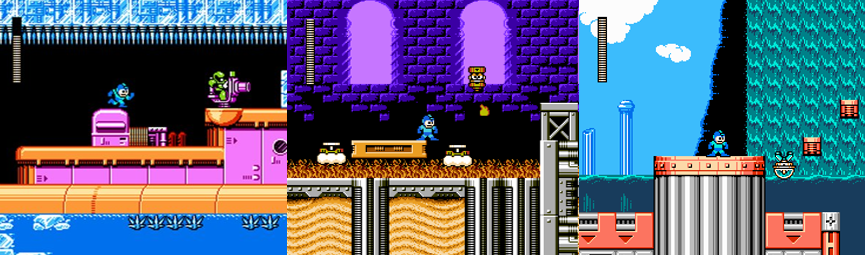
Mega Man 6 also plays it safe when it comes to stage hazards and level design. Sure, the spikes all have a different appearance in each stage and it’s fun to discover new areas, but you’ll encounter the same bottomless pits, disappearing and reappearing blocks, moving platforms, and tricky platforming challenges here (though the Rush Jet makes it much easier to bypass some of these). However, there are some new and clever mechanics to encounter here. Flame Man’s stage is filled with oil that slows you down and bursts into insta-kill flames when ignited by enemy fire. Blizzard Man’s stage also slows you down with snow and sees you skidding about on ice, making jumping to ice columns and platforms a genuine concern. Knight Man’s stage includes a large set of ceiling spikes that threatens to crush or skewer you and bouncy gears that pinball you about, Centaur Man has underwater sections (including a part where you must time your jumps according to the rising/falling water to avoid spikes and pits), and Wind Man’s stage features propellers that enhance your jump and are used to clear gaps and reach ladders and platforms. Many of these gimmicks are recycled for Mr. X (not that one) and Dr. Wily’s stages, with a falling block bridge, reliance on the Rush Jet, flipping spiked platforms, fan enemies that blow you into spikes, hidden drops, and a lack of energy refills making these, fittingly and as usual, the most challenging stages. Each time you clear a stage, you get a password (made redundant by the Legacy Collection), though I found enemies dropped health and weapon energy far less frequently than before, which can make Mega Man 6 tricky at times.
Presentation:
It remains a constant disappointment that, six games in, Mega Man’s sprite remains unchanged since Mega Man 3 (Capcom, 1990), with his sprite simply changing colour whenever he has a Special Weapon equipped, dramatically exploding when killed, and striking a pose when he defeats a Robot Master. I suppose this isn’t entirely true as Mega Man does get a new sprite when using the Rush Adapters, but I would’ve liked to see more detail, a proper idle animation, and a revised sprite to match with the far more detailed backgrounds and environments. As in Mega Man 5, Mega Man 6 uses its resources wisely, limiting the onscreen enemies to reduce (but not eliminate) slowdown and screen tearing and transitioning to a plain black background whenever larger sprites appear. Sadly, Mega Man 6 is a bit of a step back from Mega Man 5 when it comes to narrative; the introduction features large sprite art, but it’s all static and you’ll only see it animate in the game’s ending. However, the stage introductions are vastly improved, now displaying stats for each Robot Master (though not their weaknesses) and a big, animated Mega Man sprite is showcased when you obtain a Special Weapon, with my call for a visual representation of the weapon’s abilities being answered. While Proto Man, Roll, and Doctor Thomas Light are all absent, there is a sprite-based cutscene revealing that Dr. Wily was the true mastermind behind the recent robo rampage and Robot Masters are accompanied by ominous lighting when they drop into their arenas. The more detailed Capcom logo also returns, as do instances of moving foregrounds and backgrounds that appear to be a version of parallax scrolling, though they’re used sparingly (as are instances of flickering lights in the background).

The music is, again, top-notch, if hardly anything groundbreaking. What did surprise me was just how far the environments have come since the franchise’s basic early days. Again, this is why I feel the series would’ve benefitted from releasing games every two years or so, to give the developers time to figure out the NES hardware limitations and combine some of their ideas to appear more innovative with less games. Flame Man’s stage is a veritable oil field, but with an Oriental flavour to the background; I loved the gimmick of the oil igniting and wish the game had done more with it. Blizzard Man’s stage takes place in the snowy mountain peaks, featuring platforms that’ll explode under you if you’re not careful, meltable walls, and a really fun and impressive section where you carefully platform across a submarine, avoiding the spikes overhead and below. Plant Man’s stage was the most visually impressive for me thanks to the dense forest in the background. Enemies even dropped from the trees and hopped out of grass, which was really surprising, and the stage included some quirky springy parts to mix things up. Tomahawk Man’s stage has a distinctly Wild West theme, featuring cacti and a beautiful sunset in the background, while Yamato Man’s is themed more around Japan, featuring a large mountain and traditional architecture, and Knight Man’s is, as you might guess, themed around a medieval castle and dungeon. Centaur Man’s stage is more inspired by Ancient Greece or Atlantis, featuring columns and ruins and animated water, while Wind Man’s stage sees you traversing a cluttered mechanical tower. Mr. X and Dr. Wily’s stages are the usual mishmash of garish colours and mechanical trappings, though Mr. X’s impressed with a surprisingly detailed futuristic city and moon-lit night sky in the background. Being able to see through windows and Dr. Wily’s mixed and matched enemies and hazards from previous stages create another visually interesting obstacle course, though one boasting alternative paths.
Enemies and Bosses:
As you might expect, some of Mega Man’s more iconic enemies return in Mega Man 6, such as Sniper Joes now piloting massive cannons, though the Metall’s adopt a disappointingly back to basics approach. You will encounter giant Metall dispensers a few times and one pilots a mech suit in Dr. X’s third stage, but there are now fun new variants and even giant versions here. Slightly tweaked versions of the Dachone, Shield Attacker, shielded Tatepakkan cannon all appear; the Fire Boy is somewhat similar to the Hothead enemies in that they toss fireballs; drill tanks still charge towards you; and you’ll even encounter an evil version of Beat, Peat. Robotic seals, tanukis, pandas, cowboys, fish, bugs, and pelicans (which drop robot fish) make up the quirky list of enemies you’ll face. Skull-faced jumpers, erratic anthropomorphic springs, and speedy curling stones also appear alongside larger enemies. You’ll encounter a few robotic squids that fire homing missiles and ice blocks, brutish Power Slams try to crush you with a boosted jump, clouds transform to submarines, and samurai-like guardians deflect your shot with their spear and toss projectiles. Naturally, the largest enemies act as mini bosses; you’ll destroy a few Metall dispensers, as mentioned, which are more an inconvenience than anything. Gamarn and Gamadayu are a bit tougher in that the large mechanical frog fires lasers from its mouth and his little pilot tosses bombs, but they’re a largely stationary target. Not so for the Gorilla Tanks, which trundle along on tank-like treadmills and spit a spread shot as well as firing their fists at you. All these mini bosses are notably weak to the Flame Blast, though you’ll have to target the Gorilla Tanks’ eyes to take them out.
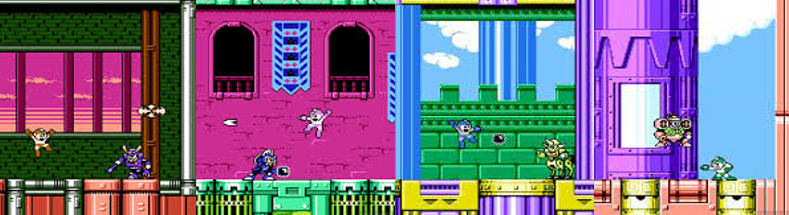
As ever, Mega Man 6’s latest Robot Masters are fought in enclosed arenas and generally jump about firing their Special Weapon. Like in Mega Man 5, Robot Masters seem to take more hits than in previous games, offering a bit more challenge even when hitting them with their weakness. All are fought a second time, in more generic settings, in Dr. Wily’s fortress and, as ever, their difficulty depends on which Special Weapons you have. I went for Flame Man first, who not only causes flame pillars to burst from the ground but also launches a fireball. The Mega Buster works on him very well, though the Wind Storm is obviously even better. His Flame Blast makes short work of Blizzard Man, who’s fought outside for a change and is invulnerable when charging in his ball form. His Blizzard Attack, which summons snowflake projectiles, is the best way to wilt Plant Man, who utilises a very familiar barrier that both protects him and acts as a projectile. You’ll need to time your Blizzard Attack to hit him in the small window when he’s vulnerable, and similarly time your own Plant Barrier when facing Tomahawk Man, who not only tosses his directional Silver Tomahawk but also fires feathers at you. Yamato Man is a bit nimbler and more versatile, defending himself with his lance and flinging his signature Yamato Spear straight ahead or in a spread. This fast-paced attack obliterates Knight Man, who’s mace/boomerang-like Knight Crusher equally crushes the life out of Centaur Man. Possibly the most creative Robot Master up to this point (at least visually), Centaur Man teleports about and fires an easily avoidable spread shot but will briefly freeze you with the Time Stopper-like Centaur Flash. This Special Weapon makes a joke of Wind Man, who desperately tries to suck you in and fires propeller-like projectiles only to fall with a few hits. When fought again in Dr. Wily’s castle, you’ll again have to endure only having your health refilled after each bout, hence why I like to conserve my Special Weapon usage in stages.
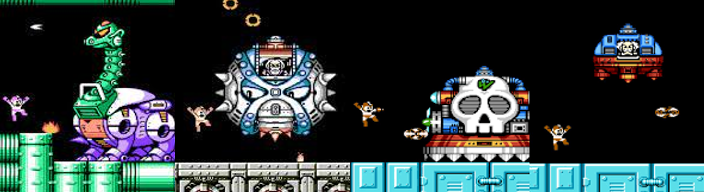
Like Mega Man 5, you’ll have to tackle Dr. X’s four stages, three guardian robots, and the madman himself to unmask the game’s true evil genius. First, you’re pitted against two upgraded Rounders; these spherical craft loop around a track dropping small bombs and are tricky to hit with the Heat Blast. The Power Piston is a much easier target, though you’ll need to position yourself just right so the Silver Tomahawk arcs into it while also avoiding its spread shot and the falling boulders. Although it looks intimidating and fires a big, bouncy shot, the Metonger Z is easily felled by the Blizzard Attack. The X Crusher can be much more challenging as it’s a huge wrecking ball sprite with an equally large hit box; it sways back and forth and drops a purple shot like the one used in Mega Man 5’s finale. However, if you stay in one corner, time your jumps, and attack with the Flame Burst, he’ll be toast soon enough. Dr. Wily’s fortress houses the huge (but entirely stationary) Mechazaurus, perhaps the franchise’s biggest and most impressive boss so far. It’s no slouch, either; you must avoid its fireballs and hop on quick moving platforms fired from its torso to shoot its eyes with the Yamato Spear, which can get quite hectic. The Tank CSII is much easier, despite being a moving target; simply avoid its small and big shots and blast its centre mass with Wind Storm. Your final confrontation with Dr. Wily is a three-phase battle that first seems him trying to crush you in a gigantic skull ship that’s also got a massive hit box. All you need to do is slide to safety and pelt it with the Knight Crusher or Silver Tomahawk, though I’d save that for the third phase. After enough hits, the cockpit is damaged and the ship moves more erratically, relying more on its large spiral shots, but the strategy remains the same. Finally, Dr. Wily again teleports about in his UFO craft and blasting you with four spiral shots. But this is probably the easiest final battle against him as you just pelt him with the Silver Tomahawk and he’ll soon be begging for mercy and finally locked up for good.
Additional Features:
Twenty-four Achievements are up for grabs in the Mega Man Legacy Collection and you’ll snag one for completing this game, and another for beating all six Mega Man games. Alongside the usual display options on offer, you can enable a turbo mode, play the Japanese version of the games, browse a concept and character art museum, and listen to the soundtrack. If you fancy an additional challenge and some more Achievements, you can check out the appropriately named “Challenge Mode”, where remixed stages from all six Mega Man games offer timed challenges. Challenges specific to Mega Man 6 are also included to test your skills, though the only real replay value offered by Mega Man 6 is again in replaying stages to find the secret exits and acquire Beat.

The Summary:
Mega Man certainly finished up his NES days with a bang. While, on the surface, Mega Man 6 is much of the same as before, offering only a few additional features and even missing or not expanding on mechanics from Mega Man 5, it’s astounding how much more detailed the game’s environments have become compared to the first game. While it’s disappointing that Mega Man’s sprite hasn’t evolved all that much, the more detailed sprite art and animations between stages and the new Jet Adapters make up for this. I missed Jet Marine and the Marine Bike, but I loved having a jetpack and the power armour and that they didn’t consume energy when used. As ever, Capcom could’ve done more with these, but it was great seeing them be necessary to access alternative paths and giving you a reason to switch to Special Weapons in stages. While the Robot Masters aren’t all that special, they’re visually very quirky, much like the beautiful stages, and I really enjoyed how big and outrageous some of the boss machines were. It’s a shame we never got a resolution to the Proto Man storyline here, or got to play as him, and that Mega Man 6 focuses more on action than narrative, but the gameplay experience was really solid, with some fun gimmicks. Again, I do think the 8-bit games would’ve been better served releasing further apart and in fewer numbers but Mega Man 6 shows how powerful the NES could be at times and offers a fair bit of innovation compared to some of its predecessors, and even sneakily teases that the series will continue by the end.
My Rating:
Great Stuff
Do you think Mega Man went out with a bang with Mega Man 6? What did you think to the new Rush Adapter mechanics? Were you disappointed that the game didn’t better expand on Mega Man 5’s gimmicks? Which of the Robot Masters was your favourite to fight against? Did you guess that Dr. Wily was behind everything again? Were you impressed by the greater level of detail in the stages? How are you celebrating the science-fiction genre this month? Whatever you think about Mega Man 6, comment below and go check out my many other Mega Man reviews.

 Dr. K's Waiting Room
2 thoughts on “Game Corner [Sci-Fanuary]: Mega Man 6 (Xbox Series X)”